The man who murdered two El Segundo policemen in 1957 got caught – 45 years later

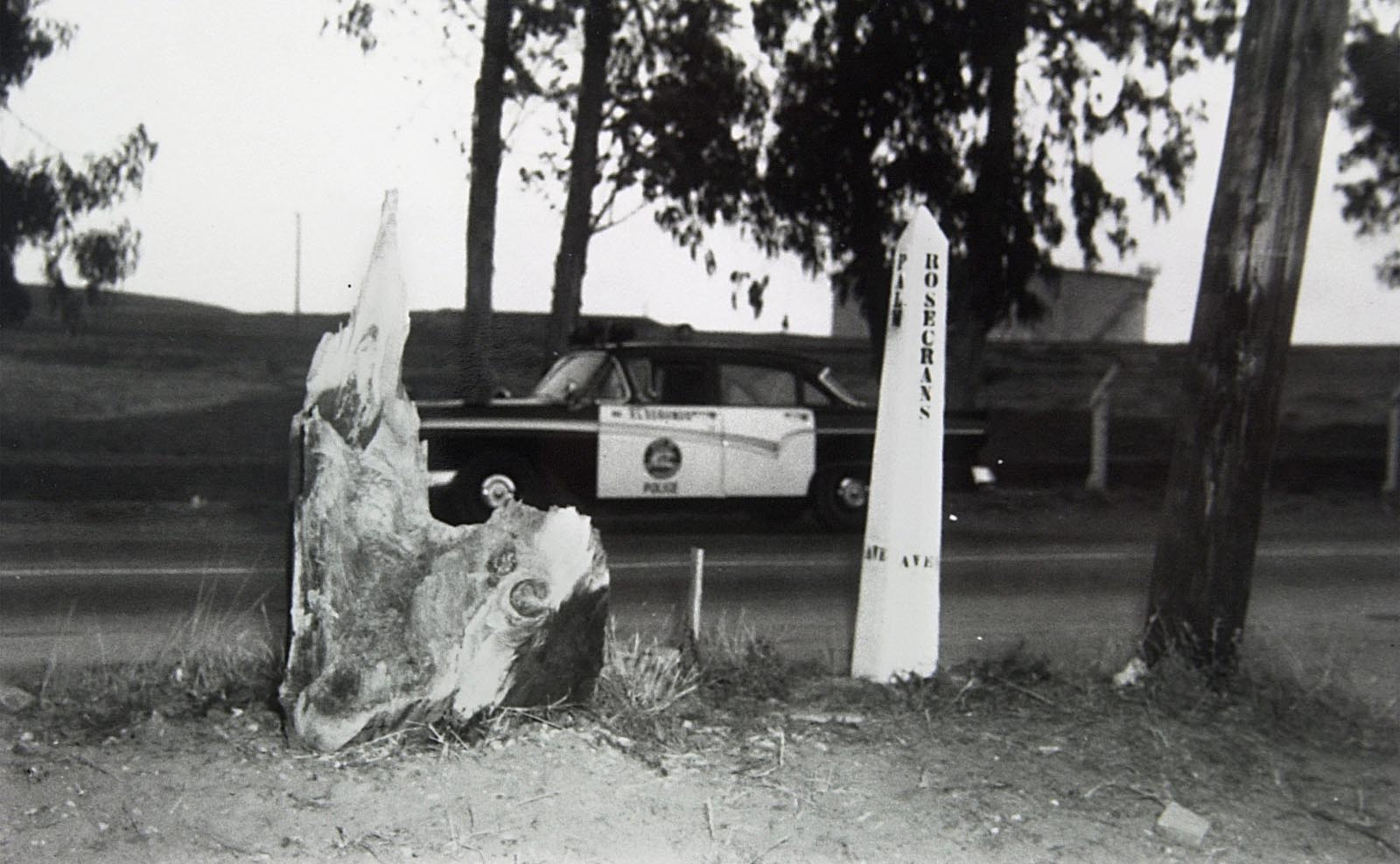
The crime scene in 1957 near Rosecrans and Palm avenues where two El Segundo police officers were killed while making a traffic stop on the El Segundo/Manhattan Beach border. (Daily Breeze file photo)

Late in the evening of July 21, 1957, two teenage couples were parked in a 1949 Ford in a darkened field at Van Ness Ave. and El Segundo Blvd. in Hawthorne, a local “lovers lane.”

A 23-year-old man with his light brown hair combed in a pompadour happened upon the scene. Brandishing a nine-shot, 22-caliber H&R revolver, he robbed all four of them, first taping their eyes and mouths shut. He forced the two boys to remove their shirts, which he tore into strips that he used to tie their hands behind their backs.

He then raped one of the girls, a 15-year-old, made all of them undress completely, and took their clothes with him as he drove off in their car, leaving the teens abandoned in the darkness.
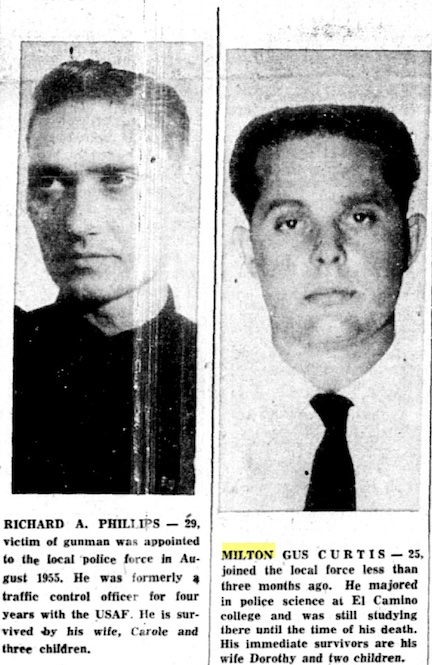
El Segundo Herald, July 25, 1957, Page 1. (Credit: El Segundo Herald archival database)

At about 1:25 a.m. on July 22, El Segundo police officers Richard Phillips, 28, and Milton Curtis, 25, noticed a 1949 Ford running a red light on Rosecrans Ave. and Sepulveda Blvd.

They had no idea who was driving; the car hadn’t been reported stolen yet.

They stopped him on Rosecrans a few blocks west of Sepulveda. (Rosecrans was one lane in either direction at the time.) Another patrol car stopped by, but the two officers waved it on, indicating that they had what they presumed to be a routine traffic stop under control.
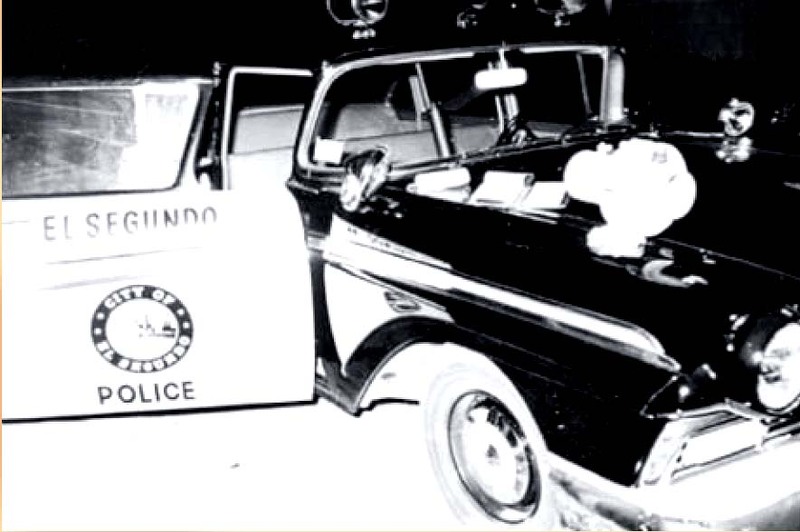
The El Segundo police patrol car after the fatal shootings on Jan. 22, 1957. Officer Phillips’ notebook can be seen on the hood. (Credit: Los Angeles County District Attorney’s office)

Minutes later, a distress call came over the radio. The officers who had checked on Phillips and Curtis returned to find them shot to death at their patrol car. Curtis had been shot three times in the chest, and Phillips, three times in the back. The suspect’s car eventually was found four blocks away. The murder weapon and some items stolen from the teenagers were not found in the car.

Among those who combed the car for clues was sheriff’s deputy and criminal scene investigator Howard Speaks of Westchester, who was able to lift three partial fingerprints. But, with fingerprint technology not being as advanced as it would become, a match for them could not be found.
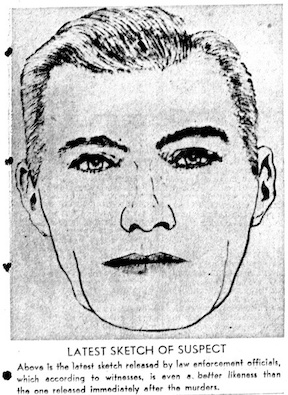
Torrance Press, Sept. 5, 1957, Page 1. (Credit: Torrance Historical Newspaper and Directories Archive database, Torrance Public Library)

Police and sheriffs departments throughout Southern California launched a massive manhunt in the wake of the killings, running down hundreds of tips. Investigators questioned thousands of potential suspects and arrested several over the next few years, but all of them were released.

Douglas Tuley of Manhattan Beach was roto-tilling the weed-filled backyard of his 33rd St. house in March 1960 when it clanked against an object, which turned out to be a gun cylinder. He checked, and it matched the gun frame he’d found the previous April. He turned the gun, a wristwatch and a crucifix necklace over to police, who verified that the gun was the murder weapon and the items had been stolen from the teens.

Police traced the gun to a Sears store in Shreveport, Louisiana, where it had been purchased using a false name and address just days before the 1957 shooting. The trail continued to grow colder.

But fingerprint expert Howard Speaks never gave up. He took the three prints he’d gathered from the suspect’s car and kept them handy. As his daughter, Cathe Gordon, told Daily Breeze reporter Larry Altman in 2006,  “It didn’t matter what he was doing, where he was, he would always have that fingerprint with him, and he would try to compare it.”

Evolving fingerprint technology in the 1990s made it possible to simulate an entire print by combining the three partials that Speaks had. That print was run against the growing collection of police fingerprint records online, but still no match was found.

Then, in 2002, a new, larger fingerprint database that included the state of South Carolina’s records was checked by investigators. It turned up a match: 69-year-old Gerald Fiten Mason.
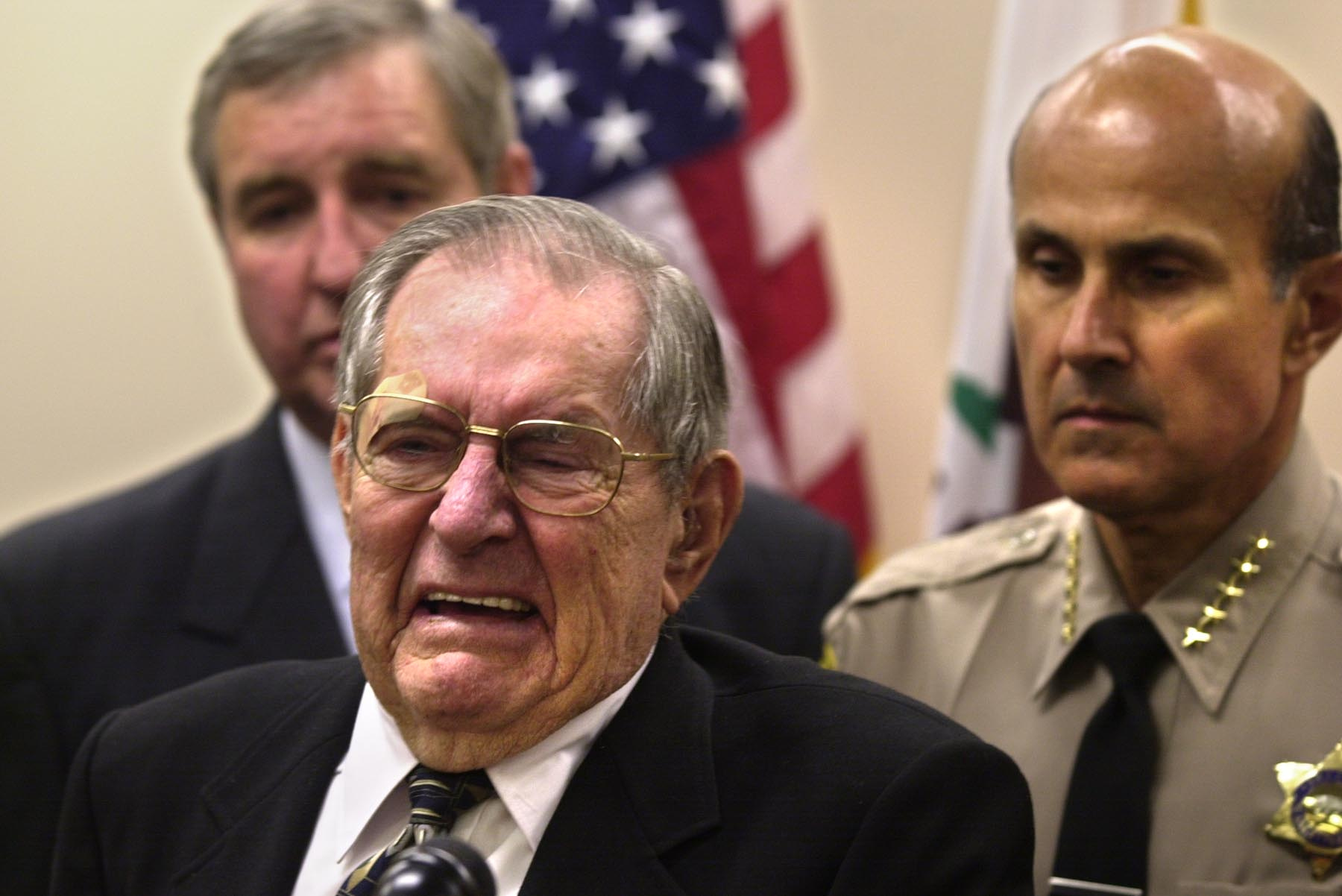
Retired Los Angeles County sheriff’s deputy Howard Speaks becomes emotional as he reflects on his role in the 46-year old investigation into the 1957 murders of El Segundo police officers Richard Phillips and Milton Curtis. March 24, 2003. (Daily Breeze staff file photo by Brad Graverson)

Mason had carved out a respectable life in South Carolina following his crime. He was a husband and father who owned a service station in Columbia, raising his family there during the 45 years following the killings. 

In 1956, he’d been arrested there for burglary and his fingerprints had been put on file, but were never matched up. After that, he’d hitchhiked to Southern California.

On Jan. 29, 2003, Mason’s stunned wife, who knew nothing of the crime, stood by and watched as he was arrested on charges of murder, rape, grand theft and robbery. He had fled to the tree section of Manhattan Beach after the killings, where he hid until the next day, when he began hitchhiking back to South Carolina.
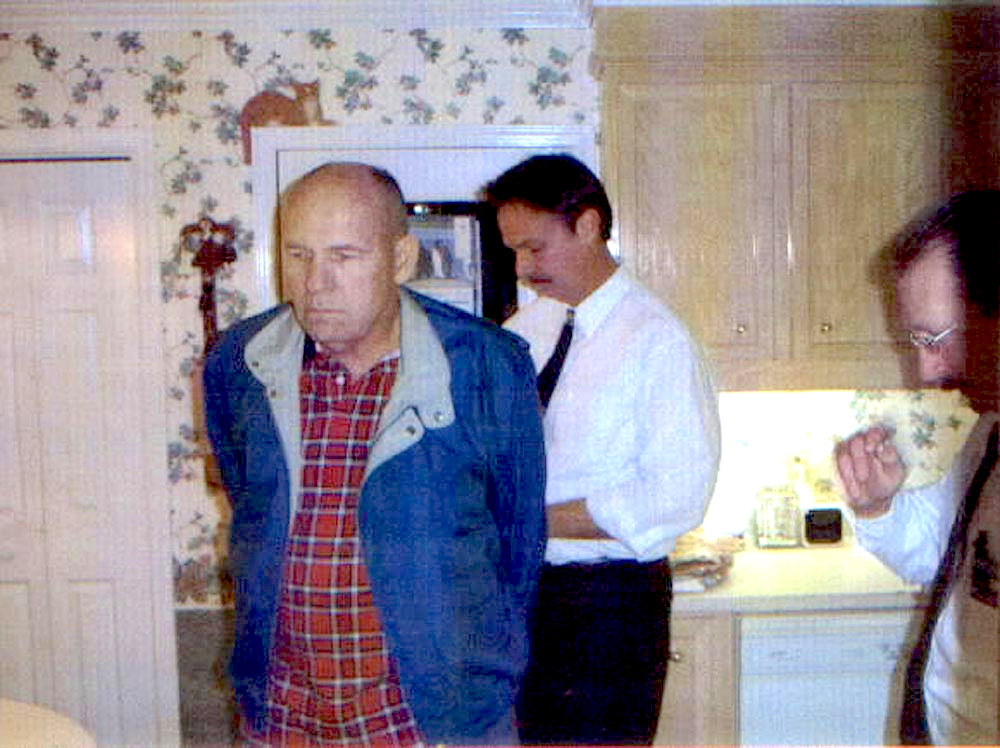
Gerald Mason being arrested in his home in a suburb of Columbia, South Carolina, in this 2003 police handout photo. (Daily Breeze file photo)

On March 24, 2003, Mason pled guilty to the two killings. In exchange, prosecutors dropped the other charges against him. He was sentenced to two consecutive life sentences in prison.  A tearful Mason apologized for the shootings in court, but could give no real reason for them. 

In addition to the matched fingerprints, other evidence against Mason included his handwriting on the ledger recording the purchase of the gun, and a bullet scar on his back that came from the one round that Officer Phillips had been able to hit him with following the shooting. (Three additional bullet holes from Phillips’ gun were found in the stolen car at the time.)

At his most recent parole board hearing in 2009, the board denied his request and announced that it wouldn’t entertain a new one until 2024. After spending nearly 14 years in a South Carolina prison, Gerard Mason died there at the age of 82 on Jan. 22, 2017.
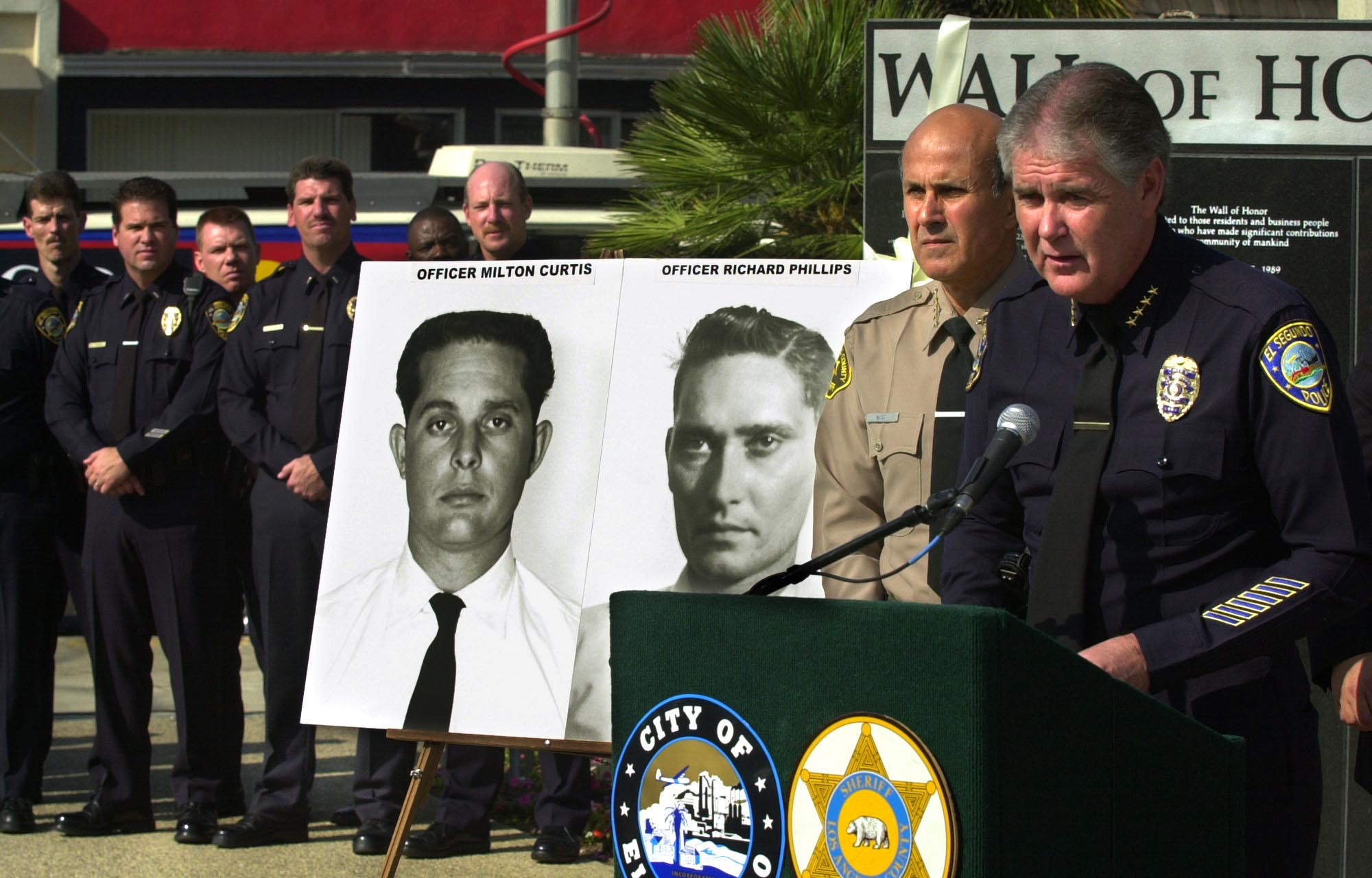
El Segundo Police Chief Jack Wayt, far right, and Los Angeles County Sheriff Lee Baca address the news media to announce an arrest in the 46-year-old murder case of El Segundo officers Milton Curtis and Richard Phillips in 1957. Jan. 29, 2003. (Daily Breeze file photo by Brad Graverson)

Sources:

Daily Breeze archives.

El Segundo Herald archives.

Los Angeles Times archives.
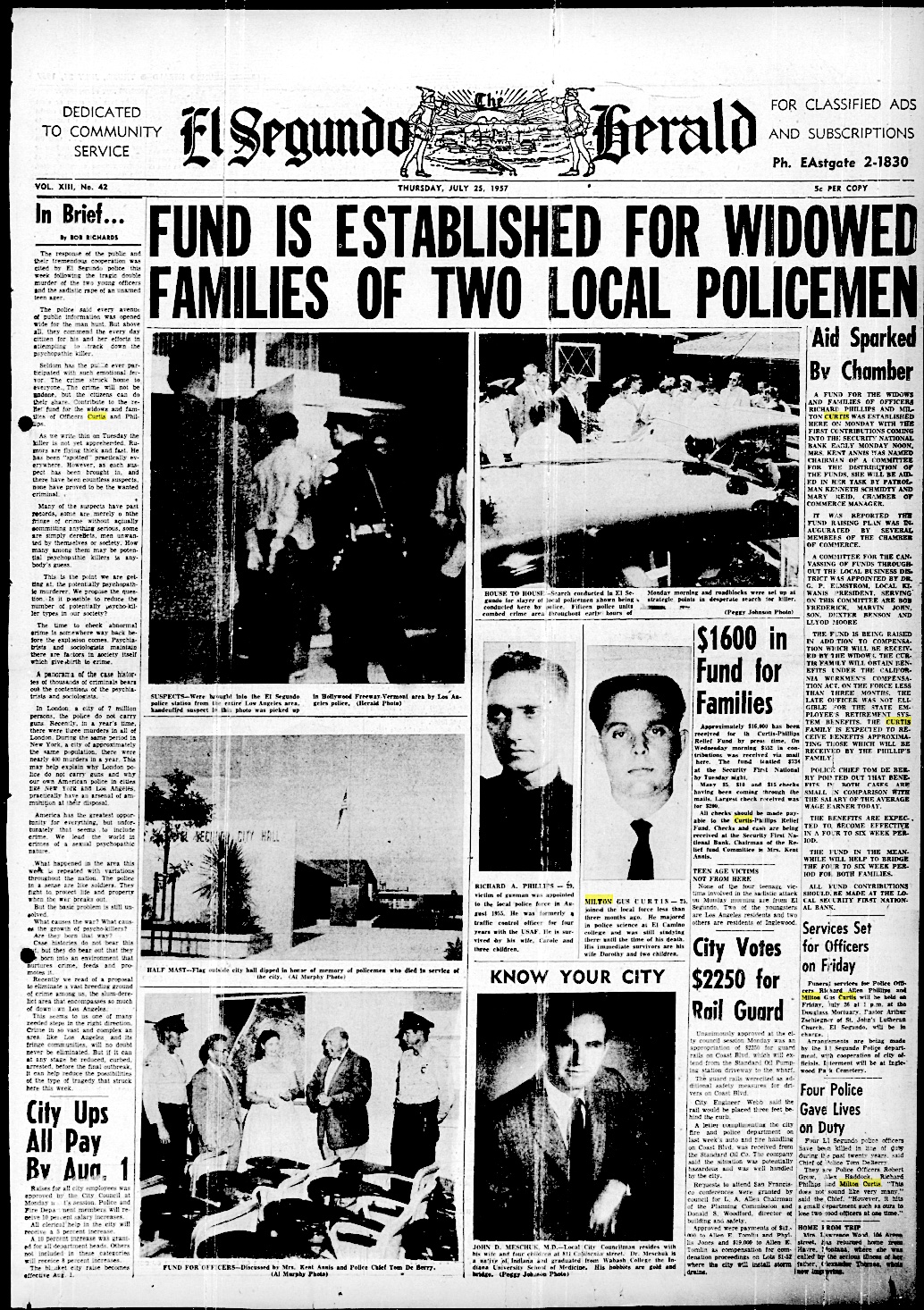
The El Segundo Herald front page for July 25, 1957. Photos include suspects being rounded up, El Segundo Police Department flags at half mast, photos of the victims and the establishing of the Curtis-Phillips Relief Fund for the officers’ families. (Credit: El Segundo Herald archival database)

The South Bay served as a backdrop in Quentin Tarantino films, especially “Jackie Brown”

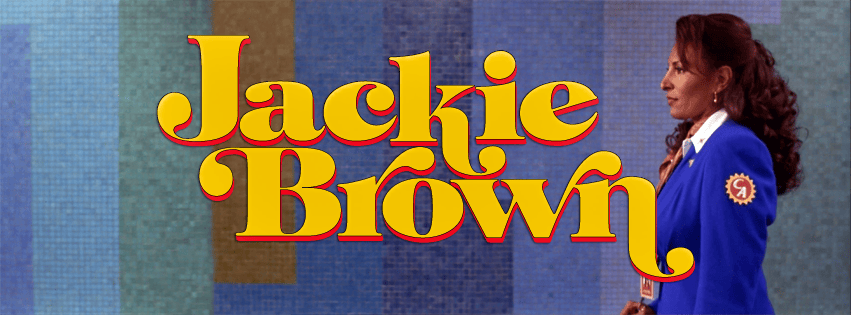
Actress Pam Grier moves through an LAX passenger tunnel during the title sequence of “Jackie Brown.” (Credit: Miramax Films)

Last week, we took a look at Quentin Tarantino’s early days in the South Bay. After becoming a film director, he would go on to use the area for location shooting in several of his films.

Though the first feature he directed, “Reservoir Dogs,” was filmed mostly in Los Angeles, no South Bay locations were used. Many of its key scenes take place at sites in the Highland Park area northeast of downtown L.A.

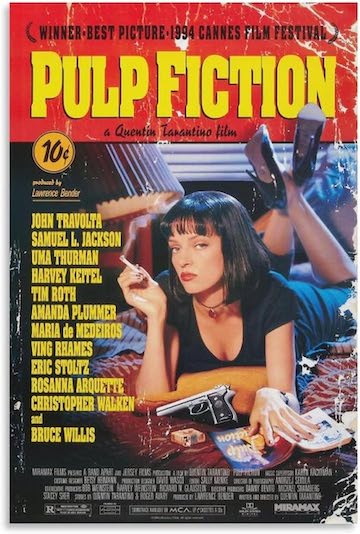
His next film, “Pulp Fiction,” became a sensation when released in 1994. Its opening and final scenes, during which Pumpkin (Tim Roth) and Honey Bunny (Amanda Plummer) attempt a robbery at a diner at which Jules (Samuel L. Jackson) and Vincent (John Travolta) are eating, were filmed at a Hawthorne diner.

The Hawthorne Grill after its closure. (Credit: Seeing Stars website)

The diner, the Hawthorne Grill at 13763 Hawthorne Blvd., was named Holly’s when it first opened in 1956. By the time it closed in 1990, it had been renamed the Hawthorne Grill. The success of “Pulp Fiction” inspired a reopening of the restaurant for a brief time, but it closed for good in 1996. It was razed in 1999, and an Auto Zone store took its place.

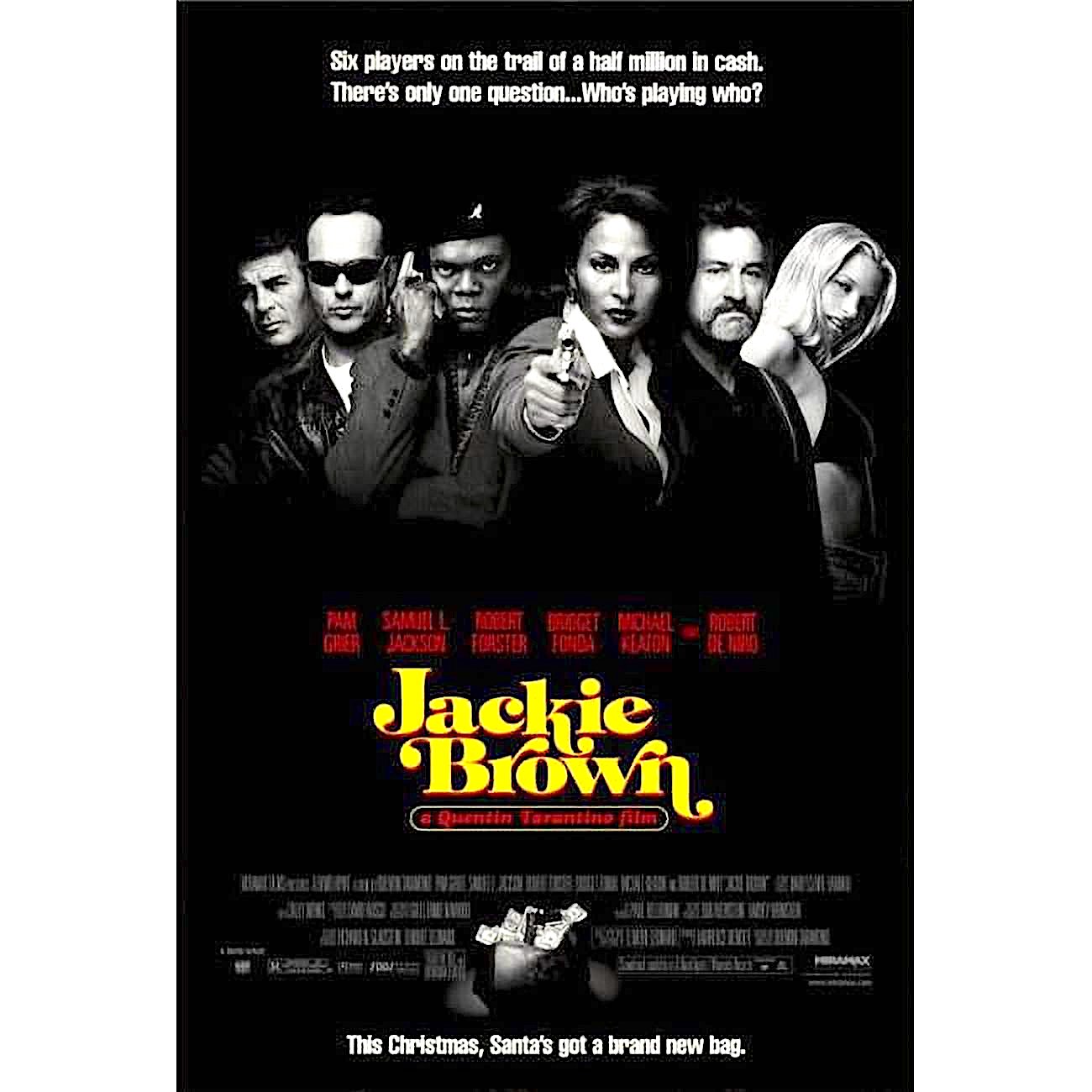
Tarantino’s next film, “Jackie Brown” (1997), remains his chief homage to the South Bay. The director chose to change the setting of one of his favorite novels, Rum Punch by Elmore Leonard, from South Florida to Southern California, specifically, to the South Bay area. 

Leonard was a Tarantino favorite. As a teen he’d been caught shoplifting a copy of The Switch, Rum Punch’s predecessor, from the Harbor City K mart.

Tarantino also changed the title character from a white female flight attendant to a black one so he could cast Pam Grier as Jackie Brown, the lead character. We first see her making her way through LAX during the opening sequence of the film. 

She starts her journey moving through the mosaic-lined tunnel leading from Terminals 5 and 6 to the baggage claim area and the exits, through which Lee Marvin famously strode during the 1967 film “Point Blank.” She ends up walking through Terminal 5 itself, where she begins working at a flight departure desk.

The remainder of the film takes place mostly in South Bay locations.

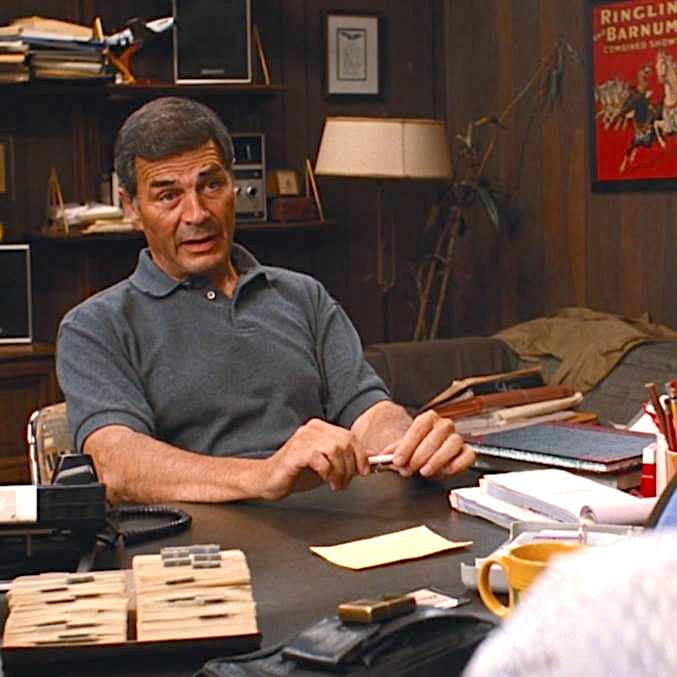
Veteran actor Robert Forster at the desk in his bail bondsman’s office in “Jackie Brown.” (Credit: Miramax Films)

Cherry Bail Bonds, owned by Max Cherry,  the bondsman portrayed by actor Robert Forster, no longer exists. Former Carson mayor and longtime city council member Vera Robles de Witt owned the business, Carson Bail Bonds, located at 724 E. Carson St., just across the street from City Hall. 

Location scouts originally looked at another bail bonds office in San Pedro owned by de Witt, but found the Carson site more suitable for filming. Cherry’s office in the film was adorned by circus posters; his dad was an elephant trainer for Ringling Bros.

The Carson Bail Bonds building was torn down in 2009 and replaced by an apartment/retail complex.

Jackie Brown’s apartment was located at the Park View apartment complex at 17575 Yukon Ave. in north Torrance. Ordell (Samuel L. Jackson) visits Beaumont Livingston (Chris Tucker) at his apartment at 1030 Lakme Ave. in Wilmington, and the Raynelle character played by T’Keyah Crystal Keymáh lives on nearby Opp St.

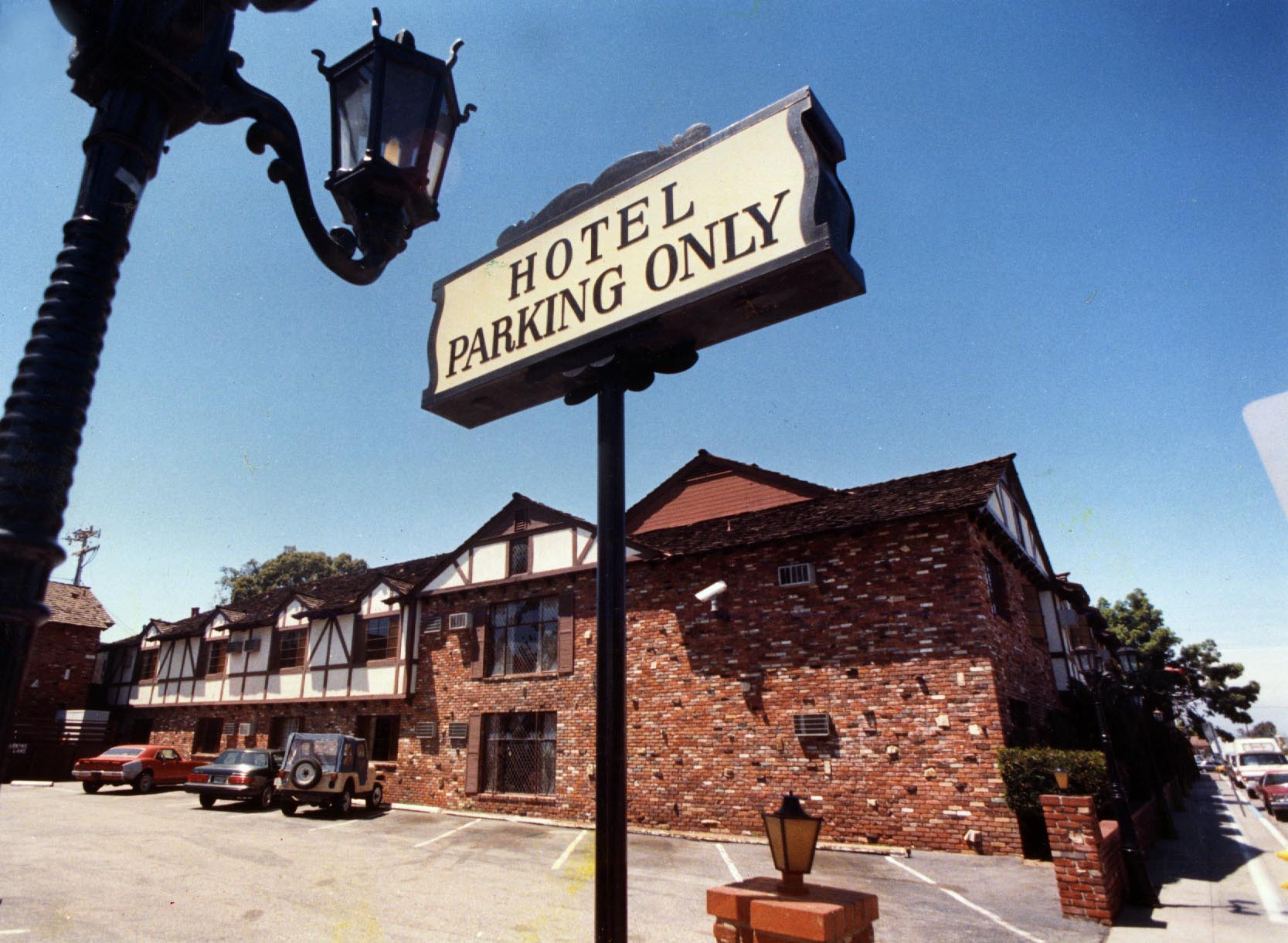
The exterior of the Cockatoo Inn in Hawthorne in 1988. (Daily Breeze staff file photo)

The local bar where Jackie Brown takes Max Cherry for a drink is the cocktail loung.at the Cockatoo Inn in Hawthorne, located at 11550 Acacia Ave., near the corner of Hawthorne Blvd. and Imperial Hwy. The hotel, opened by organized crime figure Andrew Lococo in 1958, had closed in 1996 before filming began.

Tarantino asked his location scouts to get permission to film at the closed Inn. Ownership of the hotel was in limbo at the time and they were unsuccessful at first. But then Hawthorne Mayor Larry Guidi stepped in and made it happen. In return, he asked to meet his favorite actor in the cast, Robert De Niro, and the deal was complete.

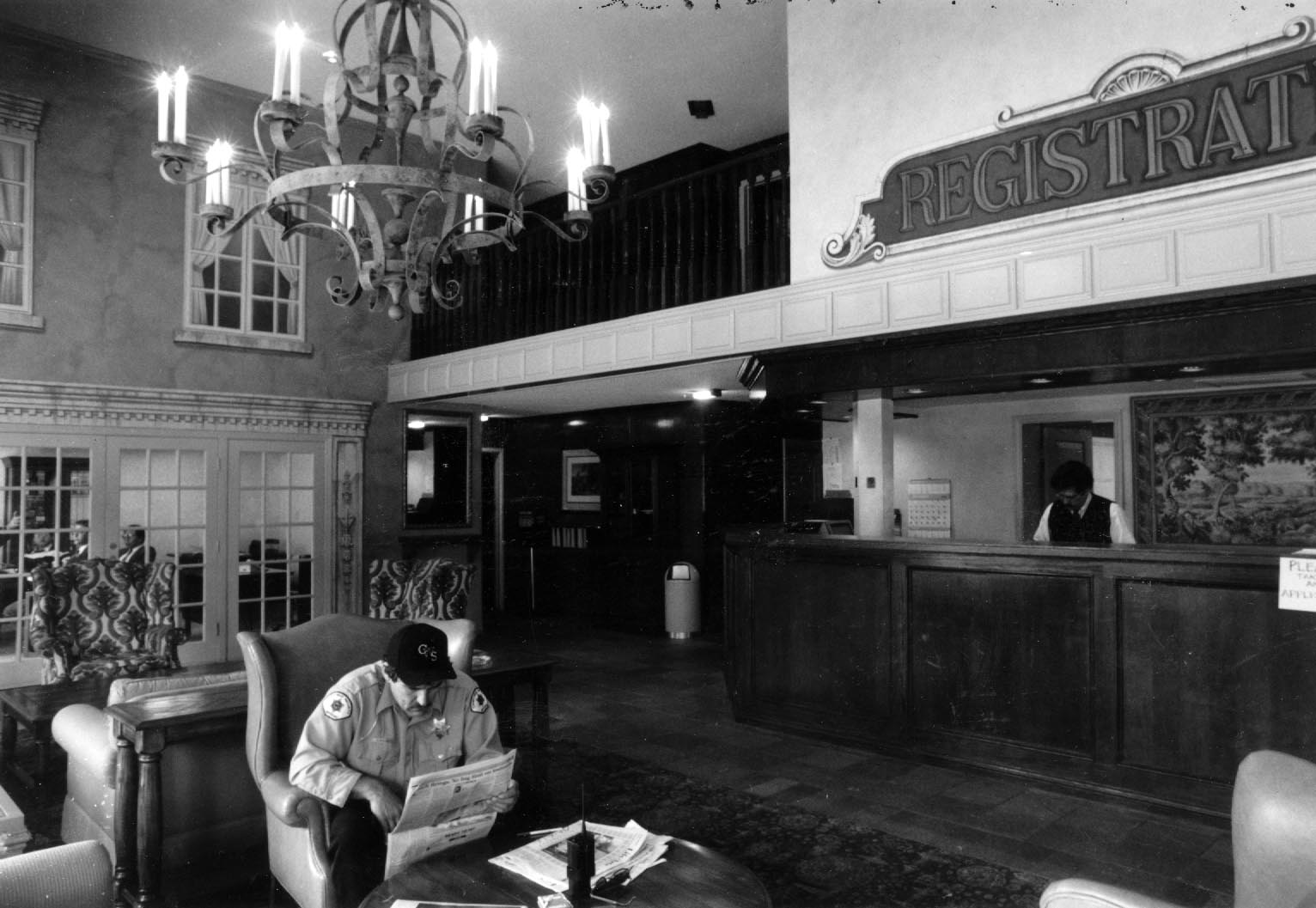
Security guard Donald Howell relaxes in the lobby of the Cockatoo Inn in Hawthorne in 1995. (Daily Breeze staff file photo)

The Cockatoo Inn was abandoned for several years, and most of it had been torn down by 2005. It has been replaced by a new complex made up of three smaller hotels.

Scenes from the “Hermosa Beach” apartment where Bridget Fonda’s Melanie character lives were actually filmed in Playa del Rey. Interiors were filmed at a small apartment building at 6403 Ocean Front Walk, and exteriors at a larger apartment complex across the street at 6309 Ocean Front Walk.

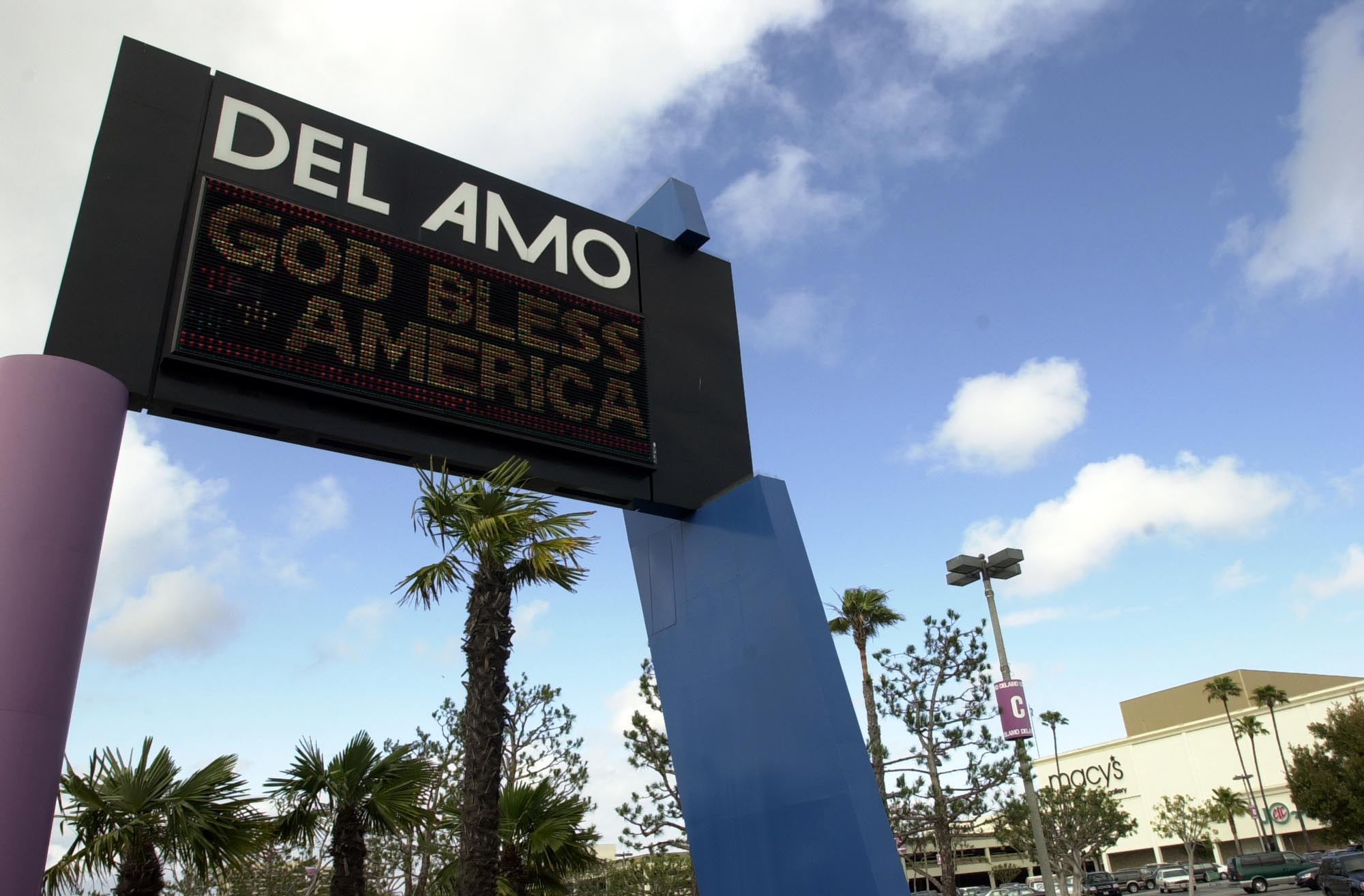
The filming location that most people remember from “Jackie Brown” is Torrance’s Del Amo Fashion Center mall. Several interior and exterior scenes were shot there, with mall scenes taking up more than half an hour of the film’s running time.

The Del Amo Fashion Center in Torrance in 2003. Macy’s can be seen at right. (Daily Breeze staff file photo by Branimir Kvartuc)

The key money-exchange sequence involving Jackie and Melanie inside Billingsley, the fictional department store, actually took place in Macy’s at Del Amo. Filming had to take place at night after the store closed. Crews had to switch things around before filming, and put everything back in place when they were done each night during the shoot.

Other Del Amo scenes take place at the Sam Goody record store, in the since-remodeled food court, along its crowded walkways and in the mall parking lot.

Tarantino’s latest film, “Once Upon a Time … in Hollywood” (2019) returns to the mosaic-lined tunnel at LAX used in “Jackie Brown” in the scene where Rick (Leonardo DiCaprio) and Francesca (Lorenza Izzo) arrive in Los Angeles. The remainder of its location scenes are, as one would expect, in Hollywood and Los Angeles.

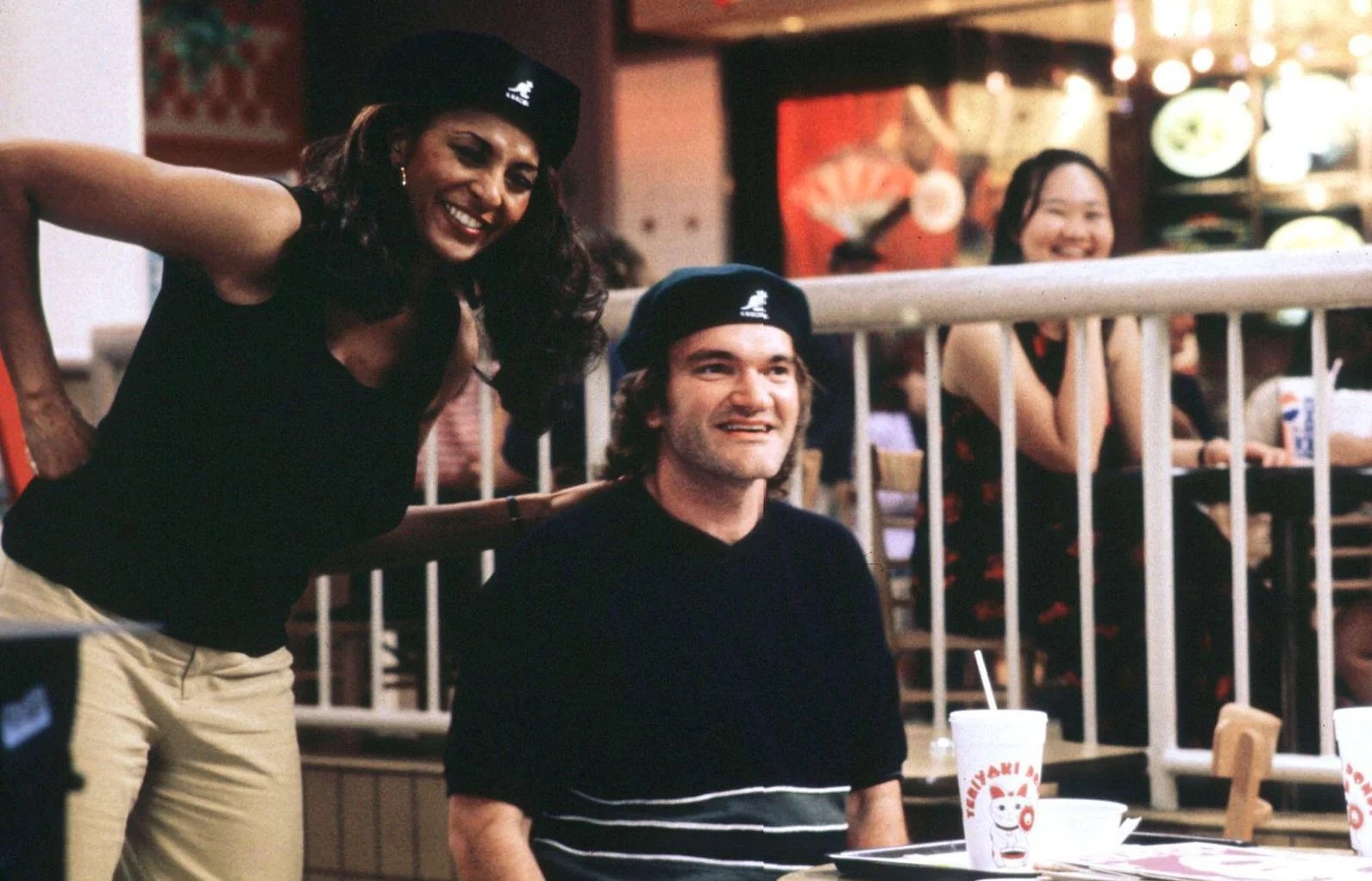
Pam Grier and Quentin Tarantino during location filming for “Jackie Brown” at the Del Amo Fashion Center food court in 1996. (Credit: Miramax Films)

Sources:

Daily Breeze archives.

“How Quentin Tarantino and ‘Jackie Brown’ made the South Bay a Star,”  by Jared Cowan, L.A. Taco blog, Dec. 21-, 2017.

Movie-Locations.com website.

“Quentin Tarantino,” The Internet Movie Database.

Tarantino: A Retrospective, by Tom Shone, Insight Editions, 2017.

“Where Was Jackie Brown Filmed?”, Giggster.com website.

Wikipedia.

Film director Quentin Tarantino dropped out of Narbonne High school and into Hollywood

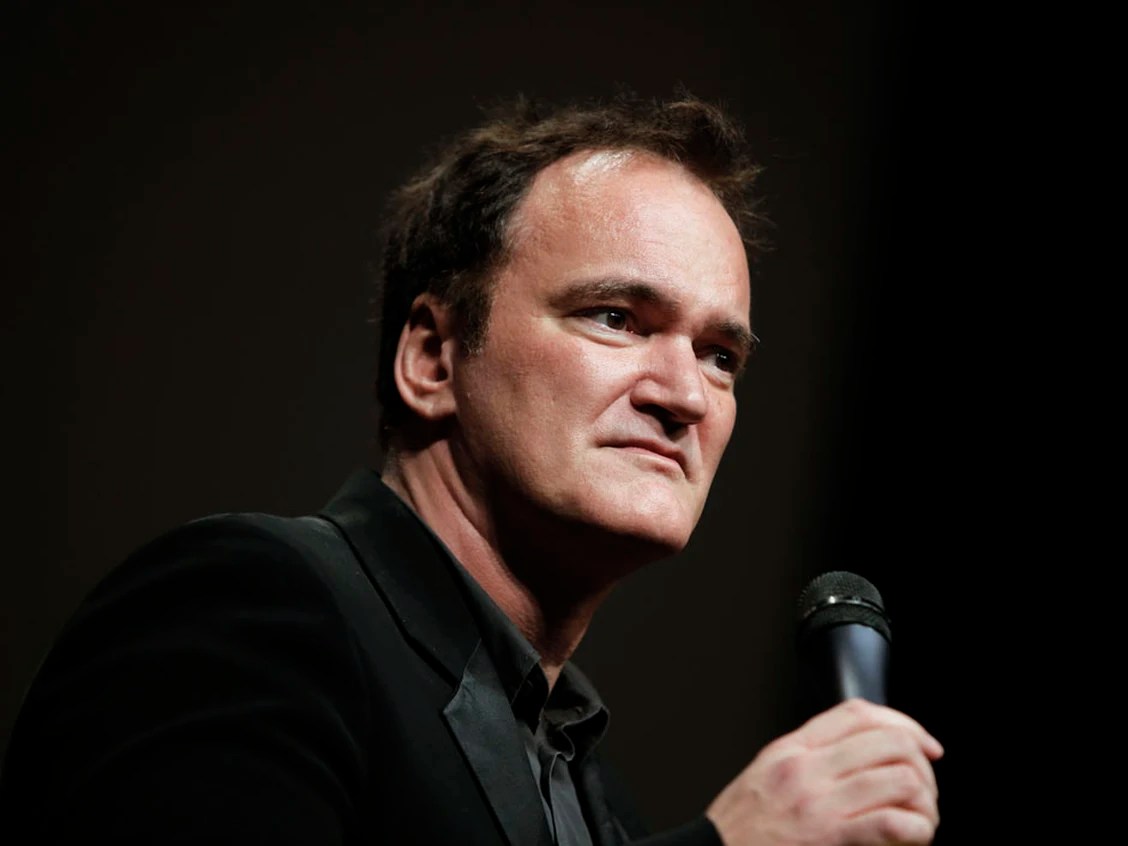
Film director Quentin Tarantino, circa 2014. Photo by Laurent Cipriani. (Credit: The Associated Press)

Quentin Tarantino may have been born in Tennessee, but he spent his formative years in the South Bay.

He grew up not knowing his father, aspiring actor Tony Tarantino, who left his teenage wife, Connie, before Quentin was born in Knoxville on March 27, 1963. The couple originally met and married in Los Angeles, but Connie returned to her family in Knoxville after their split.

She returned to Los Angeles to go to nursing school, eventually landing a job in a Hacienda Heights doctor’s office. While working there, she met and eventually married musician Curtis Zastoupil, a piano player who played in local bars and nightclubs.

The couple lived in El Segundo, then in Manhattan Beach. His mom sent for young Quentin to join them; he’d been staying with his grandmother in Tennessee. The trio formed a happy, if somewhat unconventional family unit.

Tarantino’s obsession with film may have had its roots in the many films his parents took him to as a child, including a double bill of “The Wild Bunch” and “Deliverance” when he was six.

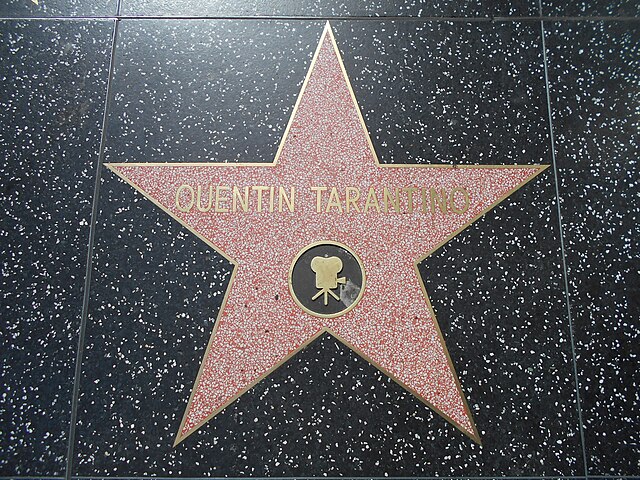
Quentin Tarantino received his star on the Hollywood Walk of Fame in 2015. (Credit: Wikimedia Commons. Photo by Mario RM 2017.)

Tarantino later paid tribute to his stepfather by including a scene with a piano player named Curt Zastoupil in his 2021 novelization of the screenplay for the film “Once Upon a Time in Hollywood” (2019).

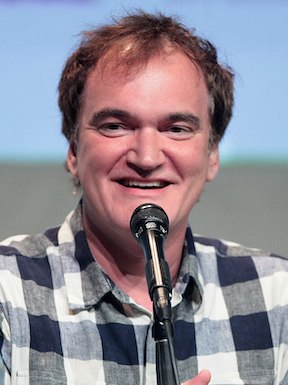
Quentin Tarantino at Comic Con in San Diego in 2015. Photo by Gage Skidmore. (Credit: Wikimedia Commons)

The marriage didn’t last, however. The couple divorced when Tarantino was nine, and his  mother and Quentin moved to Harbor City. Quentin became a regular attendee at the Carson Twin Cinema theaters. He learned to love the exploitation, horror and martial arts movies frequently screened there, later describing it to the Los Angeles Times as “the perfect grindhouse theater.”

His obsession with movies was growing more intense, at about the same time as his desire to continue his education at Narbonne High School as a ninth grader was ebbing. He gradually just stopped going to classes altogether, which his mom found out when the school called to inquire about his frequent absences.

He caught the acting bug and began attending the James Best acting school in Toluca Lake. He changed his last name from Zastoupil to Tarantino, because, as he told podcaster Mark Maron in 2021, “it sounded cooler.”

 His mom also insisted that the 15-year-old get a job if he wasn’t going to go to school. After lying about his age, he complied, getting hired as an usher at the Pussycat Theater on Cravens Ave. in downtown Torrance.

(Credit: The Bedlam Files blog)

His movie theater job wasn’t ideal – he hated how poorly the films were made – so he tried a couple more, one doing market research and one as a headhunter in the aerospace industry. After those didn’t pan out, he landed a job in 1985 that would change his life.

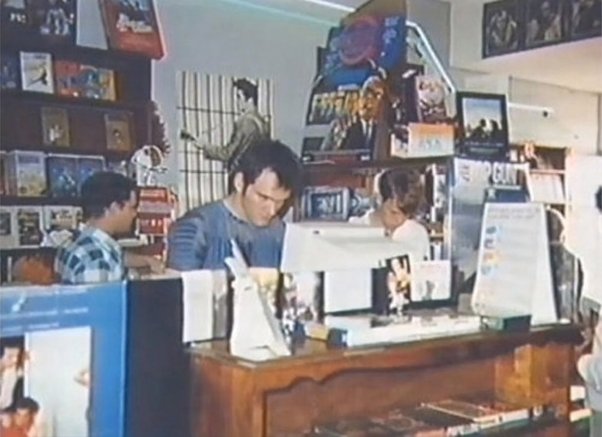
The offer came from the Manhattan Beach video rental store he’d discovered, Video Archives. The tiny store at 1822 Sepulveda Blvd. was crammed with films of all types and genres, both foreign and domestic. Tarantino spent hours hanging out there. Already well-versed in a wide variety of films, he often could be found debating and discussing their merits with the store’s clerks.

One of those clerks, future Tarantino film collaborator Roger Avary, recommended Quentin ford the job to the store’s owner, Lance Lawson. Tarantino worked there for five years, leaving just before the store moved to larger quarters at 1805 Sepulveda.

His acting career had stalled after his one television role, as an Elvis impersonator in a 1988 episode of the “Golden Girls” sitcom. But he continued writing the screenplays he’d begun writing as a young boy, living in large part off the residuals of his television guest shot.

The longer he worked at Video Archives, the stronger his desire became to break into the movie industry. He acted in two early films, the short “Love Birds in Bondage” (1983), which he and co-director Scott Magill allegedly destroyed after seeing how it turned out, and the unfinished “My Best Friend’s Birthday” (1987), a collaboration with Avary.

After leaving his Video Archives job, Tarantino began concentrating on scriptwriting, seeing it as a pathway to raising enough money to make his own films. His first project to get attention  in Hollywood was called “The Open Road.” The sprawling story, co-written with Avary,  eventually was split into two separate screenplays, “True Romance” and “Natural Born Killers.”

Director Tony Scott made “True Romance” (1993) starring Christian Slater and Rosanna Arquette, and Oliver Stone directed “Natural Born Killers” (1994) with Woody Harrelson and Juliette Lewis.

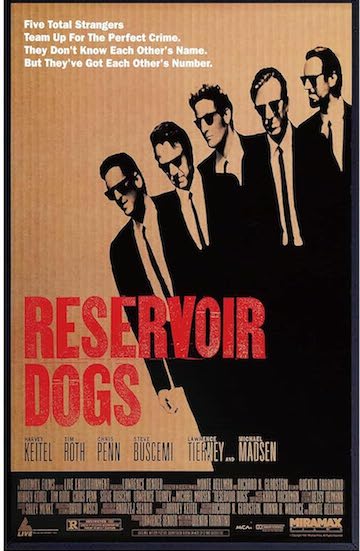
Doors were opening for Tarantino. At a 1989 meeting with Hollywood producer Lawrence Bender, Tarantino told him about his in-progress script about a gang of thieves meeting after an unsuccessful jewelry store heist. Bender encouraged him to finish it. After actor Harvey Keitel signed on to do the project, “Reservoir Dogs” went into production.

Directed by Tarantino, the film went on to become an indie sensation in 1992. “Reservoir Dogs” earned only $3 million on its initial U.S. release, but it took in $20 million internationally. It also received a host of award nominations, mainly from film critics groups and independent film associations.

Tarantino’s tour de force, “Pulp Fiction,” starring John Travolta and Samuel L. Jackson  followed in 1994, and he never looked back. But he also never forgot his childhood upbringing, frequently using South Bay locations in his films. Next week, we’ll take a look at some of those.

Quentin Tarantino working behind the counter at Video Archives in Manhattan Beach. Undated photo circa 1985-89. (Credit: FilmFreeway Facebook page)

Sources:

Daily Breeze archives.

Los Angeles Times archives.
“Quentin Tarantino,” The Internet Movie Database.

“Quentin Tarantino Explains the Heartwarming Reason He Named a ‘Once Upon a Time In Hollywood’ Character After His Stepfather,” by Fred Topel, Showbiz Cheat Sheet website, July 8, 2021

Quentin Tarantino: The Film Geek Files, edited by Paul A. Woods, Plexus Publishing, 2005 (2nd edition).

“R.I.P. Video Archives,” by Adam Groves, The Bedlam Files blog.

Tarantino: A Retrospective, by Tom Shone, Insight Editions, 2017.

Wikipedia.

Recommended: The Video Archives Podcast With Quentin Tarantino & Roger Avary.

Video: From the 1994 documentary, “Quentin Tarantino: Hollywood’s Boy Wonder”:

Jiu-jitsu is the main course of study at Torrance’s Gracie University

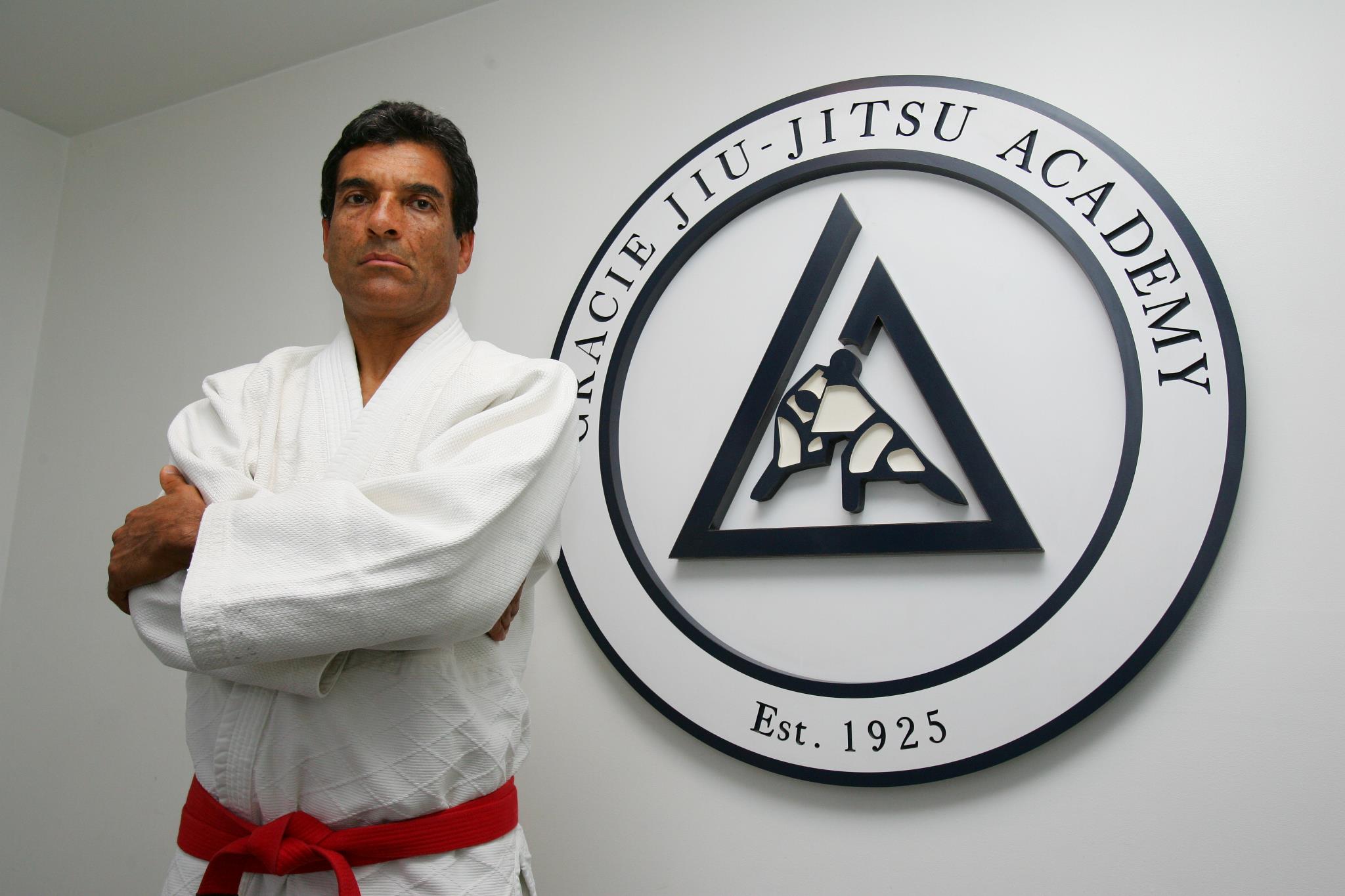
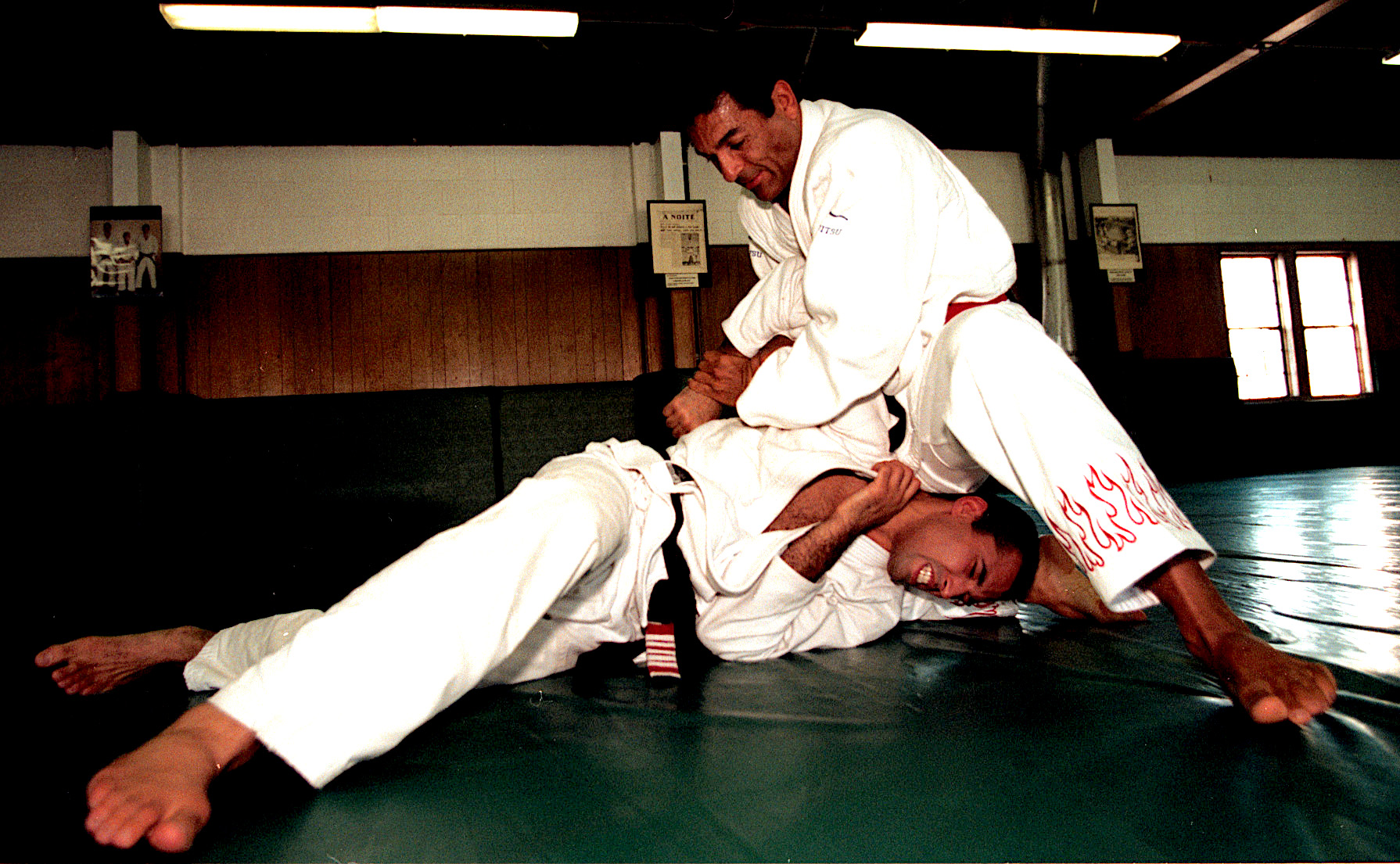
Jiu jitsu master Rorion Gracie in Torrance circa 2012. (Credit: Rorion Gracie Facebook page)

In 2022, the mixed martial arts website FanSided estimated the total value of the Ultimate Fighting Championship (UFC) franchise at $9-10 billion. Not bad for a competition co-founded by Rorion Gracie of Gracie University in Torrance in 1993.

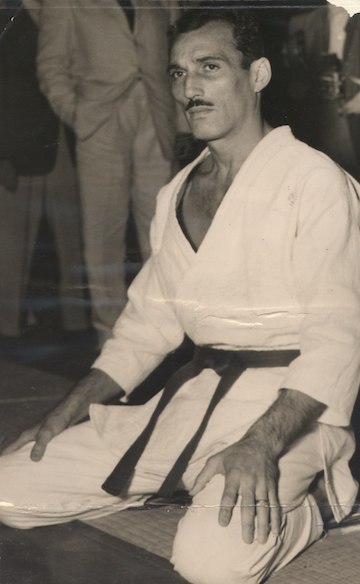
To trace how it all came to be, we’ll have to go back to Oct. 1, 1913, and the birth of Rorion’s father, Helio Gracie, in Belem, Brazil. Financial setbacks forced the family to move to Rio de Janeiro a few years later.

Helio Gracie in 1952. (Credit: Wikimedia Commons)

Helio had several physical infirmities as a child, and couldn’t participate in ovelry vigorous activities. When his brother, Carlos, opened a jiu-jitsu studio in Rio in 1925, Helio began training in the martial art.

He found that jiu-jitsu had certain elements that exceeded his physical capabilities. But when he began mixing elements of judo and other martial arts disciplines into the process, it enabled him to use leverage to his advantage against opponents. This technique became known as the Gracie Jiu-Jitsu method.

Helio began competing professionally at age 18. The Gracies felt their method would prove effective against conventional boxers and wrestlers, so Helio took to the ring in 1932, defeating boxer Antonio Portugal in his first match.

It was the first in a series of contests that came to be known as the Gracie Challenge, aimed at proving the superiority of the family’s style of hand-to-hand combat, which does not involve striking or punching, over other styles of fighting

Helio went on to fight 19 more times over the next 35 years, winning nine matches, drawing eight and losing three. He retired in 1937 and again in 1955. In addition to martial arts fighters, he also challenged boxers and wrestlers during his career, but few accepted. Heavyweight champ Joe Louis said he would face him in a boxing match, but Helio refused.

Rorion Gracie was the first of Helio’s nine children, all of whose names start with “R.” He was born on Jan. 10, 1952 in Brazil. He was a natural athlete, and excelled in the family’s Gracie Jiu-Jitsu style, training to become a teacher instead of a fighter.

Rorion Gracie, above, and his brother, Royce, below, work out at the Gracie Academy in Torrance on Nov. 9, 1999. (Daily Breeze staff file photo by Keith Birmingham)

Rorion fell in love with the United States during a 1969 visit. He returned to Brazil a year later, where he spent the next five years earning his law degree.

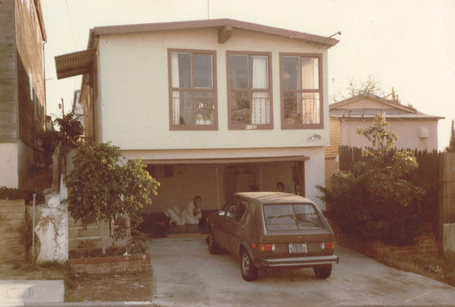
He returned to the U.S. in 1978, and settled in Hermosa Beach. He began giving informal lessons in the family’s martial arts technique in his garage, preaching its superiority to other styles. 

The Hermosa Beach garage where Rorion Gracie held impromptu training sessions in the late 1970s. (Credit: Photo courtesy Rorion Gracie, via MMA Fighting website)

His students would bring their coaches by to challenge his assertions, and Rorion would roll out the mats in his garage and do battle with them, often drawing crowds to watch the impromptu duels.

In 1985, he invited his younger brother Royce to join him, and they opened the first Gracie Jiu-Jitsu academy in a two-story building atR1951 Carson St. in downtown Torrance in 1989. 

During this period, Rorion also worked on the “Lethal Weapon” films. Director Richard Donner wanted star Mel Gibson to showcase a different style of martial arts fighting, and the Gracie method fit the bill.

In addition to working frequently with film stars and entertainment industry figures, Gracie also  worked with the U.S. Army to develop new hand-to-hand combat techniques. Police departments and government law enforcement agencies have also adopted the techniques.

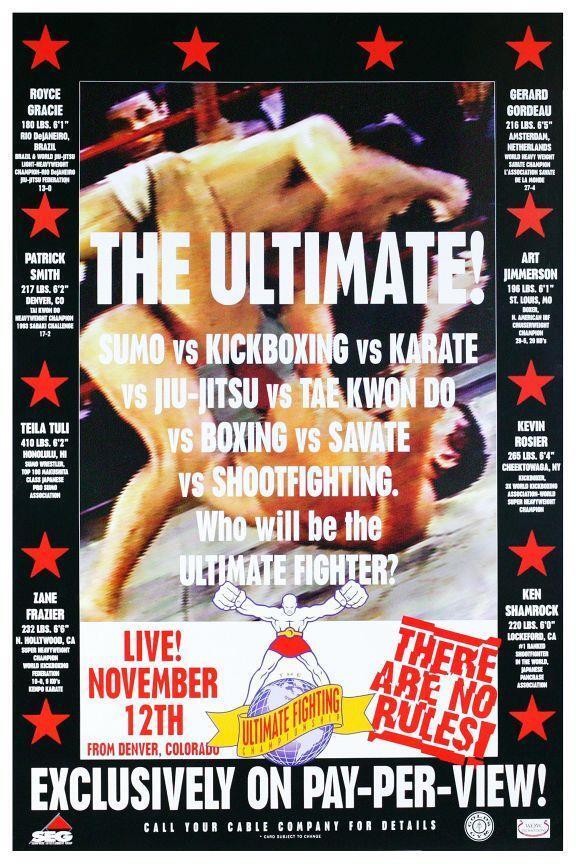
In 1993, Rorion began working with promoter Art Davie to stage a fighting event that would bring the Gracie Challenge concept into the spotlight. He was less interested in the spectacle than he was in proving the superiority of the Gracie Jiu Jitsu method.

UFC 1 promotional poster from 1993.

That’s why he selected his younger brother Royce, who, at 178 pounds, was the smallest of the Gracies. By using a smaller fighter against larger men, the strengths of the Gracie method would be illustrated more fully.

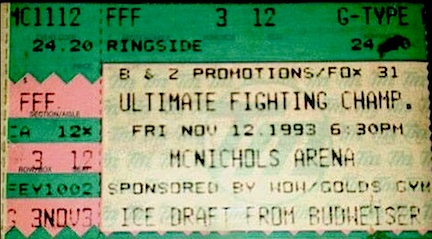
The first UFC championship match took place on Nov. 12, 1993, at McNichols Sports Arena in Denver, Colorado. Only 2,800 people attended in person, but Davie and Gracie’s pay-per-view operation drew 85,000 viewers, more than twice what they had expected.

Royce Gracie defeated all three challengers he faced to become the event’s first champion. He would go on to win at UFC 2 and UFC 4, and gain election to the UFC Hall of Fame in 2003.

Two years later after the first event, Rorion sold his stake in UFC. He felt he had proved his point, and was distressed at the whole enterprise turning into a made-for-television show. “I wanted real fights on TV. My partners wanted a TV show with fights,” he told the martial arts website MMA Fighting in 2013.

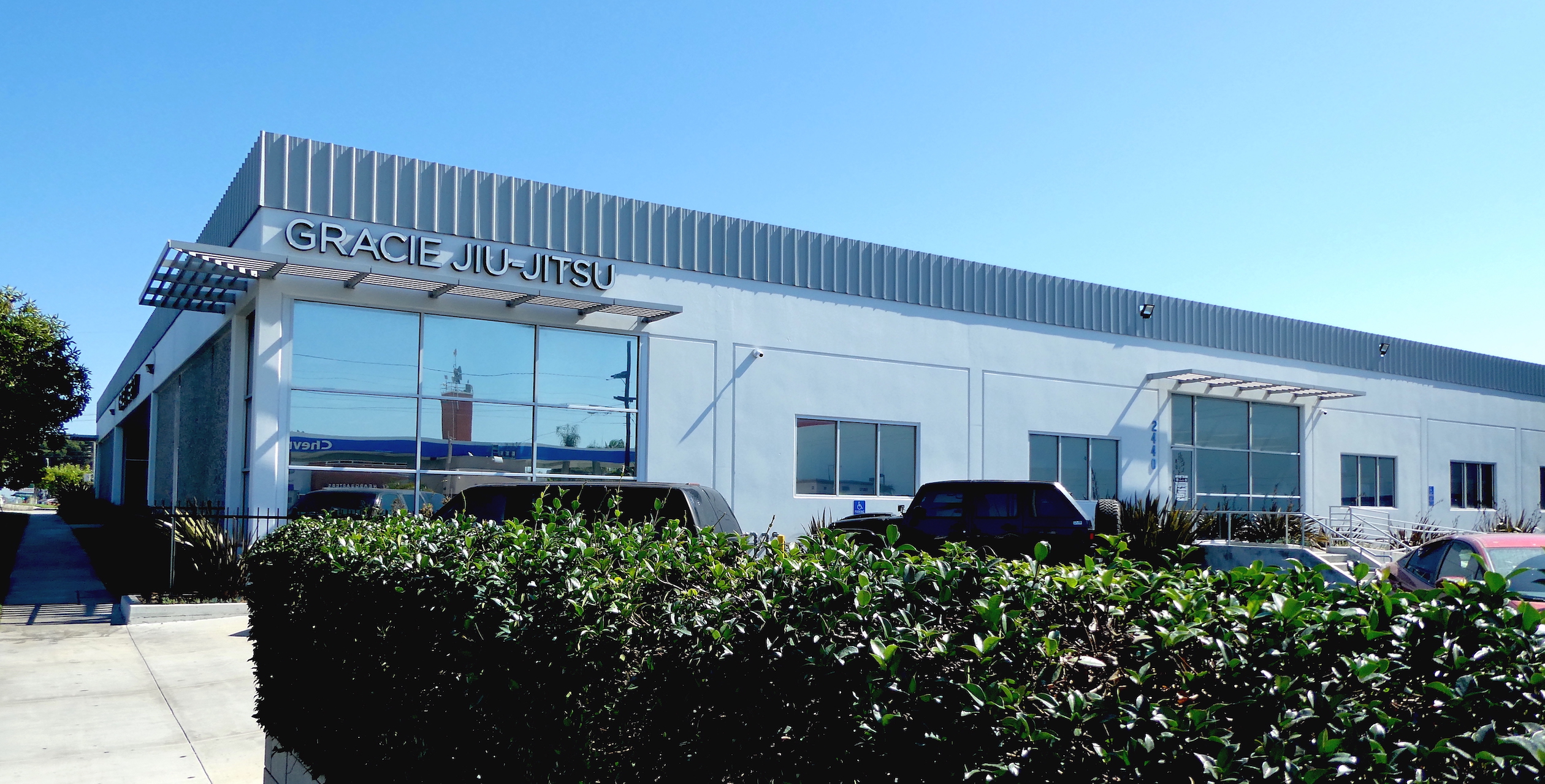
In 1997, Gracie Academy moved to its new quarters at 3515 Artesia Blvd. By 2017, the school  had outgrown that facility, moving to its newly built current location at 2440 W. Carson St. in Torrance, and adopting a new name, Gracie University.

The Torrance location serves not only as the discipline’s flagship training center, but also as the headquarters for an organization that has spread to hundreds of training locations throughout the world.

Helio Gracie, who had coached his son Royce in the first two UFC events, died in his sleep of natural causes at his home in Rio de Janeiro on Jan. 29, 2009.

Gracie Jiu-Jitsu University opened its new state-of-the-art facility in Torrance in 2017. (October 2023 photo by Sam Gnerre)

Sources:

Daily Breeze archives.

Gracie University website.

Los Angeles Times archives.

“Rorion Gracie and the Day He Created the UFC,” by Guilherme Cruz, MMA Fighting website, Nov. 12, 2013.

Wikipedia.

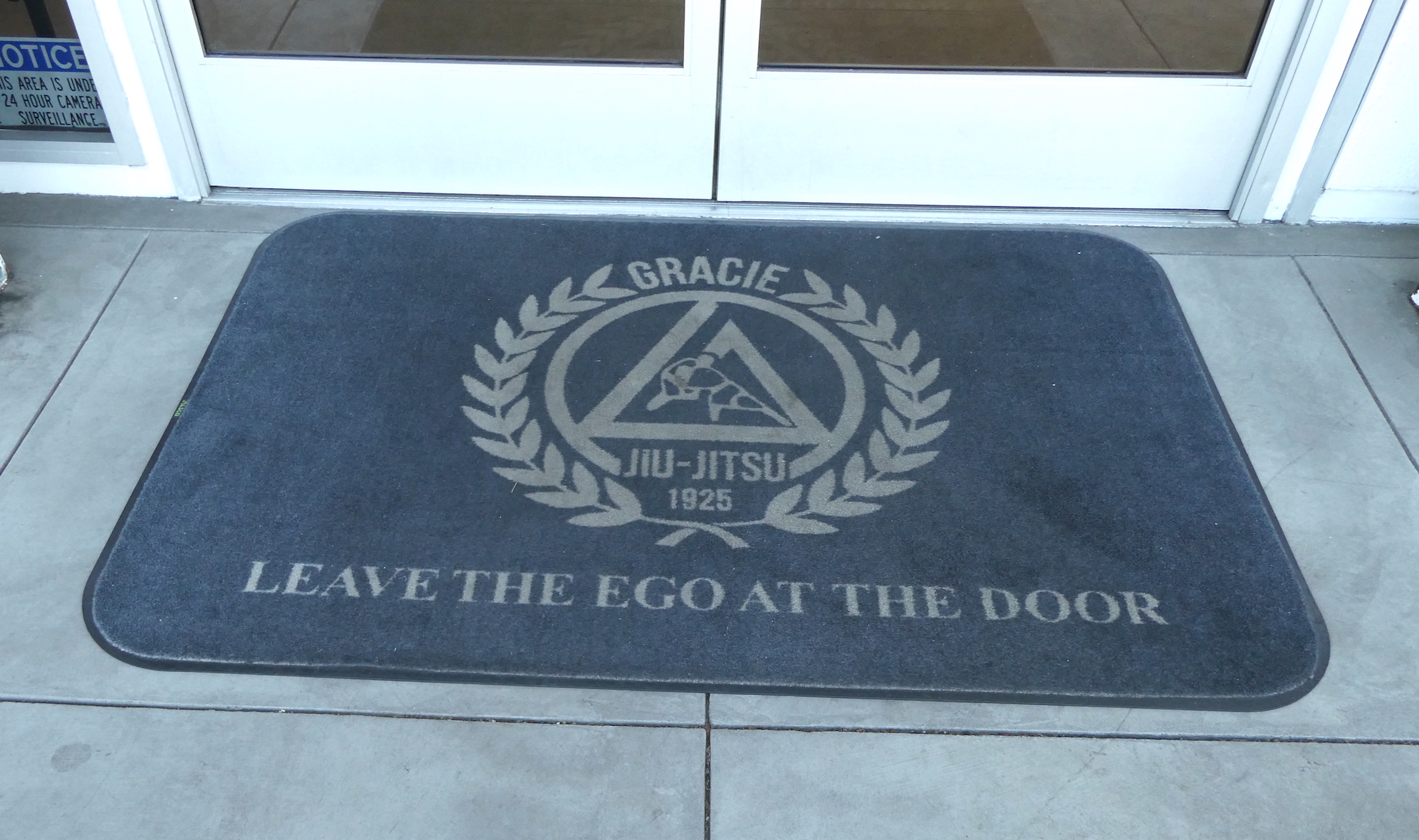
 Advice from a welcome mat at the entrance to the Gracie University building in Torrance. (October 2023 photo by Sam Gnerre)

The quixotic 1950s movement to bring the World’s Fair to the South Bay

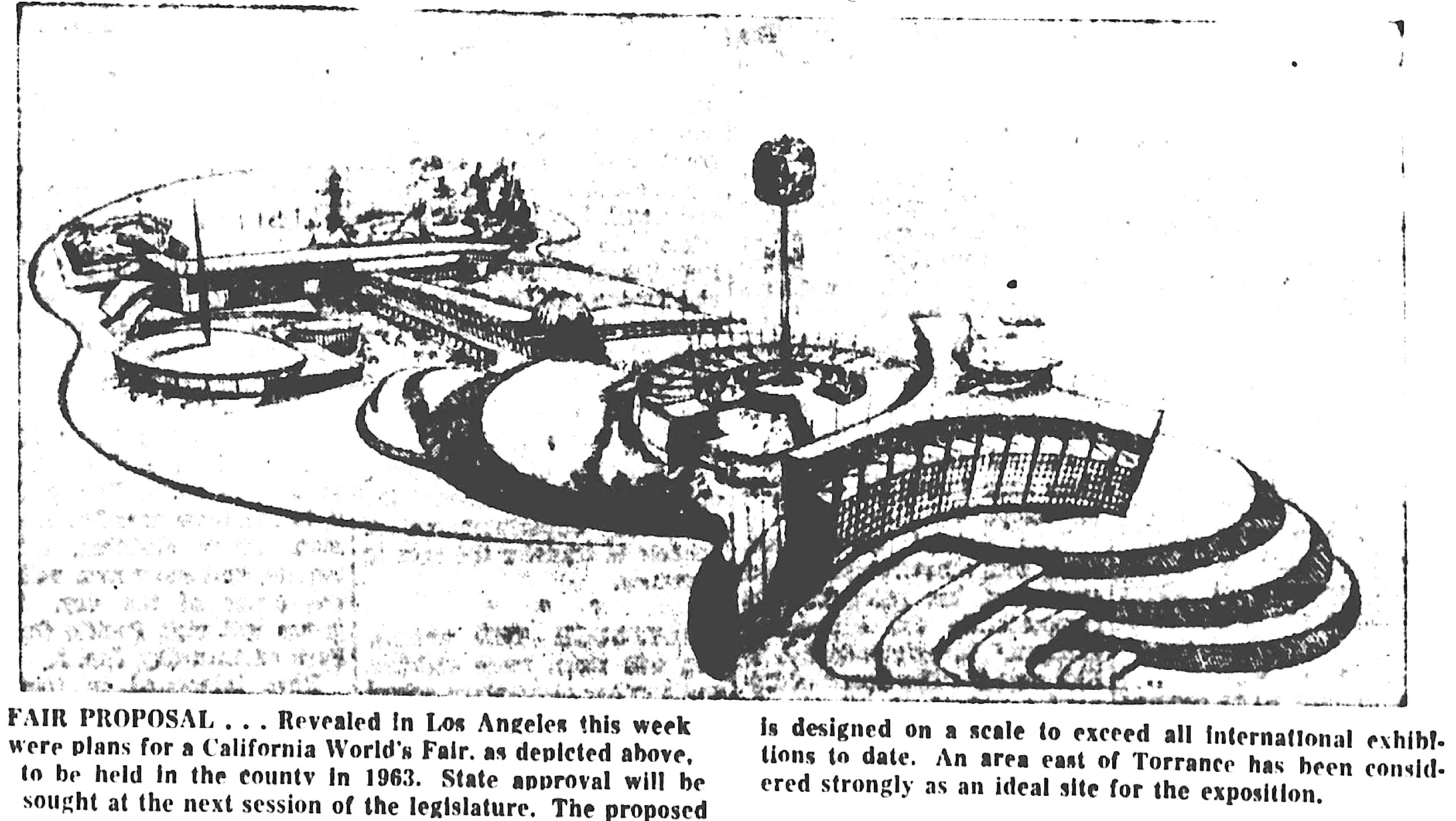
Torrance Herald, Dec. 25, 1958, Page 4. (Credit: Torrance Historical Newspaper and Directories Archive database, Torrance Public Library)

World’s Fairs have dropped off the cultural radar in recent times. The last one officially sanctioned by the Paris-based Bureau International des Expositions occurred without a lot of fanfare in Dubai in 2020, and the next one is scheduled for Osaka, Japan in 2025.

The first World’s Fair took place in Prague in 1791. The World Expo in London in 1851 during Queen Victoria’s reign is considered to be the first such fair to showcase technological and manufacturing innovations. It set the standard for those that followed.

World’s Fairs would be held roughly every three to four years after that. Philadelphia staged the first one in the U.S., the Centennial Exposition in 1876. Chicago (1893) and St. Louis (1904) followed, the latter forming the backdrop for the 1944 Judy Garland musical film “Meet Me In St. Louis.”

Perhaps the most sensational and culturally significant World’s Fair of them all occurred in New York City in 1939-40. Its exhibition halls showcased technological innovations from television to automatic dishwashers, fluorescent lighting and super highways. 

Fast forward to 1958. The Brussels World’s Fair is going strong in Europe, attracting some 41.5 million visitors. Decisions are being made as to the location of the next fair, which had 1963 as a target date.

Several cities had tossed their hats into the ring, including Washington, D.C. and Paris. A group of Los Angeles businessmen and local politicians put their heads together in 1958 and decided to add Los Angeles to the mix.

The group formed California World’s Fair Inc. (CWFI) in 1958, opening an office in downtown L.A. and naming San Diego financier J.A. Smith as its president. On June 17, 1958, the Los Angeles County Board of Supervisors passed a resolution supporting the proposed event.

Smith’s group listed six possible sites for the event, five in Los Angeles County and one in Orange County. Sanctioned World’s Fairs required the construction of permanent buildings to house the various pavilions and exhibition halls, as well as sufficient parking areas. This translated into the need for a minimum of 1,000 acres of space in order to house the fair.

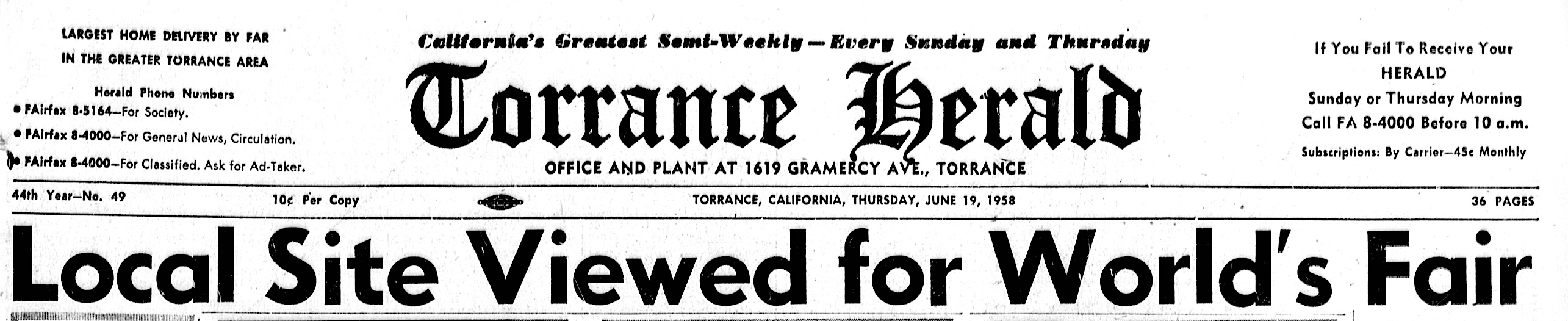
Torrance Herald front page headline, June 19, 1958. (Credit: Torrance Historical Newspaper and Directories Archive database, Torrance Public Library)

Paramount among the six sites was a 1200-acre site offered for lease to the organization by the Dominguez Estate Co. on what was then unincorporated county property between Avalon and Wilmington avenues south of Victoria St. Today, it’s the home of the Dignity Health Sports Park (formerly the Home Depot Center) and California State University, Dominguez Hills in Carson.

Fair boosters preferred the site because they envisioned that four freeways then either under construction or finished, the Artesia (91), San Diego (405), Harbor (110) and Long Beach (710), would be available to offer convenient automobile access to the fair.

An optimistic Smith told a meeting of the Los Angeles Downtown Business Men’s Association in December 1958, “Any fair we hold here must be equal or better than the recent Brussels Fair,” which had attracted an estimated 50 million visitors. “We should approach the 100 million attendance mark,” he added.

Attendees at a December 1958 California World Fair Inc. meeting include, from left, W. Herbert Allen, group president J.A. Smith, L.A. City Councilman Patrick McGee and consultant Werner Buck. Los Angeles Times, Dec. 18, 1958, Page B7. (Credit: Los Angeles Times archival database)

Residents of the area that would become Carson had been talking about incorporation as the 1950s progressed. Interest in the process accelerated when news of the proposed World Fair broke. It was also rumored that Walter O’Malley might be interested in building Dodger Stadium on the Dominguez site in case his Chavez Ravine deal didn’t work out. Despite this early push, Carson’s incorporation battle wouldn’t be settled until a successful 1968 vote.

Having gotten the approval of the Board of Supervisors, fair organizers next turned to the California Legislature for further approval. After that, the proposal would go to the U.S. Congress and then to the Paris governing body for final approval.

On May 20, 1959, CWFI won approval from both houses of the Legislature, but ran into a roadblock in the Assembly the following day. Assemblyman Jesse Unruh questioned financial aspects of the proposal, including the distribution of funds to CWFI committee members at the end of the event. The Assembly rescinded its approval by a 68-3 vote, killing the fair proposal.

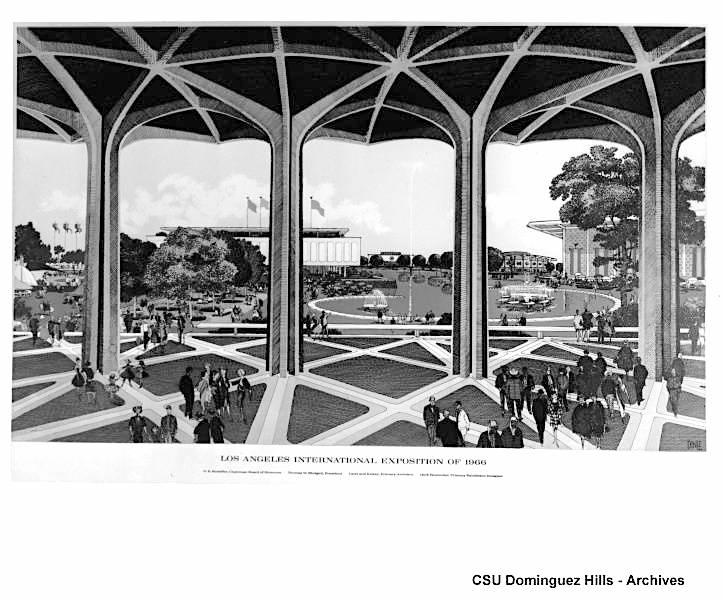
Supervisor Burton Chace revived the World’s Fair campaign in August, when he created a 15-member committee to help get the proposal moving forward again. But the dream died for good in November, when a government commission bypassed the Los Angeles bid and recommended New York as the 1963 World’s Fair site instead. In 1961, Chase’s committee attempted to revive the idea of a Los Angeles World’s Fair, this time to be held in 1966, without success.

Artist’s rendition of the 1966 Los Angeles World’s Fair, proposed in 1961 but never realized. (Credit: CSUDH Archives)

Meanwhile, the city of Seattle had been working diligently throughout the 1950s on its plan to host a World’s Fair, securing a site and doing enough preliminary preparations to convince the Paris sanctioning group to officially designate the event planned for 1962 as a World’s Fair.

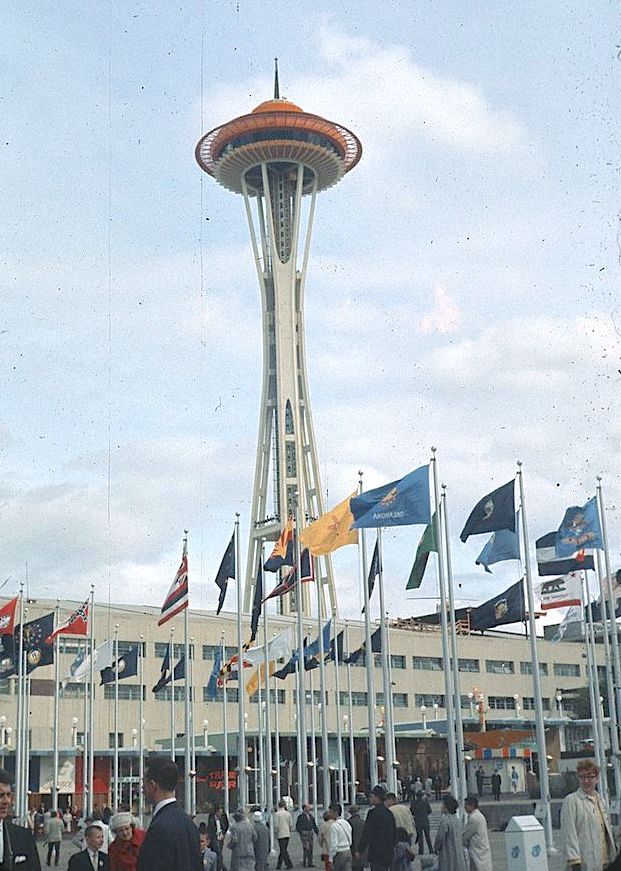
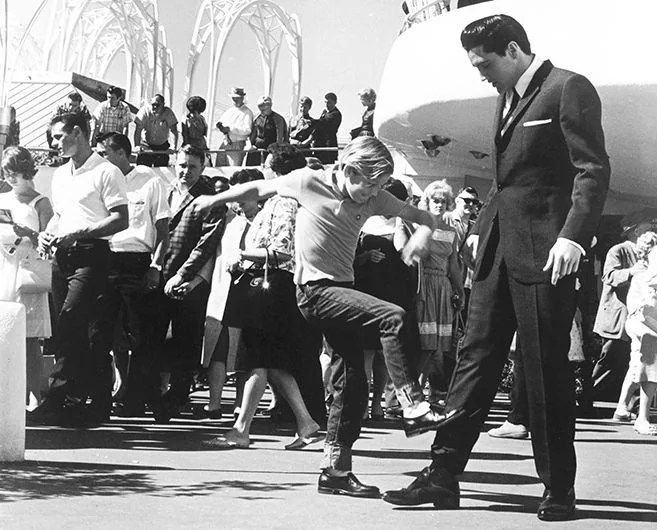
The 1962 Seattle World’s Fair brought us the Space Needle and a downtown monorail constructed for the event, both of which still stand in the Emerald City. In addition, Elvis Presley filmed his 1963 film “It Happened at the World’s Fair” at the event. 

The 1962 Seattle World’s Fair. (Credit: Seattle Municipal Archives)

Approximately 10 million people attended the Seattle Fair during its six-month run. It remains the most recent such event held on U.S. soil to be sanctioned as an official World’s Fair. (The 1964 New York world’s fair, while successful, was not officially sanctioned.)

Back in Los Angeles, the CWFI folded temporarily, but would return later in the 1960s to run smaller California World’s Fair events, including one in San Francisco in 1966.

In recent years, the World’s Fair concept has lost some steam in the U.S. Montreal’s Expo 1967 was highly successful, as well as being the last sanctioned fair to be held in the Americas. The Knoxville (1982) and New Orleans (1984) world’s fairs were unsanctioned.

But the dream still returns from time to time, most recently in the early 2010s when a group calling itself Los Angeles World’s Fair attempted to drum up crowdfunding-style support to help the city hold its first-ever World’s Fair in 2022. The effort was unsuccessful.

The 1939 New York World’s Fair. Photo by Samuel H. Gottscho. (Credit: Wikimedia Commons)

Sources:

Daily Breeze archives.

The History of a City … Carson, California, by Jack E. Jerrils, City of Carson, 1972.

Los Angeles Times archives.

Torrance Press-Herald archives.

Wikipedia.

A young Kurt Russell makes his film debut kicking Elvis Presley in the shin in the 1963 film, “It Happened at the World’s Fair.”

Torrance’s passenger rail links to the outside world have had their ups and downs

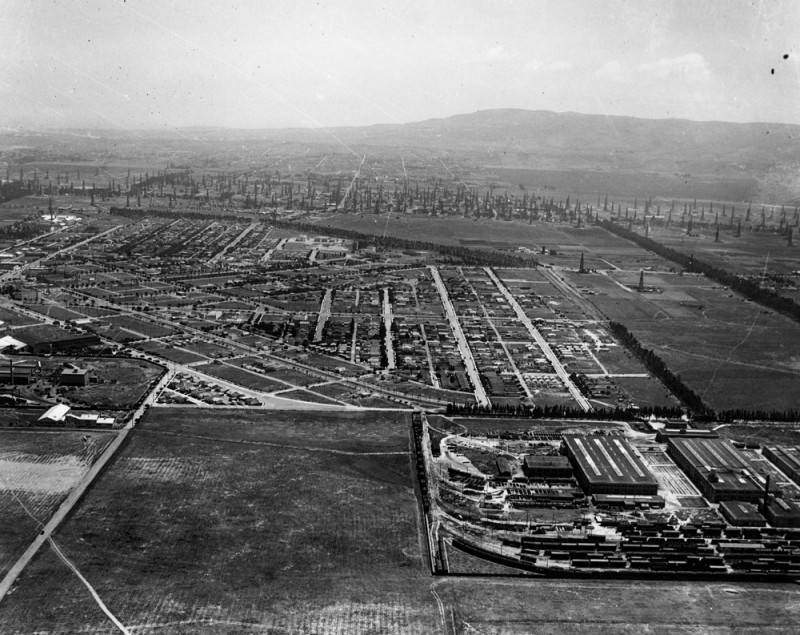
Aerial view from 1925 shows the Pacific Electric facility in Torrance, foreground right. In the distance, a large field of oil derricks stretches across Torrance, with the Palos Verdes hills visible at rear right. (Credit: Los Angeles Public Library Photo Collection)

When the city of Torrance was founded in 1911, it was considered a remote outpost, with little  transportation infrastructure. But the city’s founder, Pasadena developer Jared Sidney Torrance, had very specific plans to remedy that.

On Dec. 26, 1911, he made a deal with the Pacific Electric Railway under which the passenger railway system would get 125 acres of land to build a giant railcar construction and repair facility north of downtown Torrance. In return, the railroad agreed to build a Red Car passenger line to Torrance, which was completed in 1911. In May 1913, the city was added to the line that terminated in San Pedro.

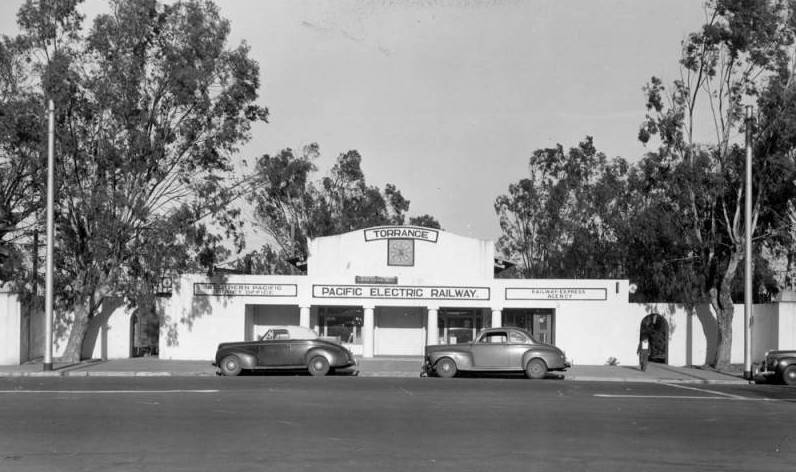
Architect Irving Gill designed the Pacific Electric depot that had been completed on Cabrillo Ave. in downtown Torrance in 1912. (It currently houses The Depot restaurant.) The Pacific Electric maintenance shops opened in the city in 1918. A special “shop train” began running that connected the Torrance depot to the Pacific Electric yards so that Pacific Electric employees could ride the trolley cars all the way to work from anywhere served by the Red Cars.

The Pacific Electric depot, located at 1250 Cabrillo Avenue in Torrance. Photo circa 1937. (Credit: Los Angeles Public Library Photo Collection)

Sleepy little Torrance now had its connection to the greater Los Angeles area, and workers began to flood into the area as large manufacturing plants were enticed to establish plants in the city. Companies that built factories there included Union Tool Co., Llewellyn Iron Works, Pacific Metal Products and the Hendrie Rubber Co.

The worker influx increased with the Southern California oil boom of the early 1920s. Thickets of wooden derricks sprang up all over the South Bay, including those that ran in a large swath across Torrance. Workers for the oil wells and the factories producing oil well parts and equipment also began arriving in the growing city.

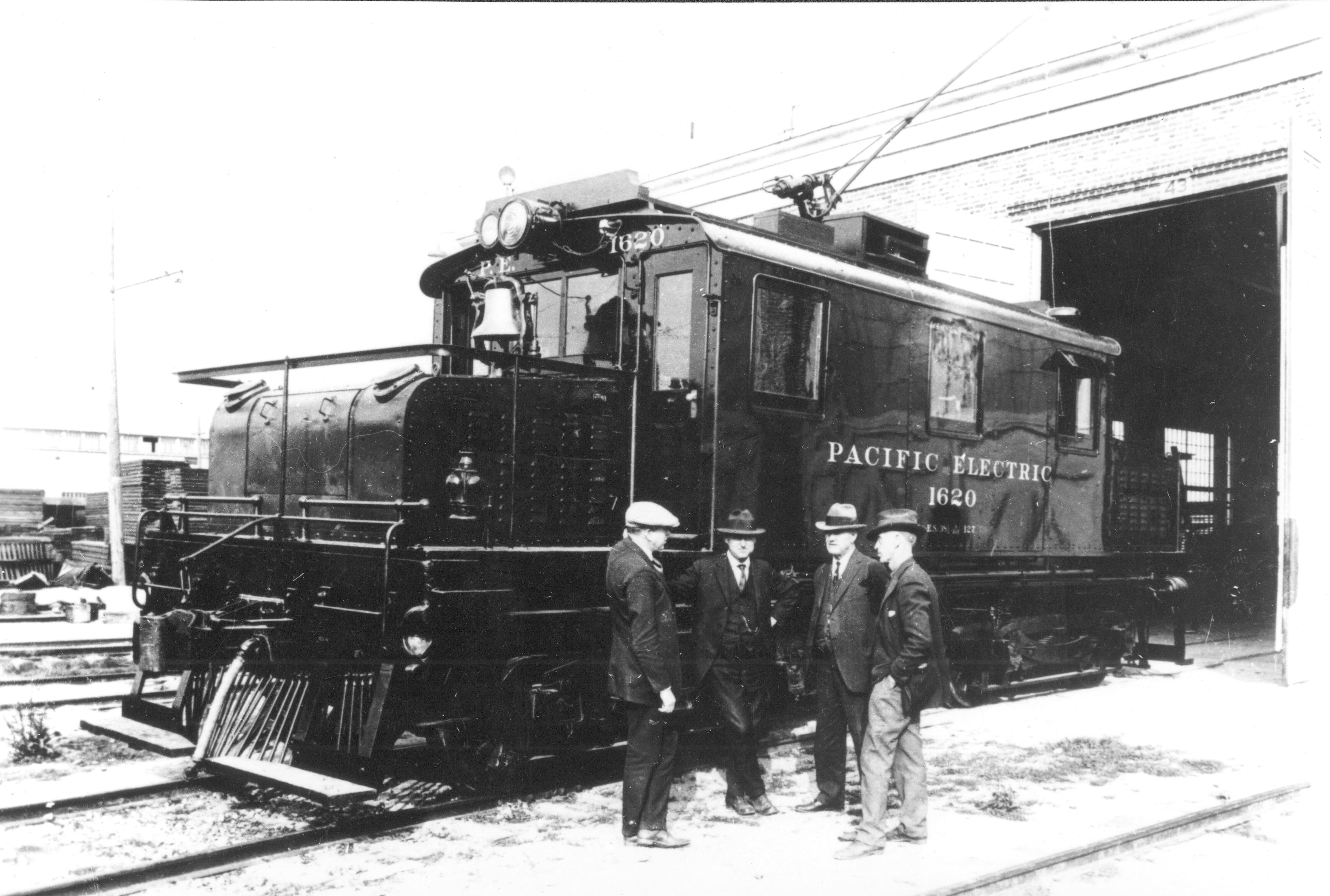
Four men pose in front of a Pacific Electric train engine at the railway’s Torrance shops in 1924. Its motor had just been built. (Credit: USC Digital Library)

Through it all, the Red Cars ran efficiently, not only delivering workers to their jobs, but also to recreational outlets in Redondo Beach, San Pedro and Long Beach. A combination of the lingering effects of the Depression, the gradual rise of the automobile and Pacific Electric’s claim that the Torrance line was losing money led to the railway proposing its closure in 1938.

PE’s original proposal called for reducing the number of Red Car runs to two per day and substituting bus service for the rest of the schedule. Torrance and the other cities along the line objected vigorously, but by June 1938 the proposal was revised to cutting the service entirely.

Despite further protests, that’s what happened on Jan. 15, 1940, when Red Car rail service to Torrance stopped forever. The entire rail system would wind down during the 1950s until its final line closed in 1961, but the 1940 Torrance route closure seemed abrupt and premature to the communities it served. (PE’s Torrance maintenance shops in the city closed in 1955.)

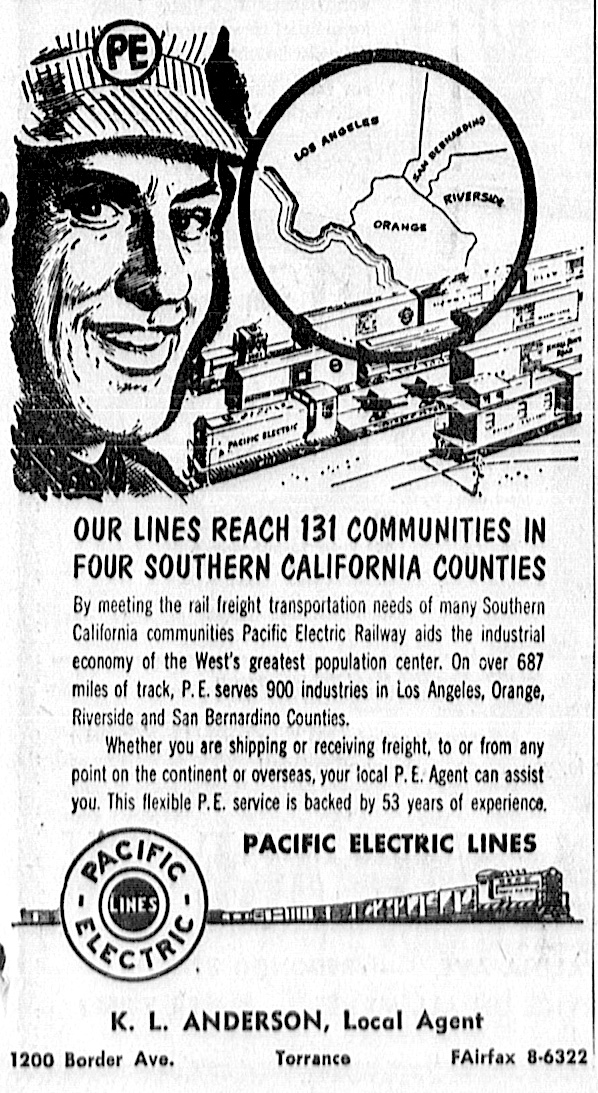
This Torrance Press ad from Dec. 12, 1955, Page 5, seems mildly cheeky in retrospect, advertising the Pacific Electric railway’s service to Torrance readers even though PE had axed its Torrance line 15 years earlier. (Credit: Torrance Historical Newspaper and Directories Archive database, Torrance Public Library)

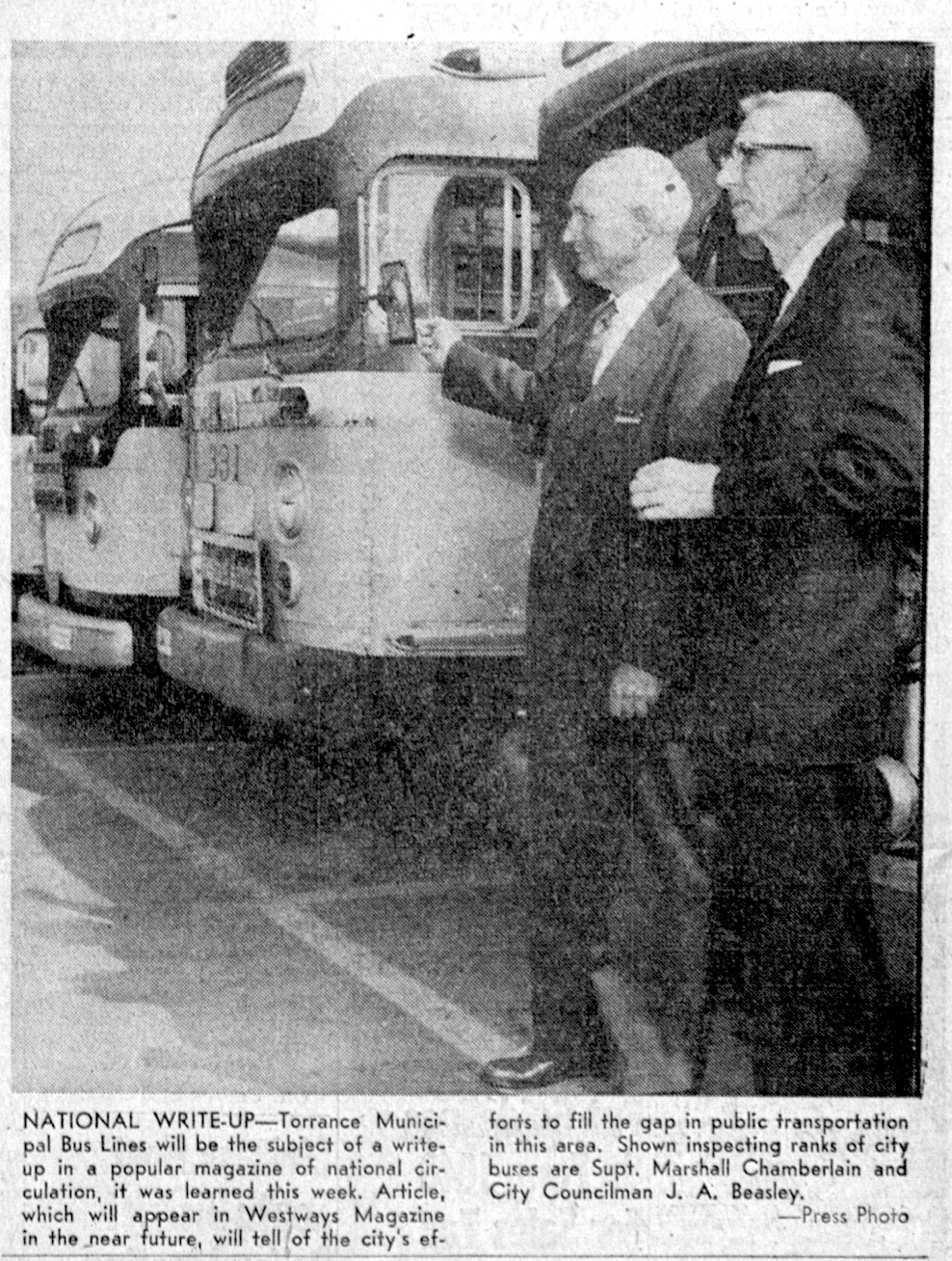
The city had to scramble to provide a link from Torrance to Los Angeles for the workers who commuted in daily. It began operating a free bus service the same day Red Car service ended, leasing buses through the private Asbury Rapid Transit Co.

The temporary arrangement lasted ten days before a 30-cent fare was imposed. By the end of the year, the city had formed its own transportation agency, Torrance Transit. By 1942, the agency was operating three 1931 Mack-33 buses daily on the Torrance to Los Angeles route.

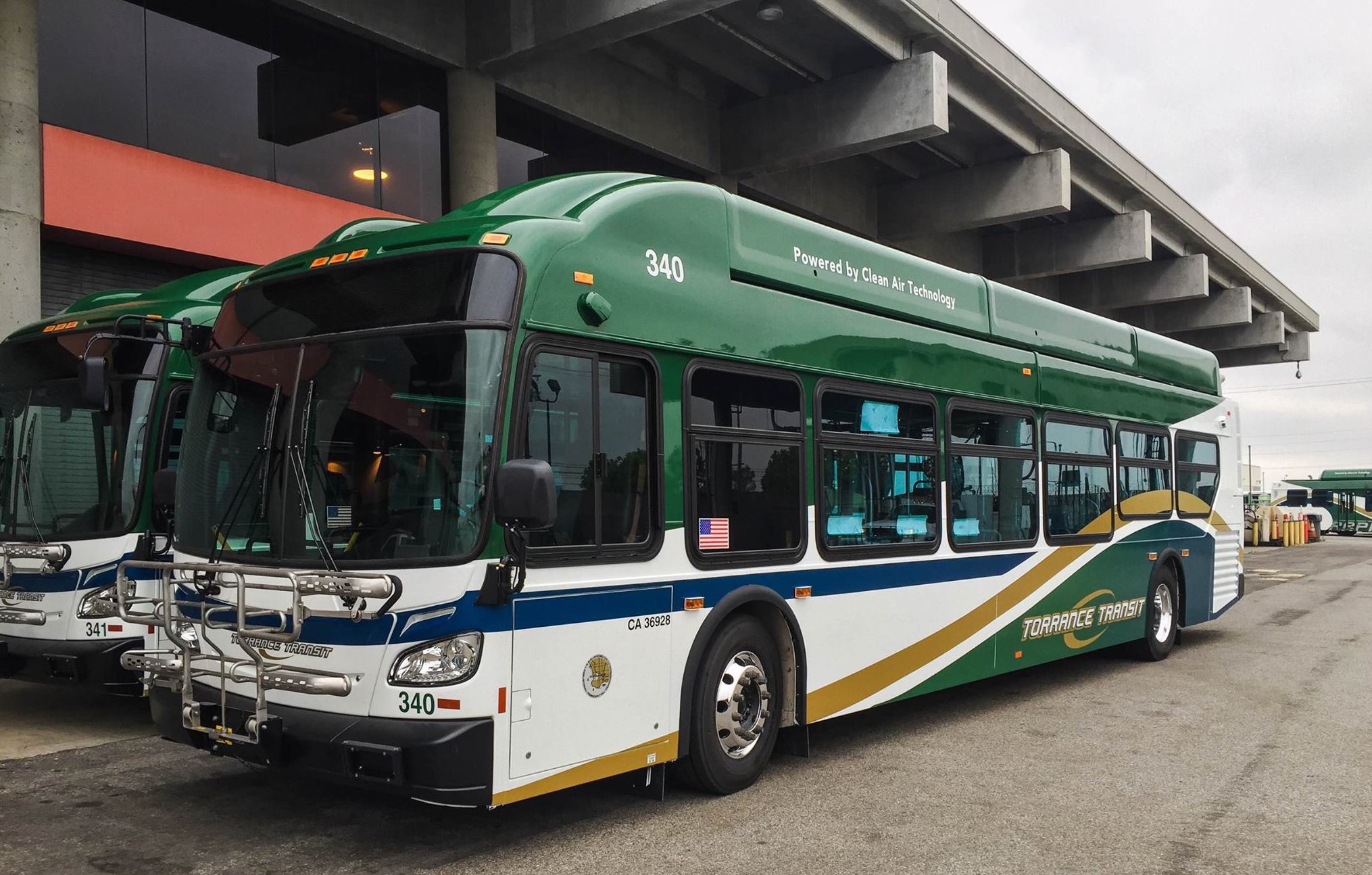
Buses from the modern-day Torrance Transit fleet on May 29, 2016. (Credit: Torrance Transit Facebook page)

Today, Torrance Transit operates a fleet of 63 alternative-fueled (CNG) buses along a dozen routes.

The next major stab taken at bringing mass transportation to the city involved the automobile. In the early 1960s, the California State Division of Highways proposed building a new Torrance Freeway. Several proposed routes were debated over the next decade, but adamant opposition by the City of Lomita and various other public interest groups scotched the proposed roadway in the early 1970s.

The Los Angeles Metropolitan Transit Authority, or MTA in brief, formed in 1963 to manage the region’s bus system. By the 1980s, the need for some sort of public transportation system beyond buses and cars became irrefutable, and the agency began securing rights of way in order to start building light rail routes. The first MTA light rail line, the Blue Line, opened in 1990.

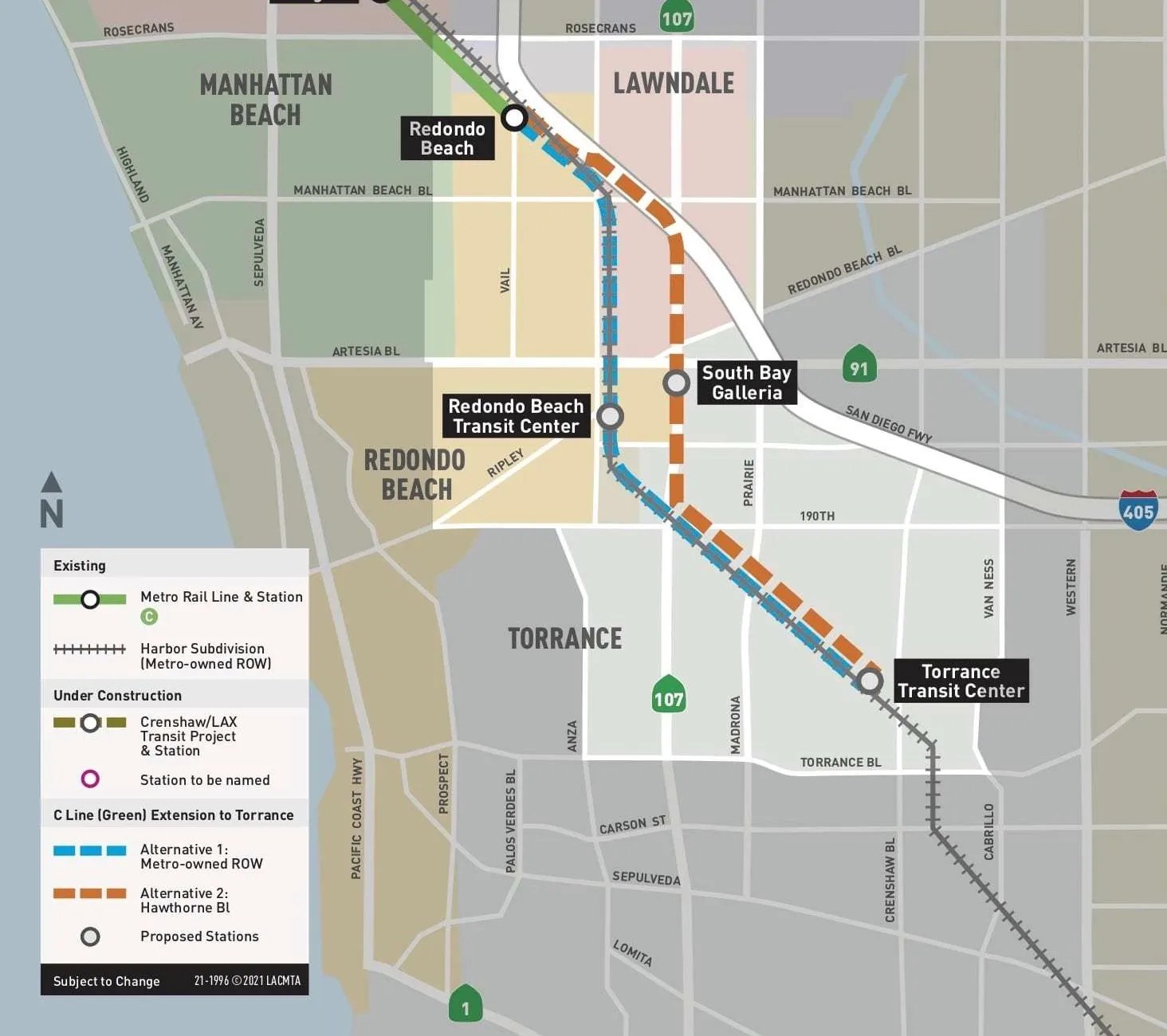
2021 map shows the proposed extension of the C Line (formerly Green Line) light rail route into Torrance. (Credit: MTA)

Over the next 30 years, several lines were completed, connecting outlying communities to the system. In the South Bay and Harbor Area, the only routes built were the Blue Line connecting Long Beach to downtown L.A., and the east-west Green Line along the Century Freeway, which stops mysteriously just short of LAX.

The possible implementation of a key piece of the South Bay transit puzzle began in 2010, when the MTA began planning a 4.1-mile extension of the C Line (formerly the Green LIne) from its Redondo Beach terminus south into Torrance. (The MTA changed the route names from colors to letters in 2019.)

The route would connect to the new transit center under construction at LAX, as well as to the entire MTA light rail system. A direct passenger rail connection from Torrance to LAX has never existed previously.

The Redondo Beach Transit Center opened near the South Bay Galleria on Feb. 9, 2023, the day it opened. (Daily Breeze file photo by Brittany Murray)

In preparation, both Torrance and Redondo Beach have opened new regional transportation centers. The Redondo Beach Transit Center at 1521 Kingsdale Ave. near the South Bay Galleria had been in the works since the early 2000s before finally opening on Jan. 29, 2023.

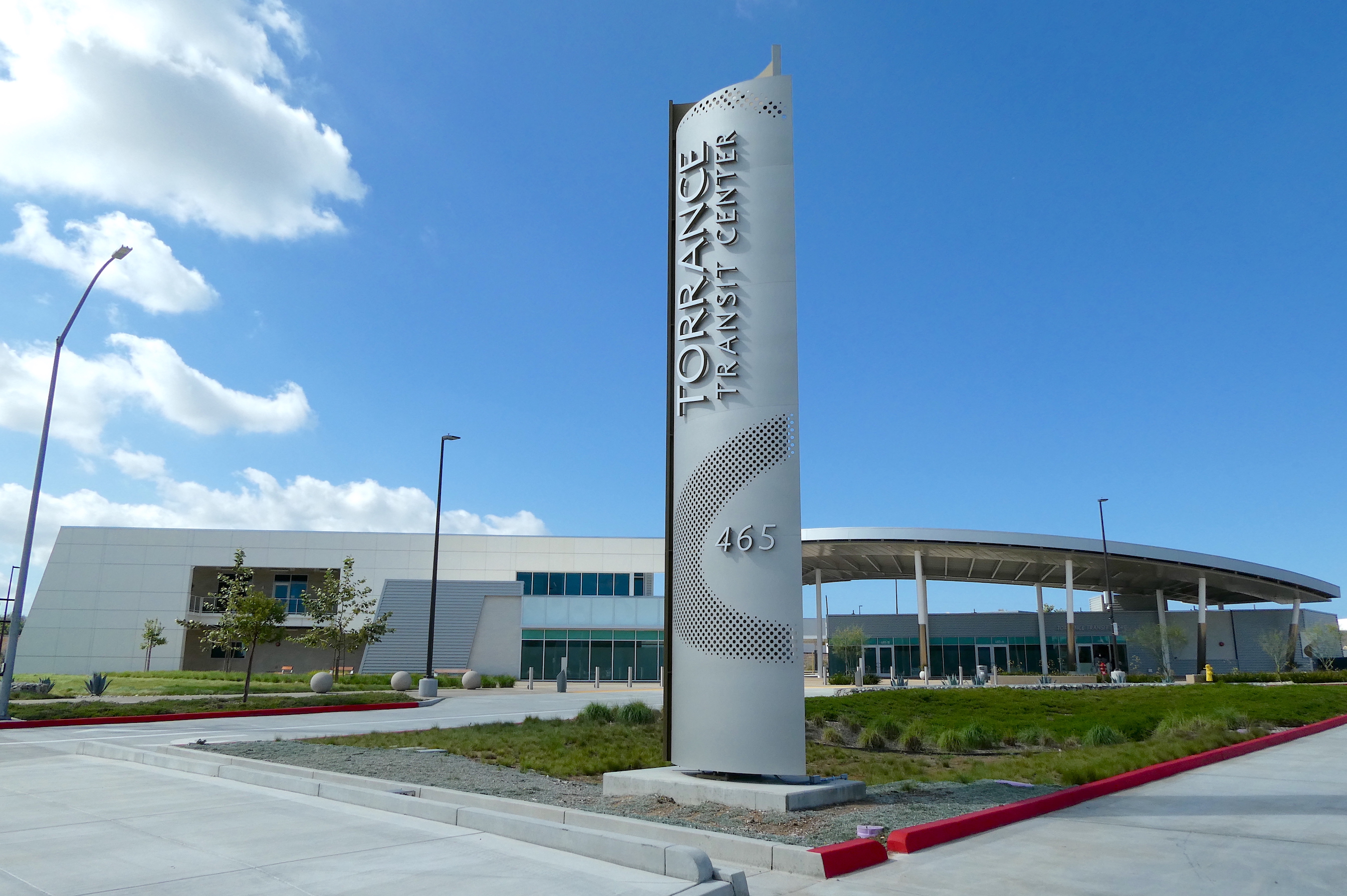
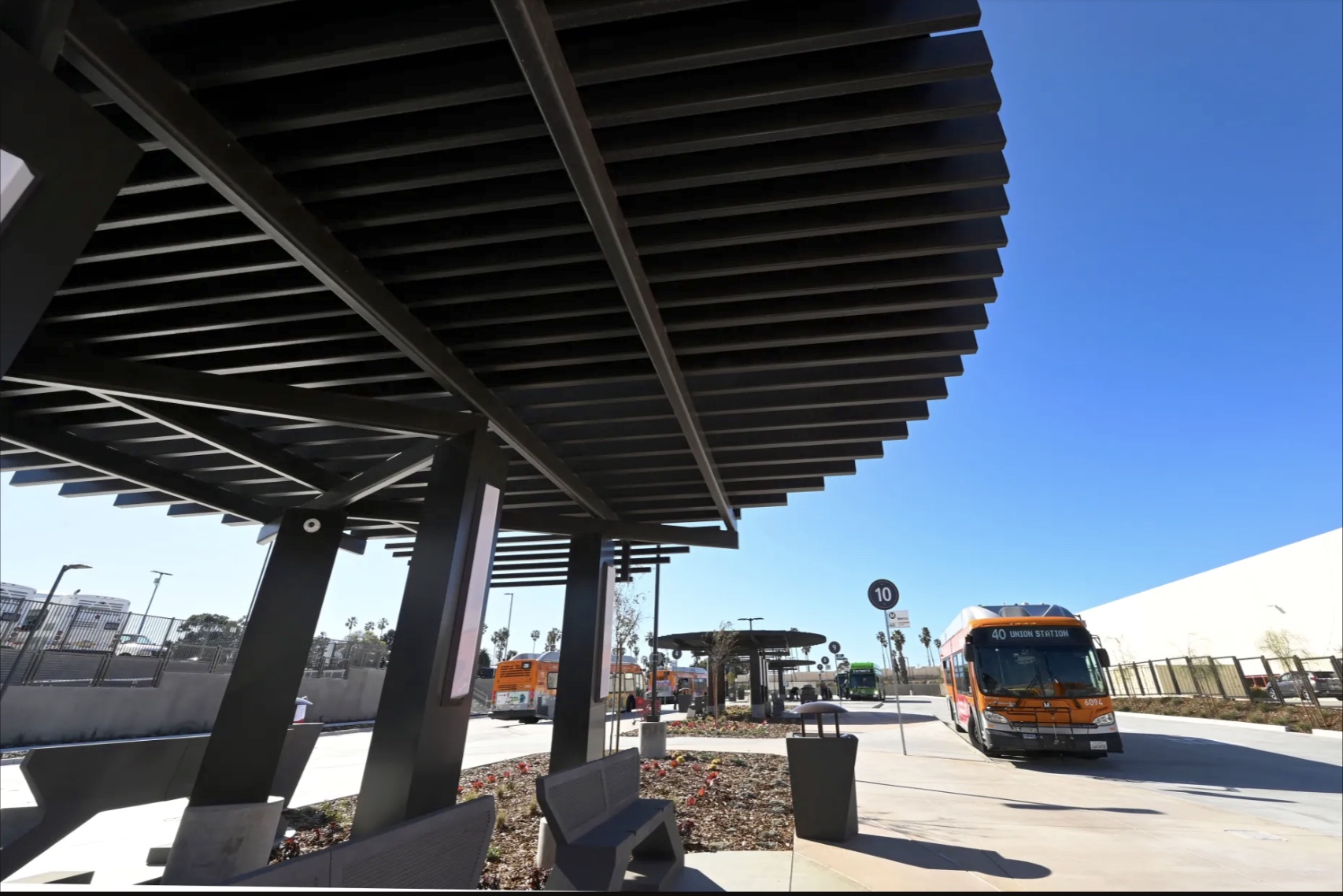
After a decade of planning and construction, Torrance opened its Mary K. Giordano Regional Transit Center on June 29, 2023. It replaces the much smaller transit hub at the Del Amo Fashion Center that closed in 2005, a victim of mall expansion.

The new $35 million center was named for the City of Torrance assistant city manager who died in 2019. She had arranged the purchase of the 15-acre site for the center at 465 Crenshaw Ave. in 2008. 

The MTA and the communities affected by the proposed extension, namely Redondo Beach, Lawndale and Torrance, currently are in the process of hashing out proposed routes. The extension has an outside chance for completion in time for the 2028 Summer Olympics.

Torrance’s new Mary K. Giordano Regional Transit Center opened in June 2023. (October 2023 photo by Sam Gnerre)

Sources:

Daily Breeze archives.

Historic Torrance: A Pictorial History of Torrance, California, by Dennis F. Shanahan and Charles Elliott Jr., Legends Press, 1984.

Los Angeles Times archives.

Pacific Electric Red Cars, by Bob Peterson, unpublished manuscript, February 1992.

San Pedro News Pilot archives.

Torrance Press-Herald archives.

Torrance Transit website.

Torrance Press, Nov 1, 1961 Page 1. (Credit: Torrance Historical Newspaper and Directories Archive database, Torrance Public Library)

Big Willie Robinson sought to foster brotherhood through street racing

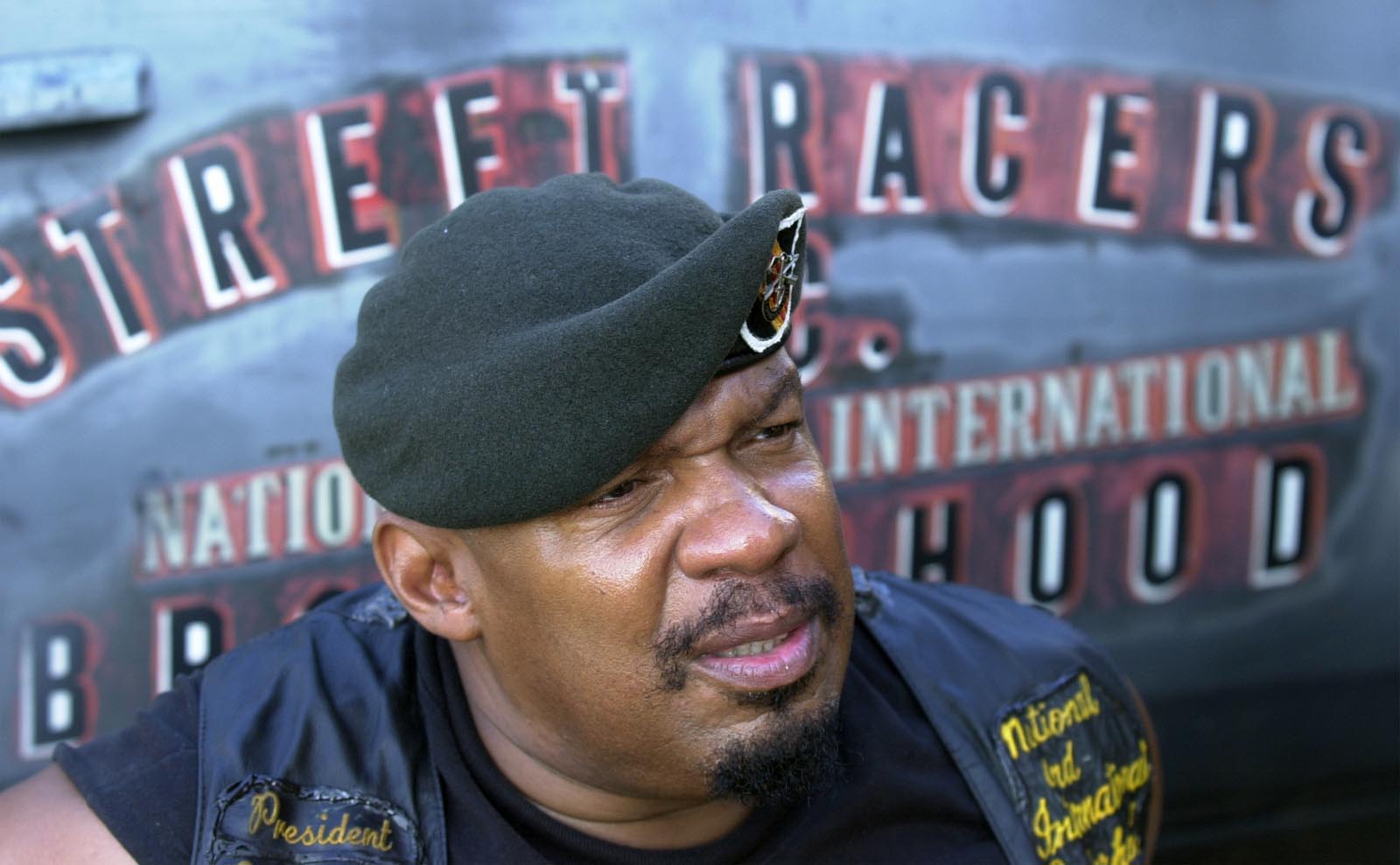
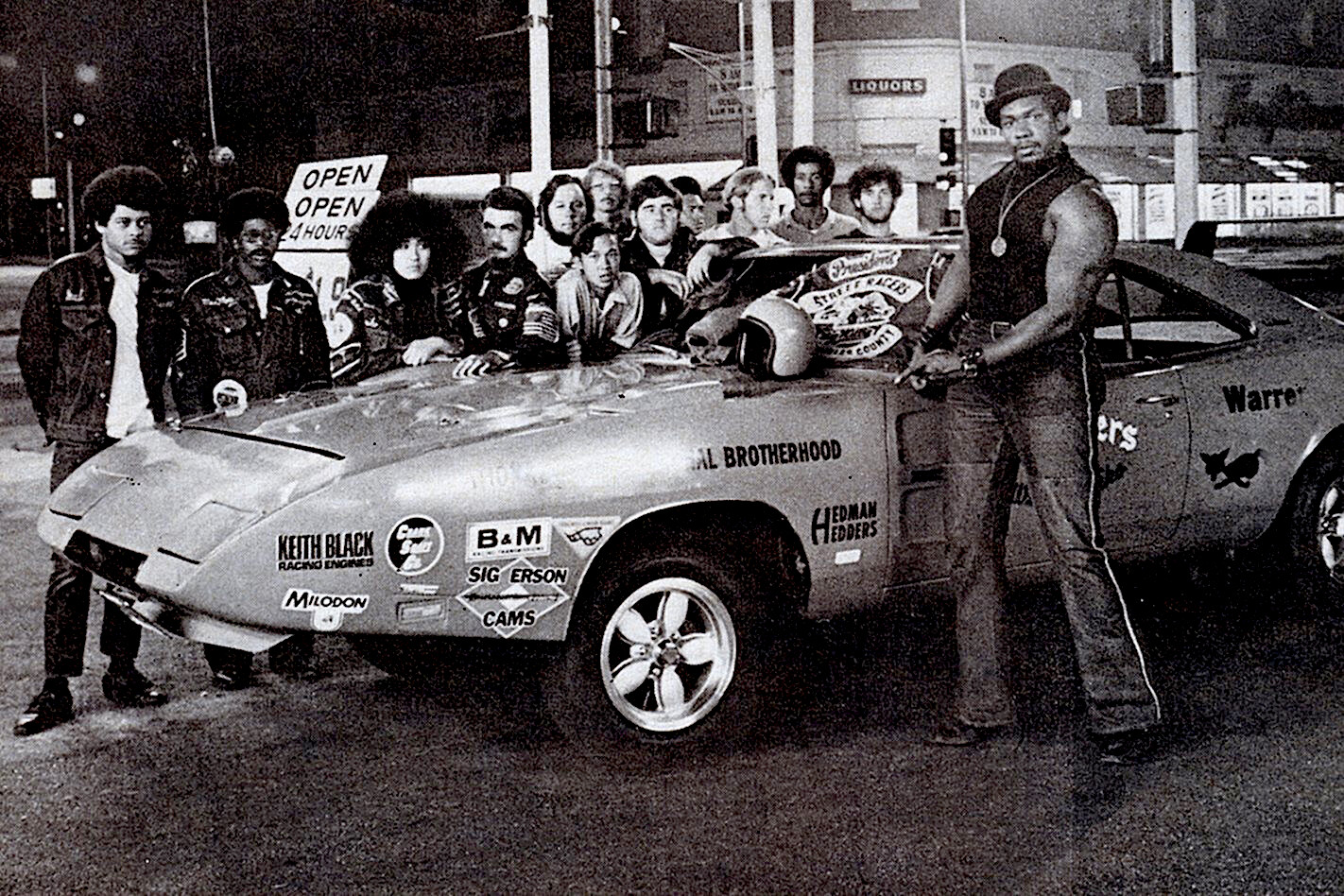
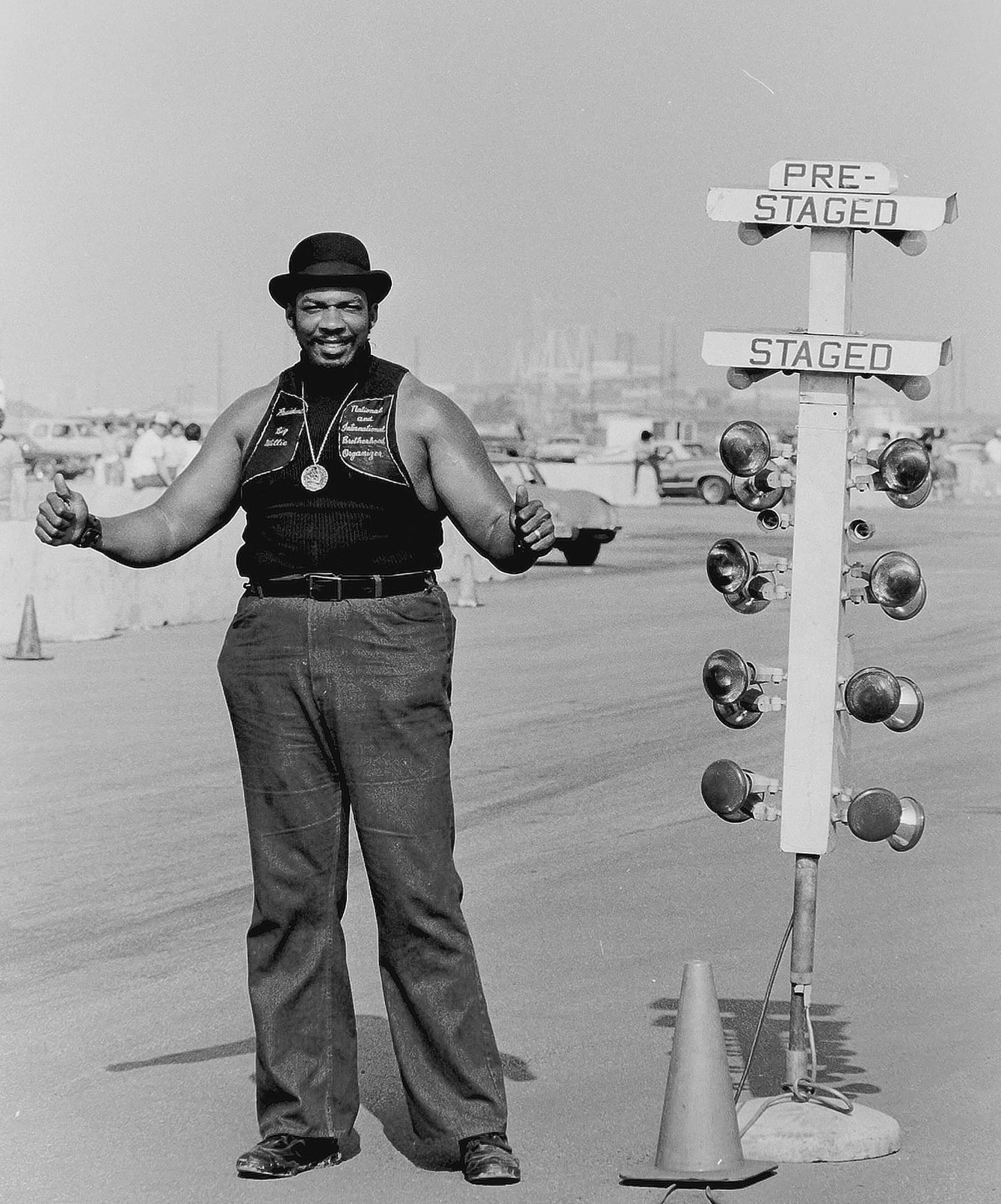
Big Willie Robinson. president of the National and International Brotherhood of Street Racers. July 9, 2001. (Daily Breeze file photo by Brad Graverson)

Big Willie Robinson, the man who spent most of his life fighting for a place for street racers to have a safe place to compete, born to Lula Mae and Willie Robinson Jr. in New Orleans, Louisiana, on Sept. 12, 1942. He was the oldest of the couple’s five children.

He wouldn’t adopt the “Big Willie” nickname until after leaving New Orleans, but, at 6-foot-6 and 300 lbs., he already had grown into the moniker as a young man. He attempted to pursue a football career at Louisiana State University, but the school turned him down. (LSU wouldn’t integrate its football team until 1972.)

He developed his love of cars from a young age working alongside his father, who was a body shop repairman. After his prized Oldsmobile 98 was destroyed in an apparently racially motivated attack, the family sent him to live on his own in Los Angeles in 1960. 

Big Willie Robinson next to his Dodge Daytona race car. Robinson’s wife, Tomiko, is third from left in this undated photo. (Credit: Street Machine website)

With hostilities escalating in Vietnam, Robinson enlisted in the U.S. Army, but physical problems with his legs and back caused him to be honorably discharged before completing basic training in 1966.

Robinson later would claim to have fought in Vietnam and usually wore fatigues and a military beret in public. After Robinson’s death, Los Angeles Times reporter Daniel Miller discovered in 2019 that Robinson had embellished the facts concerning his service.

It ultimately didn’t affect the value of Robinson’s social contributions, which would begin after the 1965 Watts Riots in Los Angeles pointed up the social and racial inequities in the polarized city.

City officials previously indifferent to the problems of poverty and racial inequity in South Los Angeles suddenly began listening to voices coming from the affected acommunity. Among those who caught their ear: Big Willie Robinson.

Big Willie Robinson and his wife, Tomiko, talk about his efforts to organize street racing in this brief interview from Oct. 10, 1972 by Tony Segreto.

As a car buff, Robinson had experienced the dangers of illegal street racing and had been advocating for an organized solution that would allow drag racing in a safer and more controlled environment. In 1968, he formed the National and International Brotherhood of Street Racers to help in his lobbying for the cause.

He began working with the Los Angeles Police Department to stage such races including all  members of the racing community on neutral turf, holding the first such event in 1968. He convinced skeptics with his belief in the use of organized street racing to help heal fractured social relationships.

As he told the Los Angeles Times, “When it comes to wheels — white, black, brown and yellow; male and female; young and old; rich or poor; from gangbangers to law enforcement — with that formula you can pull your communities together.”

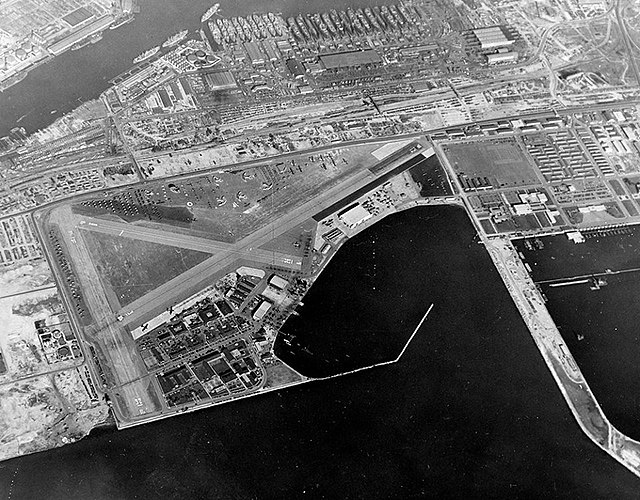
Naval Air Station Terminal Island, also known as Reeves Field, in 1944. (Credit: U.S. Navy)

The street racing events attracted large crowds, but Robinson became more and more convinced that  a permanent site was needed in order to hold the regular weekly racing events. After former LAPD chief Tom Bradley became mayor of Los Angeles in 1973, Robinson approached him with his plans.

They involved leasing land on Terminal Island just southeast of the Vincent Thomas Bridge for a raceway. The former Reeves Field had been a U.S. naval air training site since 1927, but it  was decommissioned in 1947. The Navy still used it occasionally, as did the LAPD, which held driver training instruction for its officers there.

It didn’t take long for auto racers to see the promise of those paved runways. A Long Beach car club held the first official race there in 1953. It lost money, and was not repeated, but the idea of using the former base survived and Big Willie Robinson adopted it.

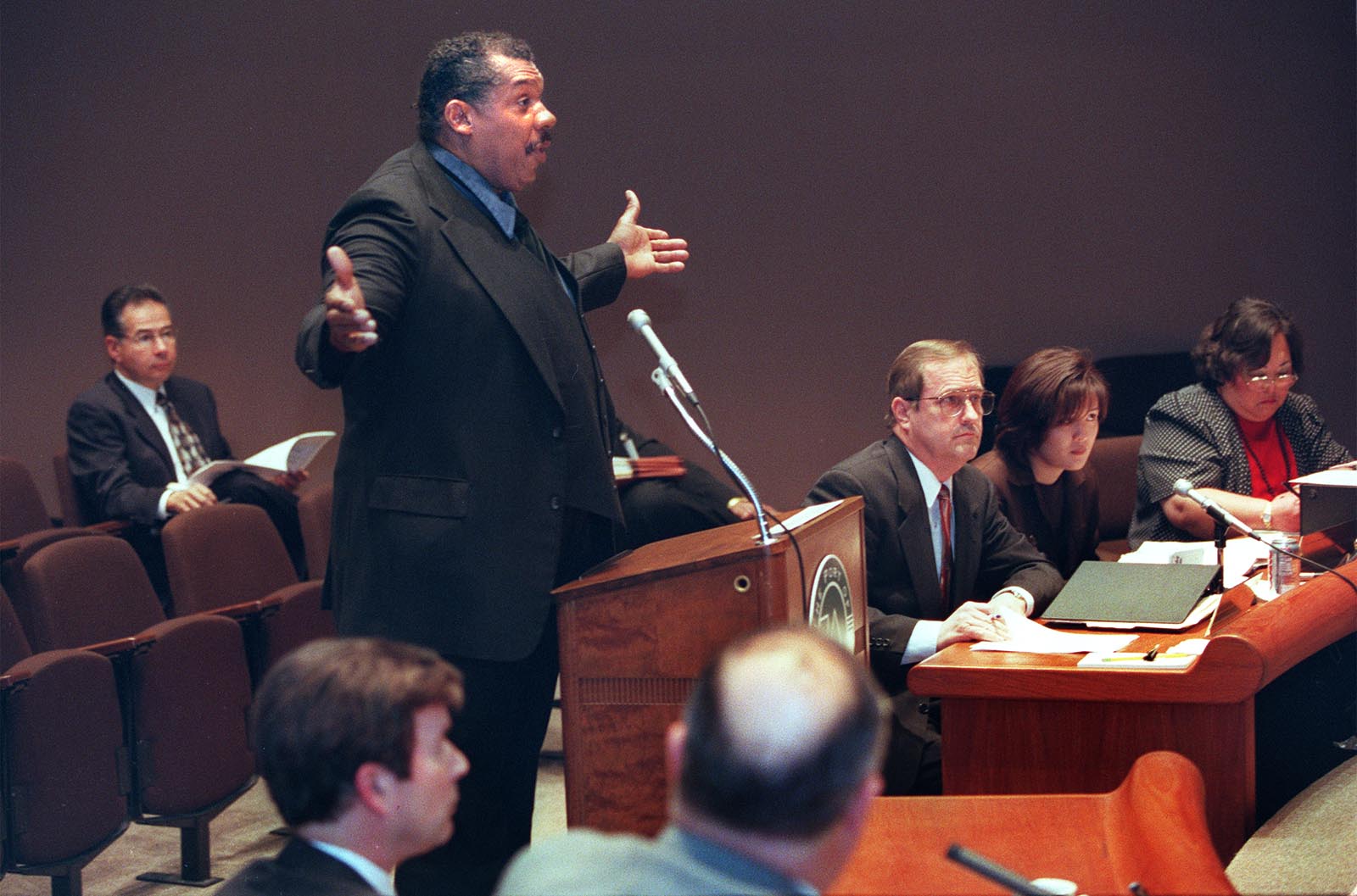
Big Willie had mastered the art of speaking in rough-hewn eloquence to those in power, in this case, the Los Angeles City Council and Port of Los Angeles officials. He described the unifying power of street racing to bring disparate groups together, while alsoveasing the rising tide of deadly traffic accidents tied to illegal racing on city streets.

Wearing a suit rather than his usual fatigues, Big Willie Robinson makes his case for a permanent street racing facility before the Los Angeles Harbor Commission at its meeting on April 14, 1999. (Daily Breeze staff file photo by Andrea Roth)

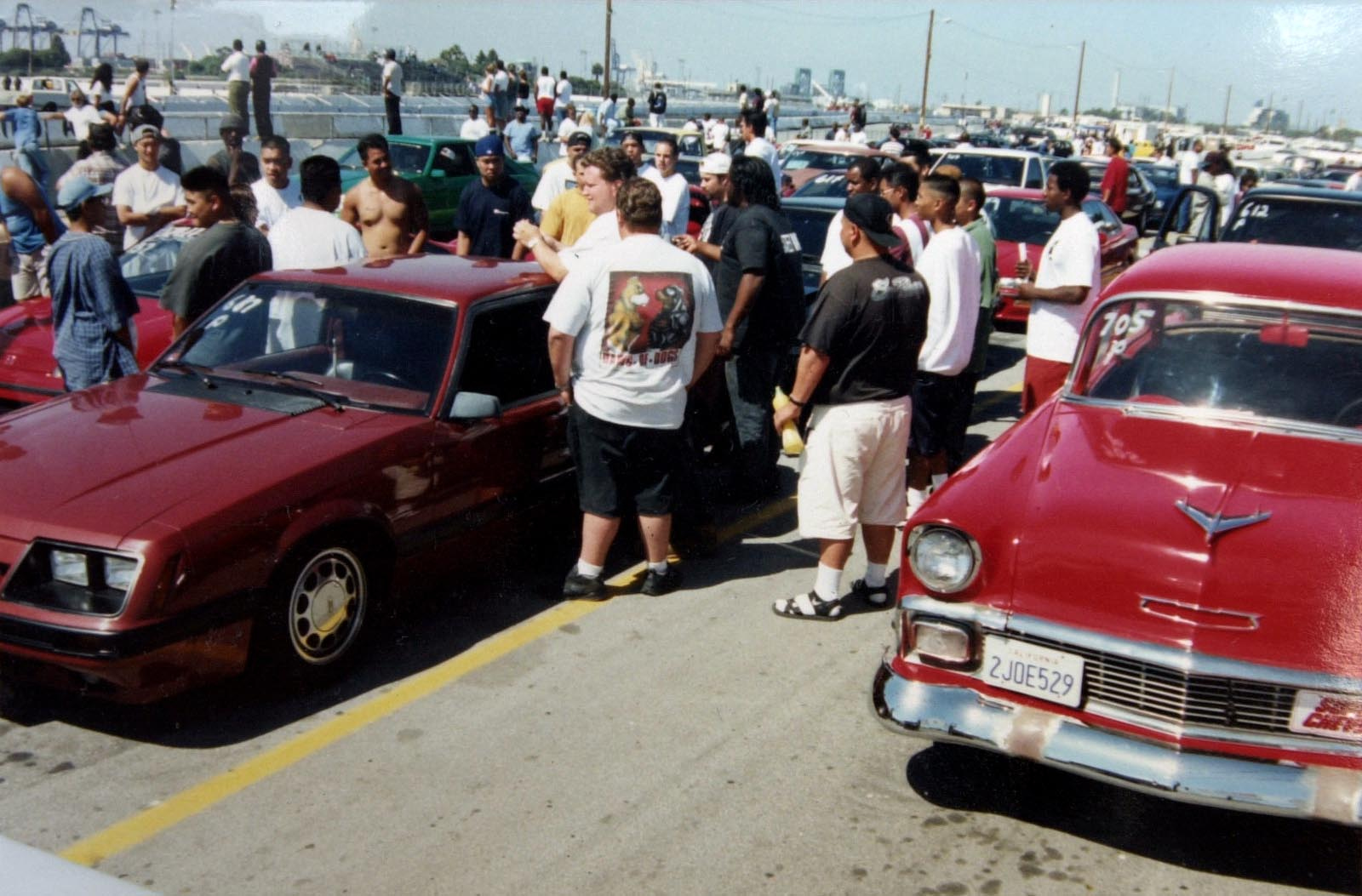
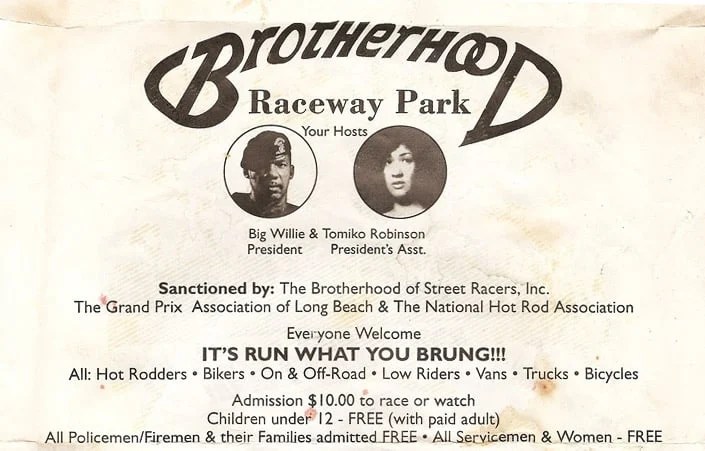
The closure of dragstrips throughout the L.A. area, including the nearby Lions Drag Strip in Wilmington in 1972, exacerbated the problem. Robinson eventually convinced the city and the port, who allowed him to open Brotherhood Raceway Park at Terminal Island in 1974. It would operate off and on there for the next 21 years.

The makeshift facility conducted races from 1974-84, when the Port closed it down to use the space to store imported automobiles. Robinson explored other options, including building a raceway at LAX and at the Palmdale airport. None of the other options panned out.

In 1993, Robinson finally convinced the Port to allow him to reopen at Reeves Field. He began holding weekly events that attracted 3,000-4,000 spectators regularly. But the Port’s permission was temporary; the track had to close in 1995 to make way for the LAXT Coal Terminal facility.

Big Willie Robinson at the starting line at Brotherhood Raceway Park on Terminal Island in 1983.
(Credit: Rick Meyer Facebook page)

The coal terminal opened in 1997 and closed in 2006. It was abandoned and the land cleared a couple of years later. Throughout it all, Robinson continued to appeal to anyone who would listen to allow the Brotherhood Raceway Park on Terminal Island to reopen. But Port officials and the Harbor Commission remained unyielding.

Big Willie Robinson died from an infection that led to heart failure on May 29, 2012. His wife and longtime racing companion, Tamiko, had died in 2007. 

Repeated attempts since then to implement his ideas about establishing a permanent home for street racers have yet to become reality, but his persistence, larger-than-life personality and idealistic ambitions have not been forgotten.

Street racers of various types gather at the Brotherhood Raceway Park on Terminal Island. Undated photo from Big Willie Robinson, circa early 1980s. (Daily Breeze file photo)

Sources:

“BIg Willie Robinson: 1942-2012: He Brought The Races Together Through Racing,” by Mark Vaughn, Autoweek website, May 20, 2012.

Daily Breeze archives.

Los Angeles Times archives.
“Street Legends: Big Willie Robinson and the Brotherhood of Street Racers International,” by jonjon005, The Symple Speed Garage blog, Oct. 5, 2015.

Wikipedia.

Undated flyer advertising Brotherhood Raceway Park.

Former West High QB Steve Sarkisian now calling signals for the Texas Longhorns

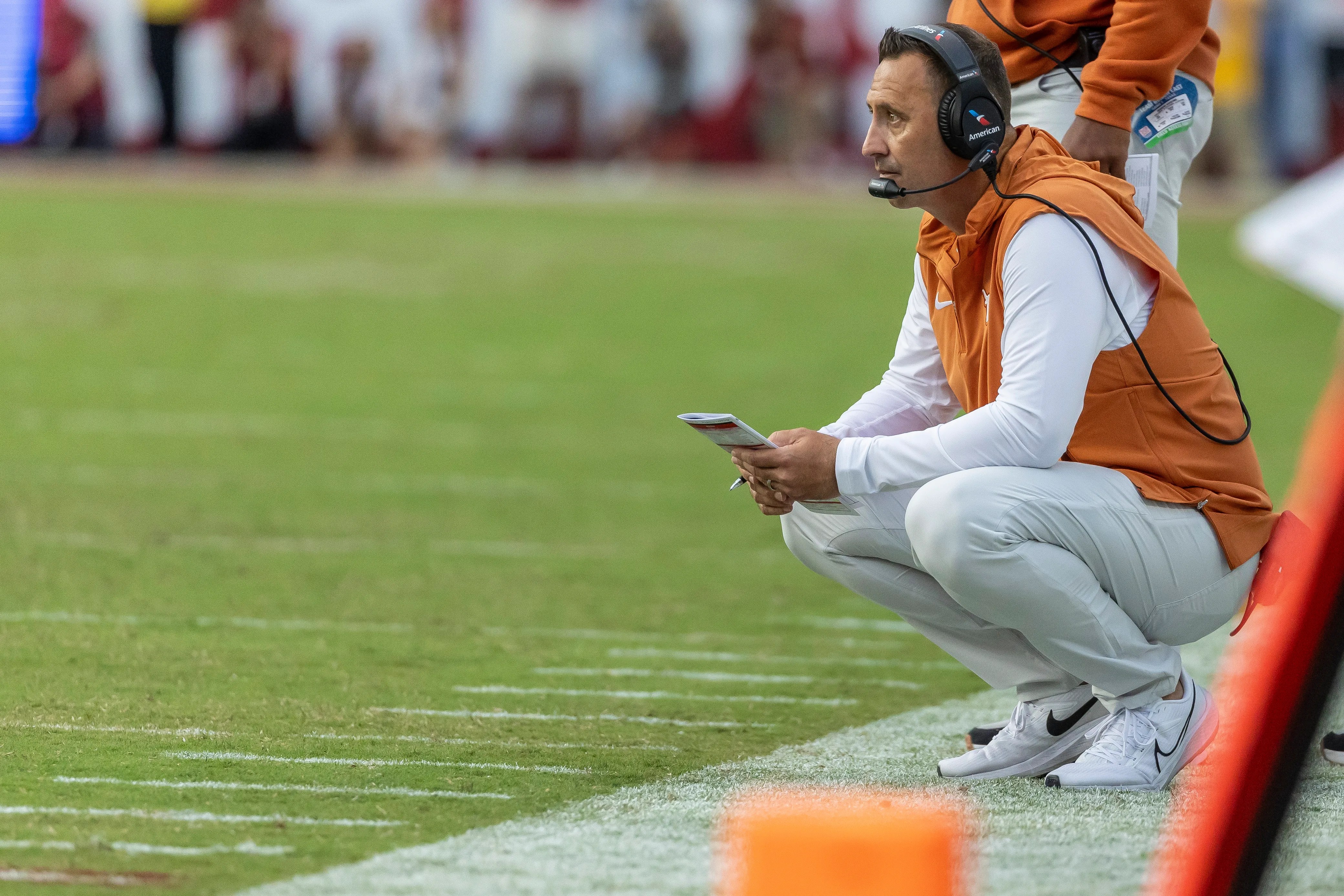
University of Texas head coach Steve Sarkisian tracks his team from the sidelines during the first half of the Texas-Alabama college football game on Sept. 9, 2023. Texas won, 34-24. (Credit: Associated Press photo by Vasha Hunt)

Steve Sarkisian’s path to becoming the head football coach for the powerhouse University of Texas Longhorns football program hasn’t always been smooth, but his football acumen continues to lead him onward and upward.

The Longhorns’ convincing dismantling of #3-ranked Alabama in the opening game of their 2023 season has brought national attention to his work at Texas since becoming head coach there in 2021. The team went 5-7 that first year, but improved to 8-4 in 2022.

Sarkisian was born the youngest of seven children on March 8, 1974, and grew up in West Torrance. He played both football and baseball at West High, excelling at both. He graduated in 1992 after earning Daily Breeze all-area second-team honors in football and first-team honors in baseball.

At 6’, 175 lbs., he lacked the size and heft of most top college football players. Sarkisian chose instead to play baseball when he enrolled at USC in the fall. But he felt he didn’t fit in there. He struggled through one semester before transferring to El Camino College near Torrance.

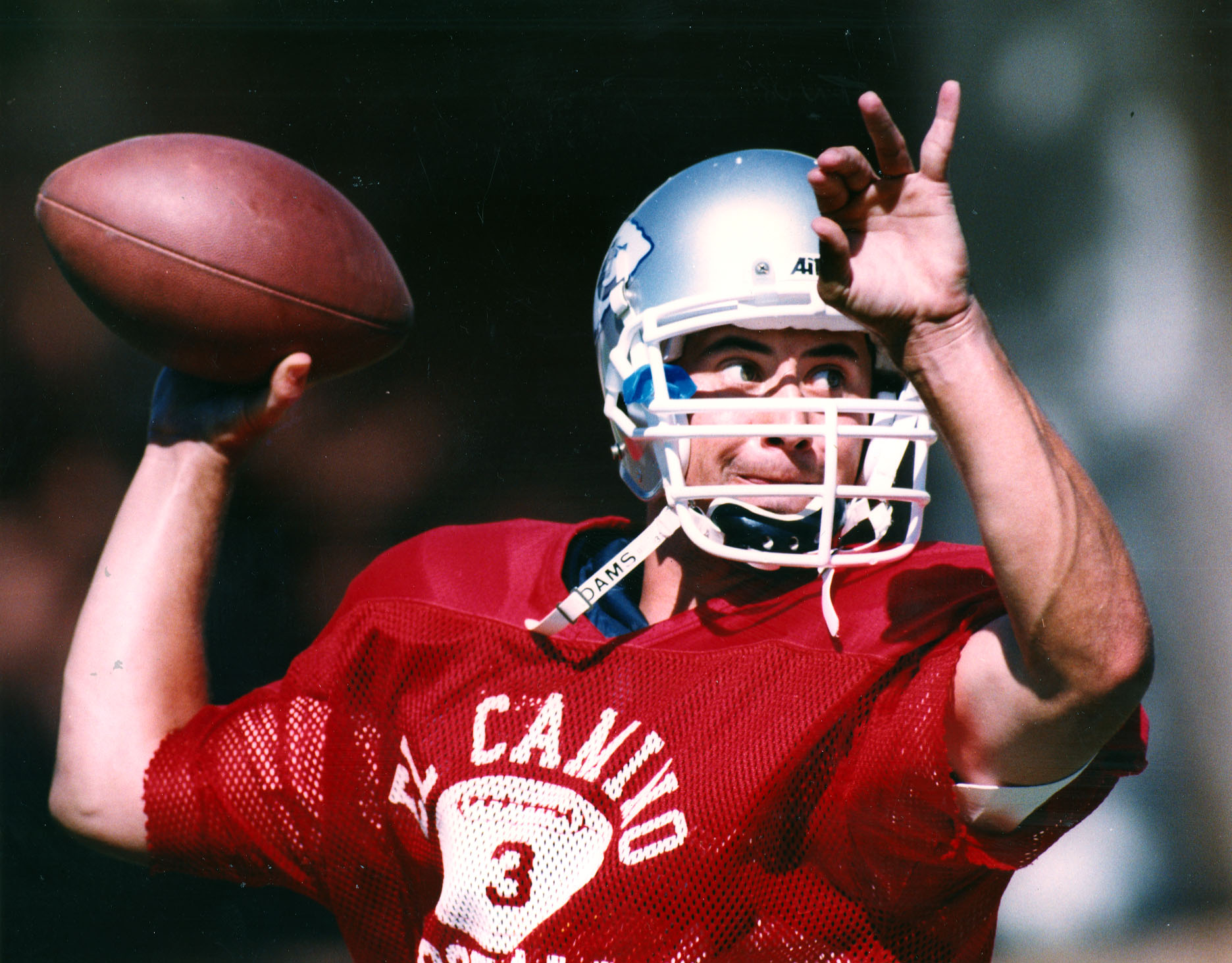
El Camino College quarterback Steve Sarkisian in 1994. (Daily Breeze staff file photo by Brad Graverson)

He wanted to play shortstop for the baseball team there, but the school’s longtime football head coach, John Featherstone, had seen Sarkisian play at West, and wanted him to take a shot at quarterbacking ECC’s football team.

Sarkisian finally decided to give it a try, and ended up having two brilliant seasons with the Warriors. He set a national community college record by completing 72.4 percent of his passes during his JC career. 

He considered returning to USC after his time at ECC ended in 1994, but then he heard that former Carson high standout and then-current Brigham Young quarterback John Walsh would be leaving BYU the following season. Sarkisian originally became West High’s starter after Walsh left the school as a senior to play for Carson, so he decided to replace Walsh once again at BYU.

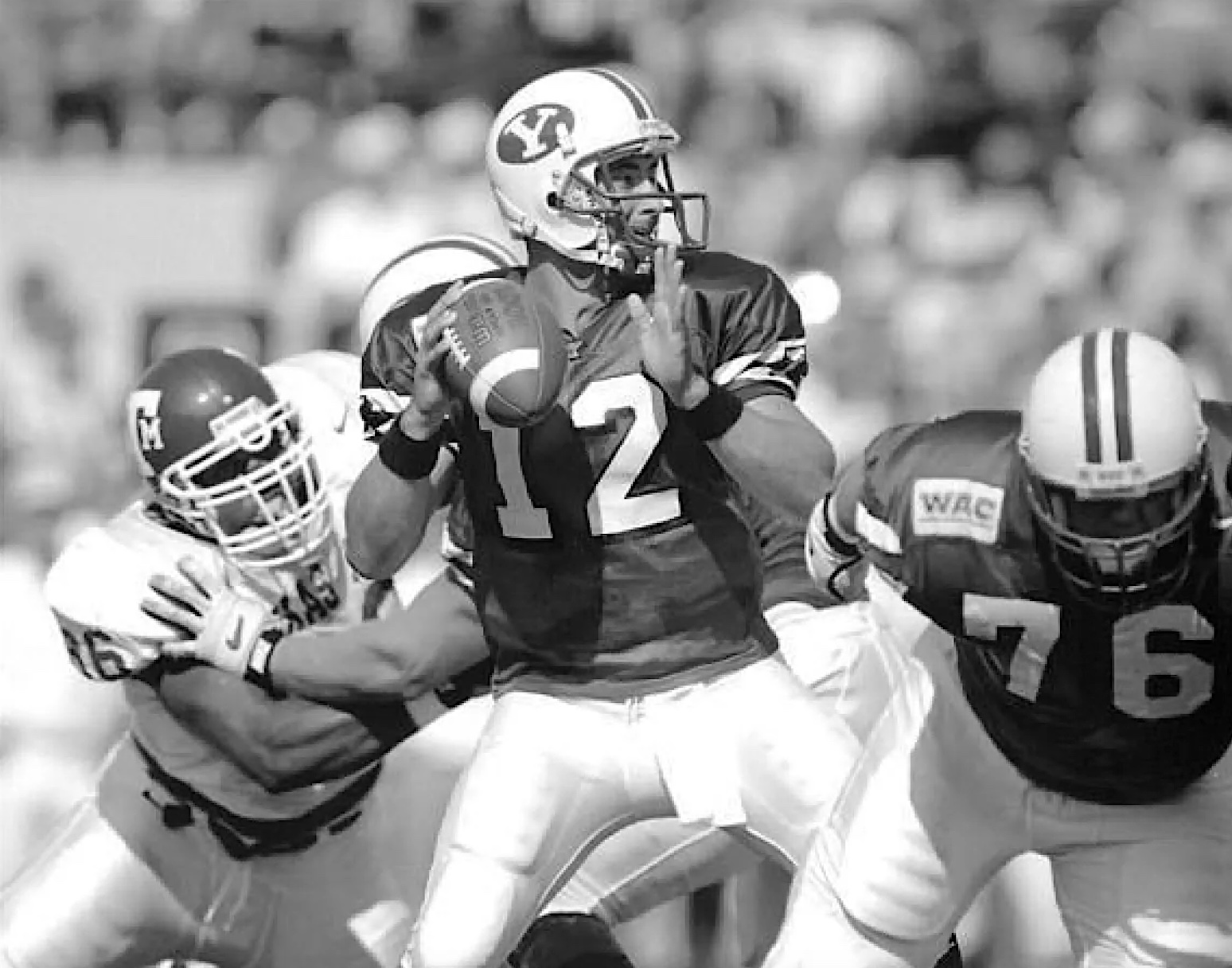
BYU quarterback Steve Sarkisian plays against Texas A&M in the Pigskin Classic in 1996. Lightly regarded BYU upset the #13 Aggies, 41-37. Sarkisian threw for 536 yards and six touchdowns. (Credit: Deseret News)

During this era under coach LaVell Edwards, BYU had become known as “Quarterback U.” Previous starters at the position there included Gifford Nielsen, Marc Wilson, Jim McMahon, Steve Young, Robbie Bosco, and Heisman Trophy winner Ty Detmer. 

Sarkisian fit right in. He had two great years at the school, including leading the Cougars to a 14-1 record and #5 national ranking in 1996, when he passed for 4,027 yards and 33 touchdowns. (Their 14th win came on Jan. 1, 1997 in the Cotton Bowl.) Sarkisian graduated from BYU with a degree in sociology in 1997.

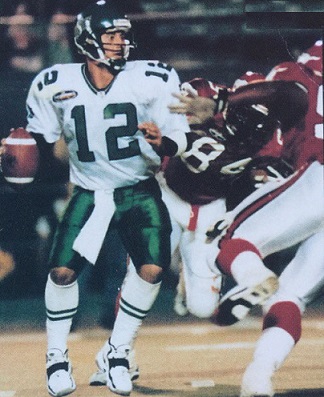
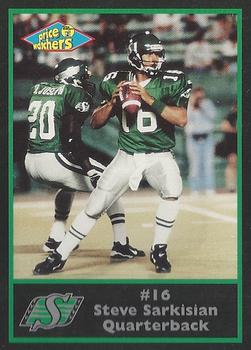
Steve Sarkisian at quarterback for the Roughriders of the CFL.(Photo courtesy Saskatchewan Roughriders).

After being passed over in the 1997 NFL draft, Sarkisian continued his pro career by signing on with the Saskatchewan Roughriders of the Canadian Football League. He played in the CFL for three seasons, retiring after his third season when the Roughriders went a discouraging 3-15 in 1999.

If you think that pathway sounds tangled, wait until we get to his coaching career, which he began pursuing after retiring from the CFL.

His first move into the coaching ranks was to become quarterback coach back at El Camino in 2000. In 2001, he became an assistant to his former BYU offensive coach Norm Chow at USC, under first-year Trojan coach Pete Carroll.

After serving as USC quarterback coach for the next two years, he joined the Oakland Raiders in the same capacity in 2004. A year later, he was back at USC as quarterback coach, then offensive coordinator for the next three years.

Sarkisian’s first head coaching opportunity seemed inevitable, and it came late in 2008, when he took the head coaching job at the University of Washington. The Huskies had just completed an 0-12 season.

They would finish 5-7 in Sarkisian’s first year. In his five years as head coach, Sarkisian’s Huskies won 34, lost 29, and appeared in four bowl games. After the team’s 8-4 season in 2013, Sarkisian resigned in order to accept an offer to become USC’s new head coach.

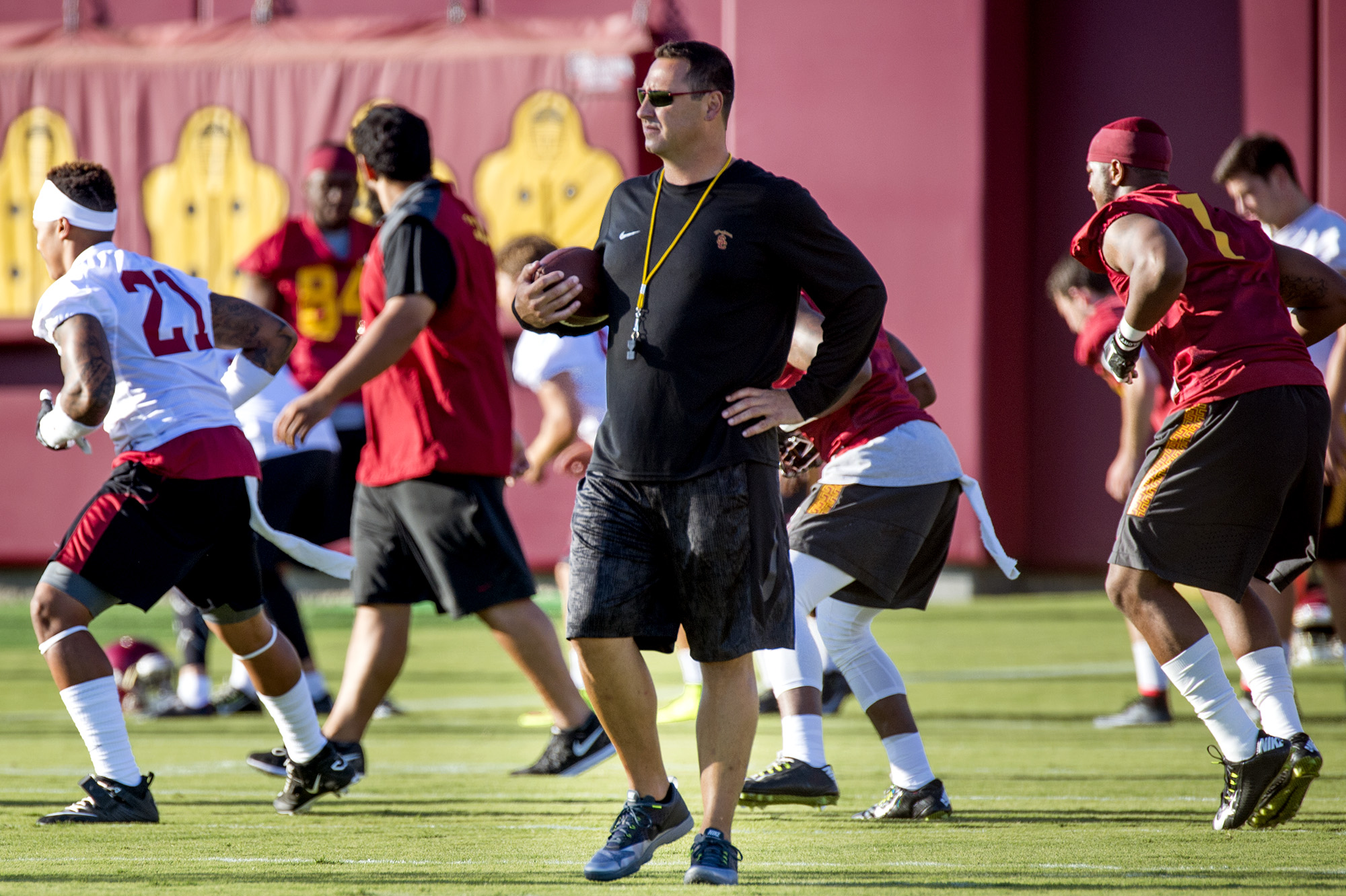
USC head coach Steve Sarkisian during the first practice of the football season at Cromwell Field on the USC campus in Los Angeles. Aug. 8, 2015. (Daily Breeze staff file photo by Leo Jarzomb)

It seemed to be the top of the mountain for Sarkisian, who responded by coaching the team to a 9-4 record and a victory over Nebraska in the Holiday Bowl. The Trojans were 3-2 in partway through the 2015 season when it all unraveled for him.

Rumors of alcohol abuse began to surface after a Sept. 26 game with Arizona State, with unidentified sources stating that Sarkisian appeared to be under the influence of alcohol on the sidelines and in the locker room.

But he wasn’t fired until Oct. 12, the day after he appeared to be intoxicated at a Sunday morning special teams meeting. Players and assistants detected alcohol on his breath. Sarkisian sued the school, but lost. He also entered an alcohol treatment program and slowly turned  his life around.

He took a year off from football before accepting an assistant coaching job at the University of Alabama, followed by a similar position a year later with the Atlanta Falcons in 2017. He returned to Alabama as offensive coordinator for two years before being hired as head coach of Texas in January 2021.

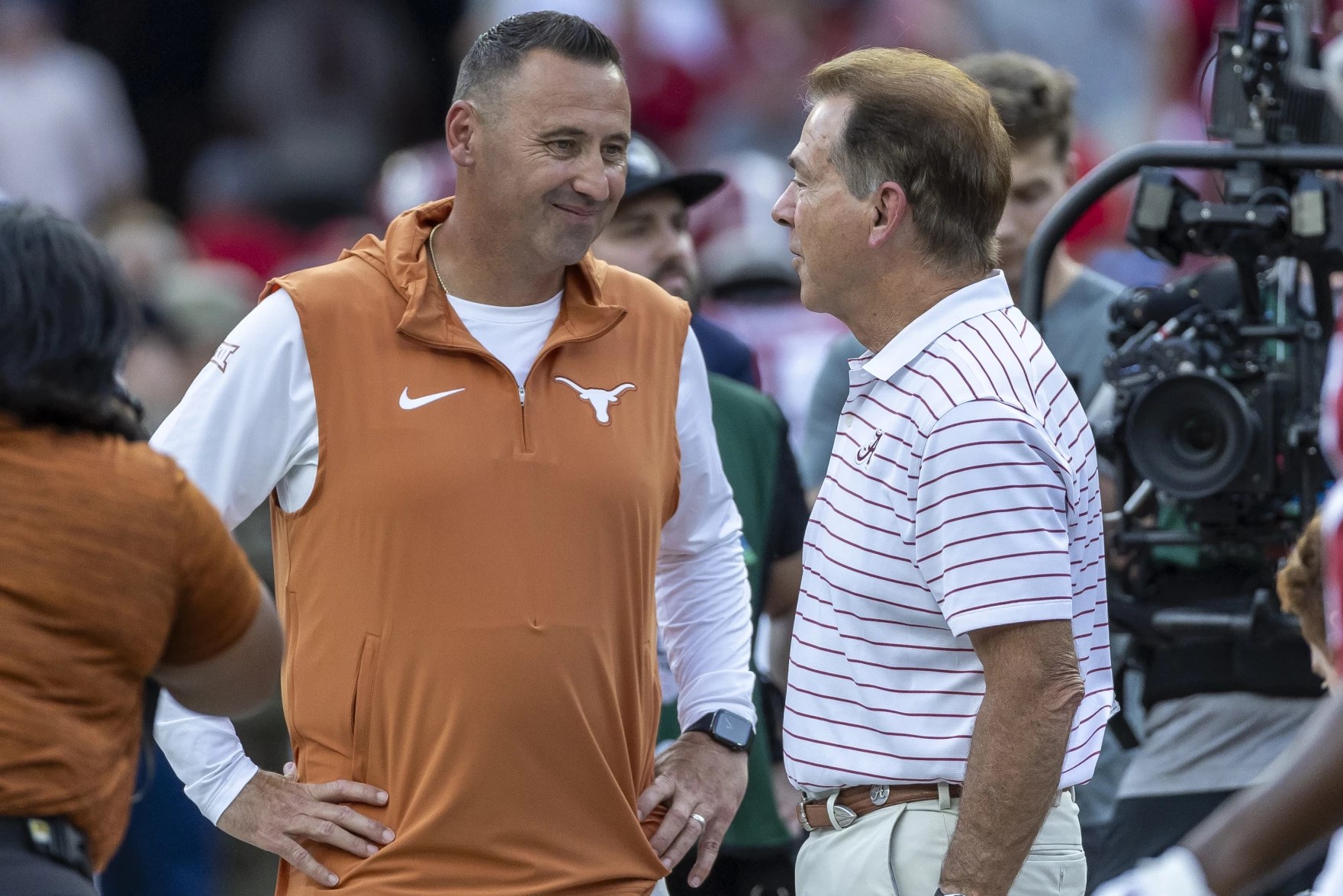
Texas head coach Steve Sarkisian visits with Alabama head coach Nick Saban during warmups before the Sept. 9, 2023, game between the two schools in Tuscaloosa, Alabama. (Credit: Associated Press photo by Vasha Hunt)

Previous to his hiring, he underwent open heart surgery for a life-threatening heart valve defect in Alabama in July 2020. Sarkisian has led an eventful life. 

Here’s what he told The Audible podcast shortly after being hired at Texas:

“Early in my career, I was the hottest thing cooking, man. I was on the fast track. I think my ego really took over who I was as a person and probably suppressed some better qualities and traits I possessed that got me to that point.

“When you get dealt that humble pie, and you don’t have a job, and you’re wondering, am I ever going to be a head coach again, or what’s my journey going to look like, and how am I going to get back to doing what I love to do? You have to just dig back into what got you there – and that’s just being the best person you can be every day.”

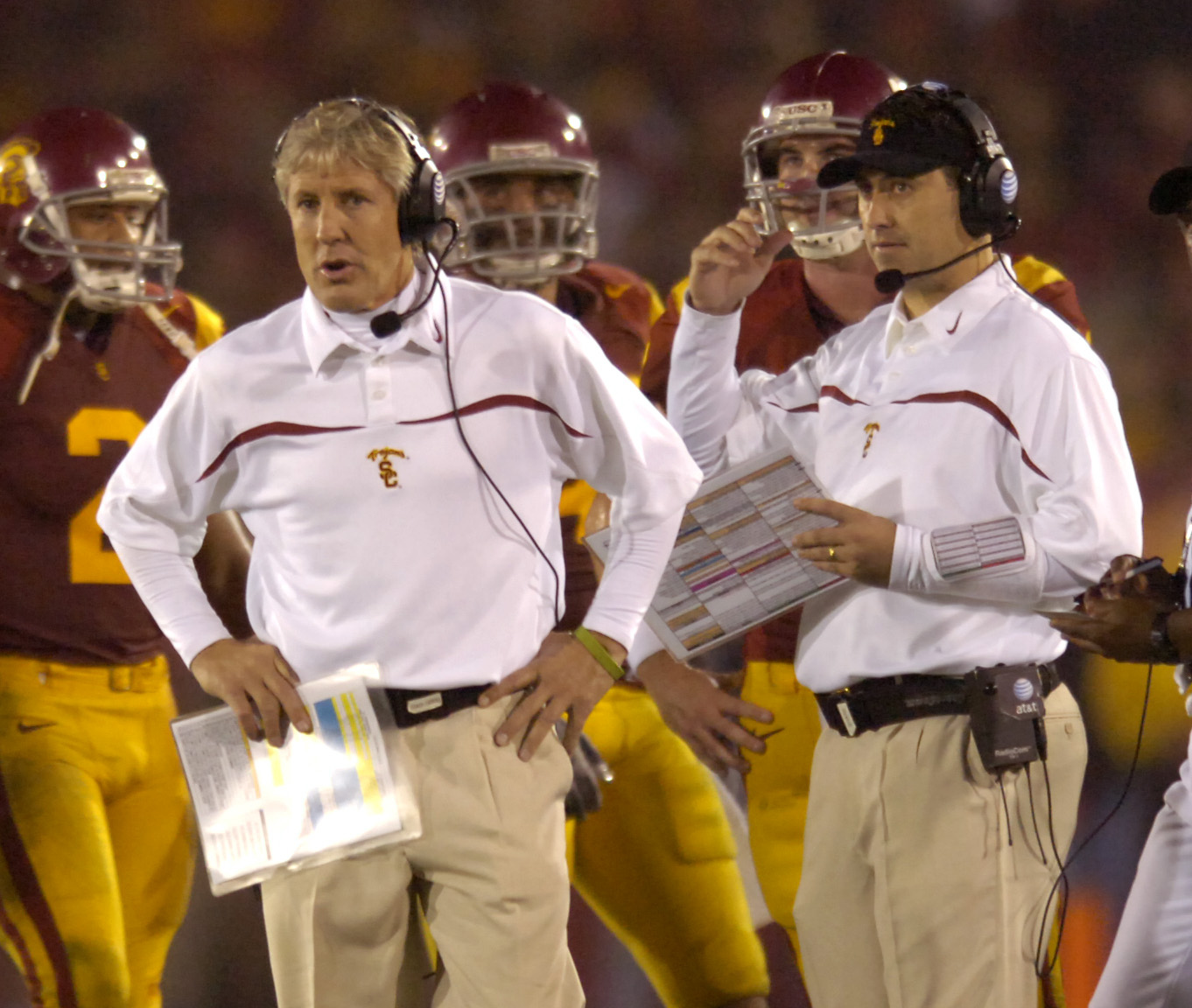
Head coach Pete Carroll, left, and assistant Steve Sarkisian on the sidelines for the USC Trojans during a game with California on Nov. 18, 2006. USC won, 23-9. (Daily Breeze staff file photo by Scott Varley)

Sources:

Daily Breeze archives.

Los Angeles Times archives.
“Steve Sarkisian,” BYU Football Wiki site.

“Steve Sarkisian’s Road to Texas,” The Audible podcast, Feb. 16, 2021.

Wikipedia.

CFL trading card.

Mike Lyman’s Flight Deck brought fashionable dining to the Los Angeles airport

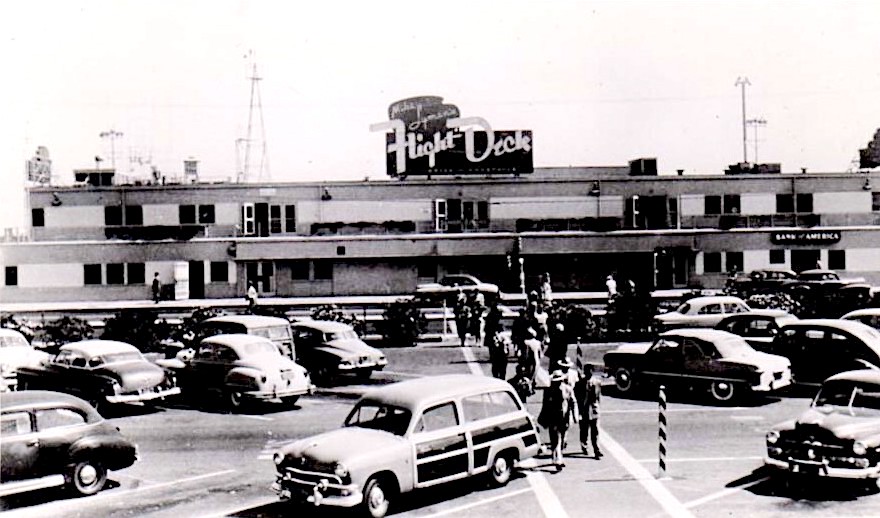
Mike Lyman’s Flight Deck as seen from the terminal parking lot. The restaurant faced the airstrip. Undated, circa late 1940s. (Credit: Martin Turnbull blog)

When veteran restaurateur Mike Lyman opened his latest eatery at the Los Angeles Municipal  Airport in 1946, he got in on the ground floor.

The bond issue authorizing funds for the former Mines Field to be developed into the city’s main airport had just passed in 1945. The major airlines who would be using it, namely American, TWA, Western, United, Pan Am and Southwest, spent 1946 quickly building terminals at the airport in time for the first flights on December 9 of that year.

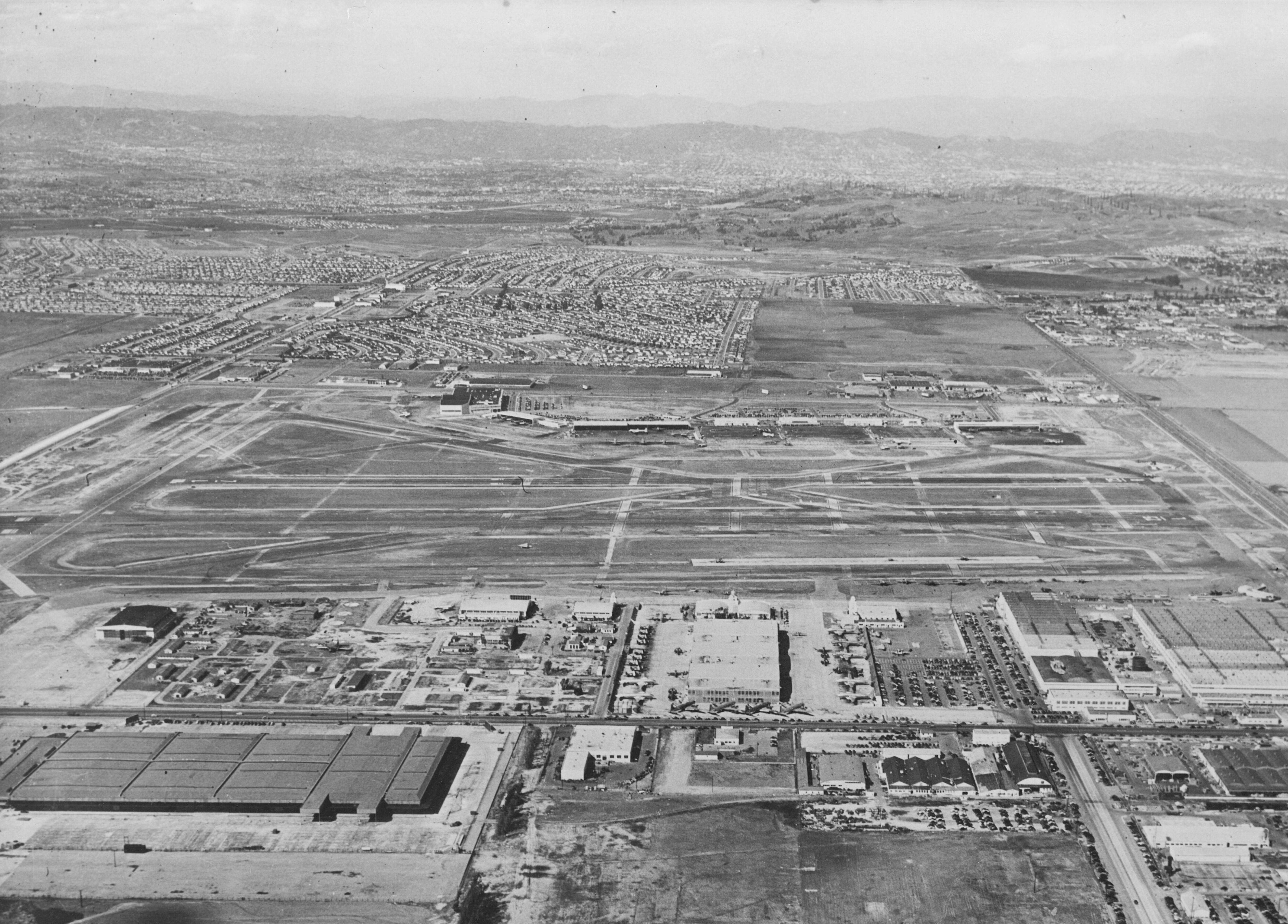
The airport, renamed Los Angeles International Airport in 1949, had a radically different layout then. The single row of terminals, mostly wooden buildings, was situated east and north of where the modern-day airport terminal loop sits now. The airport’s landing strips then were located along Century Blvd. west of Aviation Blvd.

Aerial view of the Los Angeles International Airport looking north, circa 1950. The terminals can be seen above the runways, center, with the main terminal slightly longer and darker-looking due to the tinted windows of the Flight Deck restaurant on its second floor. (Credit: USC Digital Library)

Lyman was awarded the franchise that made Mike Lyman’s Flight Deck the airport’s only full-service restaurant. Despite what I said above, he built it not on the ground floor but on the second (top) floor of the main terminal. Construction began in 1946, and the restaurant opened when the terminal did, on Dec. 9, 1946.

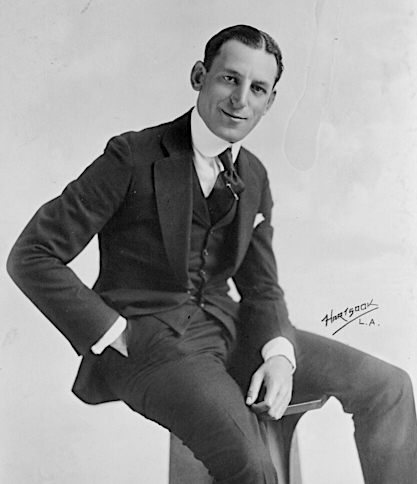
Mike Lyman when he was running the Palais Royale restaurant and ballroom in Downtown Los Angeles. Undated, circa early 1920s. (Credit: USC Digital Library)

Lyman ran his restaurants with a showman’s flair. Born Michael Simon in Chicago on May 29, 1887, he and his brother, Abe, became vaudeville performers in the early 1900s. (Abe Lyman would go on to be a successful local bandleader.)

Lyman became known for his singing and dancing nightclub act, and went on to make  entertainment part of his earliest restaurant ventures, the Sunset Inn in Santa Monica and the Palais Royale on 6th St. in downtown Los Angeles. The latter would later become Mike Lyman’s Grill, a celebrated downtown L.A. showplace restaurant and celebrity hangout.

Lyman’s restaurant ventures gradually began to overshadow his entertainment aspirations. He and his brother William began opening other eateries, including another one in downtown L.A., one in Hollywood, and, later, the Flight Deck at the airport. Under the terms of the agreement to operate the latter, an agreed-upon 10% of its gross revenues reverted to the city of Los Angeles.

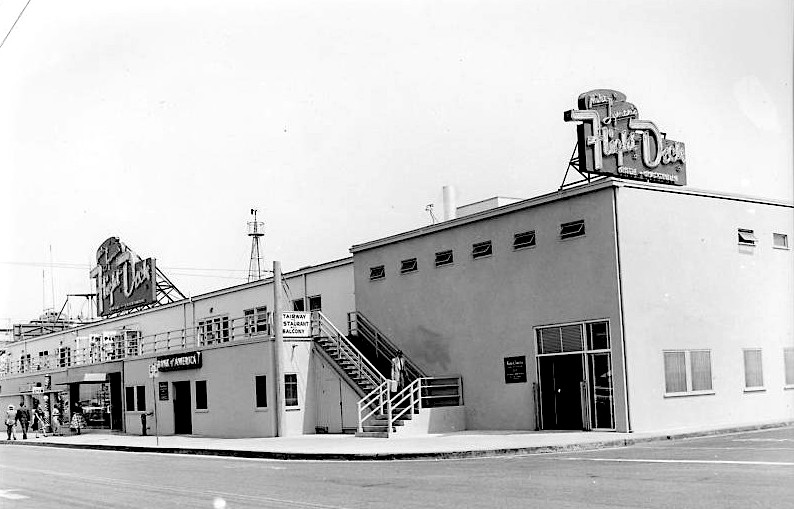
Flight Deck customers reached the indoor part of the restaurant, the Rocket Room, by climbing an outdoor flight of stairs. Just as popular was the outdoor open-air observation deck, which ran the length of the restaurant. Mounted coin-operated telescopes were available, and customers could watch planes land and passengers board to their heart’s content.

Undated photo circa 1950s shows the stairway leading up to Mike Lyman’s Flight Deck restaurant. The Bank of America can be seen at left, and the barbershop at far left. (Credit: Martin Turnbull blog)

In addition to the restaurant, the multipurpose main terminal at 5900 Avion Ave. also had government offices, including the Federal Aviation Administration, Weather Bureau and Flight Service Station.

The LAPD had its airport office there. The building also housed a Bank of America branch, a coffee shop, a Western Union office, a barbershop, and the first Travelers Aid office ever housed at an airport.

But the Flight Deck was the only restaurant, so it became a natural gathering place for travelers, aviation buffs and, not surprisingly given Lyman’s connections, celebrities. Stargazers had the chance to spot Clark Gable, Joan Crawford, Bob Hope and Groucho Marx, along with former first lady Eleanor Roosevelt and heavyweight boxing champ Joe Louis there.

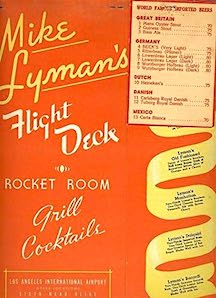
The restaurant’s bar menu.

The Flight Deck’s first few years turned out to be its most glamorous. Sadly, Mike Lyman himself became ill not too long after it opened, first undergoing kidney surgery in 1947. He rebounded briefly but, by 1950, he was bedridden. He underwent two more surgeries before he died on Nov. 29, 1952, at 65.

Mike Lyman’s Inc. continued to operate the restaurants, including the Flight Deck, with Lyman’s brothers William and Albert at the helm. But population growth and the rapid increase in the popularity of air travel at the dawn of the jet age meant big changes arriving at LAX.

The terminals built in 1946 hadn’t been meant to be permanent, but they ended up being used for 15 years. But the writing was on the wall in the latter half of the 1950s. A $59 million bond issue calling for a complete overhaul and modernization of the airport passed in 1956. The jet age literally arrived when a commercial jet landed at LAX for the first time in January 1959.

Over the next five years, the new terminals, many with their own eateries, gradually were built in roughly the same area that they are now. The old rickety buildings were slated to be torn down as the area in which they stood began to be transformed into air cargo facilities.

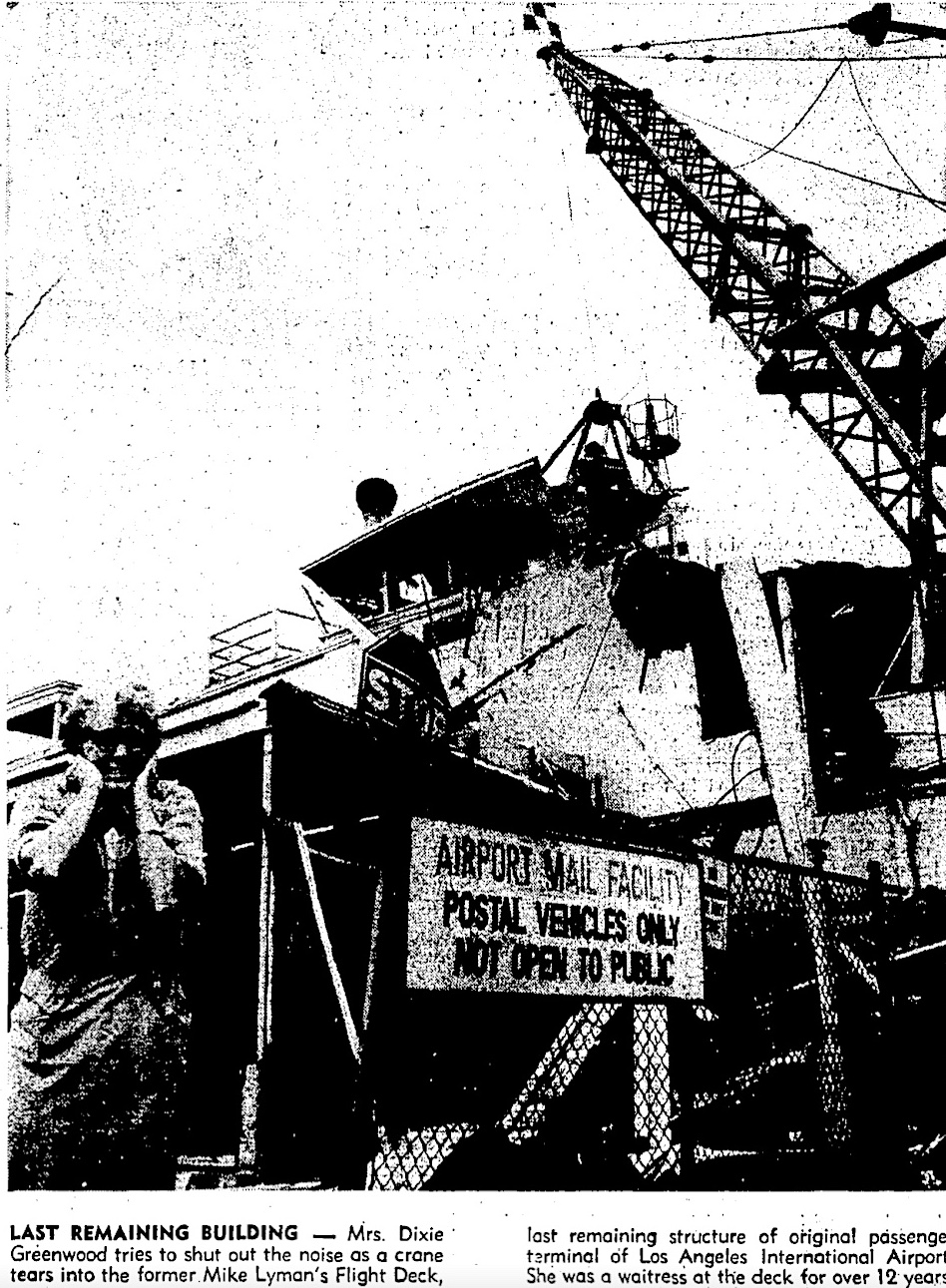
Los Angeles Times, June 29, 1969, Page CS1. Photo by George R. Fox. (Credit: Los Angeles Times archival database)

This left the once-central Flight Deck restaurant as a remote outpost far from the airport’s central activities, especially once the newly revitalized LAX opened in 1961. The restaurant soldiered on for a few months, but the completion of the futuristic Theme Building and its bird’s-eye-view restaurant in August 1961 seemed like a signal that the Flight Deck’s days were numbered. It closed for good in March 1962.

The old main terminal building actually survived for several more years as everything around it continued to change. A couple of the old tenants, the barber and the coffee shop, stuck it out after the Flight Deck closed, but even they had left by the time the building finally was razed in June 1969. The 5900 Avion Ave. address now belongs to Mercury Air Cargo Inc.

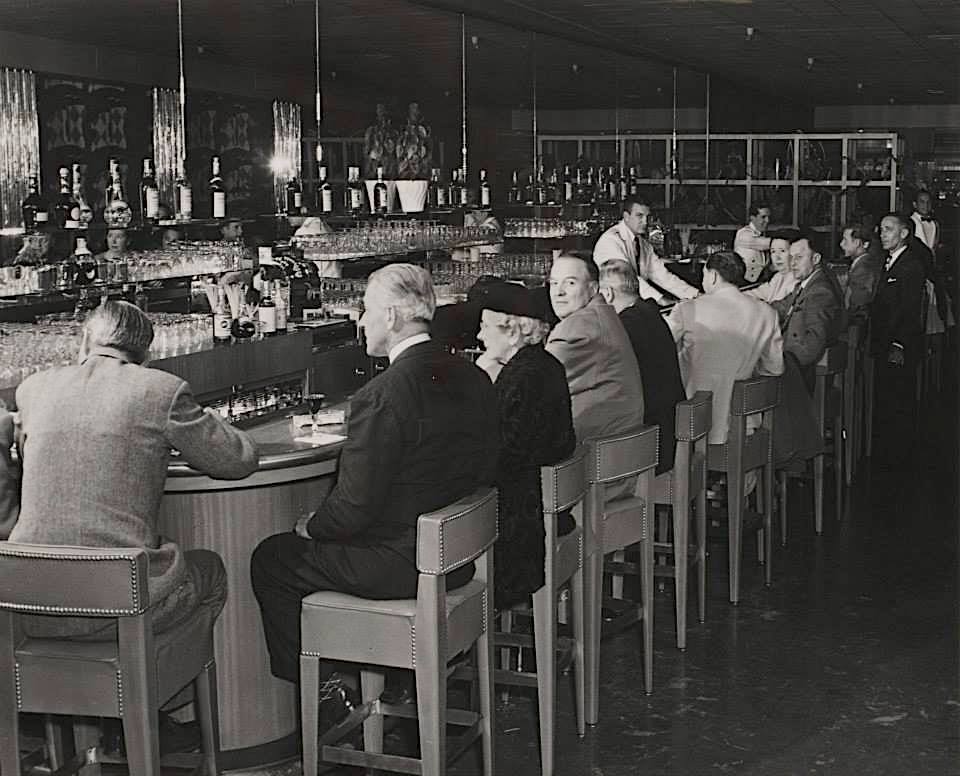
Patrons belly up to the Rocket Room bar at Mike Lyman’s Flight Deck restaurant at Los Angeles Municipal Airport in 1948. (Credit: LAX Facebook page)

Sources:

Daily Breeze archives.

Find a Grave website.

LAX: Los Angeles International Airport: From Lindbergh’s Landing Strip to World Air Center, by Tom Moran, CCA Publications, 1993.

“Looking Back: Mike Lyman’s Flight Deck Restaurant First to be Located on Airport Property,” from Aerogramme: Newsletter For the Employees of Los Angeles World Airports, LAWA, May 2014.

Los Angeles Herald archives.

Los Angeles Times archives.
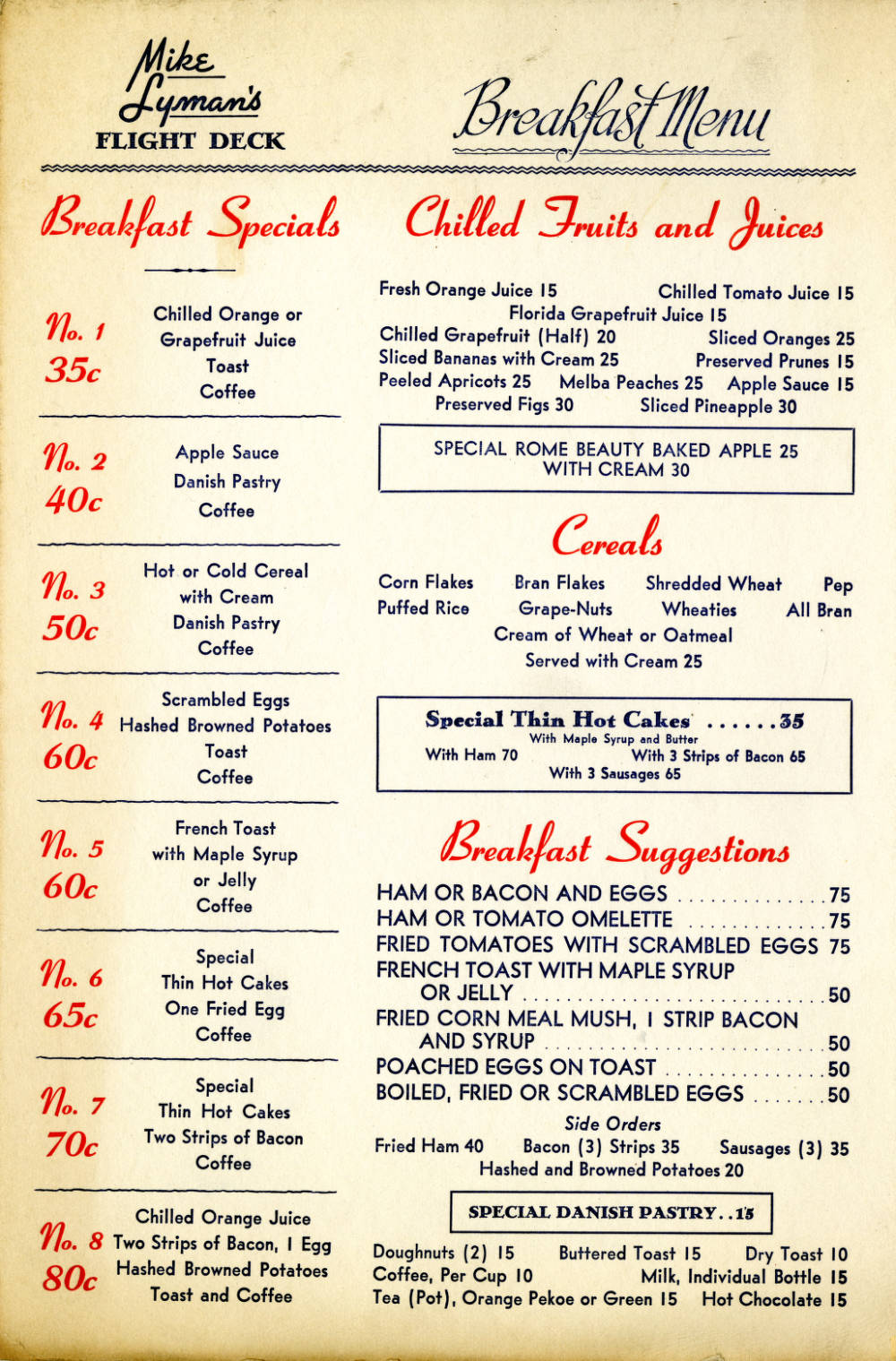
Breakfast menu from Mike Lyman’s Flight Deck. Undated, circa 1950s. (Credit: Los Angeles Public Library Photo Collection)

Frank Vanderlip had an expansive vision for the barren hills of the Palos Verdes Peninsula

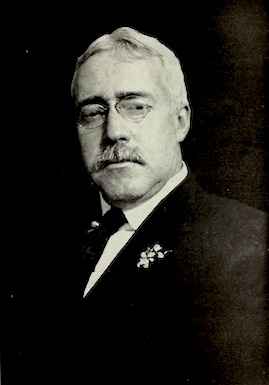
Frank Vanderlip. 1909. (Credit: Wikimedia Commons)

Somehow it’s not surprising that the man who felt awed by the unspoiled beauty of the rural  Palos Verdes Peninsula when he first saw it in person in 1914 was raised on a farm. 

Frank A. Vanderlip was born into a large family in Aurora, Illinois, on Nov. 17, 1864. His parents, Charles and Charlotte, ran a farm in neighboring Oswego, Illinois, until Charles died in 1878.

Depsite his mother’s best efforts, keeping the farm going became untenable, and it was sold in 1916. The family moved to the city of Aurora, where Frank, now 16 and a good student, quit school in order to find work to help support the family.

He worked in a lathe factory while taking classes at the University of Illinois. He then turned his attention to journalism, eventually becoming the city editor at the local Aurora Evening Post in 1885.

After that, he worked for a few years as a financial investigator in Chicago. His interest in the financial industry led to him becoming a business reporter, and then financial editor, at the Chicago Tribune.

While taking a class in political economics at the University of Chicago, he met Lyman J. Gage, who would go on to become Secretary of the Treasury under President William McKinley in 1897. Gage hired Vanderlip as his secretary, and was so impressed by him that he successfully petitioned for him to be named Assistant Secretary of the Treasury a few weeks later.

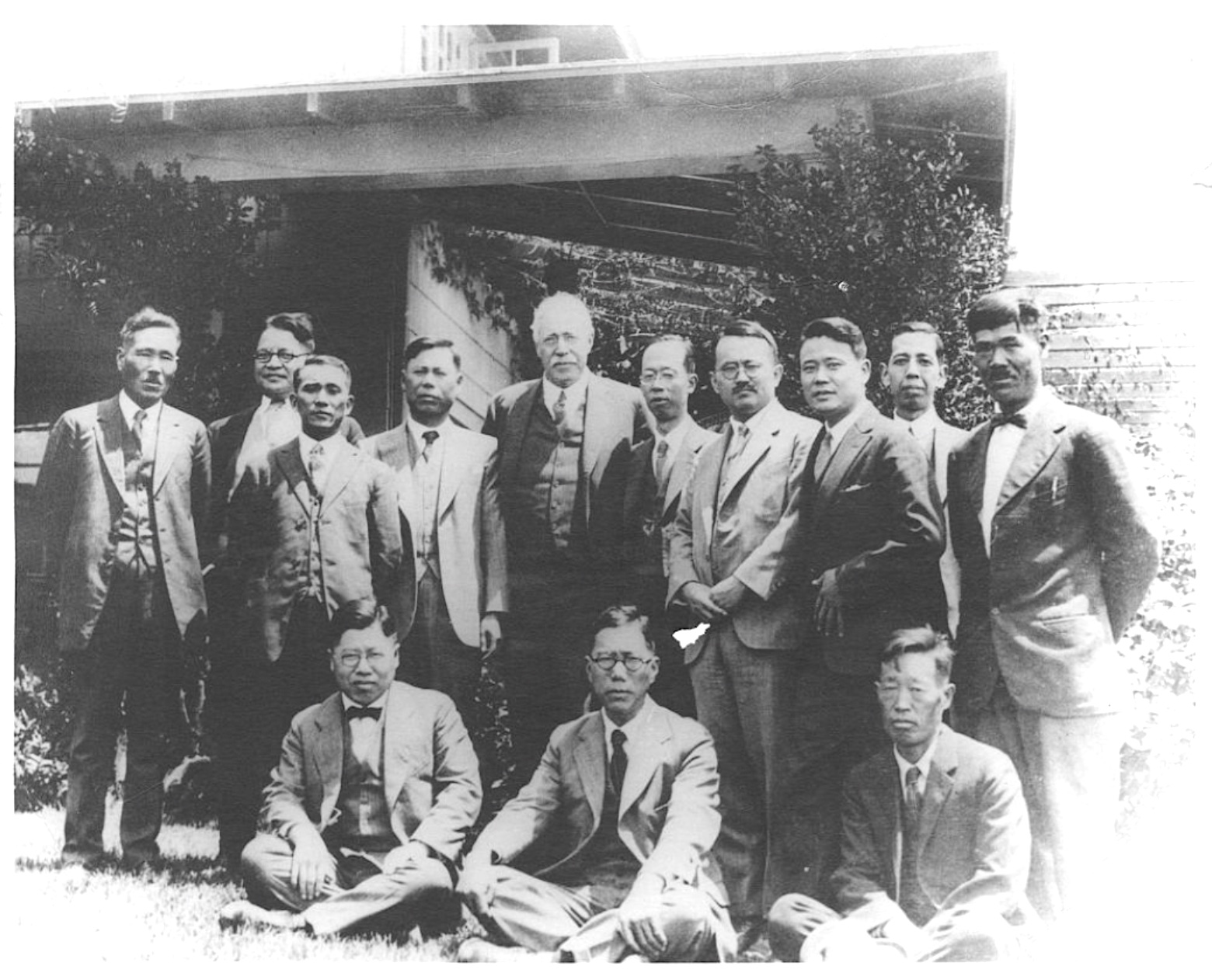
Frank Vanderlip stands in the center, back row, among 12 Japanese community leaders in Palos Verdes and visiting dignitaries, including Nobusuke Kishi, later Prime Minister of Japan, back row, second from far right. 1928 photo. (Credit: PV Local History Center, Palos Verdes Library District)

Vanderlip’s handling of the financing of the Spanish-American War in 1898 – he devised the system of war bond sales that would later be used in World War I and II – brought him to the attention of the president of the National City Bank of New York, James Stillman. Stillman hired Vanderlip at the firm which would later become Citibank, and he became a vice president there in 1902. He would serve as the bank’s president from 1909 to 1919.

He married Mabel Narcissa Cox in Chicago in 1905. (She dropped Mabel from her name, becoming Narcissa Cox Vanderlip.) The couple bought a home on the Hudson River near Scarborough, New York, in 1907. In 1913, the couple founded the Scarborough School, the first Montessori school in the United States.

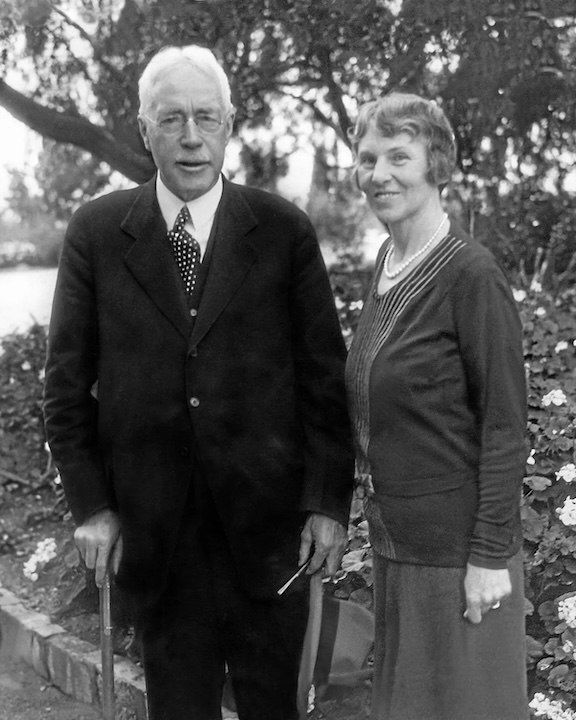
Frank Vanderlip, Sr. and his wife, Narcissa, at their home in Palos Verdes circa 1931. (Credit: Daily Breeze file photo)

After years experiencing the ups and downs in the financial industry, Vanderlip became convinced that investing in land was the soundest choice, and he began to seek out opportunities in real estate.

By 1913, the Bixby family, who had been operating farming and ranching operations on the undeveloped Rancho de Los Palos Verdes  they had received from the Sepulveda family in an 1882 land grant, were ready to sell. Owner George Bixby contacted a man named Carl Schader, who wanted to buy the 16,000 acres.

Schader didn’t have the wherewithal to pull off the deal, but he got in touch with Vanderlip in New York, seeking financing. Vanderlip ended up purchasing the acreage himself, sight unseen, in November 1913, after hearing back from two scouts he sent to examine it.

Intrigued by the possibilities of the land and its location, he paid his aforementioned first visit there in 2014. Looking at the barren hillsides with their spectacular ocean views, he envisioned a Mediterranean-styled open-air settlement enriched by lush vegetation and, yes, peacocks. Vanderlip was an ardent bird fancier who is credited with introducing the birds to Palos Verdes. 

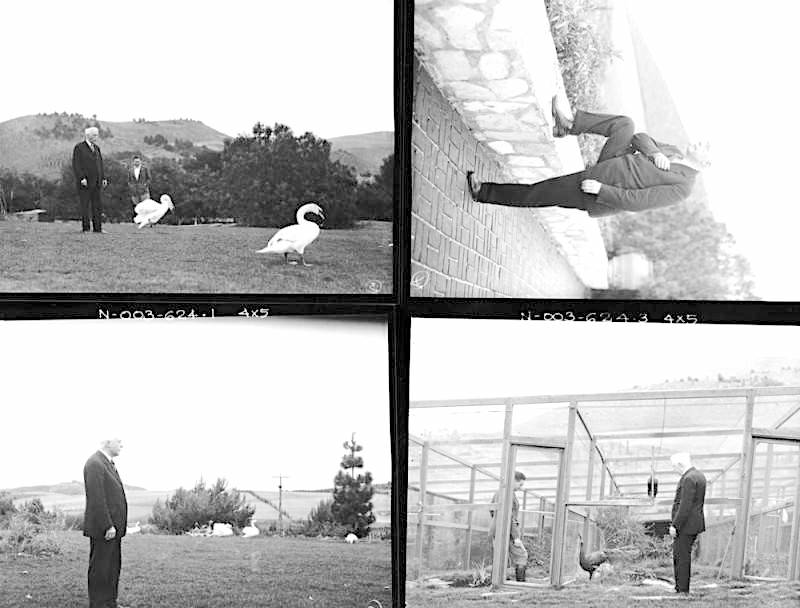
Views of the landscape around Frank Vanderlip’s Villa Narcissa estate and photos of him with his birds, circa 1930’s.
(Credit: Los Angeles Public Library Photo Collection)

In his autobiography, From Farmboy to Financier (Appleton-Century, 1935), he recalled: “The road over which I drove a I filled my eyes with a first sight of Palos Verdes Ranch was the corridor of one of the most exciting experiences of my life.”

One of his first moves was to hire the Olmsted brothers, who had designed downtown Torrance, to handle the landscape design, and architects Myron Hunt and Edward Shaw in 1914. But World War I led to the project being temporarily shelved.

After the war, Vanderlip hired real estate salesman E.G. Lewis in 1921. Lewis ran a highly successful operation to sell housing lots, until his sudden fall from grace in 1923. He would later declare bankruptcy and end up in prison for mail fraud unrelated to his Palos Verdes activities.

Vanderlip had built his first building, a cottage on a Portuguese Bend hillside overlooking Wayfarers Chapel in present-day Rancho Palos Verdes, in 1916. More structures were added to the 11.5-acre estate at 100 Vanderlip Drive in the 1920s, and it became known as Villa Narcissa, named for Vanderlip’s wife.

Vandelip began spending more time at Villa Narcissa and at Beechwood, his New York estate, during the 1920s. He lessened his involvement in business affairs, especially after his 1924 testimony before Congress outlining corruption during the Teapot Dome scandal alienated him from the corporate world. He was forced to resign from more than 40 boards of directors after speaking out.

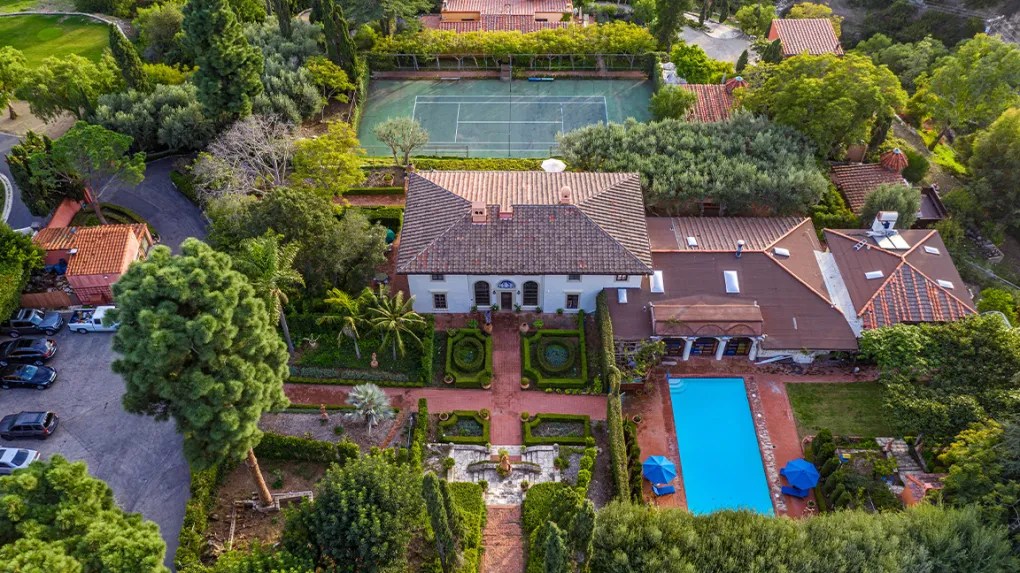
Villa Narcissa in Rancho Palos Verdes sold for $10.5 million in 2020. (Aerial photo by Simon Berlyn of Berlyn Photography)

He lived long enough to see his Palos Verdes vision blossom, however.  He died in New York Hospital in Manhattan on June 20, 1937 at 72, two weeks after being hospitalized for an intestinal ailment.

Villa Narcissa, which eventually grew to include a 7,700-square-foot mansion, 10 guest cottages, a swimming pool and a tennis court, was put on the market in 2020, after years of effort by Vanderlip’s descendants to maintain and restore it. It sold for $10.5 million.

Sources:

Daily Breeze archives.

Los Angeles Times archives.
Palos Verdes Peninsula News archives.
The Palos Verdes Story, by Delane Morgan, The Palos Verdes Review, 1982.
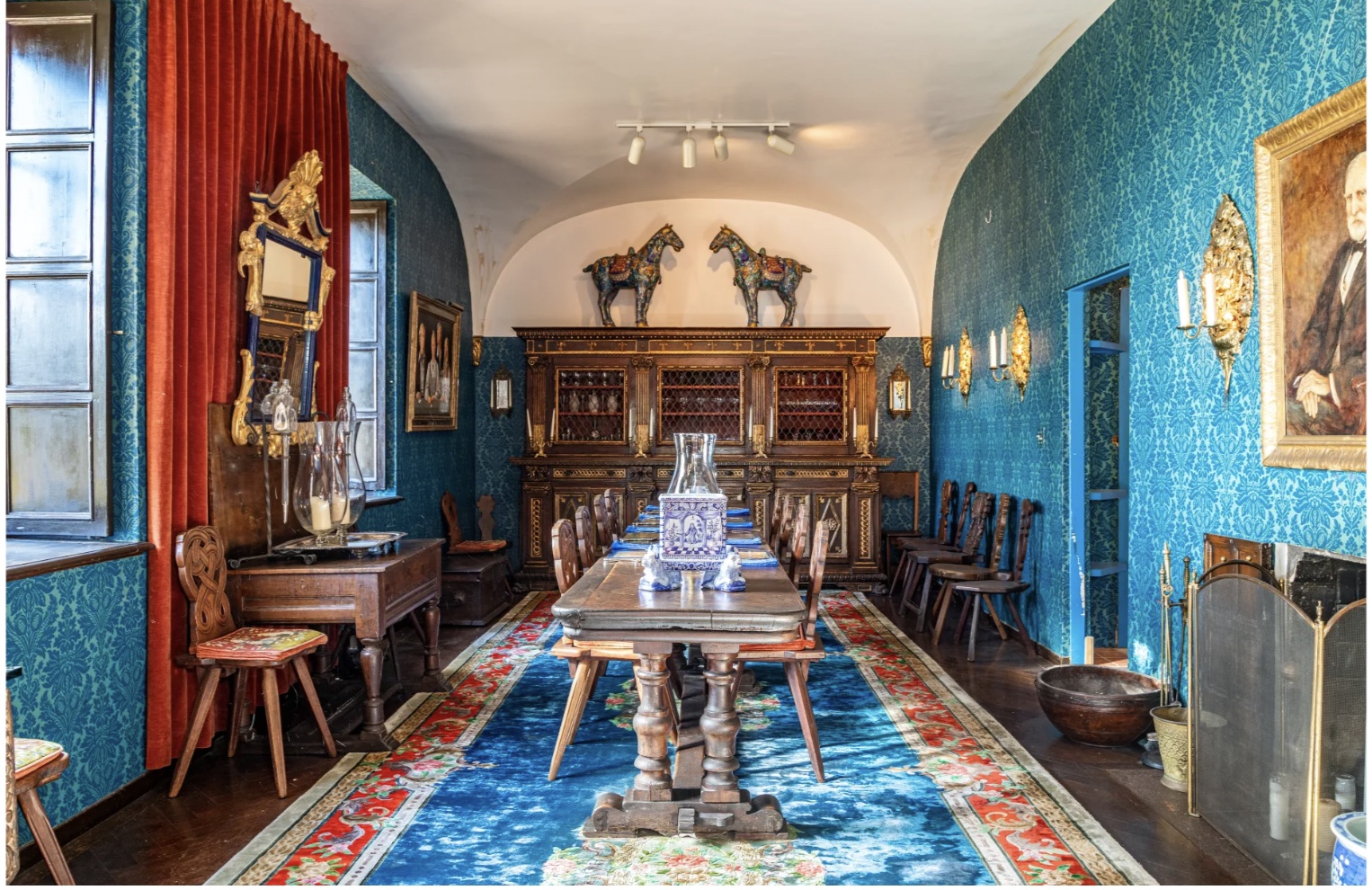
The dining room in the main house at Villa Narcissa in Rancho Palos Verdes in 2020. (Photo by Simon Berlyn, Berlyn Photography)

Further reading:

Frank A. Vanderlip: The Banker Who Changed America, by Vicki A. Mack, CreateSpace Independent Publishing Co., 2013.

From Farm Boy to Financier, by Frank A. Vanderlip and Boyden Sparkes, Dauphin Publications, 2017. (Originally published in 1935.)

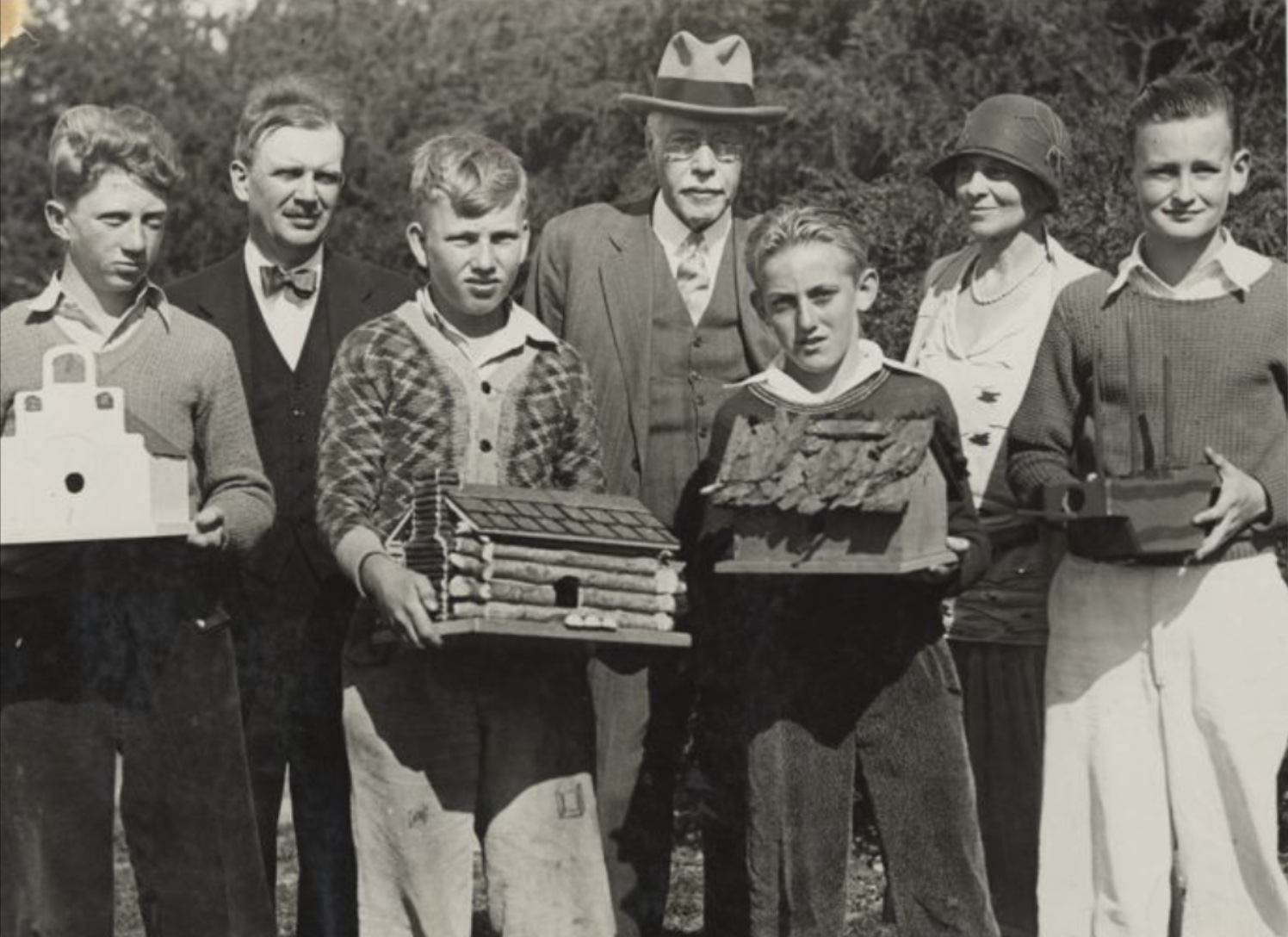
From left, front row, Melroy Hodge, Gordon Anderson, Tod Snelgrove and Tom Davis, four students who won prizes in the second birdhouse building contest at Malaga Cove School, pose with the three judges of the event: rear row, from left, Charles H. Cheney, Frank A. Vanderlip and his wife, Narcissa Cox Vanderlip. 1931 photo. Winners were awarded books on architecture and ornithology. (Credit: PV Local History Center, Palos Verdes Library District)
Is this your new site? Log in to activate admin features and dismiss this message
Log In