The Bob Hope USO at LAX has offered comfort to traveling military personnel for decades

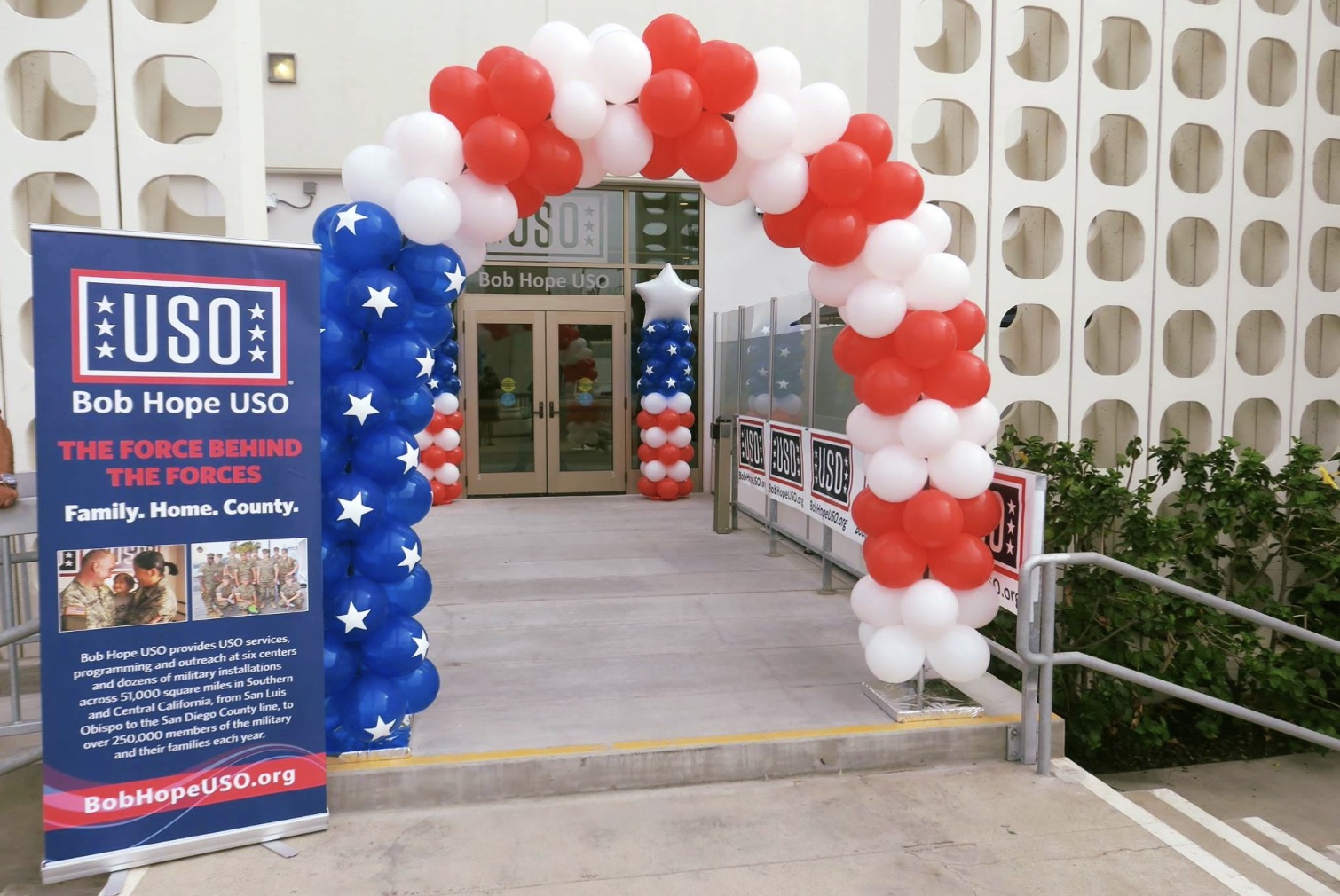
The entrance to the Bob Hope USO at LAX is festooned with balloons for its dedication on Sept. 26, 2018. (Credit: Bob Hope USO at LAX Facebook page)

President Franklin Delano Roosevelt signed the bill creating the United Service Organization (USO) on Feb. 4, 1941, ten months before the Pearl Harbor attack brought the U.S. into World War II.

The idea behind the USO was to enlist various non-governmental public service agencies to offer comfort and morale to members of the military in an organized way. The Department of Defense had wanted to take on the responsibility, fearing loss of control over its military personnel, but Roosevelt felt private agencies were better suited for the job.

The six agencies tapped for the new effort included The Salvation Army, the Jewish Welfare Board, National Catholic Community Service, the Young Men’s Christian Association (YMCA), Young Women’s Christian Association (YWCA), and the National TravelerÙs Aid Association.

Under the terms of the new organization, the six agencies would provide the comfort services required, and the government would fund the building of the new USO centers planned throughout the country.
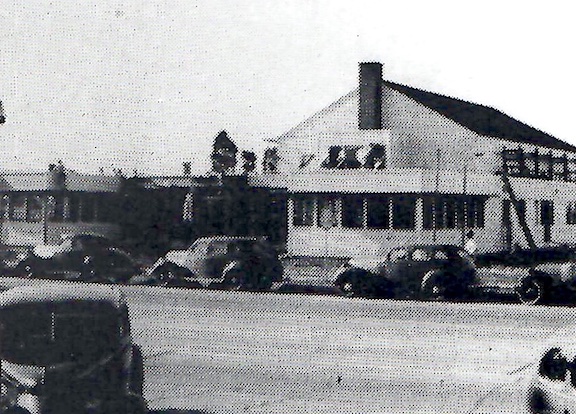
The Inglewood USO on La Brea Ave. Undated, circa 1941-45. (Credit: History of Inglewood, by Gladys Waddingham)

A hospitality center on seven acres of city-owned land at 700 N. La Brea Ave. in Inglewood became part of the first wave of USO buildings to go up when it opened on Dec. 21, 1941, just two weeks after Pearl Harbor. An estimated 2,000 visitors streamed into the $75,000 structure at the dedication ceremony.

Its proximity to Mines Field, soon to be renamed Los Angeles International Airport, and to area defense plants made Inglewood a natural location. (The La Brea location eventually became the site for the city’s Department of Motor Vehicles office, which remains there to this day.)

Other USO sites were built throughout the area, most notably in Hollywood. The movie industry acted quickly to support the new organization, notably with an all-star fundraising event at the Hollywood Bowl on June 29, 1941, that attracted a record-breaking 30,000 people.
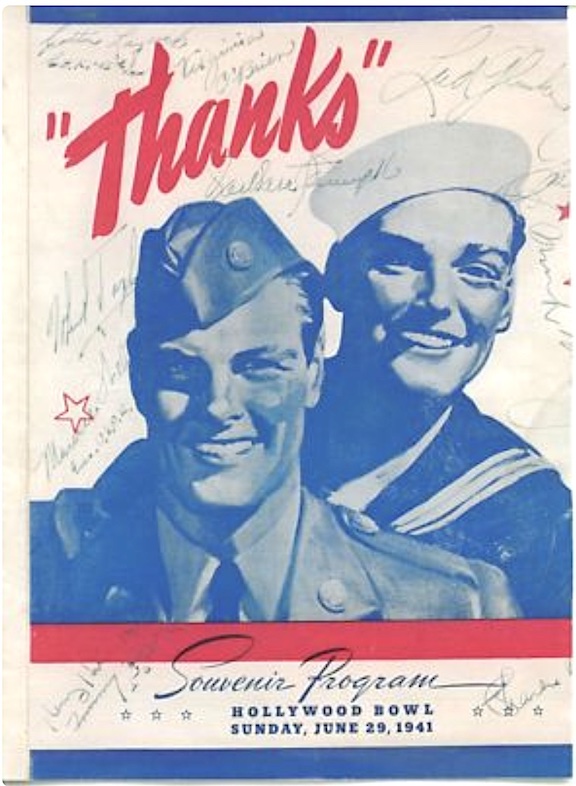
Program for the 1941 USO fundraising event at the Hollywood Bowl features signatures of some the celebrities who appeared. The list included Gene Autry, Barbara Stanwyck, Dick Powell, Edward Arnold, Edward G. Robinson, Gracie Allen, Orson Welles, Robert Taylor, Charles Boyer, Irene Dunne, Jackie Cooper, Bette Davis, Meredith Wilson, Fanny Bruce,, Rosalind Russell, Cary Grant, Virginia O’Brien, Francis Langford and Loretta Young

Activities at the Hollywood USO at 1531 N. Cahuenga Blvd. naturally drew most of the publicity, as movie stars and celebrities were frequent guests and performers there. The 1944 film “Hollywood Canteen” was based on it.

In 1951, the Travelers Aid Society added service for military travelers at its desk at Los Angeles International Airport, helping them find their way in the airport, which had just officially become a full-service international facility in 1949.

For decades, USO services at LAX consisted chiefly of one person manning a phone and answering questions at the Travelers Aid desk. 
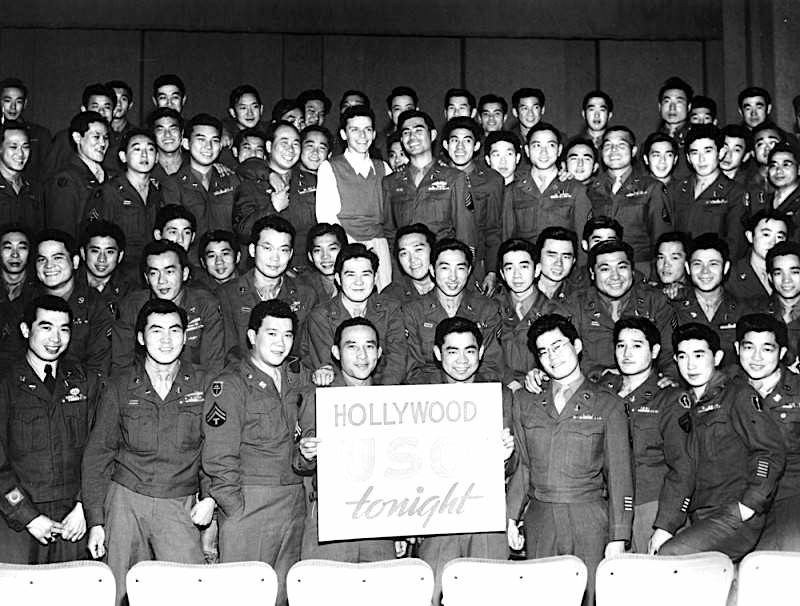
Frank Sinatra, in civilian clothes top center, poses with the Nisei Boys of the #442 Regimental Combat Team, the most highly decorated group in the U.S. Army during World War II, to the Hollywood USO on Jan. 4, 1946. Sign reads “Hollywood USO tonight.” (Credit: Los Angeles Public Library Photo Collection)

By 1980, the USO had 24 square feet of space and its own desk, but little else at the airport. Other major airports, notably in San Francisco and New York, had USO lounges offering places for soldiers to eat, shower and relax between flights.

USO management set about to change that in 1984, succeeding in opening a small 1,600-square-foot facility that offered little more than snacks and drinks. It had only one bathroom. Its location and size made it somewhat difficult to find, and its hours were variable due to staffing shortages.

After years of struggle, the USO upgraded the facility near the LAX Theme Building in 2004, thanks to $250,000 in private contributions and furnishings donated by Home Depot.

It still wasn’t huge at 3,600 square feet, but it was more comfortable and accessible than it had been. It offered comfy furniture, a 40-seat theater, a kitchen, showers, library and a computer room.
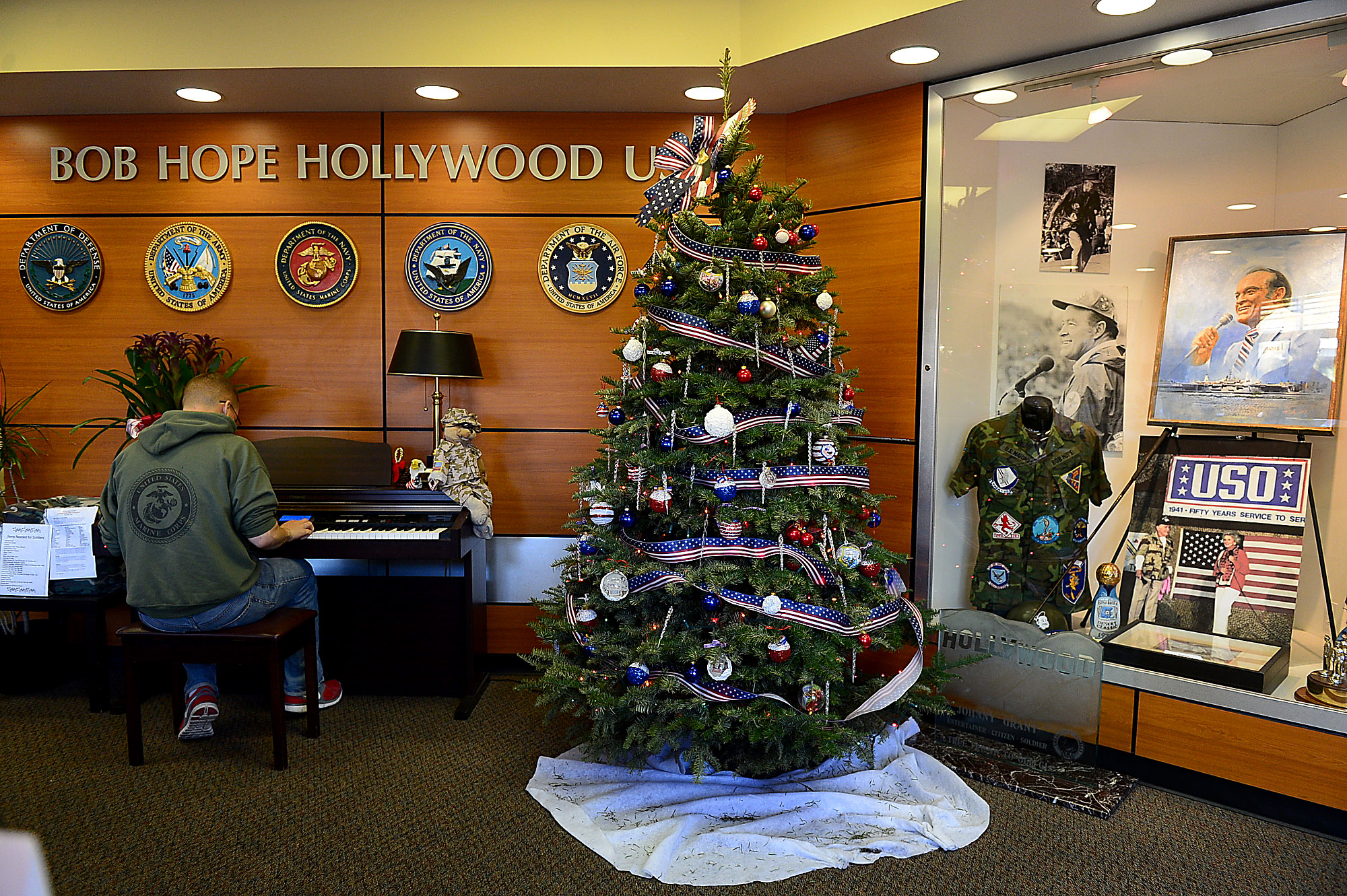
Troops on leave for the Christmas wait for flights out of LAX at the Bob Hope USO on Dec. 21, 2012. (Daily Breeze file photo by Sarah Reingewirtz)

Finally, the USO got the center it had always wanted at LAX when airport officials agreed to allow them to move into the empty space on the ground floor of the Theme Building. With LAX’s gigantic ground transportation project slated to begin, the USO’s old space was needed for its construction, while the Theme Building will remain intact.

The USO’s new permanent home is almost double the size of the old one, at 7,100 square feet. It’s brightly lit and easily visible to travelers. Improvements include a reception area, a Bob Hope memorabilia display, a pavilion, a family zone, a family hub room, three private connection rooms, a gaming lounge, a movie theater, a relaxation room, a dining room, a TV lounge, and troop baggage storage racks.
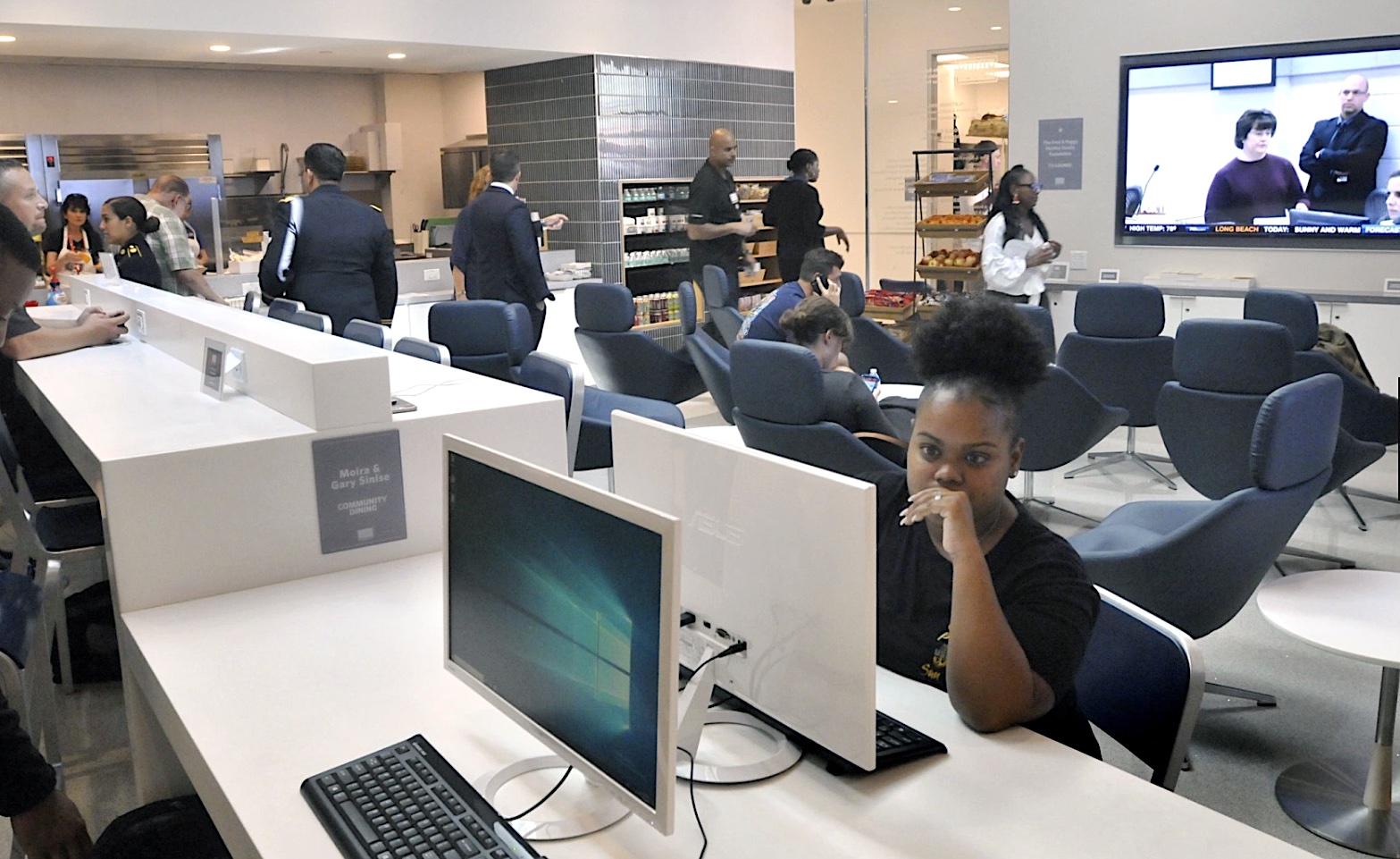
Interior of the new Bob Hope USO at LAX on Sept. 26, 2018. (Daily Breeze file photo by Mike Mullen)

“This makes a big difference,” Bob Hope USO president Bob Kurkjian told the Daily Breeze in 2018. “With all the extended layovers, they (military personnel) can come here and relax in a safe environment, all at no cost to them.”

Over the years, comedian Bob Hope’s name became synonymous with the USO thanks to his tireless tours entertaining troops, usually in combat zones. Hope, who died in 2003, made his first appearance at a USO show on May 6, 1941 at March Field (now March Air Reserve Base) in Riverside.

Thus it was only fitting that the facility at LAX be called the Bob Hope Hollywood USO. Originally named for World War II flying hero Jimmy Doolittle in 1984, its name was shortened to the Bob Hope USO at LAX for its dedication in 2018. Other L.A. area USO airport travel centers are located at Ontario International Airport, John Wayne Airport, Palm Springs International Airport and March ARB.

Through it all, from 1941 until the present day, the USO has retained its independence from the federal government, and continues to receive all its funding from personal and corporate donations. It leases its current space in the Theme Building for $1 a year.
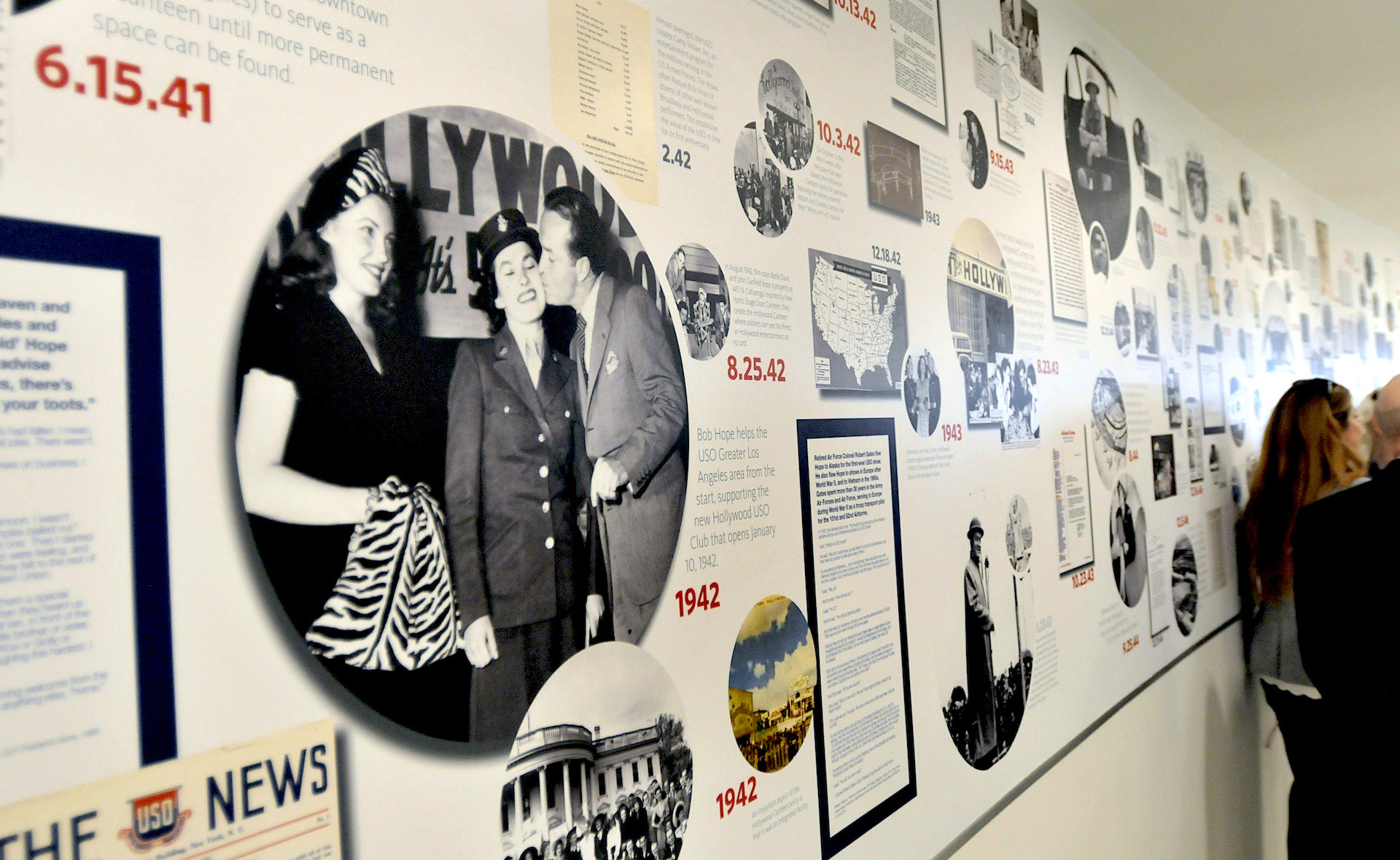
A wall display details the history of Bob Hope and the USO over the years at the Bob Hope USO Center in the LAX Theme Building. Sept. 26, 2018. (Daily Breeze file photo by Mike Mullen)

Sources:

Bob Hope USO Los Angeles website.

Daily Breeze archives.

The History of Inglewood, by Gladys Waddingham, published by the Historical Society of Centinela Valley, 1994.

Los Angeles Times archives.

“70 Years Ago Today,” The Official USO Blog, May 6, 2011.

WW2 USO Preservation Association website.
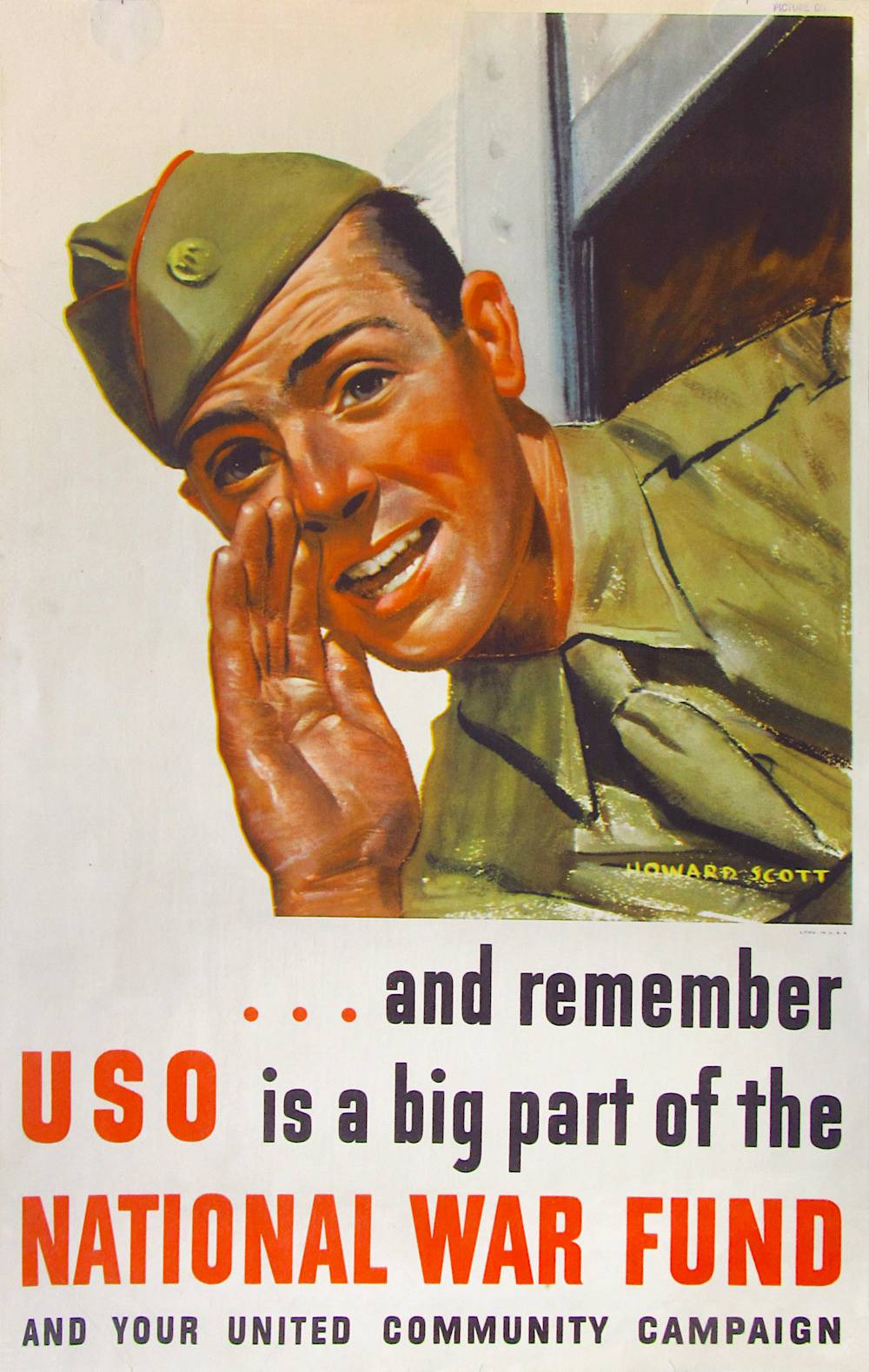
World War II-era USO fundraising poster. (Credit: Oakland Public Library archives)

Two future U.S. presidents both campaigned for California governor in the 1960s

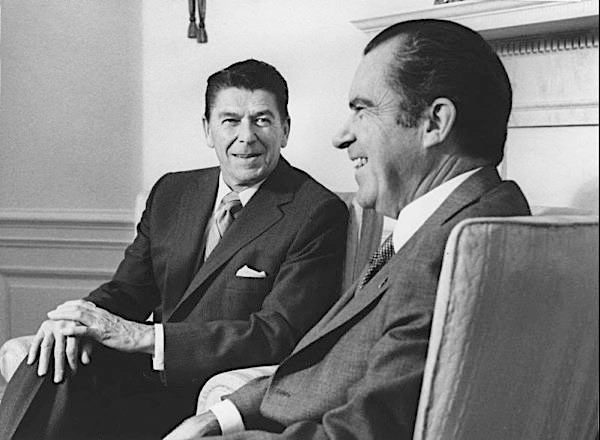
Ronald Reagan, left, and Richard Nixon. Undated, circa 1970s. (Credit: Richard Nixon Foundation Facebook page)

During the 1960s, the booming South Bay seemed to be coalescing into one giant suburb. Tract houses, modern industry and retail megaplexes dotted the landscape.

Tens of thousands of its residents worked in the aerospace industry. Firms such as TRW, Northrop, Hughes Aircraft, North American Rockwell and Douglas Aircraft built huge plants in the area, and dozens of other related but less monolithic firms based operations there.

The area had become so central to aerospace that the U.S. Air Force built the Los Angeles Air Force Base in El Segundo in 1962. It had no airplanes or runways – its function was mostly administrative – but it embodied the area’s close ties to the military and defense-related industries.

When it came to politics, those living the good life in southwest Los Angeles county tended to have conservative views. The firms they worked for had close links to the government. Fear of communism and general Cold War paranoia also held some sway over decisions at the ballot box.

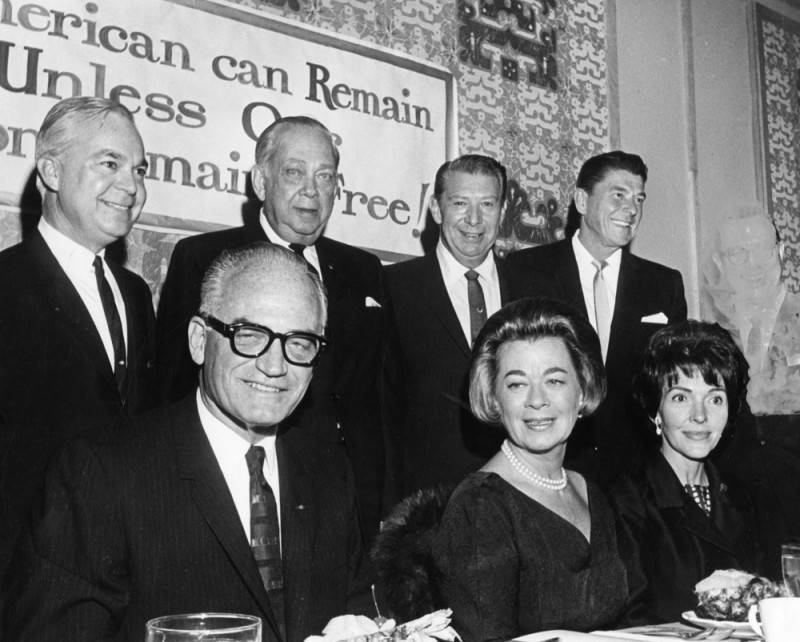
Former Arizona Sen. Barry Goldwater spoke at the annual dinner of the Americanism Educational League at the International Hotel in Westchester on Feb. 23, 1965. From left: League president A. J. Miller, Russell Quisenberry, Harry von Zell and Ronald Reagan. Front row, from left, Goldwater, his wife Margaret, and Nancy Reagan. (Credit: Los Angeles Public Library Photo Collection).

The South Bay and Harbor Area thus became a prime destination for Republicans seeking higher office. Two men in particular would visit often during their campaigns for the California governor’s office.

The first of these, Richard M. Nixon, announced his plan to run for governor of California on Sept. 27, 1961. Nixon first won election to the U.S. Congress in 1946, serving California’s 12th Congressional District. In 1950, he waged a successful campaign to win the U.S. Senate seat race against Helen Gahagan Douglas. 

Nixon then served two terms as Vice President under President Dwight Eisenhower from 1952-1960. In 1960, he ran for President, losing narrowly to John F. Kennedy.

Having grown up in nearby Whittier, Nixon knew the demographics of the area well. He worked the South Bay hard during his 1962 campaign against the incumbent Democratic governor, Edmund G. “Pat” Brown.

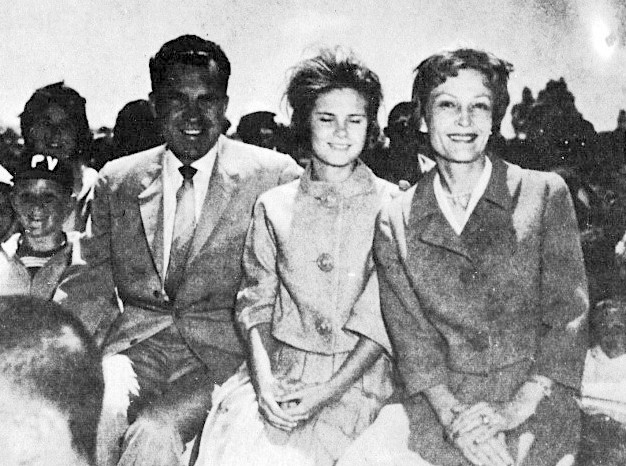
Gubernatorial candidate Richard Nixon, left, along with daughter Tricia and wife Pat, ride in the Grand Marshall’s car at the Fiesta de los Serranos parade in Palos Verdes Estates on May 12, 1962. (Credit: Palos Verdes Peninsula News archives)

His visits included giving a speech to area Republican clubs at a packed South High School gym on March 20th, and acting as grand marshall before 13,000 spectators at the Fiesta de los Serranos parade in Palos Verdes Estates on May 12. 

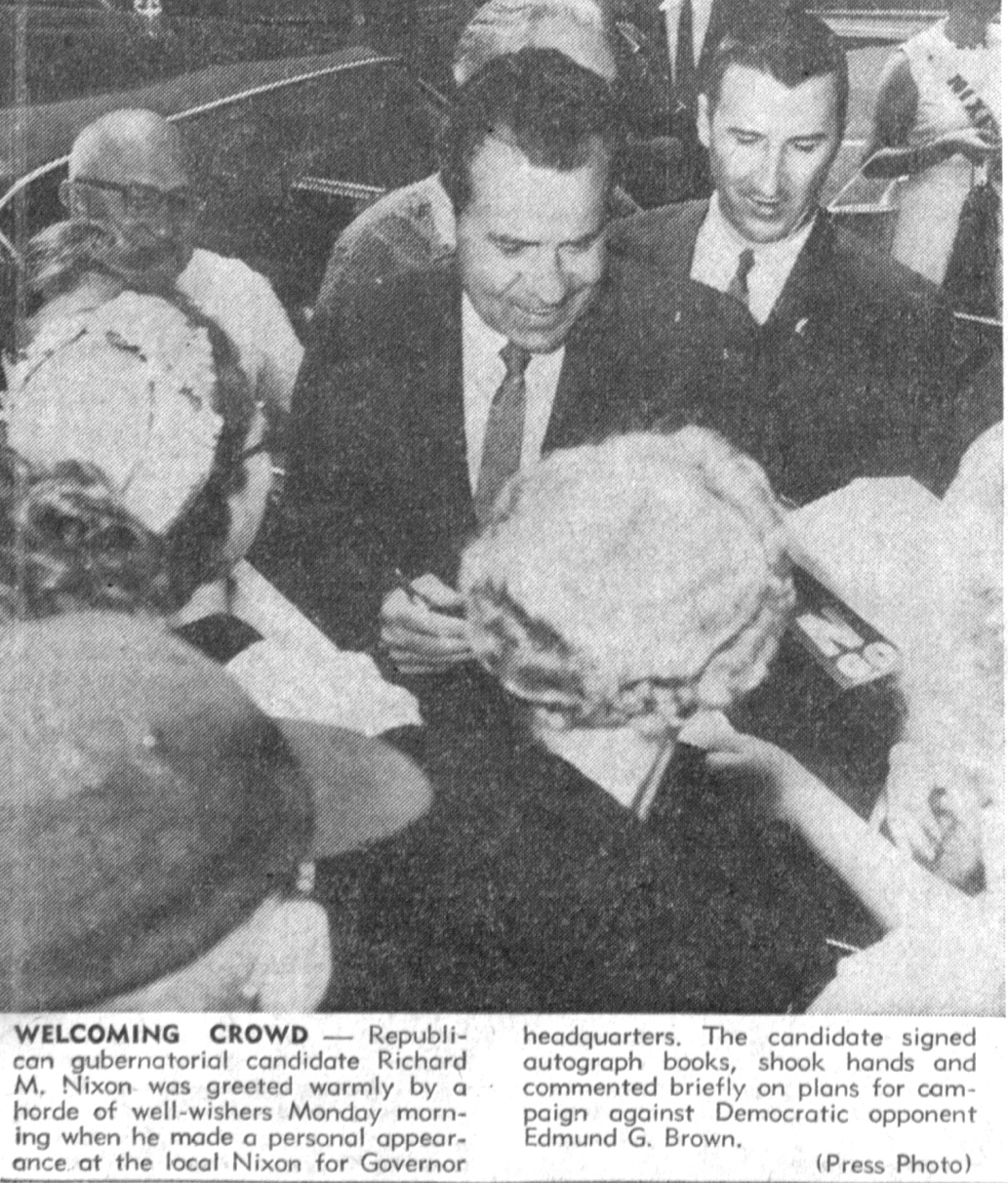
On June 4, the day before the Republican primary election, he appeared at his South Bay campaign headquarters at 1307 Post Ave. in downtown Torrance. He was greeted by a large crowd there, including the Torrance Nixonettes, a group of high-school-age female Nixon supporters. He went on to win the primary, handily defeating his opponent, Joe Shell.

Torrance Press, June 6, 1962, Page 1. (Credit: Torrance Historical Newspaper and Directories Archive database, Torrance Public Library)

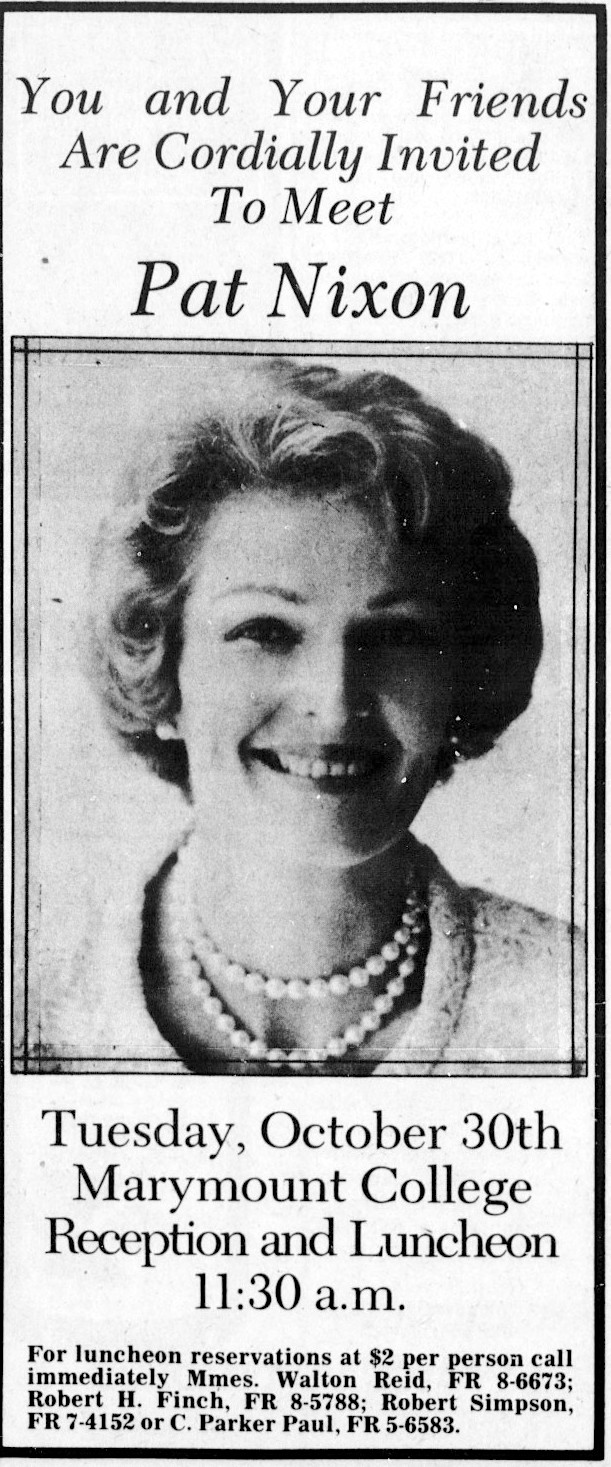
He would make several more visits to the South Bay and Harbor Area before the November election. His wife, Pat Nixon, even appeared at three events in one day on Oct. 30, a luncheon at Marymount College and teas held in Hermosa Beach and San Pedro.

Despite his best efforts, Nixon lost the election to Gov. Brown by a decisive five percentage points.

At a post-election news conference on Nov. 7, Nixon made his now infamous “…you don’t have Dick Nixon to kick around any more” statement to the press, indicating he wouldn’t run for office again. Six years later, he ran for U.S. president and won, defeating Democratic foe Hubert H. Humphrey.

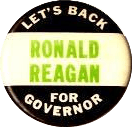
Four years after Nixon lost to Pat Brown, another Republican challenger took Brown on. In late 1965, Hollywood actor-turned-politician Ronald Reagan announced that he was planning to enter the California governor’s race. Reagan had never held political office before, though he had been president of the Screen Actors Guild twice.

He turned his attention to politics in the 1960s, turning heads at the 1964 Republican National Convention with his speech, “A Time For Choosing,” which endorsed eventual nominee Barry Goldwater. 

His combination of staunchly conservative views and movie star charisma caught the eye of Republican Party leaders, and by early 1965, his name was coming up frequently as a potential challenger to entrenched Gov. Pat Brown.

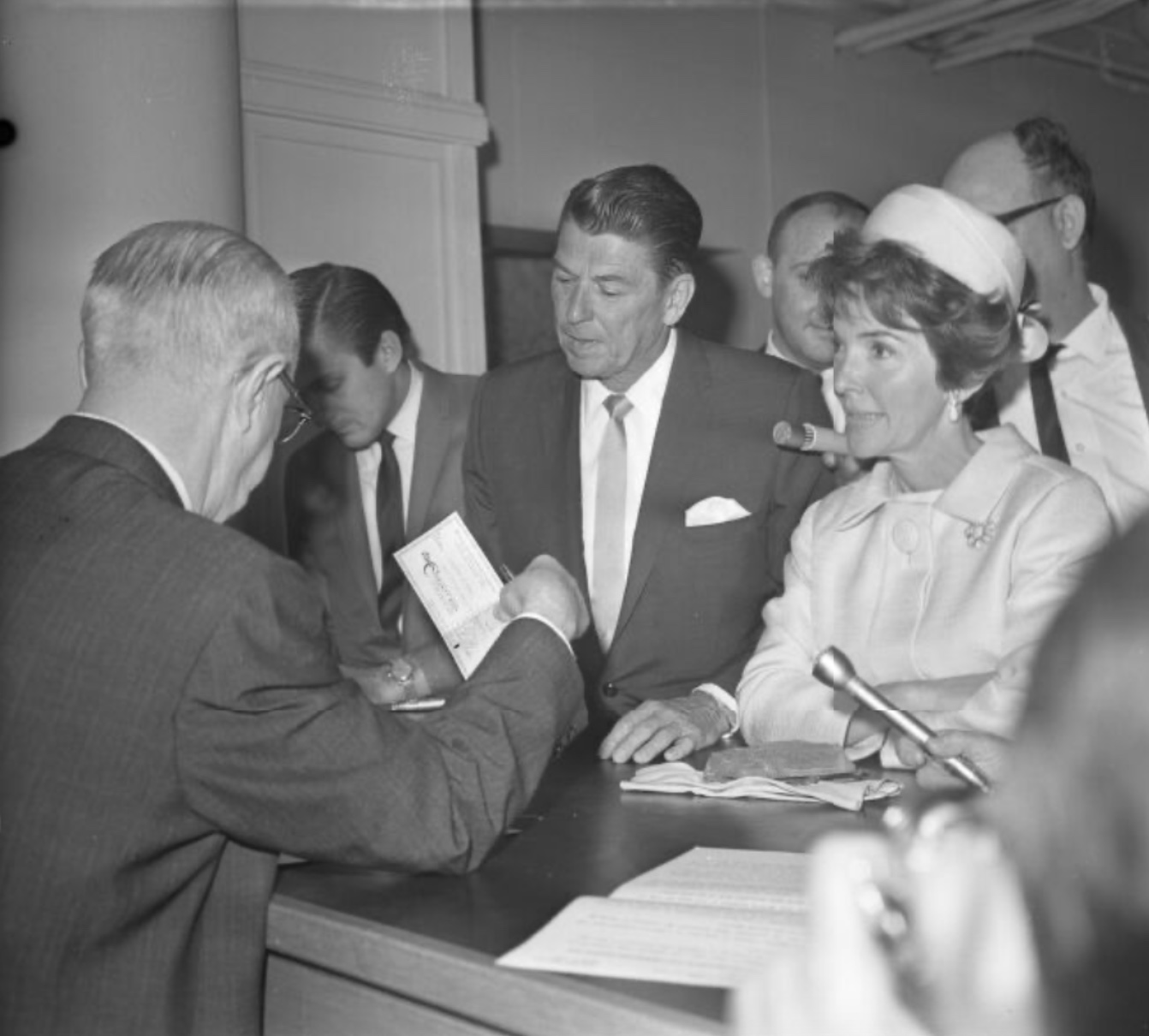
Ronald Reagan with wife, Nancy ,filing nomination papers for the office of California governor on March 10, 1966.
(Credit: UCLA Library Dept. of Special Collections)

Reagan was feted by at a dinner at Los Verdes Golf Club on January 22nd, 1965, months before announcing his candidacy. In the run-up to the June 1966 primary election, he made several appearances at dinners and banquets in the South Bay and Harbor Area.

He soundly defeated San Francisco Mayor George Christopher in the June 7 primary, and set his sights on Brown, who seemed to underestimate Reagan as a candidate, repeatedly emphasizing his political inexperience.

Reagan made a series of high profile appearances in the South Bay and Harbor Area as the November election neared. He visited the annual Fishermen’s Fiesta in San Pedro on October 2. On October 20, his campaign rally at Mira Costa High in Manhattan Beach included celebrities Buddy Ebsen, Ray Bolger, Claire Trevor and others.

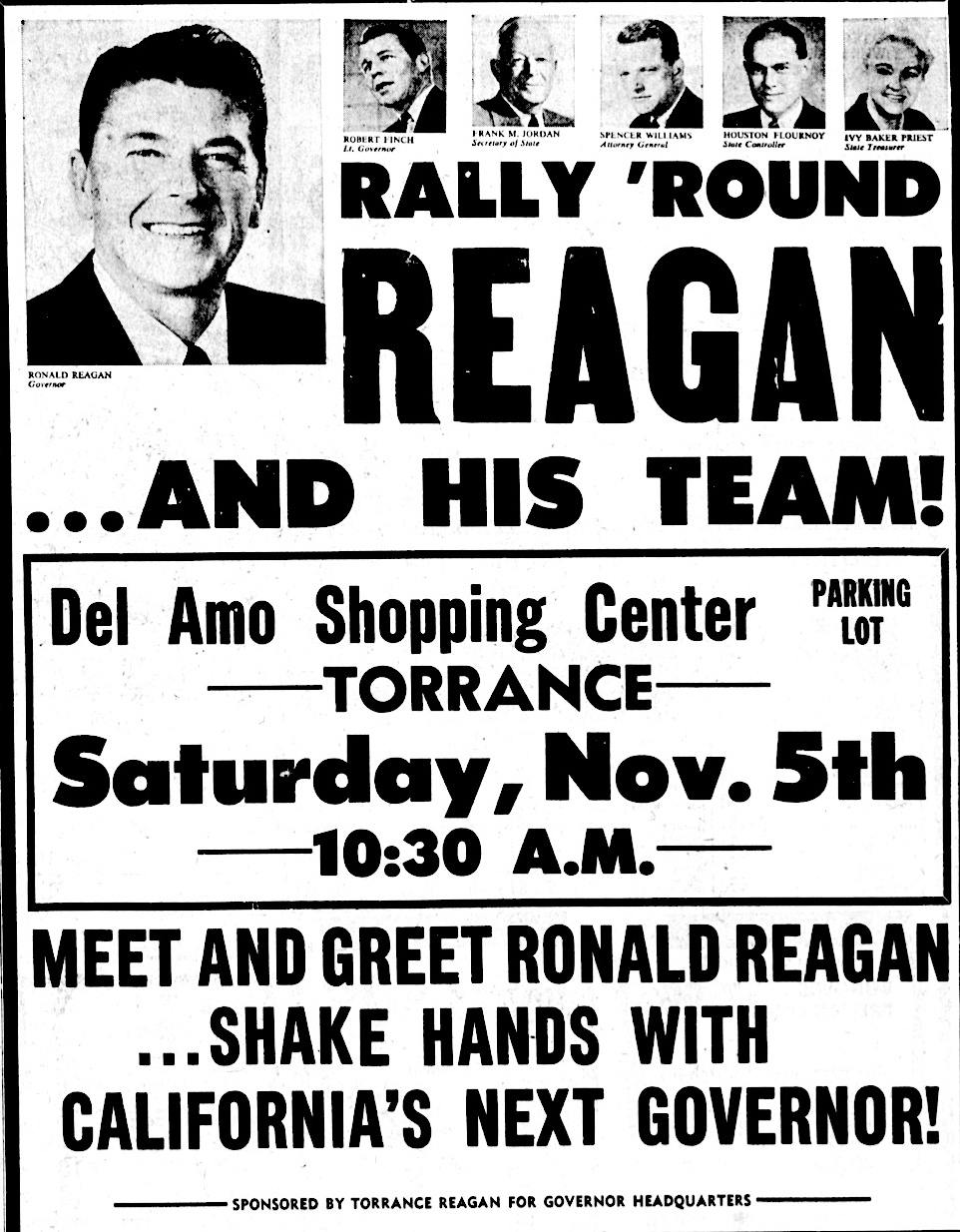
Torrance Press-Herald ad, Nov. 2, 1966, Page C-3. (Credit: Torrance Historical Newspaper and Directories Archive database, Torrance Public Library)

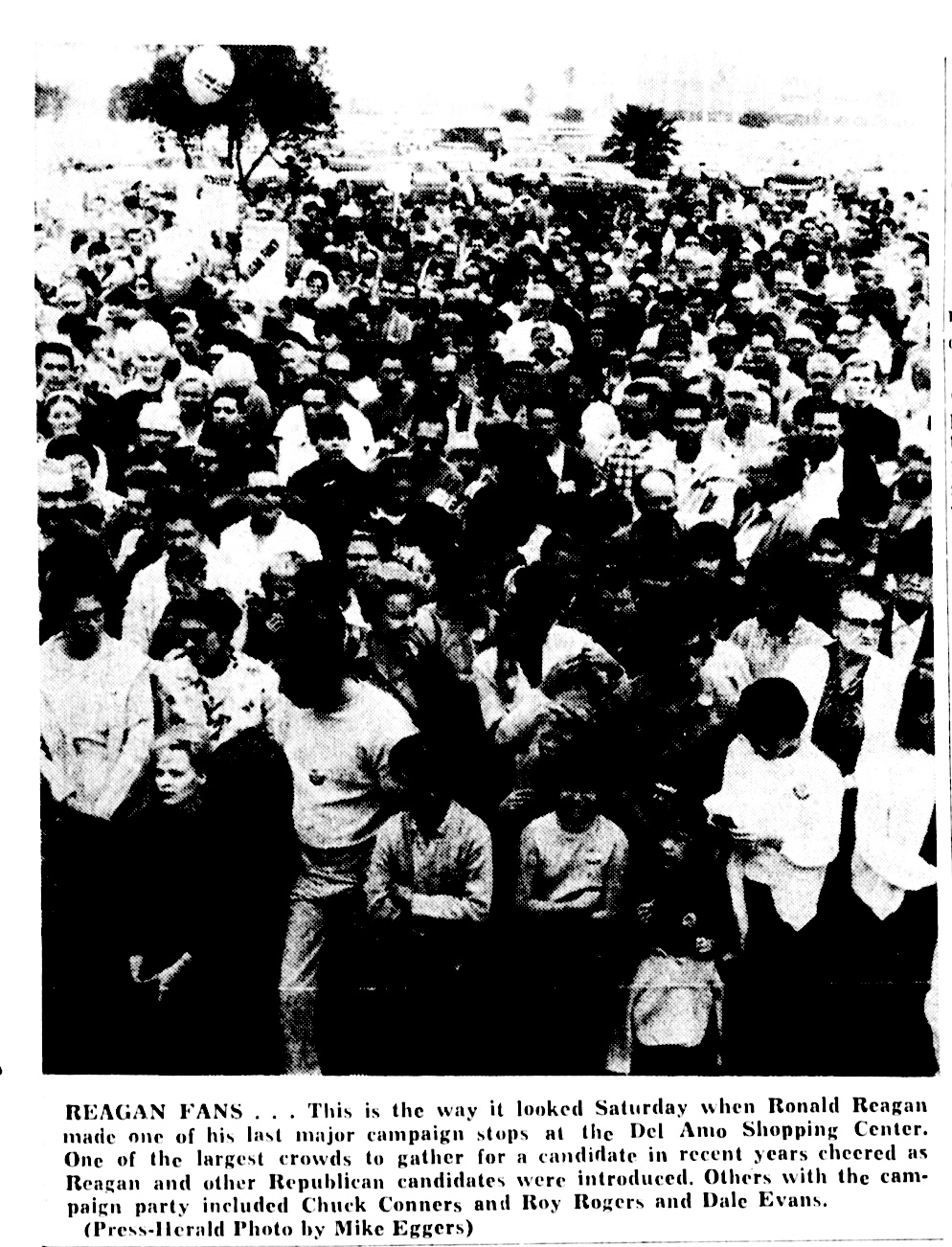
Reagan chose the South Bay for two major campaign events immediately before the Nov. 8 election. The first, on Nov. 5, was a major rally that drew throngs of people to the Del Amo Shopping Center in Torrance. The second was a similar rally on Nov. 7, the Monday before the election, held the West Imperial Terminal at Los Angeles International Airport

Reagan’s tireless get-out-the-vote efforts worked like a charm. He trounced the complacent Brown by more than a million votes. He would go on to serve two terms as California governor, followed by two terms as U.S. President.

Torrance Press-Herald, Nov. 9, 1966, Page A-3. (Credit: Torrance Historical Newspaper and Directories Archive database, Torrance Public Library)

Sources:

“AEROSPACE: The industry that built the South Bay,” Easy Reader staff, Easy Reader, Oct. 17, 2013.

“The American Presidency Project,” University of California, Santa Barbara website.
Palos Verdes Peninsula News archives.

Torrance Press Herald archives.

Wikipedia.

Palos Verdes Peninsula News ad, Oct. 25, 1962, Page 11. (Credit: Palos Verdes Peninsula News archives)

The Los Angeles & San Pedro: How Southern California’s first railroad came to be

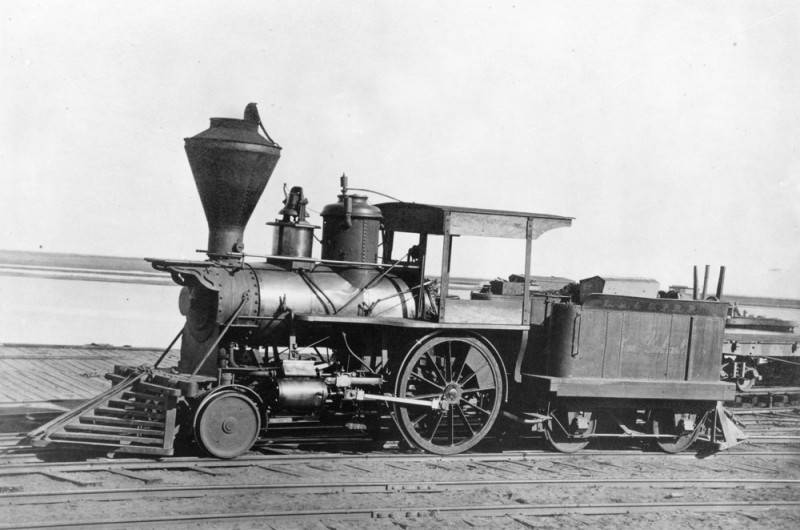
The steam locomotive “San Gabriel,” one of two purchased by Phineas Banning to make runs for the Los Angeles & San Pedro Railroad. Undated. (Credit: Los Angeles Public Library Photo Collection)

Imagining the Los Angeles of 1870 takes some mental gymnastics. The city then had a population of 5,728, and transportation consisted of horse-drawn vehicles operating on dirt roads. It was far from the sprawling metropolis it would become even 30 short years later, when its population topped 100,000.

Even with that in mind, I still found it surprising to find out that the Los Angeles & San Pedro Railroad, connecting the harbor in San Pedro to downtown L.A., became Southern California’s first railroad when it opened in 1869.

The Golden Spike was driven at Promontory Point in Utah that same year to complete the Union Pacific’s first transcontinental railroad, but its route bypassed Southern California completely, connecting instead to San Francisco.

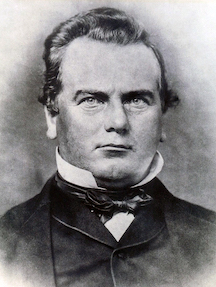
Phineas Banning. Undated.

When Wilmington-based shipping magnate Phineas Banning began building his business a decade earlier, he soon diagnosed his main supply chain issue: the difficulty and slowness of transporting goods by animal-drawn carts, especially lumber and building materials, from his wharves in Wilmington north to downtown Los Angeles.

As early as 1853, he had envisioned Wilmington as a potential site for the western terminus of the transcontinental railroad. As a first step, he pushed legislation calling for a new railroad linking Wilmington to Los Angeles, but a bill codifying Banning’s idea bogged down in Congress and never became law. Repeated attempts to pass similar laws during the 1860s also failed.

Banning himself tried again in 1866 as a member of the California State Senate. He faced opposition from farmers who raised grain to feed animals that pulled wagons carrying food to market, owners of the freight lines and those who thought the bill had been designed mainly to further line Banning’s pockets.

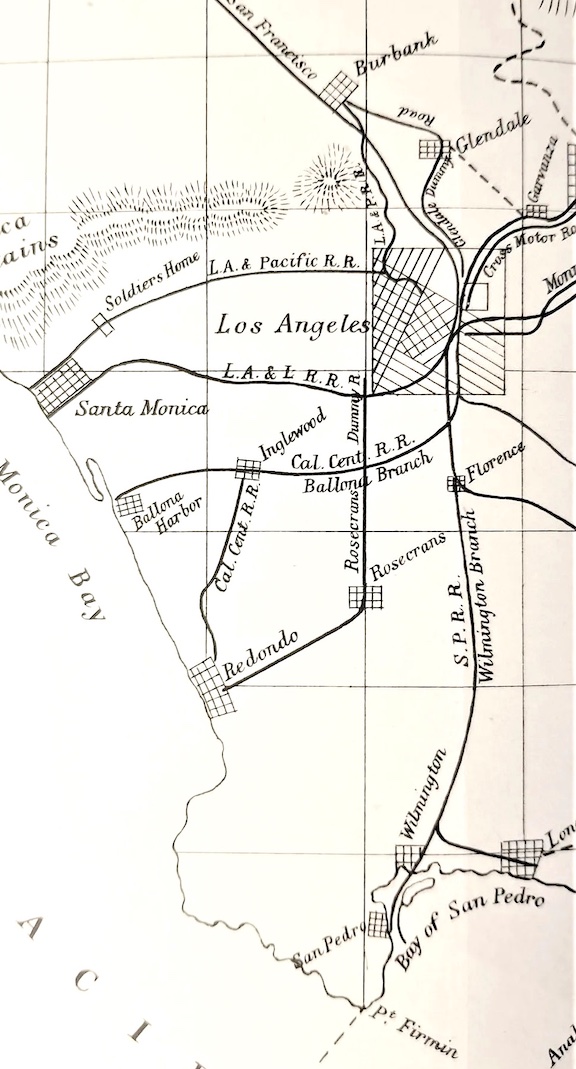
The Los Angeles & San Pedro Railroad route from downtown L.A. to San Pedro, right. It’s labeled “Wilmington Branch” as this is an updated later map showing various area railroads. (Credit: The Homestead Blog)

In 1867, he tried again. This time, he did his best to drum up support for the new railroad among local political leaders and prominent businessmen before introducing the bill. Under its provisions, Los Angeles County would buy $150,000 in stock in the railroad, with the city of L.A. buying $75,000 worth.

Banning then brought the measure before the legislature. He added a provision that would allow the stock to be resold to another railroad, should one decide to connect to the Los Angeles & San Pedro Railroad, as the new venture was known. The provision was meant to attract Southern Pacific to route its new southern route to Los Angeles instead of San Diego. The measure passed.

A referendum on the railroad project was brought to Los Angeles voters on March 24, 1868. It passed by a slim margin, and Banning was in business.

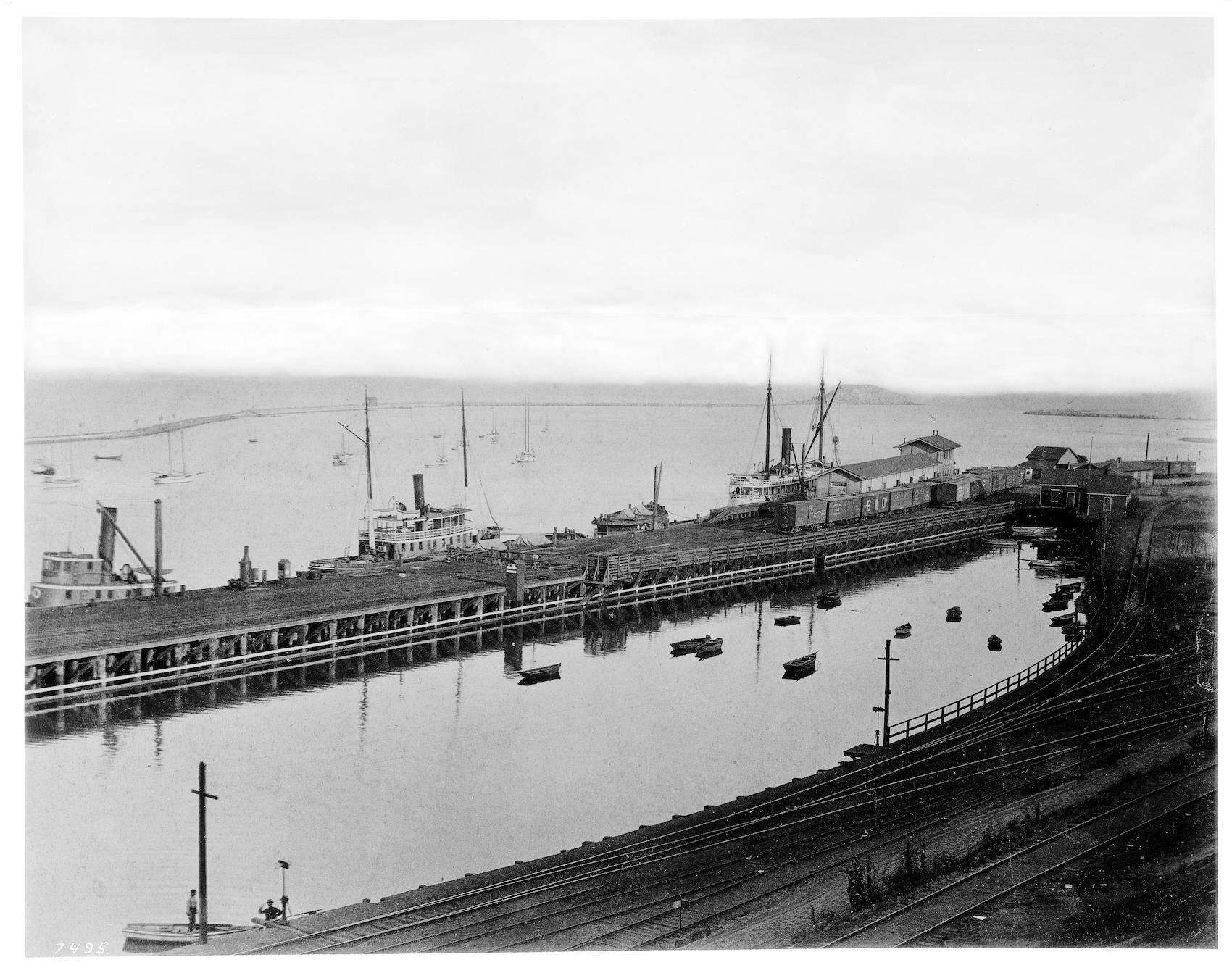
View of San Pedro Harbor shows the Southern Pacific railroad depot, upper right, and Dead Man’s Island in the background. Circa 1898. (Credit: California Historical Society via USC Digital Library)

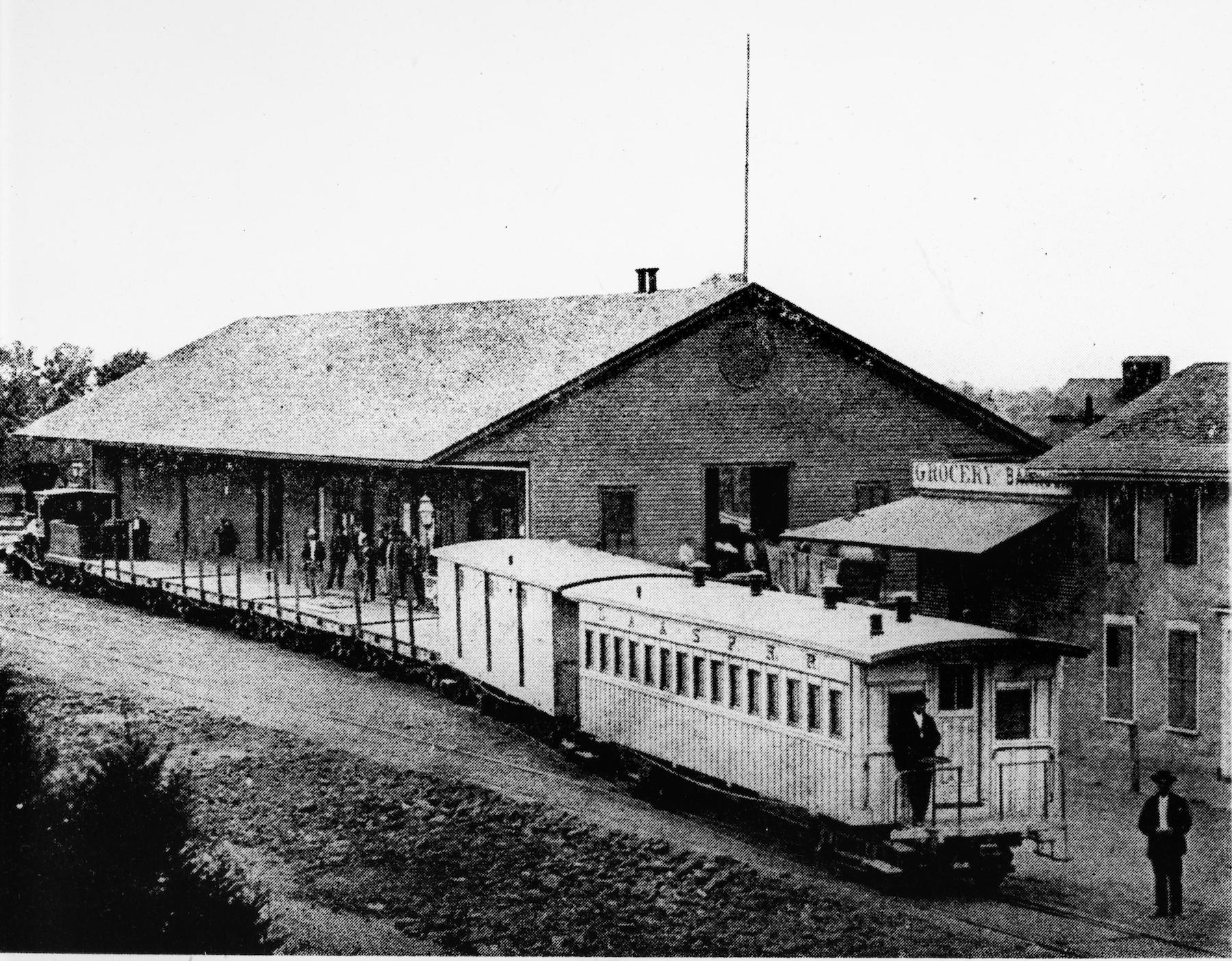
Construction began in the fall of 1868. It included the building of two railroad stations, one at Alameda and Commercial streets in downtown Los Angeles, and the other at Banning’s seaport in Wilmington, the railroad’s southern terminus. The route roughly followed Alameda Blvd. southward, much as the present-day Alameda Corridor transportation route does.

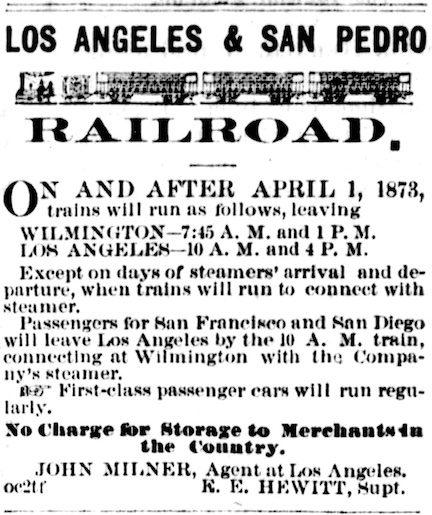
Los Angeles Herald ad, Oct. 5, 1873, Page 3. (Credit: Los Angeles Herald archives)

On October 26, 1869, the railroad officially began operations, welcoming an estimated 1500 passengers who got free rides along its 21-mile length on its first day. The day concluded with a giant gala ball held at the new railroad’s Los Angeles station. The line’s two trains began running on a regular schedule on November 1. Passengers paid $1.50 each way; dry freight cost $6 a ton, and groceries, $5 a ton.

The LA and SP Railroad operated as an independent entity only for three years. A growing chorus of voices, led by local businessmen, politicians and the then-leading paper in town, Los Angeles Star, began pressuring the Southern Pacific to extend its new route to Los Angeles.

Southern Pacific balked at first, claiming that it would be too costly to build a railroad through the mountains surrounding the city. Its engineers favored a route bypassing L.A. and running through the Tehachapi Pass instead.

The Los Angeles & San Pedro Railroad depot at Alameda and Commercial streets in downtown Los Angeles, circa 1875. (Credit: USC Digital Library)

The decision certainly was key to the future of Banning’s vision for the Harbor Area and the Port of Los Angeles, but it was also vital to the future of Los Angeles itself, which was in danger of being minimalized as a port in favor of San Diego and San Francisco.

The campaigning Angelenos convinced Southern Pacific to put the matter to the county’s voters, who approved the measure on Nov. 5, 1872. Under its terms, ownership of the LA & SP passed to Southern Pacific in 1873. 

On Sept. 9, 1876, the Southern Pacific completed its southern transcontinental route through  to Los Angeles. It then held a monopoly on all rail traffic to the city and its port.

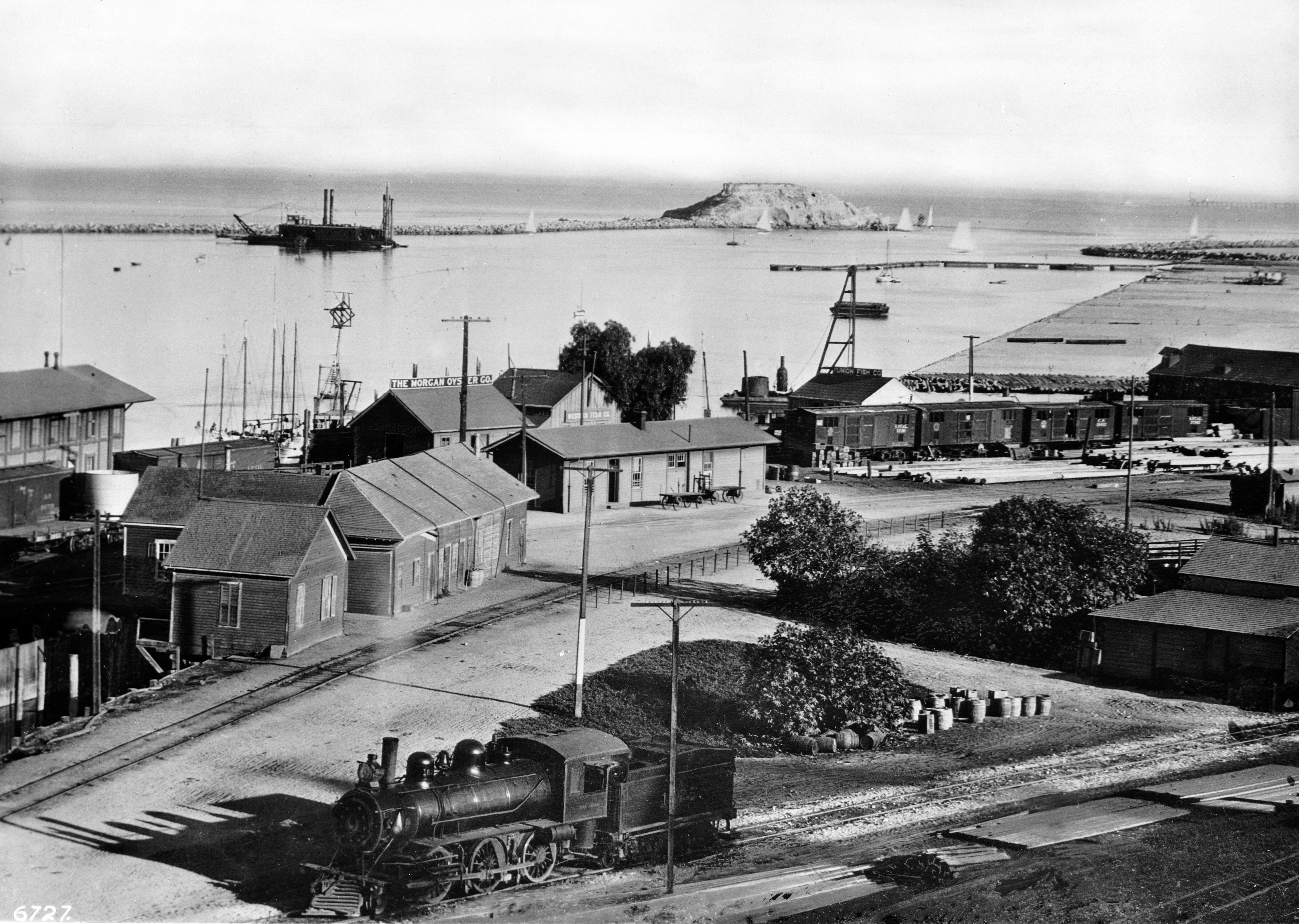
Street scene at the Port of Los Angeles in San Pedro, circa 1905. Railroad tracks can be seen embedded in the road, and a locomotive engine is visible in center foreground. Dead Man’s Island can be seen in the distance. (Credit: California Historical Society).

This became even more significant when Banning began receiving government funds to help improve the former shallow-water port at Wilmington through dredging operations. The continuing improvements to the harbor, including the construction of a breakwater that was completed in 1881.

Banning died in 1885, but the large-scale improvements he set in motion greatly influenced Los Angeles in its decision to choose San Pedro as the Port of Los Angeles, an action which became official in 1909.

In 2012, the city of Los Angeles began removing railroad tracks from Alameda Blvd. between 1st and 7th streets downtown. The tracks were among the last traces of the LA & SP Railroad.

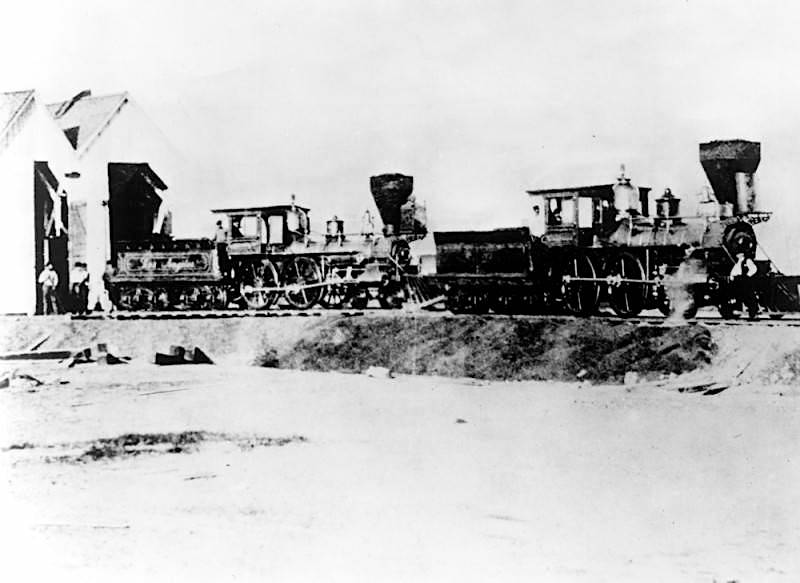
1869 photo shows the two locomotives, the Los Angeles and the San Gabriel, that operated on the Los Angeles & San Pedro Railroad. (Credit: Los Angeles Public Library Photo Collection)

Sources:

“From Point A to Point B with a Los Angeles and San Pedro Railroad Company Receipt, 2 April 1873,” by Paul R. Spitzzeri, The Homestead Blog, April 2, 2022.

Grand Ventures: The Banning Family and the Shaping of Southern California, by Tom Sitton, Huntington Library, 2010.

Los Angeles Herald archives.

Los Angeles Times archives.

“Photos: L.A.’s First Railroads Connected the Region to the Local Economy,” by Nathan Masters, KCET website, March 24, 2012.

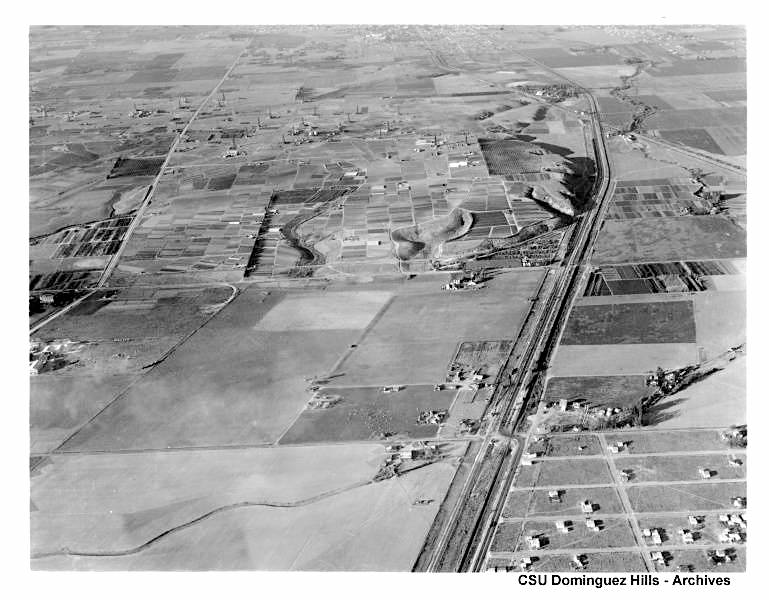
Pacific Electric and Southern Pacific Railroad tracks run through mostly open country along the original LA & SP Railroad route even in 1931. View looks north from Dominguez Hill in present-day Carson. (Credit: CSUDH Digital Archives)

George Brett’s Hall of Fame baseball career began at El Segundo High

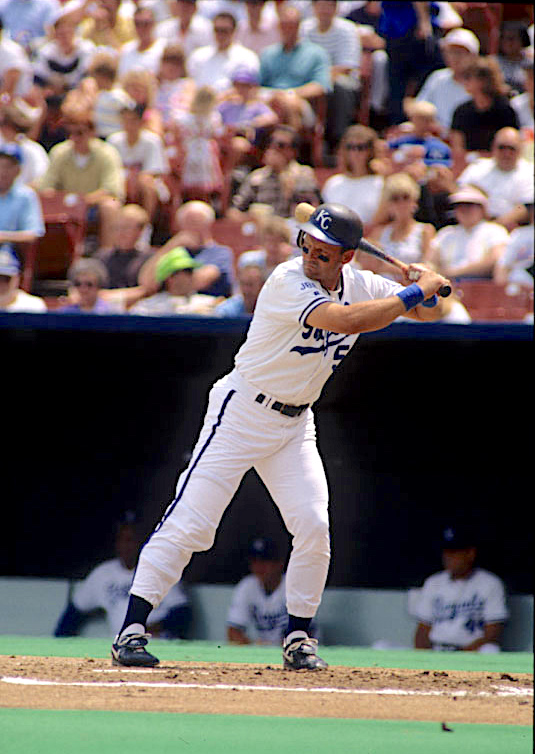
George Brett bats during a 1990 game at Royals Stadium. (Credit: Courtesy of Missouri State Archives)

When George Brett tried out for the El Segundo High School baseball team as a ninth-grader, he was five-foot-one and weighed 105 pounds. Junior varsity baseball coach Dave Reed wanted to cut him from the squad, but head varsity coach John Stevenson insisted that he stay.

Stevenson, a legendary coach in South Bay prep baseball circles, had coached Brett’s three older brothers before him, and had an inkling that young George would develop similarly.

George’s father, Jack, dropped out of high school and was working in a factory when he enlisted in the Army during World War II. When he returned, he met and married bookkeeper Ethel Hansen in Brooklyn, New York, in 1945. 

George’s brothers, John, Kemer (known during his baseball career as “Ken”), and Bobby all were born in Brooklyn. George was born on on May 15, 1953, after the family had moved to  West Virginia.

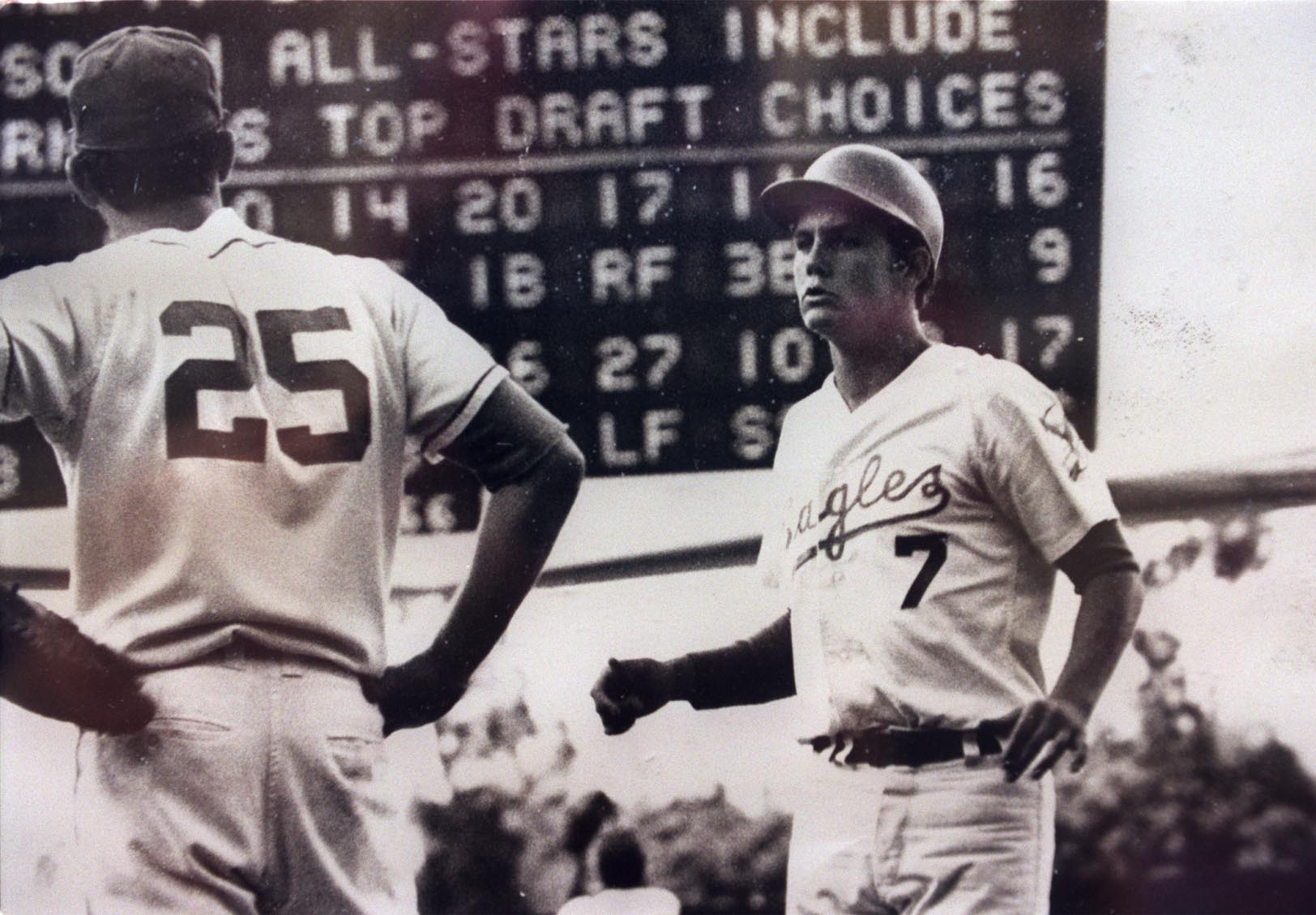
George Brett, #7, during his El Segundo High School varsity team’s run to the the 1971 CIF championship. (Daily Breeze file photo)

In 1955, the Brett family moved to California. In the years following the war, Jack had returned to school to become an accountant, and had found work with the Mattel toy company, then based in Hawthorne.

George greatly admired his brothers. All of the Brett boys played in Little League games at Recreation Park before excelling at El Segundo High. John would go on to play Class A ball in 1968. Bobby played a year of minor-league ball before going into real estate. And Ken pitched for ten different major league teams during a 14-year pro career, during which he also became known as one of the game’s best-hitting pitchers.

So George had a lot to live up to. A wrist injury ended up sidelining him as a freshman. By his sophomore year, he’d filled out considerably and had become a starting quarterback for the Eagles’ football team in addition to playing baseball.

It turned out that Brett, who began as a shortstop before moving to playing third, was in good company on the baseball team. He batted third in the lineup in front of clean-up hitter and star pitcher Scott McGregor, who would go on to a sterling career with the Baltimore Orioles.

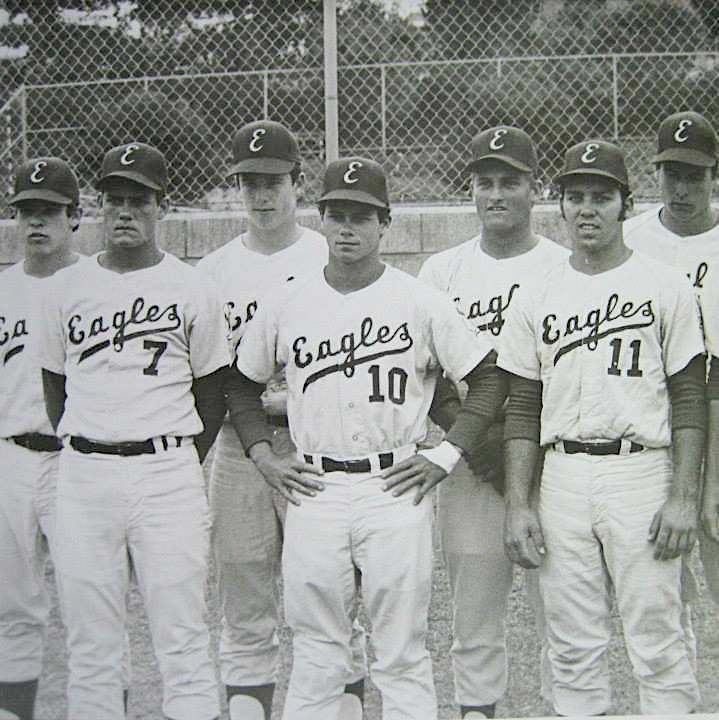
Partial photo of the 1970 El Segundo High Eagles basball team includes, from left, Frank Judge, George Brett (No. 7), Scott McGregor, Steve Ray, Ed Carroll Jr, Brad Hancock and Kirk Allinson. (Credit: Steve Ray Facebook page)

Under Coach Stevenson’s tutelage, El Segundo went 33-2 in Brett’s senior year, winning the CIF championship. In 2013, the Cal-Hi Sports website ranked that 1971 Eagles baseball team as the third best in California high school sports history, behind only the 2004 Chatsworth High team and the 1958 Fresno High squad.

Despite all the accolades, many major league scouts passed on Brett. But Rosey Gilhousen, a scout for the Kansas City Royals MLB expansion team, saw promise in him and convinced the team to draft him.

After a couple of years in the minors, Brett made his major-league debut with the Royals on Aug. 2, 1973. Manager Jack McKeon was unimpressed by the youngster, and Brett found himself back in the minors at the start of 1974.

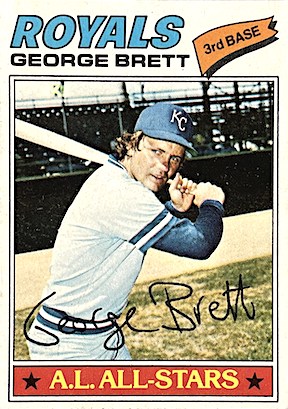
1977 Topps baseball card.

He was called up to the majors after a few weeks, but struggled at the plate until he began working with hitting guru Charley Lau. He blossomed under Lau and new manager Whitey Herzog, who took the reins in 1975.

The remainder of Brett’s 21-season career with the Royals is a litany of superlative hitting statistics. He recorded a total of 3,154 hits, won batting titles in 1976, 1980 and 1990, and was voted the American League’s 1990 Most Valuable Player award.

He went to the World Series twice with the Royals. The team lost in six games to the Philadelphia Phillies in 1980, but came back from a 3-1 deficit to beat the St. Louis Cardinals in seven games in 1985.

In 1980, Brett also made headlines by flirting with becoming the first major leaguer to hit for a .400 season average since Ted Williams in 1941. While spending a good part of the season battling injuries, he still managed to finish with a .390 average.

Brett also played the central role in one of baseball’s most infamous brouhahas, the “Pine Tar Incident” on July 24, 1983. Yankees manager Billy Martin knew that the pine tar that Brett used to help him grip the bat went above the legal height limit of 16 inches on the handle.

(Video Credit: MLB)

Martin said nothing about it until Brett smacked a two-run homer to give the Royals the lead in the ninth inning. Martin immediately protested to the umpires, who took away the home run and called Brett out.

Brett famously went ballistic, charging from the dugout in a frenzy to debate the matter with the umps. The league later overruled the call, and the Royals ended up winning a replay of the disputed game.

Brett retired from baseball on Sept. 25, 1993. The Royals retired his No. 5 uniform in 1994. In 1999, he was elected to the Baseball Hall of Fame in his first year of eligibility. Baseball experts have defined the group of three inductees that year – Brett, Robin Yount and Nolan Ryan – as one of the best of the modern era.

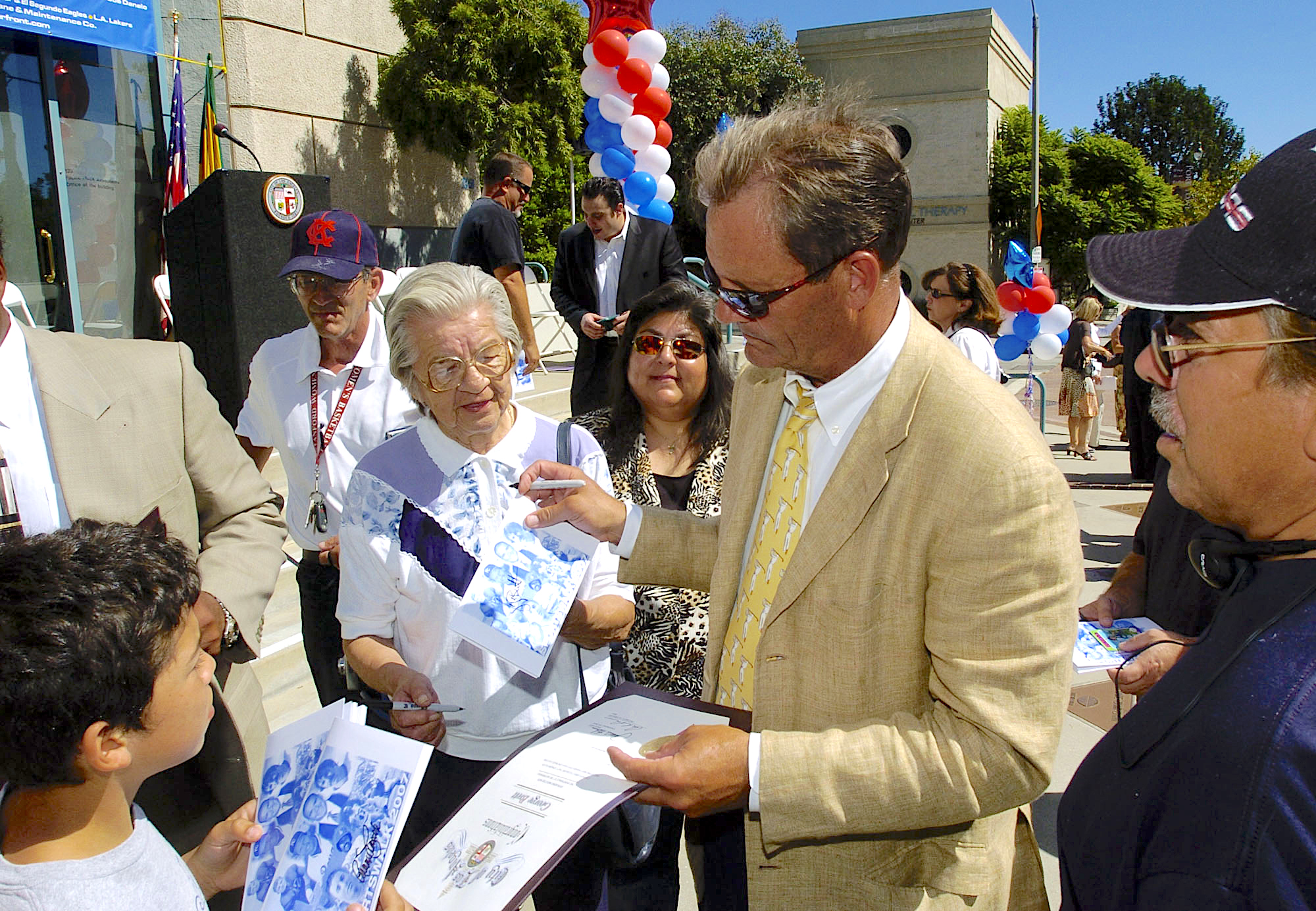
Baseball star George Brett signs autographs after ceremonies honoring him and seven other athletes during the San Pedro Sportswalk awards in San Pedro on Oct. 8, 2007. (Daily Breeze staff file photo by Brad Graverson)

Through it all, Brett never forgot his South Bay roots. He returned to Recreation Park on April 24, 1999, the day the city officially renamed its Little League diamond as George Brett Field, and came to the Harbor Area in 2007 when he was awarded a plaque on the San Pedro Sportswalk of Fame. 

Shortly after retiring as a player, Brett took a job in the Royals front office as vice president of baseball operations, and he has remained with the team ever since. He currently lives in the Kansas City area with his wife, Leslie. They have three children, Jackson, Dylan and Robin.

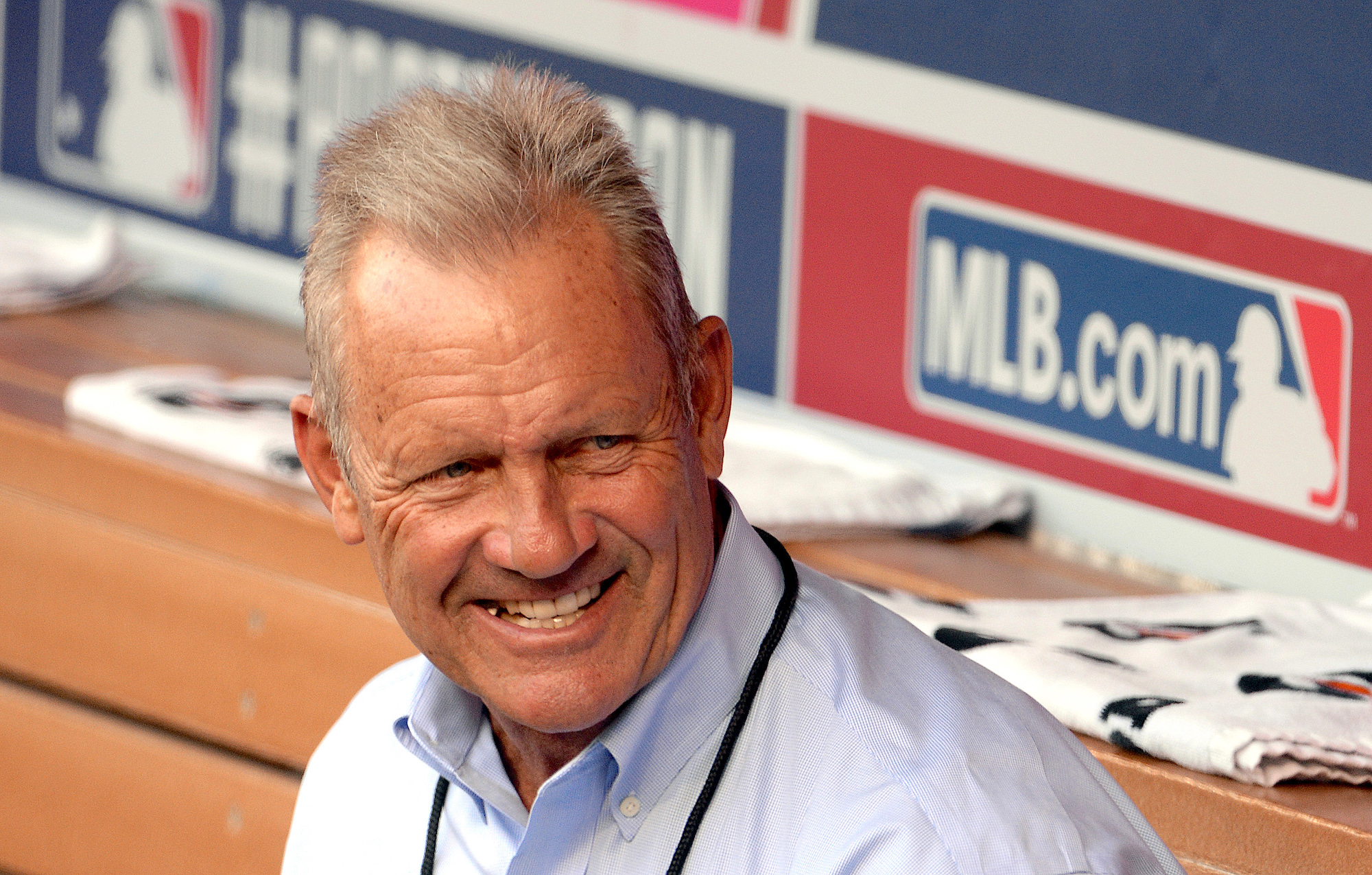
Hall of Fame Kansas City Royals third baseman George Brett prior to game two of an American League Division Series baseball game between the Angels and Royals at Angel Stadium in Anaheim on Oct. 3, 2014. (Daily Breeze staff file photo by Keith Birmingham)

Sources:

Daily Breeze archives.

“Front Office Directory,” Kansas City Royals website.
“George Brett,” by Russell Bergtold, Society for American Baseball Research website, July 15, 2019.

“Growing Into Greatness,” by Michael Austin, SchoolSports.com website via ESPN High School Sports website, 1999.

Wikipedia.

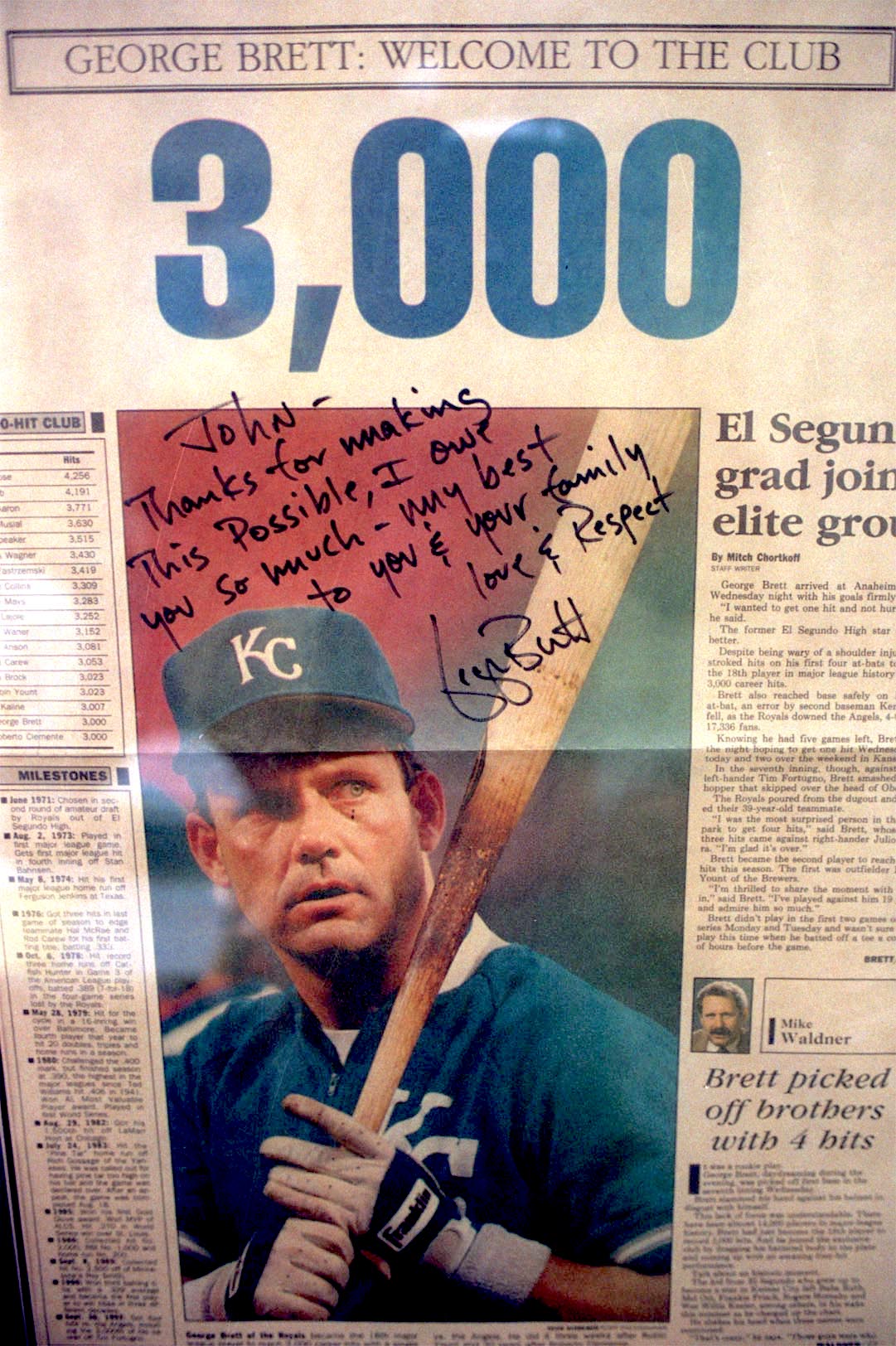
George Brett signed a copy of this 1992 Daily Breeze sports page to give to his high school coach John Stevenson after reaching the 3,000 hit milestone on Sept. 29, 1992. (Daily Breeze staff file photo)

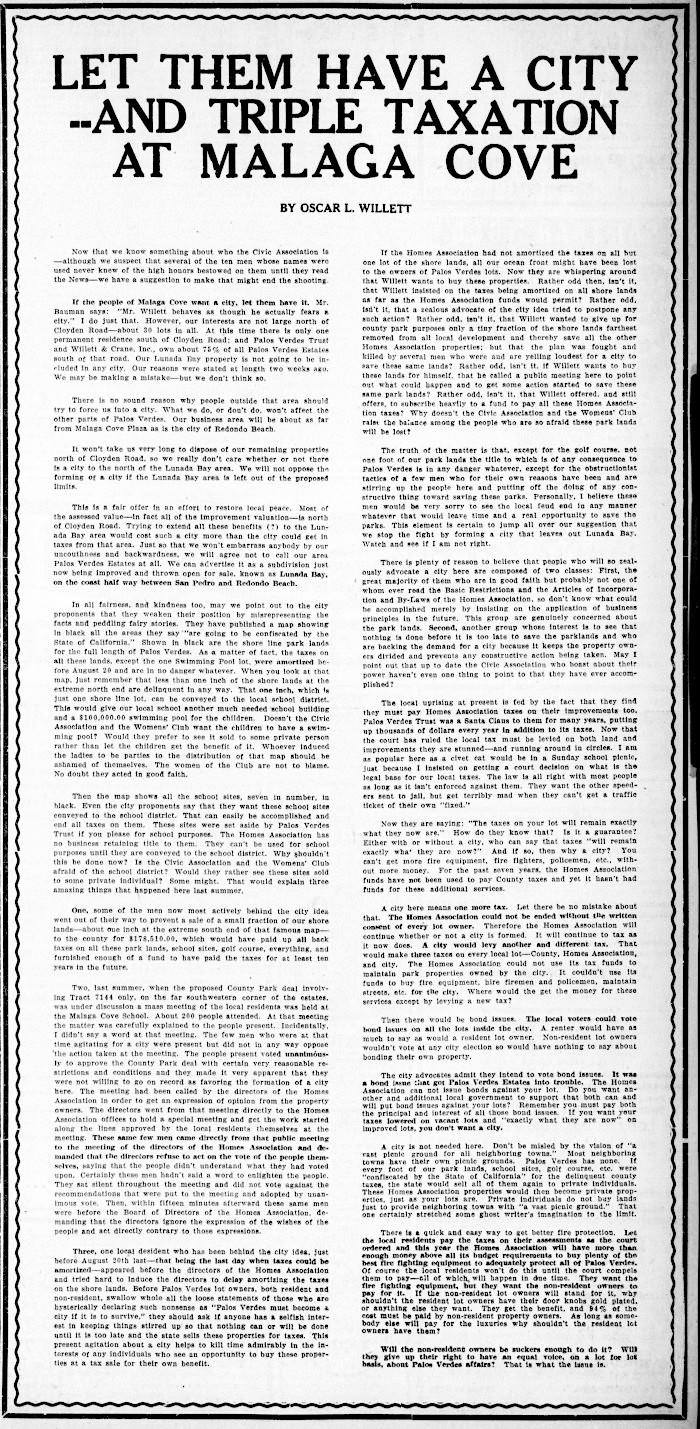
Seven votes decided the 1939 battle to incorporate the city of Palos Verdes Estates 

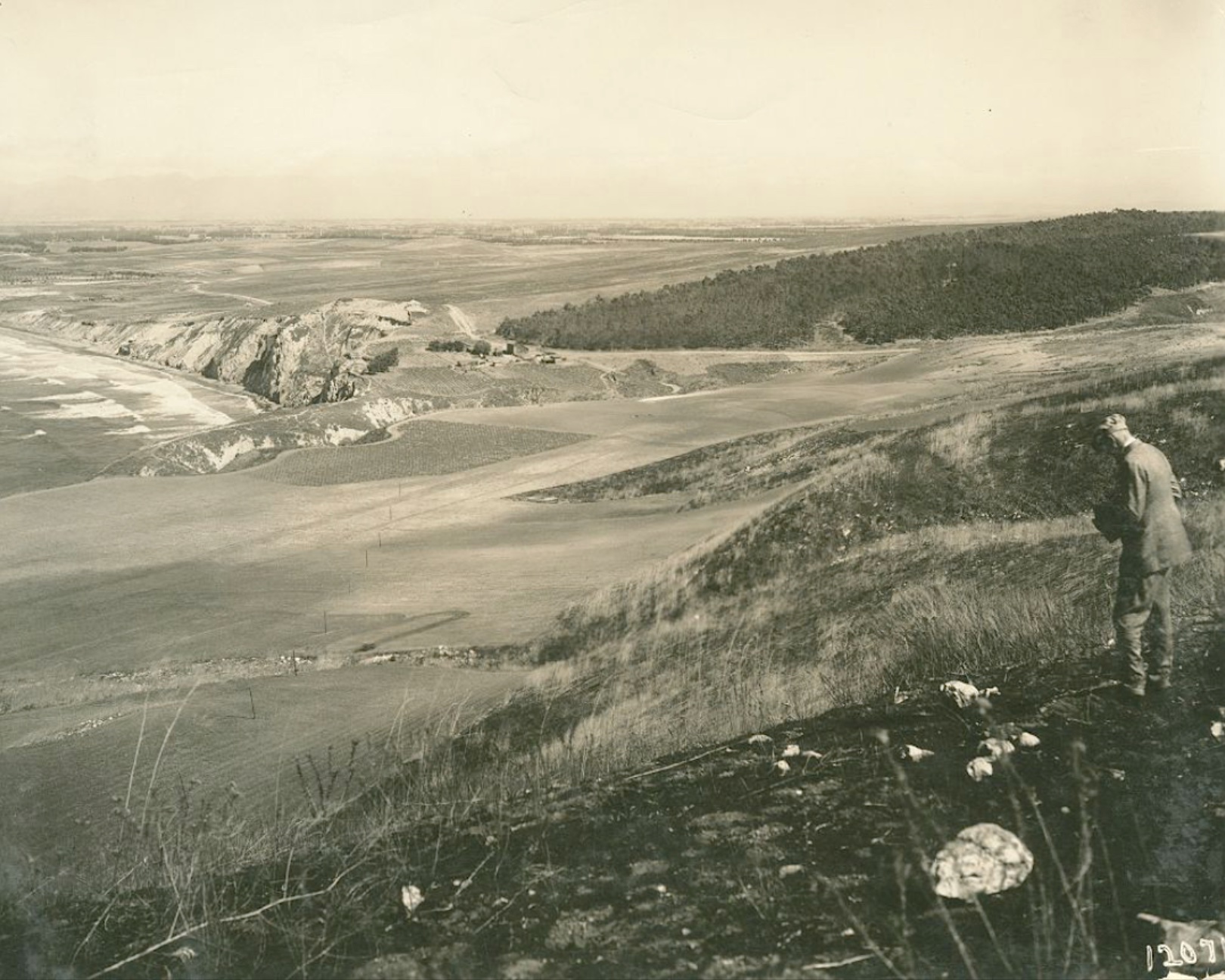
An elevated view looks northeast from the Malaga Cove hills in Palos Verdes Estates across fields toward the Hollywood Riviera area. A man can be seen in the foreground at far right, with the “Mule Camp” and eucalyptus grove visible in the background and the city of Torrance in the distance. Mules were used to help construct roads for the Palos Verdes Project. (Credit: PV Local History Center, Palos Verdes Library District.)

The four cities on the Palos Verdes Peninsula – Palos Verdes Estates, Rancho Palos Verdes, Rolling HIlls and Rolling Hills Estates – have traced their origins to a real estate rally held to promote the eventual sale of lots that was held on June 17, 1923.

To celebrate the unofficial 100th birthday of the Peninsula, the Palos Verdes Library District and the Peninsula Friends of the Library, in conjunction with the four cities, will host Doors Open Peninsula during June 2023.

The oldest of the four cities, Palos Verdes Estates, was the site of the first urban development on the Peninsula. Its first commercial structure, the Gardner Building, opened in 1925. PVE also was the first of the four cities to incorporate, but it didn’t happen without a fight.

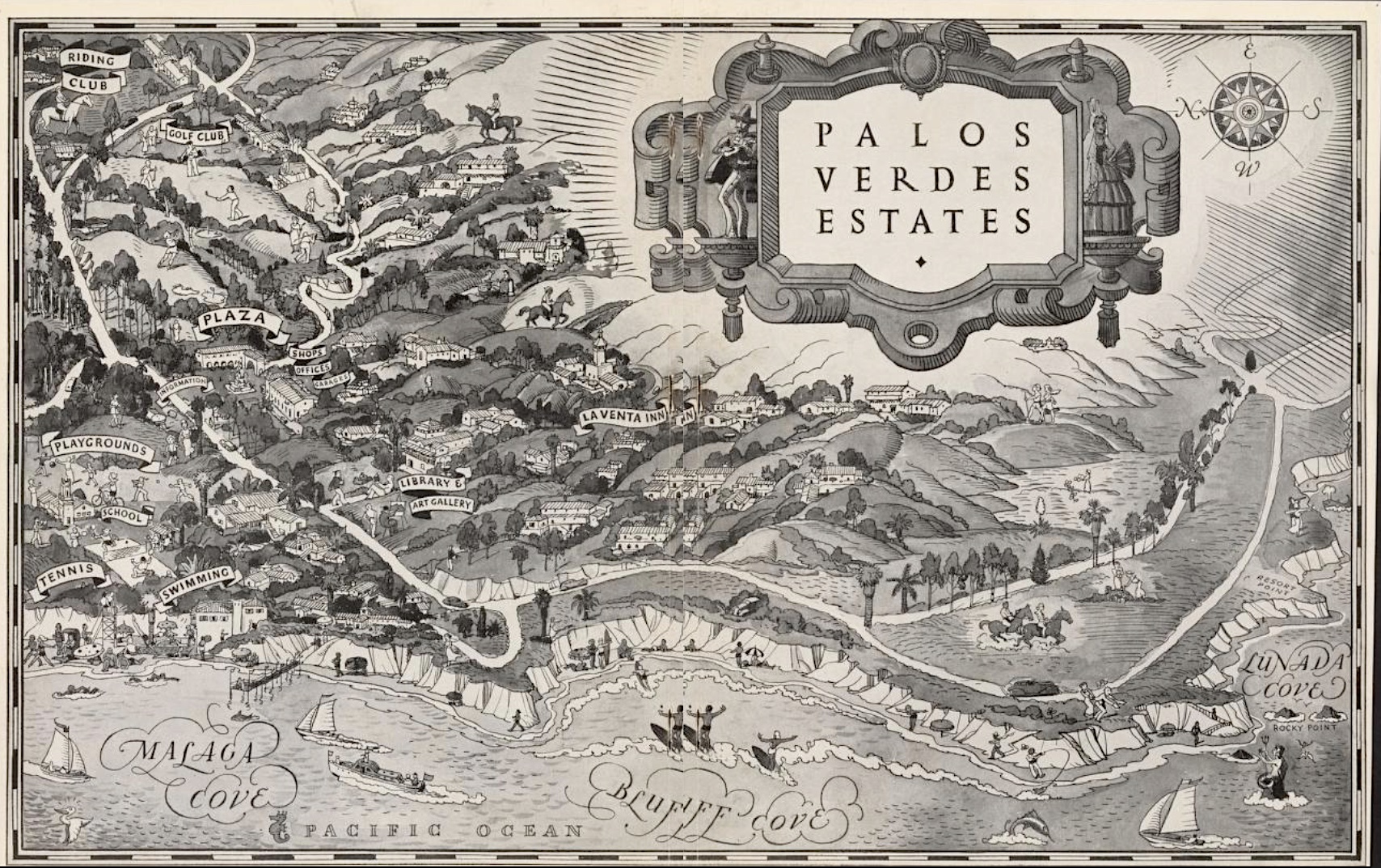
This stylized map identifying Palos Verdes Estates highlights comes from the 1936 brochure, “Judging Palos Verdes as a Place to Live.” (Credit: PV Local History Center, Palos Verdes Library District)

In the years before the city was incorporated, it was ruled by the Board of Directors of the Palos Verdes Homes Association. The governing body had limited legal and financial powers, though.

A combination of factors arising from the growing number of people wanting to call the Peninsula their home led to the move towards incorporation. One factor was the settlement’s growing indebtedness to Los Angeles County.

The Association had helped provide many public facilities on The Hill, including a the Palos Verdes Golf Club, horse stables, a community swimming pool, the Malaga Cove shopping area, Malaga Cove School and the Malaga Cove Library. 

Its members also had worked to protect what they called “the parklands,” the scenic areas of PVE that helped make it such an attractive place to live. These included Bluff Cove, parts of Lunada Bay and other scenic areas that attracted visitors from all over.

As the number of these improvements increased along with the number of residents in the city, the Homes Association found itself in arrears with Los Angeles County in the payment of property taxes.

There also existed the threat of the County taking control of the parklands and opening them to everyone. Some residents saw this as possibly leading to an influx of outsiders bringing all kinds of dangers to PVE’s citizenry, according to this anonymous writer in the May 13, 1938, Palos Verdes Peninsula News:

“With the gay throng of picnickers on our shores will come the NOT SO GAY throngs of loafers, of prowlers, of drunkards (and, of course, a few degenerates and sex maniacs) who will not resist the temptation to inspect these deserted country lanes where many of our homes are built . . .”

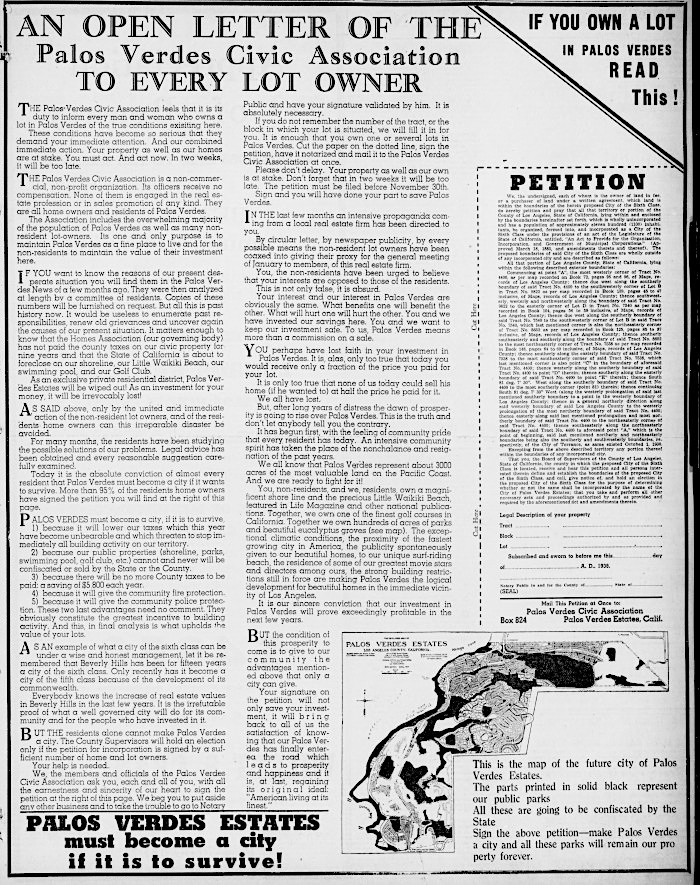
By late 1938, a movement began to grow towards incorporation as a city of the sixth class. This move would give residents control over the parklands, but, more importantly, allow them to impose taxes to raise money to pay its tax bills and generate funds for a police force, garbage collection and other services.

Undated photo of city sign at “The Grove,” a stand of eucalyptus trees in Palos Verdes Estates. (Credit: City of Palos Verdes Estates Facebook page)

A petition circulated in 1939, with enough signatures gathered for the L.A. County Board of Supervisors to call for an election to settle the matter on Dec. 9, 1939.

At this point, the campaign began to grow increasingly bitter. Opponents feared incorporation would lead to the commercialization of The Hill and a relaxation of land use restrictions that the Homes Association and the Palos Verdes Art Jury had worked very hard to establish.

Proponents saw it as the only way for the growing community to escape its many financial problems and to retain control over its future growth and development. The heated politics of the issue set household against household. 

The Palos Verdes Peninsula News at first took a neutral stand on the issue, running many pro and con articles and ads from both camps. But in its Nov. 10, 1939, issue, one month before the election, the paper announced its opposition to incorporation, which served to roil the seas even more. Here’s one of the reasons it gave:

“If any reader holds any illusions concerning a municipality, let him attend Council meetings at any of our neighboring cities, Redondo, Hermosa, Manhattan. Listen to the wrangling, the aimless discussion, the demands, the political jockeying. Then come back to our peaceful hills and think it over!”

Fred Roessler circa 1950. (Credit: PV Local History Center, Palos Verdes Library District.)

On December 8, the night before the election, Ralph Bandini of the News summed up the general tenor of the election debate:

“Tempers have frayed. Friendships have broken. Bitterness has reigned. So high has feeling and partisanship run that there is grave danger that this most important issue, important, that is, to us may not be decided upon its merits, but rather upon emotionalism and prejudice.”

In hindsight, the decision to incorporate sounds like a slam dunk solution to many of the community’s growing list of ills, but the final vote at the polls on Dec. 9 was anything but unanimous: 213 votes for, and 206 against.

On Jan. 2, 1940, the newly incorporated city of Palos Verdes Estates officially swore in Fred Roessler as its first mayor, and Dr. Ulric Bray, Dr. Paul A. Reeder, Dr. Dennis Smith and Hammond Sadler as the first members of its city council. Roessler would go on to serve as the city’s mayor for the next 25 years, until his death in 1965.

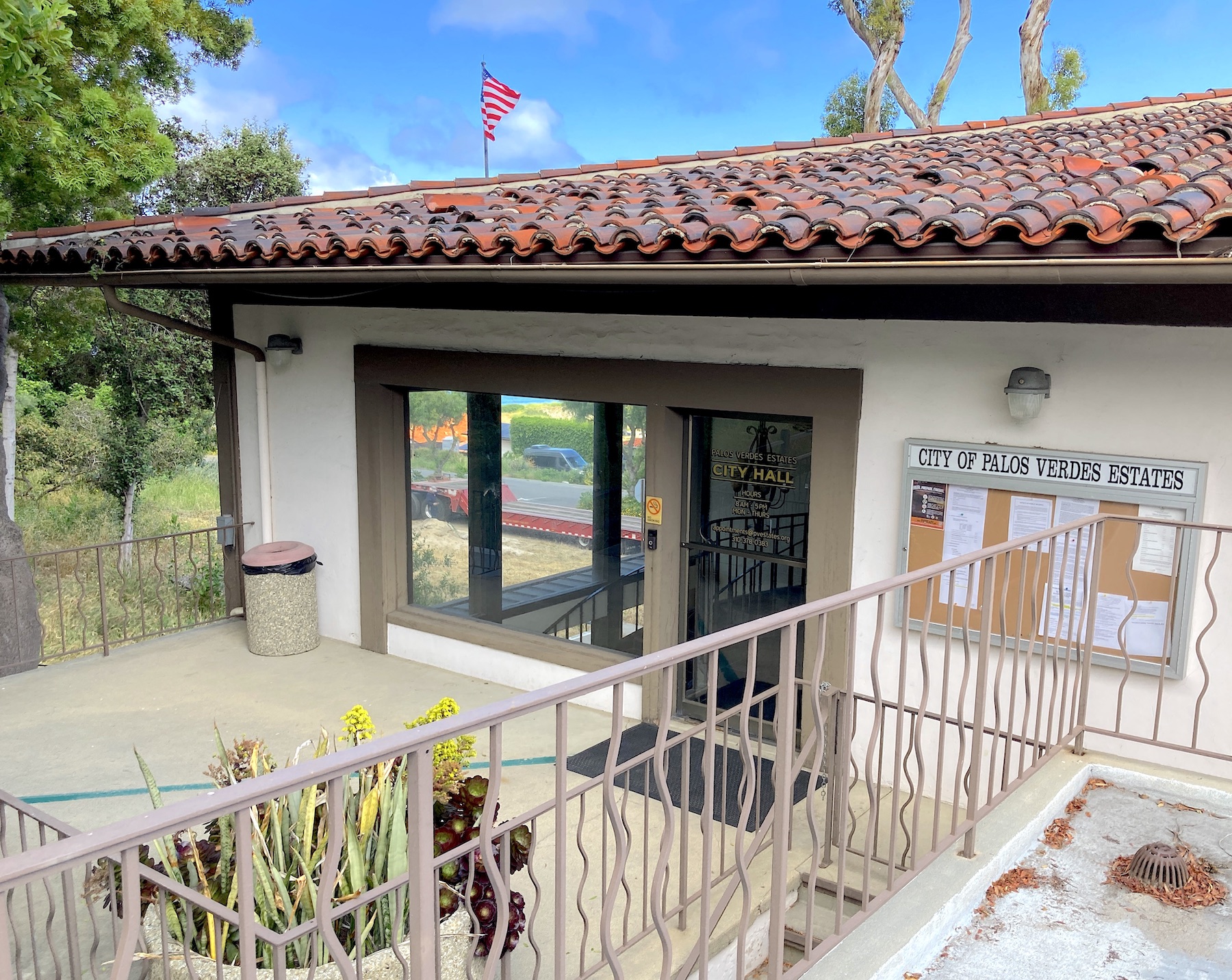
The unassuming Palos Verdes Estates City Hall in Malaga Cove. (May 2023 photo by Sam Gnerre)

Sources:

Palos Verdes Peninsula News archives.

The Palos Verdes Story, by Delane Morgan, The Palos Verdes Review, 1982.

Anti-incorporation ad:

Palos Verdes Peninsula News, Dec. 2, 1938, Page 3. (Credit: Palos Verdes Peninsula News archives)

Pro-incorporation ad:

Palos Verdes Peninsula News, Nov. 11, 1938, Page 3. (Credit: Palos Verdes Peninsula News archives)

Redondo Beach resident Ron Kovic has never backed away from a battle

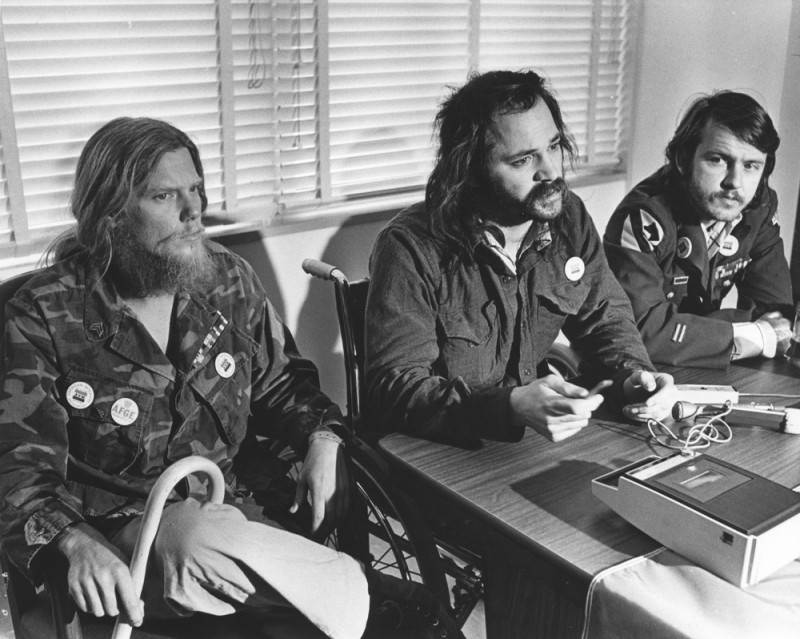
From left: Bill Unger, Ron Kovic and Max Inglett hold a press conference during their 17-day hunger strike at California Sen. Alan Cranston’s office in the Federal Building, Westwood, on February 19, 1974. (Credit: Los Angeles Public Library Photo Collection)

True to the title of his most famous book, Ron Kovic was indeed born on the Fourth of July, in 1946. Though born in Wisconsin, he grew up on Long Island in New York, graduating from Massapequa High School in 1964.

That fall, he volunteered to join the Marines in order to fight in the Vietnam War. He began his first stint in Vietnam as a member of the 1st Marine Division in December 1965, conducting reconnaissance missions into areas held by the North Vietnamese Army (NVA) and the Viet Cong guerrilla forces.

Kovic was awarded the Navy Commendation Medal for serving on 22 reconnaissance missions. He returned stateside after a 13-month tour of duty and was stationed in North Carolina in 1967 when he decided to volunteer for another hitch in Vietnam.

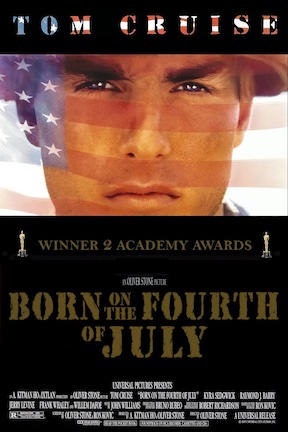
1976 edition book cover.

His life changed forever on Jan. 20, 1968. His reconnaissance squad encountered NVA and Viet Cong forces near the village of My Loc while trying to help South Vietnamese forces in the village.

During the ensuing battle,  he was shot in the right foot, and again through his right shoulder. The second bullet caused a collapsed lung and an injury to his spinal cord that permanently paralyzed him from the chest down. He was sent home after a week in the ICU in Da Nang. In addition to the Purple Heart, he was awarded the Bronze Star for valor.

Speaking about his recovery to Newsweek magazine in 1983, he said, “It was a terrible period of time. It was an impossible period of time. It was a hellish period of time. Sometimes I’m amazed I made it.”

His life changed profoundly and permanently thereafter. Now confined to a wheelchair, he began to battle on new fronts. His antiwar activism has become well-known, but he was just as outraged by the poor, sometimes abusive treatment that returning injured veterans who had sacrificed for their country received under the Veterans Administration, specifically at the VA hospital in the Bronx..

Kovic first spoke out against the Vietnam War at a protest at Levittown High School on Long Island, not far from his home town of Massapequa, in 1969. Before he spoke, a bomb threat cleared out the auditorium there, and the protest had to move to the school’s football field. He’d never made a public speech before.

His activism increased after the Kent State shootings of May 4, 1970, when four student antiwar protesters were shot and killed by National Guard troops

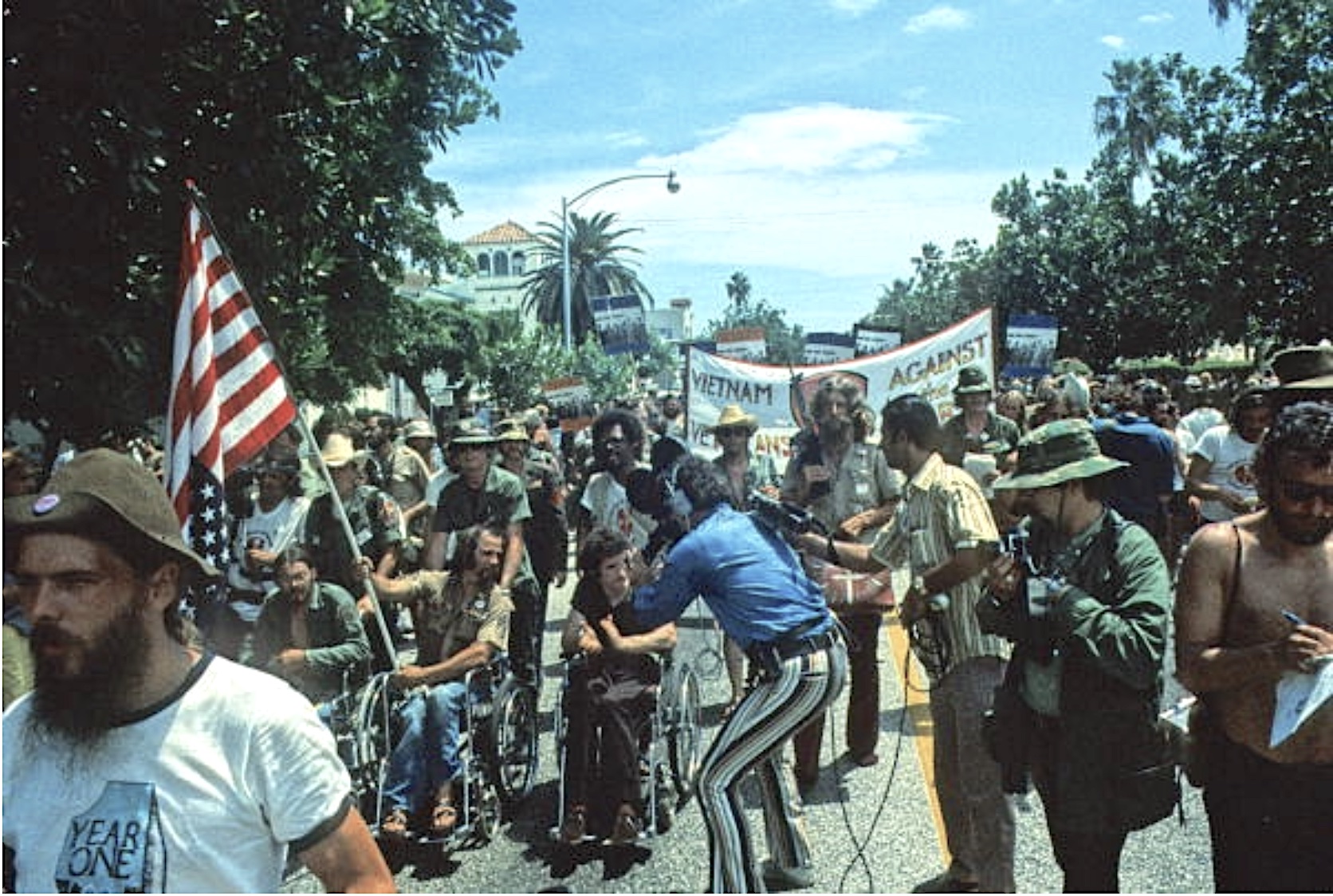
Ron Kovic, holding flag, leads Vietnam veteran protesters outside the 1972 Republican National Convention in Miami. A cameraman (in blue shirt) films him during the march. Photo by Tony Schweikle. (Credit: Wikimedia Commons)

Kovic moved to Southern California in the early 1970s, where he continued to speak out against the war. He would go on to be arrested dozens of times. His first arrest came at a protest outside of a draft board office in Orange County in 1971.

Other notable protests included a 17-day hunger strike at the Los Angeles office of then-Sen. Alan Cranston over the VA’s treatment of wounded soldiers returning from the war and an arrest for speaking out against the war outside the 1972 Republican National Convention in Miami.

Inspired by blacklisted screenwriter Dalton Trumbo’s 1939 antiwar novel, Johnny Got His Gun, Kovic in 1974 began feverishly writing about his own experiences, after he met Trumbo and actor Donald Sutherland at the opening of the film based on the book.

It took him one month, three weeks and two days of nonstop writing to complete the autobiographical Born on the Fourth of July, which was published by McGraw Hill on his 30th and the country’s 200th birthday: July 4, 1976.

With the book’s success, Hollywood came calling. Director Oliver Stone worked with Kovic on a screenplay for a film adaptation, and Tom Cruise signed on to play the lead role. At the end of filming, Kovic gifted Tom Cruise with his Bronze Star medal in thanks for Cruise’s performance in the film.

Released in December 1989, the Born on the Fourth of July film went on to be the 10th highest grossing film of the year. It was nominated for eight Academy Awards, winning Oscars for Best Director (Stone) and Film Editing. It also won Golden Globes for best dramatic film, best actor, best director and best screenplay.

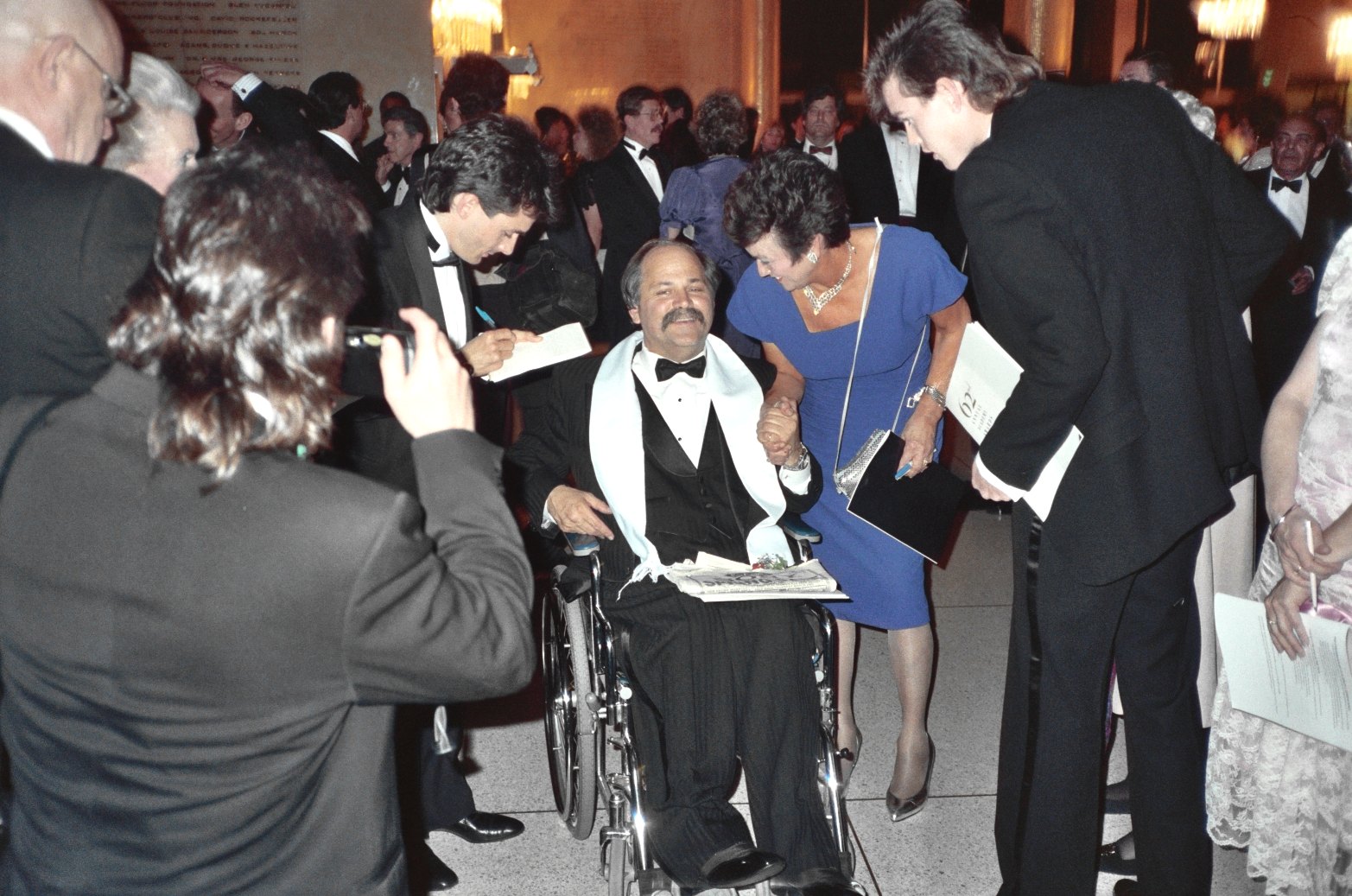
Ron Kovic at the 1990 Academy Awards ceremony. Photo by Alan Light. (Credit: Wikimedia Commons)

Kovic moved to Redondo Beach in the late 1980s. In 1990, he considered entering politics to oppose Republican congressman Robert K. Dornan, a staunch war hawk, but ultimately decided against it.

He has been arrested many times over the years, but has continued to oppose U.S. involvement in foreign wars, including frequent, vociferous criticisms of the first Gulf War in the 1990s and the 2003 invasion of Iraq.

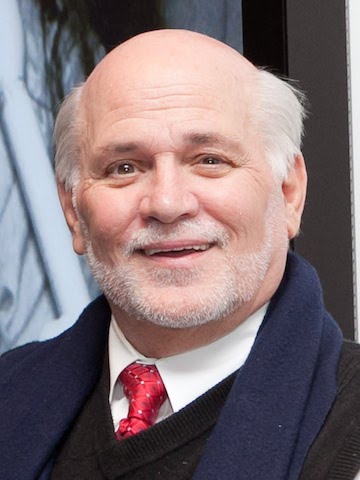
Ron Kovic. Undated photo. (Credit: Rotten Tomatoes website)

Bruce Springsteen wrote a song, “Shut Out the Light,” about Kovic after befriending him in the 1970s, and wrote a new introduction to the 40th anniversary 2016 edition of the Born on the Fourth of July book.

Kovic’s second book,  Hurricane Street, also published in 2016, detailed his efforts beginning with the hunger strike at Sen. Alan Cranston’s office in 1974 to organize the American Veterans Movement to advocate for better treatment of military veterans.

His third book, A Dangerous Country: An American Elegy, will be published in 2024. It will focus on the physical and mental traumas caused by war.

Now 76, Kovic still lives in Redondo Beach, where he counts writing, painting, music and gardening among his daily activities. 

As he told Daily Breeze reporter Megan Barnes in 2016, ““I love to write — I feel like I forget about the paralysis, I forget about the wheelchair. When I write, I just feel free and I feel like I’m in another world.”

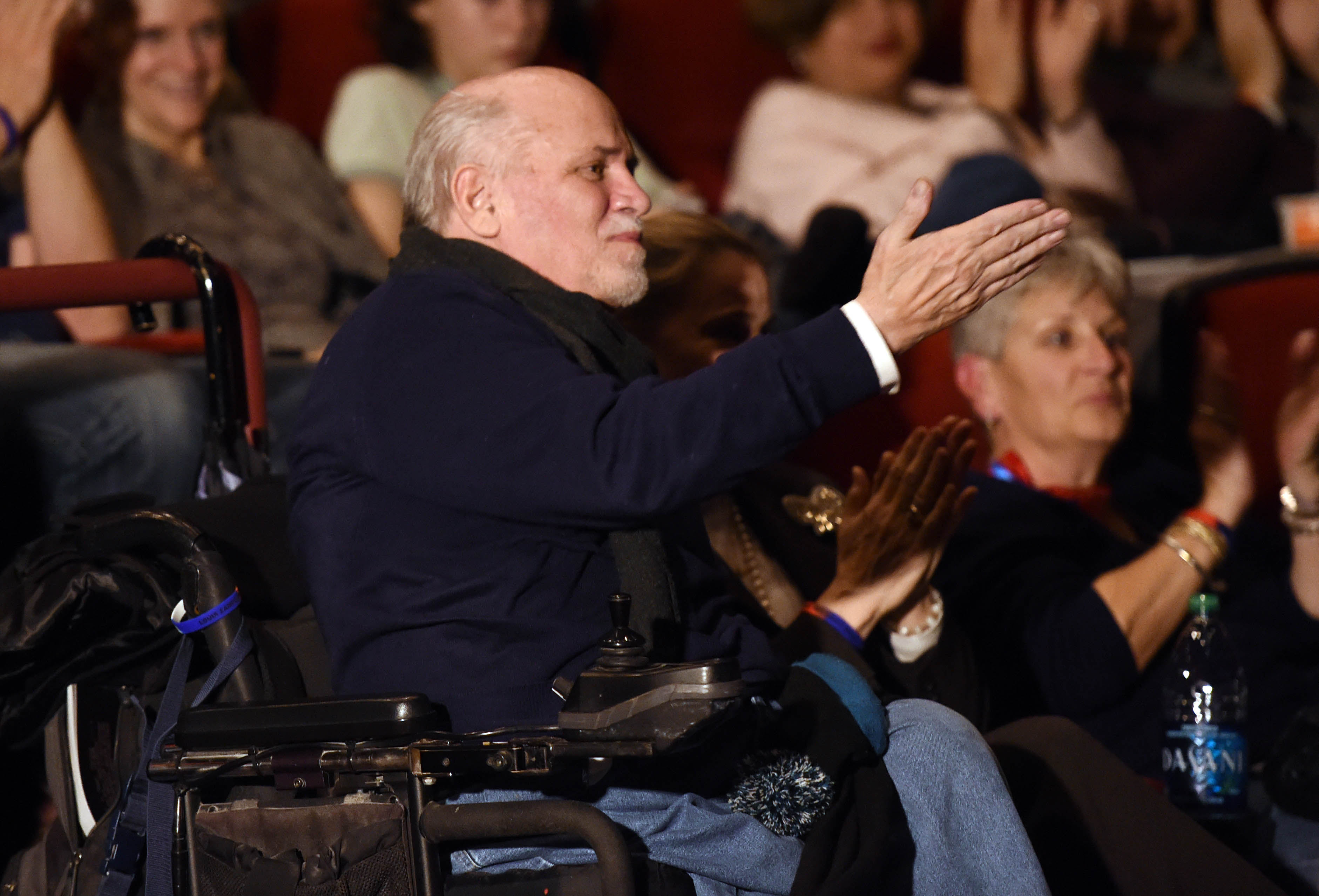
Ron Kovic was among the audience as the Torrance Historical Society sponsored a special preview of the Louis Zamperini biographical film, “Unbroken,” at the AMC Del Amo theaters in Torrance. Dec. 16, 2014. (Daily Breeze staff file photo by Stephen Carr)

Sources:

Daily Breeze archives.

Born on the Fourth of July: 40th Anniversary Edition, by Ron Kovic, Akashic Books, 2016.

Internet Movie Database.

Los Angeles Times archives.

“Ron Kovic and the Continuing Struggle for Veterans,” interview by Robert Scheer for KCRW program Scheer Intelligence, Feb. 19, 2016.

“Ron Kovic Reborn,” by Tim Gilmer, New Mobility magazine, June 20, 2003.

Wikipedia.

J.H. Hull, Torrance’s first schools chief, faced a long to-do list in 1947

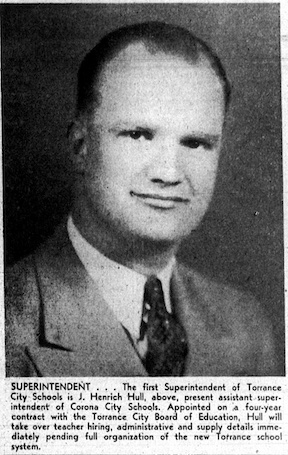
Torrance Herald, April 3, 1947, Page A-1. (Credit: Torrance Historical Newspaper and Directories Archive database, Torrance Public Library)

J.H. (John Henrich) Hull must’ve felt like he was walking into a buzz saw after he was chosen to become the first superintendent of the freshly minted Torrance Unified School District on March 30, 1947.

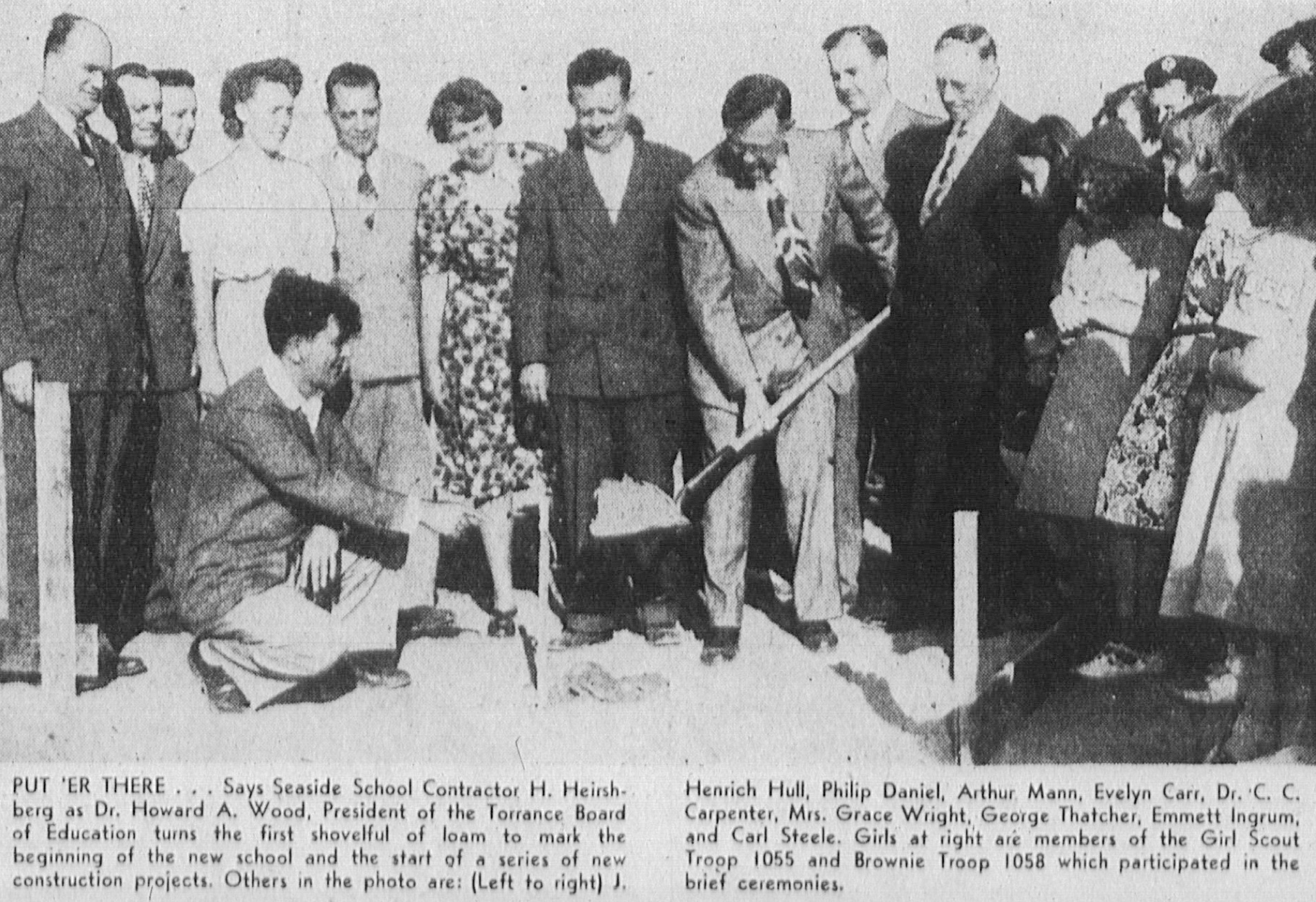
The new district’s board had been formed only a couple of weeks earlier. It included Evelyn Carr, whose tireless campaigning for Torrance to secede from the Los Angeles Unified School District and form its own school district had succeeded after years of legwork. (Carr told the Daily Breeze in 1997 that she’d worn out several pairs of shoes during her door-to-door campaigning for the new district.)

After reviewing several candidates, the new school board, which included Carr, Carl Steele, Grace Wright, Dr. Howard Wood and Howard Thatcher, voted unanimously to select Hull to be the district’s first leader.

The 38-year-old Midwestern educator was born in Council Bluffs, Iowa, on April 15, 1908. He earned a B.A. in economics and business administration from the University of Redlands, and a Master’s in education from Colorado State. Two years after taking the Torrance job, he completed his doctorate in education at USC.

He served as a high school principal and later as a superintendent in Colorado before moving to California in 1939. There, he began teaching English in Corona until the outbreak of World War II. He enlisted in the U.S. Navy in 1942. He served for three years, reaching the rank of commander.

After finishing his military service, he was working as an assistant superintendent for the Corona school district when he was hired away by TUSD for a salary of $10,000.

In his first days on the job, he had to establish a brand new school district, then consisting of only five schools, to serve the needs of a city already undergoing a postwar boom. To top it all off, LAUSD, miffed at Torrance’s secession, had stripped the schools of all their furnishings and equipment.

The first thing Hull did was to hire more teachers, using funds from a special 50-cent tax on city residents to bring on 63 of them in preparation for the 1947-48 school year. (1,973 students attended class on the first day of school in September 1947.)

Next, he mapped out a comprehensive building plan to deal with the ever-increasing number of schoolchildren in the burgeoning city, whose explosive postwar population growth was still in its early stages. 

The plan included a meticulous 31-step program detailing how to go about building new schools. He would need to refer to it often during his 23 years as Torrance schools chief, during which 37 new schools, including North, South and West high schools, would be built. 

Torrance Herald, April 26, 1949, Page A-1. Credit: Torrance Historical Newspaper and Directories Archive database, Torrance Public Library)

The student population during his tenure grew to nearly 13 times its original size, with the population of Torrance itself more than ten times what it was when he became superintendent.

Hull served as superintendent for six terms. Upon his reappointment in 1967, he announced that it would be his final term. By that time, his salary had increased to $28,000.

An avid fisherman and golfer, he lived on Hickory Ave. in Torrance with his second wife, Doris, and their two children, John Jr. and Doris Ann, who were then students at Torrance High School.

True to his word, Hull retired as superintendent on July 15, 1970. During his tenure, 20,716 students had graduated from the district’s high schools. In addition, Hull had advocated for the formation of the continuation school Shery High, as well as the establishment of the Southern California Regional Occupational Center (SCROC) for vocational education.

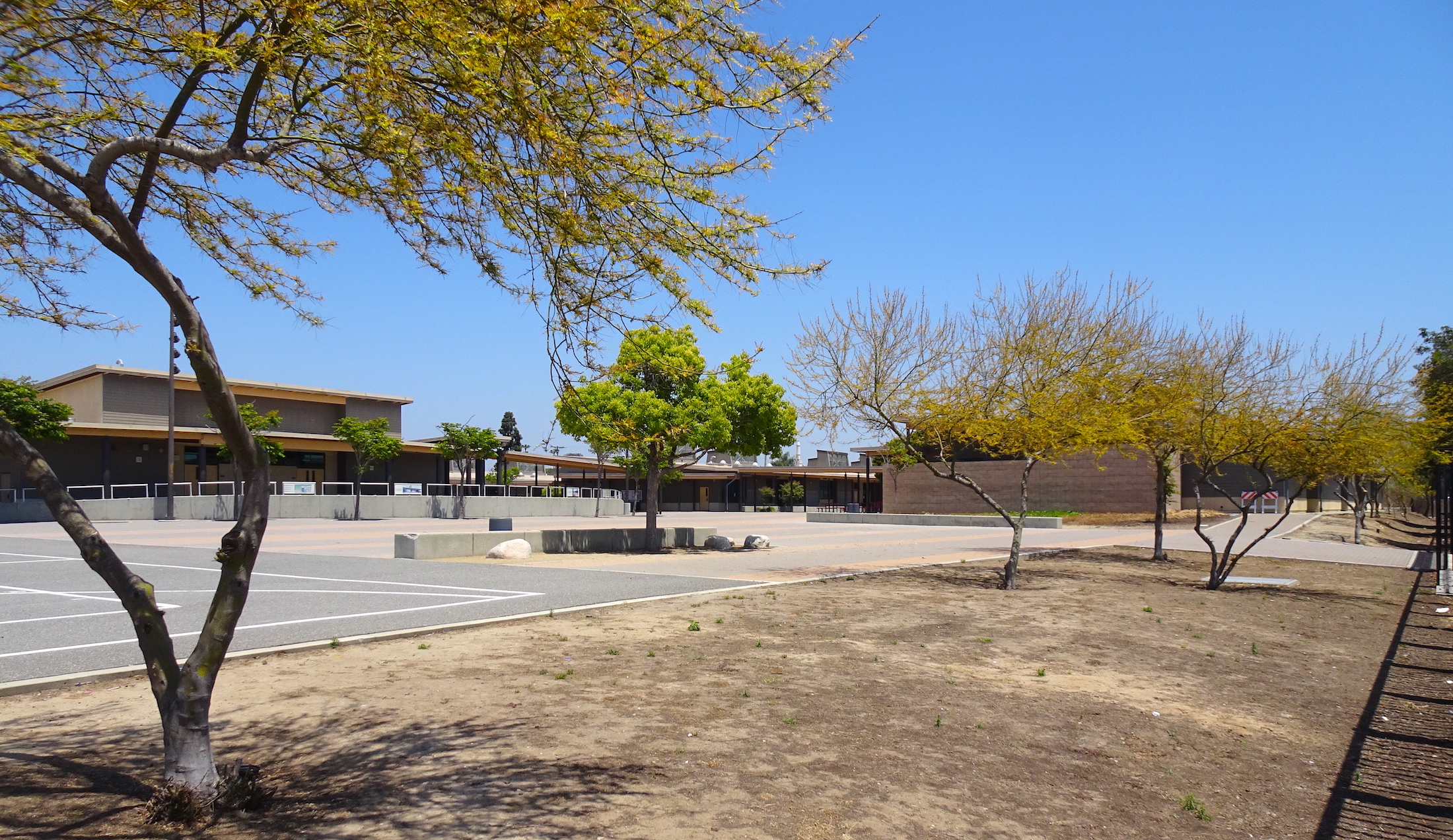
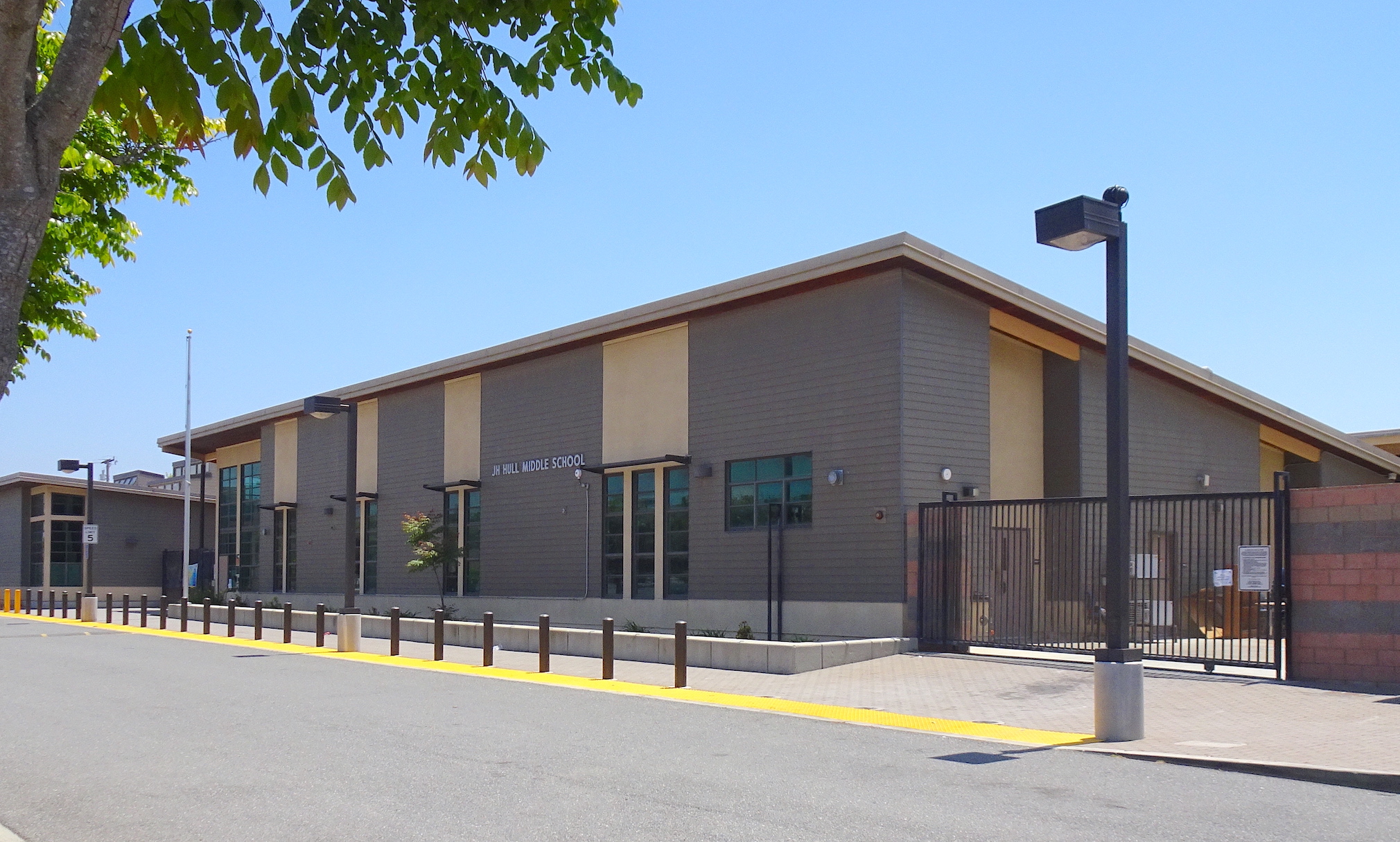
A completely rebuilt Hull Middle School opened in southeast Torrance in 2011. (May 2023 photo by Sam Gnerre)

After his retirement, Hull served as executive director of an educational research commission for the State of California, and as foreman pro tem for the Los Angeles County Grand Jury in 1973-74. 

He died on Sept. 28, 1974, while visiting relatives in Denver, Colorado. His body was cremated and his ashes scattered over the ocean. He was 66.

In April 1970, TUSD opened a new middle school on 8.9 acres of land it had purchased in  southeastern Torrance. Hull Middle School at 2800 W. 231st St., was named for the man who had played such a major role in creating and nurturing the school district.

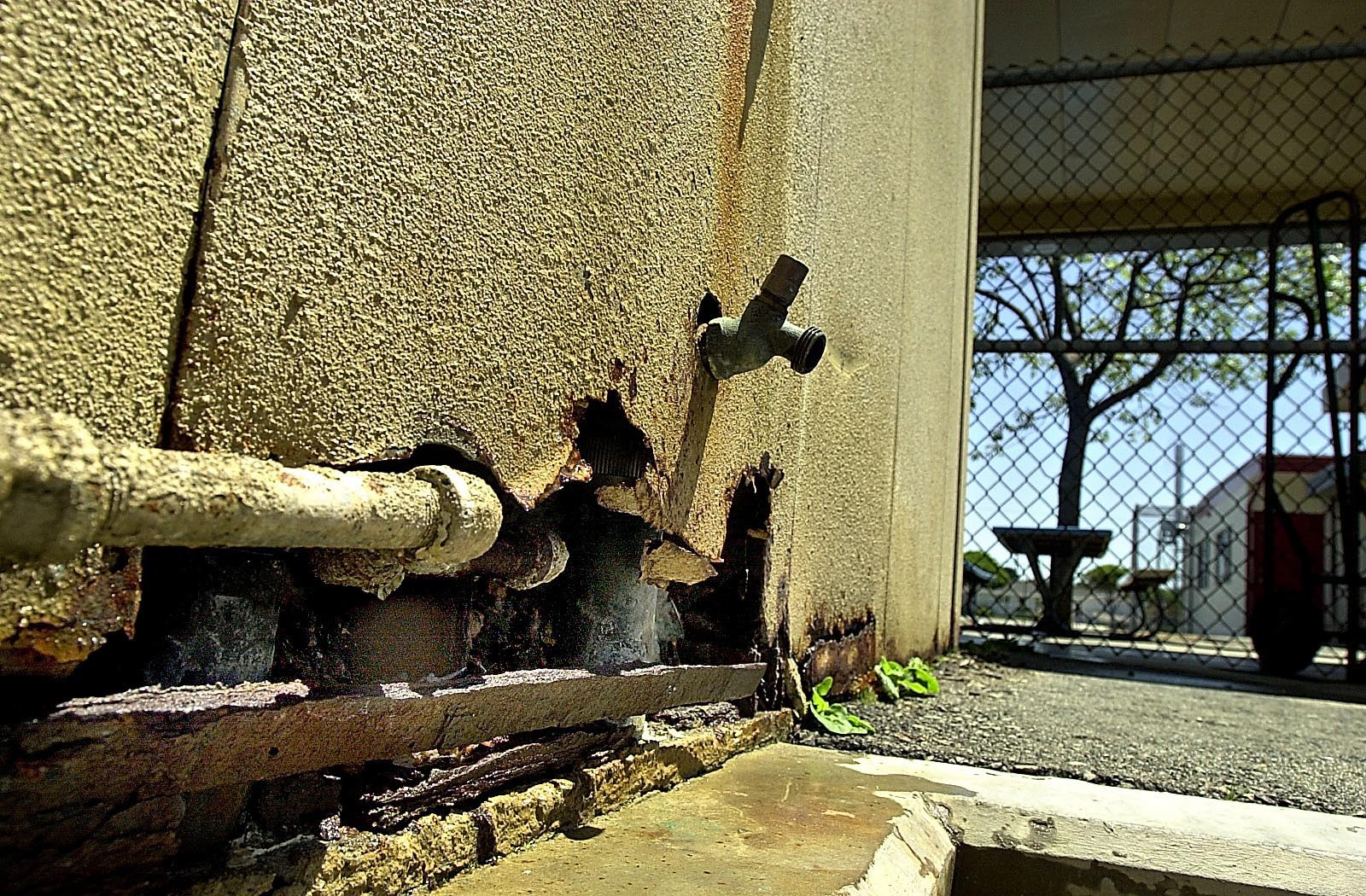
Unfortunately, the school’s infrastructure deteriorated over the years, and a series of lean school budgets didn’t provide the funds needed for its upkeep and repair. It had already been marked for possible shuttering in 1995, but little was done to improve the facilities. By 2006, its condition was so poor that it had to be closed. 

Rust has destroyed a part of the cafeteria wall at Hull Middle School in Torrance. Most of the school’s classes meet in temporary buildings. June 9, 2006. (Daily Breeze staff photo by Kim Haggerty Zylius)

Its students, who had been forced to attend classes in prefabricated modular classrooms, were sent to the closed Sam Levy Adult Center for the next five years to the long-time temporary facility that became known as J.H. Hull at Levy Middle School.

After assessing the old school’s condition, the decision was made to demolish it completely and build an entirely new facility on the site. The passage of school bond measures Y and Z in 2008 made the project possible.

The old buildings were razed in early 2010, and construction of the new school began that May. The brand-new Hull Middle School buildings opened to students in September 2011.

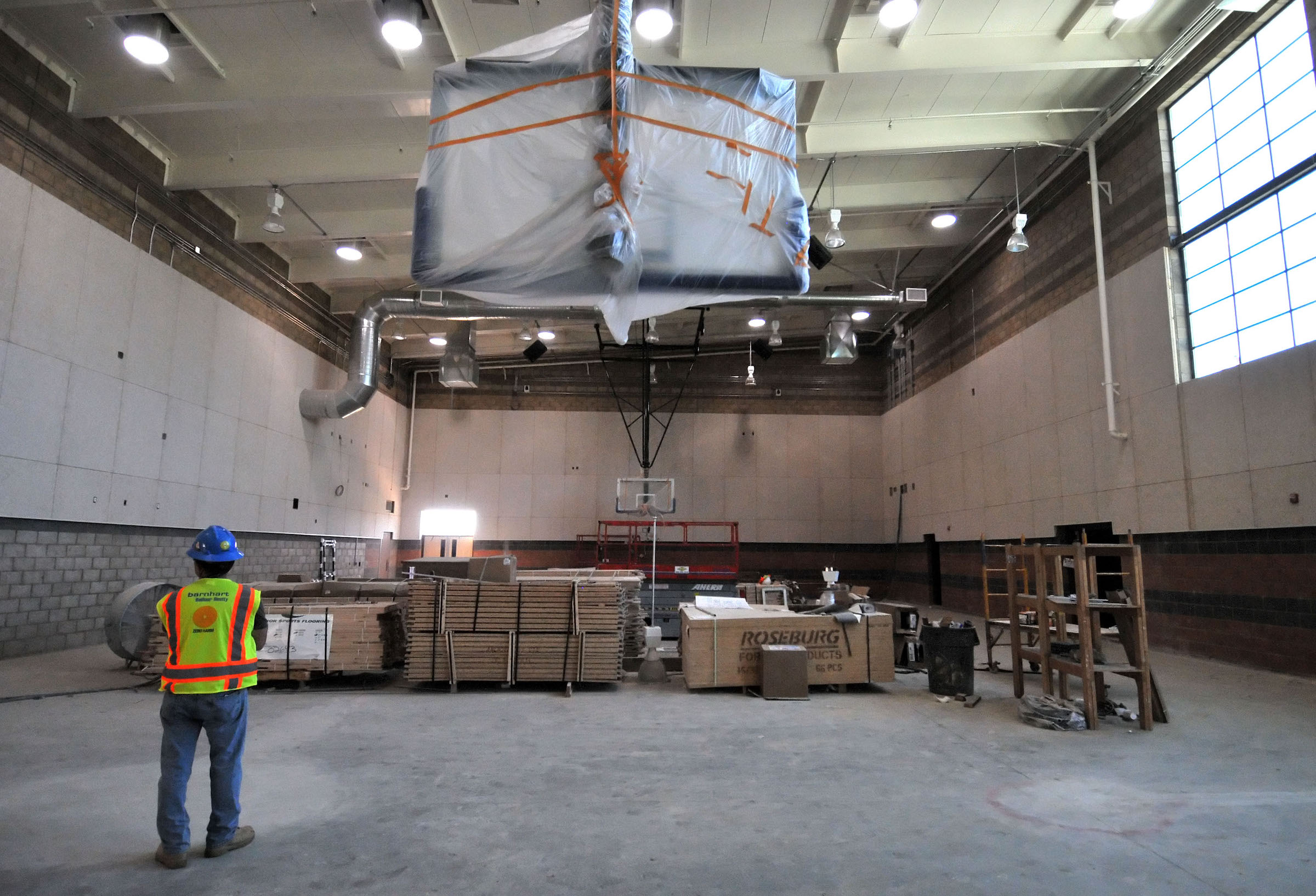
Construction safety officer Lupe Hernandez takes a look at the Hull Middle School gym, which was still under construction when this photo was taken on .July 28, 2011. (Daily Breeze staff file photo by Steve McCrank)

Sources:

Daily Breeze archives.

Find a Grave website.
The History of Torrance Schools, 1890-2000, by Thomas Rische, TUSD History Project, 2002.

Los Angeles Times archives.

Palos Verdes Peninsula News archives.


Torrance Press Herald archives.

Hull Middle School had to be rebuilt from the ground up before reopening in 2011. (May 2023 photo by Sam Gnerre)

Inglewood Oil Field drilling judged a factor in 1963 Baldwin Hills Dam disaster

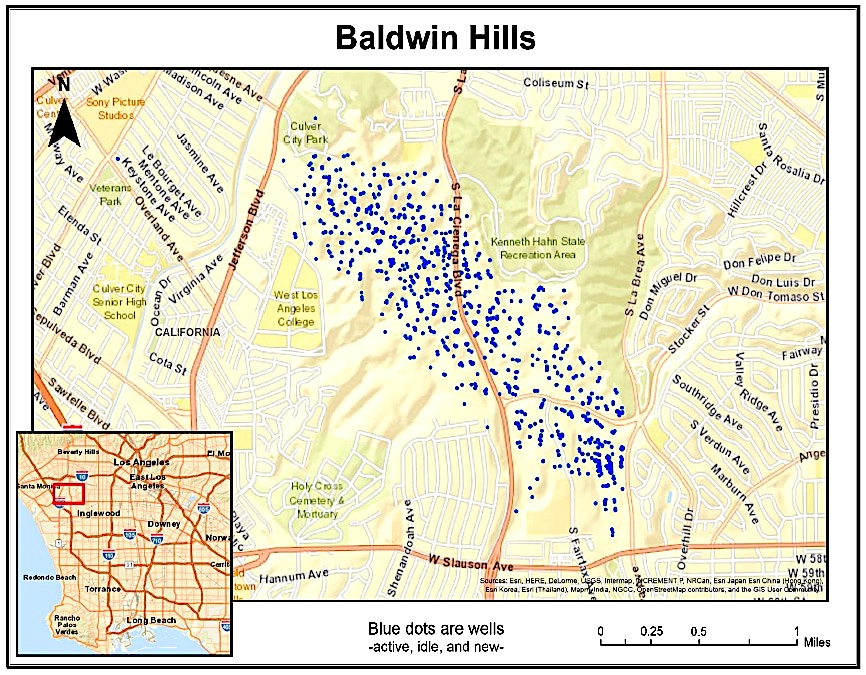
Modern undated map shows location of the Inglewood Oil Field roughly delineated by wells represented by blue dots. The Kenneth Hahn State Recreation Area, top center, was fashioned from the former Baldwin Hills Dam site. (Credit: California Air Resources Board website)

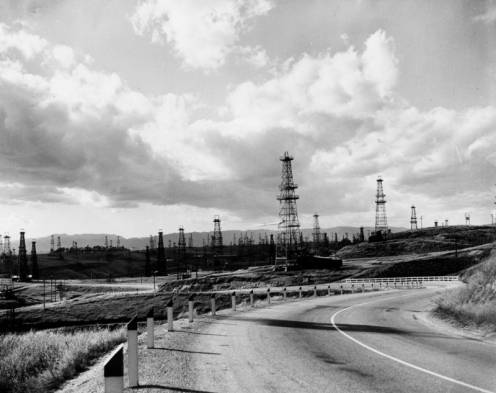
The search for oil during the boom of the 1920s left few local stones unturned. As vintage photos attest, huge swaths of land in the South Bay were blanketed with wells during the rush for black gold.

Oil derricks blanket the Inglewood Oil Field. View is toward the north along Fairfax Avenue. Undated photo. (Credit: Los Angeles Public Library Photo Collection)

One of the largest concentrated areas for drilling, roughly 1,000 acres of hilly land between Inglewood and Culver City, became known as the Inglewood Oil Field. The Standard Oil Company of California discovered oil on the site in 1924, and the rolling Baldwin Hills soon were dotted with wells.

Two decades later, Los Angeles water officials, sensing the need for improving the water supply to the booming postwar southwest Los Angeles County, began planning a new reservoir in Baldwin Hills to supply the South Bay, Harbor Area and Long Beach. It would be the first reservoir built after the end of World War II by the L.A. Department of Water and Power. 

Construction began on the project in early 1947. Its floor was built with compacted earth. It was designed to hold nearly 300 million gallons of water that would come from the Owens Valley and the Colorado River via the Franklin Canyon Reservoir in Beverly Hills. (The latter is best known as the lake seen in the opening credits of “The Andy Griffith Show.”)

An earthen dam on its northern border, also built from compacted soil, would protect the relatively pricey homes springing up in the Baldwin Vista subdivision just north of the dam. When completed, the Baldwin Hills Dam stood 235 feet tall and 650 feet in length.

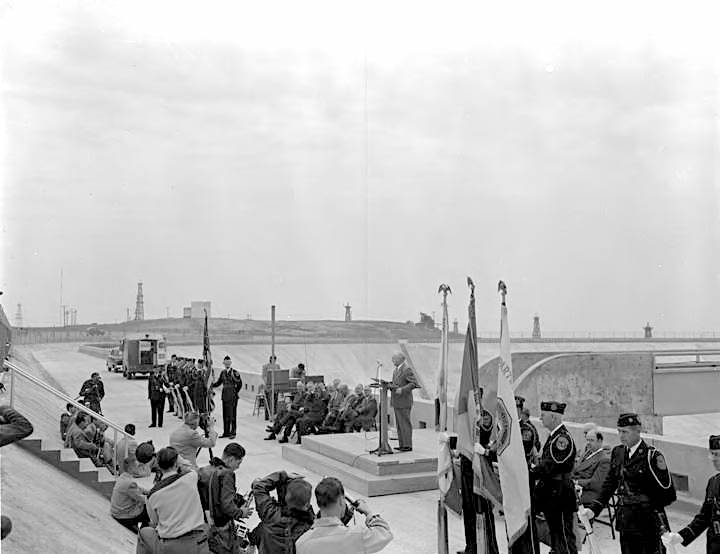
Los Angeles Mayor Fletcher Bowron speaks at the Baldwin Hills Reservoir dedication in 1951. (Credit: Historical Photo Collection of the Department of Water and Power, City of Los Angeles)

By the time Los Angeles Mayor Fletcher Bowron officially turned the wheel that brought the first water cascading into the reservoir at its opening ceremony on April 18, 1951, the project’s costs had ballooned to $10 million.

Twelve years later, at 11:15 a.m. on Saturday, Dec. 14, 1963, the reservoir’s caretaker on duty noticed water draining from pipes beneath the reservoir’s lower lining. He notified the engineer, and they tried draining the reservoir to lower its water levels. However, the process would take 24 hours.

At this point, the DWP notified police, asking them to begin evacuating residents as a precaution. Over the next few hours, many residents of the Baldwin Vista homes below and north of the dam were evacuated. DWP personnel worked desperately to remedy the situation, but still the leak continued to worsen. 

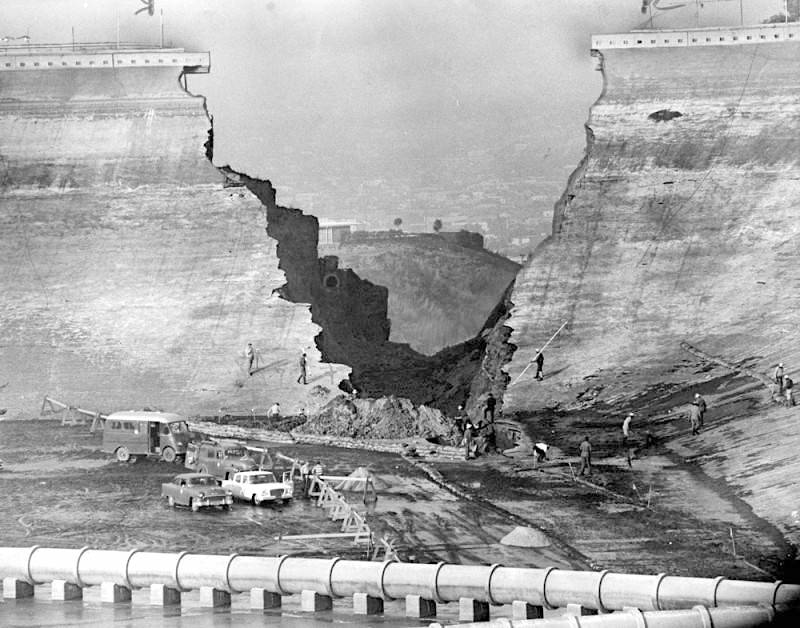
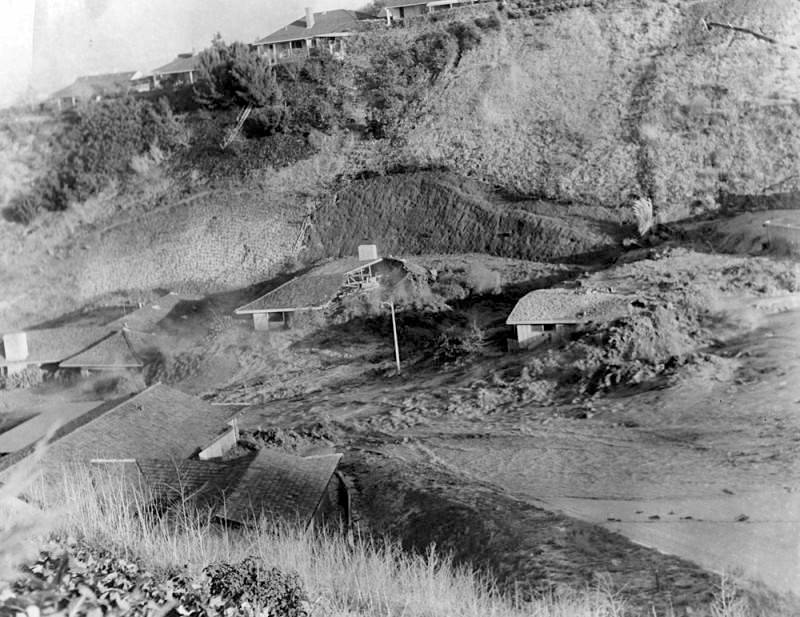
Parked vehicles are dwarfed by the inlet pipes at the bottom of the Baldwin Hills Reservoir just days after the dam broke. A row of sandbags sit in front of the enormous break and construction workers are busy with cleanup. Dec. 20, 1963. (Credit: Los Angeles Public Library Photo Collection)

News of the leak at the dam and the evacuations reached the news media, and local television station KTLA Channel 5 decided to use its brand-new news helicopter for the first time to survey the scene, an early use of that technology in news reporting. The station began breaking into its Saturday programming with updates on the leak. (See end of post for link to KTLA footage.)

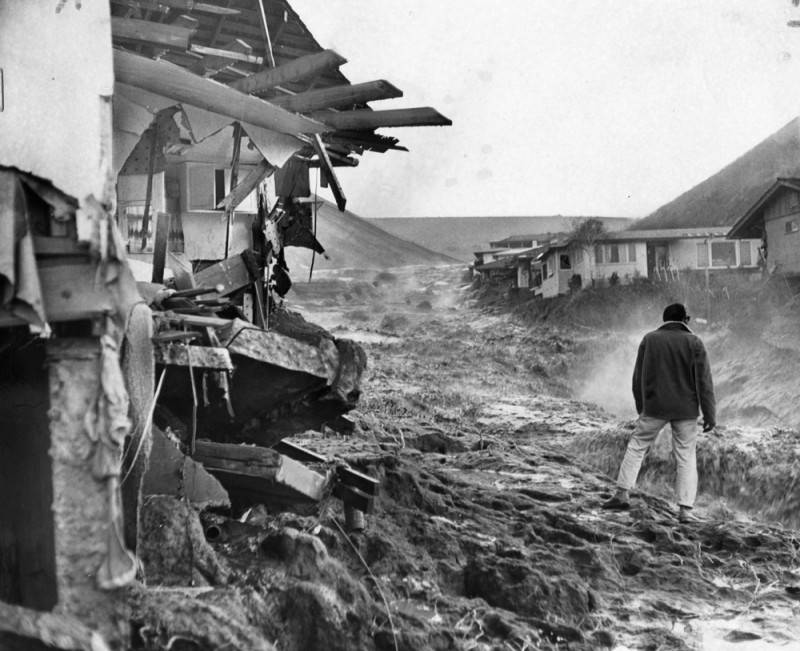
Then, at 3:58 p.m, the station broke in again, and viewers watched as a 50-foot-wide section of the weakening dam finally gave way. Within 30 minutes, the reservoir was nearly empty. An estimated 290 million gallons of water roared down the hill northward into the Baldwin Vista neighborhood, inundating houses and automobiles along Cloverdale Ave. and neighboring streets.

A street lamp, center, still stands as flood waters race down into the Baldwin Vista residential area from the Baldwin Hills Dam break on Dec. 14, 1963. (Credit: Los Angeles Public Library Photo Collection)

Only 77 minutes after the dam break, the reservoir essentially was empty. All the water had flowed out to La Cienega and La Brea boulevards to the west and east, and Jefferson Blvd. to the north. Five people were killed in the flood, 277 homes were destroyed and more than $12 million in property damage was reported.

The magnitude of the disaster led to immediate state and local government inquiries as to its cause. Initially, experts blamed the DWP for building the reservoir and dam on an active fault line, an offshoot of the nearby Newport-Inglewood fault. Shifting in the fault led to cracks in the compacted earth of the reservoir floor – for which designers also were criticized – which caused the leak.

Over the years, though, another critical factor entered the discussion. Though the oil drilling companies vehemently disagreed, engineering experts also pointed to the hydraulic fracturing process being used in the Inglewood Oil Field wells to extract oil more economically and completely.

A man stands at the edge of a turbulent river flowing from the break in the Baldwin Hills Reservoir above. Behind him, a partially demolished house still stands, its kitchen cupboards exposed. Dec. 15, 1963. (Credit: Los Angeles Public Library Photo Collection)

Fracking, as the process is commonly known, injects water, sand and sometimes chemicals into an underground well to free oil trapped by bedrock. The experts began theorizing as early as 1971 that it had destabilized the ground beneath the reservoir, which exacerbated the cracks in the reservoir that led to the weakening and collapse of the dam. Lawsuits and further investigations ensued.

Meanwhile, L.A. County Supervisor Kenneth Hahn, who had been at the dam on the day it collapsed, was determined to find some good in a bad situation.The facility and surrounding land were unusable for development due to the fault and the weakness of the underlying substrate from oil drilling.

On June 10, 1982, after several years of planning, Hahn presided over a groundbreaking for a project to transform the area into the Baldwin Hills State Recreational Area.

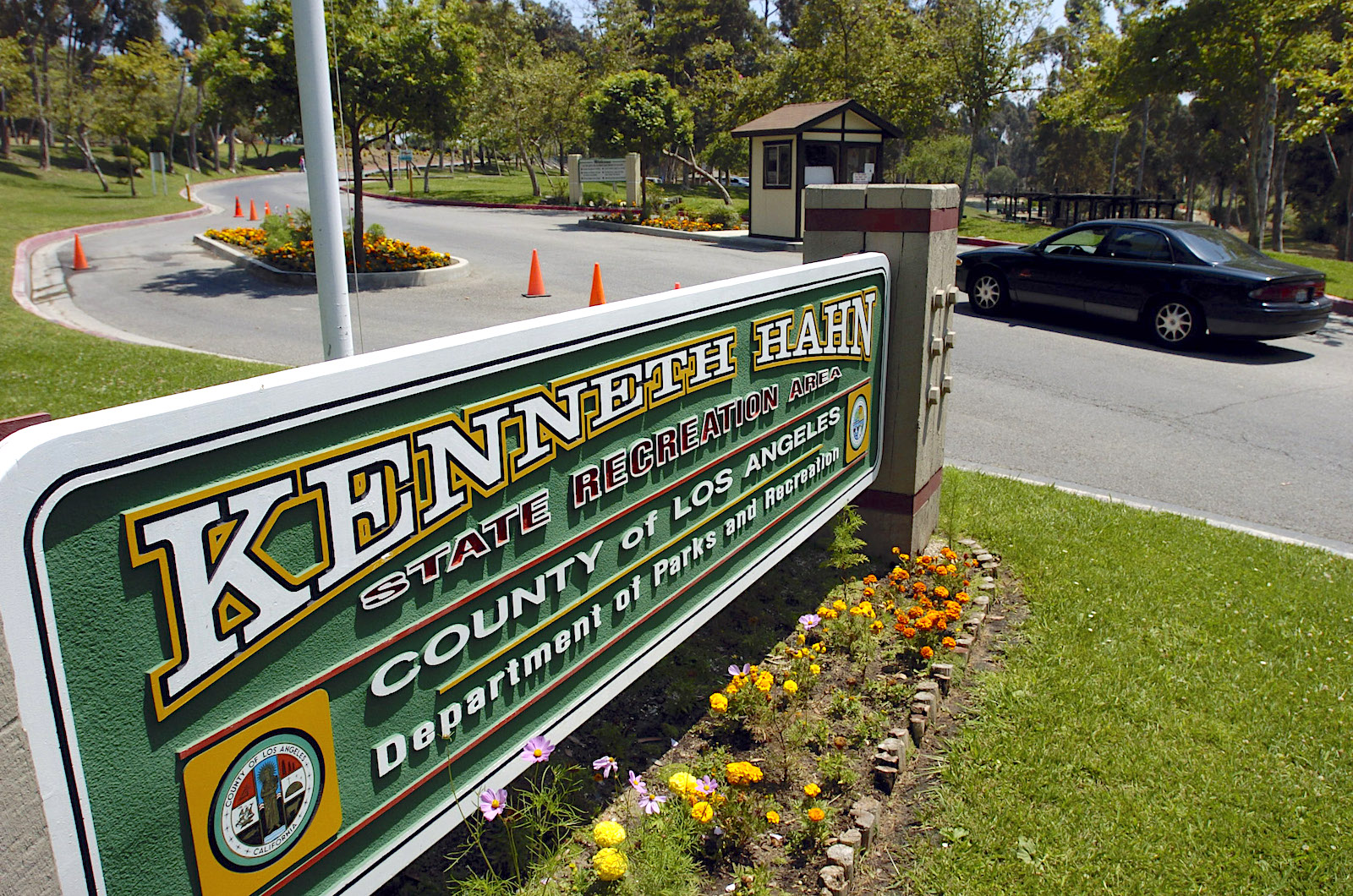
By the time the park opened in 1983, the failed reservoir had been sitting deserted for 20  years, overgrown with weeds and brush. In 1988, its name was changed to the Kenneth Hahn State Recreation Area to honor Hahn’s contributions to its creation. Hahn died in 1997.

The entrance to Kenneth Hahn State Recreation Area in Baldwin Hills. 2004 photo. (Daily Breeze staff file photo by Scott Varley)

Sources:

“The Baldwin Hills Dam Disaster,” by PEImpactJH, PE Impact blog, Aug. 26, 2021. 

California Department of Water Resources website.
Daily Breeze archives.

Inglewood Oil Field website.
“Case Study: Baldwin Hills Dam (California 1963), Lessons Learned From Dam Incidents And Failures website, Association of State Dam and Safety Officials.

Los Angeles Times archives.

“Remembering the Baldwin Hills Dam disaster,” by Drew de la Houssaye, KCRW website, Dec. 13, 2013.

Note: This video contains a chronological mix of silent footage of the Baldwin Hills Dam disaster mixed in with KTLA Channel 5 news footage. (Credit: California Department of Water Resources)

Fatal 1937 San Pedro shooting roiled tensions between longshore union, police 

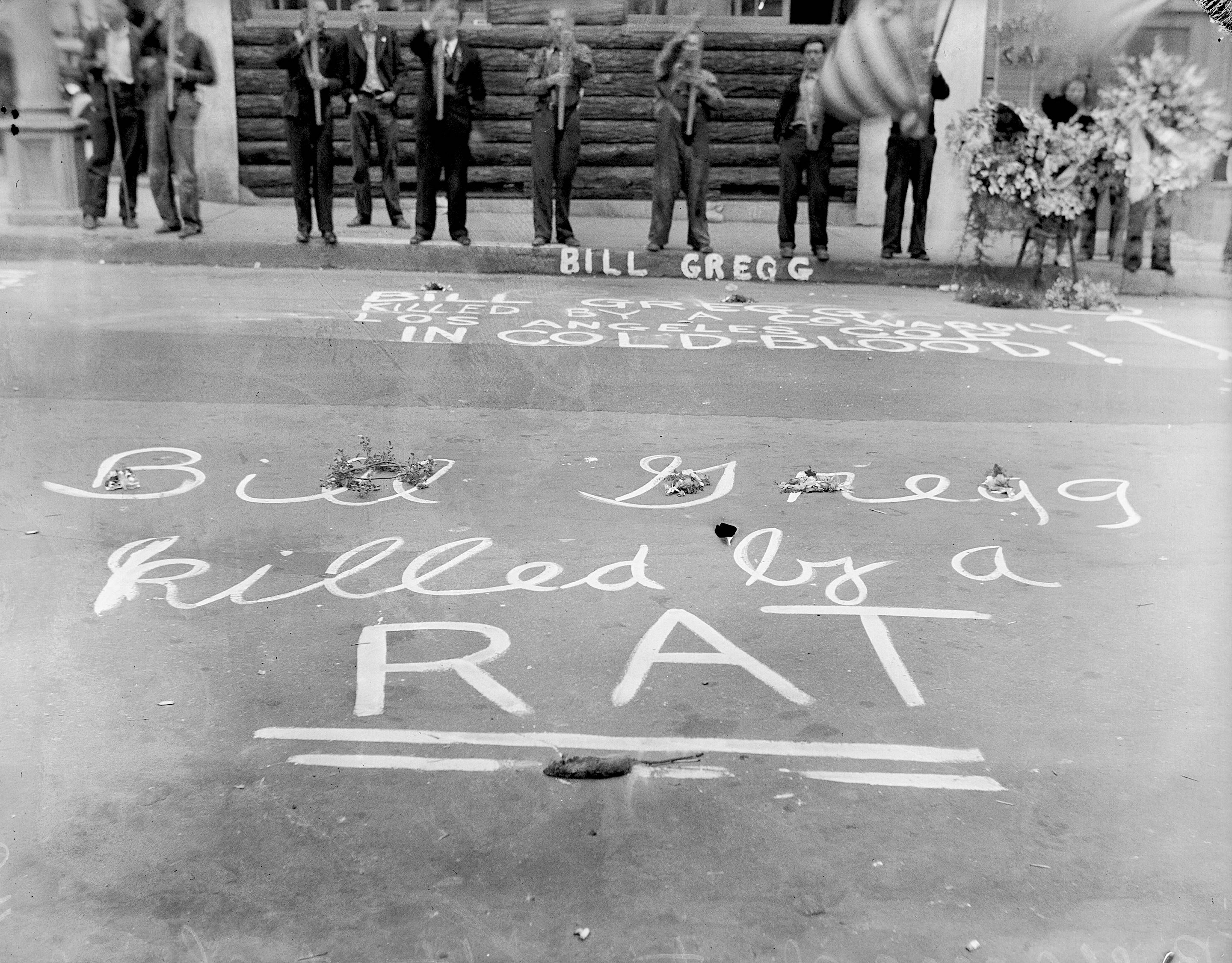
Writing on Beacon St. in San Pedro reads, “BILL GREGG KILLED BY A COWARDLY LOS ANGELES COP IN COLD-BLOOD! Bill Gregg killed by a RAT”. A dead rat was added at bottom for emphasis. May 29, 1937. (Credit: Los Angeles Daily News via UCLA Library Digital Collections)

Relations between dockworkers in San Pedro and the police during the 1930s were more than just contentious. They often turned violent, and even deadly. The unionization of longshore workers at the port was then underway, and it had turned into a lengthy, often violent struggle.

Activist Harry Bridges began his labor organizing with the already established International Longshoremen’s Association (ILA) in the 1920s. His 1933 attempts to improve the brutal and downright dangerous working conditions on the L.A. Harbor docks were stonewalled by employers at the Port.

In May 1934, the local ILA chapter voted to strike. The shipping companies responded by organizing a group of 300 scab workers. Late in the evening of May 14, a group of bitterly  resentful union men confronted the strikebreakers and police at Berth 145 in Wilmington, where the workers were quartered aboard a ship.

The scabs and police were armed, the confrontation quickly turned violent, and two local union members, recent San Pedro high graduate Dickie Parker, 20, and Lomita resident John Knudsen, 43, were shot and killed.

Harry Bridges in 1937. (Credit: San Francisco Public Library photo collection)

The confrontation was the precursor to “Bloody Thursday,” in San Francisco two months later. Violence broke out during a pro-labor march on city streets on July 5. Two union members were shot and killed. The strike finally was settled in the union’s favor in October 1934.

It became abundantly clear during all this unrest that the authorities sided with the employers at the ports, often supplying police muscle in addition to scab labor in attempts to break the unions. Union leaders and activists such as Bridges were uniformly denounced as being Communists, a charge that Bridges spent his lifetime denying. He would eventually break from the ILA and form the present-day International Longshore and Warehouse Union (ILWU), which he headed from 1938-1977.

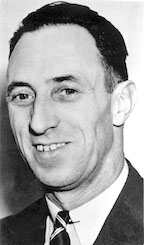
Into this fractious environment stepped our two protagonists: union member and sometimes ship’s cook Norman “Big Bill” Gregg and LAPD Patrolman William H. Redding.

Gregg, 40, often frequented the bars and cafes on San Pedro’s raucous Beacon St., home to notorious joints such as Shanghai Red Cafe at Fifth and Beacon. He’d had a couple prior run-ins with the local law. In 1934, he was arrested during a gambling raid on Beacon St., and was later arrested and cleared of a battery charge against a woman resisting his advances in a Beacon St. tavern.

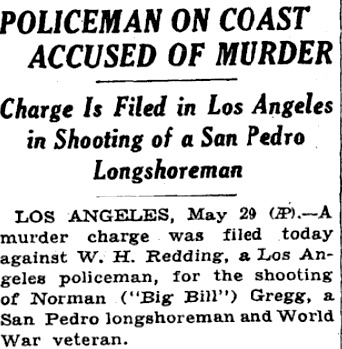
New York Times, May 30, 1937, Page 17. (Credit: New York Times archives)

But, according to the San Pedro News Pilot, Gregg was “prominent and generally well-liked” along the San Pedro waterfront. The World War I veteran had lived at 1022 W. Santa Cruz St. with his mother, Bertha, and sister, Myrtle, for four years.

Patrolman Redding claimed that he encountered Gregg annoying Lucille Wisberger, a housewife who had come to the Log Cabin Cafe with a friend. When he intervened and ordered Gregg to get away from Wisberger, Gregg grabbed the officer’s blackjack and hit him with it.

He then ran outside to his car and tried to get his gun out of the glove compartment. Redding followed him, claiming that Gregg then moved menacingly toward him with one hand behind his back. “Take another step and I’ll shoot,” Redding said. Gregg kept coming, so Redding fired once, and then twice more as Gregg fell.

Other witnesses who supported Gregg saw it differently, saying that during the initial scuffle in the cafe, Gregg took away Redding’s blackjack and threw it outside after Redding hit him on the head with it. After the dispute moved outdoors, Gregg later approached Redding in the street with both hands empty at his sides before being shot three times by the officer.

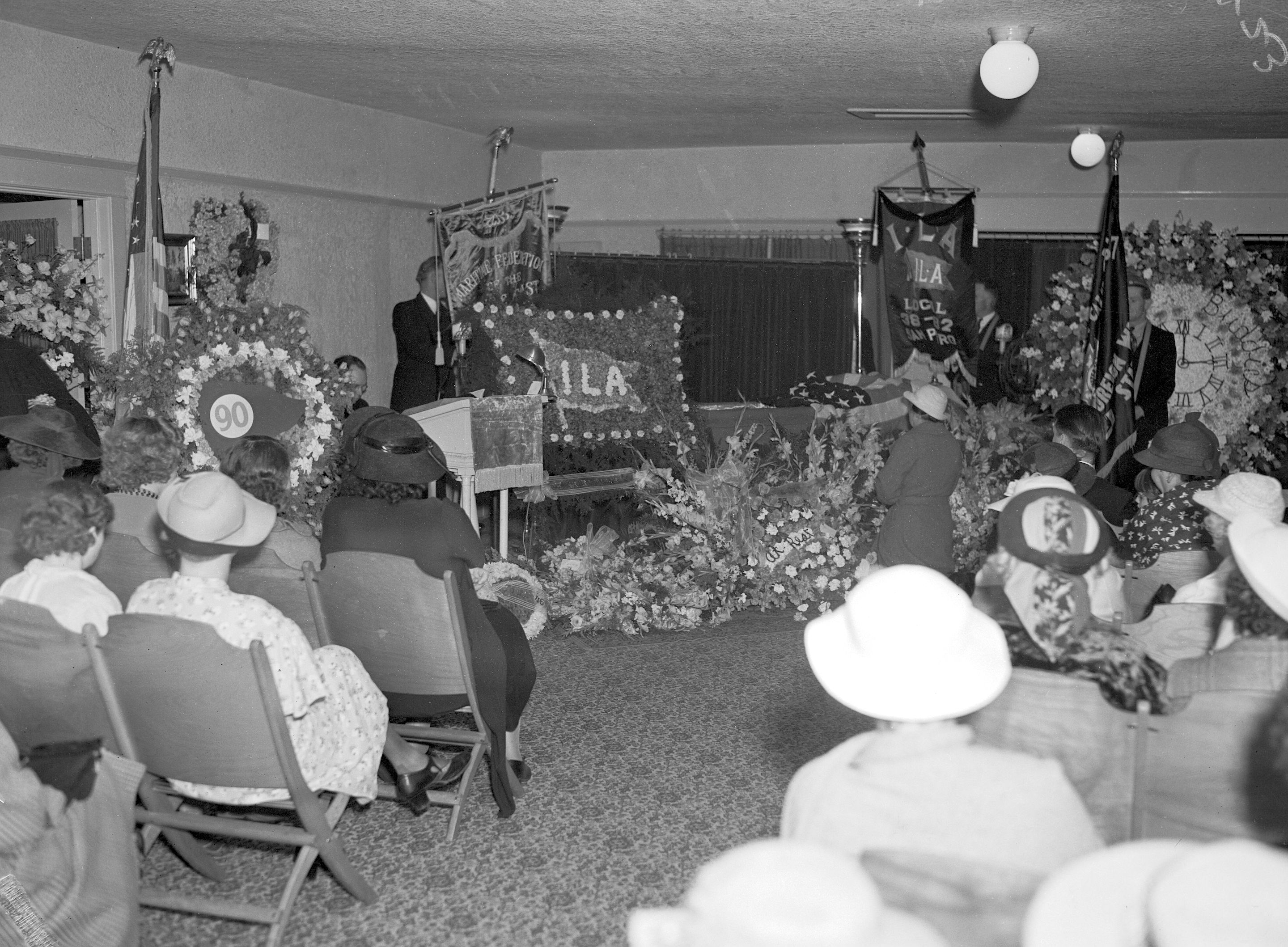
Funeral service for Norman “Big Bill” Gregg, San Pedro. June 2, 1937. (Credit: Los Angeles Daily News via UCLA Library Digital Collections)

Union members were outraged by the killing. More than 3,000 of them assembled at the Wilmington Bowl the next day to express their indignation at what they saw as the unjustified slaying of one of their own. Anti-police sentiment ran high.

The union basically had shut down the town that morning. All cargo handling stopped, buses stopped running, and many union-staffed stores and restaurants closed down. The next day, a murder charge was filed against Redding. County Coroner Frank Nance then sent the case to the grand jury for investigation.

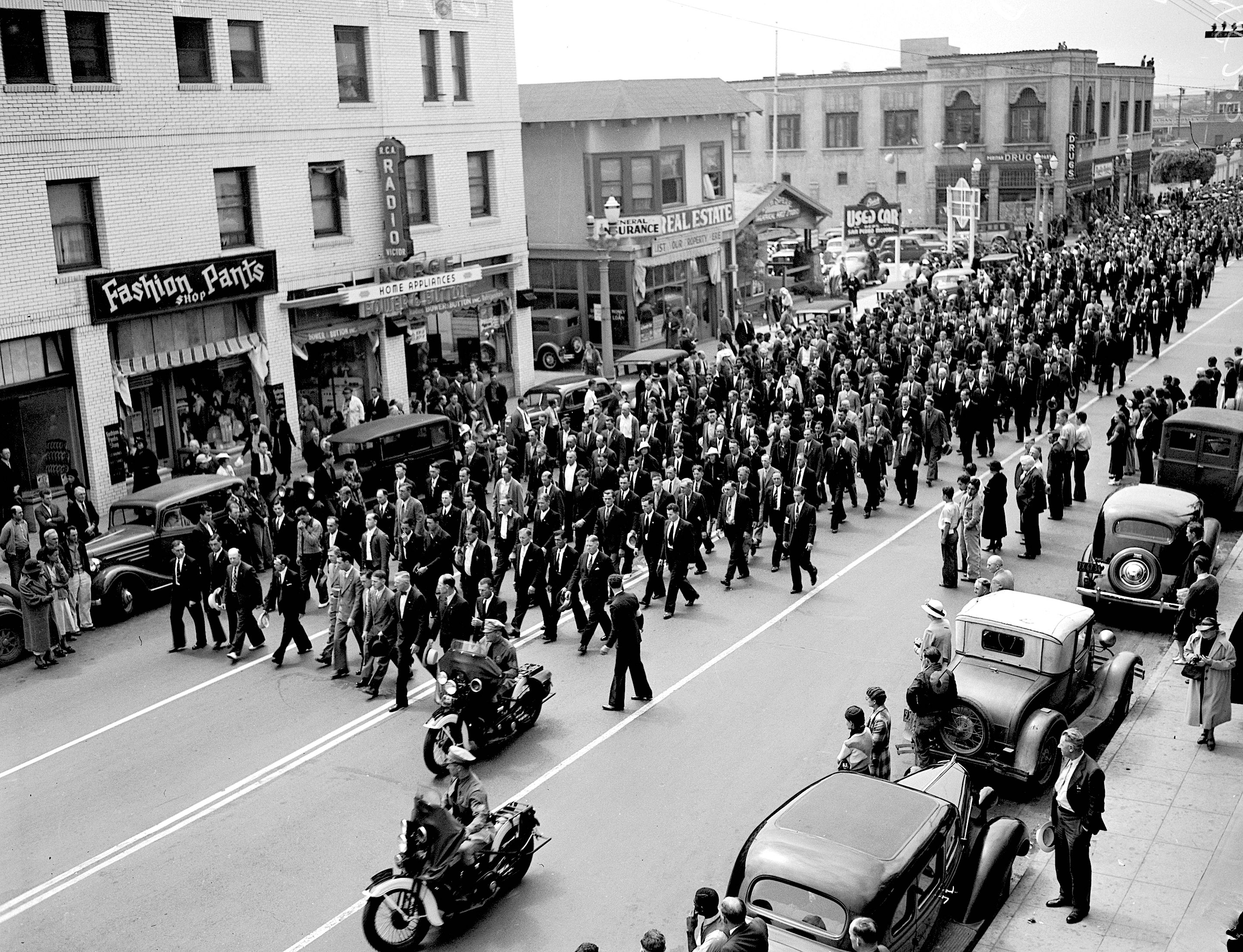
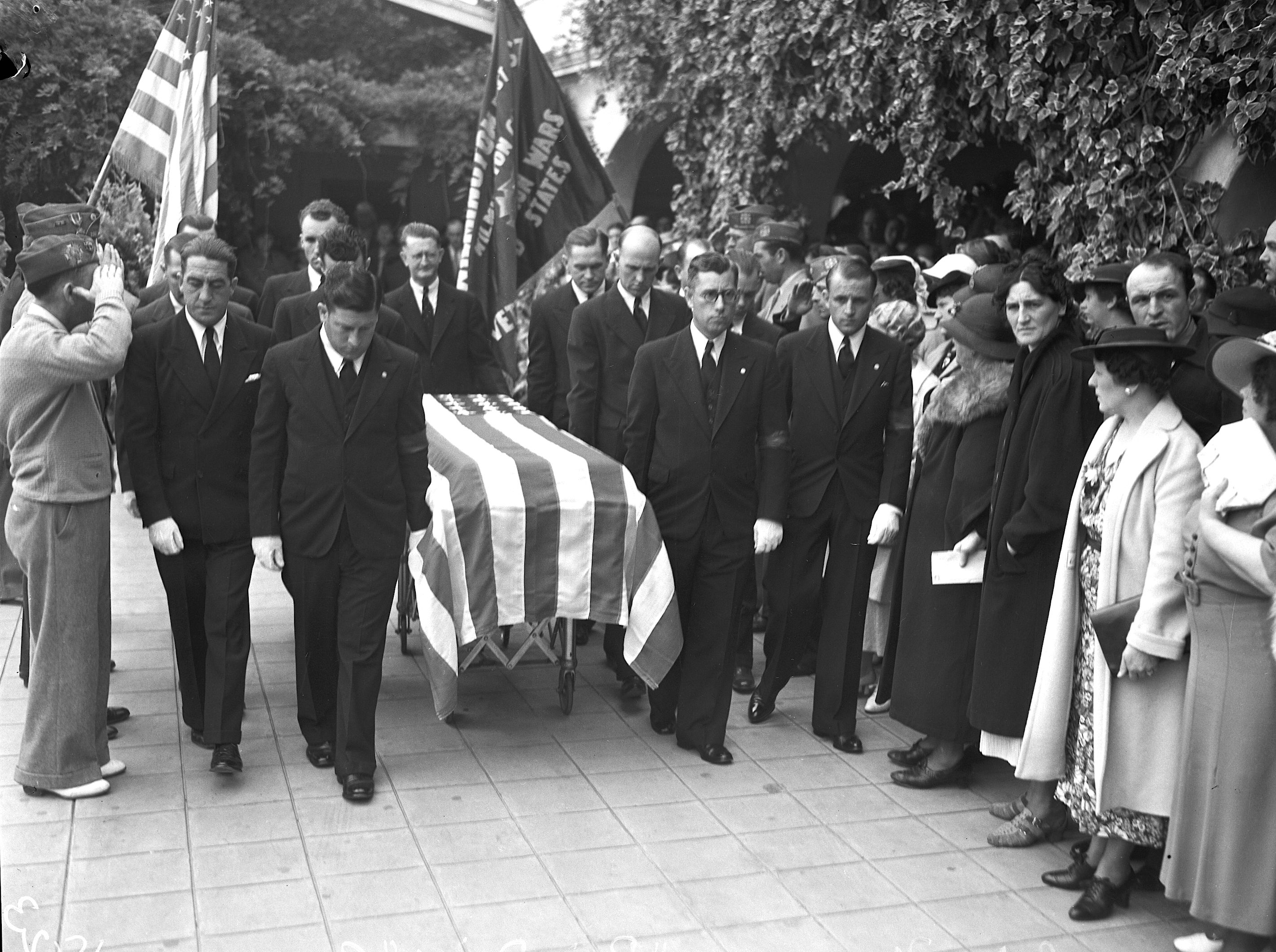
Funeral procession on Pacific Ave. in San Pedro for longshoreman Norman Gregg, who was known as “Big Bill.” Gregg was shot by LAPD Patrolman W.H. Redding. The killing created an uproar amongst longshore workers. June 2, 1937. (Credit: Los Angeles Daily News via UCLA Library Digital Collections)

On June 2, thousands of union members marched in Redding’s funeral procession on Pacific St. from Ninth to First streets before getting in their cars to attend his burial at the Veterans Administration cemetery in Westwood. At least 50 additional policemen were called to the area as a precaution, but the march was peaceful.

Testimony at the grand jury inquiry into the shooting was at turns both heated and contradictory, with Gregg supporters telling his side, and the police supporting Redding’s version.

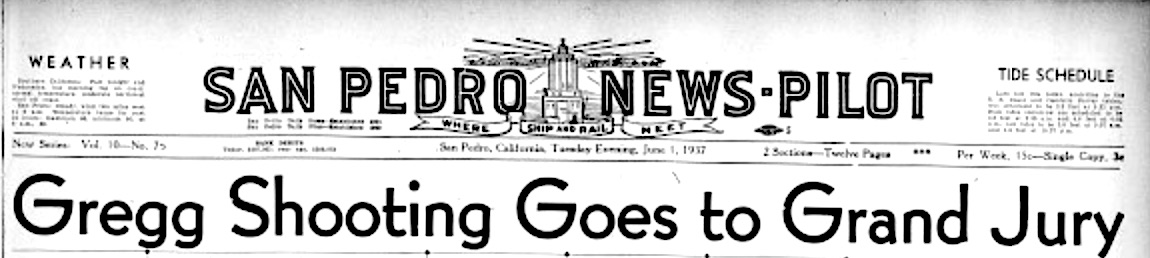
San Pedro News Pilot, June 1, 1937, Page 1. (Credit: San Pedro News Pilot archives)

Ultimately, the inquest ended on June 7, when all charges against Redding were dropped. The union, convinced that the case against the officer was being whitewashed by the courts, appealed to both the California state attorney general and L.A. Mayor Frank Shaw, neither of whom chose to reopen the matter. (A year later, Shaw became the first mayor of a large U.S. city to be recalled from office on corruption charges.)

A year later, on Memorial Day, 1938, the longshore union held a five-minute work stoppage in honor of the deaths of Gregg, Parker and Knudsen. 20 LAPD officers were summoned to Fifth and Beacon as a precautionary measure, but union leaders assured them no demonstration was planned. Police still barred union members from placing memorial wreaths on the site of Gregg’s shooting, however.

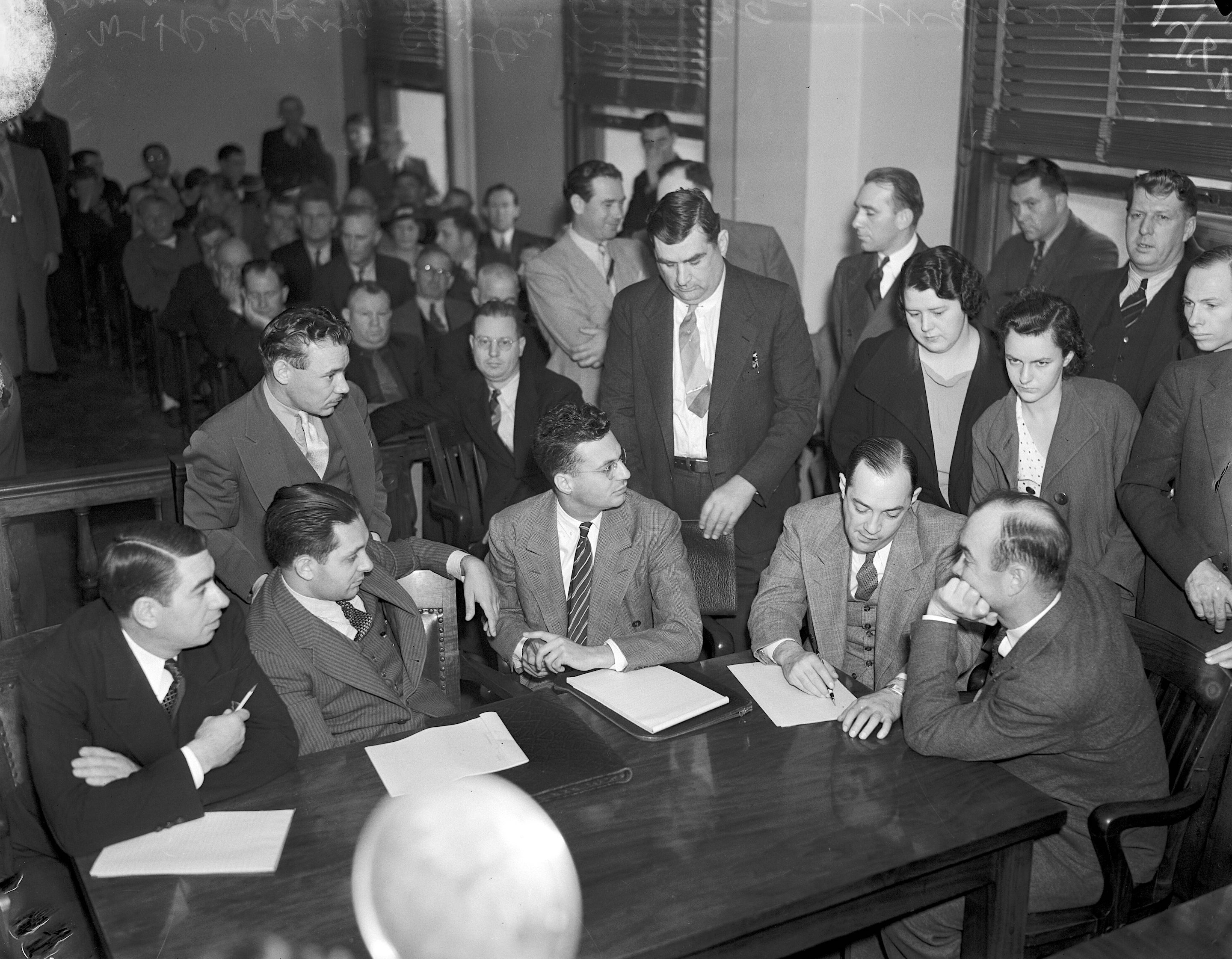
Attorneys, witnesses, and family members gather during the June 1937 downtown Los Angeles trial of Patrolman W.H. Redding, who was accused of murdering longshoreman Norman Gregg, (Credit: Los Angeles Daily News via UCLA Library Digital Collections)

Sources:

Los Angeles Times archives.

New York Times archives.

Port of Los Angeles: An Illustrated History from 1850 to 1945, by Ernest Marquez and Veronique de Turenne, Angel City Press, 2008.

San Pedro News Pilot archives.

Pall bearers march with coffin of slain longshoreman Norman Gregg. June 2, 1937. (Credit: Los Angeles Daily News via UCLA Library Digital Collections)

Byron Scott watched the Lakers from the Forum’s seats before joining them on the court

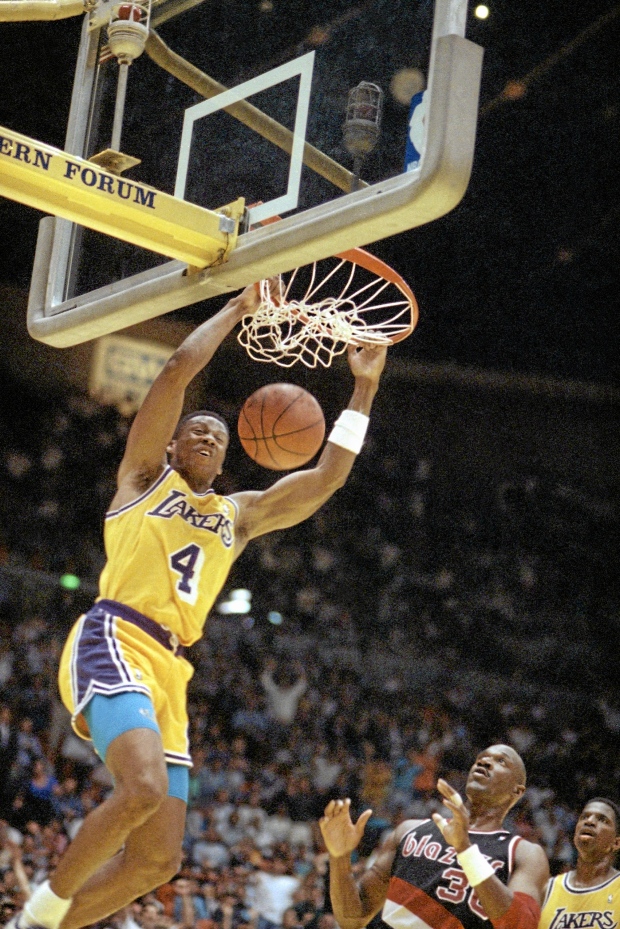
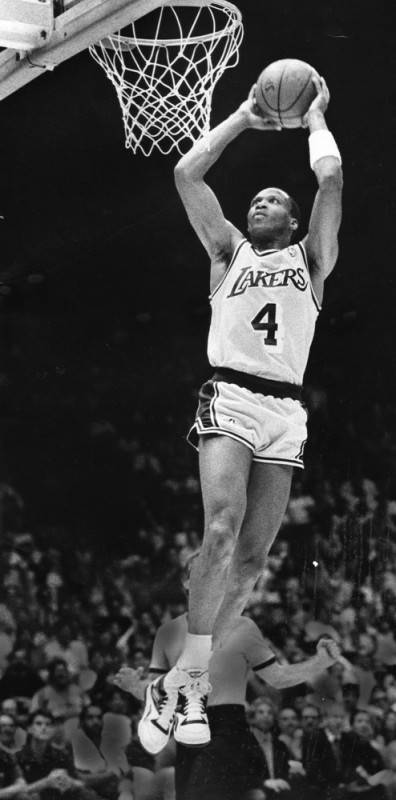
Byron Scott of the Lakers dunks over Terry Porter of the Portland Trail Blazers during an NBA playoff game at the Forum in Inglewood on May 26, 1991. (Credit: Associated Press Photo by Bob Galbraith)

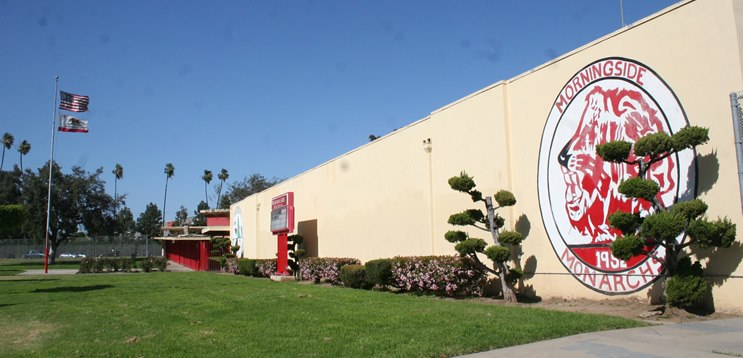
Byron Scott grew up 14 blocks from the Kia Forum in Inglewood. His alma mater, Morningside High School, is located less than two miles from the venerable sports arena.

Scott has admitted to slipping past security guards at the venue, then known simply as the Forum, to watch the Lakers play their home games during those days. He imagined himself playing on its floor someday as a Laker.

It wasn’t a pipe dream, even then. Scott was born on March 28, 1961, in Ogden, Utah. His father, Allen Holmes, had NBA-level skills. He played basketball for the University of Utah, until a leg injury he sustained in a car accident ended his career.

Scott moved to California with his mother, Dorothy Scott, while in the third grade. She would become one of his biggest supporters. He attended Woodworth Elementary School on 104th St., which is adjacent to Morningside High. His next stop, Monroe Middle School, is also part of the same complex.

Morningside High School in Inglewood. Undated photo. (Credit: Morningside High Facebook page)

Even during his formative years, Scott’s size and his skill on the court were becoming increasingly apparent. By ninth grade, he’d reached nearly six feet. A year later, he dunked a basketball for the first time.

Scott went on to attend nearby Morningside, where he played basketball for Carl Franklin. The diminutive Franklin would become a high school coaching legend, winning two CIF titles and one state championship with the Monarchs during a tenure that stretched from 1976 to 2005.

Scott blossomed under Franklin’s tutelage. He was named South Bay Player of the Year by both the Daily Breeze and the Los Angeles Times in 1979, as well as making the national McDonald’s High School All-America team.

 After sifting through offers, Scott chose to play for Arizona State. He became a first-rate shooting guard for the Sun Devils, and topped the school’s all-time scoring list until 1994. ASU retired his number 11 in 2011.

In 1983, Scott declared himself for the NBA draft under the NCAA’s hardship rule. The San Diego Clippers selected him with the fourth pick overall, after Ralph Sampson, Steve Stipanovich and Rodney McCray. (The Clippers moved to Los Angeles in 1984.)

A couple of weeks before the 1983-84 NBA season began, Scott was traded to the Lakers. Veteran Laker point guard Norm Nixon, a fan favorite, went to the Clippers. It was not a popular trade at first.

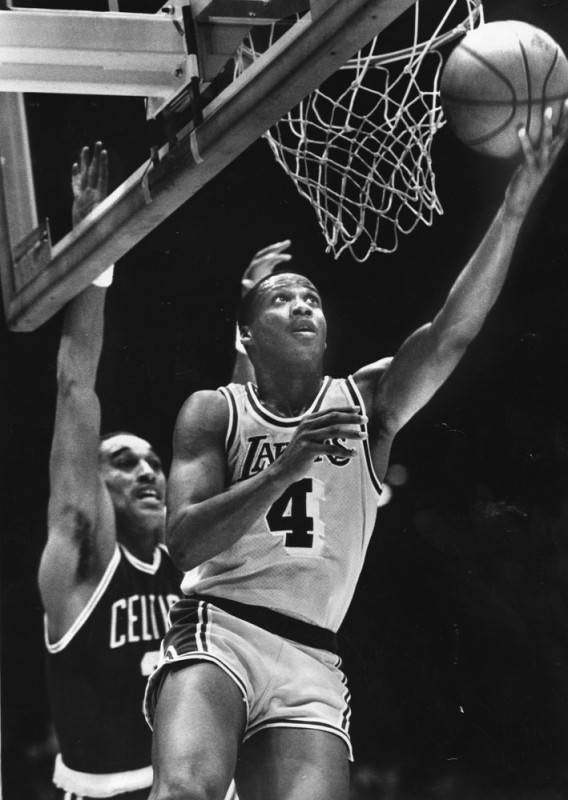
Lakers rookie Byron Scott beats the Celtics’ Dennis Johnson for two of 11 points at the Forum during the 1984 NBA Finals game on June 11, 1984. (Credit: Los Angeles Public Library Photo Collection)

Scott had to prove himself to his new teammates as well as to fans. He wasn’t as flashy or gregarious as Nixon had been. But his quiet determination along with his skillful team play  eventually won over the team and its followers, and he became a key component of the Showtime-era Lakers.

What followed was a brilliant 10-year stint with the team. He made the NBA All-Rookie Team in 1984. The team won three NBA championships, in 1985, 1987 and 1988.

After the Lakers released him in 1993, Scott played for the Indiana Pacers and Vancouver Grizzlies before returning to the Lakers for his final NBA season in 1996-97. He played one more year of pro ball in Greece for Panathinaikos before retiring as a player in 1998.

The second phase of Scott’s basketball career came about when others in the league began noticing his ability to mentor younger players, as he did when helping a young Reggie Miller develop while both were with the Indiana Pacers.

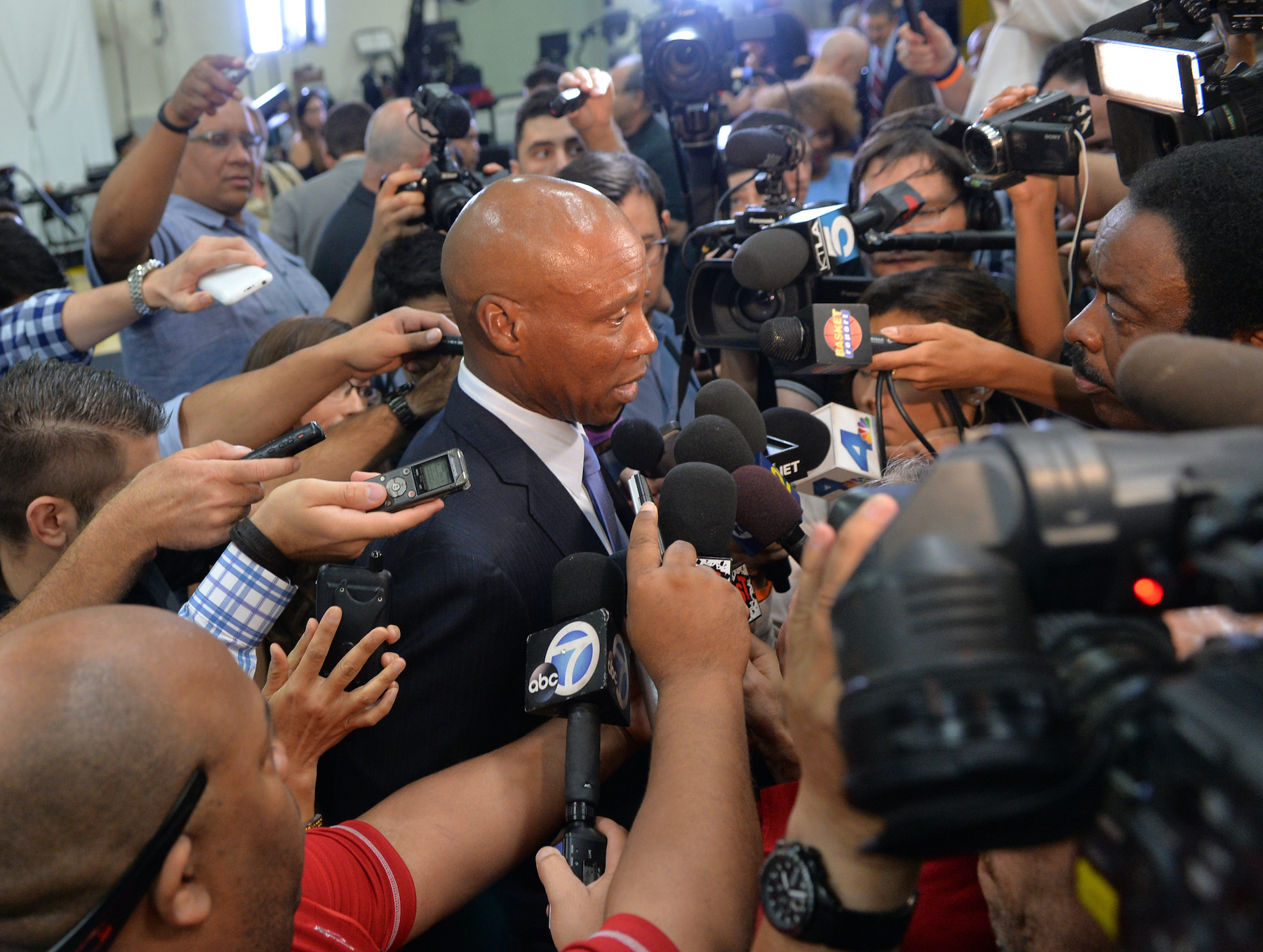
Coach Byron Scott discusses the upcoming season at Lakers Media Day in El Segundo on Sept. 28, 2015. (Daily Breeze staff photo by Robert Casillas)

To that end, Sacramento Kings head coach Rick Adelman offered Scott a job as an assistant in 1998. After two years, Scott got his first job as an NBA head coach with the struggling New Jersey Nets. Scott led them to the NBA Finals in 2002 and 2003, but the team lost both times and he fell out of favor.

He went on to helm the New Orleans Hornets and the Cleveland Cavaliers, taking over the latter squad shortly before LeBron James left to join the Miami Heat. They were tough years for Scott as a coach. The Hornets were uprooted by Hurricane Katrina in 2005, and Scott’s ability to hold the nomadic team together resulted in his receiving the NBA Coach of the Year award in 2008.

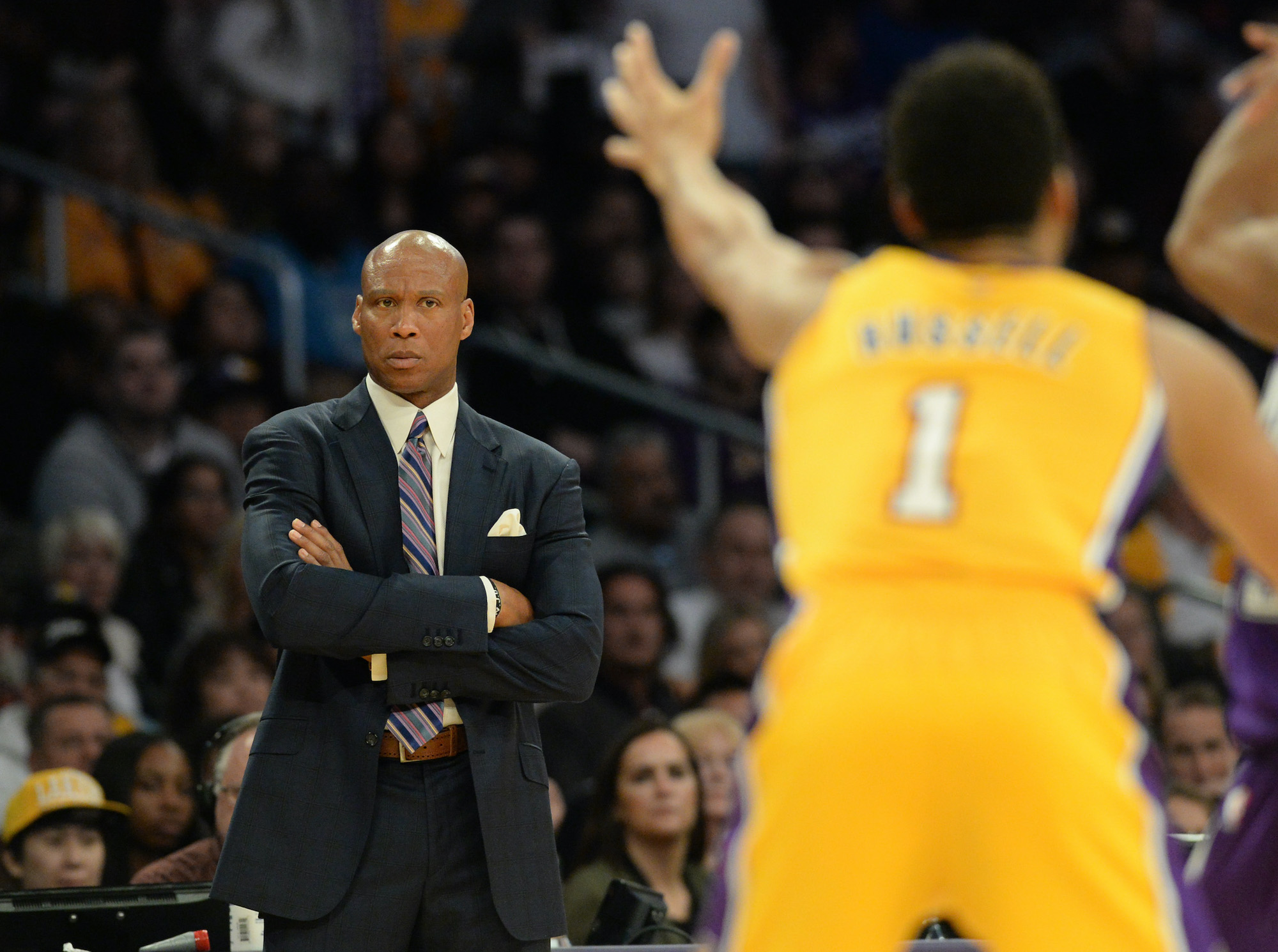
Lakers’ coach Byron Scott watches his team as they trail the Sacramento Kings during ab NBA game at Staples Center on Jan. 20, 2016. (Daily Breeze staff file photo by Steve McCrank)

But his return as coach of the Lakers from 2014-16 proved to be even more trying. The rebuilding team couldn’t match the results of the Shaquille O’Neal-Kobe Bryant juggernaut of the oughts, going 38-126 with Scott as coach. Bryant retired in 2016.

In August 2017, Scott told a TMZ reporter that he had retired from coaching, and was devoting his time to being an ESPN television analyst. That same year saw the publication of  the motivational business leadership book he co-authored with executive Charlie Norris, Slam-Dunk Success: Leading from Every Position on Life’s Court (Center Street, 2017).

He later fulfilled a promise to his mother by returning to Arizona State to finish his studies and receive his undergraduate degree in liberal studes in 2020, 37 years after he left early for the 1983 NBA Draft

Now 62, Scott remains retired from coaching and lives in Granada Hills. He stays active in community work through his charitable foundation the Byron Scott Children’s Fund, and also has completed two seasons of his “Off the Dribble” podcast.

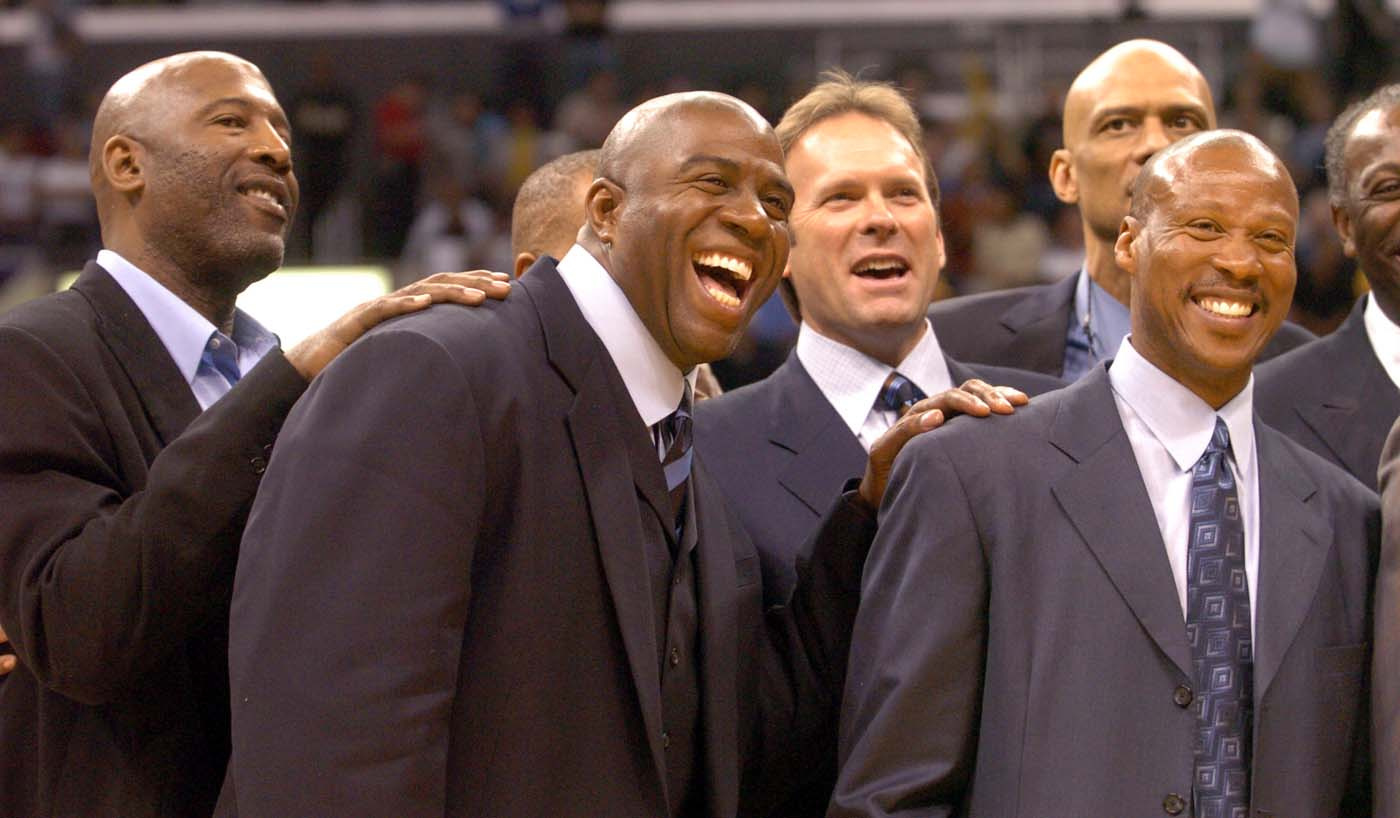
1985 Lakers championship team members, left to right,.James Worthy, Magic Johnson, Kurt Rambis, Kareem Abdul-Jabaar (partially obscured) and Byron Scott pose for team picture on April 11, 2005. (Daily Breeze staff file photo by Bruce Hazelton)

Sources:

Daily Breeze archives.

Los Angeles Sentinel archives.

Los Angeles Times archives.

“1983 NBA Draft,” Basketball Reference website.

Wikipedia.
Byron Scott collects two points the easy way for the Lakers during a game on May 24, 1988. (Credit: Los Angeles Public Library Photo Collection)
Is this your new site? Log in to activate admin features and dismiss this message
Log In