
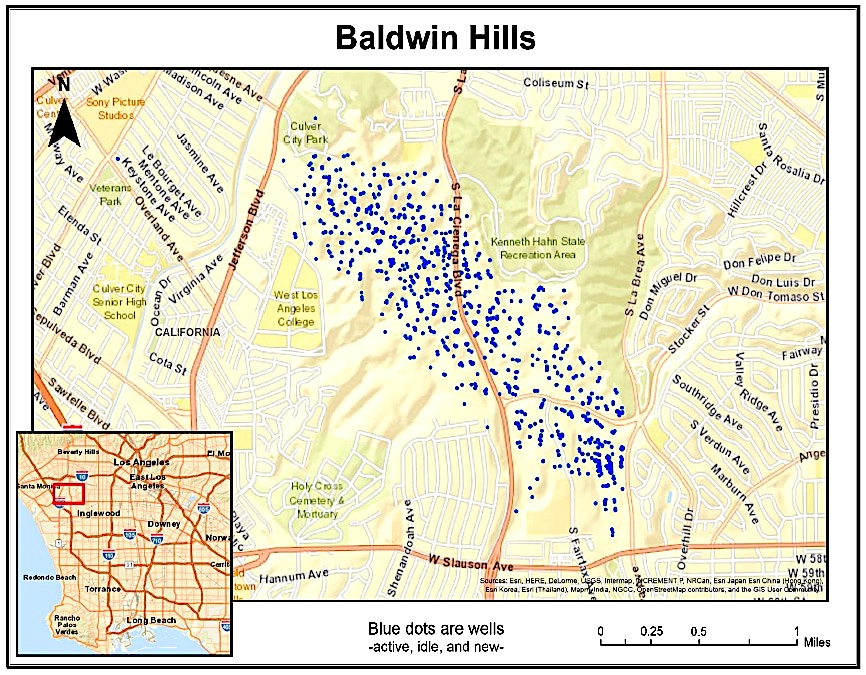
The search for oil during the boom of the 1920s left few local stones unturned. As vintage photos attest, huge swaths of land in the South Bay were blanketed with wells during the rush for black gold.
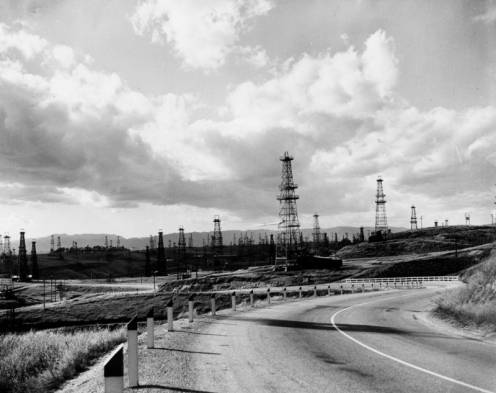
One of the largest concentrated areas for drilling, roughly 1,000 acres of hilly land between Inglewood and Culver City, became known as the Inglewood Oil Field. The Standard Oil Company of California discovered oil on the site in 1924, and the rolling Baldwin Hills soon were dotted with wells.
Two decades later, Los Angeles water officials, sensing the need for improving the water supply to the booming postwar southwest Los Angeles County, began planning a new reservoir in Baldwin Hills to supply the South Bay, Harbor Area and Long Beach. It would be the first reservoir built after the end of World War II by the L.A. Department of Water and Power.
Construction began on the project in early 1947. Its floor was built with compacted earth. It was designed to hold nearly 300 million gallons of water that would come from the Owens Valley and the Colorado River via the Franklin Canyon Reservoir in Beverly Hills. (The latter is best known as the lake seen in the opening credits of “The Andy Griffith Show.”)
An earthen dam on its northern border, also built from compacted soil, would protect the relatively pricey homes springing up in the Baldwin Vista subdivision just north of the dam. When completed, the Baldwin Hills Dam stood 235 feet tall and 650 feet in length.
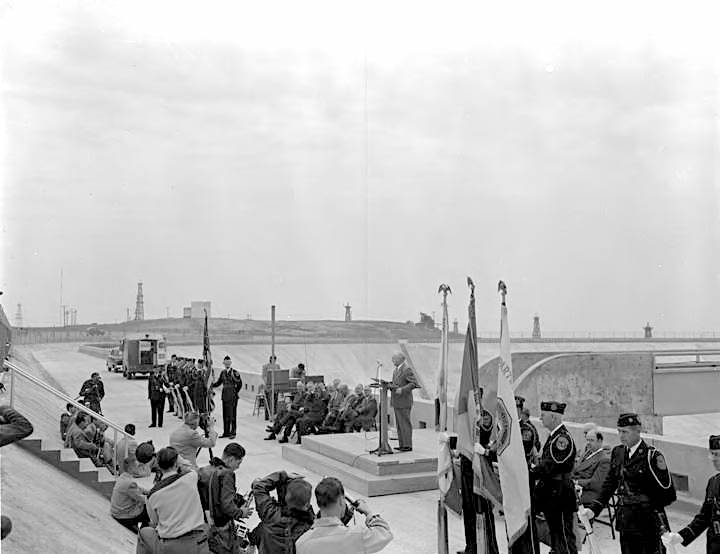
By the time Los Angeles Mayor Fletcher Bowron officially turned the wheel that brought the first water cascading into the reservoir at its opening ceremony on April 18, 1951, the project’s costs had ballooned to $10 million.
Twelve years later, at 11:15 a.m. on Saturday, Dec. 14, 1963, the reservoir’s caretaker on duty noticed water draining from pipes beneath the reservoir’s lower lining. He notified the engineer, and they tried draining the reservoir to lower its water levels. However, the process would take 24 hours.
At this point, the DWP notified police, asking them to begin evacuating residents as a precaution. Over the next few hours, many residents of the Baldwin Vista homes below and north of the dam were evacuated. DWP personnel worked desperately to remedy the situation, but still the leak continued to worsen.
News of the leak at the dam and the evacuations reached the news media, and local television station KTLA Channel 5 decided to use its brand-new news helicopter for the first time to survey the scene, an early use of that technology in news reporting. The station began breaking into its Saturday programming with updates on the leak. (See end of post for link to KTLA footage.)
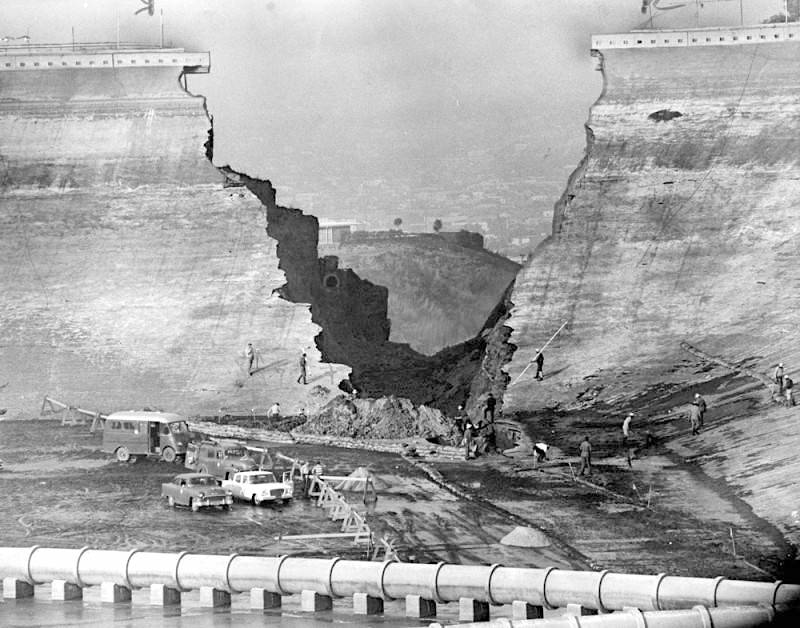
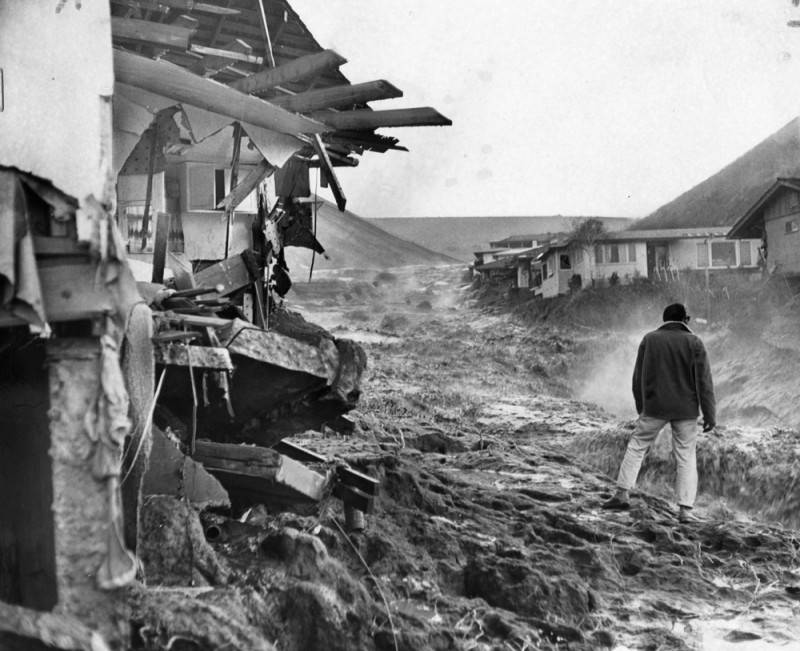
Then, at 3:58 p.m, the station broke in again, and viewers watched as a 50-foot-wide section of the weakening dam finally gave way. Within 30 minutes, the reservoir was nearly empty. An estimated 290 million gallons of water roared down the hill northward into the Baldwin Vista neighborhood, inundating houses and automobiles along Cloverdale Ave. and neighboring streets.
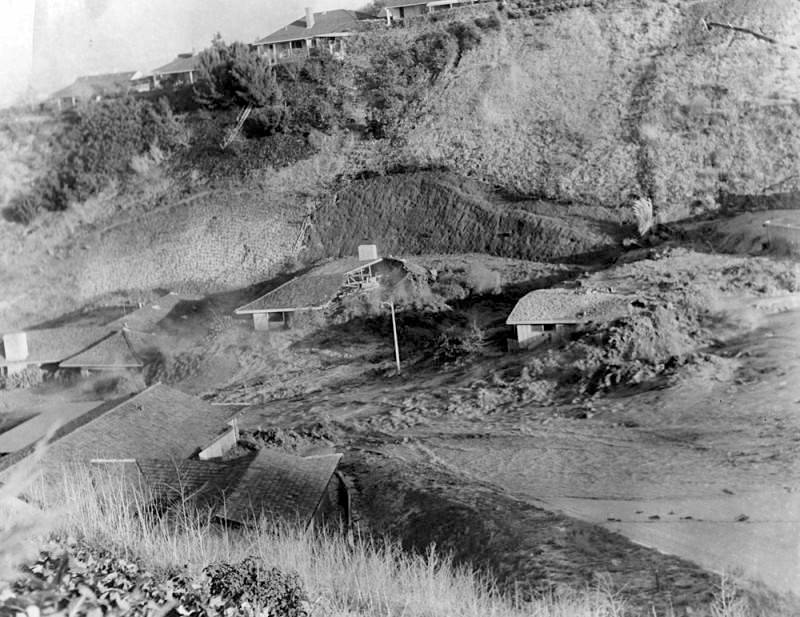
Only 77 minutes after the dam break, the reservoir essentially was empty. All the water had flowed out to La Cienega and La Brea boulevards to the west and east, and Jefferson Blvd. to the north. Five people were killed in the flood, 277 homes were destroyed and more than $12 million in property damage was reported.
The magnitude of the disaster led to immediate state and local government inquiries as to its cause. Initially, experts blamed the DWP for building the reservoir and dam on an active fault line, an offshoot of the nearby Newport-Inglewood fault. Shifting in the fault led to cracks in the compacted earth of the reservoir floor – for which designers also were criticized – which caused the leak.
Over the years, though, another critical factor entered the discussion. Though the oil drilling companies vehemently disagreed, engineering experts also pointed to the hydraulic fracturing process being used in the Inglewood Oil Field wells to extract oil more economically and completely.
Fracking, as the process is commonly known, injects water, sand and sometimes chemicals into an underground well to free oil trapped by bedrock. The experts began theorizing as early as 1971 that it had destabilized the ground beneath the reservoir, which exacerbated the cracks in the reservoir that led to the weakening and collapse of the dam. Lawsuits and further investigations ensued.
Meanwhile, L.A. County Supervisor Kenneth Hahn, who had been at the dam on the day it collapsed, was determined to find some good in a bad situation.The facility and surrounding land were unusable for development due to the fault and the weakness of the underlying substrate from oil drilling.
On June 10, 1982, after several years of planning, Hahn presided over a groundbreaking for a project to transform the area into the Baldwin Hills State Recreational Area.
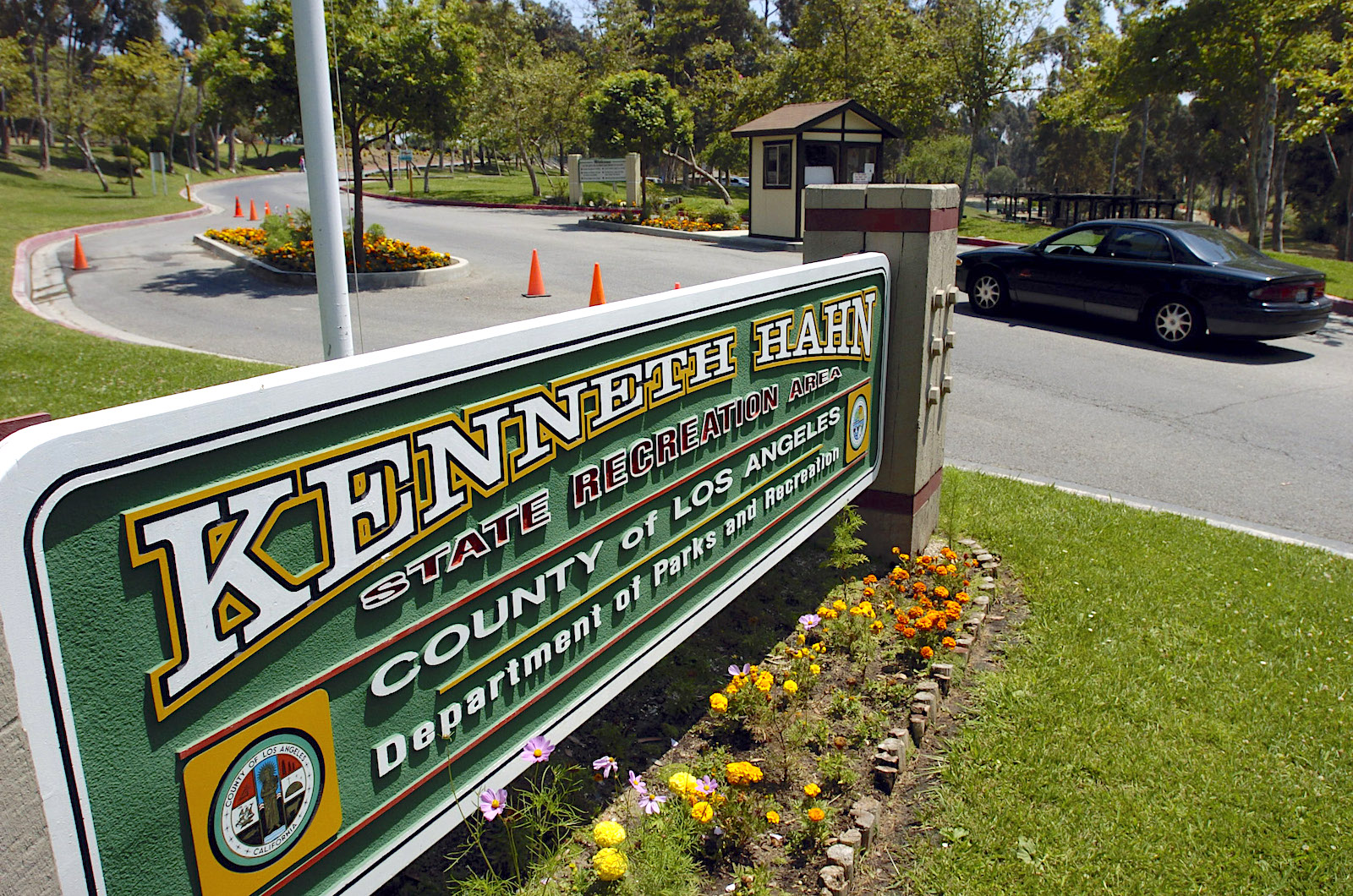
By the time the park opened in 1983, the failed reservoir had been sitting deserted for 20 years, overgrown with weeds and brush. In 1988, its name was changed to the Kenneth Hahn State Recreation Area to honor Hahn’s contributions to its creation. Hahn died in 1997.
Sources:
“The Baldwin Hills Dam Disaster,” by PEImpactJH, PE Impact blog, Aug. 26, 2021.
California Department of Water Resources website.
Daily Breeze archives.
Inglewood Oil Field website.
“Case Study: Baldwin Hills Dam (California 1963), Lessons Learned From Dam Incidents And Failures website, Association of State Dam and Safety Officials.
Los Angeles Times archives.
“Remembering the Baldwin Hills Dam disaster,” by Drew de la Houssaye, KCRW website, Dec. 13, 2013.
Note: This video contains a chronological mix of silent footage of the Baldwin Hills Dam disaster mixed in with KTLA Channel 5 news footage. (Credit: California Department of Water Resources)

