Torrance planners struggled for years to connect Cabrillo and Eshelman avenues

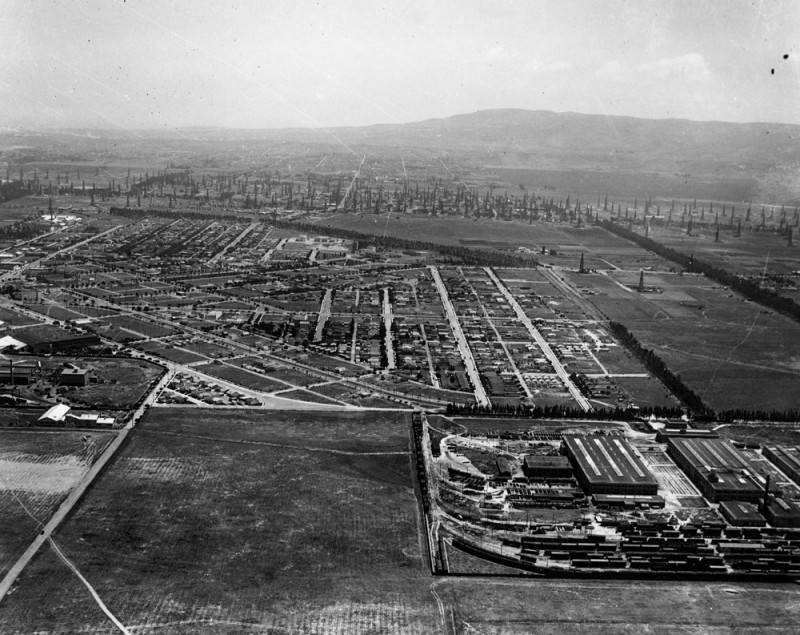
This 1925 aerial photo of Torrance looking southward includes the Pacific Electric shops in the foreground, right, and a forest of oil derricks at rear, with the city center between the two. (Credit: Los Angeles Public Library Photo Collection)

Though scarcely more than a decade old, the city of Torrance was humming during the 1920s. Major industrial plants had set up shop there, employing thousands of workers, and developers were kept plenty busy trying to build enough housing for them

Many of the workers from outside the area who commuted to their jobs at plants such as Union Tool Co., Llewelyn Iron Works or the Pacific Electric railroad shops mostly rode those same Pacific Electric red cars to get to their jobs in the city. 

Automobiles weren’t rare, but longer trips were made difficult by poor roads and convoluted, nondirect routes. A surprising number of major roads were unpaved and would remain that way for decades.

The need for better roads began to grow in importance as the Twenties progressed and automobiles began to become the preferred method of transportation. 

Torrance city officials and planners had built a fine little downtown area, but it remained relatively isolated from major auto thoroughfares. Downtown Torrance’s main north-south downtown street, Cabrillo Ave., was paved only from Torrance Blvd. south to Sepulveda Blvd.
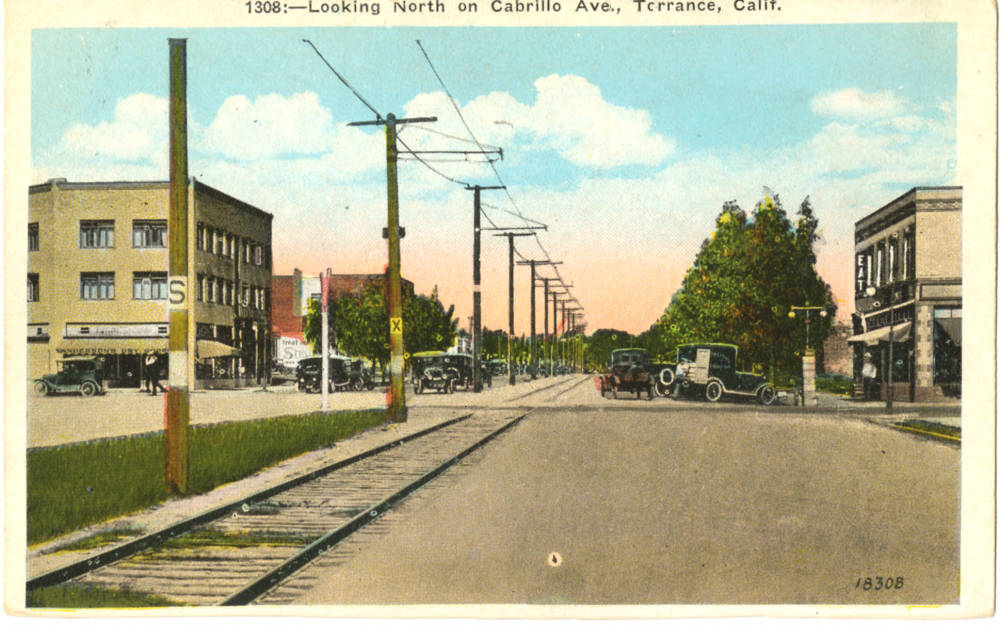
A 1920s-era postcard looks northward up Cabrillo Ave. in downtown Torrance. (Credit: CSUDH Digital Archives)

The first Los Angeles freeway wouldn’t open for another two decades, and many major connecting roadways such as Western Ave. were patchwork at best through the South Bay. 

At the time, Western ended at Torrance Blvd., and started up again about four miles south at Pacific Coast Highway near Lomita. This made connecting south by car from Torrance to San Pedro’s shipyards and other industries problematic.

In 1927, city planners proposed a solution to the connectivity problem. Instead of wrangling with the city of Los Angeles to complete that unfinished section of Western, the proposal called for the extension of Cabrillo Ave. south through privately owned land to Eshelman Ave. in Lomita. From there, motorists could reach PCH and connect with Western heading south (or north).

In September 1929, rancher and land owner Emil Kettler announced that he opposed giving Torrance a right-of-way through his property to allow the project’s completion. Kettler felt it would be more valuable to prospective buyers seeking to locate an industrial plant there if it was a single large piece of property, one not bisected by the proposed roadway.
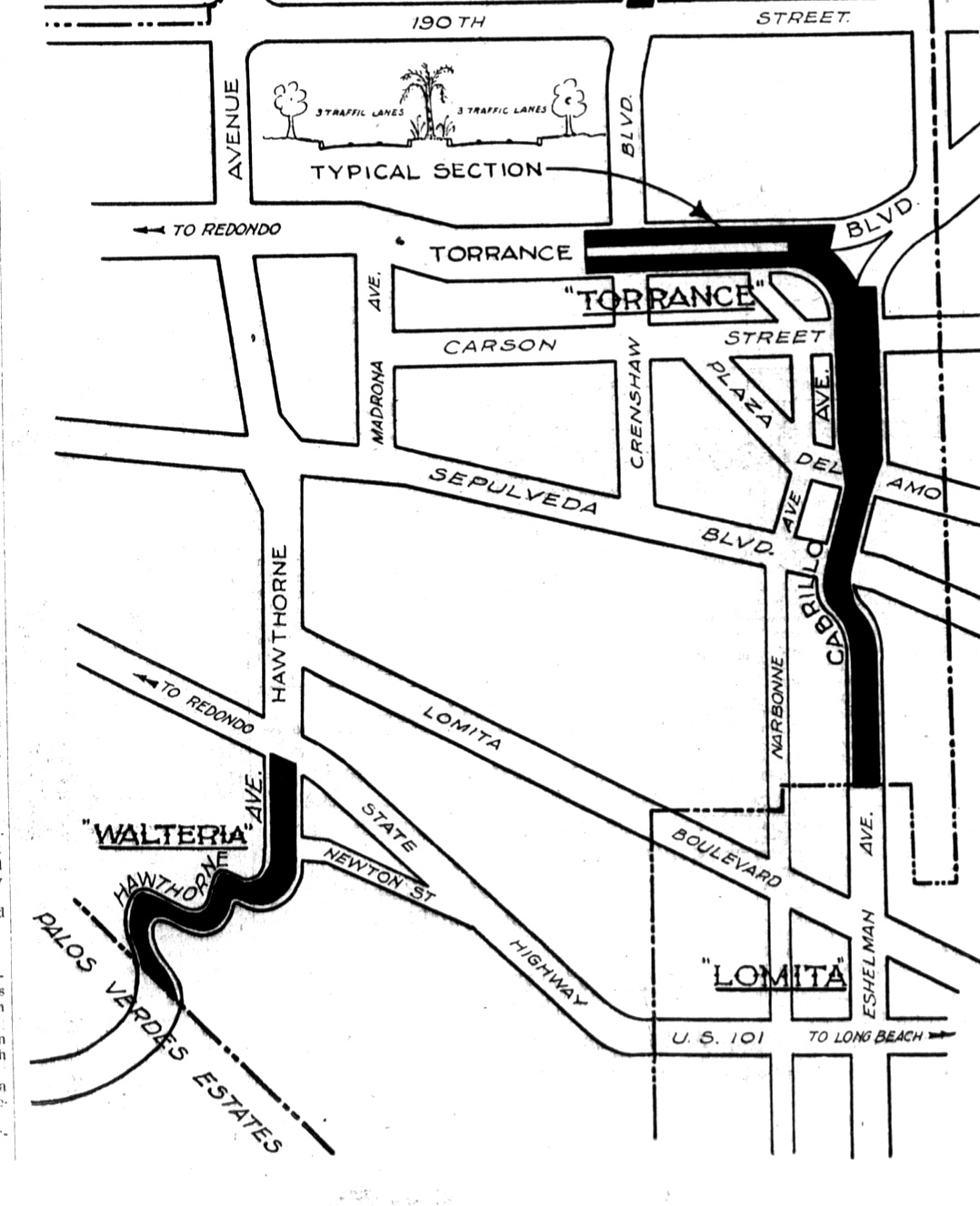
The heavy black lines indicate roadways to be added or improved under Tolson’s plan, including, at right, extending Cabrillo Ave. south from Sepulveda to meet Eshelman Ave. in Lomita. Torrance Herald, April 27, 1939, Page 2-A. (Credit: Torrance Historical Newspaper and Directories Archive database, Torrance Public Library)

Though the extension idea was kept alive, it would be another ten years before any further progress on it was reported. In April 1939, then-Mayor William H. Tolson launched a new major highway improvement program for Torrance.

Tolson’s program recognized the need for major improvements in the city’s street and highway infrastructure, and made the completion of the Cabrillo-Eshelman extension a top priority. 
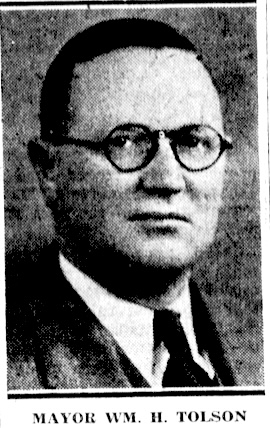
Torrance Herald, April 27, 1939, Page 1-A. (Credit: Torrance Historical Newspaper and Directories Archive database, Torrance Public Library)

To that end, he announced that the city had secured a one-year option with the heirs of the Kettler estate to purchase a right-of-way that would allow for the new roadway to be built. (Emil Kettler died in 1932.)

But no action was taken by the city before that option expired in 1940, and the outbreak of World War II further delayed the project.

In early 1946, the Kettler estate, headed by Emil’s son, John, renewed the offer to the city of Torrance to build the Cabrillo extension. In the intervening years since Emil Kettler had denied the request, the family’s strategy had shifted from courting industrial tenants to joining the headlong postwar rush into residential development.

The Cabrillo extension now was in their own best interest. John Kettler extended the offer at the same time that he announced plans to begin building a 201-home housing development on the family’s land east of Arlington Ave. and south of Sepulveda. 

This would become the first project in what would become known as the Kettler Knolls housing development, which eventually would include several hundred homes in southeast Torrance.

The estate even offered to provide grading for the land for the city’s proposed road. In return, Torrance would provide curbs, sidewalks and paving. 

The yet-to-be-completed roadway was last mentioned in an article from the Torrance Herald on Nov. 6, 1947, which reported that the Torrance City Council had authorized funding for it. Most probably, it was completed in 1948.

That’s only two decades or so after the city first officially proposed it in 1927. On the other hand, it did finally get built, barely, before the second option the city had decided against in 1927: waiting for the city of Los Angeles to complete the nearly four-mile Western Ave. through-link to San Pedro that it finally opened to motorists in April 1950.
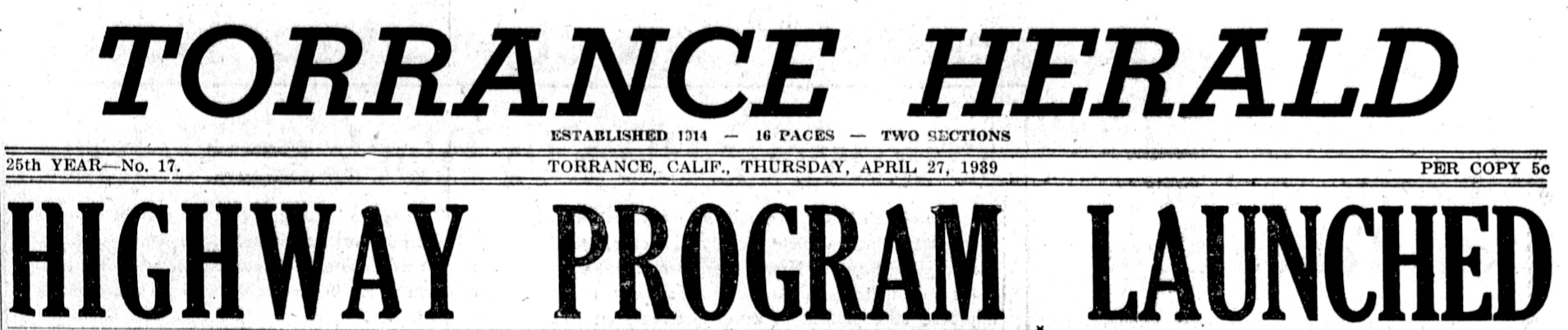
Front page headline, Torrance Herald, April 27, 1939, Page 1-A. (Credit: Torrance Historical Newspaper and Directories Archive database, Torrance Public Library)

Sources:

Los Angeles Times archives.

San Pedro News PIlot archives.

Torrance Press-Herald archives.
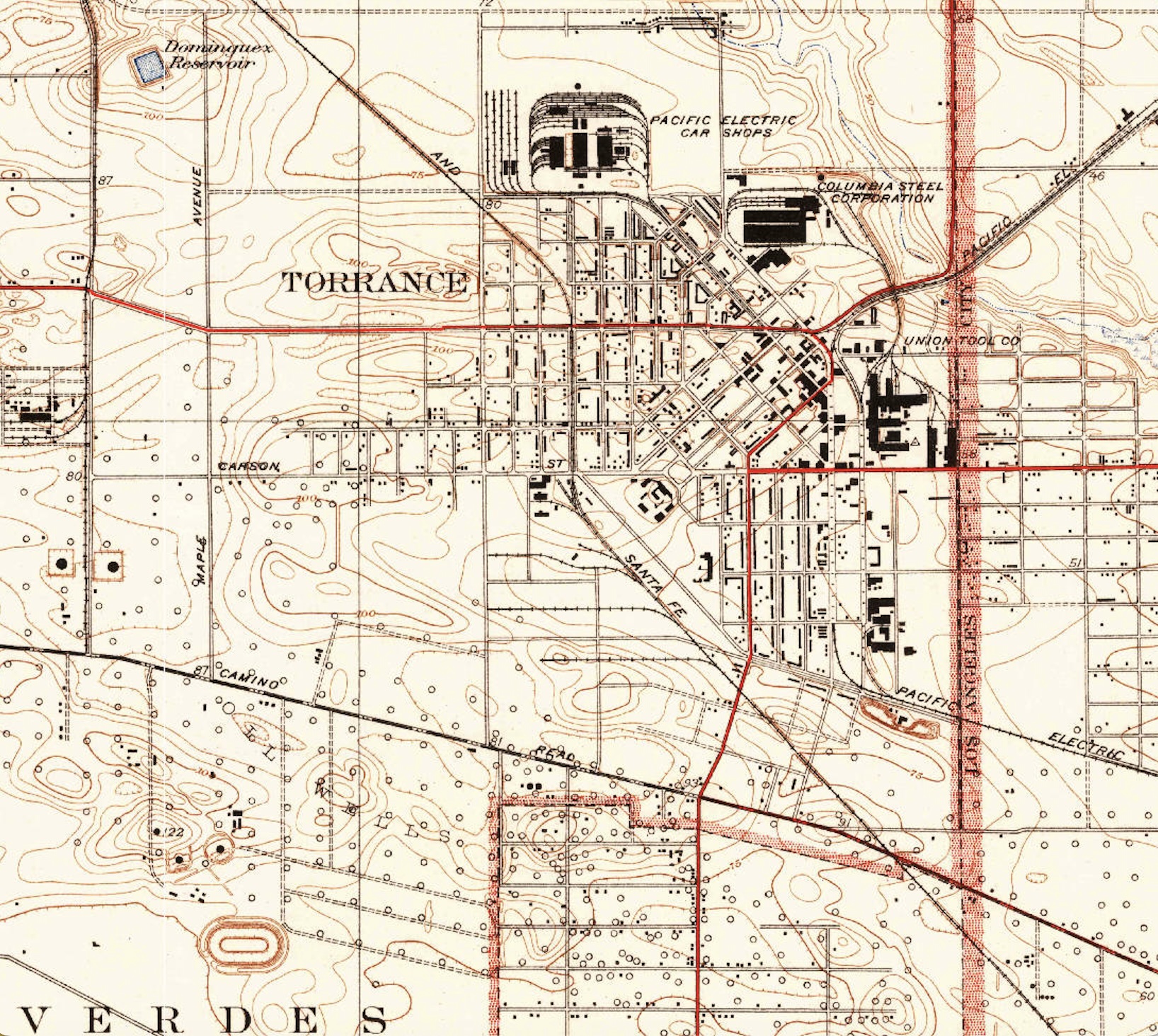
This portion of a 1934 topographical map shows the Torrance area’s somewhat isolated nature except for the Pacific Electric and Santa Fe railroad lines. (Credit: United States Geological Survey)

Redondo Beach dive shop owner searched for hidden treasure – and found it

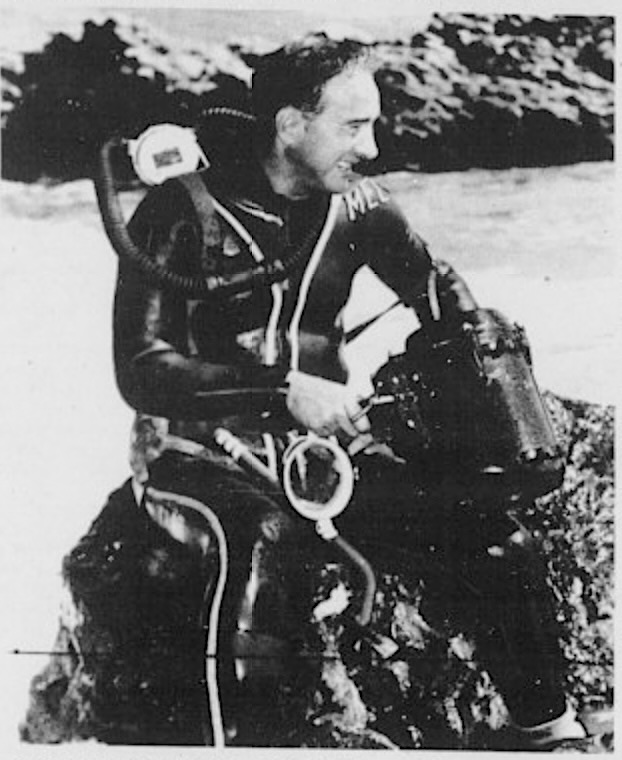
Mel Fisher, undated photo circa 1963. Palos Verdes Peninsula News, June 13, 1963, Page 4. (Credit: Palos Verdes Peninsula News archives)

One can almost picture Mel Fisher on his father’s Torrance chicken farm dreaming of a more exciting life.

Born on Aug. 12, 1922, the World War II Army Corps of Engineers vet had moved to California after the war from Indiana, where he had attended Purdue University. While in the army, he’d been stationed near enough to the Mediterranean to become hooked on skin diving.

As the reality of the day-to-day life of a chicken farmer started to lose its romance, Fisher began to spend more time diving in the nearby Pacific. He had become an expert diver and spear fisherman whose knowledge was sought out by fellow divers.

He also became intrigued with the aqualung, the first modern scuba diving equipment invented by French naval officer Jacques Cousteau and engineer Emile Gagnan during the war. 

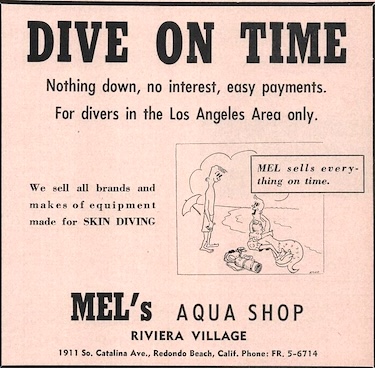
Ad from Skin Diver magazine, September 1956.

He knew that if used properly, the new equipment could be the key tool to finding legendary treasure troves he’d read about that were buried beneath the seas. He’d caught the bug, and there was no turning back. (He even began selling dive equipment on a small scale at the ranch.)

He and his father sold the chicken ranch. Fisher used the proceeds to move his wife, Delores, Deo for short, and their young children Dirk and Kim to a house on Via Pasqual in the Hollywood Riviera area of Torrance. 

Together with Deo, who also was a renowned diver, he opened Mel’s Aqua Shop at 1911 S. Catalina Ave. in Redondo Beach in December 1953. While it isn’t clear that Mel’s was the first dive shop in the U.S., it’s widely acknowledged to be the first such retail business in the state of California.

The excitement surrounding the new scuba diving technology resulted in a thriving little business for Fisher. In addition to the latest equipment, he also offered diving lessons and even beginning swim lessons.

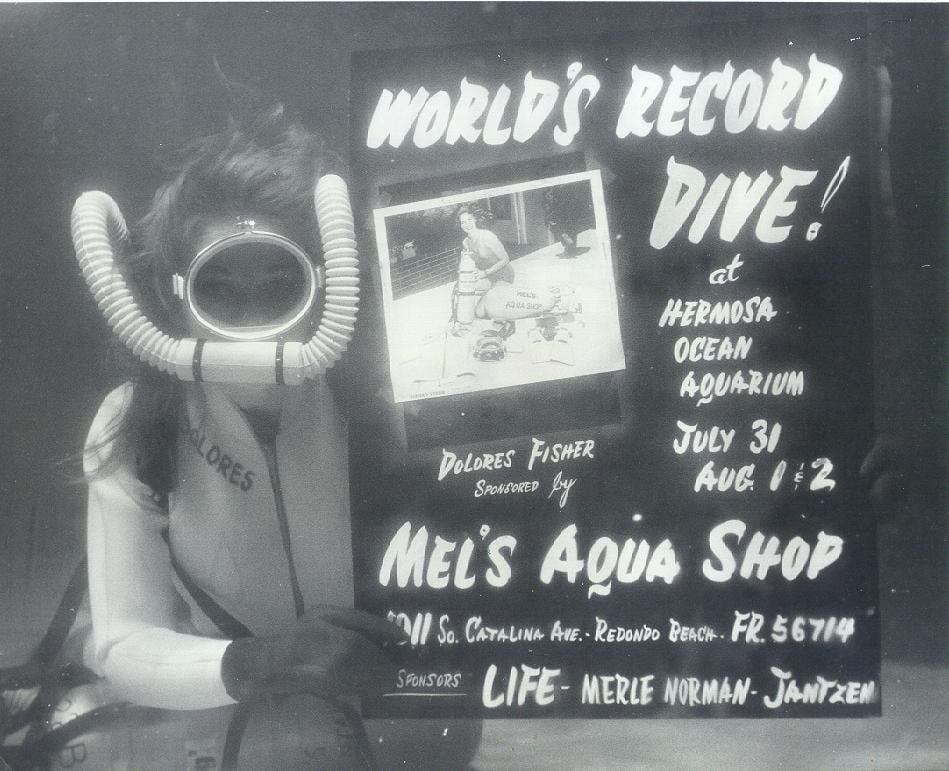
Dolores Fisher poses underwater during her record-setting 55-hour, 37-minute underwater dive in the porpoise tank at the Hermosa Ocean Aquarium in Hermosa Beach in 1959. (Credit: Mel Fisher’s Treasures Facebook page)

He led diving trips and tours in search of underwater treasure not only in the Channel Islands and other nearby sites, but also the northern California gold country. 

The tours were popular, and they only encouraged the restless Fisher’s desire to seek riches hidden in the seas. In the early 1960s, he would take weeks off from the store to search for treasure in waters near Mexico, Cuba, the Florida Keys, and other Caribbean locations. His early efforts were generally unsuccessful, but he was not discouraged.

In June 1963, Mel Fisher decided to follow his dream full-time. After selling Mel’s Aqua Shop, he and his family pulled up stakes and left the South Bay in order to go searching for sunken treasure in the Caribbean.

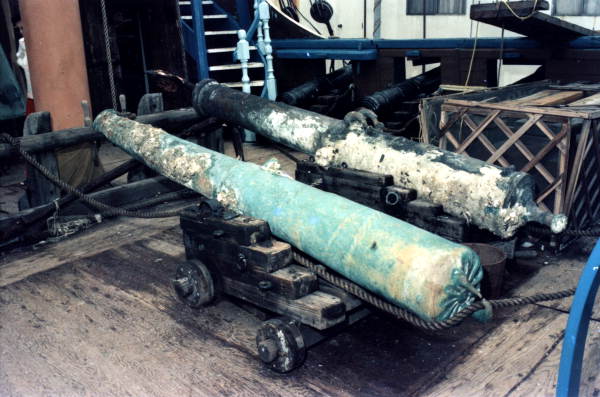
Cannons from the sunken Spanish galleon Atocha recovered by Mel Fisher’s Treasure Salvors crew, on display following their recovery from the wreck site west of Key West, Florida. July 1975 photo by Dale M. McDonald. (Credit: Florida Memory, State Library and Archives of Florida)

For years, he had been researching the potential for recovering undersea valuables from areas in the Caribbean where galleons loaded with gold and silver had gone down during the heyday of the Spanish Main in the 16th and 17th centuries.

The Fishers settled in Key West, and Fisher formed a company, Treasure Salvors Inc. Private investors were encouraged to buy shares in the firm with the understanding that they would share in the profits from any discoveries. For years, Fisher struggled along without making any major finds.

With help from historical researchers, Fisher began to focus on finding the remains of one particular Spanish galleon, the Nuestra Senora de Atocha, which sank during a September 1622 hurricane. 

After some false starts, the search began to heat up when one of Fisher’s divers, Don Kincaid, found a gold chain thought to be from the ship in 1971. 

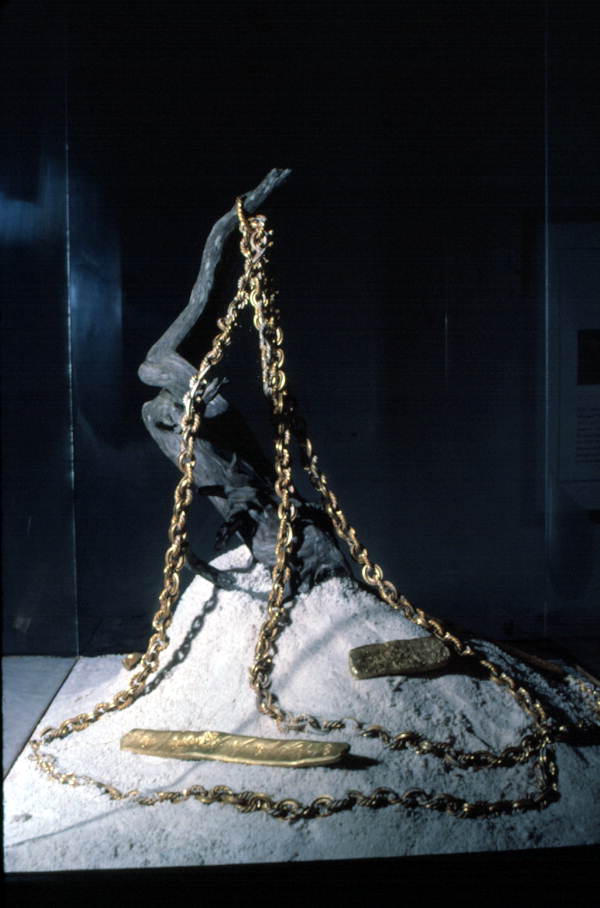
Gold chain from the Atocha treasure on display at the Mel Fisher museum in Key West, Florida, in February 1982. Photo by Dale McDonald. (Credit: Florida Memory, State Library and Archives of Florida)


Two years later, Fisher’s 14-year-old son Kane, one of the family’s five children, found a single silver bar whose weight matched that of those listed on the ship’s manifest. In July of 1975, Fisher’s oldest son, 21-year-old Dirk, discovered several cannons from the ship. 

A few days later, tragedy struck when the boat on which Dirk, his wife, Angel, and a diver named Rick Gage were sleeping suddenly took on water and sank, killing all three of them.

Despite the tragedy, Mel, very much still believing that his operation was close to succeeding, would continue the search for the Atocha’s precious cargo for the next ten years. 

Finally, on July 20, 1985, Fisher’s crews discovered what he termed “the mother lode” of treasures from the ship about 40 miles west of Key West. It was buried under four feet of sand in about 50 feet of water.

The treasure consisted of silver bars, gold bullion, pieces of eight, bushels of emeralds and other precious metals and gems, and was estimated to be worth about $400 million. 

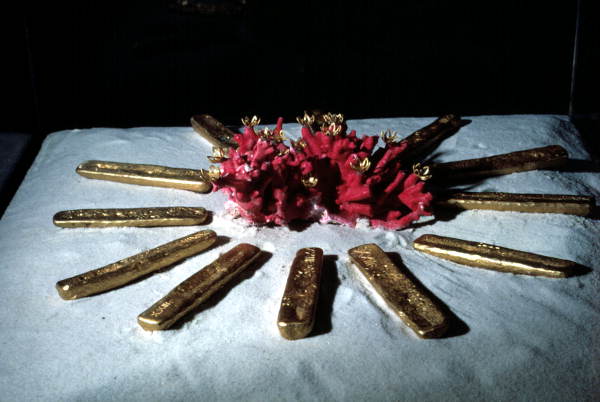
Gold bars from the Atocha treasure on display at the Mel Fisher museum in October 1982. Photo by Dale McDonald. (Credit: Florida Memory, State Library and Archives of Florida)

After the discovery of the Atocha, the Florida state government had filed a claim granting it 25 percent of the value of any future booty found by Fisher. He contested the claim all the way to the U.S. Supreme Court, which ruled in 1992 in his favor: the Atocha was ruled to have been found in international waters.

Fisher sold his Treasure Salvors company in 1986 for $7 million, but he continued to search for and find additional treasures beneath the sea until he contracted cancer in the mid-1990s. He died at 76 on July 19, 1998. He was cremated, and his ashes were scattered in the Caribbean  off of Key West.

The Mel Fisher Maritime Museum currently operates in Key West, and Mel Fisher’s Treasures displays many of his finds at its location in Sebastian, Florida.

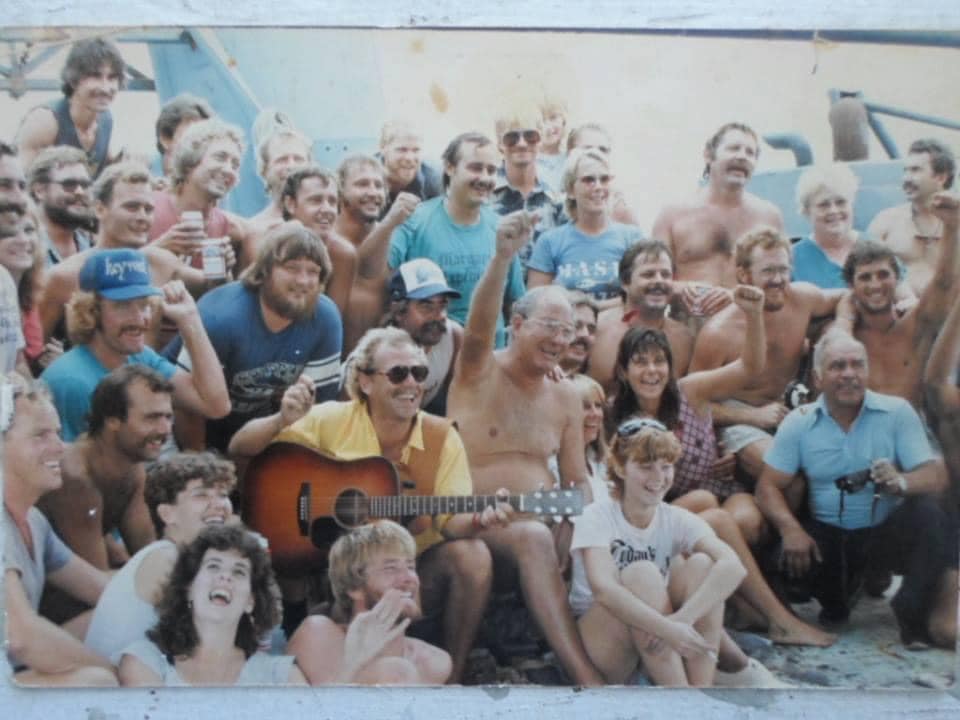
Mel Fisher, center with fist in air, celebrates next to singer-songwriter Jimmy Buffett in Key West on July 21, 1985, one day after the discovery of the Atocha “main pile.’ The pair are perched on a pile of silver bars surrounded by family and crew members. Photo by Pat Clyne. (Credit: Mel Fisher’s Treasures Facebook page)

Sources:

Daily Breeze archives.

FindaGrave website.

“The High Price of Treasure,” Robert Daley, The New York Times, Nov. 2, 1975.

Palos Verdes Peninsula News archives.

Wikipedia.

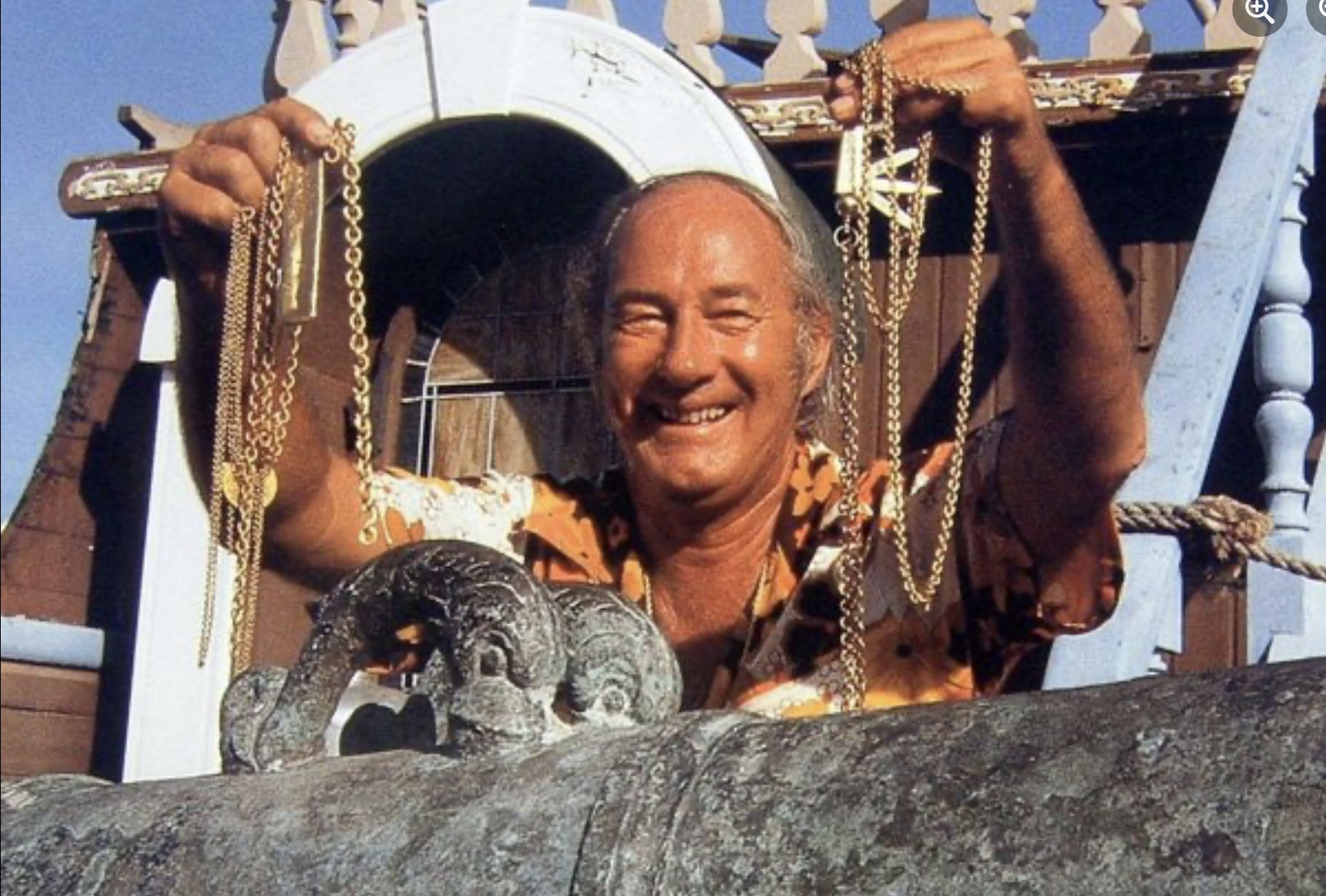
Mel Fisher displays some pieces of the Atocha treasure on board his ship in this undated photo. (Credit: Mel Fisher’s Treasures Facebook page)

Torrance hog farms became community nuisances as the area’s population grew

Torrance Herald, July 23, 1953, Page 1. (Credit: Torrance Historical Newspaper and Directories Archive database, Torrance Public Library)

Looking around at the South Bay landscape today, it’s hard to imagine it as the thriving agricultural area it once was in the first half of the 20th century.

Dairy farms once dotted the landscape. Giant greenhouses near present-day 190th St. and Western Ave. raised and sold orchids and gardenias renowned nationwide, and the Palos Verdes Begonia Farm operated in Torrance for more than half a century.

The Ishibashi family raised strawberries on fields near the Torrance Municipal Airport for decades until closing in 2011. The Mira Loma Turkey Farm on Victor St. in west Torrance raised the big birds until 1961 and sold them until 1986.

But residential and commercial development began to eat up the open spaces once used for agriculture. Gradually at first, then more rapidly following the post-World War II housing boom, land was gobbled up for housing and business development.

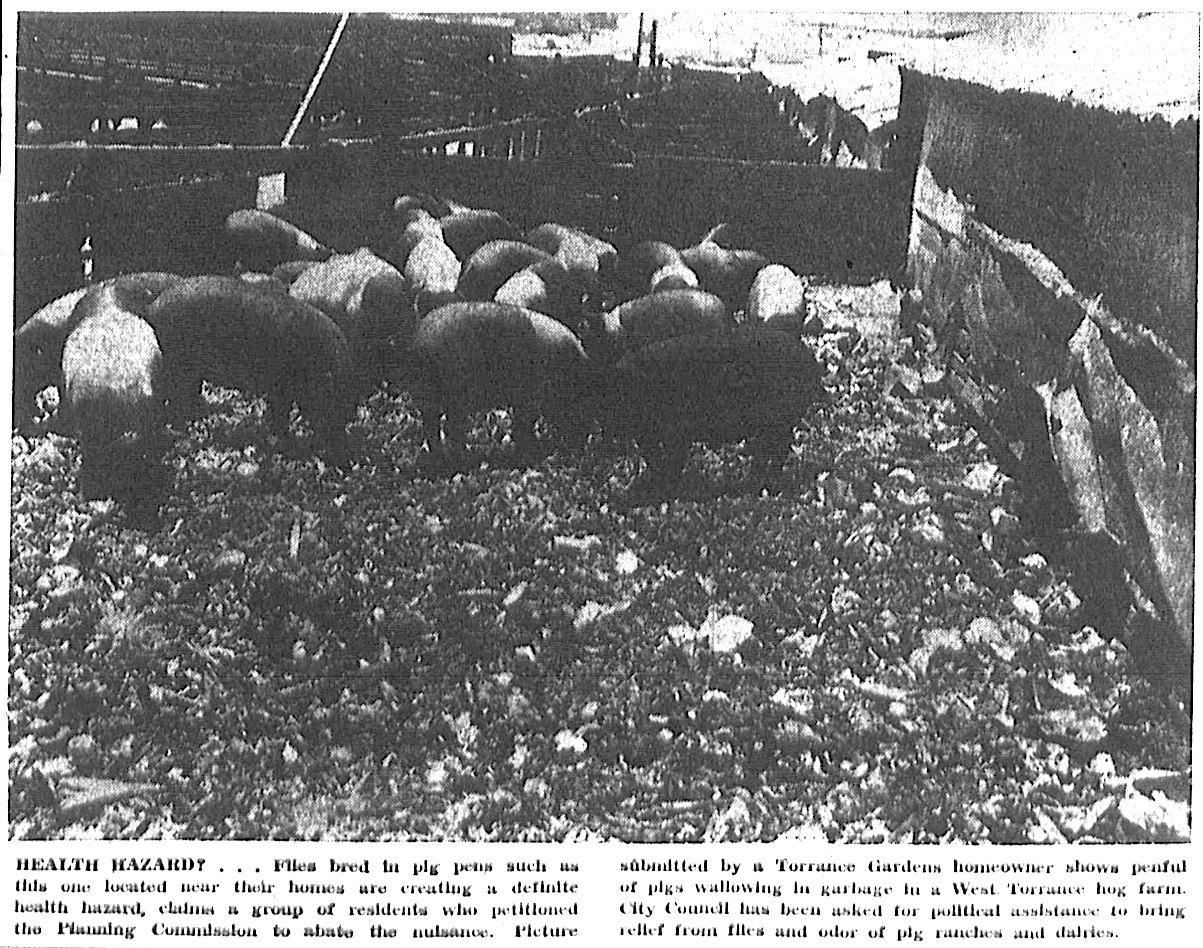
The commercial farms and ranches that remained came to be seen as nuisances and health dangers by the occupants of the newly erected houses near them. Livestock-based operations were targeted specifically, as they were easily identifiable sources of noise, pests and vermin and their accompanying unpleasant odors.

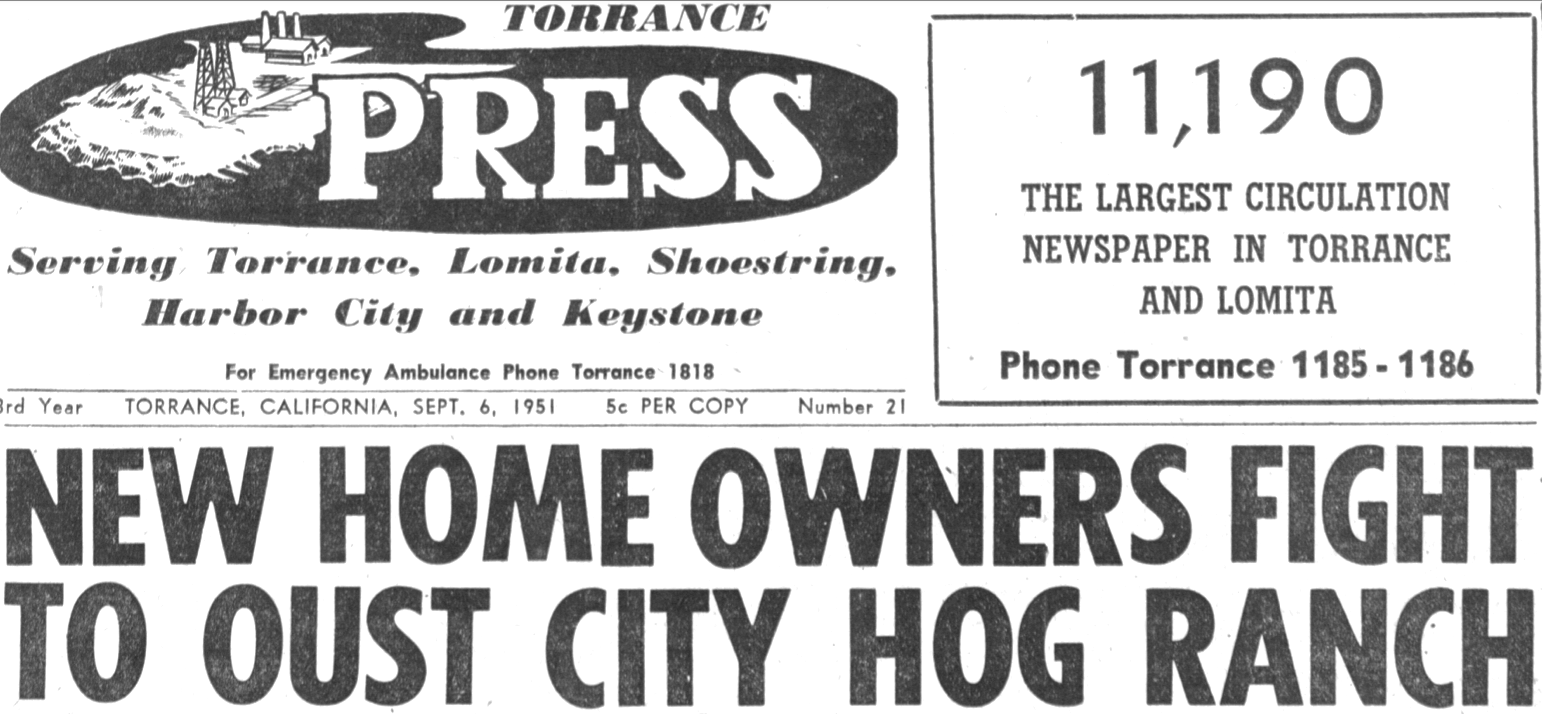
Torrance Press, Sept. 6, 1951, Page 1. (Credit: Torrance Historical Newspaper and Directories Archive database, Torrance Public Library)

Faced with public pressure from nearby residents, the city of Torrance began cracking down on dairy farms and their cattle, outlawing them as of 1963. Cities such as Lomita and Lawndale who once encouraged chicken farmers became less enthusiastic as development intensified.

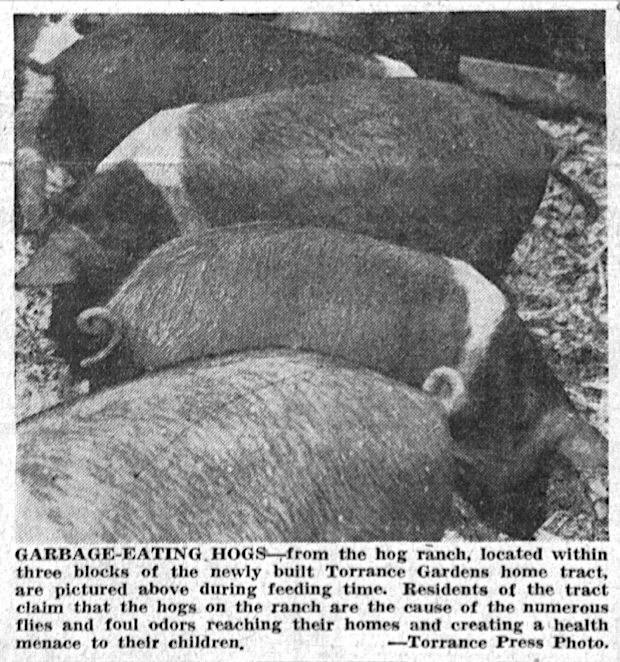
So it’s not hard to imagine how quickly and forcefully public opinion shifted when it came to hog farms, whose livestock operations were among the most odiferous. Several such enterprises had been established in the Torrance area by the mid-1930s, forcing the city to begin its attempts to regulate them.

Torrance announced an ordinance in July 1936 that required prospective hog farmers to get permits from the city. The law also attempted to regulate the common practice among the farms of hauling garbage into the city to be used for hog feed, mandating permits for that practice as well.

Though limited in scope, the ordinance had an immediate effect. Owners W.J. Frogge and Don Willis immediately had to stop building their hog farm at 182nd St. and Prairie Ave. after failing to get the proper permits for the construction.

At the same time as the ordinance was proposed, Torrance officials received word that a Chicago firm was contemplating putting a $400,000 meatpacking plant in the city. They quickly checked the text to make sure it wouldn’t jeopardize the possible project. It was never built.

The campaign against the hog farms didn’t really pick up steam again until after World War II. In 1949, flies were determined to be such a problem in parts of Torrance that a special group, the Fly Abatement Committee of Torrance (FACT) was formed to pursue solutions.

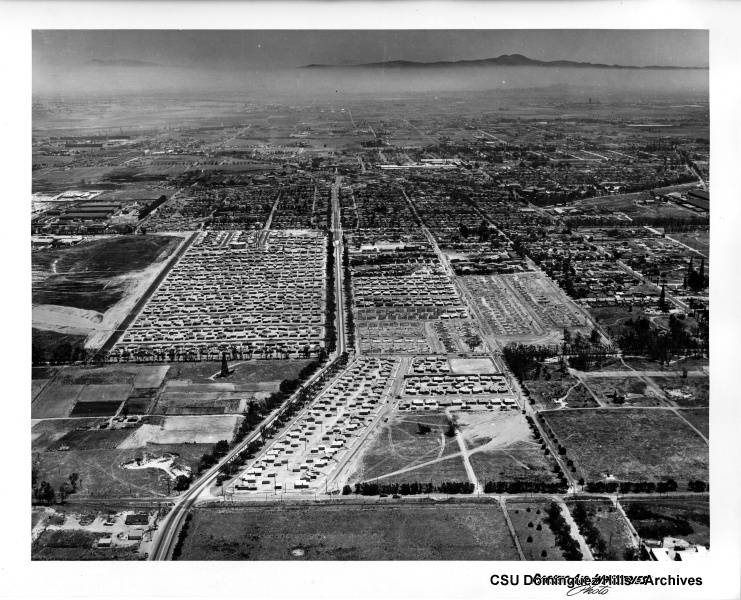
Looking east at the Torrance Gardens housing development along Torrance Boulevard, center. Houses are still being built, center-right, in this 1951 photo. (Credit: CSUDH digital archives)

In early January 1951, the Torrance planning commission asked the city to set a date beyond which the hog farms would no longer be allowed to operate, recommending a ten-year period.

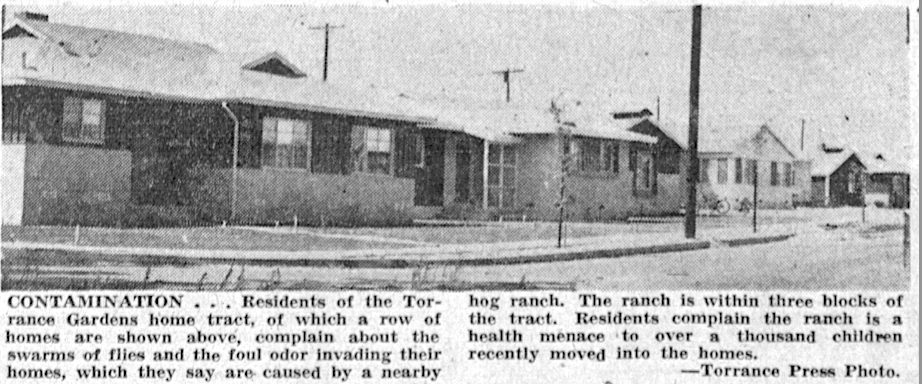
The following September, new residents at the Torrance Gardens housing development near Crenshaw and Torrance boulevards told the City Council that a nearby hog farm posed a health danger to residents and their children, and demanded its closure.

The especially hot summer of 1953 brought another much more intense round of complaints from residents. An estimated 700 of them turned out for an August 1953 council meeting to complain of “unbearable” clouds of flies and seriously bad odors coming from the hog farms, particularly those in western Torrance near Spencer St. and Madrona Ave. in Torrance.

Torrance Press, Sept. 6, 1951, Page 1. (Credit: Torrance Historical Newspaper and Directories Archive database, Torrance Public Library)

A cluster of hog farms operated there, including those owned by Frances Foley, Lester Kazarian and Edward F. Saul. George Green owned another farm on Torrance’s western border at W. 190th and Beryl streets. 

The residents claimed one of the hog farmers – they didn’t identify whom –  had been dumping garbage that the hogs wouldn’t eat in a field near their housing development. Frances Foley later admitted that he was guilty of the illegal dumping.

Finally, the City Council acted definitively in 1954, setting a three-year deadline forcing the hog farms in the city to cease operations and remove all animals by June 15, 1957. The owners complied.

A Torrance Herald story claimed that at one point the Torrance area had 85,000 residents, and 6,000 hogs living in the city. By 1957, the hogs were gone.

A similar battle over cattle at dairy farms ended with the keeping of the animals in the city declared illegal as of Dec. 1, 1963. The final dairy cows were removed in December 1966.

Torrance Press, Sept. 6, 1951, Page 1. (Credit: Torrance Historical Newspaper and Directories Archive database, Torrance Public Library)

Sources:

Daily Breeze files.

Farming in Torrance and the South Bay, by Judith Gerber, Arcadia Publishing, 2008.

Torrance Herald files.

Remembering when Western Airlines was “the only way to fly”

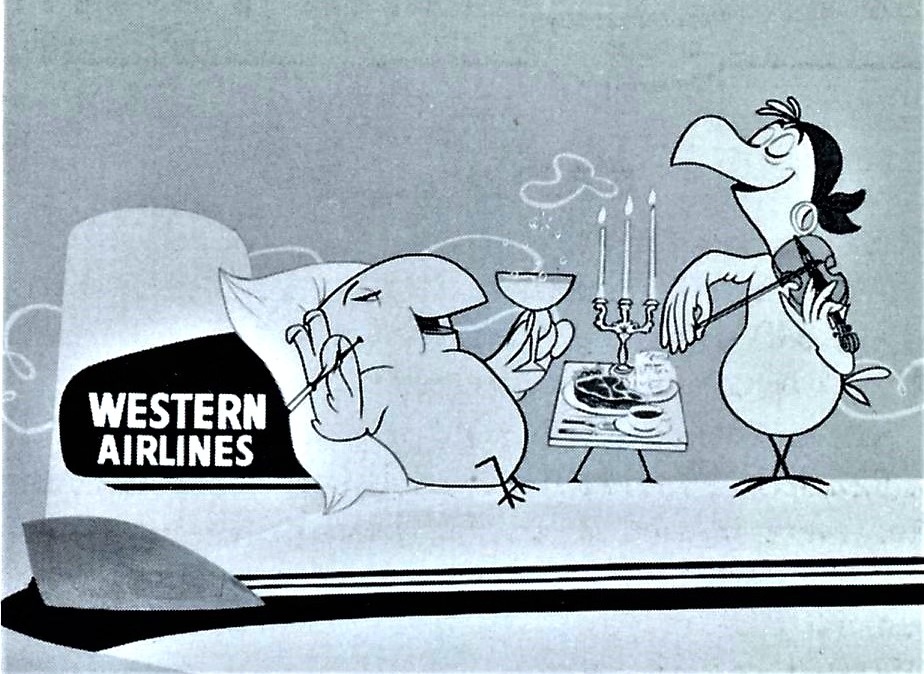
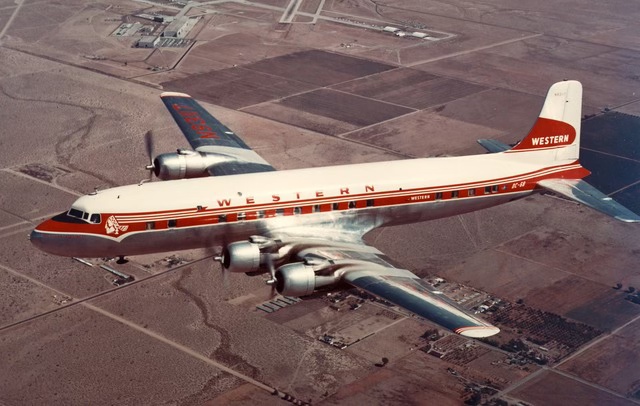
Ad spokesman Wally Bird atop a Western Airlines DC-6B in an undated still circa late 1950s-early 1960s. (Credit: AVGeekery.com website)

If you lived on the West Coast and watched television in the 1960s and 1970s, you couldn’t miss the Wally Bird commercials.

In the ads, the animated spokes-bird for Western Airlines reclined on pillows on a company plane’s fuselage while drinking champagne, a reference to the airline’s popular in-flight champagne service.

His signature slogan: “Western Airlines … the oo-oo-oonly way to fly!”

The Los Angeles-based airline’s roots extend back to the days when Los Angeles International Airport was known as Mines Field, named for William Mines, the man who leased the former beanfield to airport boosters in the early 1920s.

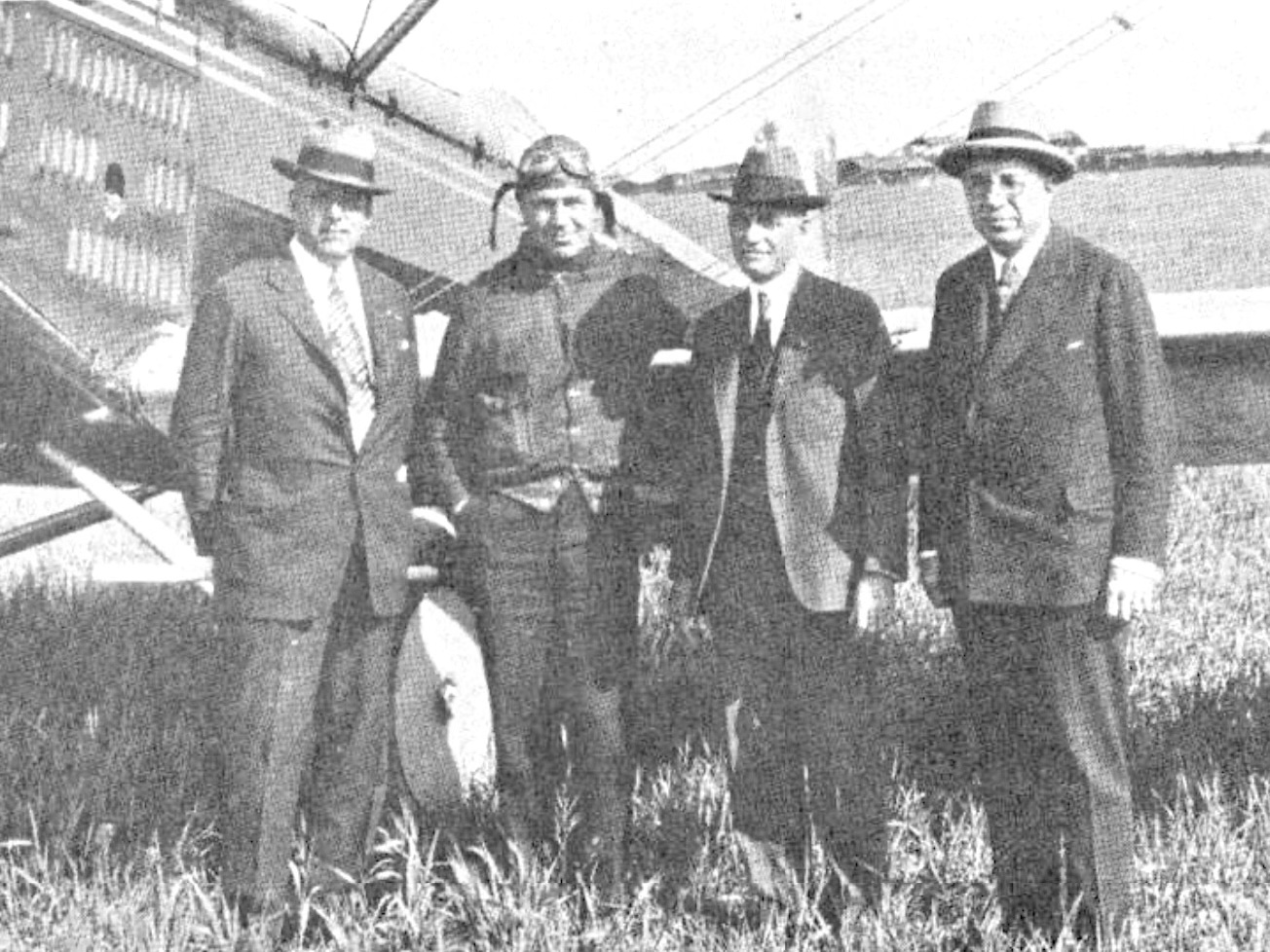
Western Air Express founders, from left: Byron L. Graves, Major C.C. Moseley, Lep M. Holly, and Harris M. Hanshue. (Credit: Glendale Public Library Collection)

Harris Hanshue founded the company, originally known as Western Air Express, in Los Angeles in 1925. Passenger air travel was in its infancy; Hanshue’s operation was predicated on his winning a key U.S. Post Office air route from Los Angeles to Salt Lake City.

In October 1925, Hanshue, a former race car driver, succeeded in landing the 650-mile long Contract Air Mail route #4 from the government.. The mail flights began operating on April 17, 1926. A little over a month later on May 23, Western’s first passenger flight took place, from Woodward Field in Salt Lake City to Los Angeles.

By securing the Salt Lake City route early on, Hanshue had established Western as a major force in early air travel in the western United States, and its operations continued to grow. Seemingly, no new route was too small. It even offered seaplane service to Hamilton Cove Sea Base just north of Avalon on Catalina Island from 1928-1930.

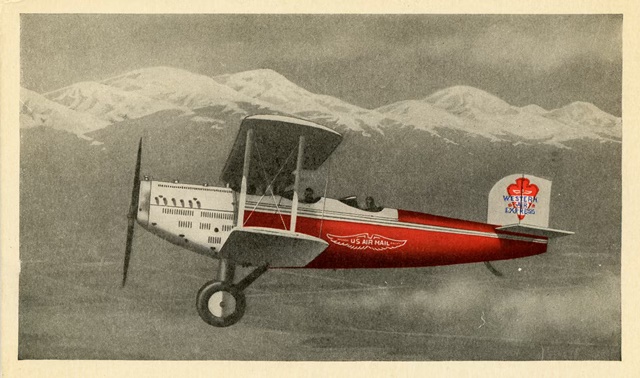
Undated postcard shows the Western Air Express Douglas M-2 biplane in flight. (Credit: Delta Flight Museum website)

The firm expanded its reach by acquiring several smaller operations during these early years. These included Standard Air Lines in 1930, and National Parks Airways in 1937. The latter acquisition extended Western’s reach from Utah up through smaller airports, several near national parks, in Idaho and Montana. 

After acquiring Standard in 1930, Western Air Express merged with the Dutch aircraft company  Fokker and Transcontinental Air Transport to form Transcontinental & Western Air, more familiarly known as TWA. Western broke off from TWA in 1934, changing its name to General Air Lines briefly before returning to the WAE name.

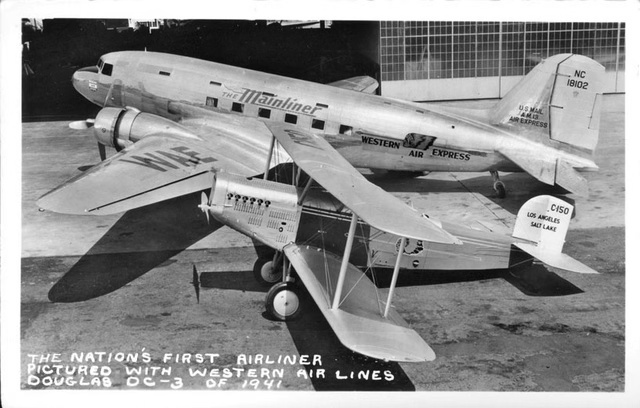
As its operations and corporate affiliations expanded, so too did its fleet of aircraft. The small Douglas M-2 biplane that carried mail to Utah and back in 1926 soon was augmented by larger planes.

1941 postcard compares size of Douglas M-2 biplane foreground with Western’s then-current Douglas DC-3.
(Credit: Pomona Public Library)

Western used a variety of them, including models made by Fokker, Stearman, Curtiss and Sikorsky before settling on Douglas DC-2s and DC-3s during the late 1930s and early 1940s.

In 1941, the company changed its name to Western Air Lines, then shortened that to Western Airlines, the name by which it would be known for the next 46 years.

Following some lean economic years after World War II, business boomed for Western in the 1950s and 1960s. Flying on commercial airlines became a much more common phenomenon, and the company found ways to get its name known in the marketplace.

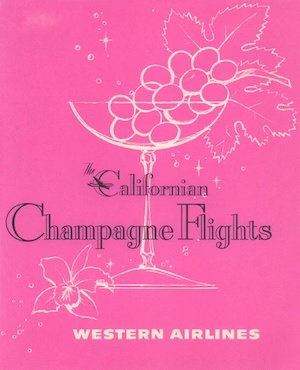
1950s in-flight menu cover for Western Airlines.

Rather than offering the usual barebones food service to passengers, Western shrewdly chose to set itself apart by offering its customers something out of the ordinary, introducing its Champagne Flights in 1954. 

In addition to the complimentary sparkling wines – the company did not serve actual French Champagne – all passengers were offered fancy meals including filet mignon, salad Escoffier and the like. 

In order to publicize the flights, the company introduced its advertising campaign featuring Wally Bird extolling the virtues of the luxurious flights in 1955. The cartoon bird would serve as the company’s advertising mascot for the next several decades.

Western also embraced the Jet Age, adding the Boeing 707 jetliners to its fleet in 1960. (Pan Am had introduced them in late 1958, and the first one to land at LAX did so in January 1959.)

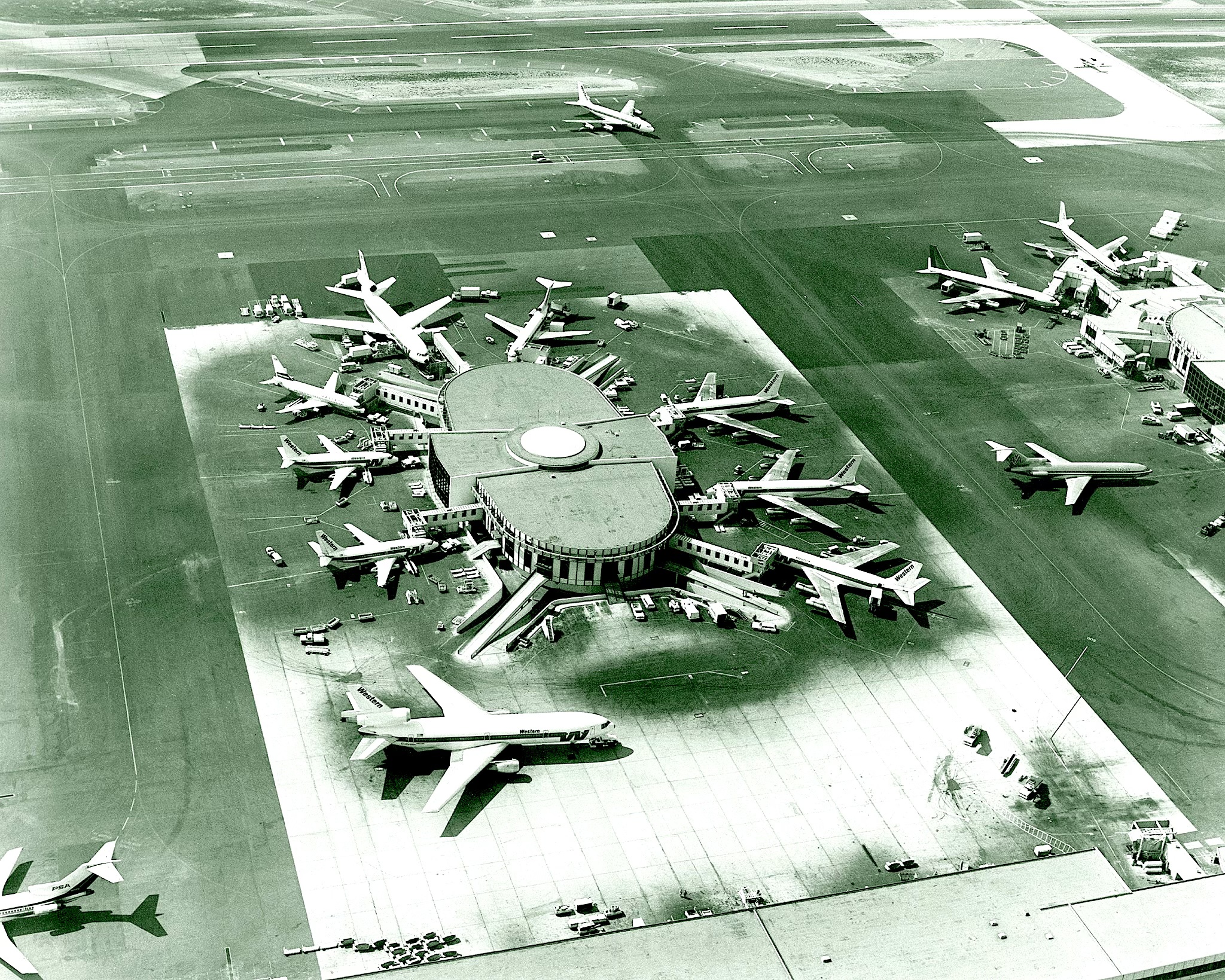
LAX’s massive remodel to accommodate the new generation of jet aircraft, which used tunnels to move people to satellite terminals, opened in June 1961. Western had its own satellite building, Terminal 5.

Aerial view of Western Airlines at LAX’s Terminal 5 satellite building circa 1970s. (Credit, LAWA via LAX Facebook page)

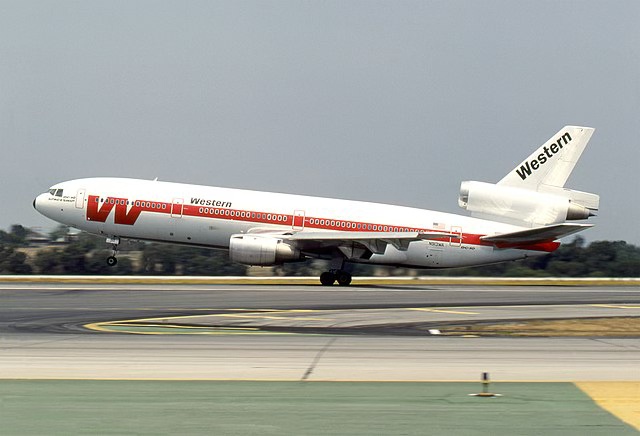
The 1960s and 1970s marked a golden era for Western, which continued to expand both its aircraft fleet – it would add its largest plane, the Douglas DC-10 in 1973 – and the markets it served from its two hubs in Los Angeles and Salt Lake City. 

Its 1967 acquisition of Pacific Northern Airlines extended the airline’s reach to Alaska, and in 1969, Western began offering flights to Hawaii from several California cities.

The first of several merger attempts involved a proposed deal with American Airlines in 1969. Government regulators ruled against the deal in 1972.

A Western Airlines DC-10 lands at LAX in 1981. Photo by Dave Faulkner. (Credit: Wikimedia Commons)

In 1978, Western and fellow LAX-based Continental Airlines agreed to negotiate a merger. They ran into difficulty when Continental chief Bob Six lost a coin toss over whether to call the new firm Western Continental or Continental Western. Supposedly, he was so unhappy about it that he called off the merger.

Eventually, Delta Airlines and Western agreed to a merger (sans coin flip) in September 1986, and it became final that December. The two companies were completely merged by April 1, 1987.

Western and Wally Bird became remnants of the past, and Delta gained two strong hubs in Los Angeles and Salt Lake City and a valuable presence in the western U.S. that it retains to this day.

A Western Airlines Douglas DC-6B circa late 1950s. (Credit: Wikimedia Commons)

Sources:

Daily Breeze archives.

Delta Flight Museum website.

“The Rich History of Western Airlines: Aircraft, Milestones and Legacy,” by Kenneth Schulte, Airspeed Junkie website, Nov. 11, 2024.

Wikipedia.

Rating: 1 out of 5.

Pioneering architect Julia Morgan designed the San Pedro YWCA headquarters in 1918

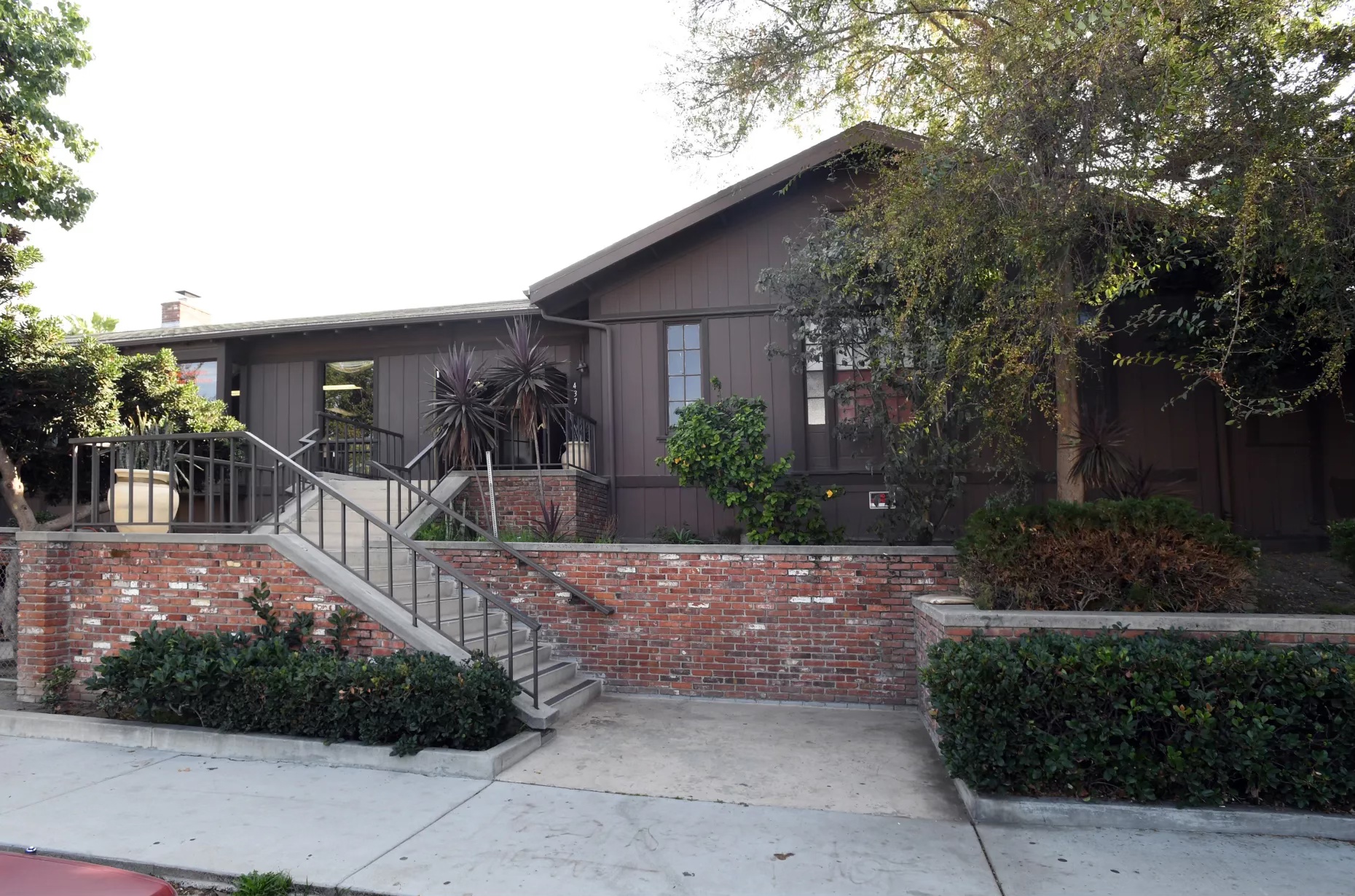
The San Pedro YWCA building designed by architect Julia Morgan as seen on Oct. 29, 2018. Photo by Axel Koester, Contributing Photographer. (Daily Breeze file photo)

The San Pedro YWCA was formed during the World War I era to give young women devoting themselves to supporting the war effort a place to live and find community.

Those goals were totally in keeping with the ideals of the original Young Women’s Christian Assocation, which was founded in London, England in 1855. Philanthropist Lady Mary Jane Kinnaird began the group 11 years after the founding of the Young Men’s Christian Association (YMCA).

The YWCA offered lodging, education and fellowship to single women – nurses, factory workers and others – migrating from the English countryside to the big city in order to work in support of an earlier war effort, the Crimean War.

In 1884, the YWCA went international, with the addition of groups that had formed in Norway, Sweden and the United States.

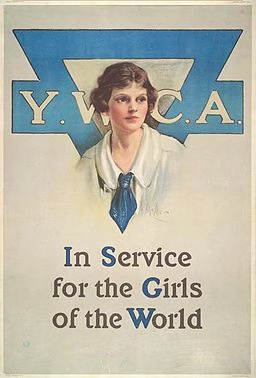
1919 YWCA poster. (Credit: Wikimedia Commons)

Kinnaird’s YWCA originally was aligned with organized religion, but by the time the San Pedro branch was founded, it was moving toward becoming a secular organization, which it mostly had become by 1920. Some branches still offered spiritual counseling, but the group was not affiliated with any one religion.

San Pedro’s standing as a major military industrial center, especially shipbuilding, led to the need for the support role played by the YWCA more apparent. Many women already had been working for a local group, the YWCA War Work Council of San Pedro. Its officers were the ones who got the ball rolling toward the establishment of a physical home for the YWCA.

In March 1918, the War Work Council purchased three lots on the south side of Ninth Street, between Mesa St. and Pacific Ave., and the drive to build the headquarters building was underway.

It was a popular idea. According to the San Pedro News Pilot, Mrs. C.J. Golden went to a YWCA conference in northern California at Asilomar in Pacific Grove to petition leadership for $5,000 in funds for the project. She returned home with a $10,000 grant from the group.

Once financing was secured, details of the building project were announced in July 1918. Its total cost: $26,000. It would include living quarters, a large social room, a locker room and even an indoor swimming pool in the basement. (Unfortunately, the swimming pool had to be filled in later when the unstable ground beneath made it untenable. An outdoor pool was later added.)

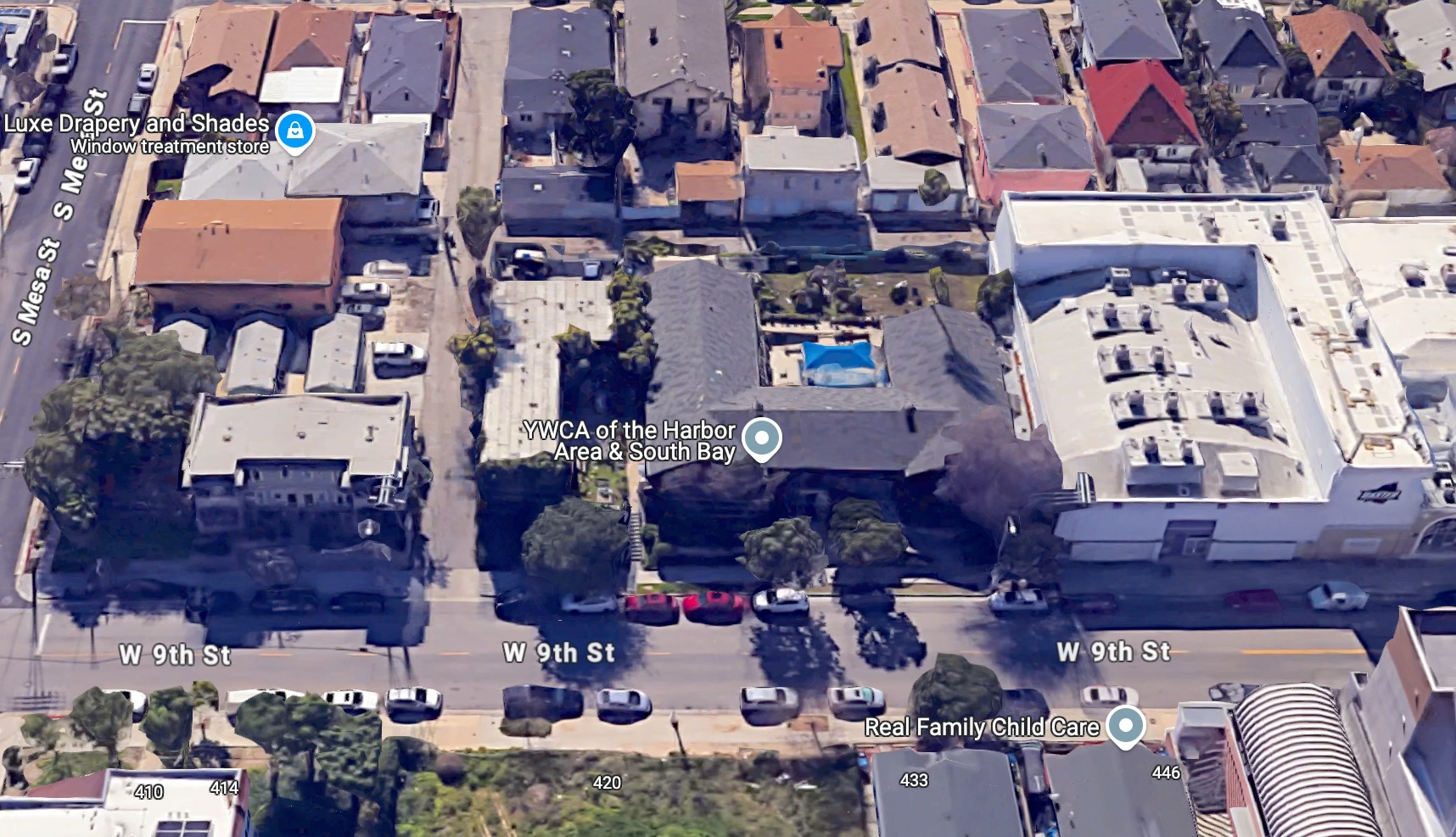
The YWCA complex at 437 9th St. in San Pedro. 2024 image. (Credit: Google Earth)

The group hired a highly regarded architect to design the facility: Julia Morgan of San Francisco. Morgan had designed several other YWCAs, including buildings in Long Beach, San Francisco and other YWCAs in Arizona, Hawaii and Utah.

Morgan’s affiliation with the group began in 1913, when Phoebe Apperson Hearst, William Randolph Hearst’s mother, recommended her to design the group’s Asilomar conference center mentioned above. 

Morgan already had begun a distinguished career as architect and engineer. She was the first woman student admitted to the architecture program at the Ecole de Beaux Arts in Paris, and the first woman architect to be licensed in the state of California. She would later go on to design the main buildings of Hearst Castle in San Simeon.

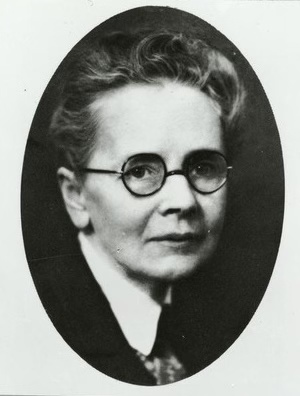
San Pedro YWCA architect Julia Morgan in 1926. (Credit: Wikimedia Commons)

Her reputation was secured by her 1904 design of the El Campanil tower at Mills College across the bay from San Francisco. Morgan’s pioneering use of reinforced concrete allowed the building to remain standing when most others in the area fell during the 1906 San Francisco earthquake. (It also survived the 1989 Bay Area quake.)

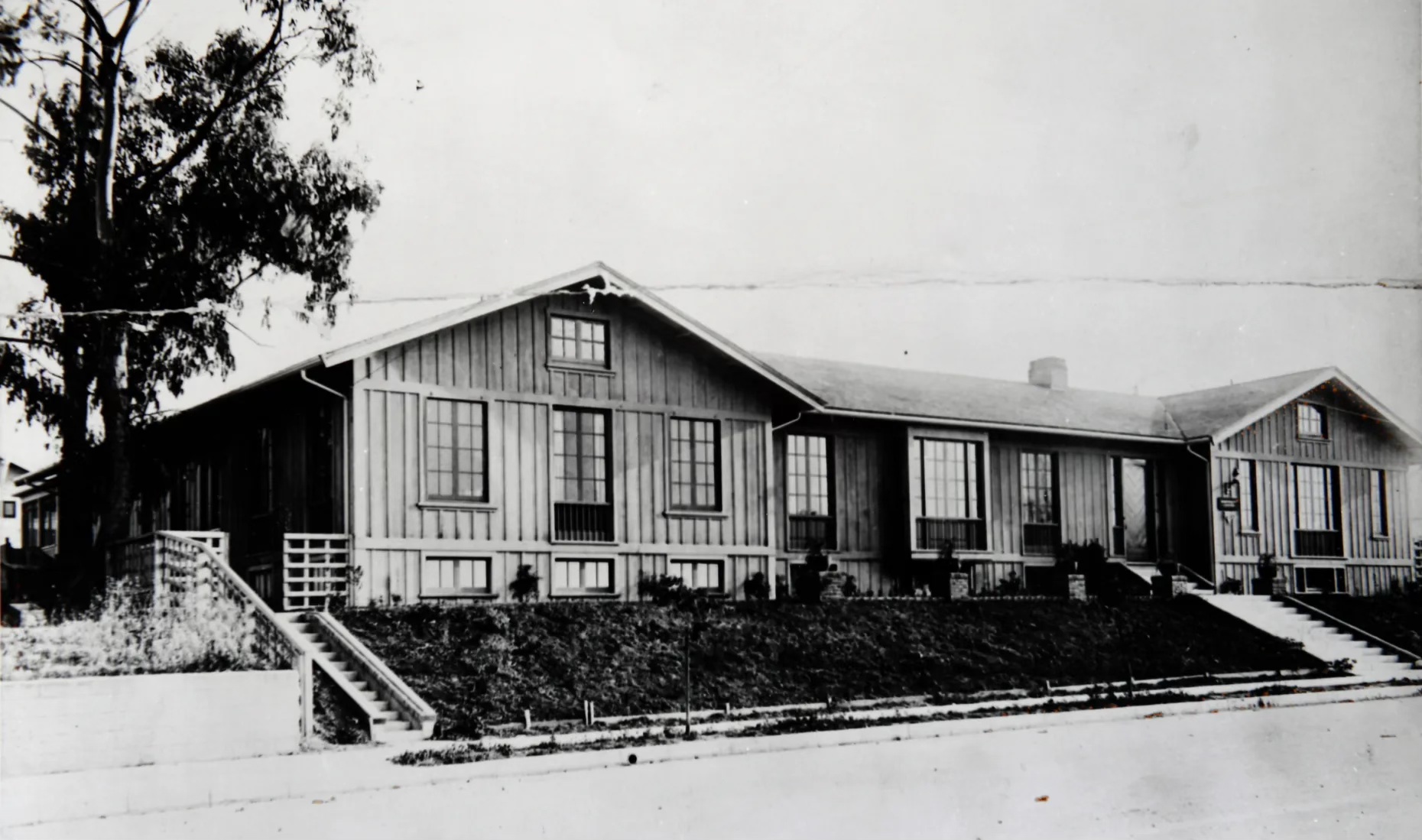
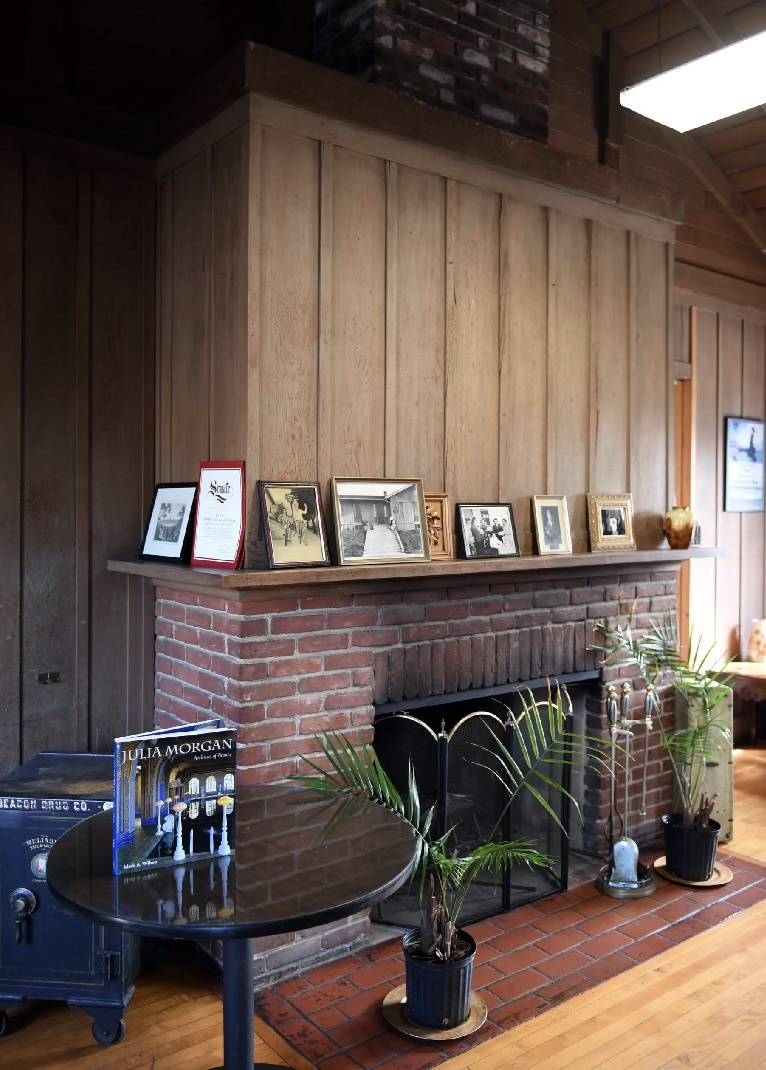
The Craftsman-style dark brown building she designed in San Pedro certainly was much less ornate than Hearst Castle. But its warm wood floors, crackling fireplace and other inviting decor elements made it a welcoming place for its members and inhabitants.

She also designed a more basic additional rectangular building in 1926, giving the facility much needed additional space.

No official dedication was held for the San Pedro YWCA building, but its occupants began moving in by late 1918, just as World War I was coming to a close. The first YWCA meeting was held there on Oct. 25, 1918. It quickly became a vital asset in the community, serving as a meeting center not only for the Y but for many other community groups.

Over the years, many additions have been made to the complex at 437 W. Ninth St., though none have quite as much charm as the original building. It remains a vital part of the community group’s operations.

Undated vintage photograph of the San Pedro YWCA, circa early 1920s. (Daily Breeze file photo)

On May 3, 1978, the San Pedro YMCA original building, also known as the Morgan House, became Los Angeles Historic – Cultural Landmark #186, and the community celebrated its 100th anniversary in 2018.

As for Julia Morgan, she died in 1957 at 85. She was inducted posthumously into the California Hall of Fame in 2008. In 2014, she became the first woman ever to receive the American Institute of Architects’ highest honor, the AIA Gold Medal.

The San Pedro YWCA now operates as the enlarged YWCA of San Pedro and the South Bay, having assimilated members of the Torrance YWCA following that group’s dissolution during the late 1990s.

One of the original surviving fireplaces of the San Pedro YWCA on Oct. 29, 2018. Photo by Axel Koester, Contributing Photographer. (Daily Breeze file photo)

Sources:

Daily Breeze archives.

“Our Local Buried Treasure: The San Pedro YWCA – A Julia Morgan Building,” by Laureen Claire Vivian, San Pedro Pulse website, May 27, 2022.

San Pedro: A Pictorial History, by Henry P. Silka, San Pedro Bay Historical Society, 1993.

San Pedro News Pilot archives.

Wikipedia.

The Harden Estate gatehouse in Portuguese Bend housed a pair of famous tenants in the 1960s

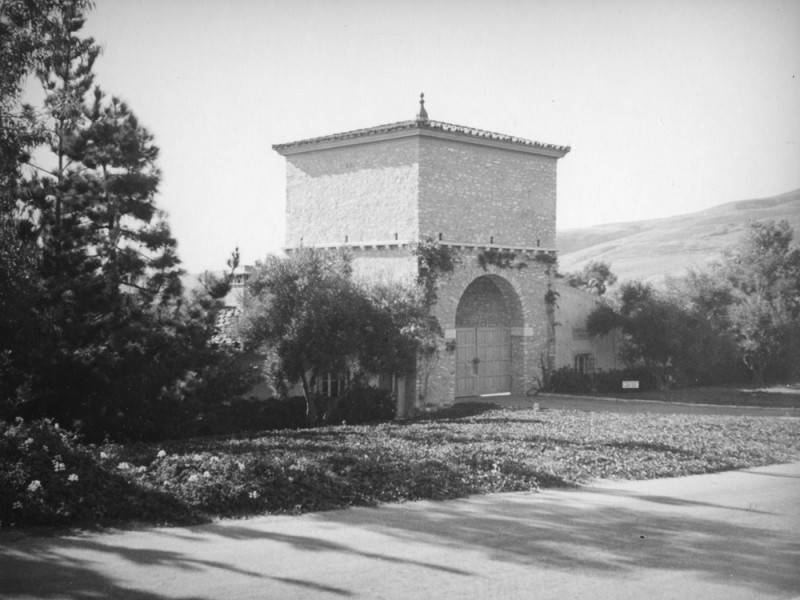
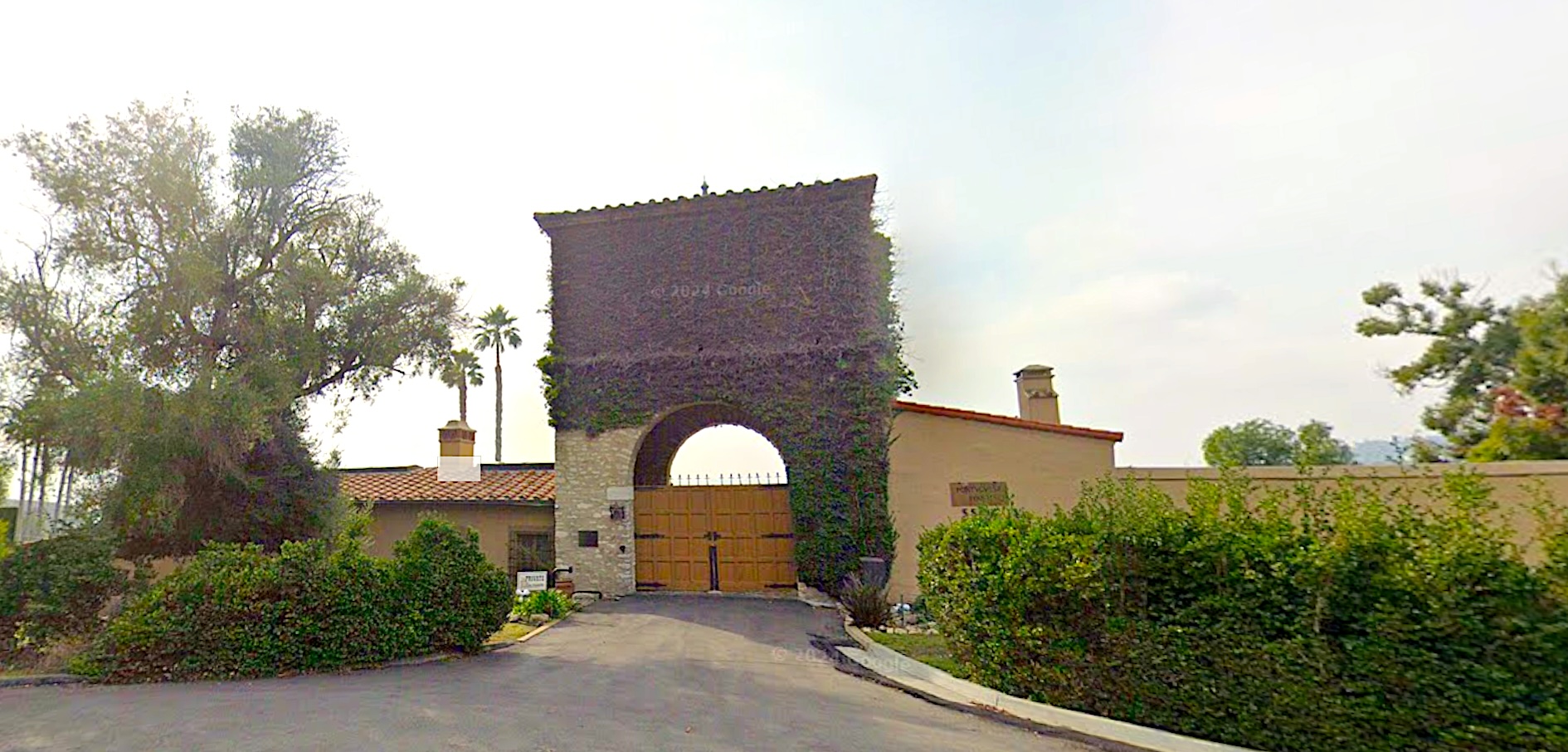
The wooden doors to this stone gatehouse provide a formidable entrance to the Harden Estate at 5500 Palos Verdes Drive South in Rancho Palos Verdes. 1937 photo. (Credit: Los Angeles Public Library Photo Collection)

The Harden Estate gatehouse in Portuguese Bend was built to be the gateway to a larger house that was never built. For nearly 100 years, it has stood guard over a mostly empty parcel of land behind it.

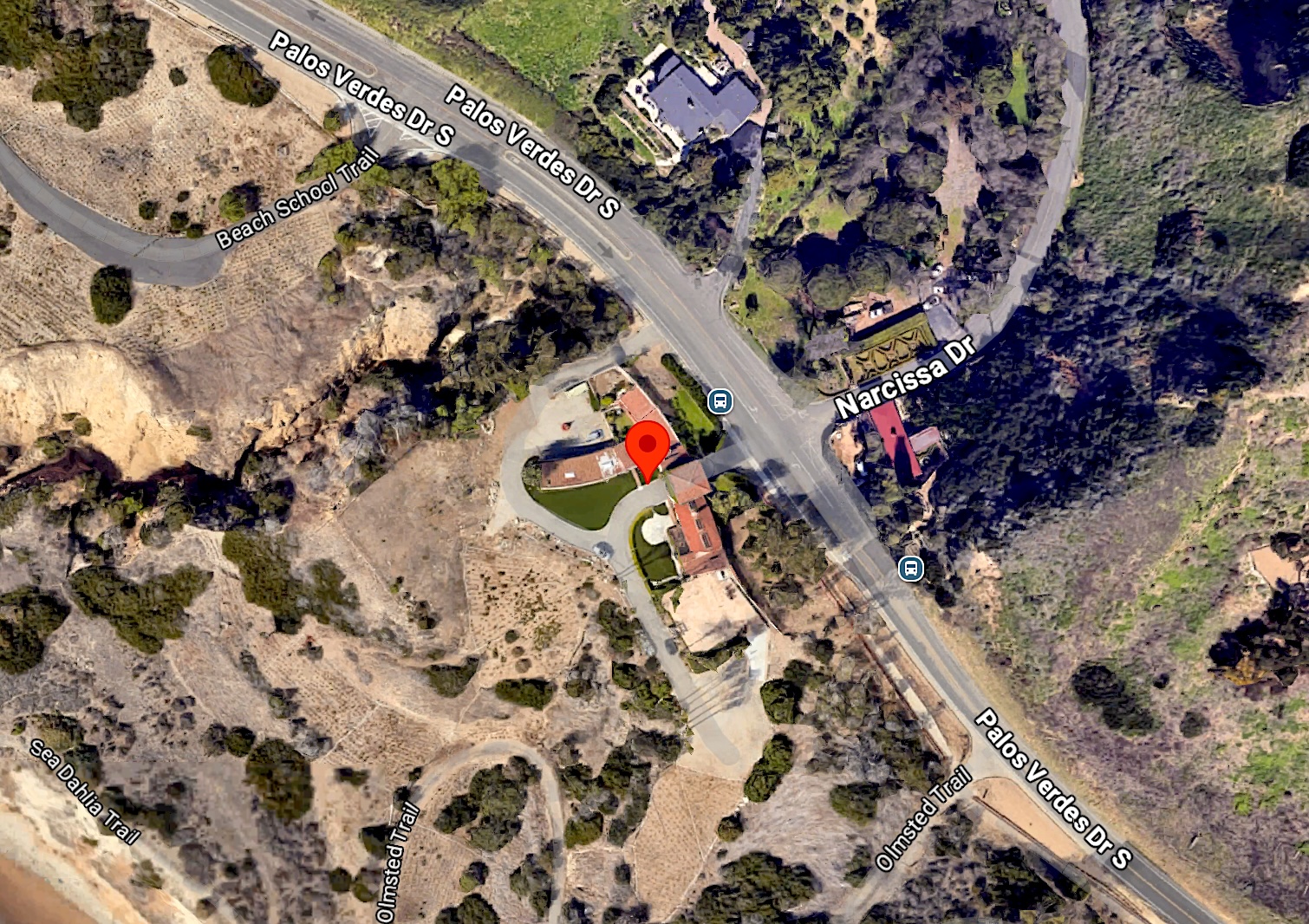
Just across Palos Verdes Drive South from the gatehouse  lies Narcissa Drive, the road that leads to Palos Verdes Peninsula land baron Frank Vanderlip’s Villa Narcissa mansion.

Vanderlip, who had purchased the Palos Verdes Peninsula in 1913, enticed his sister Ruth to move from New York to California by agreeing to her request that she get a parcel of land on the coastline. 

The Harden Estate gatehouse, center, red marker, at 5500 Palos Verdes Drive South in Rancho Palos Verdes. 2024 image.
(Credit: Google Earth)

In 1925, Vanderlip gave his sister and her husband, Edward Harden, a vice president for Vanderlip’s Palos Verdes Project, a large plot of coastal land at Portuguese Point. (They later would donate 46 acres to the city of Rancho Palos Verdes to create Abalone Cove Park.) 

In 1926, they finished building the gatehouse, with plans to build a much larger home behind it for it to protect. The gatehouse certainly was comfortable enough in its own right, consisting of a four-bedroom home, along with a six-car parking garage and servants’ quarters  in a separate wing. 

Architect Gordon Kaufman based his Italian Renaissance design for the structure on a photo he’d seen of a building in northern Italy.

It was lavishly furnished, as writer Sandi Hemmerlein discovered when she was allowed a rare tour in 2019. Since it has had few different owners over the years, the buildings still have many of their original fixtures. Some of the furniture was sold off after Ruth Harden’s time, but has been reacquired since.

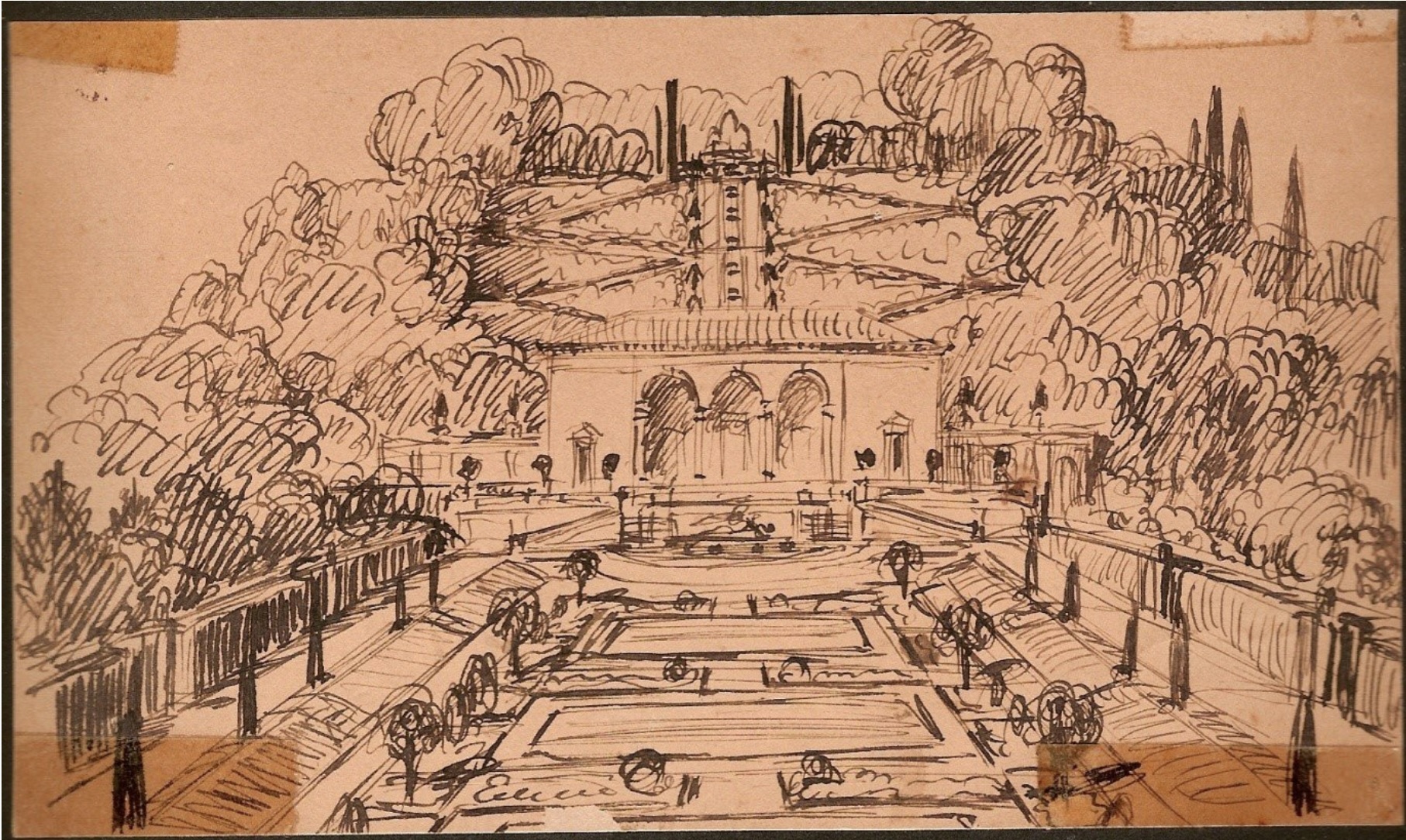
One of architect Jacques Greber’s sketches of the proposed Harden Estate main house that was never built. Circa 1920s.
(Credit: Palos Verdes Pulse website)

The Hardens had big plans for the land beyond the gatehouse. They hired architect Jacques Greber, who drew up elaborate plans for an estate house surrounded by cultivated grounds designed by landscape architects the Olmsted Brothers.

The arrival of the Depression in 1929 caused them to hold off on the building project, and it never came to pass. The discovery of the Portuguese Bend landslide in 1956 put a permanent kibosh on any further building on the land, which had become too unstable to support it.

The Hardens occasionally rented the estate out, sometimes to famous tenants. During the several months in 1939 when they were on a lengthy world tour, they leased the property to Mr. and Mrs. Arthur Hornblow. Mrs. Hornblow was much better known by her movie star name, Myrna Loy. 

Another well-known couple lived in the gatehouse twenty-five years later. John Gregory Dunne and his wife, Joan, both were established magazine writers for national publications, he for Time and she for Vogue, when they married in early 1964.

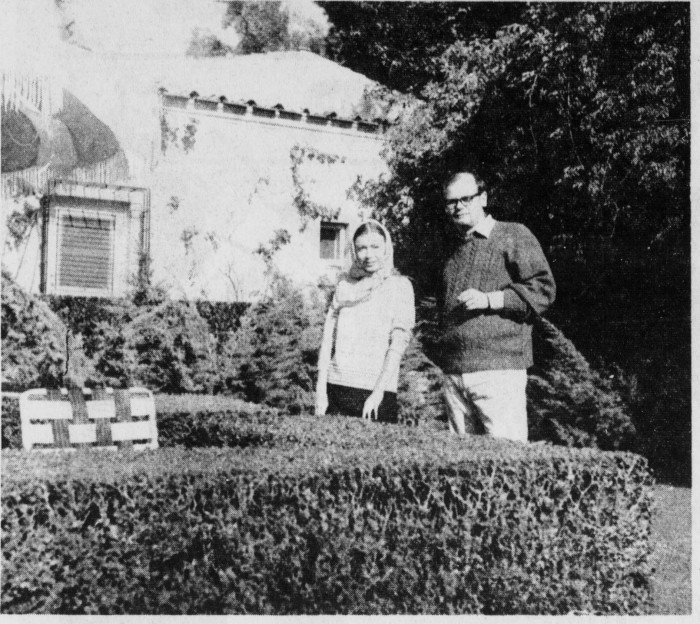
Joan Didion and her husband, John Gregory Dunne, pose in the gardens of the Harden Estate in 1965. Palos Verdes Peninsula News, Dec. 16, 1965, Page 27. (Credit: Palos Verdes Peninsula News archives)

The newlyweds decided they wanted a quiet, secluded place in which to continue their writing careers, having decided to quit their staff jobs at the New York-based magazines. Joan had just sold her first novel, Run, River which was published under her professional name, Joan Didion.

They placed an ad looking for a suitable home in Southern California, and selected the Harden Estate gatehouse from the dozens of offers they received. They would work and live there until May 1966, when they moved to Brentwood with their newly adopted daughter, Quintana Roo.

Didion’s lengthy career included co-writing several screenplays with Dunne along with a series of critically acclaimed books, including Play It As It Lays, Slouching Toward Bethlehem and The White Album.

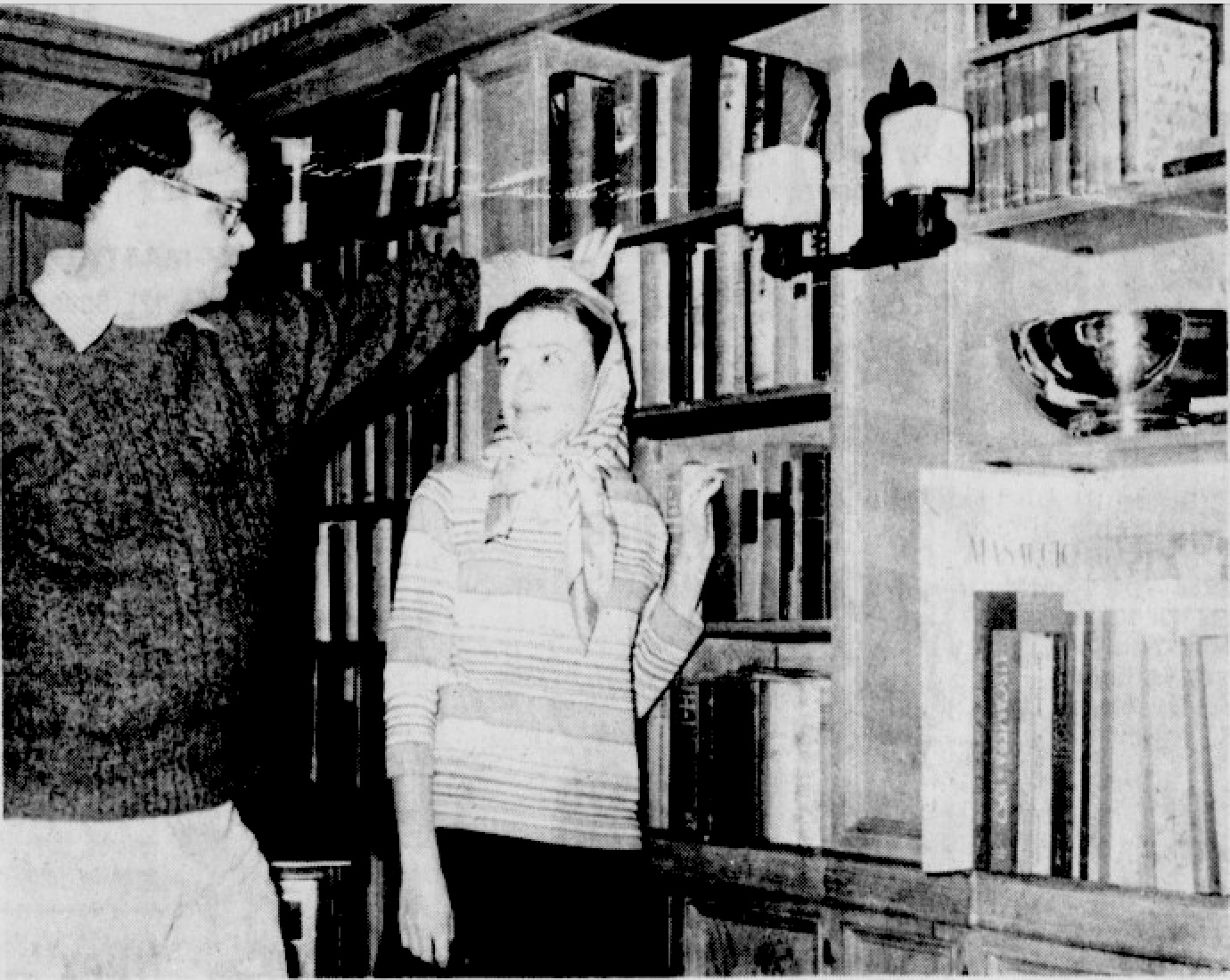
John Gregory Dunne and his wife, Joan Didion, pose in the library of the Harden Estate gatehouse in 1965. Palos Verdes Peninsula News, Dec. 9, 1965, Page 23. (Credit: Palos Verdes Peninsula News archives)

The Year of Magical Thinking, an account of the year of her life following her husband’s death, won a National Book Award and a Pulitzer Prize in 2005.

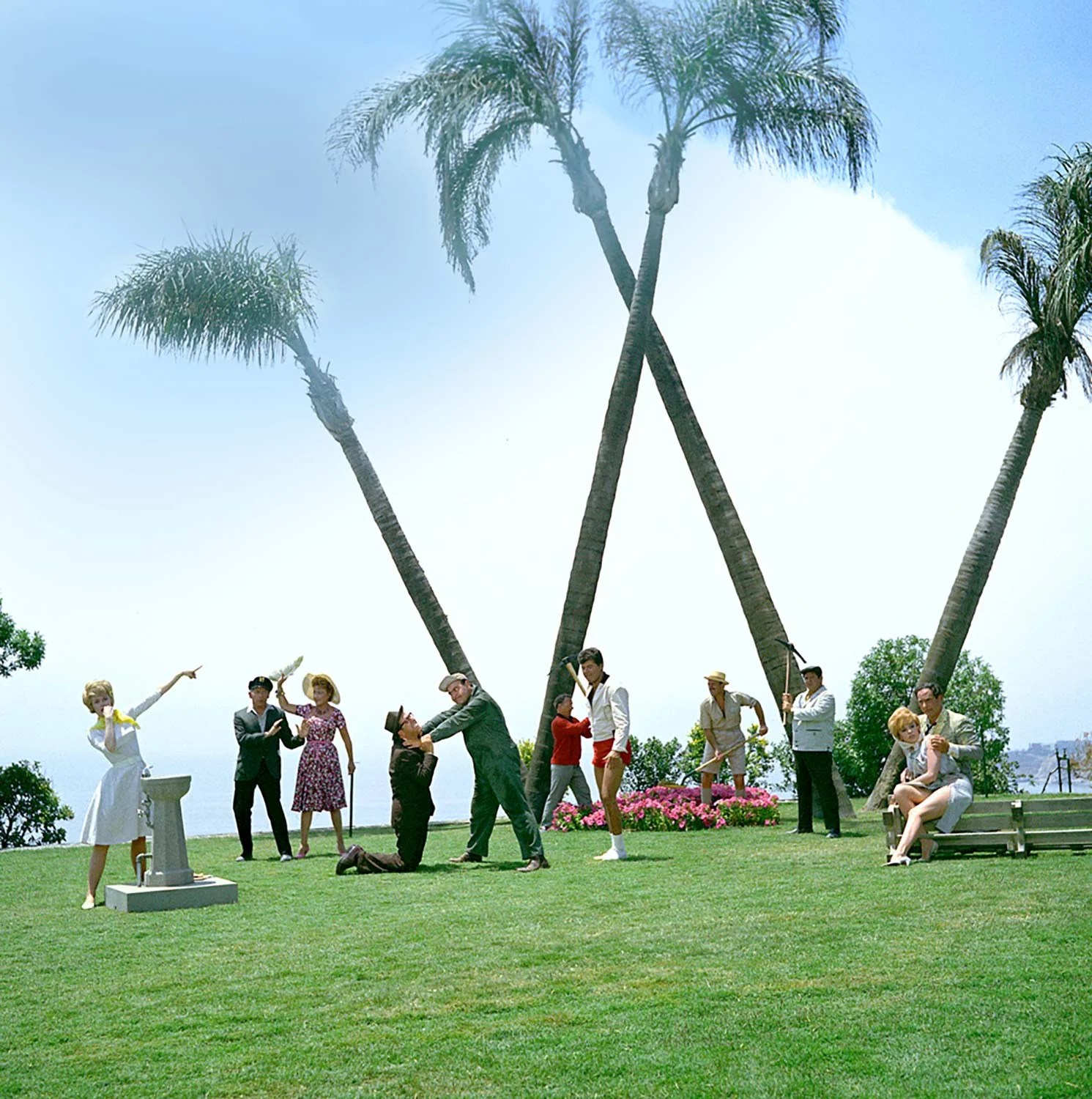
The gatehouse also has become known in recent years as the site of the final scene of the 1963 film, “It’s a Mad, Mad, Mad, Mad World.” The star-studded chase comedy culminated in a finale involving buried treasure located at the site of a giant W.

The giant W in question was formed by four palm trees planted by the film crew on the grounds of the Harden Estate. Fans of the film should know that the trees forming the W were removed decades ago and no longer exist. 

In 1990, the Rancho de los Palos Verdes Historical Society designated the gatehouse as an historic building, installing a plaque to that effect on the structure’s facade.                                                                                                                                                      

The Harden gatehouse property is currently closed to the public. In 2014, its current owners, Allen and Charlotte Ginsburg, announced plans to convert the gatehouse into a public museum called the Palos Verdes Heritage Castle Museum. Work on the project is ongoing.

The Harden Estate gatehouse. 2024 image. (Credit: Google Earth)

Sources:

Daily Breeze archives.

“A Heritage Castle for the Ginsburgs’ Future,” by Judy Rae, Easy Reader & Peninsula website, Nov. 21, 2017.

Palos Verdes Peninsula News archives.

The Palos Verdes Story, by Delane Morgan, The Palos Verdes Review, 1982.

“Photo Essay: The Gold Coast of Rancho Palos Verdes, Never Built,” by Sandi Hemmerlein, Avoiding Regret blog, March 3, 2019.

“The Villas of Portuguese Bend,” by Lee Jester, Palos Verdes Pulse website, March 11, 2024.

Movie cast members pose in front of the giant W from the final scenes of the 1963 film “It’s a Mad, Mad, Mad, Mad, World” on the grounds of the Harden Estate in Rancho Palos Verdes. (United Artists publicity photo)

The burgeoning city of Torrance tries to deal with its growing trash problem in the 1950s

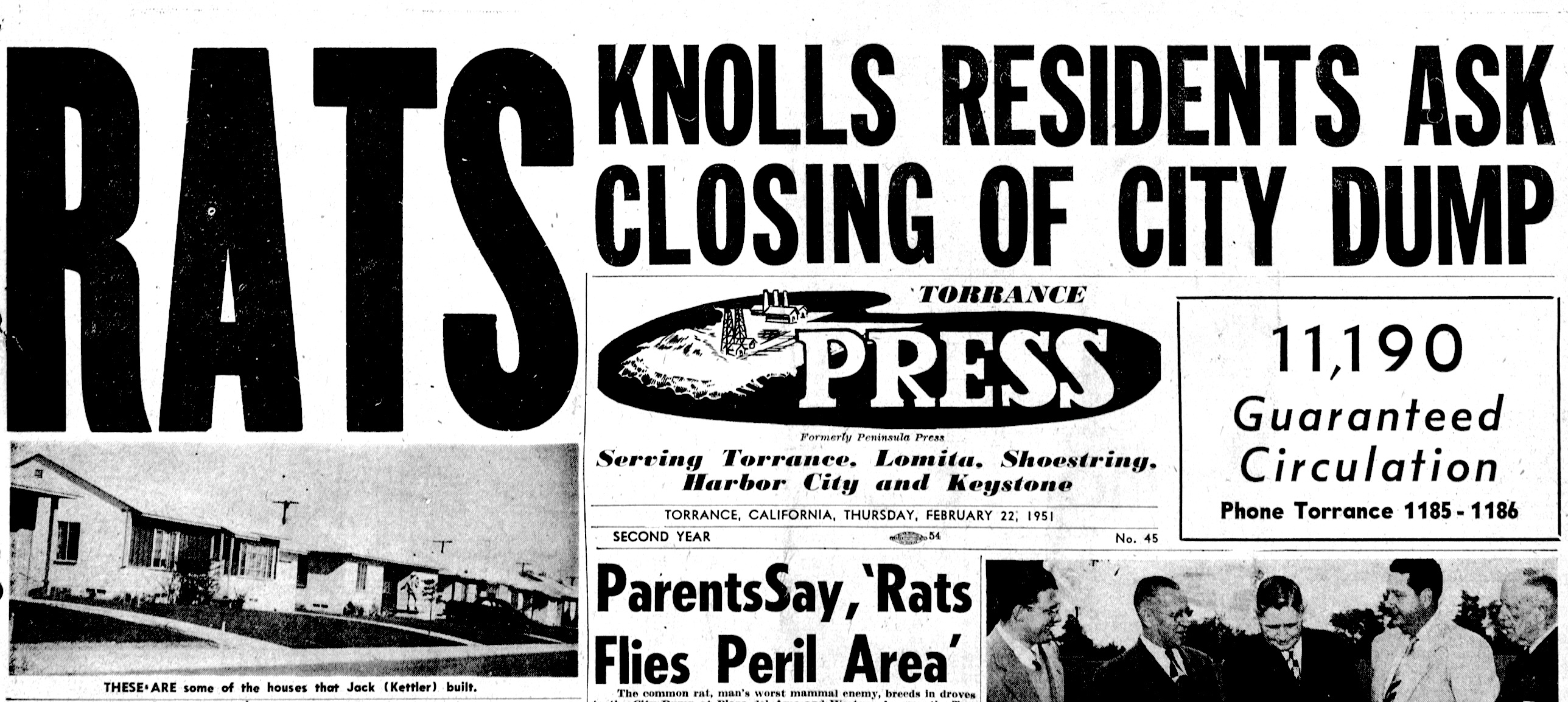
Torrance Press front page, Feb. 22, 1951. (Credit: Torrance Historical Newspaper and Directories Archive database, Torrance Public Library)

The front-page headline in the Torrance Press screamed it out with one giant word: “RATS.” The newspaper, known for its sensationalism, had been going all in on addressing a variety of concerns expressed by nearby residents over the Torrance City Dump.

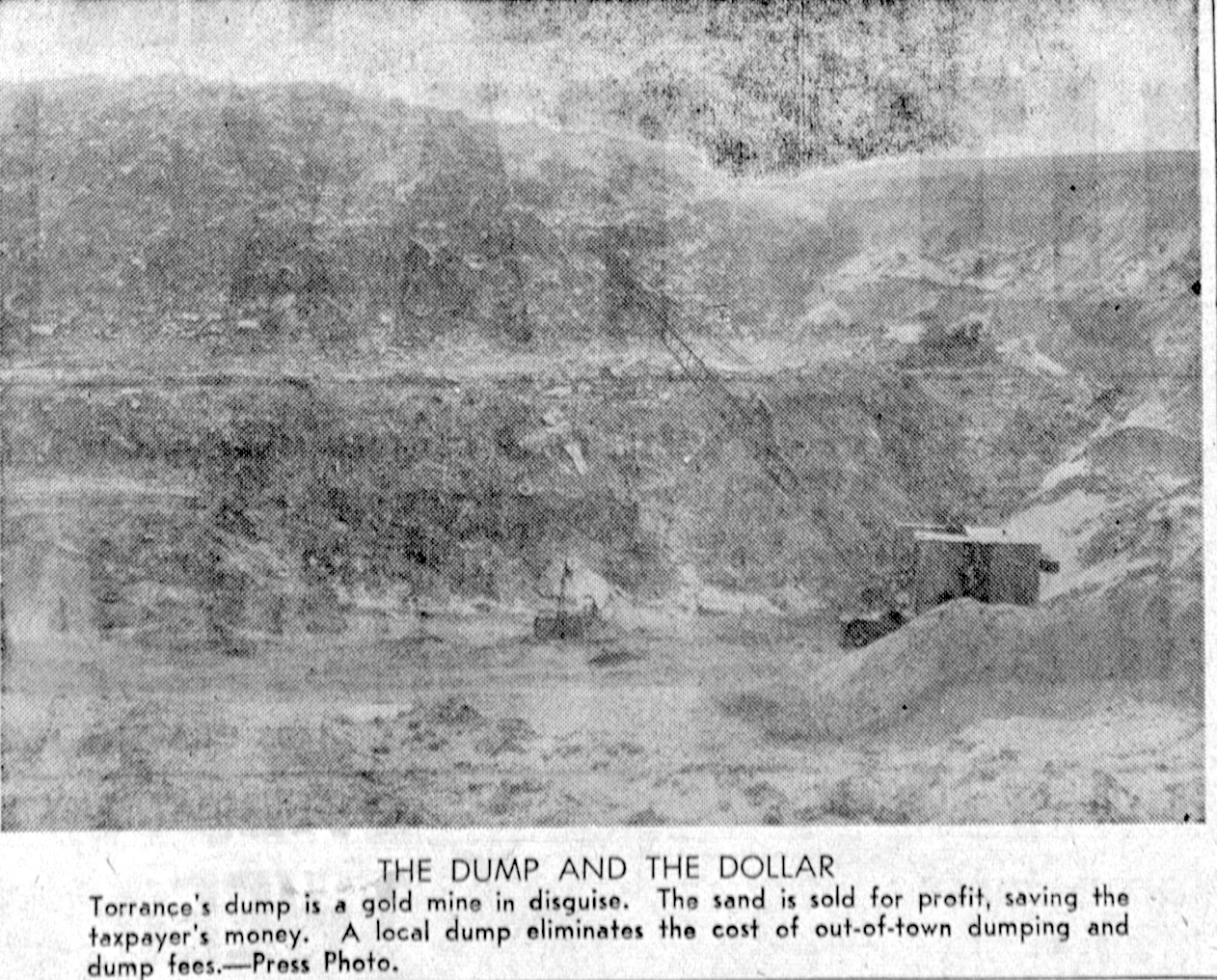
The dump, located on a large plot of barren land at the southwest corner of Plaza del Amo and Western Ave. on the city’s eastern border, had been operating since the early 1940s.

Voices only began to be raised in protest against it after the end of World War II, when the suburban housing boom resulted in the proliferation of residential developments in previously uninhabited locations. 

In this case, that meant the new housing project built along Border Ave. at the dump’s western edge by landowner/developer Jack Kettler, whose residents soon would discover the unpleasant downside of living near a dump.

The Torrance city dump near Plaza Del Amo and Western Ave. in 1949. Torrance Herald, April 28, 1949, Page 1. (Credit: Torrance Historical Newspaper and Directories Archive database, Torrance Public Library)

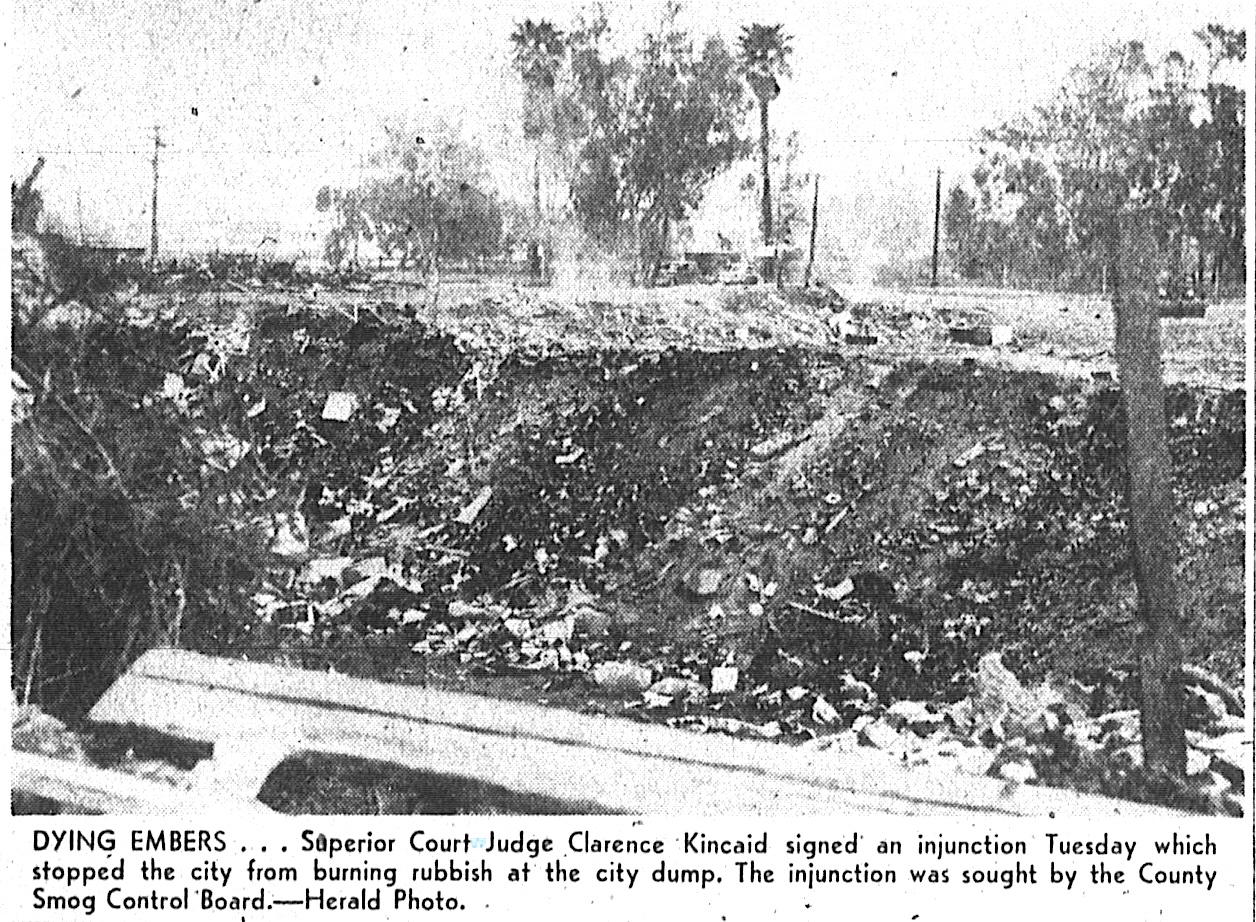
The problem was further exacerbated by an April 1949 anti-pollution ruling from the Los Angeles Superior Court that banned controlled burning of waste material at municipal dumps. Torrance stopped the practice as of July 1, 1949.

The early anti-smog ruling was a much-needed measure – the Los Angeles area would be beset by massive smog in the 1950s –, but, as a result, the city’s dump began to fill up faster and became more expensive to operate. Rubbish that once was burned had to be buried instead. 

Also, the greater amounts of material being deposited caused an increasing proliferation of rats, mice, flies and other scavenging critters. When those critters started finding their way to nearby neighborhoods, protests to city hall became more constant and vociferous.

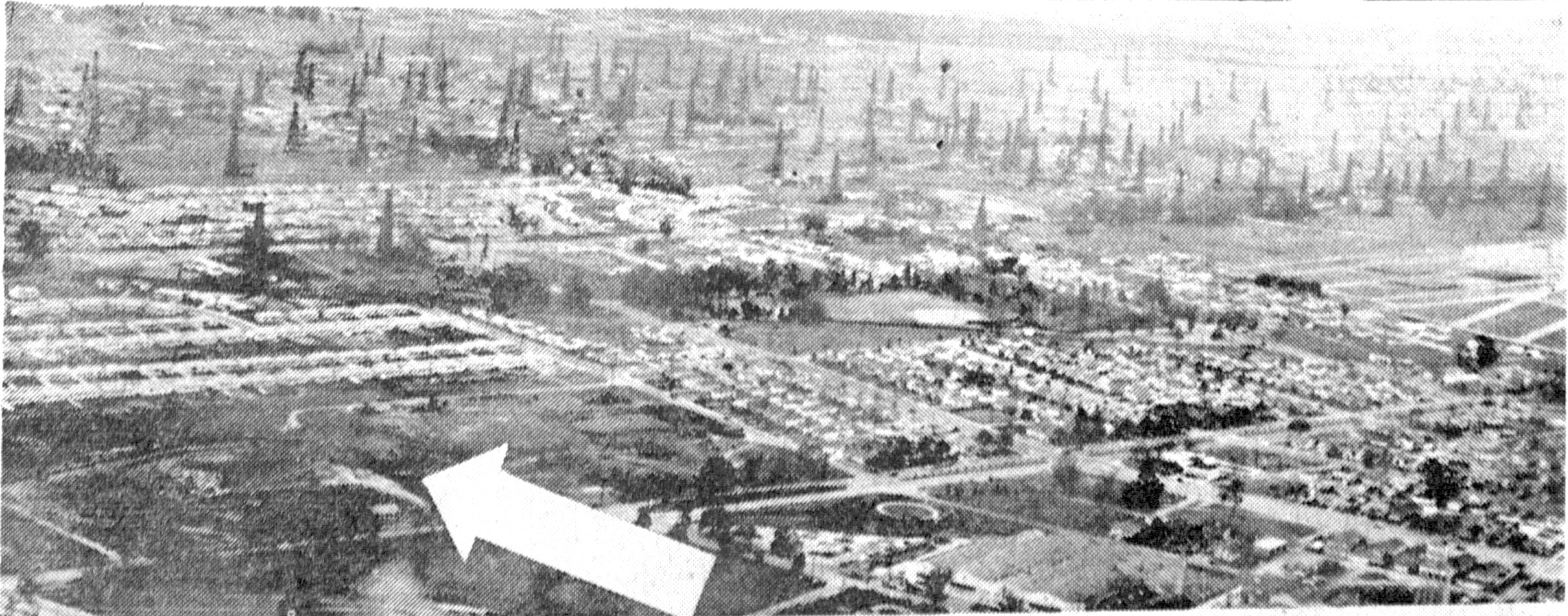
Arrow points to Plaza Del Amo dump’s proximity to new housing developments, including one on Border Ave., right of arrow. (Note the blanket of oil wells at rear.) Torrance Press, April 12, 1951, Page 1. (Credit: Torrance Historical Newspaper and Directories Archive database, Torrance Public Library)

Torrance city councilman Nick Drale heard the protests and was convinced that the dump needed to be closed. Between 1950 and early 1951, he filed a motion to do just that no less than five times. His fellow councilmen were unmoved and failed to act on the motion each time.

Enter The Press and its breathless coverage of the dump story, which began in earnest in early 1951. There may not have been quite the massive invasion of pestilence that some residents claimed, but there’s little doubt that the dump was a danger on many levels to nearby homeowners and their children.

Torrance Press, May 3, 1951, Page 1. (Credit: Torrance Historical Newspaper and Directories Archive database, Torrance Public Library)

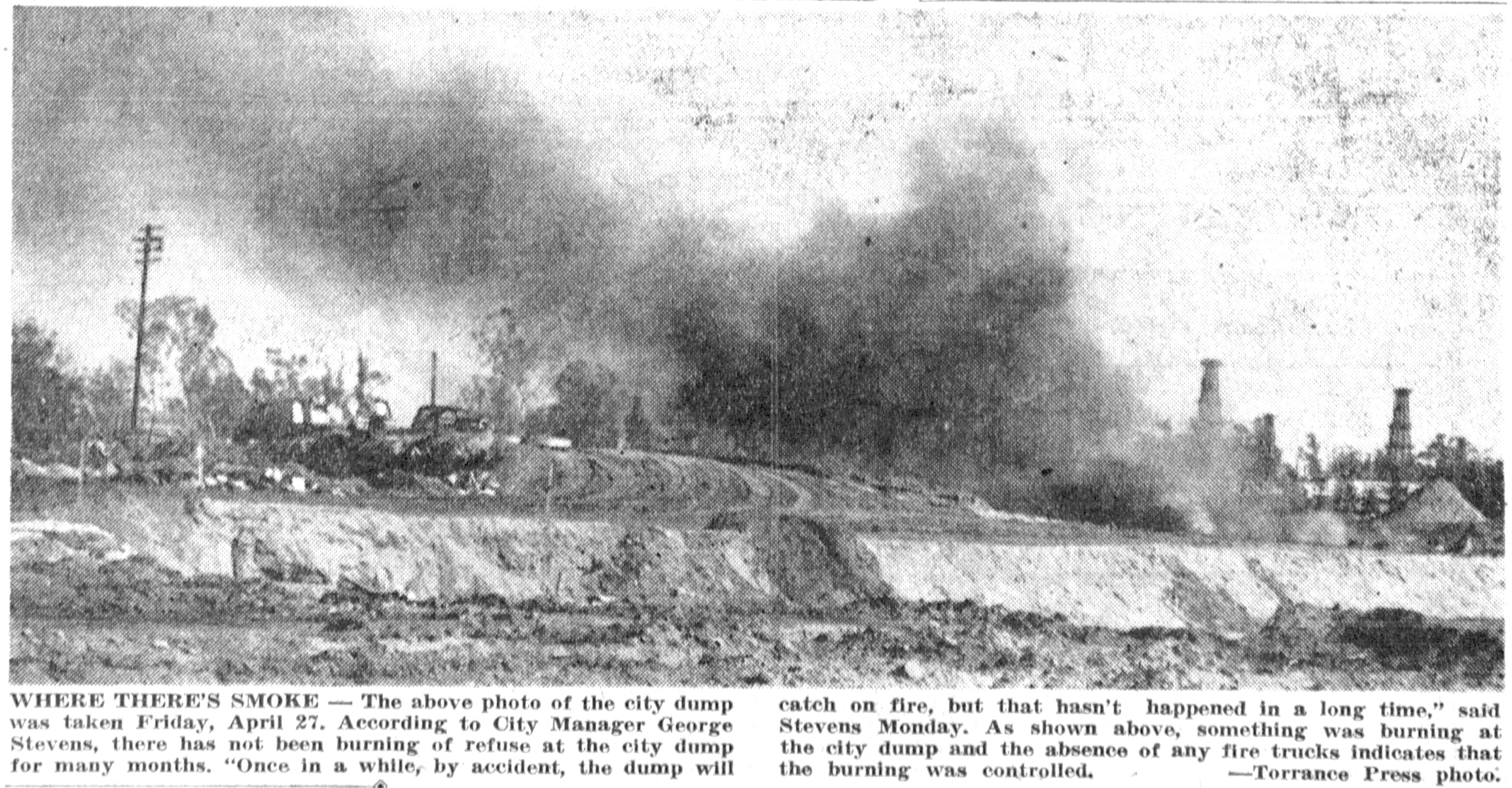
In addition to unwanted insects and rodents, the dump frequently caught on fire. In some cases, city firefighters had to battle the sometimes spontaneously-generated blazes for hours. Some residents in the area made unverified claims that the city still was conducting controlled burns there in violation of the court order.

After a year or so of often rancorous debate, the City Council finally acted, perhaps noticing that Drale recently had won re-election to his seat with the highest vote total in city history. In May  1952, it voted to acquire a new 15-acre dump site on Madrona Ave. just north of Torrance Blvd. for $45,000.

The Plaza del Amo dump site was closed, and the new dump opened for business in August 1952. It would only be used until it filled up, an estimated eight years. The plan, which later came to fruition, was to convert the site into the city maintenance yard that eventually would become part of the city’s civic center complex.

Torrance Press, May 12, 1960, Page B-6. (Credit: Torrance Historical Newspaper and Directories Archive database, Torrance Public Library)

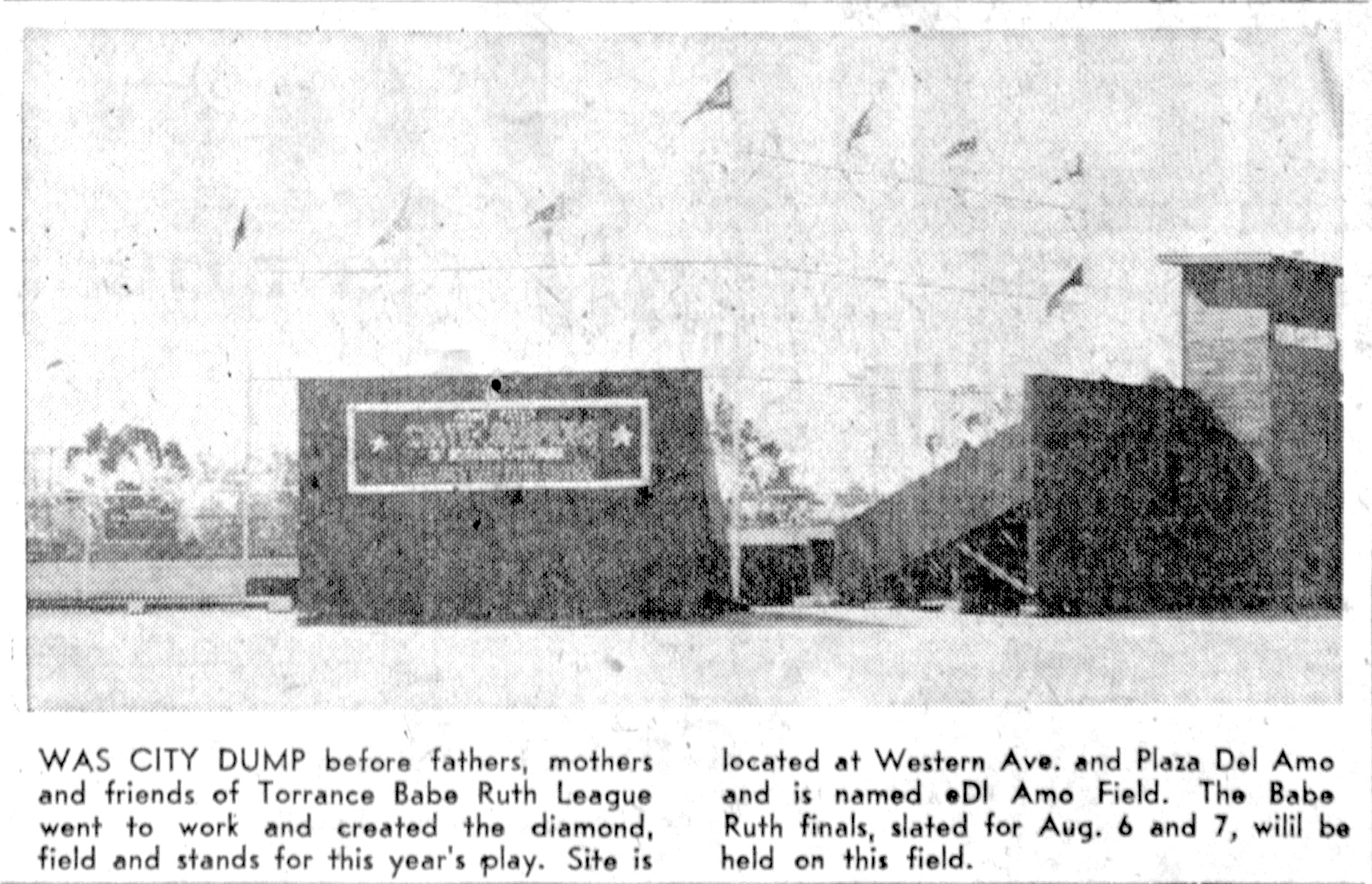
Plans to convert the old Plaza del Amo site into a recreation area were floated at the time of its closure. Discussions over the idea continued for several years, until the city’s Babe Ruth youth baseball league finally was granted use of the land. Its volunteers built Del Amo Field on the site in time for the opening of the 1960 youth baseball season.

Eventually, the unstable land beneath the field began to settle unevenly, and the field became unusable a decade or so later. 

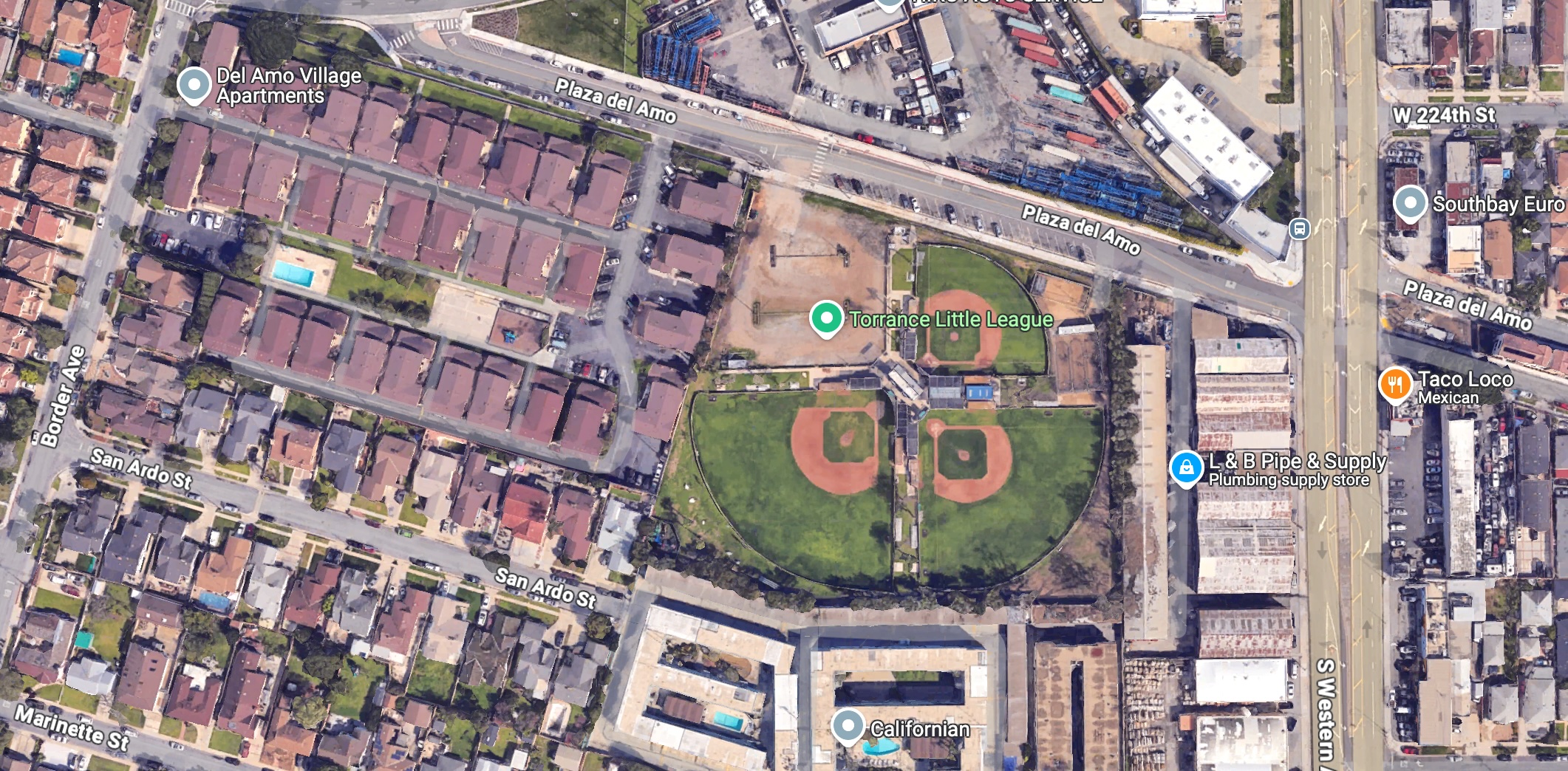
Years after youth baseball had abandoned it, a dedicated group of parents led a movement to repair, refashion and rebuild the facility. On March 15, 1997, the all-new Central Torrance Little League kicked off its first season at the remade facility, and occupies it to this day.

Back across town, the Madrona city dump continued to operate, and gradually fill up, during the 1950s. Its proximity to the city’s sparkling new civic center complex, which opened in 1956, was aesthetically displeasing to some, but it was always just a use-it-til-it-fills-up temporary solution.

Madrona Ave. city dump, Torrance Press, July 12, 1956, Page 2. (Credit: Torrance Historical Newspaper and Directories Archive database, Torrance Public Library)

By 1958, that time was coming quickly. On July 1, the Madrona dump was closed to individual citizens. It soon closed down completely, and the Torrance City Yard moved into its new headquarters on the site shortly thereafter.

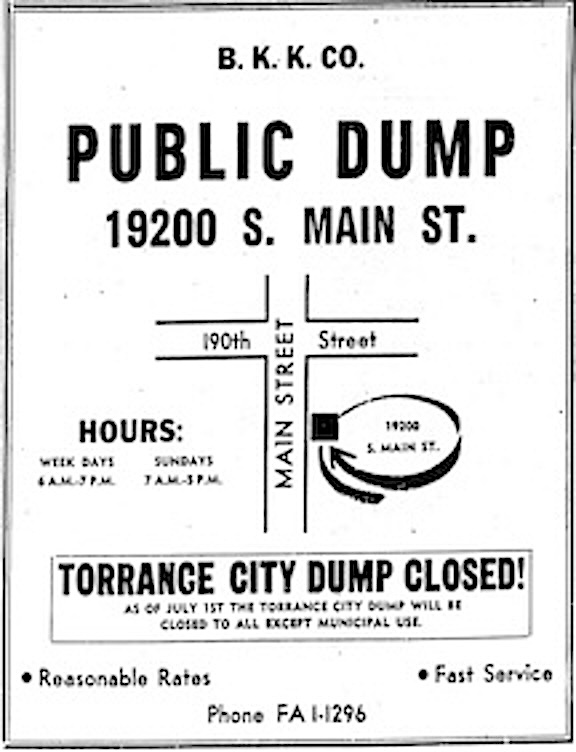
With its in-city options used up, the city moved toward using larger regional landfills. Some of these included the BKK landfill in Carson (now home of Victoria Golf Course), which operated from 1948-1959, the Cal Compact landfill, also in Carson, which operated from 1959-1965, and the Palos Verdes Landfill in Rancho Palos Verdes, which operated from 1957 until 1980.

The city of Torrance began updating and enlarging its fleet of garbage collection trucks. The increased costs caused the now dump-less city to begin charging residents a $1 monthly fee for the first time in 1959. Up until then, the use of city dumps and the garbage collection service had been free.

The city now has a large recycling program, and continues to transport its non-recyclable trash to a number of regional landfills.

The Central Torrance Little League fields, center, now occupy part of what once was the City Dump. Border Ave. is at far left. 2024 image. (Credit: Google Earth)

Sources:

City of Torrance website.

Daily Breeze archives.

Torrance Press Herald archives.
BKK landfill ad tries to lure Torrance residents to its Carson location. Torrance Herald, June 5, 1958, Page 19. (Credit: Torrance Historical Newspaper and Directories Archive database, Torrance Public Library)

Lisa Leslie’s status as a generational basketball talent became clear at Morningside High

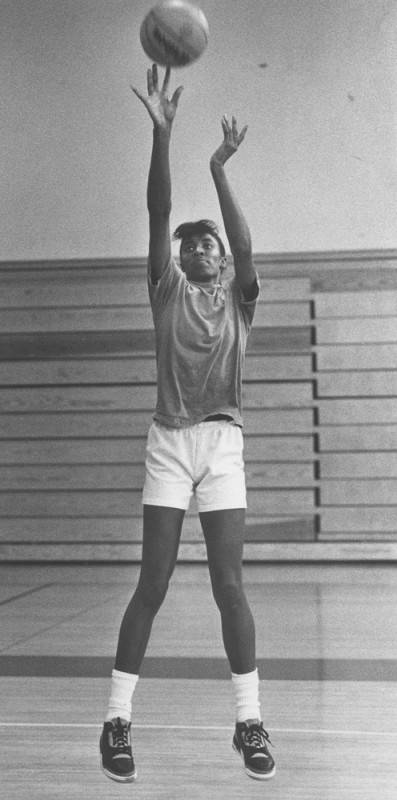
Lisa Leslie poses in the Morningside High gym. Undated, circa 1990. (Credit: 247 Live Culture website)

On Feb. 8, 1990, Morningside High center Lisa Leslie scored 101 points in a prep basketball game against South High of Torrance. In the first half.

The 6-foot-5 senior’s attempt to break the record of 105 points in a game, set by Cheryl Miller of Riverside Poly High in 1982, no doubt would have succeeded had South coach Gilbert Ramirez not forfeited the game by pulling his team off the court after halftime.

Lisa Leslie practices in the Morningside High gym on Jan. 5, 1989.
(Credit: Los Angeles Public Library Photo Collection)

Leslie was born in Gardena on July 7, 1972. Her mother, Christine, was four months pregnant with her when her father abandoned the family. Christine later moved Lisa and her two sisters to Compton, where she learned how to become a long-haul truck driver and started her own trucking company. Eventually, she got a trucking route that allowed the family to move to Inglewood.

Lisa had grown to six feet tall by the age of 12. Though most assumed she must be a basketball player, she didn’t take up the game until junior high school. She joined a boys club team in eighth grade. At first her teammates wouldn’t pass her the ball. They changed their minds after she stole a pass and immediately scored.

Leslie began to draw serious attention from college scouts and coaches after playing in the Olympic Girls’ Development League. Before she had even enrolled at Morningside High in Inglewood in 1986, she’d received recruiting letters from more than 100 colleges. (Future Lakers great Byron Scott graduated from Morningside in 1979.)

Her impact on the already successful Morningside basketball program was immediate. As a freshman, she started every game and was named California Freshman of the Year in girls basketball.

The following season, she led her team to the state championship game. The Monarchs lost to Fremont High by one point, with Leslie missing a potential winning shot as time ran out. Two years later, Morningside beat Fremont for the state title, one of two won during Leslie’s tenure.

The second title came the following year when Leslie was a senior. She continued to pile up awards, including the Naismith Girls Player of the Year Award, given to the nation’s top high school basketball performer.

Lisa Leslie displays her four gold medals and numerous other awards. Undated, post-2008. (Credit: Legends of Sport blog)

After receiving literally hundreds of college scholarship offers, Leslie chose USC. The Trojans women’s basketball team was 89-31 during her four years at the school. Though the team never won a national championship, it did make the NCAA Tournament all four years.

While at USC, Leslie became a three-time All-American selection, and the first female player to make the all-conference first team for four consecutive years. She also set Pac-10 records for scoring, rebounding and blocked shots, all while also earning her bachelor’s degree in communications.

The Women’s National Basketball Association would have been her next logical step after her 1994 graduation from USC. One problem: the league didn’t form until 1996, and wouldn’t begin play until 1997. She decided to sign with an Italian team in the European pro women’s basketball league for the 1994-95 season.

1996 brought an achievement that Leslie described as one of her proudest achievements in the sport: leading the U.S. women’s national team to a gold medal at the 1996 Summer Olympics in Atlanta. She would go on to win an additional three Olympic gold medals.

Lisa Leslie led the USA women’s basketball team to victory at the 1996 Summer Olympics. (Credit: Lisa Leslie Facebook page)

That first Olympics win increased her celebrity visibility greatly. Rather than return to Italy, she began a career in modeling, working with major fashion houses such as Armani and Anne Klein.

When the NBA began establishing its WNBA offshoot in 1996, Leslie was one of the first players to sign on, along with Sheryl Swoopes, Tina Thompson, Cheryl Cooper and Rebecca Lobo.

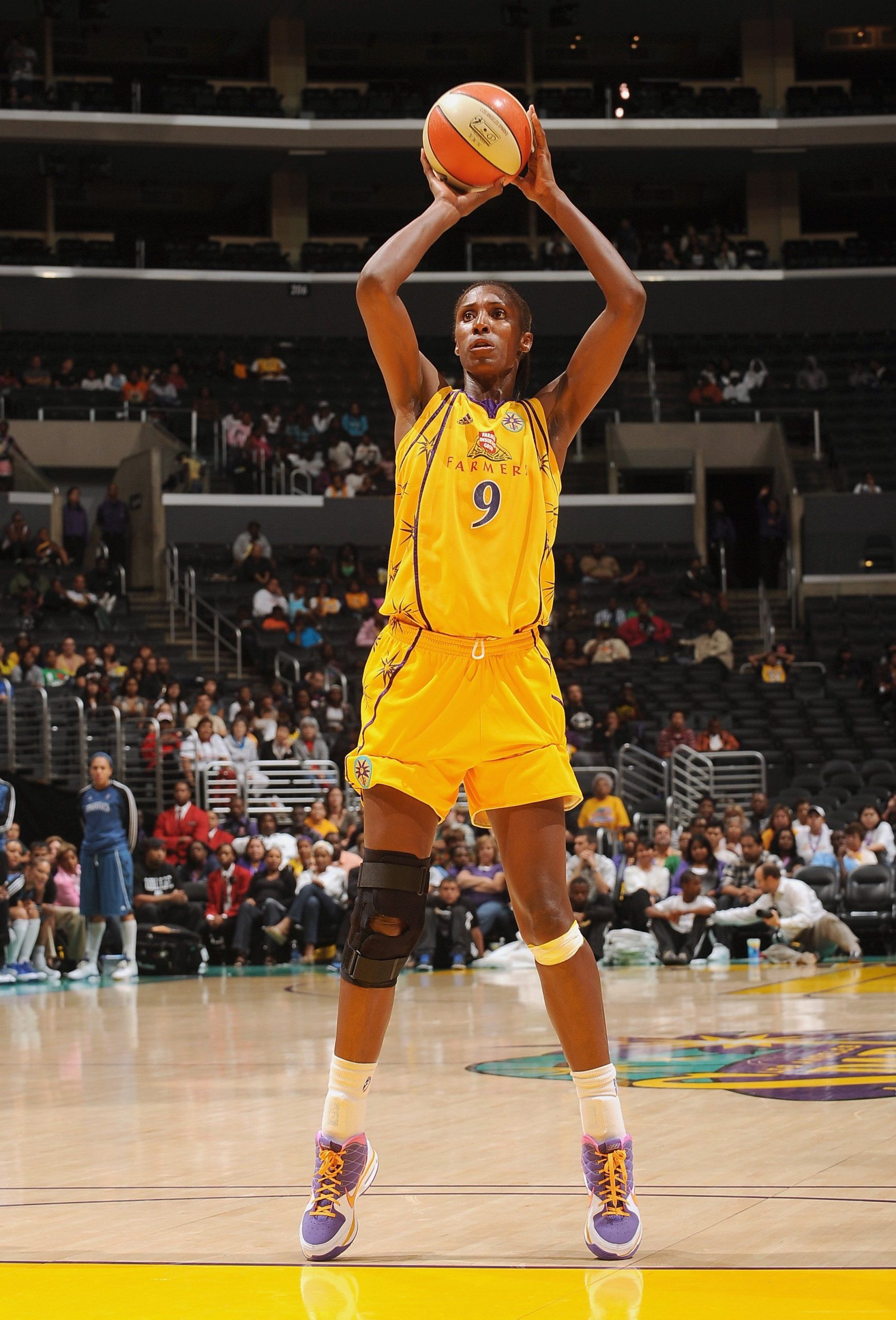
Lisa Leslie at the free throw line for the Sparks. Undated. (Credit: Antigua Observer website)

She played her entire WNBA career for her hometown Los Angeles Sparks. Another former Lakers great, Michael Cooper, coached the Sparks from 1999-2004 and 2007-2009.

Leslie’s career lasted for 12 years, from 1997 to 2009. The Sparks won WNBA championships in 2001 and 2002.

As for Leslie, she was named to the WNBA All-Star team seven times and won the league’s Most Valuable Player award three times.

On July 30, 2002, during a loss to the Miami Sol, Leslie caught a pass from Latasha Byears, took a couple of steps, then made history by becoming the first player in WNBA history to dunk a basketball.

She announced her impending retirement from the WNBA before the 2009 season, and the team honored her during its final regular season game that September. She retired with league-leading career totals in points scored, rebounds and highest total of points, rebounds and assists per game (PRA). She was inducted into the Naismith Basketball Hall of Fame in 2015.

Since leaving the sport, Leslie has worked as a model, actress, and occasional television sports commentator. She married pilot Michael Lockwood in 2005 and has two children. In 2022, she launched Aston Rose, a sports-oriented real estate firm in Boca Raton, Florida, where she now lives. She also has coached the Triplets team in the Big3 three-on-three pro basketball league.

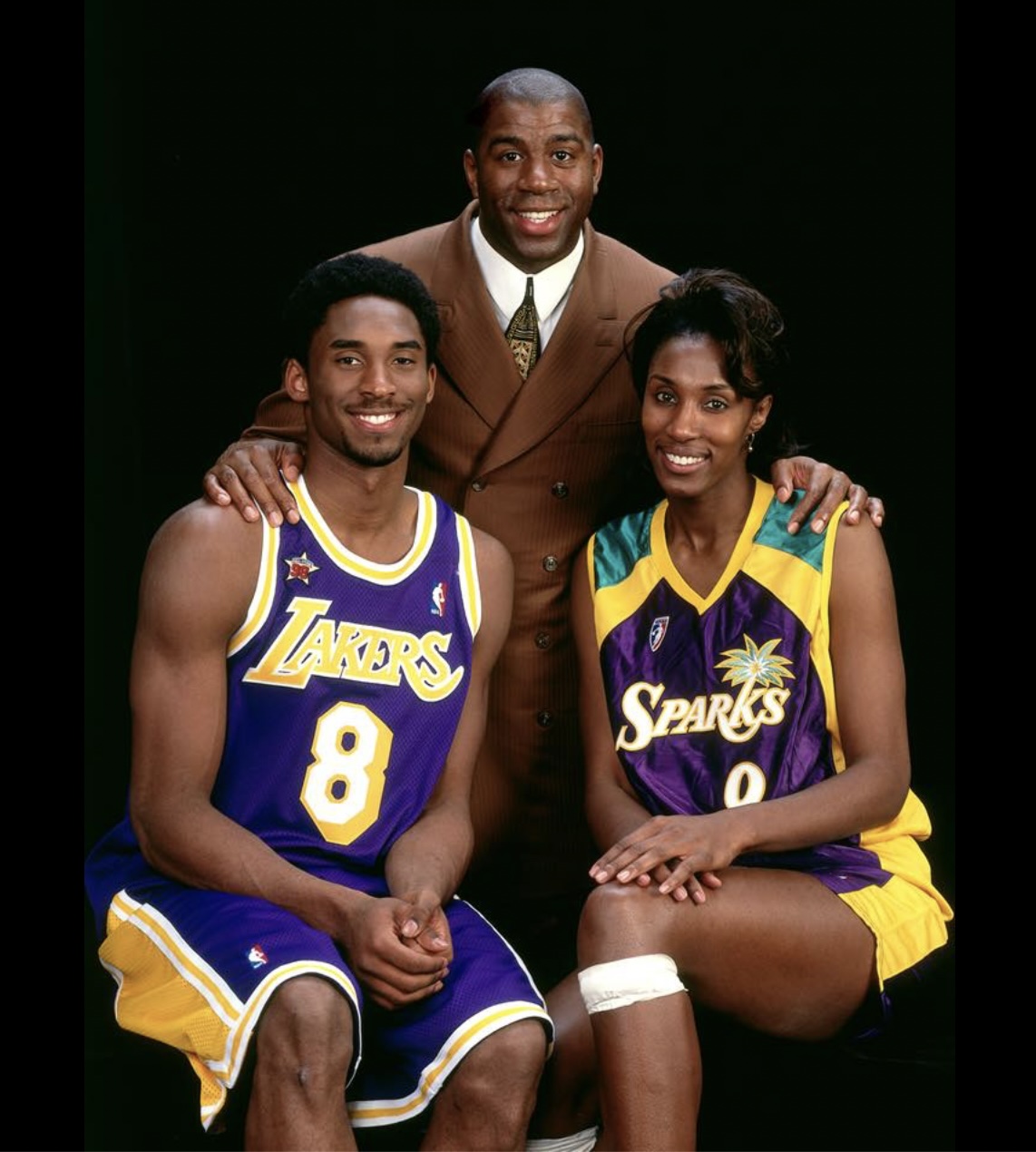
There’s still talk of putting a statue of Leslie alongside those outside the Crypto.com Arena (formerly Staples Center) in downtown Los Angeles. She would be the first woman accorded that honor. But, despite encouragement from Magic Johnson, it hasn’t happened yet.

Three Los Angeles hoops superstars, Magic Johnson (top), Kobe Bryant and Lisa Leslie. Undated. (Credit: Los Angeles Sparks Facebook page)

Sources:

Daily Breeze archives.

“Lisa Leslie,” by Mariana Brandman, National Women’s History Museum website, 2022.

“No. 9: Lisa Leslie,” by Tom Hoffarth, Tom Hoffarth’s The Drill: More Farther Off the Wall blog, July 15, 2024.

Wikipedia.

Lisa Leslie in 2022. (Credit: Lisa Leslie Facebook page)

The 1910 Los Angeles International Air Meet at Dominguez Hill put aviation in the spotlight

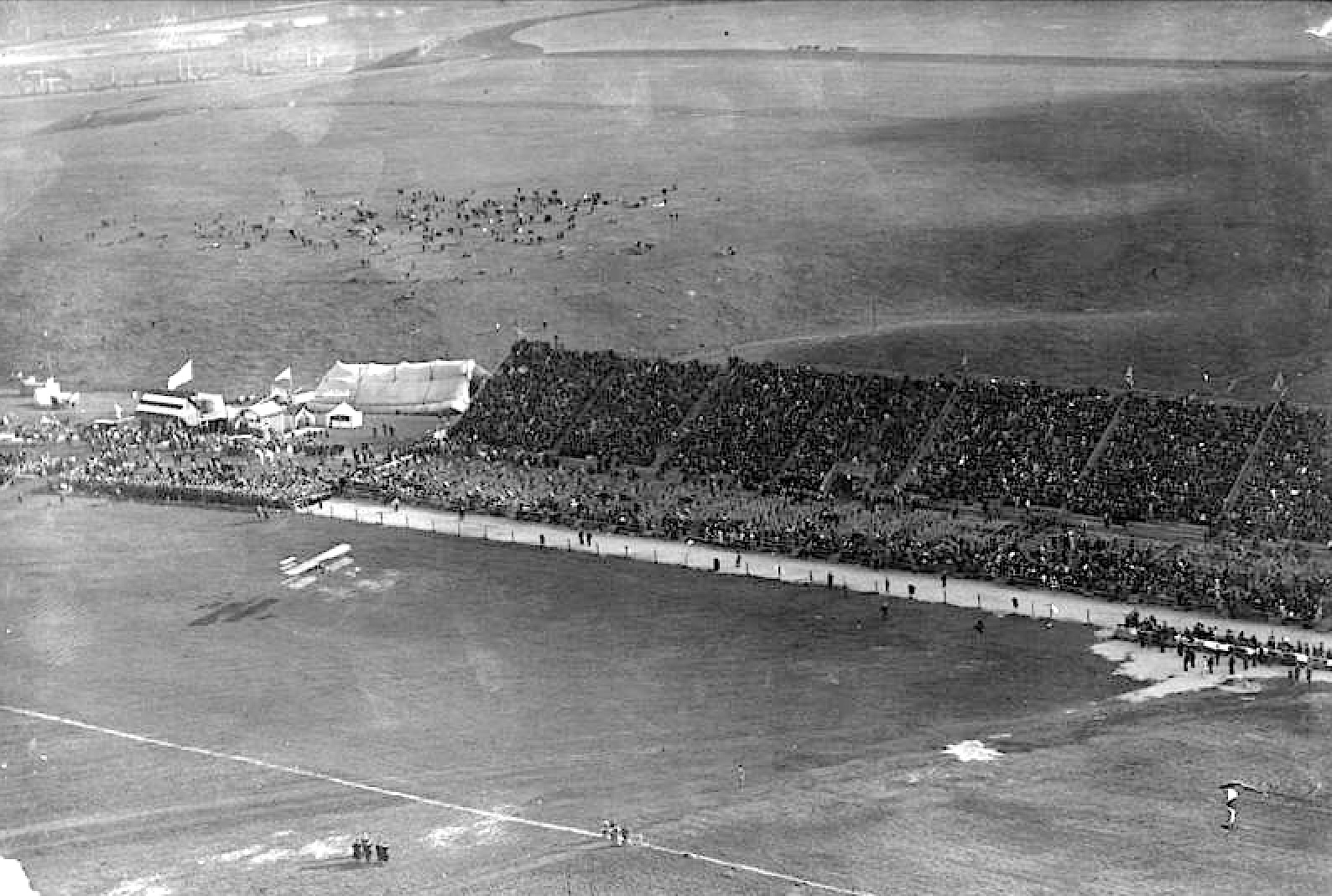
Thousands watch a biplane in low flight over Dominguez Field during the 1910 Los Angeles International Air Meet. (Credit: Los Angeles Public Library Photo Collection)

What if I were to tell you that a French pilot had flown an airplane from a dusty hillside on the outskirts of Carson to the Santa Anita racetrack in Arcadia and back, safely?

I’m guessing you’d be underwhelmed by the 45-mile trip, but tens of thousands of spectators gathered on Dominguez Hill just east of present-day California State University at Dominguez Hills couldn’t believe their eyes when French aviator Louis Poulhan pulled it off in 1910.

(Credit: Wikimedia Commons)

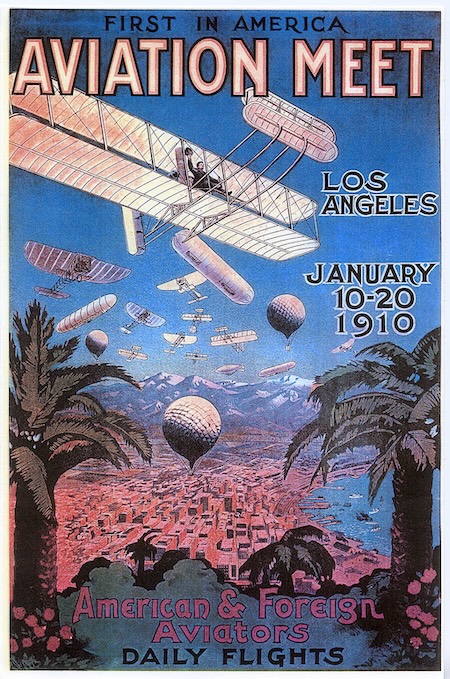
The occasion: the Los Angeles International Air Meet, the first event of its kind held in the United States. Prescient aviators Charles F. Willard and Ray Knabenshue got the inspiration to stage the meet from the first-ever International Air Meet held in Rheims, France in 1909.

That meet had caused a sensation. Remember, it took place just six years after the Wright Brothers’ successful first flight in Kitty Hawk, North Carolina in 1903.

It turns out that Orville and Wilbur had become very protective of their achievement. They did not participate in the air fairs and other public flying exhibitions of the era, and filed lawsuits against some who did. Essentially, they believed that they owned the rights to aviation technology. They would soon find out differently, though their patent lawsuit against aircraft builder Glenn Curtiss wouldn’t be settled until after the outbreak of World War I. 

Paulhan’s achievements during the Rheims meet, though ridiculously modest by modern standards, brought him great acclaim. The feats of American engineer and flier Curtiss (of Curtiss Jenny airplane fame) were more surprising and impressive to the French.

The perceived rivalry between the two drew huge crowds to Rheims, and Willard and Knabenshue convinced the pair, along with other pioneering aviators, that even greater crowds would pay to see a similar event in America. As in Rheims, cash prizes would be offered to the aviators who flew the longest, highest and fastest.

The organizers settled on Los Angeles as its location. They were aiming toward holding the fair in January 1910, and felt the area’s mild wintertime weather would be ideal.

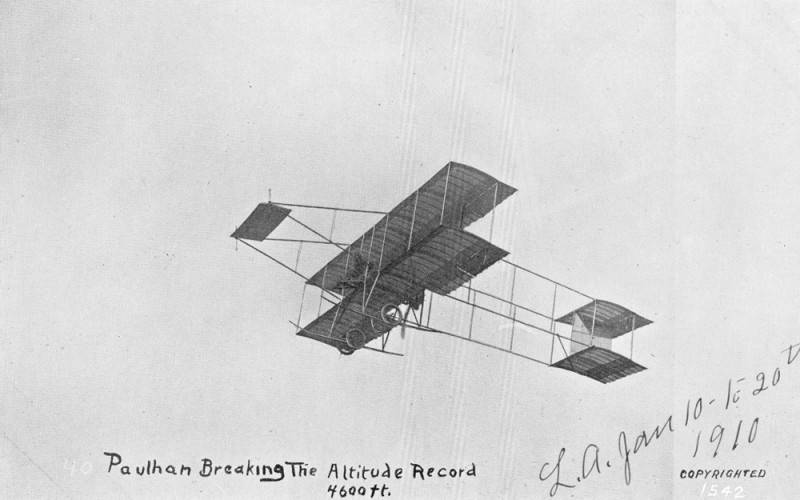
Postcard of Louis Paulhan breaking the altitude record of 4600 ft.in his biplane during the 1910 Air Meet. (Credit: Los Angeles Public Library Photo Collection)

Together with local promoter Dick Ferris, they scouted the area and chose Dominguez Hill as their venue location. Its mild elevation was sufficient enough to make viewing by freeloaders difficult, the connecting road to it was lightly traveled, and, crucially, the makeshift airfield was walking distance from a train depot serving both Pacific Electric Railway and Southern Pacific trains.

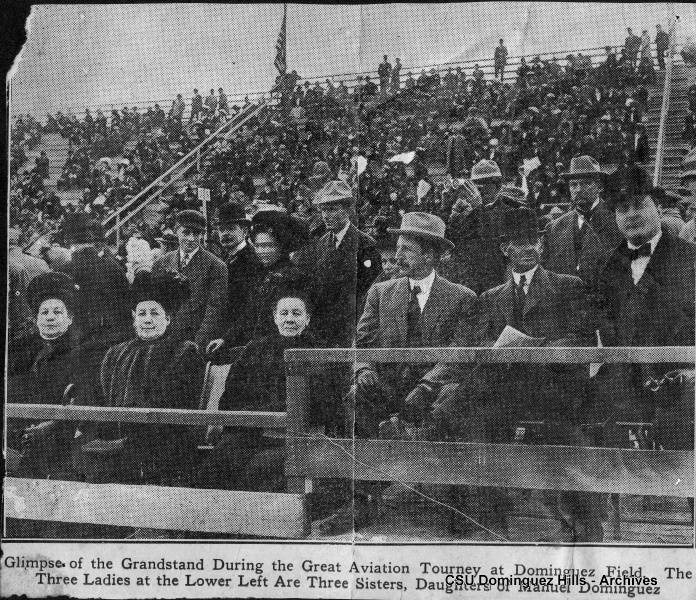
Ferris also arranged for the Los Angeles Examiner newspaper to co-sponsor and publicize the event before and during its 11-day run, from Jan. 10 through Jan. 20, 1910. The organizers also convinced the owners of the Rancho San Pedro land, the Dominguez sisters, to allow them to use their land for free. (The five sisters did receive free front row seats for the entire event.)

Daily admission to the Air Meet was 50 cents, and vehicle parking cost $1.00. Concessions stands and other amenities – including a few carnival-type sideshow tents – were in place on the meet’s first day, Jan. 10. An estimated 20,000 people filled the stands and grounds before the first aircraft took off.

A large grandstand had been built to accommodate the throngs of attendees, along with a group of tents to house airplanes, hot air balloons, dirigibles and other aircraft. The latter two groups of aircraft were more established in the public’s mind, and less of a novelty than the airplanes.

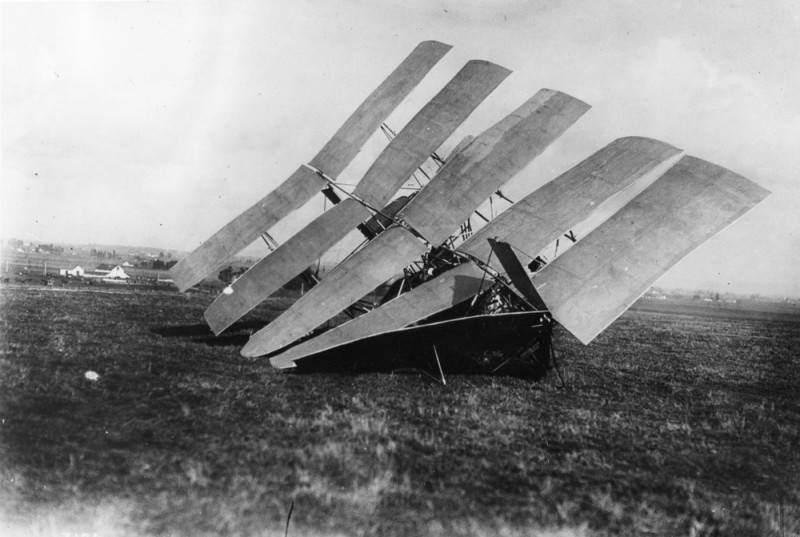
Dr. J.S. Zerbe’s multi-winged plane crashed before takeoff on Jan. 11, 1910. Zerbe was uninjured. (Credit: Los Angeles Public Library Photo Collection)

The novelty of engine-powered aviation was still fresh: few people had seen such aircraft in action, and many in the assembled crowd were skeptical that the contraptions could even get off the ground. (Some didn’t. Dr. J.S. Zerbe’s five-winged flying machine crashed before it could take off on Jan. 11. He wasn’t hurt.)

But Paulhan and Curtiss had little trouble getting their planes airborne. Paulhan’s exploits dominated the meet. 

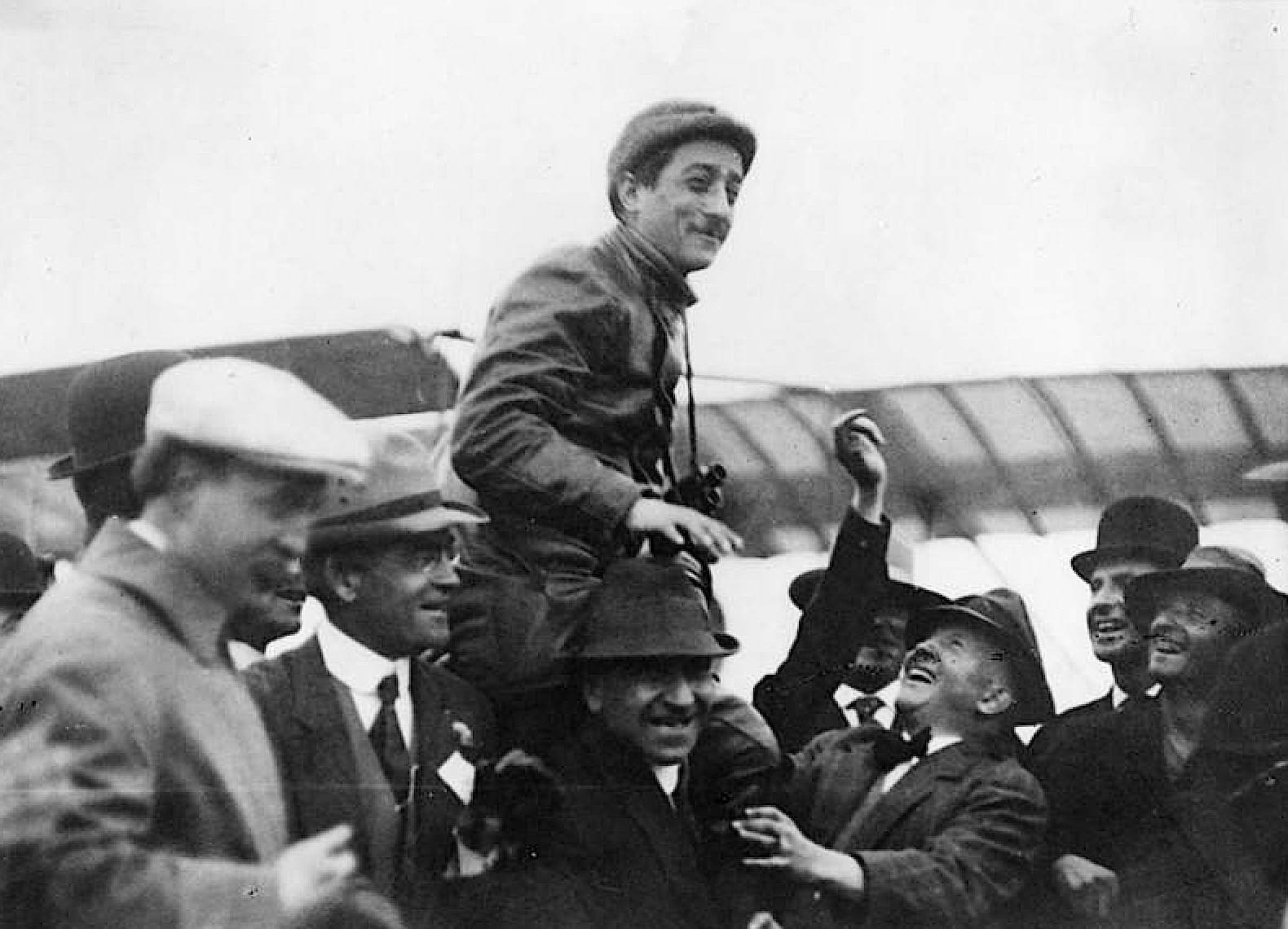
In addition to his Arcadia flight, Paulhan set a flight endurance record of one hour, 49 minutes when he took himself and a passenger, his wife Celeste, to Redondo Beach and back. He later squired another famous passenger skyward when he gave newspaper publishing baron William Randolph Hearst his first airplane ride. Paulhan later set a new airplane altitude record of 4,612 feet. 

French aviator Louis Paulhan is celebrated upon his return from setting the new world’s distance flight record during the 1910 Air Meet. (Credit: Los Angeles Public Library Photo Collection)

He took most of the prize money, but Curtiss had more than his share of enthusiastic followers.

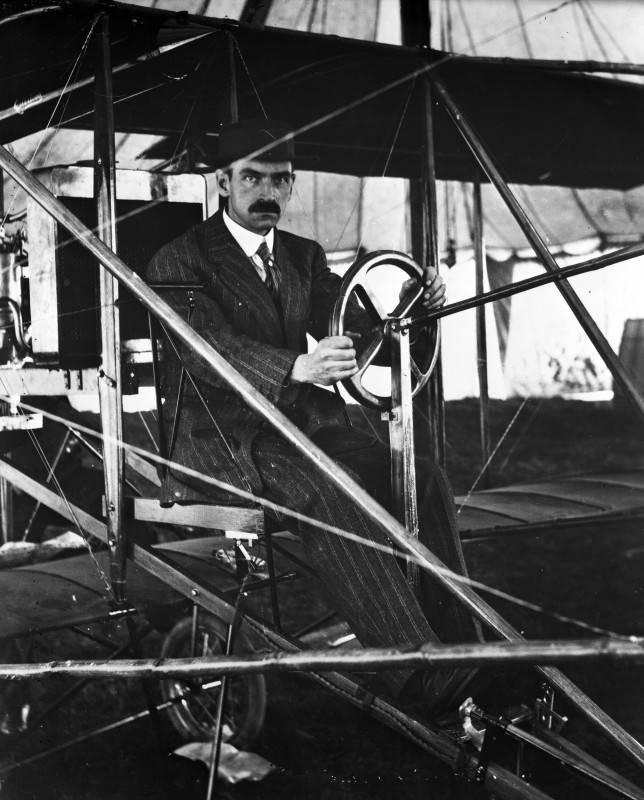
He won prizes for the best quick start and for the highest air speed, 55 mph. He also became the first person to fly a powered airplane in the western U.S. when he piloted his Curtiss biplane during the Air Meet’s first flight, an opening day jaunt lasting just under 90 seconds.

Aviator Glenn Curtiss in the pilot’s seat at the 1910 Los Angeles International Air Meet. (Credit: Los Angeles Public Library Photo Collection)

Organizers were vindicated when the weather held up. Though it rained on two days of the meet, neither downpour lasted long enough to cause cancellation of the events.

The event was a commercial success for its organizers. An estimated 254,000 tickets were sold for the entire Air Meet, with an average daily attendance of over 20,000 spectators, and the venture finished in the black. Organizers signed a five-year deal to hold an additional fairs there, but only two more were staged, one from Dec. 24, 1910 to Jan. 3, 1911 and another in 1912.

The ripple effect from the 1910 Air Meet was strong and immediate. Aviation’s coming of age  made a huge impression on inventors, engineers and entrepreneurs, many of whom would go on to build the foundation for what would become a monolithic industry. Some of them included Curtiss, Glenn Martin, Donald Douglas, the Lockheed brothers and Jack Northrop.

In addition to a plaque denoting the area’s status as a California Historical Landmark being placed on Wilmington Ave. near Artesia Blvd. in 1959, three neighboring Carson streets in the Dominguez Hills area have been named for 1910 Air Meet aviators: Glenn Curtis Street, Beachey Place and Charles Willard Street. Glenn Curtiss Middle School in Carson also was named for the aviator.

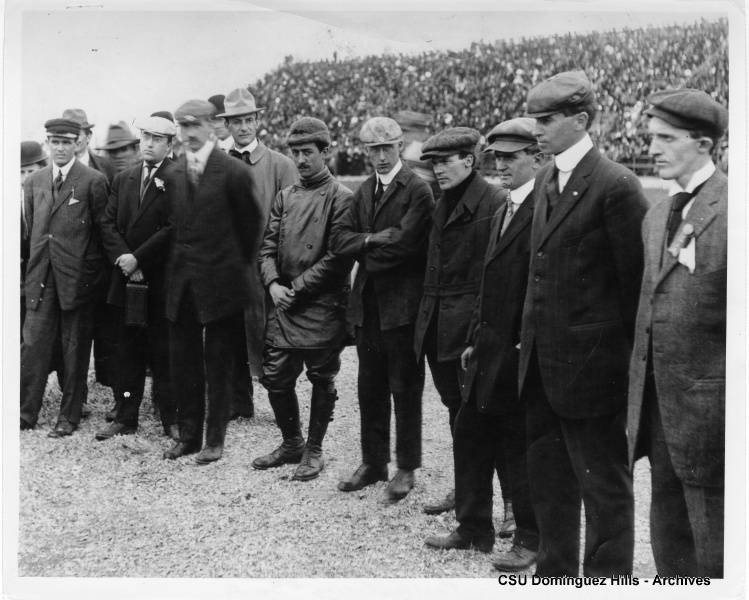
Aviators at the 1910 Air Meet included, front row from left: Hillery Beachey, Col. Frank Johnson, Glenn Curtiss, Louis Paulhan, Charles Willard, Didier Masson, Lincoln Beachey, Roy Knabenshue, Charles Hamilton. (Credit: CSUDH Digital Archives)

Sources:

Daily Breeze archives.

Dominguez Air Meet, by David D. Hatfield, Northrop University Press, 1976.

Los Angeles Herald archives.
The 1910 Los Angeles International Air Meet, by Kenneth E. Pauley and the Dominguez Rancho Adobe Museum, Images of Aviation series, Arcadia Publishing, 2009.
Wikipedia.

Three of the Dominguez sisters, left, in the grandstand at the 1910 Los Angeles International Air Meet. From left, Victoria Carson, Dolores Watson, and Guadalupe Dominguez. (Credit: Los Angeles Public Library Photo Collection)

Is this your new site? Log in to activate admin features and dismiss this message
Log In