Lions Drag Strip in Wilmington raced through its eventful 17-year run

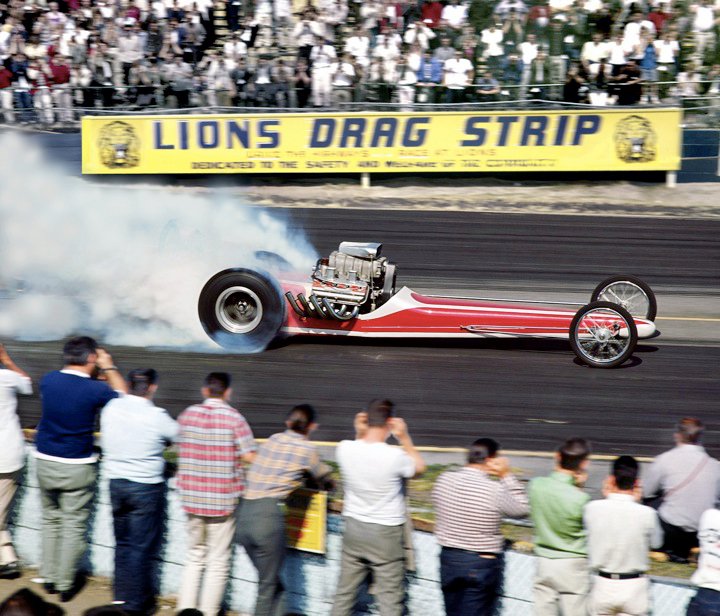
Fans watch a drag race at Lions Drag Strip. Undated photo circa 1960s. (Credit: Friends of Lions Drag Strip Facebook page)

The streets of suburban southwest Los Angeles County in the years following the end of World War II posed an increasing danger to all who used them, according to accident statistics cited in press reports from the era.

The area’s vehicle traffic infrastructure was incomplete and crude at best in the days before freeways and traffic-controlled surface streets and highways. This came at a time when the exponential growth and residential development of areas outside of central Los Angeles was causing an increased reliance on automobiles. 

Factor in the growing sophistication of automobile technology that allowed for speedier and more powerful cars, and the interest in seeing whose machine could go the fastest seems almost inevitable in hindsight.

This desire to race fueled the rise of car clubs and hot rodding among teenagers in the postwar era. At first, illegal street racing, usually done at night, was the only way to test their automotive skills. As community leaders began to decry the corresponding rise in traffic accidents and fatalities, some began to listen to the street racers, who mostly just wanted a place where they could put their lovingly customized cars to the test.
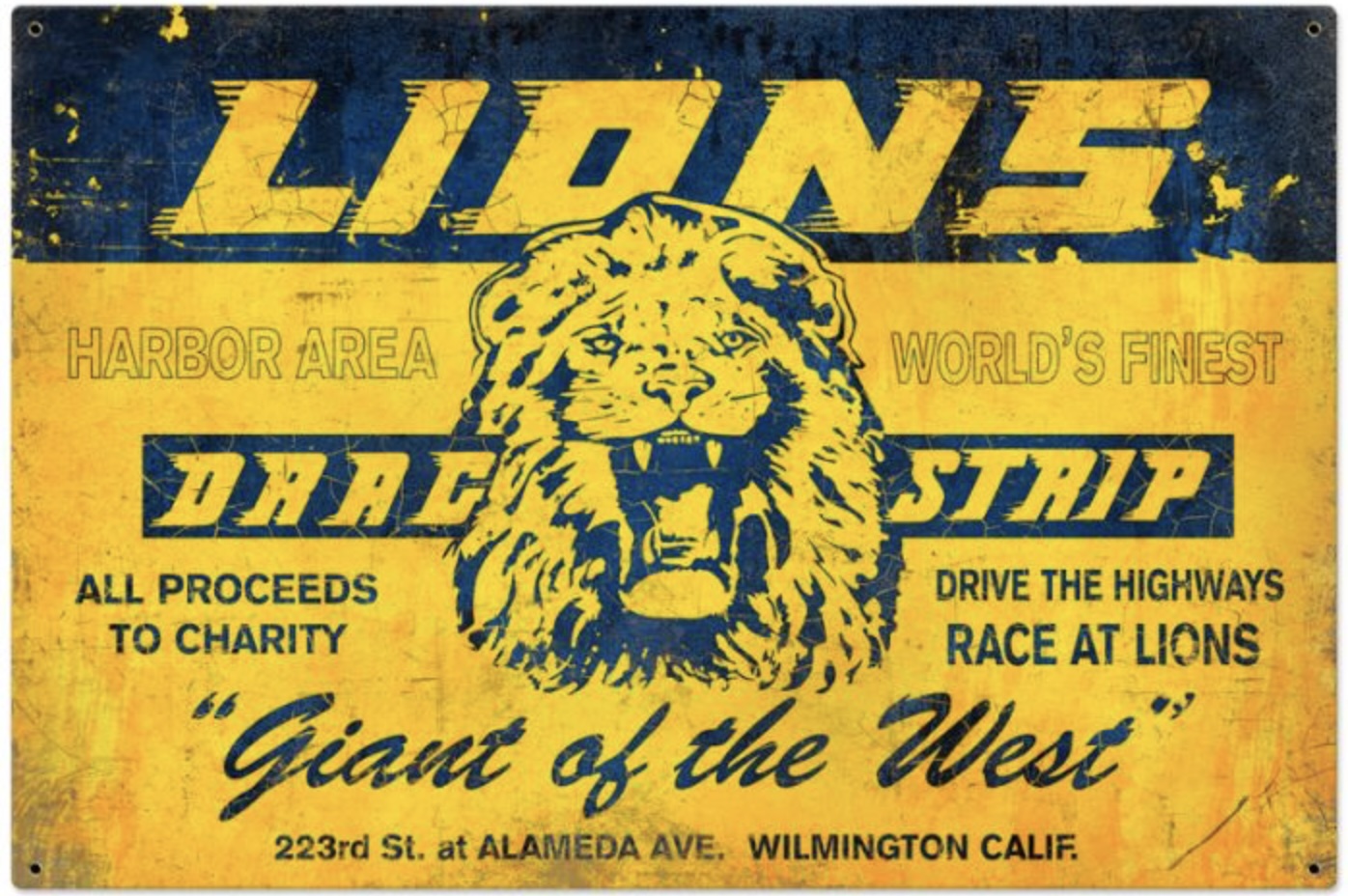
Vintage metal sign promoting Lions Drag Strip as the “Giant of the West.”

City officials, law enforcement and community organizations, worked together to create one of the first such facilities in Southern California, Pomona Raceway, which opened in 1950 at the Los Angeles County Fairgrounds.

In January 1954, the Lions Club of Wilmington, noting the proliferation of active area car clubs such as the Road Kings, Hoods, Scarabs, Pharaohs and Lords, publicly proposed the idea of establishing a similar drag strip in the Harbor Area.

Lions president John Chadwick held discussions with the YMCA, local chambers of commerce, and the leaders of the recently formed National Hot Rod Association (NHRA) with regard to organizing the effort, including financing and securing a location.
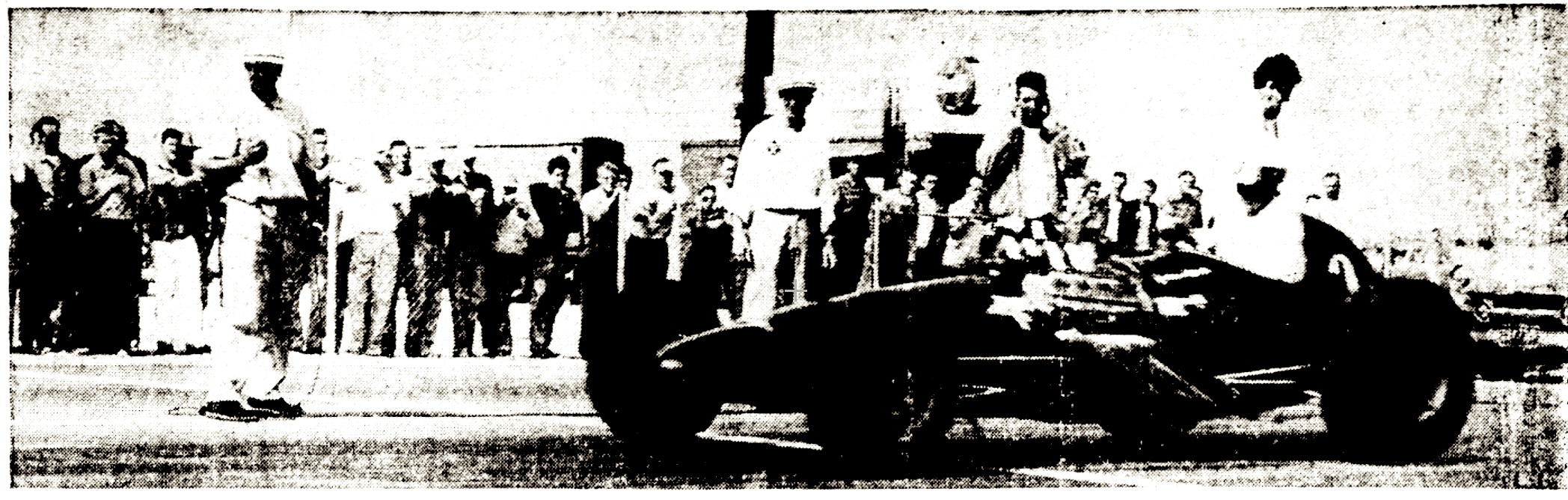
Bystanders protect ears from roar of Ed Losinski’s powerful engine as his racer lurches off the starting line on the opening day of Lions Drag Strip on Oct. 9, 1955. Wilmington Press Journal, Oct. 10, 1955, Page 5. (Credit: Wilmington Press Journal archives)

The first location proposed for the raceway was the Naval Air Station on Terminal Island, also known as Reeves Field. The U.S. Navy had commandeered the airfield for use during WWII, but was about to decommission it at the time. (Street racing advocate “Big Willie” Robinson later would fight for and eventually win the right to host street racing meets at the abandoned Reeves Field for a few years.

Unfortunately, the Lions’ Reeves Field proposal was nixed by the Harbor Commission. A new site was proposed, a mile-long 35 acre strip of land east of Alameda St. between Sepulveda Blvd. and 223rd St. The land had been part of the Harbor Department’s Railroad Classification Yard. 

Chadwick had formed a coalition with ten other area Lions Clubs, including those in San Pedro, Harbor City, Lomita, Torrance, Lakewood, and Long Beach. They pooled their resources by forming the Lions Associated Drag Strip (LADS) nonprofit group, which signed a lease deal for the Harbor Dept. land at 22660 Alameda St. in November 1954.
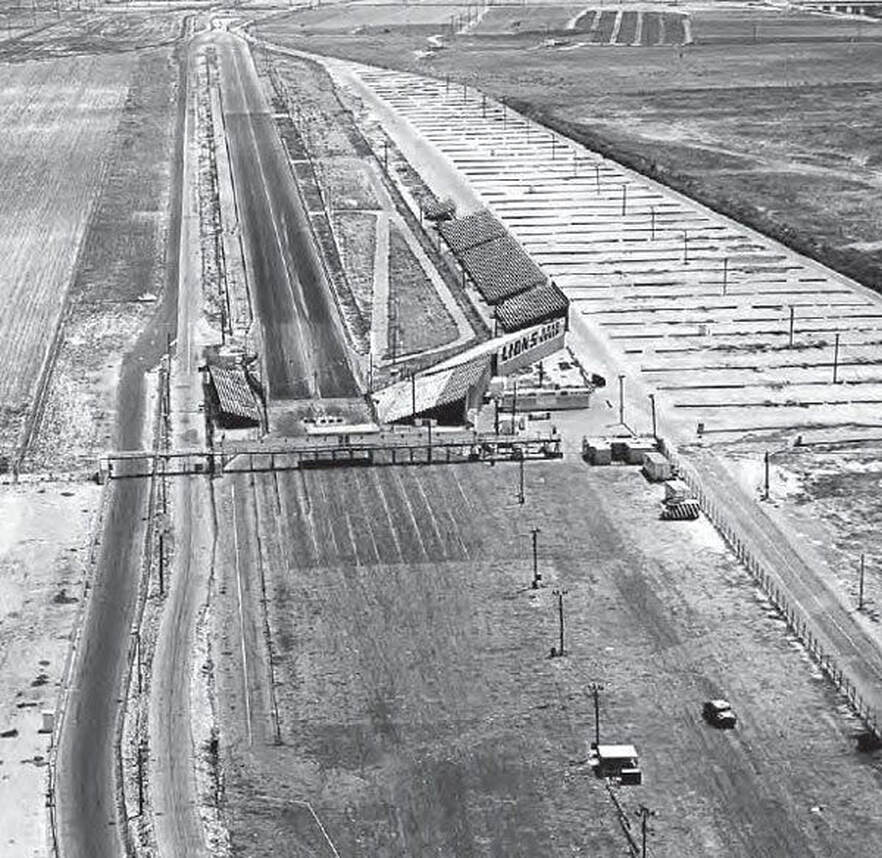
Aerial view of Lions Drag Strip circa 1966. Photo by Don Gillespie. (Credit: Speedway and Road Race History website)

LADS spent the early part of 1955 raising the required $45,000 among its various members to finance the construction of the 3,500-foot dragstrip. By August, the funds had been secured, and a groundbreaking ceremony was held on Aug. 18. Ansco Construction Co. was contracted to complete the building project.

Los Angeles Mayor Norris Paulson officiated at a Sept. 15, 1955 ribbon-cutting ceremony at the new raceway, along with Mickey Thompson, who had been named the track’s first manager. (Thompson’s story will be told in a future post.) The track’s final cost was put at about $50,000.

A week later, Chadwick announced that Lions Drag Strip would open at 9 am on Sunday, Oct. 9, 1955. In an aside, he also noted that a couple of racing enthusiasts recently had jumped the gun, sneaking onto the track at night and wrecking both of their cars on the unfinished strip. One of them struck a stray log  in the darkness which had yet to be positioned as a parking barrier.
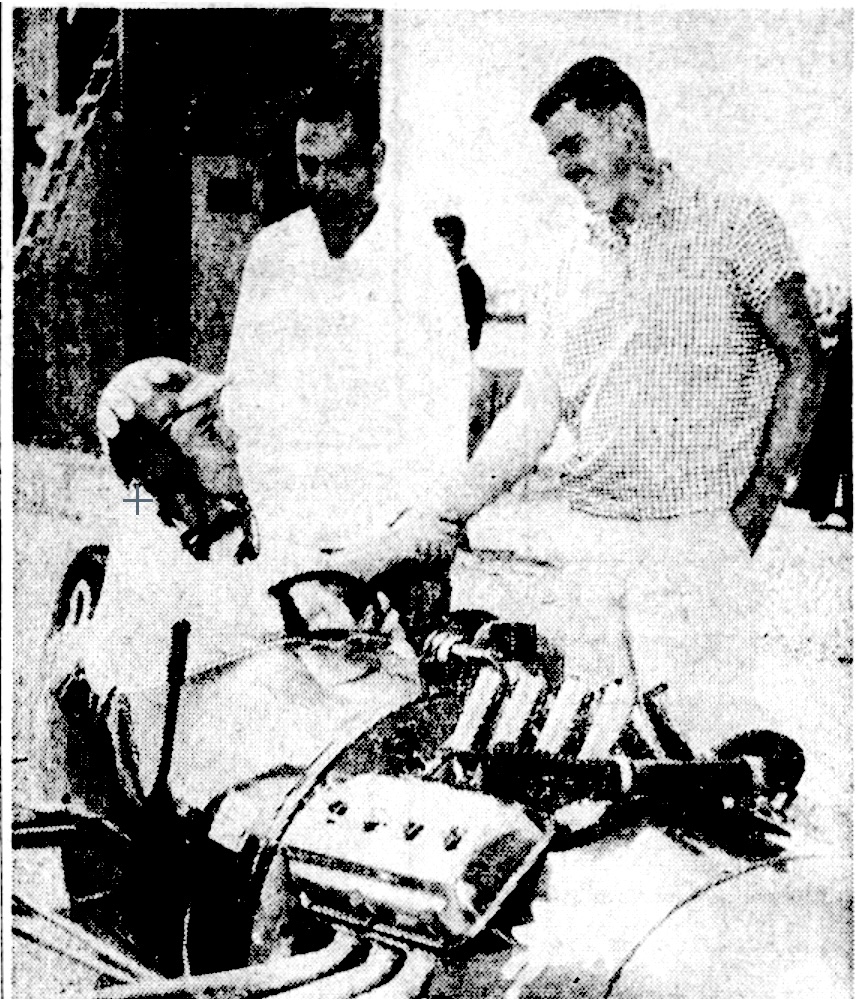
Lions Drag Strip manager Mickey Thompson, right, congratulates driver Ed Losinski on his opening day run as car owner Howard Duncan looks on.. Wilmington Press Journal, Oct. 10, 1955, Page 5. (Credit: Wilmington Press Journal archives)

Admission on opening day was 75 cents for adults, with children under 12 getting in free. Race participants were charged $1.25 to compete. Doors opened at 9 a.m., and racing continued all day until fog and darkness made further races too dangerous.

Even the drag racing track’s most enthusiastic supporters were stunned by the opening day crowds, estimated at 10,000 people. Lions was off to a flying start. Having seen the project through to completion, Chadwick resigned as LADS head in late October.
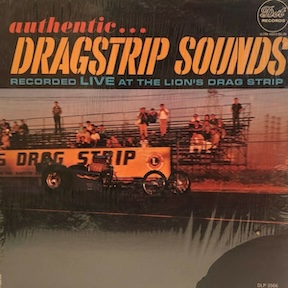
1964 record album on the Dot label features sounds recorded live at Lions Drag Strip.

Over the years, the cream of the NHRA’s drag racers competed at Lions: Gary Gabelich, Don “Big Daddy” Garlits, Tommy Ivo, Tom “The Mongoose” McEwen, Don “The Snake” Prudhomme, and a host of others. The rival American Hot Rod Association (AHRA), formed in 1956, also staged many races at Lions.

The big-name drivers and high-profile races helped bring in the money that kept Lions operating. An estimated $500,000 from the speedway’s proceeds was distributed to various charities during the years it was open.

But the big races also caused Lions to be a victim of its own success. As the vehicles became faster and more powerful, they became louder, causing more noise complaints from neighboring residents. Also, the increasing amount of big-name races made it harder for street racers to get time on the track.

These and other factors caused the Harbor Commission to cancel the lease for Lions Drag Strip, resulting in its closure on Dec. 2, 1972. Some 20,000 fans stormed the gates on its final day.
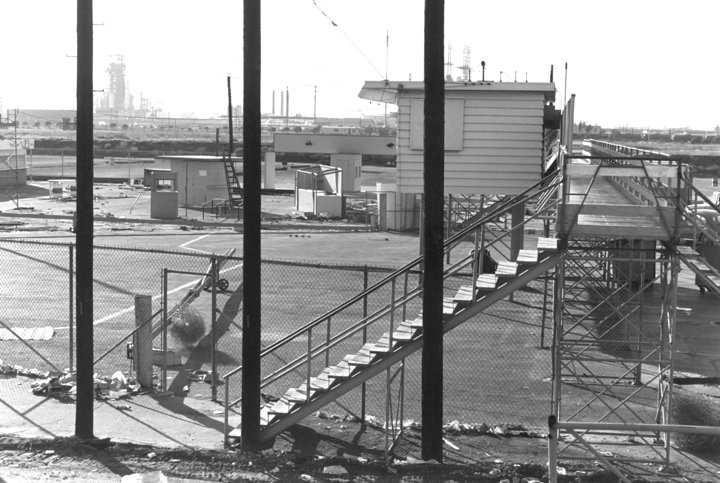
The abandoned Lions Drag Strip in Wilmington. Undated, circa 1972-82. Photo by Don Gillespie. (Credit: Friends of Lions Drag Strip Facebook page)

The Lions site sat unused and empty for 10 years. Finally, the Harbor Commission razed the facility and built a large warehouse for storing shipping containers, which remains there to this day.

During its heyday, the track was used as a filming location for TV’s “The Munsters” and “Adam-12,” and for the 1965 film, “It’s a Bikini World.” References to it also can be found in the TV series “Mad Men” and the films “Once Upon a Time in Hollywood” and “The Killer Elite.”

Note: Those wanting to take a deeper dive into the total Lions Drag Strip experience should consider a visit to the Lions Automobilia Museum in Rancho Dominguez. Admission is $20 for adults, and $15 for seniors, military members and children 4-17.
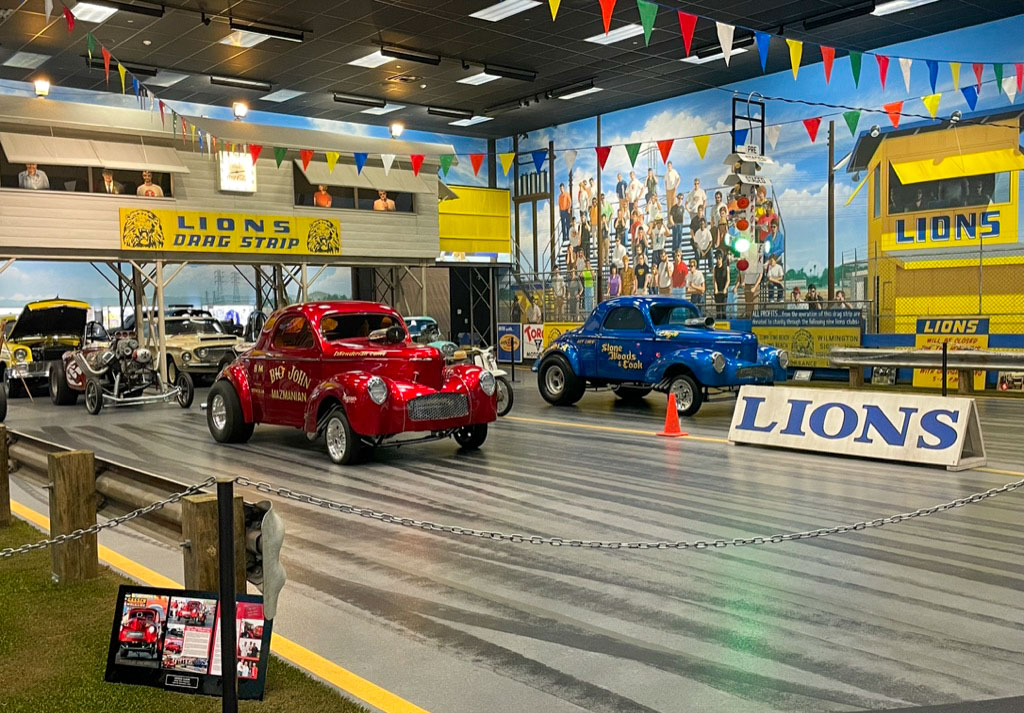
Interior of the Lions Automobilia Museum in Rancho Dominguez. 2023 photo. (Credit: Lions Automobila Foundation Facebook page)

Sources:

Daily Breeze archives.

Drag Strip List website.

“The Last Drag Race,” by Steve Alexander, Hot Rod magazine, Feb. 1973 issue.

Lions Automobilia Foundation and Museum website.

Los Angeles Times archives.

San Pedro News PIlot archives.

Wilmington Press Journal archives.
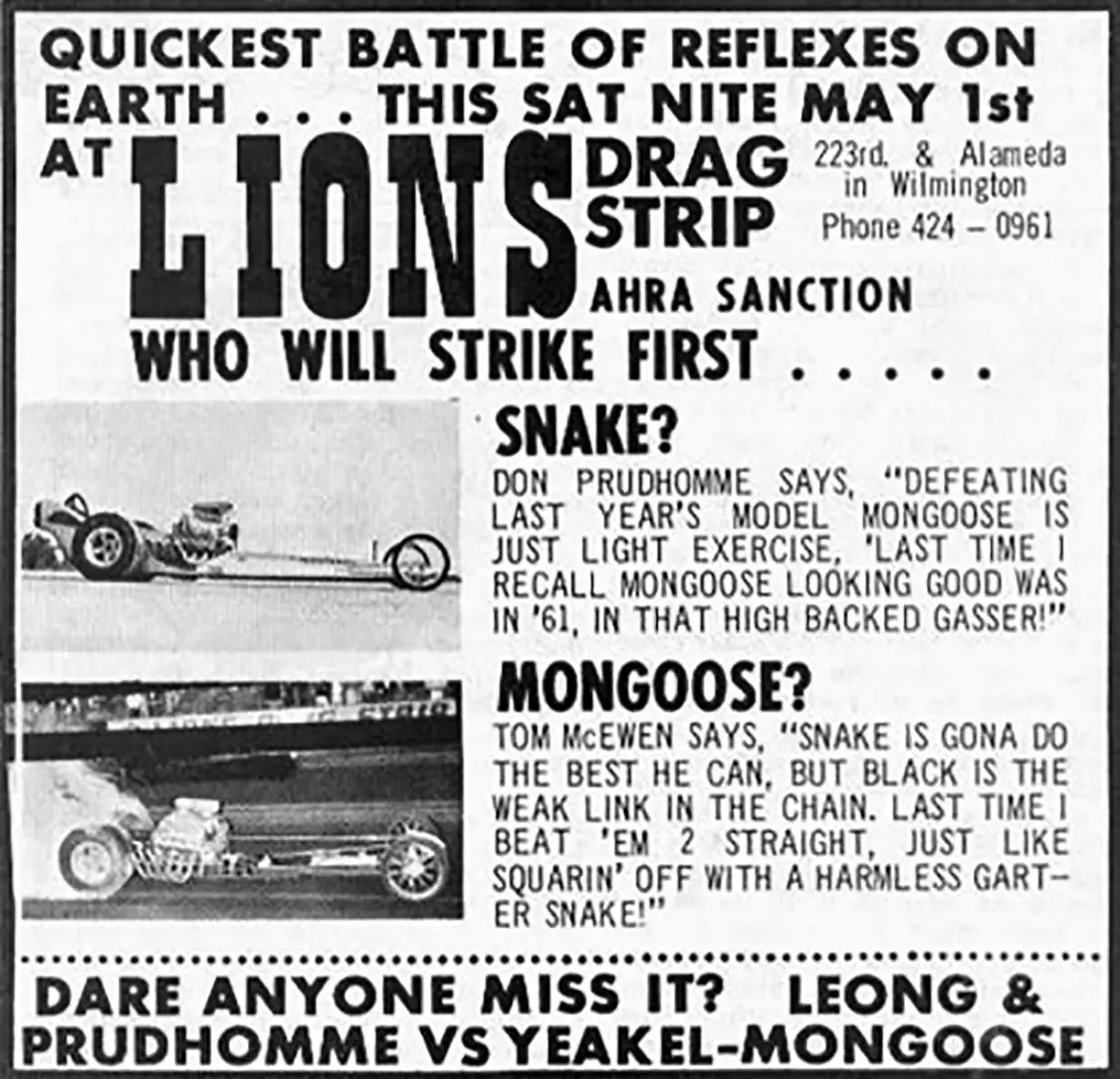
Handbill promotes an upcoming showdown between Don “The Snake” Prudhomme and Tom “The Mongoose” McEwen at Lions Drag Strip. Undated, circa mid-to-late 1960s. (Credit: Motortopia website)

Comments:

From Don Wallace:

Loved your newsletter, as one who learned to drive a stick by lying in bed at night listening to Lions dragstrip—not even knowing those were cars. To my childish ears they were literally lions in the jungle across the concrete LA riverbed a few blocks away from my Bixby Knolls house. Years later when I was given my first shifting lesson in a two and a half ton dump truck I could hear those rising chords reaching for a peak that was never sumitted until the final gear was triumphantly slotted.

Thanks for taking care with the details. Along with Tom Wolfe’s Kandy Kolored Tangerine Flake Streamline Baby the best books I know about car culture are by LA’s own Lou Mathews, who grew up inside and under the hood. His LA Breakdown and Shaky Town are quiet masterpieces, and as unflashy as those 56 Chevys were loud.

Don Wallace
Honolulu 
Author of One Great Game, about the 2001 Long Beach Poly – Concord De La Salle “first ever high school national championship football game.”
Some South Bay and Harbor Area cities found the road to incorporation rocky

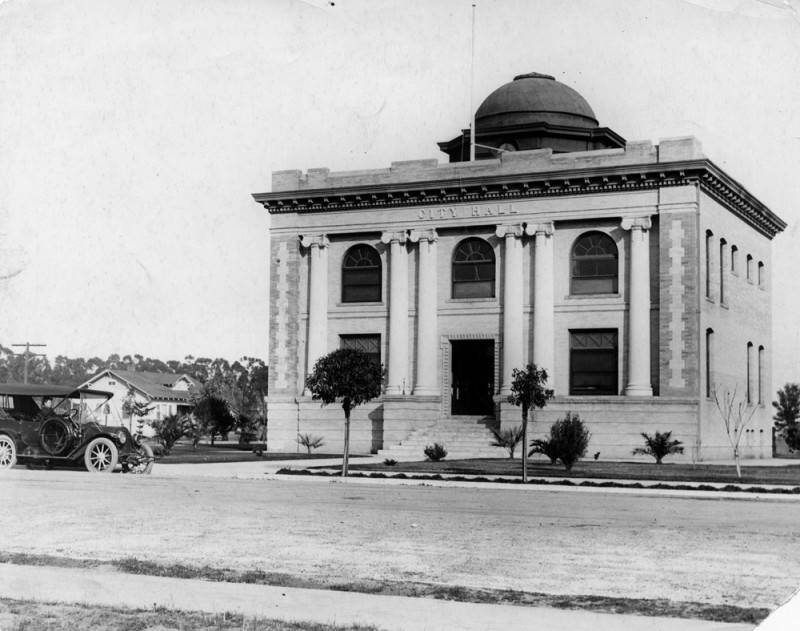
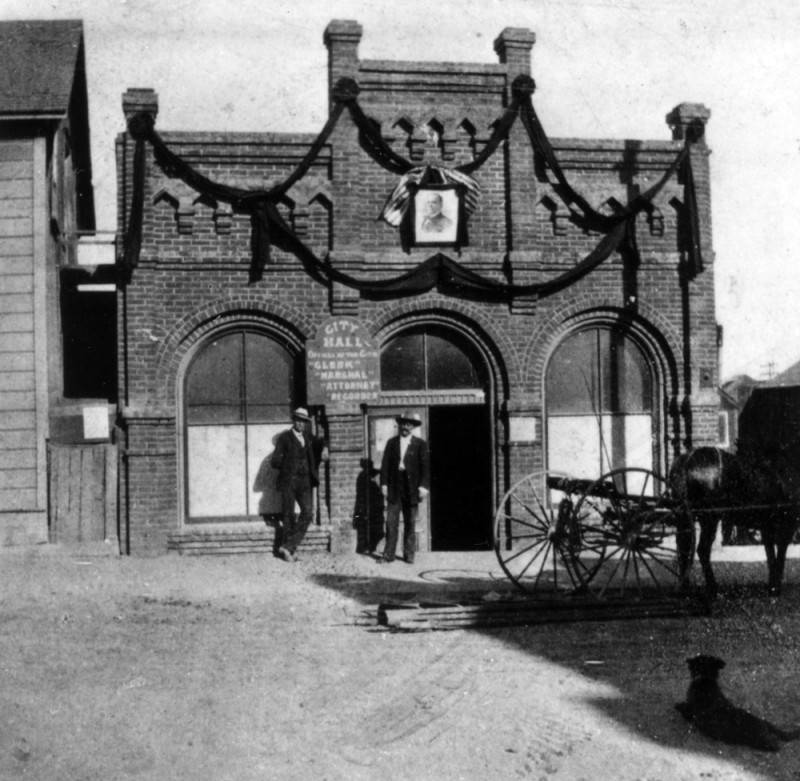
The then-new Wilmington City Hall circa 1908. (Credit: Los Angeles Public Library Photo Collection) 

Here’s a trick question for you: Which South Bay/Harbor Area city was the first to incorporate officially?

The answer: Wilmington, in 1871. The second? San Pedro, 1888.

An incorporated city is a municipality whose business affairs, public works and civic activities are managed by elected officials who have been chosen by the votes of its residents.

The practice of allowing residents to vote on whether or not to incorporate began with the passage of a law providing for the option by the California State Legislature in March 1883.

Wilmington’s first incorporation was repealed in 1887 after an economic downturn stunted the city’s economic development. 

Los Angeles city clerk O.C. Abbott (left) and Ben Baker stand outside of the second location of the San Pedro City Hall, a rented building on Beacon between 4th and 5th streets, in 1900. (Credit: Los Angeles Public Library Photo Collection)

A decade later, it began to fight its way back to becoming a thriving location again. After an unsuccessful annexation attempt by neighboring Long Beach in 1905, the city reincorporated in 1907 to fend off further attempts. It even opened its own city hall in 1908. A year later, it unincorporated again.

Meanwhile, the growing city of San Pedro began to develop rapidly due to the growing importance of its natural harbor. It built many civic structures based on its status as an independent city, including three iterations of its own city hall. Then, like Wilmington, it gave up its cityhood in 1909.

Neither Wilmington nor San Pedro currently are incorporated cities. Instead, both became part of the City of Los Angeles in 1909 as a part of the consolidation of Los Angeles Harbor into the Port of Los Angeles.

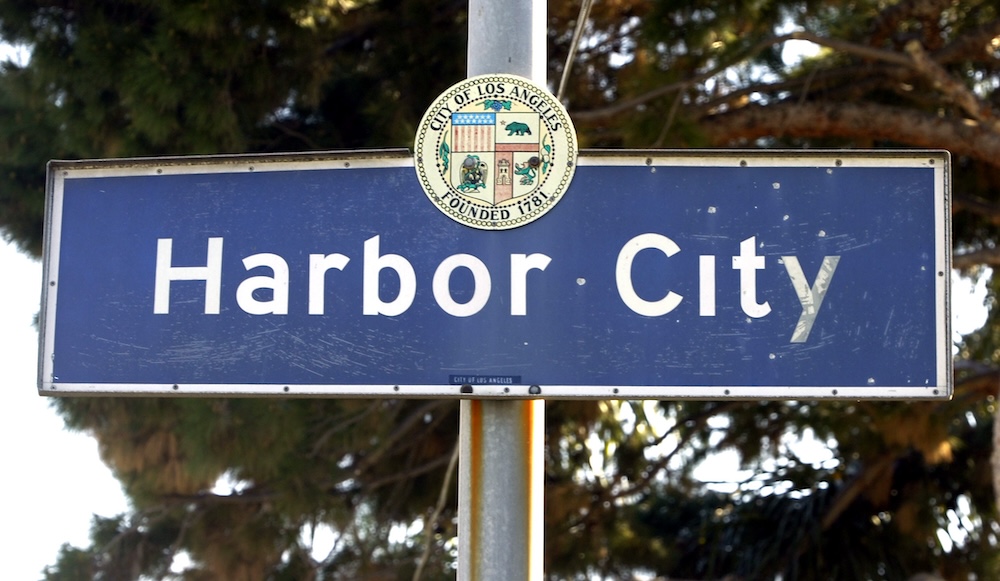
Harbor City sign on Western Avenue. Both Harbor City and Harbor Gateway are part of the City of Los Angeles. 2006 photo. (Daily Breeze staff file photo)

The beach cities along the South Bay coast voted early on to incorporate. The oldest city in the area to incorporate, and remain incorporated to date, is Redondo Beach, whose cityhood became official on April 29, 1892.

The city of Hermosa Beach incorporated on Jan. 14, 1907, and Manhattan Beach’s incorporation became official on Nov. 26, 1912. 

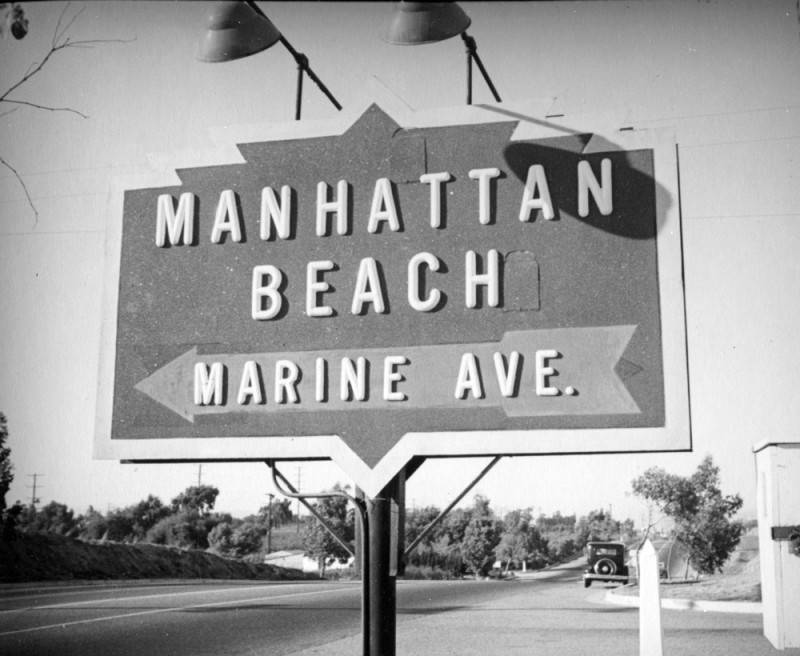
An arrow points to Marine Avenue on this Manhattan Beach pole sign. Photo circa 1937. (Credit: Los Angeles Public Library Photo Collection)

Following the opening of the Standard Oil Refinery (later Chevron) in El Segundo in 1911, the influx of employees and their families led to the beach-adjacent city’s rapid development. Its voters approved incorporation in 1916, and it became official on Jan. 18, 1917.

Playa Del Rey, the beach community just north of Los Angeles International Airport, was founded in 1902, but has never been incorporated. Like neighboring Westchester, it remains part of the City of Los Angeles despite being its own distinct community.

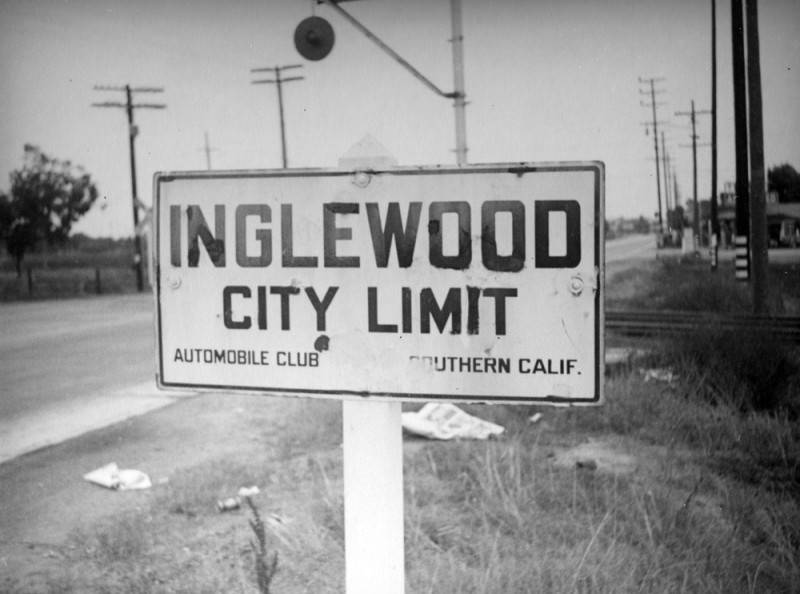
Circa 1937 photo shows sign marking the Inglewood city limit. (Credit: Los Angeles Public Library Photo Collection)

Moving inland, the long-incorporated cities of Inglewood (Feb. 7, 1908) and Hawthorne (Dec. 12, 1922) both fought for decades to annex the nearby community of Lennox. They both took chunks of the once-larger community, but never managed to annex it all. 

Lennox remains an unincorporated part of Los Angeles County. Though it survived annexation, barely, its attempts to incorporate itself were unsuccessful.

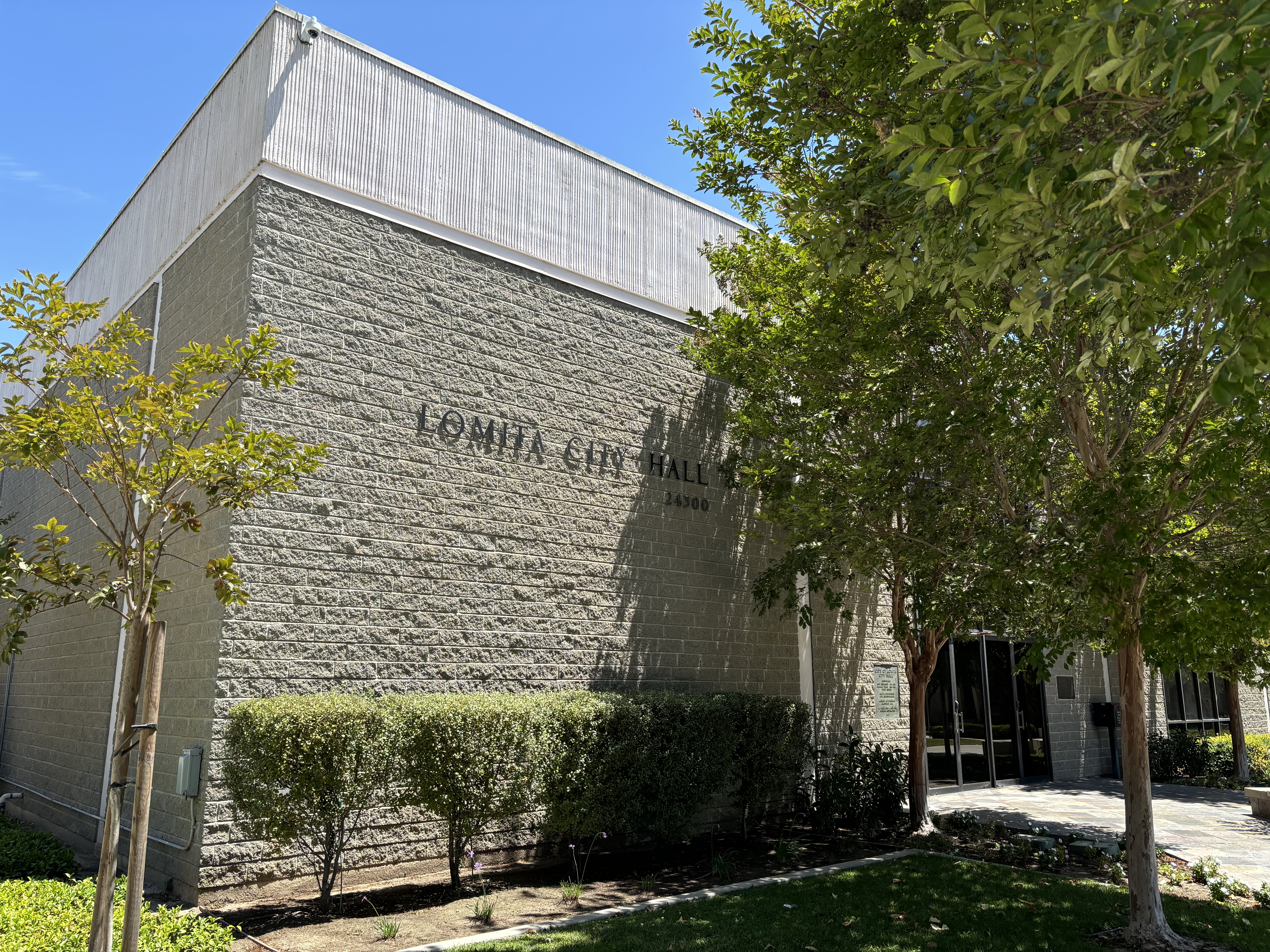
One city that succeeded in incorporating in order to fend off annexation was Lomita, the subject of repeated attempts by the city of Torrance to claim it. Serious Torrance bids during the late  1950s led to a successful incorporation movement for Lomita that became official on June 30, 1964.

Lomita City Hall. August 2024 photo. (Photo by Sam Gnerre)

As for Torrance, it had been founded in October 1912, but it didn’t become an incorporated city until May 12, 1921. Nearby Gardena’s official incorporation date is Sept. 11, 1930. Lawndale incorporated on Dec. 28, 1959.

Carson’s incorporation battle turned out to be one of the South Bay’s most epic. Fueled by Long Beach’s threat to annex land on its eastern border in 1958, the debate over incorporation raged for literally the next decade. It finally became an incorporated city on Feb. 20, 1968.

Though the Palos Verdes Peninsula’s development began with the sale of housing lots in the Malaga Cove area in 1923, incorporation for its first official city, Palos Verdes Estates, was slow in coming. When the debate finally came to a head in 1939, it split the community into bitter pro- and anti- factions.

2022 photo. (Credit: City of Rancho Palos Verdes)

The final vote in the December election was a squeaker: 213 votes for incorporation and 206 against. The city’s incorporation became official on Dec. 20, 1939.

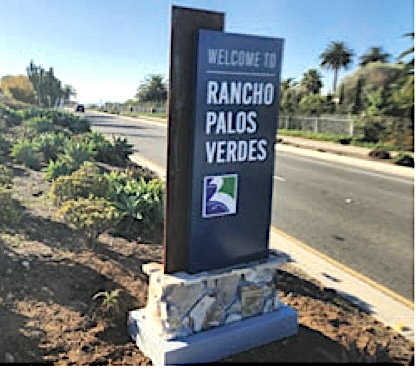
The other Peninsula cities incorporated later with far less controversy. Rolling Hills and Rolling Hills Estates both incorporated in the same year, 1957. Rolling Hills became official on Jan. 24, and Rollling Hills Estates, on Sept. 24. The incorporation of the fourth Peninsula city, Rancho Palos Verdes, didn’t become official until Sept. 7, 1973.

That leaves Avalon on Catalina Island. Most of the island is Los Angeles County land, but Avalon became its own incorporated city thanks to a drive for independence spurred on by the city’s residents.

They were chafing under the control held by the Banning family, which owned Catalina at the time, and the County, which governed it. The two entities controlled transportation to and from Catalina as well as liquor sales in Avalon, both sore points with residents.

The 1913 election resulted in a firm yes vote on incorporation, which became official on June 26, 1913. Avalon had won its freedom to regulate itself, and the Bannings were forced to loosen their stranglehold on the city.

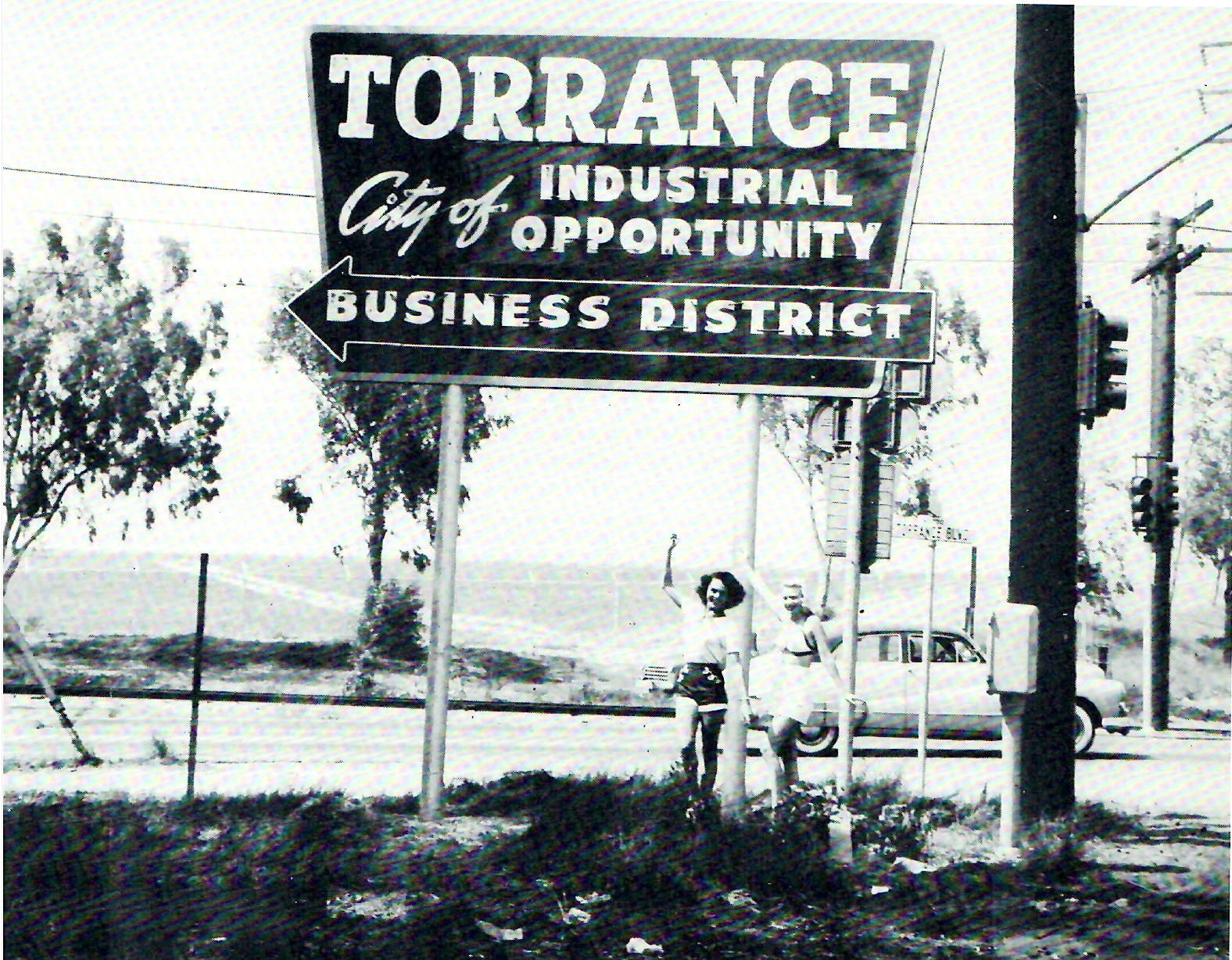
Sandra Lee Constance, Miss Torrance of 1953, and Ella Mae McLeod, pageant runner-up, call attention to the city’s then-new electric sign located on Torrance Blvd. near Western Ave. in 1953. (Daily Breeze file photo)

Sources: 

Daily Breeze archives.

Los Angeles Times archives.

South Bay History blog.

Various South Bay/Harbor Area local history books.

Wikipedia.

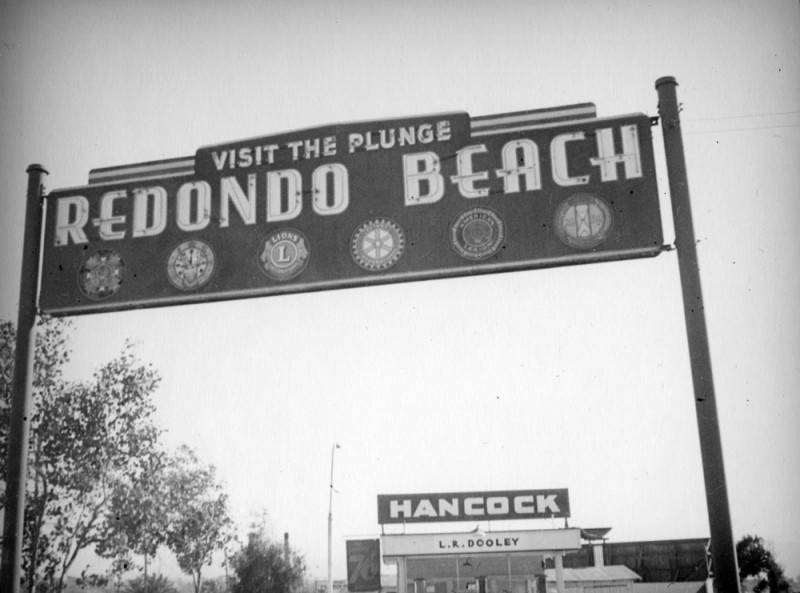
“Visit the Plunge” or join a club, maybe the American Legion, Lions, Rotarians or B.P.O.E. All of this and more is available in Redondo Beach according to this enamel and neon welcoming sign. Photo circa 1937. (Credit: Los Angeles Public Library Photo Collection) 

Dates of incorporation of South Bay / Harbor Area cities:

Avalon – June 26, 1913.

Carson – Feb. 20, 1968.

El Segundo – Jan. 18, 1917.

Gardena – Sept. 11, 1930.

Harbor City – Part of the City Los Angeles.

Harbor Gateway – Part of the City Los Angeles.

Hawthorne – July 12, 1922, founded 1905.

Hermosa Beach – Jan 14, 1907.

Inglewood – Feb. 7, 1908.

Lawndale – Dec. 28, 1959.

Lennox – Unincorporated, part of Los Angeles County.

Lomita – June 30,1964.

Manhattan Beach – Nov. 26, 1912.

Playa del Rey – Part of the City Los Angeles, founded 1902.

Redondo Beach – April 29, 1892.

Palos Verdes Estates – Dec. 20, 1939, founded 1923.

Rancho Palos Verdes – Sept. 7, 1973.

Rolling Hills – Jan. 24, 1957.

Rolling Hills Estates – Sept. 18, 1957.

San Pedro – Incorporated 1888, dissolved into the City of Los Angeles in 1909.

Torrance – May 12, 1921, founded Oct. 1912.

Westchester – Part of the City Los Angeles.

Wilmington – Incorporated 1871, dissolved 1887, incorporated again in 1907, then dissolved into the City of Los Angeles in 1909.

Geoffrey Patterson was a superhero to South Bay comic book fans

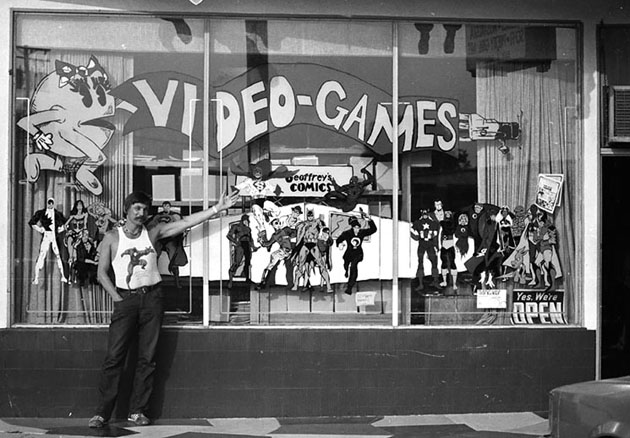
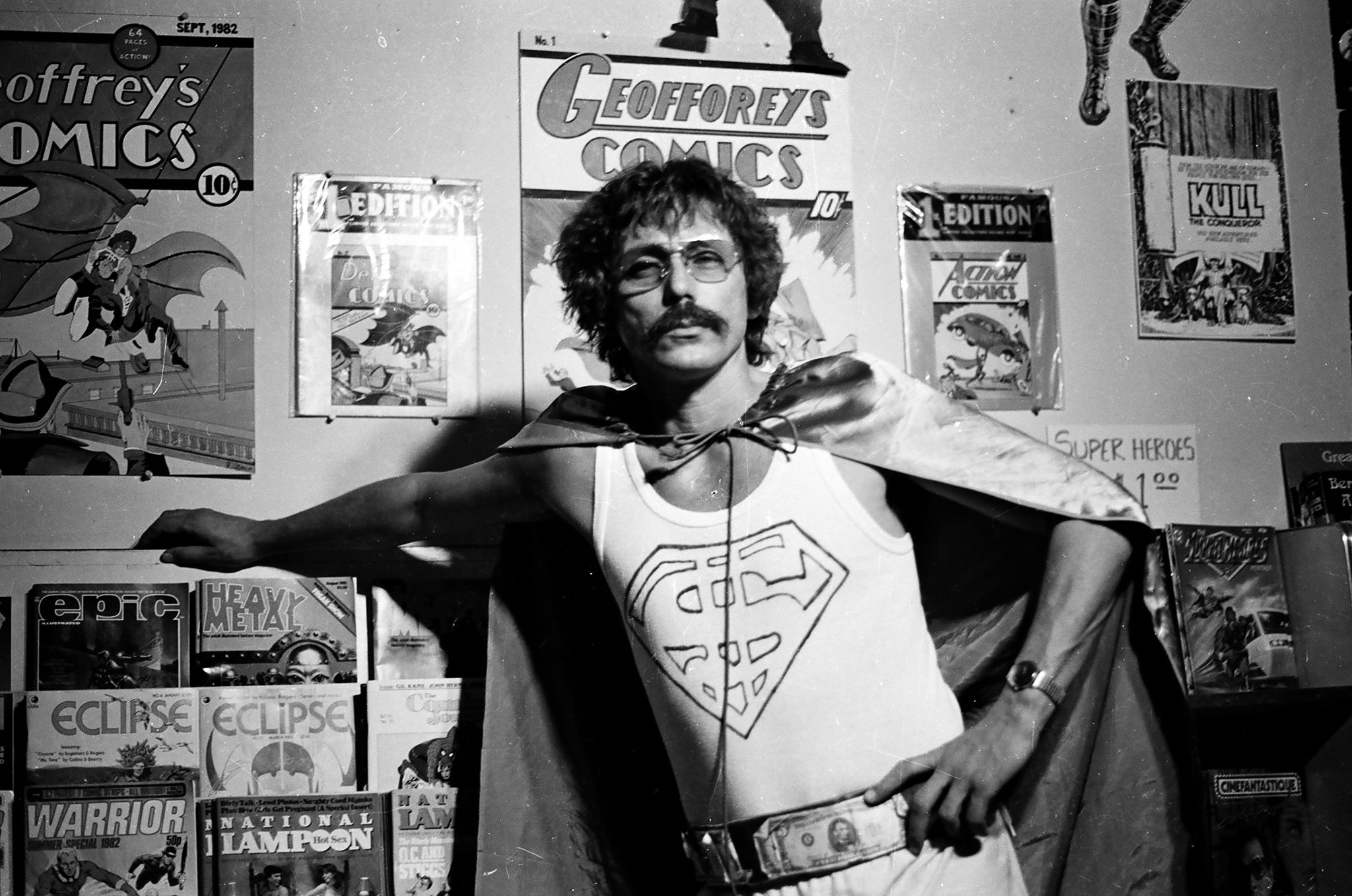
Geoffrey Patterson in front of his Crenshaw Blvd. comics shop. Undated, circa 1981. (Credit: 2 Warps to Neptune website)

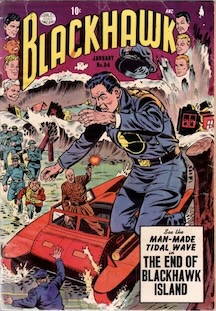
Geoffrey Wood Patterson’s lifelong comic book fandom began when he was eight years old and his mother would give him a dime to buy the latest issue of Blackhawk at the local market.

The DC Comics book featured the heroic exploits of a team of World War II-era fighter pilots who carried out missions from their secret base on Blackhawk Island. In its heyday, only Superman comic books outsold Blackhawk.

Blackhawk #84, 1955.

Decades later, Patterson would purchase a vintage back issue of Blackhawk for $100 through the mail and become hooked on collecting comics.

Patterson was born in Inglewood a week before the Dec. 7, 1941 attack on Pearl Harbor. His family moved to a Hermosa Beach trailer park in 1950, then to Torrance in 1951.

He attended Seaside Elementary, and was a member of the first graduating class from North High School in 1959. He went on to El Camino College and then to California State University Long Beach.

After graduating from CSULB, he worked as an officer for the Los Angeles County Probation Department for the next couple of decades. But after purchasing that Blackhawk comic, he began to think more and more about making his obsession his profession.

In 1979, he opened Geoffrey’s Comics at 15900 Crenshaw Blvd., Suite B, in Gardena. It was only the fourth comic book shop operating in Southern California at the time. Hi De Ho Comics in Santa Monica was the first, opening on July 7, 1977.

Patterson continued to work for the probation department until 1989, when he quit to run his store full-time.

He married his wife, Monica, in a 1993 ceremony during which both were dressed in superhero costumes. 

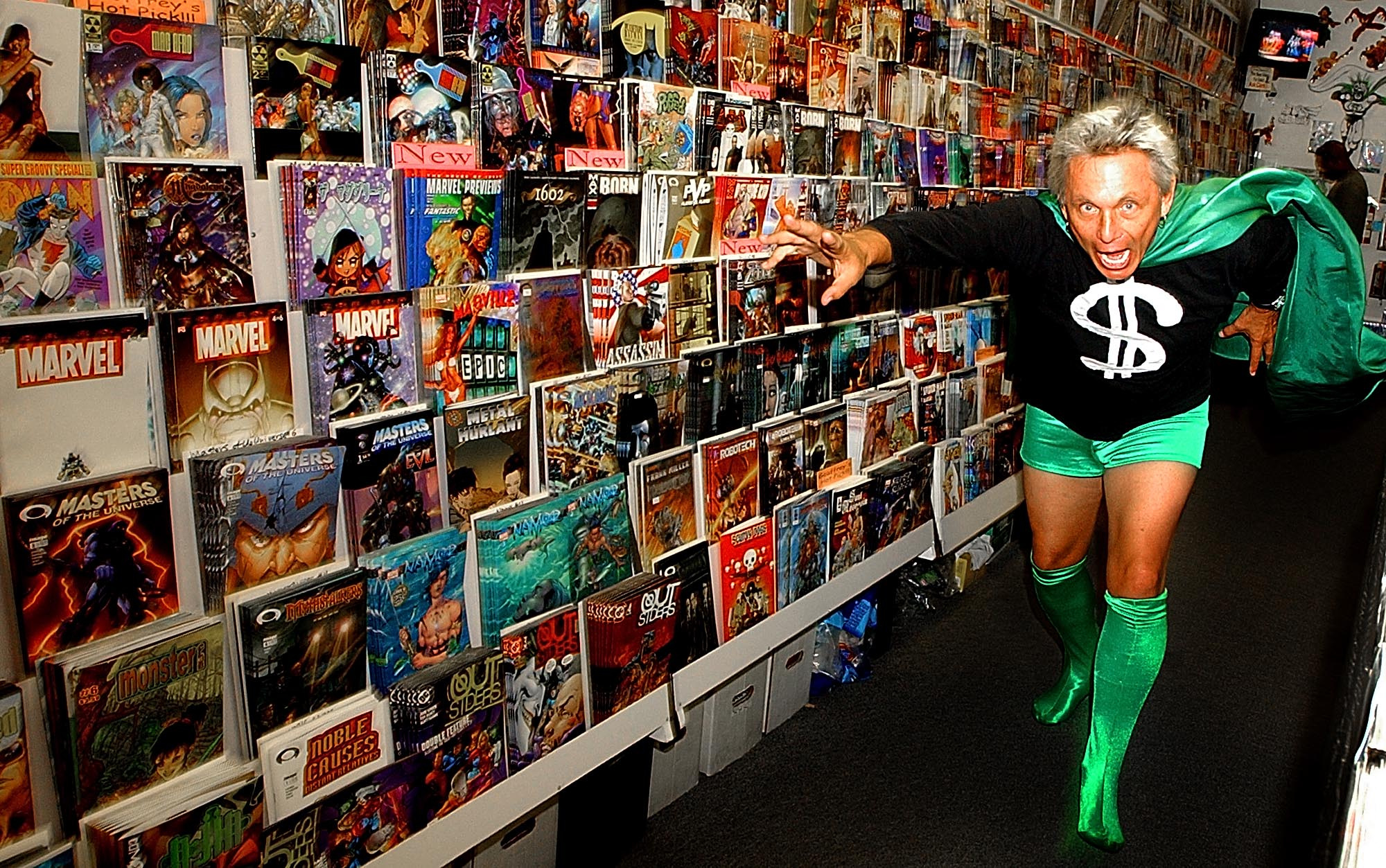
Geoffrey Patterson, dressed in his Captain Greedy costume, flies into action in his Gardena comic book shop on Sept. 24, 2003. (Daily Breeze staff file photo by Branimir Kvartuc)

Patterson dressed as “Captain Greedy,” a character he invented that parodied greedy comic book store owners, while Monica wore a full Wonder Woman outfit. Geoffrey Patterson II, his 14-year-old son from a previous marriage, came dressed as Cyclops.

The couple had met when she came into the store as a customer. In addition to Geoffrey II, they raised three children, Cazzie, Ozzie and Jazzmin.

The family’s home in South Torrance became a popular local attraction every Halloween. As many as 500 people would visit and tour the Patterson residence, festooned as it always was with paintings and action figures of superheroes and all types of comics and pop culture memorabilia.The Pattersons would hand out free comic books along with the usual Halloween treats. 

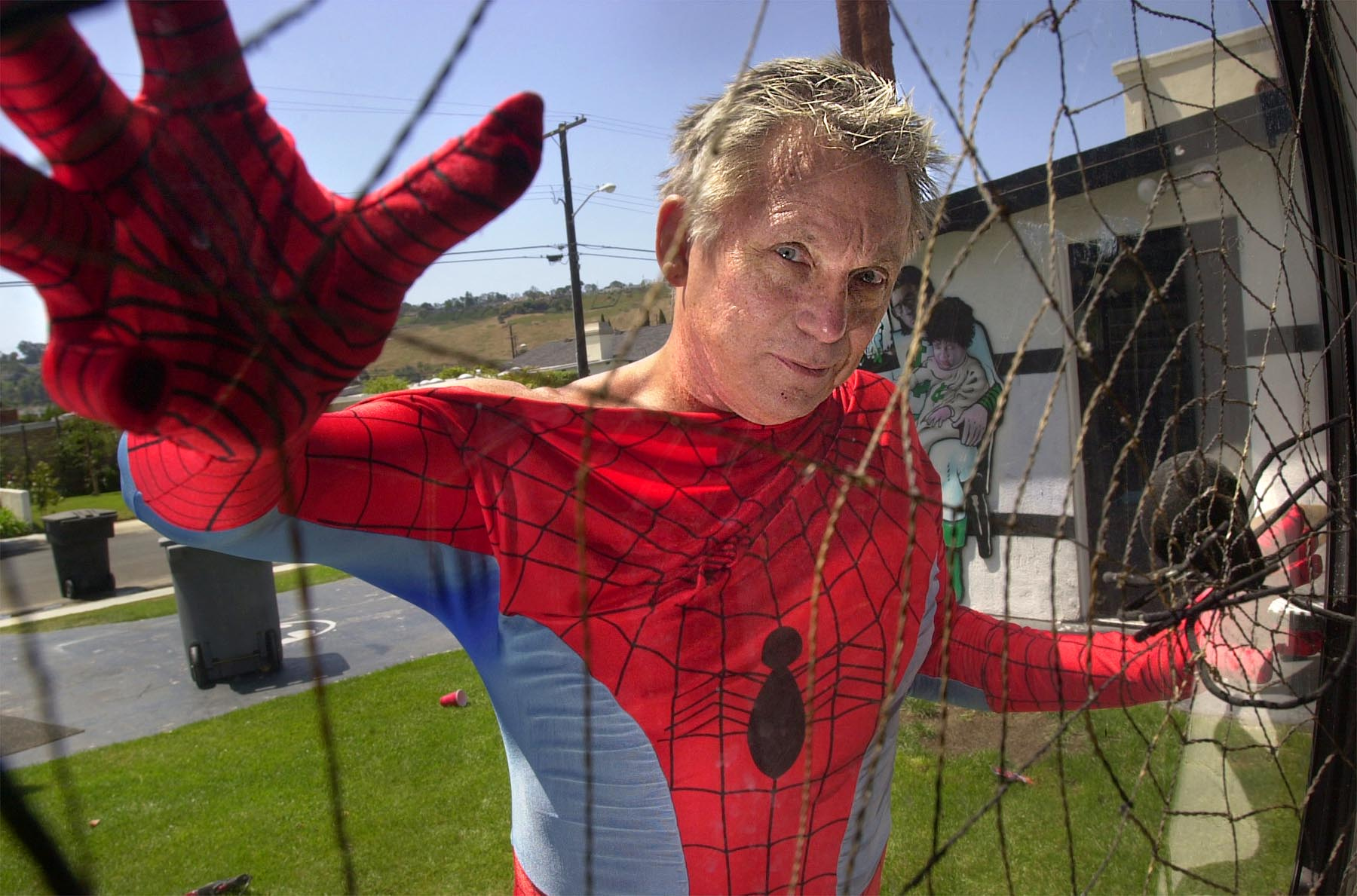
Geoffrey Patterson dressed up as Spider-Man at his Torrance home in anticipation of the 2002 superhero film of the same name. May 2, 2002. (Daily Breeze staff file photo by Robert Casillas)

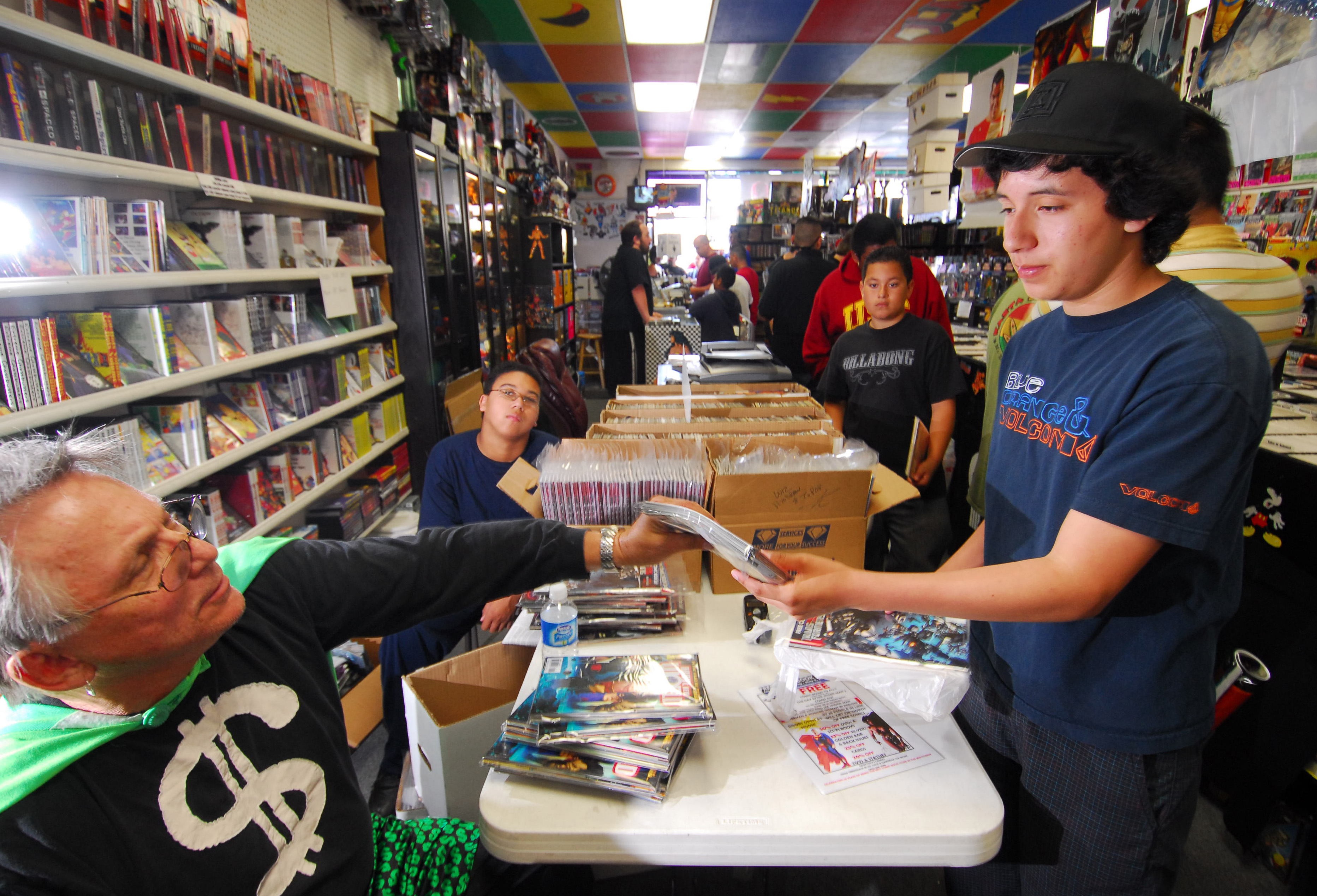
The Gardena shop always was an active participant in the Free Comic Book Day giveaway every May. The annual event at Geoffrey’s featured costumed comic book characters and drew hundreds of comics enthusiasts.

Patterson enjoyed playing his Captain Greedy role, wearing the green costume during episodes of his Torrance public access television show, “Comic Book Geeks,” which featured skits and interviews. 

He even released his own “Captain Greedy” comic in July 2003, telling Daily Breeze business reporter Muhammad el-Hasan, “He’s heroic, but likes to be compensated.”

Geoffrey’s Comics owner Geoffrey Patterson, left, hands a pack of free comic books to Erick Cardenas, 17, from Torrance, at his Gardena shop on May 5, 2007. People waited in long lines to get into the store on Free Comic Book Day. (Daily Breeze staff photo by Steve McCrank)

Geoffrey’s Comics also held its own special events featuring prominent artists, writers and other comic book industry figures.

Geoffrey II shared his father’s passion for comics, and became a part owner of Hi De Ho in Santa Monica as well as taking on a larger role in running Geoffrey’s Comics.

Sadly, Geoffrey Sr. died of liver failure at UCLA Medical Center on June 8, 2014. He was 72.

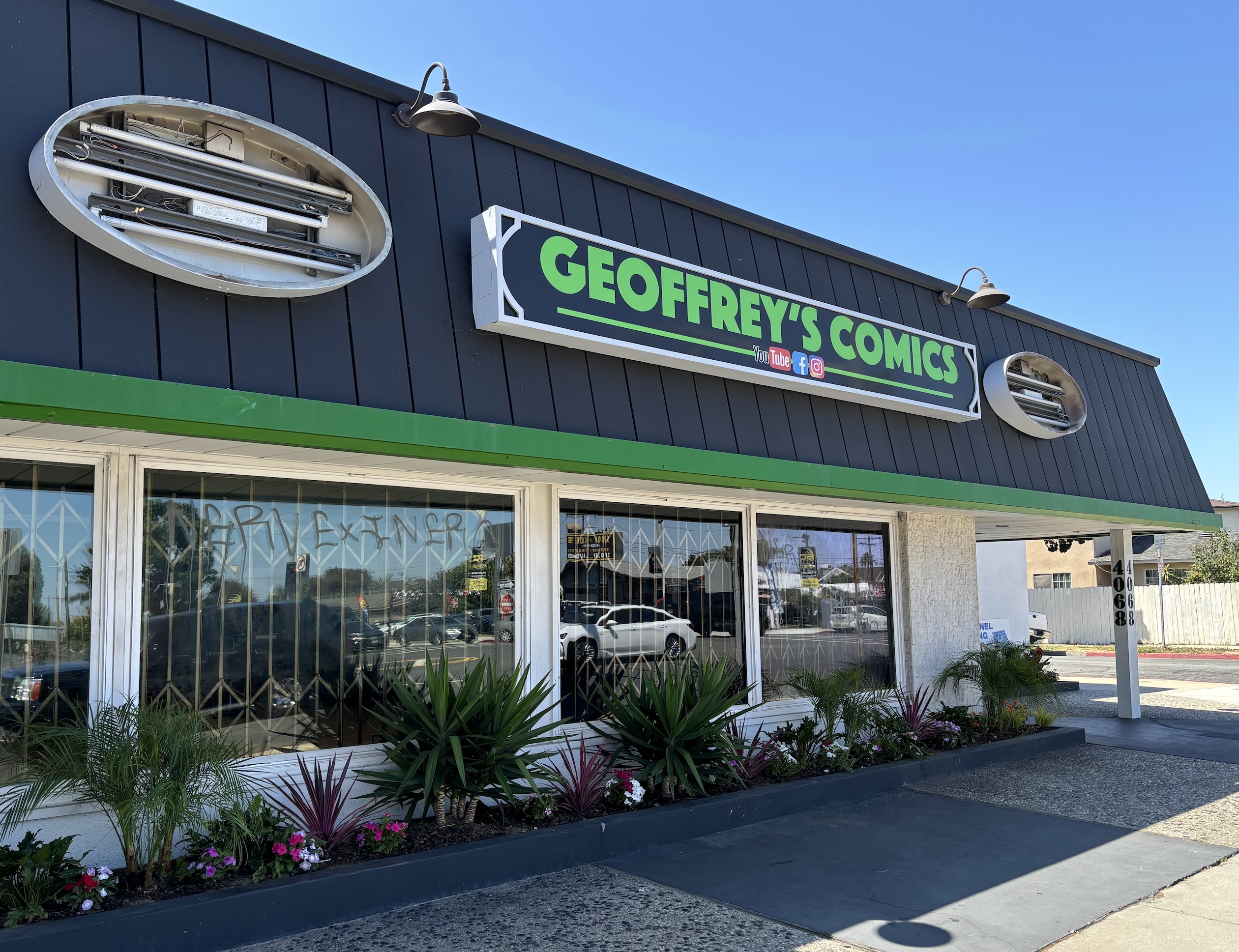
The Geoffrey’s Comics sign remains on the Redondo Beach Blvd. building, though the store closed on Dec. 31, 2023. (July 2024 photo by Sam Gnerre)

Geoffrey II continued operating the business in Gardena until 2020, when the store moved to a new location at 4068 Redondo Beach Blvd. in Torrance.

Several factors lead to the closing of both Geoffrey’s Comics in Torrance and Hi De Ho in Santa Monica on Dec. 31, 2023. The COVID pandemic played a role, causing many consumers to shift from visiting comics stores in person to making their purchases online.

In addition, the explosion in popularity of superhero comics boosted by the parade of blockbuster films based on DC and Marvel comic book characters in recent years resulted in an increased number of larger retailers such as Target stocking and selling comics, which reduced business at specialty stores.

Geoffrey’s and Hi De Ho held large going-out-of-business sales at their brick-and-mortar shops before shuttering them and switching to online operations only.

Geoffrey Patterson poses as Captain Greedy in his Gardena comics shop in this undated photo circa 1980s. (Credit: Geoffrey’s Comics Facebook page)

Sources:

Daily Breeze archives.

Geoffrey’s Comics website and Facebook page.

“Two of LA’s Oldest Comics Stores Are Closing Down,” by Anne To, LAist website, Oct. 29, 2023.

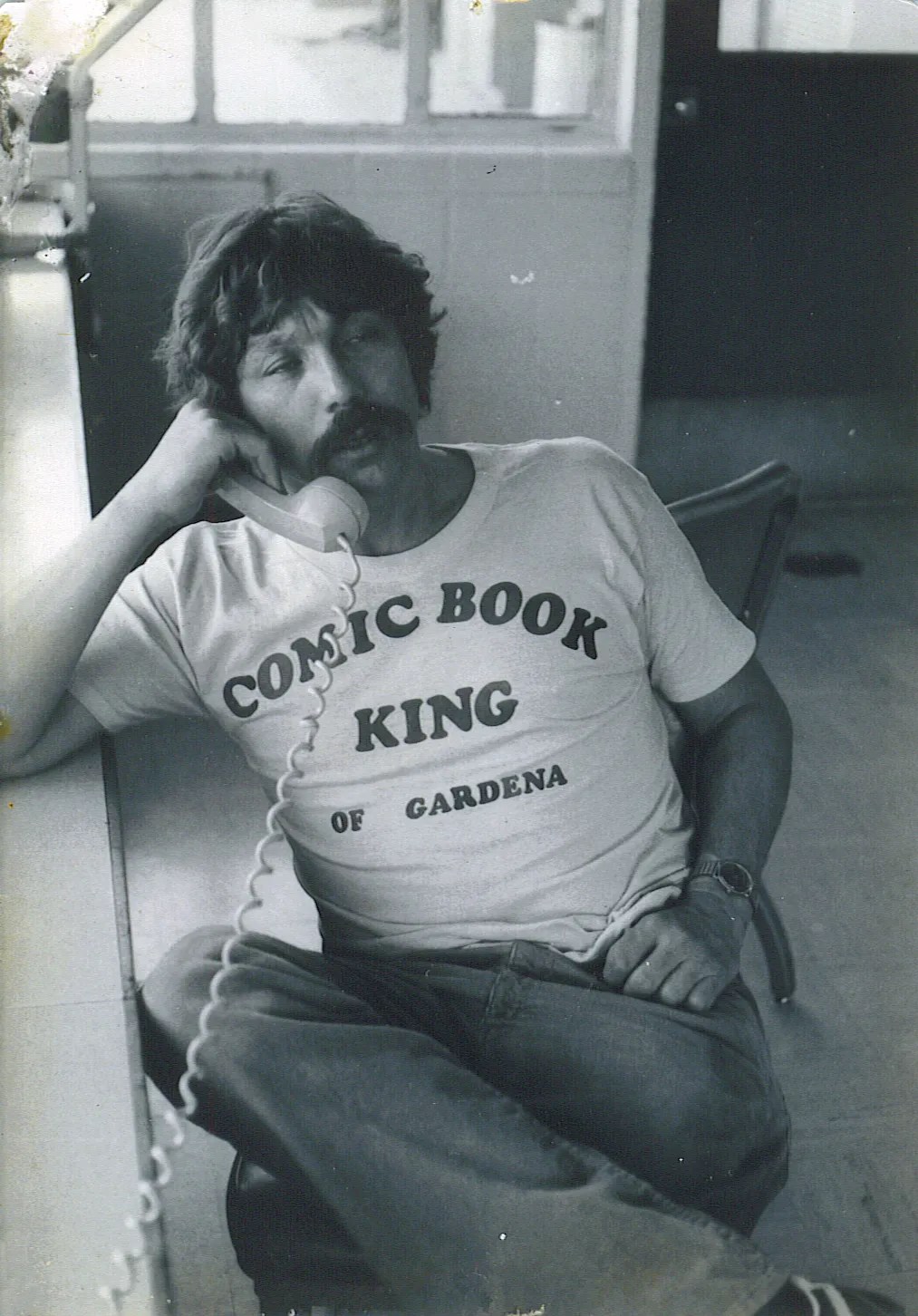
Geoffrey Patterson wears a tongue-in-cheek T-shirt in this undated photo circa 1981. ((Credit: Geoffrey’s Comics website)

Remembering former Torrance mayor and community visionary Katy Geissert

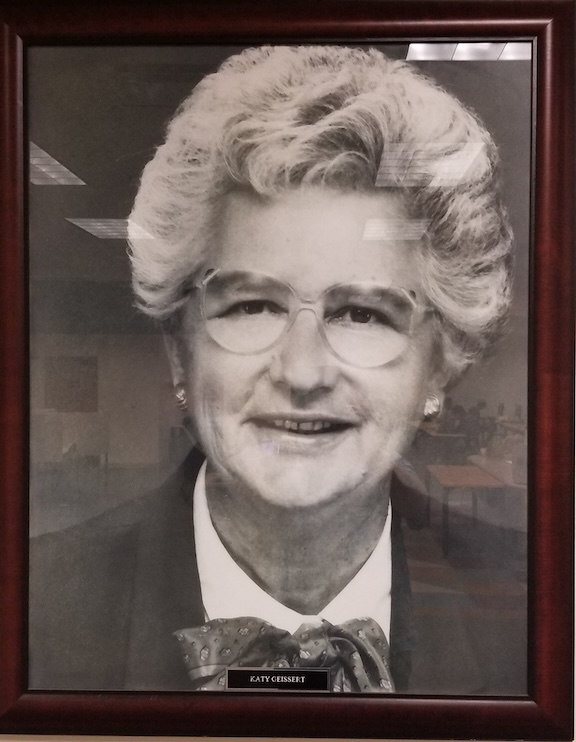
This portrait of Katy Geissert is on permanent display in the Katy Geissert Civic Center Library in Torrance. (Credit: Mike George, Katy Geissert Civic Center Library)

Every rapidly growing, forward-thinking city could use a Katy Geissert.

Geissert was devoted to making Torrance a better place to live before, during and after her twenty years in city government.

The evidence is all around town. The main branch of the Torrance library is named for her. She played a major role in the establishment of the Madrona Marsh preserve and nature center and the Torrance Cultural Arts Center.

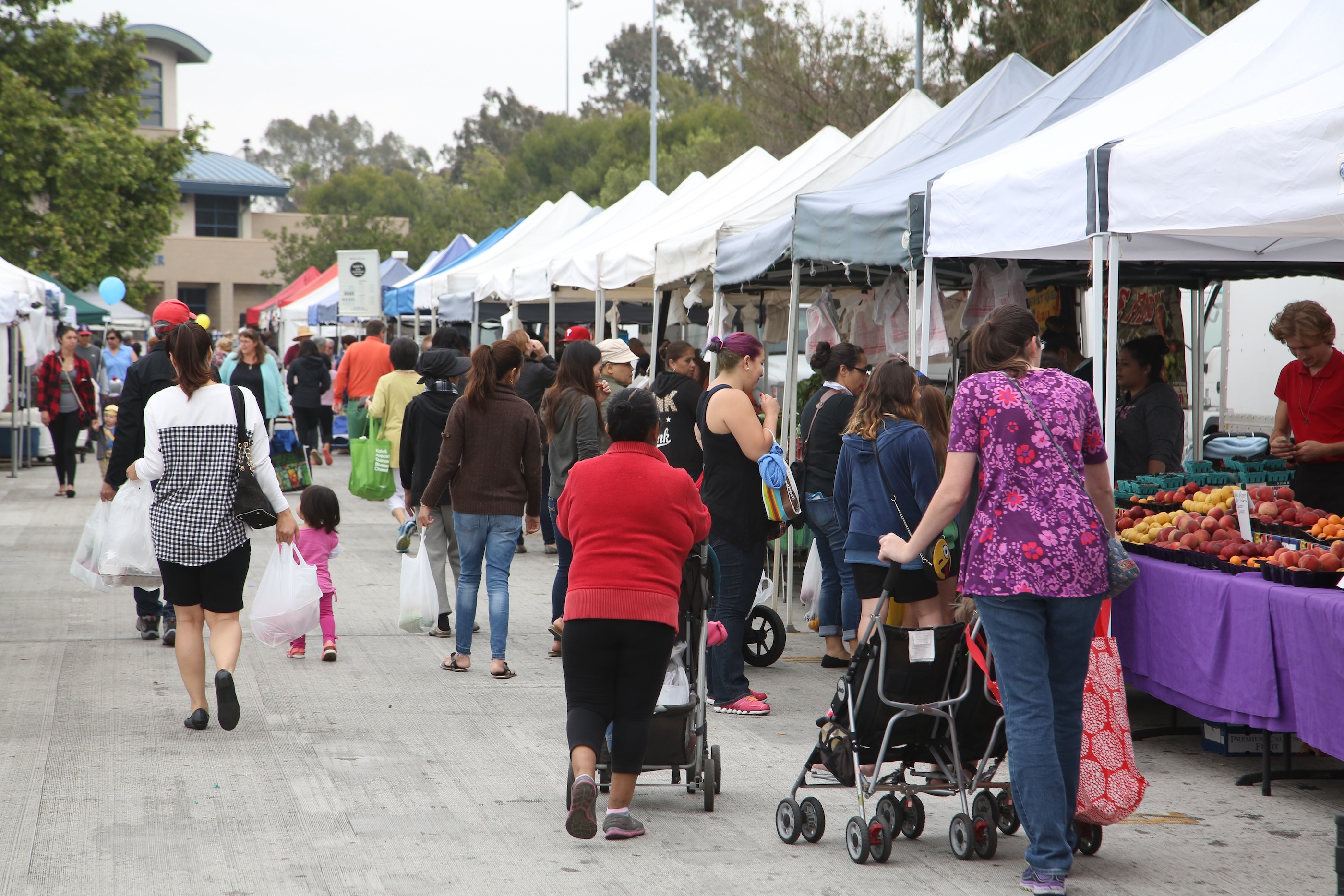
She also sparked the redevelopment of the Old Torrance downtown area, and was an impetus behind establishing the city’s farmer’s market, now a Wilson Park fixture, in 1985. 

The Torrance Certified Farmers’ Market takes place Tuesdays and Saturdays at Wilson Park. June 7, 2016. (Daily Breeze file photo by Chuck Bennett)

She was born Cathryn Ann Owen in 1926 in the small logging town of Raymond in western Washington state. She attended Stanford, majoring in journalism and playing on the softball team.

While at Stanford, she met and married former infantry captain William Geissert in 1948. After William got a job with Union Oil, they moved first to San Pedro and then to Long Beach.

Then, in 1952, the couple bought a house for $15,000 in the still-developing Hollywood Riviera section of Torrance, where they would raise five children, three boys and two girls. They would live in that same house on Calle de Castellana for the next half a century or so.

Geissert’s keen interest in public affairs can be traced to the 1960s, when she became a charter board member of the Torrance League of Women Voters. The group formed in 1962, and she later served as its president. She and her fellow members became regular attendees at Torrance City Council meetings.

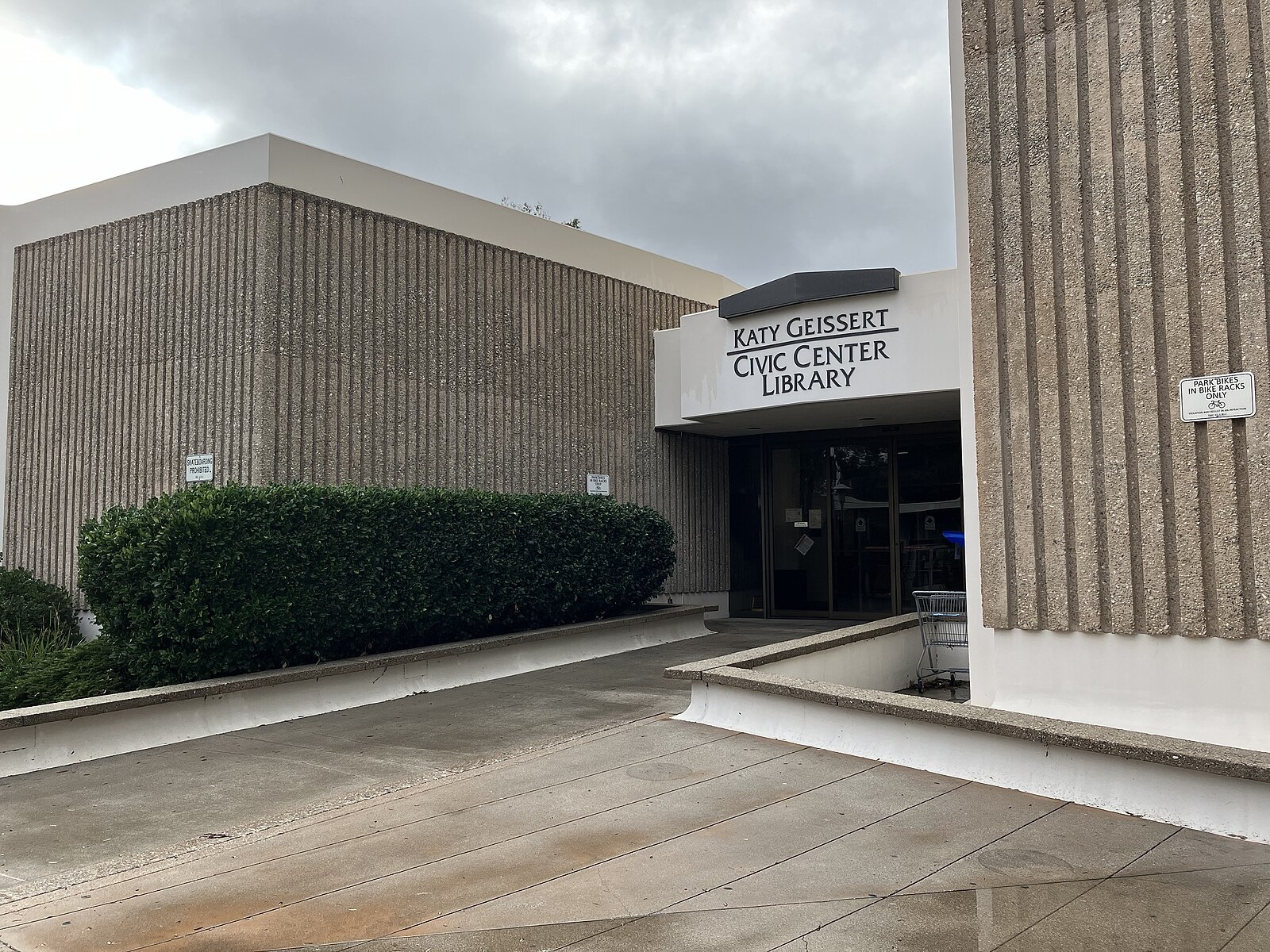
Main entrance to the Katy Geissert Civic Center Library in Torrance on Jan. 22, 2024. Photo by Penny Richards. (Credit: Wikimedia Commons)

Geissert also became an active proponent of civic and cultural improvements. She worked on the movement to help create Columbia Park, which involved battling with the Los Angeles County Board of Supervisors.

In 1967 she fought successfully for a $2.35 million bond issue that allowed for Torrance’s library system to become independent from the Los Angeles County system. The additional funds provided for the construction of a new main library building in the city’s civic center complex and the addition of the Southeast branch library in 1972.

To honor her library advocacy, the central Torrance Civic Center Library was renamed the Katy Geissert Civic Center Library in 1996.

During a 1968 City Council meeting, she had a run-in with then-Mayor Albert Isen that inspired her full-on move into city politics. Representing the League of Women Voters, Geissert was advocating that a proposed 550-unit housing complex near Madrona Ave. and Del Amo Blvd. in Torrance be rejected and the land, a former scrapyard, be turned into a public park instead.

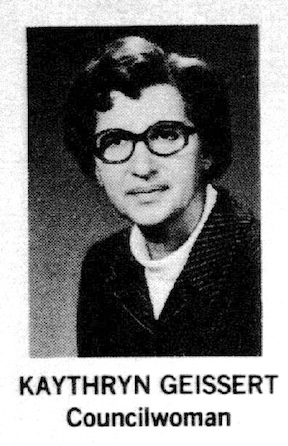
Katy Geissert, her first name wildly misspelled, as she appeared in the 1975 Torrance City Directory, (Credit: Torrance Historical Newspaper and Directories Archive database, Torrance Public Library)

During a heated debate, Isen told Geissert to “sit down and shut up.” Councilman Ken Miller responded, “Let her speak.” She did, and the land ultimately became Delthorne Park. Geissert ended up helming Miller’s successful campaign for mayor in 1970 against Isen.

Her effective activism brought increasing encouragement from friends and colleagues for her to run for public office herself. She decided to run for the Torrance City Council in 1974. She garnered 7,169 votes, second highest in the election, and became the first woman to win a council seat in the city’s history.

She served for three terms on the Council before running for and winning the mayor’s office in 1986. She ran unopposed to win a second term in 1990. Torrance mayors can only serve two terms, so she left city government and essentially retired from politics in 1994.

Her years on the council and as mayor were filled with challenges. In 1979, she helped broker the Madrona Marsh agreement that saved 43 acres of native wetland threatened by a massive new residential development. A year later, she helped convince Mobil Oil to stop using the toxic chemical hydrofluoric acid at its Torrance refinery.

In March 1991, the Council approved a $44 million renovation of the Old Torrance area that included residential elements as well as commercial improvements. That October, the city’s new Cultural Arts Center opened, including a theater, dance studio, meeting rooms and a Japanese garden.

The Arts Center was particularly meaningful to Geissert, a supporter of the arts dating back to her early days in the city. She founded the Torrance Cultural Arts Foundation group in conjunction with the Center’s creation.

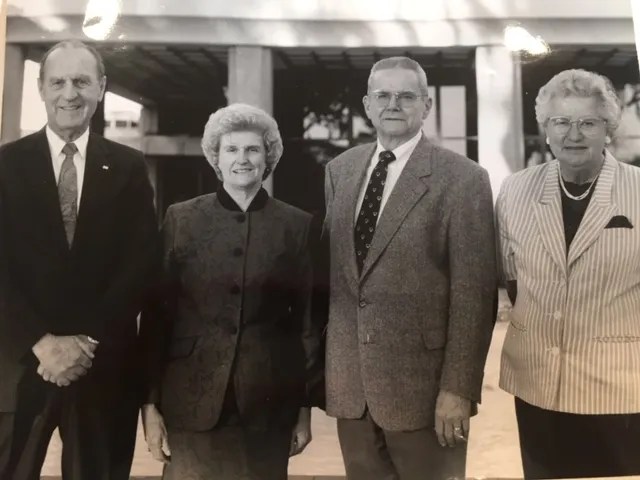
In this 1996 photo, four Torrance mayors, Ken Miller (1970-1978), Dee Hardison (1994-2002), Jim Armstrong (1978-1986) and Katy Geissert (1986-1994) pose in front of City Hall. (Photo courtesy Don Lee)

Her ability to get such projects done had friends and colleagues anticipating that Geissert, a registered Republican, would continue her political career. But the headline on a March 13, 1994 Daily Breeze story published shortly after her retirement said it all: “Despite her popularity, she sought no higher office.”
Geissert told the Daily Breeze in 1994 that  two factors deterred her from further political climbing: her family and her healthy distaste for partisan politics. She pointed out that she originally had waited until her youngest child was in high school before seeking public office, and that she didn’t relish the thought of commuting to work in Sacramento or Washington, D.C.

In the late 1990s, Geissert began a long battle against lung cancer. On July 14, 2000, she made her final public appearance as the guest of honor at a banquet held by the Torrance Cultural Arts Foundation, the group she founded.

One week later, on July 21, 2000, she died at 73. Following her death, the Daily Breeze solicited remembrances and appreciations of the woman nicknamed “Mother Mayor,” and ended up running dozens of them in its memorial editions.

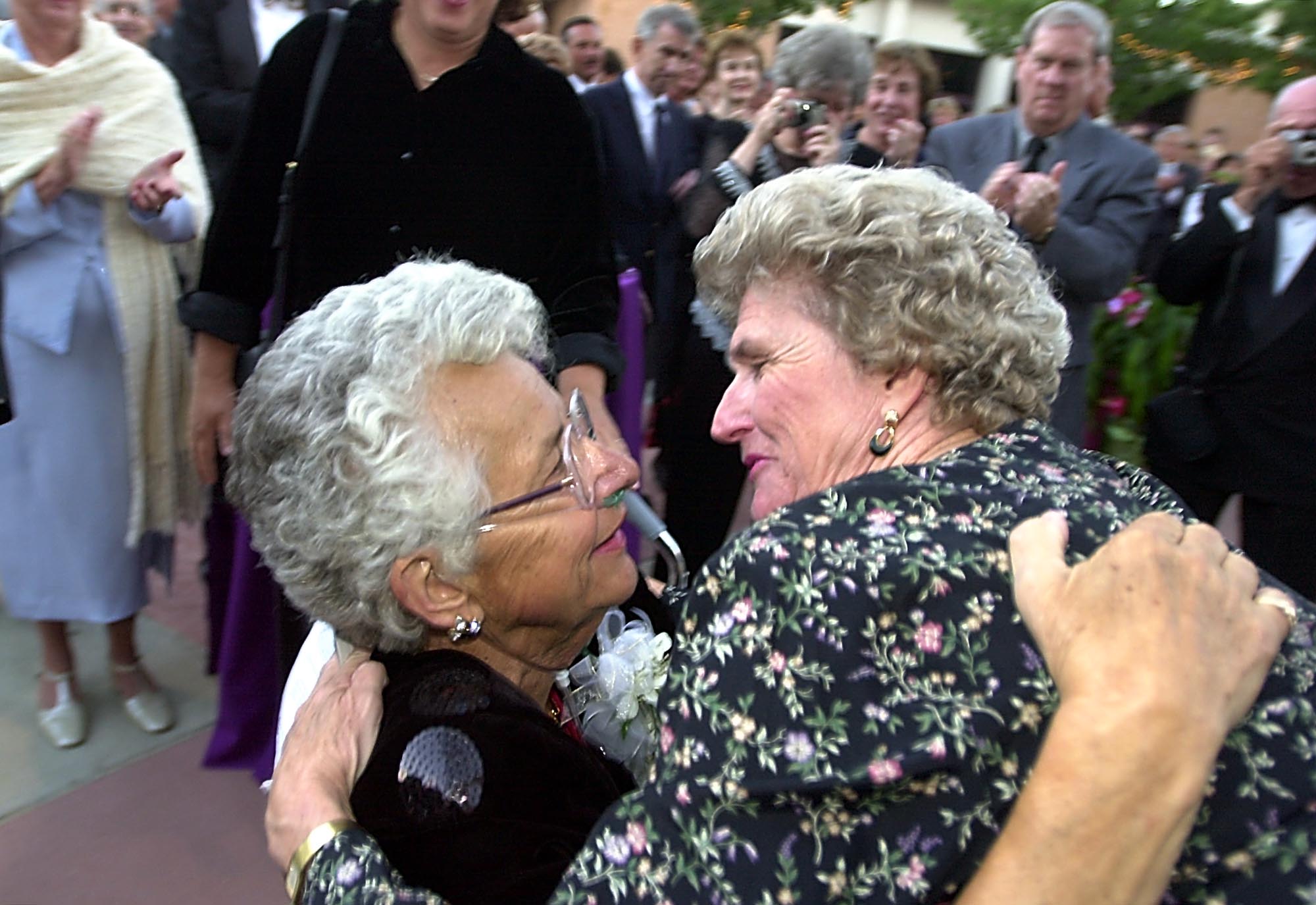
Torrance Mayor Dee Hardison hugs former Mayor Katy Geissert at the fifth anniversary gala for the Torrance Cultural Arts Center on July 14, 2000. Hardison succeeded Geissert as the city’s mayor. (Daily Breeze staff file photo by Branimir Kvartuc)

Note: Special thanks to Katy Geissert Civic Center Library reference librarian Mike George for his assistance.

Sources:

Daily Breeze archives.

Los Angeles Times archives.

“Mayor Geissert Interview,” by Molly M. Sipe, California Revealed website, May 13, 1987.

Palos Verdes Peninsula News archives.

Torrance Press Herald archives.

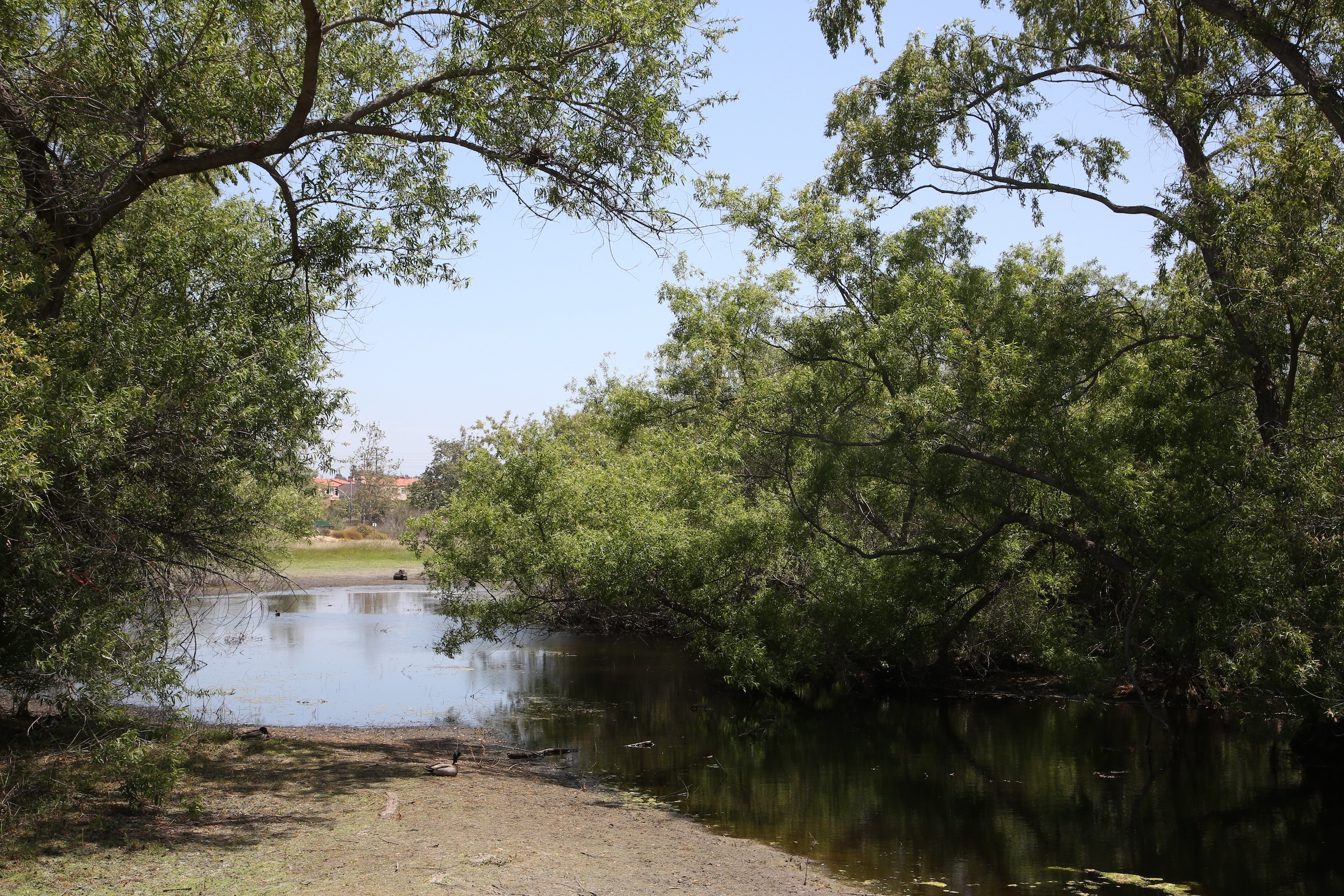
As mayor, Katy Geissert played a major role in helping to preserve the Madrona Marsh native wetland in Torrance. May 2, 2016 photo. (Daily Breeze staff file photo by Chuck Bennett)

Pro wrestling dipped its toes in the South Bay and Harbor Area in the 1940s and 1950s

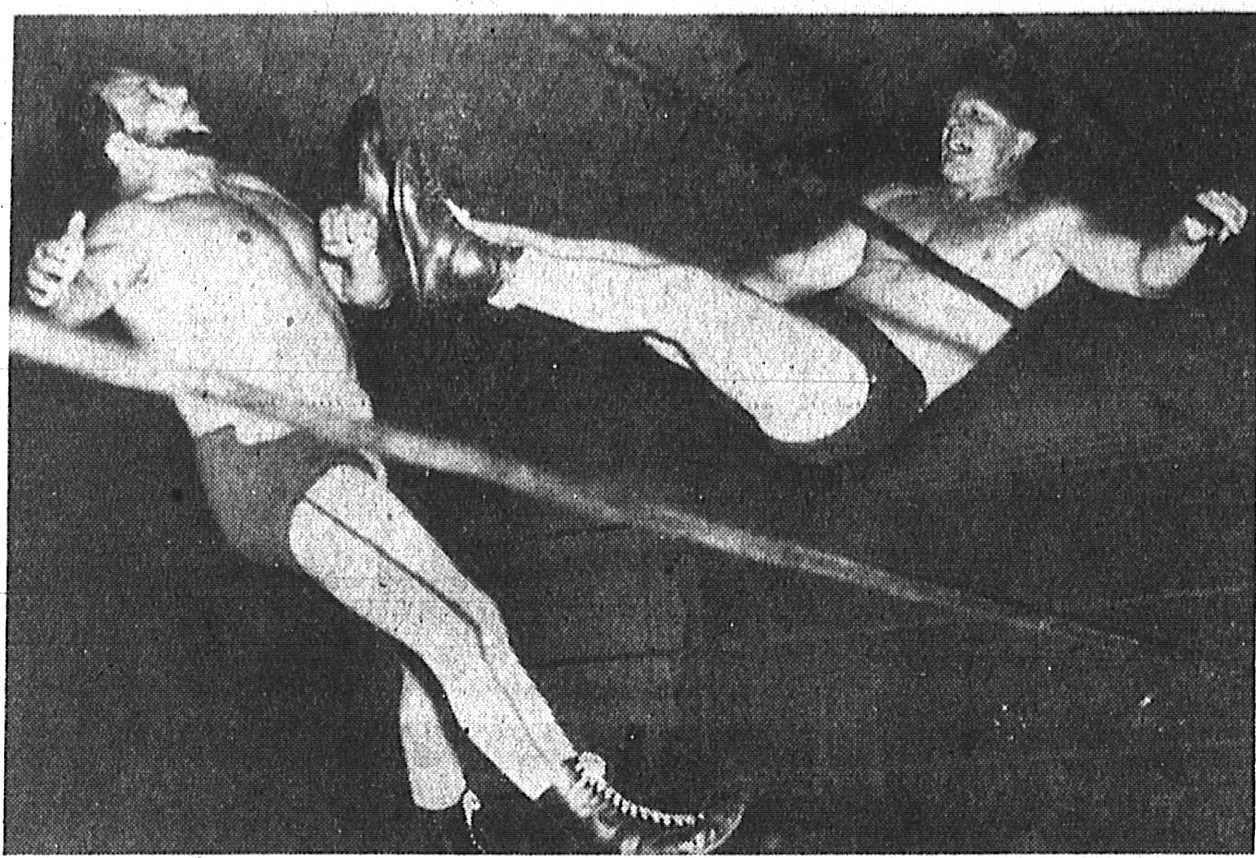
Pro wrestler Ray Gideon applies a flying dropkick to his opponent, Bennie Truesdale, during a March 23, 1950 match at the Torrance Civic Auditorium. Torrance Herald, March 30, 1950, Page 4. (Credit: Torrance Historical Newspaper and Directories Archive database, Torrance Public Library)

Professional wrestling has become such an overheated spectacle in recent decades that it’s understandable that its followers might assume that it’s always been that way.

These days, matches are held in giant arenas all over the world and broadcast via pay-per-view internationally. But in its earlier years, things were very different.

The roots of the sports/entertainment hybrid that is pro wrestling have been traced back to exhibitions that became popular during the post-Civil War era. Traveling carnivals often featured a wrestler who would take on all comers in the ring for a fee.

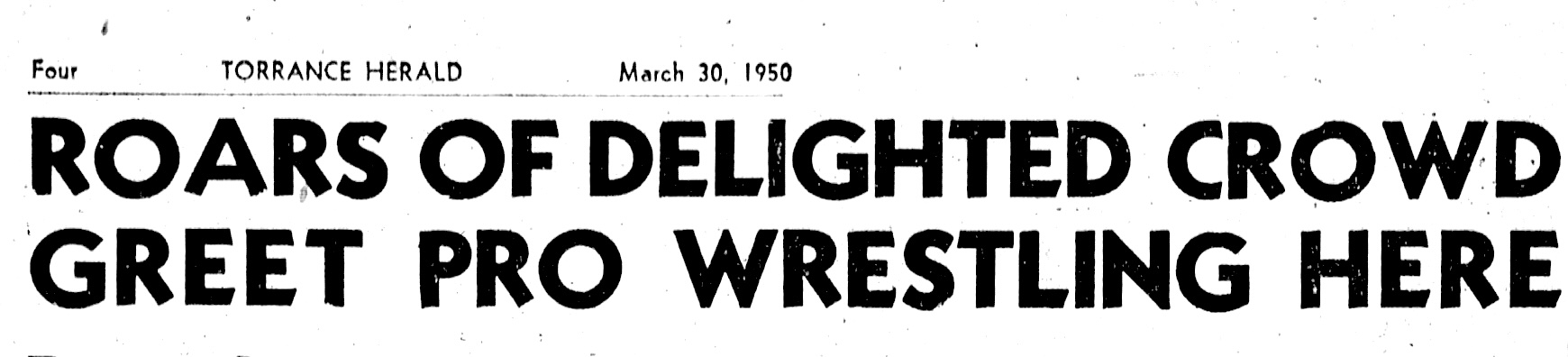
Torrance Herald headline, March 30, 1950. (Credit: Torrance Historical Newspaper and Directories Archive database, Torrance Public Library)

There were plenty of legitimate matches held in wrestling’s early days, but promoters soon realized that honest contests were less popular than fixed matches with clearly defined heroes and villains.

By the early 20th century, the fact that most wrestling matches were fixed had become common knowledge. This knowledge didn’t seem to hurt its popularity. Newspapers regularly ran exposes about pro wrestling, but instead throwing in the towel, its promoters doubled down on fixed matches.

Its managers began fabricating personas and good versus evil story lines. A wide variety of localized wrestling alliances sprung up around the country, setting up the situation where a wrestler could be a black-hearted villain in one area, then move to another area and play a heroic good-guy character there.

Wrestling events in the 1910s and early 1920s in Los Angeles County were held at a variety of venues. They were staged at first mostly in local athletic clubs, then began to graduate into larger venues such as the Shrine Auditorium and the Long Beach Athletic Arena.

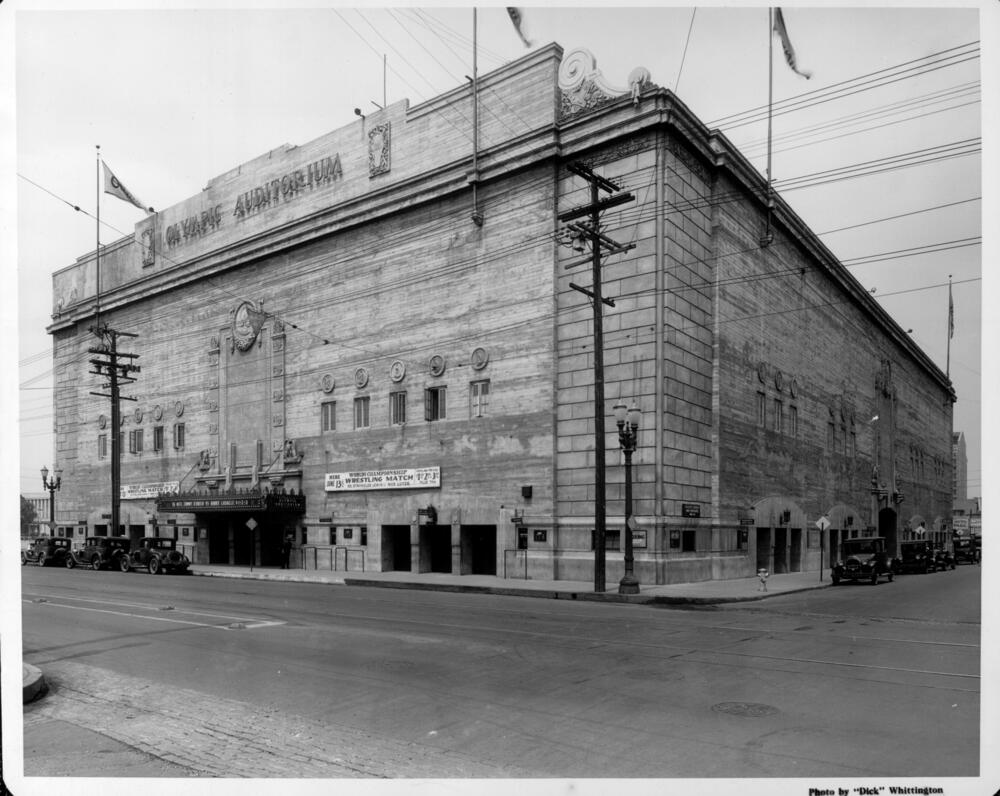
The Olympic Auditorium in Los Angeles advertising an upcoming championship wrestling match. Undated photo circa late 1920s. (Credit: USC Digital Library, Dick Whittington collection)

The 1925 opening of the Olympic Auditorium at 18th St. and Grand Ave. in Los Angeles, just south of downtown, gave wrestling a permanent foothold in the city. Boxing and wrestling would be the Olympic’s bread-and-butter events for decades to come.

But that didn’t keep the suburbs from taking a stab at staging wrestling events, including in the South Bay and Harbor areas.

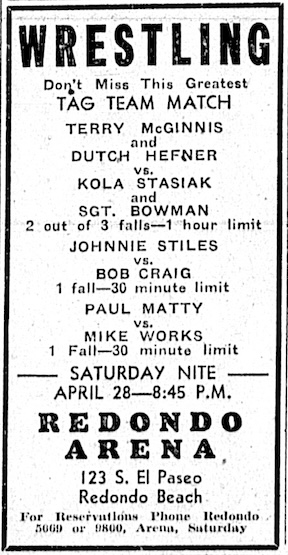
Wrestling matches became a weekly Saturday night feature at the Redondo Arena during the mid-1940s. This facility on El Paseo on the old Redondo waterfront amusement area also was known at various times as the Mandarin Ballroom and the Redondo Barn. 

Torrance Herald ad, April 26, 1945, Page 6-A. (Credit: Torrance Historical Newspaper and Directories Archive database, Torrance Public Library)

Hawthorne resident Ernest “Dutch” Hefner was a popular attraction, wrestling at the Redondo Arena several times in 1944 and 1945. 

Perhaps the most significant local matches were held at the Wilmington Bowl, an indoor arena first built at 909 Mahar Ave. in Wilmington in 1924. (The original building was destroyed by a 1929 fire, and its replacement opened in 1930.)

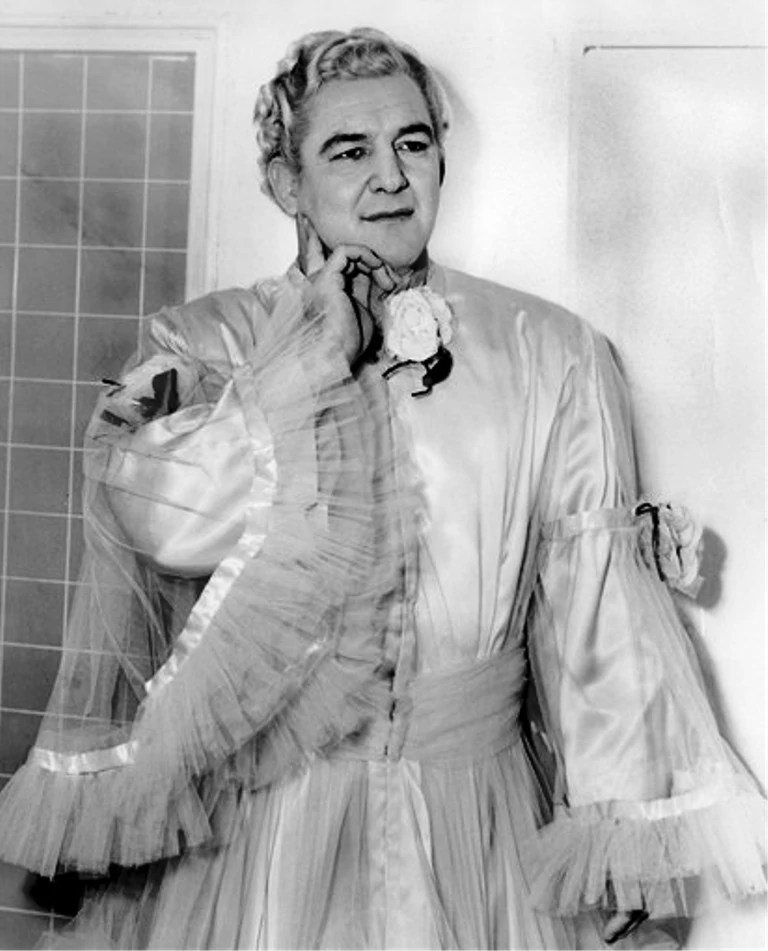
Former champ Joe Louis officiated at a match between the flamboyant legend Gorgeous George and rival Sandor Szabo at the Bowl on April 5, 1949, with George defeating Szabo before a packed house. George wrestled there more than a dozen times between 1947 and 1949.

Other colorfully named wrestlers who grappled during this era at the Bowl included Mr. Moto, the Golden Terror, Mr. X, Jungle Boy, Chief Little Wolf, Lord Blears and Judo Jack Terry. Former boxing champ Primo Carnera and pro wrestling legend Lou Thesz did battle there, as did former UCLA football star-turned actor Woody Strode.

In 1953, promoter Nick Lutze made a deal with KNXT Channel 2 to telecast “International Wrestling,” a regular Saturday wrestling show from the Bowl. It didn’t last, though. The Bowl fell on hard times in 1954 and was closed for good a year later. (The repurposed industrial building still stands.)

Torrance’s dalliance with pro wrestling was more brief and less illustrious, though that it happened at all still surprises.

Torrance Herald, Feb. 23, 1950, Page 5. (Credit: Torrance Historical Newspaper and Directories Archive database, Torrance Public Library)

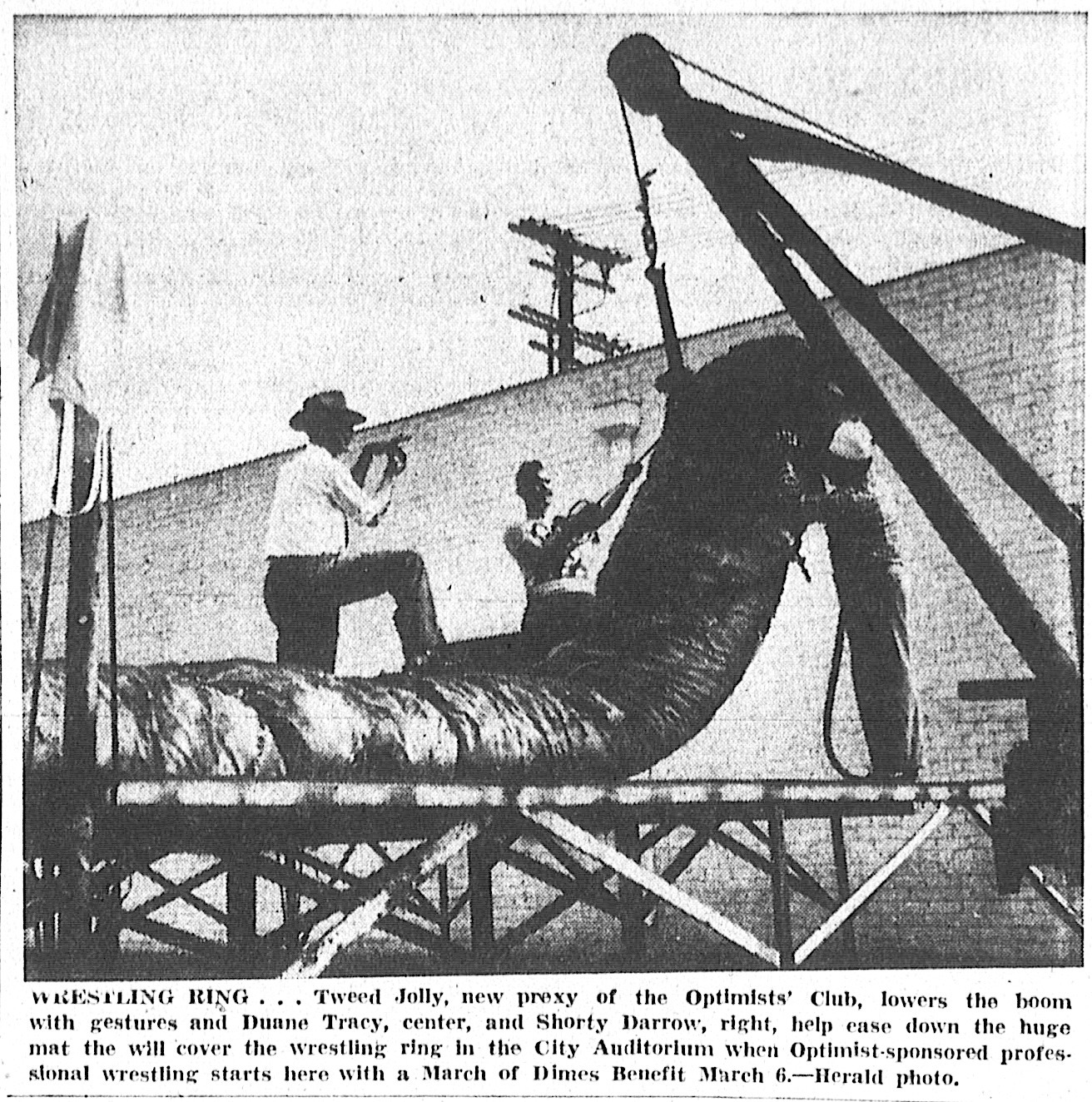
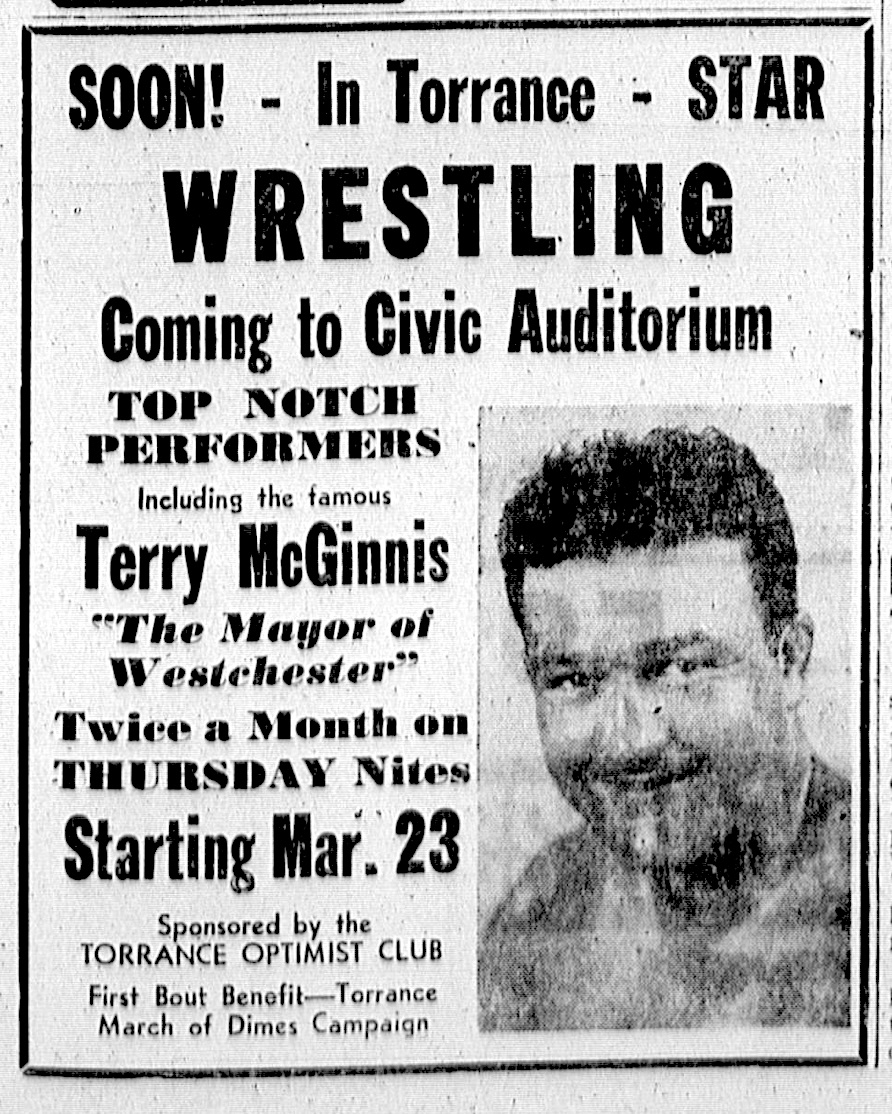
It began with the Torrance Optimist Club, which sponsored the first pro wrestling show in the city at the Civic Auditorium at 1349 El Prado downtown on March 16, 1949. Its proceeds benefited the Torrance area March of Dimes and its fight against polio, then a major public health crisis.

In early 1950, the Optimist Club made another deal with the city to sponsor 6 nights of pro wrestling matches, starting on March 2. The popular events were held every other Thursday at the Civic Auditorium. (The auditorium was demolished in 1971; the South Bay Home Health Care medical supply store now occupies the site.)

The Wilmington Bowl and the Long Beach Wrestling Arena tried unsuccessfully to quash the Torrance wrestling shows. But perhaps pressure from neighboring promoters explains why no further Torrance pro wrestling shows appear to have been held following the 1950 events.

Torrance Herald ad, March 16, 1950, Page 7. (Credit: Torrance Historical Newspaper and Directories Archive database, Torrance Public Library)

For the next few decades, pro wrestling continued to operate on a regional basis, operated by a patchwork of local governing bodies. 

That all changed with the arrival of promoter Vince McMahon, who built a nationwide organization, the World Wrestling Federation (WWF), and brought the sport into the national pay-per-view arena with the first WrestleMania telecast in 1985.

The sport’s popularity exploded, but local and regional wrestling shows became a thing of the past.

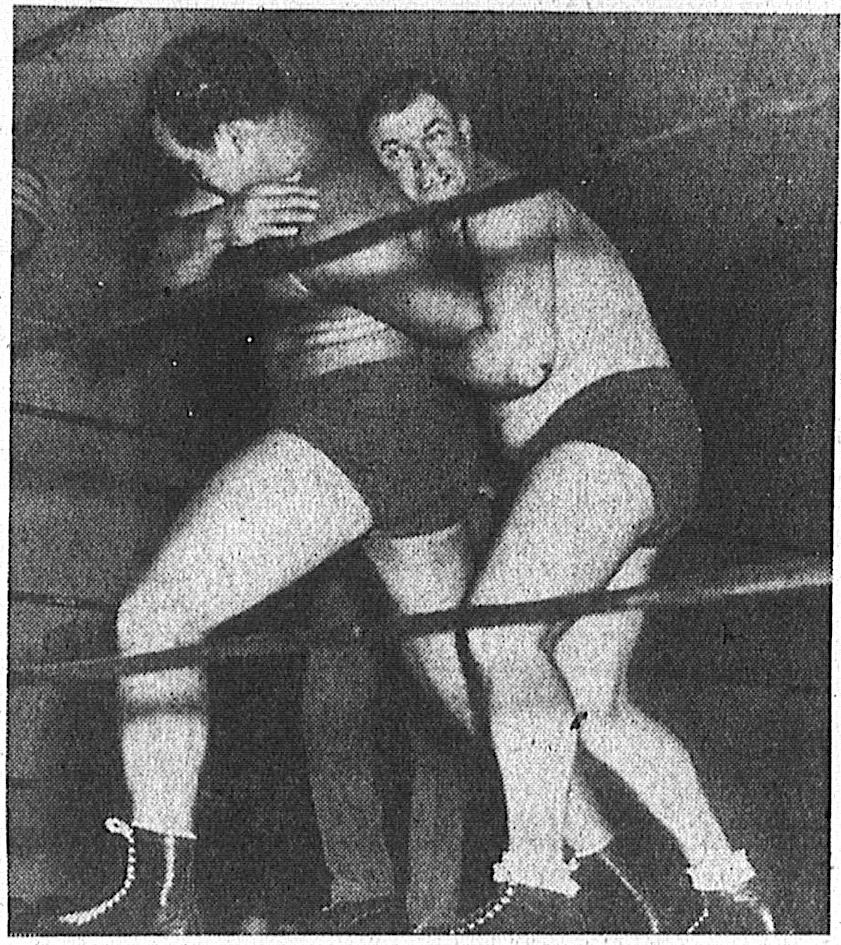
Policeman-turned-wrestler Tex Beal applies a hold to his Hawaiian opponent Leo Kalima at the Torrance Civic Auditorium on March 23, 1950. Torrance Herald, March 30, 1950, Page 4. (Credit: Torrance Historical Newspaper and Directories Archive database, Torrance Public Library)

Sources:

“The History of Los Angeles Pro Wrestling,” by Steve Yohe et al., Wrestling Classics website, April 6, 2018. (An incredible piece of research listing wrestling matches in Los Angeles dating back to 1911.)

Los Angeles Times archvies.

Redondo Reflex archives.

Torrance Press-Herald archives.

Wikipedia.

Wilmington Press Journal archives.

Flamboyant grappler Gorgeous George wrestled many times at the Wilmington Bowl and lived for a time in Hawthorne. Undated photo circa late 1940s. (Credit: Today in Pro Wrestling History Facebook page)

The Fox Theatre was the Palos Verdes Peninsula’s first movie palace

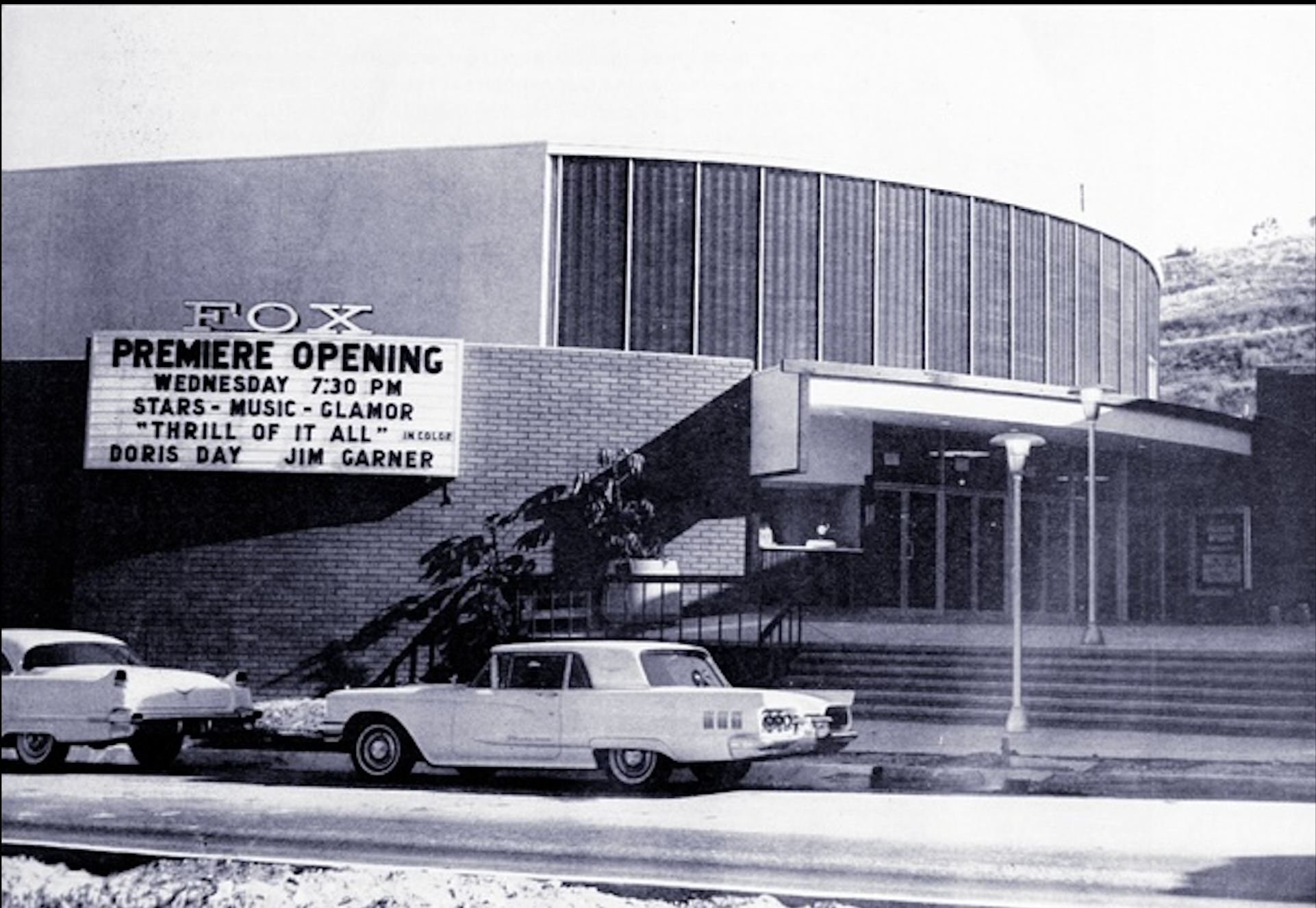
The Fox Theatre Palos Verdes marquee promotes its upcoming grand opening in this circa July 1963 photo that also includes a 1960 Ford T-Bird parked out front. (Credit: Cinema Treasures website)

The carefully planned development of the Palos Verdes Peninsula that began to be implemented in the early 1920s did not include any shopping centers.

The Peninsula’s first commercial area in Malaga Cove Plaza had a few small stores that fit the character of the semi-rural community of Palos Verdes Estates, which would become the Hill’s first incorporated city in 1939.

But, by the 1950s, suburban housing developments had blanketed much of the Peninsula, and the need for more localized shopping – like maybe a supermarket and a department store or two –  began to be keenly felt by its growing number of residents.

In 1953, the initial plans for the Peninsula’s first modern shopping center, the outdoor Peninsula Center, were drawn up by the architectural firm Victor Gruen & Associates. 

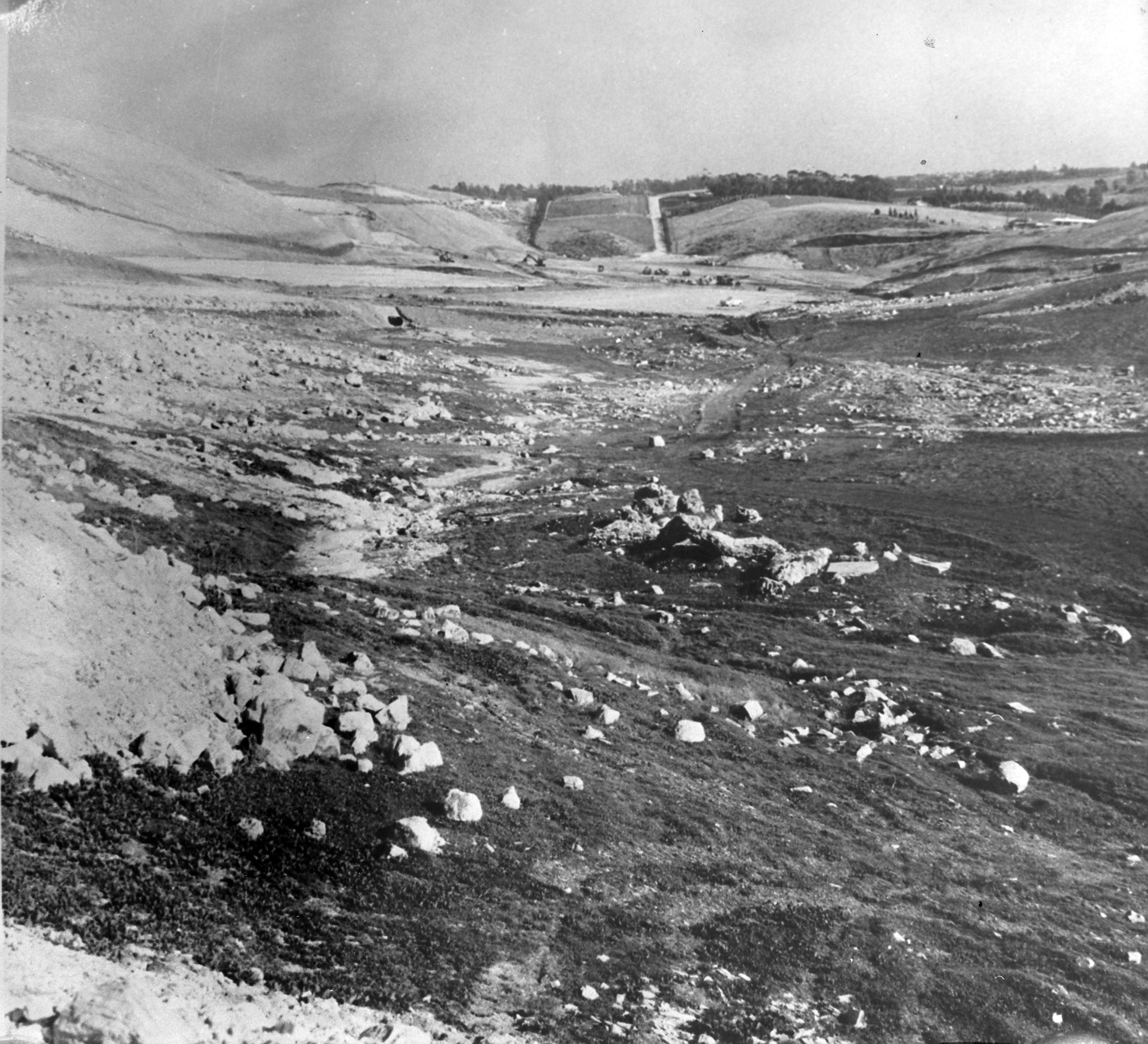
The land where Peninsula Center would be built as it was in 1959, looking east toward Rolling Hills. (Daily Breeze file photo)

The 112 acres of empty land on which Peninsula Center construction began in 1960 was located in Rolling Hills Estates, which had incorporated in 1957. The Center, which eventually would include larger stores such as J.J. Newberry, Buffum’s and a Lucky supermarket, opened in stages during the first half of the decade.

Peninsula Center plans also included another first: the area’s first movie theater. No longer would parents have to schlep their kids down into the flatlands of Torrance and Redondo Beach for a day at the movies.

National General Corp., the movie theater division of the 20th Century Fox film studio, announced plans to build the Fox Theatre Palos Verdes in 1961. Its site between Drybank and Roxcove drives was Silver Spur Rd., just east of the new Peninsula Center. Silver Spur quickly would become the main commercial artery in Rolling Hills Estates.

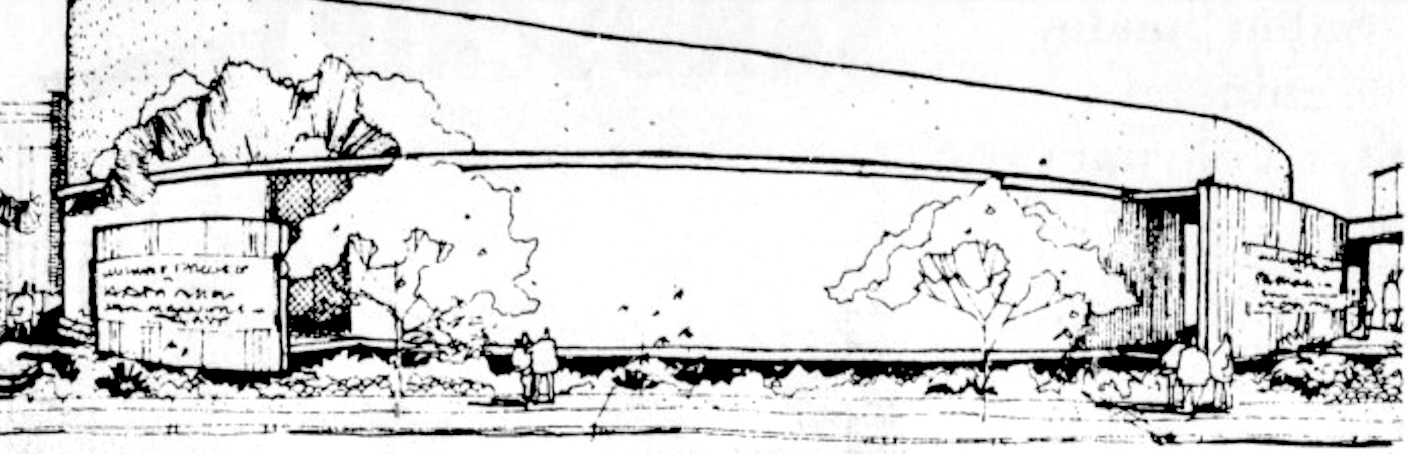
Rendering of the planned Fox Theatre Palos Verdes. Palos Verdes Peninsula News, Jan. 24, 1963, Page 3. (Credit: Palos Verdes Peninsula News archives)

Normally, National General used its own architects, but, in this case, Palos Verdes Estates architect Carver L. Baker was hired to design the new theater at 735 Silver Spur. Los Angeles-based contracting firm Sheldon L. Pollack Construction won the bid to build the new cinema showplace.

Baker’s design called for a circular building to house the 60-by-30 foot screen. The $450,000  theater contained 874 seats. The concessions stand and a lobby area were situated to the right of the entrance, with an enclosed lounge located along the left interior curve of the theater building.

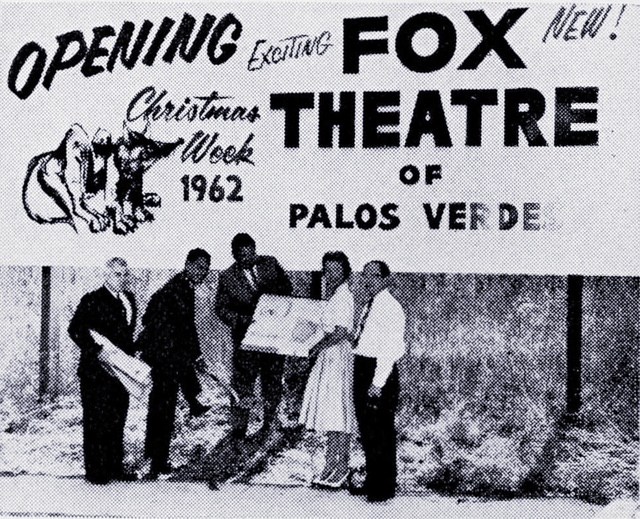
The 1962 groundbreaking for the Fox Palos Verdes Theatre. Architect Carver L. Baker, far left, holds his architectural drawings. Others are unidentified. The sign’s optimistic opening date didn’t happen for another eight months. (Credit: Cinema Treasures website)

State-of-the-art projection equipment, including an Ampex four-track sound system, was installed along with a 50-ton air conditioning plant, according to the Palos Verdes Peninsula News. On Aug. 2, 1963, the newspaper began selling tickets to opening night at the new Fox venue for $1.25 each.

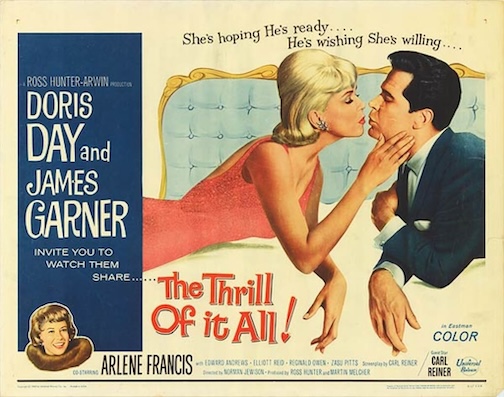
The grand opening was held on Wednesday, Aug. 7, 1963, and it was a doozy. Searchlights scanned the night sky, and the stars came out in force to see the premiere of “The Thrill of It All,” a fluffy domestic romantic comedy starring James Garner and Doris Day and directed by Norman Jewison.

Well-known KMPC disc jockey Ira Cook introduced the luminaries in attendance. They included local celebrity resident Rosemary de Camp and a host of other stars.

Lobby card for “The Thrill of it All.”
The biggest of them was Charlton Heston, whose films at the time had earned the most money of any movie star in Hollywood history. During his brief surprise appearance, Heston told the crowd, “Jim Garner and I have a deal: He comes to all my openings and I come to all his.”
The Peninsula News also documented the appearance of several other stars: character actor Chill Wills, Disney child star Tommy Kirk and the pre-”Kojak” Telly Savalas, who had been nominated for an Oscar for his supporting role alongside Burt Lancaster in “Birdman of Alcatraz.” 

A host of other lesser-known actors and actresses appeared, including a 22-year-old Tony Bill. The actor-director would later produce 1974 Best Picture winner “The Sting,” and act in “Shampoo” and many other films.

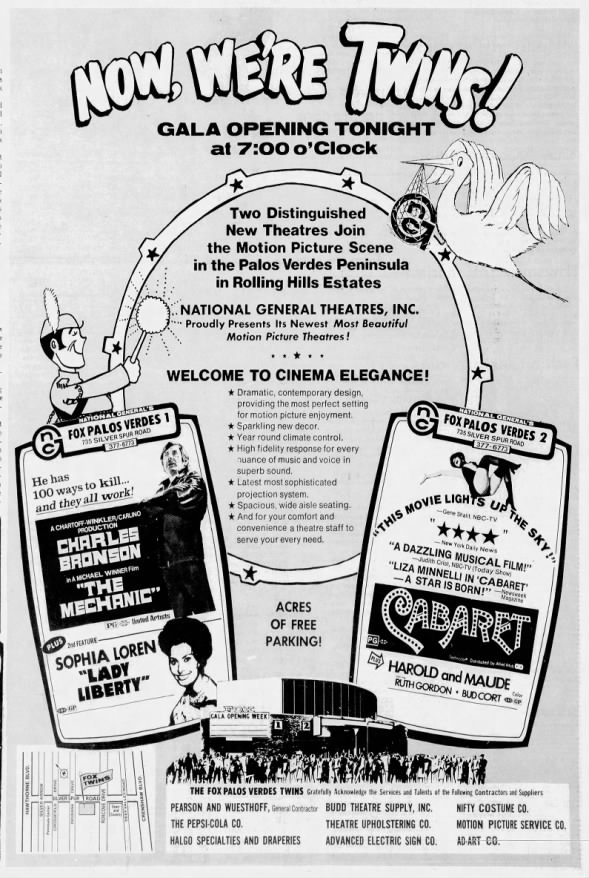
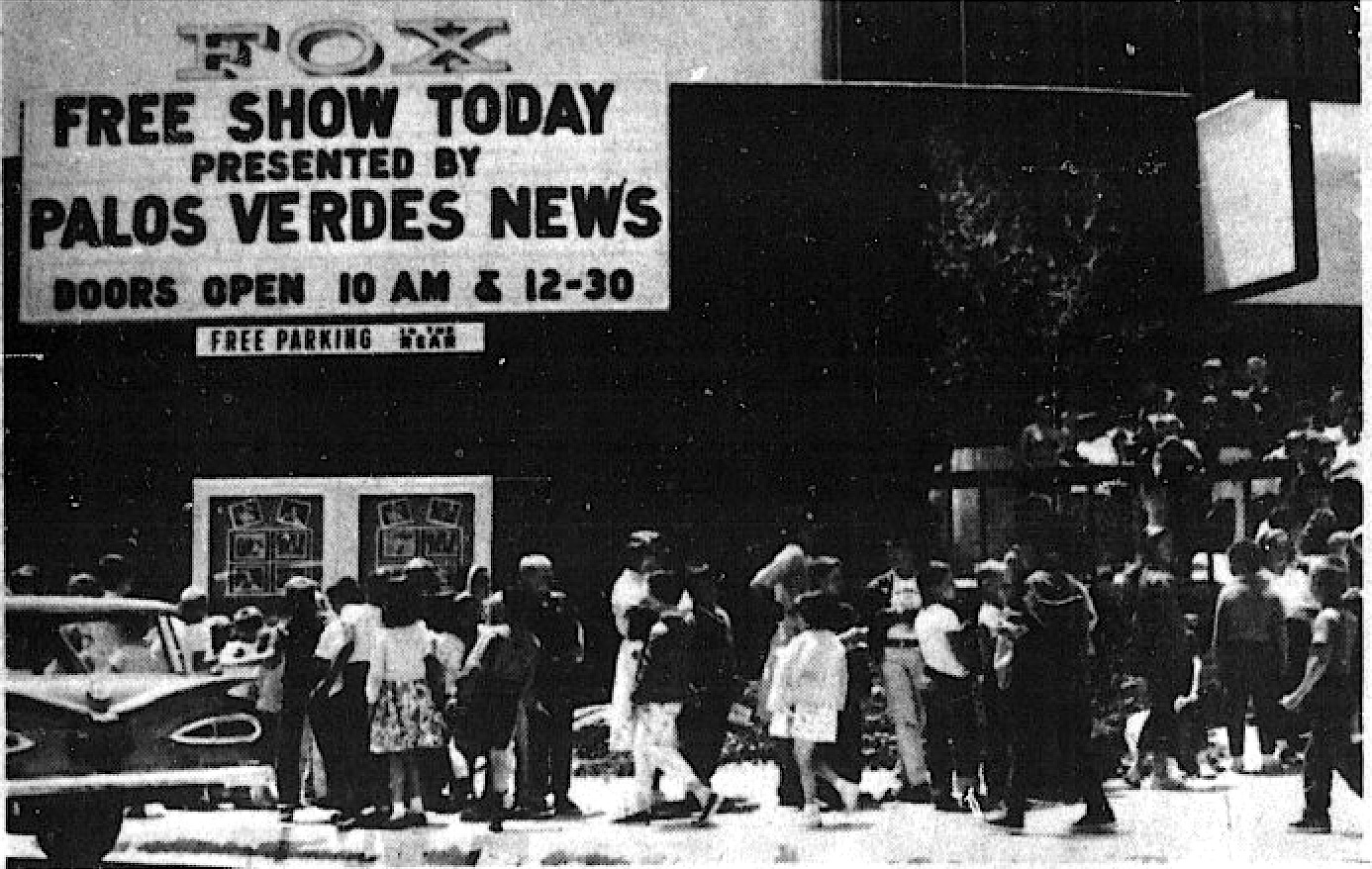
The theater screened first-run films, and also scheduled well-attended weekly free children’s matinees. Nine years after it opened, National General joined a nationwide trend by remodeling the Fox Theatre into the Palos Verdes 1 and 2 twin theaters.

The twin theaters struggled during the 1970s. The complex became part of the Mann Theaters chain before finally closing in 1979. In August 1980, Ray Jacobs won permission from the Rolling Hills Estates City Council to open the Rolling Wheels Roller Rink on the site.

Children line up for a free screening at the Fox Theatre Palos Verdes. Palos Verdes Peninsula News, June 25, 1964, Page 26. (Credit: Palos Verdes Peninsula News archives)

Jacobs completely gutted the theater, installing a 9,000-square-foot rink capable of accommodating 500 skaters. His business fell off with the 1981 opening of the Ice Capades Chalet ice  skating rink next door at the new Courtyard Mall. The roller rink eventually closed in the mid-1980s, probably around 1985.

Next up came the Palos Verdes Gymnastics Club, opened by Palos Verdes High gymnastics coach Jim Mitchell. It operated from 1986 until the mid-1990s before closing.

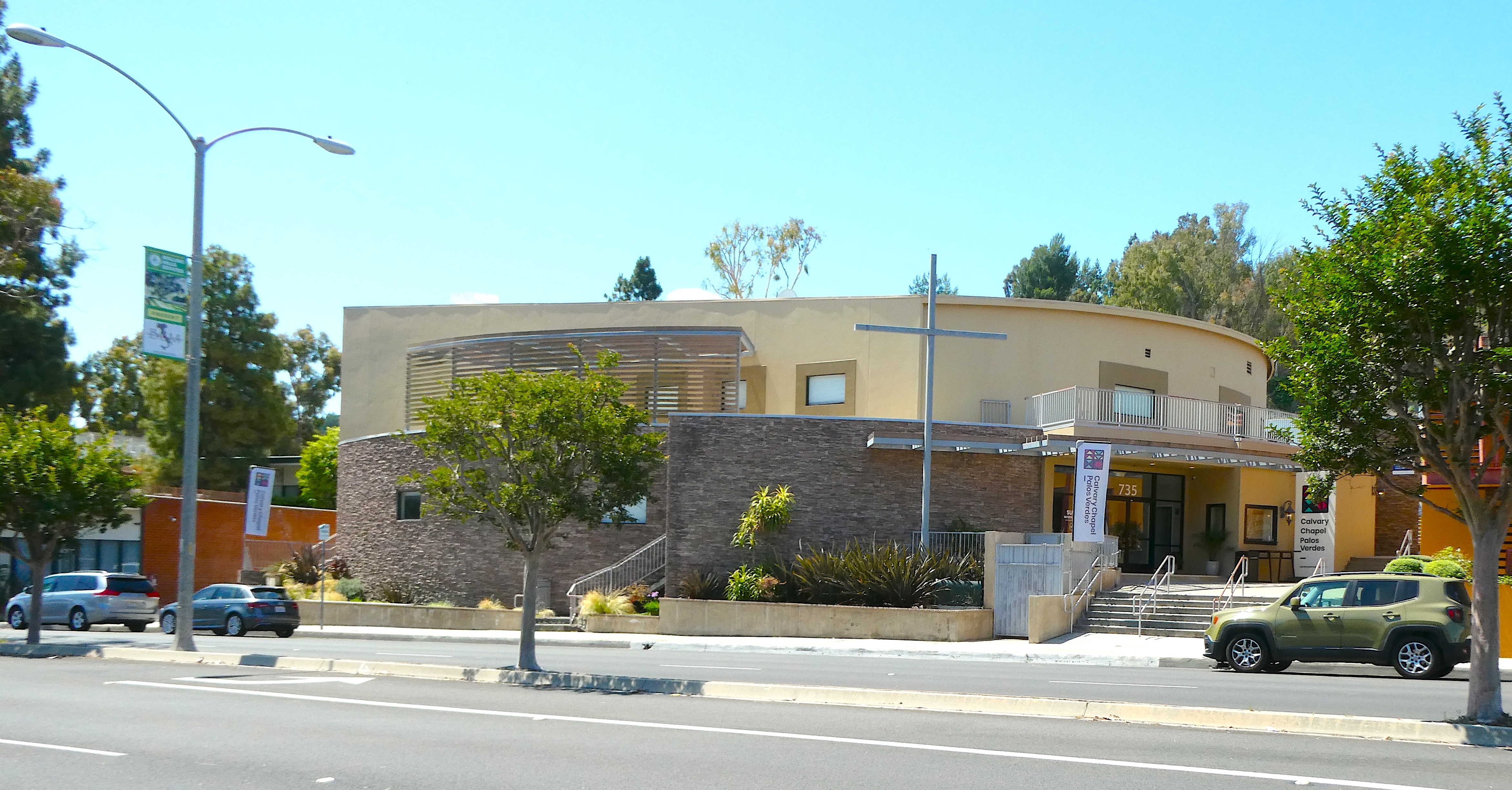
In 1996, the building reopened in its new guise as a place of worship when the Every Nation Church began holding services there. Every Nation moved to Tennessee in 2006, selling the property to Rolling Hills Covenant Church.

Covenant Church later became Calvary Chapel, which currently holds services at the former movie theater, now renamed Calvary Chapel Palos Verdes.

The Calvary Chapel Palos Verdes church now operates in the former Fox Theatre Palos Verdes building that opened in 1963. (July 2024 photo by Sam Gnerre)

Sources:

Cinema Treasures website.

Daily Breeze archives.

Los Angeles Times archives.

Palos Verdes Peninsula News archives.

Palos Verdes Peninsula News ad, Nov. 22, 1972, Page 3. (Credit: Palos Verdes Peninsula News archives)

The 1930s jitterbug craze had South Bay youths dancing all over the place

Dance historians who research such things credit American jazz singer and bandleader Cab Calloway for coining the term “jitterbug.” In 1934, he recorded a lively tune, “Jitter Bug,” that some credit for kick-starting an energetic dance craze that swept the nation.

Here’s a clip of the song from Calloway’s 1935 short film, “Jitterbug Party”:

The dance was a variation on the Lindy Hop, which originated in Harlem in the late 1920s and was named for aviator Charles Lindbergh. The jitterbug also incorporated elements of the Charleston and an earlier dance called the Texas Tommy, which originated in San Francisco.

All of these dances included a move called the breakaway, in which the partners separate from each other, usually exuberantly, before being reunited and continuing the dance. The jitterbug carried these breakaway maneuvers to increasingly frenetic extremes.

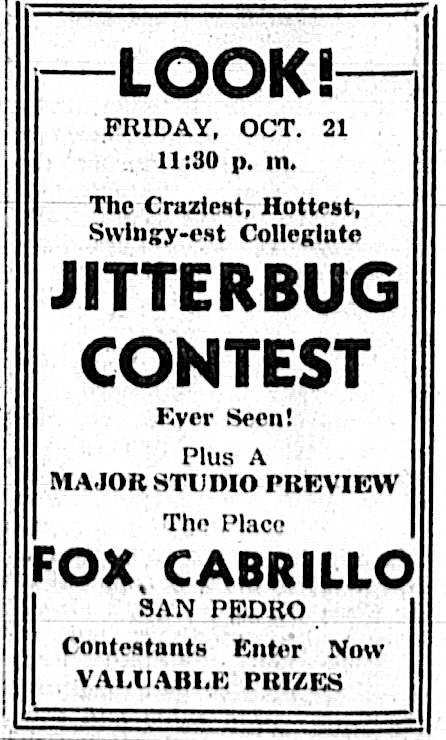
Torrance Herald ad, Oct. 13, 1938, Page 2-B. (Credit: Torrance Historical Newspaper and Directories Archive database, Torrance Public Library)

The rising popularity of swing music played by the 1930s big bands of Benny Goodman and his ilk fueled the fad. The jitterbug derived from swing dancing, but had its own highly energetic vibe. The extent to which it caught on in popular culture was remarkable, despite early attempts by outraged civic guardians of decency to ban it, mostly in the Midwest and, later, in England.

After 1935, the dance gradually started to spread from the big-city ballrooms to smaller cities and towns, as a look through news stories of the day illustrates.

Jitterbug contests begin popping up everywhere. Movie theaters became especially tuned into the craze, holding regular jitterbug contests in addition to showing films. The Fox Cabrillo in San Pedro, the Torrance Theatre, the Strand Theatre in Redondo Beach and the Gardena Theatre  were among the local venues holding regular weekly dance contests during the late 1930s.

Fraternal and veterans organizations also began hosting contests at such venues as the Masonic Temple in Wilmington, the Bert Crossland American Legion Hall in Torrance and the Regular Veterans Association Fleet Reserve Club in San Pedro.

Jitterbugging also was featured regularly at the Mandarin Ballroom at the old Redondo Beach Pavilion on El Paseo. The Mandarin, one of the South Bay’s primary live music venues during the era, had long hosted swing bands, so the dance competitions were a natural addition. The jitterbug contests continued there into the wartime years.

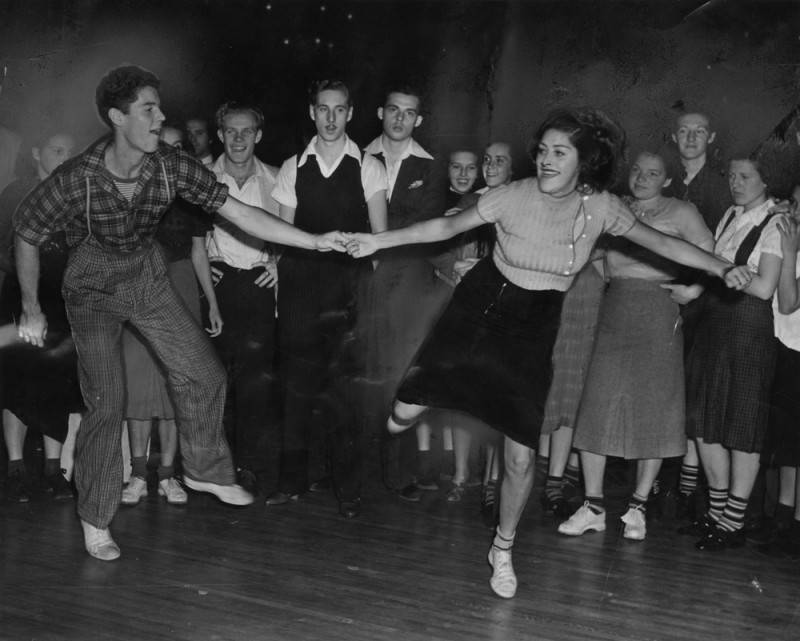
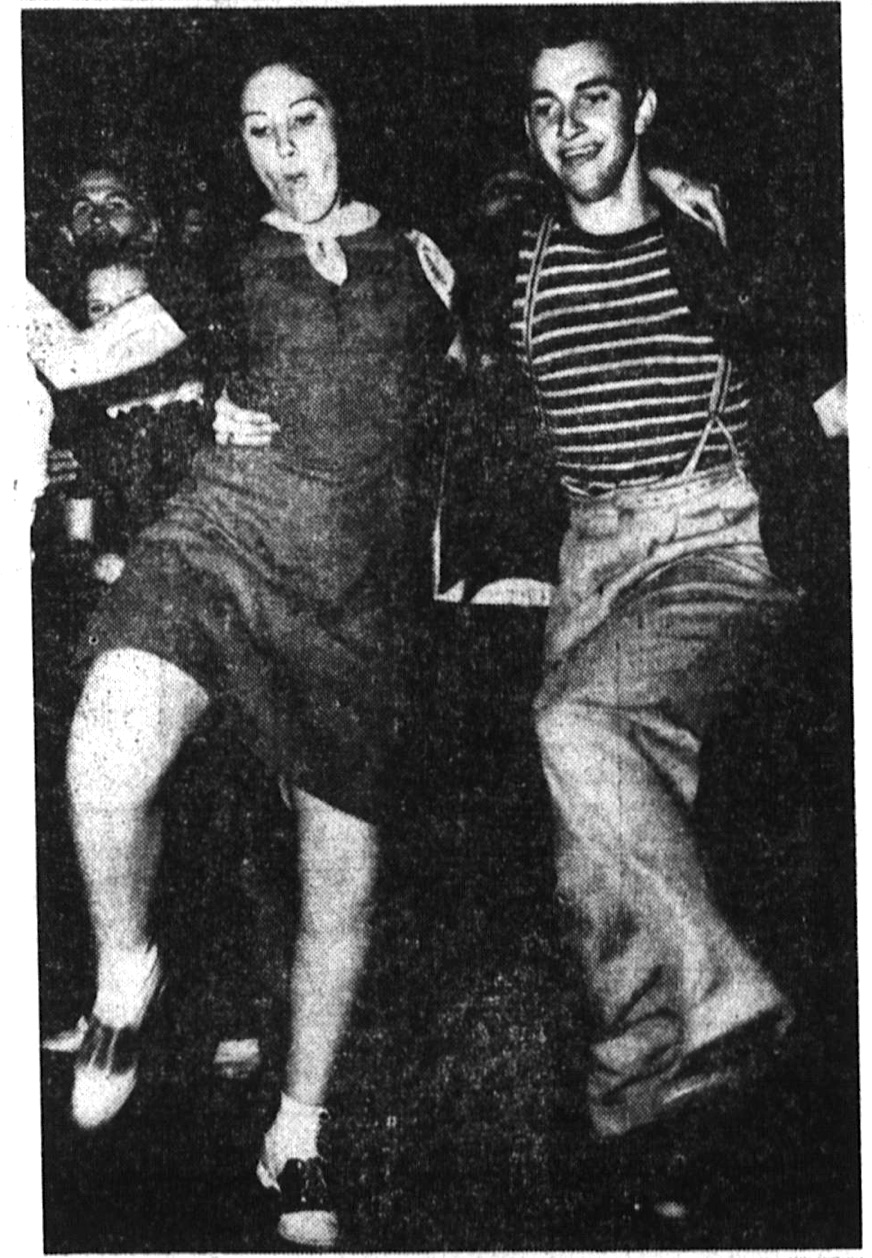
 Taylor Gronen and Ellen Leon, of Los Angeles, are shown in a breakway step while fellow dancers admire their finesse and rhythm. 1938 photo. (Credit: Los Angeles Public Library Photo Collection)

Public community events became host to some of the biggest jitterbug competitions. They became part of large store grand openings and community fairs and gatherings of all types.

In 1937, the city of Torrance decided to start a citywide community event celebrating the firms that made up its strong industrial base. It planned a jitterbug contest to be part of its first Factory Frolic celebration in 1937.

The contest was staged at the new Torrance Civic Auditorium, which had held its grand opening just a year earlier. (It was demolished in 1971.) It proved so popular that it returned to even larger crowds and more participants during the 1938 Frolic.

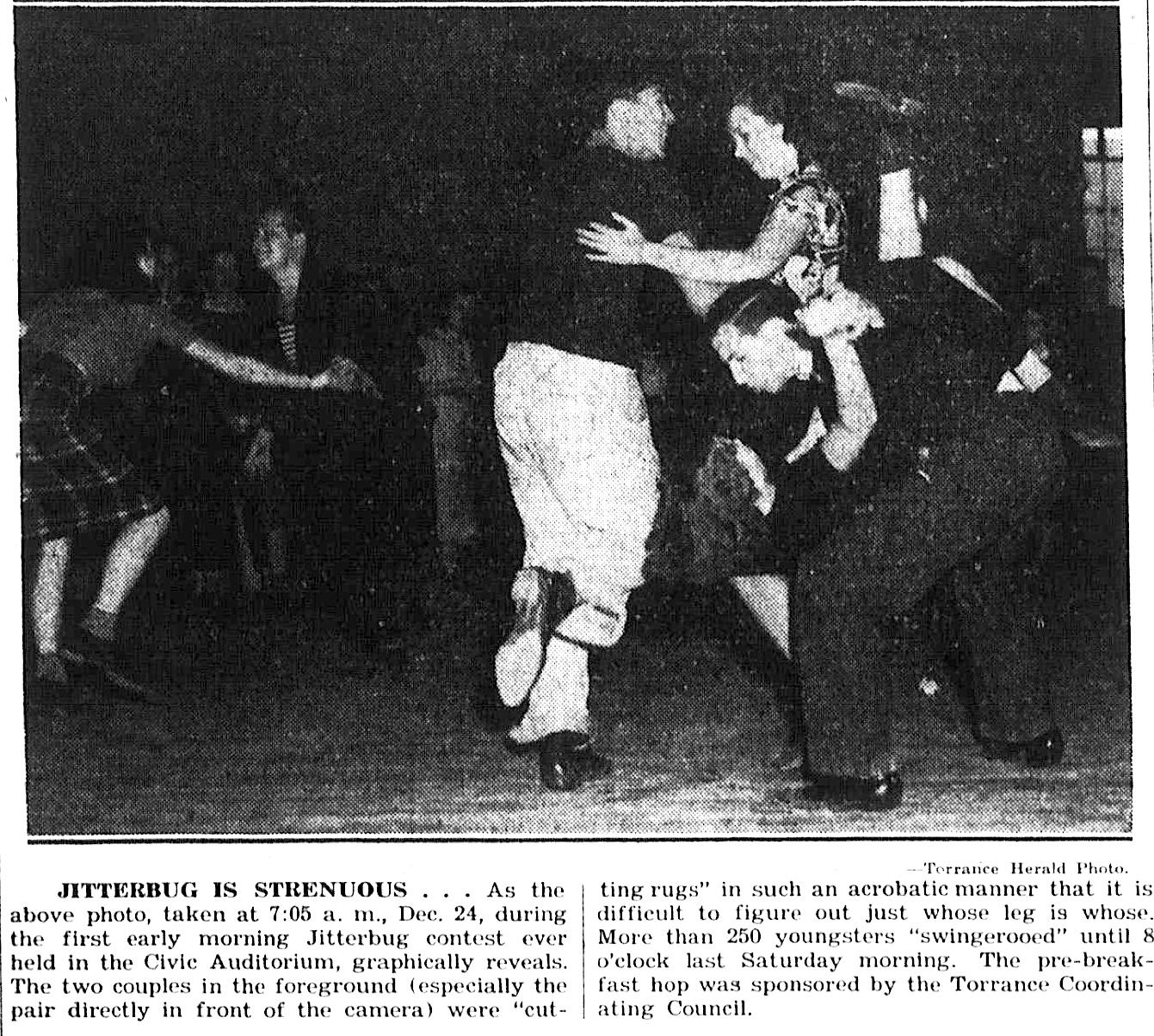
After that, regular independent jitterbug contests began to be held at the Civic Auditorium. The Torrance Herald sent veteran reporter Michael Straszer to one such event that was held on Christmas Eve in 1938 between 6 and 8 a.m. in the morning.

Torrance Herald, Dec. 29, 1938, Page 1. (Credit: Torrance Historical Newspaper and Directories Archive database, Torrance Public Library)

Straszer estimated that about 250 people, mostly teens, participated, or “swingerooed,” as he put it. The bemused reporter observed:

“They were having a wonderful time, but I fairly creaked as I tried to visualize myself out on the floor cavorting in the best ‘rug-cutting’ manner with some of those acrobatic damsels.”

The jitterbugging mania may have peaked in the Southern California area with the arrival of a giant jitterbug competition held in the Los Angeles Coliseum on June 18, 1939.

With swing bandleaders Artie Shaw and Kenny Baker providing the musical impetus, an estimated 500 participants competed for a $500 first place prize before 25,000 fans. According to the Los Angeles Times, spectators rushed the temporary dance floor set up on the athletic field after the contest ended to do their own jitterbugging.

Jitterbug dancers Hal Chavoor and Betty Roeser, Pacific Coast champions, perform in Los Angeles in 1939 as fellow swingsters admire them. (Credit: Los Angeles Public Library Photo Collection)

World War II put a damper to such widespread public frivolity, though swing bands and swing dancing remained popular into the late 1940s.

But tastes began to change with the growing popularity of crooning vocalists in the Frank Sinatra mold. Western swing bands also began to draw large crowds to “barn dances” in the late 1940s and early 1950s, many of them held at the Mandarin Ballroom.

The rise of rock ‘n’ roll in the 1950s brought about vigorous dancefloor cavorting that owed large debts to jitterbugging and swing dancing, though its participants deemed swing music itself as being hopelessly square.

By then, jitterbugging already had become a quaint fad viewed with nostalgia. But that’s no reason to discount its onetime massive popularity and its enduring influence.

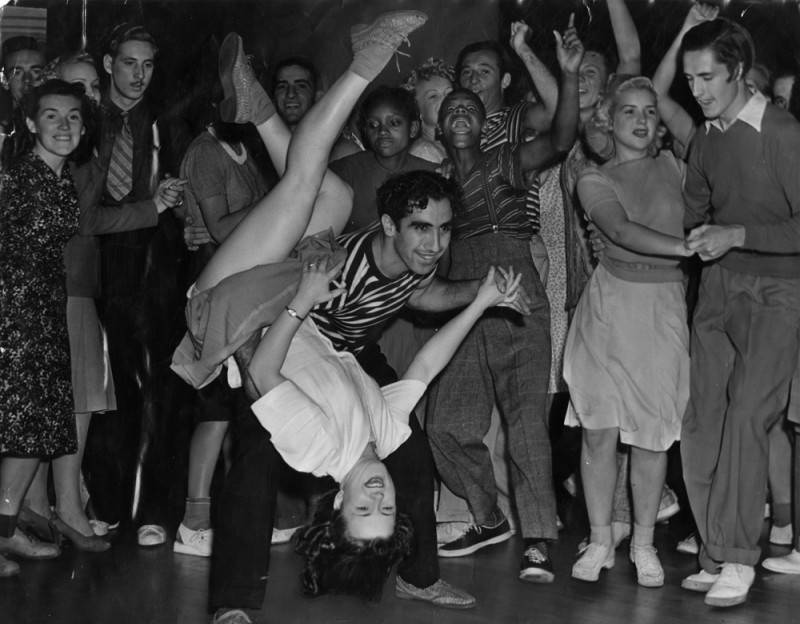
Torrance Factory Frolic Jitterbug contest winners Rosemary Wilson of Los Angeles and Eddie Zeutan of South Gate won $20 for steps such as these. Torrance Herald, Oct. 5, 1939, Page 1. (Credit: Torrance Historical Newspaper and Directories Archive database, Torrance Public Library)

Sources:

“Exploring the Jitterbug – The Dance That Divided Britain in the 1940s,” by Rose Staveley-Wadham, The British Newspaper Archive Blog, Jan, 10, 2024.

Los Angeles Times archives.

San Pedro News Pilot archives.

Torrance Press Herald archives.

Wikipedia.

The Alameda Corridor project took an old idea and made it better

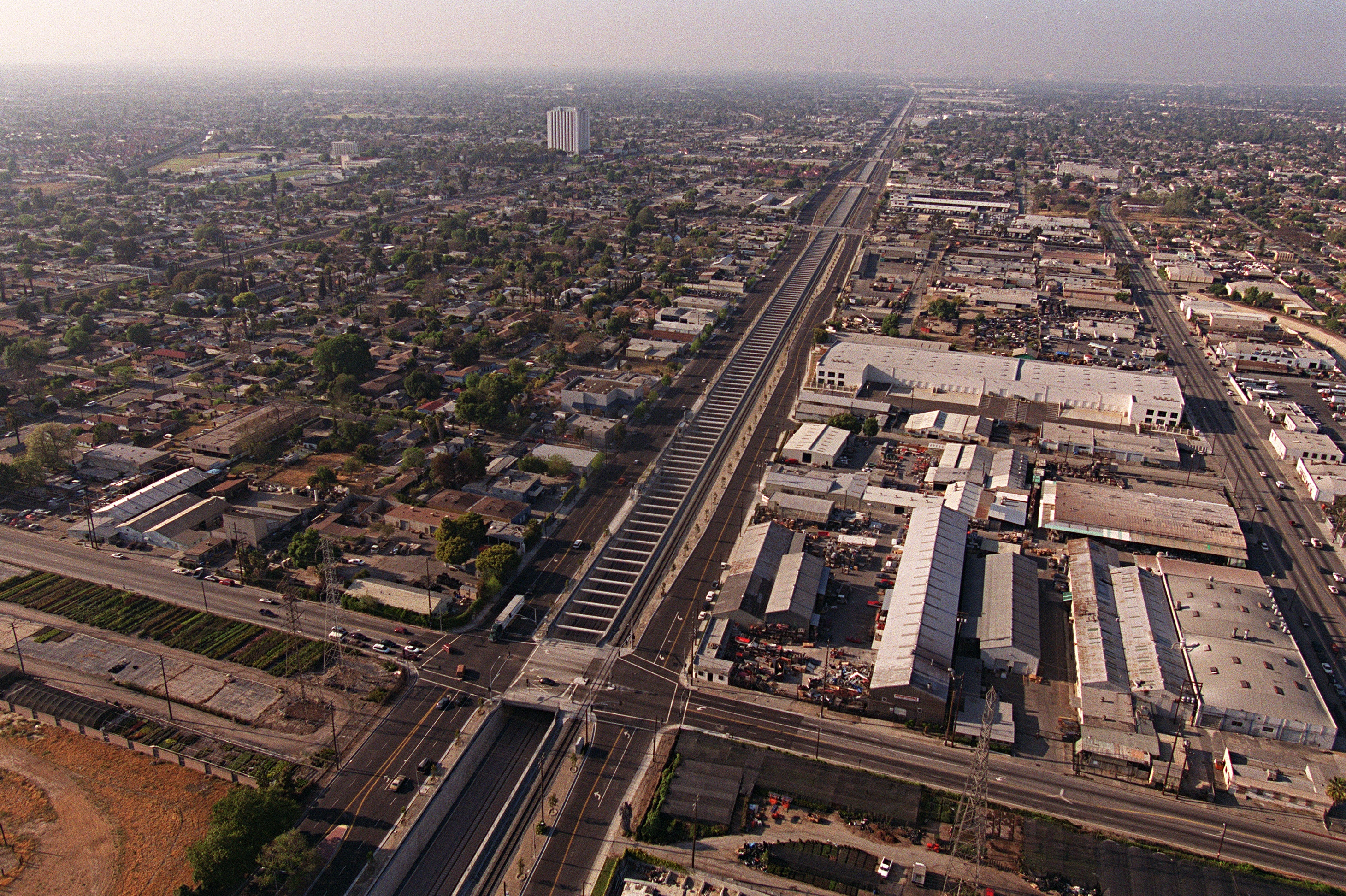
North-facing view from just above the 91 Freeway shows the Mid-Corridor Trench section of the Alameda Corridor project as it passes through Compton. Trains descend into the 10-mile-long, 33-foot-deep trench, separating them from roadway traffic. April 4, 2002. (Daily Breeze staff file photo by Jeff Gritchen)

The concept behind the $2.4 billion Alameda Corridor project isn’t altogether new.

A year ago, I wrote about the Los Angeles & San Pedro Railroad, built by Phineas Banning in 1868. It became Southern California’s first railroad, connecting Banning’s port at Wilmington to the downtown Los Angeles rail yards. Goods, including lumber and other construction materials,  could now move more efficiently from the port to the burgeoning metropolis.

In those days, there wasn’t much civilization along the 21-mile route, but a century or so later, that all had changed. The railroad lines feeding to and from the port now passed through a densely populated thicket of cities and towns

As development along the route intensified, the railroads, now operated by Union Pacific and Burlington Northern/Santa Fe (BNSF), faced challenges. 

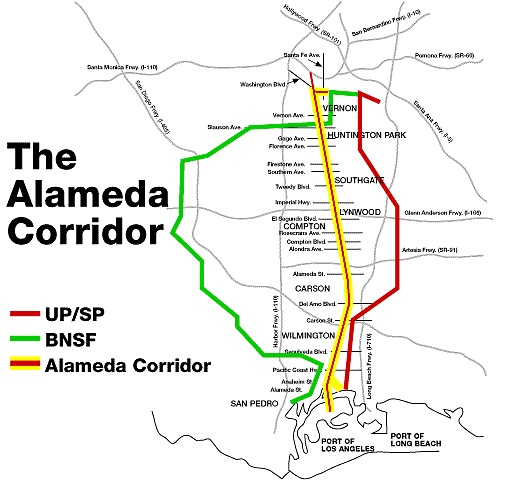
Map shows the path of the Alameda Corridor highlighted in yellow, center. (Credit: Union Pacific website)

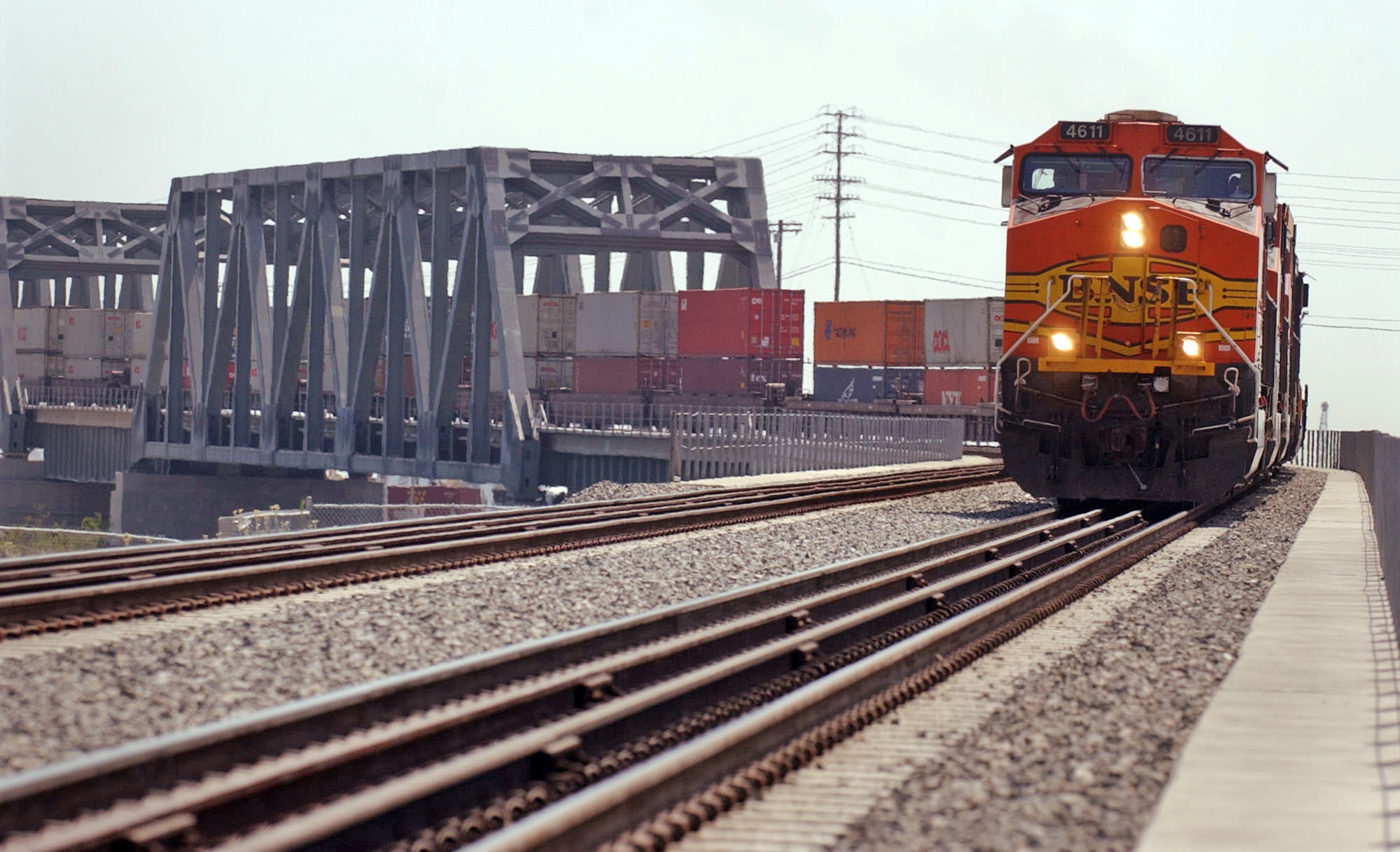
Trains laden with intermodal containers ran along the same general route as Banning’s railroad, roughly following Alameda St. north to Los Angeles. Their progress was slowed by 209 ground-level intersections with local street traffic.

In return, the incessant parade of freight trains, some more than a mile in length, snaking their way northward to the central Hobart rail yard near Vernon caused daily traffic congestion. The slow-moving trains and idling auto engines waiting for them to cross also increased air pollution on streets all along the rail lines. The problem was especially severe in the Harbor Area.

Principals of the various government and corporate entities involved, including the railroads, cities and ports, began to take steps to find a solution in 1981, when the Southern California Association of Governments (SCAG) formed the Ports Advisory Committee to study the problem.

Its various panels and task forces began coming to the same conclusion: a central, dedicated unified rail route that would cut travel times and eliminate above-grade road crossings was a necessity. They also agreed that the Alameda route was their best option.

Such a massive undertaking would involve not only a boatload of money, but also cooperation among private and public organizations. To that end, the Alameda Corridor Transportation Authority (ACTA), was added to the alphabet soup of agencies involved in the project. It was formulated as a joint powers authority, an organizing principle that puts governing bodies from different areas together to work on large projects spanning multiple jurisdictions.

ACTA included representatives from the main players involved: railroad executives, officials from the cities along the route and representatives from the ports of Los Angeles and Long Beach. Its members spent much of the 1990s obtaining various parcels of land needed, working to consolidate the various branch rail lines into one unified route, planning and designing that route, and attempting to obtain funding for the massive undertaking.

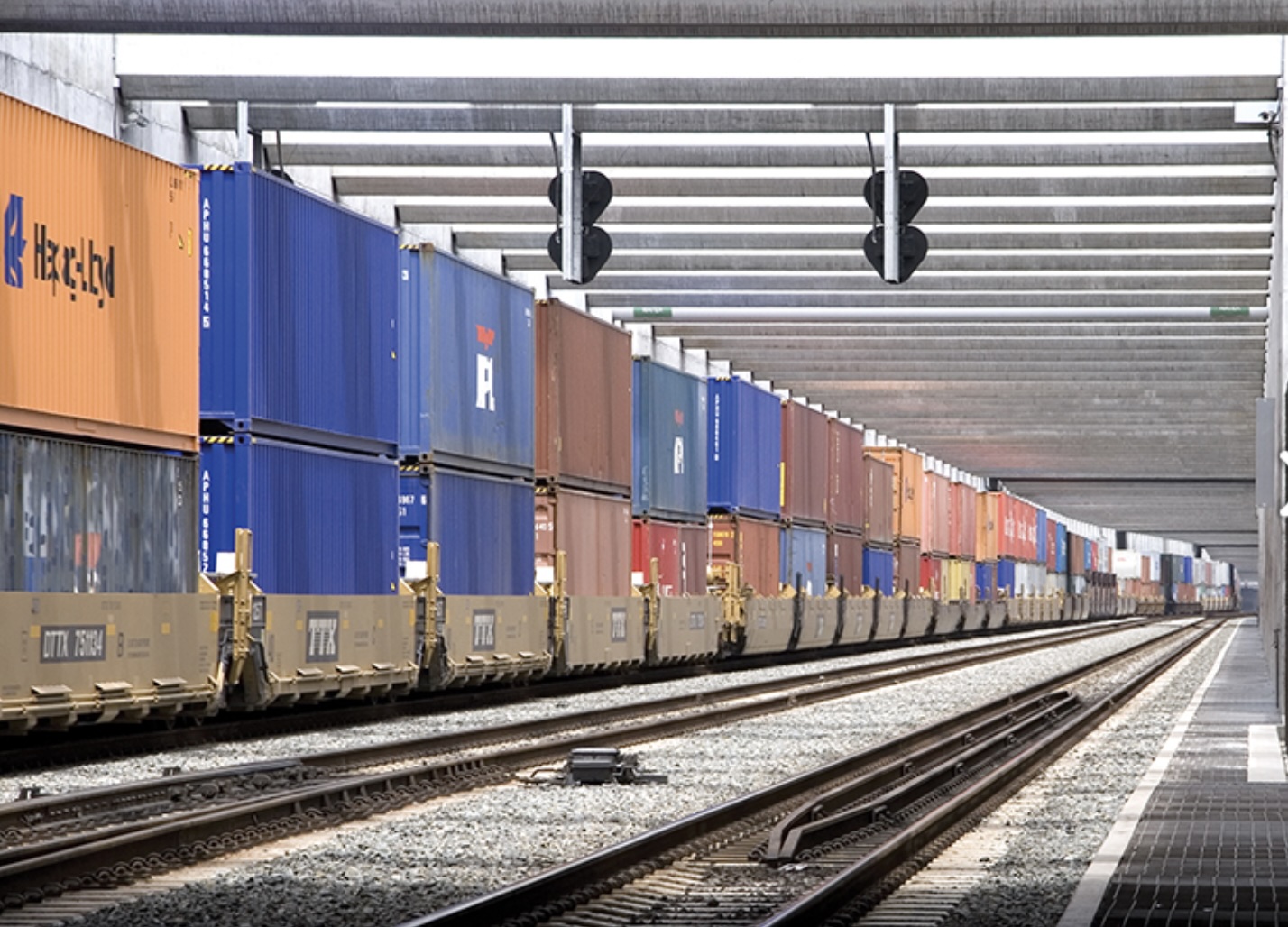
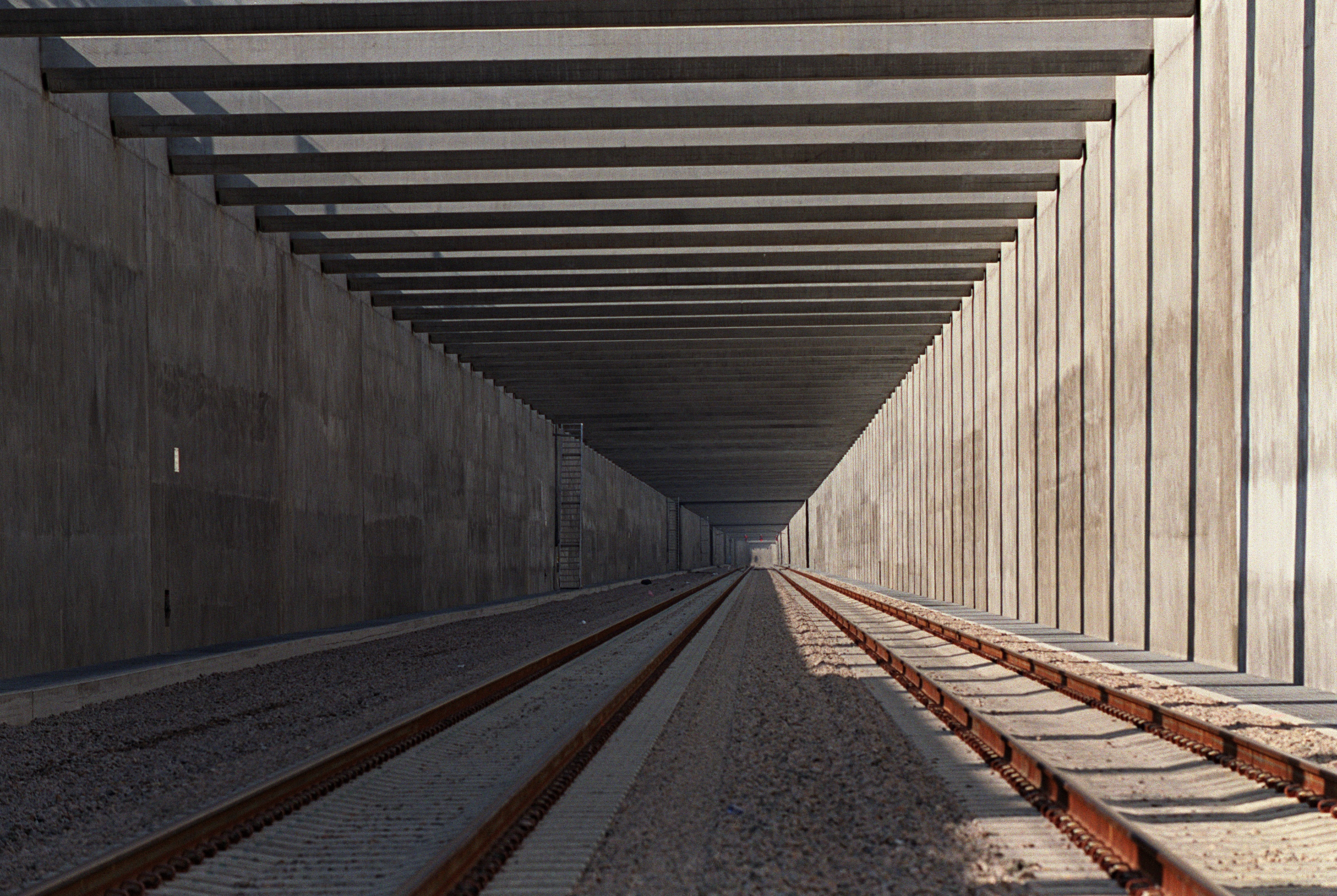
In addition to multiple bridges and underpasses bypassing street traffic routes, the Alameda Corridor plans also included an unusual 10-mile stretch known as the Mid-Corridor Trench. The below-street-level passage is 33 feet deep and 51 feet wide and stretches from the 91 Freeway in Compton north to 25th St. in Los Angeles. 

The entire project, originally given a $2 billion price tag, ended up costing $2.4 billion. Sources of its funding included the two ports, ACTA, the U.S. Dept. of Transportation, the Metropolitan Transit Authority and various other state and federal funds.

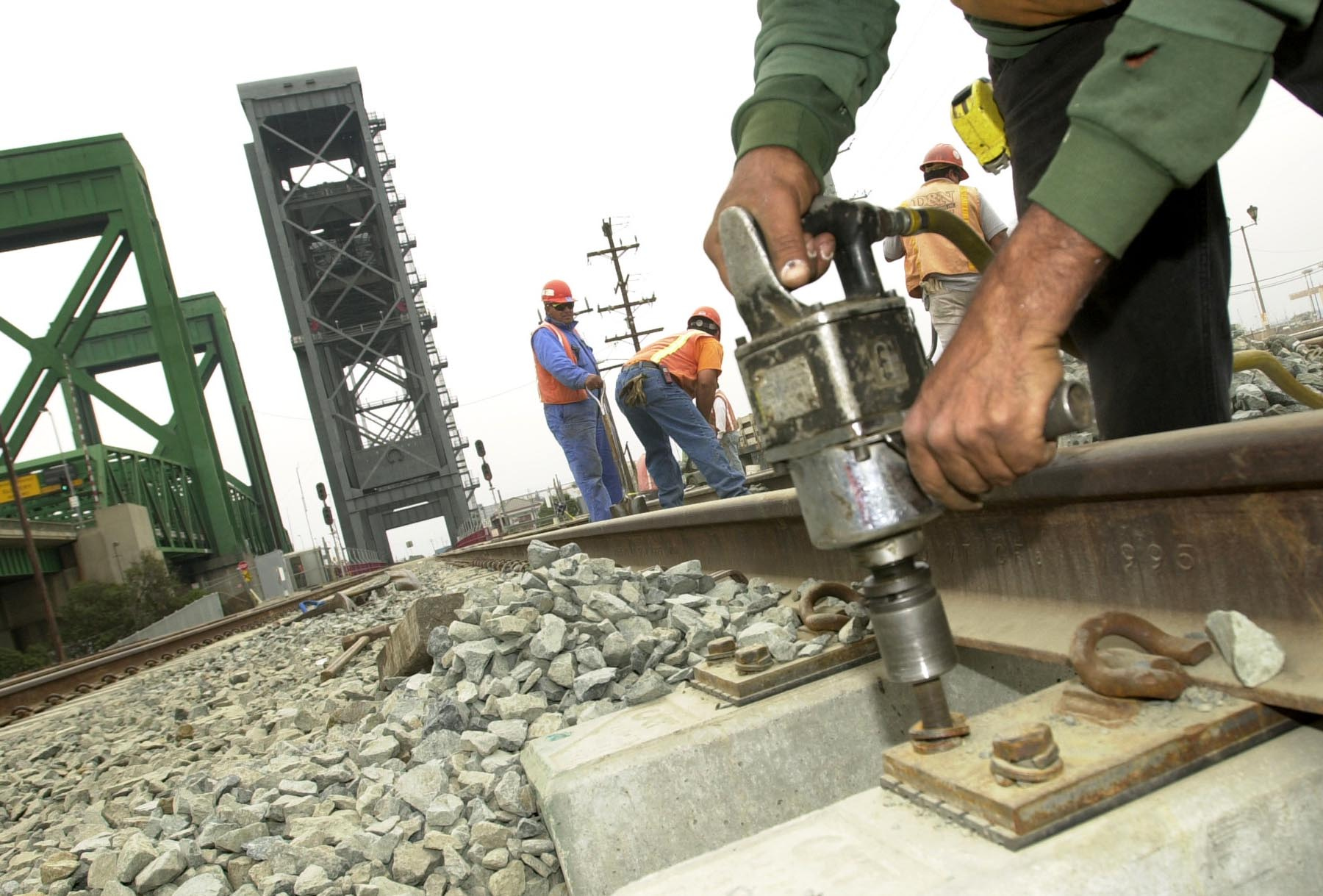
At the extreme southern end of the Alameda Corridor project, rail crew finishes bolting up concrete rail ties near the Cerritos Channel. April 2, 2002. (Daily Breeze staff file photo by Brad Graverson)

Construction on the project began in 1995. The first completed structure, the 470-foot Carson St. rail overpass in the city of Carson, opened that December and cost $13 million.

With all funding finally secured, including a $400 million Dept. of Transportation loan authorized by President Bill Clinton in January 1997, construction began in full force in 1998.

Unlike many such massive transportation projects such as the 105 Freeway and the first installment of Los Angeles’ light rail line, the Alameda Corridor came in on time and under budget when it officially opened on April 12, 2002.

The final piece of the puzzle, a $107 million half-mile-long bridge carrying Pacific Coast Highway traffic over the train route, opened on March 4, 2004. It was authorized a year after the original project was finished.

After the Alameda Corridor opened, trains from the ports were able to travel up to Los Angeles unimpeded at a speed of 40 mph, instead of their previous 8-15 mph speeds and frequent slowdowns and stops. Street traffic flow also improved greatly once the train crossings vanished.

Undated post-2002 photo shows a train loaded with containers traveling on one of three tracks through the Mid-Corridor Trench section of the Alameda Corridor. (Credit: Alameda Corridor Transportation Authority website)

Though it was a rousing success, the Alameda Corridor project hasn’t solved all the port area’s transportation problems. It has greatly improved the movement of longer-distance freight container traffic, but it turns out that semi trucks are cheaper and more efficient for transporting goods locally. 

Truck traffic continued to grow after the Corridor opened, taking its toll on the 710 Freeway, which now needs not only repairs but also a costly major renovation.

As a result of the trucking increase, the Corridor’s train traffic hasn’t risen as much as predicted. As a result, it has faced financial stresses during slower periods, as it relies on usage fees from the train companies to pay back the debts from its construction.

In 1998, work on the Alameda Corridor East project began, with the goal of extending the Corridor east from downtown through the San Gabriel Valley. As of 2023, more than half of its targeted gate crossings had been eliminated, with construction still ongoing.

In June 2024, matters regarding the Corridor fell to District 15 Los Angeles City Councilmember Tim McOsker, who was elected chair of the Governing Board of ACTA for the 2024-25 term.

A freight train traveling the Alameda Corridor crosses the Dominguez Channel as it heads out of the Port of Los Angeles on April 12, 2005. (Daily Breeze staff photo by Sean Hiller)

Sources:

Alameda Corridor Transportation Authority (ACTA) website.

Daily Breeze archives.

Los Angeles Times archives.

Union Pacific website.

Wikipedia.

The Mid-Corridor Trench section of the Alameda Corridor on April 4, 2002. A third set of tracks has yet to be added at left. (Daily Breeze staff file photo by Jeff Gretchen)

The roots of Don Kott’s landmark Carson car dealership go back to 1929

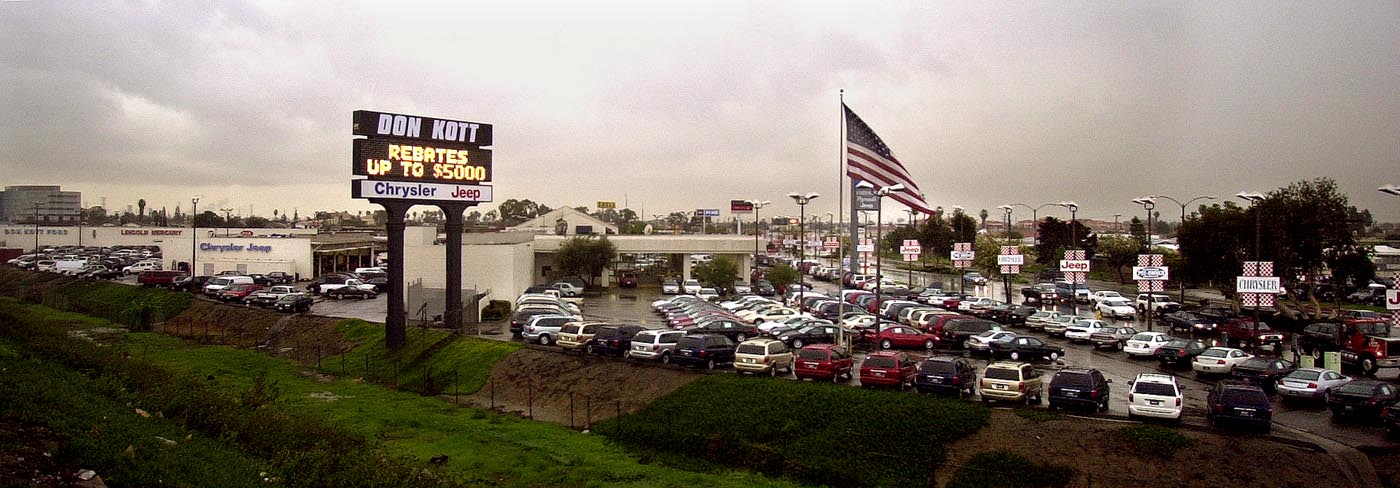
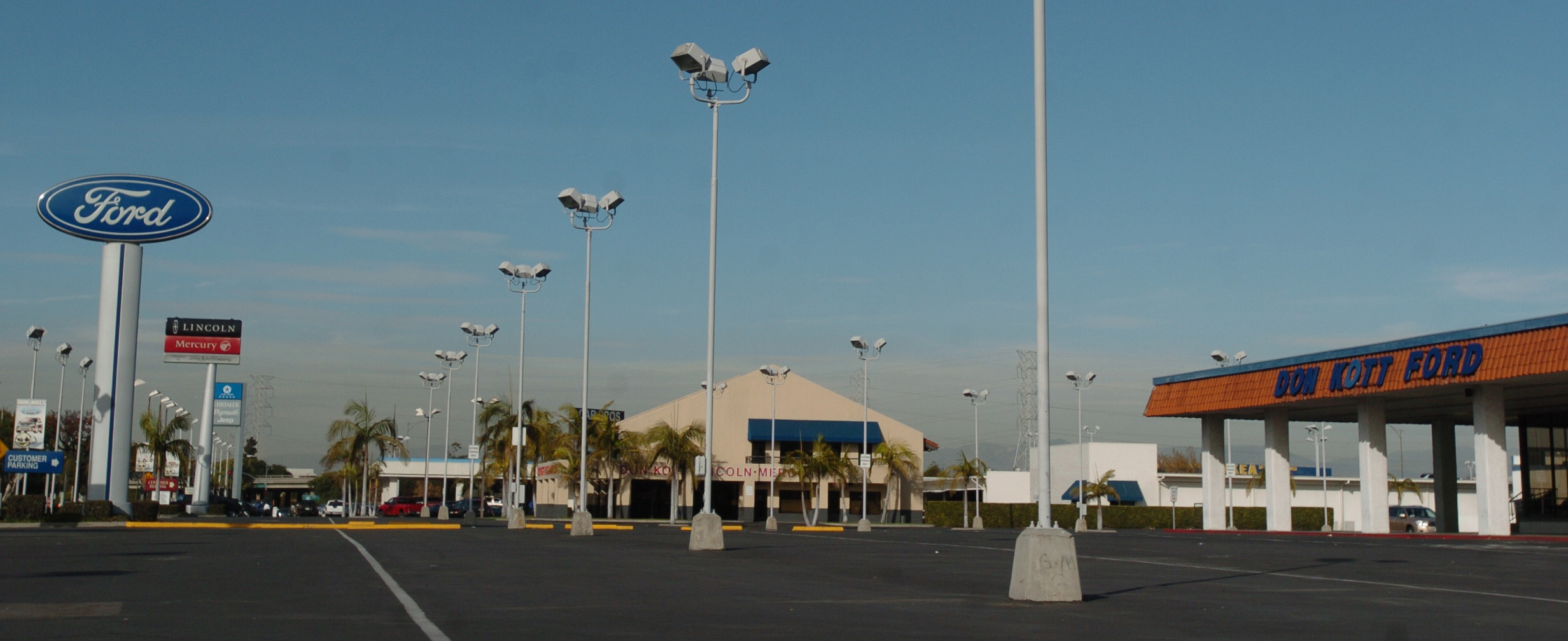
Don Kott Ford in Carson on Jan. 12, 2001. (Daily Breeze staff file photo by Bruce Hazelton)

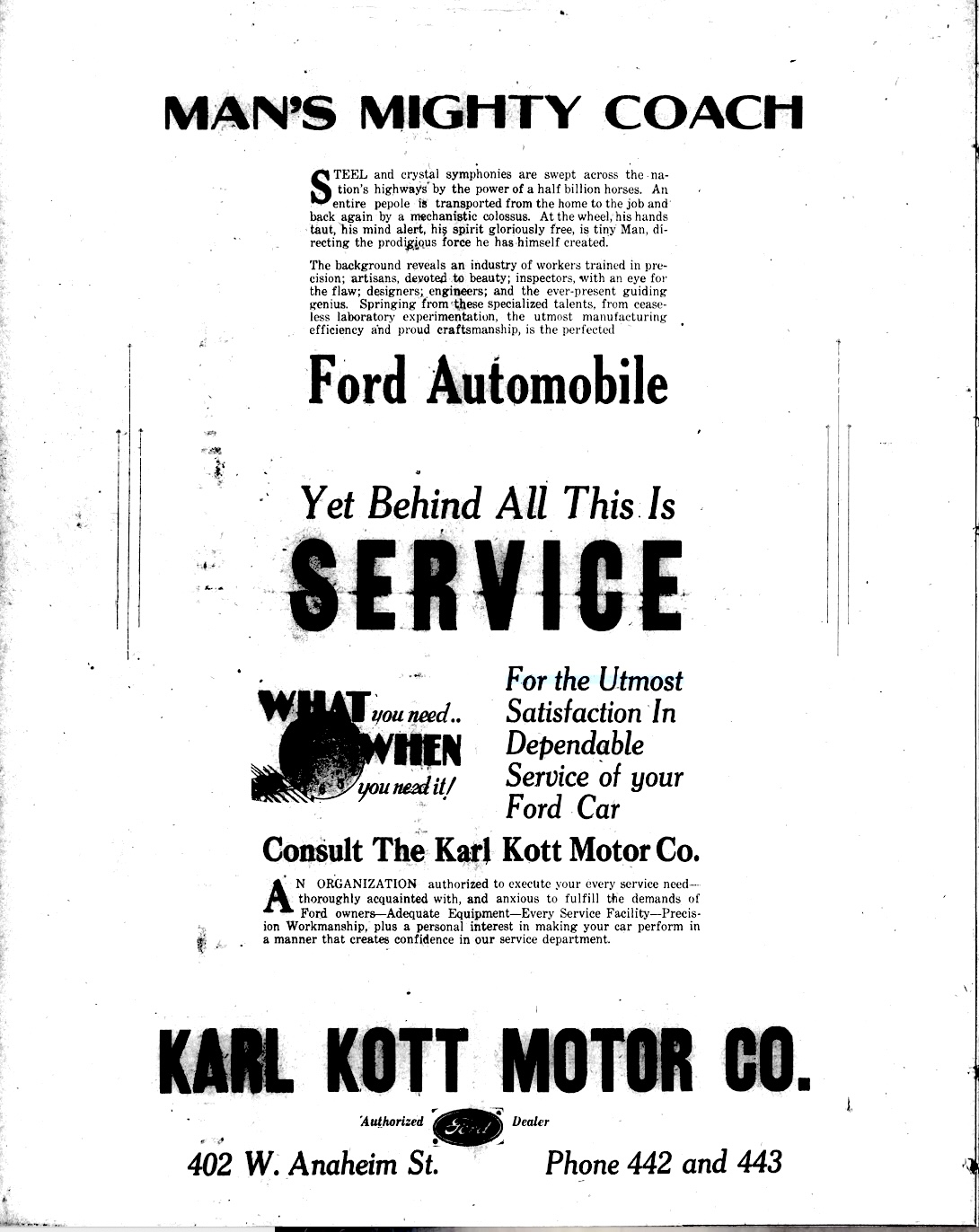
Karl Kott first toiled as a janitor after moving to California from Indiana in the early 1900s. After years of working his way up in the auto sales industry, he opened the Karl Kott Motor Co. in 1929.

The Ford dealership was located at 402 W. Anaheim St. in Wilmington. It opened two years before Kott’s son, Donald, was born on March 21, 1931. Fords were all the rage then; a year after Kott’s dealership opened, a new Ford automobile plant opened up a couple of miles away in the harbor.

Kott believed in advertising from the first, spreading the word about his dealership through ads in local papers such as the Wilmington Press Journal and the San Pedro News Pilot. He built up a very successful automobile dealership despite the economic peril brought by the Depression.

Ad from a special section in the Wilmington Press Journal heralding the arrival of the new Ford auto plant in Wilmington. Kott Motor had been founded one year earlier. April 19, 1930 edition, Page 16. (Credit: Wilmington Press Journal archives)

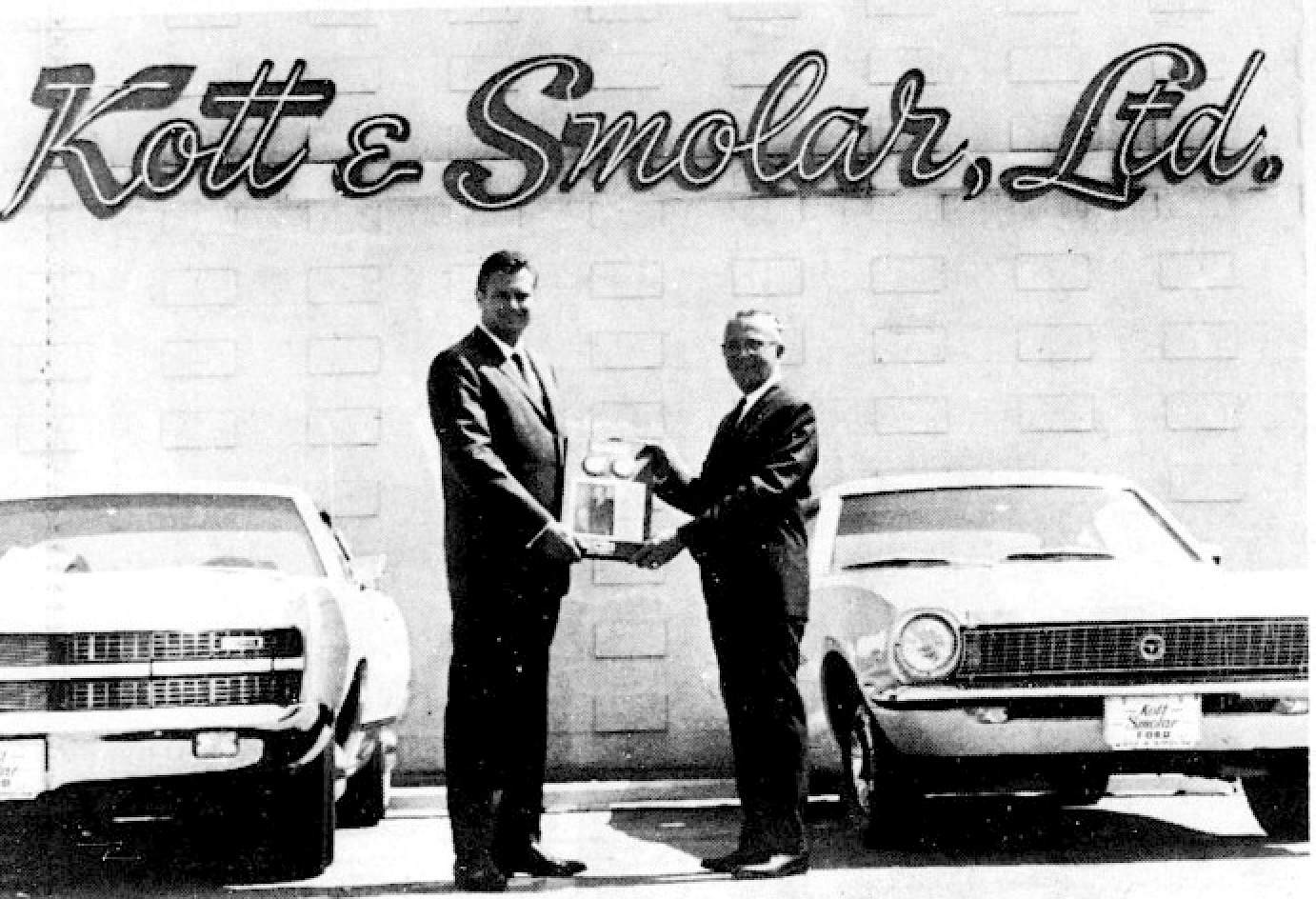
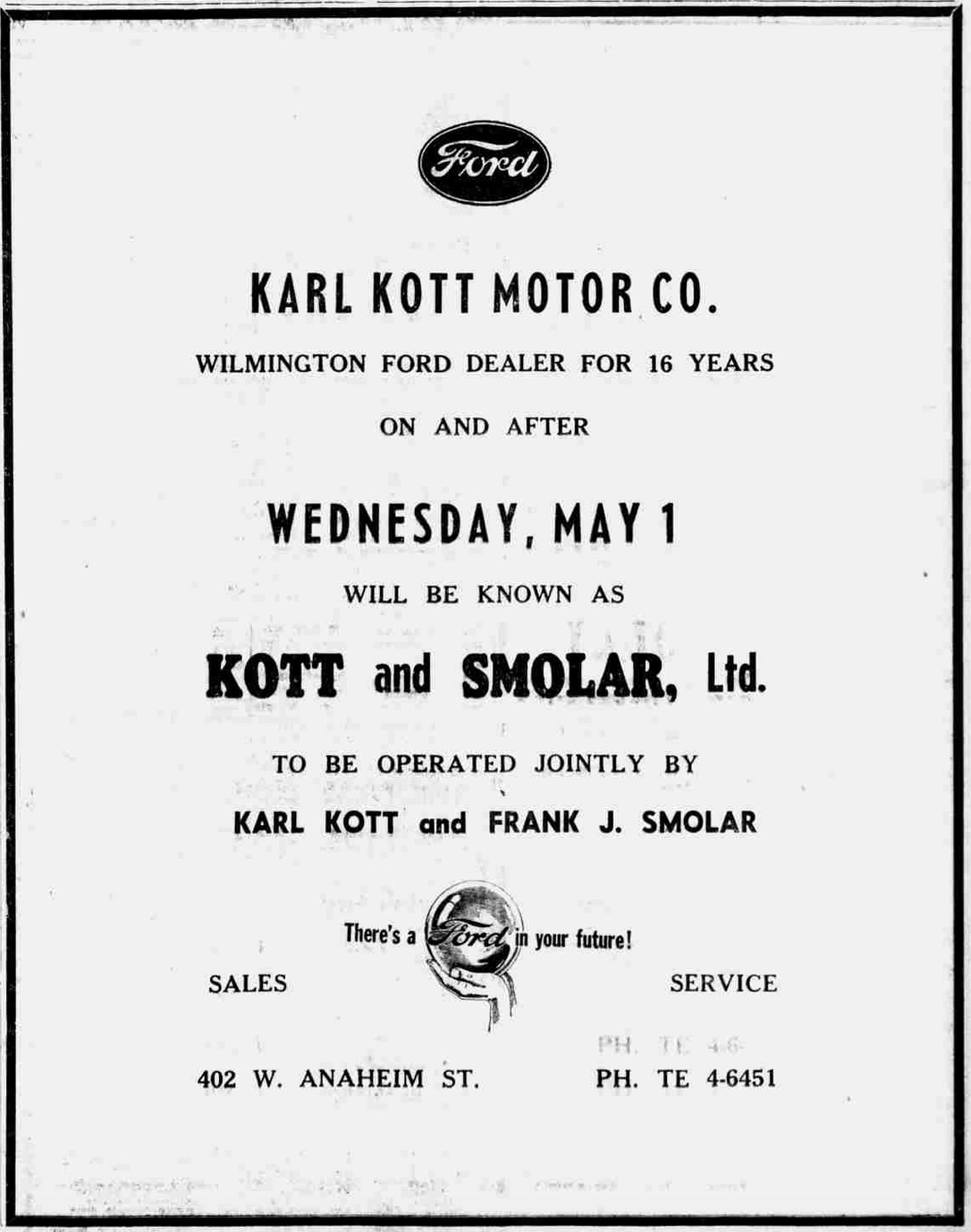
After World War II, he formed a partnership with longtime auto industry executive Frank Smolar.

The Kott Motor firm was rebranded in 1946 as Kott and Smolar Ltd. It operated under that name for the next 25 years.

Like his father, Don Kott became obsessed with automobiles. He graduated from Banning High and USC before joining the Kott and Smolar automobile dealership in 1953.

When his father Karl decided to retire in 1971, Don bought out his partners and took control of the company. (Karl Kott died in 1973.) Three years later, the younger Kott moved the operation, renamed Don Kott Ford, from Wilmington to a large lot at 21212 Avalon Blvd. in Carson.

Kott had shrewdly positioned his new dealership on a site clearly visible from the 405 Freeway, which had opened a decade earlier. Like his father, he was a firm believer in advertising, adding local television commercials in addition to huge ads in area newspapers.

Don Kott, left, poses with Frank Smolar. The pair hold the customer relations award from the Ford Motor Co. that the dealership had won for 19 of the previous 20 years. Palos Verdes Peninsula News, Aug. 6, 1969, Page 22. (Credit: Palos Verdes Peninsula News archives)

He also kept a high community profile, becoming involved with local charitable organizations. Among other efforts, he worked with leaders of the relatively new city – Carson had incorporated in 1968 – to help organize the local Boys and Girls Club.

He also funded scholarships for high-schoolers from Torrance, Narbonne and Carson. His dealership once offered a reduced-cost truck to the Harbor Area Gang Alternatives Program so it could keep graffiti paint-out crews on the road more often.

His wife, Margaret, worked alongside Kott at the dealership as its president. She became known for posting sometimes humorous, mostly inspirational messages on the lot’s gigantic electric billboard.

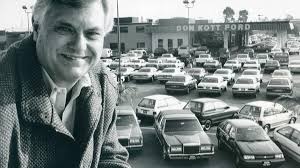
Don Kott. Undated Los Angeles Times photo.

Some samples: “Hot heads and cold hearts never solve anything.” “Laugh, even when you feel like crying.” “Luck is what happens when preparation meets opportunity.”

Thousands of  freeway commuters read her daily homilies, interspersed with car lot ads. She gathered her bromides from Shakespeare, Beatles lyrics, the Bible, the Torah and newspapers, according to a 2000 Los Angeles Times story.

Business boomed at Kott’s dealership. So much so, that Don Kott Ford eventually morphed into Don Kott Auto Center. Over the years, Kott’s assorted car lots sold Chrysler, Plymouth, Jeep, Mazda, Kia, Isuzu and Hino vehicles, in addition to Ford, Lincoln and Mercury models, making it one of the largest auto dealerships in Southern California.

But sales began to slack off during the early 2000s. In 2002, Kott, who had essentially retired by that time, sold all his dealerships to the North Carolina used-car firm Sonic Automotive Inc. He retained ownership of the land. Sonic continued operating under the Kott name.

In 2004, Kott was diagnosed with throat cancer. During his five-year battle with the disease, on Dec. 26, 2007, Don Kott Auto Center officially closed for good. After almost eight decades, the Kott name had vanished from the car dealership scene.

On Dec. 21, 2009, Don Kott lost his battle with cancer at age 78.

Carson civic leaders paid tribute to Kott following his death, including former councilwoman Kay Calas, who praised him for his contributions to the city. She also told Daily Breeze reporter Gene Maddaus, “He was a very good businessman. He was very outgoing, likeable, funny. I just wish we had a lot more like him.”

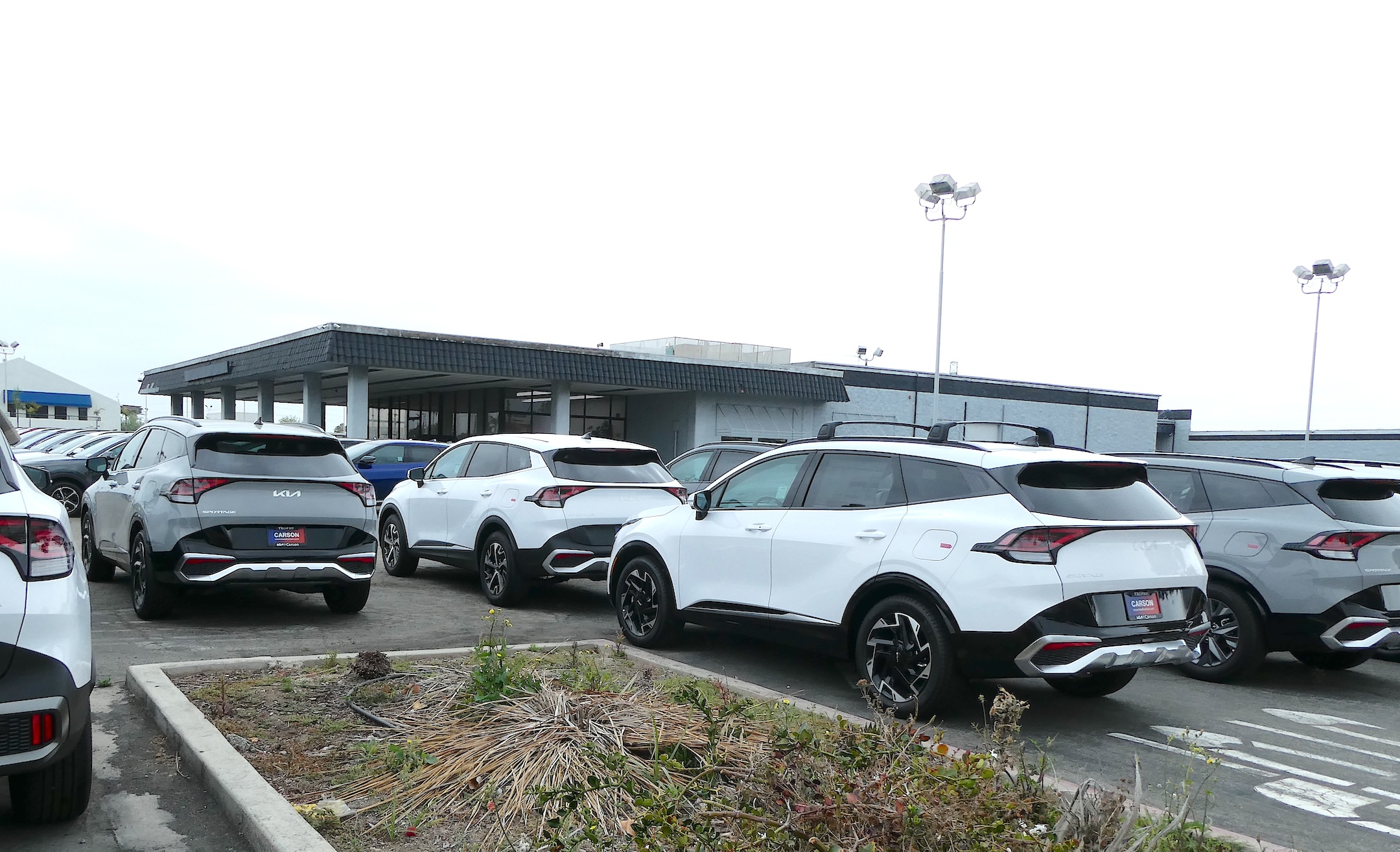
The Don Kott Ford site currently is being used for vehicle storage while it awaits possible development. June 19, 2024. (Photo by Sam Gnerre)

Carson’s “auto row,” which grew up around Kott’s pioneering dealership, now stands mostly empty. Several developers have sniffed around the property, including the latest suitor, Hanover Co.

The Houston-based developer has proposed a 20.7-acre project that would include 1,320 residential units and two restaurant spaces. In 2023, Hanover submitted partial plans to the city, but Carson officials still are waiting for complete plans.

“That one is still going through the review process,” Community Development Director Saied Naase told Daily Breeze reporter Teresa Liu in August 2023. “We’re still waiting for the developer to submit plans to us.” Previous developers for the site did not reach an agreement with the property owner, according to the city. 

Currently, the Don Kott Ford lot is being used by Kia of Carson for vehicle storage. Used car dealers also are operating on a couple of the adjoining  lots.

Don Kott Ford closed its dealership in Carson in December 2007. Its parking area, formerly crammed with autos for sale, lies empty in this Jan. 2, 2008 photo. (Daily Breeze staff file photo by Sean Hiller)

Sources:

Daily Breeze archives.

Los Angeles Times archives.

Wilmington Press Journal archives.

San Pedro News Pilot archives.

Ad announces Frank Smolar’s arrival. Wilmington Press Journal, May 1, 1946, Page 3. (Credit: Wilmington Press Journal archives)

El Segundo’s Thunderbird Hotel made quite a splash when it opened in 1959

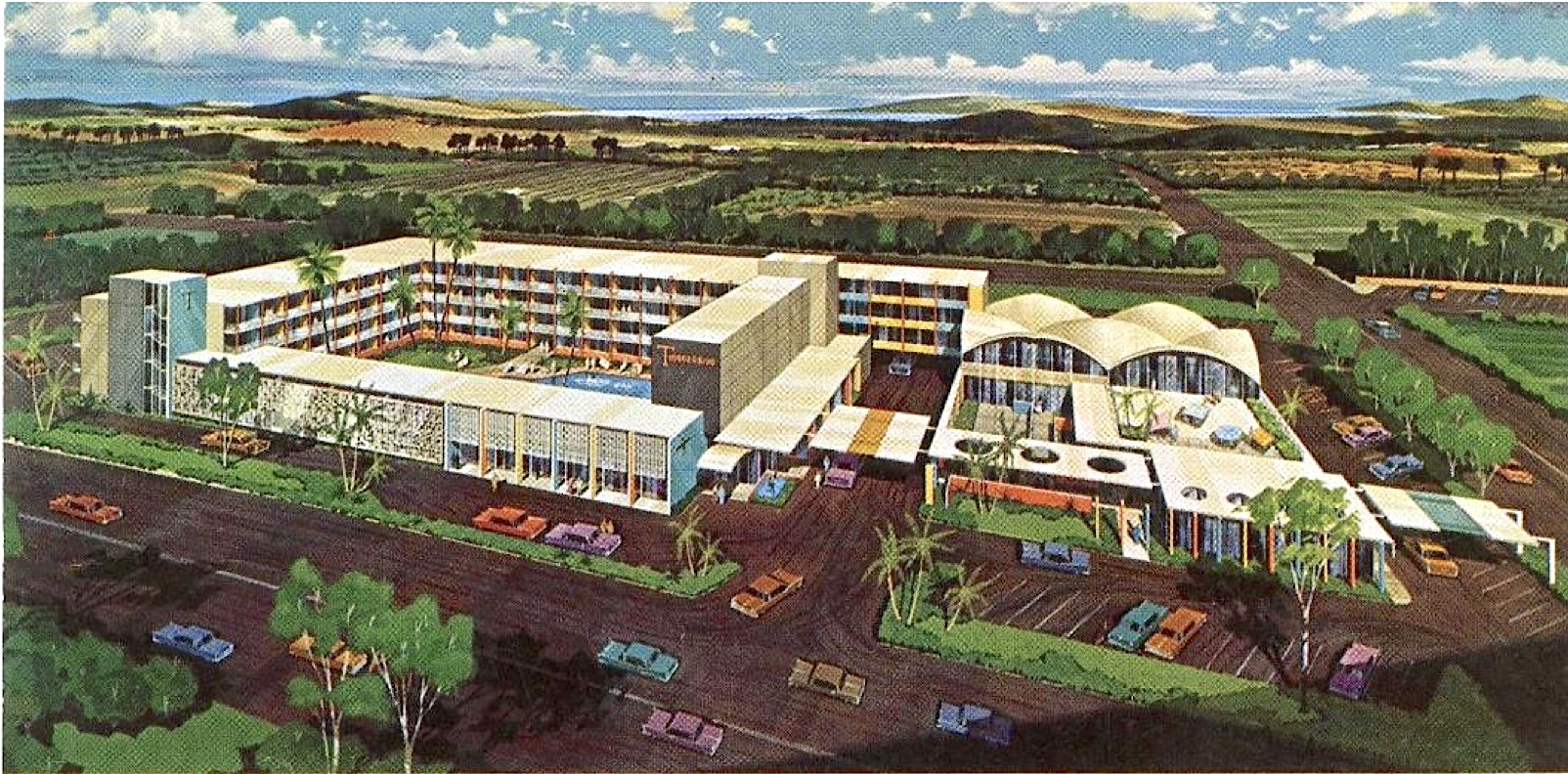
Undated postcard circa early 1960s shows the Thunderbird Hotel on Sepulveda Blvd. (foreground) in El Segundo. The surrounding properties are much less empty these days.

The commercial development of the area surrounding Los Angeles International Airport exploded in the 1950s as the airport itself grew and changed.

Commercial passenger airlines didn’t begin operating at LAX until 1946, and the burgeoning airport didn’t even get its official name until 1949. The airport’s facilities were makeshift for its first few years, but they were soon overwhelmed by the sheer volume of passengers using it.

The north side of Century Blvd. leading to LAX now is carpeted with high-rise hotels, but that didn’t even start to happen until the 1960s, following the redesign of the airport that opened in 1961.

Add in a growing concentration of aerospace firms in the area and in El Segundo south of the airport in the 1950s, and the need for infrastructure improvements became glaring.

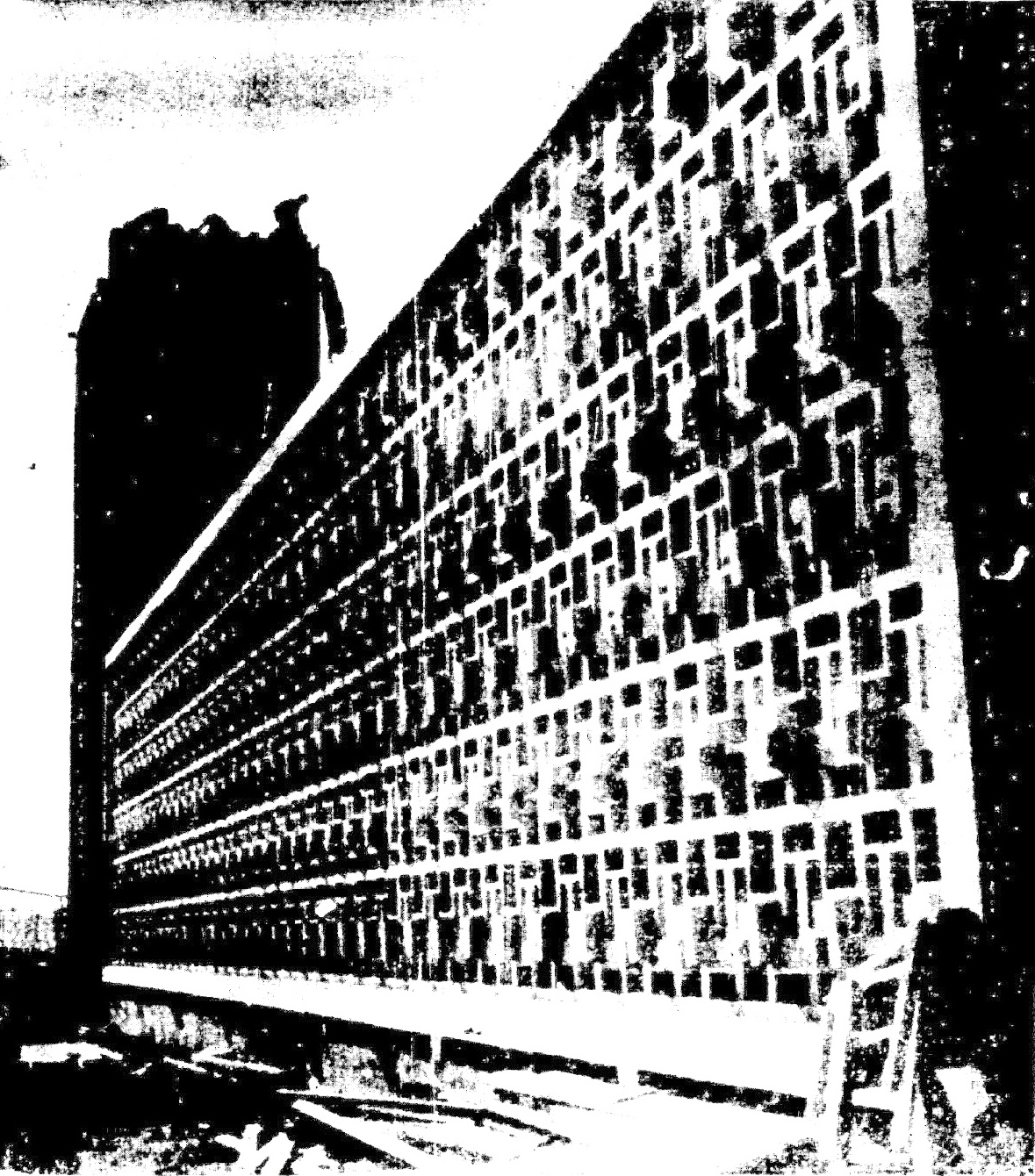
The Thunderbird Hotel begins to take shape. El Segundo Herald, Jan. 1, 1959, Page 11. (Credit: El Segundo Herald archives)

Still, the announcement in October 1957 concerning Hollywood-based hotelier Allan Siegal’s  plans to build a $1.5 million hotel on the west side of Sepulveda Blvd. between Holly and Pine avenues was big news locally, resulting in a front-page banner headline in the El Segundo Herald. A small residential development surrounded by agricultural land had stood on the site previously.

The proposed four-story, 220-room Thunderbird Hotel, to be located about 1.5 miles south of LAX at 525 N. Sepulveda Blvd.,  was the largest such project at that time in the city’s history. 

Architect Raymond A. Stockdale’s mid-century modern design included plans for a two-story restaurant with cocktail lounge and coffee shop on the first floor, and a large upstairs banquet room capable of seating 600.

The Thunderbird would also include a large parking lot and swimming pool, and retail space for a half dozen or so shops on the ground floor of the hotel. The city approved the project, and a groundbreaking ceremony featuring guest speaker California Lt. Gov. Harold Powers was held on June 18, 1958. The Herald described the hotel as the largest of its kind in the South Bay.

El Segundo Herald, April 30, 1959, Page 1. (Credit: El Segundo Herald archives)

It’s important to remember the key role that Sepulveda Blvd. played at the time. The segment of the 405 Freeway running through the South Bay had yet to be completed, much less the 105 Freeway, which was more than three decades off. 

As a result, Sepulveda for years served as a main artery leading to the airport, and was perennially clogged with airport traffic until the 1961 LAX redesign, making the boulevard a prime location for a major hotel development.

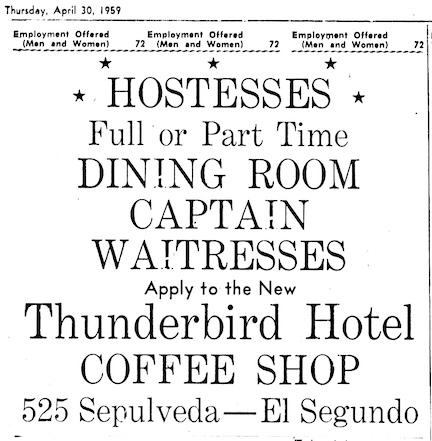
Help wanted ad. Torrance Press, April 30, 1959, Page 1. (Credit: Torrance Historical Newspaper and Directories Archive database, Torrance Public Library)

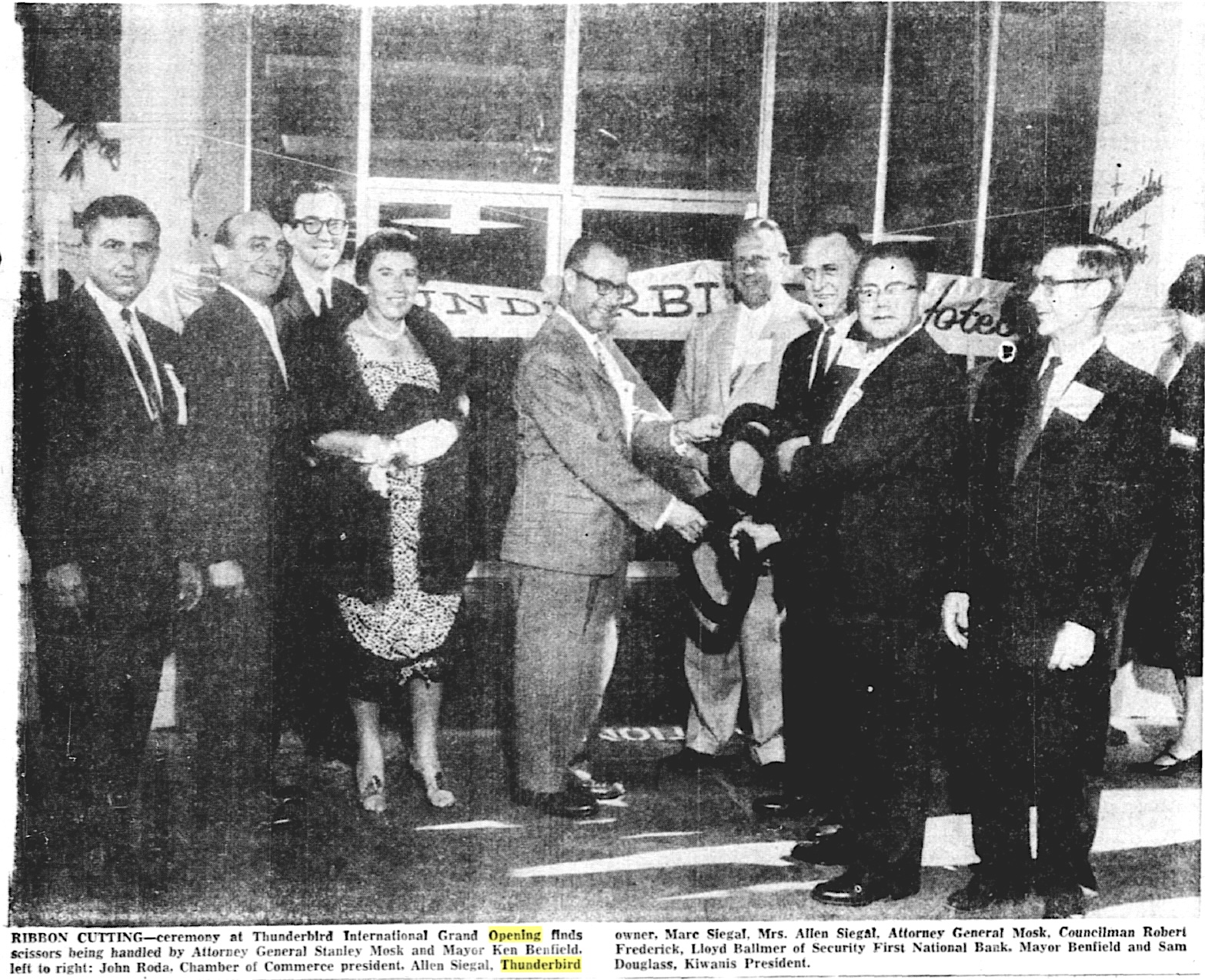
The Thunderbird Hotel’s grand opening took place on April 24, 1959. Hundreds of people attended, hearing state Attorney General Stanley Mosk and other dignitaries speak. They also had the chance to visit the retail shops, which included De Mere fashions, Allen Rabinoff’s Shop for Men, Flair for Beauty, a barbershop and a sundries store.

With its sizable banquet room, the Thunderbird soon became a meeting place for a wide variety of community groups and activities.

A few months after the hotel’s grand opening, its co-owner, Siegal’s son Marc, announced a plan to build a seven-story, 180-room hotel wing along Indiana Ave., just west of the main hotel. It was completed in 1961.

More changes came in the 1960s. In 1962, the Thunderbird Hotel Coffee Shop was refashioned into a Polynesian-style tiki restaurant and bar, done up in a style that was then all the rage. Renamed the Huki Lau, it came complete with a built-in waterfall behind the bar.

A major change came in 1965, when the Thunderbird was bought out by Las Vegas-based hotelier Warren Bayley, who’d opened his flagship Hacienda Hotel on the Las Vegas Strip in 1956. The Thunderbird became the Hacienda.

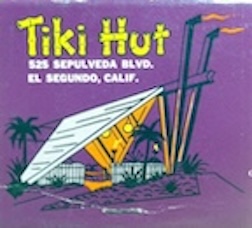
Matchbook cover.

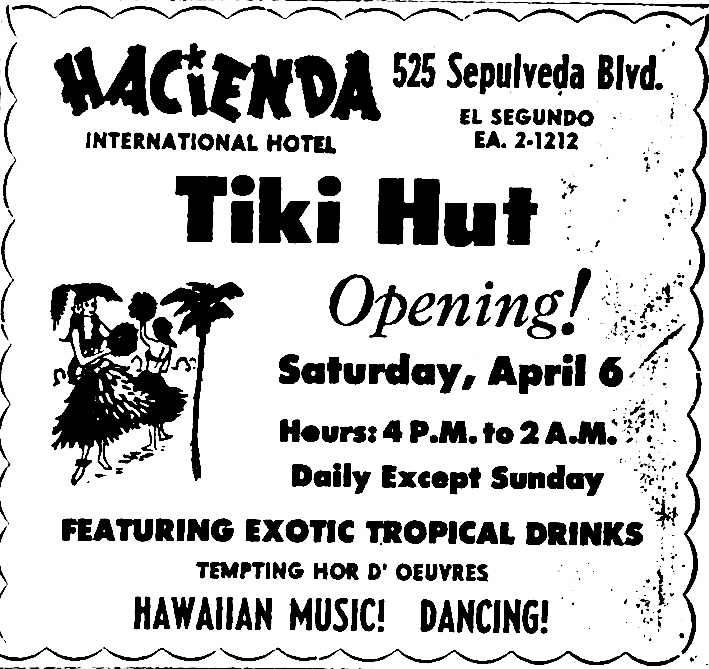
Three years later, its owners decided that customers were confused by the Huki Lau name for their tiki restaurant, and changed it to the more pedestrian Tiki Hut.

In 1979, The Hacienda decided to build an additional nine-story hotel on the plot of land just south of its location. Somewhere during this era, the Tiki Hut was phased out.

In 1987, a major remodel of its exterior removed most of the distinctive mid-century modern architectural features that might have qualified the structure for National Register of Historic Places landmark status. The request was denied in 2020.

Another ownership change occurred in 2015, when the Rubicon Companies purchased the Hacienda properties. The company announced it would split the property into two separate hotels.

Under the plan, the southern property built in 1979 would become the Aloft El Segundo hotel, while Marriott would rebrand the original Thunderbird/Hacienda location as one of its lower-priced Fairfield Inn and Suites hotels. Both of these changes occurred in 2016. Rubicon then sold the property to the Blackstone Group in 2017.

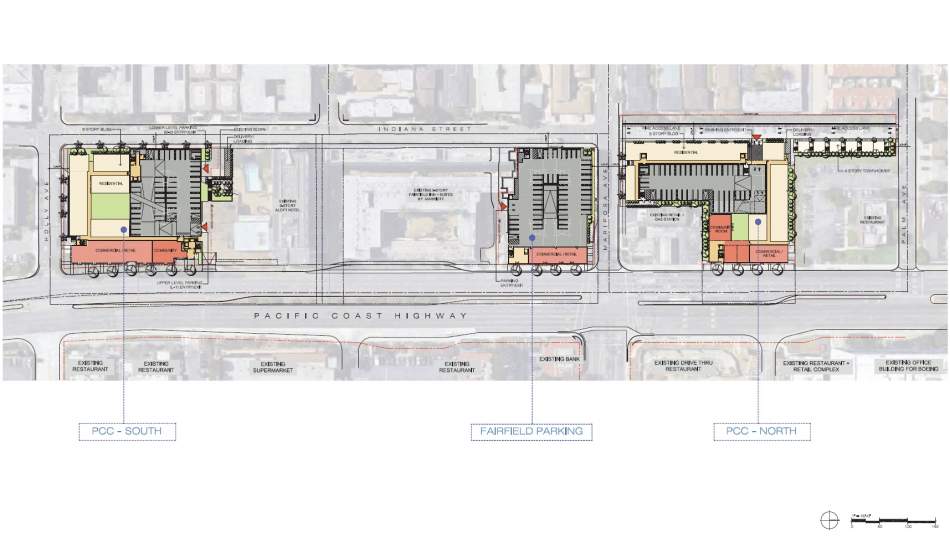
Map of the project shows two housing units, highlighted left and right. Middle highlighted area will become a parking structure. The hotels, left and center in light gray, will continue to operate. (Credit: Pacific Commons)

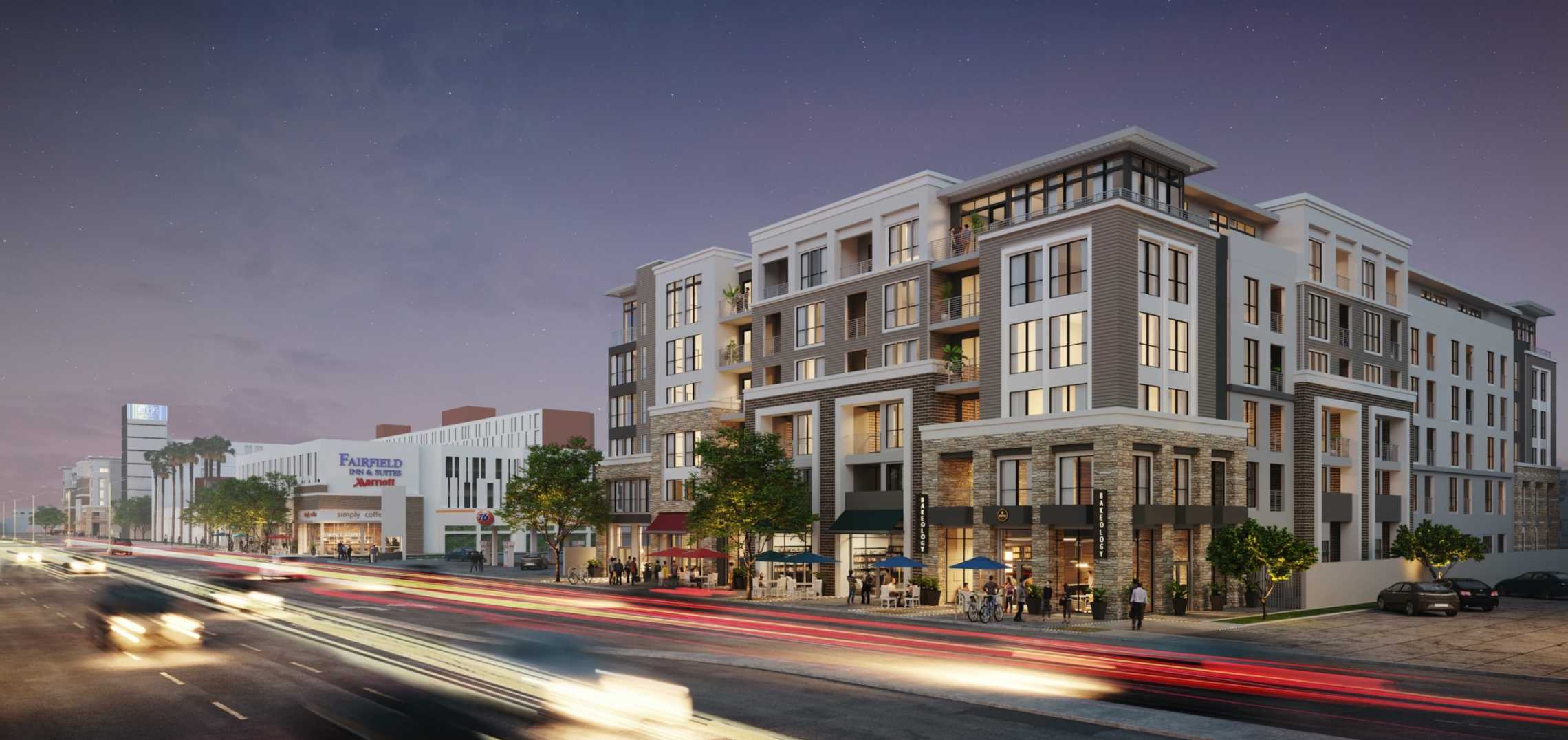
In April 2022, the El Segundo City Council unanimously approved a mixed-use development proposal from the Pacific Commons joint venture group to add additional housing and retail space while allowing the Fairfield Inn and El Segundo Aloft hotels to continue to operate.

Two of the three parking lots on the property, on its north and south ends, will be converted into six-story residential housing buildings, while the middle portion directly adjacent to the Fairfield Inn will become a multistory parking garage. As of this writing, construction has yet to begin.

Rendition of the Pacific Commons development shows new housing, foreground right, with Fairfield Inn and Suites, rear left. (Credit: Pacific Commons)

Sources:

Cultural Resources Technical Report for the Pacific Coast Commons Specific Plan Project El Segundo California, prepared by the Dudek engineering firm, October 2020.

Daily Breeze archives.

El Segundo Herald archival database, El Segundo Public Library website.

El Segundo: Seventy-Five Years: A Pictorial History of El Segundo, California, by Eileen Curry Hunter, H2 Limited Publishers, 1991.

Los Angeles Times archives.

Urbanize Los Angeles website.

Ad promotes the rebranded Tiki Hut. El Segundo Herald, April 3, 1968, Page 31. (Credit: El Segundo Herald archives)

Is this your new site? Log in to activate admin features and dismiss this message
Log In