
Dance historians who research such things credit American jazz singer and bandleader Cab Calloway for coining the term “jitterbug.” In 1934, he recorded a lively tune, “Jitter Bug,” that some credit for kick-starting an energetic dance craze that swept the nation.
Here’s a clip of the song from Calloway’s 1935 short film, “Jitterbug Party”:
The dance was a variation on the Lindy Hop, which originated in Harlem in the late 1920s and was named for aviator Charles Lindbergh. The jitterbug also incorporated elements of the Charleston and an earlier dance called the Texas Tommy, which originated in San Francisco.
All of these dances included a move called the breakaway, in which the partners separate from each other, usually exuberantly, before being reunited and continuing the dance. The jitterbug carried these breakaway maneuvers to increasingly frenetic extremes.
The rising popularity of swing music played by the 1930s big bands of Benny Goodman and his ilk fueled the fad. The jitterbug derived from swing dancing, but had its own highly energetic vibe. The extent to which it caught on in popular culture was remarkable, despite early attempts by outraged civic guardians of decency to ban it, mostly in the Midwest and, later, in England.
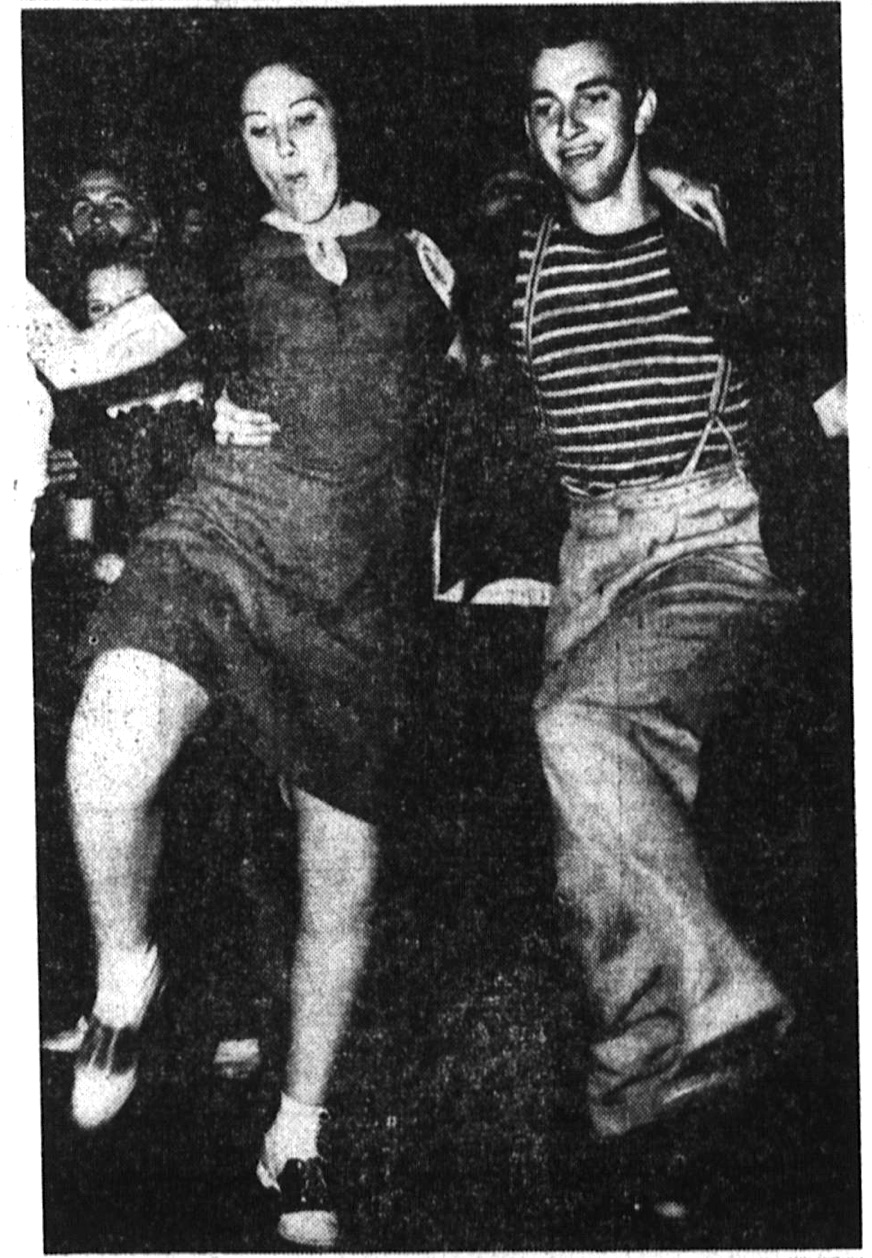
After 1935, the dance gradually started to spread from the big-city ballrooms to smaller cities and towns, as a look through news stories of the day illustrates.
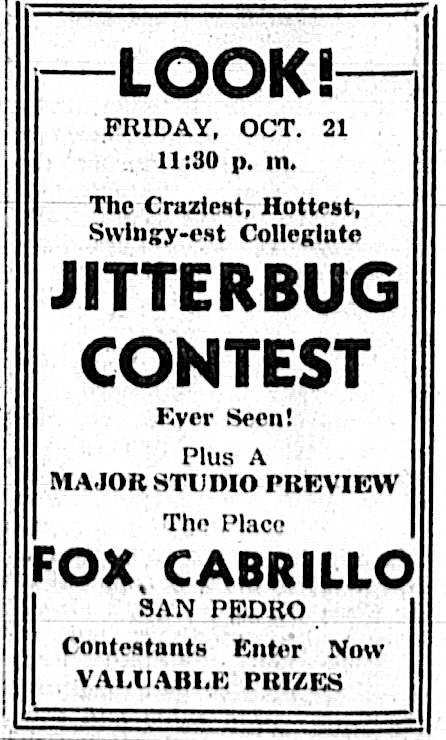
Jitterbug contests begin popping up everywhere. Movie theaters became especially tuned into the craze, holding regular jitterbug contests in addition to showing films. The Fox Cabrillo in San Pedro, the Torrance Theatre, the Strand Theatre in Redondo Beach and the Gardena Theatre were among the local venues holding regular weekly dance contests during the late 1930s.
Fraternal and veterans organizations also began hosting contests at such venues as the Masonic Temple in Wilmington, the Bert Crossland American Legion Hall in Torrance and the Regular Veterans Association Fleet Reserve Club in San Pedro.
Jitterbugging also was featured regularly at the Mandarin Ballroom at the old Redondo Beach Pavilion on El Paseo. The Mandarin, one of the South Bay’s primary live music venues during the era, had long hosted swing bands, so the dance competitions were a natural addition. The jitterbug contests continued there into the wartime years.
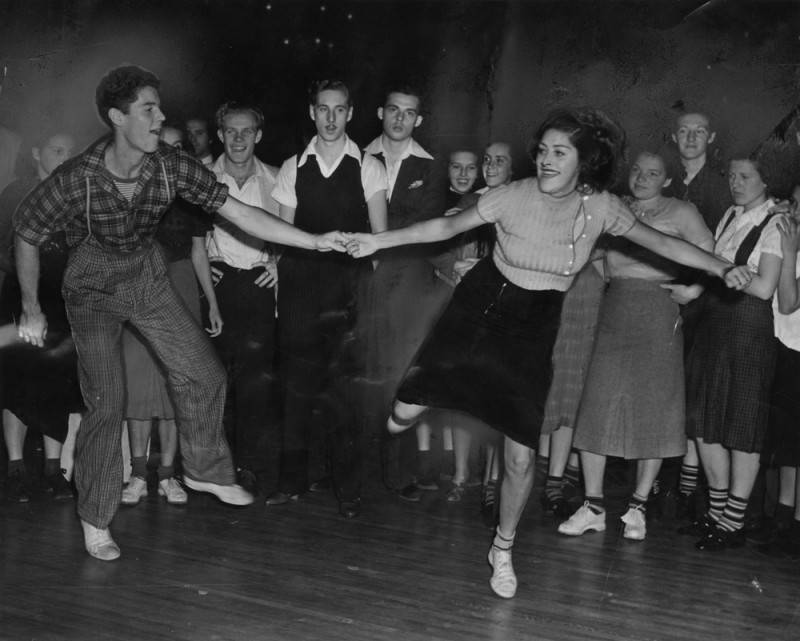
Public community events became host to some of the biggest jitterbug competitions. They became part of large store grand openings and community fairs and gatherings of all types.
In 1937, the city of Torrance decided to start a citywide community event celebrating the firms that made up its strong industrial base. It planned a jitterbug contest to be part of its first Factory Frolic celebration in 1937.
The contest was staged at the new Torrance Civic Auditorium, which had held its grand opening just a year earlier. (It was demolished in 1971.) It proved so popular that it returned to even larger crowds and more participants during the 1938 Frolic.
After that, regular independent jitterbug contests began to be held at the Civic Auditorium. The Torrance Herald sent veteran reporter Michael Straszer to one such event that was held on Christmas Eve in 1938 between 6 and 8 a.m. in the morning.
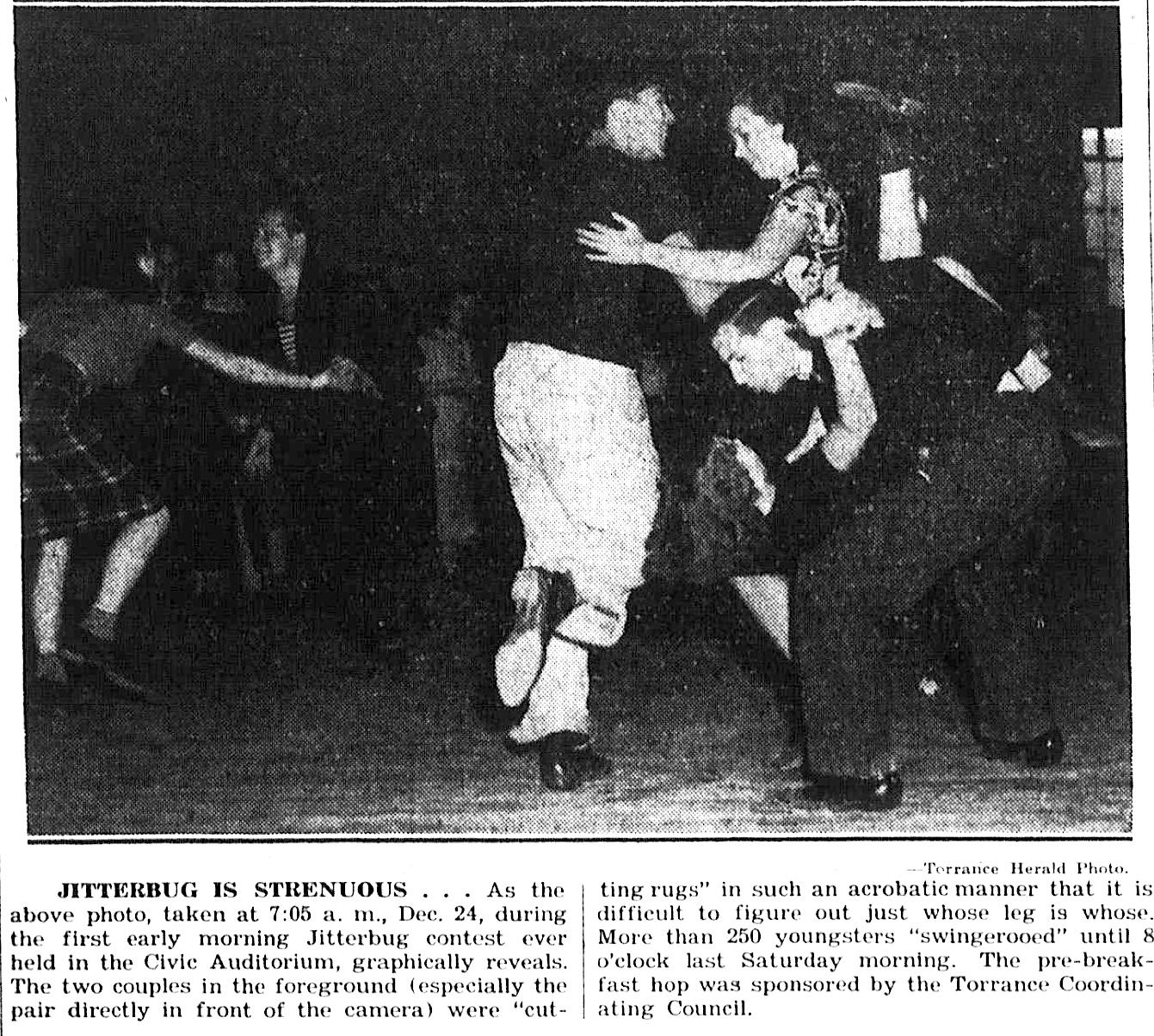
Straszer estimated that about 250 people, mostly teens, participated, or “swingerooed,” as he put it. The bemused reporter observed:
“They were having a wonderful time, but I fairly creaked as I tried to visualize myself out on the floor cavorting in the best ‘rug-cutting’ manner with some of those acrobatic damsels.”
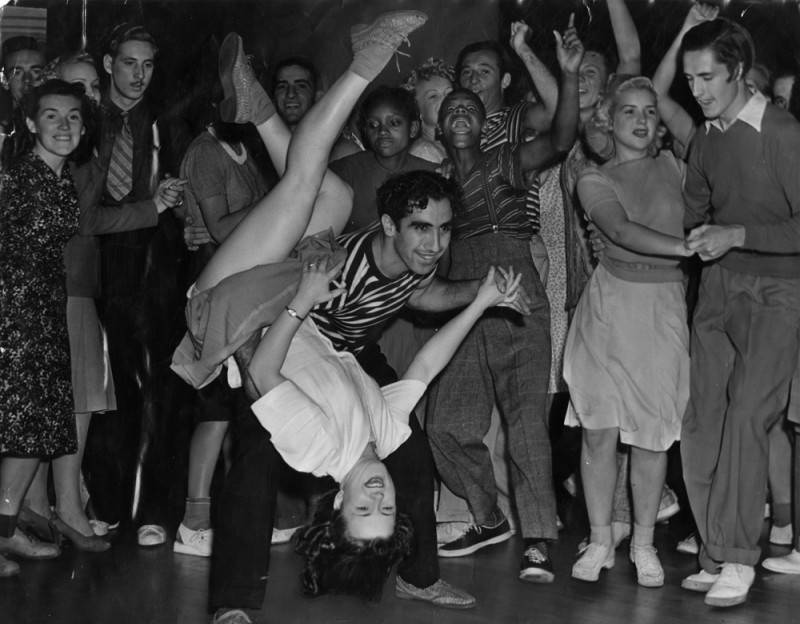
The jitterbugging mania may have peaked in the Southern California area with the arrival of a giant jitterbug competition held in the Los Angeles Coliseum on June 18, 1939.
With swing bandleaders Artie Shaw and Kenny Baker providing the musical impetus, an estimated 500 participants competed for a $500 first place prize before 25,000 fans. According to the Los Angeles Times, spectators rushed the temporary dance floor set up on the athletic field after the contest ended to do their own jitterbugging.
World War II put a damper to such widespread public frivolity, though swing bands and swing dancing remained popular into the late 1940s.
But tastes began to change with the growing popularity of crooning vocalists in the Frank Sinatra mold. Western swing bands also began to draw large crowds to “barn dances” in the late 1940s and early 1950s, many of them held at the Mandarin Ballroom.
The rise of rock ‘n’ roll in the 1950s brought about vigorous dancefloor cavorting that owed large debts to jitterbugging and swing dancing, though its participants deemed swing music itself as being hopelessly square.
By then, jitterbugging already had become a quaint fad viewed with nostalgia. But that’s no reason to discount its onetime massive popularity and its enduring influence.
Sources:
“Exploring the Jitterbug – The Dance That Divided Britain in the 1940s,” by Rose Staveley-Wadham, The British Newspaper Archive Blog, Jan, 10, 2024.
Los Angeles Times archives.
San Pedro News Pilot archives.
Torrance Press Herald archives.
Wikipedia.

