
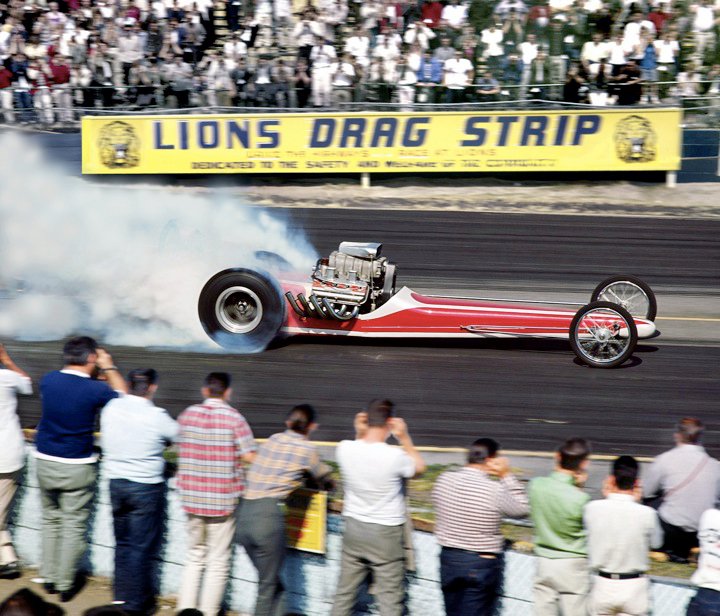
The streets of suburban southwest Los Angeles County in the years following the end of World War II posed an increasing danger to all who used them, according to accident statistics cited in press reports from the era.
The area’s vehicle traffic infrastructure was incomplete and crude at best in the days before freeways and traffic-controlled surface streets and highways. This came at a time when the exponential growth and residential development of areas outside of central Los Angeles was causing an increased reliance on automobiles.
Factor in the growing sophistication of automobile technology that allowed for speedier and more powerful cars, and the interest in seeing whose machine could go the fastest seems almost inevitable in hindsight.
This desire to race fueled the rise of car clubs and hot rodding among teenagers in the postwar era. At first, illegal street racing, usually done at night, was the only way to test their automotive skills. As community leaders began to decry the corresponding rise in traffic accidents and fatalities, some began to listen to the street racers, who mostly just wanted a place where they could put their lovingly customized cars to the test.
City officials, law enforcement and community organizations, worked together to create one of the first such facilities in Southern California, Pomona Raceway, which opened in 1950 at the Los Angeles County Fairgrounds.
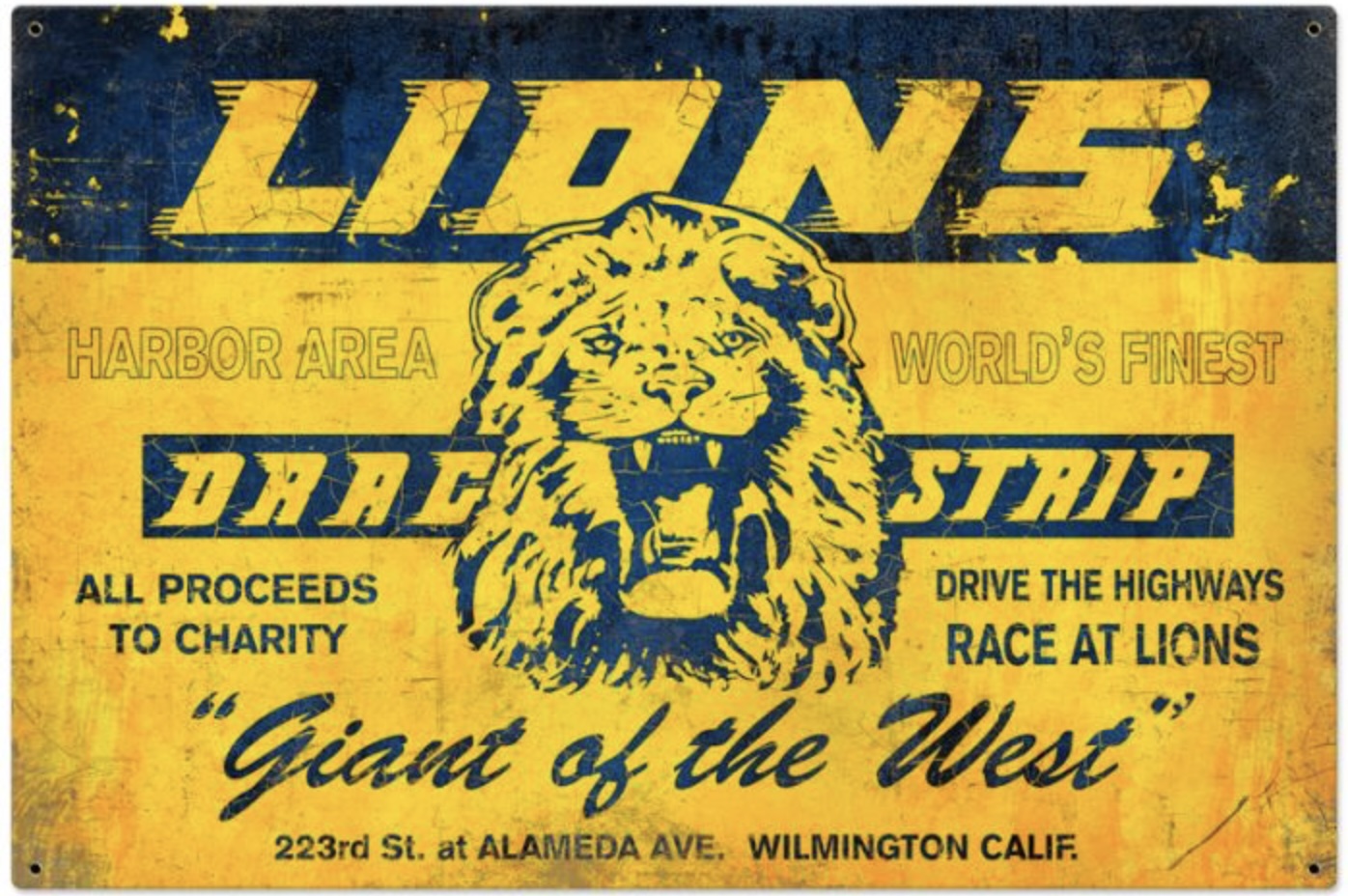
In January 1954, the Lions Club of Wilmington, noting the proliferation of active area car clubs such as the Road Kings, Hoods, Scarabs, Pharaohs and Lords, publicly proposed the idea of establishing a similar drag strip in the Harbor Area.
Lions president John Chadwick held discussions with the YMCA, local chambers of commerce, and the leaders of the recently formed National Hot Rod Association (NHRA) with regard to organizing the effort, including financing and securing a location.
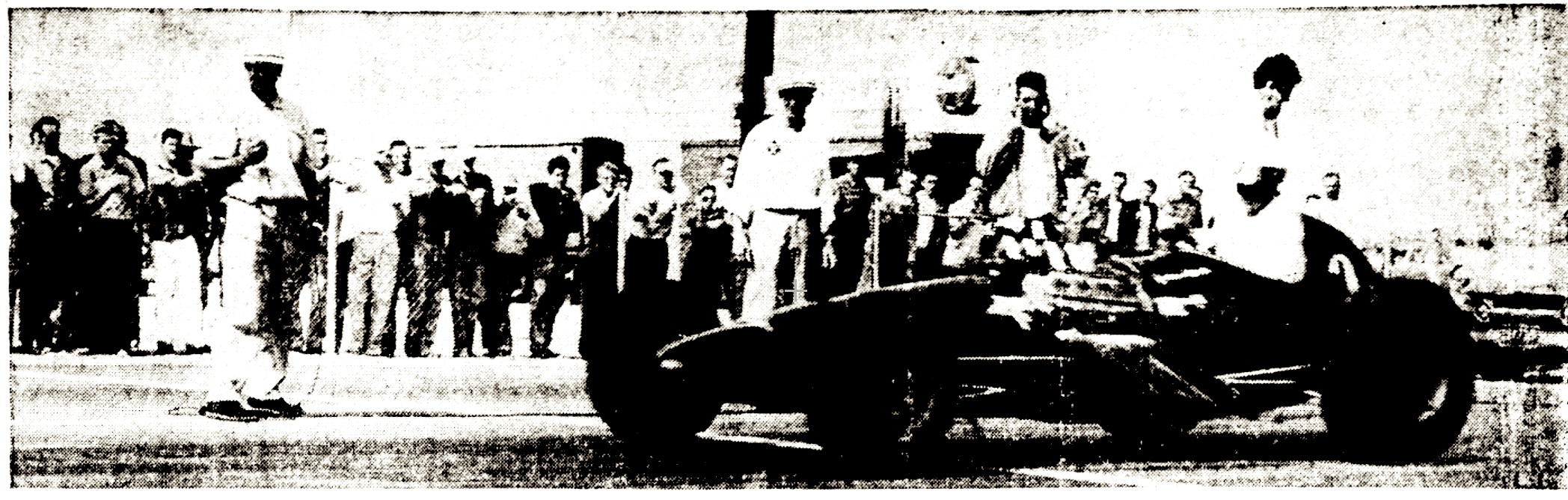
The first location proposed for the raceway was the Naval Air Station on Terminal Island, also known as Reeves Field. The U.S. Navy had commandeered the airfield for use during WWII, but was about to decommission it at the time. (Street racing advocate “Big Willie” Robinson later would fight for and eventually win the right to host street racing meets at the abandoned Reeves Field for a few years.
Unfortunately, the Lions’ Reeves Field proposal was nixed by the Harbor Commission. A new site was proposed, a mile-long 35 acre strip of land east of Alameda St. between Sepulveda Blvd. and 223rd St. The land had been part of the Harbor Department’s Railroad Classification Yard.
Chadwick had formed a coalition with ten other area Lions Clubs, including those in San Pedro, Harbor City, Lomita, Torrance, Lakewood, and Long Beach. They pooled their resources by forming the Lions Associated Drag Strip (LADS) nonprofit group, which signed a lease deal for the Harbor Dept. land at 22660 Alameda St. in November 1954.
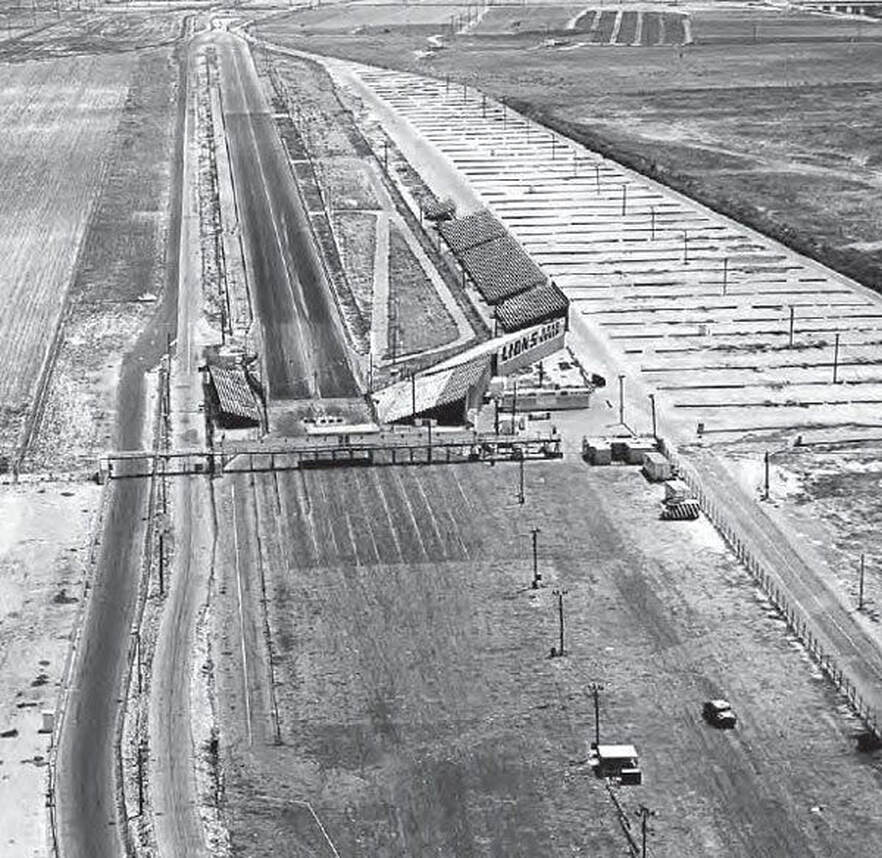
LADS spent the early part of 1955 raising the required $45,000 among its various members to finance the construction of the 3,500-foot dragstrip. By August, the funds had been secured, and a groundbreaking ceremony was held on Aug. 18. Ansco Construction Co. was contracted to complete the building project.
Los Angeles Mayor Norris Paulson officiated at a Sept. 15, 1955 ribbon-cutting ceremony at the new raceway, along with Mickey Thompson, who had been named the track’s first manager. (Thompson’s story will be told in a future post.) The track’s final cost was put at about $50,000.
A week later, Chadwick announced that Lions Drag Strip would open at 9 am on Sunday, Oct. 9, 1955. In an aside, he also noted that a couple of racing enthusiasts recently had jumped the gun, sneaking onto the track at night and wrecking both of their cars on the unfinished strip. One of them struck a stray log in the darkness which had yet to be positioned as a parking barrier.
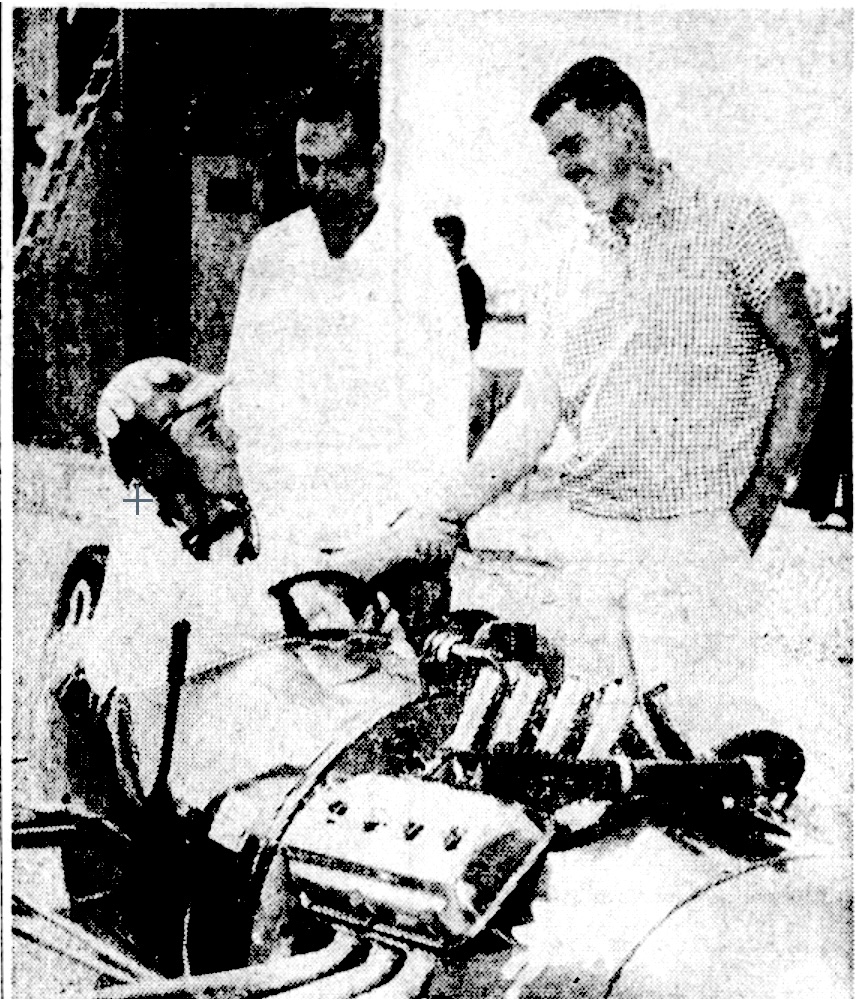
Admission on opening day was 75 cents for adults, with children under 12 getting in free. Race participants were charged $1.25 to compete. Doors opened at 9 a.m., and racing continued all day until fog and darkness made further races too dangerous.
Even the drag racing track’s most enthusiastic supporters were stunned by the opening day crowds, estimated at 10,000 people. Lions was off to a flying start. Having seen the project through to completion, Chadwick resigned as LADS head in late October.
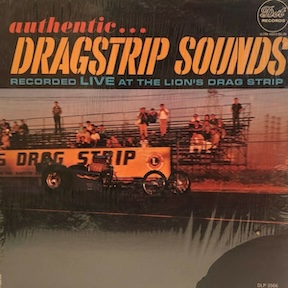
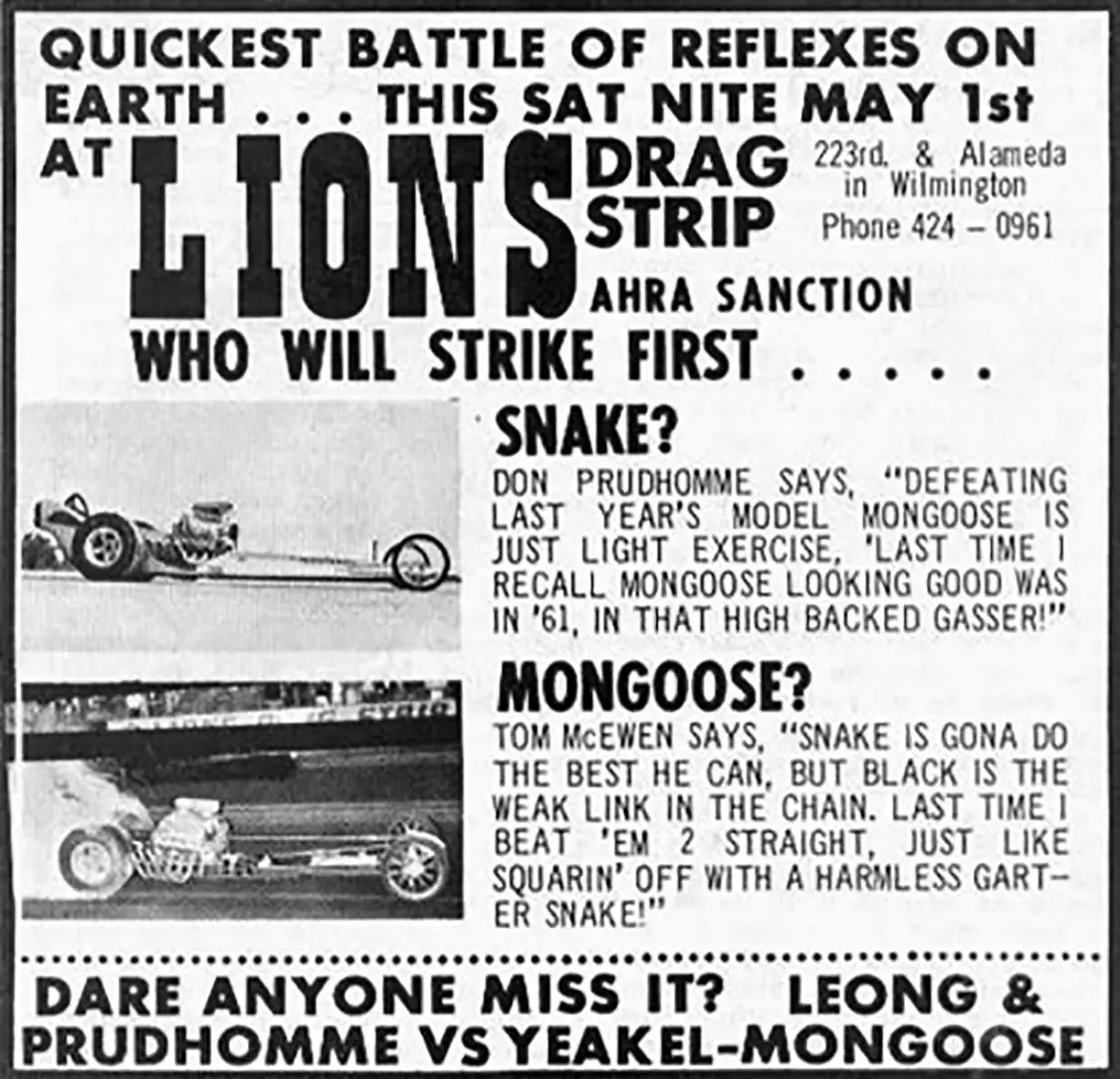
Over the years, the cream of the NHRA’s drag racers competed at Lions: Gary Gabelich, Don “Big Daddy” Garlits, Tommy Ivo, Tom “The Mongoose” McEwen, Don “The Snake” Prudhomme, and a host of others. The rival American Hot Rod Association (AHRA), formed in 1956, also staged many races at Lions.
The big-name drivers and high-profile races helped bring in the money that kept Lions operating. An estimated $500,000 from the speedway’s proceeds was distributed to various charities during the years it was open.
But the big races also caused Lions to be a victim of its own success. As the vehicles became faster and more powerful, they became louder, causing more noise complaints from neighboring residents. Also, the increasing amount of big-name races made it harder for street racers to get time on the track.
These and other factors caused the Harbor Commission to cancel the lease for Lions Drag Strip, resulting in its closure on Dec. 2, 1972. Some 20,000 fans stormed the gates on its final day.
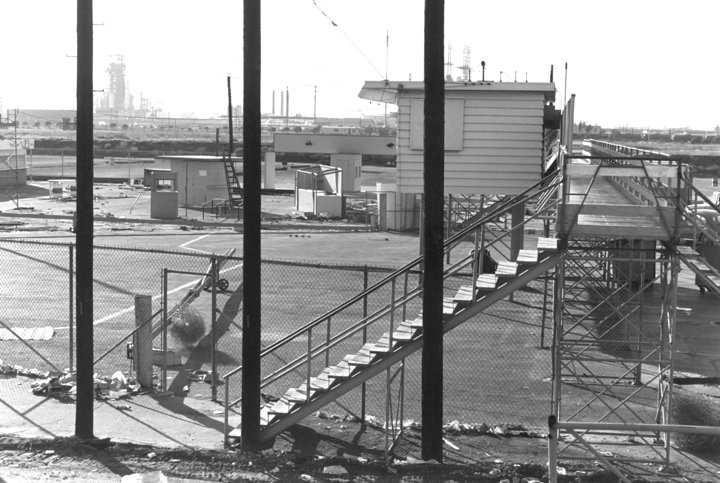
The Lions site sat unused and empty for 10 years. Finally, the Harbor Commission razed the facility and built a large warehouse for storing shipping containers, which remains there to this day.
During its heyday, the track was used as a filming location for TV’s “The Munsters” and “Adam-12,” and for the 1965 film, “It’s a Bikini World.” References to it also can be found in the TV series “Mad Men” and the films “Once Upon a Time in Hollywood” and “The Killer Elite.”
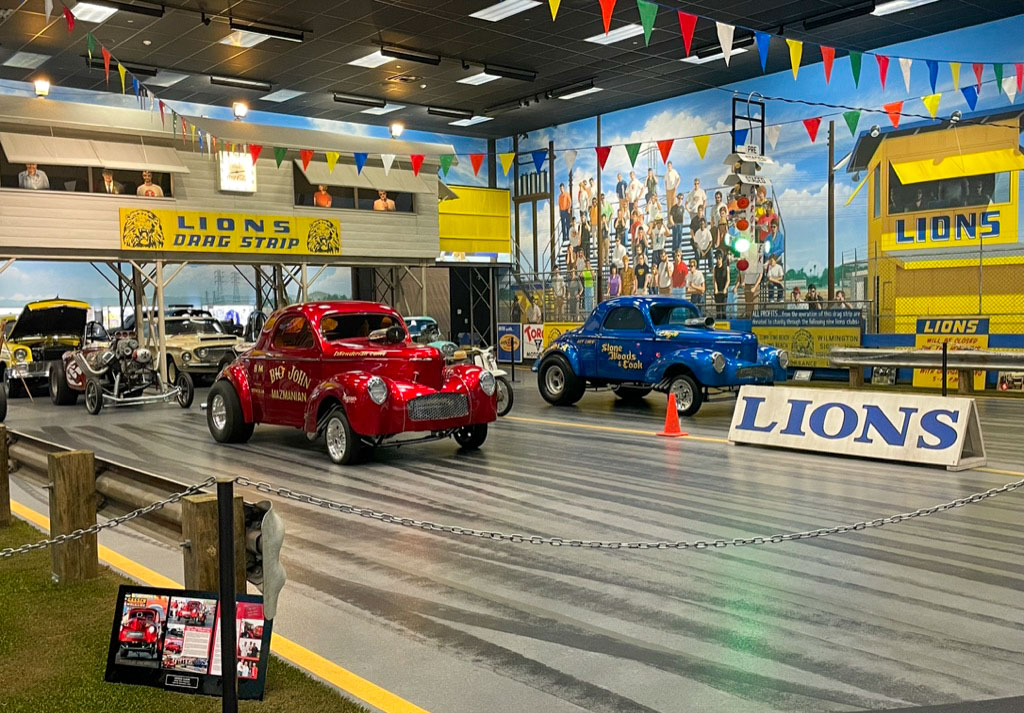
Note: Those wanting to take a deeper dive into the total Lions Drag Strip experience should consider a visit to the Lions Automobilia Museum in Rancho Dominguez. Admission is $20 for adults, and $15 for seniors, military members and children 4-17.
Sources:
Daily Breeze archives.
Drag Strip List website.
“The Last Drag Race,” by Steve Alexander, Hot Rod magazine, Feb. 1973 issue.
Lions Automobilia Foundation and Museum website.
Los Angeles Times archives.
San Pedro News PIlot archives.
Wilmington Press Journal archives.
Comments:
From Don Wallace:
Loved your newsletter, as one who learned to drive a stick by lying in bed at night listening to Lions dragstrip—not even knowing those were cars. To my childish ears they were literally lions in the jungle across the concrete LA riverbed a few blocks away from my Bixby Knolls house. Years later when I was given my first shifting lesson in a two and a half ton dump truck I could hear those rising chords reaching for a peak that was never sumitted until the final gear was triumphantly slotted.
Thanks for taking care with the details. Along with Tom Wolfe’s Kandy Kolored Tangerine Flake Streamline Baby the best books I know about car culture are by LA’s own Lou Mathews, who grew up inside and under the hood. His LA Breakdown and Shaky Town are quiet masterpieces, and as unflashy as those 56 Chevys were loud.
Don Wallace
Honolulu
Author of One Great Game, about the 2001 Long Beach Poly – Concord De La Salle “first ever high school national championship football game.”

