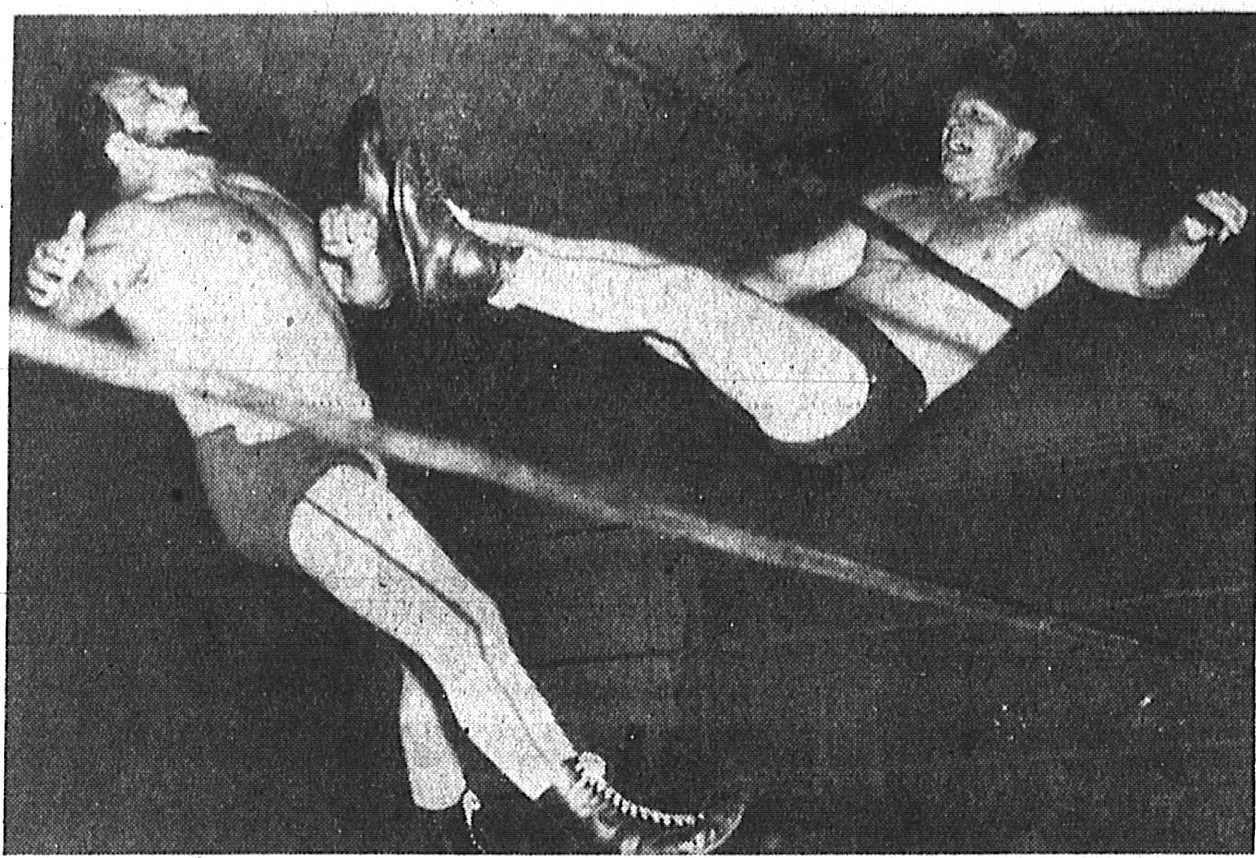
Professional wrestling has become such an overheated spectacle in recent decades that it’s understandable that its followers might assume that it’s always been that way.
These days, matches are held in giant arenas all over the world and broadcast via pay-per-view internationally. But in its earlier years, things were very different.
The roots of the sports/entertainment hybrid that is pro wrestling have been traced back to exhibitions that became popular during the post-Civil War era. Traveling carnivals often featured a wrestler who would take on all comers in the ring for a fee.
There were plenty of legitimate matches held in wrestling’s early days, but promoters soon realized that honest contests were less popular than fixed matches with clearly defined heroes and villains.
By the early 20th century, the fact that most wrestling matches were fixed had become common knowledge. This knowledge didn’t seem to hurt its popularity. Newspapers regularly ran exposes about pro wrestling, but instead throwing in the towel, its promoters doubled down on fixed matches.
Its managers began fabricating personas and good versus evil story lines. A wide variety of localized wrestling alliances sprung up around the country, setting up the situation where a wrestler could be a black-hearted villain in one area, then move to another area and play a heroic good-guy character there.
Wrestling events in the 1910s and early 1920s in Los Angeles County were held at a variety of venues. They were staged at first mostly in local athletic clubs, then began to graduate into larger venues such as the Shrine Auditorium and the Long Beach Athletic Arena.
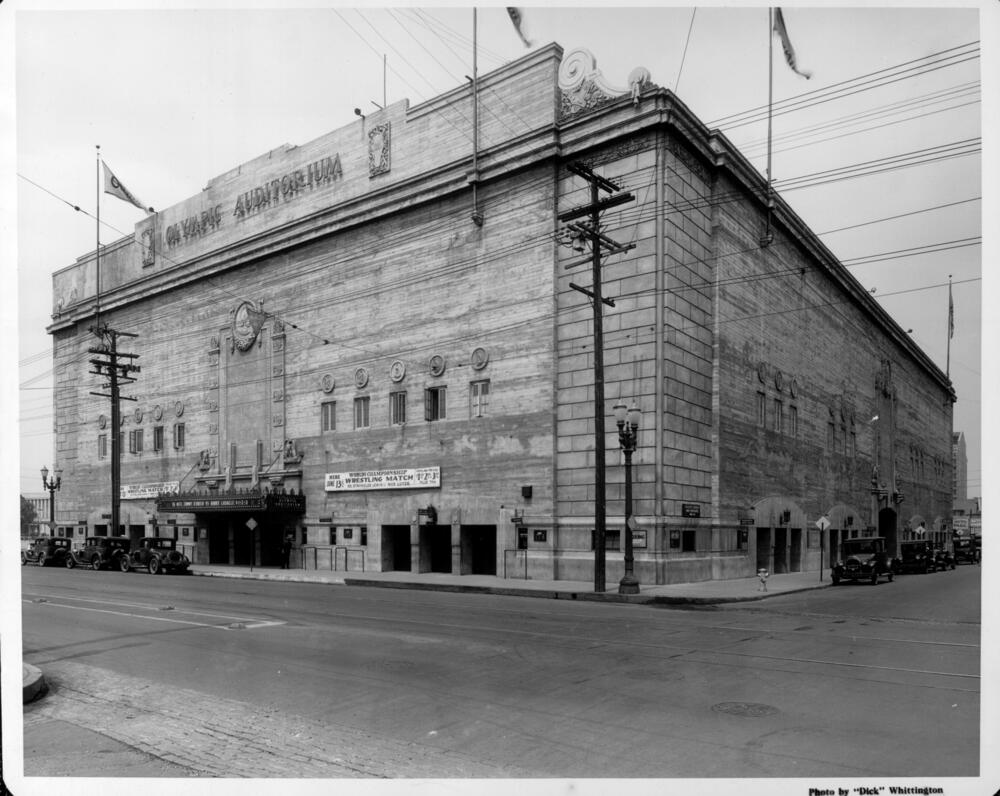
The 1925 opening of the Olympic Auditorium at 18th St. and Grand Ave. in Los Angeles, just south of downtown, gave wrestling a permanent foothold in the city. Boxing and wrestling would be the Olympic’s bread-and-butter events for decades to come.
But that didn’t keep the suburbs from taking a stab at staging wrestling events, including in the South Bay and Harbor areas.
Wrestling matches became a weekly Saturday night feature at the Redondo Arena during the mid-1940s. This facility on El Paseo on the old Redondo waterfront amusement area also was known at various times as the Mandarin Ballroom and the Redondo Barn.
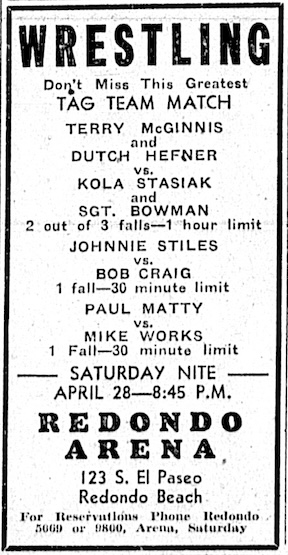
Hawthorne resident Ernest “Dutch” Hefner was a popular attraction, wrestling at the Redondo Arena several times in 1944 and 1945.
Perhaps the most significant local matches were held at the Wilmington Bowl, an indoor arena first built at 909 Mahar Ave. in Wilmington in 1924. (The original building was destroyed by a 1929 fire, and its replacement opened in 1930.)
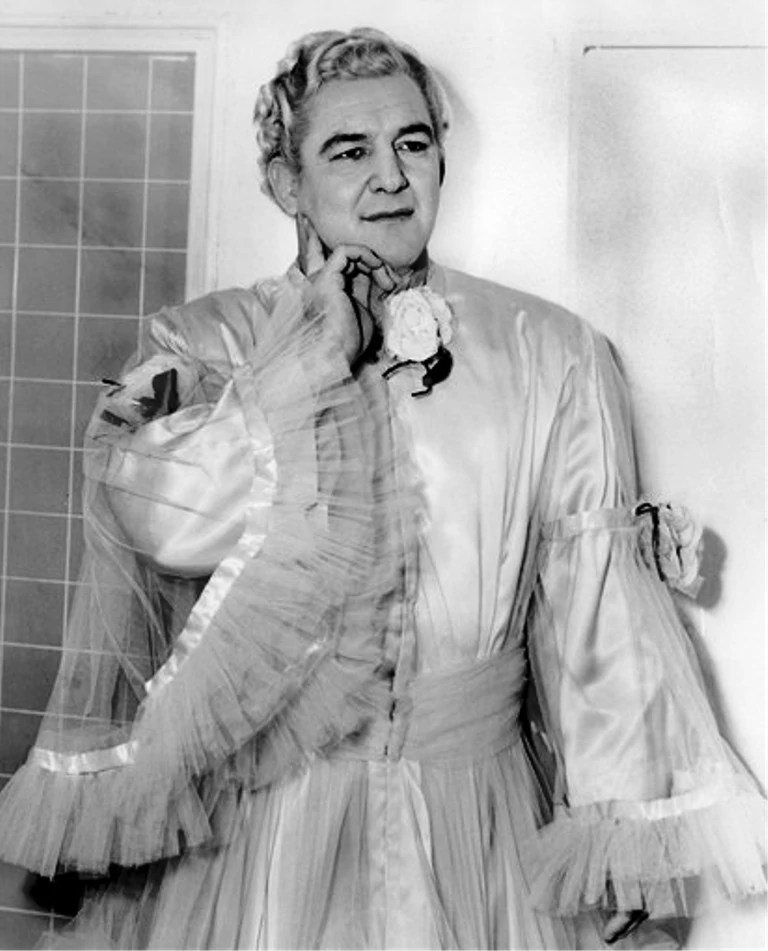
Former champ Joe Louis officiated at a match between the flamboyant legend Gorgeous George and rival Sandor Szabo at the Bowl on April 5, 1949, with George defeating Szabo before a packed house. George wrestled there more than a dozen times between 1947 and 1949.
Other colorfully named wrestlers who grappled during this era at the Bowl included Mr. Moto, the Golden Terror, Mr. X, Jungle Boy, Chief Little Wolf, Lord Blears and Judo Jack Terry. Former boxing champ Primo Carnera and pro wrestling legend Lou Thesz did battle there, as did former UCLA football star-turned actor Woody Strode.
In 1953, promoter Nick Lutze made a deal with KNXT Channel 2 to telecast “International Wrestling,” a regular Saturday wrestling show from the Bowl. It didn’t last, though. The Bowl fell on hard times in 1954 and was closed for good a year later. (The repurposed industrial building still stands.)
Torrance’s dalliance with pro wrestling was more brief and less illustrious, though that it happened at all still surprises.
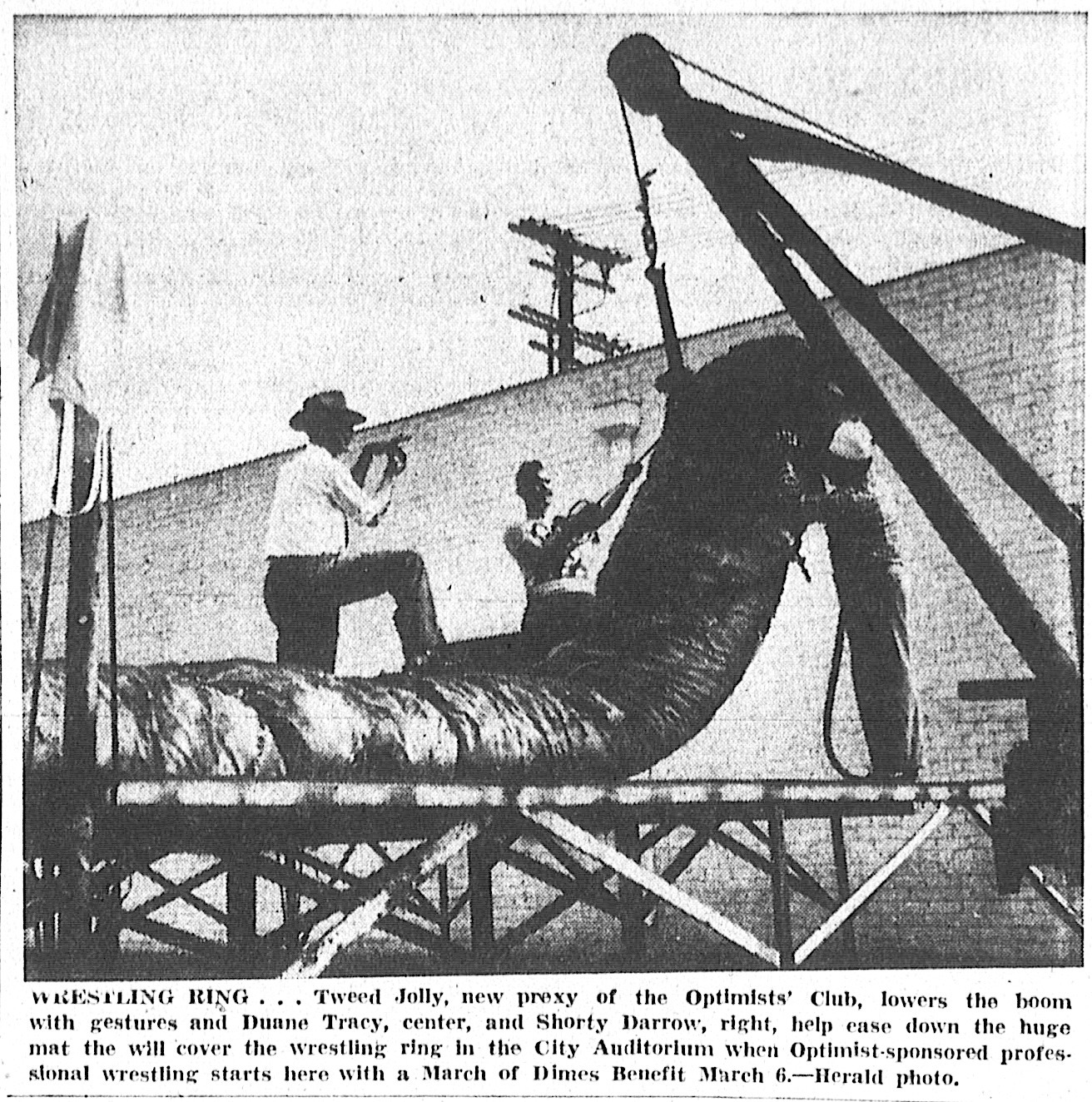
It began with the Torrance Optimist Club, which sponsored the first pro wrestling show in the city at the Civic Auditorium at 1349 El Prado downtown on March 16, 1949. Its proceeds benefited the Torrance area March of Dimes and its fight against polio, then a major public health crisis.
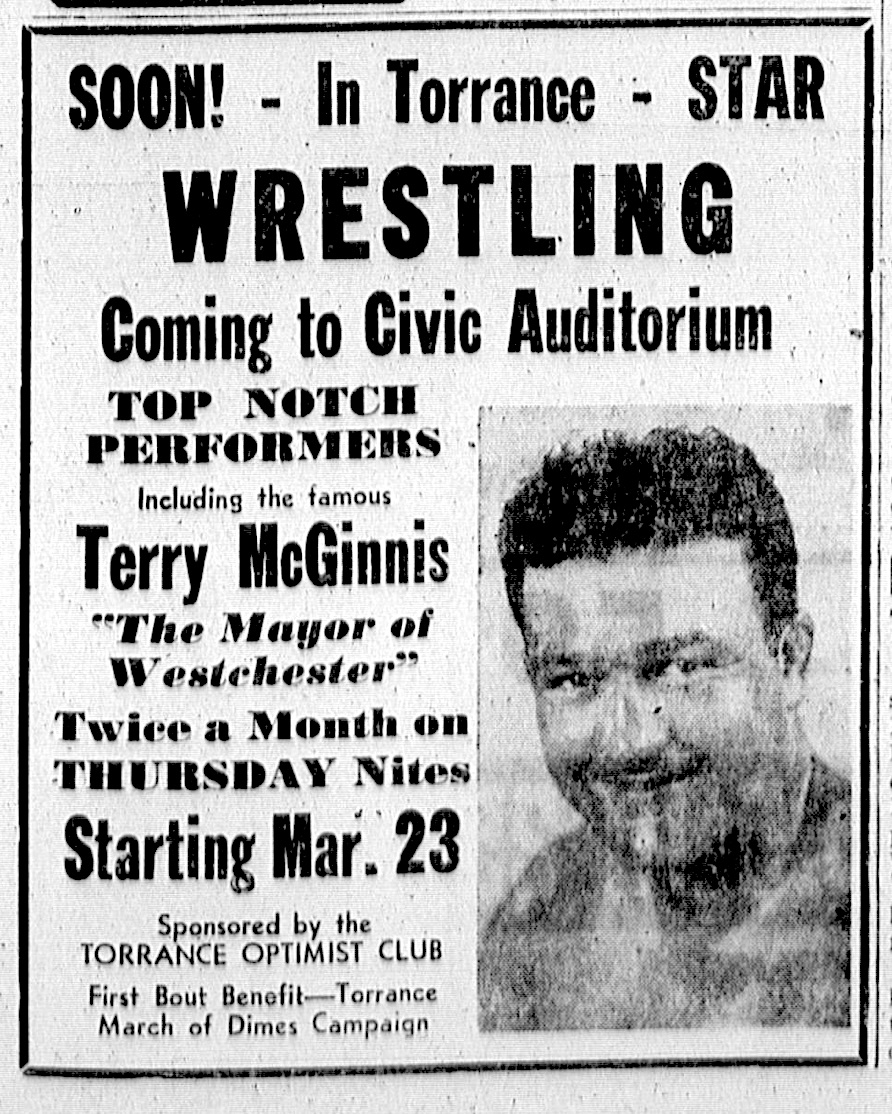
In early 1950, the Optimist Club made another deal with the city to sponsor 6 nights of pro wrestling matches, starting on March 2. The popular events were held every other Thursday at the Civic Auditorium. (The auditorium was demolished in 1971; the South Bay Home Health Care medical supply store now occupies the site.)
The Wilmington Bowl and the Long Beach Wrestling Arena tried unsuccessfully to quash the Torrance wrestling shows. But perhaps pressure from neighboring promoters explains why no further Torrance pro wrestling shows appear to have been held following the 1950 events.
For the next few decades, pro wrestling continued to operate on a regional basis, operated by a patchwork of local governing bodies.
That all changed with the arrival of promoter Vince McMahon, who built a nationwide organization, the World Wrestling Federation (WWF), and brought the sport into the national pay-per-view arena with the first WrestleMania telecast in 1985.
The sport’s popularity exploded, but local and regional wrestling shows became a thing of the past.
Sources:
“The History of Los Angeles Pro Wrestling,” by Steve Yohe et al., Wrestling Classics website, April 6, 2018. (An incredible piece of research listing wrestling matches in Los Angeles dating back to 1911.)
Los Angeles Times archvies.
Redondo Reflex archives.
Torrance Press-Herald archives.
Wikipedia.
Wilmington Press Journal archives.