
Looking around at the South Bay landscape today, it’s hard to imagine it as the thriving agricultural area it once was in the first half of the 20th century.
Dairy farms once dotted the landscape. Giant greenhouses near present-day 190th St. and Western Ave. raised and sold orchids and gardenias renowned nationwide, and the Palos Verdes Begonia Farm operated in Torrance for more than half a century.
The Ishibashi family raised strawberries on fields near the Torrance Municipal Airport for decades until closing in 2011. The Mira Loma Turkey Farm on Victor St. in west Torrance raised the big birds until 1961 and sold them until 1986.
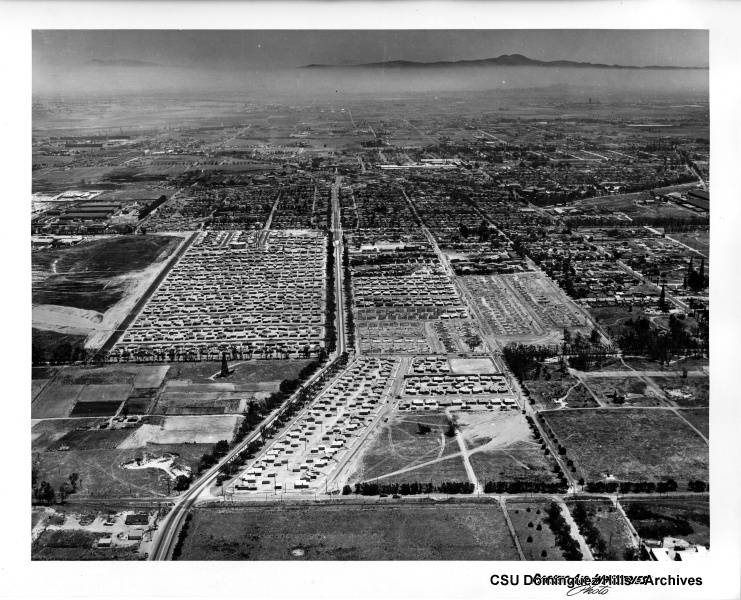
But residential and commercial development began to eat up the open spaces once used for agriculture. Gradually at first, then more rapidly following the post-World War II housing boom, land was gobbled up for housing and business development.
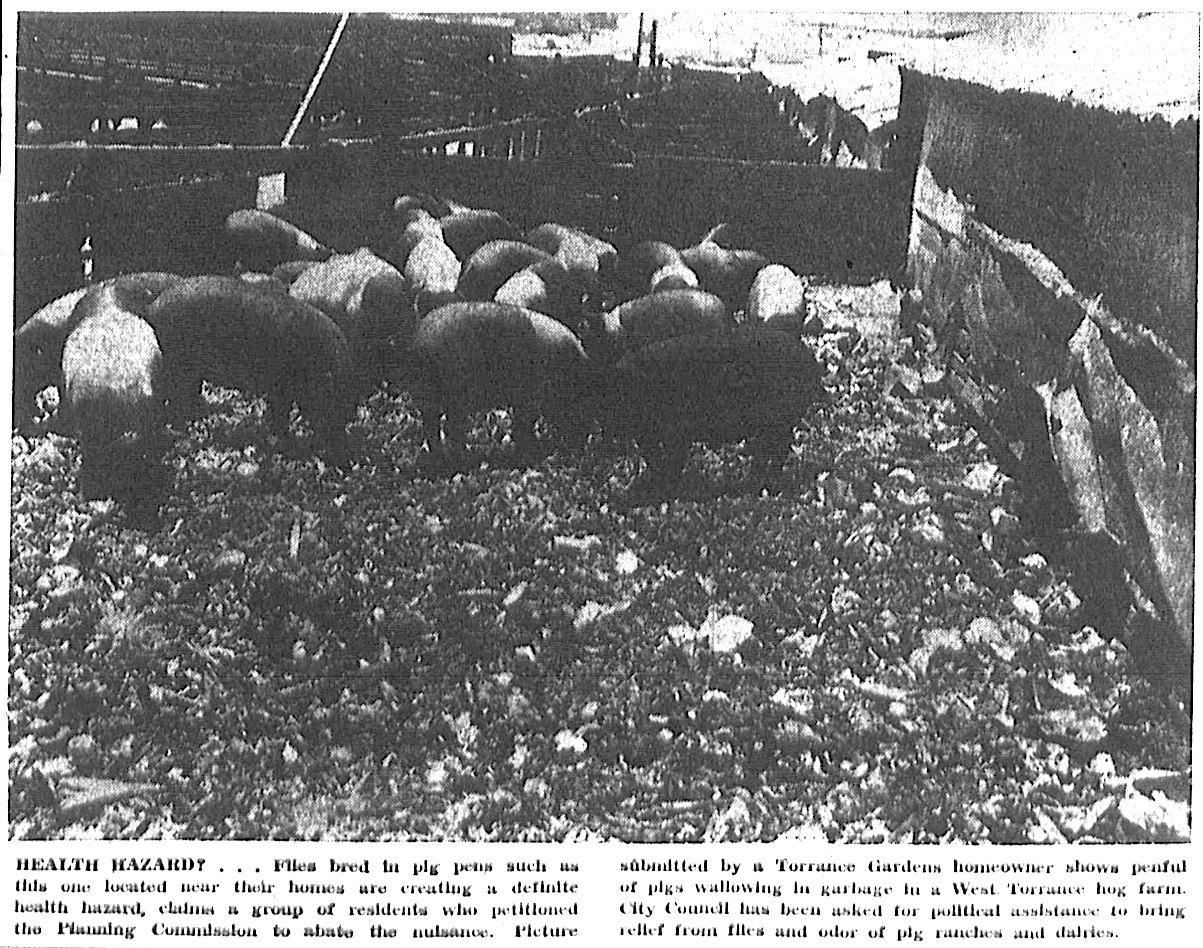
The commercial farms and ranches that remained came to be seen as nuisances and health dangers by the occupants of the newly erected houses near them. Livestock-based operations were targeted specifically, as they were easily identifiable sources of noise, pests and vermin and their accompanying unpleasant odors.
Faced with public pressure from nearby residents, the city of Torrance began cracking down on dairy farms and their cattle, outlawing them as of 1963. Cities such as Lomita and Lawndale who once encouraged chicken farmers became less enthusiastic as development intensified.
So it’s not hard to imagine how quickly and forcefully public opinion shifted when it came to hog farms, whose livestock operations were among the most odiferous. Several such enterprises had been established in the Torrance area by the mid-1930s, forcing the city to begin its attempts to regulate them.
Torrance announced an ordinance in July 1936 that required prospective hog farmers to get permits from the city. The law also attempted to regulate the common practice among the farms of hauling garbage into the city to be used for hog feed, mandating permits for that practice as well.
Though limited in scope, the ordinance had an immediate effect. Owners W.J. Frogge and Don Willis immediately had to stop building their hog farm at 182nd St. and Prairie Ave. after failing to get the proper permits for the construction.
At the same time as the ordinance was proposed, Torrance officials received word that a Chicago firm was contemplating putting a $400,000 meatpacking plant in the city. They quickly checked the text to make sure it wouldn’t jeopardize the possible project. It was never built.
The campaign against the hog farms didn’t really pick up steam again until after World War II. In 1949, flies were determined to be such a problem in parts of Torrance that a special group, the Fly Abatement Committee of Torrance (FACT) was formed to pursue solutions.
In early January 1951, the Torrance planning commission asked the city to set a date beyond which the hog farms would no longer be allowed to operate, recommending a ten-year period.
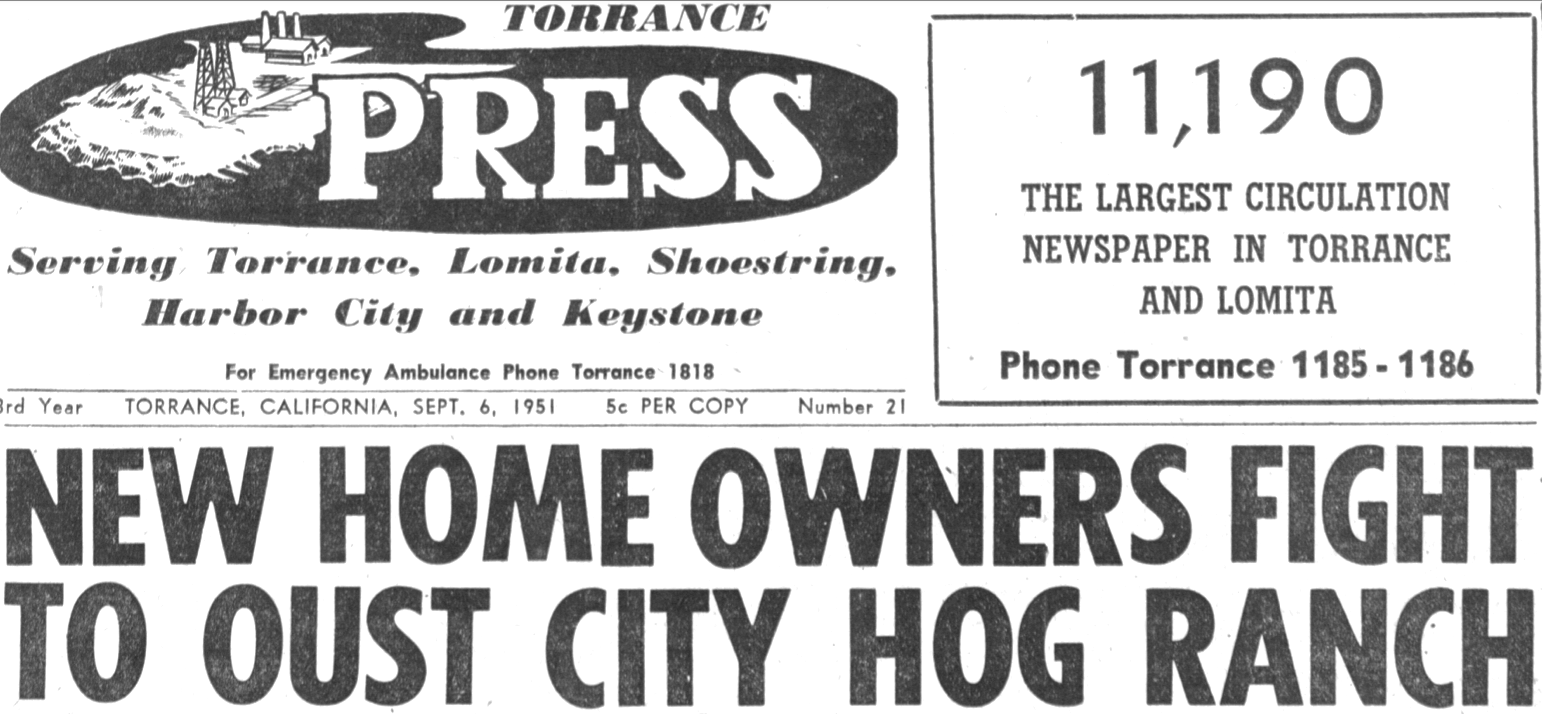
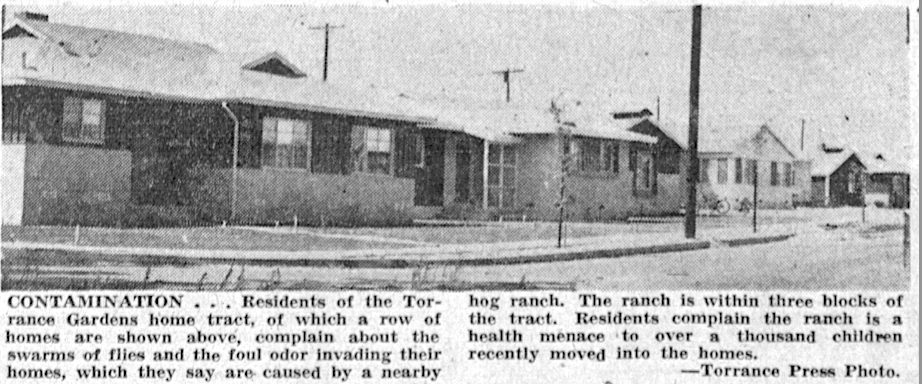
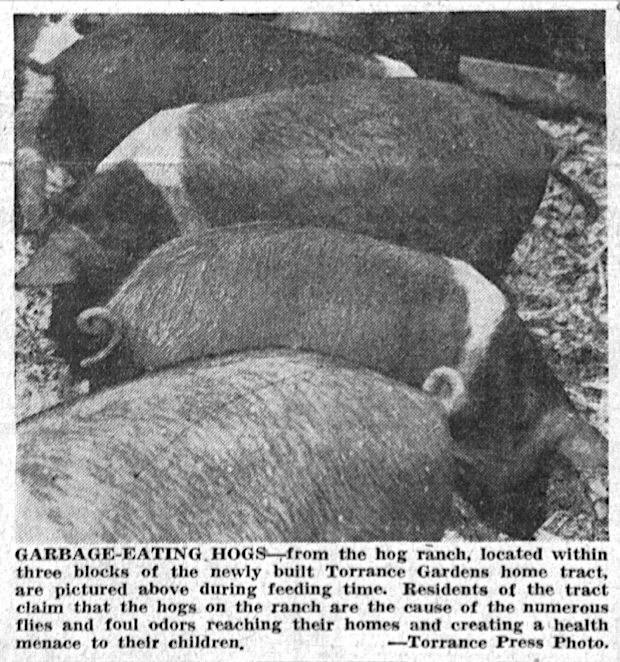
The following September, new residents at the Torrance Gardens housing development near Crenshaw and Torrance boulevards told the City Council that a nearby hog farm posed a health danger to residents and their children, and demanded its closure.
The especially hot summer of 1953 brought another much more intense round of complaints from residents. An estimated 700 of them turned out for an August 1953 council meeting to complain of “unbearable” clouds of flies and seriously bad odors coming from the hog farms, particularly those in western Torrance near Spencer St. and Madrona Ave. in Torrance.
A cluster of hog farms operated there, including those owned by Frances Foley, Lester Kazarian and Edward F. Saul. George Green owned another farm on Torrance’s western border at W. 190th and Beryl streets.
The residents claimed one of the hog farmers – they didn’t identify whom – had been dumping garbage that the hogs wouldn’t eat in a field near their housing development. Frances Foley later admitted that he was guilty of the illegal dumping.
Finally, the City Council acted definitively in 1954, setting a three-year deadline forcing the hog farms in the city to cease operations and remove all animals by June 15, 1957. The owners complied.
A Torrance Herald story claimed that at one point the Torrance area had 85,000 residents, and 6,000 hogs living in the city. By 1957, the hogs were gone.
A similar battle over cattle at dairy farms ended with the keeping of the animals in the city declared illegal as of Dec. 1, 1963. The final dairy cows were removed in December 1966.
Sources:
Daily Breeze files.
Farming in Torrance and the South Bay, by Judith Gerber, Arcadia Publishing, 2008.
Torrance Herald files.

