Clifford Reid envisioned Torrance’s Hollywood Riviera as part celebrity enclave

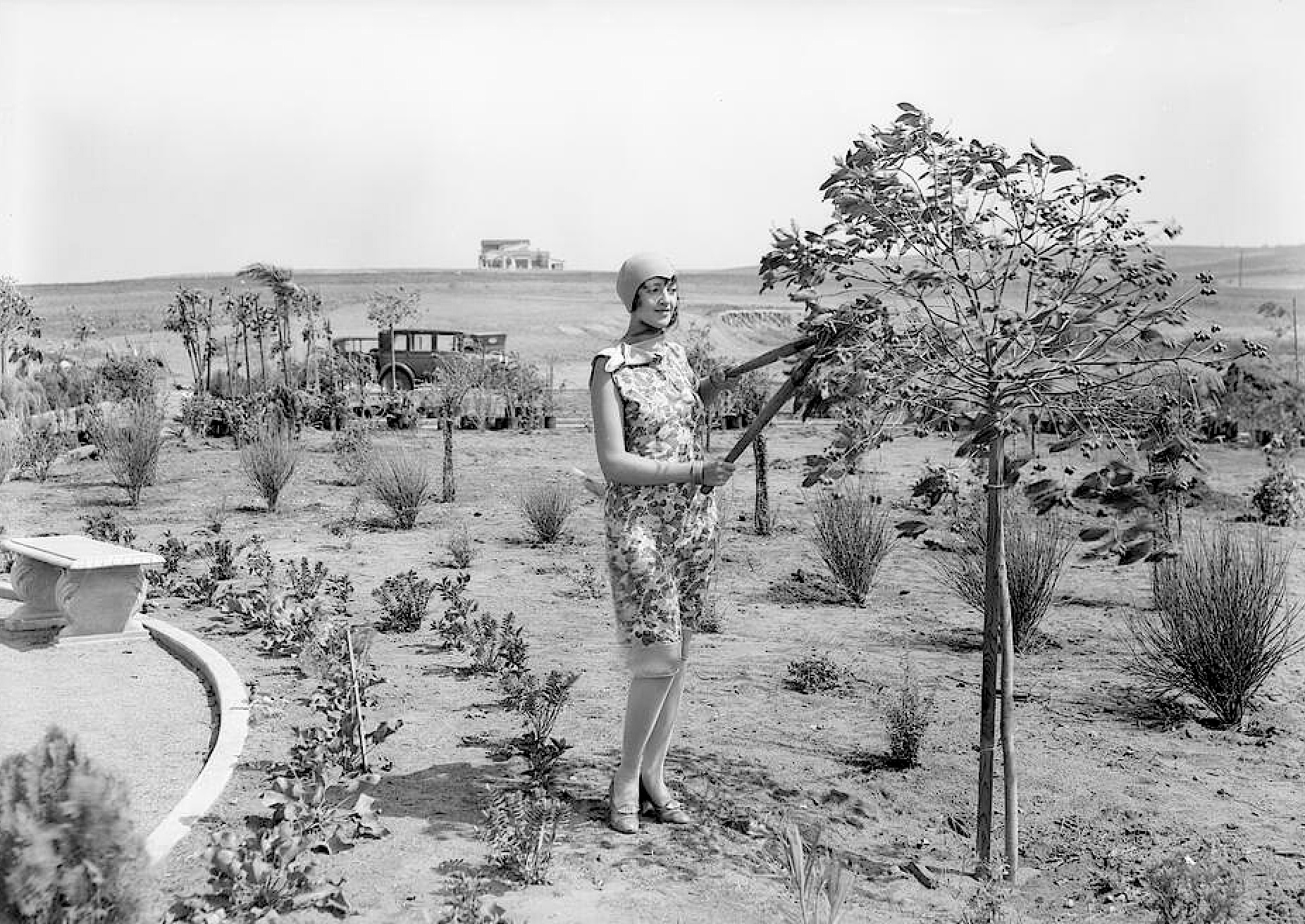
An unidentified woman prunes a young tree on the grounds of the new Hollywood Riviera housing development in 1928. Only one other house can be seen in the distance. (Credit: USC Digital Library)

Clifford Fletcher Reid was born in McMinnville, Oregon, in 1883. His first business venture after dropping out of college involved selling stereopticon cards. He turned out to be a natural salesman.
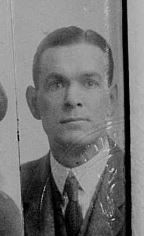
Clifford Reid. 1923 passport photo. (Credit: FindAGrave website)

After marrying and moving to Portland, he found real estate suited his marketing skills. The vibrant market in the Los Angeles area in the early 1900s drew the Reids south, and Clifford established a real estate business on Western Ave. near 6th St. in Los Angeles.

The Clifford Reid Co. sold lots in Los Angeles, Burbank and the then-booming San Fernando Valley. Reid became very interested in the South Bay once he caught wind of the development of the Palos Verdes Peninsula in the early 1920s.

Upon scouting the area, he became convinced that the barren low foothills between southern Torrance and Redondo Beach would make for a phenomenal luxury development. He foresaw building homes on the elevated fields that would all have a European Riviera-like view of the nearby shoreline. 

In 1926, he purchased 640 acres of unincorporated land in the area from the Huntington Land Co. and began pursuing his vision.  It was a grandiose one: he felt sure he could attract Tinseltown movie stars and executives to the new development, which he optimistically named “Hollywood Riviera.”
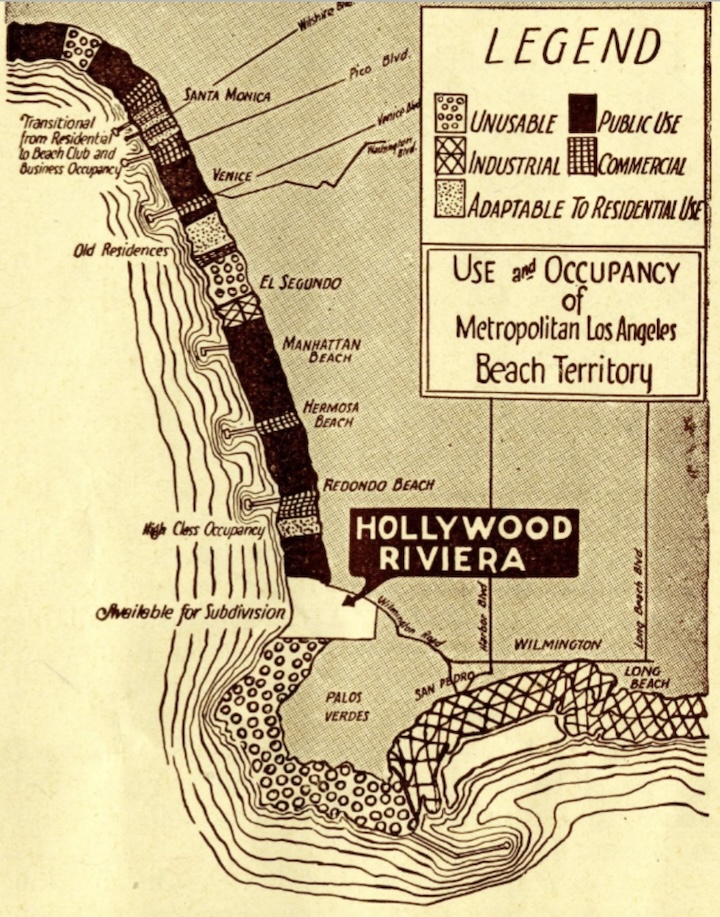
Map from a Hollywood Riviera promotional brochure circa 1927 shows the development as the last remaining open coastal area where new houses could be built. (Credit: Palos Verdes Library District Local History Center)

The area was considered to be fairly remote at the time, but Reid felt that a highway could be built linking it to Los Angeles. He and others began pushing the Hollywood-Palos Verdes Parkway, a  major thoroughfare that would link the South Bay to the southern edge of Los Angeles, and from there, 10 miles further north to Hollywood.

For a variety of reasons, including the arrival of the Depression, the Parkway was never completed. Torrance and Redondo Beach eventually did build a section of the roadway from Sepulveda Blvd. to Palos Verdes Drive North, the present-day Palos Verdes Boulevard.

The city of Torrance was in an acquisitive phase during the 1920s, and scooped up most of Reid’s development area as part of its Meadow Park annexation approved on Jan. 18, 1927. The large chunk of land, 5.91 square miles, stretched from Crenshaw Blvd. west across the southern portion of the city all the way to the Pacific Ocean, giving the city its own beach.

Another factor which drew attention to the Hollywood Riviera, which Reid originally called “Hollywood Shores,” was the nearby glider field. The 1929 American Glider Meet attracted 30,000 spectators, many of whom looked over Reid’s new development while they were there.
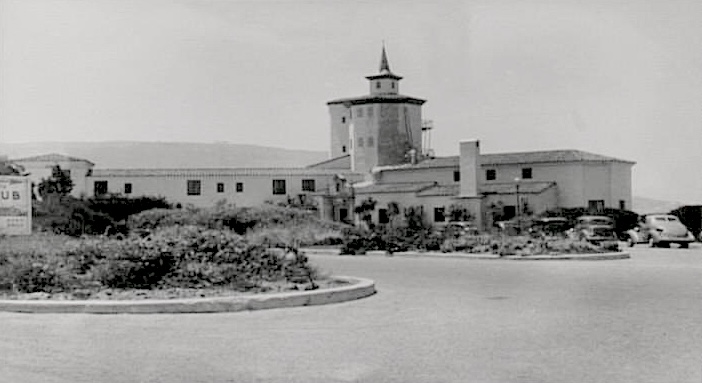
The Hollywood Riviera Beach Club, circa 1930s. (Credit: City of Torrance website)

On Feb. 18, 1927, Reid formally announced his $15 million development plan. In addition to homesites, it included a communal clubhouse for residents, the Hollywood Riviera Beach Club. The club was set on a bluff overlooking the Pacific, and opened in 1931. It burned down in 1958, and the beach below it still is known as “Burnout Beach.”

Another inducement, an 18-hole miniature golf course, was added near the Beach Club  in 1930. In addition, the development also included a full-size driving range.

A grand opening celebration and fiesta for the Hollywood Riviera was held on March 4, 1928. 

The first house Reid built was his own mansion on Via Monte d’Oro, which still stands. The 6,700-square-foot home included a central round tower with spectacular coastal views. He used the house and its surroundings as a showplace to woo prospective buyers.
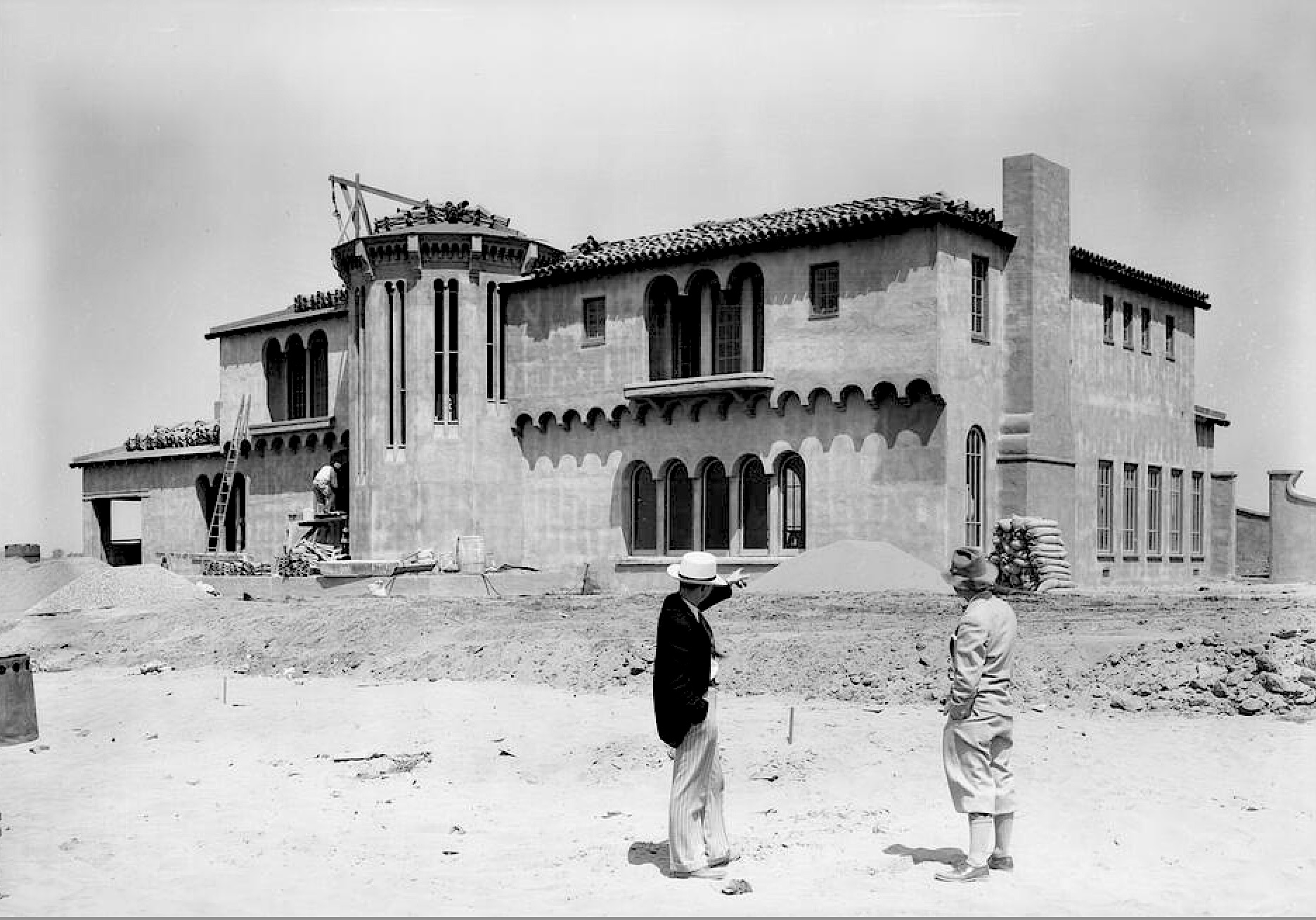
Clifford Reid’s Hollywood Riviera house on Via Monte d’Oro under construction in 1928. (Credit: USC Digital Library)

Taking its cue from nearby Palos Verdes Estates, an art jury was formed to enforce the  mandate that all houses be built in the Mediterranean cottage style with red tile roofs. The streets were given exotic names evoking the Spanish Riviera, also known as the Costa del Sol.

Paving those “vias,” “avenidas” and “calles” turned out to be a challenge. Mule teams were used to pull the grading and paving machines up and down the hillsides. In order to preserve scenic views, utility wires were buried underground, an unusual innovation at the time.
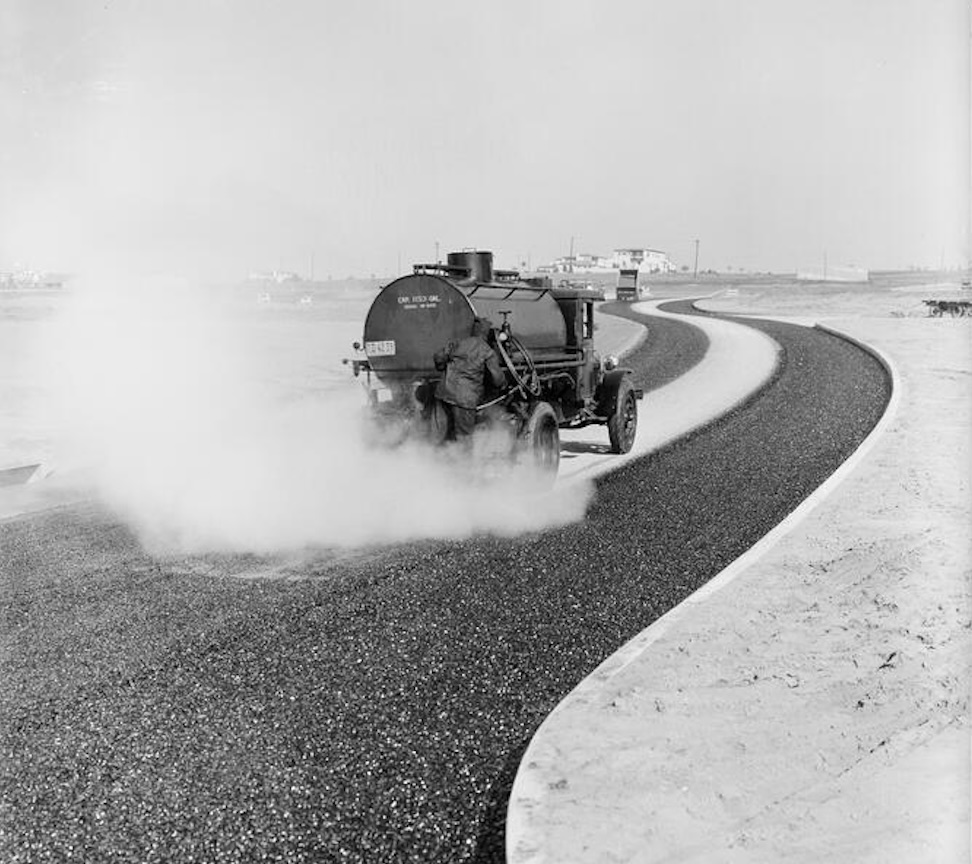
A crew paves a new road in the Hollywood Riviera development in 1932. Houses are still few and far between. (Credit: USC Digital Library)

Many Hollywood stars did make the pilgrimage to Torrance to hear Reid’s sales pitch, including Gary Cooper, John and Ethel Barrymore, Clara Bow, Marion Davies and Clark Gable. For years it was rumored that Mae West had bought a house there.

All of them may have come to the Riviera at one time or another to check it out, but actress Rosemary DeCamp was the only Hollywood star to buy a home and settle down there, along with her longtime husband, Judge John Shidler. She died in 2001.

MGM mogul Louis B. Mayer supposedly was interested in building a home there, but that never happened, either. Home ownership in Reid’s development was “restricted,” with no minorities allowed. This ruled out Mayer, who was Jewish.
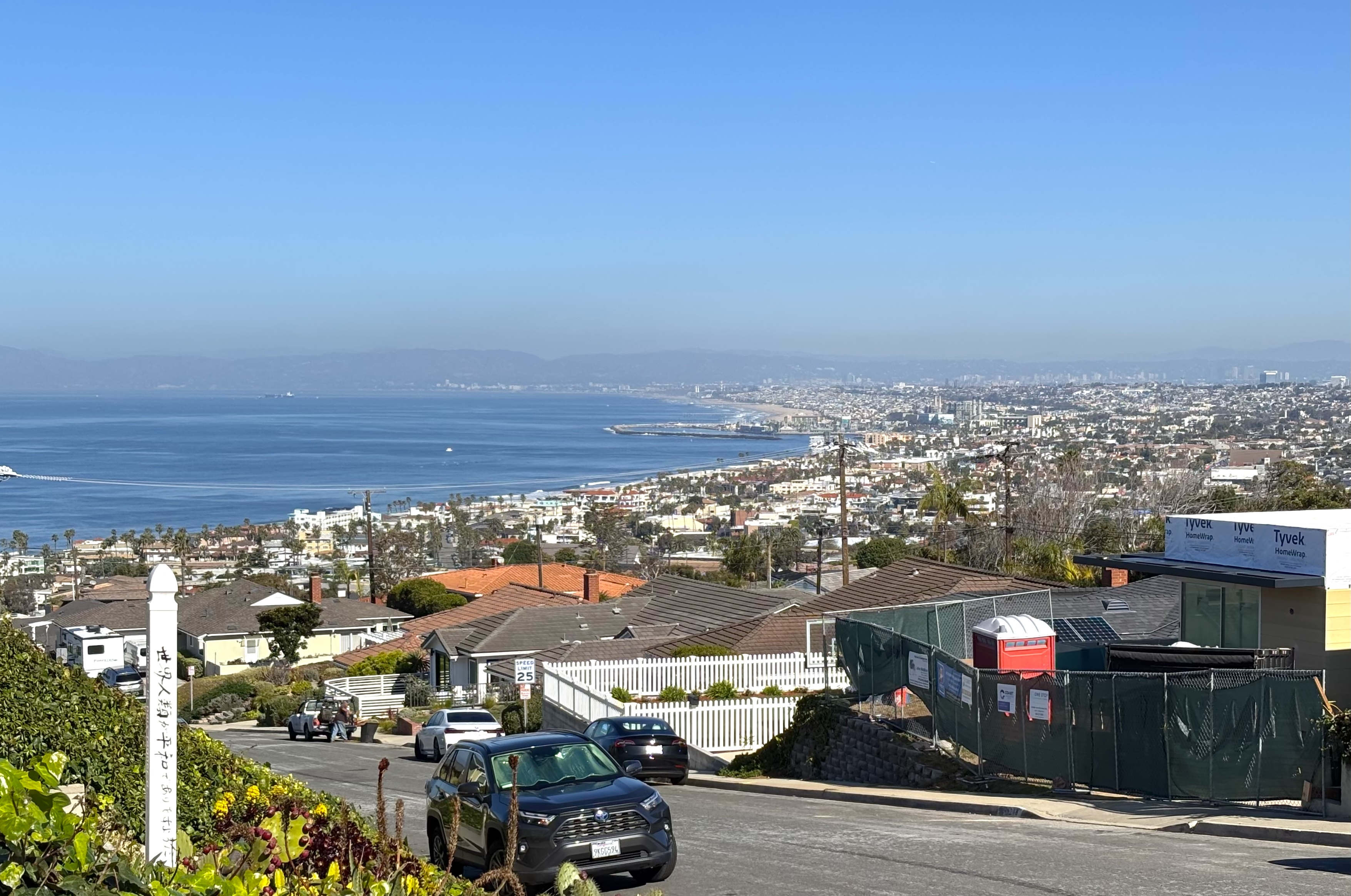
The homes in the Hollywood Riviera have an expansive view of the South Bay coastline and Santa Monica Bay. Redondo Beach pier, center. March 2025. (Photo by Sam Gnerre)

Lot sales started out well until the stock market crash and ensuing depression hit. By the late 1930s, they began to pick up again, but World War II cooled the real estate market once more. By the early 1940s, only a few dozen lots had been sold.

The development was revived by the postwar baby boom and the rise of the aerospace industry in the South Bay, whose many workers needed housing. Sales also picked up considerably after the restrictions on what style of houses could be built were removed.

Reid sold out his share in the development in 1947, though he continued to live in his home on Via Monte d’Oro. He died at 71 on June 3, 1955.

Hundreds of homes built during the 1950s eventually filled out the Hollywood Riviera, partially fulfilling Reid’s ambitious dream. Though most of the area lies within the Torrance city limits, many of its residences have a Redondo Beach mailing address, as its residents are served by the Redondo Beach post office.
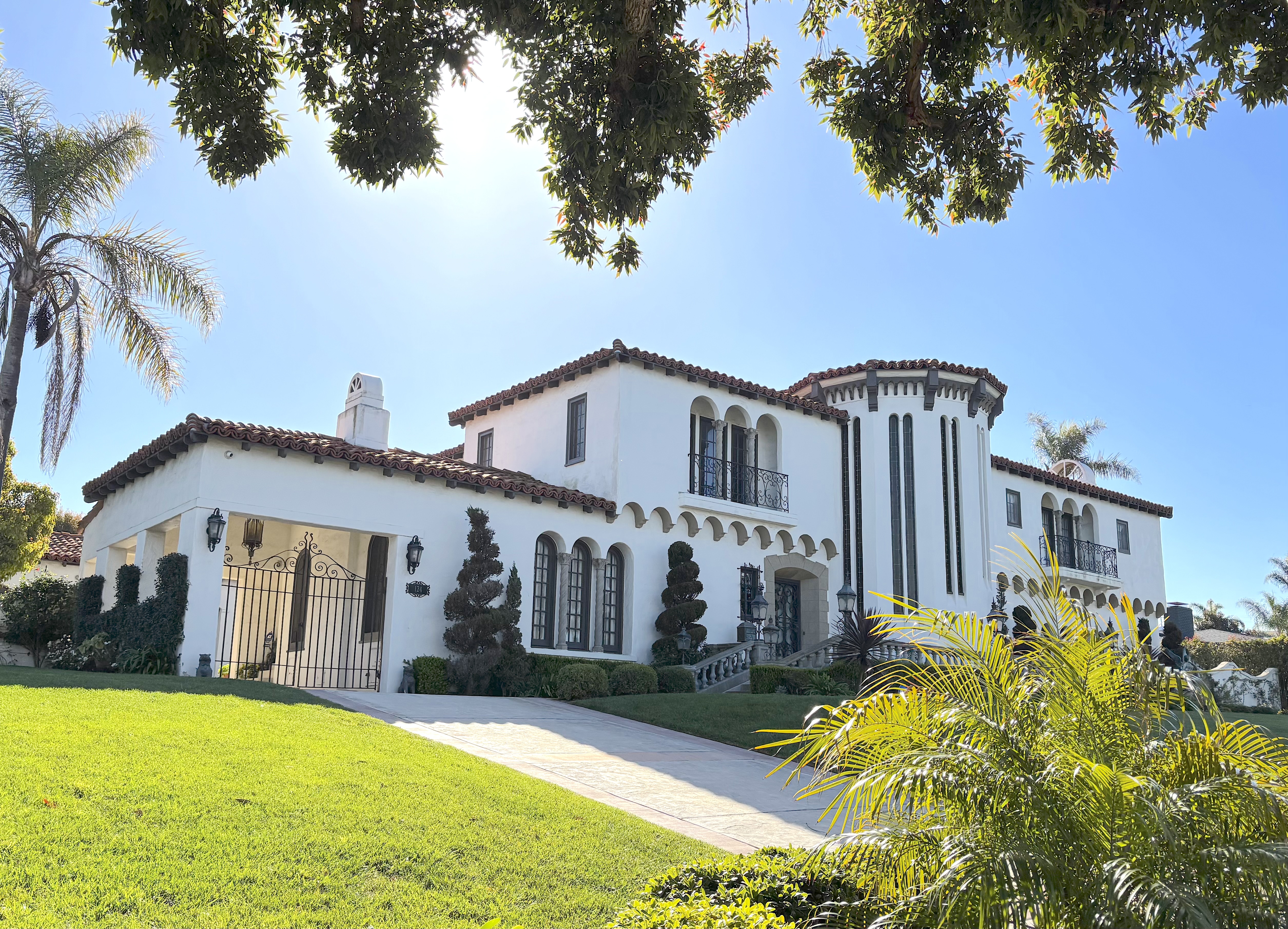
Clifford Reid’s Hollywood Riviera mansion in March 2025. (Photo by Sam Gnerre)

Sources:

City of Redondo Beach Historic Context Statement, by Marguerite Duncan-Abrams and Barbara Milkovich, Ph.D, Redondo Beach Planning Department, 1995.

Daily Breeze archives.

“A History of the Hollywood Riviera,” by Marshall E. Stewart, Redondo Riviera Real Estate website.

Los Angeles Times archives.

Torrance Press Herald archives.
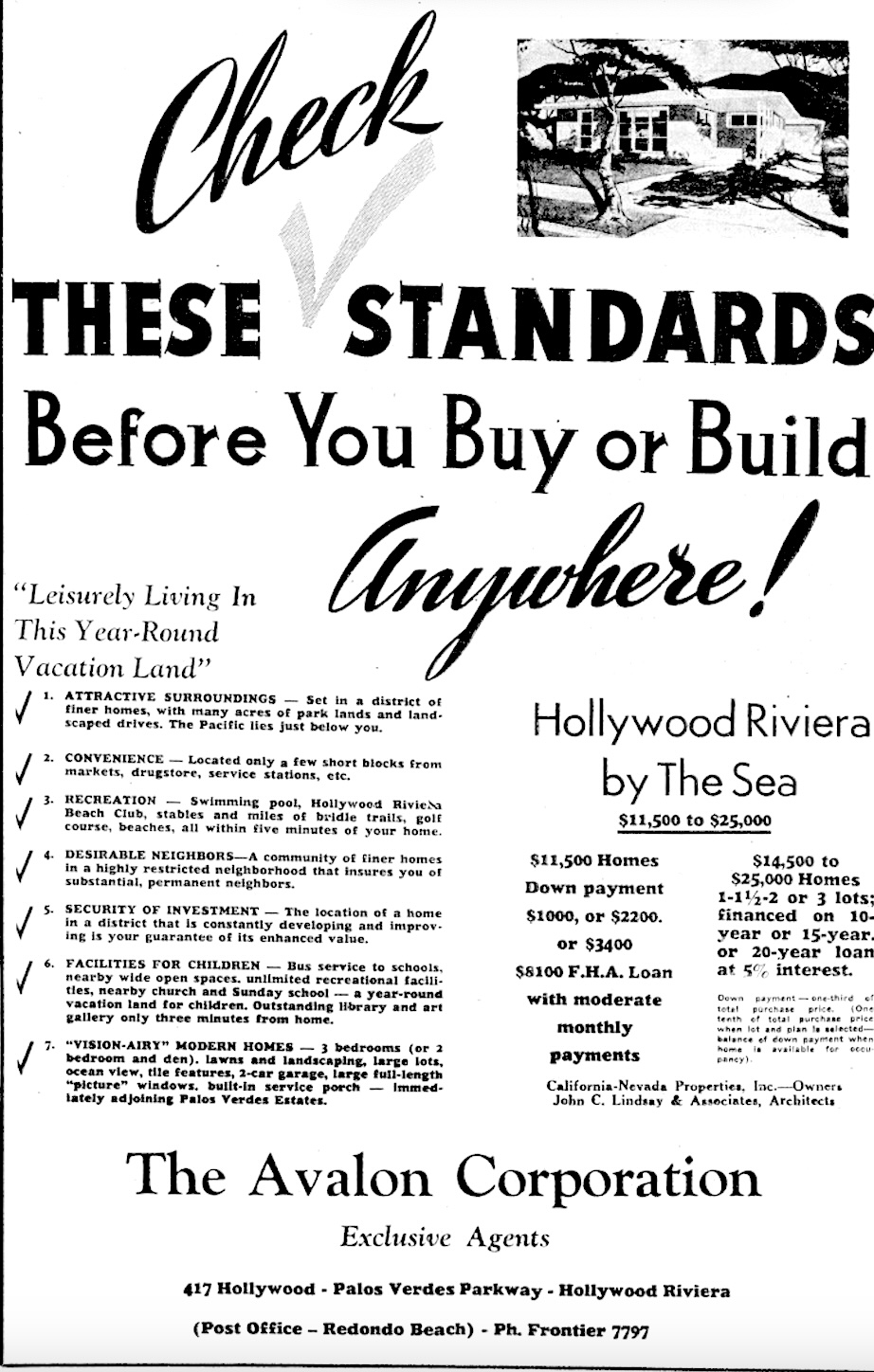
Sales of Hollywood Riviera lots were brisk following World War II. Palos Verdes Peninsula News ad, Oct. 23, 1947, Page 4. (Credit: Palos Verdes Peninsula News archives)

Redondo Beach’s Casino was a popular attraction on the city’s waterfront

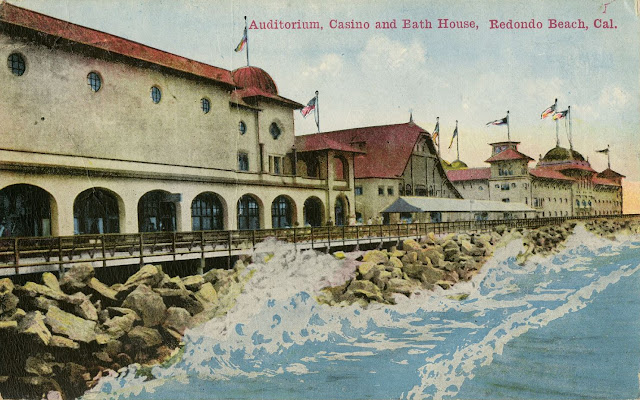
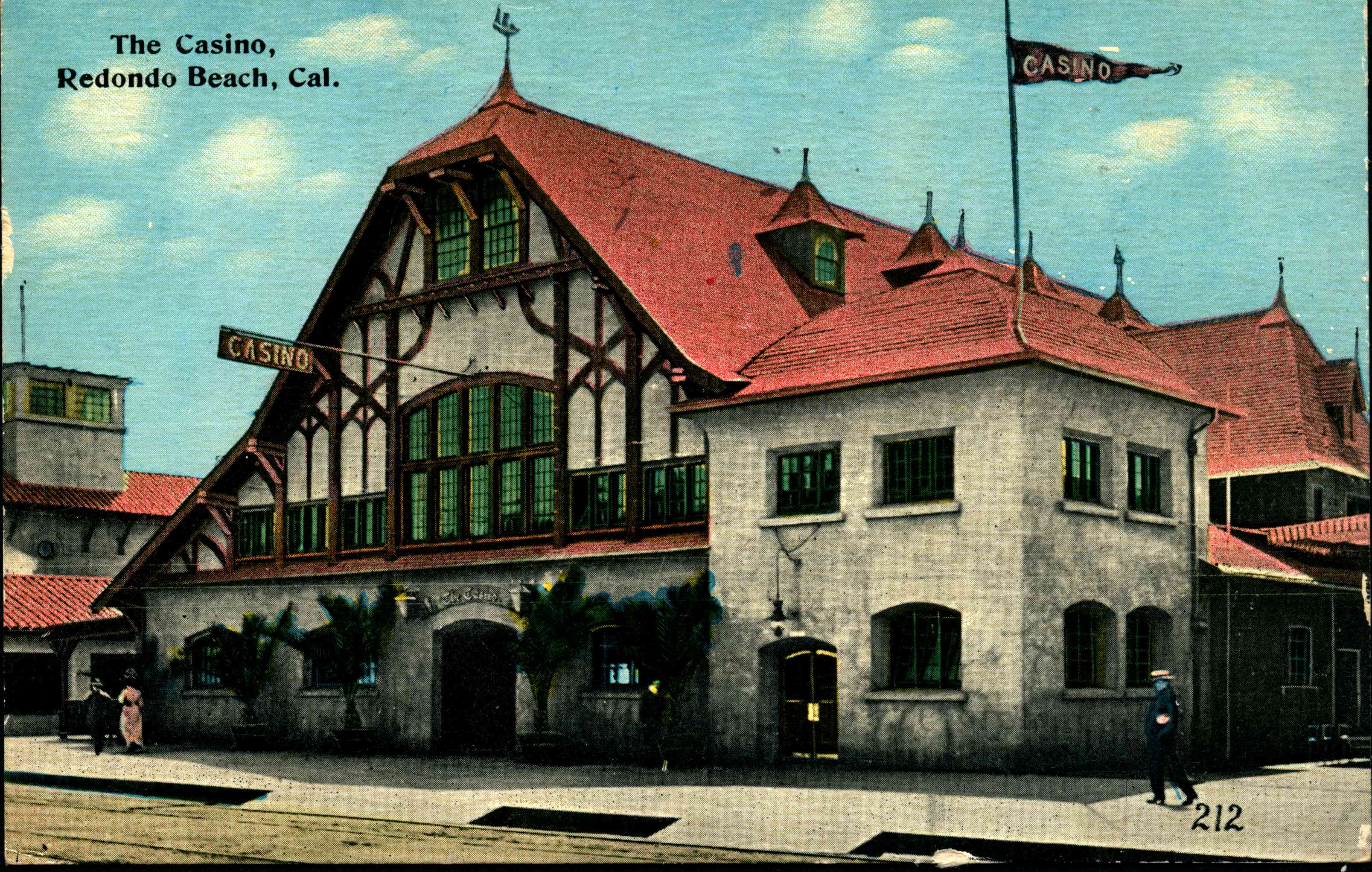
The Redondo Beach Casino, postcard circa 1914. (Credit: California State Library)

When sea captains J.C. Ainsworth and R.R. Thompson began developing Redondo Beach in the mid-1880s, they saw the potential in transforming the sleepy seaside town into a major tourist attraction, especially once railroads could be built connecting it to Los Angeles.

The Santa Fe railroad came first in 1888, followed two years later by Ainsworth and Thompson’s  Redondo Railway (later renamed the Los Angeles & Redondo Railway). 

To accommodate the influx of visitors the railroads brought, the pair’s Redondo Beach Investment Co. built the magnificent Hotel Redondo, which opened on May 1, 1890. The Redondo Railway line connected directly to a depot behind the hotel.

The first Redondo Beach Casino, built in 1892. (Credit: USC Digital Library)

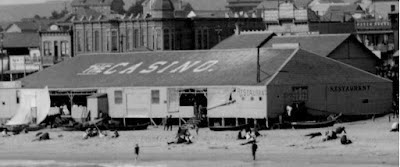
Tourists started flocking to Redondo, which was incorporated in 1892. That same year, the beginnings of a downtown entertainment area took shape with the opening of the Redondo Beach Casino, operated by Michael Mayer, along with the city’s first pavilion building. 

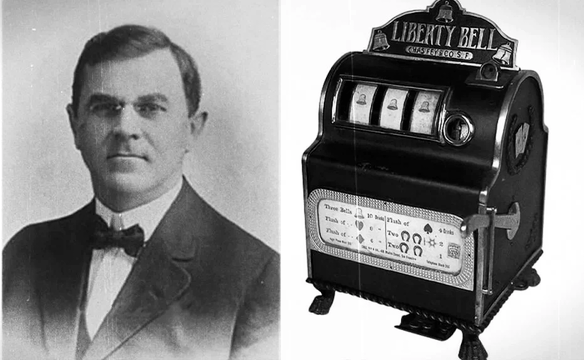
Situated directly on the shoreline, the Casino, a large, architecturally nondescript building housed a popular cafe in addition to offering gaming opportunities, including some of the earliest coin-operated slot machines. Californian Charles Fey had invented the first such device, the “Liberty Bell,” in 1895.

An ordinance banning such gambling devices passed in June 1900. But the city often turned a blind eye toward such “amusements” until finally driving gambling operations out during the late 1930s.

Charles Fey, left, inventor of the “Liberty Bell” slot machine. Undated photo. (Credit: Wikimedia Commons)

When Henry Huntington brought his Pacific Electric trolley system to Redondo, he saw the advantages the city offered. He bought out Ainsworth and Thompson’s holdings in 1905, and established the Red Cars on the Los Angeles & Redondo Railway line the same year.

Huntington also set about revamping the beachside area around the city’s main railroad depot at Pacific Ave. and Emerald St. The district would become known as El Paseo.

Three major structures were envisioned to replace the original pavilion and casino buildings. The buildings were adjoining but not connected. Huntington built the mammoth new Pavilion with its huge upstairs Mandarin Ballroom as well as the combination salt/freshwater indoor Plunge, while Michael Mayer financed the new Casino building in between the two on land owned by Huntington.

The Pavilion and Casino were built first. Construction began in January 1907, with a grand opening ceremony for both scheduled for Saturday, June 29, 1907. 

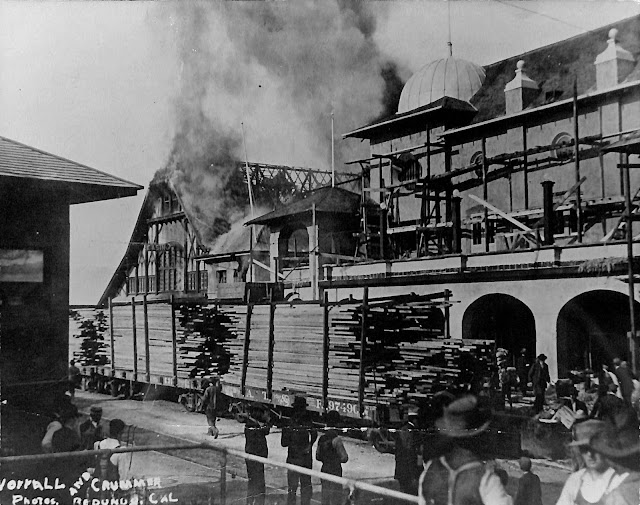
But those plans changed early on Friday morning, the 28th. Around 7 a.m., carpenter Joseph Oouthoudt and two of his fellow Casino construction workers went over to the building to take a look at its interior. They encountered a locked door, behind which were large clouds of smoke.

Oouthoudt broke one of the building’s large plate glass windows, ran in, found a hose and began battling large flames at the rear of the structure. But the hose’s water pressure didn’t hold out and soon the entire building was ablaze.

The second Redondo Beach Casino on fire on the morning of June 28, 1907, the day before it was scheduled to open. (Credit: Redondo Beach Historical Museum via Redondo Beach Public Library)

A quick-thinking worker at the new Pavilion building next door may have saved it from destruction by spraying water on the side of the building facing the Casino to keep flames from spreading to it.

At the time, Redondo had no fire department, but citizens mobilized quickly, forming an old-fashioned bucket brigade to staunch the blaze. The call also went out to the Los Angeles Fire Dept. to send help. The railroad lines were cleared for a firefighting crew and equipment. By the time they arrived by rail 35 minutes later, the flames had been extinguished.

When Mayer saw the blaze consuming his new Casino, he collapsed due to the shock and his longtime heart condition. A short in the electrical wiring was blamed for sparking the blaze.

Mayer survived, but the German Heidelberg-styled building was a total loss, though the larger conflagration that many had first feared was avoided. The Pavilion was cleaned up and able to hold its grand opening on the following Monday, July 1, 1907.

Postcard view circa 1910 from the sea shows the Redondo Beach Pavilion, left, Casino, center, and Plunge, right. (Credit: San Diego State University Library collection)

The rebuilding of the Casino began in late August 1907. The exact date of its reopening is unclear, but it probably occurred in early 1908. The Plunge opened in 1909, and three of El Paseo’s biggest attractions were complete. (The Lightning Racer seaside roller coaster was added nearby in 1913.)

The new, larger Casino was rebuilt exactly as it had been designed originally. It had an open-beamed ceiling and a popular restaurant which Mayer continued to manage until the building was bought and converted into a showplace movie theater in 1920. (Mayer died of heart disease at his Redondo Beach home in 1925.)

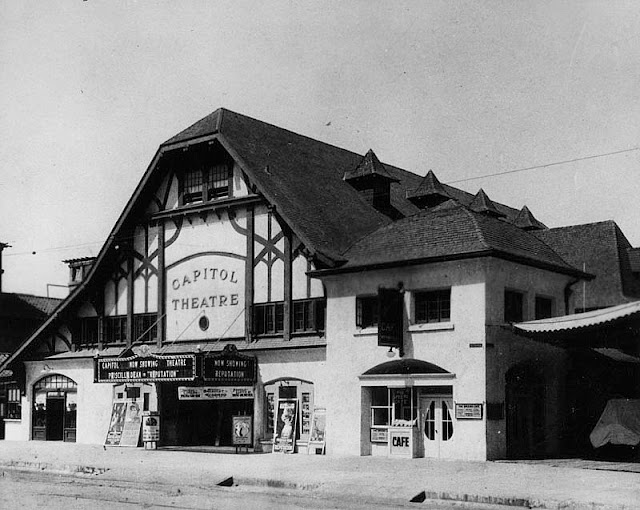
The new theater, Fancher’s Capitol Theatre (later shortened to the Capitol Theatre), opened on Aug. 1, 1920. As was the case with many theaters of the era, hosted vaudeville acts, musical revues and fashion shows in addition to first-run Hollywood films.

The Capitol Theatre replaced the Redondo Beach Casino in 1920. May 1921 photo. (Credit: Los Angeles Public Library Photo Collection)

Its status as Redondo’s premier theater was eclipsed when the Fox Redondo opened on Feb. 22, 1929, on nearby Diamond St. It became the city’s first-run theater, and the Capitol fell on hard times, especially after the Depression hit.

The theater soldiered on for a few more years. It was still showing films as of 1935, but after that there are no mentions of it in local newspapers. A Feb. 19, 1944 Los Angeles Times article states that, as of that date, the building hadn’t been used in several years, and its demolition had begun that day.

The neighboring Plunge had been torn down and turned into a parking lot for the Pavilion in 1941. The Pavilion was the final of the three buildings to be torn down in December 1960 to make way for the King Harbor redevelopment that changed the face of the Redondo shoreline. 

The land where the three main buildings stood currently lies underwater. 

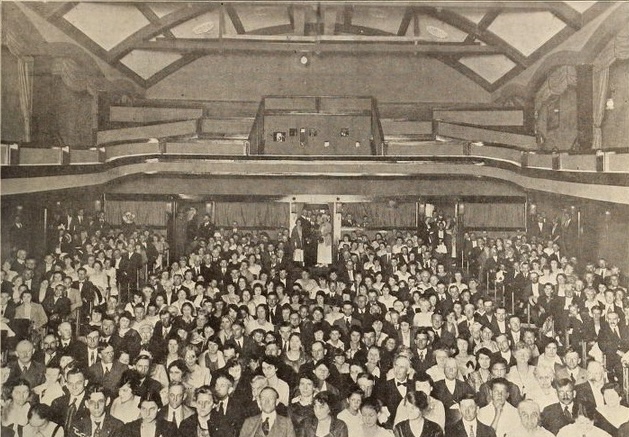
This 1920 interior photo of the Redondo Beach Capitol Theatre is probably from its opening night. The balcony is unfinished. (Credit: Los Angeles Theatres website)

Sources:

Cinema Treasures website.

Daily Breeze archives.

Los Angeles Herald archives

Los Angeles Theatres website.

Los Angeles Times archives.

Old Redondo: A Pictorial History of Redondo Beach, California, by Dennis Shanahan, Legends Press, 1982.

Redondo Reflex archives.

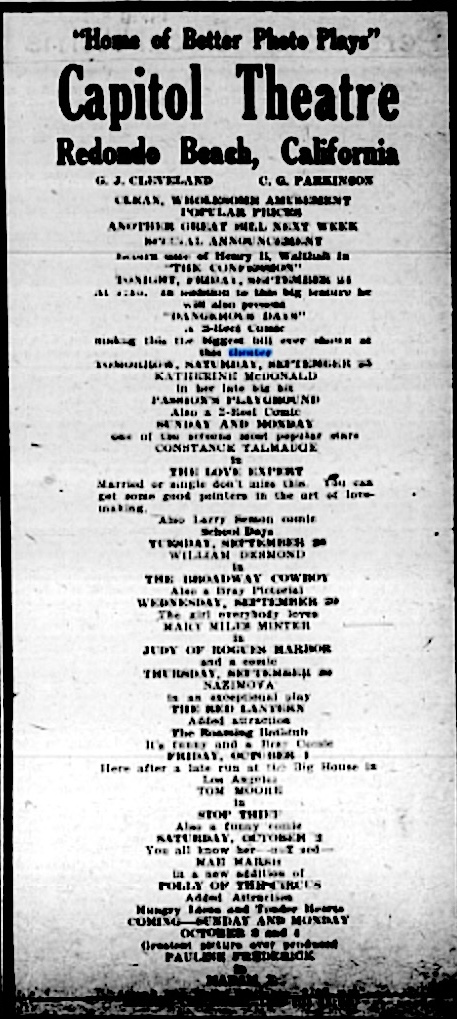
Redondo Reflex, ad, Sept. 1, 1920, Page 14. (Credit: Redondo Reflex archives)

Former Torrance councilman George Vico hit a home run in his first major league at-bat

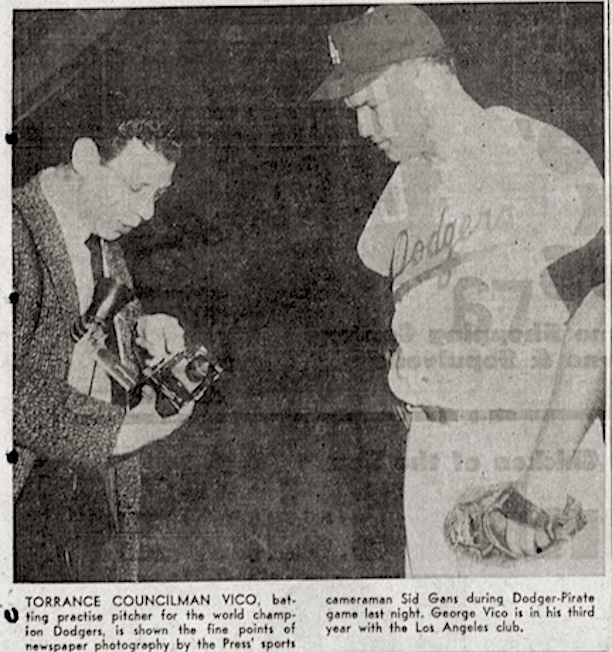
Baseball was a big part of George Vico’s life, both before and after he retired from the game.

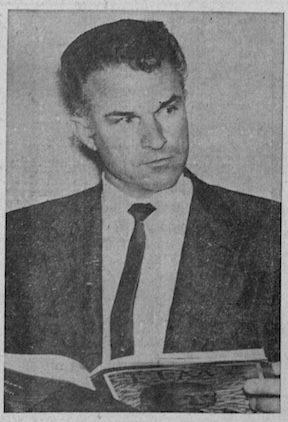
George Vico. Torrance Press, April 10, 1960, Page 1. (Credit: Torrance Historical Newspaper and Directories Archive database, Torrance Public Library)

He was born to Serbian immigrant parents in San Fernando, Calif., on Aug. 9, 1923. The 6-foot-4 Vico turned out to be a natural athlete whose first love was baseball.

The left-handed batting first baseman began pursuing a playing career in the Detroit Tigers organization with the minor-league Class D Tigers in Fulton, Kentucky in 1941. He worked his way up to Class A ball with the Winston-Salem Twins in 1942. World War II delayed any further advancement. Vico enlisted in the U.S. Navy, serving from 1943-45.

He picked up where he left off after the war, playing for Oregon minor-league teams the Salem Senators and the Portland Beavers. He was a member of the Triple-A Beavers when he received word from the Tigers to report for spring training with the big club in early 1947.

During spring training, Vico hit over .400, but the Tigers decided he needed more seasoning, and sent him back down to the Beavers. He hit over .300 during the 1947 season with the Beavers, and his manager told the Tigers he was ready.

He began the 1948 season with the Tigers in spring training, winning the job as starting first baseman. And that’s when he made the most of his big moment.

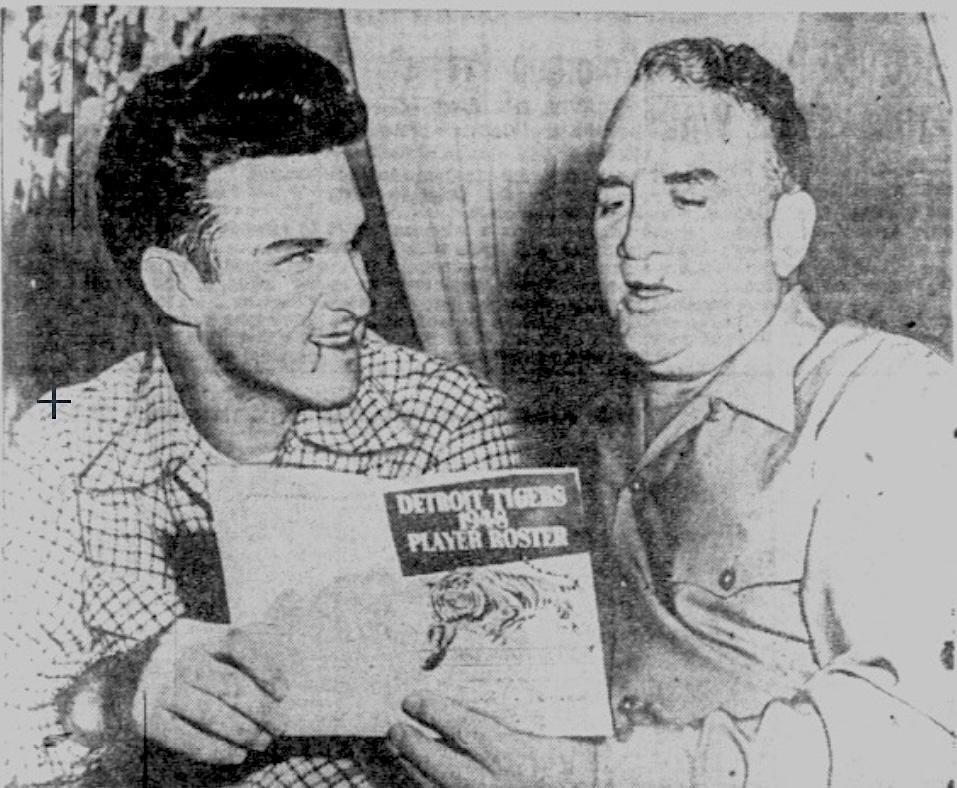
Rookie first baseman George Vico, left, checks the Detroit Tigers roster with manager Steve O’Neill at the team’s Florida training camp in February 1948. (Credit: Associated Press)

On Opening Day, April 20, 1948, Vico stepped into the batter’s box against Chicago White Sox pitcher Joe Haynes, and hit the first major league pitch he ever saw over the Comiskey Park wall for a home run. At the time, he was only the 24th player to homer in his first at-bat. (A total of 136 players have accomplished the feat as of the end of the 2024 season.)

Vico also was proud of his final game of the 1948 season, in which he had two hits against Hall of Fame pitcher Bob Feller of the Cleveland Indians.

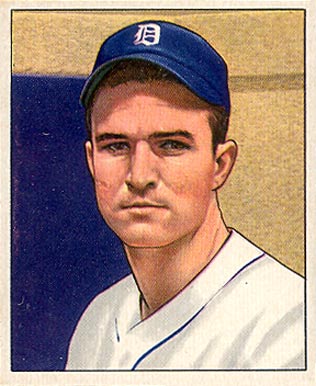
George Vico’s 1950 Bowman baseball card.

After a fine rookie season, Vico slumped during 1949, finishing with a .190 batting average. He was an excellent fielder, but the Tigers returned him to the minors. He never played in the majors again. During his two years in the majors, he played in 211 games and hit 12 home runs.

Vico continued his career in the minor leagues. He moved to Torrance in 1946, and took classes at the recently opened El Camino College when he wasn’t playing ball for teams in the storied Pacific Coast League.

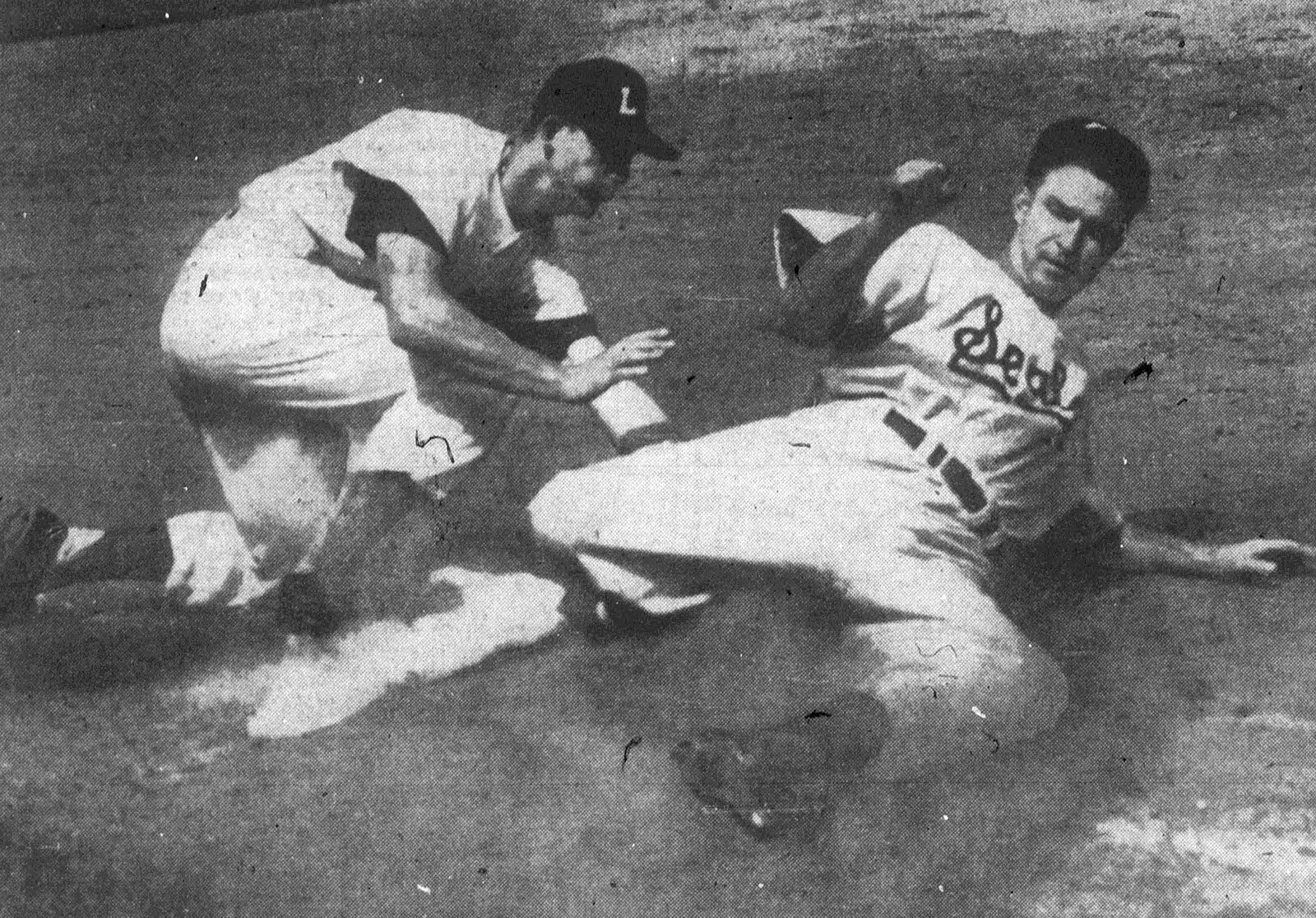
Over the years, Vico served stints with the Seattle Rainiers, San Francisco Seals, and, in 1955, the Hollywood Stars. He retired from baseball after landing a job with the Dominguez Estate Co. land management firm during the 1957 season.

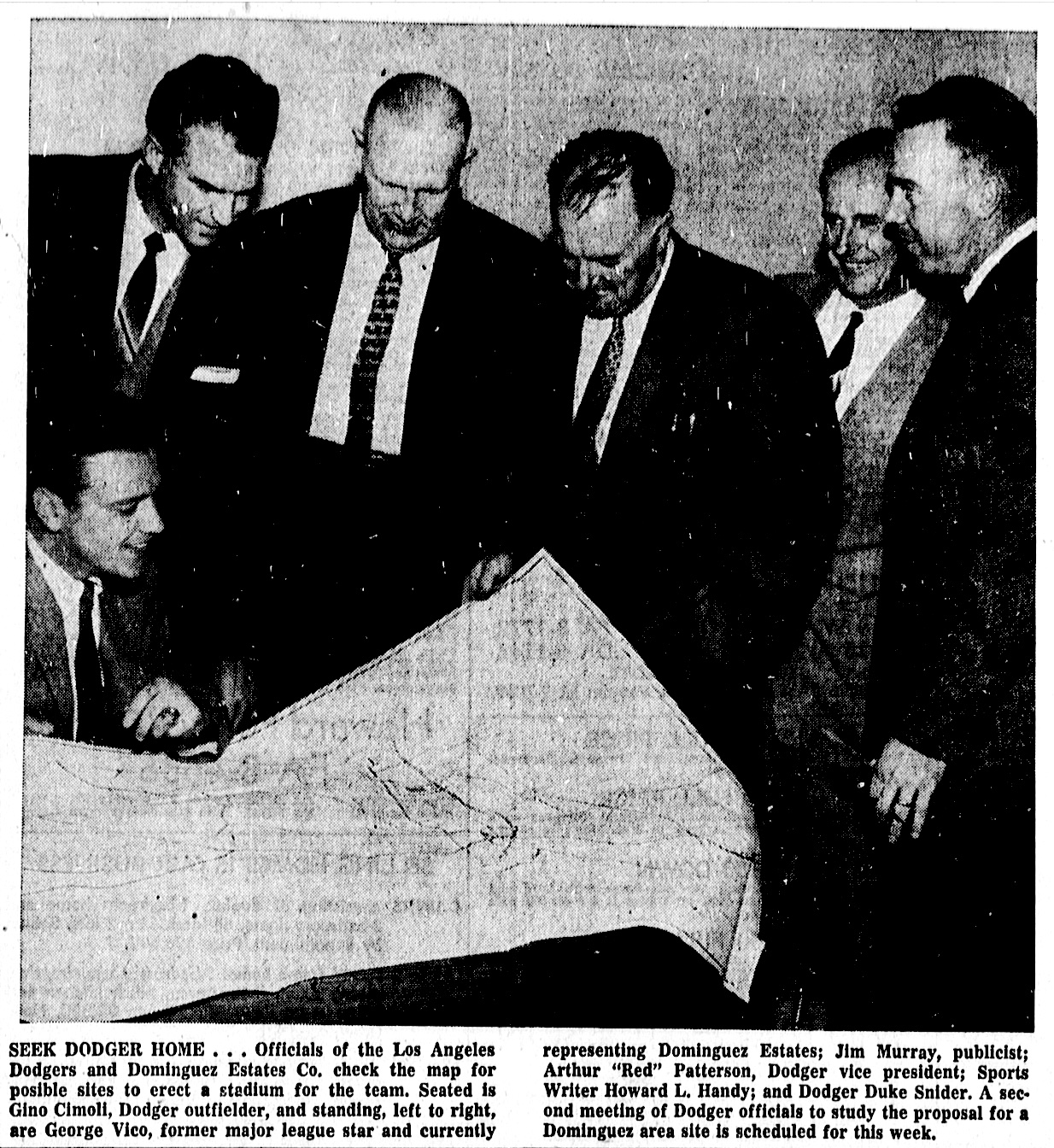
As assistant land manager at Dominguez, he worked to convince the newly arrived Los Angeles Dodgers to build their stadium on a 1200-acre plot of land the company owned near 190th St. and Avalon Blvd., then unincorporated county land.

The Dodgers demurred, set on their plans to build the stadium in Chavez Ravine north of downtown. The 1200-acre site also was proposed for an unsuccessful World’s Fair bid in 1958. It later became part of Carson when it incorporated in 1968. Cal State Dominguez Hills and the Dignity Health Sports Park currently occupy the parcel.

Torrance Herald, Jan. 12, 1958, Page 9. (Credit: Torrance Historical Newspaper and Directories Archive database, Torrance Public Library)

During this time, Vico also became one of the batting practice pitchers for the Dodgers, a position he held from 1958-1960.

Vico, now settled in a house with his wife Helen on Paseo de las Delicias in the Hollywood Riviera section of Torrance, announced in February 1960 that he would run for one of three city council seats in the city.

He campaigned on plans that included “the development and improvement of a recreation program for youth and adults alike,” as he told the Torrance Herald. Before the election, Vico had been instrumental in the project to convert the Entradero Sump in West Torrance into the Little League field which is still in use today.

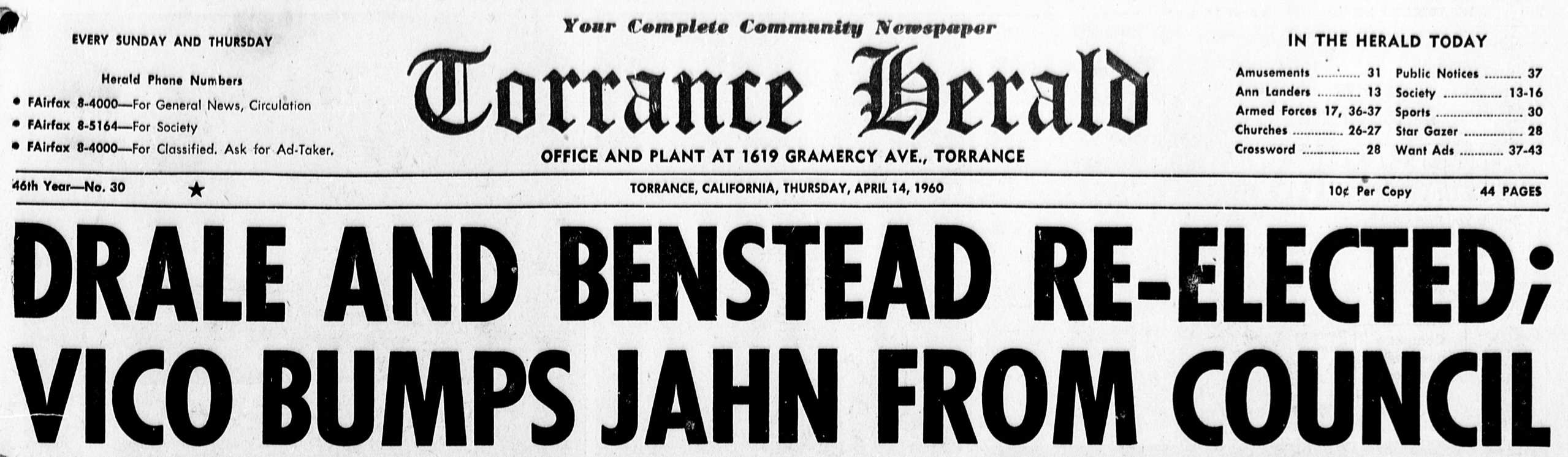
Torrance Herald, April 14, 1960, Page 1. (Credit: Torrance Historical Newspaper and Directories Archive database, Torrance Public Library)

Vico won a seat on April 12, garnering nearly as many votes as incumbent Nick Drale, the top vote-getter.

He worked tirelessly to live up to his commitment, using his baseball contacts to stage many popular public events in the city promoting youth sports. His first big splash came with the Torrance Baseball Day Parade on May 7, 1960.

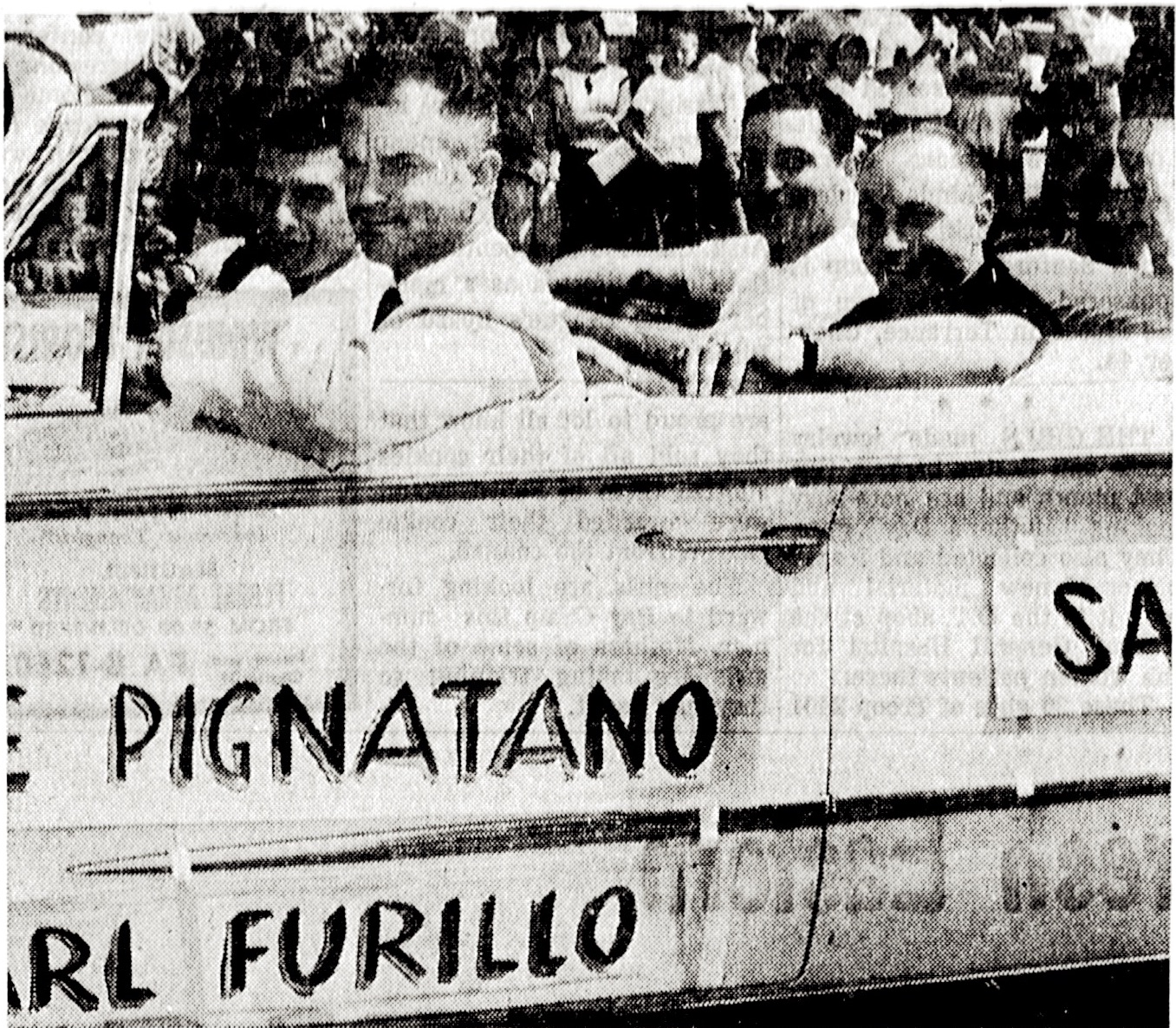
Thousands attended and participated in the festivities, which included a parade during which Vico drove a car containing Dodger players Sandy Koufax, Carl Furillo, Joe Pignatano and Chuck Essegian.

Vico ran for re-election in 1964, winning a second term easily. His tenure on the council ended when he finished fourth in the 1968 election.

Torrance Press, June 19, 1960, Page A-9. (Credit: Torrance Historical Newspaper and Directories Archive database, Torrance Public Library)

After his death at 70 on Jan. 14, 1994, following years of battling heart disease, his colleagues recalled him fondly.

Fellow councilman Ken Miller told Daily Breeze reporter Jim Radcliffe, “George was an outgoing, happy-go-lucky fellow who seemed to enjoy life. He was fun to be around. I don’t think he took himself too seriously. He served rather diligently.”

In the same story, former Torrance mayor Katy Geissert said of Vico, “He was very well liked. A big, easy-going fellow who didn’t have enemies. He did a conscientious job. He had a reputation for being good-natured.”

Vico was buried in the Serbian United Benevolent Society Cemetery in East Los Angeles along with his wife Helen, who died in 2016.

San Francisco Seals baserunner George Vico (right) beats the tag from Los Angeles Angels third baseman Tommy Brown during a Pacific Coast League game on April 18, 1954 at Wrigley Field in Los Angeles. (Credit: Wikimedia Commons)

Sources:

Daily Breeze archives.

Find A Grave website.

Torrance Press Herald archives.

Wikipedia.

Driver and Torrance city council member George Vico chauffeurs Dodger players Sandy Koufax, front seat left, Carl Furillo, back seat left, and Joe Pignatano, back seat right, in the annual Torrance youth baseball parade. Torrance Herald, May 8, 1960, Page 9. (Credit: Torrance Historical Newspaper and Directories Archive database, Torrance Public Library)

Club Bagatelle was a 1960s hot spot for Palos Verdes Peninsula teens

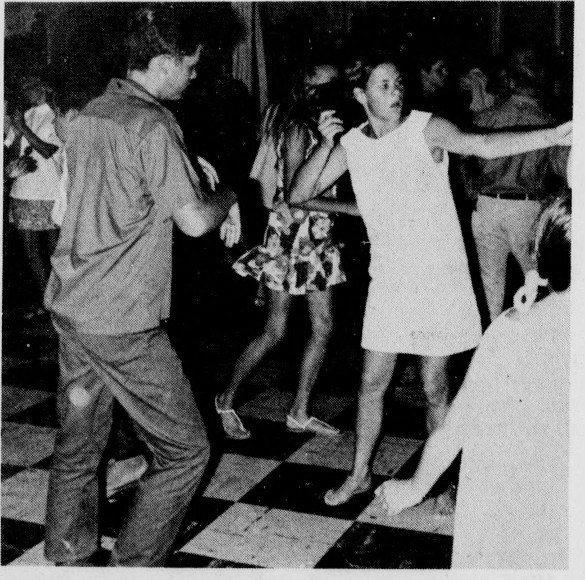
Curtis Tandy and Carrie Anthony dance at the Future Freshman Wipe Out Dance at Club Bagatelle in Rancho Palos Verdes. Palos Verdes Peninsula News, July 17, 1968, Page 26. (Credit: Palos Verdes Peninsula News archives)

The idea for a teen club serving the Palos Verdes Peninsula area came from Elin Vanderlip, the daughter-in-law of pioneer Peninsula developer Frank Vanderlip. Norwegian by birth, she had married Vanderlip’s son Kelvin, who died in 1956.

In February 1967, she told the Palos Verdes Peninsula News of her plans to start a social center for young people aged 15-20 in the newly built Golden Cove Shopping Center in Rancho Palos Verdes.

The 3200-square foot space was situated on the second floor of one of Golden Cove’s office buildings, at 31244 Palos Verdes Drive West, Suite 203.

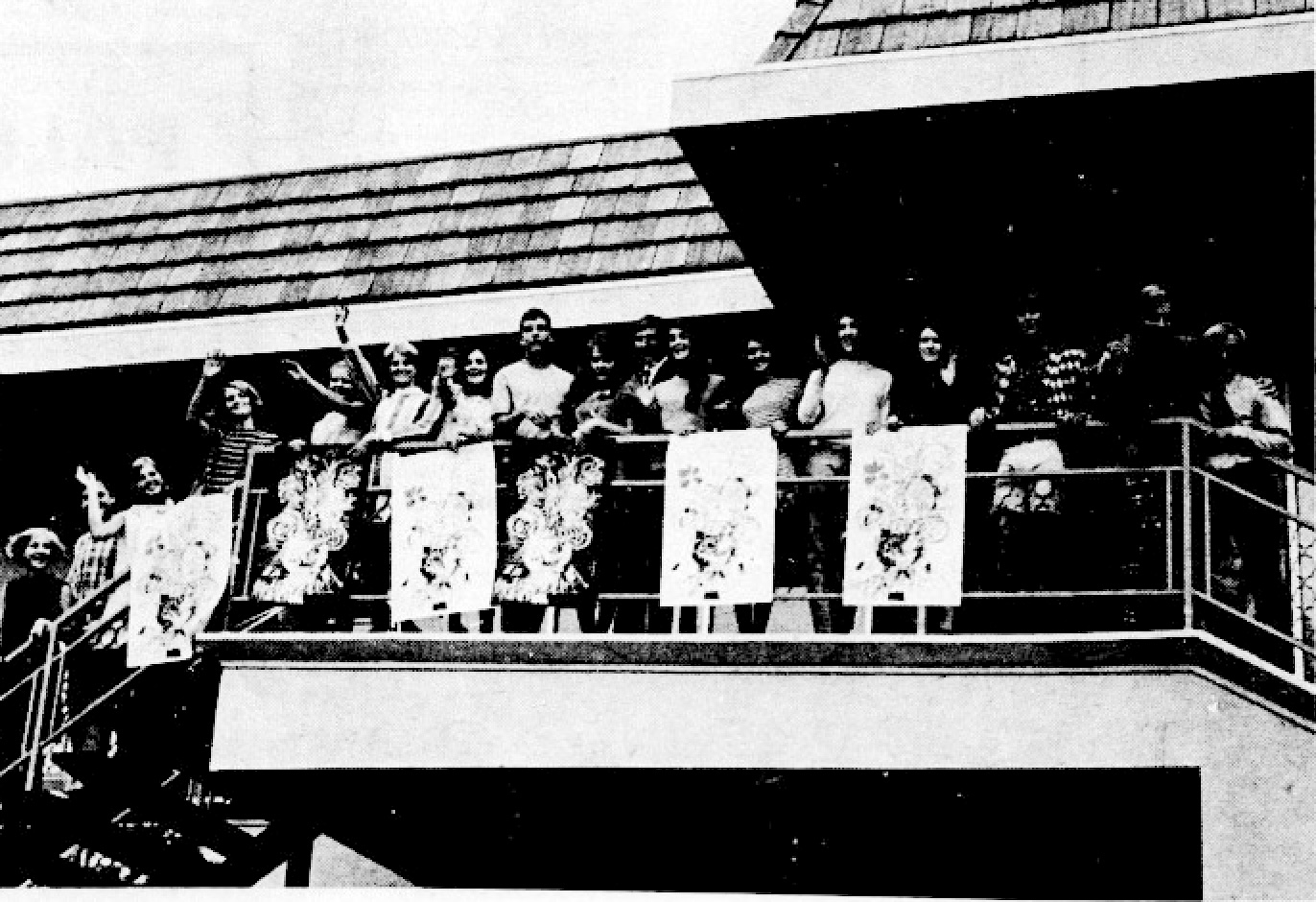
Club Bagatelle members wave to the camera outside the club entrance at the Golden Cove Shopping Center. Photo by Richard Brassauw. Palos Verdes Peninsula News, May 29, 1968, Page 52. (Credit: Palos Verdes Peninsula News archives)

The teen center’s name, Club Bagatelle, came from the Chateau Bagatelle, an 18th century pavilion built for Marie Antoinette in a rose garden in the Bois de Boulogne in Paris.

In her announcement of the club’s founding to area parents, Vanderlip said, ““We hope to create in the Club Bagatelle the beauty, grace and charm of the original which will cause the teenager to be proud of his club and to dress and behave so as to live up to its elegance and warmth.” 

Teenage volunteers and new club members pitched in with preparations, including painting and decorating its rooms and furniture. The teens told the Peninsula News that the center filled a need, as “Hollywood is just a little too far and the corner at Peninsula Center is just a little too dull.” 

The new club’s first event was very much a high-society affair. The formal College Ball on June 24, 1967 featured a cordon bleu dinner catered by Air France, and music by Joe Moshay and his orchestra. The French consul in Los Angeles was Elin Vanderlip’s guest of honor. Presumably, the high school ball held a week later on July 1 was less stuffy.

Palos Verdes Peninsula News, June 28, 1967, Page 52. (Credit: Palos Verdes Peninsula News archives)

With that, the club was off and running. Membership was available to those aged 15-20 for $10 per year. Applications were distributed through the Palos Verdes Peninsula high schools.

Club Bagatelle offered a surprisingly wide variety of activities for teens. In addition to the stage, discotheque and dance floor, its  facilities included a library, a game room and a lounge area with ping pong and pool tables.

A steady stream of special speakers delivered programs on teen topics, from fashion to relationships. Lessons on playing backgammon, chess and bridge were offered, and special interest groups on skiing, surfing, tennis, fencing, foreign languages and folk dancing were formed, and various field trips were planned.

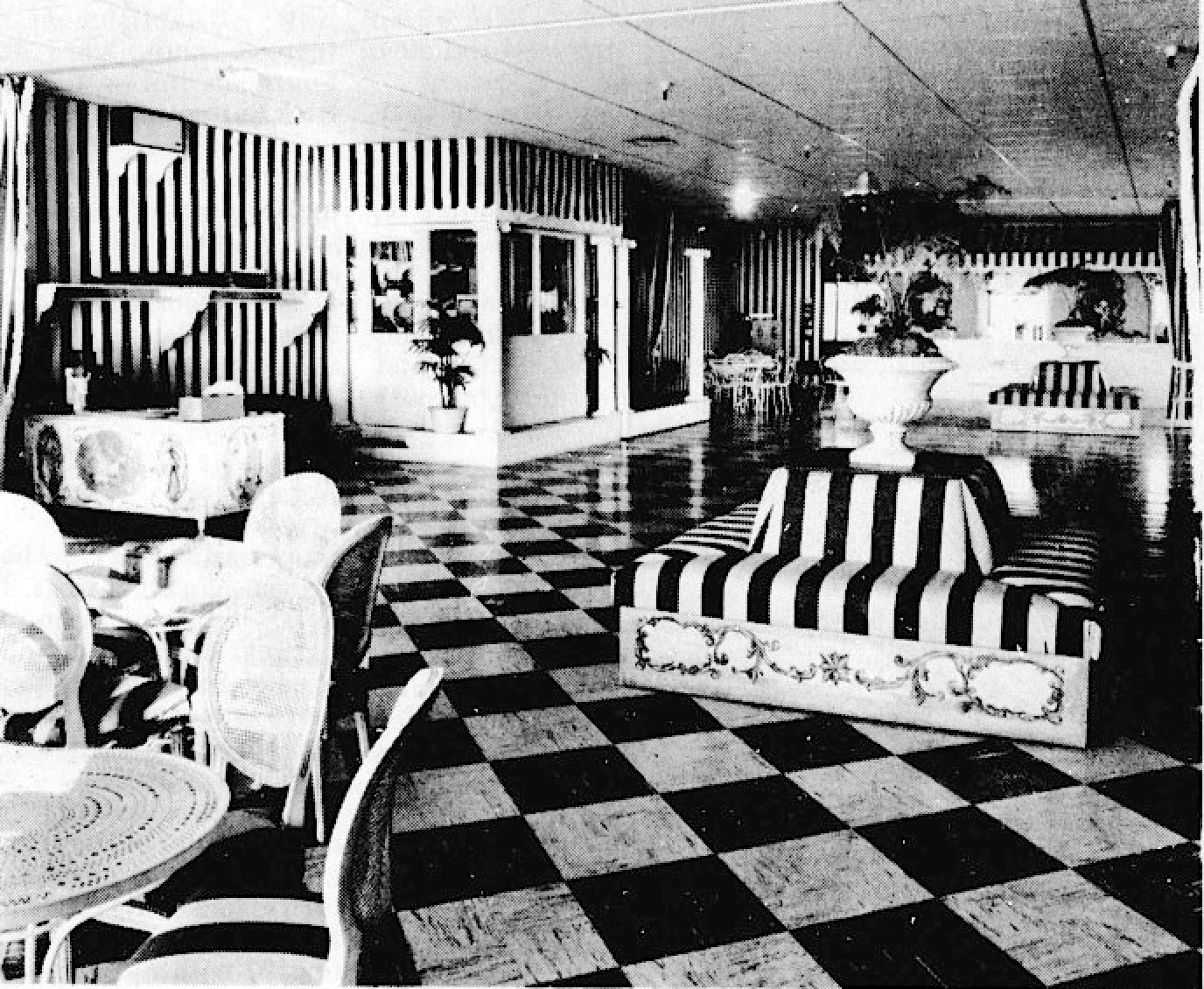
The interior of Club Bagatelle, circa June 1967. Palos Verdes Peninsula News, May 29, 1968, Page 52. (Credit: Palos Verdes Peninsula News archives)

The Peninsula News began running a regular column documenting recent events and announcing upcoming ones under the headline “Club Bagatelle News.” It was here that teens could find out about one of the center’s most popular features, its regular concerts and dances.

The club was a prime venue for up and coming local garage bands. Outfits such as the Raving Madd, which drew most of its members from Rolling Hills High, played there regularly. 

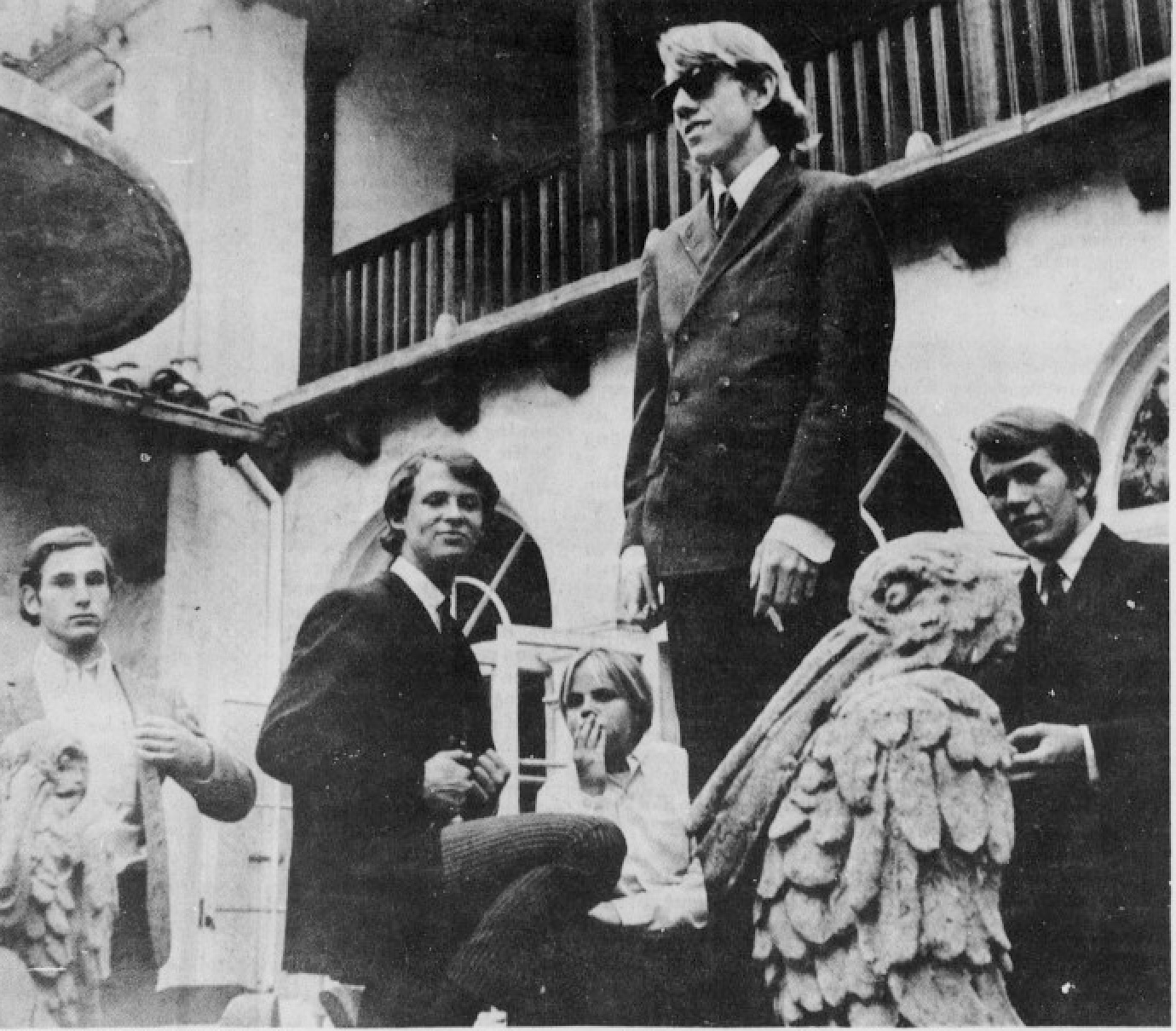
Four of the five members of the Raving Madd were Rolling Hills High School students. The band played regularly at Club Bagatelle. Palos Verdes Peninsula News, Aug. 30, 1967, Page 11. (Credit: Palos Verdes Peninsula News archives)

The Raving Madd eventually recorded a 45 rpm single on the Golstar label which has become a collector’s item among fans of the 1960s garage band genre. Keyboard player and lead vocalist  Russ King wrote both songs on the record, “ I Said Oh No No No (What’s In It For Me)” and “Boundaries.”

Other performers who appeared at the Bagatelle included several other bands who released local records: The Innkeepers (Gardena), Chapter VI, Nik of Tyme and Chapter VI. (None of them became hits.) Apparently unrecorded acts who also performed included Fyve of a KInd (Ojai), the Andromeda Breakthrough, the Off Setts, Fair Befall, the Thornes and folk singer Rick McAlary (San Pedro).

In addition to live bands, Club Bagatelle also hosted fashion shows and speakers from magazines such as Vogue and Seventeen discussing the latest mod trends, and a Halloween costume party for which female teens dressed up as young Marie Antoinettes.

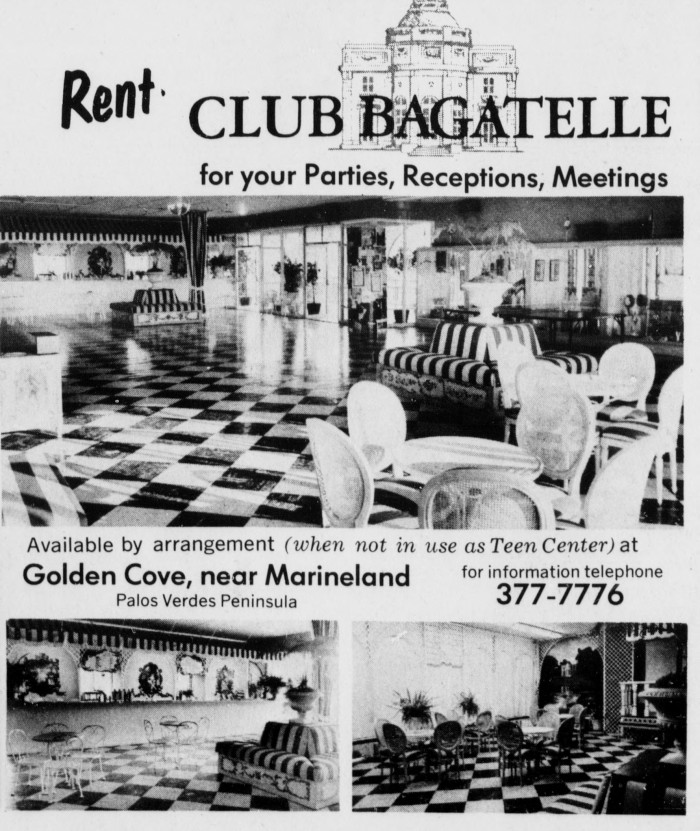
In addition to events aimed at its teen membership, Club Bagatelle also promoted itself as a hall for hire for special events, usually club and social gatherings, balls and the like. Community groups such as local PTAs and service clubs often met there as well.

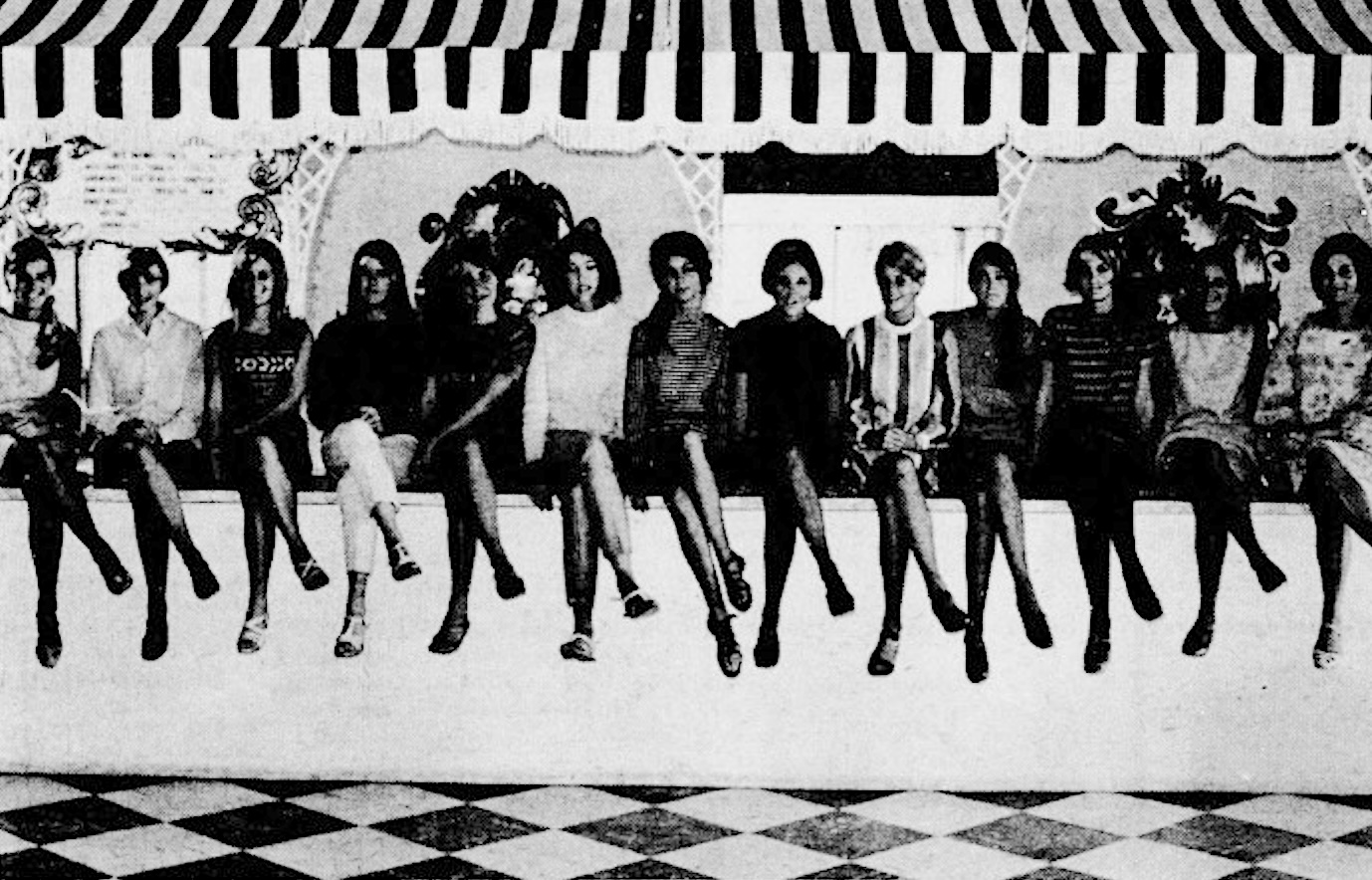
Club Bagatelle members pose atop the snack bar counter inside the club. Photo by Richard Brassauw. Palos Verdes Peninsula News, May 29, 1968, Page 52. (Credit: Palos Verdes Peninsula News archives)

Signs of troubles at the club began to appear in February 1968, when Elin Vanderlip complained to the Peninsula News about petty thefts, acts of vandalism and problems with drug use becoming more commonplace there.

Two months later, while appealing for more adults to act as chaperones, Vanderlip told reporter Betty Lukas that “the amount of promiscuous necking, smoking, common discourtesy and disrespect for the clubs’ property, and the dishonesty and vandalism are appalling.” She threatened to close the club down on June 30 unless conditions improved.

The club continued to operate after that, but Vanderlip’s enthusiasm continued to wane as well. On Nov. 18, 1968, she terminated the club’s operation as a teen center, vowing to only use it as a rental hall.

That’s how the space was used for the next few months. Then, on July 18, 1969, a new operation sprang up on the site, unaffiliated with Mrs. Vanderlip. The Third Eye club held its first concert, headlined by Columbia Records artists Illinois Speed Press and also featuring the bands Charity, Chalice and Mojave Honey.

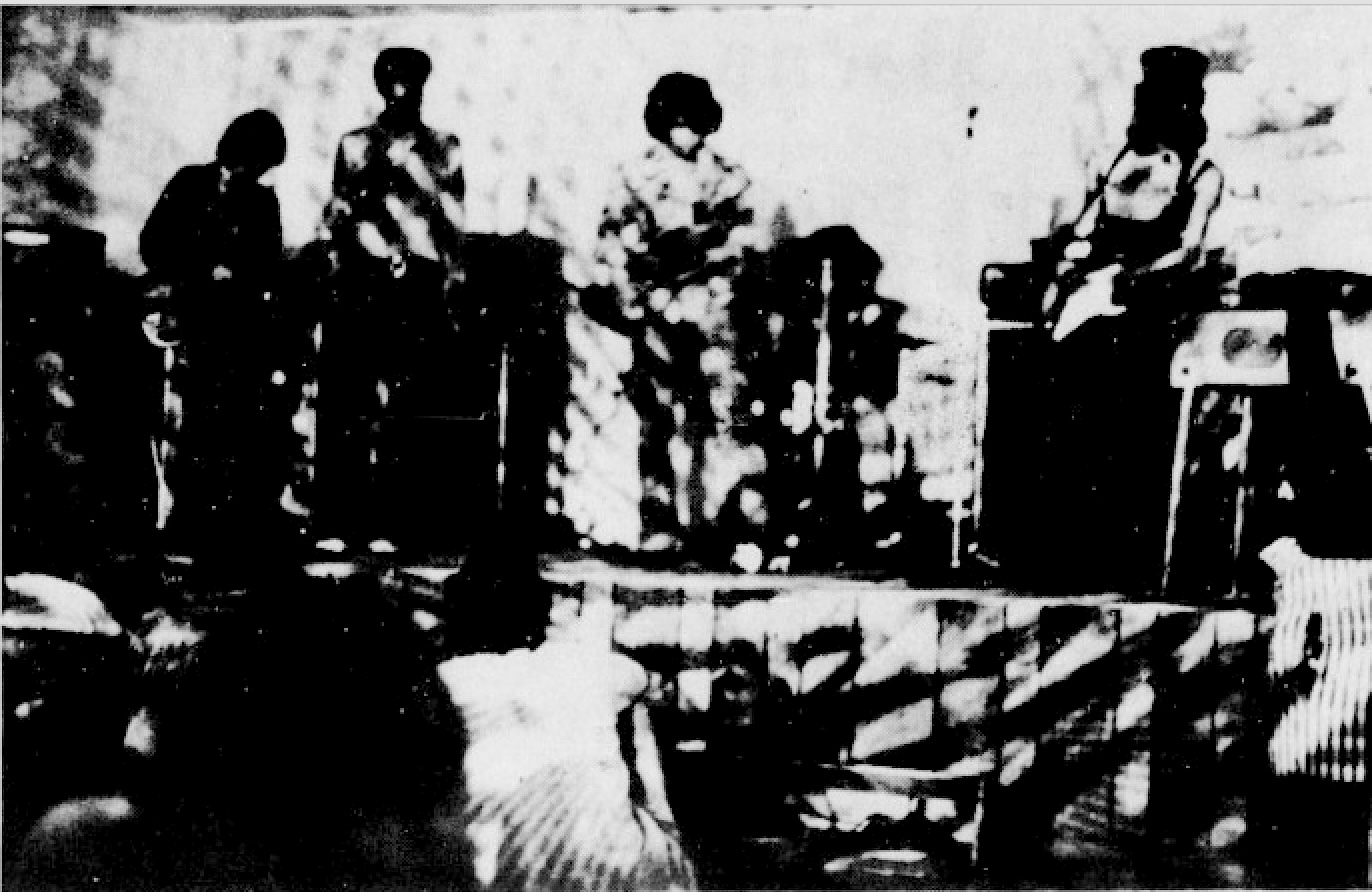
One of the four bands who played on opening night at the Third Eye, formerly Club Bagatelle, on July 18, 1969. The Peninsula News did not identify the band, possibly due to the lightshow effects. Palos Verdes Peninsula News, July 23, 1969, Page 2. (Credit: Palos Verdes Peninsula News archives)

It was a short-lived last gasp for the site. Vandalism at the club that spilled over to a nearby dress shop was reported a month later, and two teens were arrested for fighting at a Sept. 7 incident there. After those incidents, no more was heard about the club in any form, which today houses health-related offices.

Elin Vanderlip died at 90 on July 20, 2009.

The club often was rented out for community group meetings and special events. Palos Verdes Peninsula News ad, Sept. 3, 1967, Page 2B. (Credit: Palos Verdes Peninsula News archives)

Sources:

Los Angeles Times archives.

Palos Verdes Peninsula News archives.

The first San Pedro breakwater transformed the Port of Los Angeles

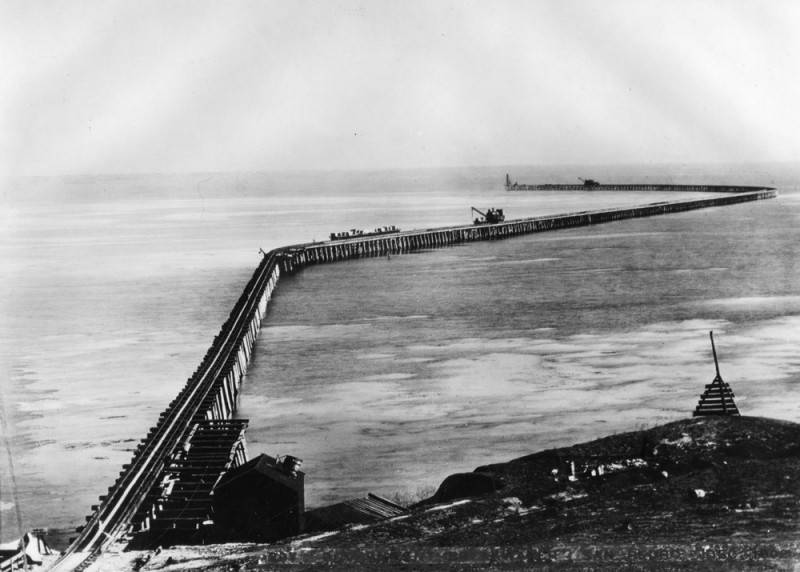
Construction of the San Pedro breakwater continues in December 1902. It was completed in 1912. (Credit: Los Angeles Public Library Photo Collection)

Wilmington shipping magnate Phineas Banning was among the first to understand the importance of improving the Harbor Area shoreline to accommodate larger ships. 

His freighters brought all manner of goods to the growing city of Los Angeles 20 miles to the north, building and construction materials chief among them. In 1869, he opened the first railroad in Los Angeles, the Los Angeles & San Pedro line, to expedite the movement of these and other goods to the “big” city, whose population at the time was just under 6,000..

Banning financed many dredging operations to help make the shallow mud flats deeper and more able to handle larger-hulled ships

It took a while, but he finally convinced the U.S. government to finance the construction of the first breakwater parallel to the port at Wilmington in the early 1880s. He needed it to protect his ships and wharves from damage from ocean waves during storms.

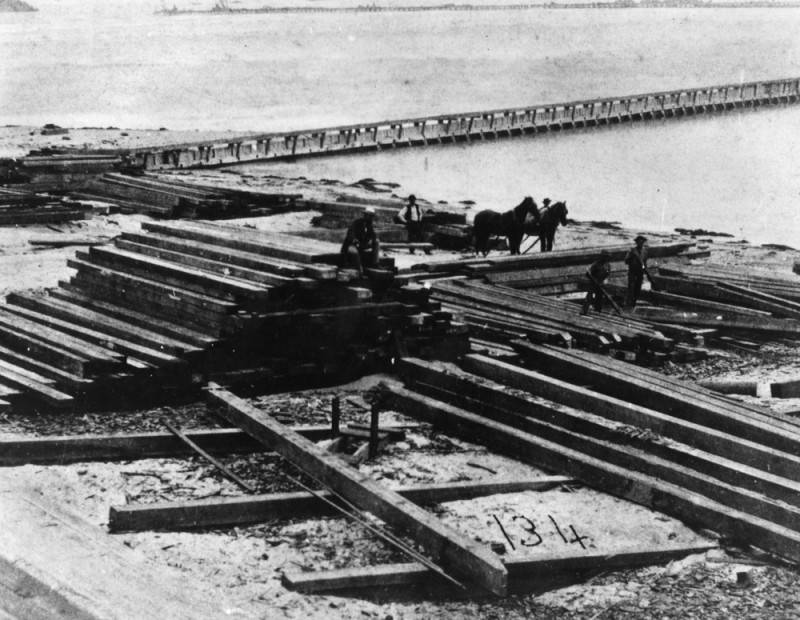
Workers are building the breakwater at Wilmington in this 1876 photo, with help from a team of horses to move large beams. (Credit: Los Angeles Public Library Photo Collection)

The geography of the area was considerably different then, and included several sandy islands and mudflats. When finished in 1882, the 4,700-foot Wilmington breakwater stretched from Rattlesnake Island, which later would be reworked into Terminal Island, west across the water to the smaller Dead Man’s Island. The project cost $480.000.

Banning died in 1885. He had directed all his efforts to creating a harbor at Wilmington, but in the 1890s, the focus turned just west to San Pedro, a thriving settlement whose harbor was deemed to have more potential.

In the early 1890s, the debate over which port should become the official Port of Los Angeles at first centered on Santa Monica, Redondo Beach and San Pedro. Redondo’s bid was ruled out after its shoreline was found to be too unprotected from periodic violent storms.

A contentious debate followed between advocates of Santa Monica, backed by Southern Pacific railroad head Collis Huntington, and San Pedro, backed by Los Angeles Times publisher Harrison Gray Otis. 

It raged for a couple of years. Finally, San Pedro was selected for the honor on March 1, 1897. Once that had been decided, the rush was on to transform its sandbars and mudflats into a first-class seaport.

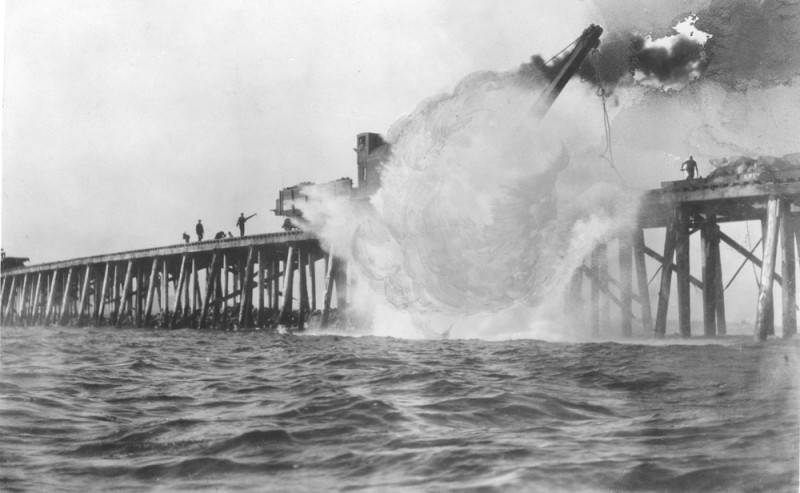
A crane dumps rocks on San Pedro’s breakwater in 1899. (Credit: Los Angeles Public Library Photo Collection)

The construction of a much larger breakwater, this one stretching eastward from San Pedro Point for nearly two miles (9,250 feet) to protect the harbor’s main channel, was deemed a must. It was authorized by the federal government, and ultimately would cost $3 million to build.

In order to celebrate, San Pedro staged the Free Harbor Jubilee, a giant picnic and party, for April 26-27, 1899. It kicked off on April 26th with a special telegram from President William McKinley ordering construction of the new breakwater to begin.

When the telegram arrived, a crane in position was signalled to drop the first load of boulders into the sea, and the project was underway. An estimated 10,000-15,000 people witnessed the event.

Twin railroad tracks gradually were built on a trestle extended over the water, allowing trains laden with specific boulders of varying sizes to position themselves for depositing the giant rocks in an exact pattern. A pile-driving rig was used to dig holes for support poles used to advance the trestle as sections were completed.

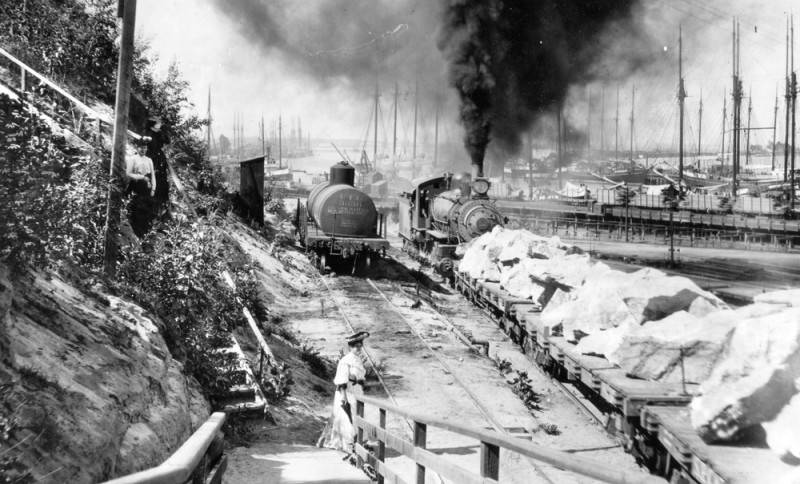
Two women (on left stairs), and a third woman (center) watch as a train hauls rocks to the San Pedro breakwater project. View is looking northward up the main channel. Photo circa 1900. (Credit: Los Angeles Public Library Photo Collection)

The U.S. Army Corps of Engineers supervised the construction. The building contract originally was awarded to the Chicago firm of Heldmaier & Neu. When that firm encountered difficulties that forced it to drop the project, the California Construction Co. took over and finished the breakwater. A third contractor, the Russell-Green-Foel Co., was hired to remove the rail trestle after the project was completed.

More than four million tons of stone was used in the breakwater’s construction. Finding the proper type of stone proved problematic. Heldmaier originally planned to use stones from quarries on Catalina and San Clemente islands, but they turned out to be unsuitable.

At first, California Construction brought in stone all the way from the Declez quarry south of Fontana, but deliveries were too slow, and the company ultimately switched to rock from a Chatsworth Park Quarry in the San Fernando Valley.

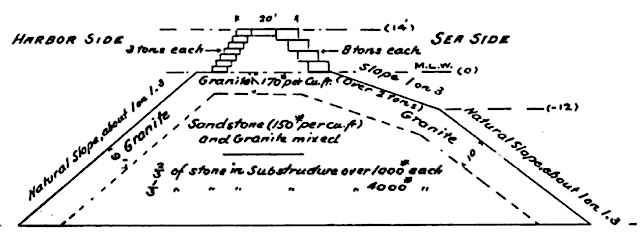
Cross-section diagram from 1906 shows the structure of the San Pedro breakwater. U.S. Army Corps of Engineers. (Credit: Wikimedia Commons)

The rocks dumped into the sea by trains and cranes reached a height of 14 feet from the sea floor. They were positioned in a precise pattern for maximum stability and longevity.

The building process was declared complete on Aug. 3, 1912, when Southern Pacific train foreman George Clough dumped the final load of rock onto the breakwater.

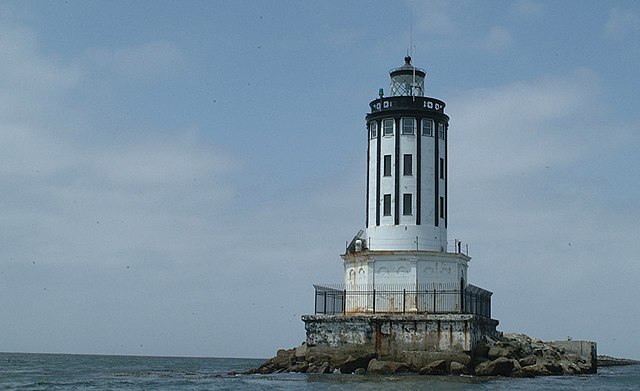
At the eastern tip of the breakwater, a platform was built for the installation of the Los Angeles Harbor Lighthouse in 1913. The 73-foot-high structure, also known as the Angels Gate Lighthouse, replaced a makeshift wooden light post, and is still in operation.

The combination of the new breakwater along with a major 1904 dredging project enabled the new port to accommodate almost all the freighters of the era. The Port of Los Angeles was on its way.

The 73-foot-high Angels Gate Lighthouse is located at the mouth of Los Angeles Harbor, at the end of the San Pedro breakwater. April 8, 2004 United States Coast Guard photo. (Credit: Wikimedia Commons)

Next, attention turned to the gaps in the breakwater. For one thing, it didn’t connect to San Pedro Point on its western end. In 1912, that gap was filled. The middle segment of the breakwater was built during the 1930s, and the final 2.5-mile eastern segment extending nearly  to Seal Beach was built from 1941-49.

After that, the only gaps that remained were those left deliberately to allow for the passage of ships into the harbor channels.

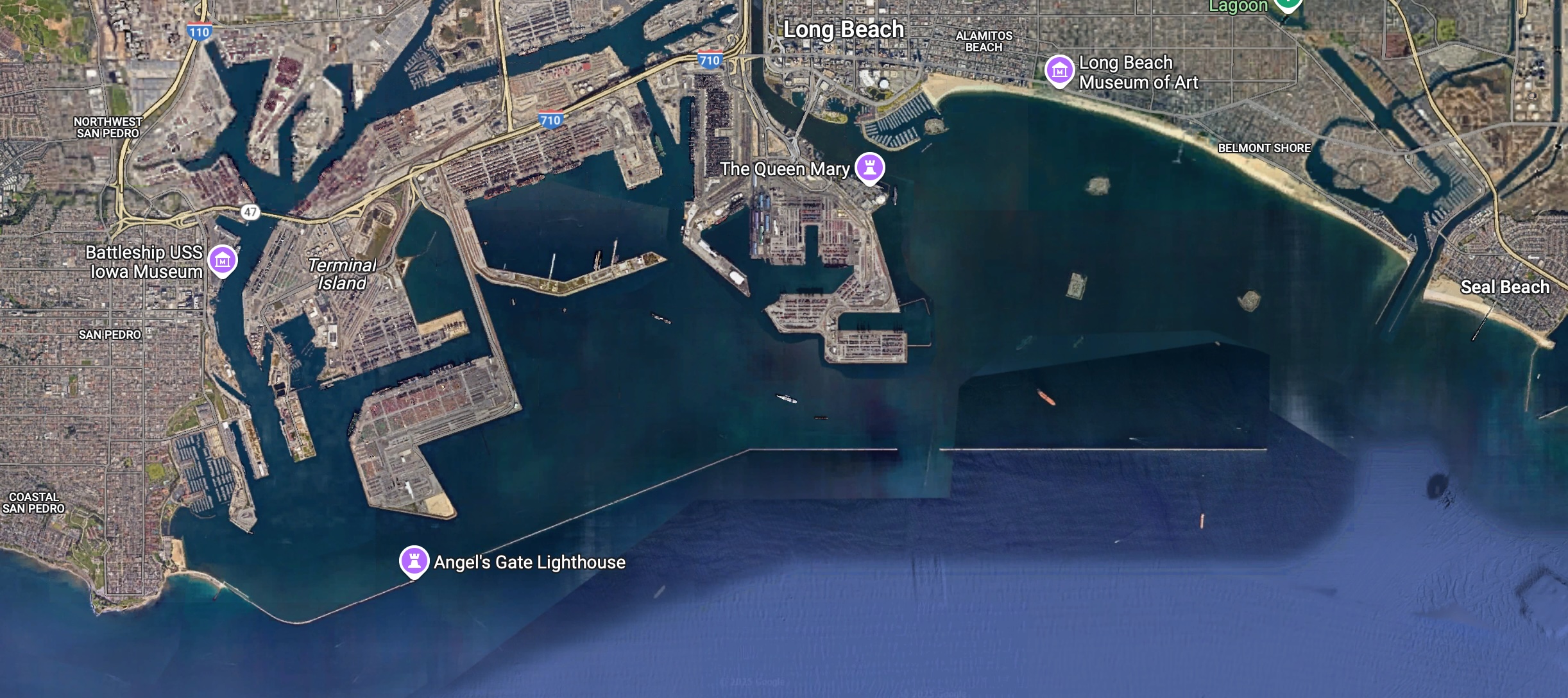
Breakwaters protecting the ports of Los Angeles and Long Beach show as thin white lines across the bottom of this Google Earth image from 2025. The San Pedro breakwater is at lower left, from San Pedro to the Angels Gate Lighthouse. (Credit: Google Earth)

Sources:

Los Angeles Herald archives.

Los Angeles Times archives.

Port of Los Angeles: An Illustrated History From 1850 to 1945, by Ernest Marquez and Veronica De Turenne, Angel City Press, 2007.

San Pedro: A Pictorial History, by Henry Silka, San Pedro Bay Historical Society, 1984.

San Pedro News Pilot archives.

Wikipedia.

Undated postcard circa 1930s shows military ships inside the San Pedro breakwater. The Cabrillo Beach Bathhouse is at right. (Credit: Wikimedia Commons)

Fry’s Electronics in Manhattan Beach sold more than just computer components

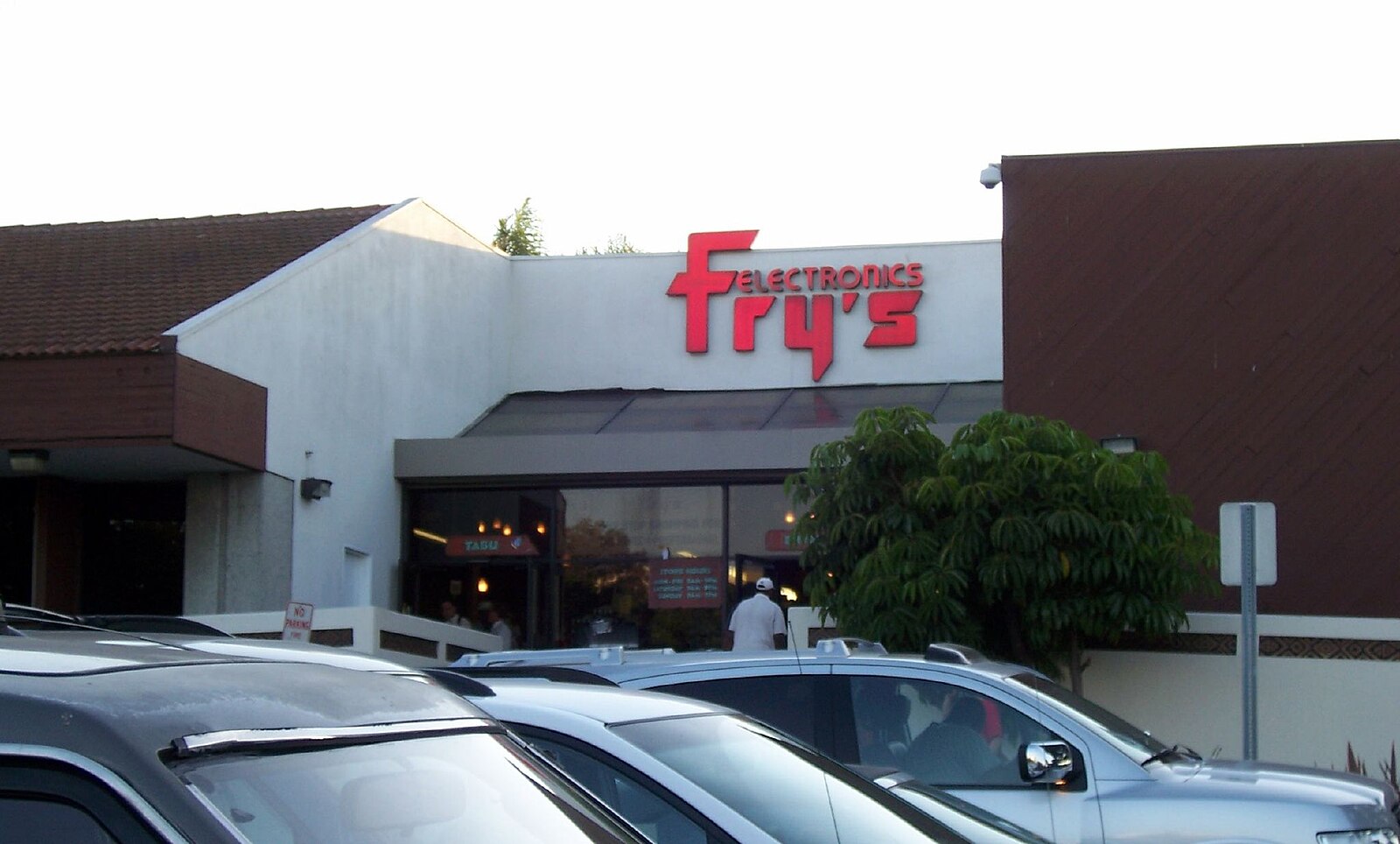
The main entrance to Fry’s Electronics in Manhattan Beach in 2006. Photo by Bryce Edwards. (Credit: Wikimedia Commons)

The shelves at Fry’s Electronics in Manhattan Beach were stocked with everything the 1990s-early oughts techie could possibly ask for, along with lots of other things they wanted more than needed.

The 48,000-square-foot store at 3600 N. Sepulveda Blvd. opened in February 1992 on the southeast corner of Sepulveda and Rosecrans Ave., adjacent to the Manhattan Beach Village Mall. It had its own parking lot, and was separated from the mall by the Southern Pacific railroad right-of-way.

Supplies for the do-it-yourself computer nerd were its main stock in trade. Ample selections of circuit boards, memory chips, keyboards, monitors, mouse pads, power strips and the like captivated both casual tech shoppers and hardcore enthusiasts into building their own souped-up custom home computers.

But the store also stocked a wide variety of other items, from televisions and refrigerators to video games, DVDs, compact discs and magazines. Shoppers preparing to check out also ran a gamut of all manner of junk food items and energy drinks at the checkstands, ostensibly for consuming while they computed.

Computer stores were a hot retail trend at the time. Computer City and CompUSA stores began opening, and longtime electronics retailer Radio Shack began shifting its inventory to reflect the new fascination with personal computing. Tandy Corp, Radio Shack’s parent company later started its own full-fledged computer retail chain, Incredible Universe, in 1992.

Still, it was a considerably different line of business than the Fry family had been conducting previously. In 1954, Donald Fry bought out Ray’s Market in the Contra Costa County town of El Sobrante in the Bay Area and renamed it Fry’s.

Together with his brother, Charles, they established a chain of Fry’s Food and Drug stores in northern California and Arizona that grew to more than 40 locations during the 1950s. The chain thrived, and was acquired by the larger Dillon Companies grocery firm in 1972. Fry stayed on as an executive.

After Dillon was acquired by the mega-grocery firm Kroger Co. in 1983, Donald Fry cashed out and gave his sons, John, Randy and David, $1 million each from the proceeds of the sale. John convinced his two brothers and his girlfriend, Kathy Kolder,  to join him in a new startup venture, and the first Fry’s Electronics store opened in Sunnyvale, California in 1985.

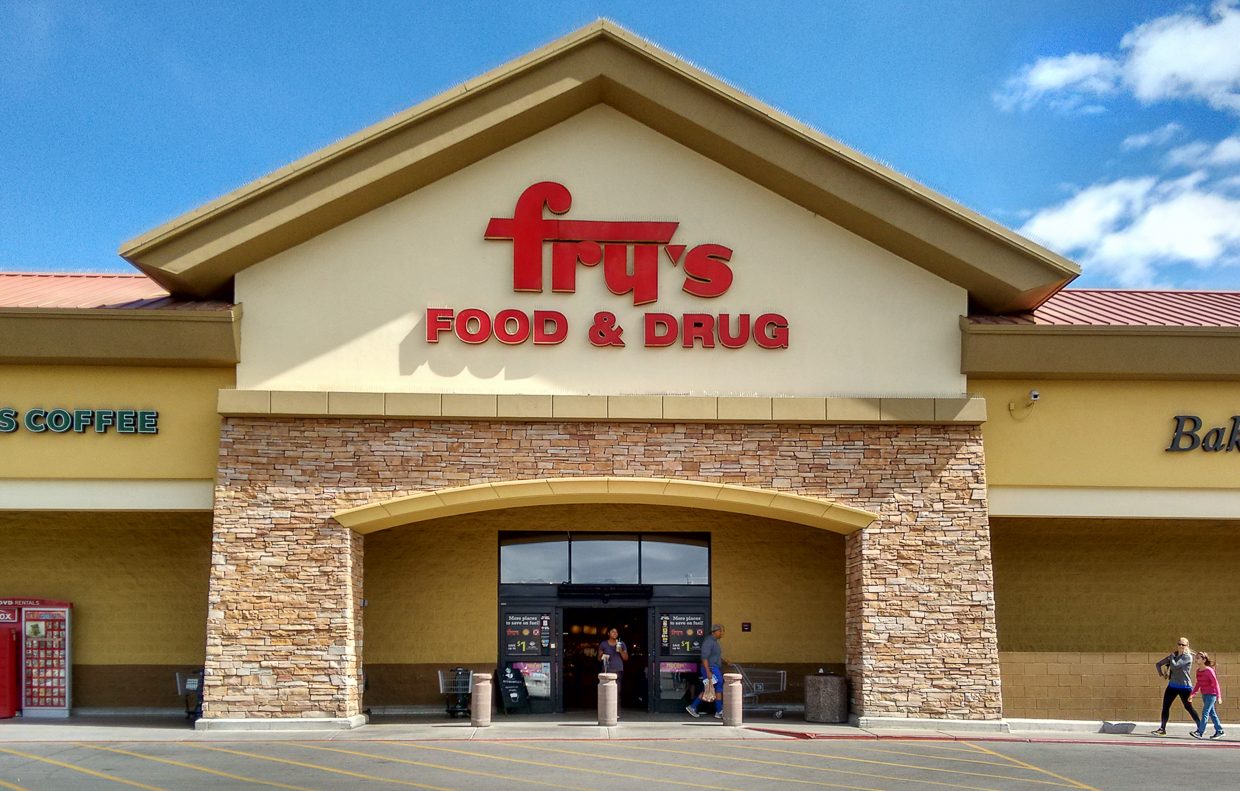
Now owned by Kroger Co., Fry’s Food & Drug stores such as this one in Sierra Vista, Arizona, continue to operate. The first Fry’s grocery was founded in 1954. Feb. 26, 2017 photo by StellarD. (Credit: Wikimedia Commons)

Influenced by the original family business, the Fry brothers at first offered a wider range of  grocery items for sale in their stores, including a full produce section. Those were quickly phased out in favor of just drinks and snacks aimed at tech junkies.

Their timing was right. The store was a success, and two more were opened in northern California before the company opened the Manhattan Beach store.

The Fry brothers began looking at the stores as entertainment destinations as well as retail outlets. They hired designers to give their various locations thematic designs and decor.

Thus, the Burbank location was given a 1950s science fiction film theme, with a flying saucer crashing into its facade, the City of Industry featured industrial steampunk motifs, and Woodland Hills had an Alice in Wonderland theme. 

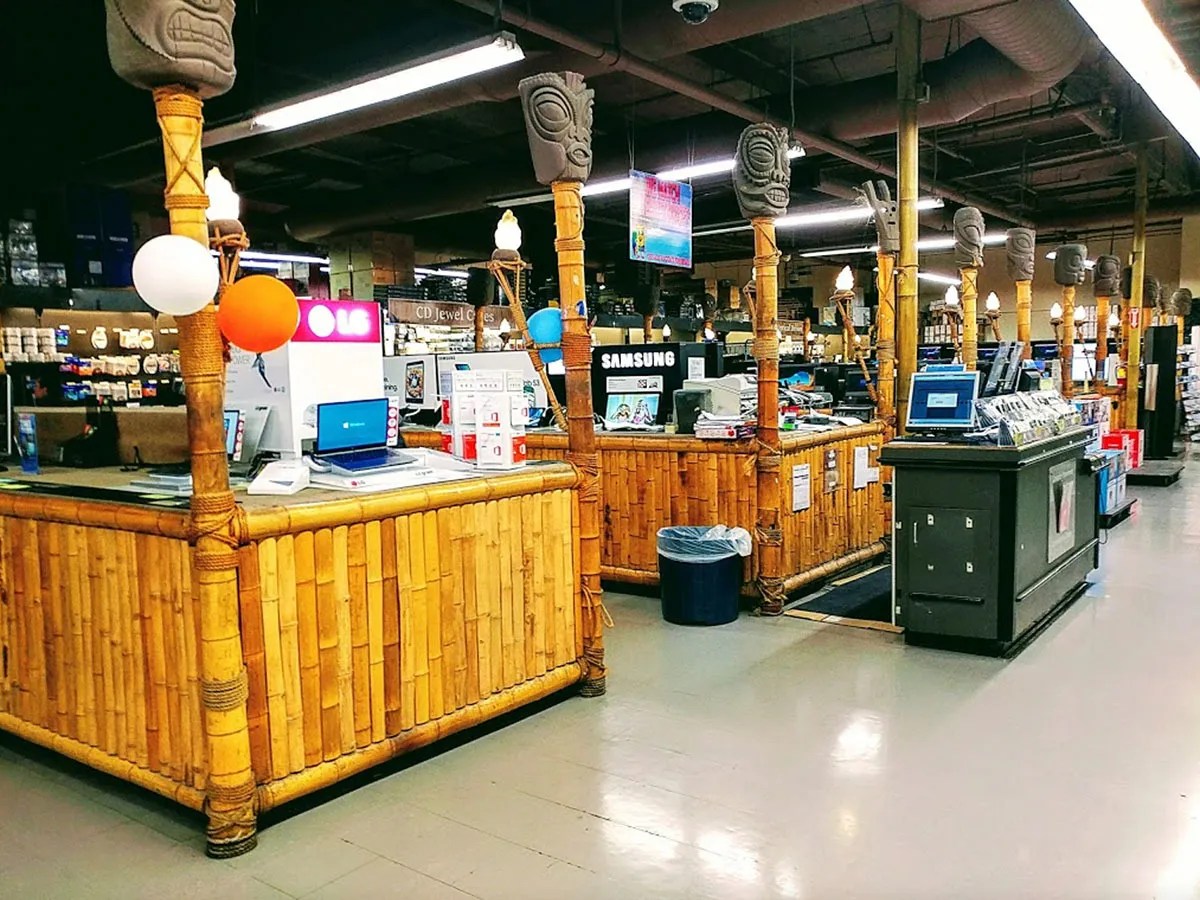
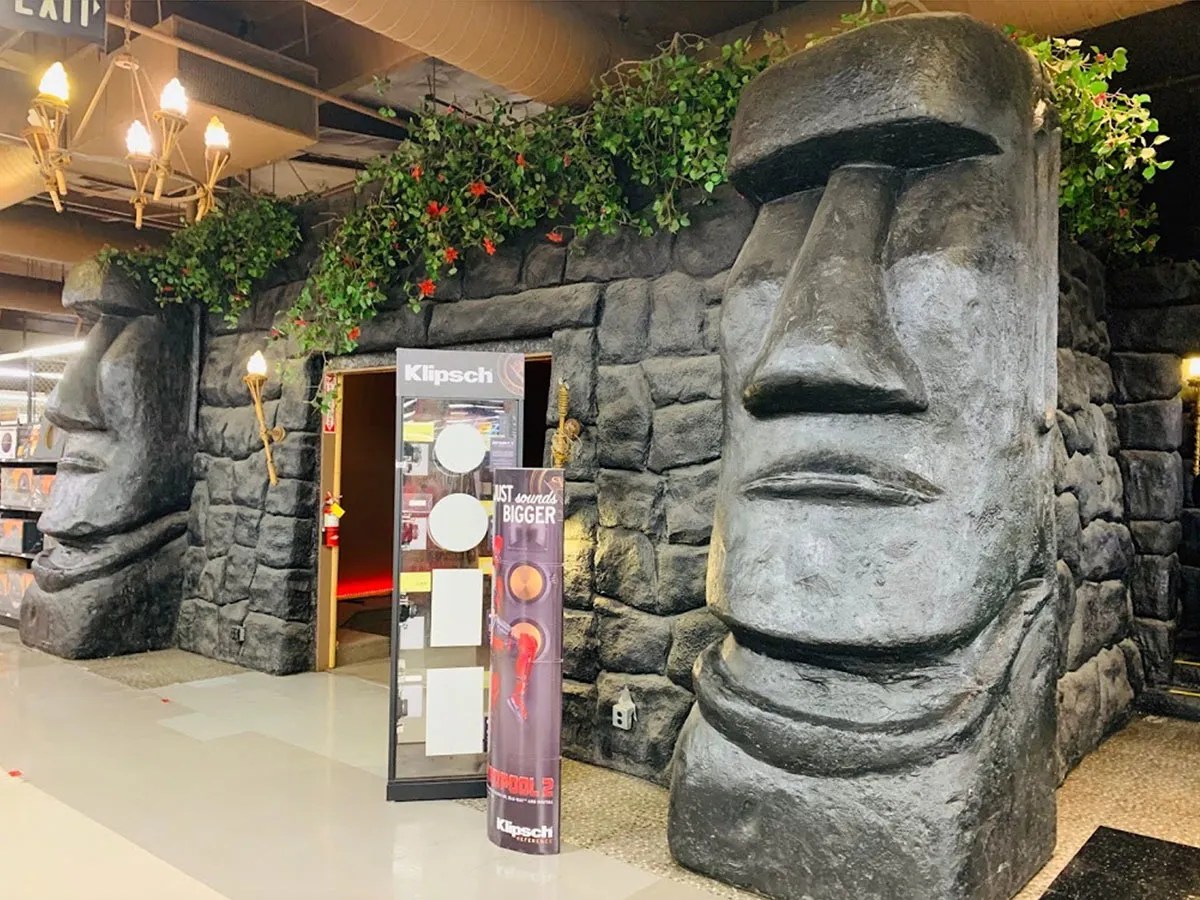
Appropriately, the Manhattan Beach store was given a beach/tiki theme when it opened in 1992. It had an outdoor koi pond, and its interior was festooned with palms, bamboo and tiki figurines. In addition, larger statues of an island god guarded the entrance to the theater/listening room in the store.

Bamboo display stands adorned with tiki figures on poles add to the South Seas ambience inside the Fry’s Electronics store in Manhattan Beach. Undated pre-2021 photo by Leevi Graham. (Credit: mytiki.life website)

Fry’s Electronics acquired six of those Incredible Universe locations from Tandy Corp. in 1996. By August 2014, the firm owned 34 retail stores in nine different states.

By then, however, the rise of online retailers such as Amazon.com that had begun in the early 2000s had started to put a huge dent in Fry’s core business. Competitors such as Circuit City and Best Buy also offered similar products. Also, the build-it-yourself fervor had cooled as personal computers became more sophisticated.

Fry’s also had developed a negative reputation for poor customer service, its outlets accused of making it difficult for consumers to return purchases for refunds.

By the late 2010s, customers began to notice that the shelves at Fry’s were less full of merchandise than they previously had been.

During 2020, the company closed four of its stores, and the end seemed to be nearing. It came suddenly on Feb. 24, 2021, when the company abruptly announced the closure of its remaining 30 retail locations, including the Manhattan Beach store. Spokesmen cited the downturn in the economy as the result of the COVID-19 pandemic.

Giant Moai heads modeled after the famous Easter Island sculptures stand guard outside the listening room/theater at Fry’s Electronics in Manhattan Beach. Undated pre-2021 photo by Leevi Graham. (Credit: mytiki.life website)

As early as 2004, the city of Manhattan Beach, sensing that Fry’s might be leaving the location, floated plans on reworking the Fry’s store site. The 2004 plan called for demolition of the Fry’s building and replacing it with 122,200 square feet of retail, restaurant and office space, and adding a new parking lot that would span the railroad right of way in the gully between Fry’s and the mall.

Of course, Fry’s hadn’t left yet and would remain in place for another 17 years. 

Since the store’s closure, city planners have begun mulling a preliminary proposal that would convert the parcel to a mixed-use residential location by erecting two multistory apartment buildings containing a total of 285 units.

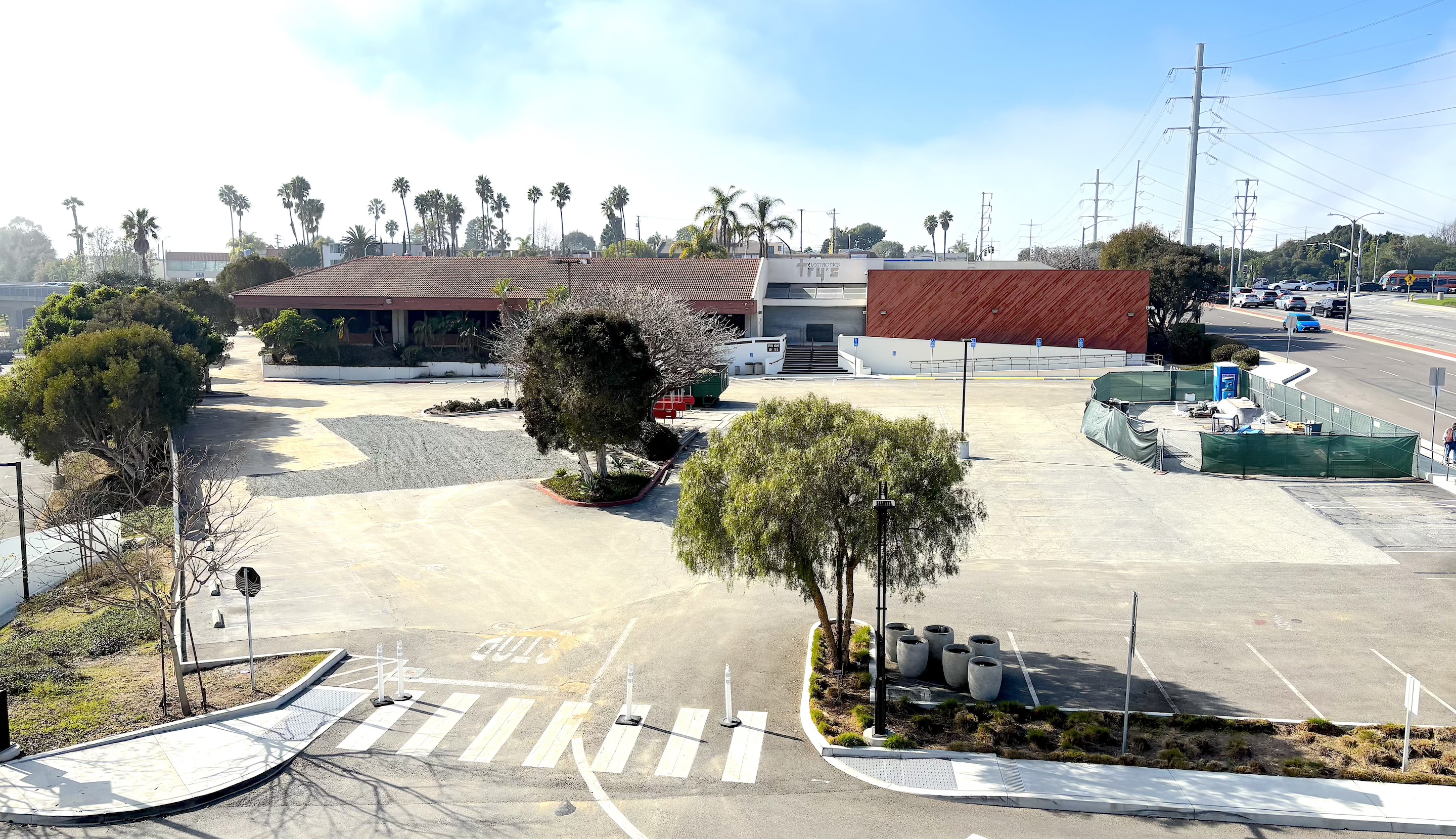
But the building remains vacant for now.

The empty former Fry’s Electronics site in Manhattan Beach. Rosecrans Ave. is at right. February 2025. (Photo by Sam Gnerre)

Sources:

Beach Reporter archives.

Daily Breeze archives.

Easy Reader archives.

Mytiki.life website. (Highly recommended for fans of tiki culture.)

Wikipedia.

Broadcast television took several decades to become prevalent in American homes

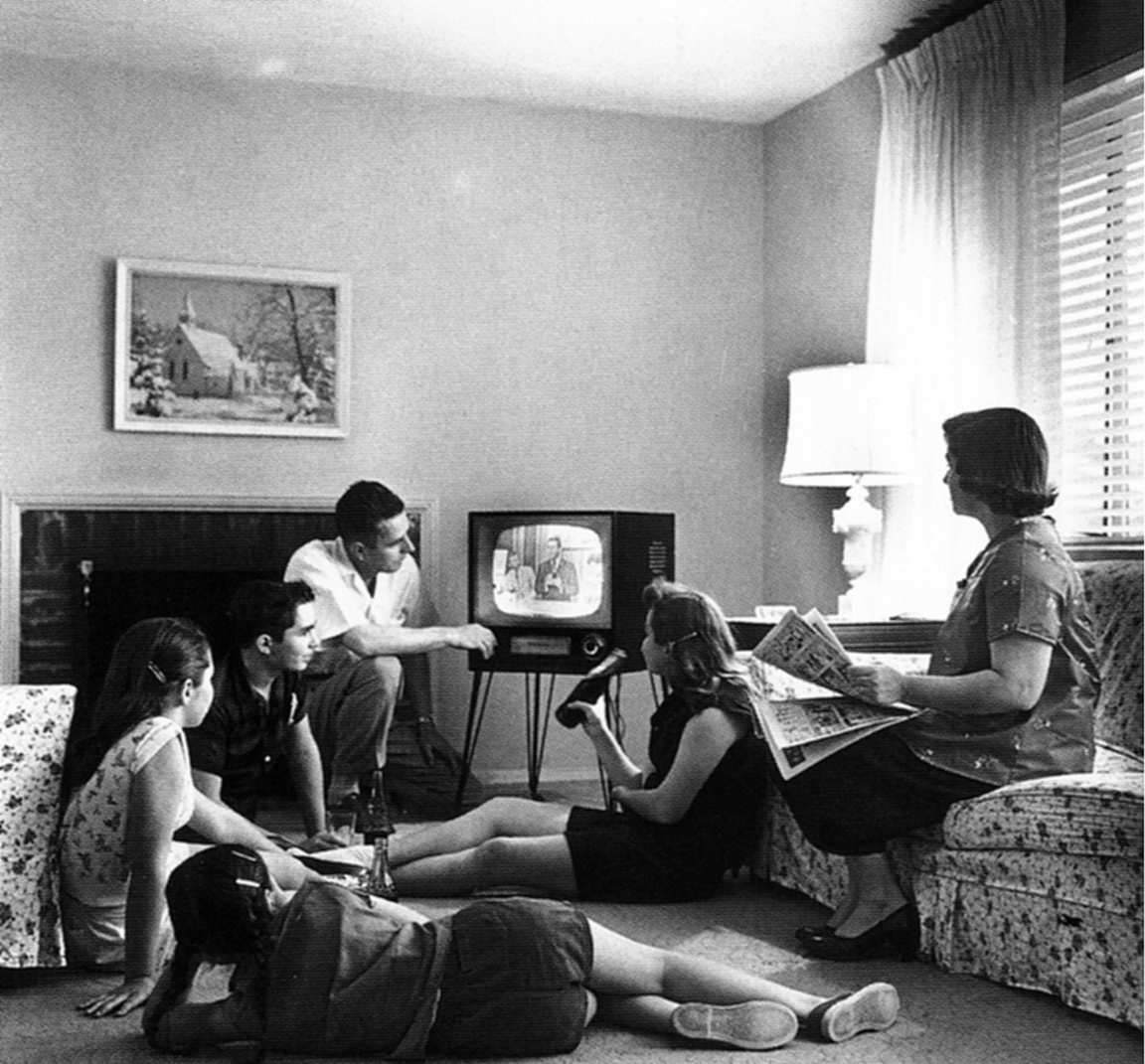
By the time this photo was taken in 1958, the television set had become a fixture in American living rooms. (Credit: Wikimedia Commons)

For a scientific marvel that has had amazing, far-reaching impacts on almost all aspects of modern life, it took television a long time to arrive in homes.

The concept of using radio waves to transmit images from one place to another began to take root in the early 1900s. The first use of the word has been traced to a scientific paper delivered at the International World’s Fair in 1900, though the concept existed even earlier.

No one person gets full credit for inventing television. Different scientists and engineers provided separate pieces of the puzzle. These include Nikola Tesla, John Logie Baird, Philo Farnsworth, C. Francis Jenkins, Kenjiro Takayanagi and many others who contributed in various ways to the development of the technology during the early 20th century.

Torrance Herald, Feb.24, 1938, Page 7-A. (Credit: Torrance Historical Newspaper and Directories Archive database, Torrance Public Library)

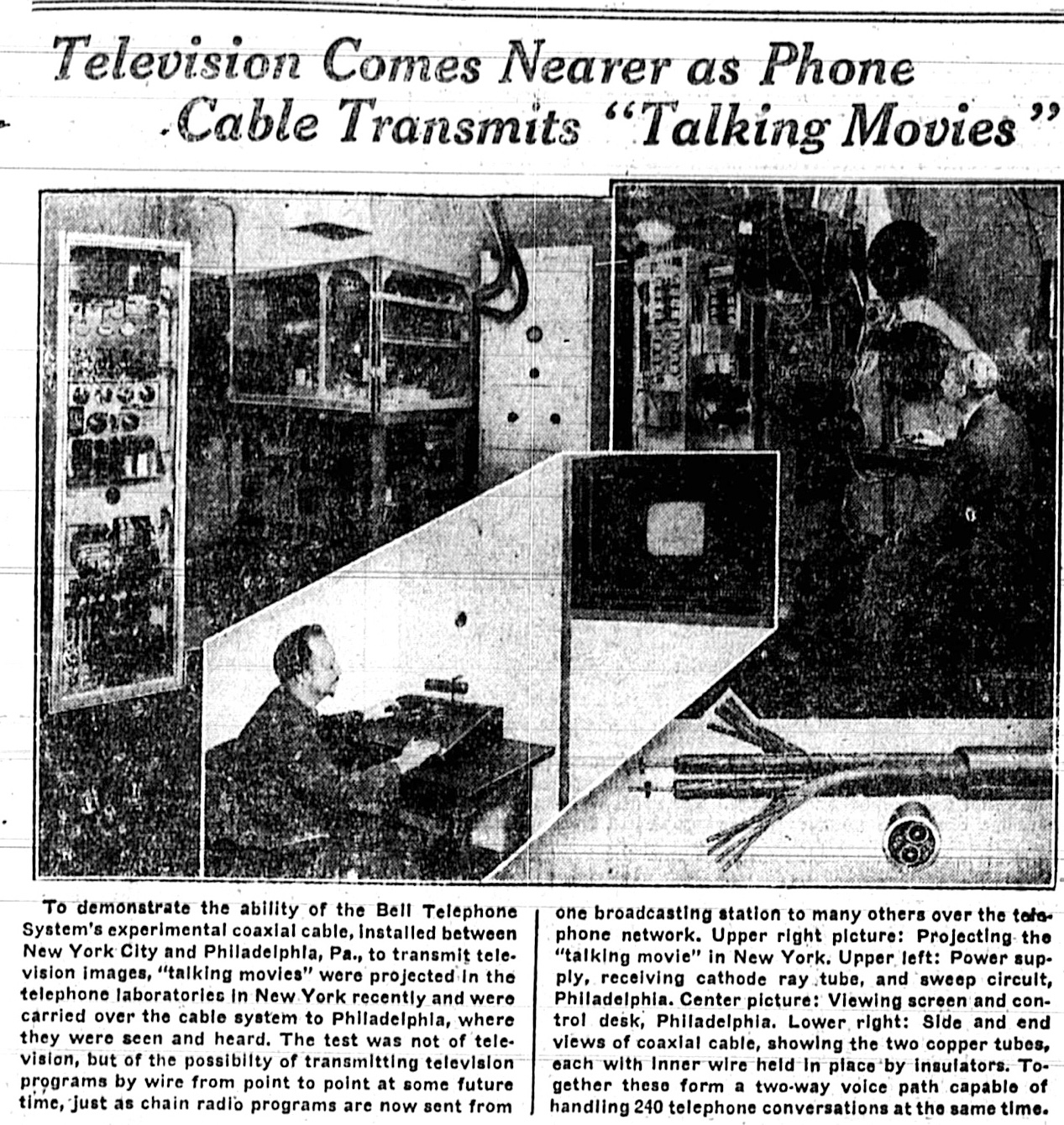
The early technology was crudely mechanical in nature and existed mostly in labs and technology centers. But by the 1920s, newspaper stories about the new electronic technologies being experimented with began to become commonplace

Headlines about television began appearing in local newspapers: 

“Radio Movies Come Soon, Says Science | British Inventor is Sure Television Will Arrive in a Few Years,” San Pedro News PIlot, Jan. 24, 1924, Page 9, 

Then, nine years later from the same paper:

“Television In Home Distant | Philco Officer Sees General Use of Invention Within Decade,” Dec. 11, 1933, Page 10.

The latter headline turned out to be more prescient, though it, too, also was overly rosy. Television technology had arrived in the laboratory by the 1920s, but there was no infrastructure yet to support its widespread use. Radio still ruled the airwaves during the 1930s.

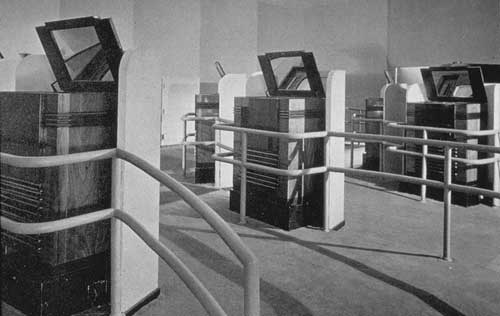
Televisions used for demonstrations at the RCA Pavilion at the 1939 World’s Fair in New York City in 1939. (Credit: Early Television Museum website)

Seeing television’s potential, major communications companies such as American Telephone & Telegraph and the Radio Corporation of America began working with the technology in the 1930s. USC offered one of the first courses in television science in 1934.

A public coming-out party for the nascent technology took place at the 1939 World’s Fair in New York City, when RCA devoted its pavilion to television. President Franklin Delano Roosevelt became the first U.S. president to appear on a television broadcast on April 20,1939, albeit on a highly localized network, when RCA broadcast his opening-day dedication speech at the fair.

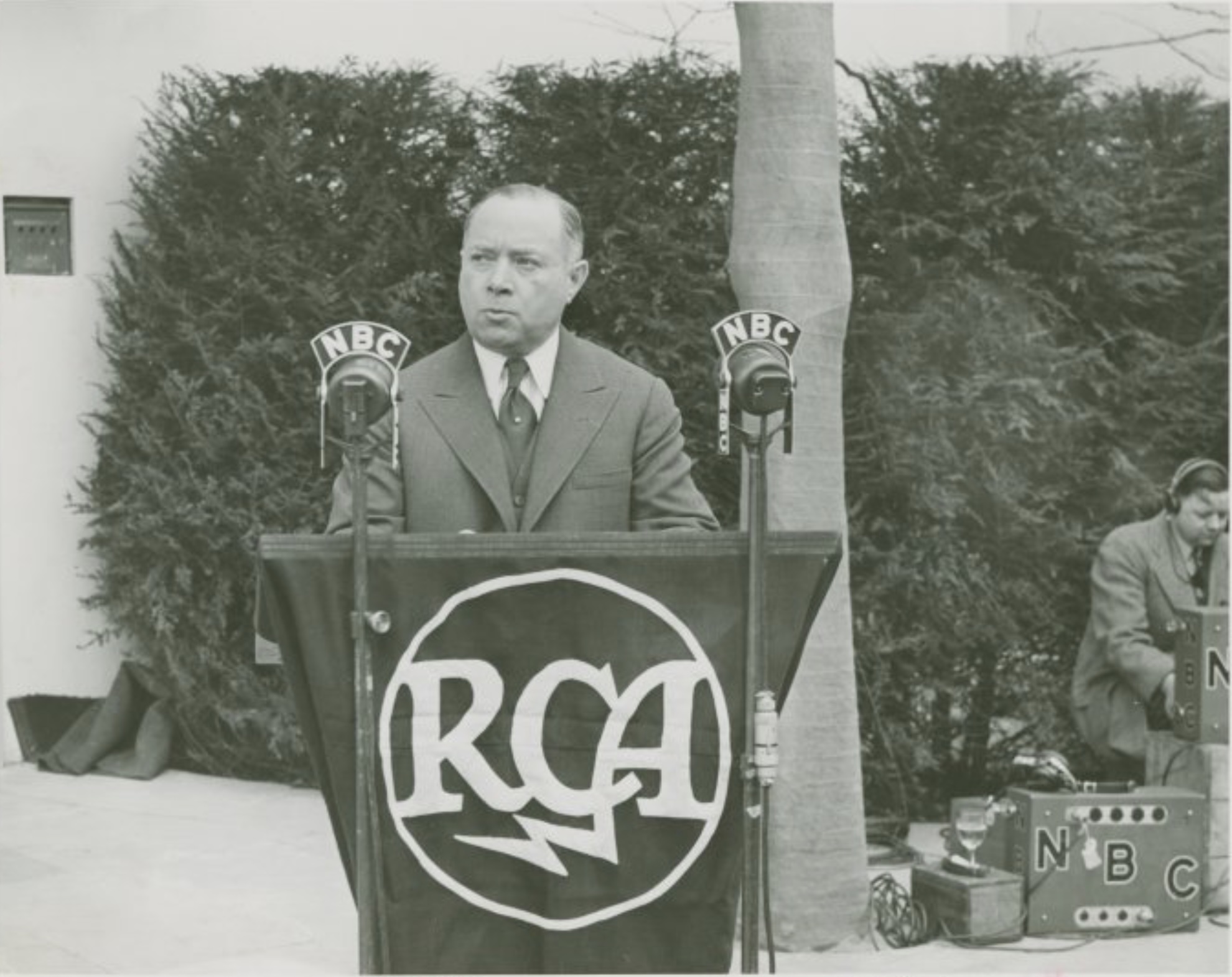
RCA president David Sarnoff speaks at the 1939 New York World’s Fair as television technicians help broadcast the event, right. (Credit: The New York Public Library photo collection)

But, even with its limited localized networks, television was a growing phenomenon. The Palos Verdes Peninsula News reported on television programming being offered to diners at the La Venta Inn in its March 1, 1940 edition.

Early broadcasts from the Los Angeles-based Don Lee Network were shown at two times: from 2:00 – 3:00 in the afternoon, and from 8:00 – 9:00 in the evening. 

Don Lee, who made his fortune as a Cadillac dealer, owned a radio company that had been experimenting with television throughout the 1930s. It offered limited broadcasts using the cruder mechanical television technology to a tiny audience on its first station, Gardena-based W6XS, in 1931. 

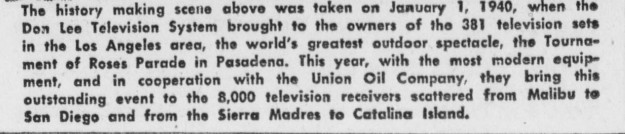
Its later W6XAO station used electronic television when it aired the first broadcast, the Tournament of Roses Parade on Jan. 1, 1940, to 381 viewers. (An estimated 300,000 viewers in greater Los Angeles would view the station’s 1947 parade broadcast.)

Palos Verdes Peninsula News, Dec. 18, 1947, Page 7. (Credit: Palos Verdes Peninsula News archives)

World War II delayed the arrival of  television on a large scale for another few years – no TV sets were even manufactured from 1942-45 – but its spread into more homes began in earnest during the postwar years.

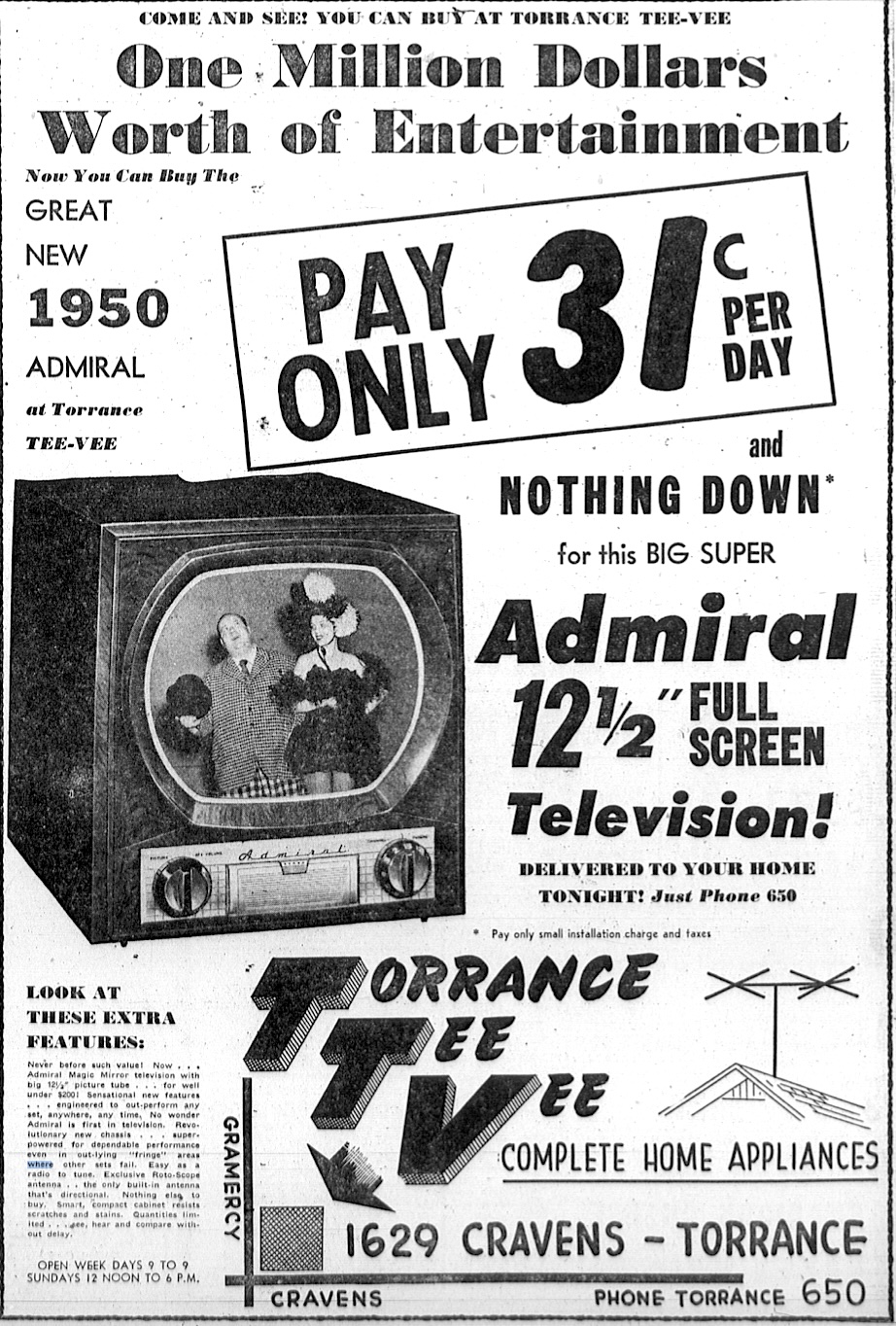
Ads for large home television sets with small screens began appearing in newspapers. The devices cost several hundred dollars, some of them costing more than automobiles.

TVs still were enough of a novelty that newspapers such as the Palos Verdes Peninsula News, Torrance Herald and San Pedro News Pilot began running stories on their social pages about local families who were holding television viewing parties at their homes for invited guests.

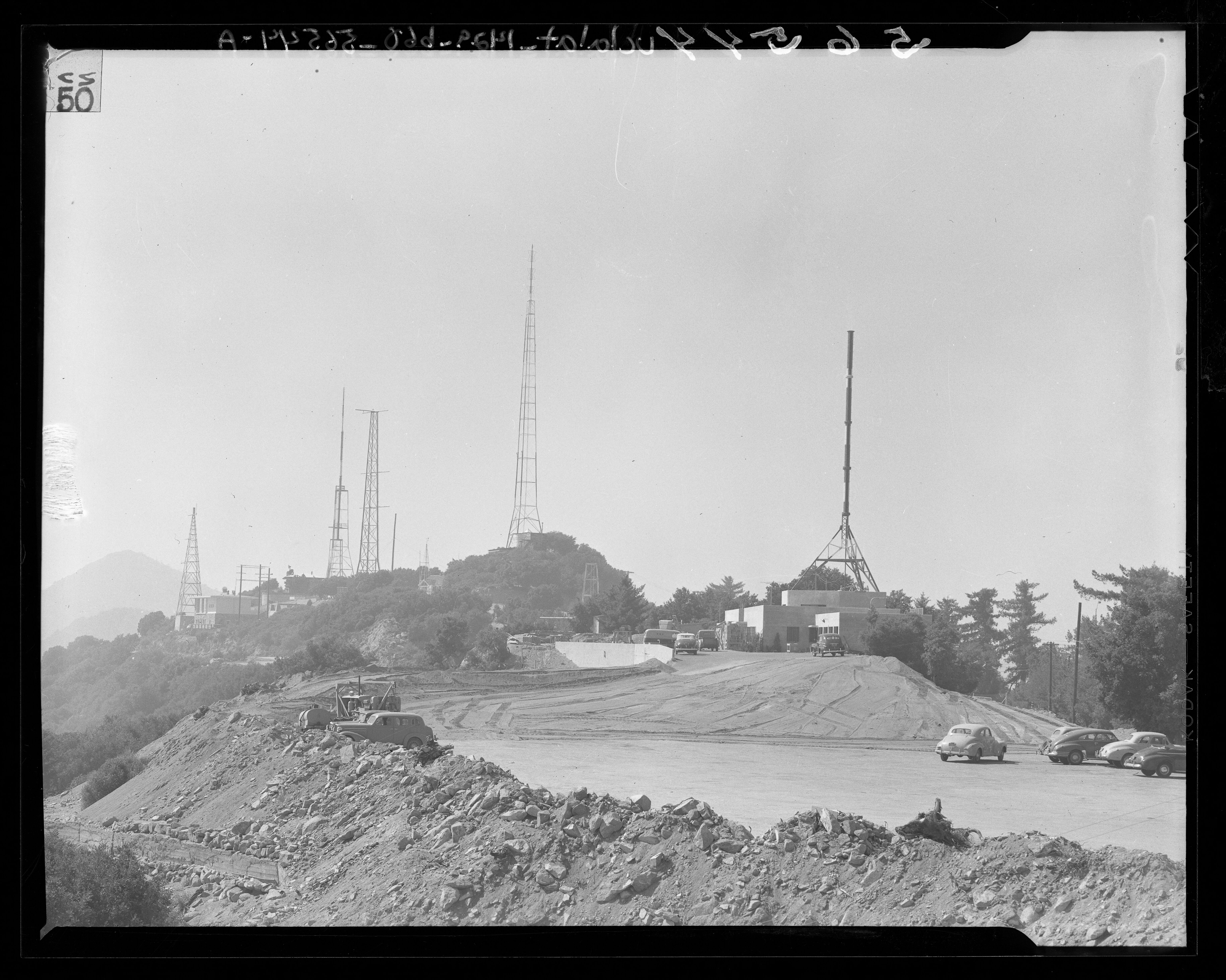
National networks were still developing in the late 1940s, but regional ones such as the Don Lee Network widened their range through the use of broadcast towers located on Mt. Wilson in Los Angeles.

Antennas of FM and television stations populate Mt. Wilson in Los Angeles. Images beamed from broadcasting studios in the metropolitan area are captured, regenerated and sent out on a broad scale to Southland receivers. March 8, 1949. (Credit: UCLA Library Digital Collections)

KTLA became the first TV station west of the Mississippi when it debuted on Jan. 22, 1947. Two years later, the station pioneered local news saturation coverage with its focus on the unsuccessful days-long attempt to rescue Kathy Fiscus, the three-year-old girl who fell into a well in San Marino on April 8, 1949. Tragically, she was found dead when rescuers reached her two days later.

By that time, television’s march into family living rooms was unstoppable. More local stations, including KNXT, KTTV, KHJ and KCOP came on the air to serve the growing audience for programming.

Television truly exploded during the early 1950s. For one thing, there was more for people to watch. Using a tower-to-tower network established by AT&T, four national networks were operating by 1949: NBC, CBS, ABC and the Dumont Network. (Dumont went off the air in 1956.)

According to 1953 statistics from RETMA, the Radio and Electronic Television Manufacturing Association, there were 44,000 TV sets in the U.S. in 1946. By 1952, that number had grown to more than 24 million, with sets in 52.9% of American households. Television, such as it was, was here to stay.

Torrance Herald ad, March30, 1950, Page 9.(Credit: Torrance Historical Newspaper and Directories Archive database, Torrance Public Library)

Sources:

Early Television Museum website.

Palos Verdes Peninsula News archives.

San Pedro News Pilot archives.

Torrance Press Herald archives.
Wikipedia.

A long tale of a short freeway: California State Route 47

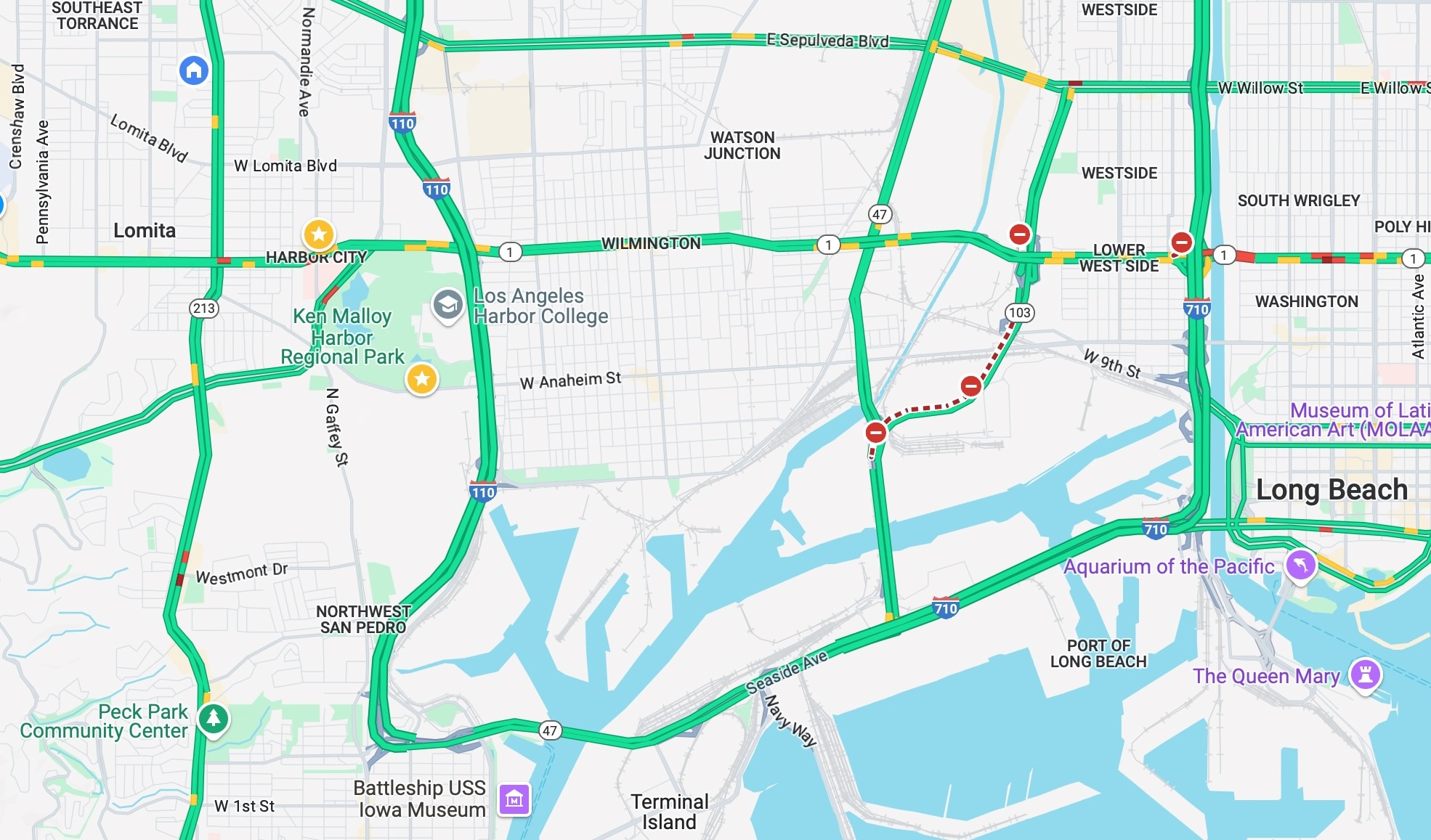
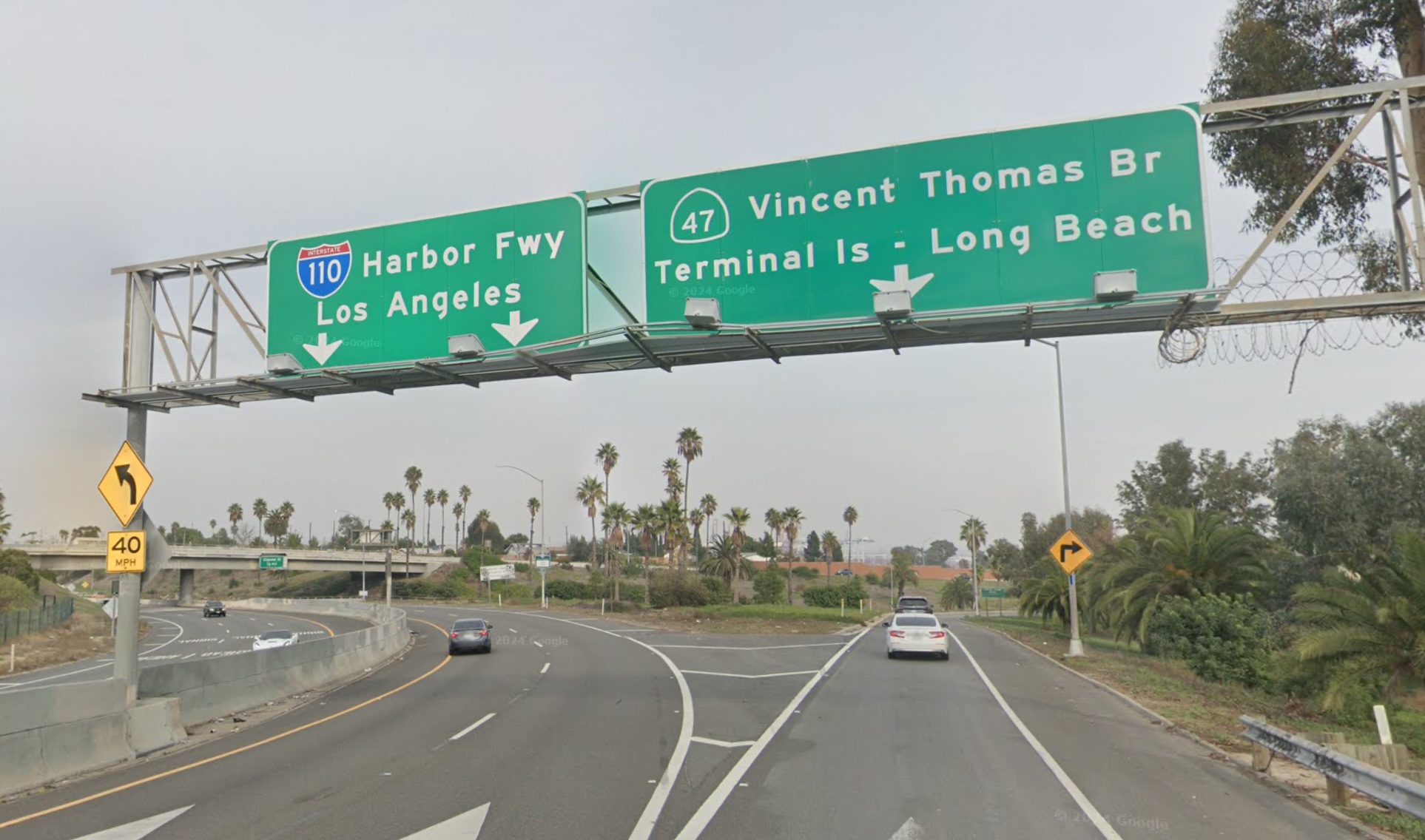
The 47 Freeway runs from the end of the 110 Freeway, lower left, along Seaside Avenue. It turns inland, center, and eventually follows Alameda Blvd. northward. The Terminal Island Freeway (103) branches off and ends at Willow St. in Long Beach. (Credit: Google Maps)

The 47 Freeway may not be the longest in the Los Angeles area – only the 3.1-mile Marina Freeway is shorter – but it provides a vital link to the ports of Los Angeles and Long Beach.

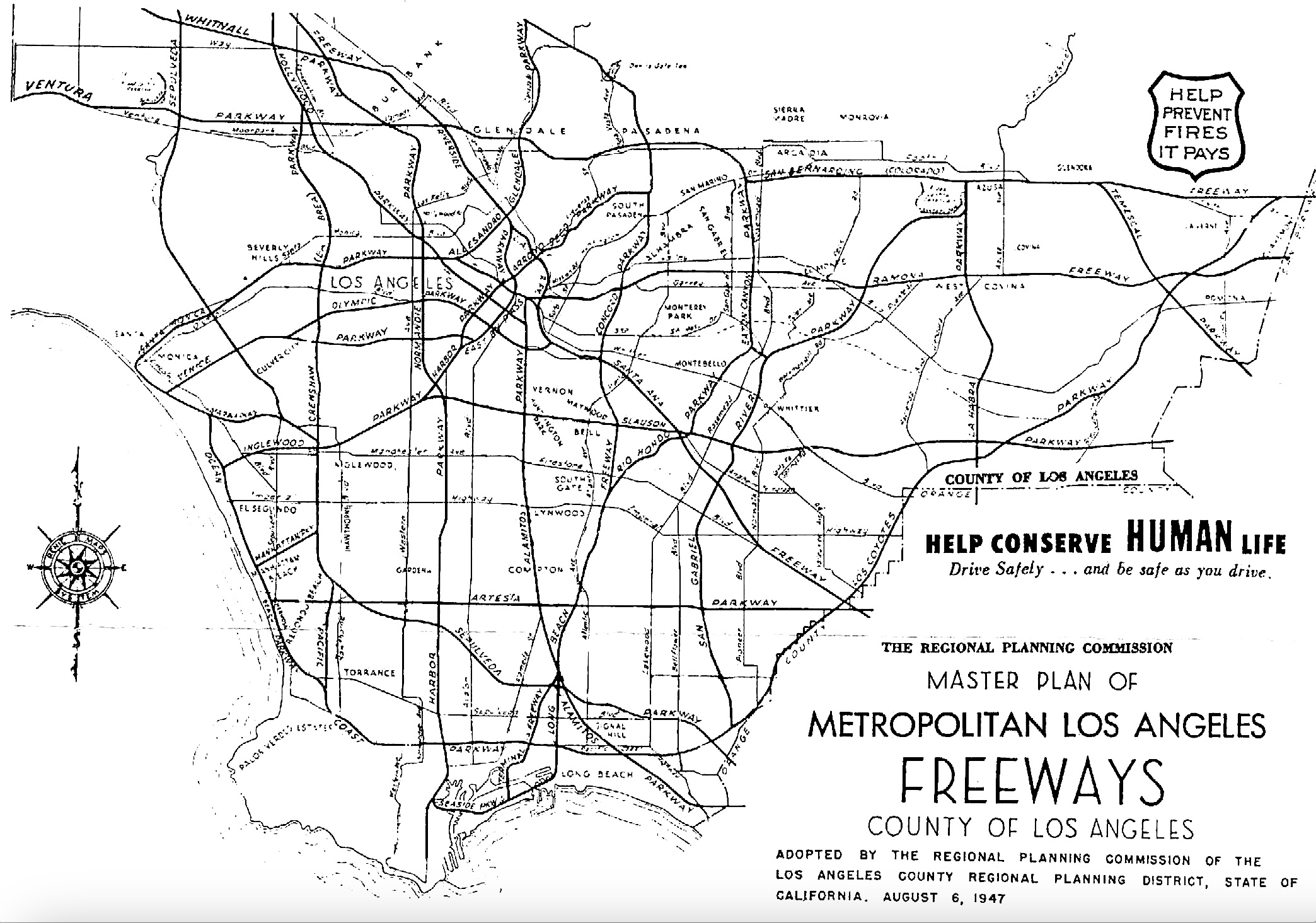
Officially known as California State Route 47, or California 47 for short, the freeway was part of the plan set forth by the Los Angeles Metropolitan Parkway Engineering Committee in 1946. 

The ambitious planners envisioned a 1,500-mile network of freeways, expressways and parkways for the Los Angeles metro area. Only a third of the proposed roadways were ever built.

This 1947 Los Angeles County map shows planned freeways and parkways. Only the Arroyo Seco Parkway from Pasadena had actually been built at the time. (Credit: Los Angeles County Regional Planning Commission)

With the exception of the Arroyo Seco Parkway in Pasadena, whose first section opened in  1940, the sprawling city and its suburbs were then freeway-less, relying on an often crazy-quilt network of surface streets.

A look at a pre-freeways map of the Harbor Area shows that, while many north-south roadways stretched from the ports of Los Angeles and Long Beach to points north, very few east-west routes linked the ports to each other.

It would be many years before the 47 Freeway opened. In the meantime, Alameda Blvd. remained the main roadway linking the ports of Los Angeles and Long Beach to the north. The 710 Long Beach Freeway, originally named the Los Angeles River Freeway, became heavily used by trucks going to and from the port after it was completed in 1964. 

The U.S. Navy, looking to improve access to its various operations on Terminal Island, financed the construction of the Terminal Island Freeway in 1946. The 2.1-mile roadway eventually became California State Route 103, which branches off from Henry Ford Ave. in Wilmington, heading northeast to its Willow St. terminus in Long Beach.

The master plan for the 47 Freeway called for a route from Terminal Island that would link with Seaside Blvd. (later changed to “Seaside Ave.”). Seaside, also called the Seaside Freeway even though it had traffic signals, was the east-west artery linking San Pedro to Long Beach. (Seaside becomes Ocean Blvd. at the Long Beach city limit, just east of Navy Way.) 

It was the only part of the proposed “Industrial Freeway,” designed to stretch from Terminal Island to downtown Los Angeles, that was ever built.

From there, the proposed roadway would head northward along Alameda and link to the 103 before continuing all the way to the 10 Freeway in Los Angeles.

By the late 1960s, that plan had been scaled back to an eight-mile freeway from Terminal Island north to the 91 Freeway. But, first things first, a way was needed to cross the main channel of the Port of Los Angeles onto Terminal Island.

Before the construction of the Vincent Thomas Bridge in the early 1960s, the only transport from San Pedro to Terminal Island was via the Terminal Island Ferry. 

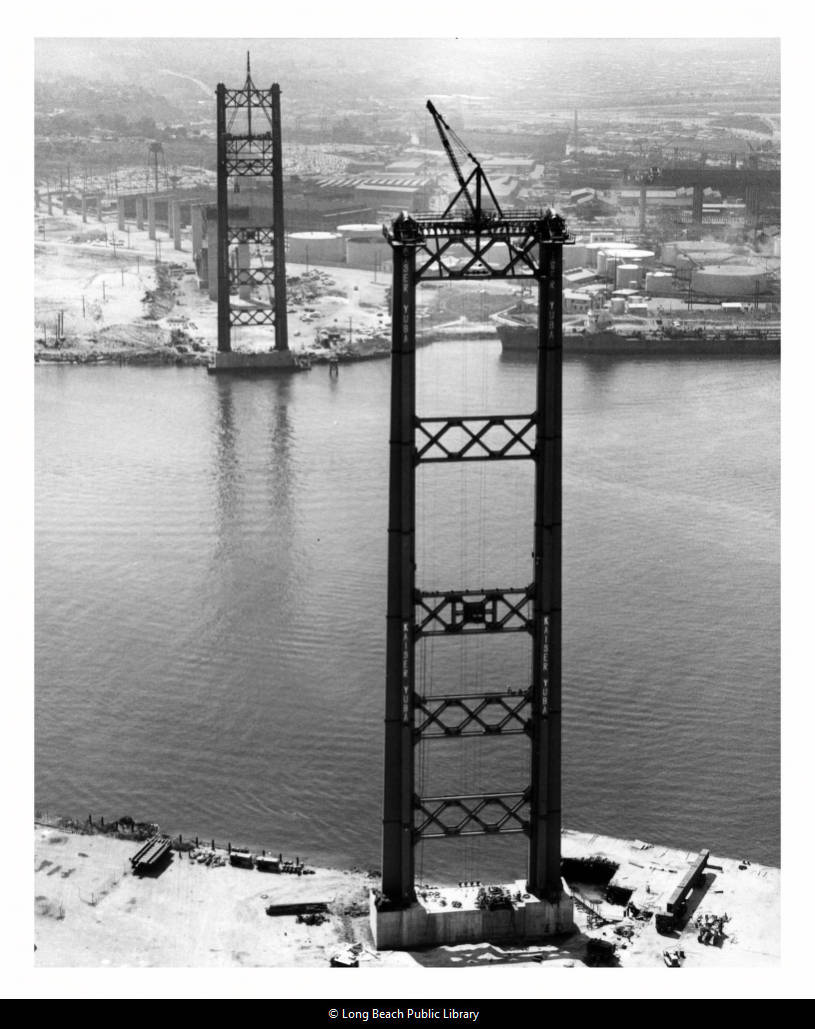
The two 360-foot-tall main towers of the Vincent Thomas Bridge have been completed in this 1962 photo looking west from Terminal Island towards San Pedro. The bridge opened to traffic in 1963. (Credit: Long Beach Public Library Digital Archive)

Thanks to the tireless efforts of San Pedro resident and longtime California Assemblyman Vincent Thomas, that came to an end when the iconic bridge bearing his name officially opened to traffic on Nov. 15, 1963. (The ferry made its final run the night before.)

Thomas paid the first toll, which at that time was 25 cents. It would rise to 50 cents in 1983. In 2000, the toll (and the toll booths) were eliminated.

The bridge figured prominently in what would become the present-day 47 Freeway, which starts  at the terminus of the 110 Freeway at Gaffey St. in San Pedro. The 47 follows the Vincent Thomas Bridge onto Seaside Ave., with one stoplight at Navy St. The section connecting the 47  Freeway to Seaside opened on July 9, 1970.

Originally, the 47 was designed to follow the Terminal Island Freeway (103), but in 1982 it was rerouted to parallel Henry Ford Ave. to Alameda, and from there, follow Alameda north to the 91 Freeway and ultimately all the way up to the 10 Freeway. 

It was a grand plan, but it never came to pass. Civic officials were still pushing for its completion as late as 1975, but by the mid-1980s, the project was dead in the water. Though road signs identifying the Henry Ford Ave. and Alameda Blvd. stretches of the 47 Freeway up to the 91 Freeway still exist, the actual freeway project was never built.

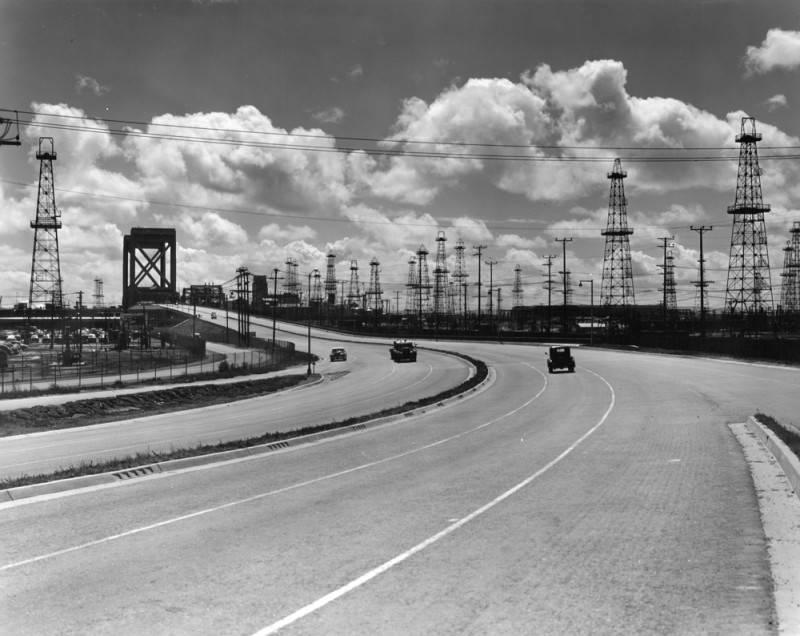
The 47 Freeway on Terminal Island turns inland toward the Schuyler F. Heim Bridge against a backdrop of oil derricks. Pre-1981 photo by Ralph Morris. (Credit: Los Angeles Public Library Photo Collection)

The massive Alameda Corridor project opened in 2002, but its goal, met successfully,  had more to do with facilitating train traffic than motor traffic. Other than that project, no additional constructions or improvements have been made to the Alameda section of California State Road 47. Hundreds of trucks traversing it daily make maintaining it a challenge.

The city of Long Beach currently is seeking to decommission the northern portion of the Terminal Island Freeway (103) that runs from 20th St. to Willow St., a stretch of roadway that also has many rough patches.  The city plans to transform it into a much smaller local road surrounded by new park and green space areas. 

The Gaffey St. entrance to the 110 Freeway north, left, and the 47 Freeway, right. (Credit: Google Earth)

Sources:

AA Roads website.

California Highways website.

Daily Breeze archives

Freewaytopia: How Freeways Shaped Los Angeles, by Paul Haddad, Santa Monica Press, 2021. 

Gribblenation website.

Los Angeles Times archives.

Southern California Regional Rocks and Roads website.

Wikipedia.

Northrop develops the first intercontinental cruise missile, the Snark, in Hawthorne

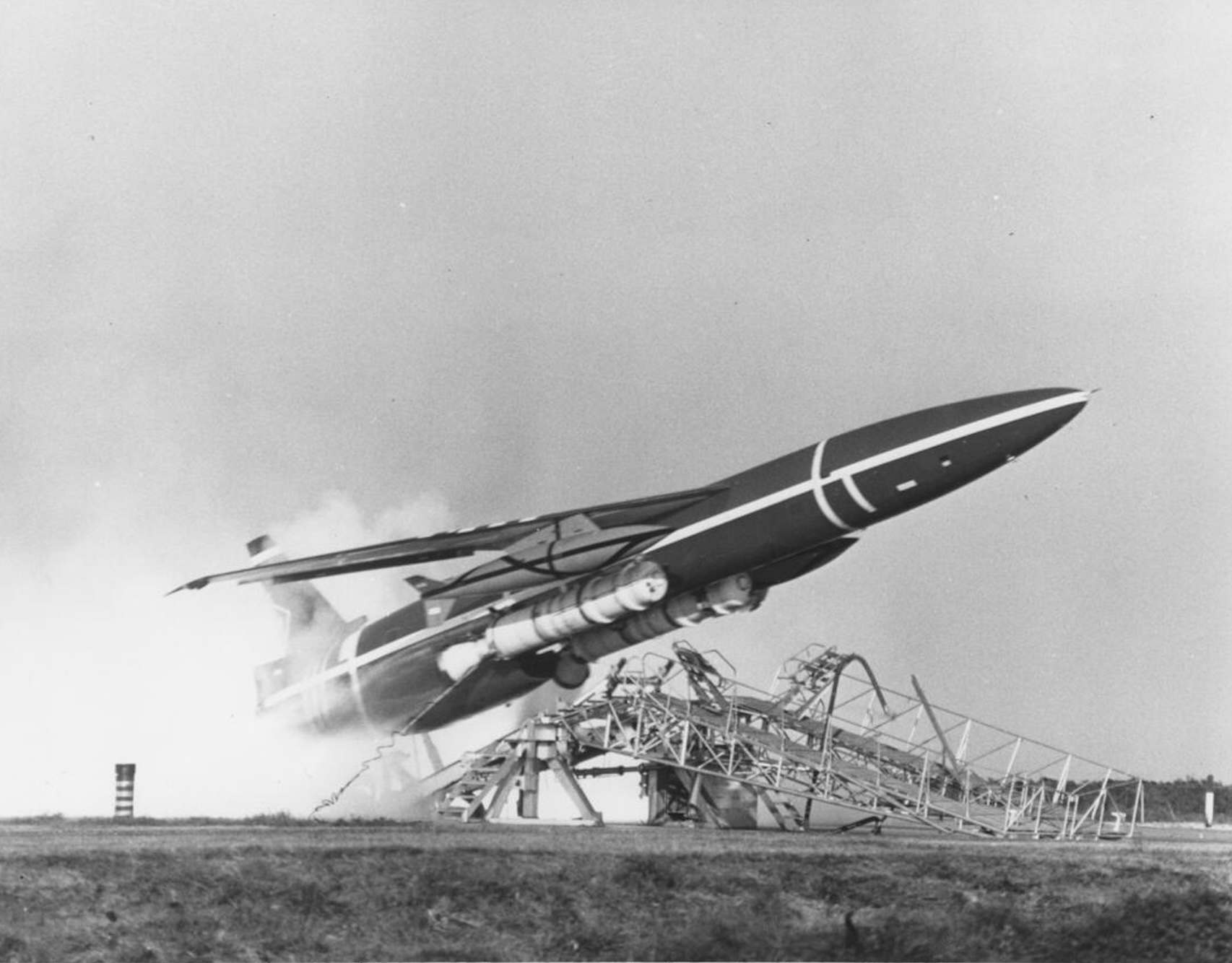
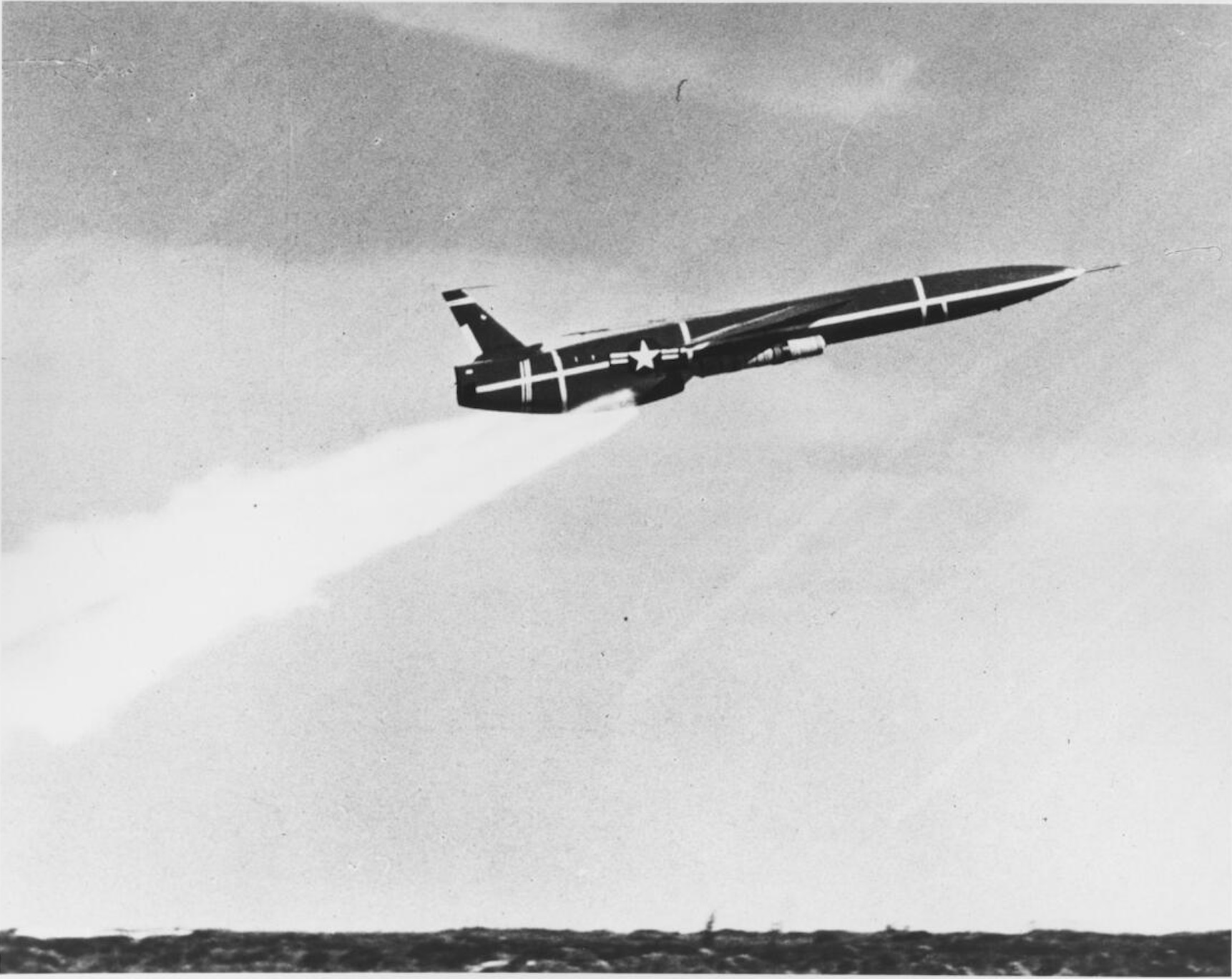
A Northrop Snark SM-62 missile launches from Cape Canaveral in Florida, circa 1960. (Credit: USC Digital Library)

No, the Snark missile’s name doesn’t mean what you might think at first. Northrop Corp.  founder Jack Northrop took the name from the author Lewis Carroll’s mythical animal character “the Snark“ in his 1876 poem, “The Hunting of the Snark.”

In October 1945, two months after deploying the atomic bomb in Japan, the United States Air Force put forward the request for proposals to develop an unmanned aircraft capable of delivering nuclear weapons remotely.

Northrop Corp. was the first defense contractor to respond. Its Snark program would create the first intercontinental cruise missile developed for the armed forces. 

Jack Northrop was an experienced aircraft engineer who started his first aviation firm, Avion, in 1928. After various business travails during the 1930s, he teamed with co-founder Moye Stephens, who’d located an ideal site for the physical plant in Hawthorne, to form the new company.

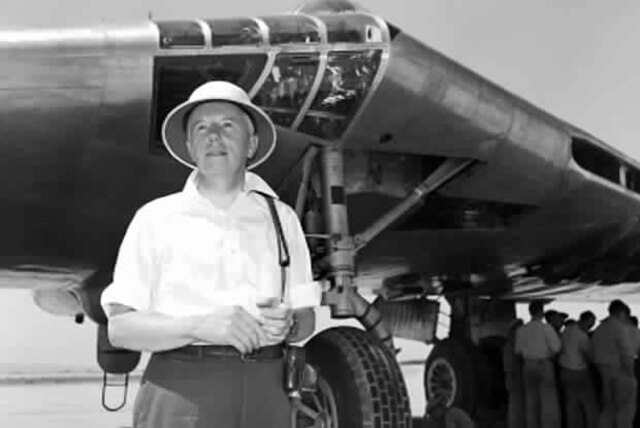
Jack Northrop standing near an XB-35 Flying Wing aircraft in 1948. (Credit: U.S. Air Force via Wikimedia Commons)

The site south of 120th St. between Prairie Ave. and Crenshaw Blvd. had an adjoining air strip which the company named Northrop Field. With the outbreak of World War II, the U.S. military took control of the strip. It was returned to the city in 1946, and officially became Hawthorne Municipal Airport in 1948.

Under a cooperative agreement, Northrop Corp. continued to use the field for aviation development and testing. Its aircraft manufacturing plant was located just south of the airstrip.

The SM-62 Snark missile program began in secret at the Hawthorne location following the end of the war, in October 1945. It would remain a classified program for the next several years. 

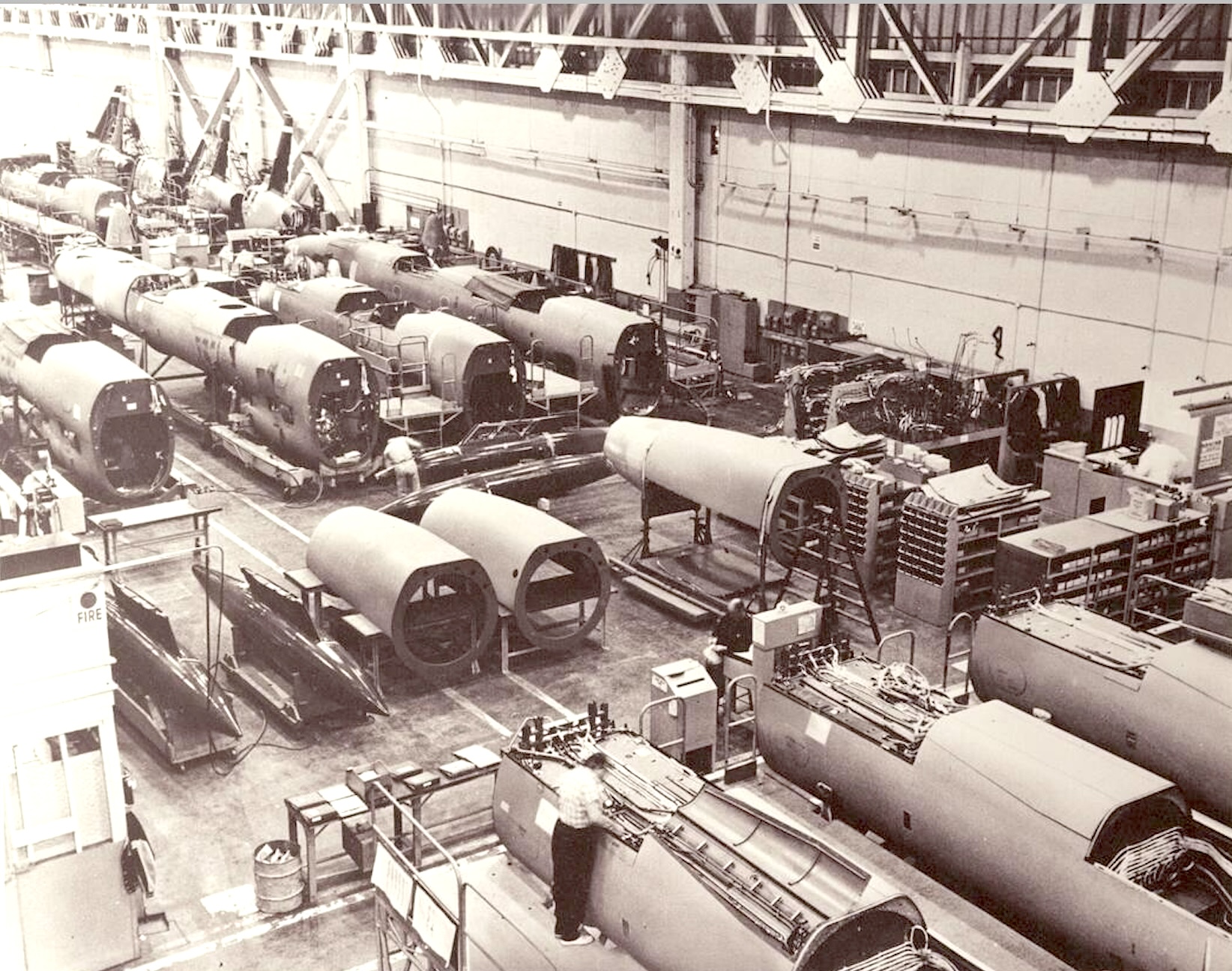
Interior of the Northrop Corp.’s Hawthorne plant, where the Snark missile was being constructed, circa 1950. (Credit USC Digital Library)

Its builders needed not only to design and build a missile capable of long-range unmanned flight – it ultimately would have a range of 6,325 miles – but also had to devise an automated guidance system capable of guiding the aircraft to its target.

Specifications and capabilities for the missile were upgraded during its first few years of development as its technology became more sophisticated. 

Testing of the early version of the missile, the N-25, took place at Holloman AFB in New Mexico from 1951-52. The first prototype flight of the Snark missile took place on Aug. 6, 1953, after the testing had been moved to larger facilities at Cape Canaveral in Florida.

As it turned out, the missile performed well, but the guidance system was another matter. Perfecting it took years. 

Engineers settled on the Nortronics navigation system, which was capable of reading the position of stars in all kinds of weather, and using celestial navigation to guide the missile’s flight. The technology had never been used on missiles before.

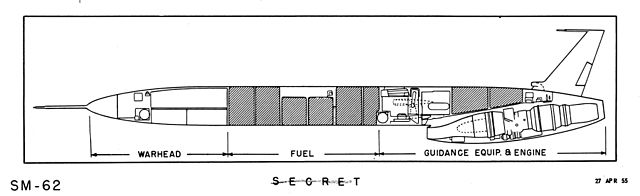
This 1955 diagram shows the configuration of the Snark missile. (Credit: U.S. Air Force via Wikimedia Commons)

This and other technological challenges meant the Snark wouldn’t become ready for implementation by its 1953 target date. In fact, it would take several more years, causing doubts about its efficacy from government defense experts.

Such problems weren’t uncommon during the aerospace buildup of the 1950s, as engineers and developers tried to harness all kinds of new technologies.

By 1956, the push was on to make the Snark operational through increased testing. One such test flight took place on Dec. 5 of that year, when a Snark missile was sent on a test flight that would ostensibly take it from Cape Canaveral to Puerto Rico and back.

At first, technicians received signals indicating the missile was on course, but it didn’t last. The missile began veering off track, and, worse, failed to respond to commands sent to its system to correct its flight path.

Its last known location was somewhere off the coast of Venezuela, headed on a course for the Amazonian jungles of Brazil. It was never found.

The Snark intercontinental guided missile in flight after launch from the U.S. Air Force’s missile test center at Patrick Air Force Base in Brevard County, Florida. Photo circa 1960. (Credit: USC Digital Library)

Despite such misadventures – observers joked that the seas in the area around the Cape were “Snark-infested waters” – the Snark missile program eventually did become operational. 

The 702nd Strategic Missile Wing under the Strategic Air Command (SAC), was activated at Presque Isle AFB in northern Maine on Jan. 1, 1959, and the first Snark missile arrived that May. In March 1960, the first Snark was placed in service on official alert at Presque Isle.

But time and rapidly advancing technology had caught up with the Snark program. In June 1961, President John F. Kennedy ended the program, declaring it obsolete, and the 702nd Wing was disbanded.

Kennedy had determined that a new generation of intercontinental ballistic missiles (ICBMs), including the Atlas and Titan programs, were superior choices, and shut the Snark program down.

Jack Northop’s company emerged unscathed, becoming one of the leading aerospace firms in the U.S. Northrop died in 1981 after a long illness.

Northrop Corp. merged with Grumman in 1994, and closed its Hawthorne aircraft plant in 1997. Following Northrop’s departure, SpaceX occupied the plant from 2008 until owner Elon Musk announced the company’s move to Texas in July 2024.

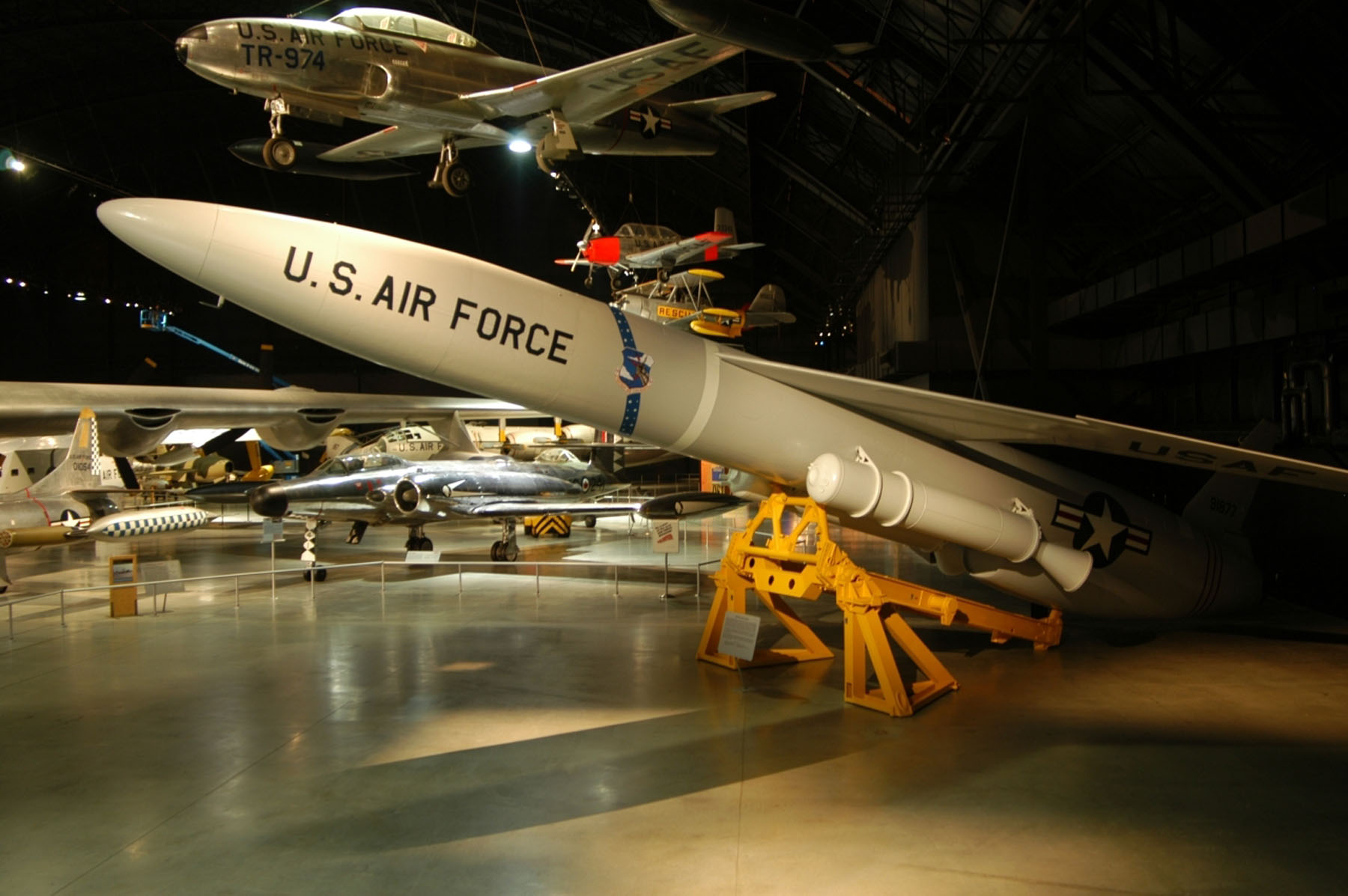
A Northrop SM-62 Snark missile currently on display in the Cold War Gallery at the National Museum of the United States Air Force Museum at Wright-Patterson Air Force Base near Dayton, Ohio. (Credit: U.S. Air Force photo)

Sources:

Daily Breeze archives.

“The Day They Lost the Snark,” by J.P. Anderson, Air & Space Forces Magazine, Dec. 1, 2004.

Los Angeles Times archives.

“Northrop SM-62 Snark,” National Museum of the United States Force website.

“Snark,” Cape Canaveral Space Force Museum website.

Wikipedia.

1950s Northrop recruitment film featuring the Snark missile and extolling the appeal of working and living in Southern California:

Torrance teen’s whirlwind wedding to Swiss businessman caused a sensation in the 1950s

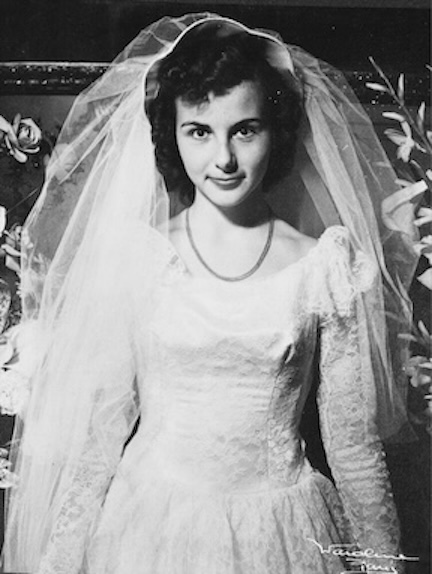
Martha Morris DeVigier at her wedding at Notre Dame Cathedral in Paris on Nov. 22, 1951. (Credit: USC Digital Library)

The wedding of Martha Morris, dubbed the “Cinderella Bride” by the Torrance Herald, to Swiss industrialist Roland DeVigier in 1951 sounds like one of those modern-day I’m-gonna-marry-a-prince movies on the Hallmark Channel. At first, anyway.

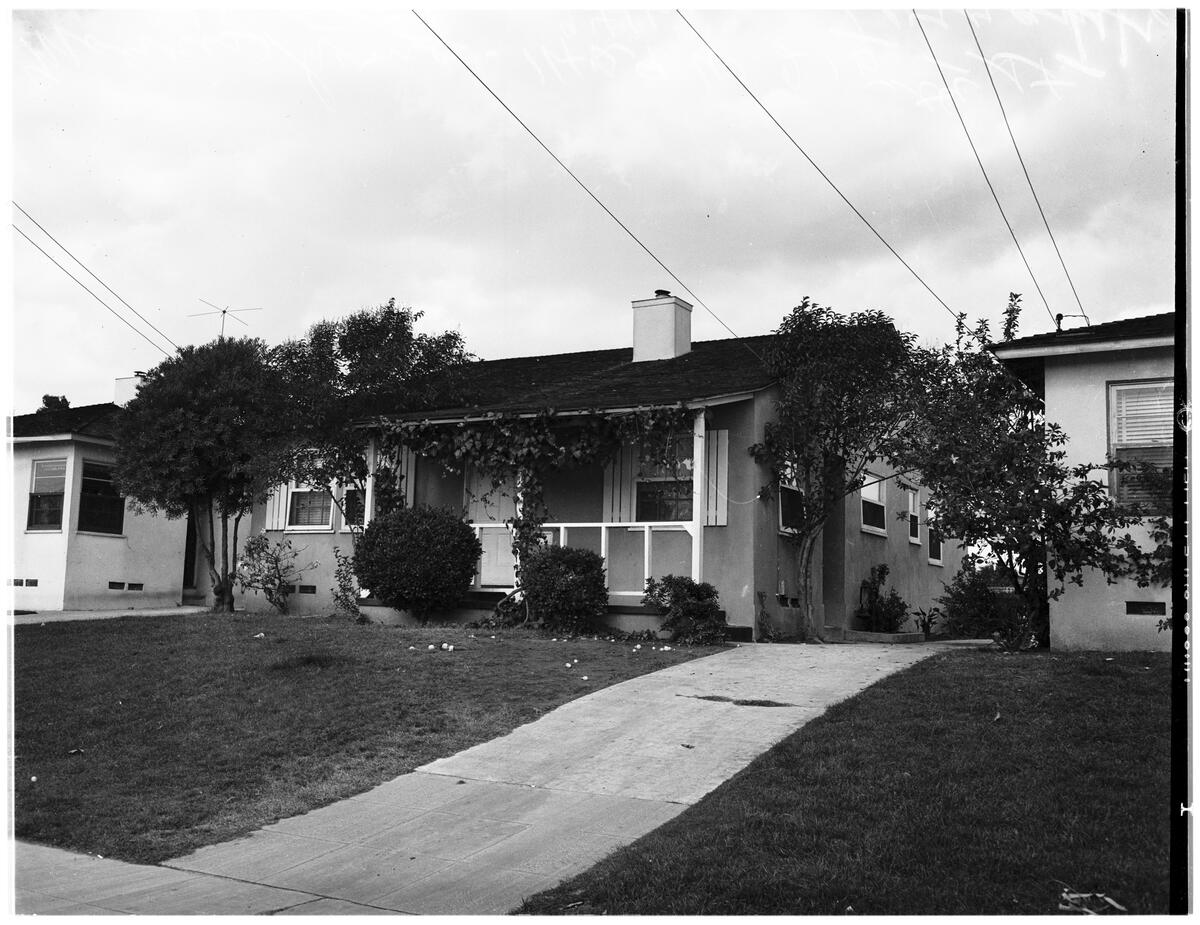
The 16-year-old Morris lived with her parents, Mr. and Mrs. Charles Ray Morris, on 215th St. in the Harbor Gateway section of the Los Angeles city strip, a few blocks east of Western Ave., the Torrance city limit. She attended Torrance Elementary and Torrance High School before transferring to St. Anthony High School in Long Beach. 

Her life changed one day during October 1951, when she became acquainted with Roland DeVigier at the Torrance Grill, a cafe/soda fountain at 1500 W. Carson St. (The building at the southwest corner of Carson and Denker Ave. currently houses Circus Donuts.)

The 28-year-old Swiss businessman was not literally a prince, but an executive vice president of Avcor Inc., then the world’s largest manufacturer of heavy concrete manufacturing equipment. The company had plants all over the world, including the one where DeVigier was working at 1400 West 260th St. in Harbor City when he met Martha.

According to the Herald, DeVigier was struck immediately with Morris’ vivaciousness upon first meeting her. After a whirlwind courtship, Morris agreed to marry him. 

The couple traveled in DeVigier’s powder blue Cadillac to Quartzsite, Arizona, where they were married in a civil ceremony on Nov. 11, 1951.

The Harbor Gateway home where Martha Morris grew up. 1951 photo. (Credit: USC Digital Library)

After the ceremony and dinner at the Westward Ho Hotel in Phoenix, the couple boarded a plane for Chicago, and another one for New York a few days later. They were accompanied by Martha’s sister, Mrs. Dudley Gray, wife of the noted Torrance lawyer.

In addition to a varied and distinguished legal career, Dudley Gray also is known as the man who later transported a courthouse building in pieces from Council Bluffs, Iowa and had it painstakingly reconstructed as a legal office complex in Torrance in the early 1980s. It still stands on Crenshaw Blvd. just south of the 405 Freeway.

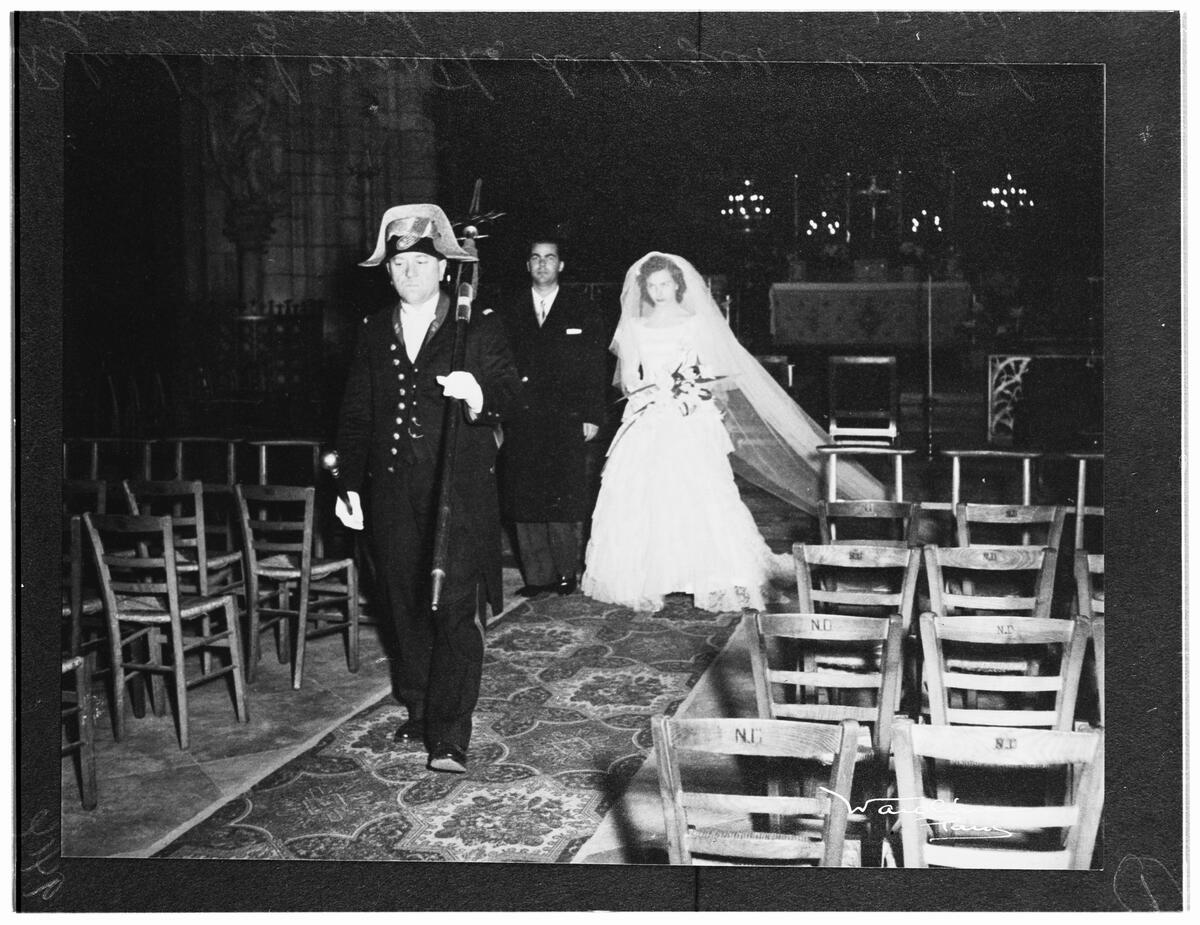
From New York, the newlyweds and Mrs. Gray boarded a plane to Paris on Nov. 19. It had been decided that a more formal wedding was appropriate, so the pair echoed their first humble ceremony with a full-on formal wedding at Notre Dame Cathedral attended by the bridegroom’s parents from Switzerland.

The bride wore a $700 wedding gown (about $8,500 today) and a 100-year-old DeVigier family heirloom necklace at the Notre Dame ceremony held on Nov. 22, Thanksgiving Day.

An Honor Guard member leads the way for newlyweds Roland and Martha DeVigier after their wedding at Notre Dame Cathedral in Paris on Nov. 22, 1951. (Credit: USC Digital Library)

Everyone returned to California on Nov. 24, and were the stars of the party at a lavish reception held for them at the Ambassador Hotel in Los Angeles.

A lengthy honeymoon was planned after that, including a trip to South America followed by visits to Italy and the DeVigier home in Switzerland. The couple also bought a 1.5-acre plot of land in Palos Verdes Estates, where they planned to build their home.

And then, it all went south. Roughly three weeks after the initial wedding, Martha DeVigier flew to San Francisco, where she filed for a legal separation on Dec. 3. Citing “extreme cruelty,” the filing asked for a $10,000 a month allowance and $75,000 to cover legal fees.

Torrance Press headline. (Credit: Torrance Historical Newspaper and Directories Archive database, Torrance Public Library)

Her husband flew to San Francisco in an attempt at reconciliation, but it didn’t happen. The couple did get back together briefly a few days later after Martha withdrew the demands in her lawsuit, but this attempt to save the marriage also didn’t last. 

On May 16, 1952, Roland DeVigier sued his estranged wife in a Riverside court for an annulment of their wedding, claiming that she had deceived him and had no intention of living up to her vows. 

DeVigier claimed that he had unknowingly entered into a “kissless marriage,” and the court agreed, granting him the annulment and bringing the matter to an end. 

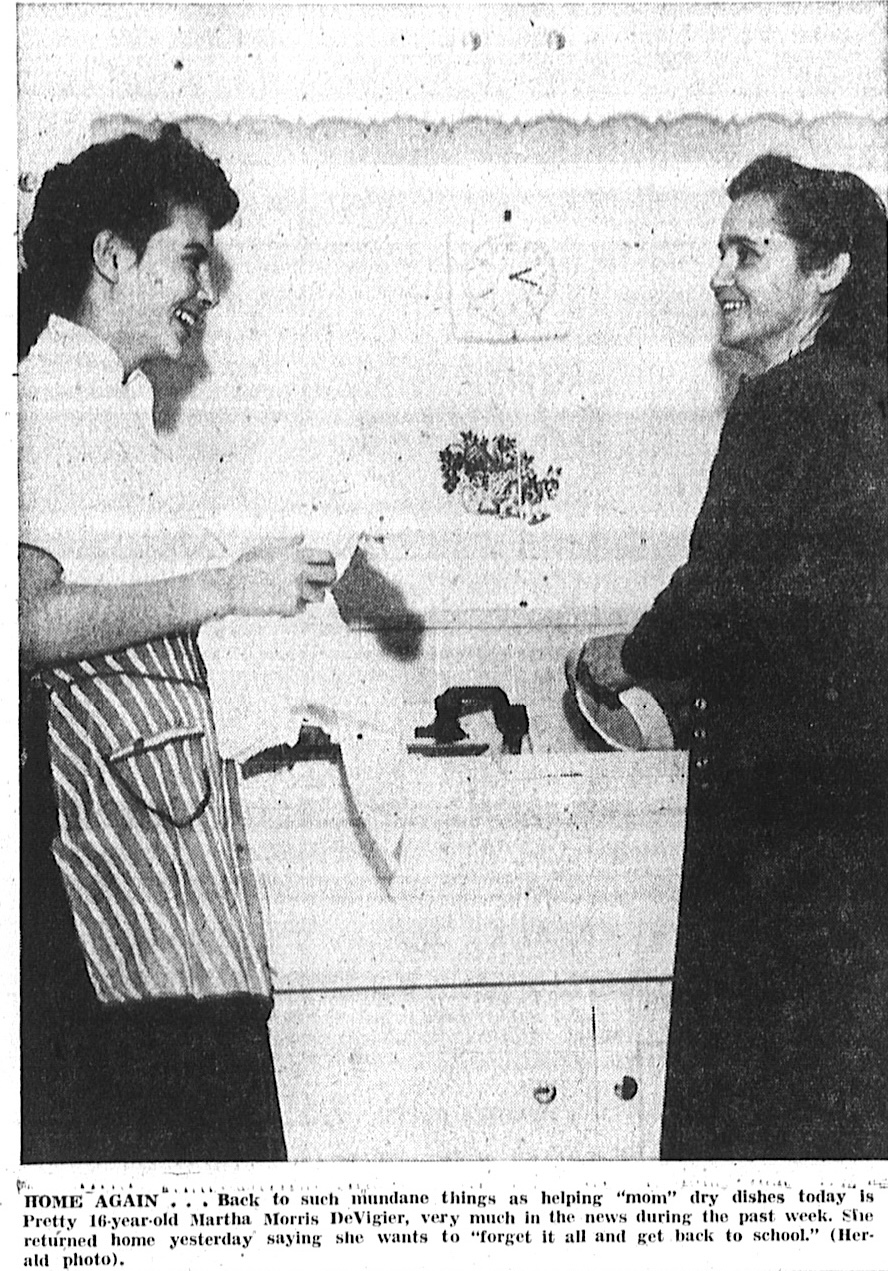
Torrance Herald, Dec. 6, 1951, Page 1. (Credit: Torrance Historical Newspaper and Directories Archive database, Torrance Public Library)

Martha’s brother-in-law Dudley Gray, who was serving as her attorney, revealed that she had moved to Oklahoma and was attending high school there to avoid publicity.

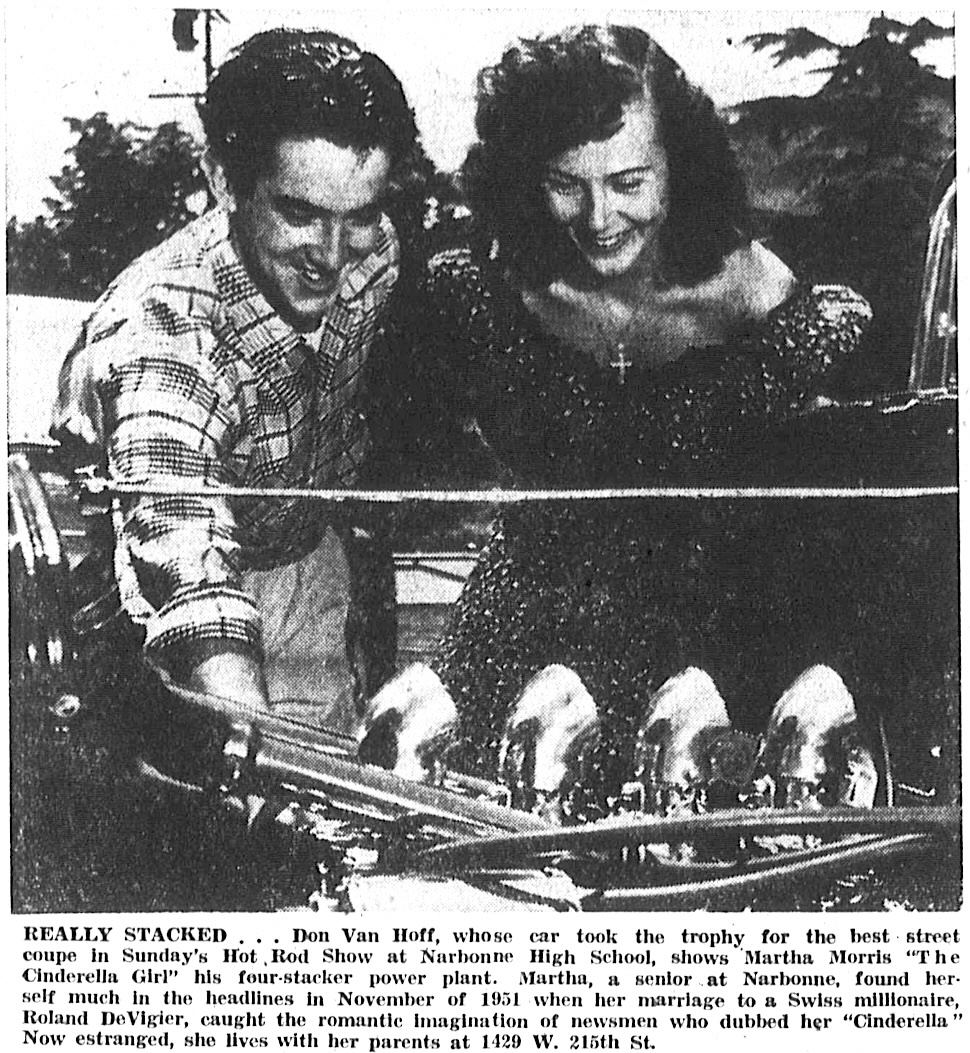
She already had received plenty of it, as the Cinderella story had been picked up and followed by newspapers nationwide.

A 1953 photo shows Martha as a Narbonne High School student. As there are no further mentions of her in the local papers, it appears that she lived up to what she told the Torrance Herald during the episode:

“I just want to go back to school and live the life I was living before all this happened.”

Torrance Herald, May 14, 1953, Page 1. (Credit: Torrance Historical Newspaper and Directories Archive database, Torrance Public Library)

Sources:

Los Angeles Times archives.

Torrance-Press Herald archives.
Is this your new site? Log in to activate admin features and dismiss this message
Log In