
Wilmington shipping magnate Phineas Banning was among the first to understand the importance of improving the Harbor Area shoreline to accommodate larger ships.
His freighters brought all manner of goods to the growing city of Los Angeles 20 miles to the north, building and construction materials chief among them. In 1869, he opened the first railroad in Los Angeles, the Los Angeles & San Pedro line, to expedite the movement of these and other goods to the “big” city, whose population at the time was just under 6,000..
Banning financed many dredging operations to help make the shallow mud flats deeper and more able to handle larger-hulled ships
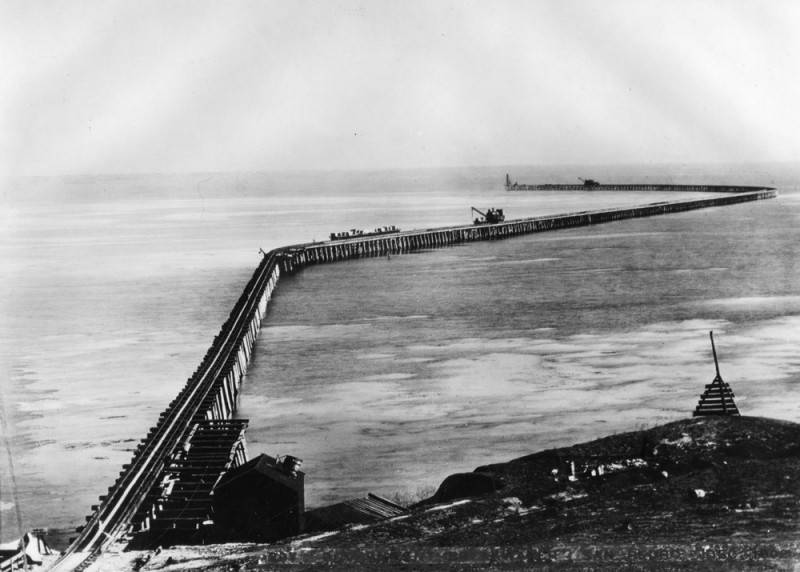
It took a while, but he finally convinced the U.S. government to finance the construction of the first breakwater parallel to the port at Wilmington in the early 1880s. He needed it to protect his ships and wharves from damage from ocean waves during storms.
The geography of the area was considerably different then, and included several sandy islands and mudflats. When finished in 1882, the 4,700-foot Wilmington breakwater stretched from Rattlesnake Island, which later would be reworked into Terminal Island, west across the water to the smaller Dead Man’s Island. The project cost $480.000.
Banning died in 1885. He had directed all his efforts to creating a harbor at Wilmington, but in the 1890s, the focus turned just west to San Pedro, a thriving settlement whose harbor was deemed to have more potential.
In the early 1890s, the debate over which port should become the official Port of Los Angeles at first centered on Santa Monica, Redondo Beach and San Pedro. Redondo’s bid was ruled out after its shoreline was found to be too unprotected from periodic violent storms.
A contentious debate followed between advocates of Santa Monica, backed by Southern Pacific railroad head Collis Huntington, and San Pedro, backed by Los Angeles Times publisher Harrison Gray Otis.
It raged for a couple of years. Finally, San Pedro was selected for the honor on March 1, 1897. Once that had been decided, the rush was on to transform its sandbars and mudflats into a first-class seaport.
The construction of a much larger breakwater, this one stretching eastward from San Pedro Point for nearly two miles (9,250 feet) to protect the harbor’s main channel, was deemed a must. It was authorized by the federal government, and ultimately would cost $3 million to build.
In order to celebrate, San Pedro staged the Free Harbor Jubilee, a giant picnic and party, for April 26-27, 1899. It kicked off on April 26th with a special telegram from President William McKinley ordering construction of the new breakwater to begin.
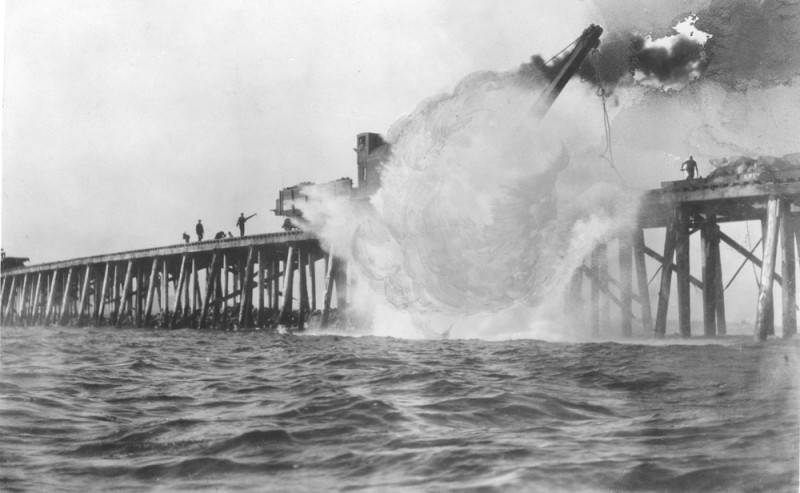
When the telegram arrived, a crane in position was signalled to drop the first load of boulders into the sea, and the project was underway. An estimated 10,000-15,000 people witnessed the event.
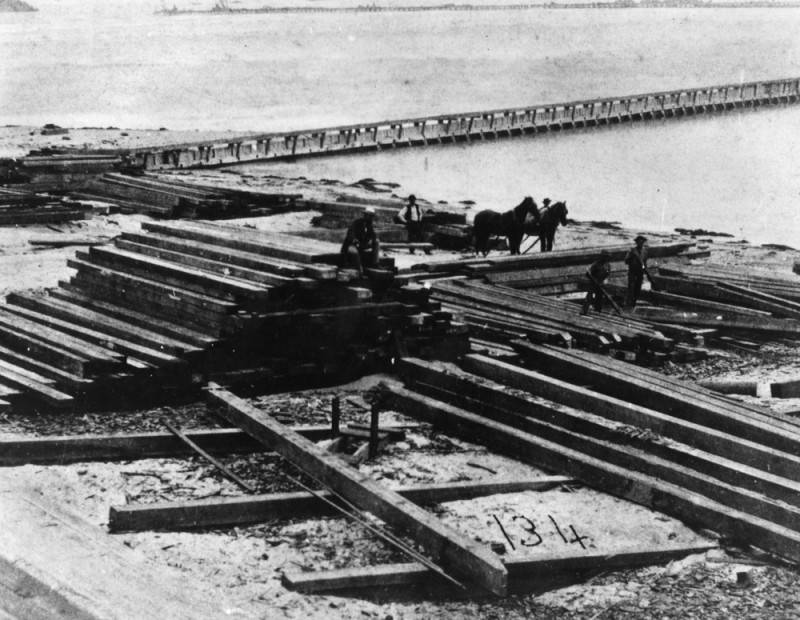
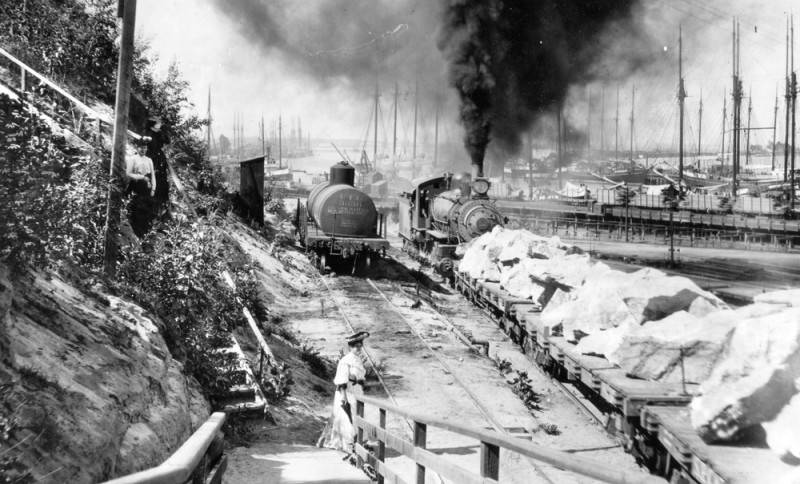
Twin railroad tracks gradually were built on a trestle extended over the water, allowing trains laden with specific boulders of varying sizes to position themselves for depositing the giant rocks in an exact pattern. A pile-driving rig was used to dig holes for support poles used to advance the trestle as sections were completed.
The U.S. Army Corps of Engineers supervised the construction. The building contract originally was awarded to the Chicago firm of Heldmaier & Neu. When that firm encountered difficulties that forced it to drop the project, the California Construction Co. took over and finished the breakwater. A third contractor, the Russell-Green-Foel Co., was hired to remove the rail trestle after the project was completed.
More than four million tons of stone was used in the breakwater’s construction. Finding the proper type of stone proved problematic. Heldmaier originally planned to use stones from quarries on Catalina and San Clemente islands, but they turned out to be unsuitable.
At first, California Construction brought in stone all the way from the Declez quarry south of Fontana, but deliveries were too slow, and the company ultimately switched to rock from a Chatsworth Park Quarry in the San Fernando Valley.
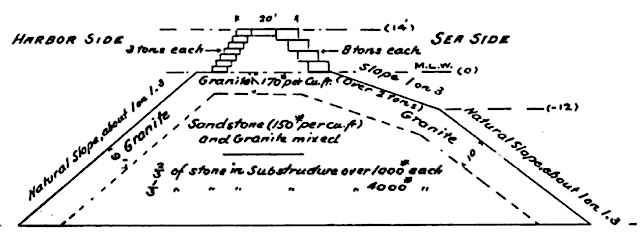
The rocks dumped into the sea by trains and cranes reached a height of 14 feet from the sea floor. They were positioned in a precise pattern for maximum stability and longevity.
The building process was declared complete on Aug. 3, 1912, when Southern Pacific train foreman George Clough dumped the final load of rock onto the breakwater.
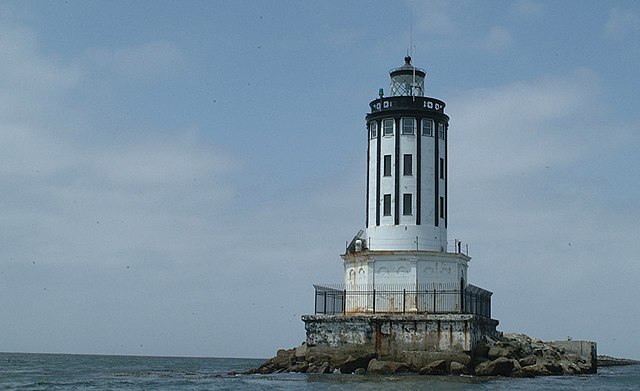
At the eastern tip of the breakwater, a platform was built for the installation of the Los Angeles Harbor Lighthouse in 1913. The 73-foot-high structure, also known as the Angels Gate Lighthouse, replaced a makeshift wooden light post, and is still in operation.
The combination of the new breakwater along with a major 1904 dredging project enabled the new port to accommodate almost all the freighters of the era. The Port of Los Angeles was on its way.
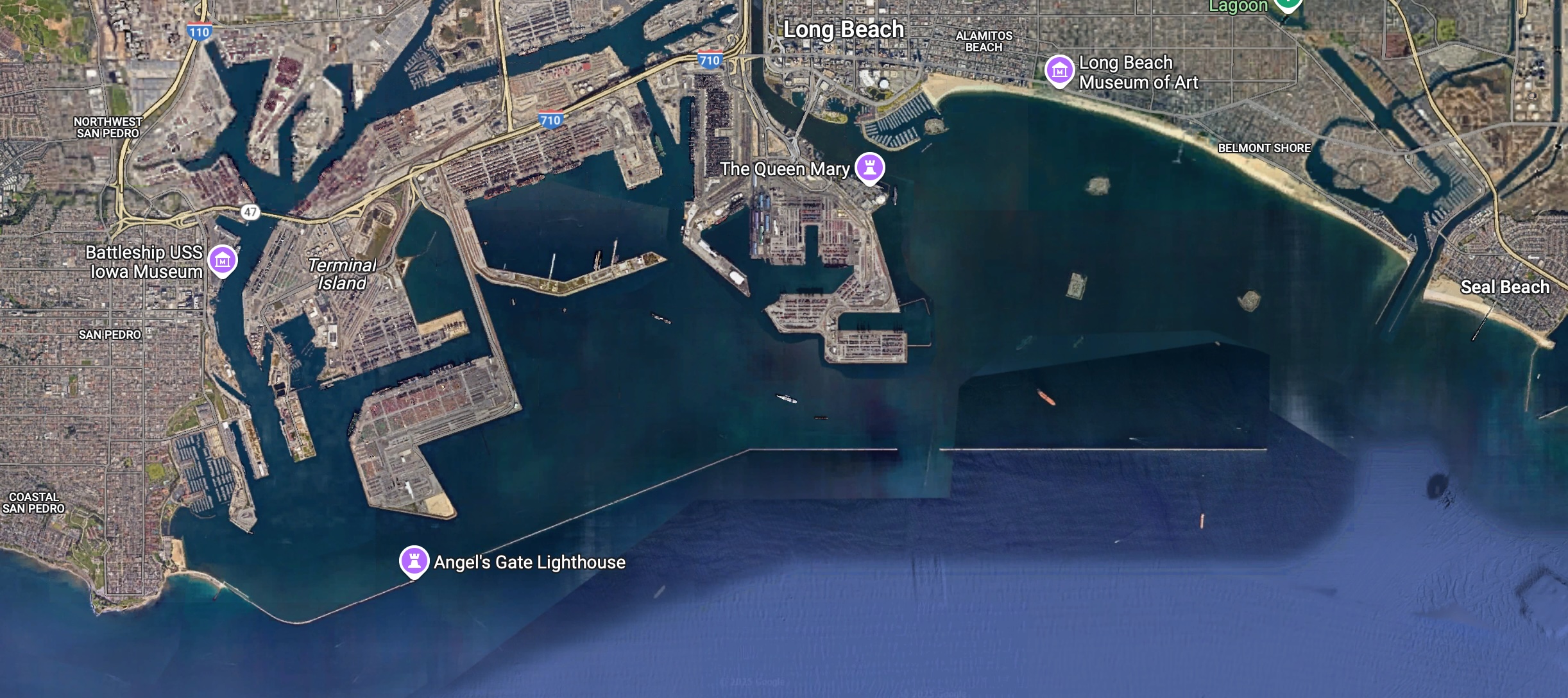
Next, attention turned to the gaps in the breakwater. For one thing, it didn’t connect to San Pedro Point on its western end. In 1912, that gap was filled. The middle segment of the breakwater was built during the 1930s, and the final 2.5-mile eastern segment extending nearly to Seal Beach was built from 1941-49.
After that, the only gaps that remained were those left deliberately to allow for the passage of ships into the harbor channels.
Sources:
Los Angeles Herald archives.
Los Angeles Times archives.
Port of Los Angeles: An Illustrated History From 1850 to 1945, by Ernest Marquez and Veronica De Turenne, Angel City Press, 2007.
San Pedro: A Pictorial History, by Henry Silka, San Pedro Bay Historical Society, 1984.
San Pedro News Pilot archives.
Wikipedia.


