1960s garage band icon Dick Dodd of the Standells grew up in the beach cities

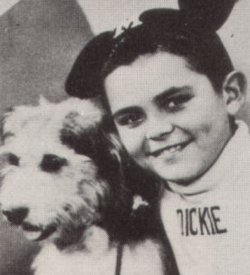
“Mickey Mouse Club” publicity photo circa 1955.

You’d never mistake Dick Dodd for a former member of “The Mickey Mouse Club” after hearing his snarling vocal on the 1966 smash “Dirty Water” by The Standells. Though many child actors who wore the mouse ears did go on to later stardom in one form or another, few had later careers as starkly contrasting as Dodd’s.

Joseph Richard Dodd Jr. was born in Hermosa Beach on Oct. 27, 1945. His father, who served in the U.S. Army, abandoned his mother, Florinda Murillo, and the family a few months after Dodd was born.

Florinda moved the family to Redondo Beach, and supported them by taking a job as a store clerk. Dick’s grandmother looked after him while Florinda worked, and he grew up speaking Spanish as well as English.

He also took dancing lessons in a Redondo studio as a young boy, where a Disney talent scout spotted him and thought he would be worth auditioning as a potential Mouseketeer. After a mass audition with 300 children at the Burbank film studio, he was among those called back for further interviews.
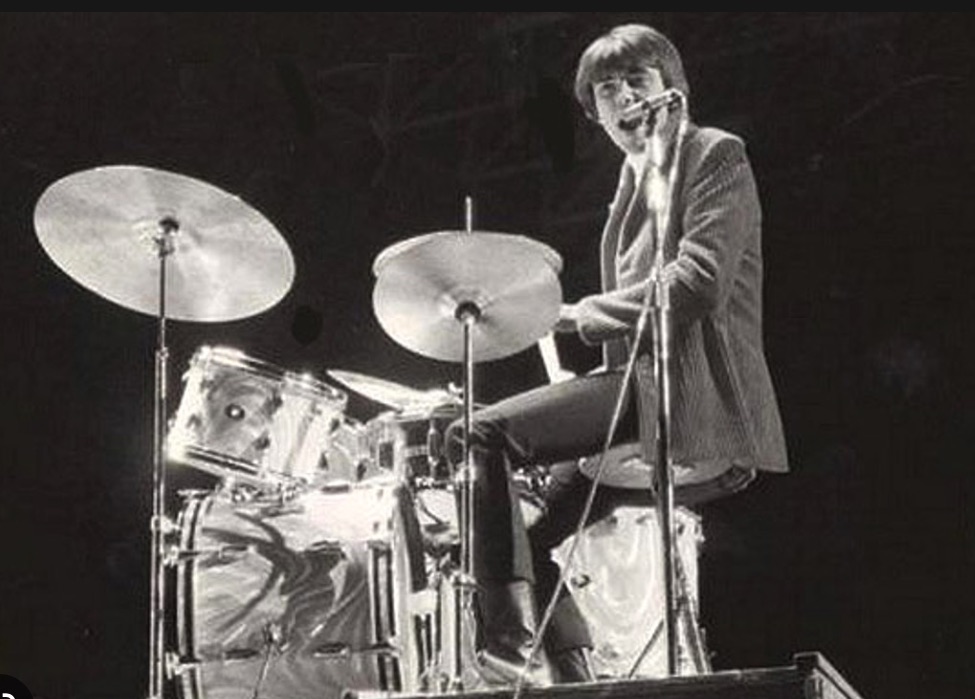
Drummer Dick Dodd sings onstage with the Standells. Undated photo, circa 1966. (Credit: Ultimate Classic Rock website)

He wasn’t selected as one of the original Mousketeers, but he was hired. Before long, he was  pressed into service when Mickey Rooney’s sons Tim and Mickey Jr. left the show during its first season in 1955.

Now nine years old, Dodd appeared in the “MMC” cast in secondary roles for about six months, until early 1956. His character name became “Dickie.” (He was no relation to chief Mouseketeer Jimmie Dodd.)

During downtime on the set, he learned some rudimentary drumming skills from fellow Mouseketeer Cubby O’Brien, who would later become a professional session drummer. Inspired, Dodd bought a snare drum and high-hat cymbals from fellow Mouseketeer Annette Funicello for twenty dollars so he could continue to practice.

After leaving “The Mickey Mouse Club,” he picked up more child acting gigs, including a yearlong stint on “The Gisele McKenzie Show” on NBC at age 11. 
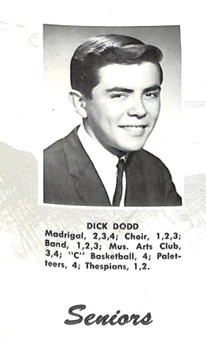
Senior photo from the 1963 RUHS yearbook, The Pilot.

He kept up with his drumming after entering Redondo Union High School. He met up with legendary South Bay surf guitarists Paul Johnson and Eddie Bertrand while there, joining their band, the Belairs, after the group released its local hit, “Mr. Moto.”

The Belairs played all over the South Bay, including many gigs at Club Bel Air (later the Revelaire Club) at 312 S. Catalina Ave. in Redondo. When Bertrand left to form his own band, Eddie & the Showmen, Dodd went with him as the group’s original drummer.

During this period, Dodd still took the occasional acting role, including appearing with Ann-Margret in the hit film, “Bye Bye Birdie.”

Dodd hit the jackpot with his next musical gig. After graduating from RUHS in 1963, he kicked around Hollywood for a time. In early 1964, he discovered that a local band, The Standells, needed a drummer quickly to replace the departing Gary Leeds for an upcoming residency at the Santa Monica Blvd. nightclub P.J.s. (Leeds would go on to fame with the Walker Bros.)

The Standells had been formed by Larry Tamblyn (brother of actor Russ Tamblyn) along with Tony Valentino in 1962. Tamblyn had issued solo records before forming the group, which was about to record its first album for Liberty Records.
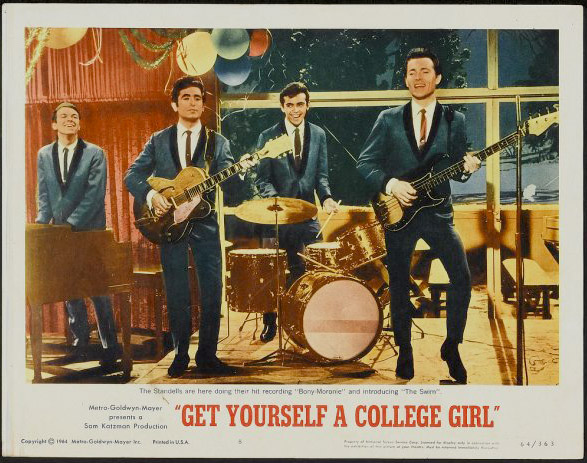
“Get Yourself a College Girl” was filmed long before the band’s hit, “Dirty Water,” was recorded. Dodd on drums, center.

Dodd turned out to be a good fit. The gig brought the band greater renown, and Dodd ended up singing lead on one song, “Help Yourself,” on the Liberty album, “In Person at P.J.’s.” It became a minor hit, earning the band its first appearance on Dick Clark’s “American Bandstand.”

From there, the Standells became well-known enough to appear on several TV shows, including “Ben Casey,” “The Bing Crosby Show” and, most famously, “The Munsters.” The band also appeared in the teen musical “Get Yourself a College Girl.”
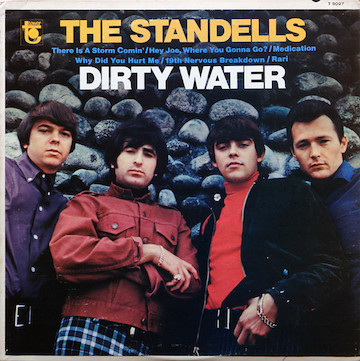
The band’s first album on Tower contained the hit “Dirty Water,” and, much like the song itself, would become a 1960s garage band classic. From left, Larry Tamblyn, Tony Valentino, Dick Dodd, Gary Lane.

The band’s increasing visibility came to the attention of Capitol Records, who signed the group to its Tower subsidiary in late 1965 on the recommendation of former Four Preps member Ed Cobb, now a producer. Cobb especially wanted the band to record his recently written ode to the city of Boston, “Dirty Water.”

Dodd had become the group’s lead singer by this time, and his brash, over-the-top vocal propelled by the band’s intense backing made “Dirty Water” a sensation. “It was just this raw, unfinished style,” Dodd told The Dallas Morning News about the song in 1998. “We had no idea it would become our sound.”

The record soared to #11 on the Billboard charts in June 1966, leading to a nationwide tour with the red-hot Rolling Stones. The band also made appearances on all the major teen music shows of the day, including “Shindig,” “Shebang,” “Where the Action Is” and many others.
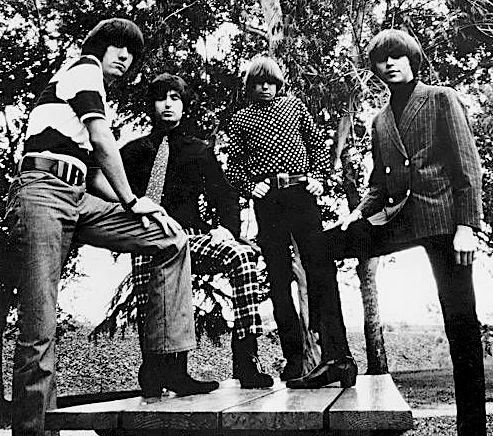
Publicity photo circa 1967. From left, Dave Burke, Tony Valentino, Larry Tamblyn, Dick Dodd.

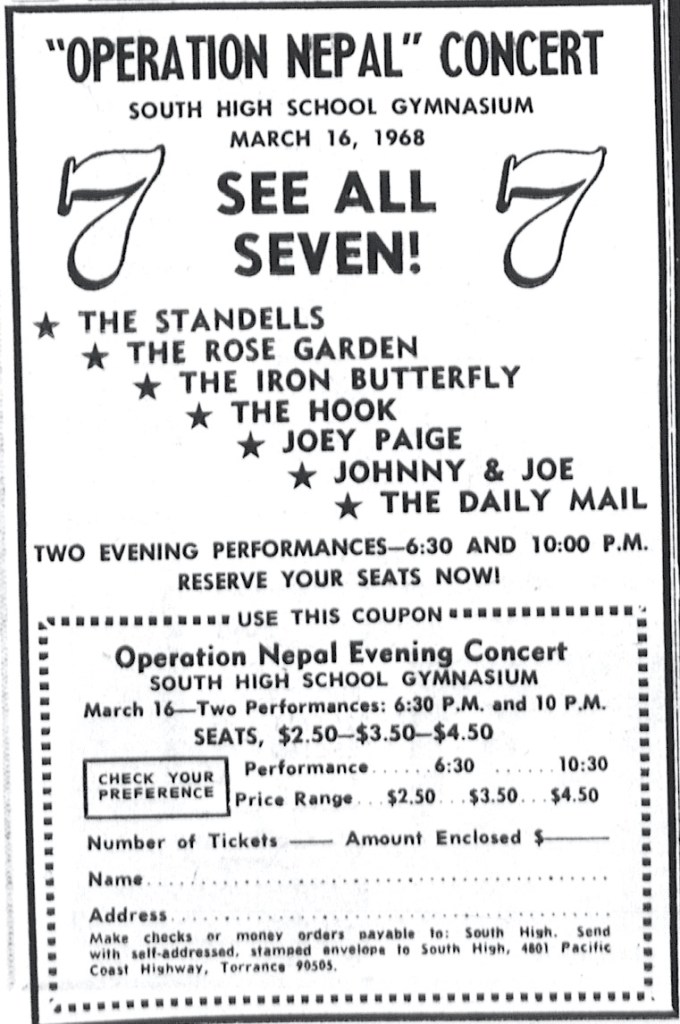
Even with its success, the band still played many local dates, including concerts at the (pre-mall) Bullock’s Fashion Square and at South High in Torrance, and at Dodd’s alma mater Redondo Union High.

The band followed with several lesser hits, including “Sometimes Good Guys Don’t Wear White,” “Why Pick On Me,” and “Try It,” and released three more albums for Tower. Its involvement in the Sunset Strip teen riots exploitation film, “Riot on Sunset Strip,” included the wild title track, one of the band’s best.

Internal tensions eventually fractured the band. Cobb convinced Dodd to leave and go solo, but his “Evolution of Dick Dodd” album on Tower had little commercial success. The band soldiered on for a while longer before breaking up.
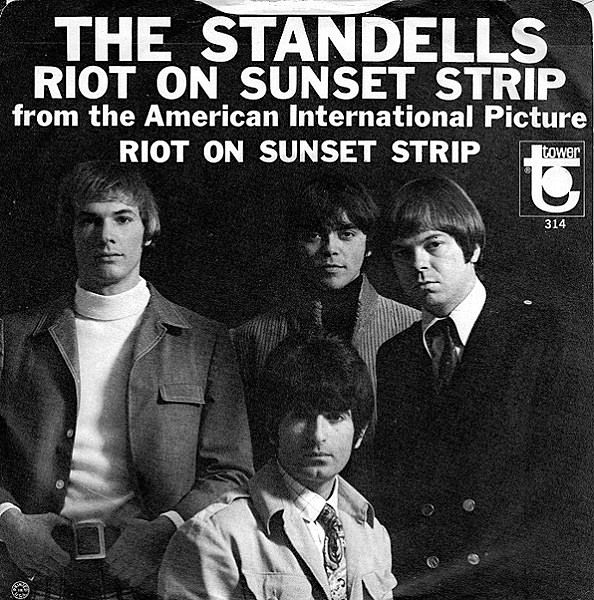
U.S. picture sleeve for the “Riot on Sunset Strip” 45 from the film of the same name. Dodd is at rear center.

Dodd left the music business except for occasional reunion shows. The raucous, powerful sound of the Standells at their peak had influenced a whole generation of punk rockers and garage band revivalists who wanted to see them perform again.

Dodd settled in Fountain Valley in Orange County, where he died at 68 on Nov. 29, 2013, following a bout with cancer. Like those of his mother, Florinda Murillo, who died at 82 in 2006, Dodd’s remains are kept at Pacific Crest Cemetery in Redondo Beach.

Special thanks: Douglas Thompson, Redondo Beach Public Library.
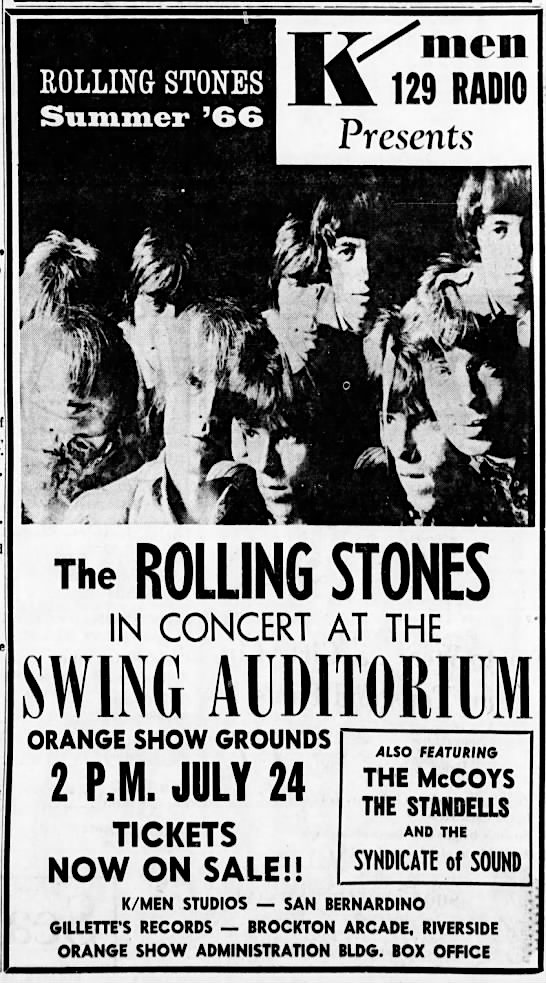
This ad appeared in the San Bernardino Sun on July 20, 1966. Tickets were $4 and $5. In addition to the Standells, the show featured the McCoys (“Hang On Sloopy”) and the Syndicate of Sound (“Little Girl.”)

Sources:

Daily Breeze archives.

Dallas Morning News archives.

“Dickie Dodd,” The Original Mickey Mouse Club Show website.

Find a Grave website.

Palos Verdes Peninsula News archives.

Redondo Reflex archives.

San Bernardino Sun archives.

“The Standells,” Garage Hangover website, Sept. 5, 2010.

“The Standells: Banned in the USA!”, by Devorah Ostrov, Tales From a Former Fanzine Journalist blog, Jan. 31, 2017.

Torrance Press Herald archives.

Note: Standells founding member Larry Tamblyn has just released From Squeaky Clean to Dirty Water: My Life With Sixties Garage Rock Trailblazers The Standells (BearManor Media, 2022), which covers the band’s entire history in much greater detail.
This “Mike Douglas Show” appearance from 1966 begins with a live version of “Dirty Water.”
The Standells headlined a special Nepal benefit concert at South High in Torrance in 1968. Torrance Herald, March 6, 1968, Page A-3. (Credit: Torrance Historical Newspaper and Directories Archive database, Torrance Public Library)

Works Progress Administration infrastructure work remains part of the South Bay landscape

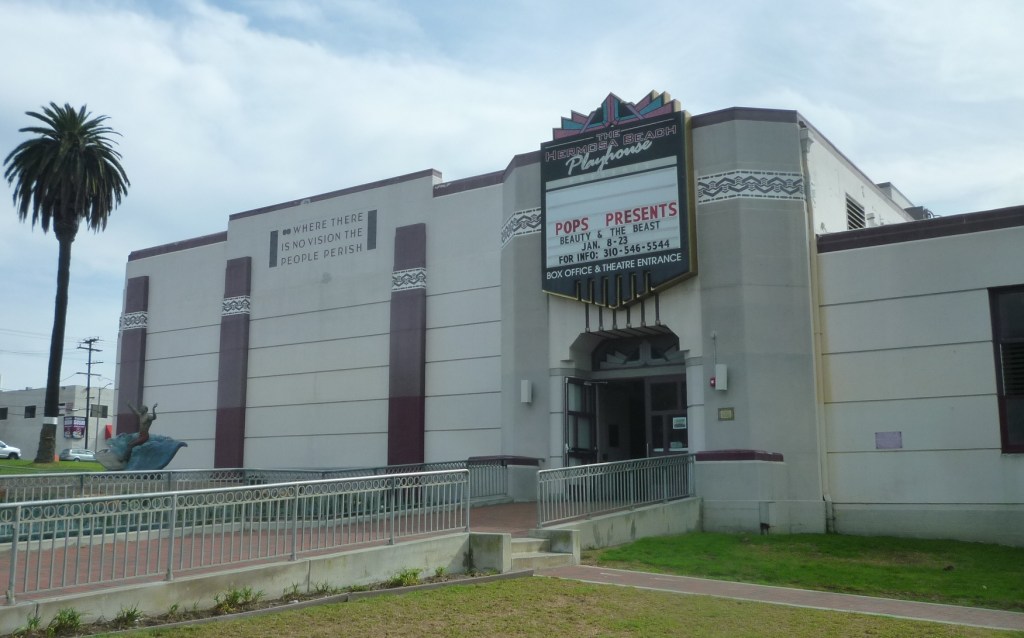
The Hermosa Beach Community Center once was Pier Avenue Elementary School, built by the WPA. (Jan. 2016 Daily Breeze photo)

Infrastructure has become quite the buzzword in Washington, DC in the last few years. 

The movement toward a major government initiative to rebuild roads, bridges and other public structures finally resulted in the passage of the $1.2 trillion Infrastructure and Investment Jobs Act, which President Biden signed into law a year ago in November 2021.

Wide-ranging federal projects of this scale haven’t been that common in U.S. history with perhaps only the interstate highway system of the 1950s being the most recent example.

An earlier, more wide-ranging infrastructure effort began during the 1930s under President Franklin D. Roosevelt’s New Deal program with the establishment of the Public Works Administration (PWA) in 1933 and the Works Progress Administration (WPA) in 1935.

The PWA tackled large projects such as bridges, dams, streets and highways.Today we’re  concentrating on the smaller-scale, local-level structures that were the WPA’s specialty.

The WPA financed many different types of programs, all with a similar aim: to put people to work during the Depression on projects that would improve their quality of life while attempting to rebuild the nation’s economy. These included programs in the arts as well as building projects, and often combined the two.

The program had its detractors, but also had a major impact in cities and towns large and small throughout the country. Many of the buildings constructed under its auspices still stand in the South Bay and Harbor Area, and the following list covers some of the major ones still in use. The list also includes major artworks commissioned by the Federal Arts Project under the WPA.

Airports:

Hawthorne Municipal Airport (12101 Crenshaw Boulevard), 1939. Originaly known as  Jack Northrop Field, its name was changed in 1948 to Hawthorne Municipal Airport.

Schools:

Daniel Freeman Elementary School, (2602 W. 79th St., Inglewood), 1939. Name changed to Warren Lane Elementary School in 2013 when the two schools were combined.

Grandview Elementary School (455 25th St., Manhattan Beach.) Still a functioning elementary school.

Pier Avenue Elementary (710 Pier Ave., Hermosa Beach). Completely rebuilt by the WPA in 1935-36 to repair earthquake damage, it has served as the Hermosa Beach Community Center since 1978. The horror film “Carrie” famously was filmed there in 1975.

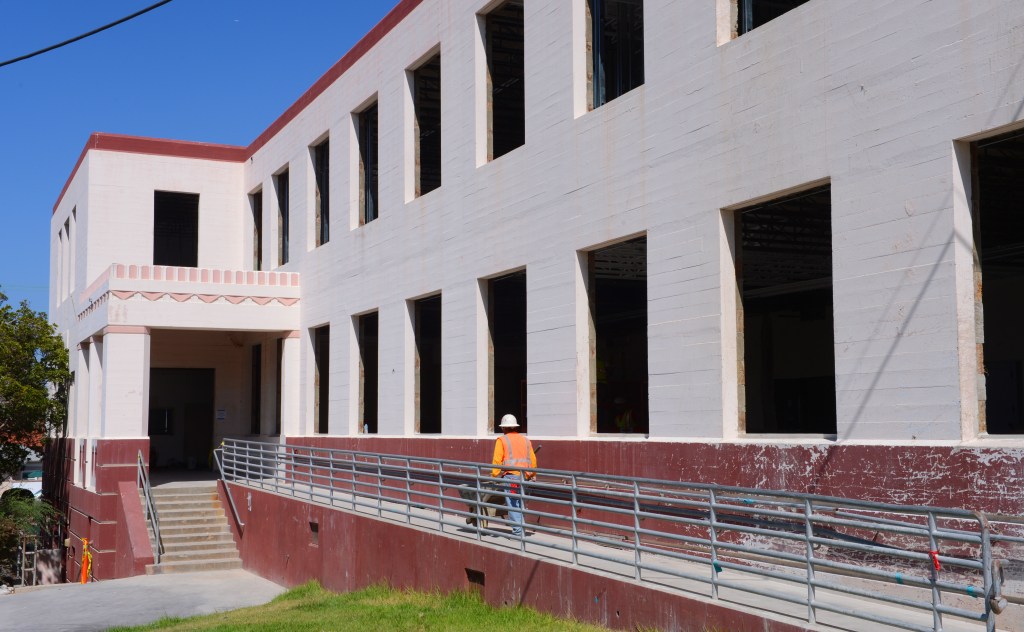
A workman pushes a wheelbarrow at the Redondo Union High School science building built by the WPA in 1939 during its refurbishment in 2013. (Daily Breeze staff file photo by Brad Graverson)

Redondo Union High School Science Building (631 Vincent Park, Redondo Beach), 1939. Still in use with alterations and updates.

Robert E. Peary Middle School (1415 Gardena Blvd., Gardena), which operated as Gardena High School until 1956. Earthquake-damaged buildings repaired and replaced, 1936. Still in use.

Post office artworks

The Gardena Post Office (1103 W. Gardena Blvd.), Inglewood Post Office (300 E. Hillcrest Blvd.) and San Pedro Post Office (839 S. Beacon St.) all contain major artworks installed under the WPA’s Federal Arts Project.

Libraries

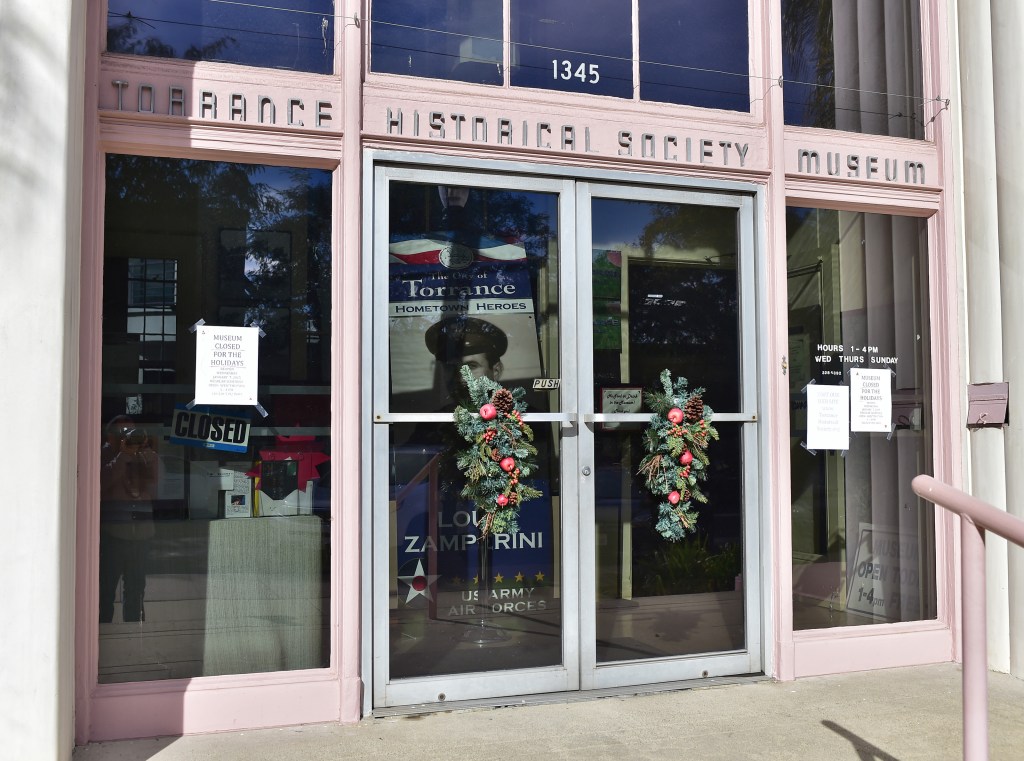
Torrance Public Library (1345 Post Ave.), 1936. The original building now houses the Torrance HIstorical Society.

The Torrance Historical Society now is headquartered in the former original Torrance Public Library building constructed by the WPA in 1936. (Daily Breeze staff file photo by Robert Casillas)

Parks

Clark Stadium and Clark Building (861 Valley Drive, Hermosa Beach), 1937. Baseball field and community building.

Live Oak Park (1901 N. Valley Drive, Manhattan Beach.) Completed by the WPA in the Late 1930s.

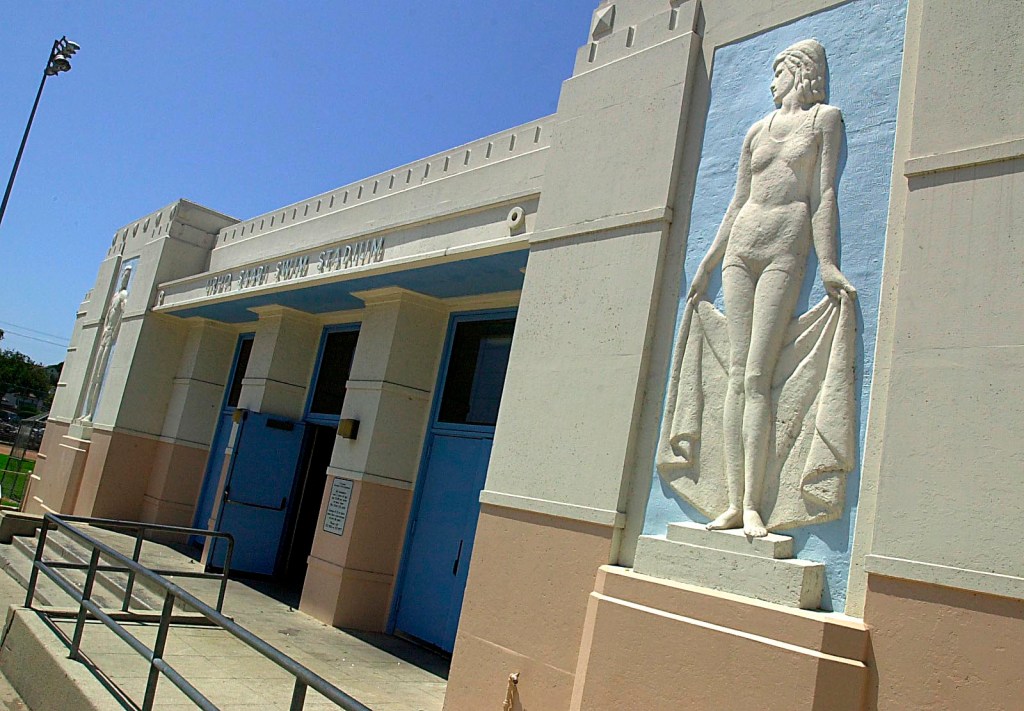
Urho Saari Swim Stadium (291 W. Mariposa Ave., El Segundo), 1940. Still in use.

Veterans Memorial Building, Ed Vincent Park (formerly Centinela Park). 1936-37. The park’s tennis courts also were built by the WPA.

Art works, freestanding

“History of Transportation,” mural by Helen Lundeberg, Grevillea Art Park (101 E. Kelso St., Inglewood), 1940. Moved from Vincent Park in 2007, the mosaic mural is 240 feet long and eight feet high.

The Veterans Memorial Building in Ed Vincent Park in Inglewood opened in 1937. July 2022 photo. (Photo by Jengod, via Wikimedia Commons)

Sources:

Daily Breeze archives.

“History of Transportation,” Inglewood, CA Public Art website.

The Living New Deal website.

Los Angeles Times archives.

San Pedro News Pilot archives.

Torrance Press Herald archives.

Wikipedia.

The Urho Saari Swim Stadium in El Segundo was built by the WPA in 1940 and is still in use. (2002 Daily Breeze staff file photo by Robert Casillas)

Torrance scaled back its once-grandiose plans for a veterans memorial

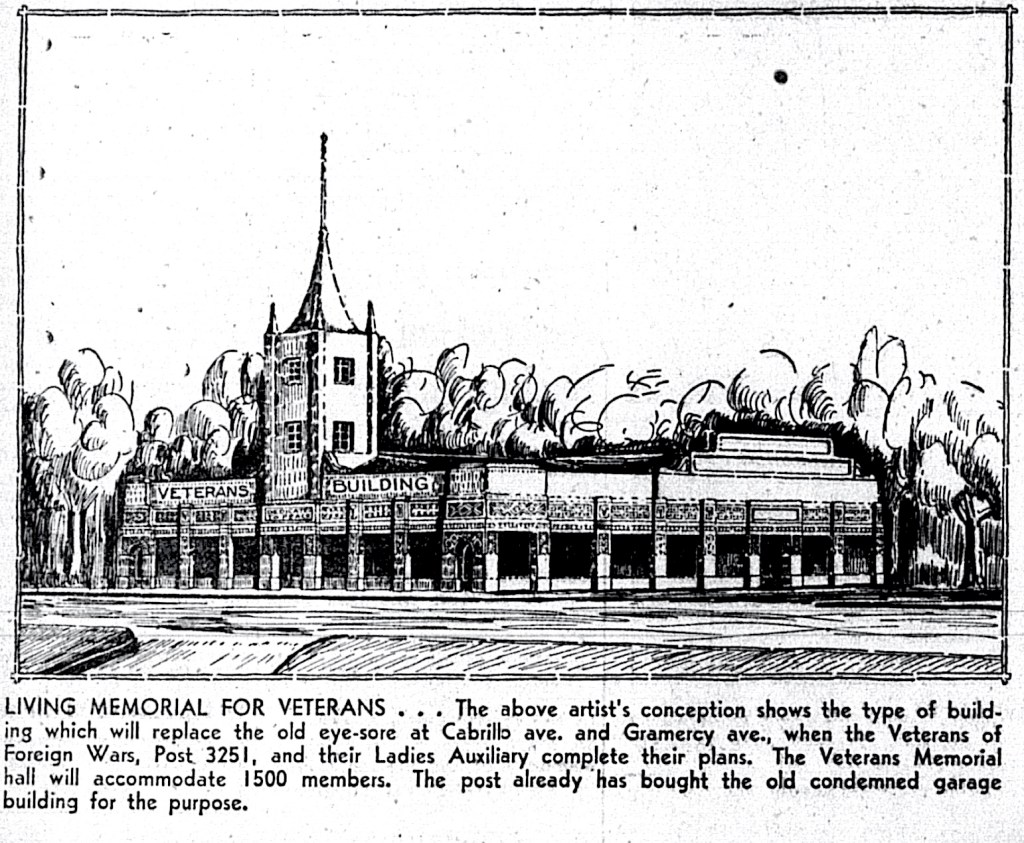
From Torrance Herald ad, July 19, 1945, Page C-2. (Credit: Torrance Historical Newspaper and Directories Archive database, Torrance Public Library)

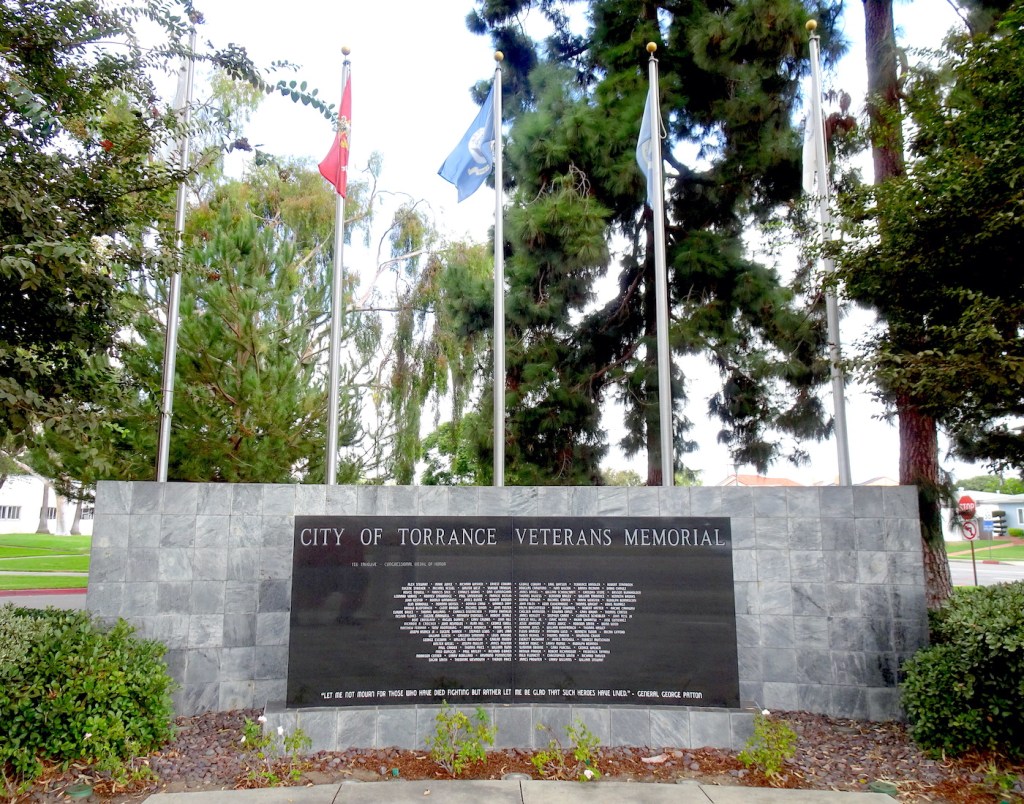
Near the Torrance City Hall building at Torrance Blvd. and Maple Ave. stands the city’s elegant veterans memorial, which calls the roll of residents who lost their lives in defense of our country.

In the years following World War II, though, a far more elaborate veterans memorial nearly became a reality.

The idea to create a $200,000 veterans memorial auditorium with meeting rooms, a gymnasium, a swimming pool, a full kitchen, a rooftop garden with badminton and shuffleboard courts and more first surfaced at a city council meeting in December 1944.

Chamber of Commerce president Harry B. Lewis presented the proposal to the council. The building would have many uses. In addition to meeting places for various veterans groups, the Boy Scouts and other community groups would use the structure. 

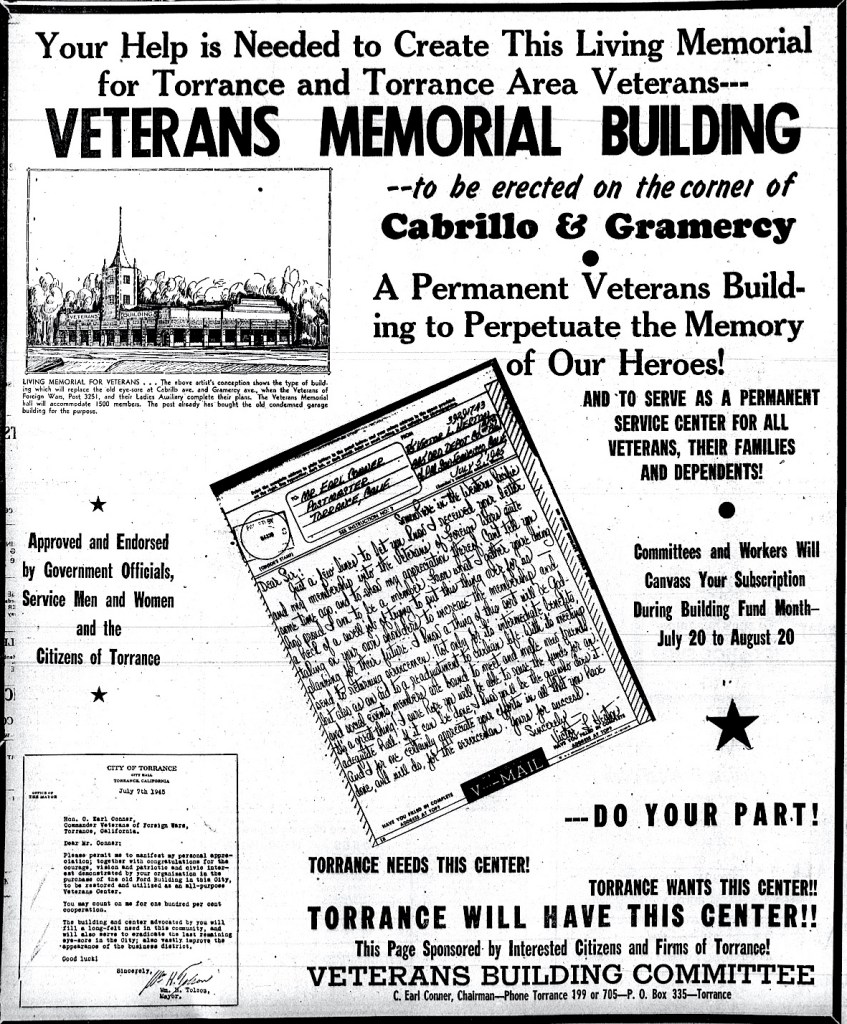
Torrance Herald fundraising ad, July 19, 1945, Page C-2. (Credit: Torrance Historical Newspaper and Directories Archive database, Torrance Public Library)

Admission would be charged to the general public to use its swimming pool, gym, and other facilities to help finance the project, to be built on three city lots near El Prado and Cravens avenues in downtown Torrance.

The council chose not to go with the fanciful and expensive plan, but the seed had been planted. One of the veterans groups involved, Torrance Veterans of Foreign Wars (VFW) Post 3251, took the idea and revamped it.

Torrance Herald, Feb. 10, 1949, Page 1. (Credit: Torrance Historical Newspaper and Directories Archive database, Torrance Public Library)

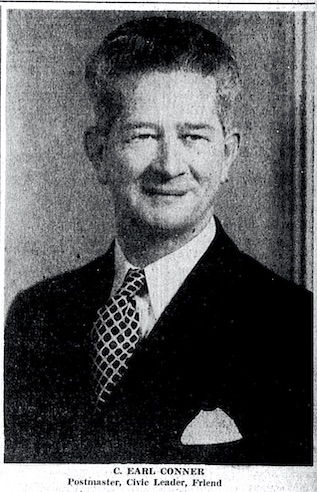
Its commander, C. Earl Conner, got behind the planned veterans center in a big way. The World War I veteran had become highly influential in the community. Conner won election to the City Council in 1926, and, in 1933, defeated the controversial William Klusman to become mayor.

Conner’s mayoral tenure lasted only until February 1934, when he resigned the post in order to accept a federal appointment as the city’s new postmaster. As we noted in a 2015 post, he served in that position until 1949.

He became the driving force behind the movement to get the veterans memorial built. Instead of a whole new building, the VFW plan called for a makeover of the former Torrance Ford dealership location at 1606 Cabrillo Ave., near Gramercy Ave.

The garage building on the site had become a dilapidated eyesore since the car dealership suffered damage during the 1941 earthquake and was forced to close.

In early 1945, the VFW paid $12,000 for the site, and began an intensive fundraising drive to cover the cost of remaking into a veterans center that could serve the post’s 1,500 members and other community groups. The group set a goal of $20,000 in contributions from businesses, individuals and organizations.

That October, members of the group even began some preliminary work on the old building they hoped to revamp. The fundraising effort had enthusiasm behind it, with regular optimistic progress reports appearing in the Torrance Herald, whose publisher, Grover Whyte, was a strong supporter of the project.

It’s hard to pinpoint just where the campaign faltered. The last news reported about the project came in April 1946, when the VFW purchased a two-story metal building from the California Shipbuilding Co. on Terminal Island that it planned to move to the Torrance site and reshape into the veterans center.

A year later, in May 1947, the Torrance Herald reported that the lot once proposed to be developed on Cabrillo had been resold, and the Chamber of Commerce was calling for the city to remove the unsightly brick walls and other remaining structures on it. The dream had died.

Any remaining momentum to build the center probably vanished with the death of its most active supporter. Torrance postmaster Earl Conner died suddenly of a heart attack on Feb. 3, 1949. His wife, Clara, took over the job for him, and she served as postmaster until 1965.

Torrance Press, Aug. 16, 1956, Page 24. (Credit: Torrance Historical Newspaper and Directories Archive database, Torrance Public Library)
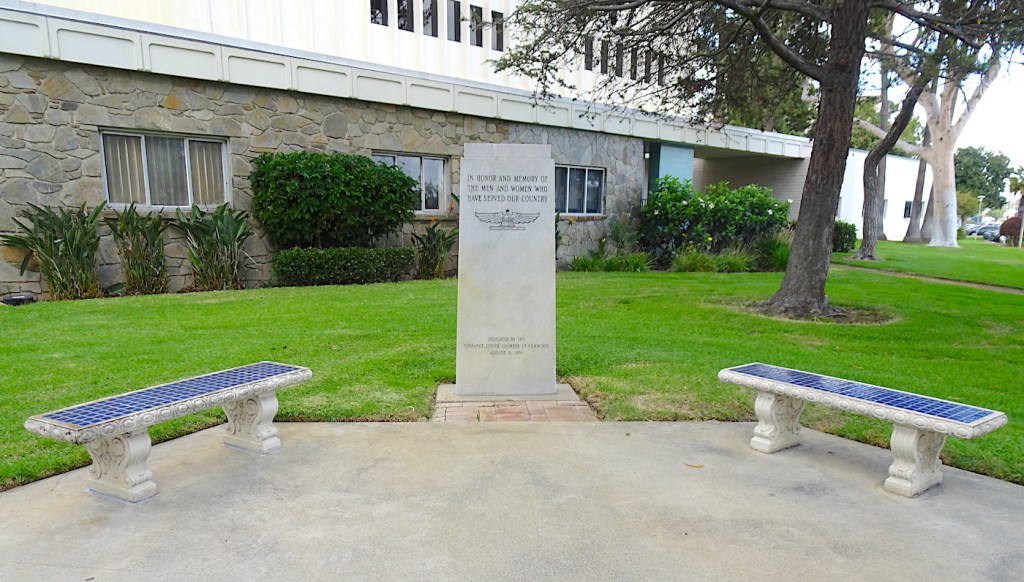
The Junior Chamber of Commerce memorial near Torrance City Hall in November 2022. (Photo by Sam Gnerre)

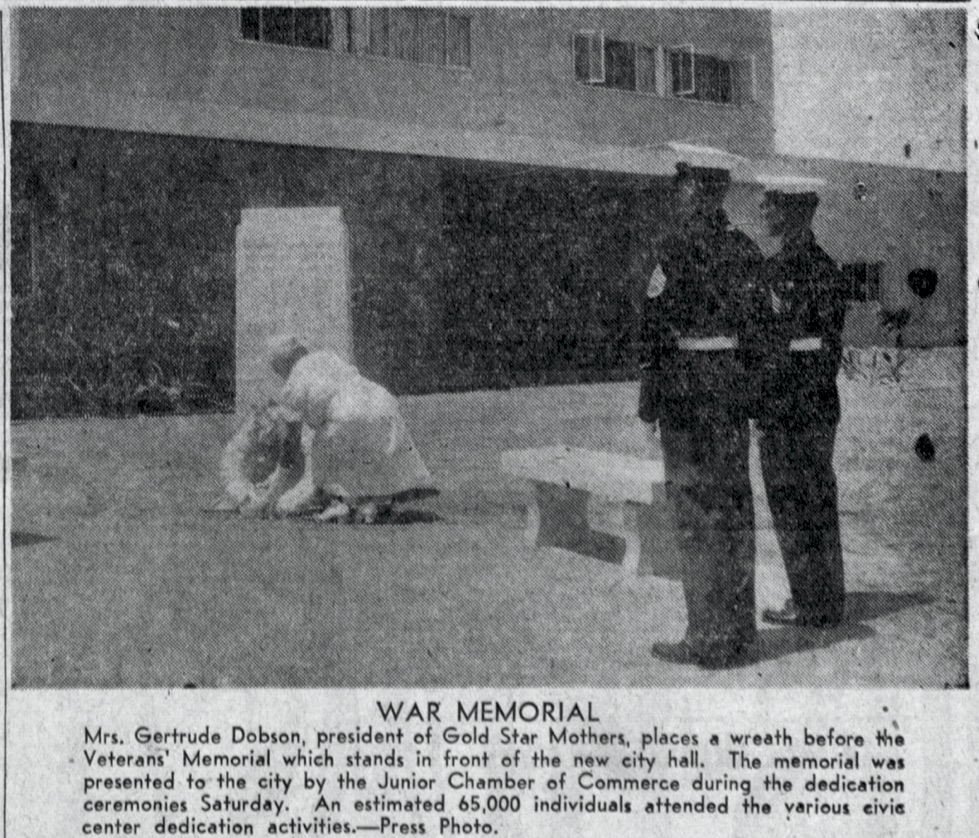
The Torrance Junior Chamber of Commerce managed to get a small memorial built near the new City Hall building when it opened in 1956, but the plans to commemorate veterans with a grand gesture along the lines of the auditorium at Veterans Memorial Park in Culver City or Long Beach’s Veteran’s Stadium never happened.

In the late 1990s, another drive began to build a larger outdoor memorial to the city’s veterans. In 2001, California Assemblyman George Nakano, D-Torrance,  secured a $100,000 state grant for the project and the city put up $5,000. The total cost for the memorial had been put at about $200,000.

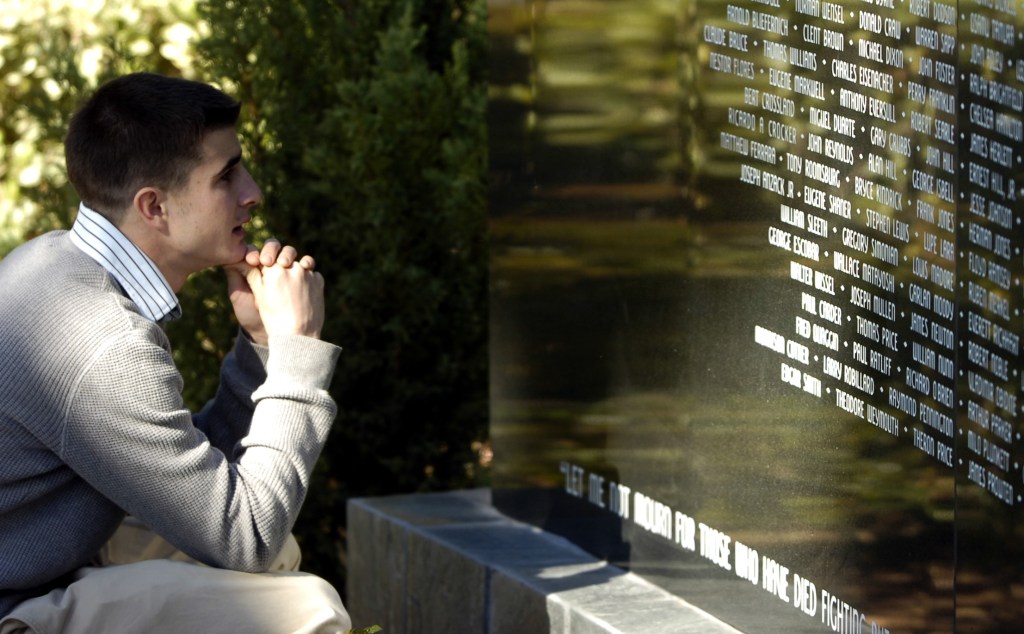
Army Capt. Matthew Ferrara’s name was engraved on the Torrance Veterans Memorial wall on Dec. 27, 2007. Ferrara, a 2001 South High graduate, was killed while on patrol in Afghanistan. Andy Ferrara pauses to look at his brother’s name on the wall. (Daily Breeze staff file photo by Scott Varley)

The memorial would have all the names of those who died etched in marble, much like the Vietnam War Memorial in Washington, D.C. The Sept. 11 terrorist attacks added momentum to the drive to erect the five-by-twelve foot granite monument.

The city of Torrance ended up funding the remainder of the construction costs, and the Torrance Veterans Memorial was dedicated on March 19, 2002. The project was fully completed in March 2003.

On the third Saturday of every month, members of the Vietnam Veterans of America South Bay Chapter 53 spend time maintaining the monument and its surrounding grounds as a reminder to us all of the sacrifices of the 146 persons who names are memorialized there.

The Torrance Veterans Memorial is located near the corner of Maple Ave. and Torrance Blvd., east of City Hall. (November 2022 photo by Sam Gnerre)

Sources:

“Articles Related to South Bay Chapter,” Vietnam Veterans of America website.

Daily Breeze archives.

Torrance Press Herald archives.

“Veterans Memorial and Hometown Heroes,” City of Torrance website.

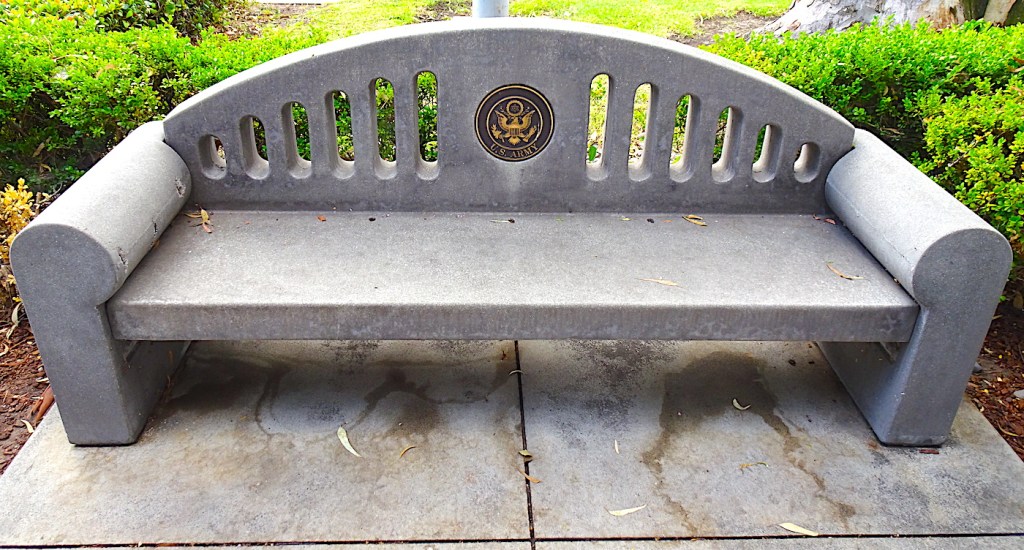
Each of the benches at the Torrance Veterans Memorial is adorned with the seal of a different branch of the military. This one has the U.S. Army seal. (November 2022 photo by Sam Gnerre)

Looking back to the days when bathing suits could bring about prosecution

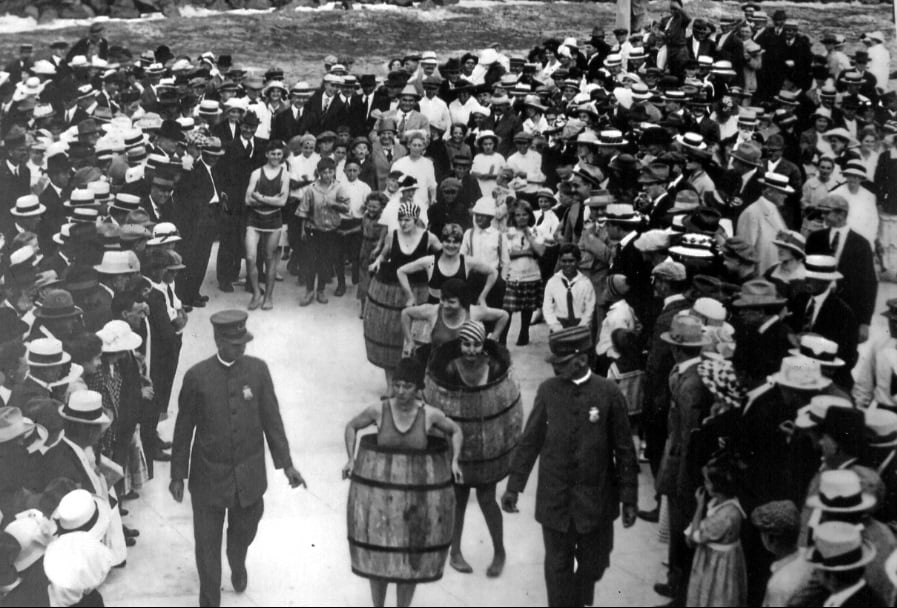
Redondo Beach police escort young women covered by barrels to prevent exposure of their bathing suits to the public in this undated photo circa 1920s. (Credit: South Bay/Los Angeles Days of Old California Facebook page)

The South Bay and Harbor Area have been blessed with beautiful beaches. But if you’d gone to one wearing even a modest modern-day swimsuit a century or more ago, you’d have been carted off to jail. Male or female.
When one sees the bathing suits being worn on beaches in photos from the late 19th and early 20th century, it’s hard to imagine that anyone clad in them actually could swim.

In fact, most beach visitors didn’t do much swimming – it was too dangerous in the full length outfits of the time. A 1920 San Pedro News Pilot editorial advocating for common sense in bathing suit regulation cited the decline in drownings in Atlantic City, New Jersey, following the introduction of less restrictive swimsuits there. They enabled many more bathers to learn how to swim, which cut down on beach fatalities.

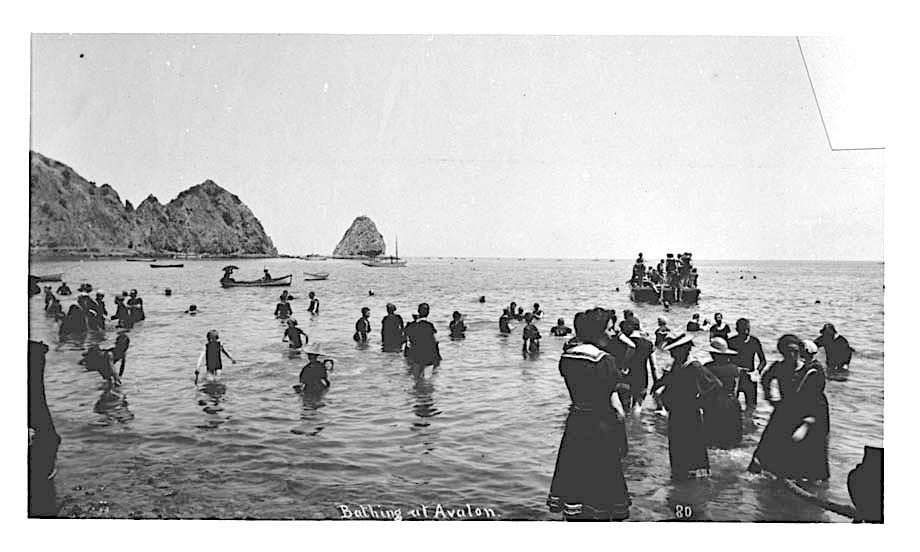
Bathers test the waters at Avalon, Santa Catalina in 1895. (Credit: California State Library)

Still, debate raged over immorality and indecency on Southern California beaches during the early 1900s. Bathers of both sexes who went too far in their attire were jailed regularly.

The popular beaches of Venice and Santa Monica seemed particularly prone to violations, probably because they were closer to Los Angeles and more easily accessible by public transportation.

As the South Bay and Harbor Area became opened up to development and tourism, first via the Red Cars and other public rail systems and later by automobile, the area’s beaches began to see larger influxes of visitors.

The debate over dress standards continued to rage during the 1920s, when social strictures grew more lax and bathing suits grew more revealing. 

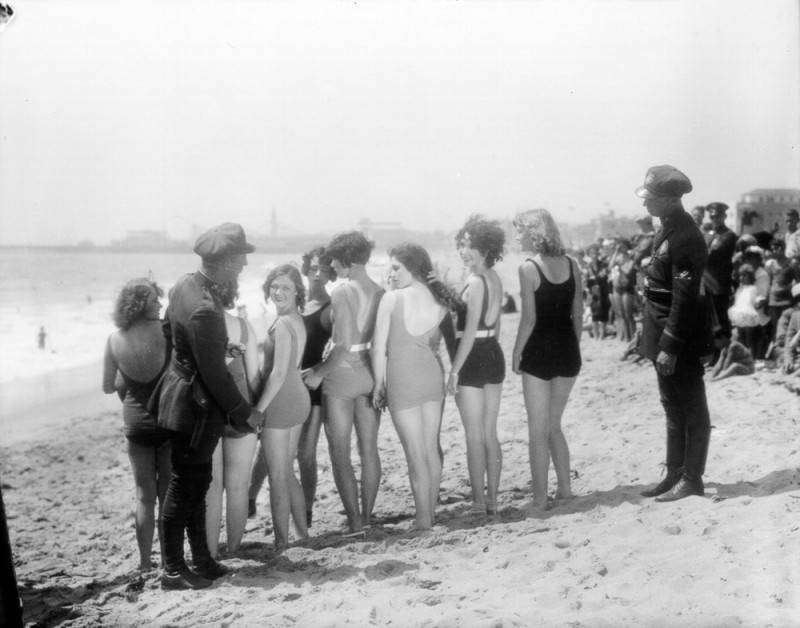
In what appears to be a publicity photo, the “beach patrol” checks women’s swimsuits for propriety at Venice Beach in 1936. Two police officers perform the inspection as a crowd looks on at right. (Credit: Los Angeles Public Library Photo Collection)

The pages of the News Pilot document several arrests for public indecency. Four males were arrested on Brighton Beach on Terminal Island for swimming sans bathing suits in 1920.

Four years later, two women spent the night at the sergeant’s desk of the San Pedro police station after being arrested for attending a party in which everyone wore only bathing suits. The station had no facilities to house women, so they eventually were moved to bunks at the Wilmington jail.
In 1926, police had to institute regular patrols of Brighton Beach on Terminal Island due to repeated complaints of bathers, mostly males, frolicking in scanty attire there.

A young woman identified as “Miss Mary Wilson” was taken into custody in Hermosa Beach in March 1929 by two police officers for wearing too scanty a suit. After everyone looked her over, including a city councilman who just happened to be in the courthouse where she was taken, she was let off with a warning not to wear her suit again, as it violated the city’s bathing suit regulations.

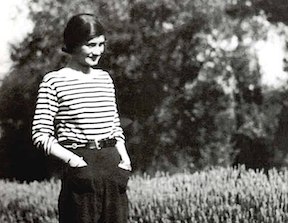
French designer Coco Chanel in 1928. (Credit: Wikimedia Commons)

The trend toward greater skin exposure also accelerated thanks to fashion icon Coco Chanel. As high society types have been known to do, she went on a Mediterranean cruise in 1923 with the Duke of Westminster. When she stepped off the boat upon her return, her richly tanned skin caused a sensation.
She wasn’t the first person ever to get a suntan on a cruise, but her status as the most iconic fashion trendsetter of her generation made the look one that fashion-conscious people wanted to emulate. And they couldn’t do that while clad in the full-body suits of their forebears.

Tanning may have become trendy, but more revealing bathing suits still faced fierce resistance from the moral standard-bearers of the era.

Santa Monica pastor Dr. Albert J. McCartney touched off a firestorm in June 1929 with his sermon entitled “Comes Again This Pageantry of Nakedness.” The Los Angeles Times quoted  him as telling churchgoers and invited local leaders this:

“The disease spreading throughout the beaches is that of the feminine mind of both sexes, which wants to attract attention and travel roughshod over all convention.”

Pushback against his comments was strong, but he also had many supporters who leaned on municipal officials for more moral regulation. Local city governments up and down the coast all had different standards with regard to regulating beach dress, as it turned out. 

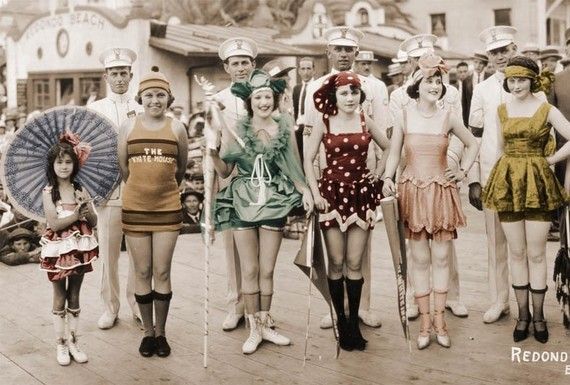
Tinted 1921 photo shows a variety of colorful bathing suits on display near the Santa Fe Depot (visible in background) in downtown Redondo Beach. (Credit: Redondo Beach Historical Museum Facebook page)

Partially sparked by McCartney’s outrage, the Los Angeles Playground and Recreation Dept. convened a summit conference of local police and city leaders in March 1930. Attendees included officials from a variety of local cities, including Manhattan, Hermosa and Redondo Beach, as well as Santa Monica and San Pedro.

In the end, the committee wisely decided to let each community set its own standards, and “the battle of the bathing suits,” as Redondo Beach Police Chief Pete Peterson described it to the LA Times, had ended.

Peterson went on to say that Redondo had two general rules concerning bathing suits at the time: 1) Men may wear trunks without uppers, and 2) Women may not.

Standards have changed drastically since the 1930s. The first bikinis began appearing after World War II, and tops for men’s suits disappeared.

Fashion designer Rudi Gernreich fomented more controversy in 1964 when he introduced the topless bathing suit for women, which he called the monokini.

Since then, bathing suits have gone through even more changes, from thongs and Speedos to board shorts and tankinis. But I think it’s safe to say that Pastor McCartney wouldn’t have approved of any of them.

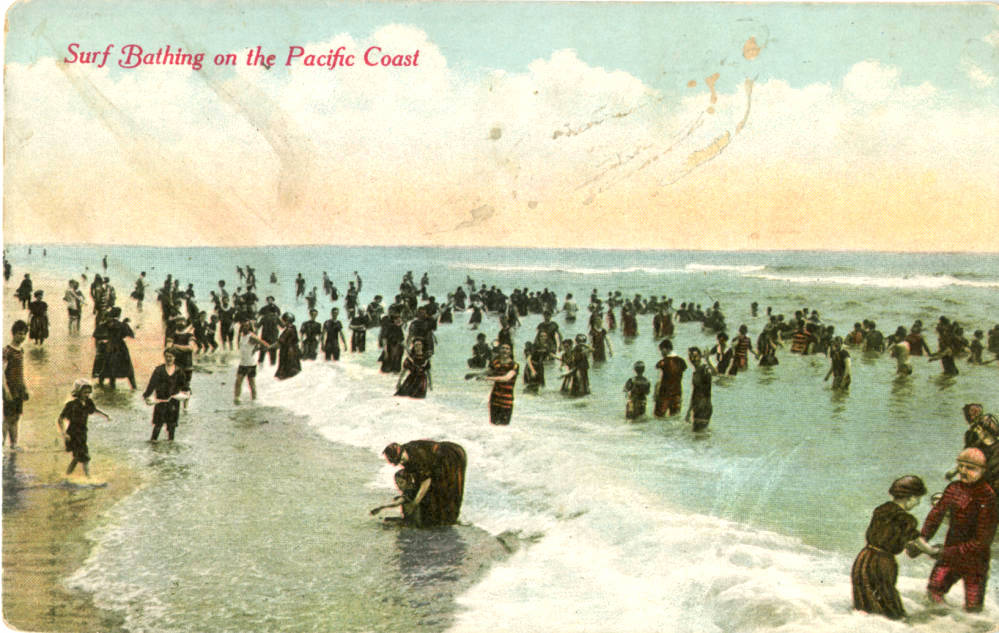
Men, women and children are seen frolicking in the surf at Redondo Beach. Most wear full garments and clothes, with only some in swimsuits. Postcard, circa 1910-15. (Credit: CSUDH Digital Archives)

Sources:

Daily Breeze archives.

Footnotes on the Sand: An Incomplete Compendium, an Arbitrary Selection of Events, Rumor, Speculation, Some Fact and Some Fiction About Hermosa Beach, by Patricia A. Gazin, self-published, 1991.

“A History of Women’s Swimwear,” by Fiona Ibbetson, Fashion History Timeline website, Sept. 24, 2020.

“If You Like Tanning, It’s All Thanks to Coco Chanel,” by Marlen Komar, it’sROSY blog, July 7, 2020.

Los Angeles Herald archives.

Los Angeles Times archives.

Old Redondo: A Pictorial History of Redondo Beach, California, by Dennis Shanahan, Legends Press, 1982.

San Pedro News Pilot archives.

A Walk Beside the Sea: A History of Manhattan Beach, by Jan Dennis, Janstan Studio, 1987.

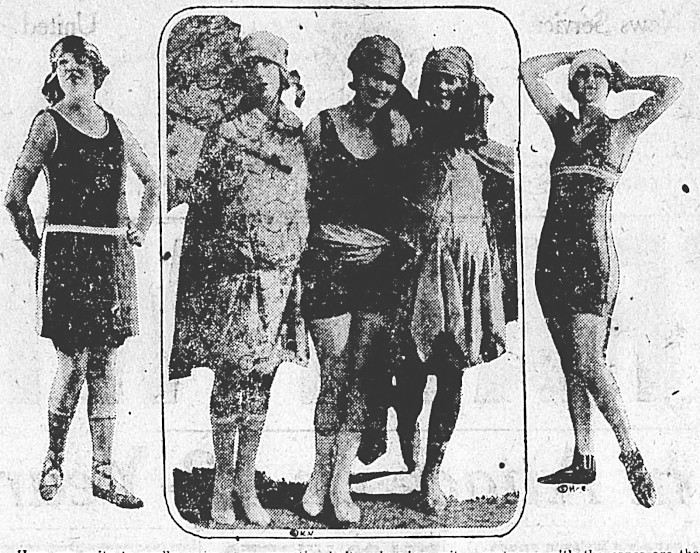
Original caption: “Here are suits to really swim in and suits to wear when strolling on the beach and doing nothing more strenuous than looking pretty. The one on the left is a conservative knit swimming suit in black and white. On the extreme right is also a knit suit in tan with brown gray and white stripes across the chest. The costumes with the capes are the kind you wear when mother says, “Don’t go near the water.” The central figure need only doff her sash and plunge into the waves.” San Pedro News Pilot, June 18, 1923, Page 2. (Credit: San Pedro News Pilot archives)

The winding road to the Los Angeles Clippers’ new home in Inglewood

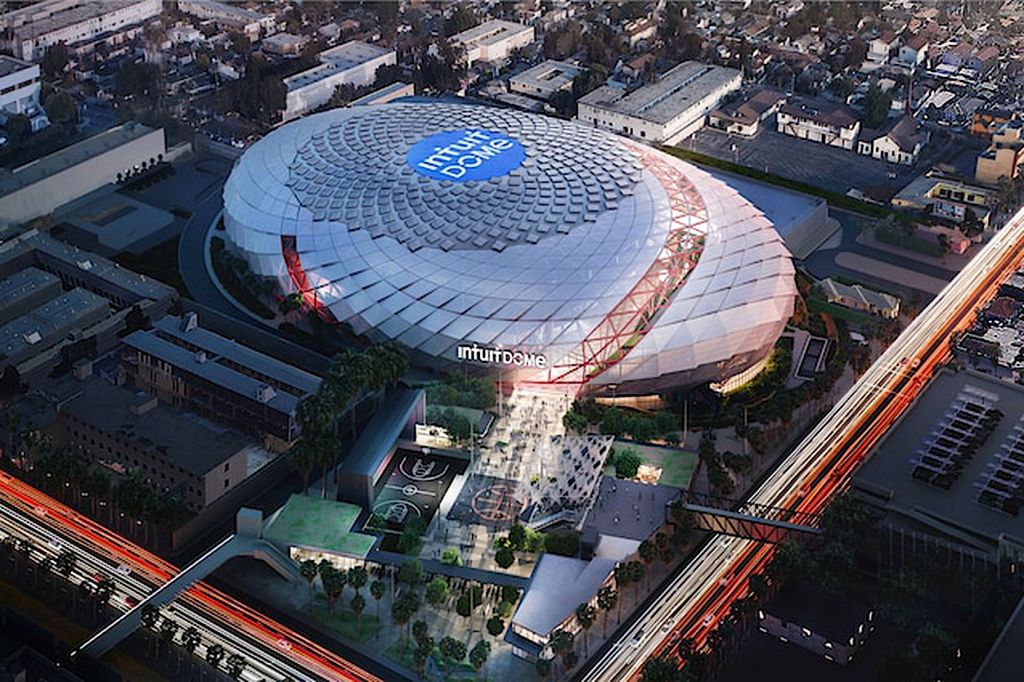
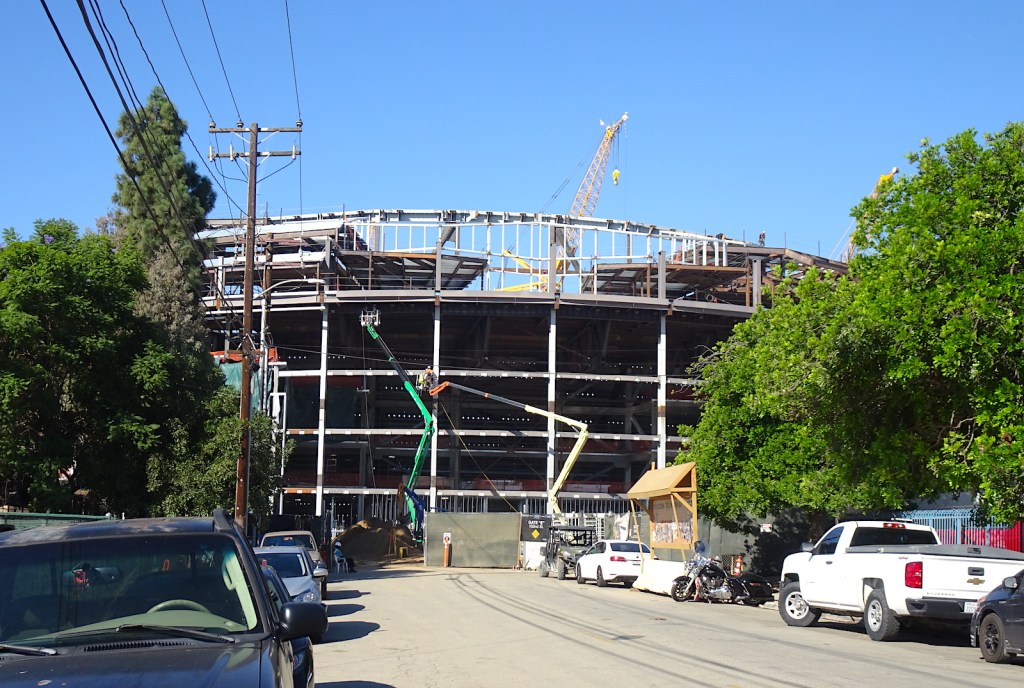
Rendition shows the planned Intuit Dome, now under construction in Inglewood. Century Blvd., left, Prairie Ave., right. (Courtesy of the LA Clippers)

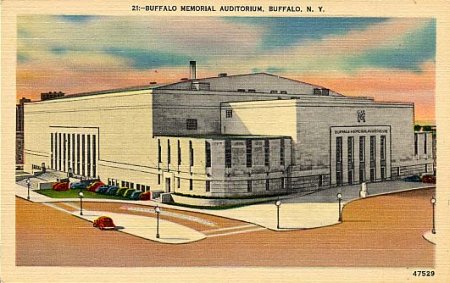
The long road for the Los Angeles Clippers to their new Intuit Dome now under construction in Inglewood began at the Buffalo Memorial Auditorium in New York state on Oct. 14, 1970.

The NBA franchise now operating as the Clippers played its first game on that date as the Buffalo Braves, one of three new expansion teams launched by the league that year. (The Portland Trail Blazers and Cleveland Cavaliers were the other two.)

Postcard of Buffalo Memorial Auditorium, circa 1940s.

“The Aud” had opened in 1940. It was built under the Works Progress Administration (WPA)  New Deal program. The venerable arena also hosted the newly created National Hockey League team, the Sabres, whose first season also was in 1970.

33-year-old entrepreneur Paul Snyder paid $4 million (remember that number) to become owner of the Braves. The team did fairly well on the court, thanks to players such as Randy Smith, Jim McMillan and future Hall of Famer Bob McAdoo.

But Snyder had trouble wrangling home game dates for the team at The Aud, which already had established tenants. The Braves were forced to play some of their “home” games in Toronto as a result. Frustrated, Brown made a deal to swap ownership with Irv Levin of the Celtics in 1978.

Levin lived on the West Coast and moved the Braves to San Diego for the 1978-79 season. Fans voted to change the team name to the Clippers, after the tall sailing ships, and the team played its first game in the San Diego Sports Arena on Oct. 13, 1978.

Despite having stars such as Bill Walton and Terry Cummings, the renamed team struggled in San Diego and its stars often were injured. Mercurial guard World B. Free did average 30.2 points per game during the 1979-80 season.

Its next ownership change would prove to be catastrophic. Levin sold the team to real estate developer and attorney Donald T. Sterling for $12.4 million on May 4, 1981. The Clippers went on to have one of their worst seasons, winning only 17 out of its 82 games in 1981-82.

Eyeing the success of owners such as the Lakers’ Jerry Buss, Sterling had wanted the team to feed his self-image, but he lacked sports management knowledge and seemed unwilling to run it coherently.

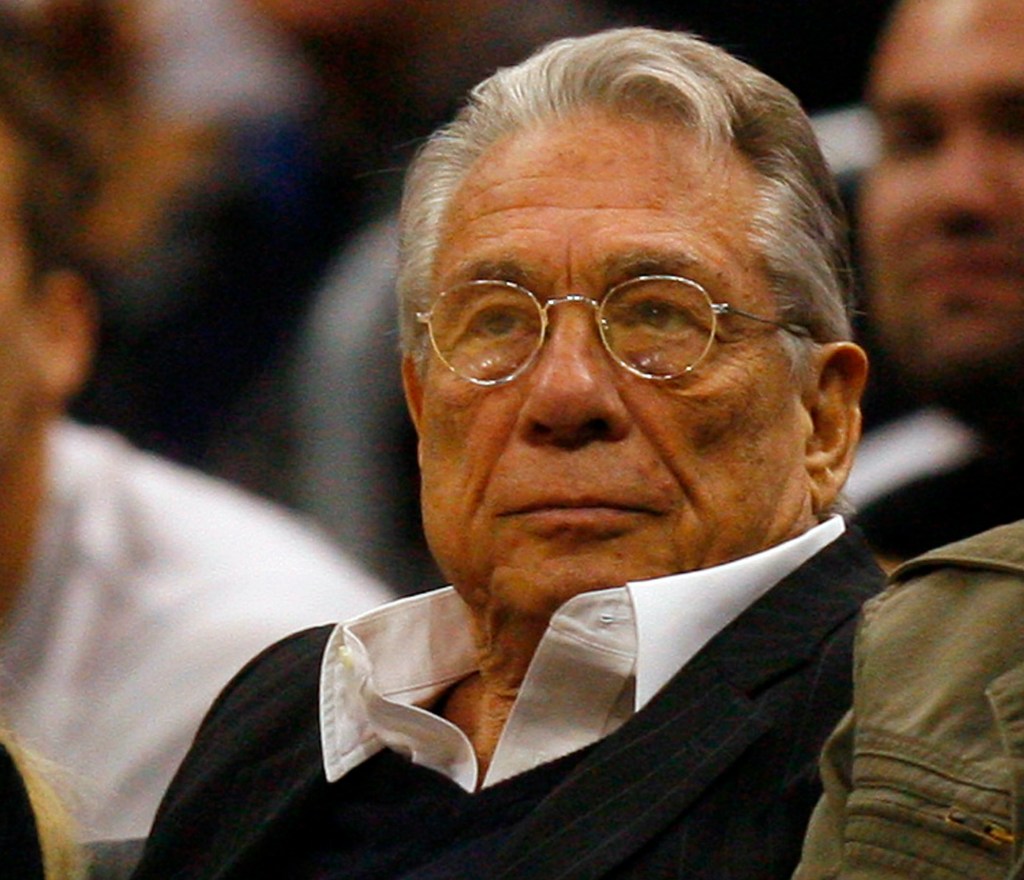
Clippers owner Donald Sterling looks on as the team plays the New Orleans Hornets at Staples Center, Jan. 2. 2008. The NBA removed Sterling as the team’s owner in 2014. (Daily Breeze file photo by Keith Birmingham)

He also was notoriously stingy. Hotels refused to book the team due to his previous failures to pay bills. Bus companies did likewise. Sterling also got into trouble with the players’ association for insisting that the team travel in coach on commercial airlines during road trips, which violated the union’s rules.

The NBA nearly stripped him of ownership over these and other instances of mismanagement, until Sterling agreed to hire Alan Rothenberg to run the team.

Day-to-day operations ran more smoothly under the former Laker executive’s direction, but the team continued to fare poorly in San Diego. After a legal battle with the NBA, Sterling succeeded in moving the franchise to Los Angeles in 1984.

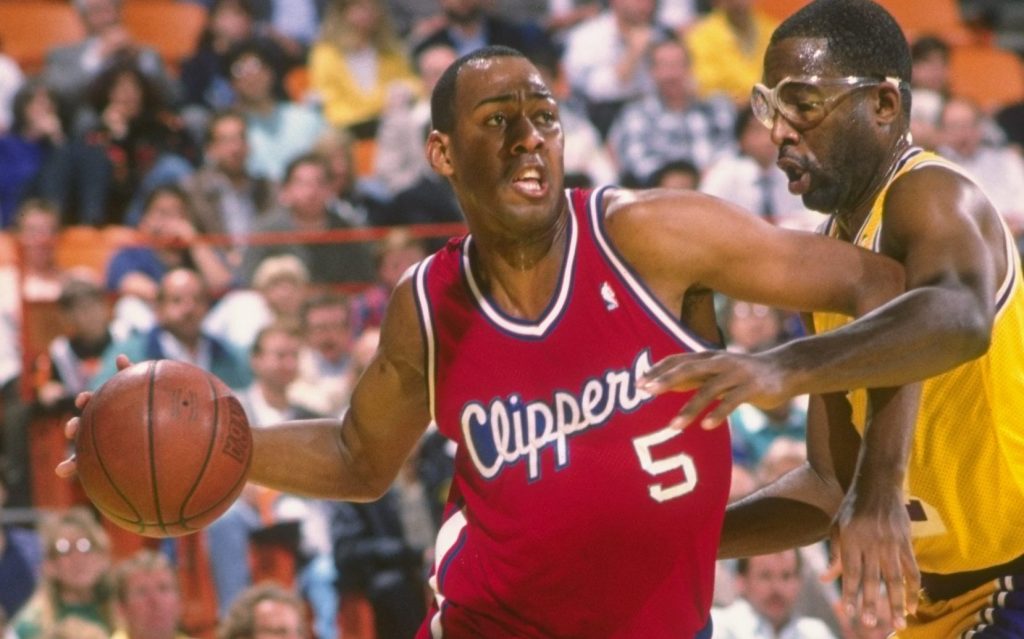
Danny Manning drives against James Worthy of the Lakers during a Clippers home game at the Los Angeles Sports Arena. Manning played for the team from 1988-94. (Credit: Mike Powell /Allsport)

The Clippers played their first game at the aging Los Angeles Sports Arena next to the Coliseum on Oct. 27, 1984, defeating the Utah Jazz. But, with the Showtime-era Lakers in the middle of epic battles with the Boston Celtics for NBA championships, little notice was paid to the Clips. They continued to struggle on the court, winning a franchise-low 12 games during the 1986-87 season.

The team made playoff appearances in the early 1990s, thanks to players such as Danny Manning and Ron Harper. Plans later in the decade to have its own arena built in Exposition Park fell through, though. After flirting with the Pond in Anaheim, the team decided to join the Lakers in moving to the new Staples Center (renamed the Crypto.com Arena in December 2021) downtown in 1999.

On the court, the team had its ups and downs during the early 2000s, but, through it all, Sterling just couldn’t seem to avoid negative publicity. Matters came to a head in 2014 when TMZ released the tape of a conversation between Sterling and his alleged mistress during which he made racist remarks while excoriating her for having her picture taken with Magic Johnson.

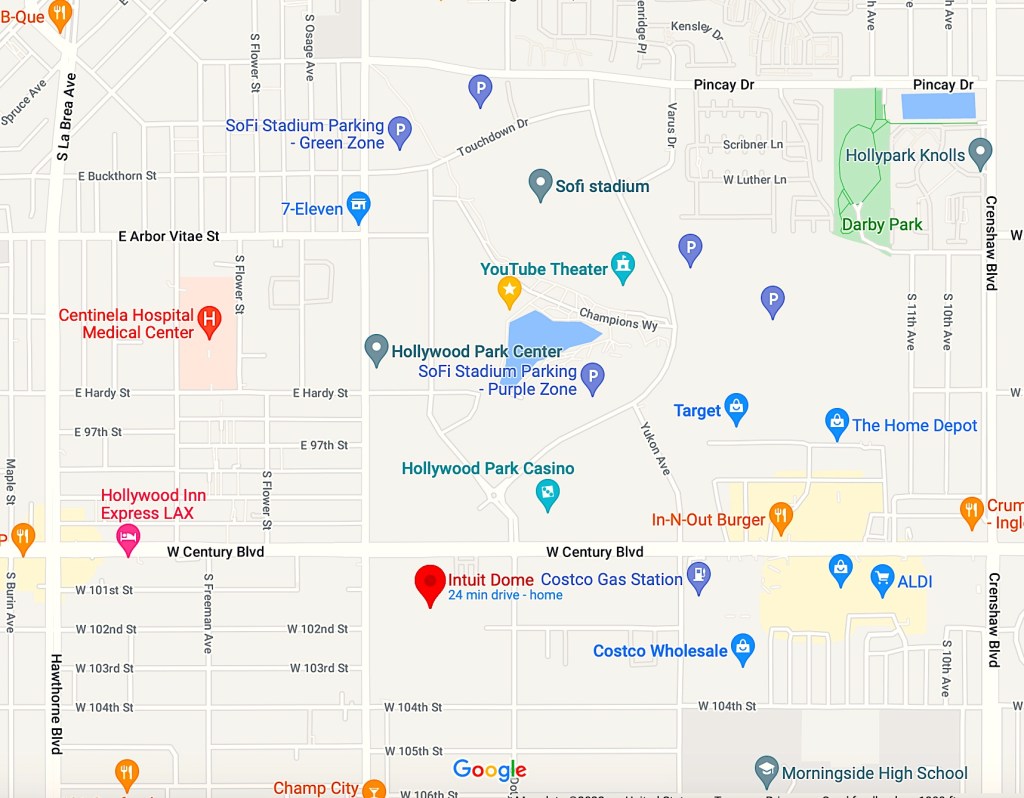
The Intuit Dome site near Century Blvd. and Prairie Ave. is located just south of Sofi Stadium and the Hollywood Park Casino. (Credit: Google Maps)

Adding racism to the long litany of Sterling’s indiscretions tipped the scales, and the NBA stripped him of ownership after furious protests from league players, advertisers, activists and fans. These included members of the Clippers wearing their jerseys inside out so as to let the team logo show during a playoff game. Sterling ultimately was fined $2.5 million and banned from the league for life.

On Aug. 2, 2014, former Microsoft CEO Steve Ballmer officially took control of the franchise, after purchasing it for $2 billion, 500 times what Paul Snyder originally paid in 1970. Known for his incessantly jubilant cheerleading at games, Ballmer has managed to turn the franchise around and build it into a successful enterprise.

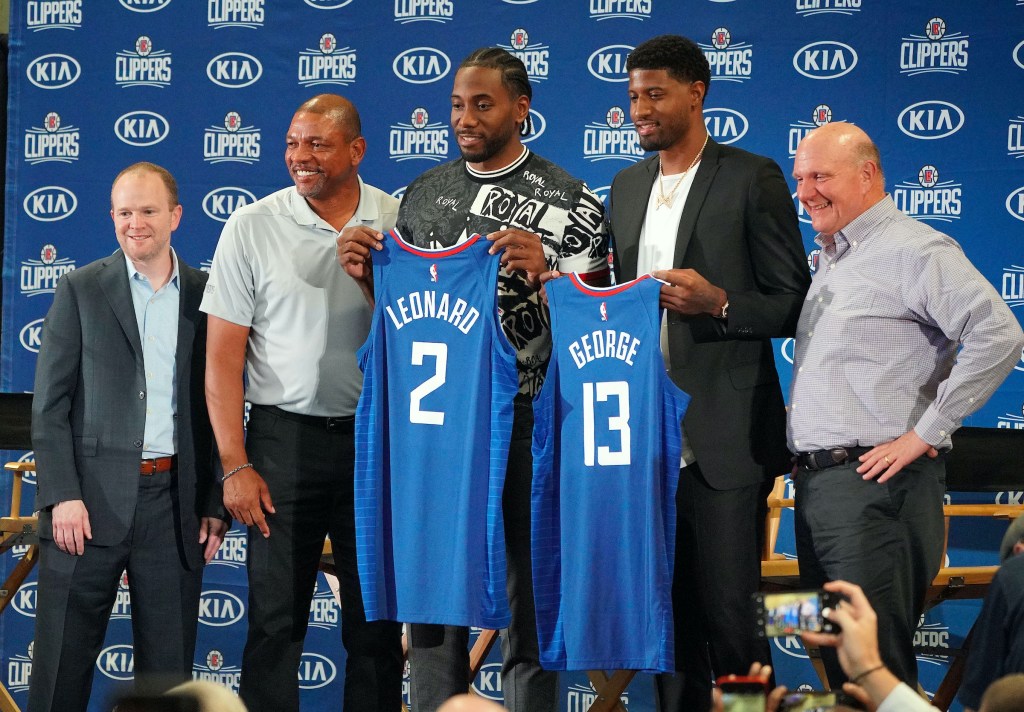
From left, Clippers president of basketball operations Lawrence Frank, head coach Doc Rivers, Kawhi Leonard, Paul George and owner Steve Ballmer gather for a press conference in Los Angeles on Wednesday, July 24, 2019. George and Leonard were introduced to the media and fans as the newest members of the Clippers. Head coach Rivers has since been replaced by Tyronn Lue. (Daily Breeze file photo by Scott Varley)

In 2017, the city of Inglewood signed a deal with the Clippers calling for the construction of a new arena for the team. The Madison Square Garden Corp., owners of the Forum in Inglewood, attempted to block the deal, claiming the new arena would unfairly compete with live events at the Forum. The legal wrangling continued for the next couple of years.

Ballmer solved the dispute by agreeing in 2020 to buy the Forum from MSG for $400 million. Ground was broken for the new arena on Sept. 17, 2021. Shortly afterward, the Clippers announced a lengthy naming-rights deal with the Intuit software company.

The Intuit dome is currently under construction, with the team expected to move into the new facility in 2024. The arena at 3921 W. 102nd St. will include a practice facility (replacing its current one in El Segundo), a sports medicine clinic, some retail space and an outdoor plaza with public basketball courts.

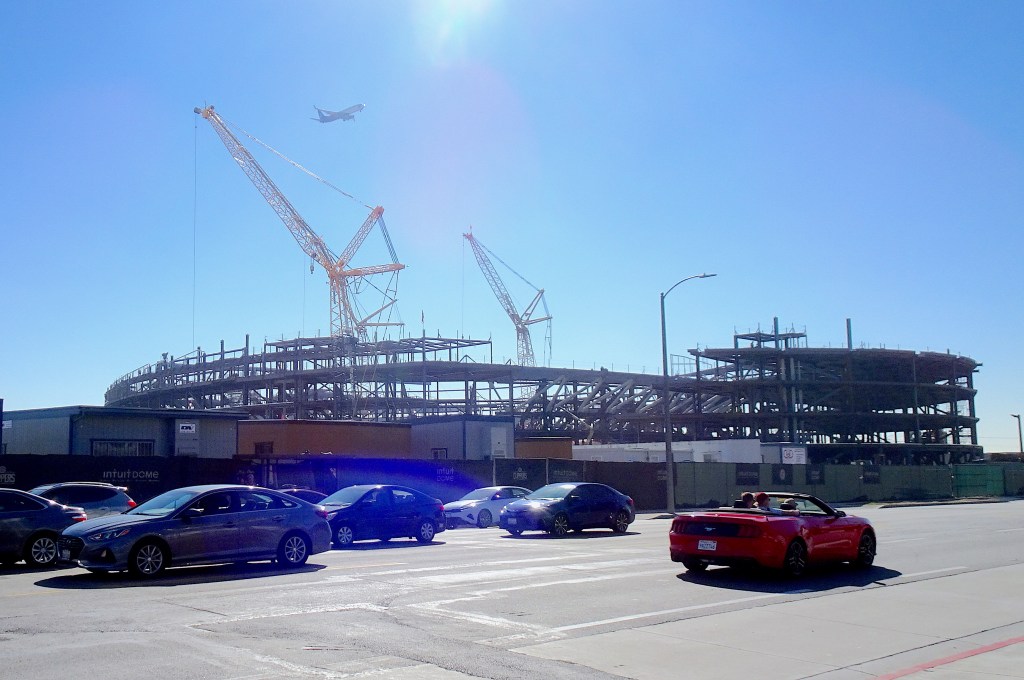
Cars go by on Prairie Ave. as the Intuit Dome goes up in Inglewood. (October 2022 photo by Sam Gnerre)

Sources:

Basketball Reference website.

Buffalo Braves History blog.

Buffalo News archives.

Daily Breeze archives.

San Diego Union-Tribune archives.

Wikipedia.

The Intuit Dome, new home of the Clippers, rises above a modest neighborhood on W. 102nd St. in Inglewood. (October 2022 photo by Sam Gnerre)

Winning the messaging battle at home was key to the World War II effort

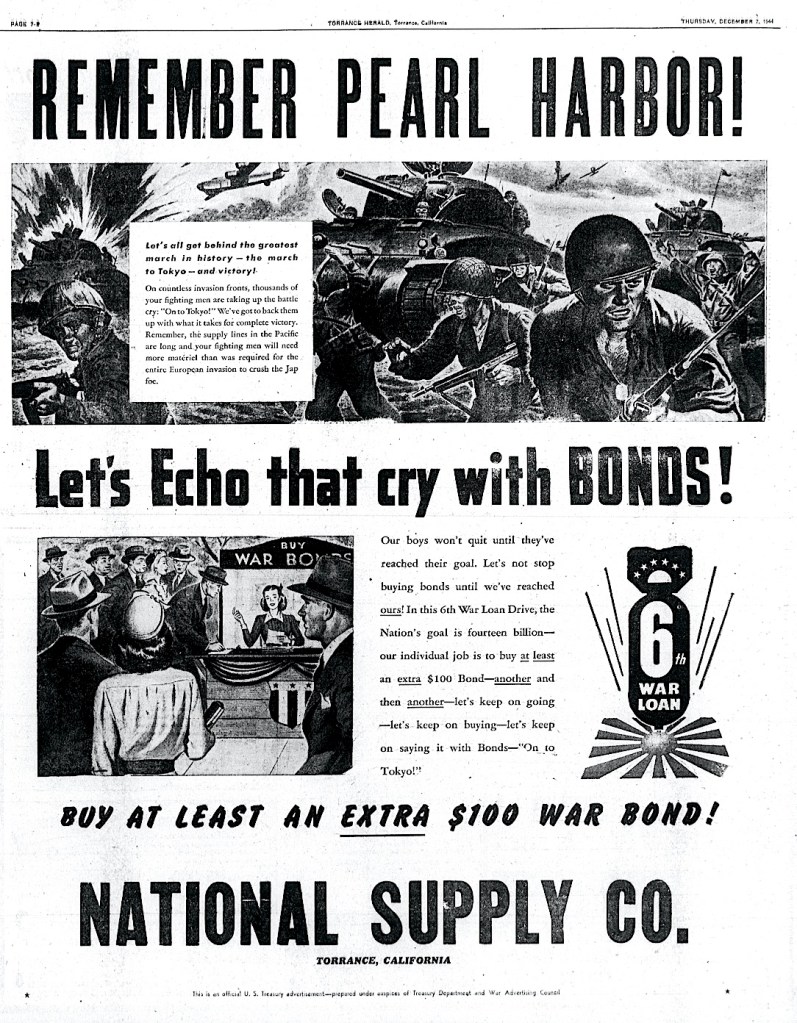
This Torrance Herald ad promoting war bonds ran on Dec.7, 1944, the third anniversary of the Pearl Harbor attack. The National Supply Co. was a manufacturing firm involved in the war effort. (Credit: Torrance Historical Newspaper and Directories Archive database, Torrance Public Library)

It’s difficult to overestimate the degree to which World War II affected every household in the U.S.

The country had lived through one world war already, World War I. American forces saved the day against the Germans and their allies with our late entry into the first “war to end all wars.” But more than 116,000 U.S. soldiers lost their lives during our participation between April 1917 and November 1918, so its impact never should be minimized.

However, the severity of its effects on the home front did differ from World War II due to its shorter duration. By contrast, the U.S. entered World War II two years after it began in Europe, and at the very beginning of the war in the Pacific, thanks to the Pearl Harbor attack which began hostilities with Japan.

It quickly became apparent that our military would be in this one for the long haul, and the government knew it.

The early months of the war confused many on the home front, with conflicting reports and scares becoming a regular part of life. Accurate information was hard to come by, and difficult to disseminate to the public. To combat this, President Franklin Delano Roosevelt created the Office of War Information (OWI) on June 13, 1942. 

The agency had many purposes besides the dissemination of information, including keeping morale high, boosting home front contributions to the war effort, maintaining security at defense plants and portraying the American way of life as worth protecting. (The OWI created the still-operating “Voice of America” broadcasting operation as part of that effort in 1942.)

At the time, detractors felt that the OWI would operate merely as a propaganda machine. That was part of its mission, to be sure, but it also was responsible for providing accurate information to the country about the war.

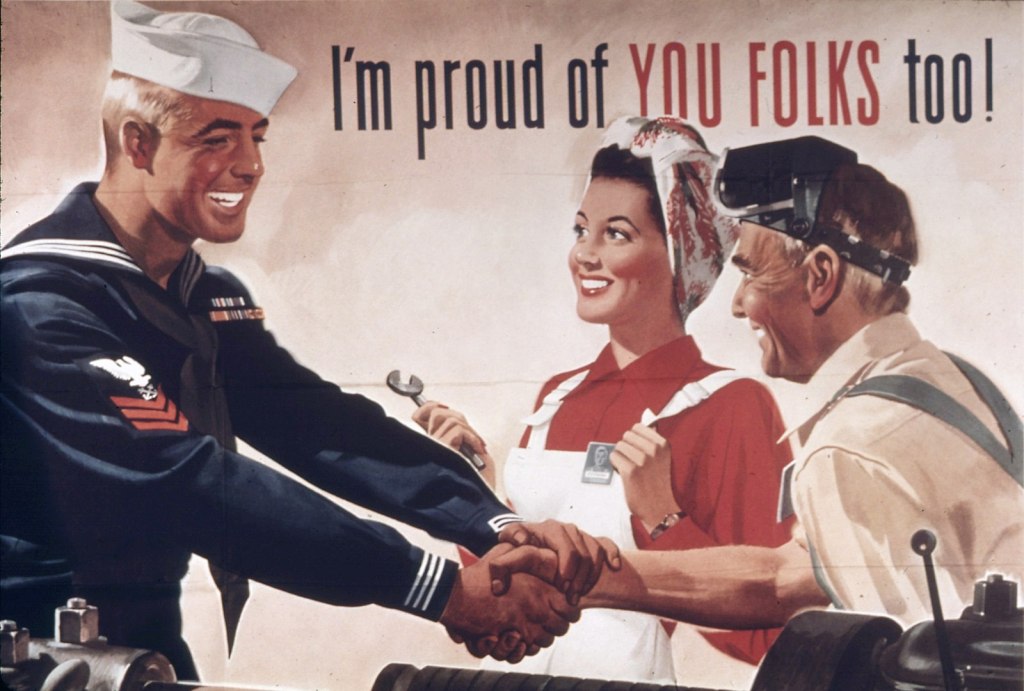
This OWI poster stresses the importance of home front workers to the war effort. (Credit: U.S. National Archives and Records Administration)

Another part of that mission was providing the domestic media with tools with which to boost morale and security. The South Bay / Harbor Area received a good dose of such messaging, in part because of its plethora of defense plants.

Aircraft manufacturers such as North American Aviation, Douglas, Northrop, Hughes, Doak  and many others had plants turning out aircraft and other equipment for the war effort.

The Harbor Area had several major shipbuilders, including Todd-Los Angeles Shipbuilding and the California Shipbuilding Corp.

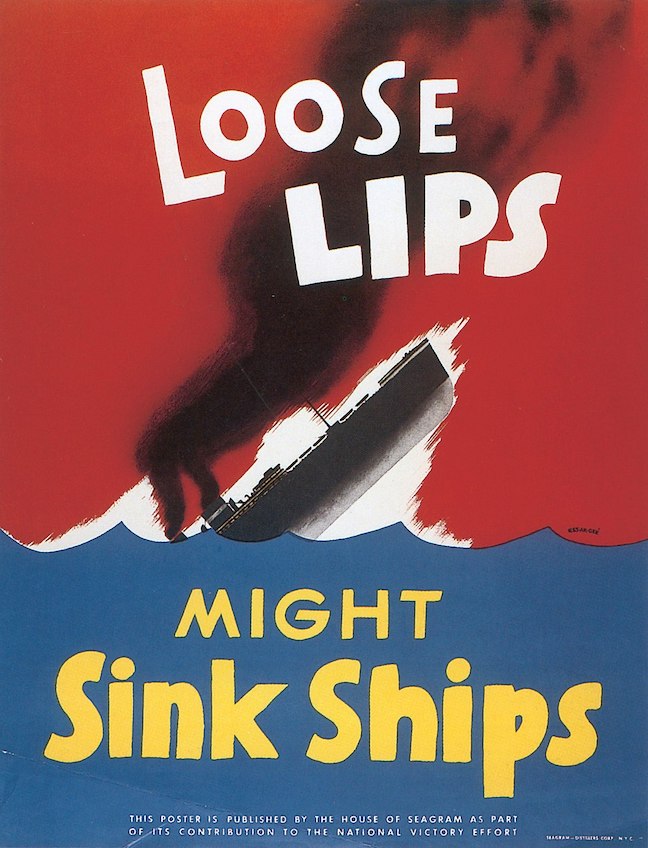
These plants employed tens of thousands of wartime workers. The ever-present threat of espionage and the need for security and secrecy were paramount. The OWI produced a series of posters stressing the need for defense employees to keep mum. This is perhaps the most famous:

This famous poster was distributed by the Seagram distillery to taverns in areas where defense workers might congregate. (Credit: Public domain)

Thousands of troops also were stationed in the Harbor Area at Camp Ross and the Los Angeles Port of Embarkation in Wilmington and at Fort MacArthur in San Pedro, which also housed naval personnel at various installations in San Pedro. The OWI’s message was clear to all: mum’s the word!

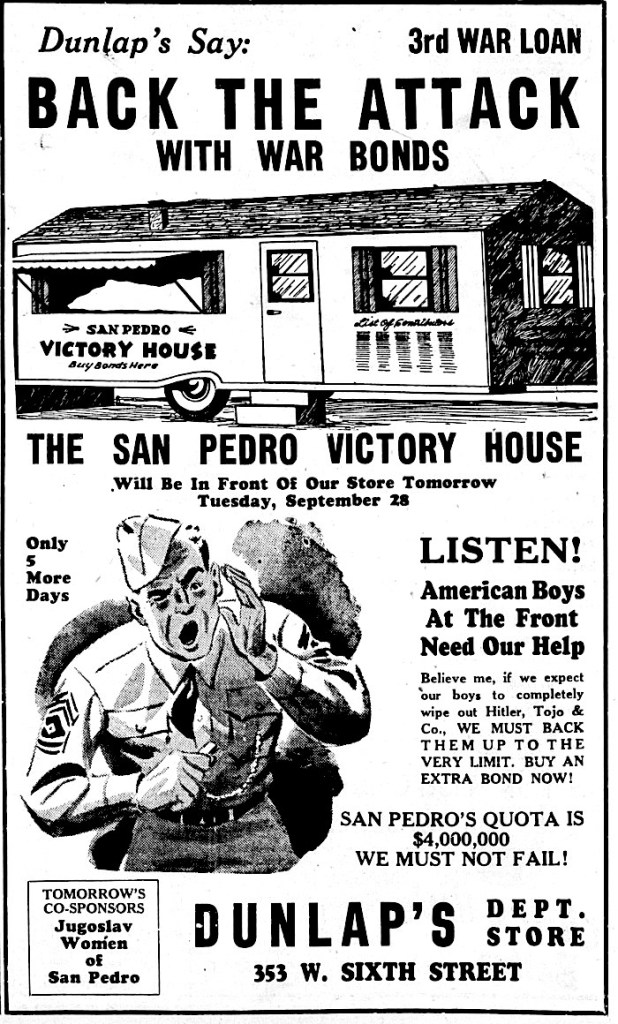
Another major part of the home front messaging effort concerned war bonds. The immense expense of mounting a massive world war on two major fronts called for a large-scale, continuous fundraising drive whose scope reached from Washington, D.C., to the corner drug store.

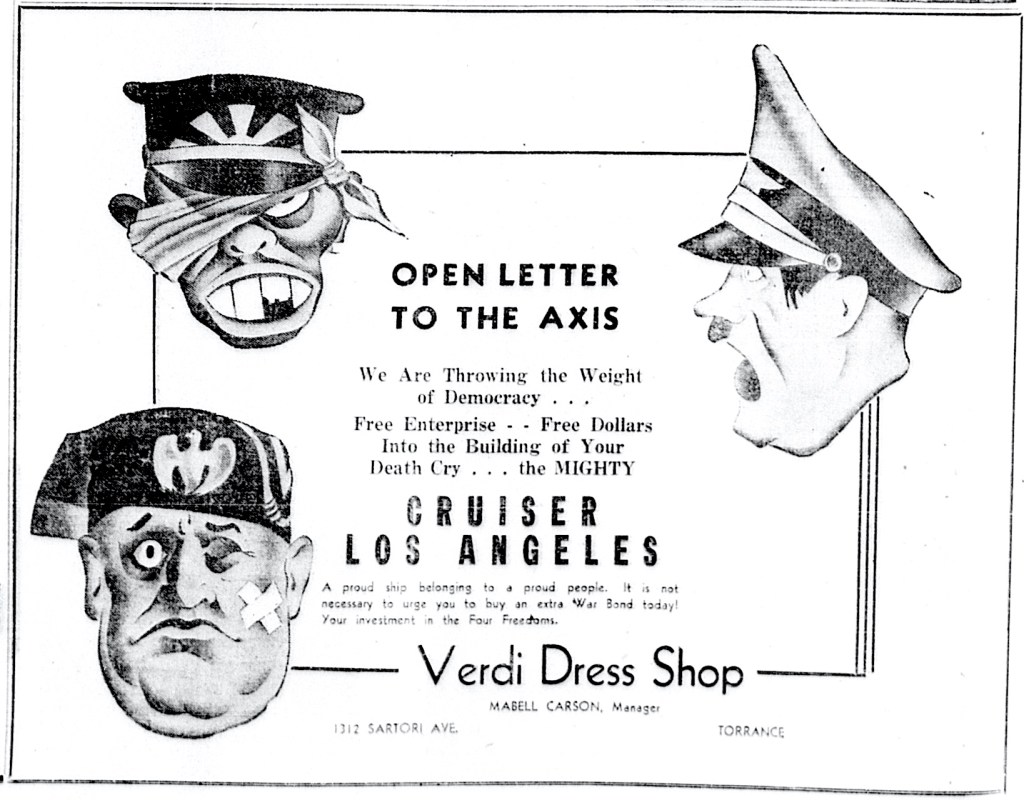
A Torrance dress shop sponsored this ad using racist caricatures of Tojo, Hitler and Mussolini to promote war bond sales. Torrance Herald, July 15, 1943, Page 2-B. (Credit: Torrance Historical Newspaper and Directories Archive database, Torrance Public Library)

The OWI provided effective template ad copy to newspapers large and small. Local businesses then would add their names to the ads to show solidarity with the war effort. War bonds also were promoted by events including large, often star-studded rallies, but also through smaller neighborhood efforts such as the San Pedro Victory House, a mobile bond-selling vehicle.

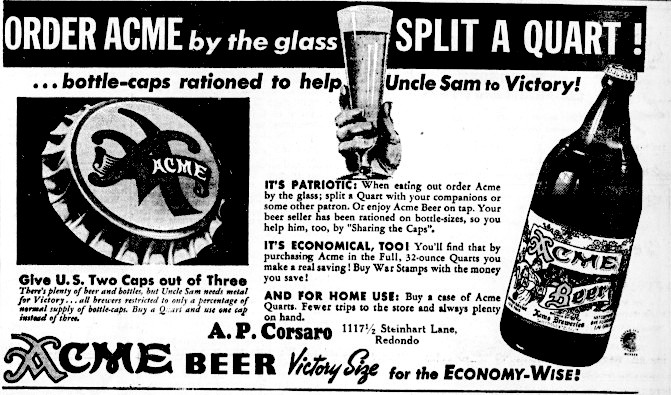
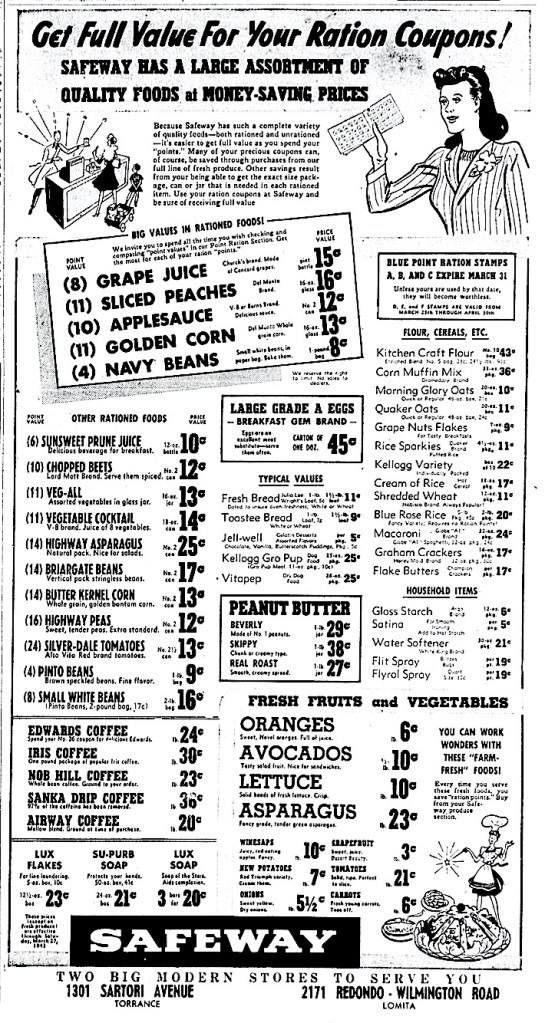
At the most granular level, the government promoted sacrifices that could be made by all citizens for the war effort. Wartime rationing of consumer goods was the most onerous of these. The government restricted the sale of everyday items such as gasoline, rubber tires, fuel oil, firewood, nylon, silk, shoes and a long list of food staples.

Torrance Herald ad, March 24, 1943, Page 3-A. (Credit: Torrance Historical Newspaper and Directories Archive database, Torrance Public Library)

Newspapers of the day were filled with information about the latest ration coupon programs, with promotional ads stressing the importance of local hometown sacrifice for our troops abroad.

San Pedro News Pilot ad, Sept. 27, 1943, Page 2. (San Pedro News Pilot archives)

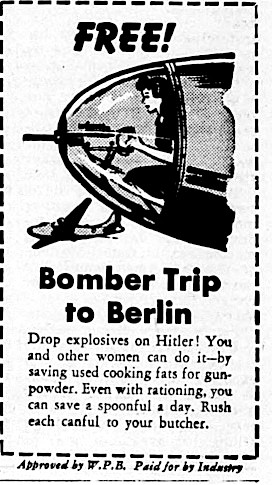
They also promoted individual initiative in the face of rationing by encouraging citizens to grow their own food at home in “victory gardens,” an idea which quickly caught on. Citizens also took part in scrap metal drives and even were urged to save household grease, as it could be used in the making of gunpowder.

While many of these ideas proved materially useful to the war effort, they probably had even more value in helping to boost morale on the homefront during a time of great peril.

In addition to its widespread use of printed promotional material, the OWI also produced radio programs, pro-U.S. propaganda leaflets for use overseas, and a series of films extolling the virtues of the American way of life.

President Harry Truman disbanded the OWI shortly after the war’s end in 1945. Many of its operations were folded into the U.S. State Dept., with some becoming part of the CIA when it was formed in 1947.

No gesture was too small when it came to helping the war effort. Palos Verdes Peninsula News ad, July 3, 1942, Page 3. (Credit: Palos Verdes Peninsula News archives)

Sources:

“AEROSPACE: The industry that built the South Bay,” By Easy Reader Staff, Easy Reader, Oct. 17, 2013.

“Everything You Know About How World War I Ended Is Wrong,” by Geoffrey Wawro, Time magazine website, Sept. 26, 2018.

Palos Verdes Peninsula News archives.

San Pedro News Pilot archives

Torrance Press Herald archives.

Wikipedia.

San Pedro News Pilot ad, Sept. 27, 1943, Page 2. (Credit: San Pedro News Pilot archives)

Marymount California University’s roots on the Palos Verdes Peninsula go back to 1960

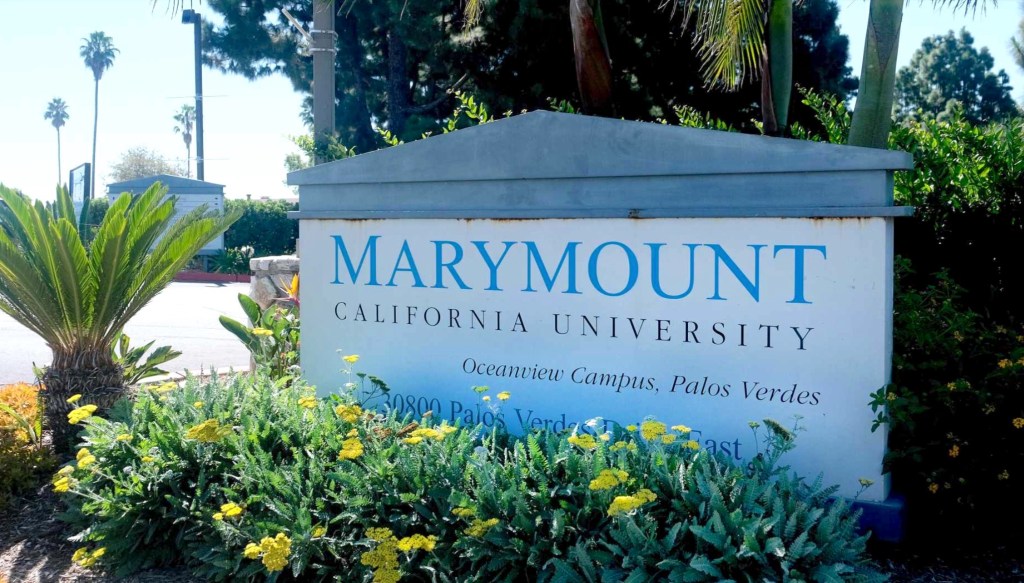
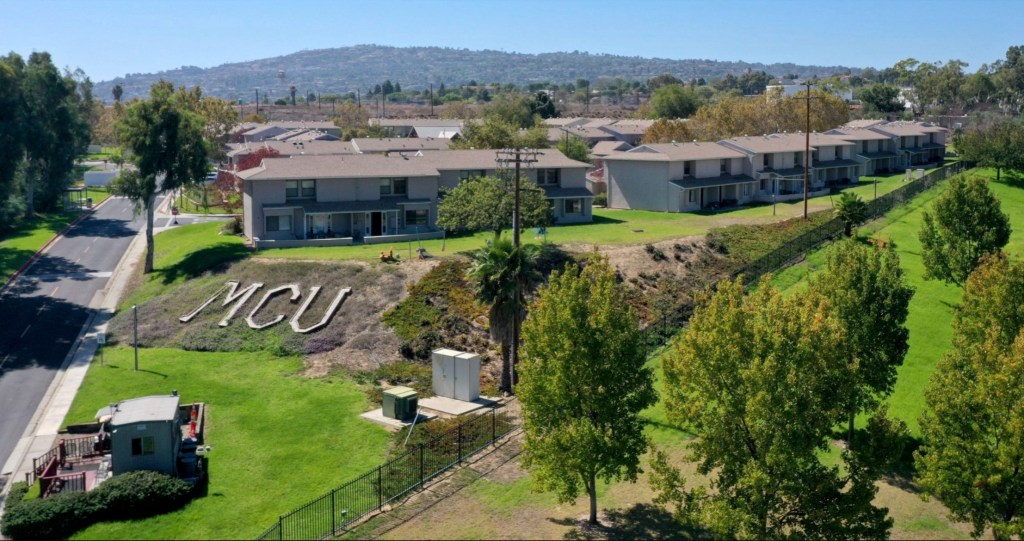
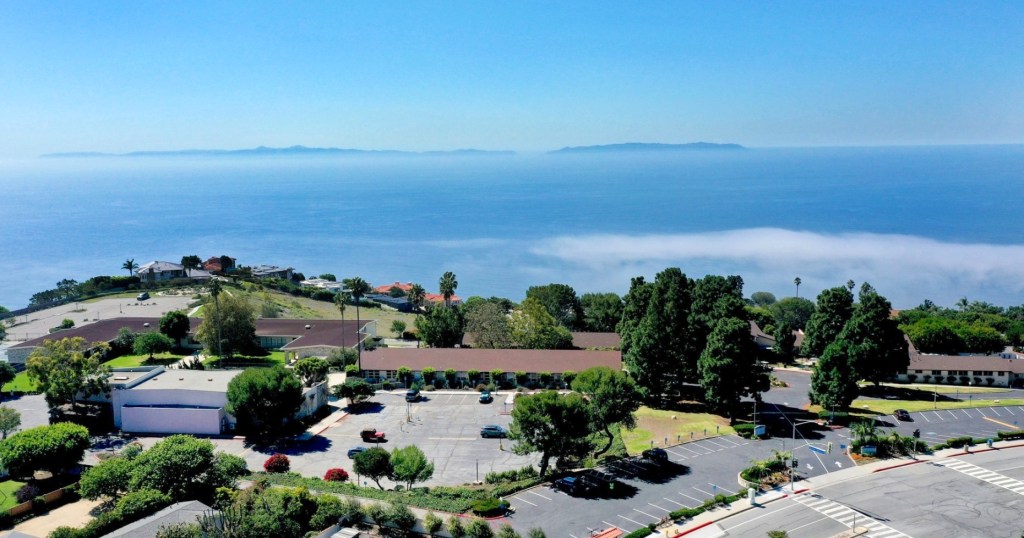
Entrance sign to the Marymount California University in Rancho Palos Verdes on Sept. 27, 2022. (File photo by Dean Musgrove, Los Angeles Daily News)

Recent news that UCLA has purchased the closed campus of Marymount California University in Rancho Palos Verdes and its housing annex in San Pedro warrants a look back at the school’s history.

Its earliest roots lie in Westwood at 10643 Sunset Blvd. near UCLA, where Marymount was founded by the Religious of the Sacred Heart order in 1932 as an all-girls high school before later becoming a two-year college.

It holds the distinction of being the first Catholic junior college to be established in California. In 1948, the school expanded into a four-year university.

Its road to the Palos Verdes hills began with a March 1951 announcement that its new campus would be built on a hilltop near the intersection of Crest Rd. and Palos Verdes Drive East in Rancho Palos Verdes.

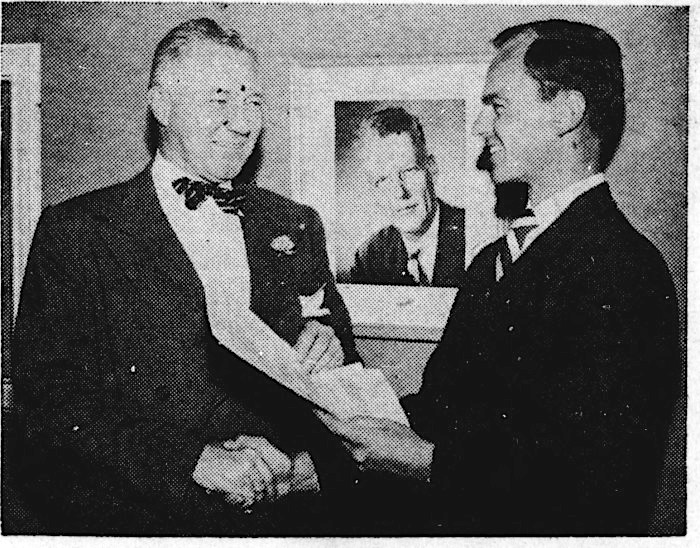
Palos Verdes Land Corporation President Frank Vanderlip Jr. presents the paperwork on his gift of land for Marymount College to college president John Howard, right, in March 1953. (Credit: Palos Verdes Peninsula News archives)

Palos Verdes Corporation President Frank Vanderlip Jr. granted 45 acres of land for the purpose of housing the $250,000 original campus. The 1,000-foot-high site overlooks the western San Pedro and Portuguese Bend coasts, with Catalina Island in the distance.

The architectural firm Welton Becket and Associates designed the first buildings for the school. The plan was to open an elementary and high school first on the site for approximately 200 students, which would later be transformed into a four-year college. 

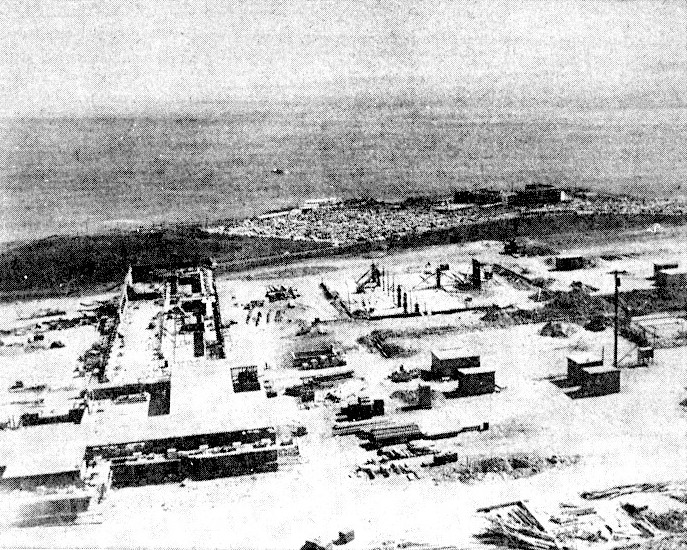
Its first students graduated from the high school in 1955. Actual construction of the full college campus began in June 1959. That October, Los Angeles Archbishop Timothy Manning conducted a ground-blessing ceremony for the $7.5 million project.

Marymount College under construction. Palos Verdes Peninsula News, Aug. 27, 1959, Page 3. (Credit: Palos Verdes Peninsula News archives)

It was a star-studded affair. Hotel magnate Conrad Hilton delivered the keynote address. Attendees included parents of students at all eight Marymount schools in California. Celebrities June Allyson, Dick Powell, Tom Harmon, Van Heflin, Lucille Ball, Desi Arnaz, Bob Hope, Pat O’Brien and Danny Thomas were among the estimated 3,000 people present.

Initial registration for the new Marymount College began in June 1960, and it opened its doors to its first 200 students, all women, on Sept. 12, 1960. Enrollment was limited at 350 at first, with plans to expand eventually to more than 1,000 students. (The high school returned to Westwood with the opening of the college.)

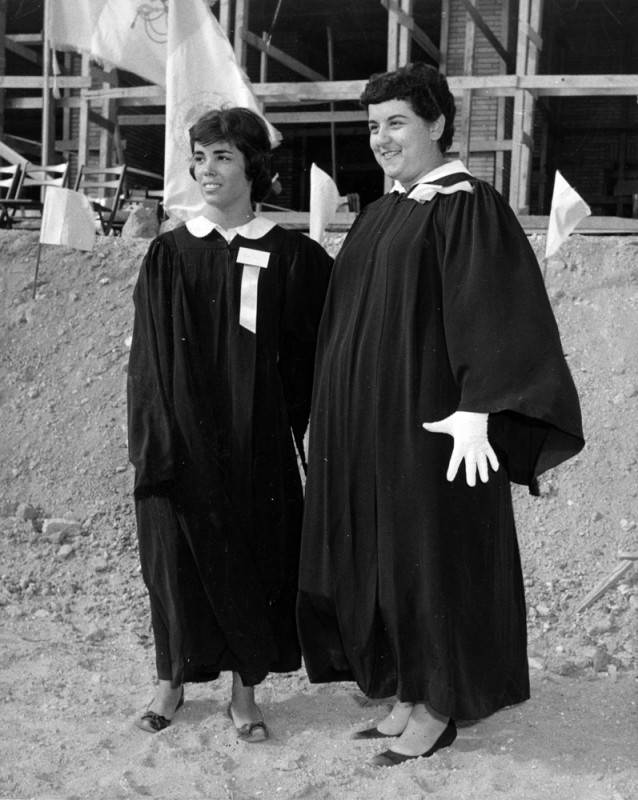
Geri Ghiz and classmate Marie Nora, students at Marymount College in Westwood, view the new Marymount College campus under construction in Palos Verdes, at which they will be students in Fall 1960. Nov. 14, 1959 photo. (Credit: Los Angeles Public Library Photo Collection)

In 1961, Associated Press Hollywood columnist James Bacon revealed the identity of a mysterious $100,000 donor to the college: Frank Sinatra. The college also announced its accreditation by the Western College Association after just one year of operation.

Additional buildings were added to the campus during the next few years. In addition, its management structure underwent some changes. In 1967, the decision was made to move the four-year college operation to Loyola University, which opened in Westchester in 1929. The two-year junior college would continue to operate on the RPV campus.

The merger between the schools became complete in 1973, with Loyola became Loyola Marymount University. Things looked rocky for the renamed and newly coeducational Marymount Palos Verdes College in 1973; it had only 120 students and a budget deficit.

Its financial situation became dire enough to warrant the sale of its original 1960 campus site to the Salvation Army, who has used it ever since to train its officers. Marymount then moved its campus to the smaller Marymount Prep School site nearby, which closed to facilitate the move.

The college carried on at its new site, and by 1985, its financial problems had eased and its enrollment had reached 650, some of whom lived on the school’s satellite 11-acre housing site in San Pedro.

The Marymount California University housing annex in San Pedro on Sept, 27, 2022. (File photo by Dean Musgrove, Los Angeles Daily News)

The school’s next few decades would be filled with similar ups and downs. Maintaining its enrollment and funding while operating as a two-year commuter college proved difficult.

For years, Marymount had tried to build on-campus dorms in order to become more of a residential college, and a new such initiative was launched in 2002. The school gave up on the effort in 2009 after seven years of contentious dealings with opposed local residents and RPV city planners.

Instead, the school announced plans in 2009 to once again become a four-year institution offering bachelor’s degrees after more than three decades as a two-year school. In 2012, Marymount opened its Waterfront Campus in a former Northrop Grumman office building in San Pedro.

That same year, it awarded its initial bachelor’s degrees to its new crop of four-year students, with former Los Angeles Dodgers manager Tommy Lasorda giving the commencement address. In 2013, 50 more students received their B.A. degrees.

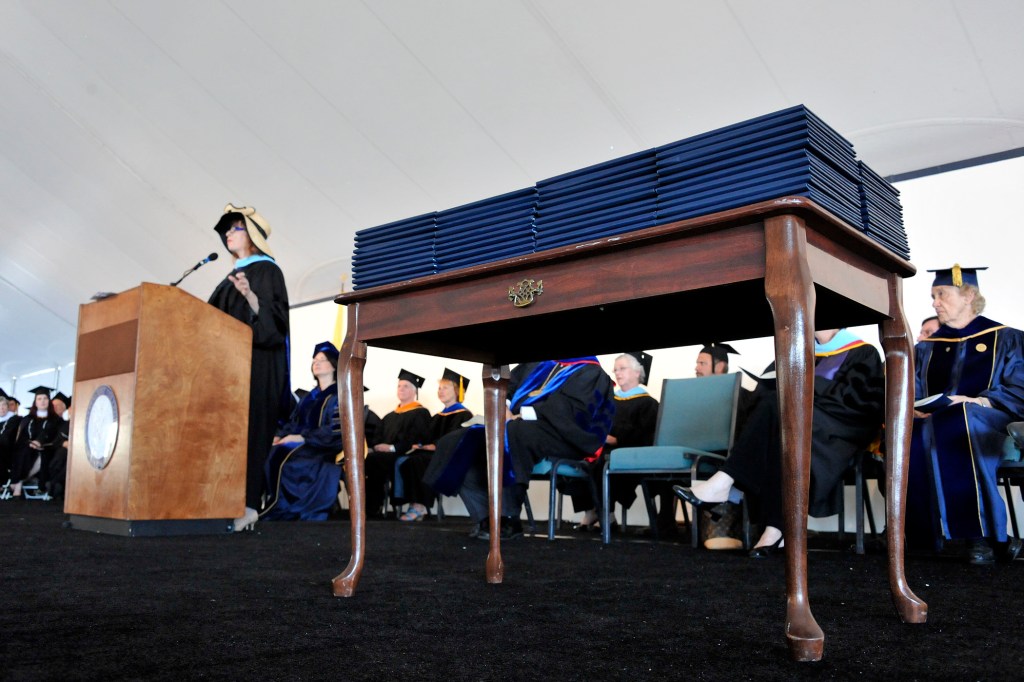
Diplomas await presentation on May 11, 2013, as Los Angeles Times columnist Patt Morrison delivers the commencement address at Marymount College in Rancho Palos Verdes. (Daily Breeze file photo by Mark Savage) .

Earlier in 2013, the college changed its name to California Marymount University and announced plans to open a satellite campus in the northern California town of Lucerne, in Lake County. Enrollment at the main CMU campus had reached 1,000 students.

But the school continued to struggle with falling enrollment and financial difficulties over the next few years. Rising costs and fewer students, combined with the arrival of the COVID-19 pandemic, led to the school’s permanent closure as of Aug. 31, 2022.

On Sept. 27, UCLA announced that it would pay $80 million for the two Marymount sites in an effort to ease overcrowding and expand enrollment. The school also operates satellite campuses in Culver City and downtown Los Angeles.

UCLA Chancellor Gene Block told the Daily Breeze the move would help strengthen its connection to the greater L.A. region, and that academic offerings at the newly purchased facility could begin as early as 2023.

The Marymount California University in Rancho Palos Verdes on Sept. 27, 2022, with Catalina Island visible in the distance. (File photo by Dean Musgrove, Los Angeles Daily News)

Sources:

“About Marymount California,” Marymount California University website.

Daily Breeze archives.

Los Angeles Times archives.

Palos Verdes Peninsula News archives.

“UCLA expands with new sites in the South Bay,” by Bill Kisliuk, UCLA Newsroom website, Sept. 27, 2022.

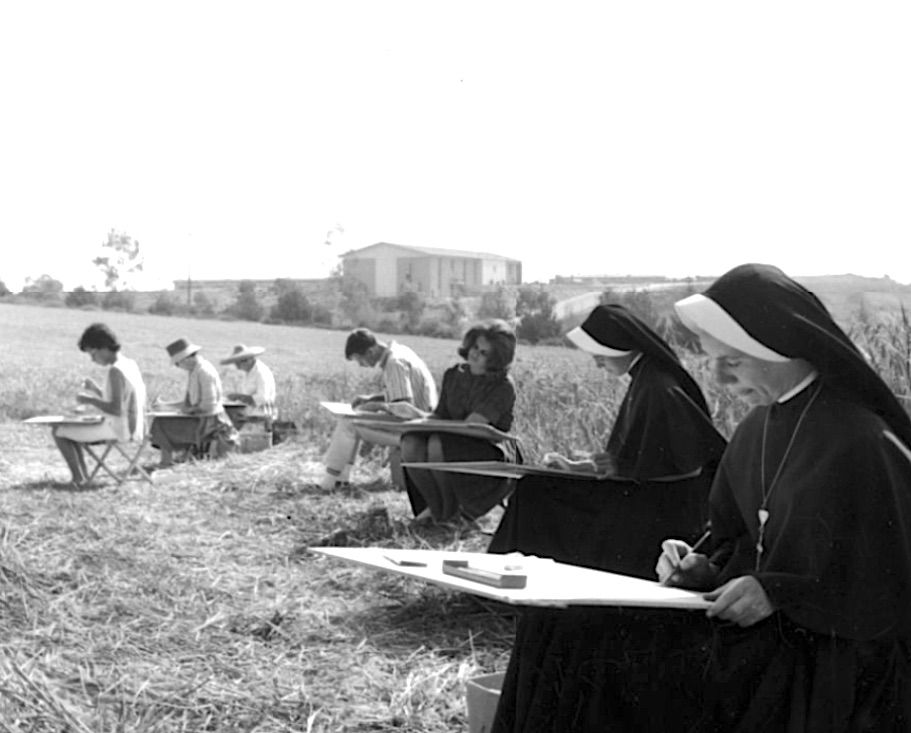
Two nuns and five students, one of them male, participate in an art class outdoors at Marymount College in Rancho Palos Verdes. Undated photo.
(Courtesy of the Department of Archives and Special Collections, William H. Hannon Library, Loyola Marymount University, via Calisphere.org)

Pinewood Derby founder Don Murphy created a racing phenomenon in Manhattan Beach

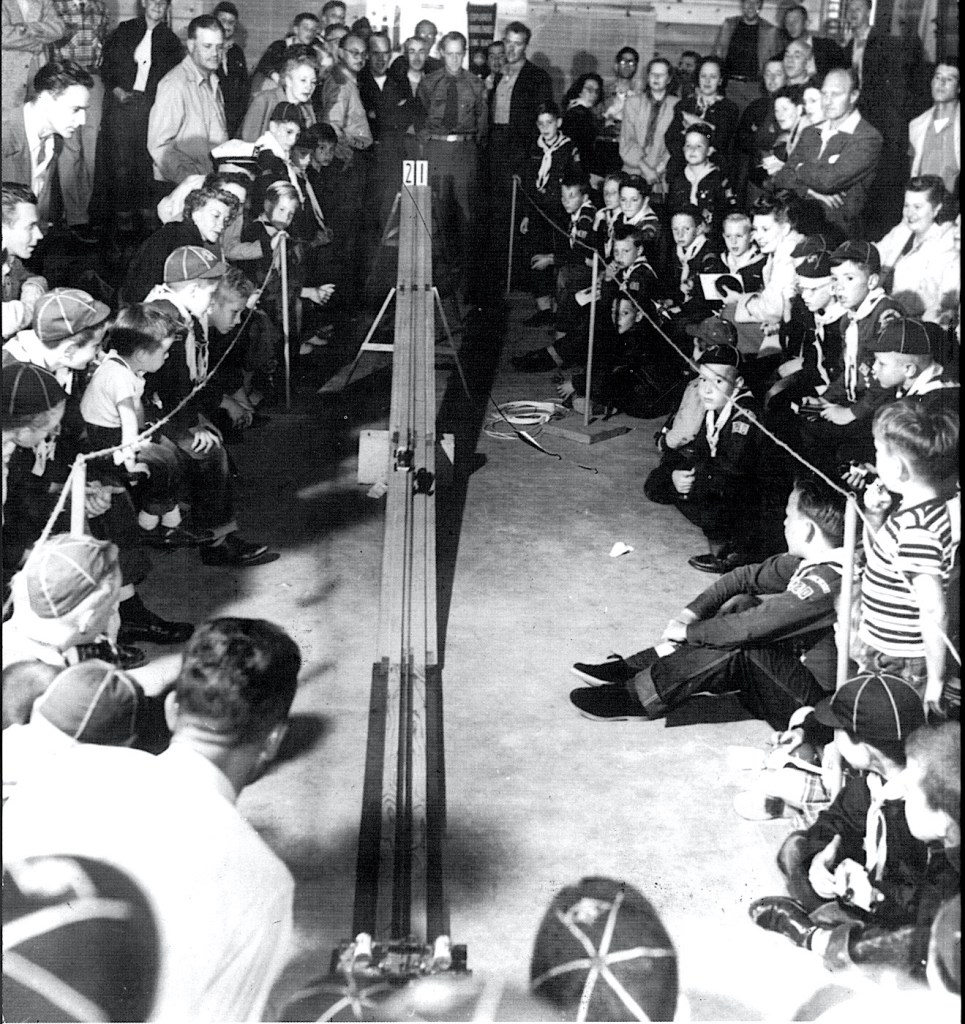
Cub Scouts, family and friends witness the first Pinewood Derby held on May 15, 1953, at the Manhattan Beach Scout House. (Daily Breeze file photo)

Don Murphy was working as an aerospace artist at the North American Aviation plant near LAX in 1953 when he heard about an upcoming company-sponsored Soap Box Derby competition open to children of employees.

The Manhattan Beach resident was disappointed to learn that the father-son activity had an age limit of 12, which meant that his son, 10-year-old Donn, was too young to enter.

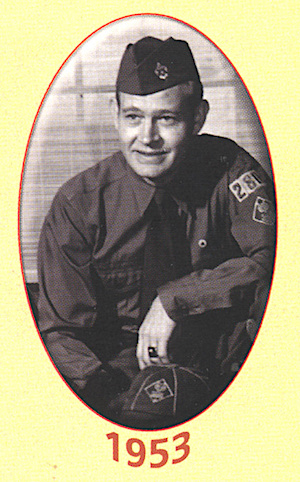
Don Murphy is shown wearing his Cubmaster’s uniform in 1953, the year he invented the Pinewood Derby in Manhattan Beach. (Daily Breeze file photo)

That got Murphy to thinking that there must be an alternative to the full-size, expensive soap box derby racers, something similar that younger children could participate in. 

He’d had fun building miniature models as a boy in LaPorte, Indiana. What if Donn and his fellow members of the 55-member Cub Scout Pack 280C in Manhattan Beach built and raced small wooden cars they’d build together with their parents instead of the larger ones? They would still use gravity, but, with the use of five-foot-high, 32-foot long wooden tracks sloping downward, races could be staged almost anywhere.

He took the idea to local Scouting leaders, and they expressed great enthusiasm. They hammered out a set of rules for the cars: they all had to be made from the same type of wood (pinewood), be no longer than 7 inches, no wider than 2 ¾ inches, and weigh less than 5 ounces.

With the help of sponsorship from North American, they designed uniform kits for building the models that would be issued to every participant. They contained four plastic wheels, four nails and three blocks of wood from which the cars were to be crafted without the use of power tools.

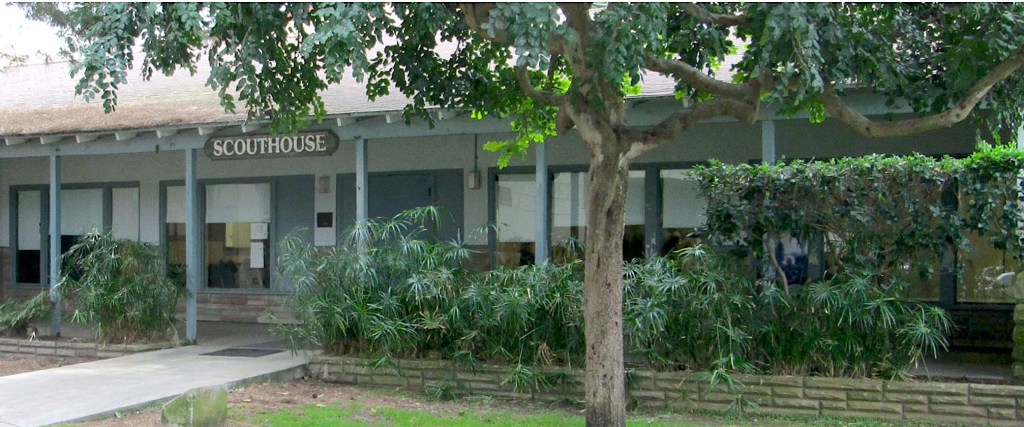
The scouts and their parents also built the first Pinewood Derby track at the Manhattan Beach Scout House at 1617 N. Valley Dr. in Live Oak Park, which had just opened a year earlier in 1952. (The local scouting community currently is trying to raise funds to build a new scouting center on the site.) 

The original 31-foot track was fashioned from wood; later tracks would be made from metal. It had a battery powered finish gate whose sensors would trigger a light bulb to come on as the winning car passed over them at the end of the race.

Leaders passed the car-making kits out at the scout meeting on April 17, in advance of the first-ever Pinewood Derby to be held on May 15, 1953.

The current Manhattan Beach Scout House where the first Pinewood Derby was held was built in 1952. (Credit: Manhattan Beach Senior & Scout Community Center website)

The Manhattan Beach Scout House filled with excited parents and their children on the night of the big race. The track worked flawlessly as cars raced in three categories: ten-, nine- and eight-year-olds. Den Chief Daniel Hoffman’s car ended up the big winner.

More importantly, Murphy’s idea had turned into a big winner. It spread quickly through Cub Scout circles, with packs first throughout the South Bay, then farther afield introducing the competition. The City of Los Angeles Parks and Recreation Dept. even introduced it as a citywide event in its parks for youths in 1954, just a  year after the first Manhattan Beach races.

The need for the kits increased exponentially, especially after the official Boy Scout magazine Boys Life ran a detailed article on the Derby in its October 1954 edition. 

The original Pinewood Derby car kit. (Credit: PinewoodPro website)

The Boy Scouts of America wanted to take the program nationwide, and it did so after securing Murphy’s approval. In early 1955, national scouting officials contracted with Beta Crafts, a firm in Brunswick, New Jersey, to produce official Pinewood Derby car kits nationwide.

After that, the competition essentially became a part of Cub Scout life, with competitions held at packs throughout the country. Over the next 50 years, Beta Craft would sell about 100 million of the kits, which cost $3.50.

As for Murphy, he left scouting after his children outgrew the program. By giving his idea over to the Boy Scouts without any claims on ownership, he never made a dime from the program.

But you can’t always measure life by money. In 1997, Gary MacAulay, the current scoutmaster in Murphy’s former Manhattan Beach pack (now named Pack 713), tracked down Don Murphy at the house had moved to in Torrance and knocked on its door.

After talking, it turned out that Murphy had no idea how large and far-reaching his Pinewood Derby had become. MacAulay invited Murphy back to the Scout House to preside over Derby events, and the resulting publicity brought Murphy renewed attention.

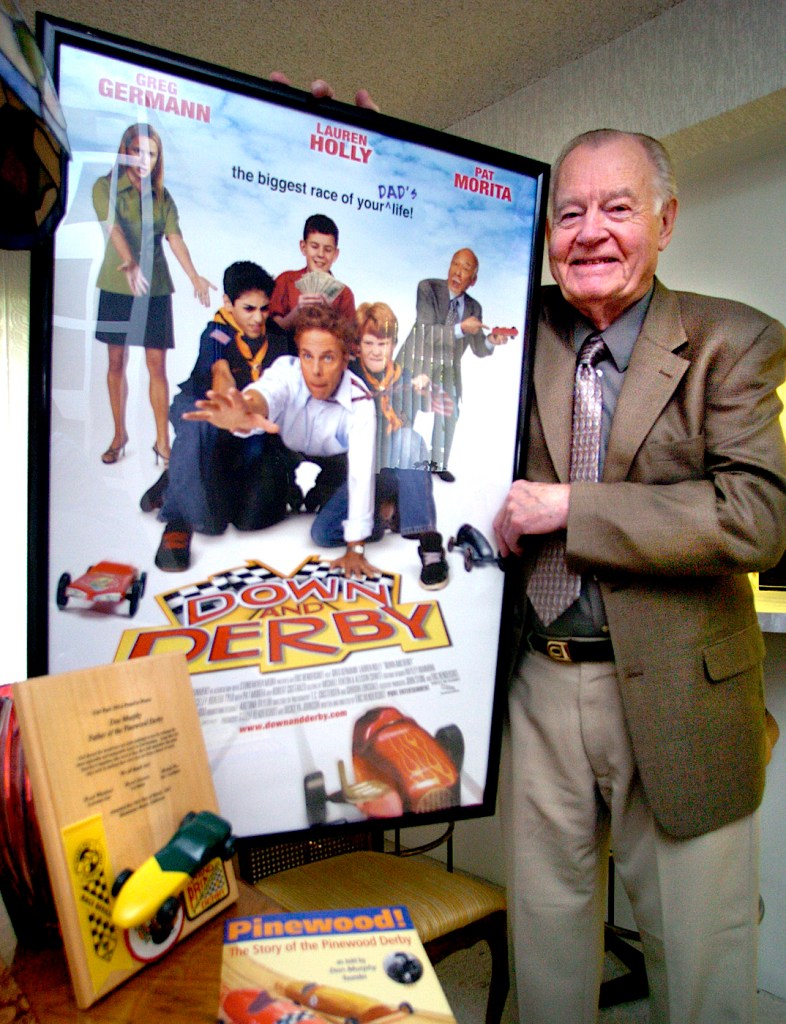
He even had a walk-on role in the movie comedy “Down and Derby,” a 2005 film about the phenomenon Murphy had started 52 years earlier.

Don Murphy, inventor of the Pinewood Derby, poses in 2005 next to a movie poster of the just-released film, “Down and Derby”, in which Murphy makes a cameo appearance. (Daily Breeze staff file photo)

Don Murphy died at 90 of pneumonia on July 1, 2008.

MacAulay summed Murphy’s life and ambitions up best when he told the Daily Breeze’s John Bogert at the time of his death:

“For Don it was never about money, it was about fathers and sons. He was an old-style gentleman, a thoughtful and kind man who was delighted that the boys were still racing and still enjoying themselves.”

And they still are.

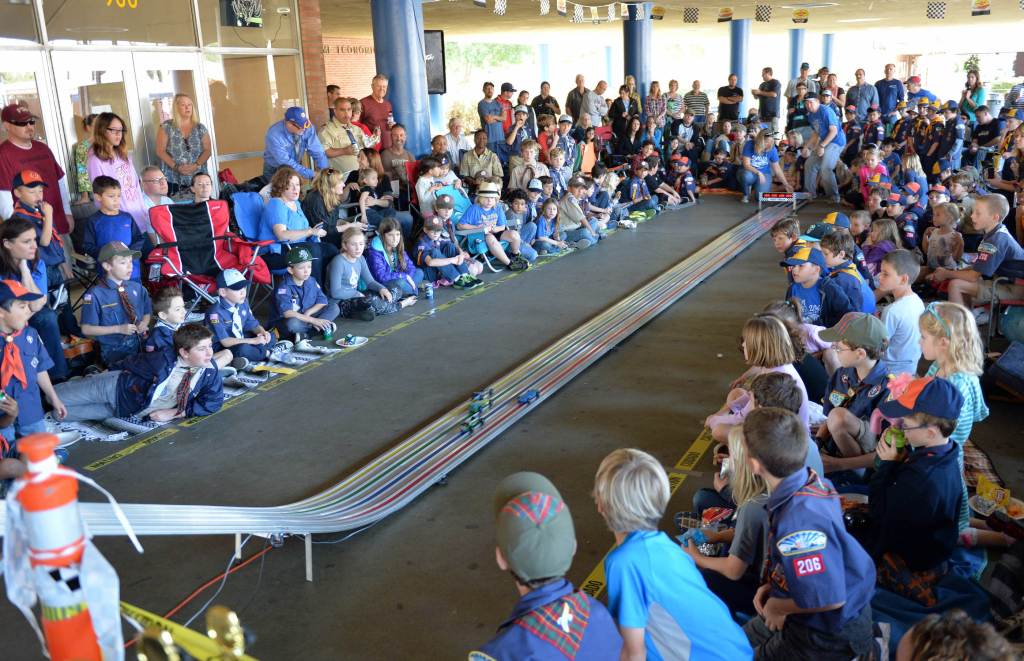
Excited scouts watch intently as Cub Scouts Pack 206 holds its annual Pinewood Derby race held at Millikan High School in Long Beach on Jan. 31, 2014. (Daily Breeze staff file photo)

Sources:

Daily Breeze archives.

“A Fascinating Look at the History of the Pinewood Derby,” by Brian Wendell, On Scouting website, Jan. 21, 2019.

Easy Reader archives.

Los Angeles Times archives.

Manhattan Beach Senior & Scout Community Center website.

“Pinewood Derby History Started with the First Race in 1953,” by Joe Gargiulo, PinewoodPro.com website.

Torrance Press Herald archives.

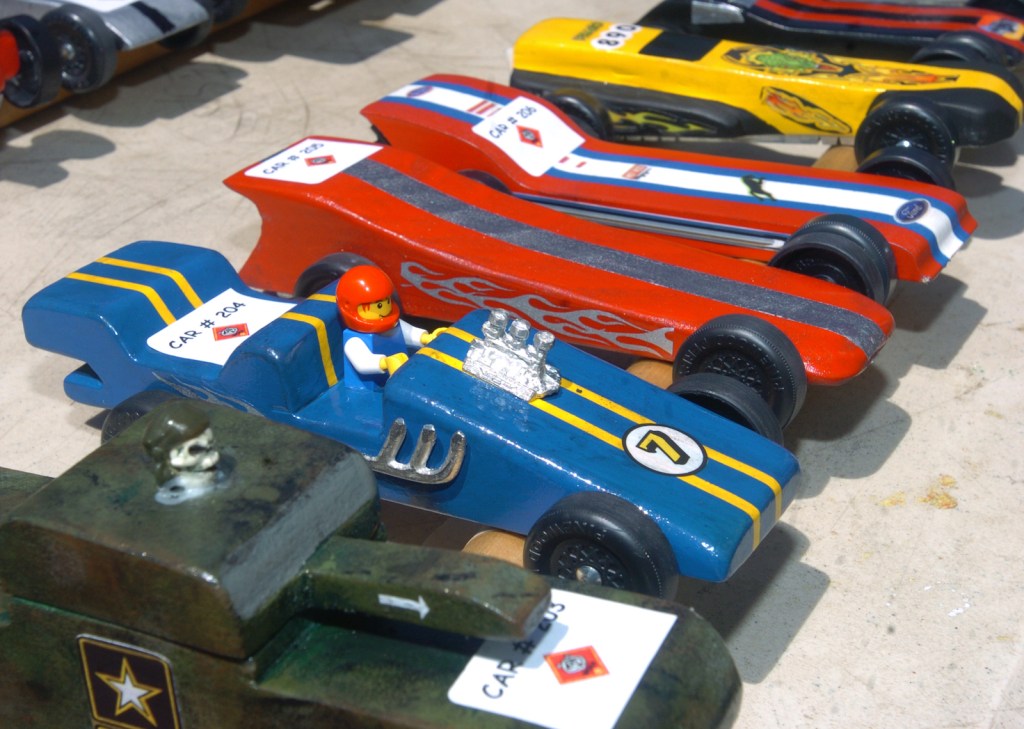
Cars line up to be raced during the 4th Annual Rio Hondo Summertime Pinewood Derby at Montebello Golf Course in Montebello on Aug. 18, 2007. (Southern California News Group file photo)

WPA art works have enlivened the Inglewood Post Office since the 1930s

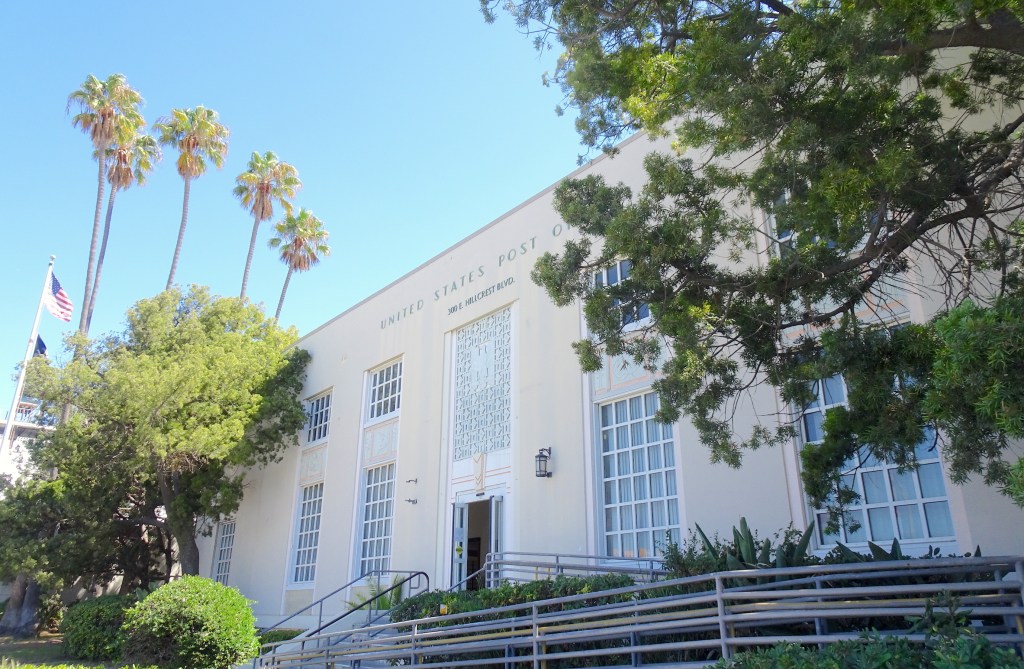
The Inglewood Post Office on Hillcrest Blvd. in September 2022. (Photo by Sam Gnerre)

One of the first entities created in the 1880s settlement that would become known as Inglewood was its post office.

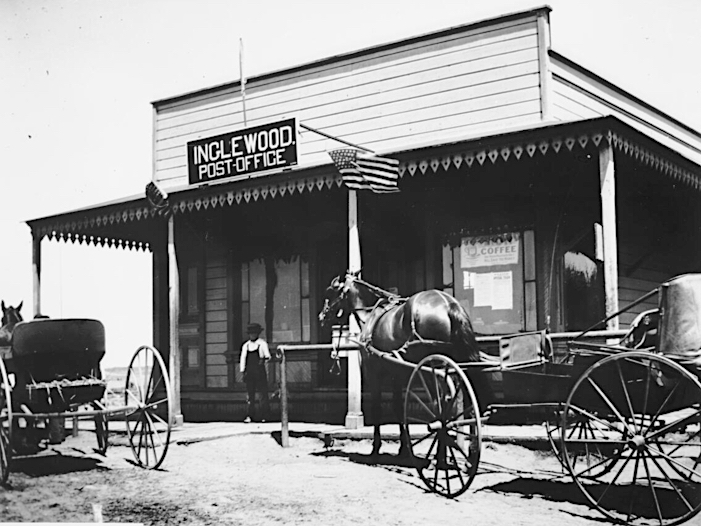
The “Centinela Post Office,” as its first sign read, operated out of the general store in which it had been established. President Grover Cleveland appointed store owner George Robbins as the settlement’s first postmaster in 1884.

Though local land baron Daniel Freeman would have preferred that the new town be called “Centinela,” Inglewood became its name upon its official founding in 1888. The post office sign was changed to reflect the new name.

Horse-drawn carriages in front of the first Inglewood Post Office, circa.1900. (Credit: USC Digital Library)

Inglewood officially incorporated in 1908. As the city grew, so did its need for a much larger post office. The old one suffered damage in the 1920 earthquake that shook the city.

So, with much fanfare, a brand new post office held its grand opening on Oct. 30, 1926. As that was Halloween eve, the gala opening doubled as a community Halloween celebration, its guests encouraged to arrive in costume.

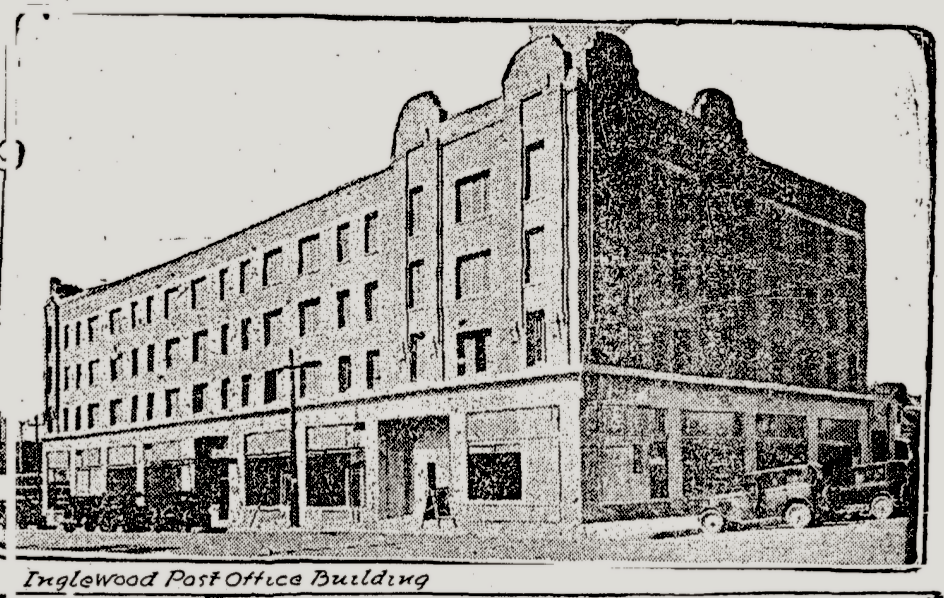
The new post office building in 1926. (Credit: Los Angeles Times archival database)

The imposing four-story building at the northwest corner of Queen and Locust streets cost $325,000 to build. It had 5,000 square feet of floor space and was considered to be “the most elaborate of any outside the largest cities of the State,” according to the Los Angeles Times.

Problems with the new building apparently arose over the next six years, as the U.S. Treasury Dept. announced in December 1932 that it had acquired land for a new post office at Hillcrest Blvd. and Kelso St. for $26,000.

One of the 1926 building’s problems became obvious following the Long Beach earthquake of 1933. The powerful temblor registered 6.4 on the Richter scale, severely damaging the Inglewood post office building.

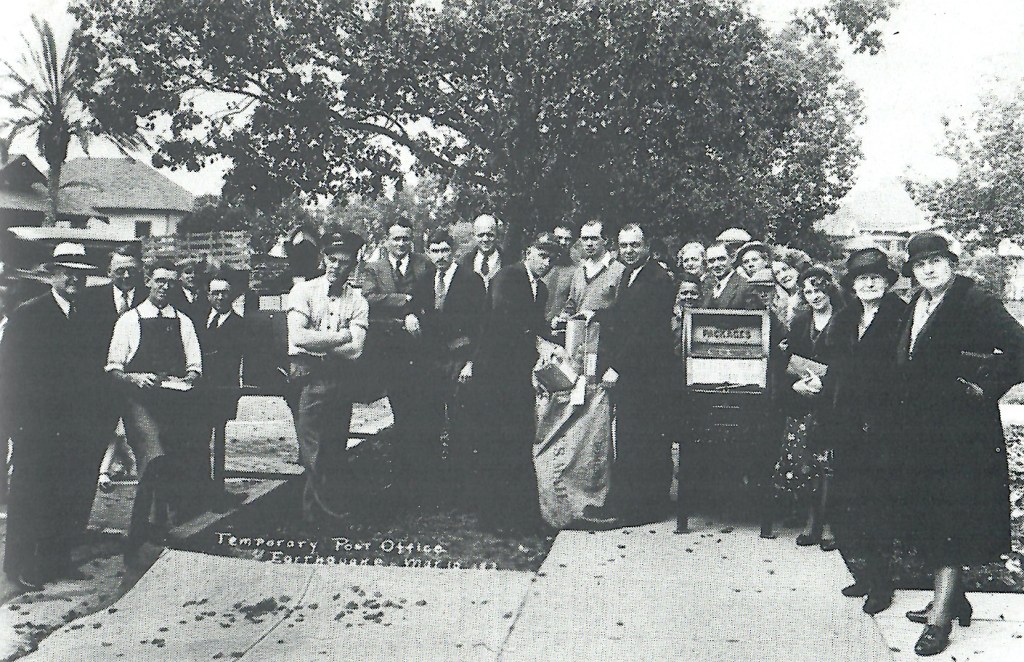
Thinking on their collective feet, Its employees set up an impromptu outdoor postal facility the day after the quake in order to continue to conduct business.

Inglewood Post Office employees at their impromptu outdoor facility the day after the 1933 Long Beach earthquake. (Credit: The History of Inglewood, by Gladys Waddingham, Historical Society of Centinela Valley, 1994)

One of the most important side effects of the 1933 quake was the California Legislature’s near-immediate passage of the Field Act, which mandated earthquake safety standards for schools and other public buildings in the state.

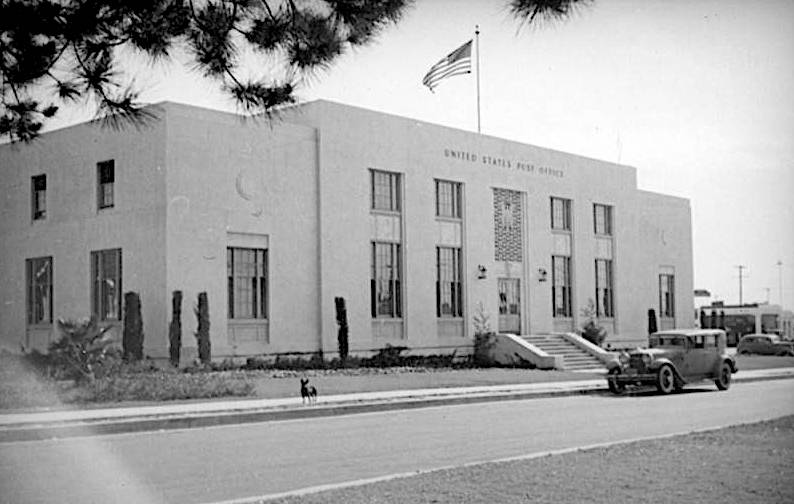
The $210,000 federal government project going up at 300 E. Hillcrest Blvd. adhered to those standards. The groundbreaking ceremony at the Streamline Moderne structure took place in April 1935, with several past postmasters – including George Robbins – present to hear Mayor Raymond Darby’s speech commemorating the event. The new post office building was completed later that year.

A flag flies over the Inglewood post office at 300 East Hillcrest Blvd, completed in 1935. Photo circa 1938. (Credit: Inglewood Public Library)

Management and construction of the project fell to the New Deal federal Works Progress Administration (WPA). In addition to the building itself, the WPA also funded two pieces of public art for the project. The Treasury Section of Painting and Fine Arts, founded in 1934, was put in charge of soliciting local artists for its indoor and outdoor works.

Hugo Ballin, a noted muralist of the era, had submitted drawings for proposed artworks at the Washington, D.C. post office. A couple of them showed riotous scenes of drunkenness and brawling during the California Gold Rush era, and the Treasury selected those two for the Inglewood post office, much to Ballin’s surprise. He turned down the offer, explaining that he had submitted them as a joke.

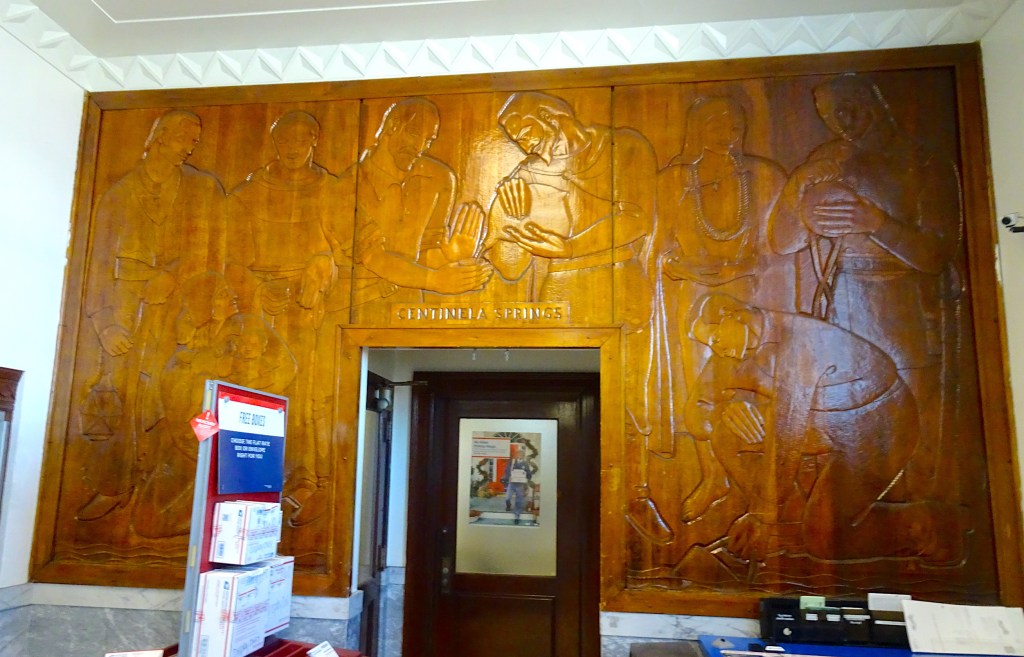
A more respectable entry for the interior mural by Archibald Garner then was chosen. The result, a wooden bas relief mural entitled “Centinela Springs,” depicted early California residents obtaining water from the nearby local spring.

Archibald Garner’s “Centinela Springs” sculpture inside the Inglewood Post Office in September 2022. (Photo by Sam Gnerre)

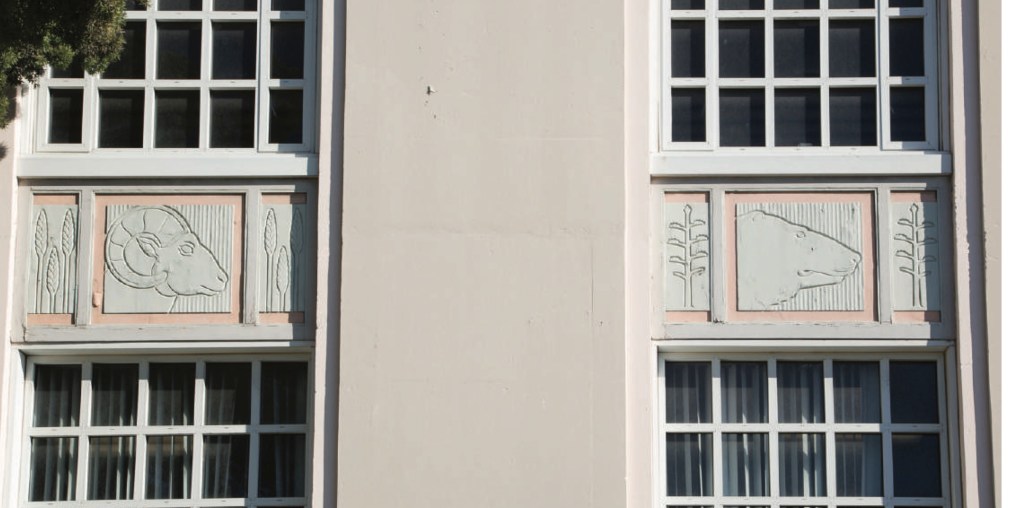
Artists Gordon Newell and Sherry Peticolas crafted the four plaster animal images from California wildlife – a buffalo, bear, ram and lion – on the building’s front exterior. Both the  interior and exterior sculptures were completed in 1937.

And that’s the central Inglewood Post Office that exists today, with only minor modifications.

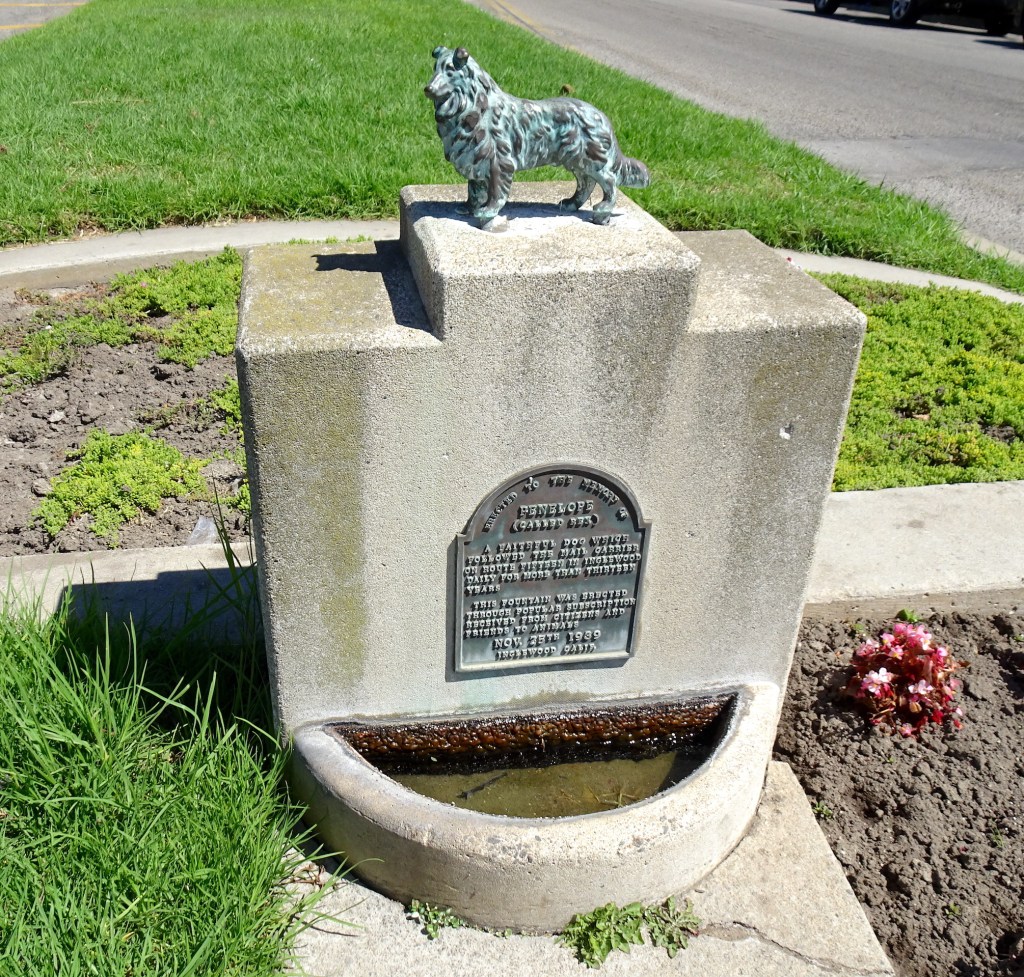
A third sculpture was added in front of the post office building in 1940. This one honored a local dog, Penelope, aka Rex. “Rex” followed mailman Lorenz Prader on his route every day for more than 13 years, dining on treats given by local residents along the way, and walking an estimated 60,000 miles in the process. 

The statue and pet fountain honoring Rex still stands in the median in front of the Inglewood Post Office. September 2022. (Photo by Sam Gnerre)

He died in 1939 after being hit by a car. Uniformed members of Prader’s VFW unit dipped their flags in tribute to Rex at the 1940 dedication ceremony. The bronze statue and granite pet fountain erected in his honor still stand.

For decades, the Inglewood Post Office also featured a stamp collector’s room inside the building, dedicated to serving the needs of serious philatelists as well as casual collectors. Budget cuts caused its closure in the early 2000s.

But at least its constructors got the building right in 1935. Much like the similar-in-design San Pedro Post Office, completed a year later in 1936, it endures as a window back to a bygone time while continuing to perform its functions in the modern era.

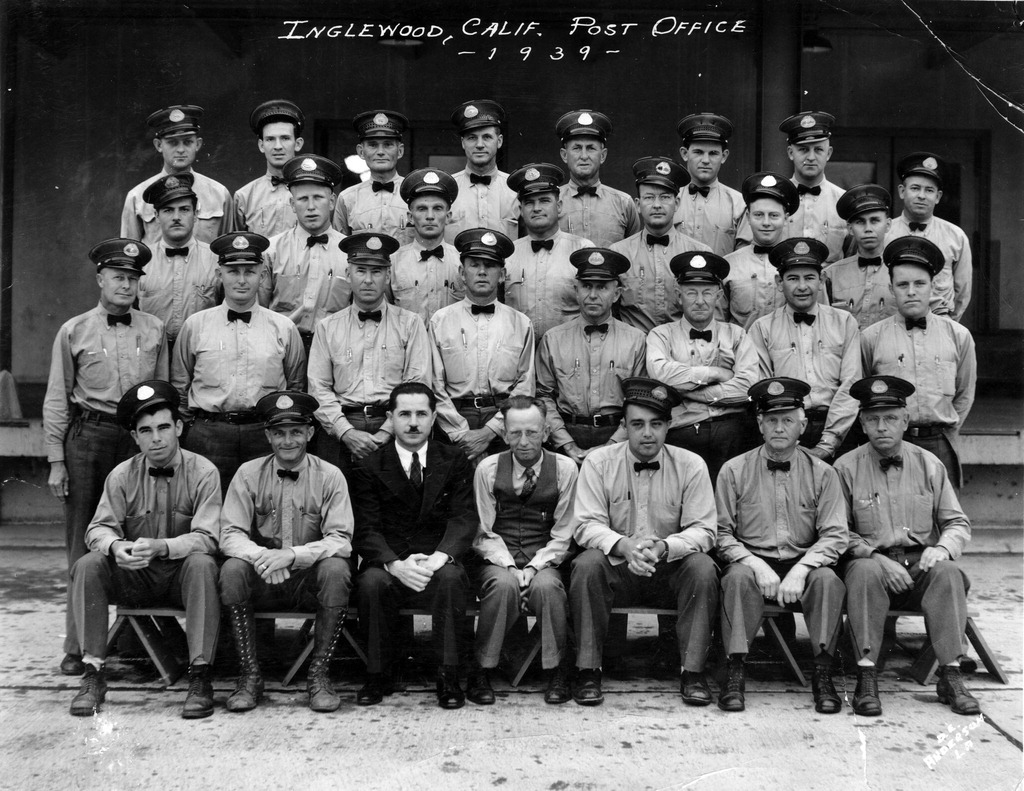
Group photograph of the Inglewood Post Office staff in 1939. The only identified person in the photo is Anthony Siminski, who stands on the left side, first in back row. (Credit: Inglewood Public Library)

Sources:

“The Centinela Springs / Lion Buffalo Ram + Bear / Monument to Penelope (Rex),” City of Inglewood Public Art Education Project website.

Daily Breeze archives.

The History of Inglewood, by Gladys Waddingham, Historical Society of Centinela Valley, 1994.

Los Angeles Times archives.

“Tile Mosaics at the Los Angeles Design Center,” by Vicky Kall, History, Los Angeles County blog, April 14, 2014.

“Post Office — Inglewood CA,” The Living New Deal website.

Detail photo shows the exterior ram and bear sculptures at the Inglewood Post Office. (Credit: City of Inglewood Public Art Education Project website)
Is this your new site? Log in to activate admin features and dismiss this message
Log In