The Del Aire area remains unincorporated despite decades of annexation attempts

Del Aire neighborhood sign. March 31, 2024. (Credit: Wikimedia Commons, Photo by Jengod)

Attempts to annex the unincorporated Del Aire area, located roughly between the cities of Hawthorne and El Segundo, began soon after houses started going up in the region in the late 1930s.

First, some geography. The Del Aire area as currently constituted consists of two roughly rectangular segments whose combined area totals just over one square mile. The 2020 U.S. Census counted 10,338 residents living there; as of July 1, 2025, that number was 9,958.

The top segment adjoins the eastern edge of Los Angeles International Airport and straddles the 405 Freeway. It stretches from 116th St. to El Segundo Blvd. on the north and south and Aviation Blvd. and Felton Ave. on the west and east. Los Angeles County opened the satellite Airport Courthouse in this section in December 1999.
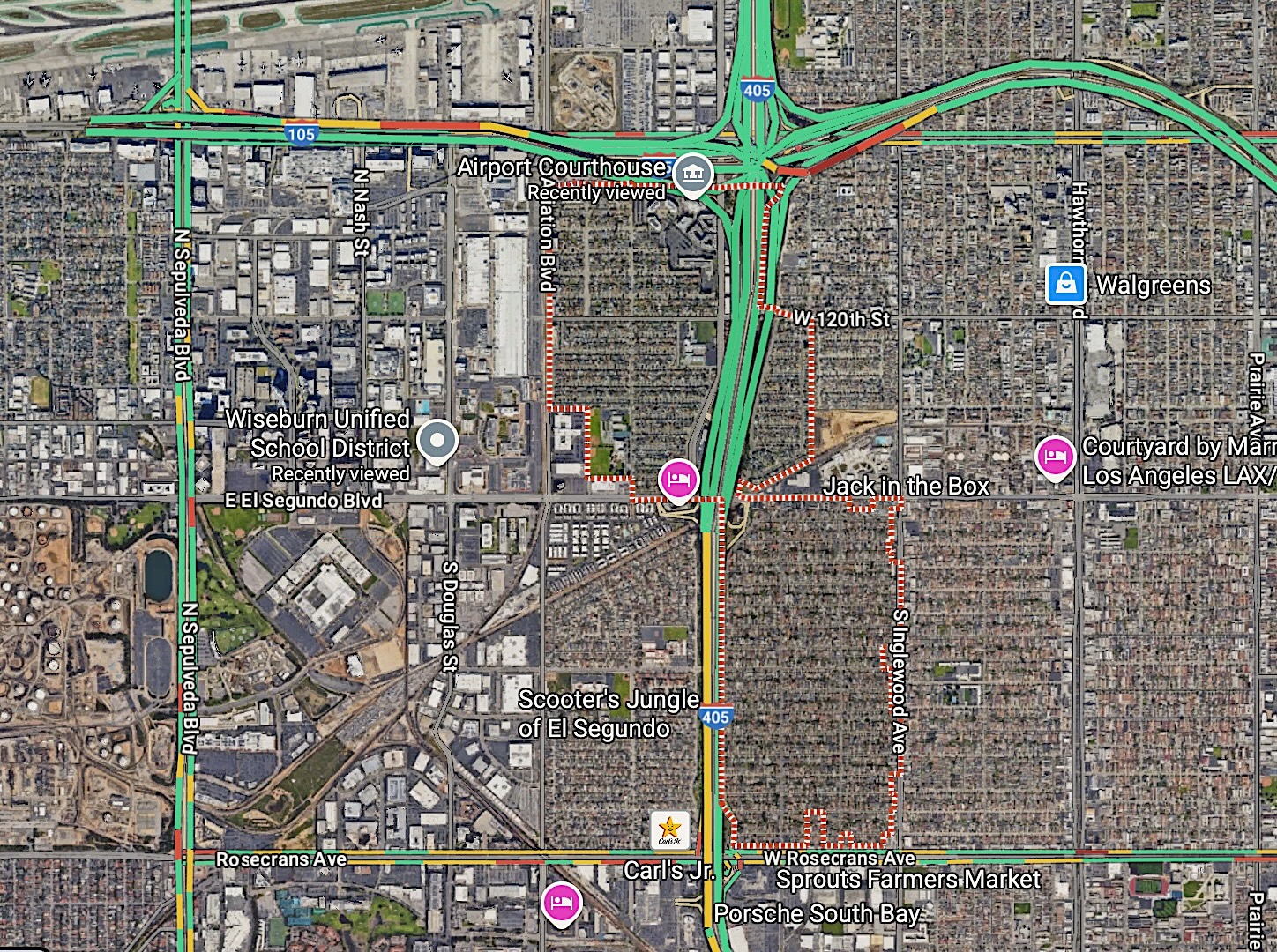
Del Aire is composed of the two rectangular dark-shaded areas, center, outlined by red and white borders. 2025 image. (Credit: Google Maps) (For a more detailed map, see here.)

The bottom segment, sometimes referred to as Liberty Acres, lies just east of the 405 between El Segundo Blvd. and Rosecrans Ave. on the north and south and Inglewood Ave. on the east.

Hawthorne took the first stab at grabbing the area in 1944, when the Hawthorne City Council called for a Sept. 26 election calling for its annexation. That measure didn’t come to pass, though the city did annex a relatively small 31-acre tract in July 1946 on which 217 homes were built.

Thus would begin a decades-long history of moves by Hawthorne to annex the area. Supporters announced the next serious attempt to give Hawthorne control of all of Del Aire in November 1947. At that time, the land in question contained approximately 1,400 houses and was half the total area of Hawthorne itself.

The movement called the northern section of Del Aire the Haynes Annexation, and the southern portion the Johnson Annexation, and the city set the election concerning the move for May 1, 1948. On that date, residents soundly rejected the measure with 632 voting against and 248 voting for it.
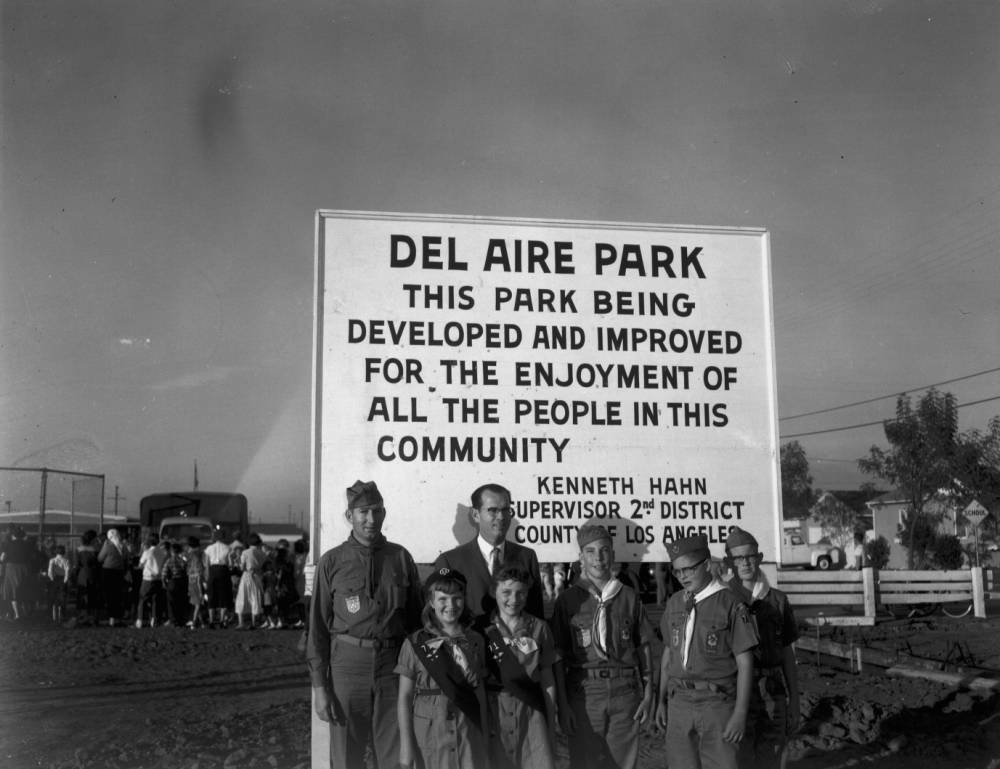
Supervisor Kenneth Hahn (back row, second from left) and a group of scouts at the groundbreaking ceremony for additional facilities at Del Aire Park in 1961. (Credit: Los Angeles County Library photo collection)

After that defeat, the annexation attempts slowed down during the 1950s. In the meantime, Los Angeles County Supervisor Kenneth Hahn set about making civic improvements in the area.

These included the announcement of a branch of the Los Angeles County Library in October 1955 in Del Aire. The Wiseburn branch, established a year later at 11936 Aviation Blvd. originally was a rented storefront. The county replaced it with the free-standing Wiseburn Branch Library building that opened at 5335 135th St. in 1966.

In November 1956, Hahn began acquiring land for a seven-acre county regional park at 126th St. and Isis Ave., that eventually would include a community building and gymnasium in addition to recreational facilities.

The resulting Del Aire Park has become an important community resource serving a variety of users since opening in 1958. The park benefitted from a major upgrade in 2012, with revamped play areas, basketball courts, and a new community center and gym.
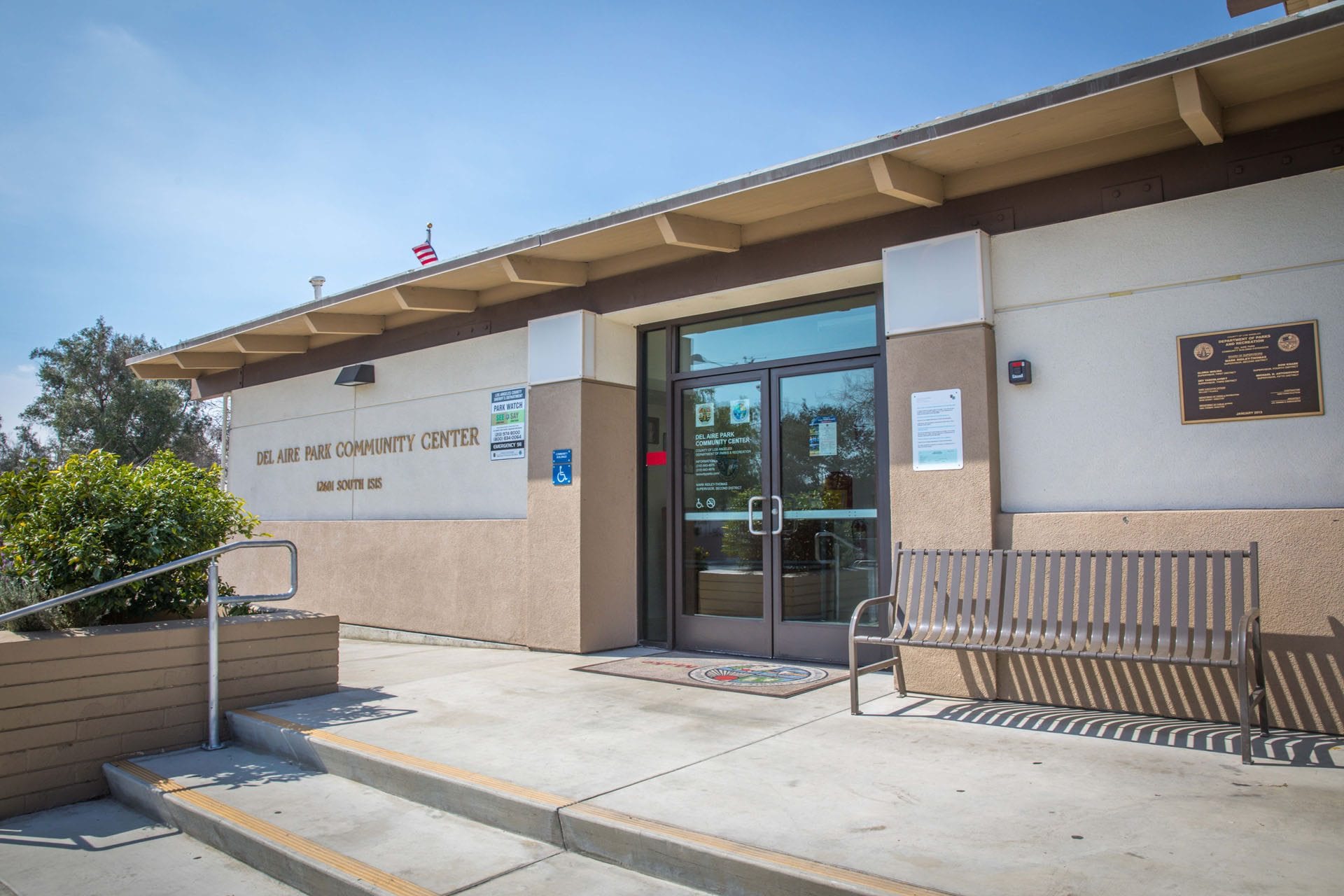
The new Del Aire Park Community Center opened in 2012. (Credit: Los Angeles County Parks & Recreation website)

In 1960, residents of Del Aire started a movement to incorporate as their own independent city, to be given the name Juan De Anza after the 18th century Spanish pioneer who directed expeditions in California and what would become New Mexico. Aimed at warding off outside annexation, the attempt at self-incorporation ultimately failed.

After that effort fell through, Hawthorne tried again to annex Del Aire, slating an Aug. 15, 1961 election on the measure. The final vote total was 150 for, to 140 against. 

Success at last? Not so much. Opponents immediately took the matter to court, claiming in their legal action that Hawthorne used inaccurate property valuations in its incorporation filings and asking that the subsequent election be invalidated. The judge agreed, and as a result, the annexation failed to go through.

Hawthorne kept at it with new attempts in 1969, 1972 and 1983, but each time, Del Aire residents refused to go along with annexation to the city. As of this writing, Del Aire remains unincorporated.
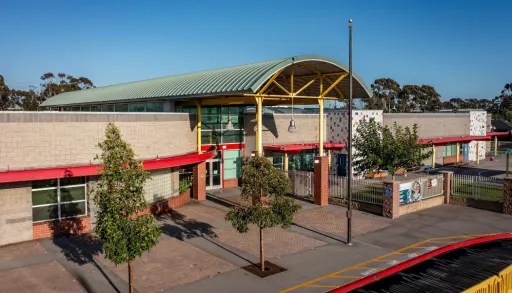
Del Aire Elementary School on Hindry Ave., undated photo. (Credit: Wiseburn Unified School District)

School-age children in Del Aire attend schools in the Wiseburn Unified School District, a small but highly respected district originally founded in 1896. In addition to the Wiseburn area itself, the district also includes the Del Aire and Holly Glen areas.

As with other such unincorporated areas, mailing addresses can be fluid, and confounding. The U.S. Postal Service does not always make its zip code areas contiguous with city boundaries. Residents wishing to change that have to present a compelling case to the USPS in order to change their zip code.

The USPS generally considers Del Aire part of its Hawthorne service area, but the northernmost chunk of Del Aire between 116th and 120th streets has been assigned a Lennox zip code and an Inglewood mailing address even though it’s not physically connected to either community.

Over the years, some Del Aire residents have pushed for it to become part of El Segundo, but that city has expressed little interest in the idea. On the other hand, Hawthorne has pursued the  annexation of Del Aire on at least five separate occasions, but its resilient residents have actively resisted that move for decades.

Note: Thanks to reader Tyson Lee for the story suggestion.
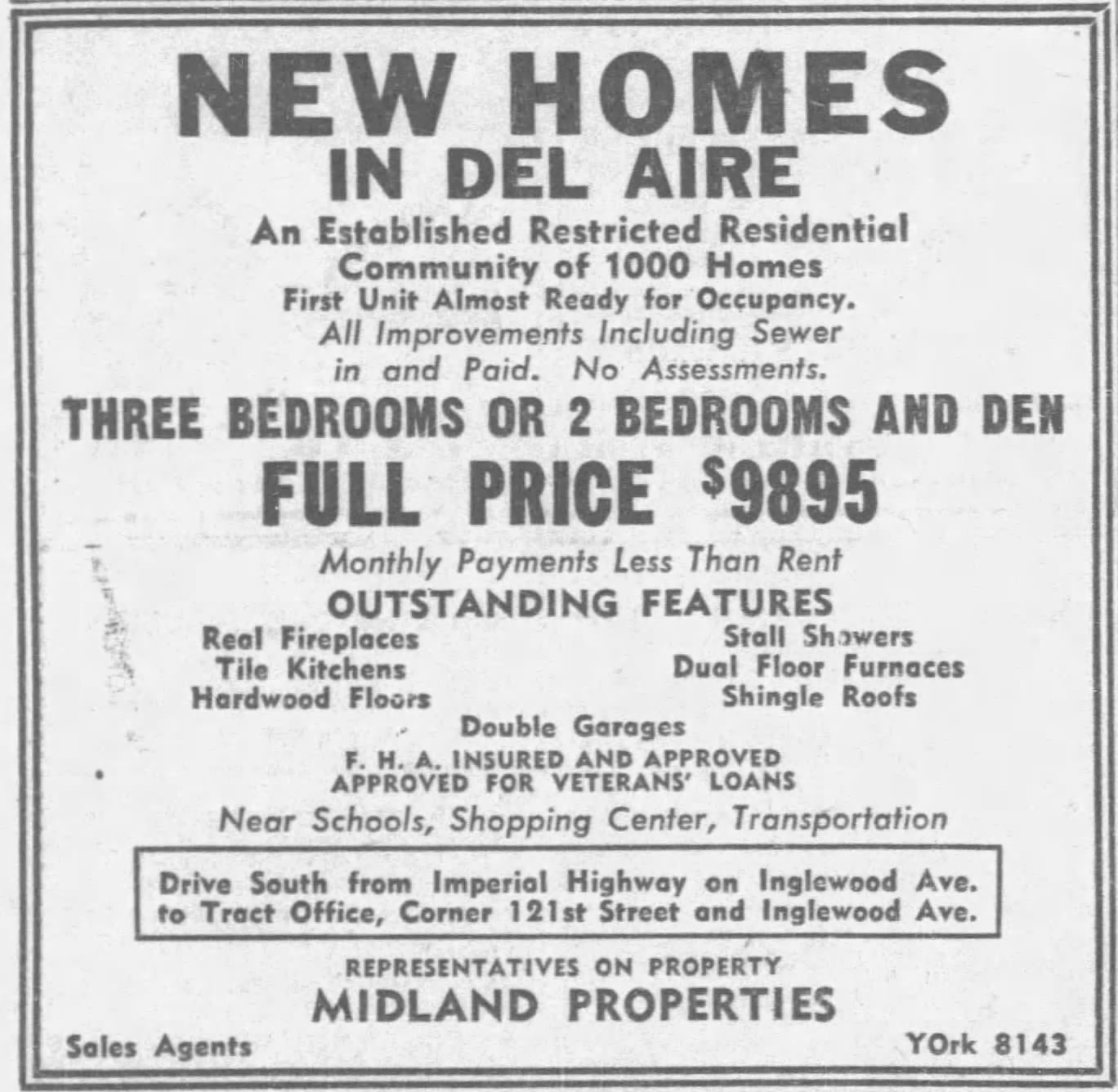
Los Angeles Times ad, Aug. 31, 1947, Page 10. (Credit: Los Angeles Times archives)

Sources:

Daily Breeze archives.

“Del Aire, California Profile: Facts and Data,” HomeTown Locator website, 2025.

Los Angeles Times archives.

Winning Wiseburn: How a Small California School District Beat the Odds, by Jean Merl, 2024.
Why Assemblyman Vincent Thomas deserved having a bridge in his name

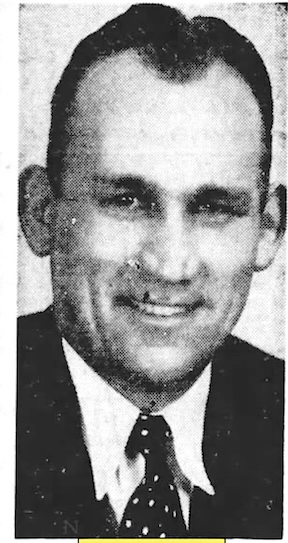
When Vincent Thomas was 16, he used his boxing skills – he earned $2.50 per fight – to help support his family.

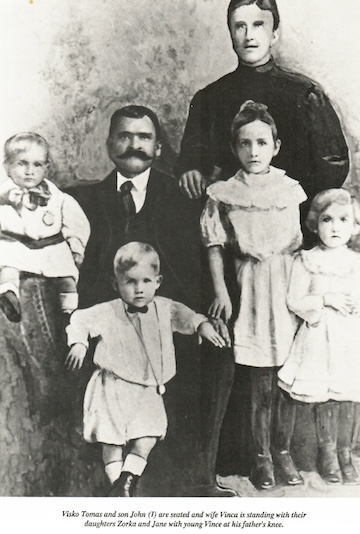
A young Vincent Thomas stands in front of his father, Visko, sitting, and mother, Vinca, standing at right in this mid-1910s photo. Also from left, son John, seated, and daughters Zorka and Jane, standing. (Credit: San Pedro Bay Historical Society)

His parents, Visko and Vinca Tomas (shortened from Tomasevich) arrived from Croatia in eastern Europe in 1903. They were living in Biloxi, Mississippi, when Vincent, one of eight children, was born on April 16, 1908.

Visko got a job with the Southern Pacific Railroad in Oakland and the family moved there before World War I. In 1918, the family visited San Pedro, where Visko died at 45 after he contracted the then-rampaging Spanish flu.

That left Vinca, a diabetic, to raise a houseful of children in San Pedro. Four of them moved in with Vince’s older sister Zorka, and her husband Tom, a fisherman.

Vincent attended Fifth Street School in San Pedro, where his surname was recorded as Thomas. He and his brothers and sisters kept the new spelling.

While attending San Pedro High School, Thomas’ athletic ability was noted by the school’s football coach, Carl Haney, who encouraged him to participate in sports, including boxing. Thomas remained a boxing fan his entire life.

He also acquired the nickname “Snake Oil,” for a rubdown compound for athletes that he made and sold while in high school. He became an Ephebian, joining the organization that valued youth education and social service.

He was granted a scholarship to the University of Santa Clara upon graduating in 1928. He earned his bachelor’s degree there in philosophy in 1932. He earned his law degree from Loyola University in 1936, but decided not to practice law.

Vincent Thomas circa 1940. (Credit: San Pedro News Pilot file photo)

He worked for French Sardine, the Terminal Island company that later became Star-Kist Tuna, and also did some lobbying in Sacramento for the fishing industry. His talents were recognized by executives at French Sardine, who encouraged him to run for state assemblyman in 1940.

Thomas, a lifelong San Pedro booster, ran on the idea that the town should secede from the City of Los Angeles and take back the Port, claiming that the big city 22 miles to the north often ignored Pedro’s unique needs.

He pointed to the 32 years it took the city to make the Municipal Ferry between San Pedro and Terminal Island a reality. The ferryboat moving workers to and from their jobs on Terminal Island opened in 1941; San Pedro became part of Los Angeles in 1909.

Local voters were in tune with Thomas’ ideas, and he won the Assembly 68th District seat by a margin of more than three-to-one in the Nov. 5th election.

He immediately joined several Assembly committees, most notably the Pacific Marine Fisheries Commission. He served as an advocate for the fishing industry for the rest of his tenure.

Speaking of that tenure, it would become, and remains at 38 years, the longest term of service in California State Assembly history. He won 19 consecutive two-year terms there before losing the seat to Gerald Felando in 1978.

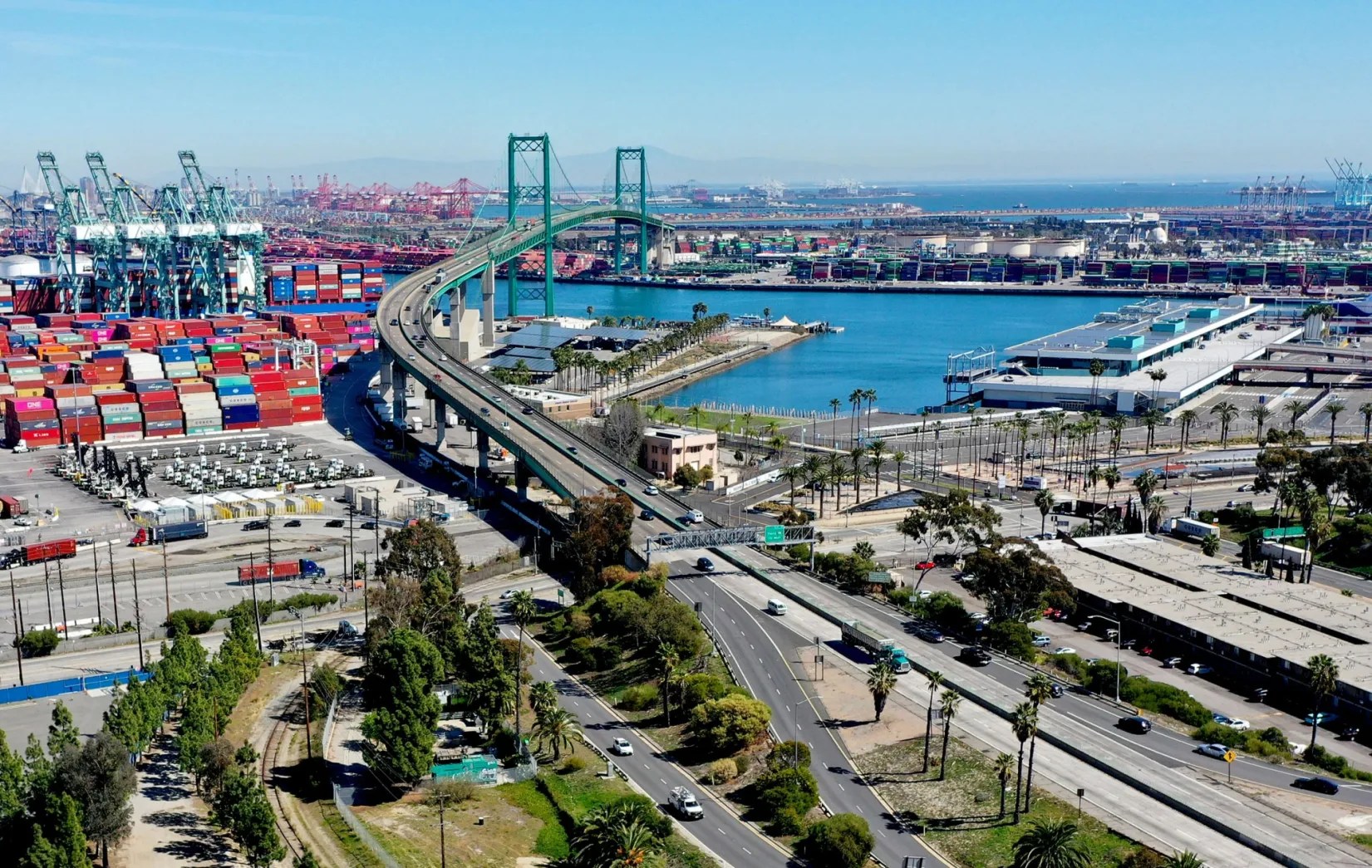
His most memorable accomplishment turned out to be the $21 million, 6,050-foot-long suspension bridge across the Port’s main channel that bears his name. The Vincent Thomas Bridge opened to traffic on Nov. 15, 1963. 

The Vincent Thomas Bridge in 2021, looking east toward Terminal Island and Long Beach. (Daily Breeze file photo by Dean Musgrove/SCNG)

Detractors called it a boondoggle and “the bridge to nowhere” during Thomas’ years-long struggle to get it built. In the end, collected tolls from bridge users paid for the bridge after 21 years instead of the projected 40 years.

It wasn’t always planned as a bridge, though. Ever since the early 1920s, the prevailing opinion was that the project connecting San Pedro to Terminal Island would consist of tunnels under the main channel, not a bridge over it.

Legislation to build the underground passage was first proposed in 1938, but failed to advance. Thomas authored a series of bills between 1948 and 1957 paving the way for tunnel construction. After they all had passed, state engineers pointed out to Thomas that a bridge over the channel wouldn’t cost much more than funding the tunnels. By 1958, he’d pivoted, launching the bridge plan instead.

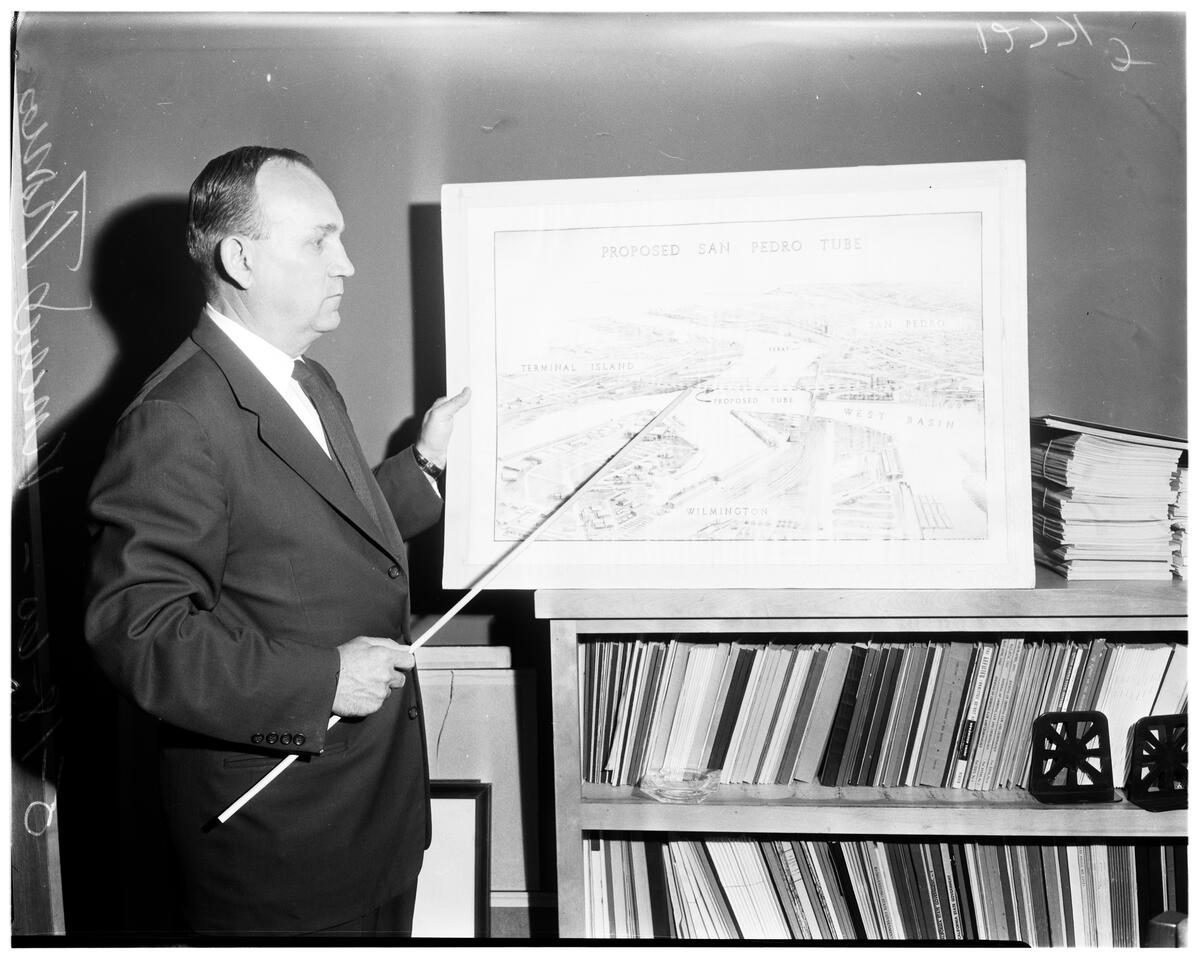
Assemblyman Vincent Thomas points out drawing of proposed San Pedro tube between San Pedro and Terminal Island in this May 18, 1960 photo. He spearheaded the drive for underwater auto-truck tube between San Pedro and Terminal Island, and later championed the plan for a bridge project for on which construction began in 1960. (Credit: USC Digital Library)

In 1961, the state authorized naming the span “The Vincent Thomas Bridge,” after its longtime champion, a rare case of naming a government structure after a still-living person. The bridge is currently undergoing a roadway refurbishing project estimated to cost $706 million.

The building of the bridge also led to the extension of the 110 Freeway further into San Pedro in order to link it to the bridge. The 110 was originally planned to end at Pacific Coast Highway.

Thomas was disappointed and surprised by his 1980 loss to Felando. He had hoped to complete 40 years of service in the Assembly, but had to settle for 38.

Vincent Thomas died of a heart attack at 1:10 a.m.on Jan. 31, 1980. He was 72. He was survived by his wife Mary DiCarlo of the DiCarlo Bakery family, whom he had married in 1947, and their two children, Mary and Vincent Jr.

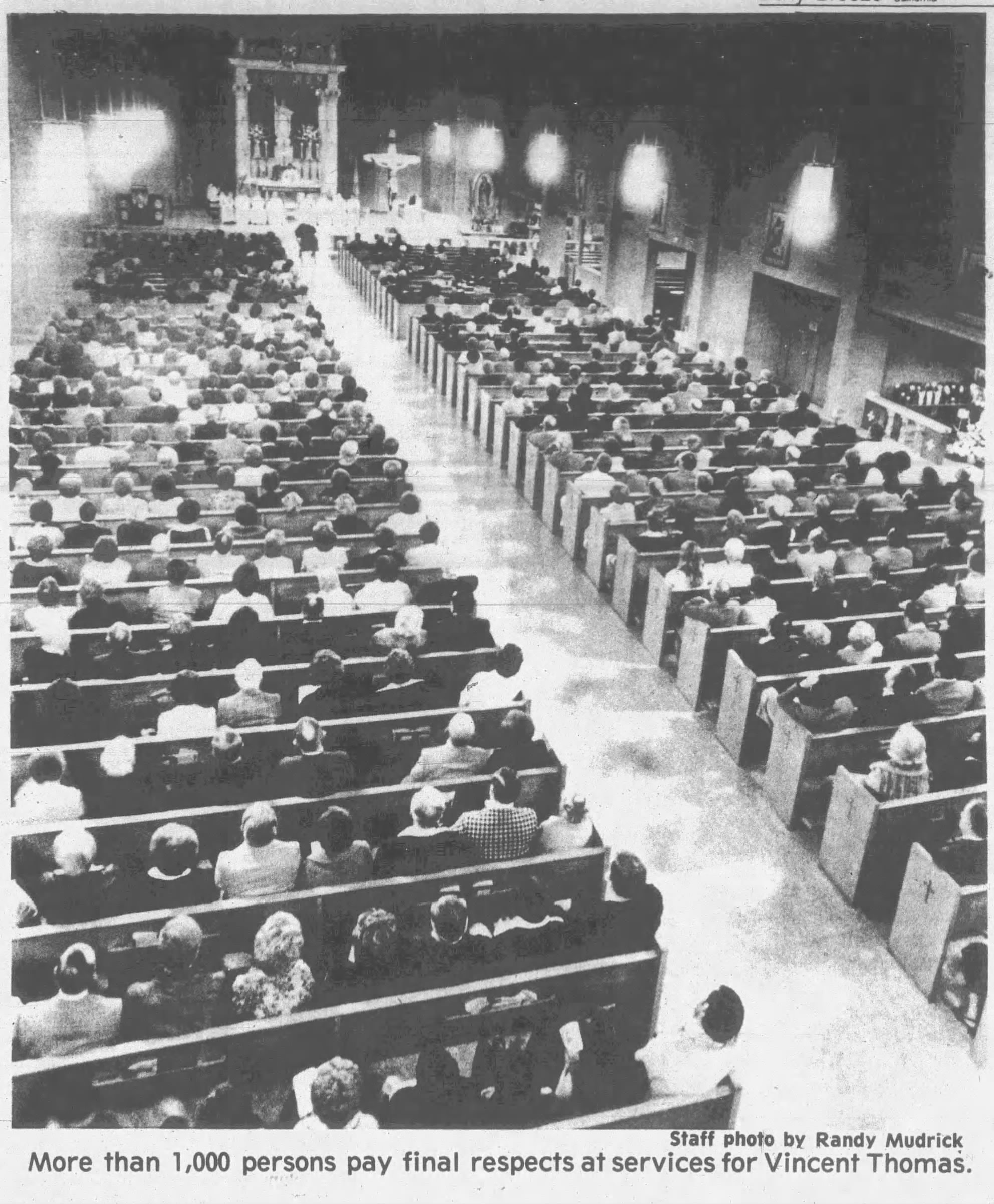
Following his death, tributes to him and his nearly four decades of public service poured in from around the state and from then-President Ronald Reagan. More than 1,000 people packed Mary Star of the Sea Catholic Church for his funeral.

One of Thomas’s many accomplishments was the upgrading of boxing industry conditions in the state, and the provision of pension benefits for its practitioners. At the time of his death, he was working on the establishment of a local boxing museum.

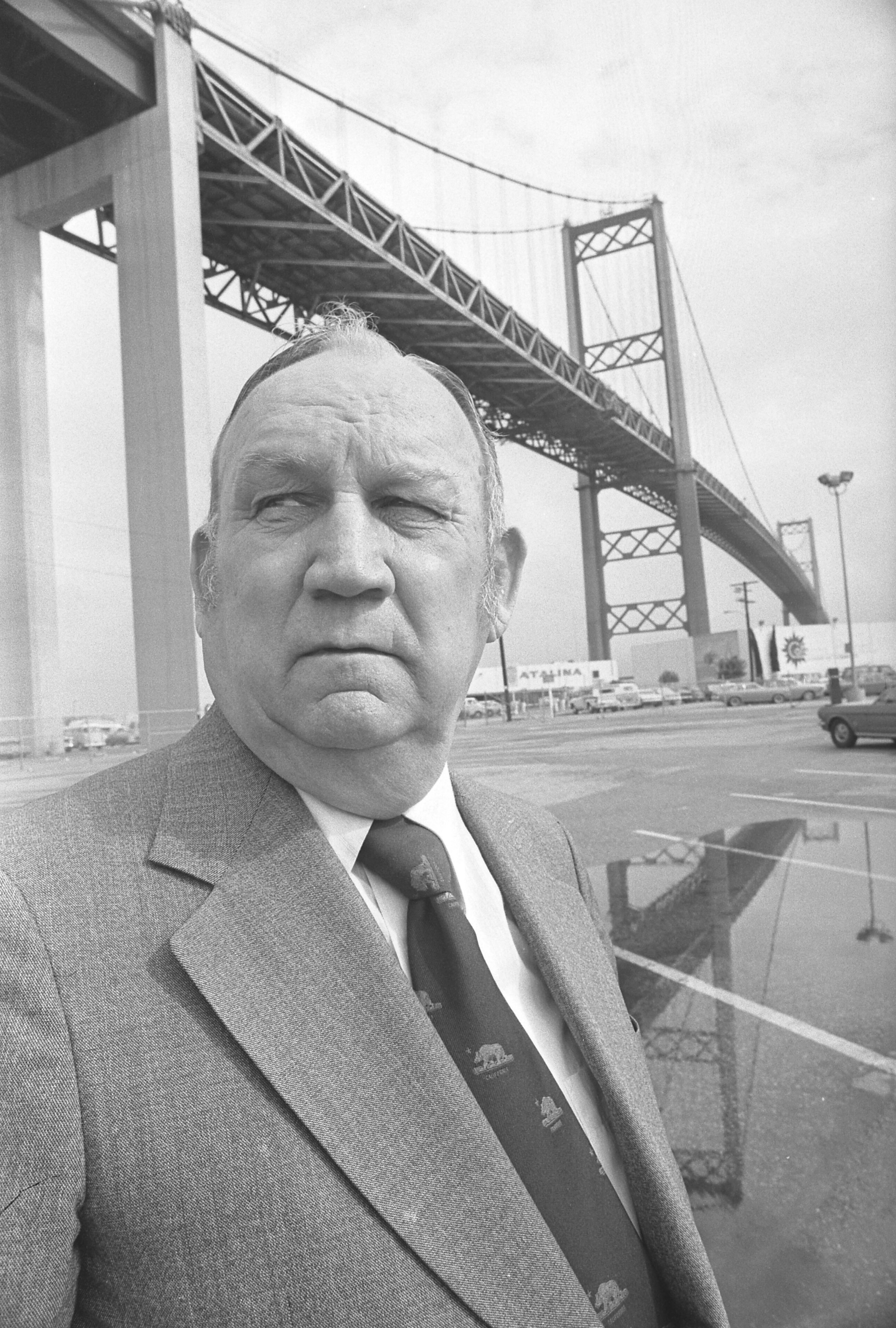
Assemblyman Vincent Thomas stands under the Vincent Thomas Bridge on Nov. 11, 1978. (Credit: UCLA Library Dept. of Special Collections)

Sources:

Daily Breeze archives.

San Pedro News Pilot archives.

The Vincent Thomas Bridge: San Pedro’s ‘Golden Gate,’ San Pedro Bay Historical Society, 1988. 48 pages.

Wikipedia.

Daily Breeze, Feb. 4, 1980, Page 3. (Credit: Daily Breeze archives)

Note: The place of origin of Vincent Thomas’ parents has been changed from “Yugoslavia” to “Croatia,” as Yugoslavia did not exist as a country until 1929. Thanks to reader Joseph McGrath for the correction.

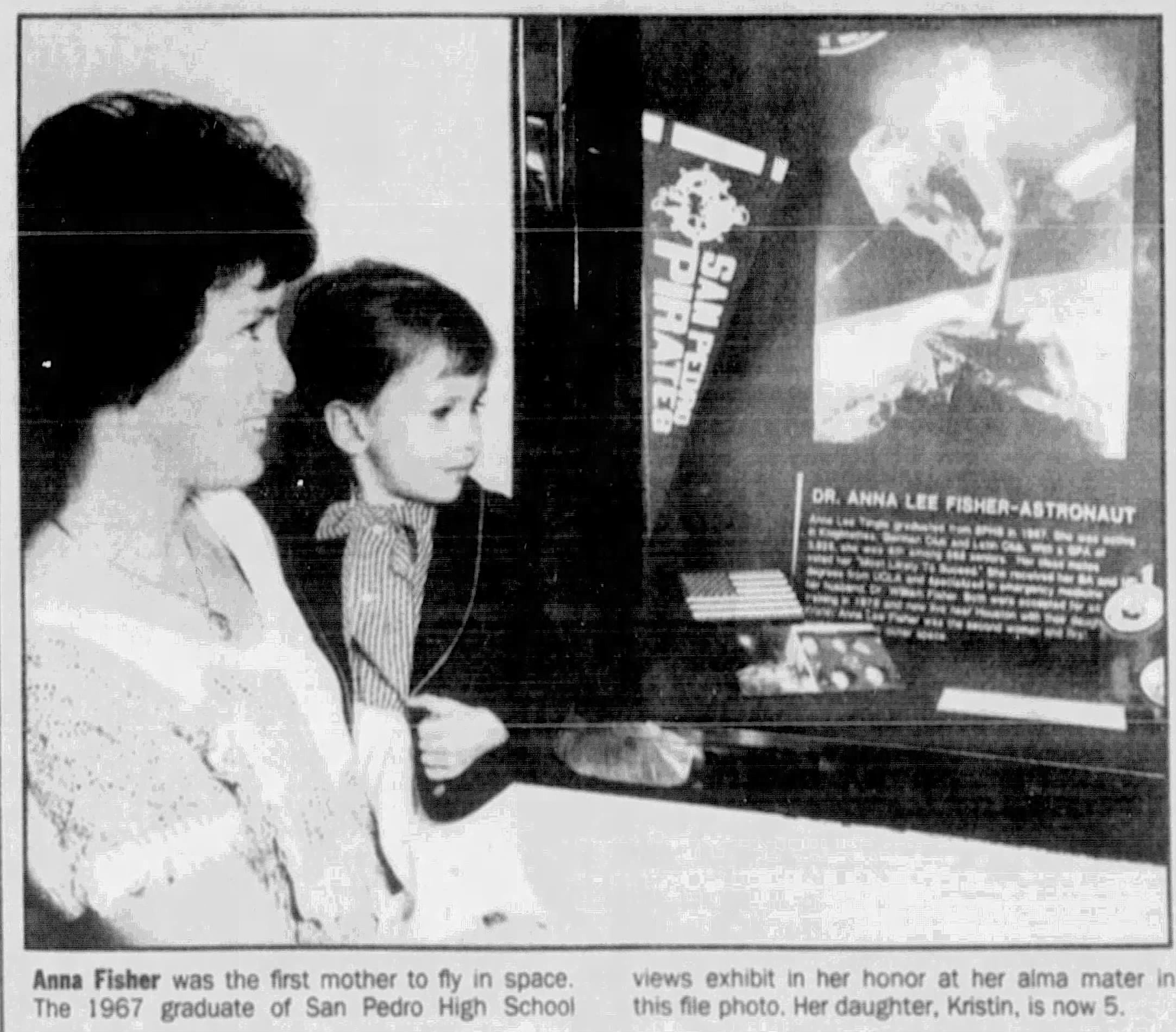
Astronaut and San Pedro High grad Dr. Anna Fisher became the first mother to fly in space

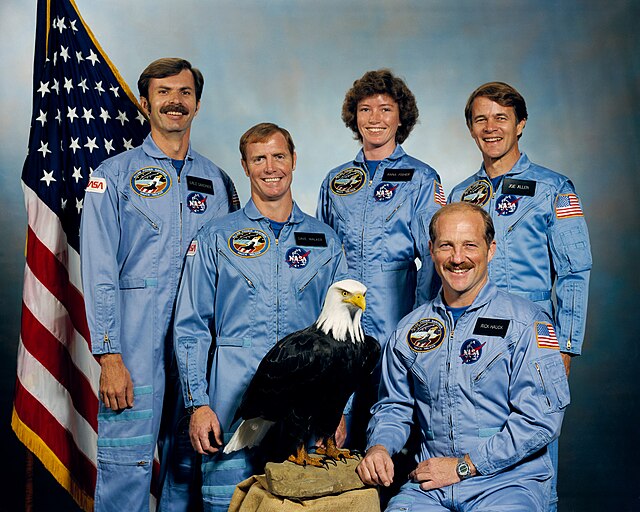
The crew assigned to the STS-51A Space Shuttle Discovery mission included Frederick H. Hauck, commander, seated right. Standing, left to right, are Dale A. Gardner, mission specialist; David M. Walker, pilot; and mission specialists Anna L. Fisher, and Joseph P. Allen. 1984 photo. (Credit: NASA/Wikimedia Commons)

Anna Lee Fisher decided that she wanted to be an astronaut on May 5, 1961.

On that day, Alan Shepard became the first American to reach space during a 15-minute flight that took him 116 miles above the Earth before his capsule returned him to a landing in the Atlantic Ocean.

Nearly two decades before NASA even considered the possibility of having women astronauts, Fisher, then an 11-year-old attending school in Kentucky, vowed in the face of very long odds to become one.

Fisher was born Anna Lee Tingle in Albany, New York on Aug. 24, 1949. Her father was a US Army sergeant, and she lived the nomadic  life of a military brat for the first dozen years of her life. Every couple of years brought a new town and a new school.

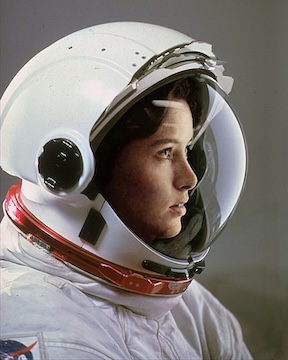
NASA astronaut Anna Lee Fisher, circa January 1978. (Credit: NASA/Wikimedia Commons)

When she was 13, her family finally settled in San Pedro, where she enrolled in Dana Middle School. She was a fine student who excelled in math and science at Dana. 

She did the same at San Pedro High School, where she graduated third in her class in 1967 and was voted “most likely to succeed.” (The school honored her with a permanent plaque on campus at a December 1984 ceremony.)

While attending San Pedro High, she volunteered as a candy striper at Harbor General Hospital, now known as Harbor-UCLA Medical Center and located on unincorporated Los Angeles County land just east of Torrance.

After graduation, she attended UCLA. She first majored in math, but then switched to chemistry, earning her bachelor’s degree in the subject in 1971. She found the job prospects in chemistry wanting, so she decided to enroll in medical school at UCLA instead.

She was admitted and decided to return to Harbor General for her internship. While at Harbor, she met another intern, Bill Fisher, who was a year ahead of her in the program. On their first date, they discovered that they both dreamed of becoming astronauts.

She earned her medical degree from UCLA in 1976, and completed her internship at Harbor in 1977.

In June 1977, Bill Fisher found out from a friend that NASA was about to recruit a new group of astronauts, and was encouraging women applicants for the first time. He immediately told Anna, to whom he was now engaged. They had to move their planned wedding up a week in order to apply.

Five astronaut candidates take a break from training at a three-day water survival school held near Homestead Air Force Base, Florida.. Left to right: Sally K. Ride, Judith A. Resnik, Anna L. Fisher, Kathryn D. Sullivan and Rhea Seddon. August 1978 photo. (Credit: NASA/Wikimedia Commons)

Anna became Mrs. Bill Fisher in a ceremony held at Wayfarers Chapel in Rancho Palos Verdes on Aug. 23, 1977. (The church had to be disassembled in 2024 due to land instability and remains closed.)

The Fishers flew to Houston for the interviews and evaluations. In January 1978, Anna learned that she had been selected for training in the group that also included future astronaut Judith Resnik, who worked for Xerox Corp. in El Segundo. The two became friends.

The couple moved to Houston later in 1978. Bill Fisher was not selected until 1979, at which point the Fishers became the first husband and wife to be admitted to the astronaut training program.

Anna worked at a variety of support jobs for NASA while awaiting assignment to a space flight crew. She was a “Cape Crusader,” the nickname given to those astronauts on the ground who worked giving direct support to space missions. During this time, she became involved with the testing of the Canadarm remote control device, among many other projects.

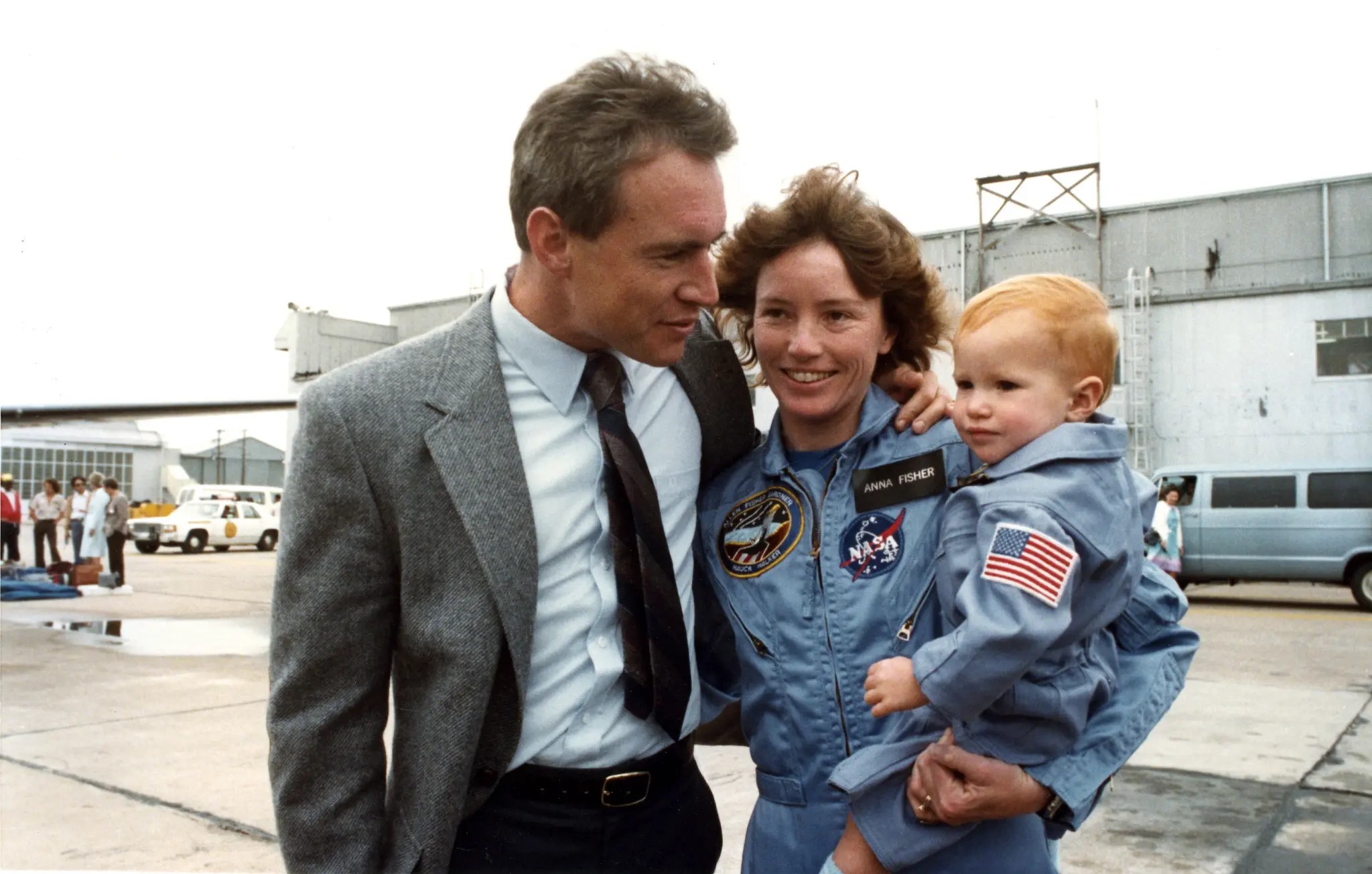
Married astronauts Bill and Anna Fisher with their daughter, Kristen, in 1984. (Credit: NASA/Wikimedia Commons)
She became pregnant in 1982, and had her daughter, Kristen Anne, on July 29, 1983. She had made NASA aware of her intentions to raise a family while pursuing her career, and was assured that it would not affect her standing in the program.
On June 28, 1983, Sally Ride became the first female in space aboard Space Shuttle Challenger. In September 1983, NASA announced that Anna would become the first mother to go into space when she was slated to serve as the flight engineer aboard a Space Shuttle Discovery mission scheduled for Aug. 1, 1984.

When reporters asked her how she felt leaving her daughter to participate in the space flight, she pointed out that several of the male crew members were doing the same thing with regard to their children.

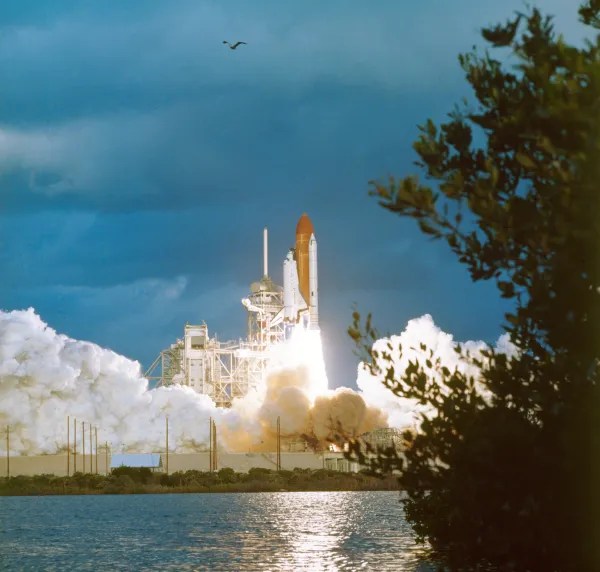
Space Shuttle Discovery launches on Nov. 8, 1984, with Anna Lee Fisher aboard. (Credit: NASA/ Wikimedia Commons)

The Discovery launch took place on Nov. 8, 1984. Officially known as Mission STS-51A, it was the spacecraft’s second space flight. One of the mission’s chief tasks was the recovery of two failed satellites that had been abandoned during an earlier mission. 

Anna used the Canadarm device, but it was unable to retrieve them. It took a space walk along the device’s arm by Joseph Allen to secure the satellites successfully for return to earth.

Anna was scheduled for a second mission in June 1986, but it was canceled following the Space Shuttle Challenger disaster in January 1986. 

The Discovery mission would be the only one on which she flew, but she spent several years closely involved with NASA projects, especially the International Space Station. She had a second child, Kara Lynne, in 1989, and she and Bill Fisher divorced in 2000.

She retired from NASA in 2017, but continues to make public appearances. Through it all, she has always claimed San Pedro as her hometown, and has participated in several community  events there over the years. She also does motivational speaking at the Johnson Space Center in Houston, near where she now lives.

San Pedro News Pilot, Sept. 13, 1988, Page 1. (Credit: San Pedro News Pilot archives)

Sources:

Daily Breeze archives.

Los Angeles Times archives.

San Pedro News Pilot archives.

The Six: The Untold Story of America’s First Women Astronauts, by Loren Grush, Scribner, 2023.

Wikipedia.

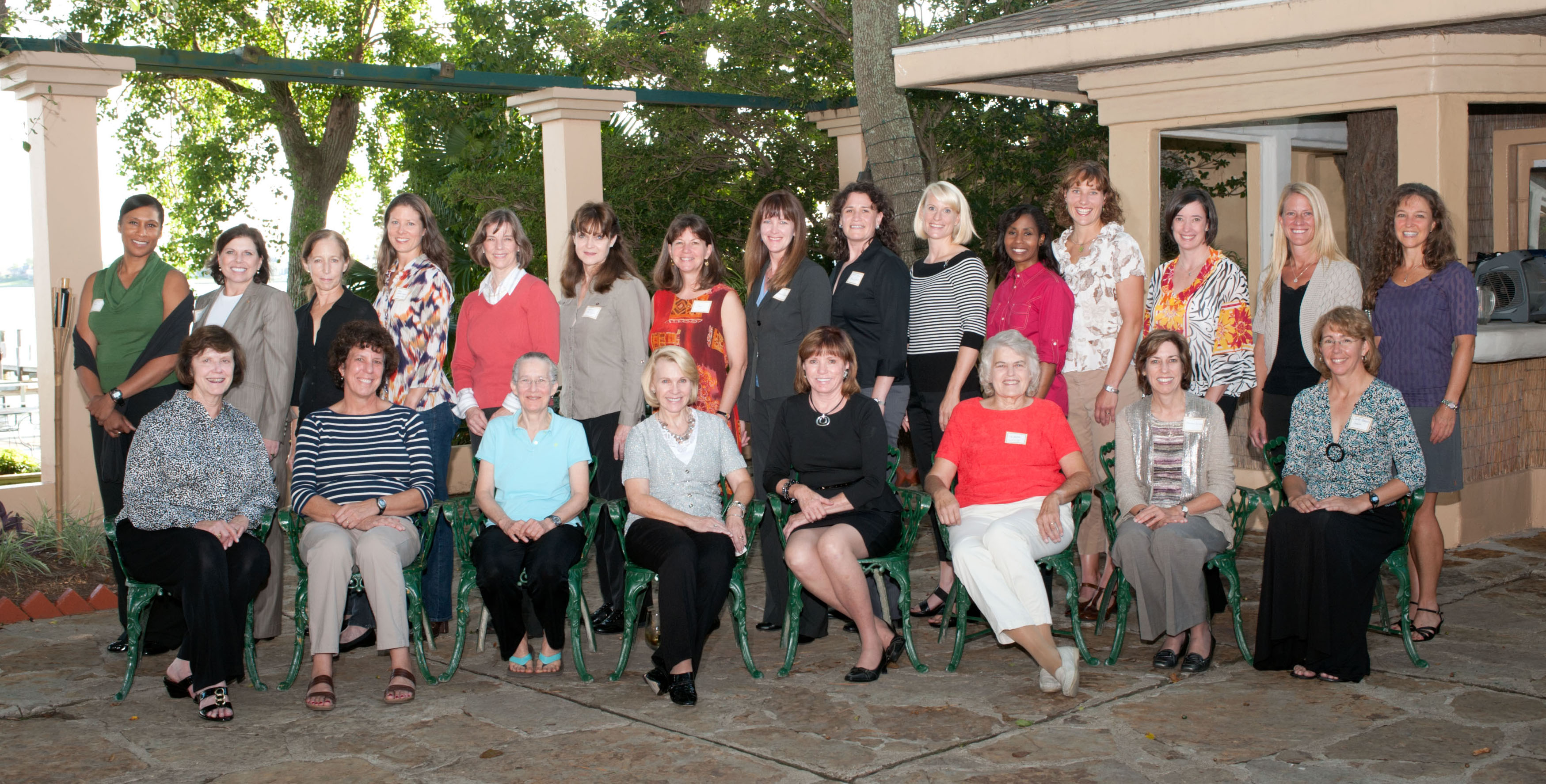
Female astronauts past and present gather at the Villa Capri restaurant in Houston, Texas, on Sept. 17, 2012. Photo by Lauren Harnett. (Credit: NASA/Wikimedia Commons)

Real estate entrepreneur gave Redondo Beach its captains-of-industry street names

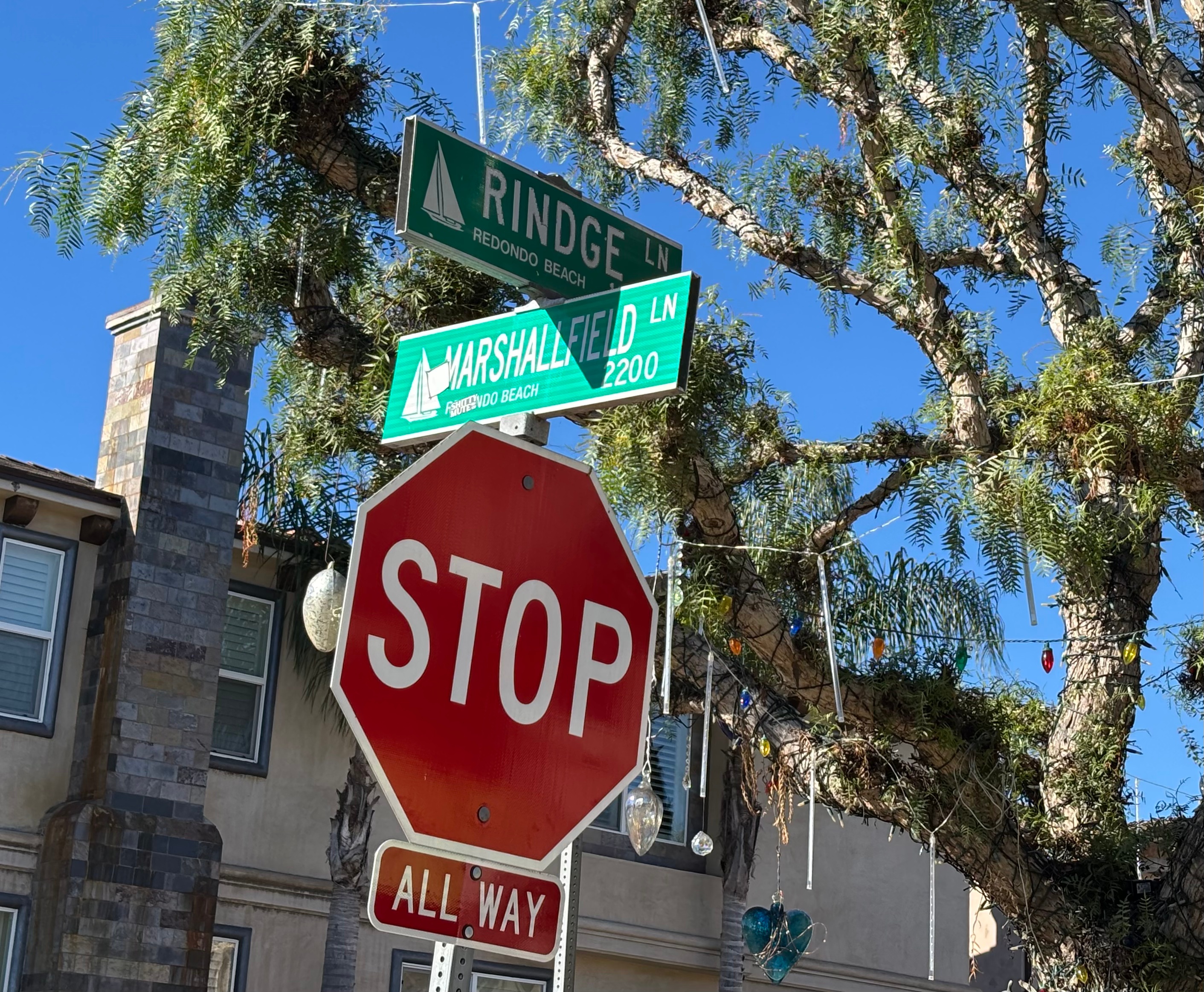
A series of streets in North Redondo are named for industrialists, in this case Marshall Field and Frederick Hastings Rindge. Dec. 10, 2025 photo. (Credit: Photo by Sam Gnerre)

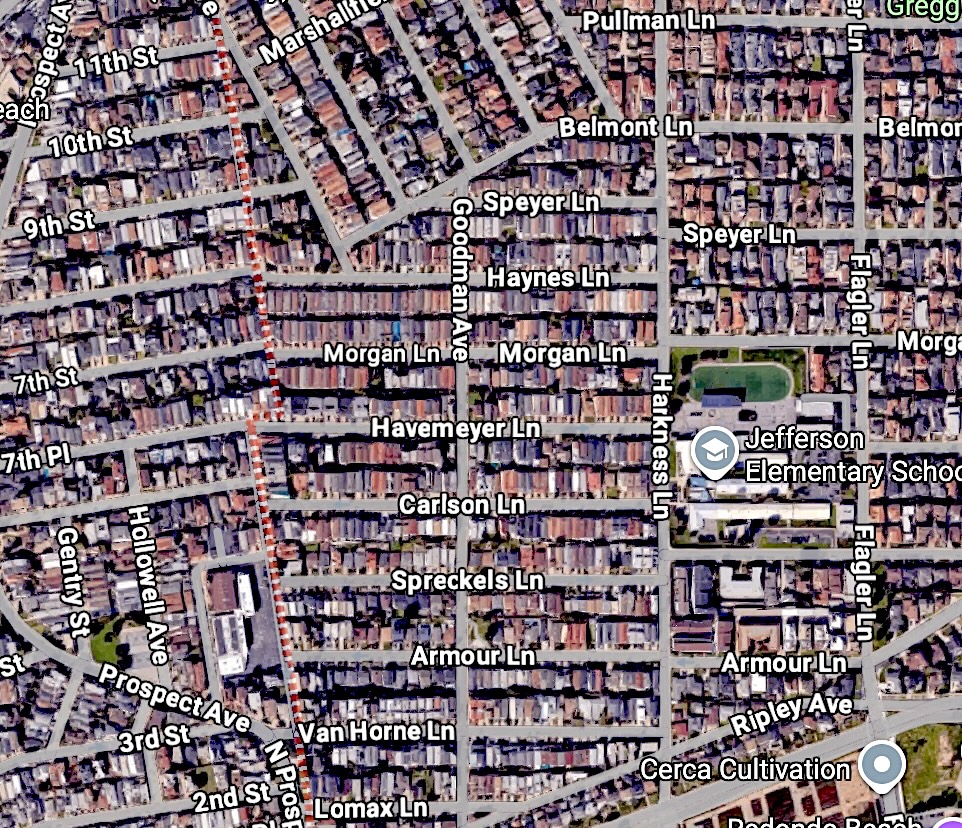
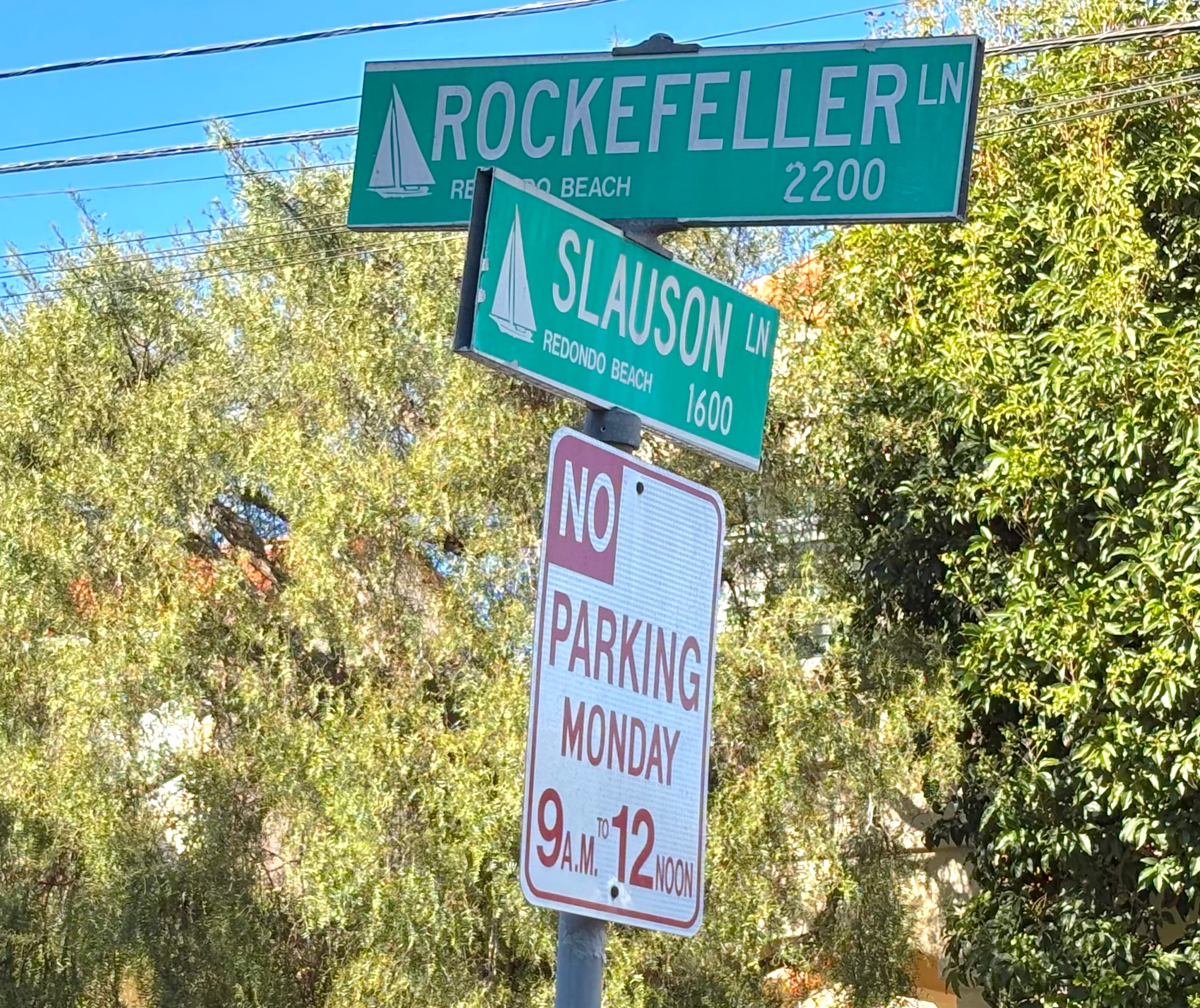
Anyone who’s spent time driving in north Redondo Beach has seen the streets named for early 20th century captains of industry, or, depending on your perspective, robber barons: Rockefeller Lane, Ripley Ave, Huntington Lane, etc.

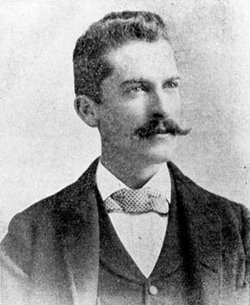
It turns out one man was responsible for naming them in the early 1900s, in 1906 to be exact. His name was William Henry “Bill” Carlson, and he admired the men he named the streets after a great deal. Perhaps too much so at times, judging by some of his actions.

Carlson was born in Sweden on April 11, 1864. His family emigrated to America when he was a young boy, around 1870 or so. They settled in San Francisco, where he quickly learned to speak English. He eventually became a master of the slick, fast-talking sales pitch.

William Henry “Billy” Carlson. Undated. (Credit: Wikimedia Commons)

By 1885, he had moved to San Diego, then in the throes of a real estate boom. The city’s population had grown from 2,600 in the early 1880s to more than 40,000. Carlson wanted in on the money to be made from its rapid development, and he formed a real estate business partnership with fellow former San Franciscan Frank Higgins. 

Their timing was good. The pair bought 600 acres of land and called their subdivision Ocean Beach. Business was brisk, especially after they promised to build railroad lines connecting it to the rest of the city. It was a promise they couldn’t keep; the lines wouldn’t be built until 1909.

The boom went bust, Higgins committed suicide in 1889 and the firm collapsed. Carlson decided to go to law school. After passing the bar, he ran for and won a seat in the California State Assembly. He then ran for and won election as mayor of the city in March 1893. Only 28 at the time, he remains the youngest mayor ever elected in San Diego.

While mayor, he again made big promises about developing the city’s railroad connections, most of which did not come to pass. He raised lots of money for a rail line to Arizona, for instance, but only 10 miles of it was ever built.

He lost his 1896 mayoral re-election bid. Having exhausted his political capital down south, Carlson moved to the Los Angeles area, which also had a wide open real estate market at the time. He managed the Pasadena Villa development in the city’s El Sereno area in 1902.

Many of the named Redondo streets can be seen, center, in this Google image from 2025. (Credit: Google Earth)

By 1906, he’d set up shop in Redondo Beach, and was selling lots in the Redondo Villa development. He began naming streets for the successful industrialists and financiers of the era in both Pasadena and Redondo.

He was particularly fond of railroad men. Hence, Collis Ave. and Huntington Lane, for railroad moguls Collis P. Huntington, and his nephew, Henry Huntington, Pullman Lane, Vanderbilt Lane, and others. He saw himself as a railroad man, too, but his ventures in that field were rarely fully realized.

Some of the Redondo Beach streets named for industrialists:

Armour Lane – Meatpacking baron Phillip Danforth Armour.

Carnegie Lane – Steel industry titan Andrew Carnegie. 

Collis Ave. – Railroad mogul Collis P. Huntington, uncle of Henry Huntington.

Gould Ave. – Jason “Jay” Gould, railroad magnate and financier.

Harriman Lane – Financier and transportation investor E. Roland Harriman.

Havemeyer Lane – Henry Havemeyer of the sugar refining Havemeyer family.

Huntington Lane – Railroad mogul Henry Huntington, nephew of Collis Huntington.

Marshallfield Lane – Chicago department store magnate Marshall Field.

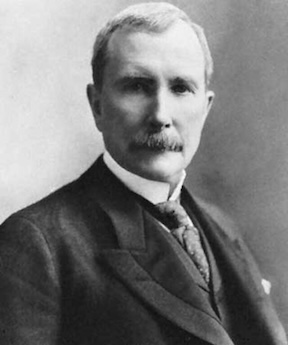
John D. Rockefeller, circa 1875.
(Credit: Wikimedia Commons)

Morgan Lane – J.P. Morgan, banker and financier.

Pullman Lane – George Pullman, railroad car innovator.

Ripley Ave. – Railroad baron E.P. Ripley.

Rindge Lane – Los Angeles area real estate investor Frederick Hastings Rindge.

Rockefeller Lane – John D. Rockefeller, founder of Standard Oil.

Spreckels Lane – Sugar magnate Claus Spreckels.

Van Horne Lane – Railroad man Cornelius Van Horne.

Vanderbilt Lane – Railroad/shipping magnate Cornelius Vanderbilt.

There’s also Carlson Lane among the other big-name businessmen. It’s understandable why William wanted to see his name among the more prominent industrial leaders honored in the Redondo Villa development. He aspired to have some of the recognition, not to mention stacks of money, that the big players had garnered.

Unfortunately, he often chose shady ways of trying to reach their level.

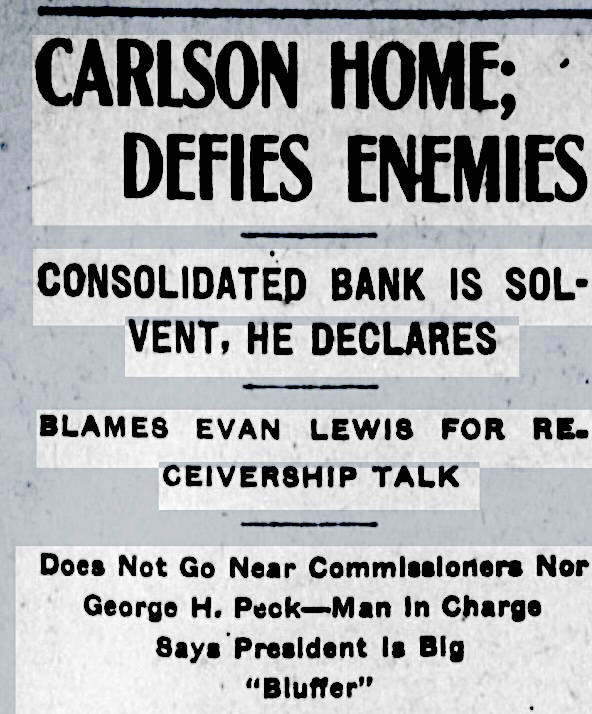
Los Angeles Herald headline, June 26, 1908, Page 3. (Credit: Los Angeles Herald archives)

In 1908, Carlson managed to infuriate South Bay/Harbor Area land baron George Peck by combining his land dealings with his own Consolidated Bank, which came under heavy scrutiny for its poor  financial condition. Peck launched an investigation of the dealings of the barely solvent bank, but the fast-talking Carlson managed to wiggle out of trouble.

Carlson was less fortunate in 1917 when he was caught perpetrating a fraudulent land scheme that used the mails to sell the same desert land parcels to more than one buyer at a time. He served two years of his four-year sentence for mail fraud in the case.

He seems to have become more subdued in his later years. He and his wife of 50 years, Carmen Luisa Ferrer, settled in South Pasadena for the rest of their days. Carlson died at home there at 73 on July 7, 1937. Carmen died 10 days later.

Rockefeller Lane in North Redondo Beach. Dec. 10, 2025 photo. (Credit: Photo by Sam Gnerre)

Sources:

Find A Grave website.

L.A. Street Names website.

Los Angeles Herald archives.

Wikipedia.

Larry Walters takes off from San Pedro for his unbelievable 1982 flight

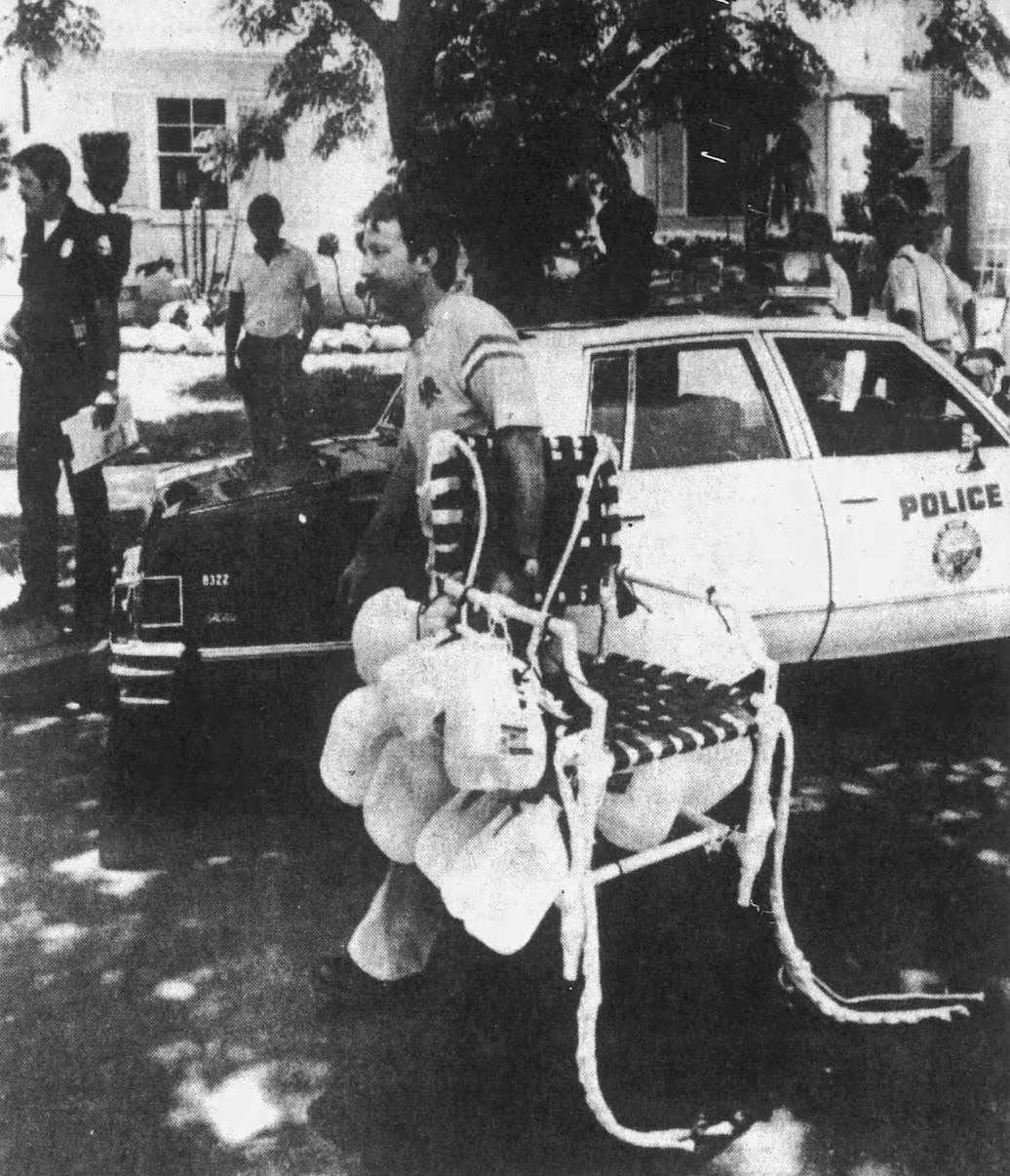
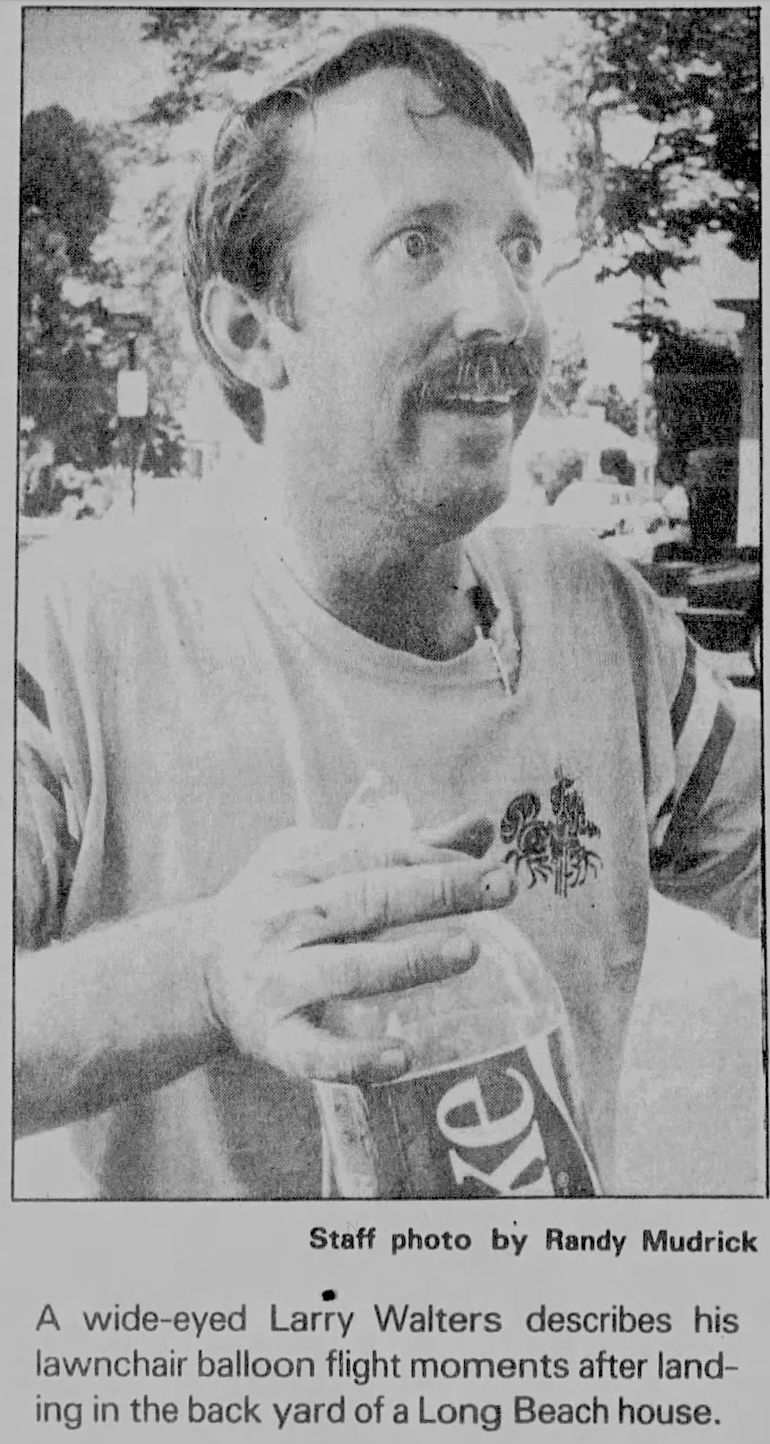
Larry Walters carries his lawn chair aircraft from his landing spot in Long Beach on July 2, 1982. Photo by San Pedro News Pilot staff photographer Randy Mudrick. (Credit: San Pedro News Pilot archives)

Larry Walters told the San Pedro News Pilot that he got the idea for his July 2, 1982 flight after seeing some military weather balloons for sale in an Army-Navy surplus store when he was 13.

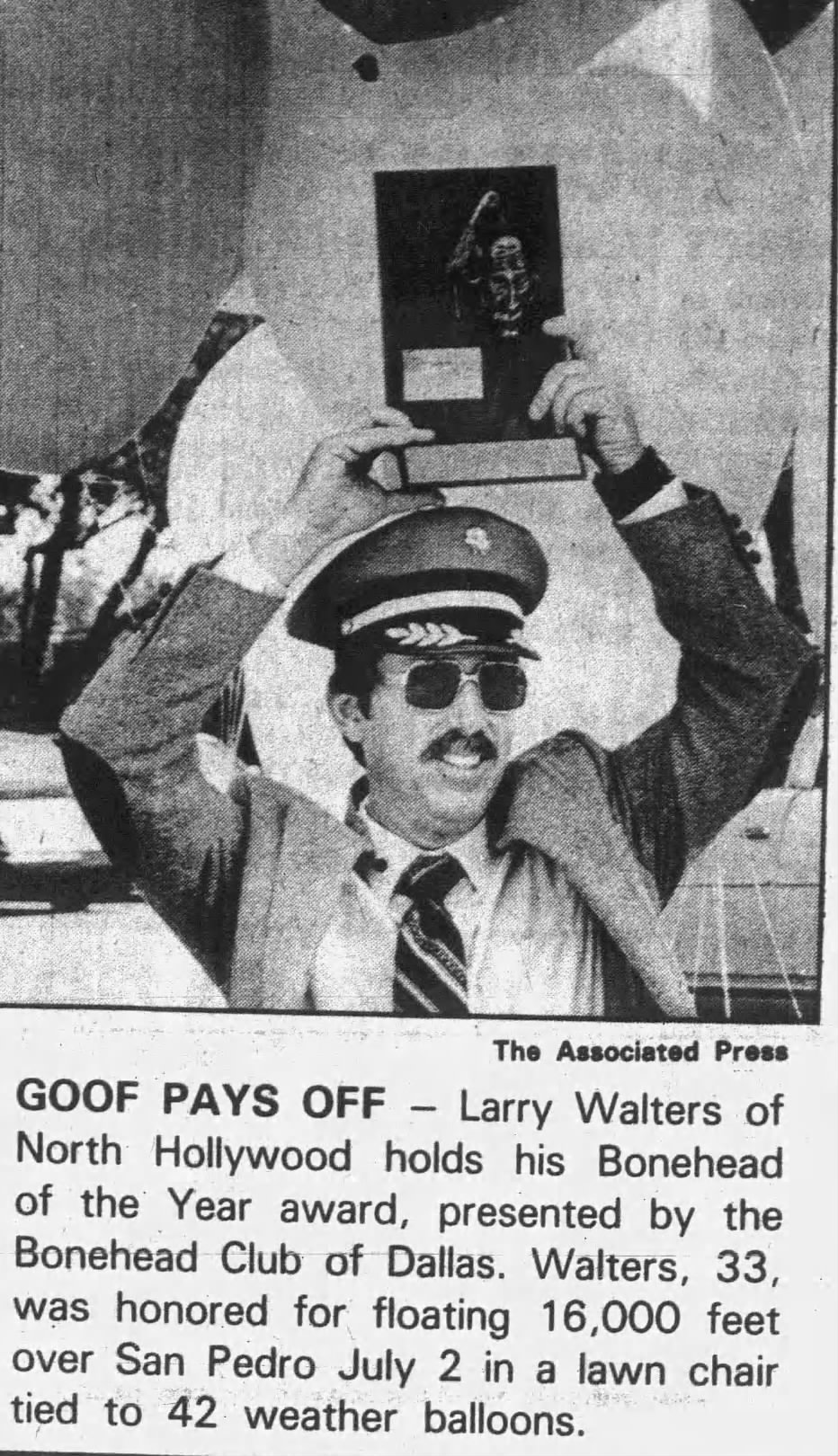
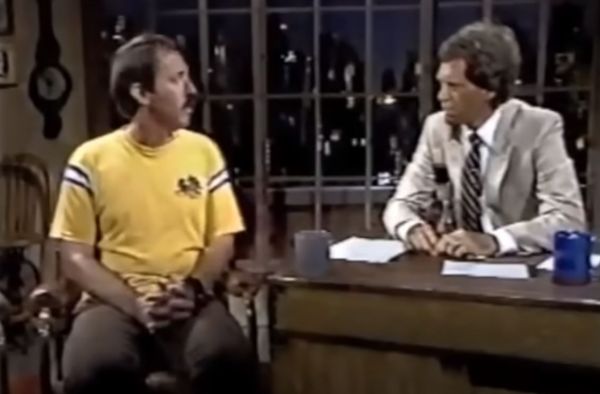
He no doubt wasn’t the first person to imagine tying balloons to a lawn chair and taking to the skies, but his all-too-successful attempt brought him temporary fame and even an appearance on NBC’s “Late Night With David Letterman.”

The 33-year-old North Hollywood man began his aerial escapade in the backyard of his girlfriend Carole Van Duesen’s house near Western Ave. and Seventh St. in San Pedro. 

He’d experimented with the concept at her house a few months earlier, but winds had scattered the balloons before he could get airborne.

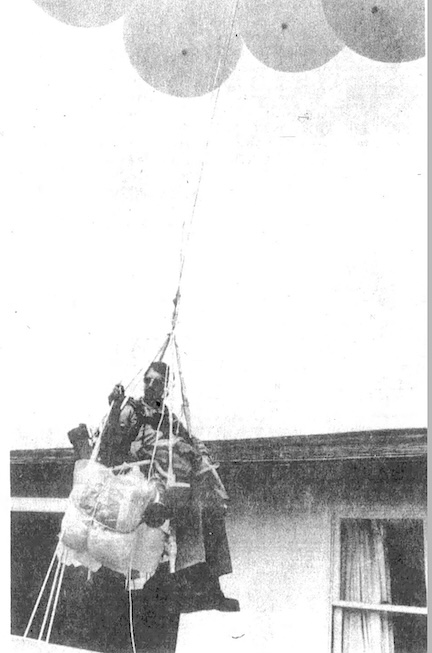
Larry Walters readies for his flight in San Pedro on July 2, 1982. Photo by News Pilot staff photographer Randy Mudrick. (Credit: San Pedro News Pilot archives)

He tried again on July 2nd, with different results. His original flight plan was modest. He would raise the 42 balloons 100 feet in the air, then ascend up to them on a tether line in his garden-variety lawn chair purchased at Sears before returning to earth.

He spent the previous night inflating the four groups of balloons with compressed helium gas from cylinders he’d purchased. Then he outfitted himself with an altimeter, parachute, walkie talkie, lifejacket and a BB-gun pistol before settling in for what was meant to be a quick ride.

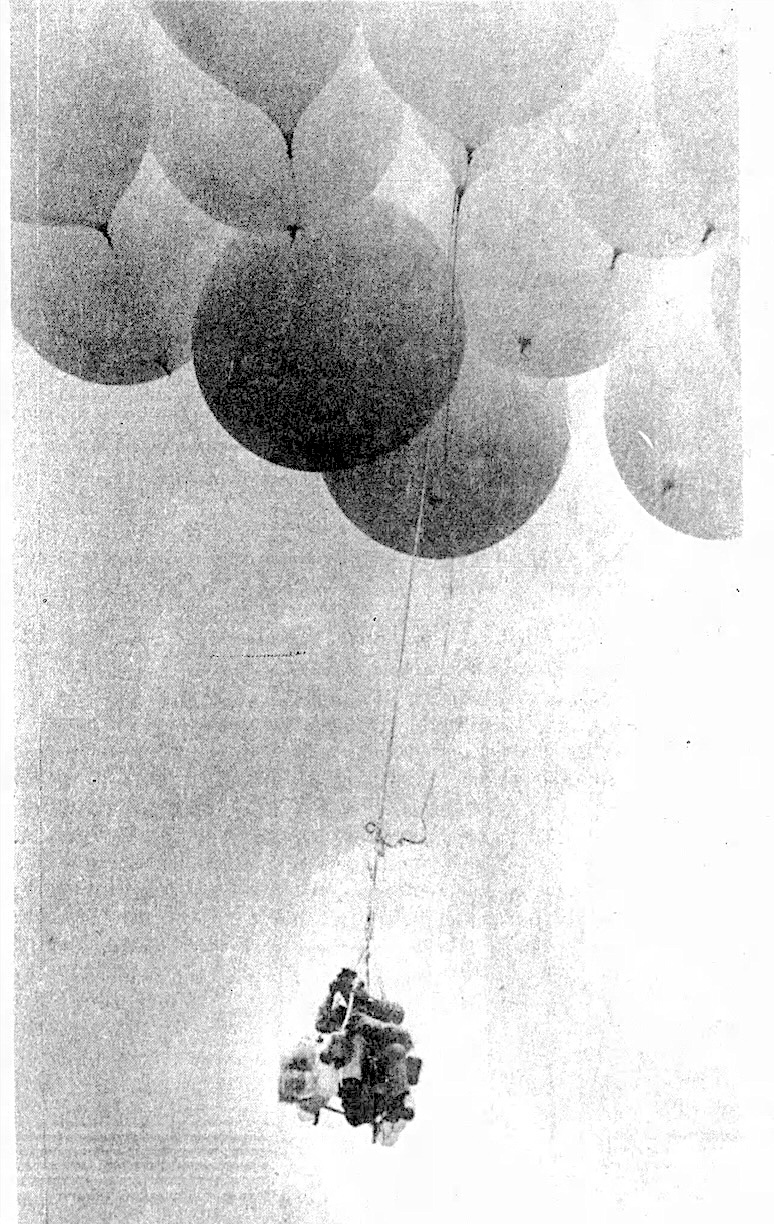
About twenty friends and neighbors had gathered to help with the project. As the balloons began to be released shortly before 11 a.m., the force of their rise ascent gave a small jerk to the tether line holding Walters’ chair, which broke loose with him in it.

His chair immediately began rising in the sky. He hit a mile in height quickly, and still continued upward. At first, winds carried him westward near Marineland in Rancho Palos Verdes, but as he ascended, the winds changed direction and he drifted eastward over the Vincent Thomas Bridge and Wilmington.

Larry Walters takes flight on July 2, 1982. Photo by San Pedro News Pilot staff photographer Randy Mudrick. (Credit: San Pedro News Pilot archives)

At 13,000 feet, he began drifting over Long Beach, toward the Long Beach Airport. No longer in control of his flight path or in contact with those on the ground, he radioed a mayday message to a citizens band channel. 

When he reached 16,000 feet, his feet grew numb from the bitter cold. Fearing he might pass out, he began shooting out the balloons with the BB-gun in an attempt to reach land. His target was the open spaces of the Virginia Country Club in Long Beach. After puncturing a few balloons, he set the gun down on the chair to check the altimeter. The pistol slipped out of his reach and fluttered down toward the ground.

Meanwhile, his friends below had heard his mayday call, and alerted the control tower at Long Beach Airport. Controller Jerry Yokum quickly alerted both private and commercial aircraft to steer clear of the unique hazard.

Back in the sky, Walters began emptying jugs of water he carried for ballast in an attempt to slow his descent. It worked, but not well enough for him to reach the country club.

Instead, he was headed for a residential neighborhood. He missed one power line, and avoided electrocution when one of his insulated ropes entangled in a second power line, leaving him dangling five feet from the ground.

Daily Breeze, March 13, 1983, Page 17. (Credit: Associated Press photo, Daily Breeze archives)

He found himself suspended in the Long Beach backyard of Robert Dunham at 432 E. 45th St., behind the Bixby Knolls Shopping Center, about 15 miles from where he’d started. He was unhurt.

Walters told the various authorities that he understood he had piloted an untested aircraft and disturbed air traffic in the area, and was willing to face the consequences. (One immediate consequence was the two-hour power outage that befell the neighborhood when he got snagged in the power lines.)

In the wake of the unusual flight, he became an instant celebrity, making the talk show rounds and entertaining offers of television and movie deals and commercial endorsements. A group of San Diego businessmen offered him a $100,000 deal to make a second flight in that city that he considered, but nothing came of it. He never piloted a lawn chair again.

In December 1982, the Federal Aviation Administration charged him with four violations of aviation regulations, levying a $1,000 fine for each. Walters vowed to fight the $4,000 penalty.

He turned down the San Diego offer because they wanted him to make the flight before clearing himself with the FAA. In April 1983, he agreed to pay the FAA $1,500 in fines for the incident.

Years later, in November 1991, Walters was featured as part of a nationwide Timex watch ad campaign celebrating ordinary people who had overcome a personal obstacle or challenge. He was in somewhat dire financial straits at the time, with fees from public speaking one of his few sources of income.

Larry Walters appears on “Late Night With David Letterman” ten days after his flight. (Credit: YouTube still)

The Larry Walters story unfortunately came to a sad end on Oct. 6, 1993. Walters hiked up to what his mother described as “his favorite place,” a remote canyon in the Angeles National Forest, and killed himself with a shot to the heart. He was 44.

The action surprised his family, who could give no reason for his suicide. He’d never married and had no children.

Though he did enjoy riding the publicity wave that resulted from his flight, he seemed uneasy with his resulting fame. As he told the News Pilot in 1991, “I didn’t do it because I thought it would get attention or make money. I did it because it was a lifelong dream.”

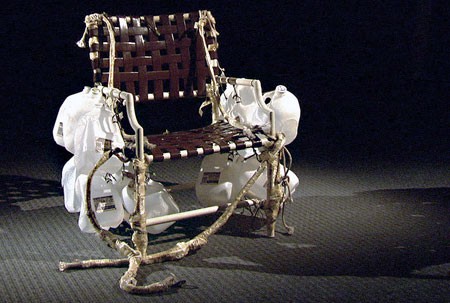
In 2019, Walters’ lawn chair was installed at the Smithsonian’s National Air and Space Museum in Washington, D.C. (Credit: National Air and Space Museum, Smithsonian Institution)

Sources:

Daily Breeze archives.

San Pedro News Pilot archives.

San Pedro News Pilot, Jan. 5, 1983, Page 2. (Credit: Daily Breeze archives)

Pioneer centenarian Phoebe Sykes came to Torrance before it was Torrance

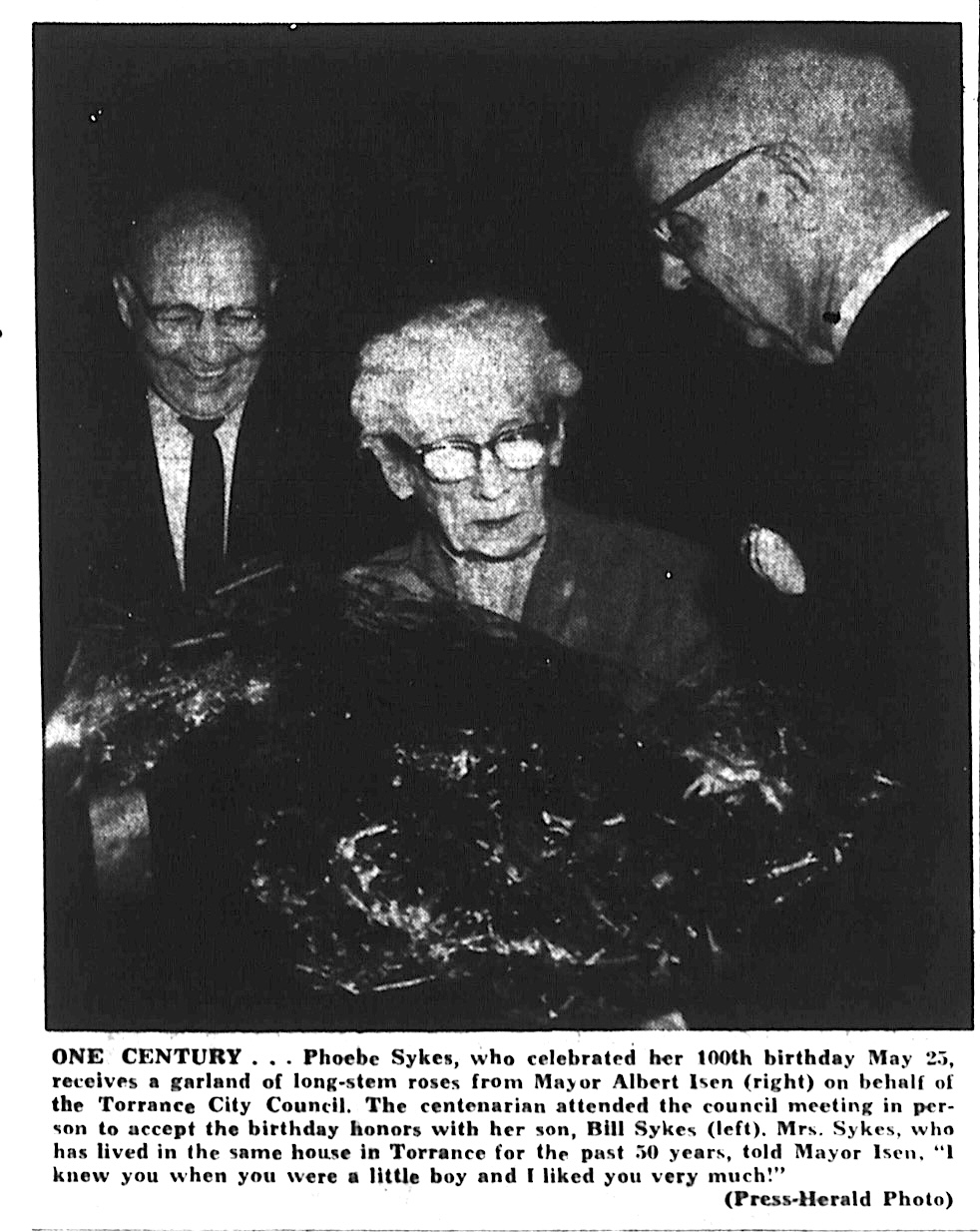
Torrance Herald, June 5, 1968, Page 1. (Credit: Torrance Historical Newspaper and Directories Archive database, Torrance Public Library)

Phoebe Sykes knew Torrance when it was mostly just an idea in founder Jared Sydney Torrance’s mind. The Torrance she knew then was mostly dusty fields, broken up by occasional  encampments of workers on construction projects in the nascent city.

Sykes was born Phoebe Hartley in Huddersfield, England, on Oct. 25, 1868. She married jeweler Albert E. Sykes, and their son, William was born in 1894.

The family decided to move to America, and they arrived in the South Bay in October 1911, the year before Torrance officially founded his city, and a decade before it officially was incorporated. 

The family settled in a house on Chestnut Ave. in the Lomita area, which later became 238th St. when the land became part of the city of Torrance. (Lomita remained unincorporated until 1964.)

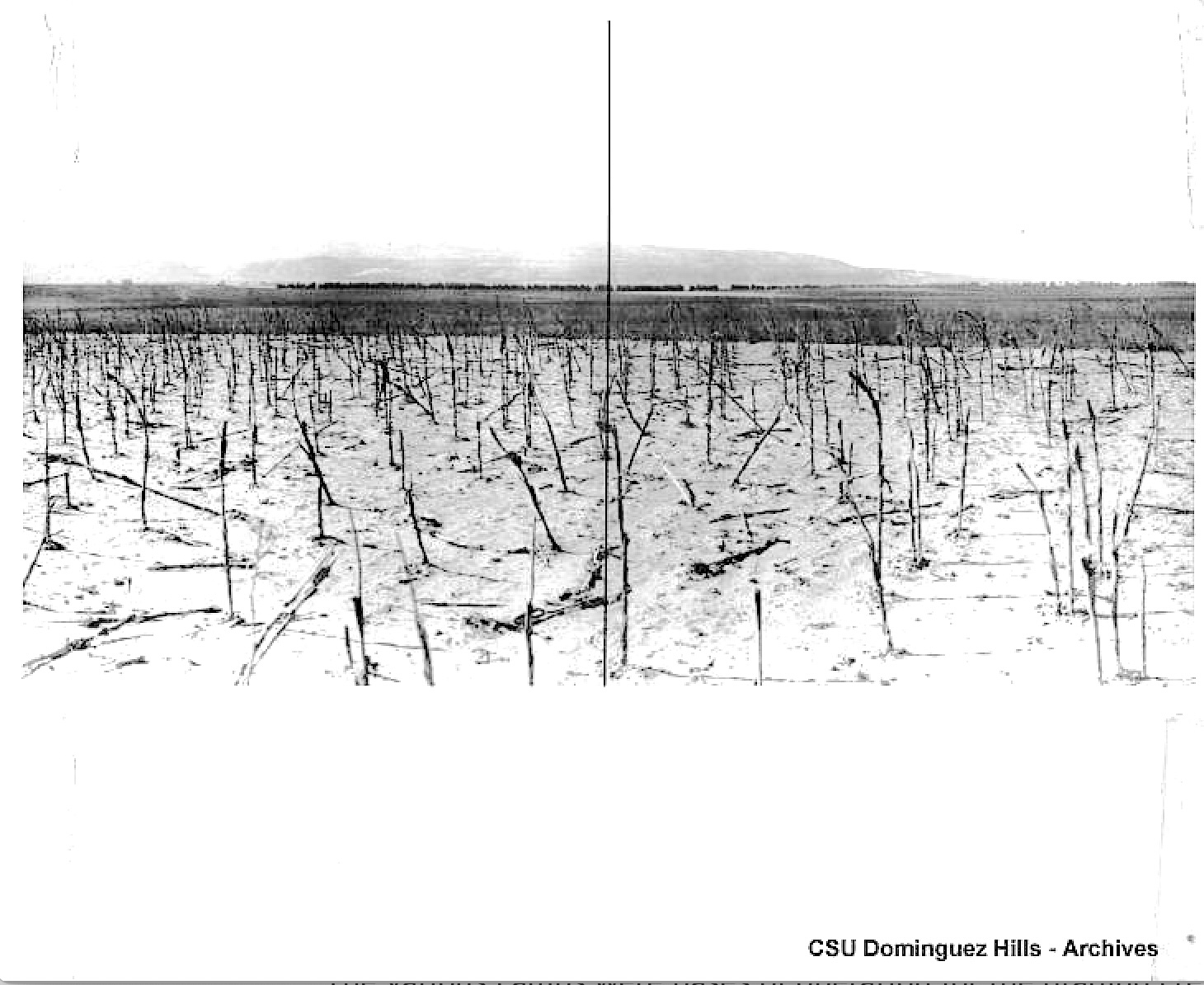
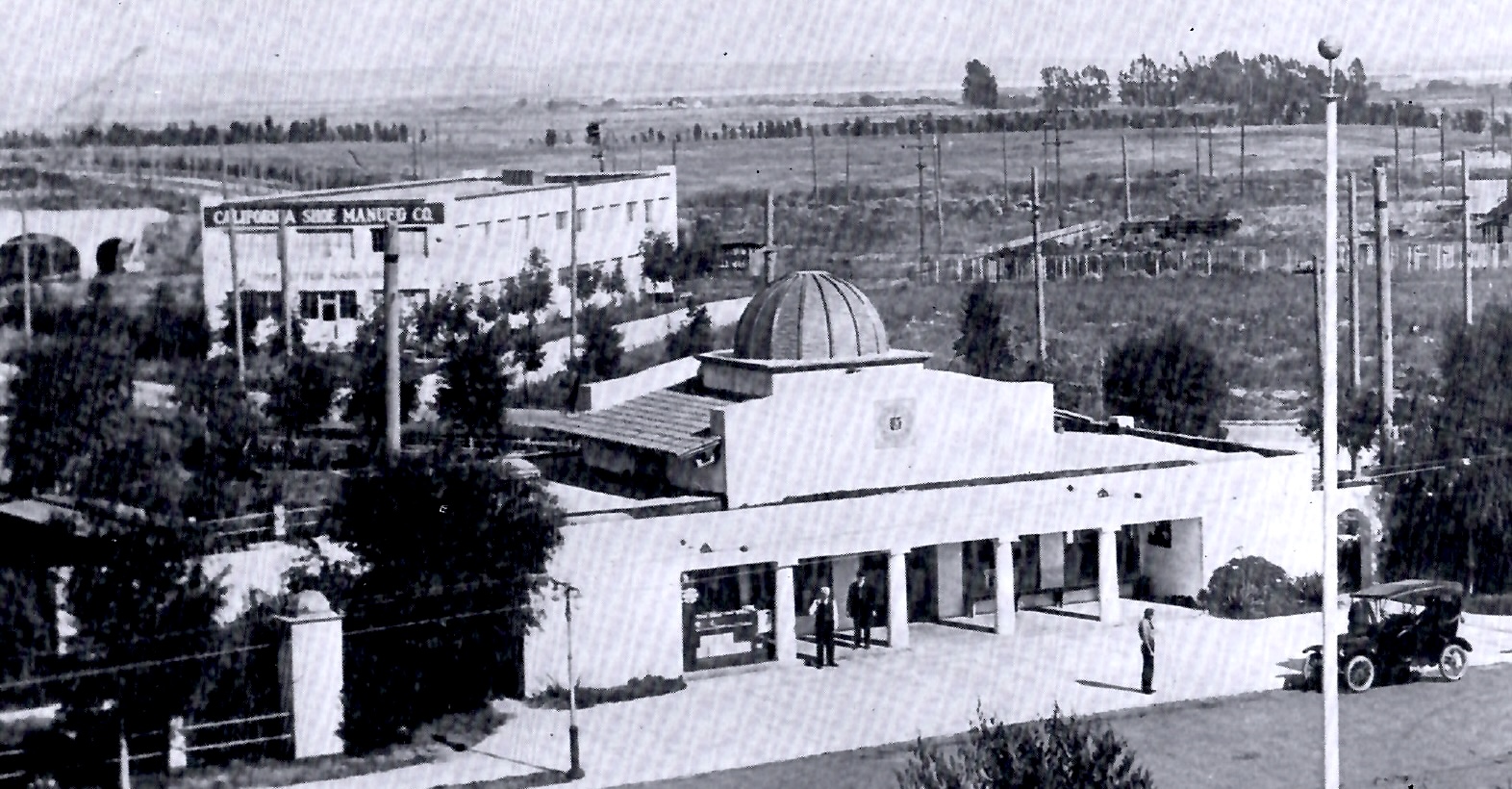
The couple worked hard to make a living in the then-desolate Torrance area, shown below in a 1910 photo. In February 1912, before the new city’s streets had been graded and while the foundation was still being laid for the giant Union Tool Co. plant, Albert established a tent store among the worker camps.

The various camps were bases of operation for the grading crews, the street and sidewalk contractors, those working on the Union Tool plant, the engineers, pipefitters and other workers.

The Sykes’ tent store was located at the present-day downtown Torrance “five points” intersection of Carson St. and Cravens Ave. 

It provided a variety of essentials for the workers, including newspapers, tobacco, candy, overalls and suspenders, and provided a laundry service for them. Candles were in such demand that Albert and Phoebe had to go to downtown Los Angeles to buy enough to keep the tent store  stocked.

The couple also delivered newspapers, which arrived at the Pacific Electric railroad station near the Weston ranch  in the southern part of the city. Phoebe and William would walk there from their Lomita home and distribute the papers to the Lomita area, covering some 26 miles on their trek. Albert covered the worker areas in Torrance, and his daily  trek covered 10 miles.

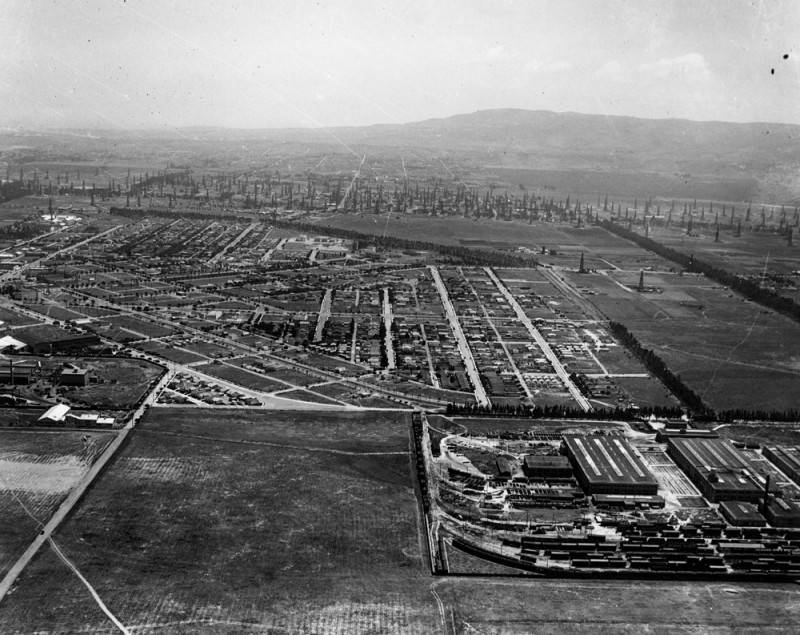
1925 aerial view of Torrance industries, with the Pacific Electric repair shops in foreground at right and a band of oil derricks, rear. (Credit: Los Angeles Public Library Photo Collection)

In addition, Phoebe became the first person to deliver mail to the Torrance area in those early days before a post office was established there. She would travel by horse and buggy to the post office in Redondo Beach and lug the sacks of mail to the workers’ camps and to Lomita in order to deliver it. (The first Torrance post office was authorized in September 1912.)

Sadly, Albert took ill with tuberculosis in the early summer of 1912, and never recovered. He died on October 18, 1912. 

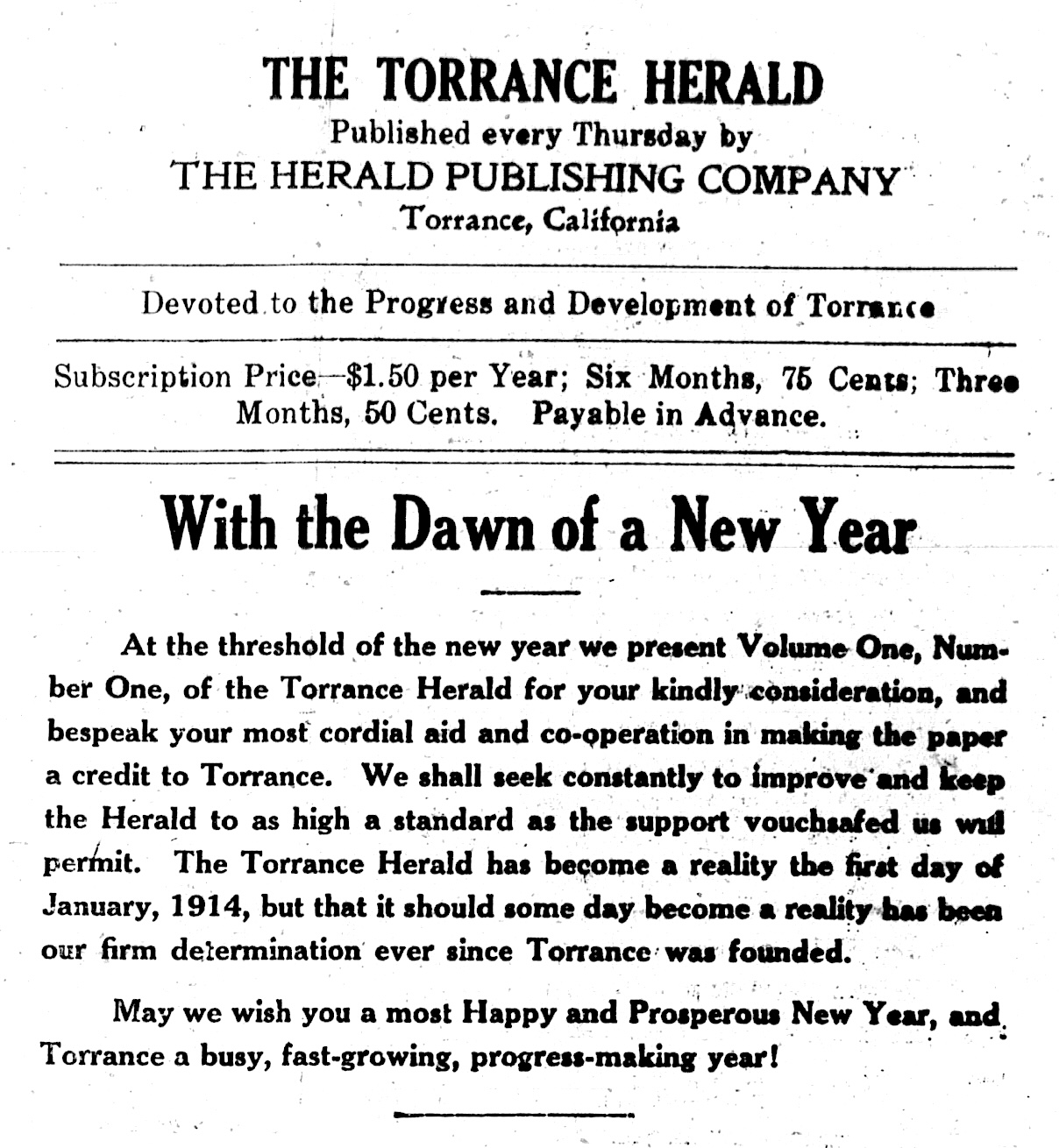
In his absence, Phoebe and William continued the work the family had been doing. This included delivering copies of the first-ever edition of the Torrance Herald on Jan. 1, 1914. They would deliver that paper for several years, until the paper finally hired newsboys to take over the job in 1921.

From the debut edition of the Torrance Herald, Jan. 1, 2014, Page 2. (Credit: Torrance Historical Newspaper and Directories Archive database, Torrance Public Library)

As the town began to take physical shape, Sykes and her son were no longer required to make daily visits to the worker camps. There were fewer of them as the projects that spawned them began to be completed.. 

Instead, Phoebe relocated the family business to the Irving Gill-designed Pacific Electric railroad depot on Cabrillo Ave. just south of Torrance Blvd., completed in 1912. (The structure currently houses The Depot restaurant.)

The Sykes newsstand at the Torrance Pacific Electric depot, center, left of last column on the left. (Credit: Torrance Historical Society)

She and William manned a newsstand and tobacco shop located on the exterior of the Red Car depot. It was an ideal spot to catch the growing number of workers commuting to and from the new city to their jobs at the large industries that were now operational there. These included the Union Tool Co., the Llewellyn Iron Works and the railroad’s own large maintenance shops complex, among others.

She opened the store in the mid-1910s, probably around 1915. In 1923, she sold the business to local businessman Paul Beall. 

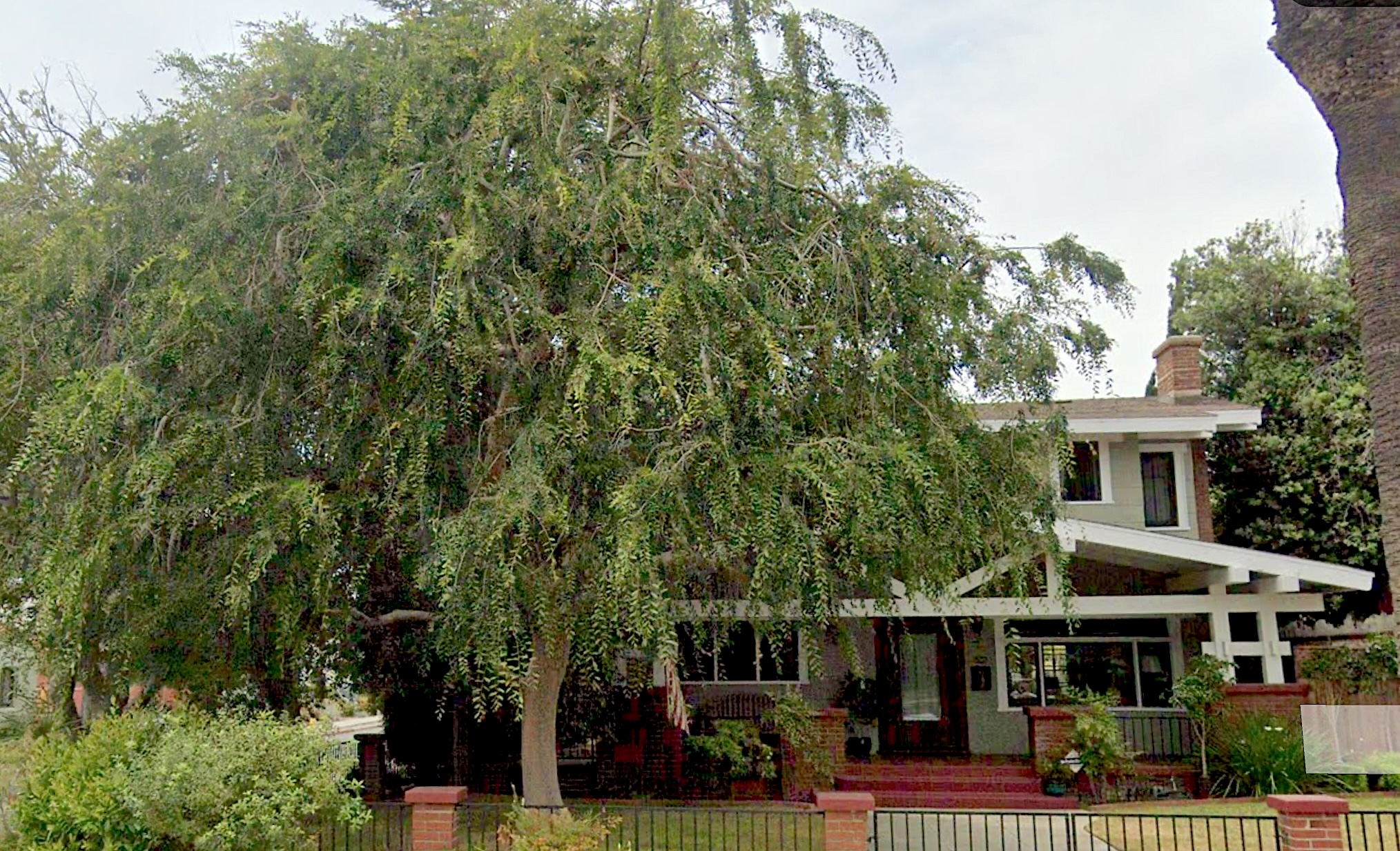
She also sold their Lomita-area house and moved into the house at 1521 Cota Avet. near downtown Torrance that her son William had purchased in 1918 on his 21st birthday. The seller was no less than Jared Sydney Torrance himself, the city’s founder. 

The house at 1521 Cota Ave. in Torrance where Phoebe Sykes lived for 50 years with her son, William. 2025 image. (Credit: Google Earth)

She would live there with William and his wife for the rest of her life. William worked for Columbia Steel in Torrance for 42 years before retiring. He died in 1994.

Phoebe spent much of the rest of her days engaged in community activities and traveling the world.

Much like her husband, she was especially active in Masonic activities. She was a charter member of the Torrance chapter of the Eastern Star, Order of the Amaranth. She served as its royal matron, the highest female position in the organization

During her later years, her birthday became something of an annual social event in the city. Mayor Albert Isen attended several of the celebrations, since he had grown up next door to the Sykes house on Cota.

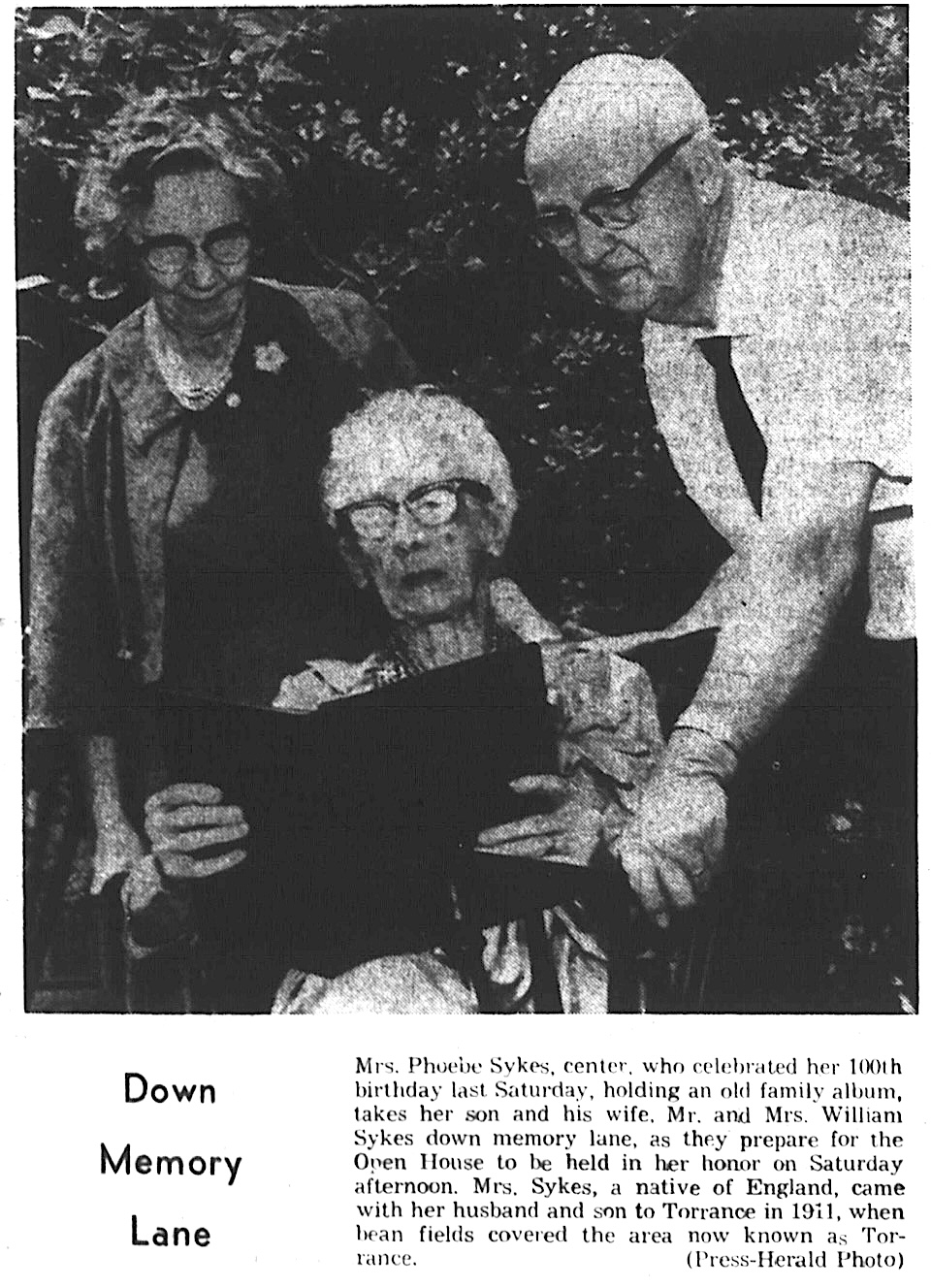
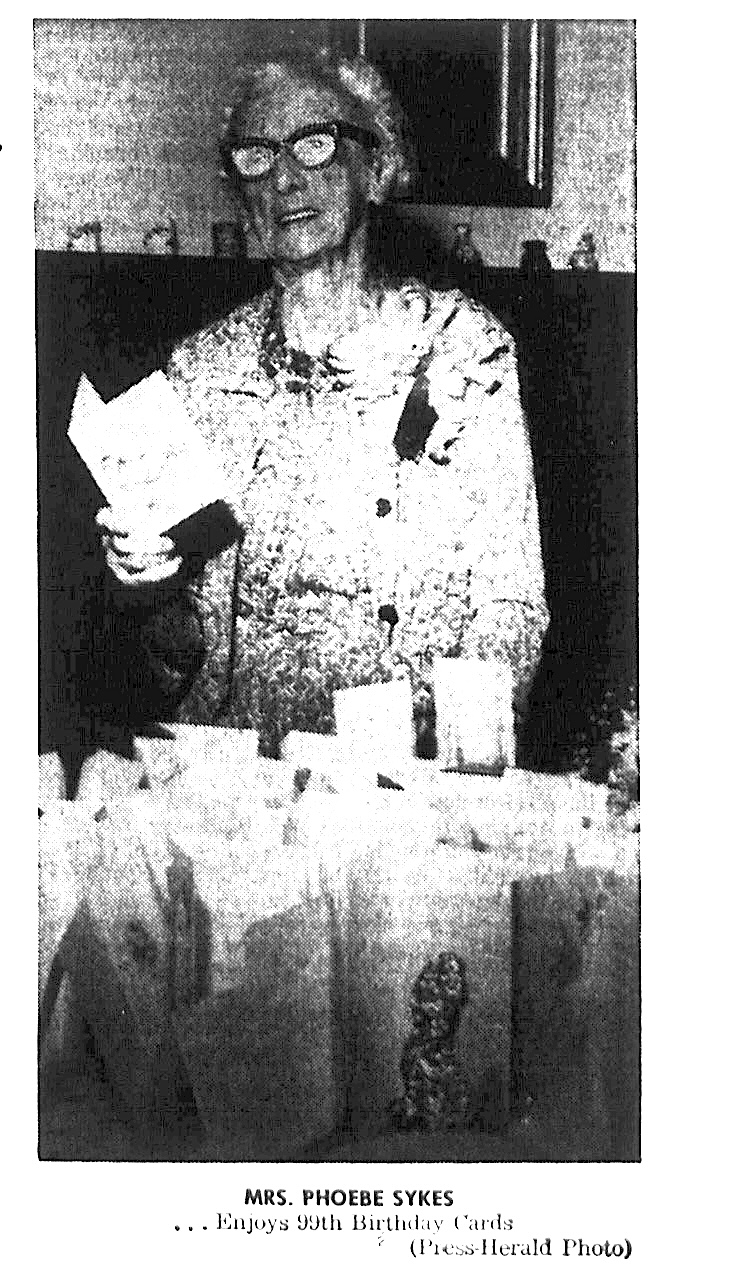
Phoebe Sykes died on Feb. 16, 1969, after being publicly feted for her 100th birthday the previous May.

Torrance Herald, May 29, 1968, Page B-1. (Credit: Torrance Historical Newspaper and Directories Archive database, Torrance Public Library)

Sources:

Daily Breeze archives.

Find A Grave website.

Historic Torrance: A Pictorial History of Torrance, California, by Dennis F. Shanahan and Charles Elliott Jr., Legends Press, 1984.

Torrance Press-Herald archives.

Torrance Herald, June 7, 1967, Page B-1. (Credit: Torrance Historical Newspaper and Directories Archive database, Torrance Public Library)

San Pedro’s Al Larson Boat Shop has been a Port fixture for more than a century

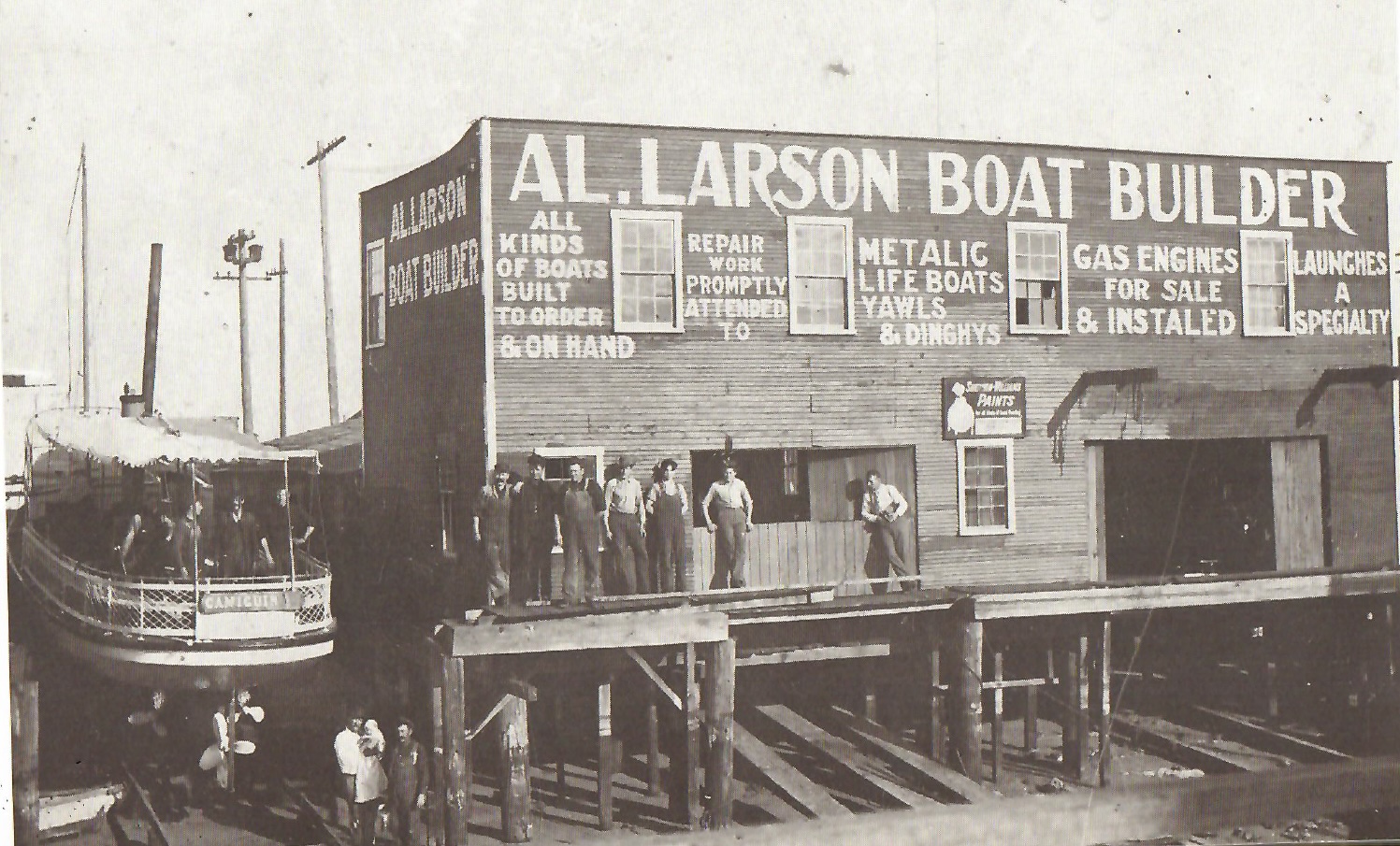
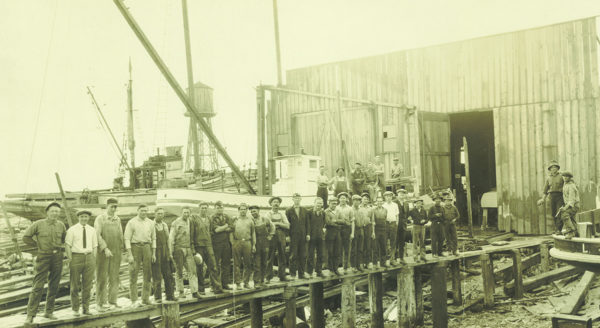
Employees pose in front of the Al Larson Boat Shop in 1908. “Repair work promptly attended to.” (Credit: San Pedro Bay Historical Society)

Peter Adolph (Al) Larson emigrated from his native Sweden to the United States as a 16-year-old in 1890. He first began learning the boatbuilding trade in the San Francisco Bay area, and eventually moved south to Los Angeles.

He founded the Al Larson Boat Shop on the Salt Lake Wharf at the harbor in Wilmington in 1903. At that time, most of the structures in the harbor were built on stilts, and transportation from place to place could be accomplished only by boat.

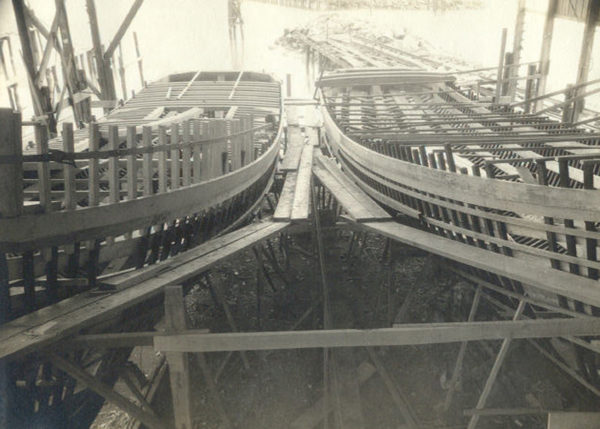
The lumber industry was thriving in San Pedro at the time, and wood for potential boatmakers was plentiful. Though he offered repair services, Larson spent much of his early years crafting wooden fishing boats.

The boat repair sideline of his business eventually would become more dominant, but that came a few decades later.

Wooden blocks for holding ships under repair in the drydocks at Al Larson Boat Shop at the Port of Los Angeles. Undated photo. (Credit: Al Larson Boat Shop Facebook page)

Larson had arrived in the Harbor Area four years before the city of Los Angeles chose San Pedro as its official harbor. He certainly chose the right spot to establish his business, which he moved to Berth 224 on Terminal Island.

Its success, and increased defense industry work during World War I, led to its relocation in 1924 to an even larger space at Berth 258 on Terminal Island in the heart of the harbor.

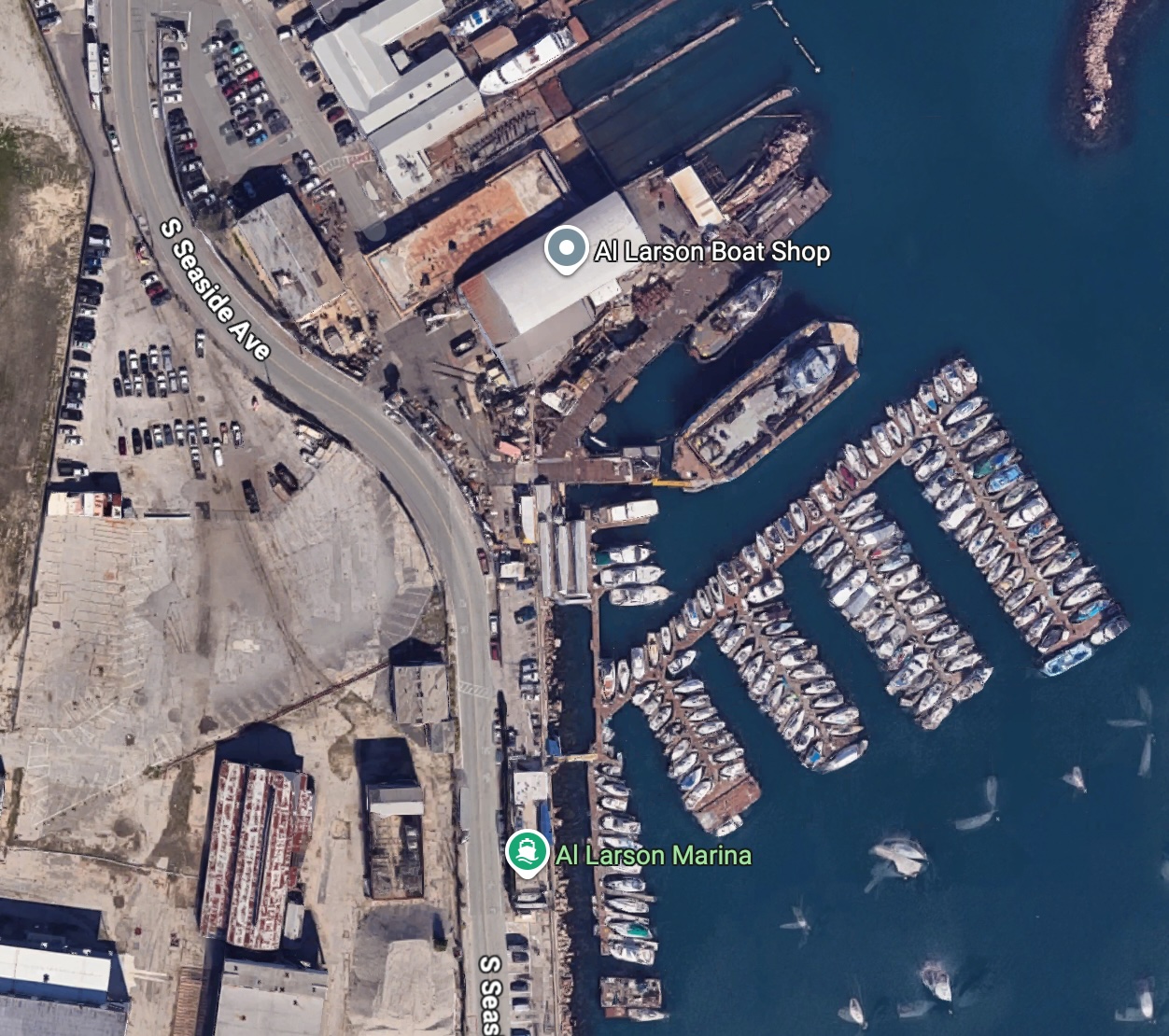
The complex is still located on the site at 1046 South Seaside Ave, which also includes the Al Larson Marina with its 128 boat slips.

Aerial view shows Al Larson Boat Shop, center top, and Al Larson Marina, center bottom, on Terminal Island. 2025 image. (Credit: Google Earth)

The Al Larson Boat Shop survived a blazing fire, possibly caused by a nearby bonfire, on Nov. 21, 1937.  It caused $15,000 in damage and destroyed the lumber storage building and a nearby boat hangar. Hundreds of spectators watched the blaze, which was doused by firefighters on land and sea before more disastrous damage could be done.

The onset of World War II brought about a change in focus for the business. Shipbuilding for the war effort became a major industry in the Port of Los Angeles. California Shipbuilding (aka Calship), Bethlehem Steel and Todd Shipyards all were turning out warships. 

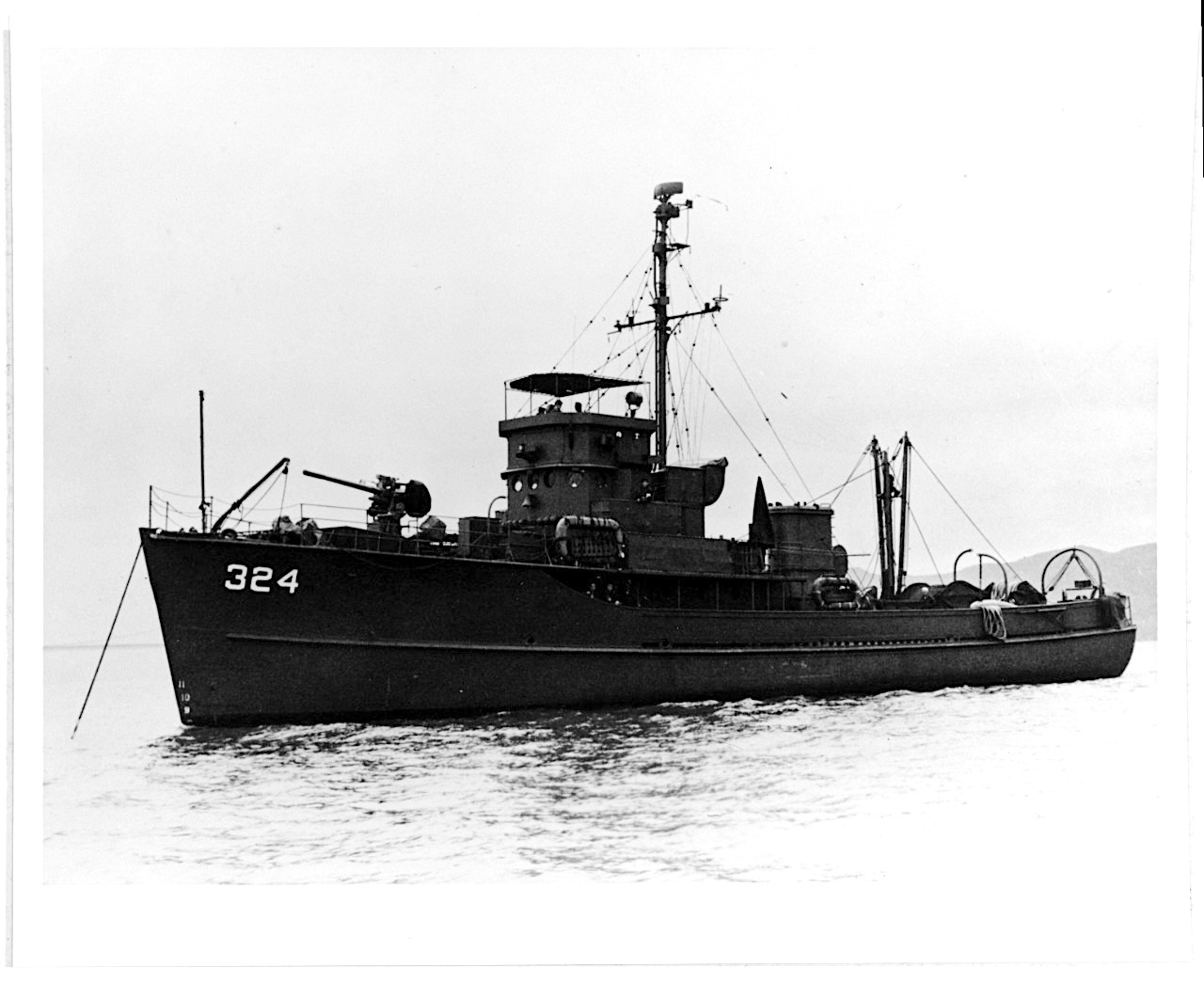
The Al Larson Boat Shop also contributed to the effort, focusing on building smaller patrol boats and minesweepers for the U.S. Navy during the war years.

The USS YMS-324 minesweeper in San Francisco Bay, after the end of World War II, circa 1945-46. This ship, manufactured by the Al Larson Boat Shop, became the USS Gull (AMS-16) in 1947. (Credit: U.S. Naval History and Heritage Command photo.)

The boatbuilding business fell off drastically following the war. The company built its last ship, an 80-foot-long fishing boat, in the late 1940s. By the late 1950s, the company’s repair workload had dwindled to the point where it only had only five employees, and its physical plant had become run down.

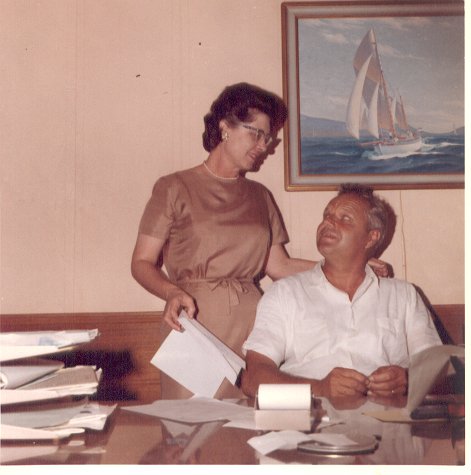
In 1959, the family-owned business was purchased from then-owner Adolph Larson, Al’s son, by Andy Wall and his wife, Gloria. Wall was a police officer based in San Pedro who became an aviator in the U.S. Coast Guard. The couple married in 1943.

Gloria and Andy Wall at work. at the boat shop. Undated. (Credit: Al Larson Boat Shop Facebook page)

Wall had experience in the business, having worked for a time in his father-in-law’s boat shop. He invested money in fixing up and expanding the Larson Boat Shop’s facilities, and began concentrating more on repairing more large commercial ships instead of smaller yachts and pleasure craft.

The Wall family succeeded in turning the business around. It survived, and thrived, while other similar operations such as nearby Southwest Marine left the business.

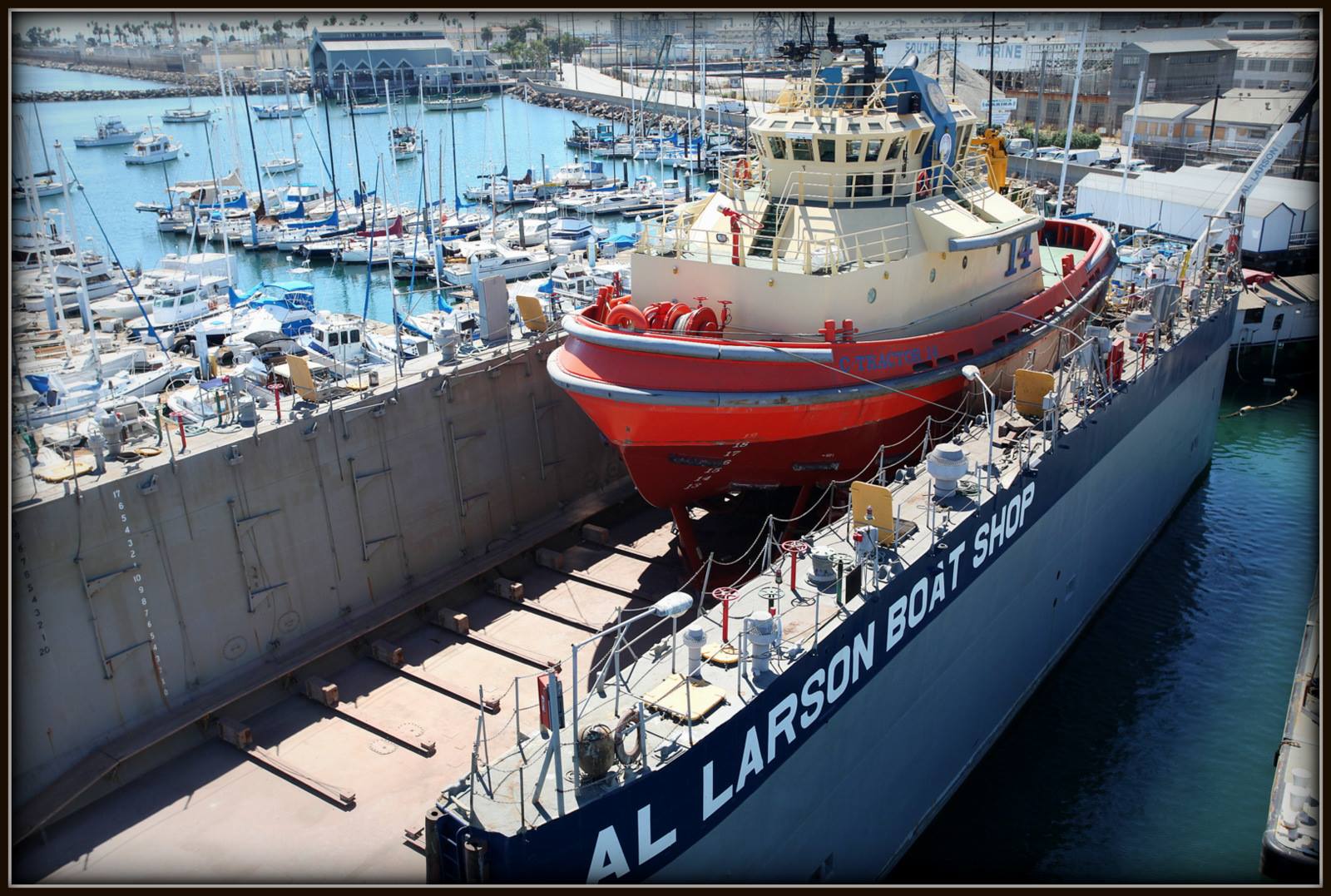
The shop’s facilities sit on two acres of land and five acres of ocean at its Port of Los Angeles location. They also include an additional two acres at its Port of Long Beach location.

The firm works on barges, tugboats, barges, fireboats and the high-speed ferries that transport  people between Catalina and the mainland. It also services cranes and other types of marine-based machinery.

Wall’s son Jack told Daily Breeze business reporter Muhammad el-Hasan in 2003 that the family at one point considered changing the shop’s name to reflect its new owners. They decided against it: “We kept the (Larson) name because it had a good reputation.”

As a part of Al Larson Boat Shop’s 100-year anniversary that year, the Los Angeles Maritime Museum in San Pedro presented a special exhibit detailing the firm’s history.

Andy Wall died at 67 in 1984, and his wife, Gloria, passed away in 2009 at 88. Their descendants continue to run the firm, which has been family-owned and operated, albeit by two different families, since its inception.

A tugboat under repair at the Al Larson Boat Shop in 2014. (Credit: Al Larson Boat Shop Facebook page)

Sources:

Al Larson Boat Shop website.

“Al Larson Boat Shop Complex,” Los Angeles Conservancy website.

Daily Breeze archives.

Los Angeles Times archives.

San Pedro News Pilot archives.

Wikipedia.

Employees at the Al Larson Boat Shop. Undated photo. (Credit: Al Larson Boat Shop Facebook page)

Battles of the bands thrived in the South Bay during the 1960s garage band era

Daily Breeze, July 30, 1964, Page 19. (Credit: Daily Breeze archives)

The “battle of the bands” concept wasn’t invented during the 1960s, when hundreds of teen bands began springing up in suburban garages in the wake of the rise of surf music and, a bit later, the Beatles-led British Invasion. But the shifts in pop music tastes definitely sparked a renaissance in the band contests.

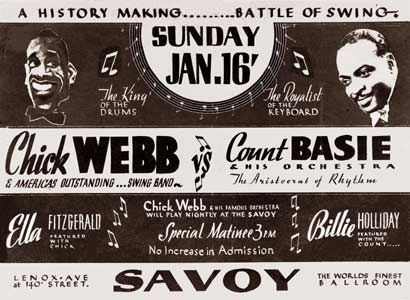
Pop culture historians have traced the phenomenon back to the swing band era of the 1930s and 1940s, when popular bandleaders would face off in “battles” that drew thousands of fans.

(Credit: Off Beat With Michael Aubrecht blog)

One such event took place at the Savoy Ballroom in Harlem on Jan. 16, 1938, pitting bandleader Chick Webb and singer Ella Fitzgerald against Count Basie and singer Billie Holliday. (Downbeat magazine proclaimed Webb’s group the winner.)

The “battles” between marching bands at historically black colleges and universities (HBCUs), that grew in popularity during the 1940s, are another antecedent. These involved rival marching bands showing off elaborate dance steps while performing their musical numbers during football game halftime shows.

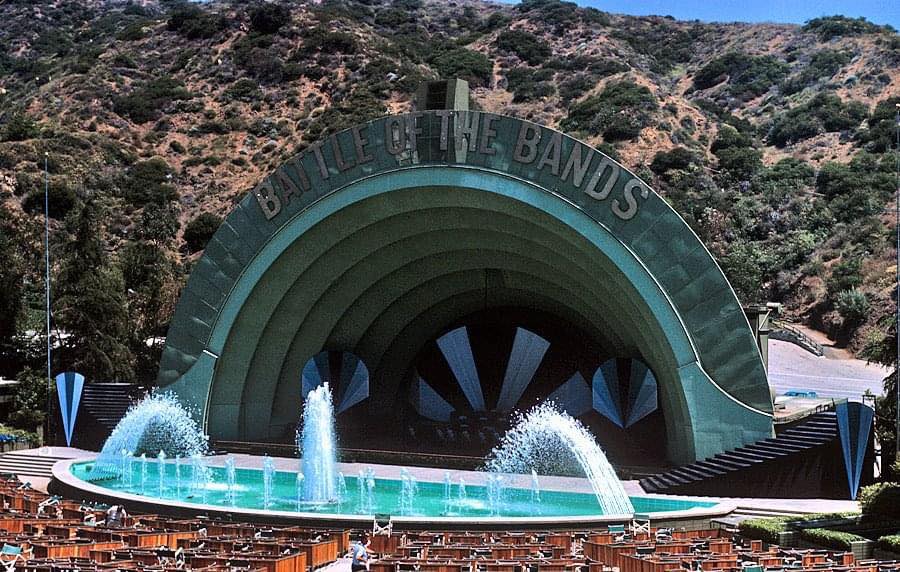
The Hollywood Bowl revived the concept on a large scale in Los Angeles with the introduction of its Battle of the Bands competition in 1959. The competition showcased school-age musicians in various categories such as school bands, vocalists, small pop and jazz combos and solo instrumentalists.

The Hollywood Bowl with its “Battle of the Bands” signage. Undated photo circa 1959-1972. (Credit: Vintage Los Angeles Facebook page)

The Richard Carpenter Trio famously won its category for its June 25, 1966 performance in the competition. The trio, including Richard Carpenter on keyboards, his 16-year-old sister Karen on drums and Wes Jacob on upright bass, played a selection of jazz and pop instrumentals. (Karen did not sing.)

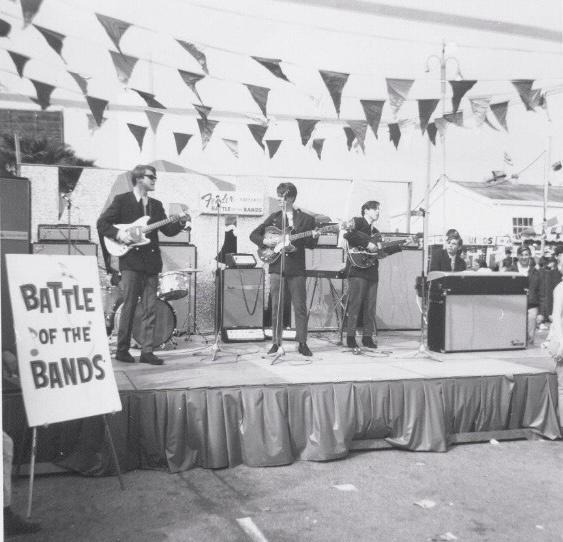
An unidentified band competes in the 1967 Teenage Fair’s battle of the bands contest. (Credit: The Hollywood Teenage Fair Facebook page)

The idea began to spread to other venues and cities large and small. The Teenage Fair, an annual event held at the Hollywood Palladium beginning in 1962, almostalways included a battle of the bands. This time, the performers were strictly rock ‘n’ roll groups, unlike the Bowl contests. The Fair’s enormous popularity waned during the late 1960s and early 1970s, and it was discontinued after 1972.

Various South Bay cities, civic groups and promoters picked up on the idea and began sponsoring local “battles” during the 1960s. 

Those held in the earlier years of the decade featured mostly dance bands and surf instrumental combos. Those held following the stateside arrival of the Beatles and Rolling Stones included bands attempting to incorporate elements of the British sounds in a harder-edged style that would later be labeled “garage rock.”

Daily Breeze, April 16, 1964, Page 16. (Credit: Daily Breeze archives)

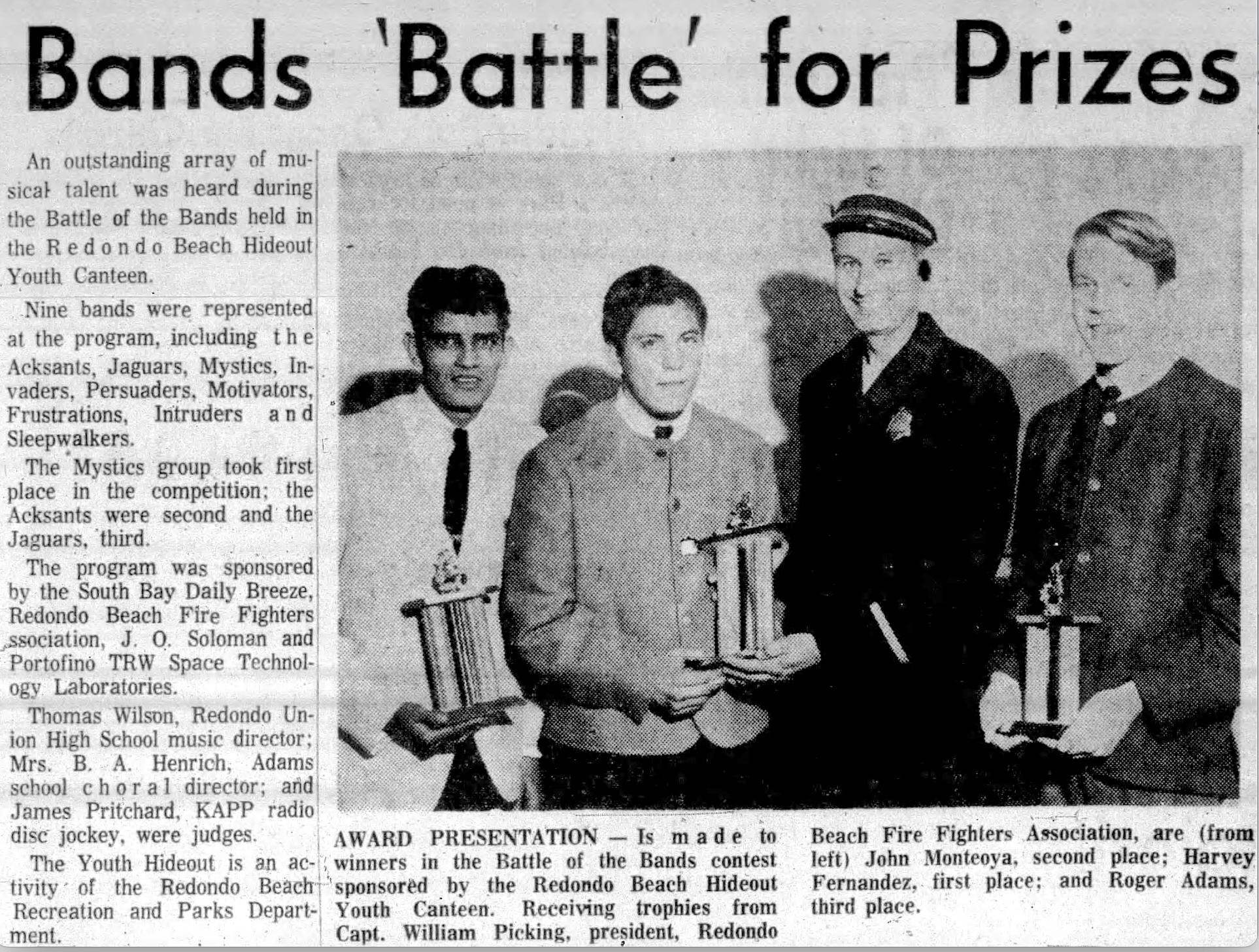
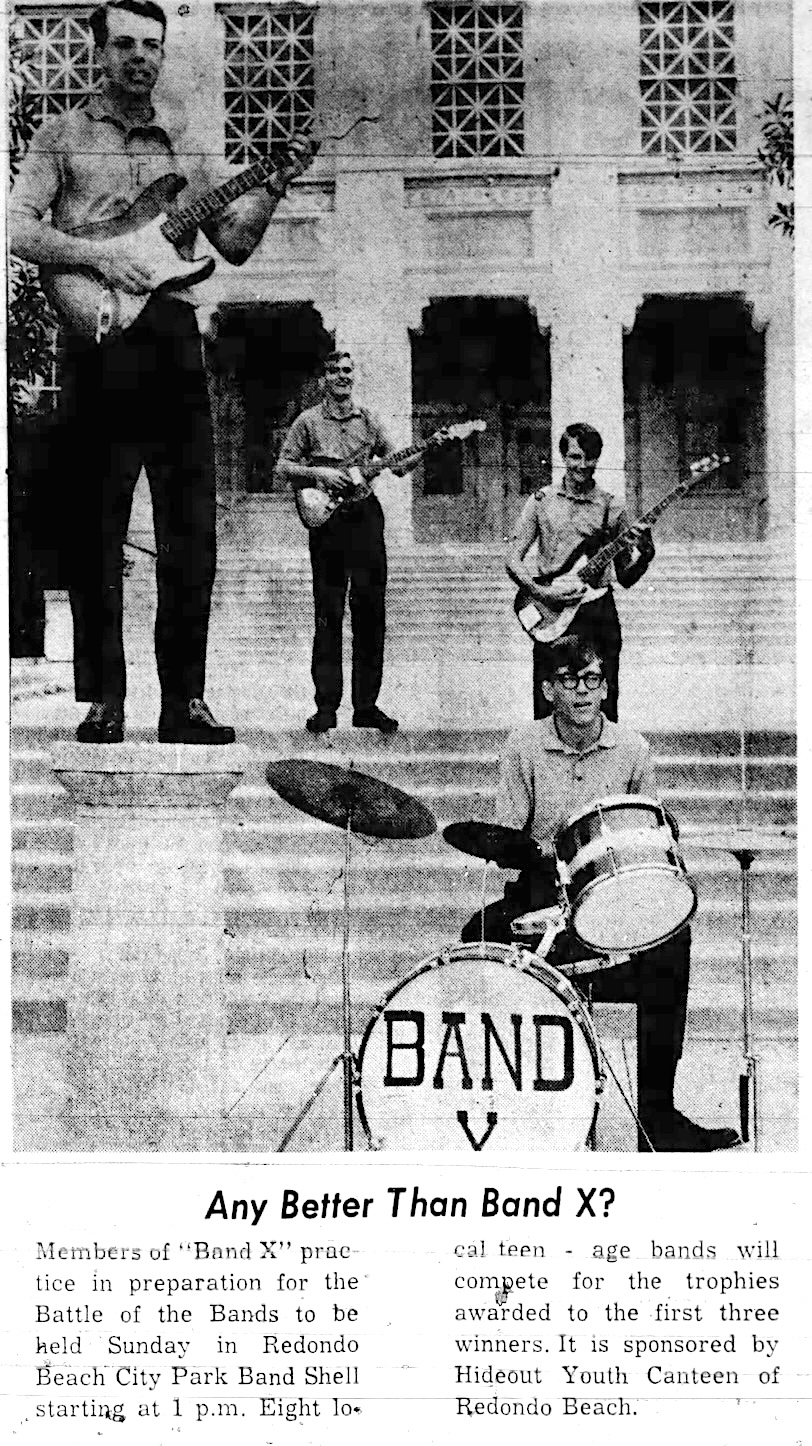
The battles often were held in cities with sponsored youth activities programs based in a teen center. Redondo Beach’s Hideout Youth Canteen was just such a program. Sponsored by the city’s Recreation and Parks Department, it was located on the campus of Redondo Union High. 

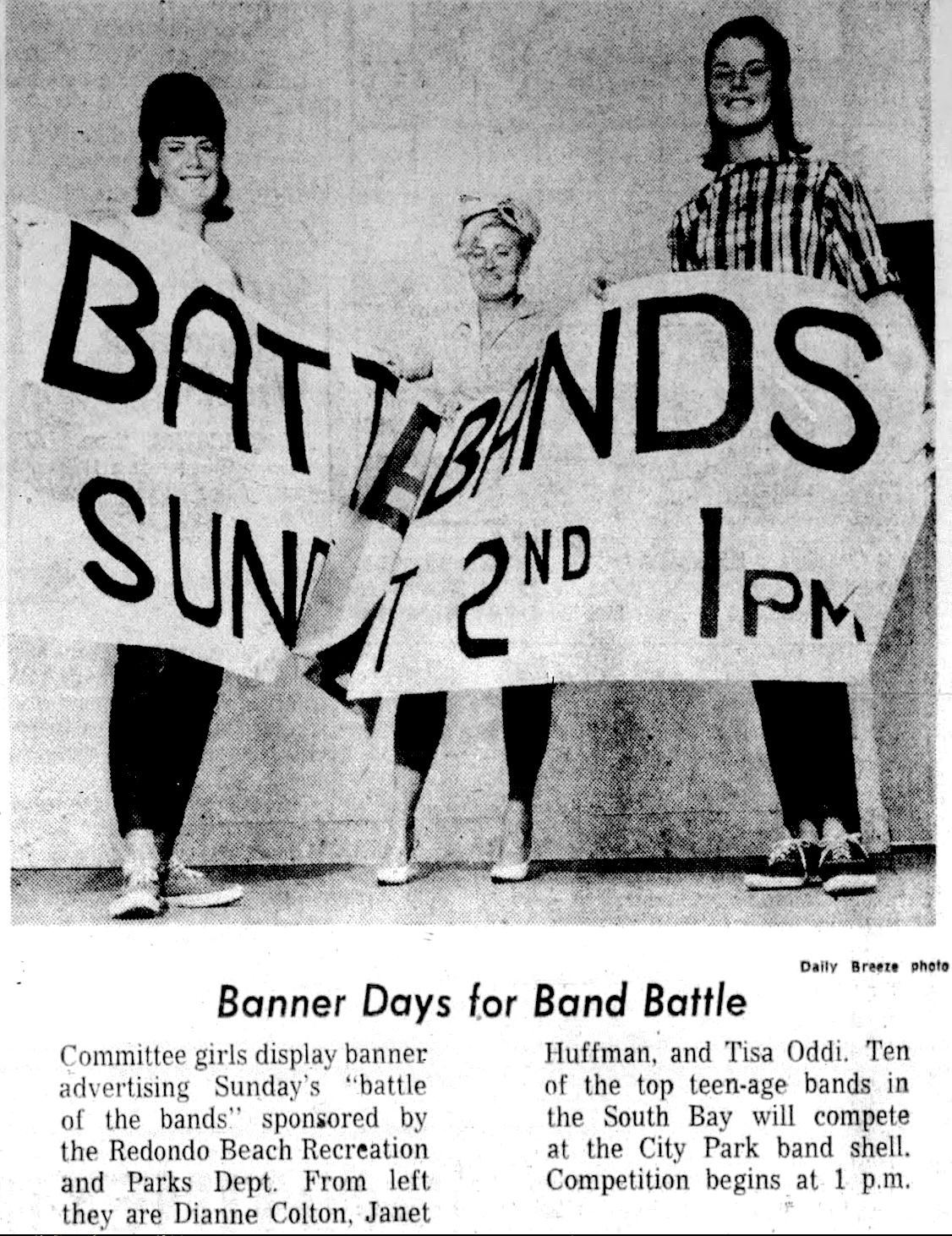
In addition to its dances and social activities, the Hideout Youth Canteen also held regular annual band “battles” from 1963 to 1966. By 1965, the contest was popular enough to be moved to the Redondo Beach City Park bandshell. Eight groups participated on Aug. 8th, including the Toads From Sleepy Hollow, Ye Coachmen, and Diane and the Invaders.

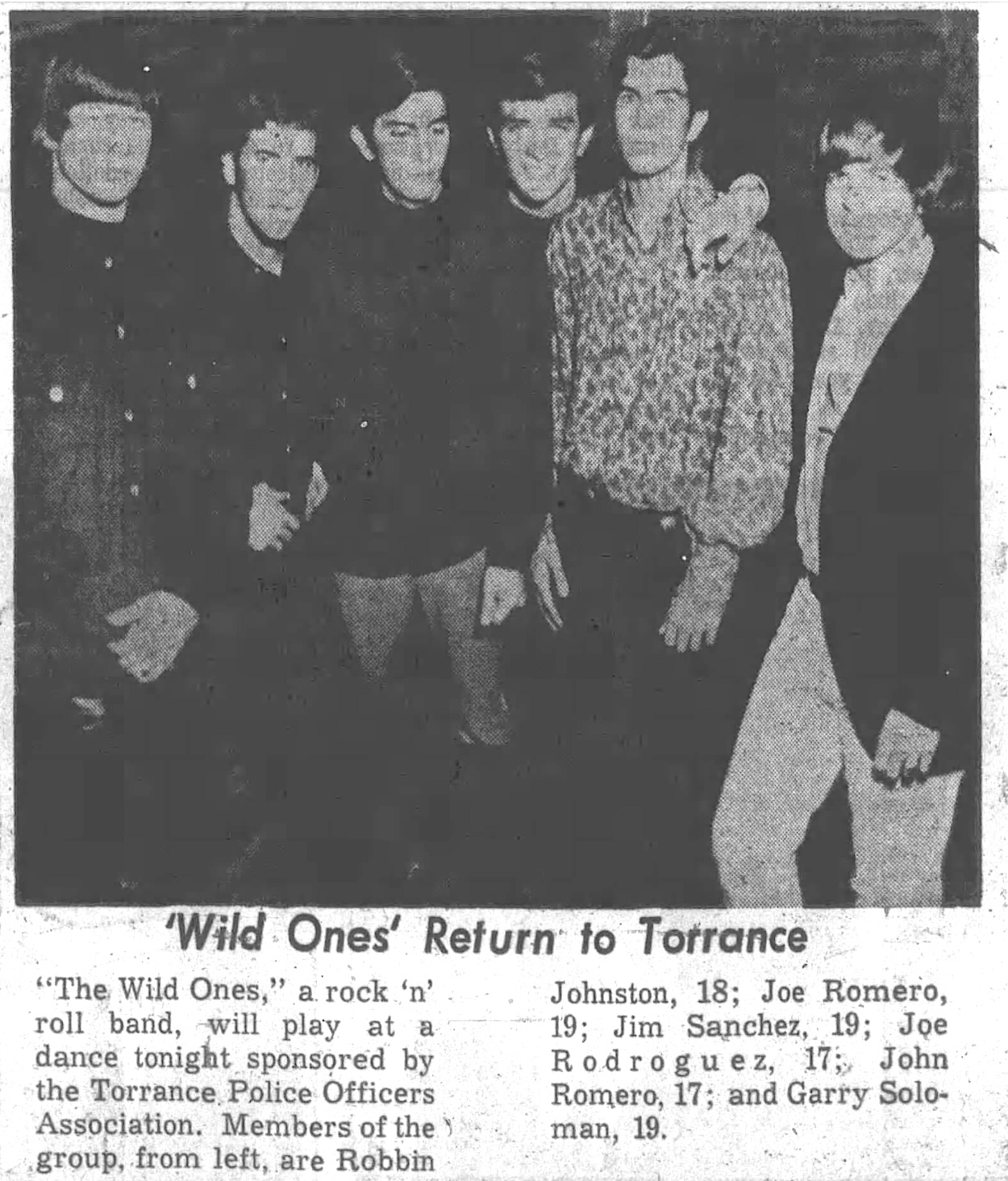
In Torrance, the Police Officers Association sponsored regular dances at the former downtown Grand Theater movie house on Cravens Ave. starting in 1963. The dances regularly attracted 700-800 youths, according to police, and featured an ongoing battle of the bands. 

Daily Breeze, April 1, 1967, Page 2. (Credit: Daily Breeze archives)

The Hawaiian-shirt-clad combo Bay Sounds Inc. won the August 1965 battle of the bands held during the weeklong Island Fair festival at Valley Drive and Manhattan Beach Blvd. in Manhattan Beach.

Lomita got into the act with battle of the bands events in 1967 and 1968 held at the Lomita Recreation Center gym in Lomita Park. Eight bands participated in the 1967 battle, which was hosted by KHJ disc jockey The Real Don Steele.

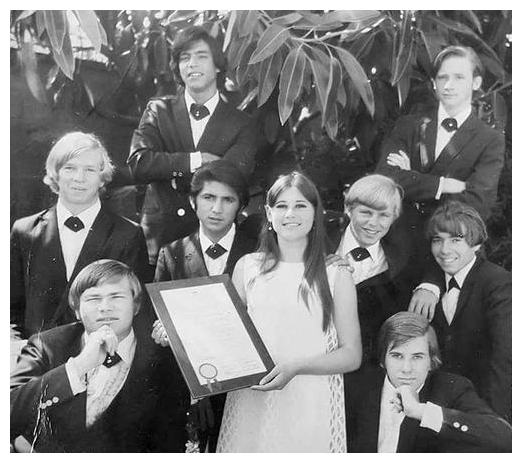
Hawthorne held its first community battle of the bands contest at the Hawthorne Memorial Center in April 1968 in an event sponsored by the local Jaycees and the Hawthorne Youth Canteen. 

The Symbols of Time in 1968, after winning the National Battle of the Bands contest in New Jersey. (Credit: Torrance High School Music Hall of Fame Facebook page)

The ten-piece band Symbols of Time won the title at the Hawthorne event. The group of Torrance High students, which also won a national battle of the bands event in Atlantic City, included David Pack.

Pack would go on to form the successful 1970s group Ambrosia with Symbols bandmate Joe Puerta, The band’s hit, “Holdin’ on to Yesterday,” co-written by Pack and Huerta, reached #17 on the Billboard music charts in 1975.

The battle of the bands phenomenon lost steam by the late 1960s and early 1970s, and the events became less frequent. 

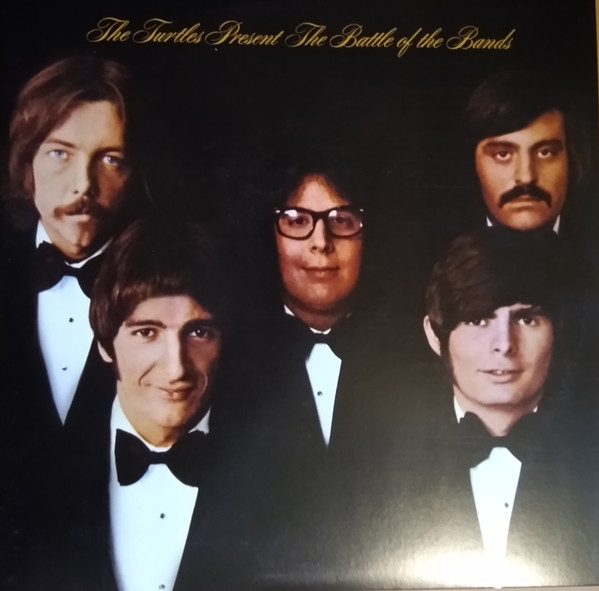
But not before Westchester’s own homegrown rock stars, The Turtles, celebrated the idea with their 1968 concept album, “The Turtles Present the Battle of the Bands,” which featured the band playing as different imaginary bands on each track.

The Turtles’ 1968 album contained a track titled “Battle of the Bands.”

Sources:

Daily Breeze archives.

Los Angeles Times archives.

Redondo Reflex archives.

“Webb vs. Basie,” by Michael Aubrecht, Off Beat With Michael Aubrecht blog, Nov. 18, 2019.

Wikipedia.

Daily Breeze, Aug. 7, 1965, Page 3. (Credit: Daily Breeze archives)

Panama Canal celebrations at the Port of LA were muted by the outbreak of World War I

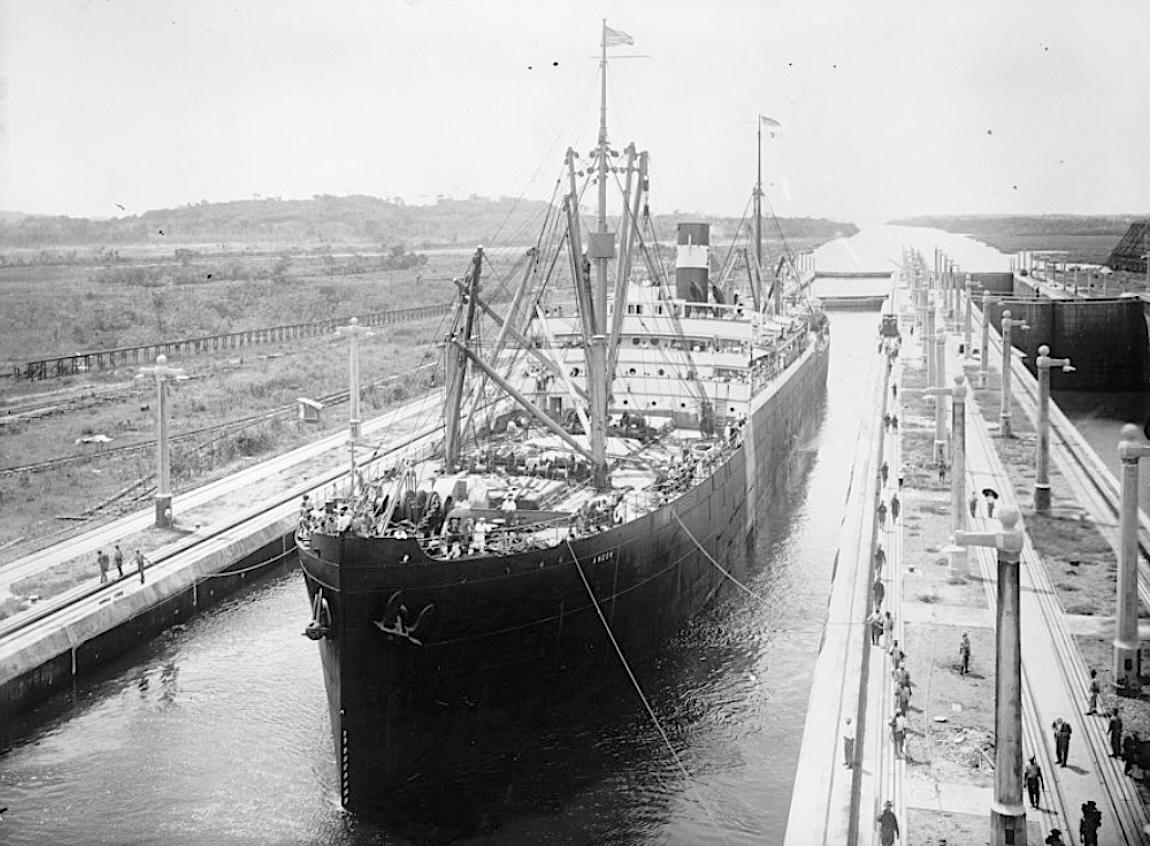
A cargo ship passes through the Gatun Lock of the Panama Canal. Undated, circa 1914-1919. (Credit: Library of Congress)

The successful completion of the Panama Canal on April 1, 1914 stands as one of the most significant moments in the development of the West Coast shipping industry, and, in particular,  the development of the newly minted Port of Los Angeles, founded just seven years earlier.

The idea of linking the Atlantic and Pacific oceans to facilitate the transport of goods without ships having to navigate all the way around South America was far from new. Explorer Vasco de Nunez Balboa has been credited with suggesting the idea in 1513, though no action was taken on his idea at the time.

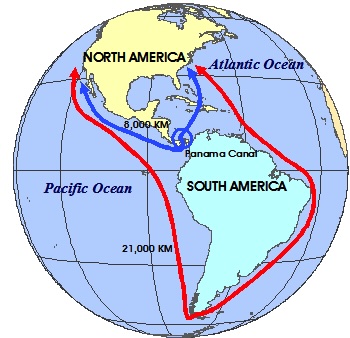
Blue route on map shows distance from New York to California as shortened by the Panama Canal. (Credit: Hofstra University)

France made a serious attempt to connect the Atlantic and Pacific via a canal through the Isthmus of Panama in the late 1800s. Construction on the project began in 1881, but it was plagued with financial and logistical troubles from the start. 

An estimated 20,000 canal workers died from malaria, yellow fever and other tropical diseases, and the French effort eventually went bankrupt.

In 1904, following the urgings of President Theodore Roosevelt, the U.S. purchased the rights to the canal project from France, and construction began in May of that year.

The Americans building the canal found ways to reduce deaths from the diseases that had plagued the French effort, and far fewer workers perished because of them.

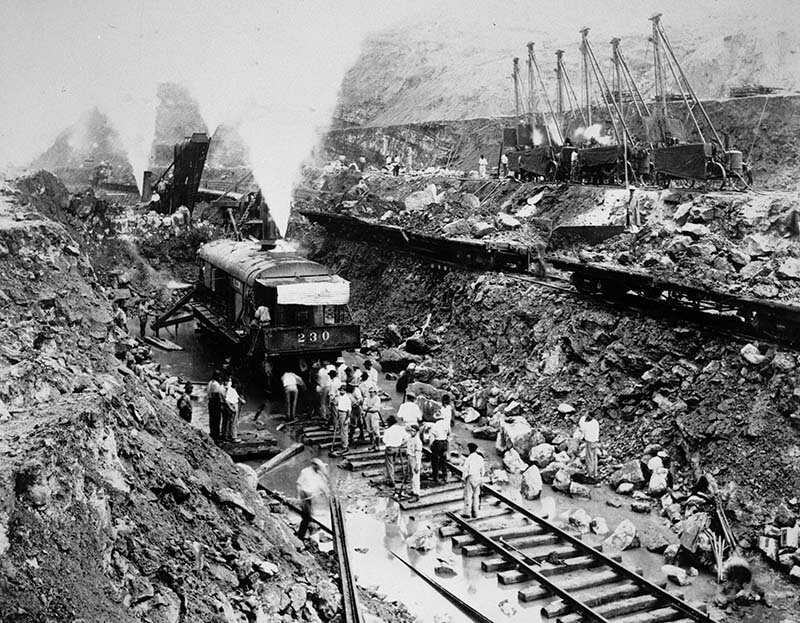
Two steam shovels meet in the middle of the Culebra Cut at the Panama Canal. Undated, circa 1904-1913. (Courtesy: National Archives)

The mammoth construction project took a decade to complete, and cost in the neighborhood of $375 million, or $11.8 billion in 2025 dollars. But it was worth it: the trip through the canal reduced the length of the voyage from New York City to San Francisco from 13,000 miles to 5,200 miles.

Even though the official opening wouldn’t take place until months later, Harbor Day celebrations were held in honor of the canal’s completion in San Diego on March 28 and at the Port of Los Angeles on April 11.

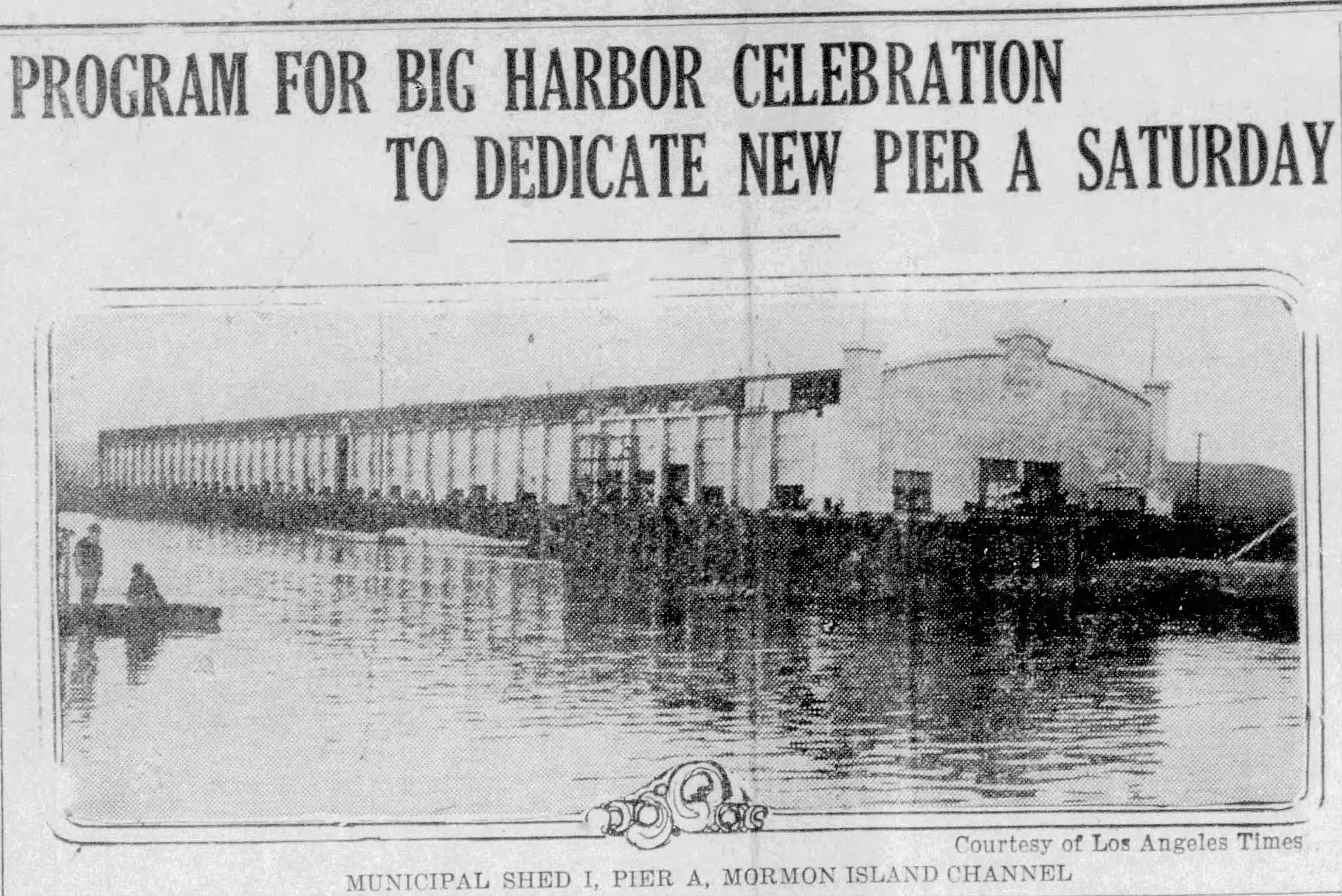
San Pedro Daily Pilot, April 8, 1914, Page 1. (Credit: San Pedro News Pilot archives)

30,000 people attended the April 11 festivities near the Port’s commercial wharf and warehouse at Pier A in Wilmington, which were the first structures built to accommodate freighters coming west through the canal. 

Former Port of Los Angeles executive director and Port history expert Geraldine Knatz recounts in an article on the Palos Verdes Pulse website how actor-director Charlie Chaplin used the occasion to make a short silent film, “A Busy Day.” 

Chaplin dressed in drag for the comic role. The film included footage of the lengthy parade that was part of the celebration, along with harbor scenes.

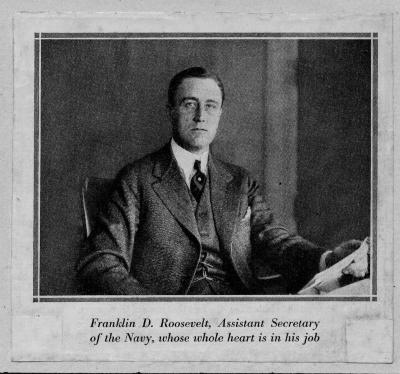
1913 photo. (Credit: New York State Archives)

Harbor Day also included speeches by Los Angeles Mayor Henry Rose and Assistant Secretary of the Navy Franklin Delano Roosevelt, a distant fifth cousin of canal booster Teddy Roosevelt.

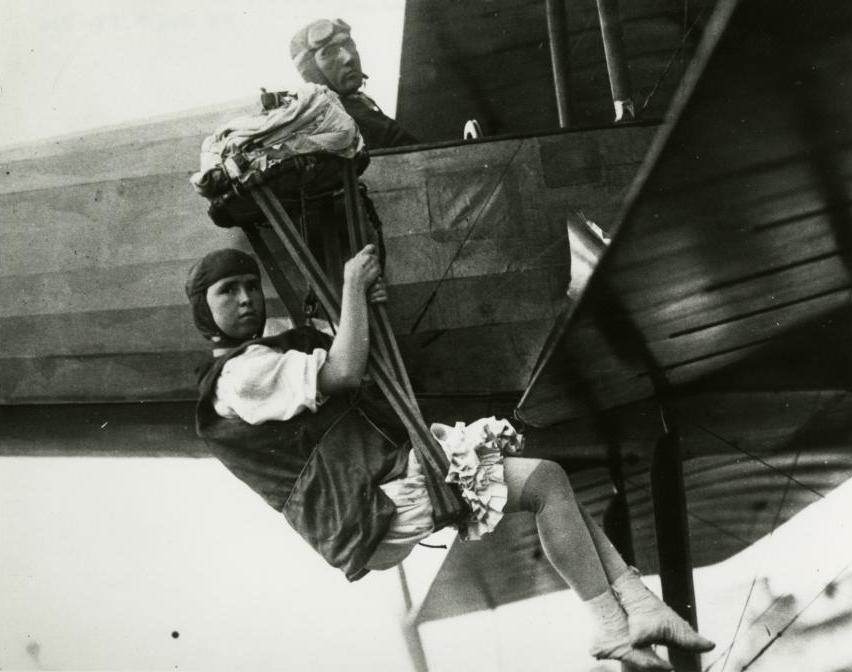
The large crowd also came to see aviator Glenn Martin drop a four-foot-tall woman skydiver named Tiny Broadwick from his plane into Los Angeles Harbor. Broadwick had gained fame by  becoming the first woman to skydive from an airplane a couple of years earlier.

And all that was just to celebrate the canal’s completion. Though some ships had traversed the waterway to test its efficacy beforehand, the official opening of the Panama Canal to ocean traffic wasn’t scheduled to take place until August 15, 1914.

One can imagine the larger celebrations that might have occurred on or around that date had world events not intervened in the interim.

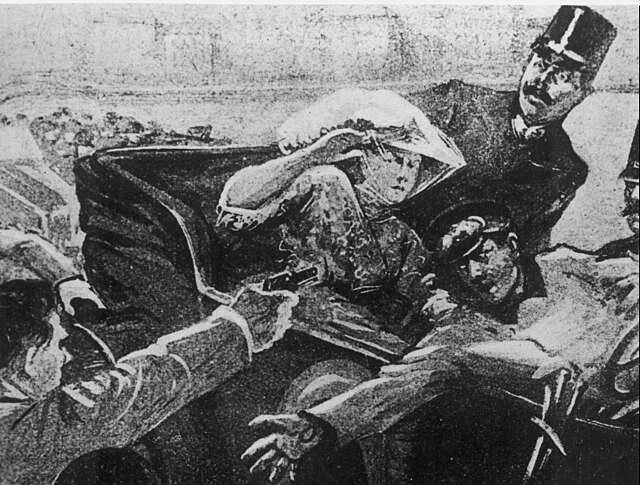
An artist’s rendition shows the assassination of Archduke Franz Ferdinand of Austria-Hungary and his wife, Czech Countess Sophie Chotek, during their visit to Sarajevo, Bosnia Herzegovina, on June 28, 1914. The assassin, Serbian nationalist Gavrilo Princip, left, of the group Black Hand, was captured. The incident sparked World War I. (AP Photo)

Tensions had been growing higher in Eastern Europe during 1914, and they exploded on June 28, 1914. On that day, Archduke Franz Ferdinand of Austria was assassinated in Sarajevo, the capital of Bosnia and Herzegovina by Gavrilo Princip, a Bosnian Serb who opposed Austria’s recent annexation of his country.

The political assassination sparked the onset of World War I on the European continent, and put a serious damper on potential celebrations surrounding the official opening date of the canal slated for Aug. 15, 1914.

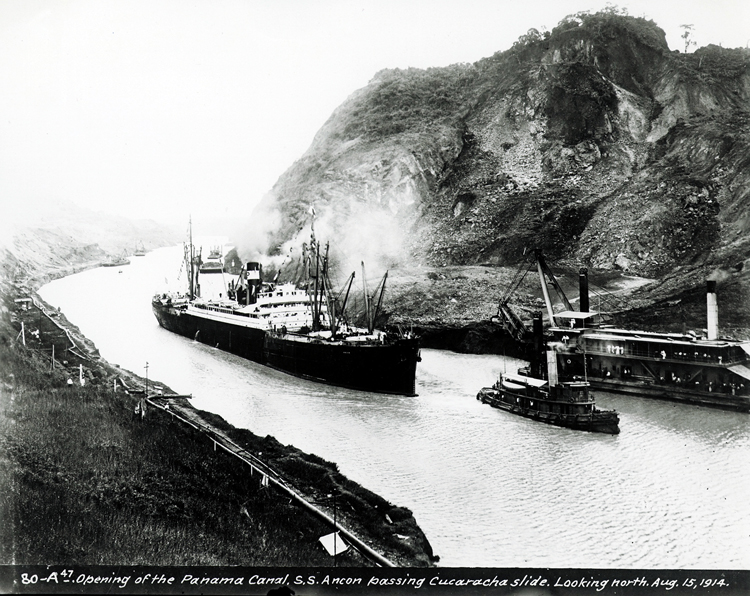
Ceremonies were muted on that day when the Boston Steamship Company’s ship the SS Ancon officially became the first freighter to complete the passage through the locks.

The SS Ancon makes its way through the west locks of the Panama Canal. It was the first ship officially to pass fully through the waterway on Aug. 15, 1914. (Credit: U.S. Army Corps of Engineers)

Full-scale celebrations saluting the opening of the Panama Canal were shifted to early 1915, when both San Diego and San Francisco held large-scale fairs in its honor. 

San Diego’s Panama-California Exposition opened in what is present-day Balboa Park on Jan. 1, 1915. It gave the city a chance to tout itself as the first port of call for ships coming westward through the canal.

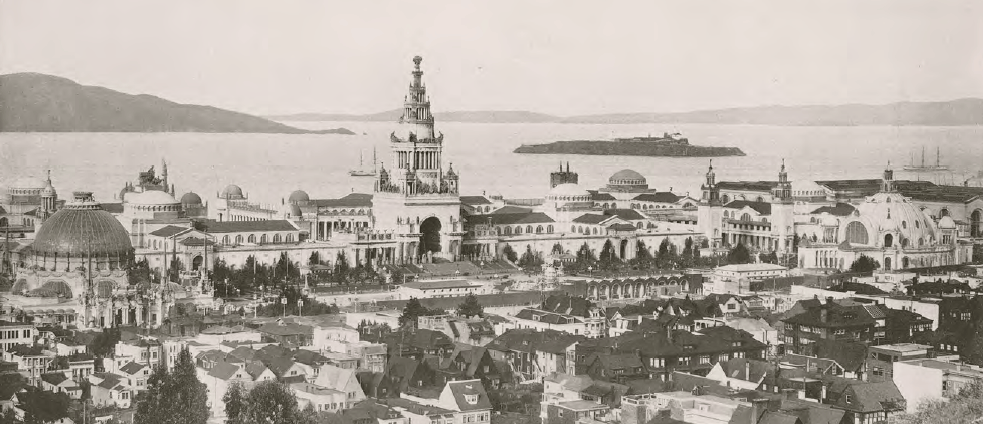
San Francisco went even further overboard with its Panama-Pacific International Exposition, which opened on Feb. 20 that year. The Exposition was a full-on world’s fair with permanent exhibit buildings, some of which are still in use.

Los Angeles didn’t hold any such large-scale celebrations, leaving that to its neighbors to the north and south. But hundreds did welcome the passenger steamship Great Northern upon its arrival in Los Angeles Harbor on Feb. 11, 1915, after it became the first passenger ship to pass through the Panama Canal.

The Tower of Jewels at San Francisco’s Panama-Pacific International Exposition (center) stands out among the fair’s other buildings. The domed Palace of Horticulture can be seen on the left. Alcatraz can be seen in the background.(Credit: Wikimedia Commons)

Sources:

Daily Breeze archives.

“The Day Charlie Chaplin and Aeronaut Tiny Broadwick Came to Los Angeles Harbor,” by Geraldine Knatz, Palos Verdes Pulse website, Nov. 8, 2020.

“A History of the Panama Canal,” by Anthony York, Brooks Bell website, Aug. 9, 2025.

Los Angeles Herald archives.

Los Angeles Times archives.

“The Opening of the Panama Canal,” U.S. Army Corps of Engineers website.

San Pedro News Pilot archives.

Wikipedia.

Parachutist Tiny Broadwick is ready to drop from a Martin T airplane piloted by Glenn Martin in this undated photo. Her appearance at Harbor Day in Wilmington in 1914 helped attract people to the celebration. Credit: Wikimedia Commons)

Ichabod Crane’s restaurant was just one of four that preceded King’s Hawaiian in Torrance

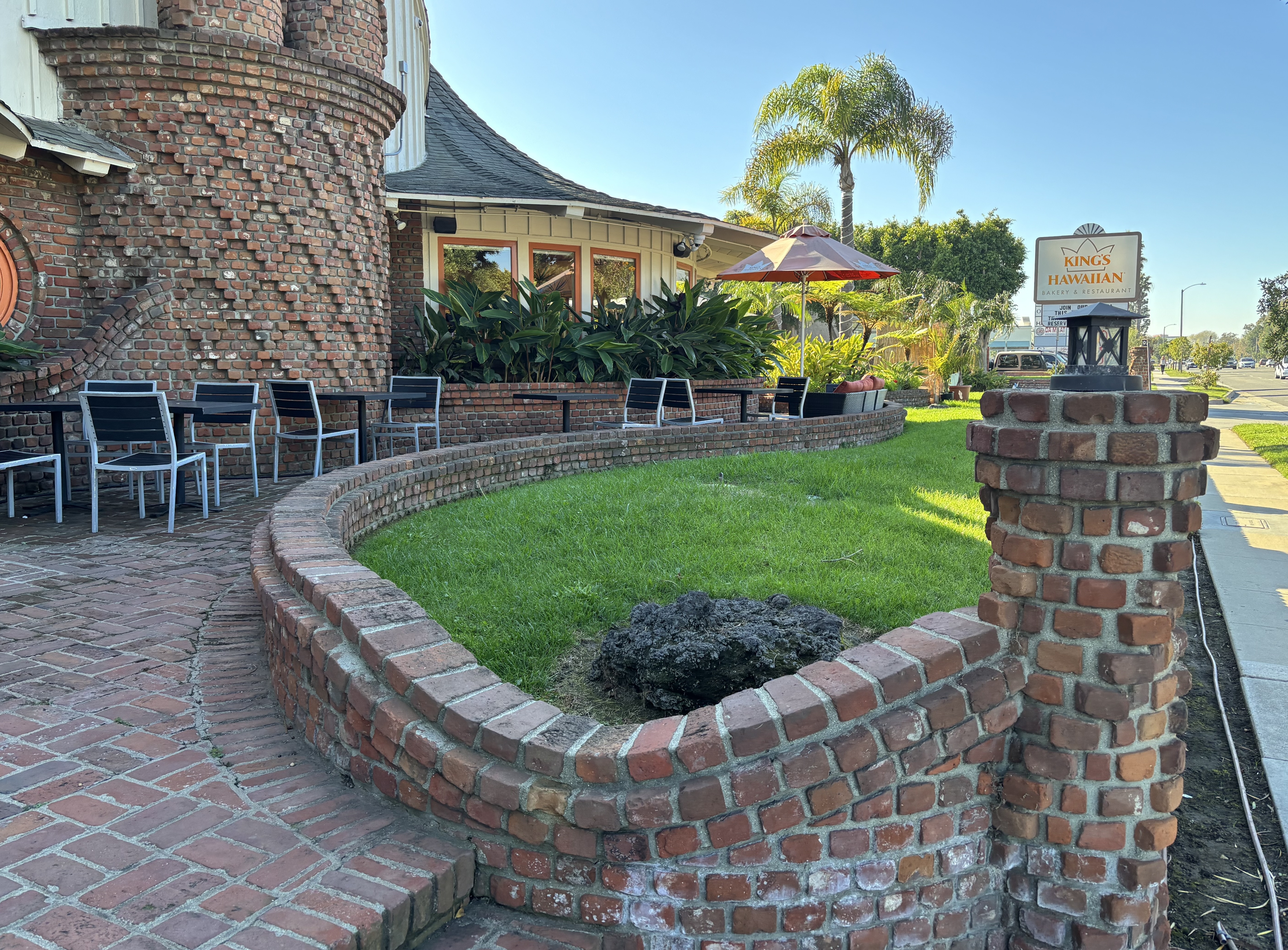
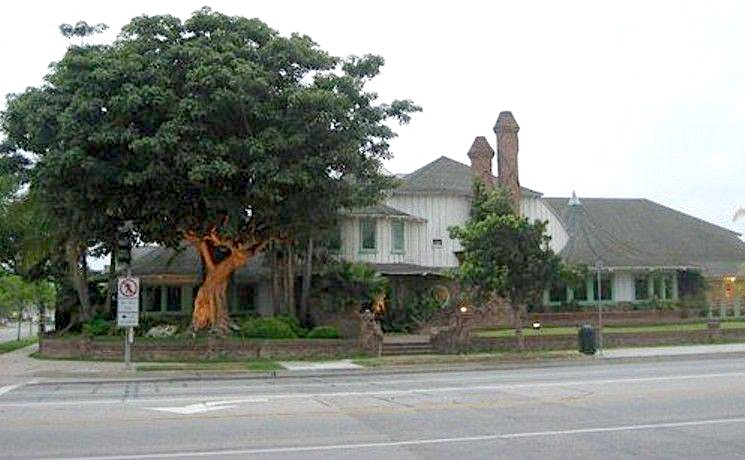
King’s Hawaiian Bakery and Restaurant is the fifth restaurant to occupy this building on Sepulveda Blvd. in Torrance. Oct. 28, 2025. (Photo by Sam Gnerre)

King’s Hawaiian Bakery and Restaurant at 2808 Sepulveda Blvd. in Torrance has become a South Bay fixture since opening for business in 1988. (I profiled the King’s operation in 2019.)

King’s has added a palm tree and some tropical plants, but otherwise, the popular eatery’s carefully manicured, brick-enhanced exterior doesn’t exactly evoke a traditional Hawaiian look, and there’s a reason for that.

To more recent residents, it may seem as if King’s has always been there. In fact, it turns out that four earlier restaurants occupied the building before King’s moved in (and installed that enticing front counter bakery display).

Torrance housing designer and builder John Gallareto, a Narbonne High graduate, deserves the credit for the construction of the original structure. In addition to his work on housing developments, he also had a passion for building restaurants.

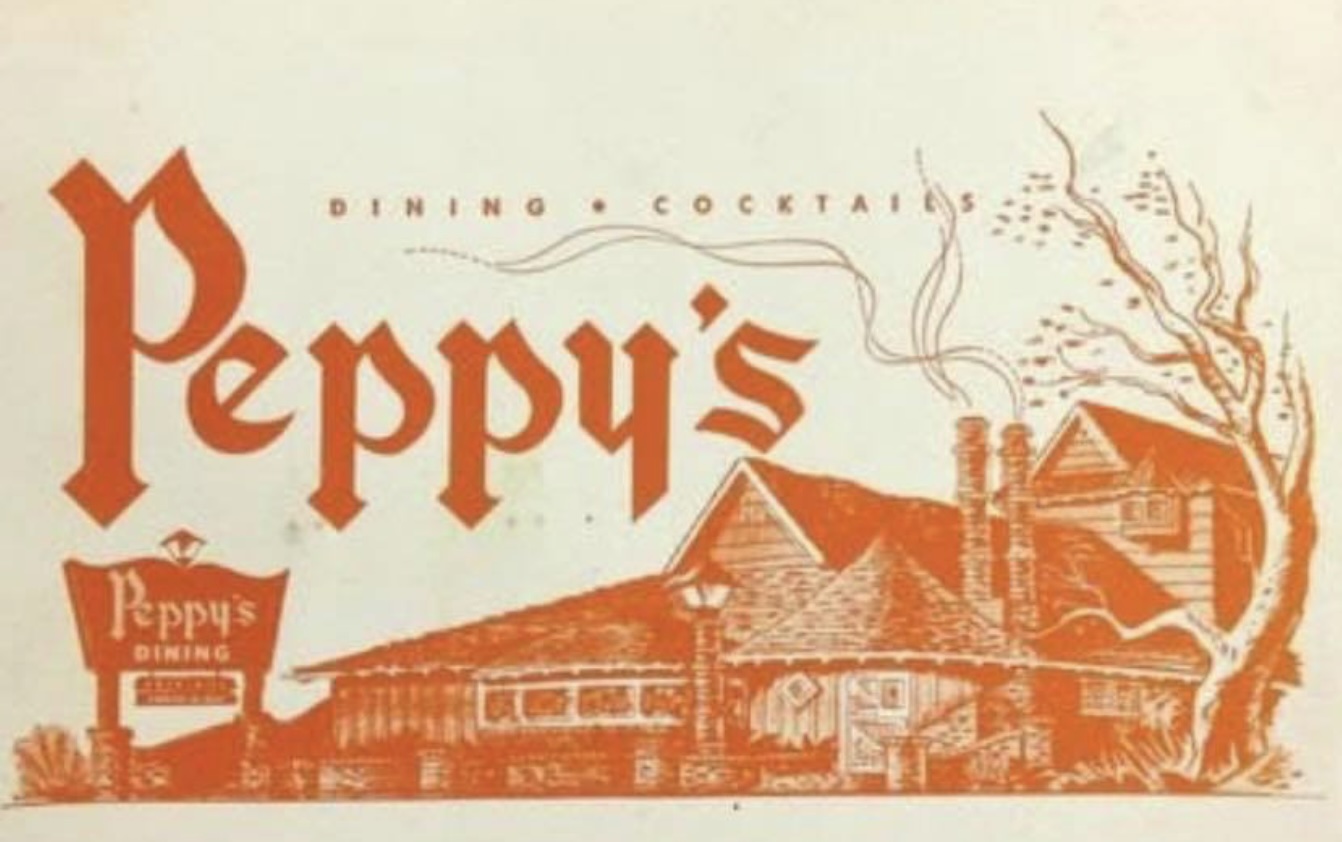
Drawing of Peppy’s in San Pedro taken from a circa 1960s menu, shows John Gallareto’s design, which has elements in common with his later Gallareto’s restaurant design in Torrance. (Credit: WorthPoint website)

He designed two distinctive restaurants in San Pedro: the Tasman Sea on Western Ave., and Peppy’s steak house on 9th St. A second Peppy’s opened in 1973 in Torrance at 2880 Sepulveda, just down the street from the current King’s location. After that Peppy’s closed, it  became a Sizzler steak house for many years. The site is now a vacant lot.

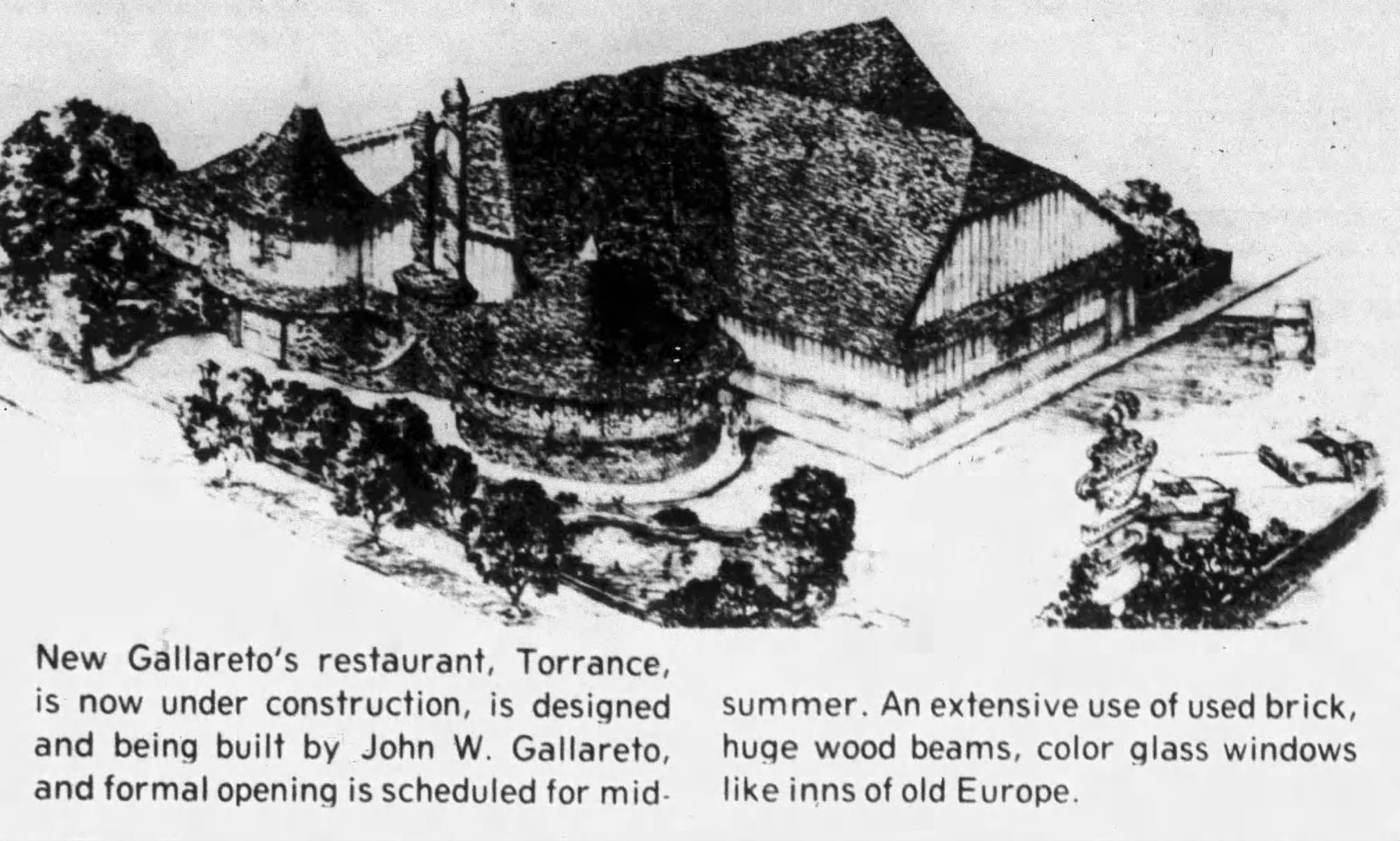
Gallareto spent $750,000 on his lifelong dream to build and open his own restaurant, Gallareto’s, on the Sepulveda site in October 1972. Its interior design featured heavy wooden beams, sculpted ceilings and a large brick fireplace in the entryway.

Architect’s rendition of Gallareto’s restaurant in Torrance. Daily Breeze, May 19,1972, Page 27. (Credit: Daily Breeze archives)

In addition to the main dining room, the interior layout included a spacious cocktail lounge area and a performance space visible from most of the rest of the 10,000-square-foot restaurant.

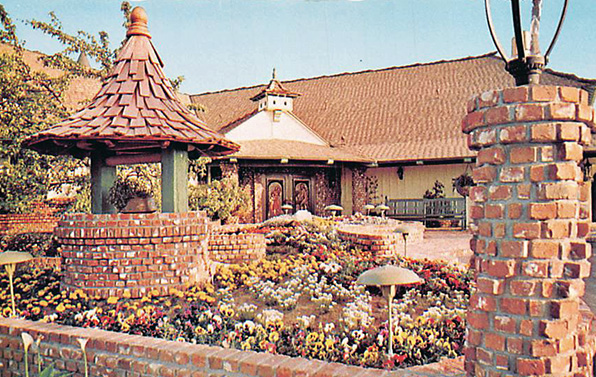
The distinctive exterior sported extensive brickwork, rounded turrets and cupolas and a brick lamp post, features that still adorn the building today.

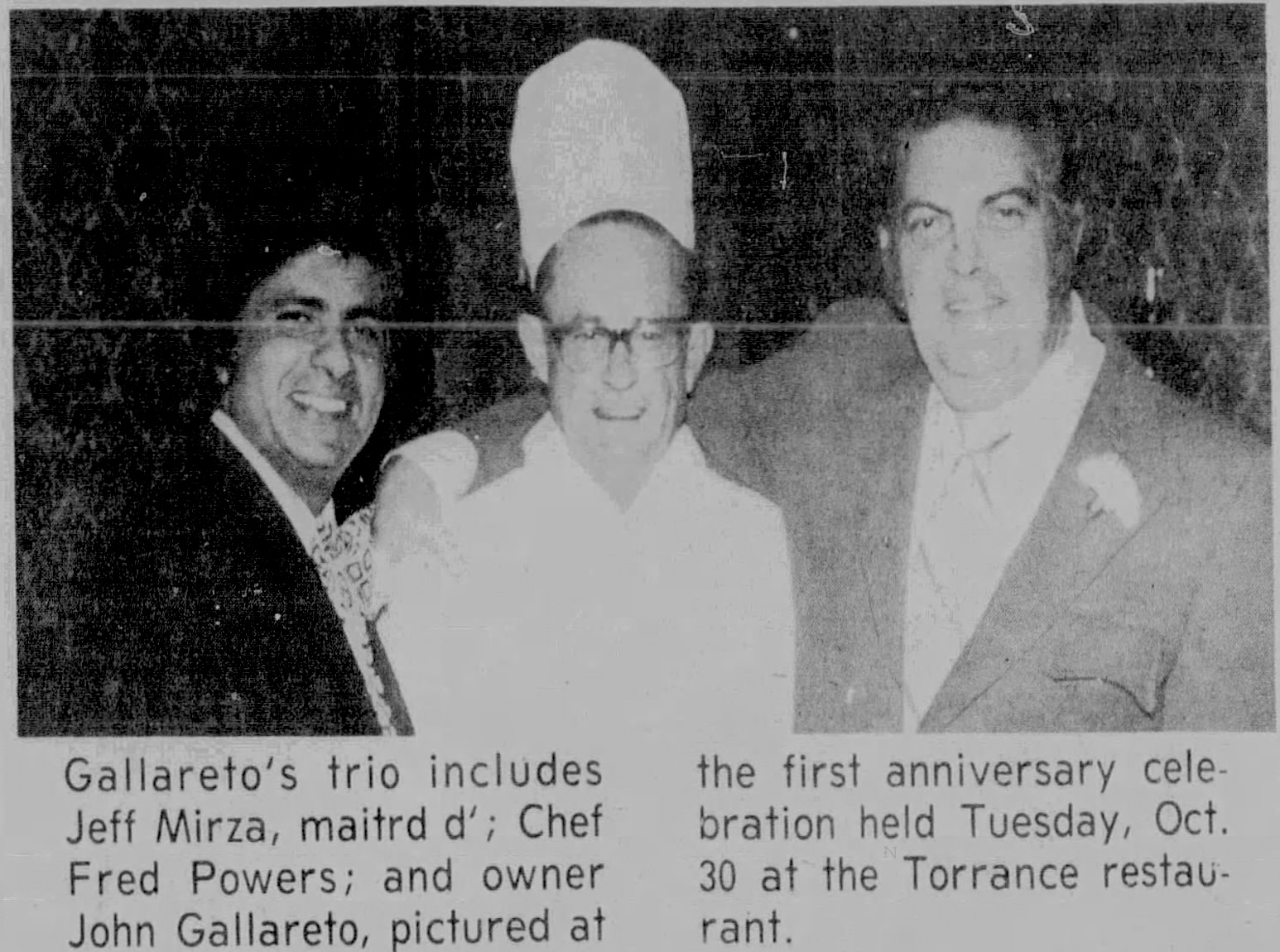
San Pedro News Pilot, Nov. 9, 1973, Page 14. John Gallareto at right. (Credit: San Pedro News Pilot archives)

Unfortunately, Gallareto’s closed in mid-1974. Gallareto died at 61 on April 5, 1986.

Very little information exists on the restaurant that followed Gallareto’s, 30 Tons of Bricks. It apparently opened in late 1974 in the same building, but only lasted a few months. 

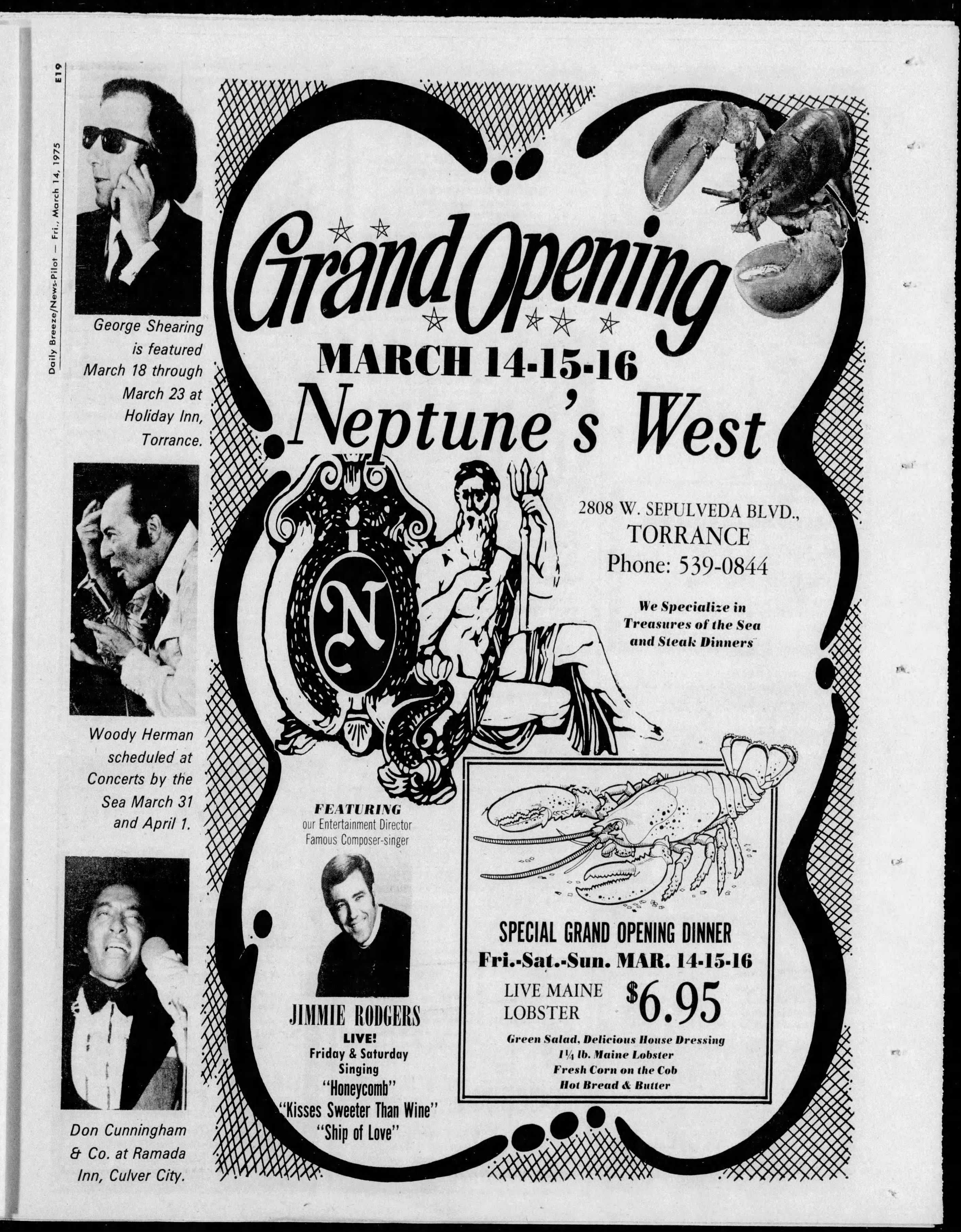
On March 6, 1975, restaurant operators Nick Denny and Irwin Paris took over the building with Neptune’s West, a seafood eatery. The partners refurbished the restaurant, installing tanks stocked with various shellfish from which diners could select their dinner. 

San Pedro News Pilot ad, March 14, 1975, Page E19. (Credit: San Pedro News Pilot archives)

They hired pop singer-songwriter Jimmie Rodgers to perform and handle the booking of musical acts. Employees wore various nautically themed uniforms. Denny and Paris envisioned a nationwide chain with the Torrance location as its flagship.

Sadly, large restaurants are tricky financial propositions, and Neptune’s West was unable to sustain its initial success. It closed its doors in early 1976.

The next occupant at 2808 Sepulveda embraced the “theme restaurant” movement of the 1970s that brought us the likes of Victoria Station and Chuck E. Cheese.

Owners Harry Prodromides (known informally as Harry Prod) and Jose Ruiseco adopted a literary theme for their restaurant, which opened on March 4, 1976. Ichabod Crane’s Tarry Town Tavern took its name from the main character in Washington Irving’s 1820 ghost story, “The Legend of Sleepy Hollow.”

Entrance to Ichabod Crane’s restaurant in Torrance. Undated, circa 1976-1987. (Credit: You Know South Bay If … Facebook page)

The restaurant included various themed rooms. Diners entered via the Great Hall and could choose rooms such as Sleepy Hollow, Katrina’s Cottage, the Library, the Study, or the Tarry Town Tavern cocktail lounge and live music space. The Garden Room and an upstairs lounge branched off from the tavern.

The interior decor included antiques, Persian rugs, hanging plants and various Americana-themed items meant to evoke the early 19th century atmosphere of Irving’s tale.

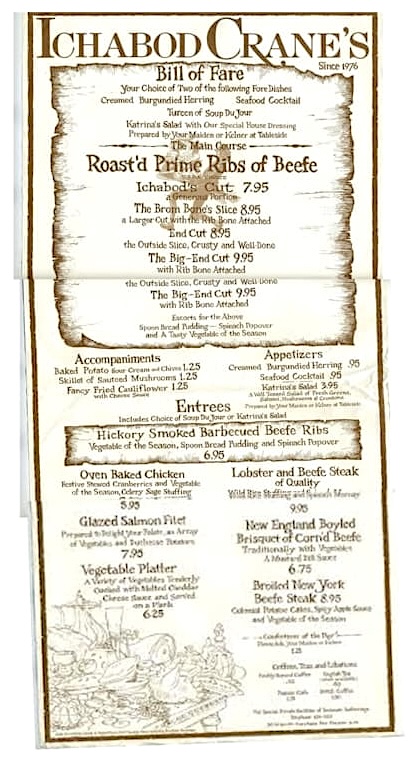
Menu specialties at first concentrated on hearty entrees such as prime rib, chateaubriand and seafood dishes.

Exterior photo of Ichabod Crane’s restaurant. Undated, circa 1976-1987. (Credit: You Know South Bay If … Facebook page)

Ichabod Crane’s had great success in its early years. Reservations weren’t accepted, so diners often had to get there early to avoid long waits for a table. It also became a favorite location for community service clubs, and a meeting room was added for such larger groups.

After more than a decade of operation, the restaurant’s business began to slack off. The menu changed to somewhat lighter fare in 1986, but it wasn’t enough to reverse the restaurant’s declining fortunes. Ichabod Crane’s was closed by September 1987.

King’s Hawaiian already had established its commercial baking business by the time it replaced Ichabod Crane’s with its King’s Hawaiian Bakery and Restaurant in 1988. It continues to be a Torrance dining mainstay as it approaches 40 years in business at the Sepulveda Blvd. site.

Ichabod Crane’s menu. (Credit: You Know South Bay If … Facebook page)

Sources:

Daily Breeze archives.

Los Angeles Times archives.

San Pedro News Pilot archives.

Comments:

From Paul Hill:

I loved your story about Kings Hawaiian. Just recently some friends and I were trying to recall what was there prior.

Regarding the Pepys/Sizzler restaurant, unfortunately the pretty building was torn down a couple years ago. It had been vacant since Covid. Someone had planned to put in a self-service carwash on the property, but thankfully that never happened.

From Gary Narimatsu:

Thanks for the article about Ichabod Cranes.  I remember that place.  Also remember Peppys.  I was employed at Hughes starting 1979.  We went there for various occasions.  I sometimes think back about the 94th Aero Squadron too, and when Skypark was a two laned drive.

Is this your new site? Log in to activate admin features and dismiss this message
Log In