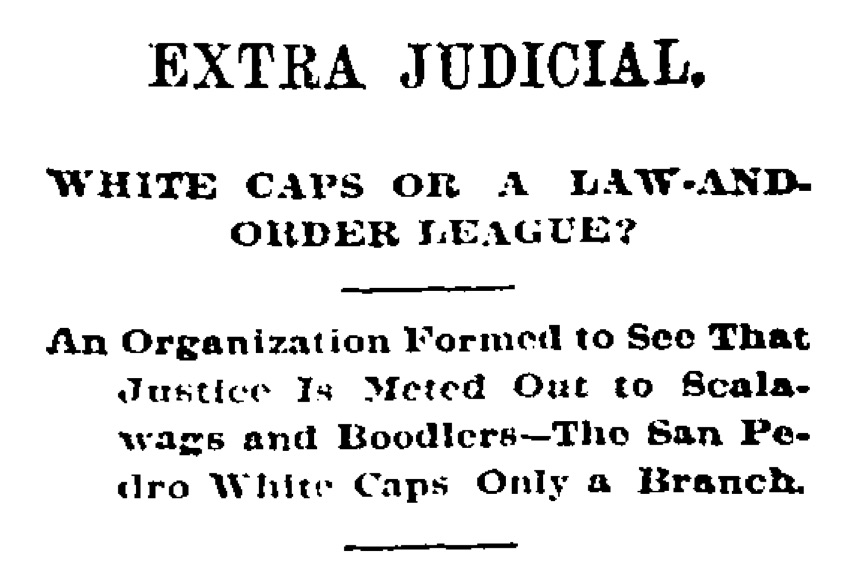
The White Caps movement started in Indiana in the late 1830s. The vigilante group used a variety of methods in order to maintain what they felt were proper community standards, especially in frontier areas with little formal law enforcement.
Its members usually were members of the community seeking to punish men who abused their wives, had shameless affairs, or were noticeably shiftless and lazy, and women who were considered to have loose morals.
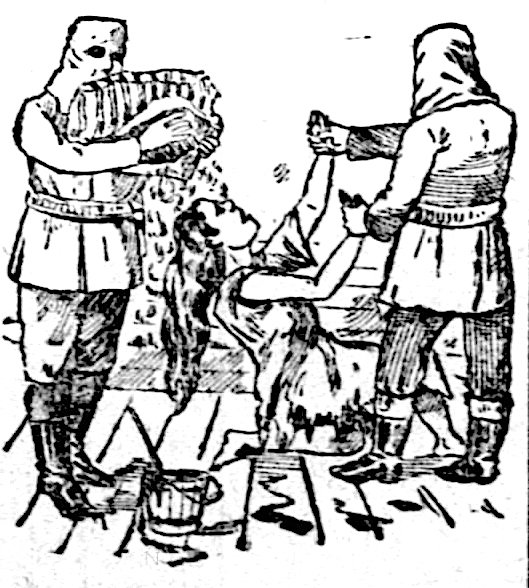
Feb. 25, 1889, Page 8.
The White Caps took their name for the makeshift white hoods they wore while carrying out their often dubious brand of justice. Their practices strongly influenced the more well-known Ku Klux Klan, which arose after the Civil War. (The iconic pointed white KKK hoods and fancy robes weren’t adopted until the racist group’s revival in 1915.)
“Whitecapping” activities, typically carried out only under cover of darkness, included threats, intimidation, public shaming and more violent acts such as beatings, whippings, arson and tarring and feathering. Though racism played a part, especially in the South and Midwest, the White Caps in other groups of the country oftentimes were more pro-morality than anti-minority.
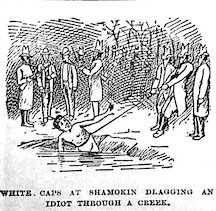
Drawing from The Cincinnati Enquirer,
Feb. 25, 1889, Page 8. Shamokin is a town in central Pennsylvania.
As E.W. Crozier noted in his 1899 book on the White Caps, “The original purpose of whitecapping was to administer punishment to (those) who lived in adultery and kept disorderly houses in the community.”
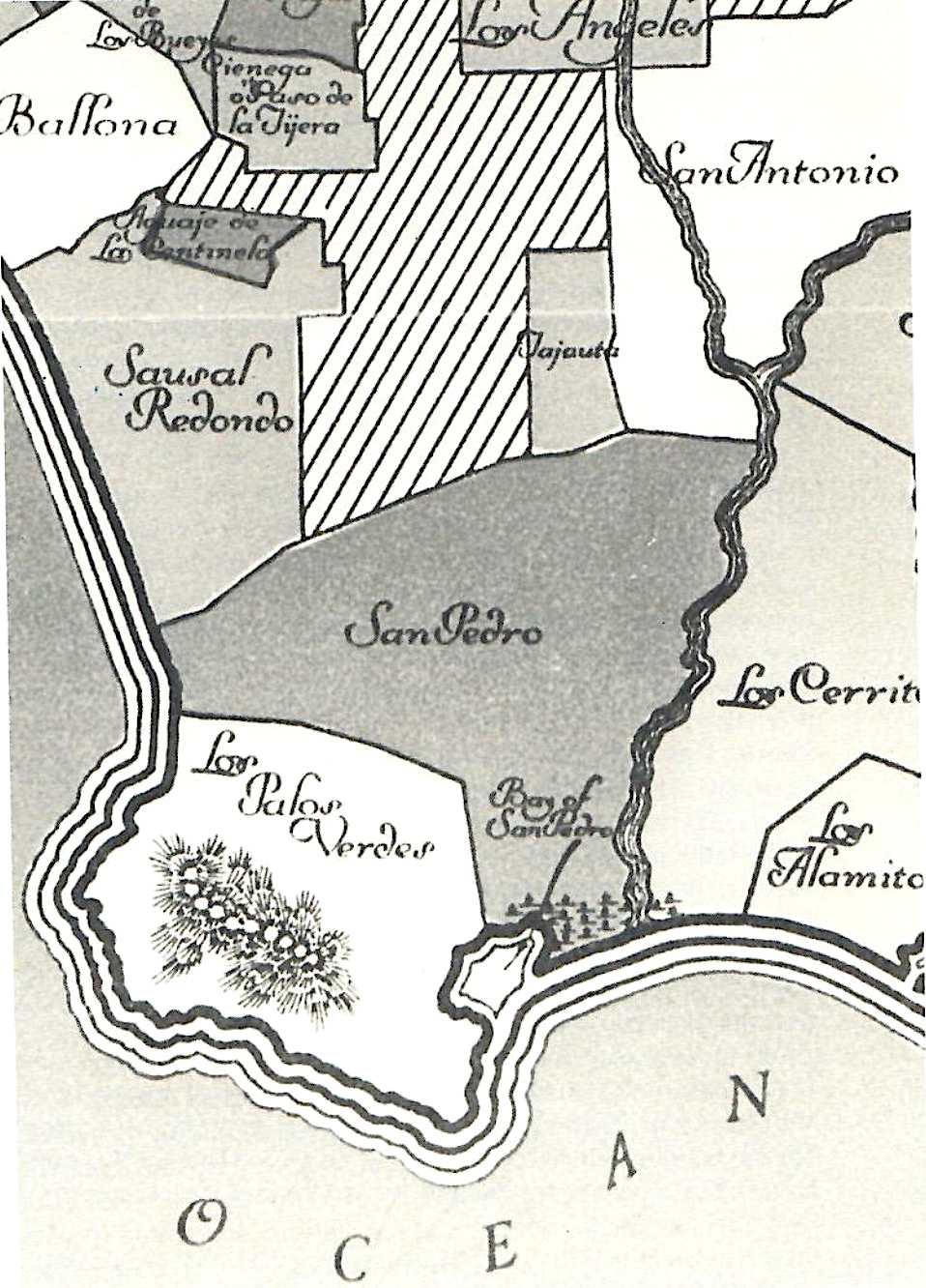
Offshoots of the loosely-formed group sprouted up throughout the country, and enjoyed a particularly strong renaissance during the late 1880s, which brings us to the local chapter that began operating in San Pedro at that time.
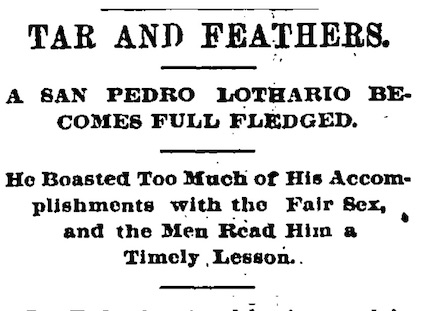
The White Caps caught wind of an incident of marital infidelity involving a Swedish carpenter and self-proclaimed local Romeo named Gustave “Gus” Braman. Braman, 28, who lived in San Pedro, got caught alone with a sea captain’s wife in the married couple’s Vinegar Hill residence in the early morning hours of April 22, 1889.
Capt. Koughan had been piloting the barque Lilian to Santa Barbara when he decided to come home early from the trip and surprise his wife. Though Koughan didn’t catch Braman red-handed, the circumstances were suspicious enough, and a heated argument ensued between the two men.
The next day, Braman took the matter to court, accusing Koughan of having threatened to kill him during their confrontation. Koughan quickly was cleared of the charge.
It might have ended there had the boastful Braman not gone to a local saloon afterward, and, according the the Los Angeles Herald, told those assembled, “Yes, I have been sleeping with her (the captain’s wife), and what is more, boys, there’s four or five more up there that l am staying with, too.”
Word spread quickly, and the White Caps, many of them working men from the community, felt sufficiently threatened and outraged by Braman’s braggadocio to swing into action.
That night at around midnight, a group of about ten men wearing white hoods stormed into Braman’s 17th Street house. According to the Herald, one of them read from a sheet of paper: “In the name of the Lord, it is decreed that you be tied to a pole and tarred and feathered.” Braman later identified the man as Tommy Thompson.
The men dragged Braman outside, where tar was applied to the lower half of his body, followed by by the shower of feathers which stuck to the tar on his skin. They then marched him to Front St., where he was chained to a lamp post at roughly 1:30 a.m. Wednesday morning before the men fled.
He was discovered about 90 minutes later and taken to a druggist’s office, where he underwent the painful removal of the bulk of the tar and feathers. Later that day, he went back to court and testified against several men who had been arrested in the case by the local sheriff.
A few days later, on May 1, someone soaked the house and surrounding grounds of Braman’s house and set it afire, burning the house and everything in it to the ground. Braman was not home at the time. The arson seemed to be a fairly clear case of retaliation, but no culprit ever was found.
Seven men, including Thompson, were held over for trial and ultimately convicted that July, but only on misdemeanor charges of assault with a deadly weapon and inflicting bodily harm upon Braman. Their sentences ranged from a month in jail to a $50 fine.
As for Gustave Braman, he moved to Santa Cruz, where he was tried for murder and arson in 1891 in the death of his brother, Eric, in a house fire. The circumstances were similar to the arson incident that resulted in his own house being burned down earlier in San Pedro, but there was not enough evidence in the case to convict him.
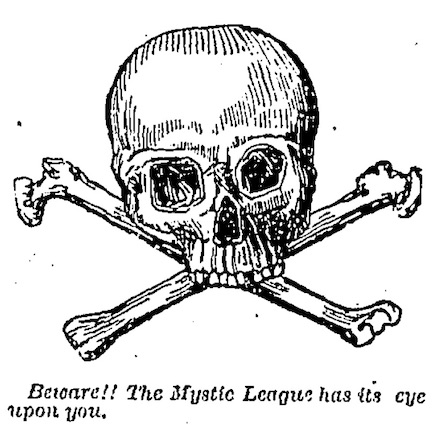
Despite the minor nature of the charges in the Braman case, it seemed to have had an effect on subduing the local activities of the White Caps. A Los Angeles Times story from Feb. 7, 1890 reported on an anonymous group called the Mystic League who were threatening a San Pedro barkeeper by leaving threatening calling cards, but apparently it went no further. No further activities of the group were reported.
Though they continued to be active in some parts of the country, many states began cracking down on the White Caps with more strident arrests and prosecutions of their members from the mid-1890s on The movement seems to have died down in the early 1900s, but another more virulent group, the revived KKK, would soon begin waging a far more terrifying brand of violence in 1915.
Note: This 1905 Edison silent film portrays the White Caps in a positive way.
Note: Gustave “Gus” Braman’s name has been misspelled widely in various newspaper accounts of the day as Bremen, Braeman, Brennan and Broman, among other variations.
Sources:
Los Angeles Herald files.
Los Angeles Times files.
San Pedro News Pilot files.
Santa Cruz Sentinel files.
“These racist vigilantes inspired the Ku Klux Klan and battled state governments for years | Whitecappers went outside the law and terrorized at will,” By Matt Reimann, Timeline website, Aug. 14, 2017.
The White-caps : a history of the organization in Sevier County (Tennessee), by E.W. Crozier, 1899. Republished by Internet Archive.