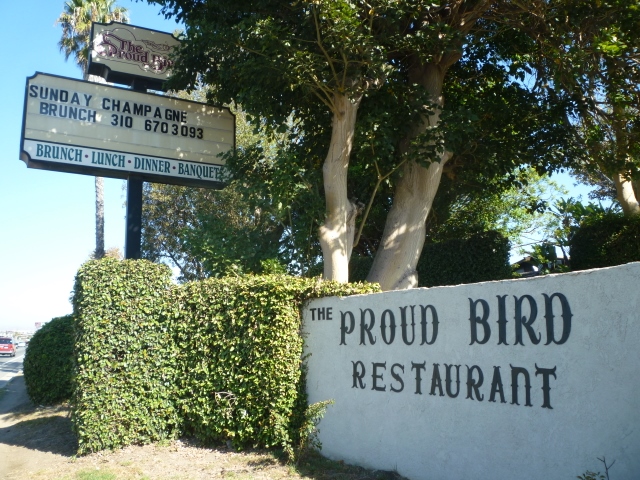
The Proud Bird restaurant

Entrance to The Proud Bird restaurant near LAX. Daily Breeze photo, Nov. 2013.

Specialty Restaurant Corp. of Anaheim chose a novel way to break ground for its latest restaurant, The Proud Bird, at a ceremony before LAX officials and members of the press on Tuesday, Nov. 15, 1966.
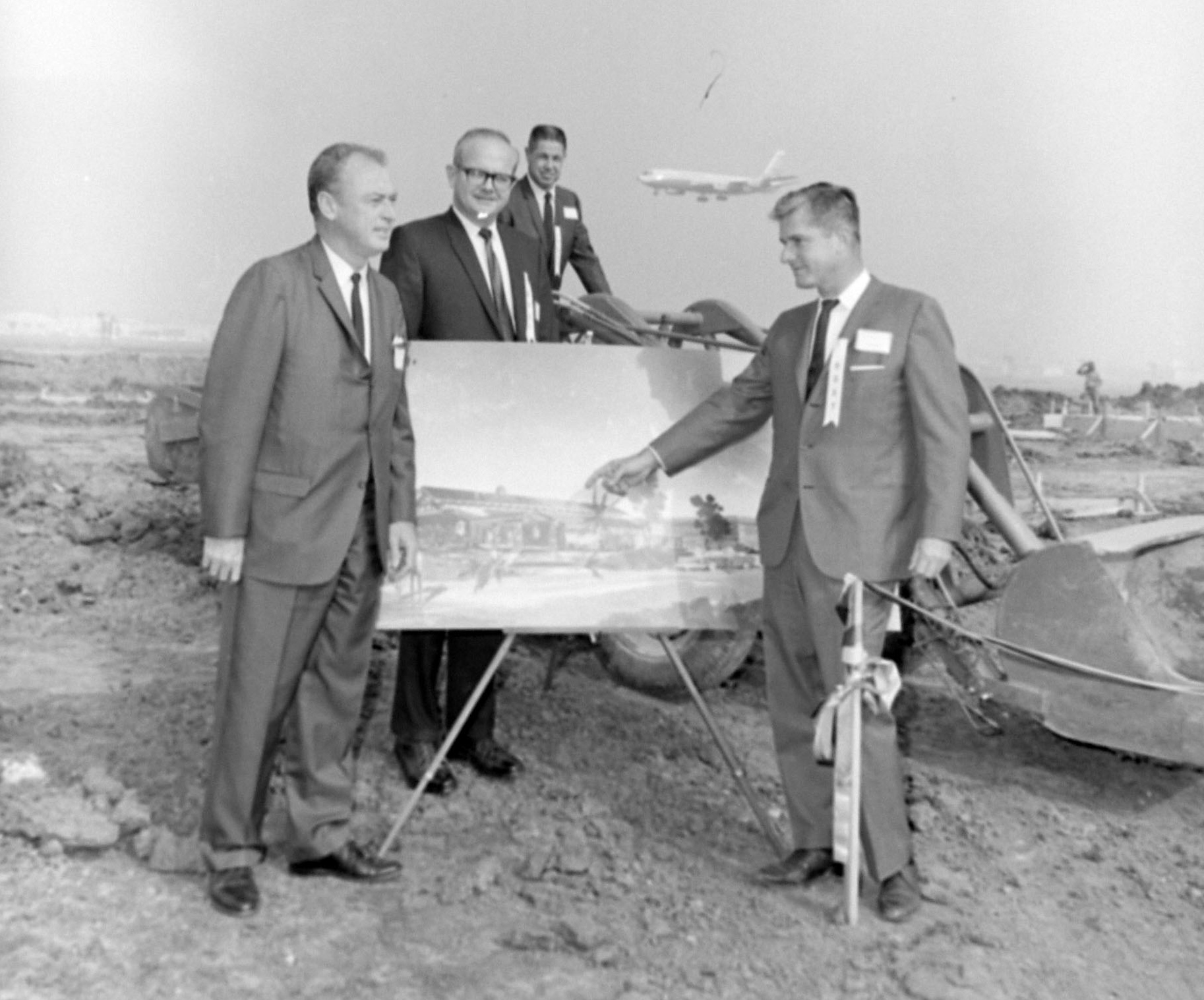
Groundbreaking for The Proud Bird restaurant near LAX, Oct. 15, 1966. Speciaty Restaurants owner David Tallichet, far right, points at an artist's rendering as, L to R, LAX manager Francis Fox, architect Kenneth Wing and Specialty VP David Perrin look on. Daily Breeze file photo by Jack Wyman.
Groundbreaking for The Proud Bird restaurant near LAX, Oct. 15, 1966. Speciaty Restaurants owner David Tallichet, far right, points at an artist’s rendering as, L to R, LAX manager Francis Fox, architect Kenneth Wing and Specialty VP David Perrin look on. Daily Breeze file photo by Jack Wyman.

LAX general manager Francis Fox was tapped to drive a tractor to break the ribbon, eschewing the traditional giant pair of scissors usually used for such events, while company president David Tallichet, an aviation buff and former World War II pilot, looked on.

Founded by Tallichet in 1958, Specialty pioneered the concept of destination restaurants, building their outlets on top of a hill, by the water, or near an airport. Panoramic views and large banquet facilities remain part of the company’s vision. Its current 22 outlets including its first, The Reef in Long Beach, the hilltop Castaway locations in Burbank and San Bernardino, Shanghai Red’s in Marina del Rey, and the 94th Aero Squadron restaurant at the Van Nuys Airport.

The Proud Bird took its name from the Continental Airlines advertising slogan, “The proud bird with the golden tail.” It was built on a 5.6 acre site at 111th Street and Aviation Boulevard just east of the airport’s southern runways, with seating for 300 patrons and banquet facilities available for 1,200 more. It opened for business on April 1, 1967.
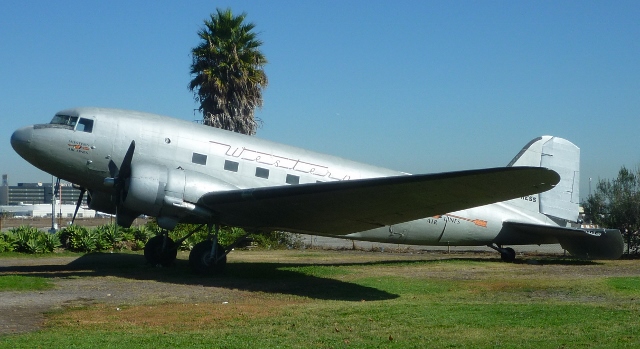
This DC-3 on display on the grounds of The Proud Bird restaurant near LAX has vintage Western Airlines markings. Daily Breeze photo, Nov. 2013.

The grounds of the large Spanish-style structure were festooned with airplanes of various types mounted on stands, many from Tallichet’s private collection. The number of planes grew over the years, and walkways were built on the restaurant’s northern lawn to allow viewing of the display aircraft and explanatory plaques. A DC-3 with original 1940s Western Airlines markings was added in 2009.

The Proud Bird soon became a popular gathering spot for aviation executives, plane spotters and just about everyone else involved in the aviation industry.

Tragedy struck the restaurant in the pre-dawn hours of Tuesday, Dec. 4, 1984. Fire broke out, completely gutting the 55,000-square-foot grand ballroom building.
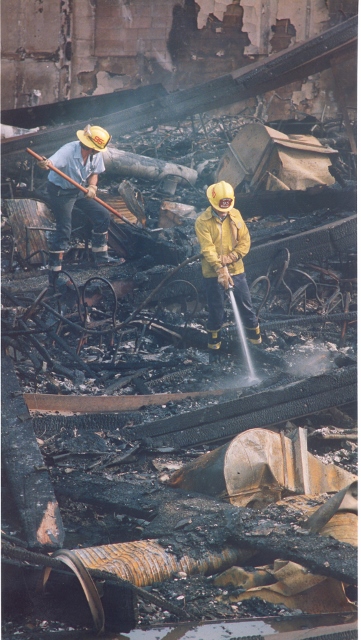
Firefighters mop up at the Dec. 4, 1984 blaze at the Proud Bird restaurant near LAX. Daily Breeze file photo by Brad Graverson.

Firemen received the first call on the fire from an unidentified person at 5:10 am. They arrived at the 11022 Aviation Boulevard address to find the restaurant’s grand ballroom competely engulfed in flames.

The real tragedy occurred when Los Angeles city firefighter Benjamin Pinel of San Pedro collapsed amid the dense smoke and flames at about 6:30 a.m. Four firefighters were injured when they re-entered the building to pull Pinel out.

He was rushed to Centinela Hospital, but did not survive.

It took firefighters more than two and a half hours to knock down the blaze, which was exacerbated by the collapse of the building’s roof just as the blaze began to come under control.

Damage was estimated at more than $1 million, and, though parts of the eatery remained open, its operators estimated they would lose an additional $300,000 in business and 95 percent of its banquet trade until repairs could be made.
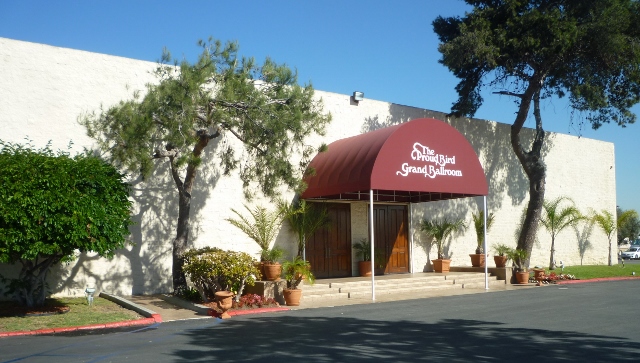
The Grand Ballroom at The Proud Bird restaurant was rebuilt after being gutted in a 1984 fire. Daily Breeze photo, Nov. 2013.

Jose Jesus Davila, a 19-year-old part-time dishwasher and night janitor, was arrested on murder and arson charges in December 1984, but was released in January 1985 when charges were dropped due to insufficient evidence. No further arrests ever were made in the case.

In May 1991, rumors began to circulate that The Proud Bird would close when the restaurant’s lease on the airport’s land expired. There was some talk that LAX, the leaseholder, might want the land back, but ultimately the Proud Bird would remain in place for more than two more decades.

Specialty Restaurants founder David Tallichet died on Oct. 31,, 2007. His son, John, now runs the firm.

It was John Tallichet who confirmed in late September 2013 that the venerable restaurant finally would close its doors for good on Nov. 21, 2013.

When the company determined that it could not obtain a long-term lease on the property without a possible 250-percent increase in rent to $510,000 a month, the decision was made to close The Proud Bird permanently after 46 years of operation.

Update: On Jan. 13, 2014, airport officials announced that a new lease extension had been signed that will keep the Proud Bird operating for a 13-month period ending in January 2015.
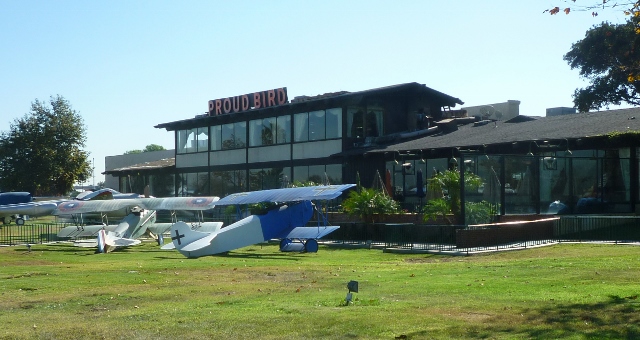
 

The Proud Bird restaurant near LAX will be closing permanently on Nov. 21, 2013. Daily Breeze photo, Nov. 2013.
The Proud Bird restaurant near LAX will not be closing permanently on Nov. 21, 2013 as originally announced. Its owners have signed a new lease and will remain open through January 2015. Daily Breeze photo, Nov. 2013.

Sources:

Daily Breeze files.

Los Angeles Times files.

Specialty Restaurants Corporation website, http://www.specialtyrestaurants.com/src/.

 For more information:

Proud Bird website: http://www.theproudbird.com/proudbird/default.aspx

On Facebook: https://www.facebook.com/proudbirdrestaurant


Wilmington riot erupts in 1970

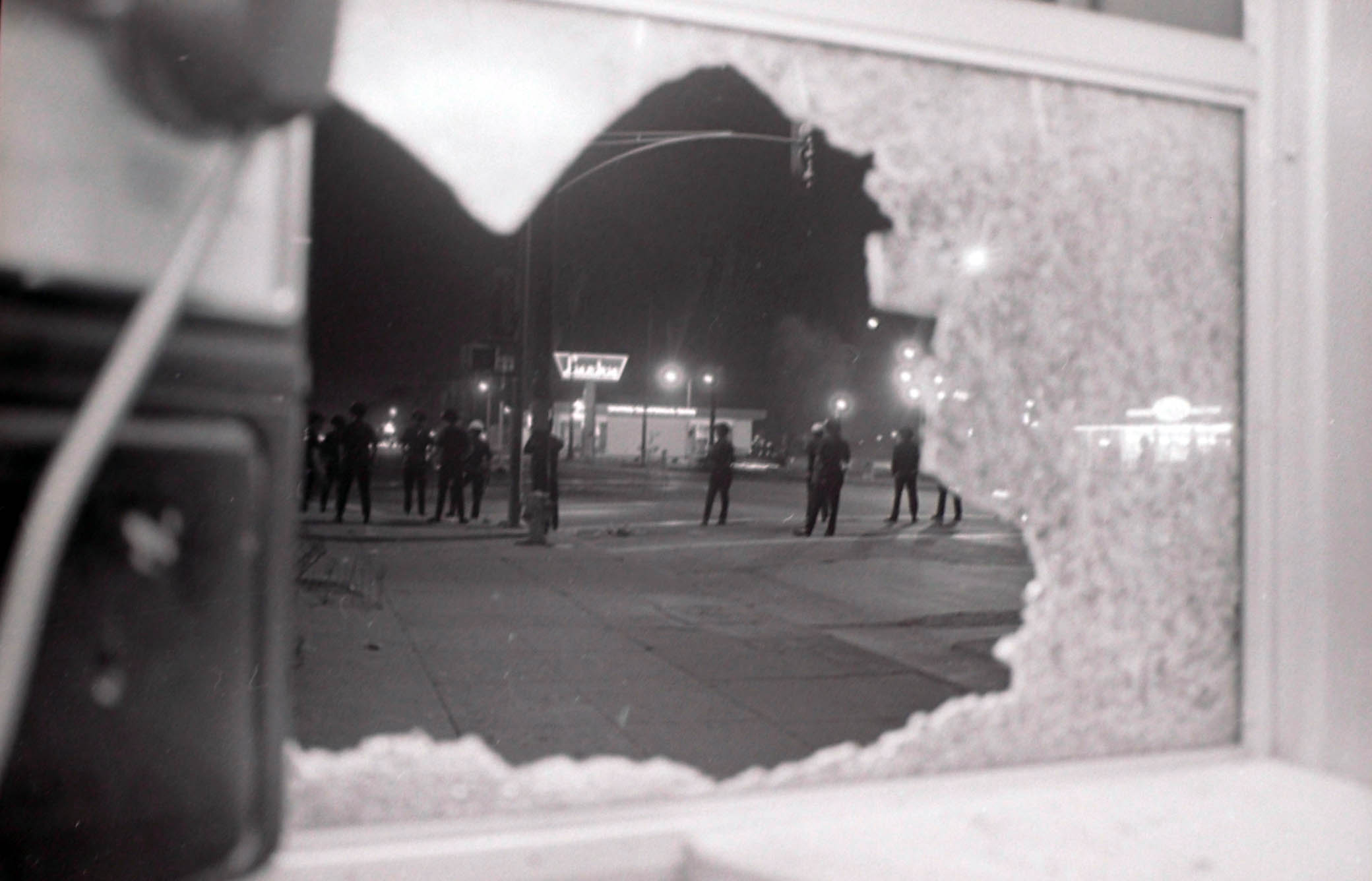
Police patrol the streets of Wilmington during the Aug. 31, 1970 riot. Daily Breeze file photo by Jack Wyman.

The events that sparked the Aug. 31, 1970 riot in Wilmington actually began in East Los Angeles the day before.

On Saturday, Aug. 30, a peaceful antiwar demonstration sponsored by the Chicano National Moratorium Committee took place on Whittier Boulevard in Los Angeles County territory in the heart of the Mexican-American community.

After the demonstration ended, police moved in to disperse the crowds, and the hostilities began. For five hours, hundreds of rioters broke windows and set fires, damaging an estimated 178 businesses. It took about 500 officers to quell the disturbance. Their tactics included firing tear gas cannisters to subdue rioters, who ended up causing more than $1 million in damages. Nearly 200 people were arrested.

Two people died and at least 60 injured during the riot. One of those killed was Los Angeles Times reporter and columnist Ruben Salazar, who died instantly when struck by a 10-inch tear gas cannister fired into the Silver Dollar cafe.

News of Salazar’s death inflamed the Hispanic community.

The next evening, Sunday, Aug. 31, violence erupted in the community of Wilmington.

Angered by the earlier events in East Los Angeles, a couple of hundred people gathered in the 900 block of Avalon Boulevard in Wilmington at 9:30 p.m.

When police arrived to break up the assembly, the unruly crowd, which had grown to an estimated 500 people, pelted them with rocks and bottles. The violence began to spread, eventually encompassing a 12-block area centering around Avalon from C Street up to Pacific Coast Highway.

At least 80 businesses were damaged by the rioters. Molotov cocktail attacks were reported at several businesses, including Gilbert’s 5 and 10 department store, Spear’s Men’s Clothing, the Tic Toc Market and McMahon’s Furniture, all of which suffered damage to their buildings and inventories.

What authorities at first thought might be sticks of dynamite thrown at the Pacific Maritime Exchange on Fries Avenue turned out to be signal flares thrown on its roof. Firefighters responding to reports of a Molotov cocktail thrown at an oil well on Eubank Avenue and an oil tank on McDonald Street were able to douse the blazes before they spread to either of the highly flammable structures.

Police line up along Avalon Boulevard during the Aug. 31, 1970 disturbance in Wilmington. Daily Breeze photo by Jack Wyman.
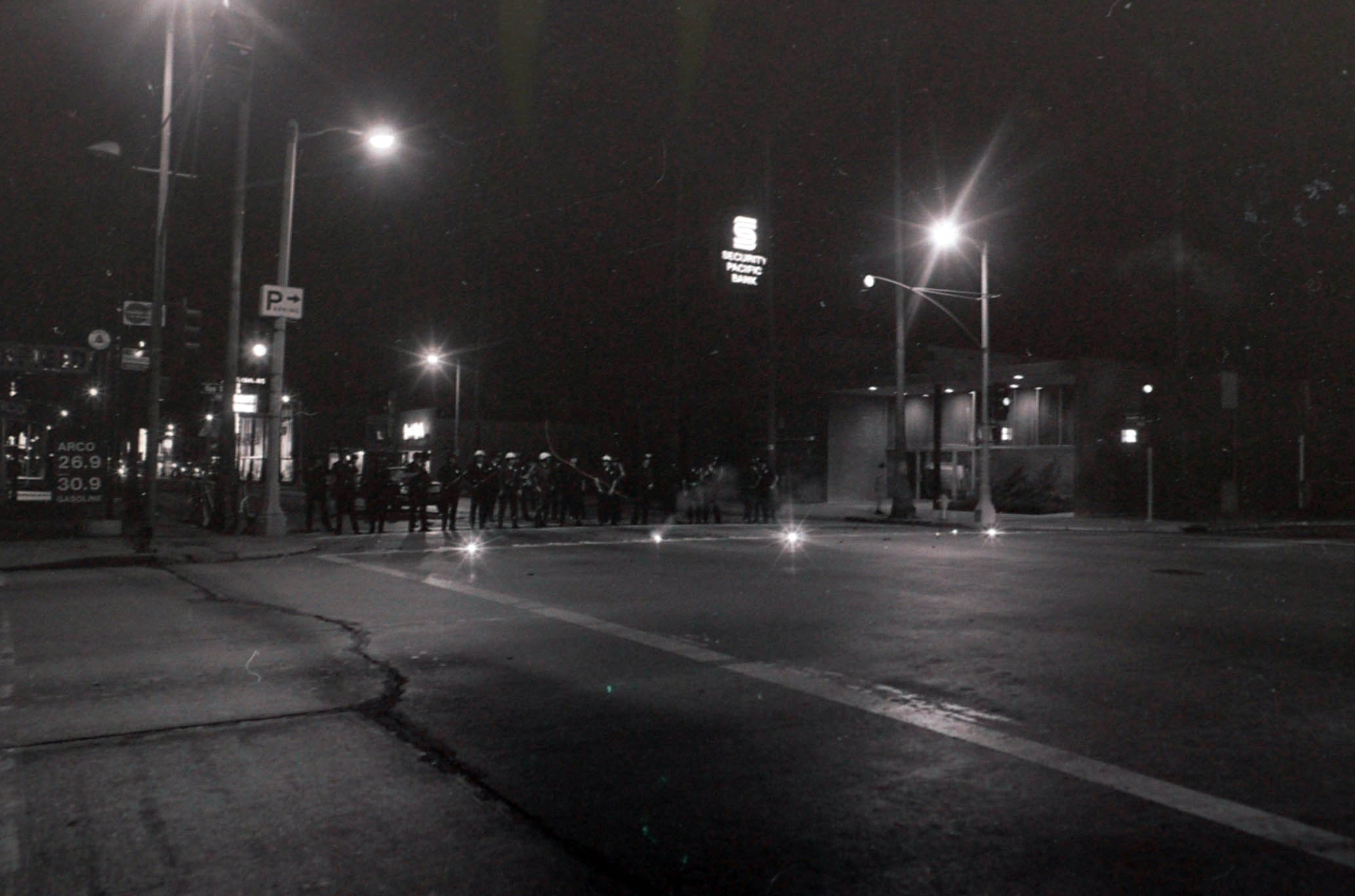
Police line up to block off a street during the Aug. 31, 1970 disturbance in Wilmington. Gas prices were somewhat cheaper in 1970 (sign at far left). Daily Breeze photo by Jack Wyman.

The fires and sporadic outbreaks of violence continued well past midnight before a force of more than 100 policemen finally subdued the rioters. No one was killed during the disturbance. 27 people were arrested on various charges.

Except for heavy traffic caused by curiosity seekers looking at the damage on Avalon Boulevard, Monday was quiet. Jeff Donfeld, a special assistant to President Richard Nixon, flew in to tour the damaged Avalon Boulevard area along with Republican candidate for Congress Mike Donaldson and Sgt. Bill Pearcy of the LAPD Harbor Division.

On Monday evening, at least six new fires were set in the same Avalon area of Wilmington. Molotov cocktails and signal flares were used to start blazes in an empty house, a vacant commercial building and in trash bins located behind businesses, including the Tic Toc Market again.

The arson outbreak was the last gasp of the disturbance. No new rioting occurred, and no further arrests were made.


Sources:

Daily Breeze files.

Los Angeles Times files.


Redondo Beach’s gateway sign

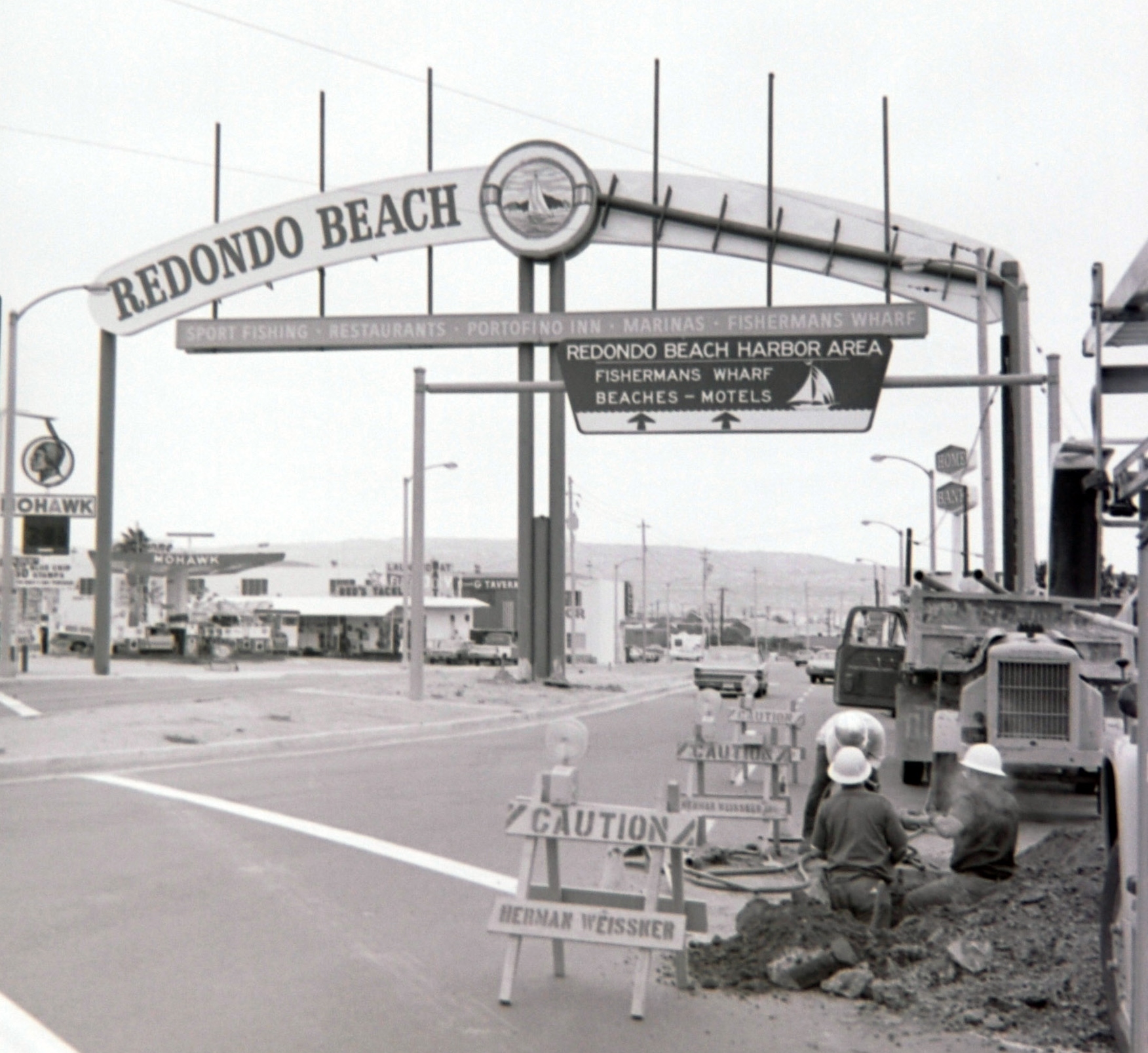
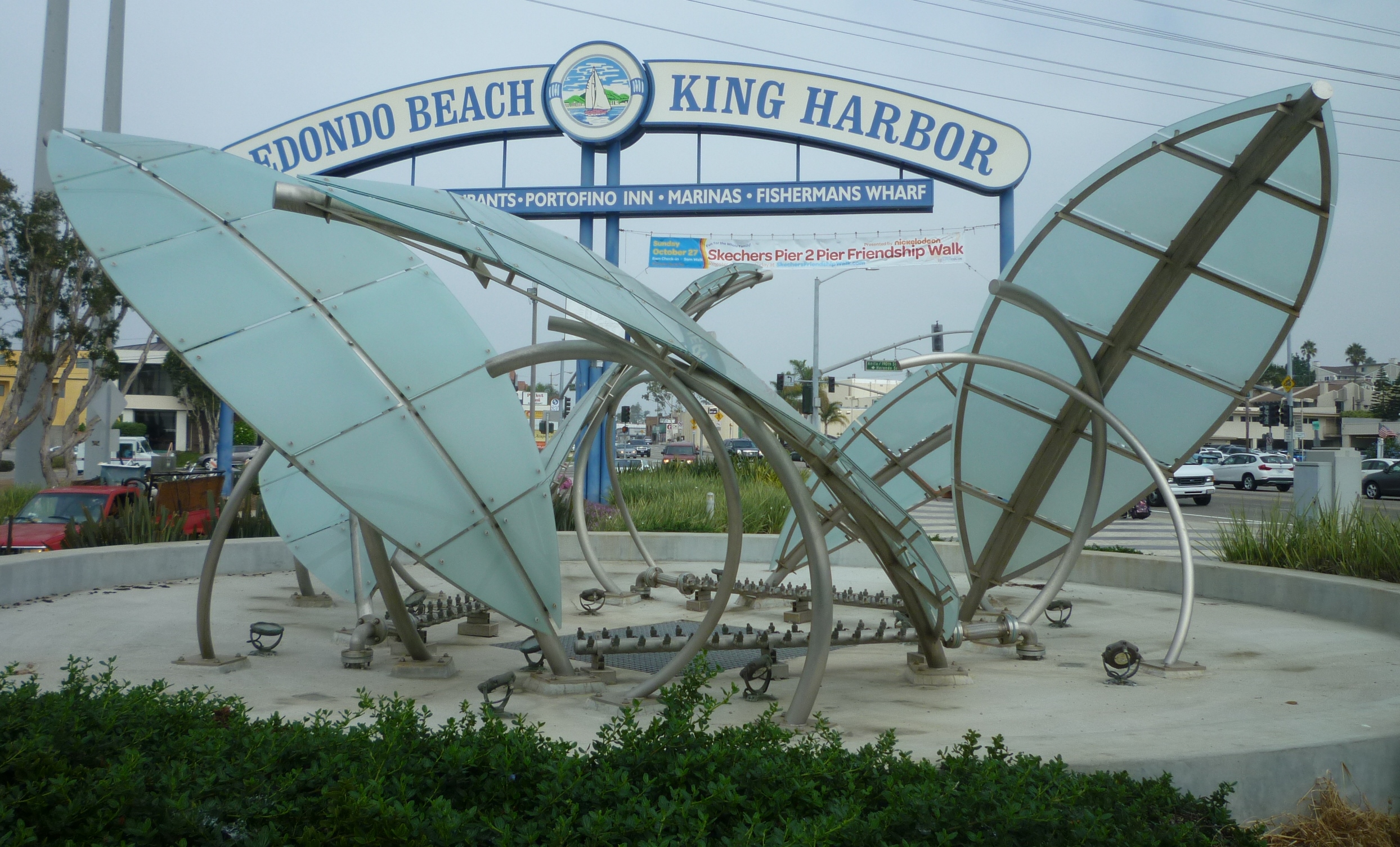
This June 1969 Daily Breeze file photo shows the original gateway sign at front right, and the then-new sign under construction at rear.
This June 1969 Daily Breeze file photo shows the original King Harbor gateway sign with sailboat at right, and the then-new larger sign under construction at rear. Two-way traffic on Catalina Avenue under the sign can also be seen.

The first King Harbor sign at the intersection of Pacific Coast Highway and Catalina Avenue in Redondo Beach went up in 1967, shortly after the King Harbor project was completed. (King Harbor was dedicated on Nov. 19, 1966.)

After a couple of years, the city decided to go with something a little more flamboyant. On June 9, 1969, the council approved a contract for Rich Sign Co. to install the new sign. It would read, “Redondo Beach King Harbor,” be double-sided, illuminated by fluorescent lighting and cost $30,000.

Businesses were in favor of the sign, feeling that it would give the city a strong northern portal of entry into King Harbor and the city’s business district. In fact, the King Harbor Association paid for the sign’s construction.

Under the original design, two-way traffic passed underneath the sign, and it continued to do so until 1975.

That ended when, as a part of the $1.4 million street improvement project that extended and transformed Herondo Street into a major four-lane roadway, the Catalina Avenue connection with PCH at the Herondo intersection was closed permanently on June 23, 1975. Catalina’s northern terminus was rerouted to intersect with PCH south of Herondo.

The iconic sign remained, but cars no longer passed beneath it.

Plans to reverse that action began in September 2002, when the California Coastal Commission approved a traffic realignment that called for reopening a single southbound lane reconnecting Catalina with the PCH and Herondo intersection.

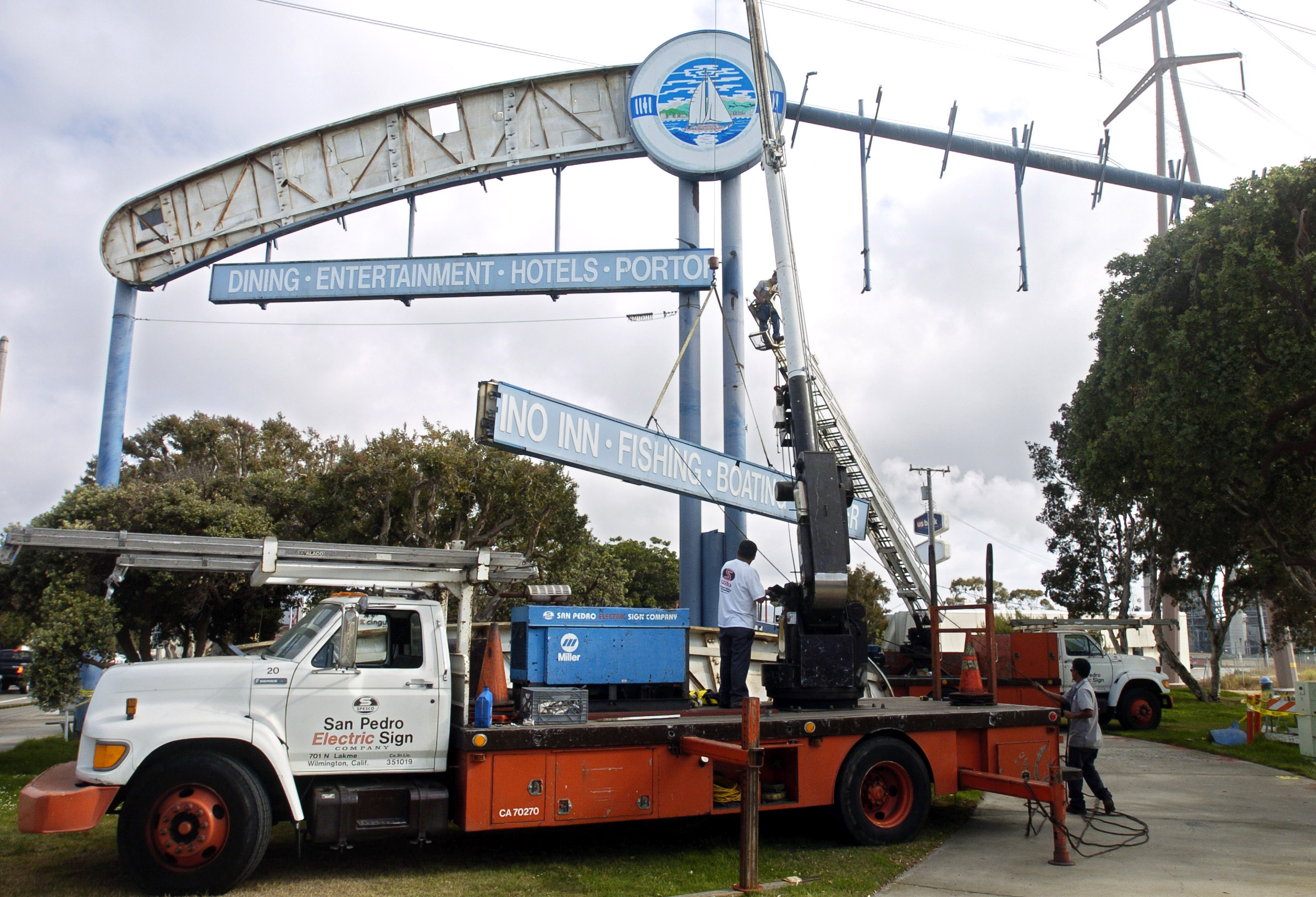
Workers remove the Redondo Beach King Harbor gateway sign on May 19, 2004 in preparation for replacing it with a replica sign. Daily Breeze file photo by Scott Varley.

In order to prepare for that eventuality, and to rectify the beating that weather and time had taken on the original sign, the city began a $150,000 project in May 2004 that involved building a complete replica of the old sign.

The project came about after City Engineer Steven Huang’s study detected rust problems both at the base of the original sign and in the sign itself. High winds during a December 2003 storm even blew down some of its panels. The council decided that leaving the old sign place could be potentially dangerous.

Work on the replacement sign was completed in July 2004.

The reconfiguration of the southbound Catalina lane under the sign began soon afterward, and took longer than anticipated. Originally scheduled for opening in May 2005, the new roadway finally opened to traffic on Sept. 9, 2005.

Now that the city had a new sign and a new roadway beneath it, the council decided that grounds around the city’s new northern gateway should be spruced up as well.

The landscaping project turned out to have a lengthy gestation. The original architectural plans, which included palm trees and a shallow pool, drew much criticism when first presented in July 2006.

The city considered a variety of proposals before settling on a design including trees, a fountain and other landscaping. Ground was broken on the project on July 22, 2008, and it was completed a few months later.

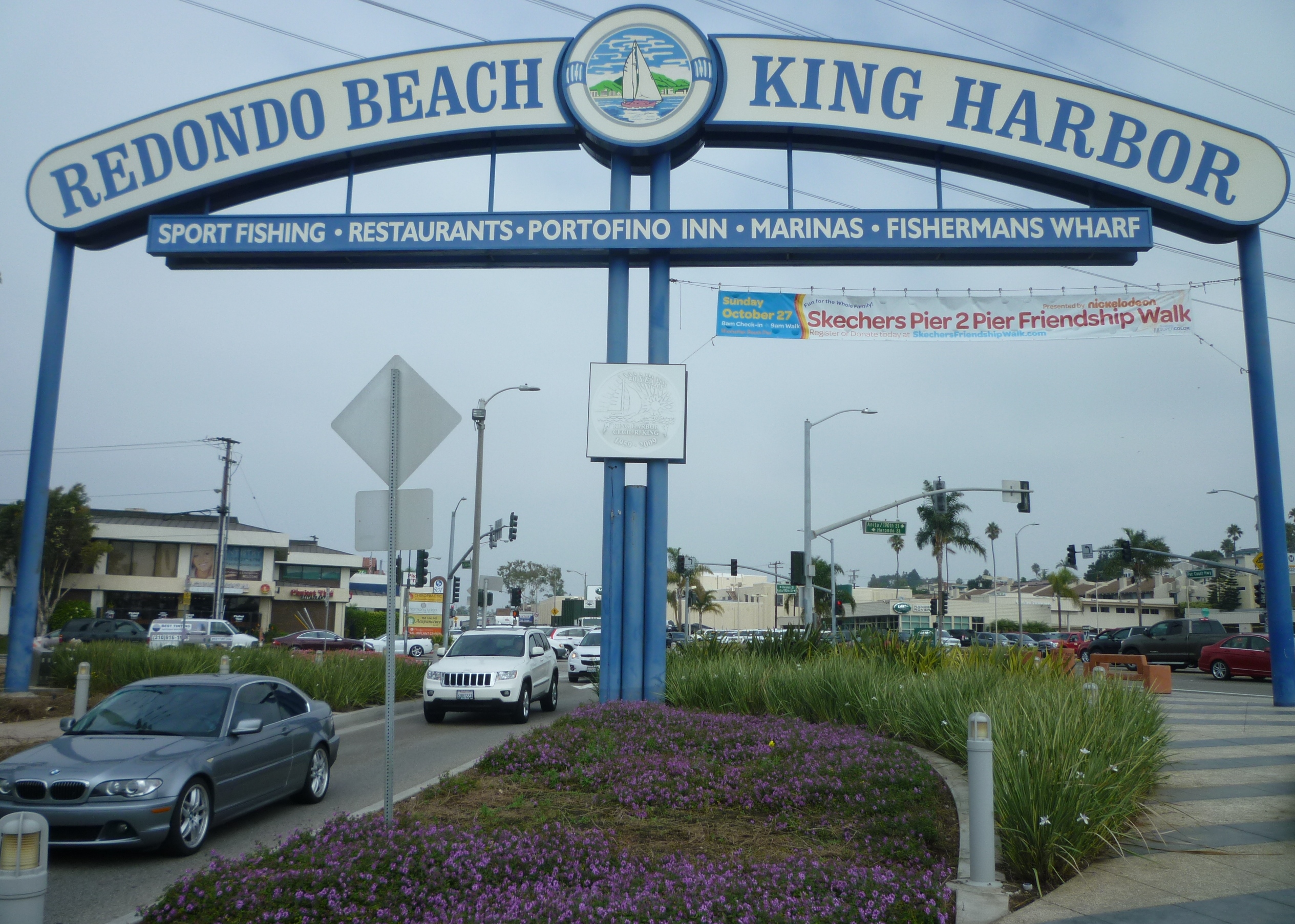
The Redondo Beach gateway sign in its current configuration, with a single southbound Catalina Avenue lane, right. October 2013 Daily Breeze photo.
The Redondo Beach gateway sign in its current configuration, with a single southbound Catalina Avenue lane, left. October 2013 Daily Breeze photo.

Sources:

Beach Reporter files.

Daily Breeze files.

Los Angeles Times files.

This fountain, dry on the day this photo was taken, was part of the landscaping plan undertaken in 2008. October 2013 Daily Breeze file photo.

Golf Man becomes Porsche Man in Carson

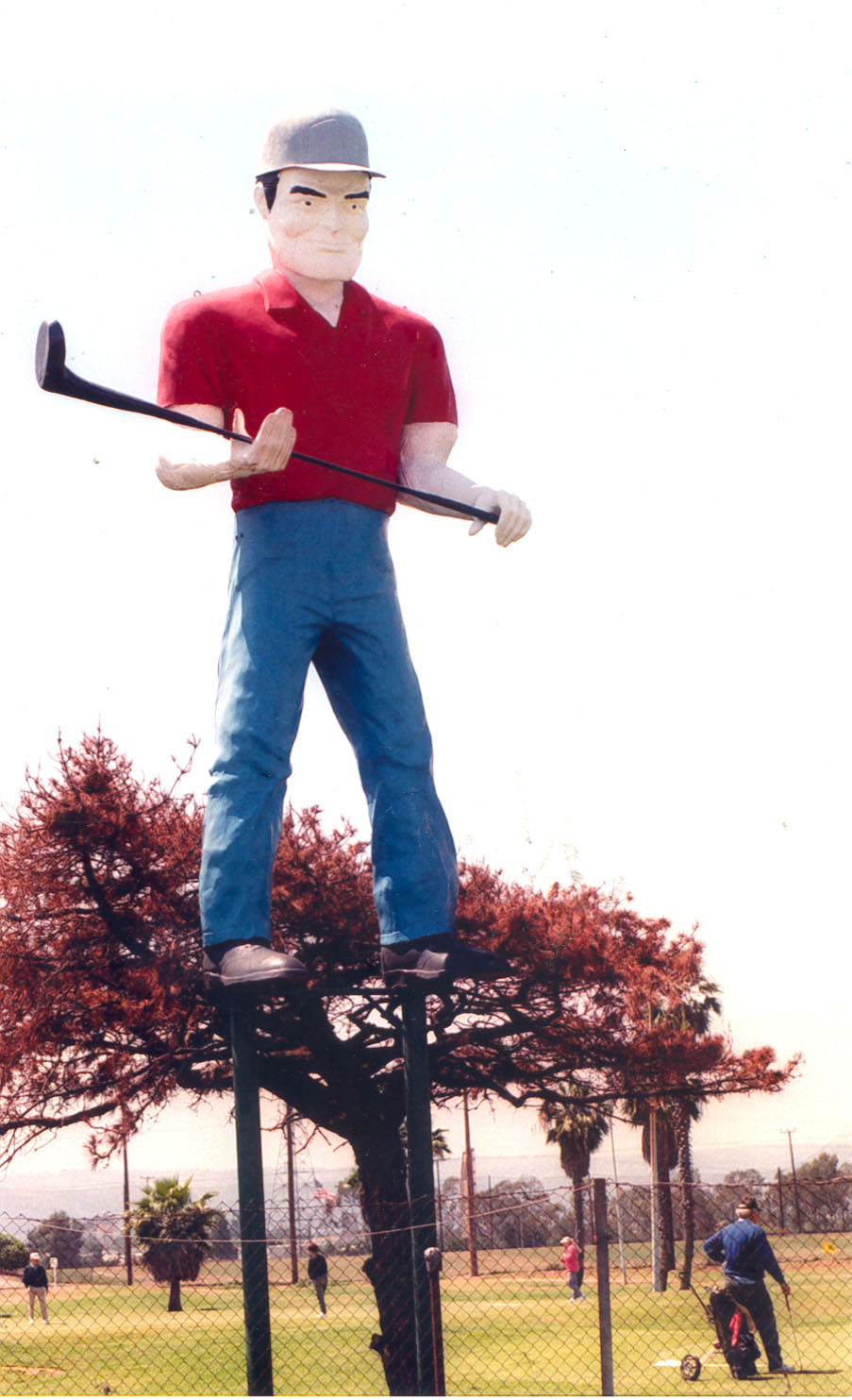
Golf Man in his prime. Daily Breeze file photo, April 1995.

Though he is known in his myriad iterations throughout the roadsides of America as “Muffler Man,” the large statue that stands astride the San Diego Freeway in Carson always has been known by the handle of “Golf Man” by South Bay residents.

The statues, used as eye-catching roadside advertisements for businesses, were manufactured beginning in the 1960s by International Fiberglass in Venice, Calif. They were adapted from a single mold for use in a variety of retail settings throughout the U.S.

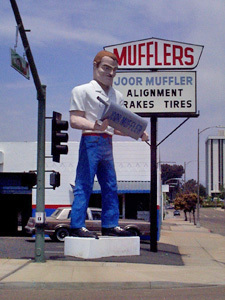
The Joor Muffler man assumes the classic pose outside the Escondido, Calif. business. Photo: City of Escondido.

The very first such figure appeared as Paul Bunyan outside the PB Cafe on Route 66 in Flagstaff, Ariz. in about 1962, according to an interview with Steve Dashew, the owner of International Fiberglass, on the highly informative Roadside America website. (The website also contains a detailed map charting the locations and uses of all the known Muffler Men throughout the U.S.)

The 20-foot-high fiberglass man guarded the Dominguez Golf Course from freeway incursions for more than two decades. According to Andrea Woodhouse’s 2005 Daily Breeze profile on him, though, he wasn’t always stationed there.

Dominguez Golf Course opened in 1963, replacing its predecesor, the Rancho Los Angeles Gun and Skeet Club. The course was built on top of a landfill.

Golf Man’s exact date of arrival at the course isn’t clear. Jay Carballo, regional manager of American Golf Corp., the company that oversaw Dominguez Hills, told the Daily Breeze in 2005 that Golf Man came from a golf equipment store in Carson, which had used him as an attention-getting mascot, though the name and location of the store remains mysterious.

Also, according to longtime club employees, Golf Man wasn’t placed in his prominent sentry position by the freeway at first. Instead, he stood at the rear of the course’s driving range, serving as a target for golfers practicing their swings.

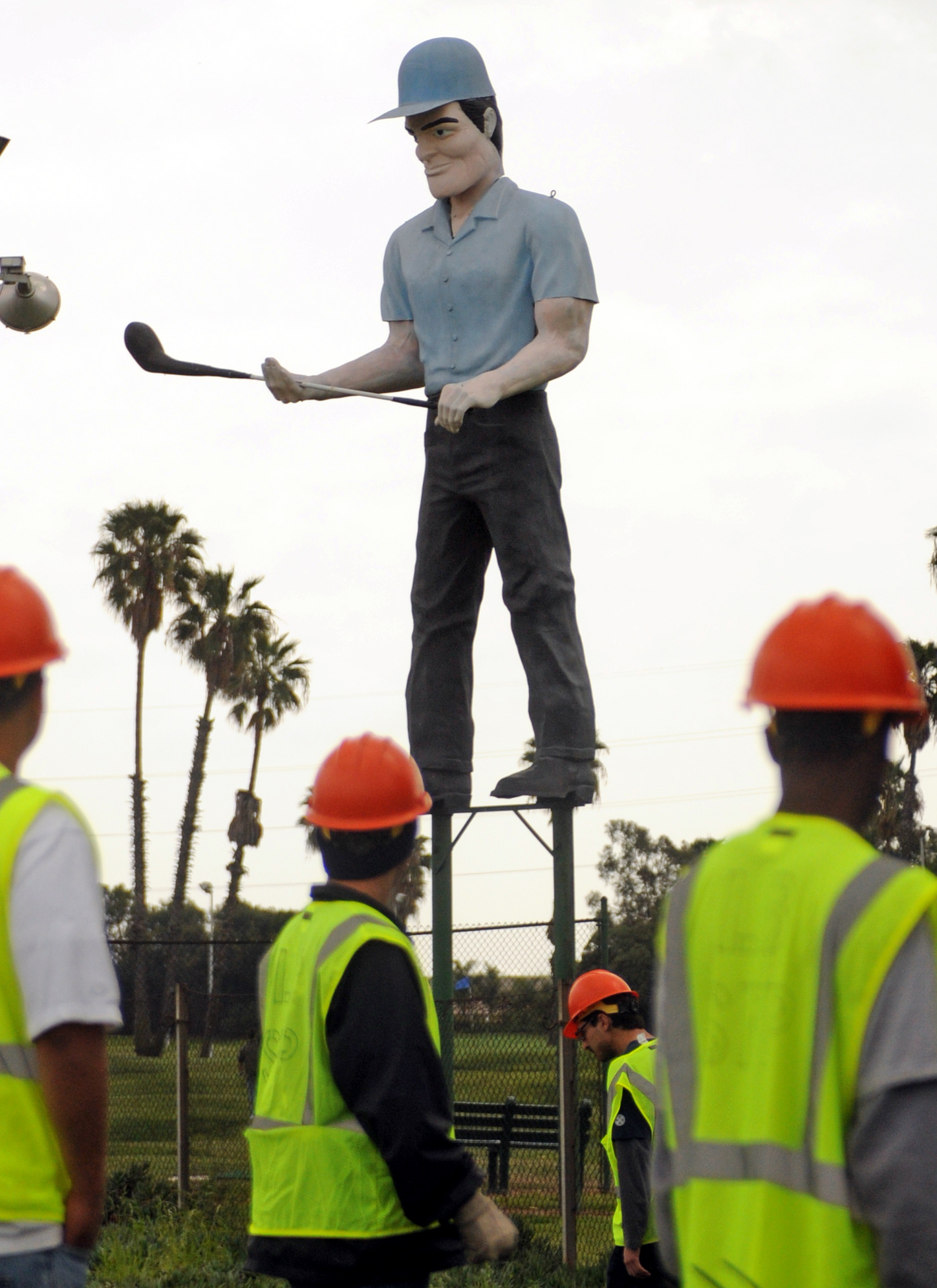
Workers cleaning the landscaping along the southbound San Diego 405 Freeway in Carson are dwarfed by the iconic Golf Man statue at the Dominquez Hills Golf Course. (Daily Breeze file photo by Sean Hiller, March 11, 2009.)

Once ensconced at the freeway’s edge, however, his soothing presence helped calm the frayed nerves of drivers stuck in 405 traffic. He served as a golfing beacon to freeway travelers, receiving annual coats of paint and periodic refurbishings, and holding on to his driver with stoic determination through it all.

His latest makeover, though, has changed everything completely.

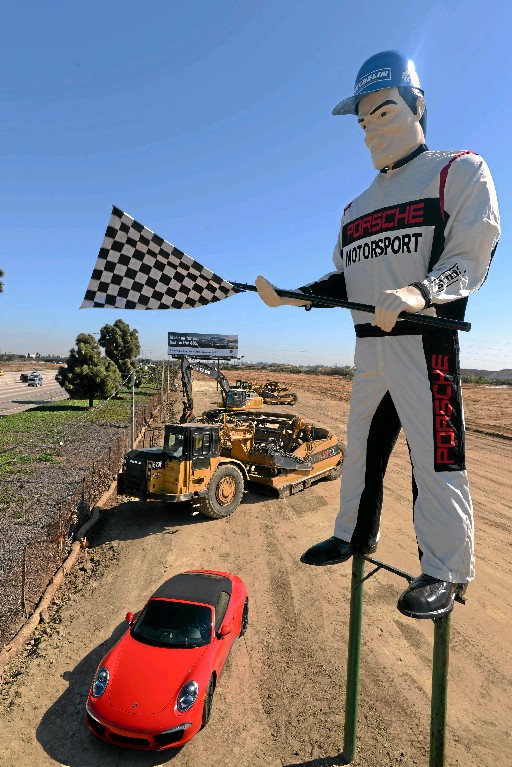
Golf Man has become “Porsche Man,” and his golf club has morphed into a checkered flag.

At the Los Angeles Auto show in November 2011, Porsche announced its plan to open a large test track on the land, which would replace not only the popular par-3 golf course, but also the Don Dominguez apartment complex.

Golfers lamented the closure of the popular course. Closing a golf course in the urban Los Angeles area is unusual, since open land large enough to hold a course is a rarity.

But close it did, on April 1, 2012.

Construction on the Porsche Experience Center had begun. The elaborate complex will house seven different courses, or “modules,” that can be driven separately or combined into one course. Porsche Motorsport North America, the company’s U.S. Racing arm, announced plans to move from Santa Ana to the office building planned for the 53-acre Carson site.

Anxious South Bay residents began to express fears that Golf Man also would become a casualty of the new development, but he has survived and adapted well.

By October 2013, both the golf course and the apartment complex had been leveled, and the reinvented Porsche Man now stands guard over a flat plain of dirt.

In mid-October 2013, Daily Breeze reporter Sandy Mazza reported on the company’s announcement that the Center’s opening on the former landfill site would be delayed until Winter 2014 in a story that also contained many details about the Center’s operation.

Porsche Man seems unpreturbed by the delay. He stands confidently awaiting his new role, feet slightly parted, checkered flag waving, newly painted racing suit looking crisp and fresh. He’s ready.

Golf Man's transformation into "Porsche Man" has become complete in this Oct. 2013 photo. (Photo @ Axel Koester / Porsche, All Rights Reserved, 2013)
Golf Man’s transformation into “Porsche Man” has become complete in this Oct. 2013 photo. (Photo @ Axel Koester / Porsche, All Rights Reserved, 2013)


Sources:

Daily Breeze files.

Los Angeles Times files.

Roadside America website, http://www.roadsideamerica.com/.

Torrance Herald files.


Anteaters invade Redondo Beach!

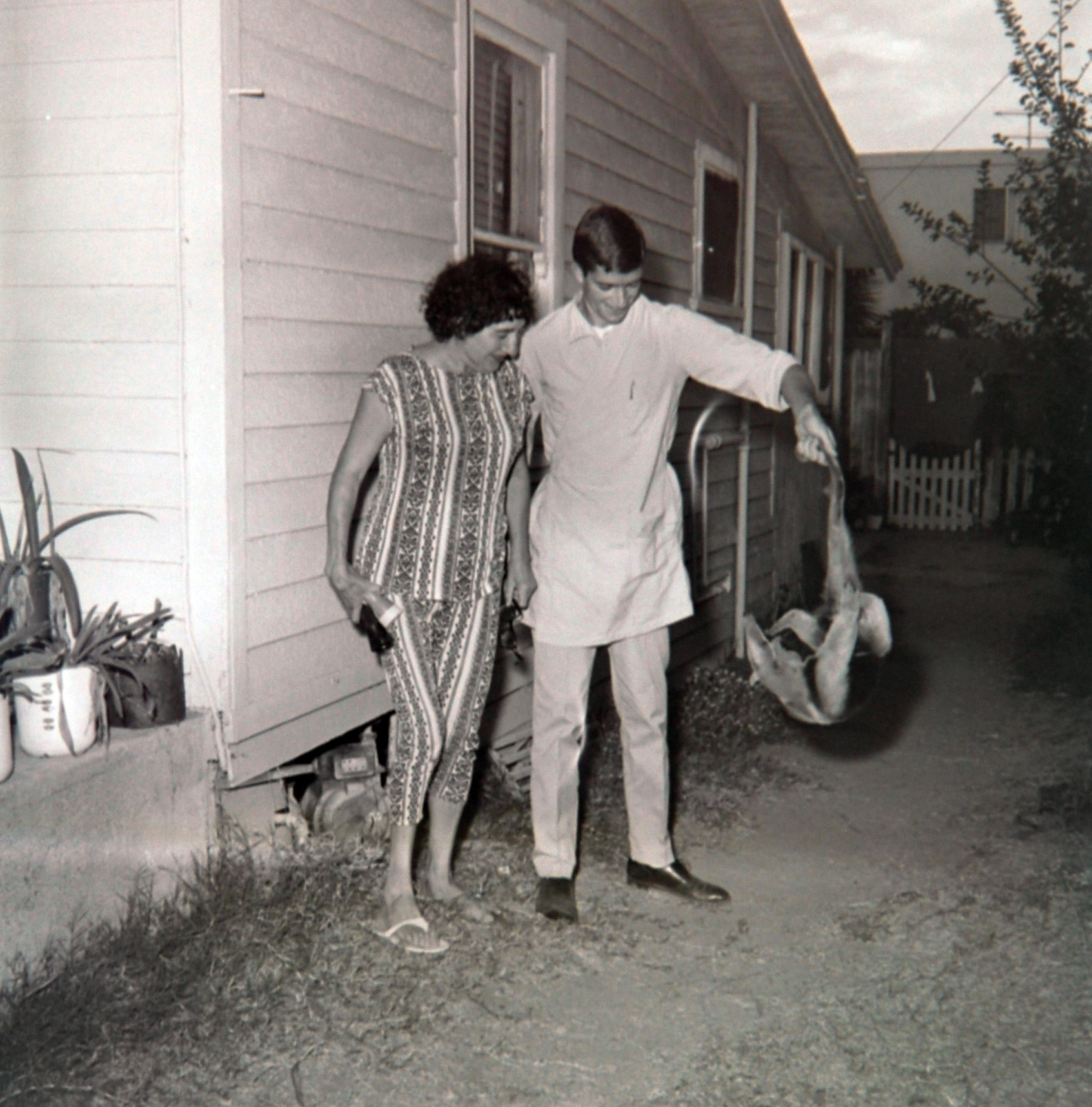
Dobrick's Pet Store manager Howard Newman holds one of the recaptured anteaters that he had retrieved from under the Carnelian Avenue house of Redondo Beach resident Mrs. Rose Ron, left. Daily Breeze file photo, Oct. 26, 1966.
Dobrick’s Pet Store manager Howard Newman holds one of the recaptured anteaters that he had retrieved from under the Carnelian Avenue house of Redondo Beach resident Mrs. Rose Ron, left. Daily Breeze file photo, Oct. 26, 1966.

Around noon on Tuesday, Oct. 25, 1966, nine anteaters from Ecuador arrived at Dobrick’s Pet Center in Redondo Beach.

By Wednesday morning, all of them were gone.

They had been placed in an outdoor cage at the pet store. Store manager Howard Newman told the Daily Breeze that the animals apparently had escaped during the night by climbing up the chain link cage and slipping out through a small hole in the top.

And, with that, nine northern tamanduas began to roam Redondo Beach in the area between the Civic Center and King Harbor.

Continue reading “Anteaters invade Redondo Beach!”

How monorail systems became the road not taken in the South Bay

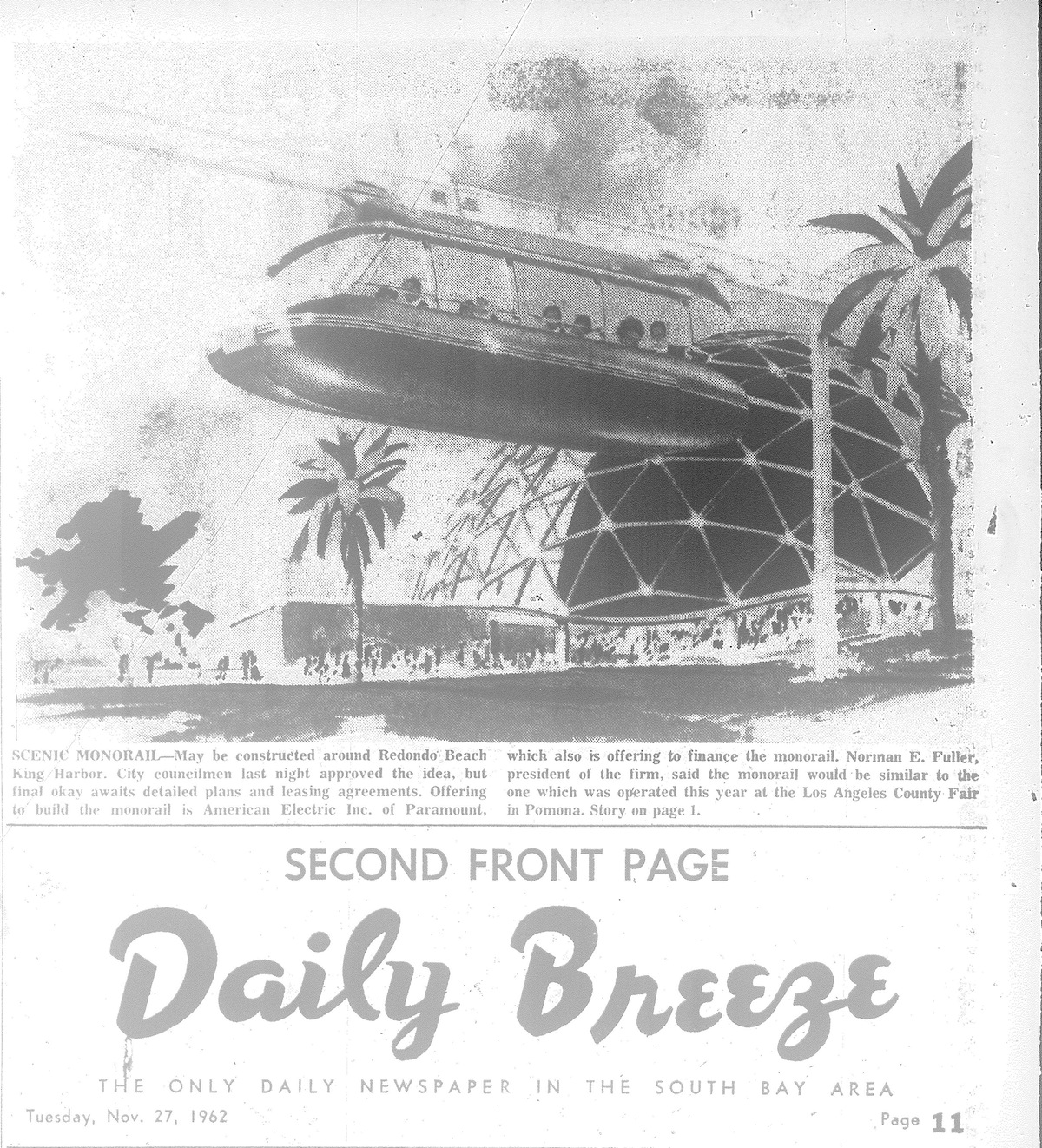
Artist's rendition of the proposed King Harbor monorail, taken from the Daily Breeze, Nov.27, 1962, Page 11.
Artist’s rendition of the proposed King Harbor monorail, taken from the Daily Breeze, Nov.27, 1962, Page 11.

Monorail systems have tempted South Bay municipal planners ever since E.G. Lewis proposed one from downtown Los Angeles to Palos Verdes in November 1921.

Lewis, who had the option to buy Frank Vanderlip’s 16,000-acre Palos Verdes ranch, envisioned a monorail system from downtown L.A. directly to the Palos Verdes property, with a branch running from there to the Harbor Area.

“It will be an express service with practically no stops between downtown Los Angeles and Palos Verdes,” with an estimated cost of $3 million, Lewis told the Los Angeles Times.
The trip would have taken eight minutes and cost five cents, had the fanciful idea ever come to fruition.

Unfortunately, it merely was an early example of the allure of the monorail solution, which would crop up again and again in South Bay transportation and recreational planning over the next few decades.

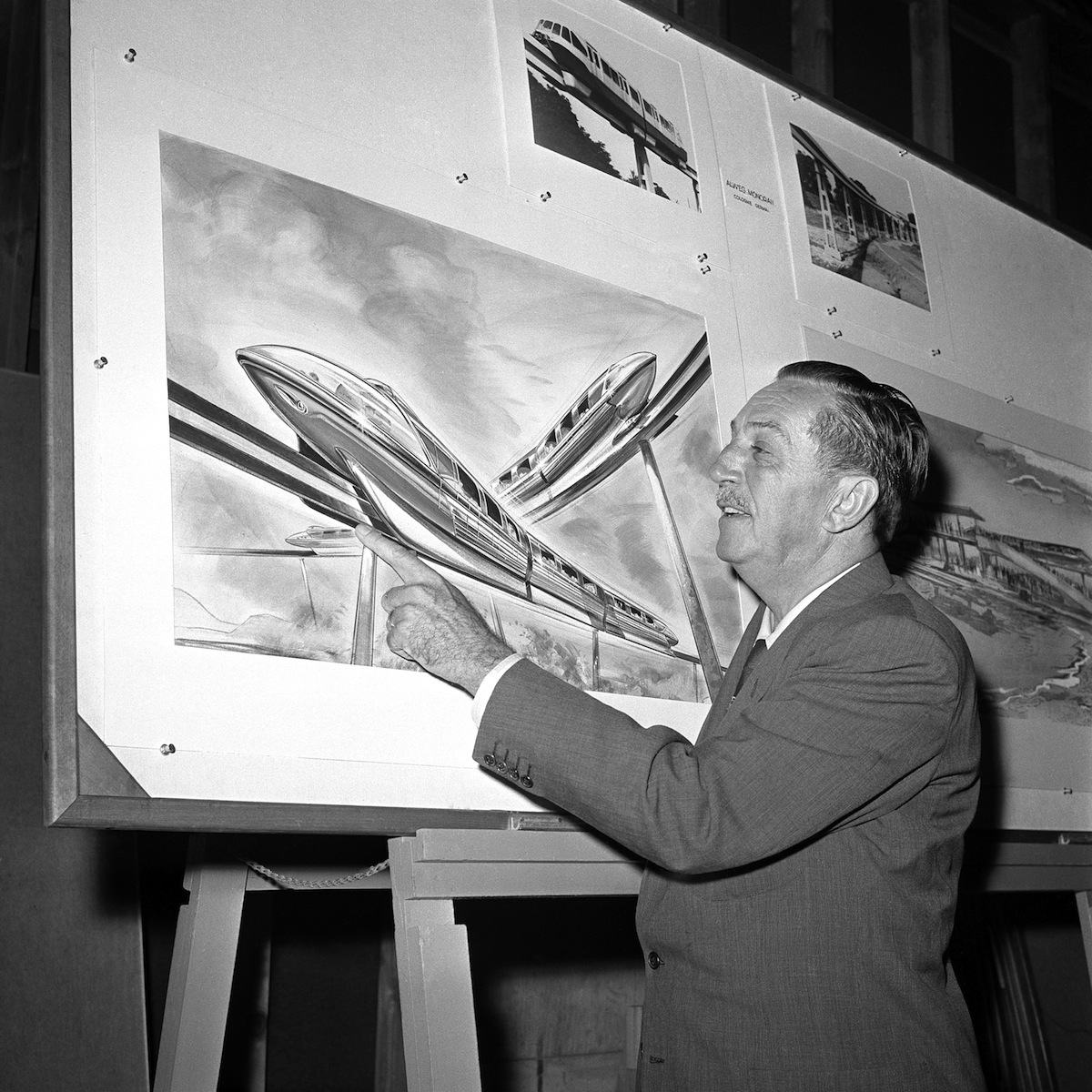
The Disneyland Monorail System, which opened at the Anaheim theme park on June 14, 1959, seems to have been a major inspiration to reviving the monorail concept in modern urban planning.

Walt Disney points out features of a million-dollar monorail system which he expects to have in operation at Disneyland by next June, and shown in Hollywood, Dec. 4, 1958. Two electrically-powered trains, being developed by German engineers, will serve as a practical prototype of high-speed interurban systems which crowded metropolitan areas could adopt, Disney said. The concrete track on which the trains will run will be nearly a mile long. (AP Photo/Don Brinn)

At least that’s how Los Angeles County Supervisor Kenneth Hahn saw it at the time, when he enthusiastically supported a monorail line from downtown Los Angeles to LAX.

The 17-mile train would have run down the Harbor (110) Freeway from downtown, then hung a right down the middle of Century Boulevard to the airport.

In June 1961, Hahn said the Disneyland monorail “demonstrates clearly that rapid monorail transit is feasible and practical.” But others weren’t convinced enough to push the plan through.

The planners behind the King Harbor redevelopment project in Redondo Beach also became enamored of the monorail idea.

Their plan, approved by the City Council in November 1962, called for 3,300-foot route around the King Harbor area. The cars would be of the lighter type used for scenic rides, not the more heavy-duty transit cars.

It would have cost riders about 50 cents a ride for the six-minute scenic trip, but alas, it never was built.

The Los Angeles Harbor department explored monorail possibilities in 1968, when the panel considered a proposal to build a $2.5 million, two-mile monorail on Terminal Island.

The operators of the Princess Louise floating restaurant were behind the proposal, which would have included a Canadian trading post, a seal tank, a mine-train ride, a wedding chapel and an artificial mountain built to block the view of a nearby oil company tank farm.
The monorail would wind through the canneries and fishing boat docks on Terminal Island, and rise to a height of 80 feet near the entrance to Fish Harbor.

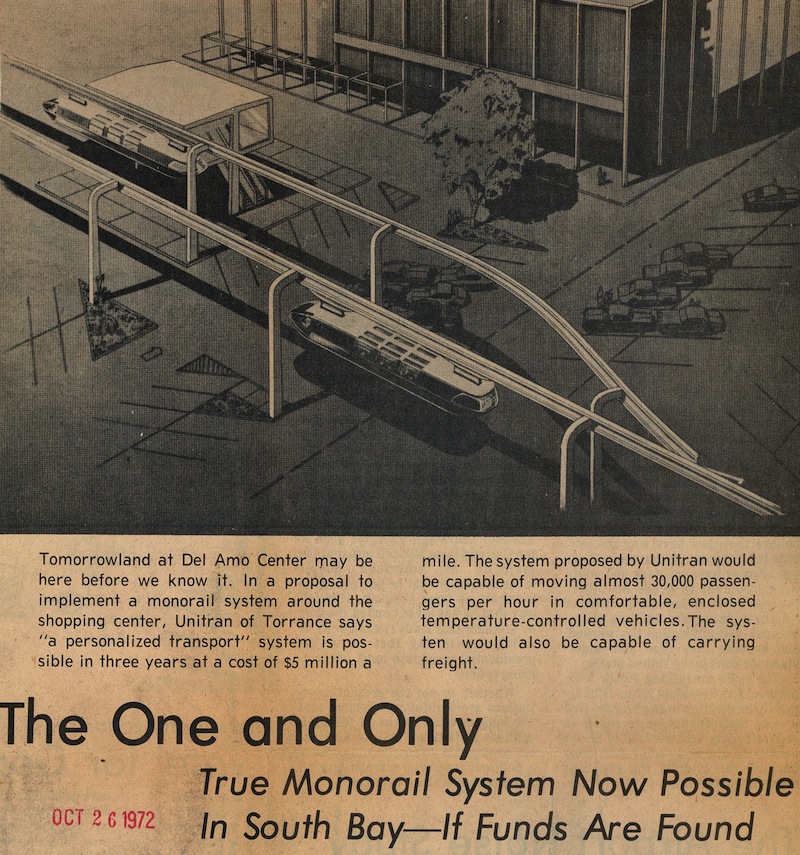
Artist's rendition of the Unitran monorail system proposed for the Del Amo Center mall. Daily Breeze, Oct. 26, 1972, Page 11.
Artist’s rendition of the Unitran monorail system proposed for the Del Amo Center mall. Daily Breeze, Oct. 26, 1972, Page 11.

The Torrance-based monorail firm Unitran tried to pitch its system to the newly constructed Del Amo Center mall in October 1972.

The firm’s sophisticated presentation impressed city leaders, but the $5 million-per-mile price tag was too steep, and the idea never became reality.

Redondo Beach returned to the monorail idea in June 1973, when City Councilman Anthony DeCou asked for a report on the feasibility of establishing a public monorail system for the beach and pier areas.

One line would have run from Anita and Prospect to the beach, where it would turn south to Avenue I, then east back to Pacific Coast Highway. Another would have run from Prospect Avenue and Torrance Boulevard to the pier area.

The plan never came to pass.

Neither did Hawthorne Mayor Joe Miller’s idea, which he admitted was inspired by the Disneyland monorail, for a monorail from LAX down Century Boulevard, turning south on Hawthorne Boulevard to PCH, where it would run to Long Beach.

Los Angeles County Supervisor Baxter Ward made the Hawthorne Boulevard route part of a $7 billion transport plan that he placed on the ballot in June of 1976.

The elaborate plan with criss-crossing lines required a one percent sales tax increase. This time, voters approved the measure. The sales tax revenue, however, ended up being redirected toward the early planning and construction stages of the MTA’s Red Line subway system, with the agency abandoning the monorail plan completely.

At least South Bay leaders were willing to consider the monorail option again and again, though no one ever found a way to overcome the main obstacle standing in the way of implementation: cost.

Sources:

Daily Breeze files.

Los Angeles Times files.

Rolling Hills Estates and the Red Barn

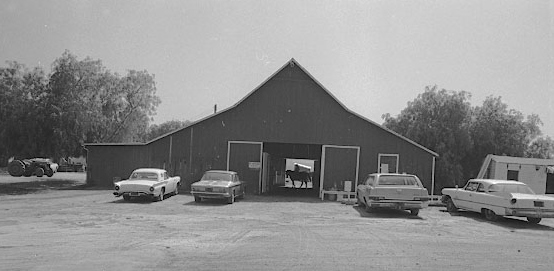
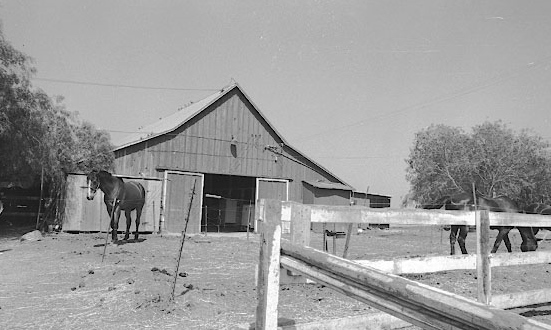
The Red Barn in Rolling Hills Estates. Daily Breeze file photo.
The Red Barn in Rolling Hills Estates. Daily Breeze file photo, June 17, 1971.

For years, the “Red Barn” in Rolling Hills Estates was considered to be the oldest man-made building on the Palos Verdes Peninsula.

Estimates for the year it was erected vary from sometime in the 1890s to around 1904. It was built on the 16,000-acre cattle ranch then owned by Joatham and George Bixby, and managed by Harry Phillips from 1894 to 1913.

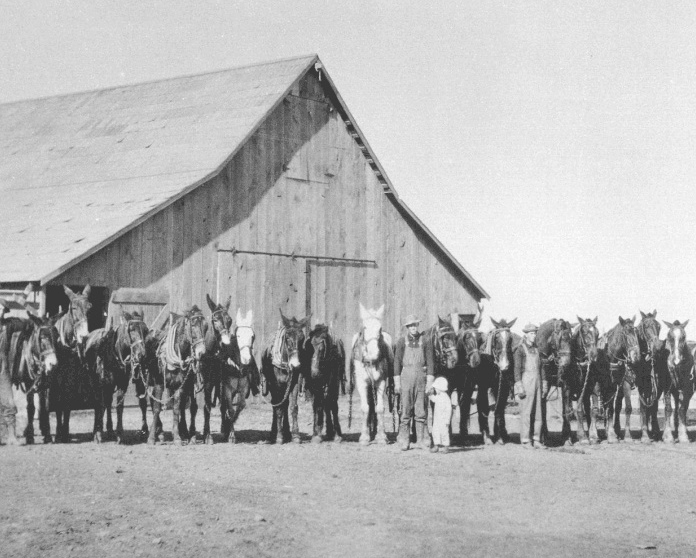
Its original location was at the Phillips Ranch House at Palos Verdes Drive North and Rolling Hills Road, where it was a functional barn for many years. The barn itself sat near Lariat Lane, just south of the current location of Rolling Hills City Hall.

The red barn at its original location at the Phillips Ranch House. Photo courtesy City of Rolling Hills Estates / Mayor Frank Zerunyan.
The red barn at its original location on the Phillips Ranch House property. Photo courtesy City of Rolling Hills Estates / Mayor Frank Zerunyan.

Right across Rolling Hills Road to the west was the eastern edge of the Palos Verdes Landfill, now the site of the South Coast Botanic Garden.

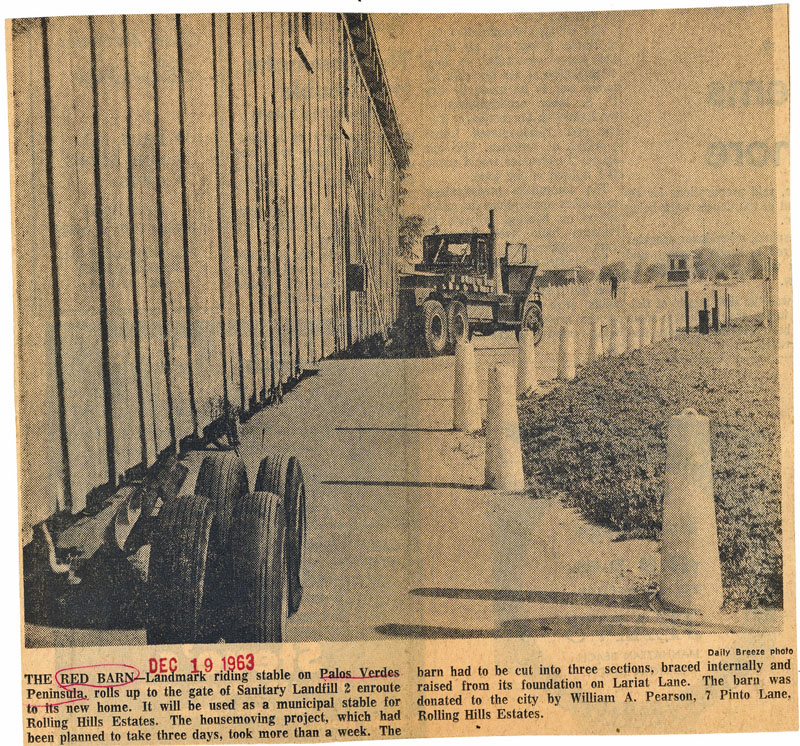
The barn’s owner in the 1960s, William Pearson of Rolling Hills Estates, agreed to donate the structure to the city for use as a municipal stable facility for horses, if they would agree to move it from Lariat Lane to a different location.

Discussion over the proposal continued through the fall of 1963. The city came up with a possible site for the barn at Sanitation Fill Area No. 2 at the landfill on Crenshaw Boulevard.

After some negotiating, Mr. and Mrs. C. Dana Souther agreed to become the managers of the city-owned stable, which was re-christened the Rolling Hills Estates Municipal Stable.

redbarnclipDuring a week-long period in mid-December 1963, the barn was moved. It had to be cut into three sections for the short jaunt to its new home.

Shuttle buses transported guests from the Little League fields at the foot of the hill up to the barn’s new location for its gala dedication on March 15, 1964.

But by 1968, there were complaints. A petition signed by more than 200 area residents stated that the old structure was “woefully inadequate and too limited.”

The barn’s future grew increasingly tenuous when Los Angeles County asked the city of Rolling Hills Estates in 1971 to move the barn and stables from its landfill site so that the county could complete work on the landfill.

An estimate of $10,000 to move the barn a second time to a site on Crenshaw closer to the Torrance city border was considered to be too high for the city to pay. Daily Breeze articles about the barn’s plight were brought to the attention of Chet Chamberlain, a descendant of the Bixby family, who briefly considered moving the structure to his Santa Ynez Valley ranch.

After visiting the barn, however, Chamberlain declined, saying, “It’s too far gone. It is rotting away.”

The Rolling Hills City Council granted the barn several stays of execution in late 1971 in an attempt to find a way to save it, but when stables finally were moved to their new location in 1974, the barn did not make the trip.

In 2005, the Rolling Hills Estates Municipal Stables offcially was renamed the Peter Weber Equestrian Center, named for the former RHE mayor.

Horses wander near the Red Barn at the Rolling Hills Municipal Stables. Daily Breeze file photo.
Horses wander near the Red Barn at the Rolling Hills Municipal Stables. Daily Breeze file photo, June 17, 1971.


Sources:

Daily Breeze files.

Special thanks:

Rolling Hills Estates Mayor and local historian Frank Zerunyan.

Mary Scott, Editor-in-Chief, Palos Verdes Peninsula News.

Elizabeth Gnerre and Debra Constans.

Classified research plane crashes into El Segundo apartments in 1969, killing 6

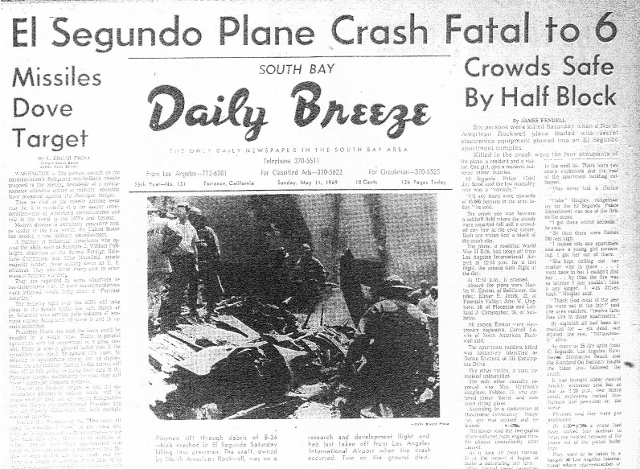
The front page of The Daily Breeze, Sunday, May 11, 1969.

Four North American Rockwell employees took off in a revamped B-26 World War II-era twin-engine Martin Marauder from LAX shortly after noon on Saturday, May 10, 1969.

The plane carried highly classified government electronic engineering equipment for testing purposes.

Shortly after takeoff, the men knew something was wrong. The right engine cut out almost immediately. The plane had performed flawlessly on a flight earlier that morning, but this time was different.

On the ground below them, a variety of community activities were underway in El Segundo. A youth baseball tournament that had drawn thousands of spectators was in full swing across the street from the apartments at Recreation Park. A block away, a carnival to raise funds for new uniforms for the school band was underway at El Segundo High School.

Spectators on the ground watched in horror as the plane dipped lower and lower, in obvious distress. Authorities speculated that the pilot, Marlin W. Easton of Bellflower, saw the crowded areas and decided to take the plane down into the apartment house at 331 Eucalyptus Drive instead.

El Segundo Police Chief Jay Stroh estimated 10,000 people were out and about in the immediate area. Very few people were in the apartment house, where the cartwheeling plane first clipped a corner of the neighboring apartment house at 335 Eucalyptus before crashing, exploding and burning in the courtyard of 331.

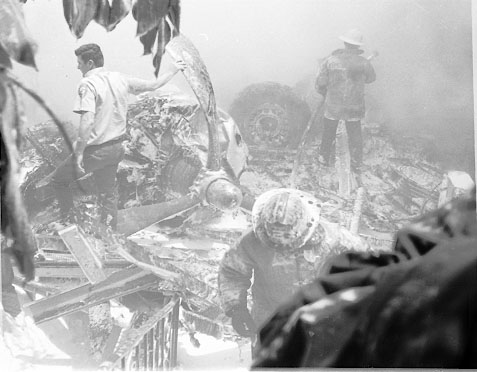
Firefighters make their way through the wreckage following the B-26 crash in El Segundo. The man at left braces himself on on of the downed aircraft's engine propellers. Daily Breeze file photo.
Firefighters make their way through the wreckage following the B-26 crash in El Segundo. The man at left braces himself on on of the downed aircraft’s engine propellers. Daily Breeze file photo.

All four passengers on the plane were killed, and two people in the apartment house died.

The North American Rockwell employees killed on the plane were identified as Easton the pilot, 49, Lehland J. Christopher , 39, of Anaheim, project engineer, Elmer R. Jezek, 42, of Fountain Valley, engineer and John W. Claghorn, 39, Placentia, an electronics technician. All four were married with children.

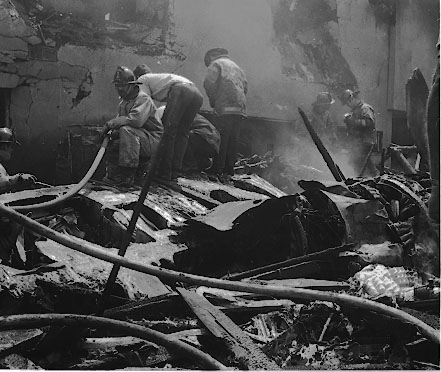
Firefighters knock down the blaze following the B-26 crash in El Segundo. The fire was put out less than an hour after the crash. Daily Breeze file photo.

Two bodies were found under the rubble of the plane about seven hours after the crash. They were identified the following Monday as real estate agency owner Leonidas W. (Lonnie) Hood, 56, of Altadena, and Donnagene Lois Ryerson, who lived in the 331 apartment building. Ryerson’s 14-year-old daughter Debbie was rescued from the building shortly after the crash with minor injuries.

Hood, the former head of the Pomona and Palm Springs chambers of commerce, left a wife and four children.

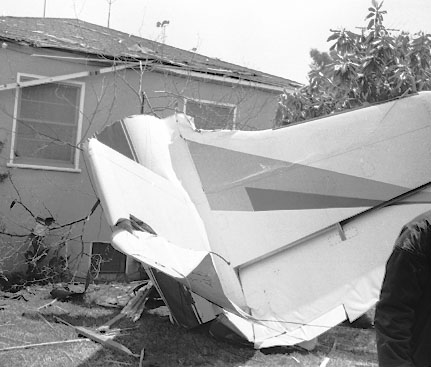
The tail section of the B-26 ended up in the yard of a nearby house, which was not damaged by the debris. Daily Breeze file photo.

The accident was the third fatal LAX-related crash up to that point in 1969. 15 died and 30 were injured on Jan. 13 when an SAS jetliner crashed into the ocean on approach to the airport, and 37 died on Jan. 18, 1969, when a Denver-bound United Airlines jet crashed into the ocean moments after takeoff.

Federal investigators immediately began investigating the cause of the crash, carting off the remains of the downed B-26 to a hangar on Imperial Highway. There, they pieced together the remains of the plane. Perhaps due to the classified nature of the aircraft and its mission, the results of the inquiry were not made public.

At least two lawsuits were filed following the crash. In March 1970, Wanda Thibodeaux sued North American Rockwell and the estates of the four crash victims for $40,000, claiming the men “carelessly operated and flew” the B-26 “so as to cause it to collide with the apartment building” where she lived.

In May 1970, Debbie Ryerson sued North American Rockwell for $1 million for the wrongful death of her mother in the accident, plus an additional $150,000 for her own injuries. The disposition of the suits apparently never was reported publicly.

Sources:

Daily Breeze files.

Los Angeles Times
files.

H.B. “Toby” Halicki makes a film and a phenomenon

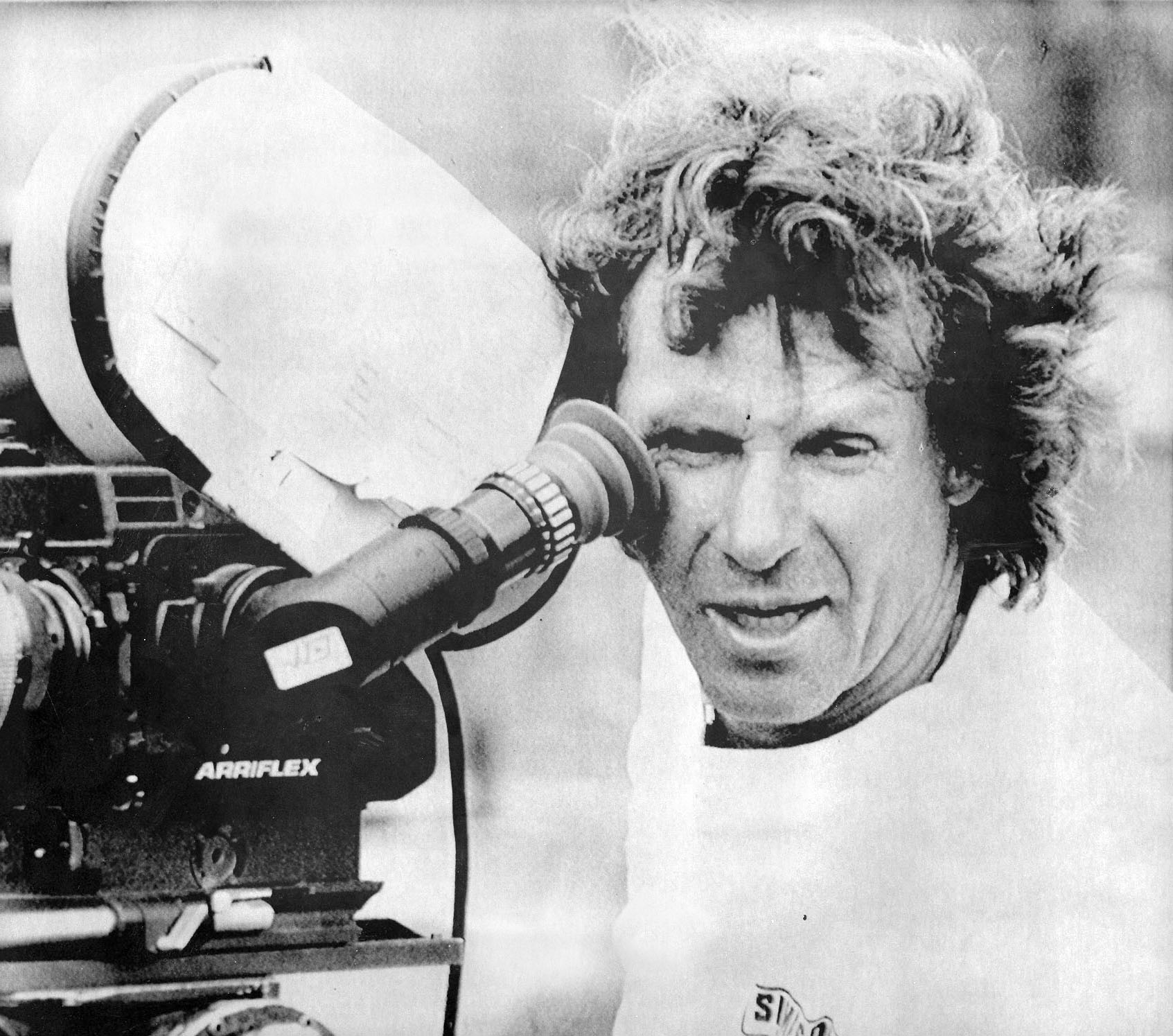
Toby Halicki checks a camera angle during the filming of his sequel, "Gone in 60 Seconds II," on Aug. 20, 1989, the same day an accident during filming took his life. Photo: The Associated Press.
Toby Halicki checks a camera angle during the filming of his sequel, “Gone in 60 Seconds II,” on Aug. 20, 1989, the same day an accident during filming took his life. Photo: The Associated Press.

Gardena mechanic and auto wrecker-turned-filmmaker Henry Bernard Halicki heard about a Torrance train derailment one morning in 1973, and immediately decided it would make a great opening for his first feature film. He rounded up a crew and headed to the site, convincing authorities there to allow him to film a quickly improvised scene.

So begins “Gone in 60 Seconds,” one of the great independent movie successes of the 1970s. Made on a shoestring in 1973, the film went on to make millions following its 1974 release.

Its director, H.B. “Toby” Halicki was born into a Polish family Dunkirk, New York on Oct. 18, 1940. One of 11 children, he moved to California in 1955 at age 15, allegedly because his mother refused to let him get his driver’s license.

He arrived with $40 in his pocket and got his first job pumping gas. Eventually, he started his own auto garage and wrecking yard on Vermont Avenue near 179th Street in Gardena.

In September 1968, Halicki was among four men indicted as allegedly being part of an auto theft ring that specialized in stealing late model cars from Los Angeles and San Francisco International Airports.

According to police, the ring would buy wrecked cars at salvage yards, then switch out parts from the stolen cars and resell them at an Inglewood car lot. It’s probably no coincidence that the ring’s activities bear a striking resemblance to the modus operandi of the car thieves depicted in  “Gone in 60 Seconds.” Charges against Halicki later were dropped.

In the early 1970s, Halicki began trying to fulfill his dream to become a filmmaker. He began acquiring all kinds of vehicles at auction, more than 200 of them, including police cars, fire engines, garbage trucks and passenger cars of all types, for use in his film.

Working on a minuscule budget completely outside the Hollywood studio system, Halicki began filming in 1973, with no real script, just a series of dialogue outlines.

As lead character Maindrian Pace, Halicki performed all his own stunts in the film, suffering injuries on at least two occasions.

– In a scene filmed on the northbound Harbor Freeway in San Pedro, his beloved Mustang, “Eleanor,” gets clipped by a pursuing car – the stunt driver missed his mark – and spins out of control, smashing into and demolishing a metal light pole at 100 mph. injuring him and knocking him unconscious.

– In the film’s climactic scene on 190th Street in Redondo Beach, Halicki and Eleanor fly some 30 feet in the air over wrecked cars, land, and continue driving. Halicki suffered compressed vertebrae in his back as a result. His friends and colleagues said he never walked quite the same afterwards.

The “Smokey and the Bandit” chase films and “The Dukes of Hazzard” had yet to be made when Halicki’s low-budget “Gone in 60 Seconds” was released in 1974. Steve McQueen’s “Bullitt” (1968) and the original 1971 “French Connection” film were the state of the art in filmed car chases at the time. Halicki’s film quickly became a word-of-mouth sensation.

The film, which cost an estimated $150,000 to make, grossed $40 million domestically in its original run, and made much more than that in re-releases, overseas receipts and video issues.

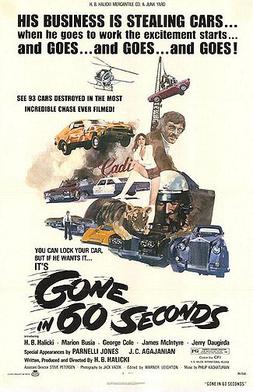
Movie poster for the 1974 "Gone in 60 Second" film.
Movie poster for the 1974 “Gone in 60 Second” film.

After the great success of “Gone,” Halicki made two more films, “The Junkman” (1982) and “Deadline Auto Theft” (1983), both in a similar vein

Halicki met his wife, Denice Shakarian, in 1983. They were married in his hometown of Dunkirk, N.Y., on May 11, 1989, as Halicki was preparing to shoot the sequel, “Gone in 60 Seconds II,” a bigger and more elaborate version of the original, though its plot was unrelated. Shooting for the new film began in June 1989. Three months after becoming a bride, Denice Halicki became a widow.

On Aug, 20, 1989, Halicki was shooting a stunt for the film in Tonawanda, N.Y. According to Tonawanda police officer Michael Thorp, a water tower rigged for the stunt fell prematurely, causing an attached cable to snap and knock over a telephone pole. The pole fell on Halicki, killing him.

In 1992, Halicki’s mammoth toy collection, which filled a large warehouse at his Vermont Avenue business he called the “H.B. Halicki Junkyard and Mercantile Company,” was auctioned off to pay off creditors who had invested money in the unfinished “Gone” sequel. Over 100,000 pieces were split up and sold off at an auction at the Pasadena Convention Center that drew an estimated 5,000 people. The Vermont Avenue studios and wrecking yard buildings were torn down in March 1995 by the property’s new owners.

Halicki’s estate went through probate, and his wife Denice struggled through the legal proceedings for years, ultimately emerging with a cash settlement, the couple’s Rolling Hills Estates home and the rights to Halicki’s films.

She began receiving offers from Hollywood to remake “Gone,” choosing to sign with Disney. Michael Lynton, then head of the studio’s Hollywood Pictures arm, turned out to be a fan of Halicki’s work.

Director Jerry Bruckheimer agreed to film the 2000 “Gone in 60 Seconds” remake, which starred Nicolas Cage, Angelina Jolie and “Eleanor,” Halicki’s yellow Mustang. (Eleanor remains the only automobile to receive top star billing in a movie, which Halicki gave the car in the original “Gone” film.) The 2000 version was a hit, grossing  $237 million worldwide.

LOCATIONS:

The list of South Bay locations used in the original “Gone in 60 Seconds” is a long one. Here are some of them:

– Port of Los Angeles main channel, with Los Angeles Harbor Lighthouse visible.
– Night chase scene on Crenshaw Boulevard in Torrance.
– Car theft of Ascot Raceway owner J.C. Agajanian’s car in scenes filmed at the raceway. Agajanian and veteran race car driver Gary Bettenhausen appear as themselves.
– Gamby Mortuary in Lomita.
– The Tijuana Inn Cafe, Gardena.
– Parnelli Jones Enterprises on Earl Street in Torrance. Jones’ Ford Bronco,which he still owns, is among the cars stolen, and we get a glimpse of Jones’ automobile operations during the scene.

The famous 40-minute chase scene begins at the International Tower Apartments in Long Beach, 700 Ocean Boulevard, then passes through the following sites:

– Gerald Desmond Bridge.
– Vincent Thomas Bridge. The chase passes through the toll booths on the bridge’s eastern side, which were still in operation then.
– Harbor Freeway north from the Vincent Thomas Bridge, exiting at Sepulveda.
– Figueroa Boulevard in Carson.
– Mayor Sak Yakomoto of Carson is seen dedicating the then-new Carson sheriff’s department building, along with the Carson City Council, as the chase goes by, disrupting the ceremony.
– Goodyear Blimp base site in Carson.
– Datsun U.S. headquarters building, later Nissan, in Carson. Nissan has since moved its U.S. headquarters to Tennessee.
– A key scene in the chase takes place at Ronald Moran Cadillac on Hawthorne Boulevard in Torrance, where more cars were wrecked than planned, and Halicki had to pay the dealership for the extras.
– The chase continues down 190th, with Halicki executing his famous stunt leap on the 190th Street hill near the present-day Redondo Beach dog park east of Pacific Coast Highway.
– The final scenes of the film take place at a long-gone carwash at a shopping center at Anza Avenue at 190th in Torrance.

Other locations in Long Beach besides the International Towers:

– The landmark Villa Riviera building.
– The hungry tiger restaurant.
– Blyth Eastman Dillon & Co. building.
– KFOX radio studio, International Tower Apartments building.
– Through streets, sidewalks and Lincoln Park in downtown Long Beach past many terrified onlookers who may or may not have been acting.
– The Queen Mary.
– Long Beach Airport.

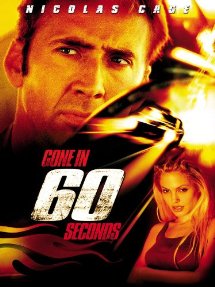
gone2000posterThe 2000 remake of the film starring Nicolas Cage paid homage to the original with scenes filmed on the Vincent Thomas Bridge and on locations in San Pedro and Redondo Beach.


SOURCES:

Daily Breeze files.

“Gone in 60 Seconds,” DVD re-release of the 1974 film, Bci/Eclipse Music, 2005.

“Gone in 60 Seconds – Leading Lady,” interview with Denice Halicki on Mustang Monthly web site, http://www.mustangmonthly.com/featuredvehicles/1305_gone_in_60_seconds/viewall.html

Location Filming in Long Beach, by Tim Grobaty, The History Press, 2012.

Torrance’s courthouse didn’t come without trials

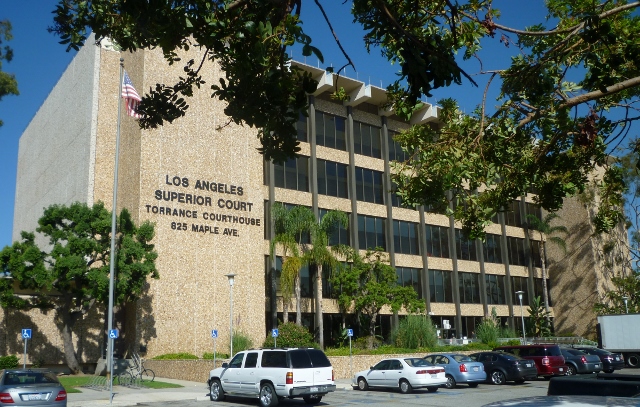
The Torrance courthouse building.  Daily Breeze file photo, Sept. 6, 2013.
The Torrance courthouse building. Daily Breeze file photo, Sept. 6, 2013.

Until a municipal courthouse opened in Inglewood in 1947, the bulk of legal matters arising in the South Bay had to adjudicated in downtown Los Angeles courts. That meant that long trips downtown as a matter of routine for attorneys and litigants.

The Inglewood municipal court didn’t even handle criminal cases until 1958, so those cases still had to be tried downtown before then. In 1958, Torrance elected to have its criminal cases tried at the Inglewood court, but litigants still were unhappy that the burgeoning South Bay area lacked its own central courthouse. Smaller municipal courts established in Gardena and Redondo Beach were not equipped to handle serious criminal cases.

After some wrangling in the late 1950s, a courthouse of sorts did come to Torrance. The one-story brick building was built at a cost of $300,000, and was dedicated on March 9, 1959, but it only handled small claims, traffic violations and misdemeanor police cases.

In January of 1961, Los Angeles County issued a report calling for the construction of a building to house the new Southwest Judicial District Superior Court in Inglewood. This facility would handle civil and criminal trials, and involved combining several smaller courts in the area under one roof.

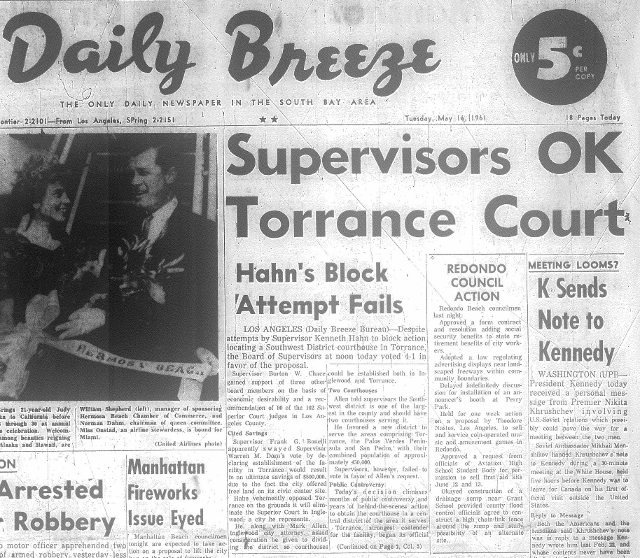
The Daily Breeze reports the Board of Supervisors vote on the front page of its May 16, 1961 edition. Click to enlarge.

Civic officials in surrounding cities greeted the report with howls of protest, each insisting that their municipality was best suited to be the site of the new facility.

The primary participants in the battle to land the courthouse were Inglewood, Hawthorne and Torrance, with Lawndale making a late bid as well. Inglewood and Torrance had an advantage: each could, and did, offer free land for construction of the building. Hawthorne offered a site on Imperial Highway near its civic center. Inglewood’s site was near its already existing courthouse, while Torrance offered land on Maple Avenue behind its growing civic center complex.

The battle between the cities lasted for months. On May 6, 1961, a three-member judicial committee weighed the case for each site, and recommended unanimously that the new Superior Court district be headquartered in Torrance. The Los Angeles County Board of Supervisors made the decision official, approving the project

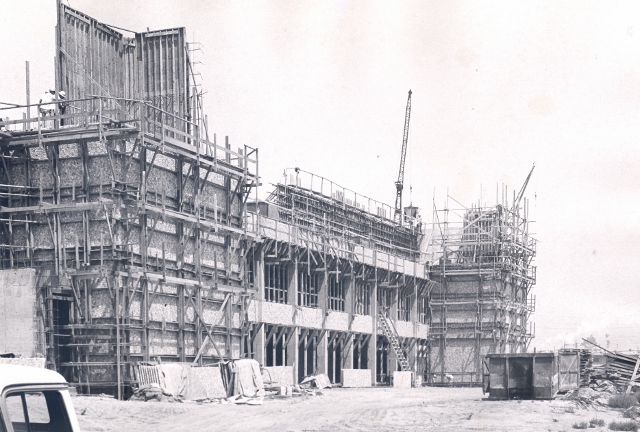
The courthouse in Torrance begins to take shape in this Daily Breeze file photo from Aug. 9, 1965.

It took three more years of planning and procedural hurdles before the structure could start becoming a reality. A $3,978,000 contract to build the courthouse was announced by Torrance City Manager Ed Ferraro in July 1964, with an estimated June 1966 completion date. A groundbreaking ceremony was held on Aug, 7, 1964.

As originally conceived, the courthouse would consist of five stories, with the top story left unfinished, to be developed later as needed. The new structure would contain 12 court rooms and 12 judges’ chambers, a law library, juvenile traffic bureau, and a fallout shelter in the basement. The basement also would contain holding cells for criminal defendants, who would be transported to courthouses on the upper floors via secure elevator.

For the next three years. construction on the courthouse continued on schedule. Plans for an elaborate dedication ceremony began in earnest with the January 1967 appointment of Redondo Beach attorney Fred W. Benson as director of the festivities. A full roster of dignitaries, including Judge John Shidler, county supervisors Burton Chace and Kenneth Hahn and state district attorney Evelle Younger, were scheduled for the April 21, 1967 event.

Unfortunately, elevator construction workers went on strike in March 1967, before final work on the building’s elevators could be completed. The dedication had to be rescheduled, and ultimately would take place on Friday, June 23, 1967.

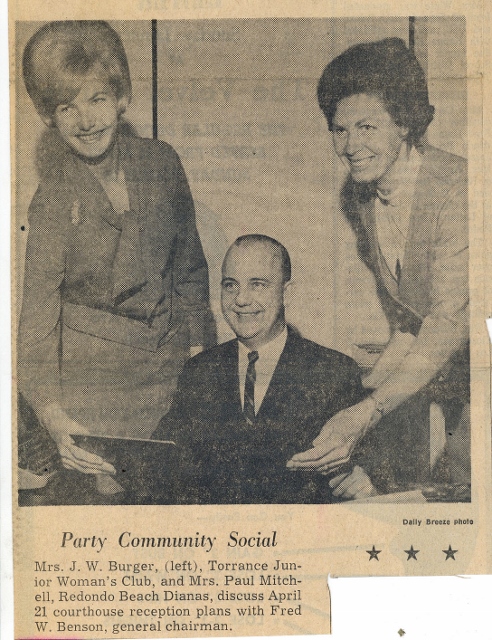
The dedication ceremony committee enlists help for refreshments. Click to enlarge.

In the meantime, some important details were worked out. Funds were approved for the finishing of that fifth floor. The additional space was deemed necessary soon after the first floor was completed, and plans to leave it unfinished were dropped.

Benson’s committee also decided that the dedication ceremonies needed “the feminine touch,” and tapped local Junior Women’s Clubs to prepare and serve refreshments for guests following the dedication.

The June 23 dedication went smoothly, with political and judicial dignitaries everywhere one looked.

With the consolidation of of courts that occurred when the new courthouse opened, the older, smaller courthouse was converted into city offices.

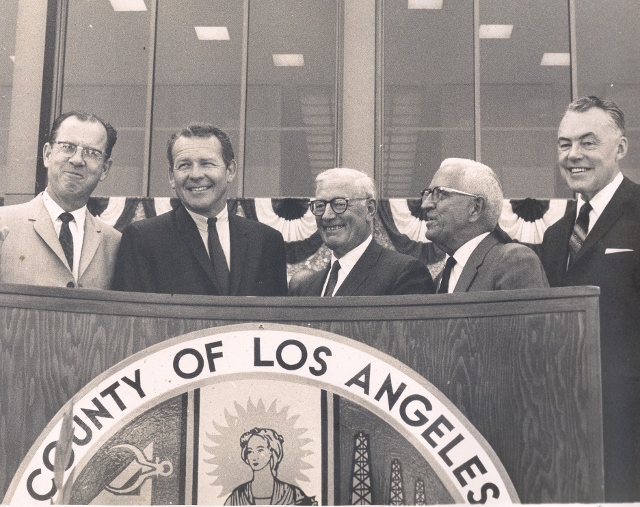
Dignitaries at the Torrance courthouse dedication include, from left to right, County Supervisor Kenneth Hahn, Calif. Lt. Gov. Robert Finch, event emcee Lloyd Nix, County Supervisor Burton Chace and Calif. Supreme Court Justice L.H. Burke. Daily Breeze file photo, June 23, 1967.

Within a few years of its opening, the once-modern courthouse would begin to feel overcrowded, cramped and badly in need of renovation. The jury room had to be moved out of its dank basement into an annex on the courthouse’s patio.

In March 1994, the Los Angeles County Board of Supervisors spent $8.6 million to purchase property two blocks north of the current courthouse that once housed the Boise Cascade paper plant. The 6.2 acres of land would be used for a new courthouse to house the South Bay Municipal Court exclusively, though supervisors admitted it might take “10 years or longer” to find the money to build the facility.

Plans to revamp and renovate the original courthouse remain stalled, though it is high on the list of such sites planned for renovation when funds become available.

In April 2011, California Assemblywoman Betsy Butler a plan through which the city of Torrance would lease the 6.2-acre courthouse site purchased in 1994 for a nominal fee from its owners, the county and the state.

Butler’s plan called for the development of youth sports ballfields on the site until courthouse construction takes place, something she estimated at the time would not happen for “10 years, maybe 15.”

The Torrance City Council signed off on a five-year lease for the site on April 2, 2013. The city expects to spend $600,000 or more on preparing the land for youth sports within a year.

Sources:

Daily Breeze files.

Los Angeles Times files.

Is this your new site? Log in to activate admin features and dismiss this message
Log In