Fosters Old Fashioned Freeze

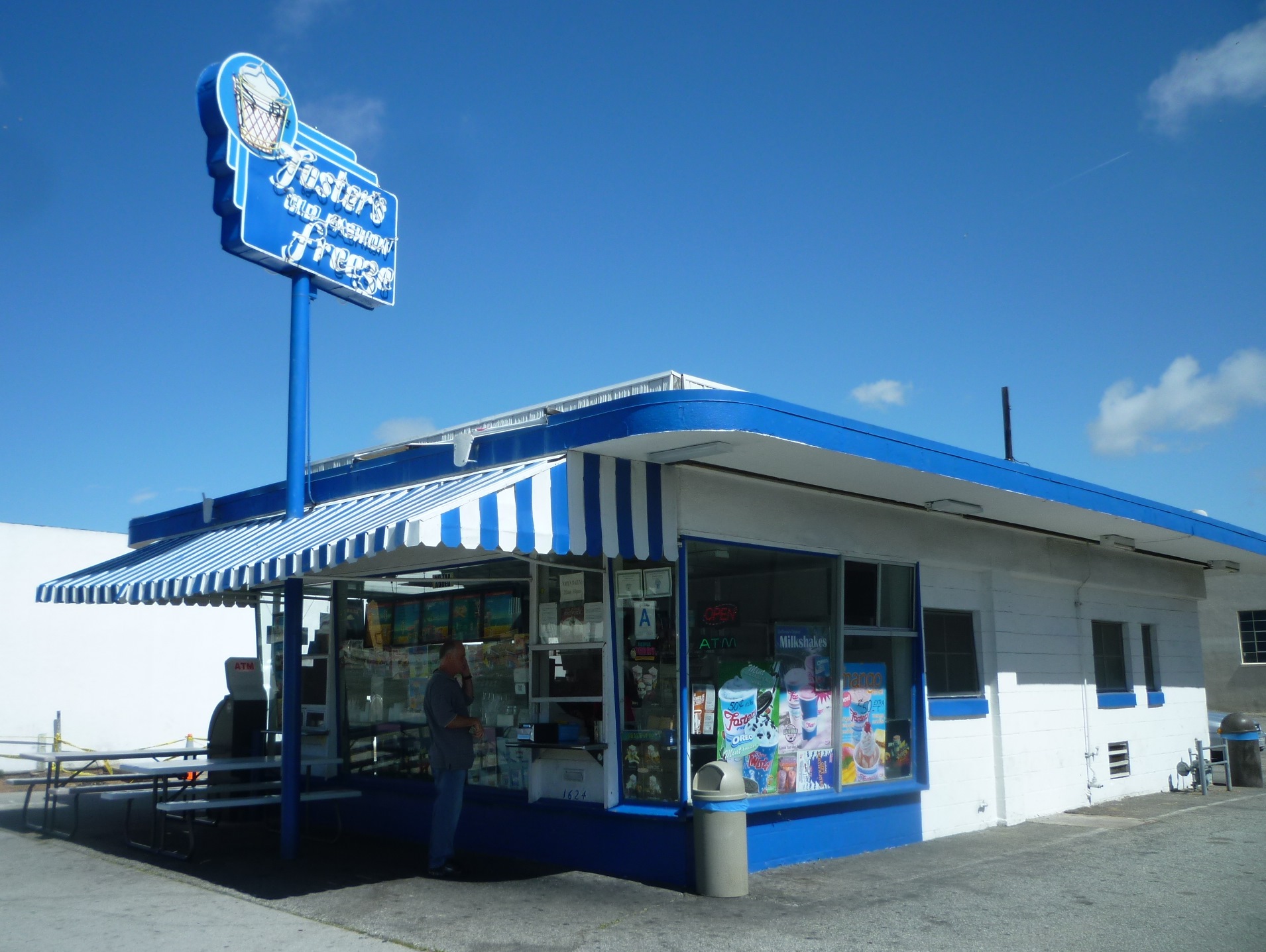
Fosters Freeze #23, 1624 Cravens Avenue, Torrance. (March 2014 Daily Breeze photo)

George Foster came out to California after World War II with an eye toward opening Dairy Queen outlets, as he had acquired the DQ franchise rights for the state.

Unfortunately, strict laws protecting California’s dairy industry kept him from using the “dairy” part of the name at the time.

So, he decided to open soft serve ice cream stands under his own name. The first Fosters Old Fashioned Freeze opened in 1946 at 999 South La Brea Avenue in Inglewood. Fosters Freeze still operates at that location today, though the building probably is not the original one. (Note: Though vintage signs read “Foster’s Freeze,” the chain’s official name is “Fosters Freeze,” sans the apostrophe.)

By 1951, when Foster sold his chain for $1 million, he had opened 360 restaurants in California, making Fosters one of the first fast-food chains to be established statewide.
South Bay locations were among the earliest to be built, and, in addition to Inglewood, several are still in operation.

They are:

•    Torrance, Store #23, 1624 Cravens Avenue
The Old Torrance location has been in operation in its original building since 1947. Unlike many of the Fosters locations, it only serves ice cream and desserts, not hot food.
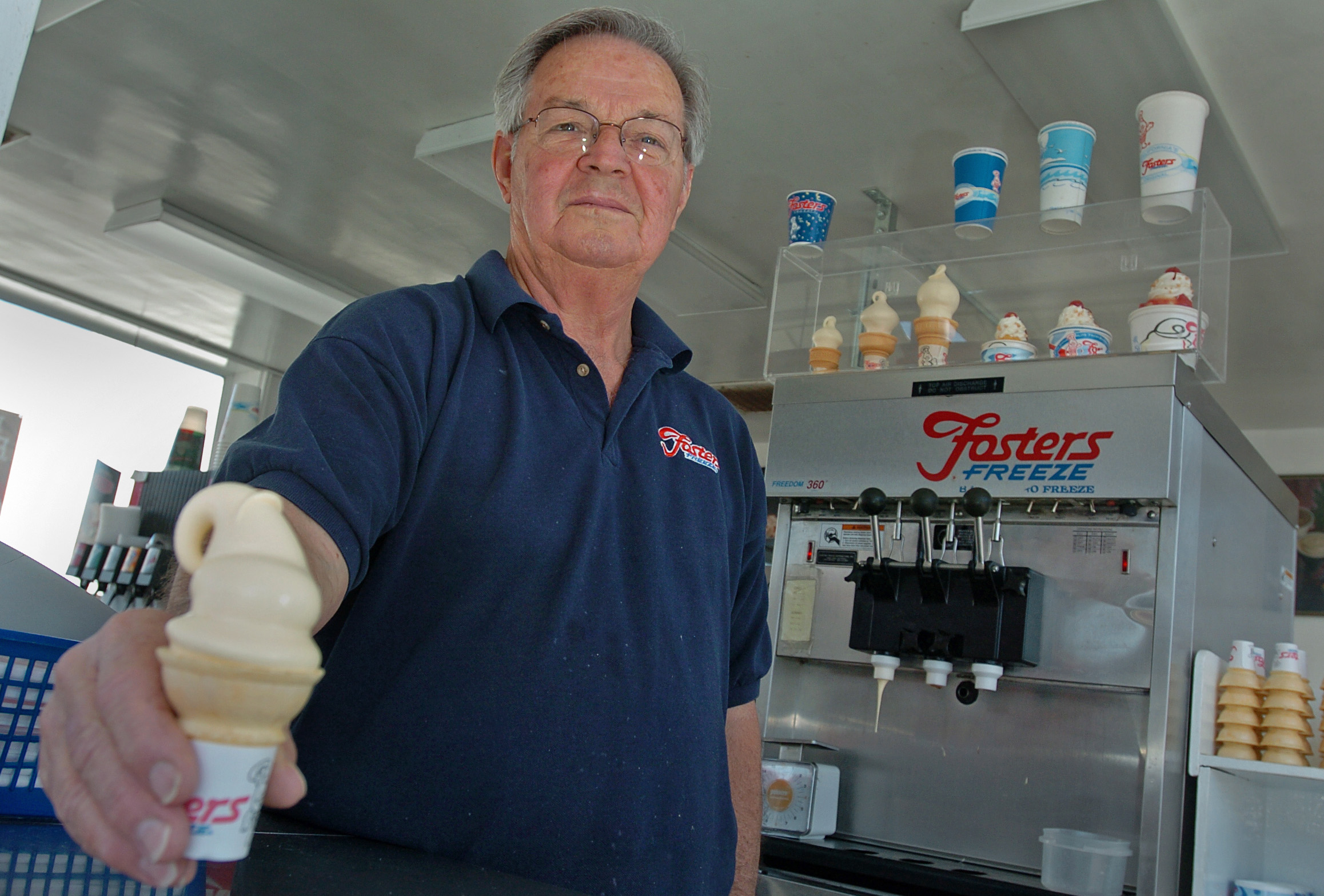
After serving up frozen treats for 35 years, Old Torrance Foster's Freeze owner Chuck Baldwin sold the franchise in 2009 and retired. Jan. 27, 2009 file photo by Daily Breeze Staff Photographer Robert Casillas.
After serving up frozen treats for 35 years, Old Torrance Foster’s Freeze owner Chuck Baldwin sold the franchise in 2009 and retired. Jan. 27, 2009 file photo by Daily Breeze Staff Photographer Robert Casillas.

From 1974 through Jan. 30, 2009, Chuck and Joan Baldwin owned and operated the franchise. They were only the third owners in the ice cream stand’s history. Much to the Baldwins’ surprise, the city of Torrance signed off on a demolition permit requested by the owners of the property on March 9, 2005.

Shortly before the permit was issued, the building had been singled out by a local preservation group as a landmark structure. The building stands in an area of the city where such permits are supposed to receive two reviews by the city, but in this case only one was done before issuance.

After word got out about the proposed demolition, the city realized it had signed off on the permit mistakenly, and quickly rescinded its approval.

The Baldwins retired on Jan. 30, 2009, after 35 years, but the new owners continue to keep the ice cream treats flowing.

•    Hawthorne, Store #18, 11969 South Hawthorne Boulevard


This location opened in 1947. Its exterior has been remodeled, so the current blue roof with its crisp white wooden awning were not part of the original structure.
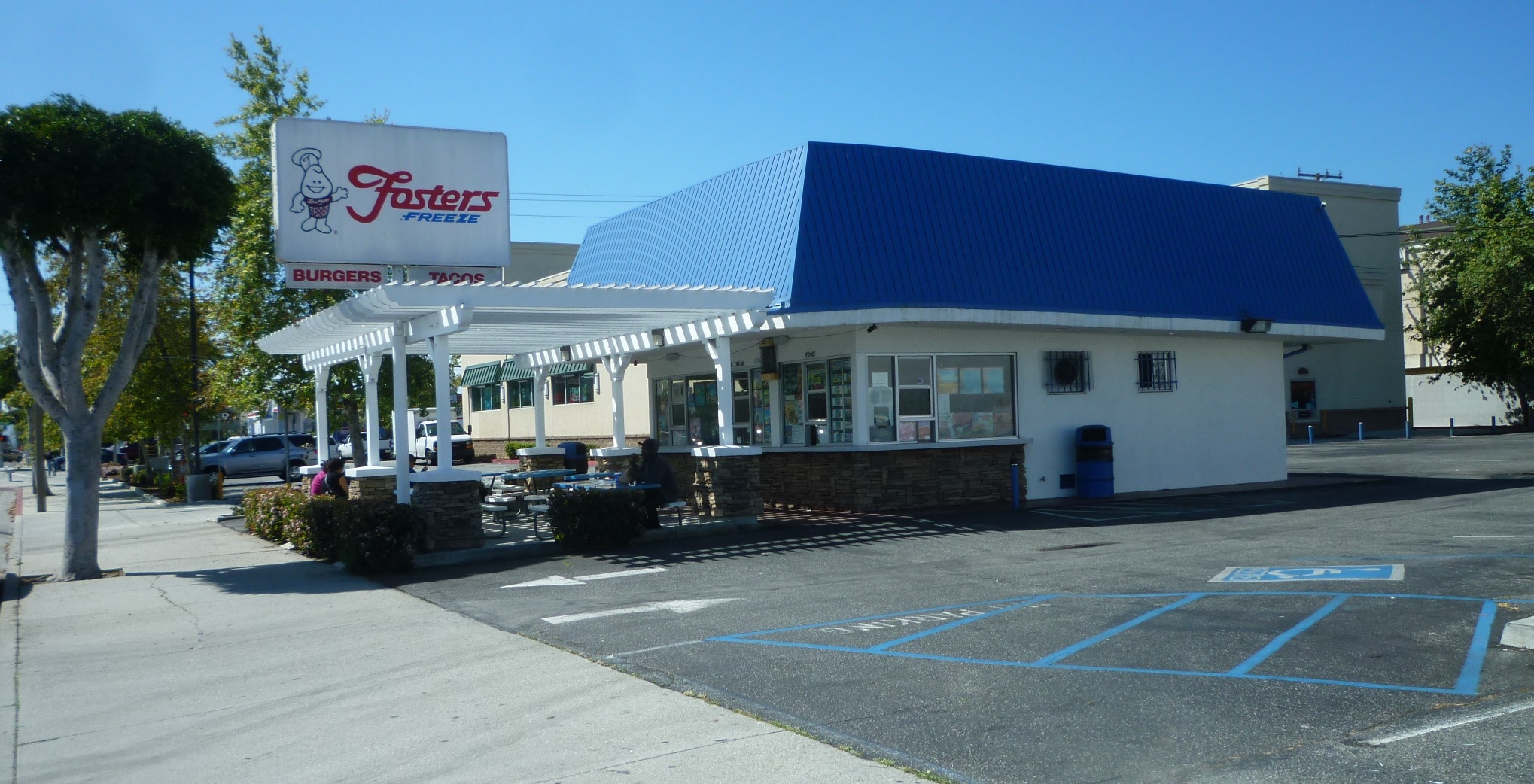
"Well, she took her daddy's car and she cruised through the hamburger stand now..." Fosters Freeze #18, 11969 South Hawthorne Boulevard, Hawthorne. (March 2014 Daily Breeze photo)
“Well, she took her daddy’s car and she cruised through the hamburger stand now…” Fosters Freeze #18, 11969 South Hawthorne Boulevard, Hawthorne. (March 2014 Daily Breeze photo)

The Hawthorne location’s greatest claim to fame comes from being associated with the Beach Boys’ 1964 smash hit “Fun Fun Fun,” written by Brian Wilson and Mike Love.
Though there are varying theories as to the song’s origins, over the years the Hawthorne Fosters Freeze has been credited, rightly or wrongly, as being the “hamburger stand” mentioned in the song’s opening line.

•    Wilmington, Store #28, 603 West Pacific Coast Highway
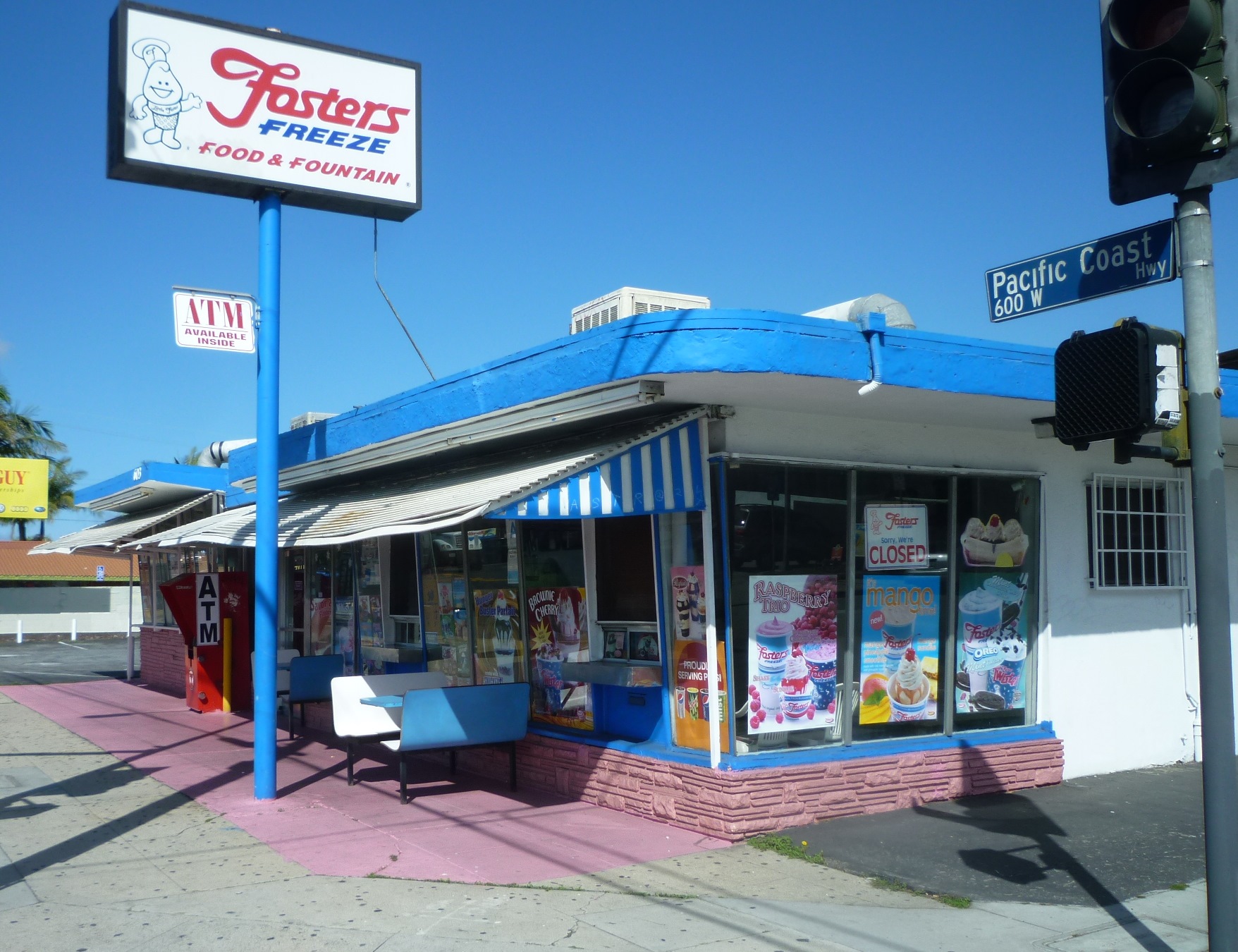
Fosters Freeze #28, 603 West Pacific Coast Highway, Wilmington. (March 2014 Daily Breeze photo)

This building still has the rounded corners that were part of the design of the chain’s earlier buildings. Judging by its low number, it opened shortly after the Old Torrance location (#23). It continues to operate to this day at the same site.

•    Carson, Store #171, 117 East Carson Street
Though it’s not quite as old as the other locations, this Carson outlet has been a fixture for decades. The building has a more squared-off design as opposed to the earlier rounded structures, and features a different and very kitschy sign. It dates back to the 1950s.

Among those Fosters Freeze locations that are no longer around, the Redondo Beach Fosters Freeze was a particular favorite for decades. Located at Knob Hill Avenue and Pacific Coast Highway, the stand opened in 1948.
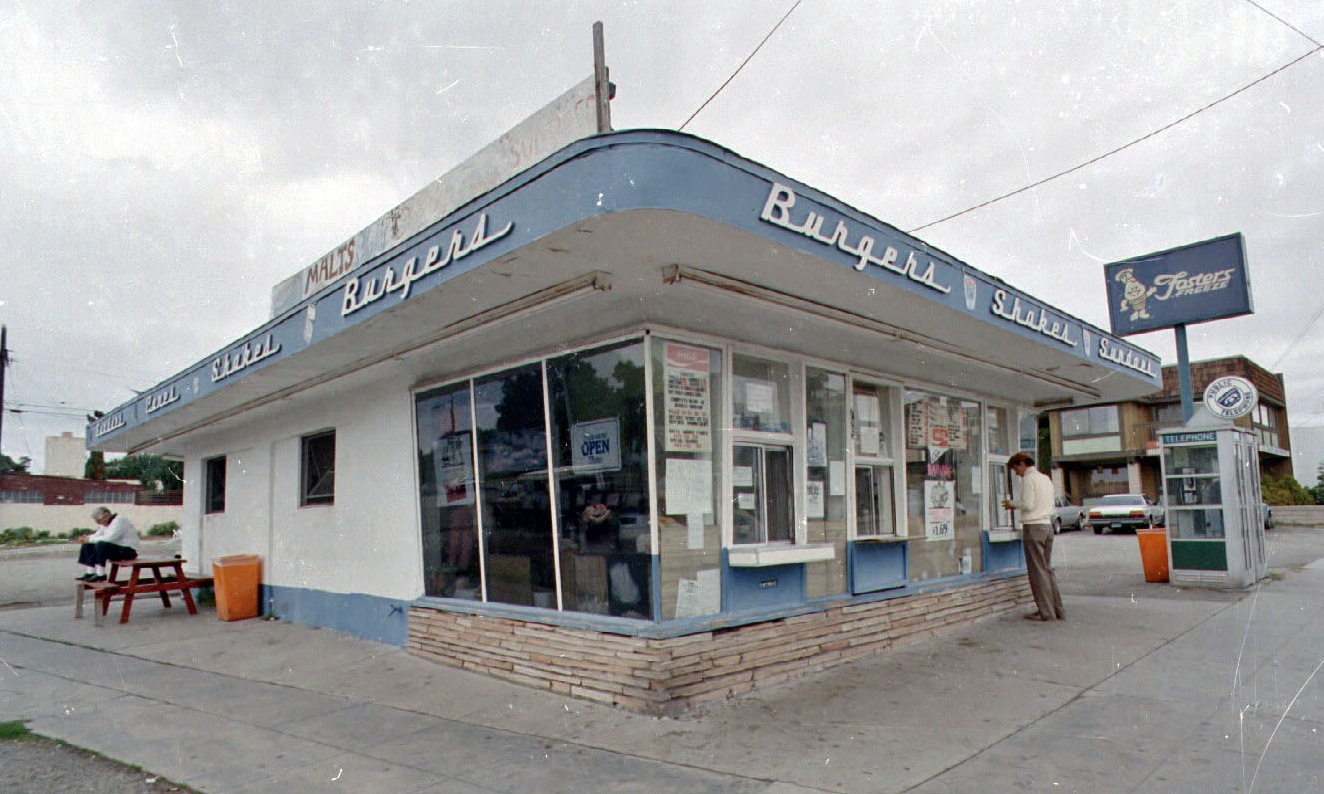
The Fosters Freeze location at Knob Hill and PCH in Redondo Beach shortly before its closure and demolition. Feb. 9, 1987 Daily Breeze staff photo.

In 1970, Jack and Virginia Bausman bought the business and operated it for 17 years. But they didn’t own the property, so despite a vigorous petition drive to save it that garnered almost 4,000 signatures, the business closed in March 1987 when its owners decided to sell it to a developer. The building eventually was torn down to make way for a strip mall.

fosterslogoAccording to its website, Fosters Freeze currently has 91 locally owned and operated outlets in California. In addition, an agreement was signed with El Pollo Loco in 1994 for that chain to serve Fosters Freeze soft serve ice cream products in its restaurants, and more than half of them do, adding more than 160 additional locations where the company’s products are sold.

Fosters Freeze has its corporate headquarters in Rancho Cucamonga.

Sources:

Daily Breeze files.

“Fosters Freeze,” History, Los Angeles County blog, http://historylosangeles.blogspot.com/2009/02/fosters-freeze.html.

“Fosters Freeze,” Roadside Architecture.com, http://www.agilitynut.com/eateries/fosters.html.

Fosters Freeze website, http://www.fostersfreeze.com/.

“Fosters Freeze,” www.wikipedia.org.

Los Angeles Times files.


Coastal military readiness at Long Point in Rancho Palos Verdes

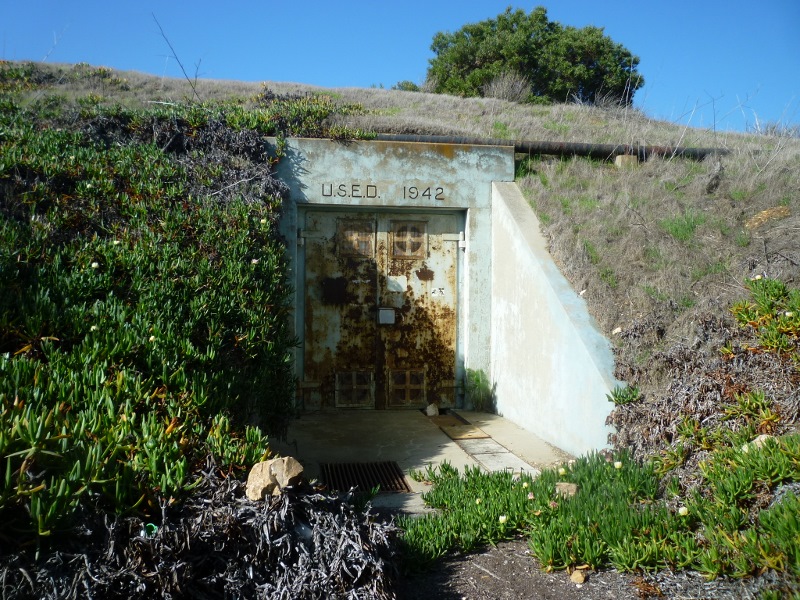
The rear entrance to Battery Barnes near the Rancho Palos Verdes City Hall. "U.S.E.D." stands for U.S. Engineering Department, part of the U.S. Army Corps of Engineers. (March 2014 Daily Breeze photo)
The rear entrance to the bunker at Battery Barnes near the Rancho Palos Verdes City Hall. “U.S.E.D.” stands for U.S. Engineering Department, then part of the U.S. Army Corps of Engineers. (March 2014 Daily Breeze photo)

If you look closely, remnants of past military readiness can be found all along the south-facing South Bay and Harbor Area coast.

The strategic importance of the Palos Verdes coastline had been recognized as early as the 1920s, when the U.S. Army installed a series of small bunkers along the coastal hillsides. Their purpose was to act as observation stations and control centers for artillery.

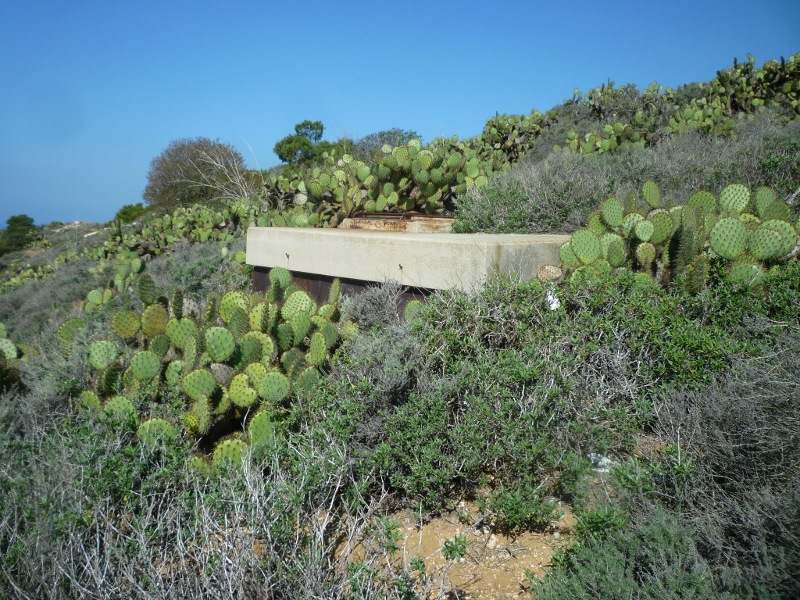
Hillside bunkers such as this one near Long Point in Rancho Palos Verdes served as control stations and observation posts for the gun installations along the coast.  (March 2014 Daily Breeze photo)
Hillside bunkers such as this one near Long Point in Rancho Palos Verdes served as control stations and observation posts for the gun installations along the coast. (March 2014 Daily Breeze photo)

Not surprisingly, the attack on Pearl Harbor that sparked the U.S. entry into World War II brought urgency to the upgrading of coastal fortifications.

In January 1942, the U.S. Government purchased 107 acres from the Palos Verdes Corporation in order to establish the Point Vicente Military Reservation.

The hillside control stations already in place had telephone cables installed for communication with a series of artillery emplacements from Long Point down the coast to installations at White Point and Fort MacArthur.

Traces of the Point Vicente installation remain today, including a bunker and gun emplacement near the current city hall complex.

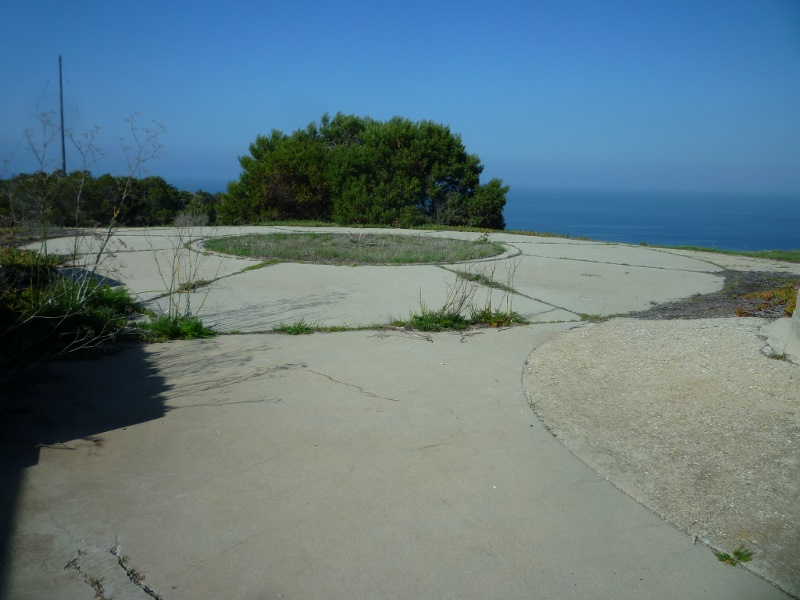
What remains of the gun emplacement at Battery Barnes near Rancho Palos Verdes City Hall.  (March 2014 Daily Breeze photo)
What remains of the gun emplacement at Battery Barnes near Rancho Palos Verdes City Hall. (March 2014 Daily Breeze photo)

The gun emplacement was designated as Battery 240, and it was completed in October 1943, when the two mounted six-inch guns were test-fired.

In 1948, Battery 240 was renamed in honor of U.S. Army Colonel Harry C. Barnes, a lifetime artillery soldier who won the Distinguished Service Medal for his service during World War I.

Soon afterward, Battery Barnes would be dismantled, its guns removed and the remaining equipment sold for scrap.

Today, Battery Barnes has been repurposed by the U.S. Coast Guard into a radio beacon for navigation.

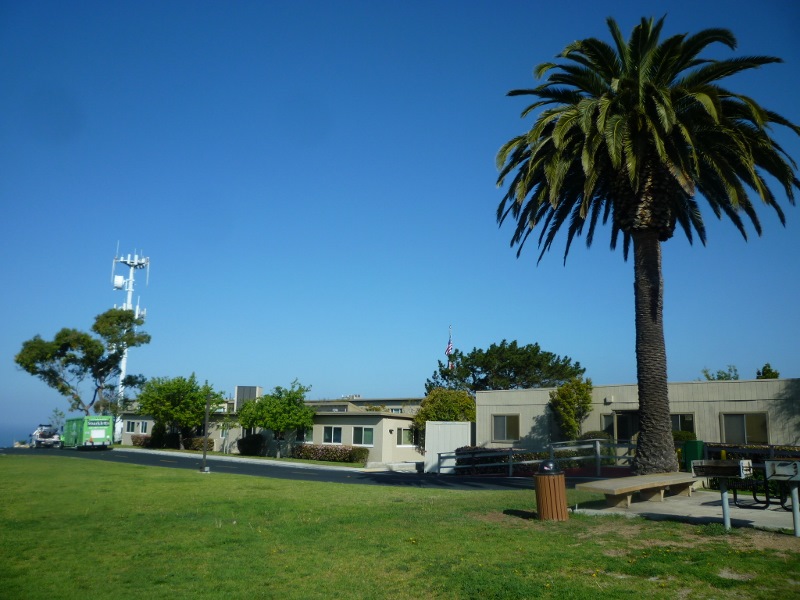
Rancho Palos Verdes City Hall was fashioned out of military buildings left over from a former Nike missile post.  (March 2014 Daily Breeze photo)
Rancho Palos Verdes City Hall was fashioned out of military buildings left over from a former Nike missile post. (March 2014 Daily Breeze photo)

Nearby, the Rancho Palos Verdes City Hall has been fashioned out of the barracks and associated buildings that were constructed when a Nike missile base was built on the site in 1956.

Asked about the possibility of the city building a new city hall on the site, Rancho Palos Verdes City Councilman Bob Ryan told the Breeze in 1988, “I think it’s about as likely as running into an iceberg in the Catalina Channel,”

Remodelings and additions have updated the facility somewhat, but  its combination of spectacular coastal setting and low-budget facilities is unmatched in the South Bay. And 26 years later, Ryan’s assessment still holds.

The military designated the site as Nike Missile Site LA-55L when it opened. RPV reacquired the land and buildings back from the government in 1977, three years after the site was declared obsolete and closed by the U.S. Army. (The city had been using temporary quarters after its incorporation on Aug. 28, 1973.)

The actual Nike missile silos and launching pad area have been covered over with concrete, and currently are in use as part of the city’s vehicle maintenance yard.

The U.S. Coast Guard currently occupies the Point Vicente lighthouse just down the hill from RPV City Hall, using the buildings near it for housing for its staff stationed in the area.

For a more complete look at the entire wartime system of emplacements along the Palos Verdes and San Pedro-area coastlines, online and in-person visits to the Fort MacArthur Museum are essential.

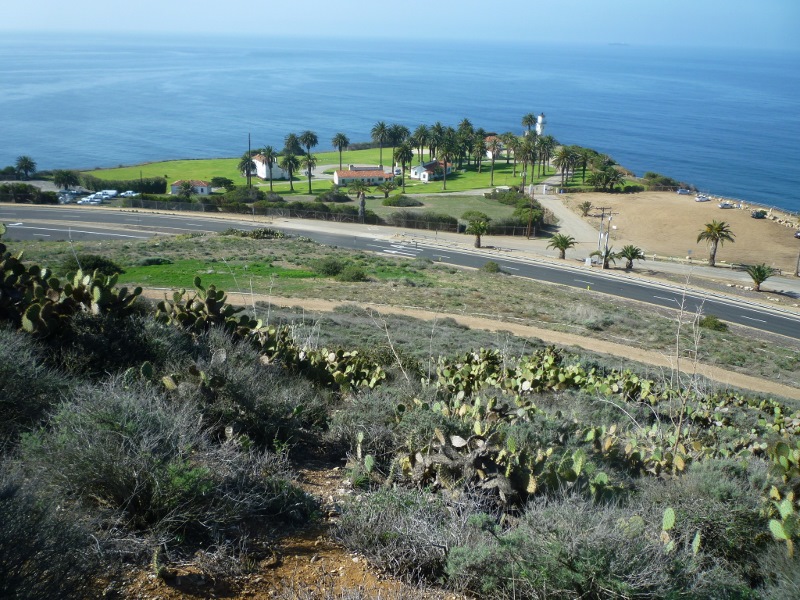
Point Vicente Lighthouse and related buildings are just down a cactus-filled hillside from Battery Barnes. The lighthouse site and grounds are operated by the U.S. Coast Guard.  (March 2014 Daily Breeze photo)
Point Vicente Lighthouse and related buildings are located just down a cactus-filled hillside from Battery Barnes. The lighthouse site and grounds are operated by the U.S. Coast Guard. (March 2014 Daily Breeze photo)

Sources:

“Battery Barnes BCN-240,” Fort MacArthur Museum web site.

Daily Breeze files.

“Long Point Military Reservation, California,” U.S. Forts: Exploring Historic U.S. and Canadian Forts website, Jan. 10, 2013.

Wartime Palos Verdes, by Donald J. Young, self-published, 1987.


The 1922 Ku Klux Klan Inglewood raid

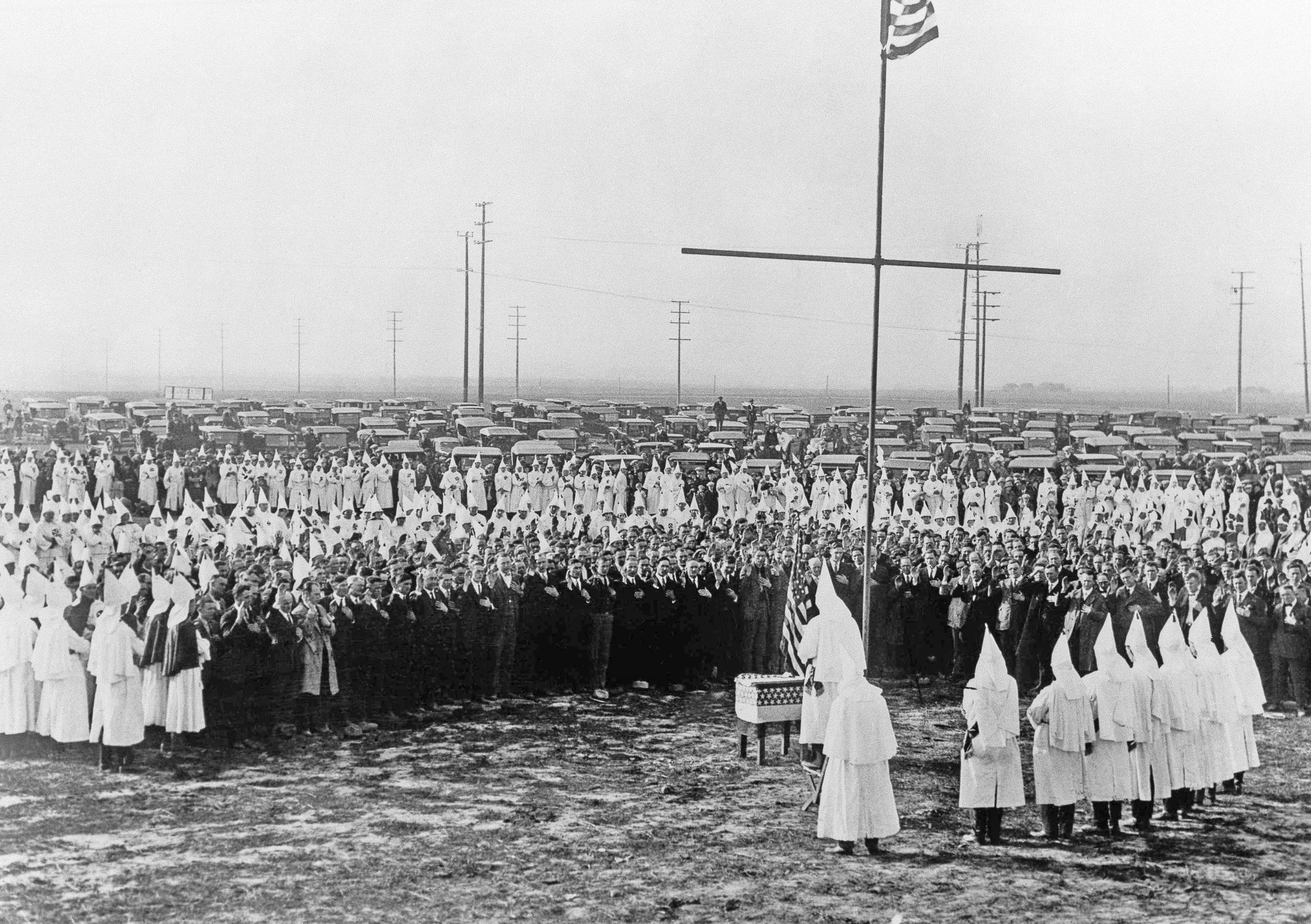
Ku Klux Klan ceremonial meeting near Los Angeles, Calif. when 800 applicants swelled the ranks of this realm to 4000 members. A crowd of people witnessed the ceremonial, February 13, 1925. (AP Photo)

Though the Ku Klux Klan normally is associated with the Deep South, its immense popularity in the 1920s caused its reach to increase throughout the country.

Its first incarnation began in Tennessee as a Southern reaction to Reconstruction following the end of the Civil War in 1865.

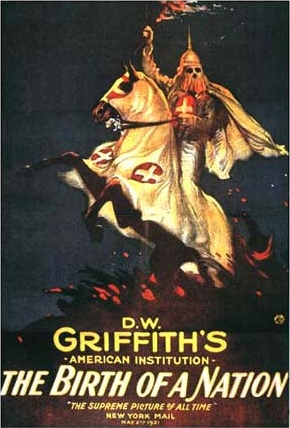
A second wave began in 1915 in Atlanta, Georgia, and quickly spread to a peak membership estimated at 4 to 5 million men by the mid-1920s. D.W. Griffith’s landmark 1915 silent film “Birth of a Nation,” with its positive portrayal of the original KKK, often is cited as a partial inspiration for the group’s rebirth.

Movie poster for the 1915 film, "Birth of a Nation."
Movie poster for the 1915 film, “Birth of a Nation.”

The Klan of the early 20th century was a secret fraternal organization whose leaders saw threats to their role in society from all directions. The group was virulently anti-immigration, anti-union, against Catholics and Jews and strongly in favor of Prohibition, which was put in place in 1919 with the ratification of the 18th Amendment.

The KKK had surprising strength in the West, with powerful organizations in Oregon, Colorado and California, including a group in Anaheim and several in the South Bay.

In April 1922, area Klansmen got wind of a bootleg operation in Inglewood being run by Basque immigrants Fidel and Angela Elduayen. The illegal liquor they had sold from their Pine Avenue home allegedly had sickened one man and caused the death of another.

On April 21, a Klan meeting was held at the Inglewood funeral home owned by H.B. Beaver. Nathan A. Baker, the Kleagle, or chief recruiting officer, of the local chapter led the meeting, which involved the planning of a raid the next night on the Elduayen house.

On April 22 at around 11:30 p.m., a band of about 200 men descended on the Elduayens, whose number included Fidel and Angela, their two teenage daughters, Mary and Bernarda, and Fidel’s brother, Mathias.

News accounts of the actual raid vary, but most say that the Klan members blocked off surrounding streets before the Elduayens were threatened, bound, and beaten up and the house’s furnishings smashed and destroyed. The arrival of so many hooded Klansmen and the subsequent tumult caused enough of a neighborhood disturbance for Inglewood police to be summoned.

Inglewood city marshal Frank Woerner arrived at the scene on a motorcycle driven by 19-year-old volunteer Clyde Vannatta. According to Vannatta’s later account, Woerner was challenged immediately by hooded Klansmen.

Words were exchanged with one of the Klan members along the lines of “I’m a policeman,” with a hooded man responding to the effect that, well, he was, also. Shots were fired, and when the dust cleared, Inglewood city constable Medord B. Mosher was discovered to be the Klansman in question. He died, and two other Klansman were injured in the shooting.

The raid and subsequent shooting outraged all of Los Angeles.

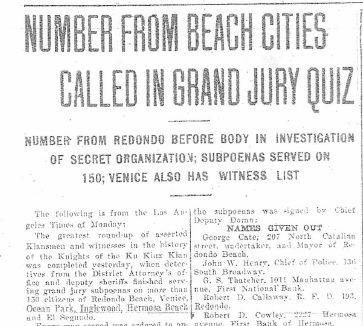
About 150 supboenas were served following the raid, summoning Klan members whose names were found by investigators at the KKK’s local headquarters in the Hass building in downtown Los Angeles.

Daily Breeze front page headline, Friday, May 19, 1922.

The roll call of witnesses called before the grand jury included Redondo Beach mayor George Cate, Redondo police chief John W. Henry, and a large number of city employees, bankers and prominent businessmen in Redondo, El Segundo, Hermosa Beach, Inglewood, Venice and Ocean Park.

Many of those called, including the Redondo mayor and police chief, either denied membership in the secret group, or said they had resigned from it once they heard about the raid.

The testimony and investigation into the Inglewood raid lasted about a month. On June 7, 1922, 37 men were indicted by the grand jury on various weapons and assasult charges.

Their trial began on August 7, and concluded August 26. All 37 were acquitted.

The Elduayens were arrested and tried for selling bootleg liquor, but the charges were dismissed on Feb. 2, 1924.

The local Klan was undeterred by the fallout from the Inglewood raid, and turned its attention to other activities, this time involving labor unions, specifically the left-leaning International Workers of the World.

In June 1924, Klansmen stormed the IWW union hall of the at 12th and Centre streets in San Pedro during a benefit for two workers killed in a railroad accident.

They beat many of the union members, scalded two children with a hot pot of coffee and ultimately destroyed everything they could get their hands on in the hall.

The KKK continued to hold meetings in the South Bay in Torrance, Inglewood and San Pedro throughout the 1920s and into the 1930s.

The Torrance Herald ran listings and stories on the doings of the Triple Cities Ku Klux Klan group at their Border Avenue meeting hall as late as 1933.

The end of World War II and subsequent legal rulings in the late 1940s and early 1950s led to a waning of activities by this particular iteration of the Klan.

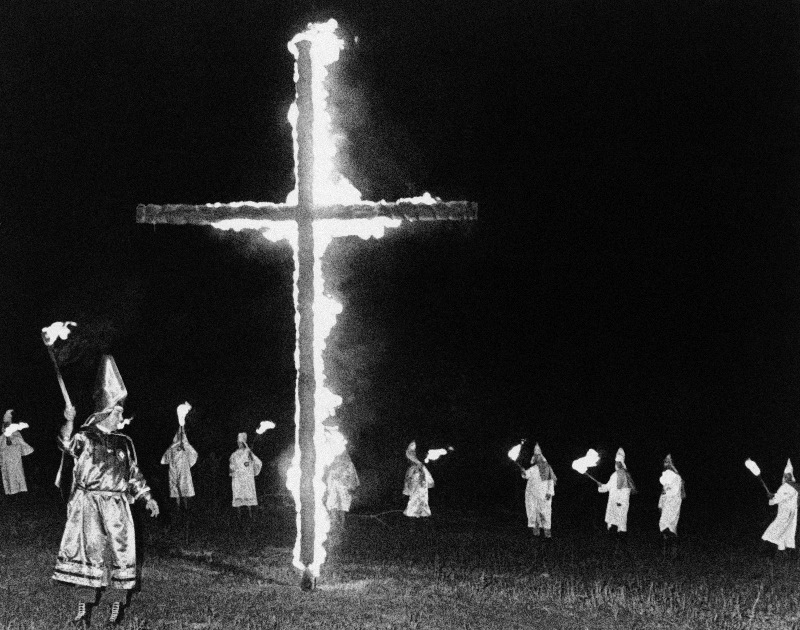
Hooded members of the United Klans of America in Mississippi wave flaming torches at an open-air torch burning near Edinburg in Central Mississippi, March 25, 1967. More than 3,000 Mississippians belonged to the United Klans at its peak in 1964 but not figures indicate there are fewer than 500 members, only 250 of whom pay dues. (AP Photo)

With the advent of the civil right struggle, the group gathered new momentum as an intolerant opposition force nationally in the 1960s and 1970s.

They even showed a presence in the South Bay again, most notably receiving blame with a series of cross burnings on black residents’ lawns in Redondo Beach and Culver City in 1976.


Sources:

Daily Breeze files.

Industrial Workers of the World Photograph Collection I, http://guides.lib.washington.edu/content.php?pid=318431&sid=2643170.

“Ku Klux Klan raid (Inglewood),” Wikipedia, www.wikipedia.org.

Los Angeles Times files, especially “Klan’s tentacles once extended to Southland,” by Cecilia Rasmussen, May 30, 1999.


Additional reading:

“Ku Klux Klan in Inglewood, California,” edited by Frederic P. Miller, Agnes F. Vandome and McBrewster John, VDM Publishing, Jul 17, 2010

“The Invisible Empire in the West: Toward a New Historical Appraisal of the Ku Klux Klan of the 1920s,” Edited by Shawn Lay, University of Illinois Press, 2004.

Jim Thorpe’s days in the South Bay

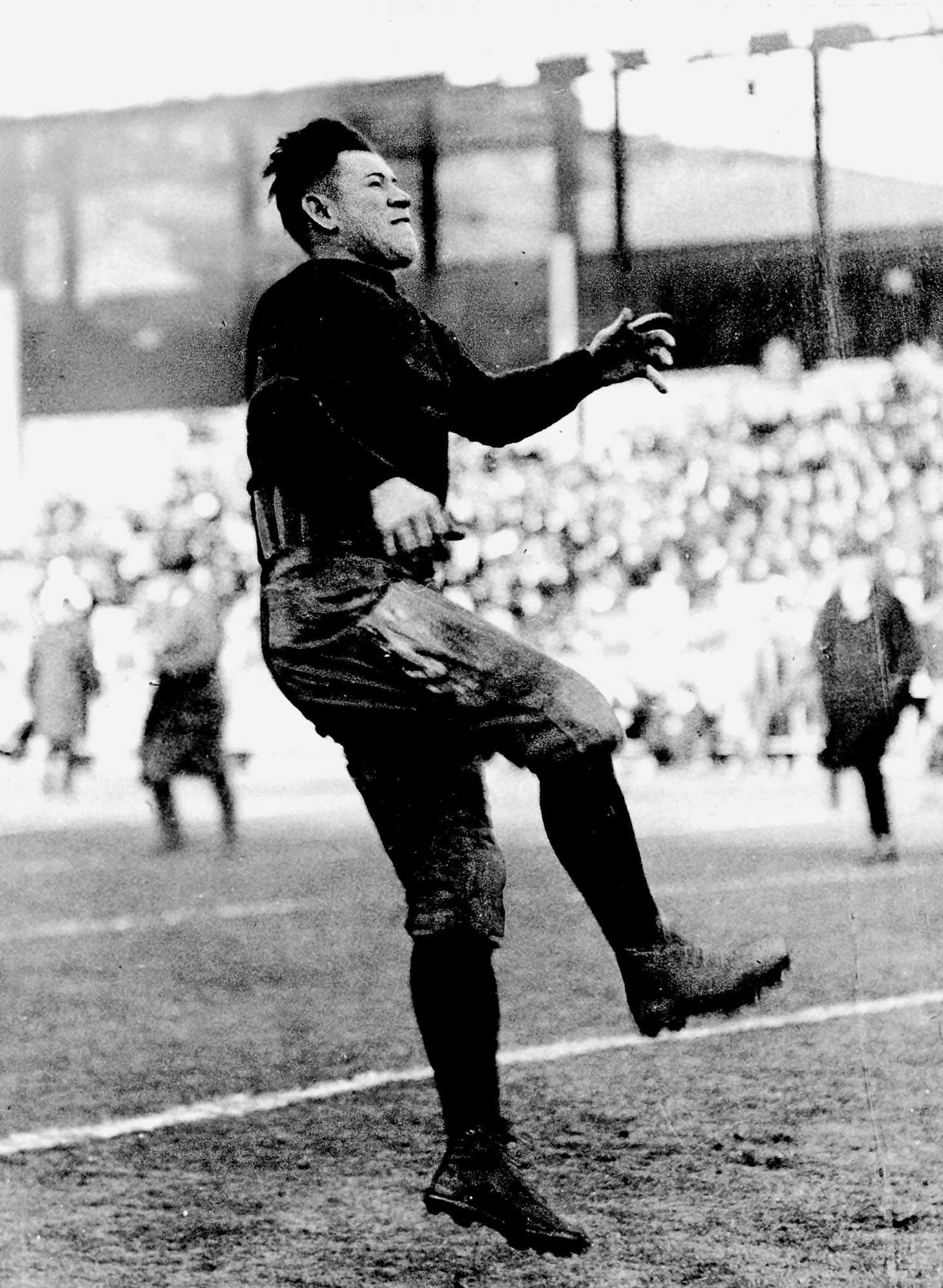
Jim Thorpe of the Carlisle Indian School gets off a kick during warm-ups before a game in this 1912 photo. Thorpe scored 25 touchdowns and 198 points that year in leading his team to the national collegiate championship. (AP Photo)

Jim Thorpe was one of the most amazing athletes of the 20th Century. Some say he was the best of them all.

He was born a member of the Sac and Fox Tribe on May 22, 1888 in Indian territory in what become Oklahoma when that state joined the Union in 1907.

Thorpe’s meteoric rise to fame began at Carlisle Indian Industrial School in Pennsylvania, where he made the first team in football in 1907. Led by Thorpe’s prowess, the tiny school’s team, coached by Glen “Pop” Warner, beat major teams such as Penn and Harvard.

Military hero, U.S. President and former West Point defensive back Dwight David Eisenhower later told the story of an unsuccessful attempt to tackle Thorpe during a game between Carlisle and Army, which resulted in a collision between himself and a teammate that knocked both of them nearly unconscious. Thorpe scored on the play, and Carlisle won the game easily.

In 1912, Thorpe won both the pentathlon and the decathlon in track and field at the 1912 Summer Olympics in Stockholm, Sweden. A year later, the Amateur Athletic Union forced him to surrender the medals after finding out that he’d played semi-pro baseball in North

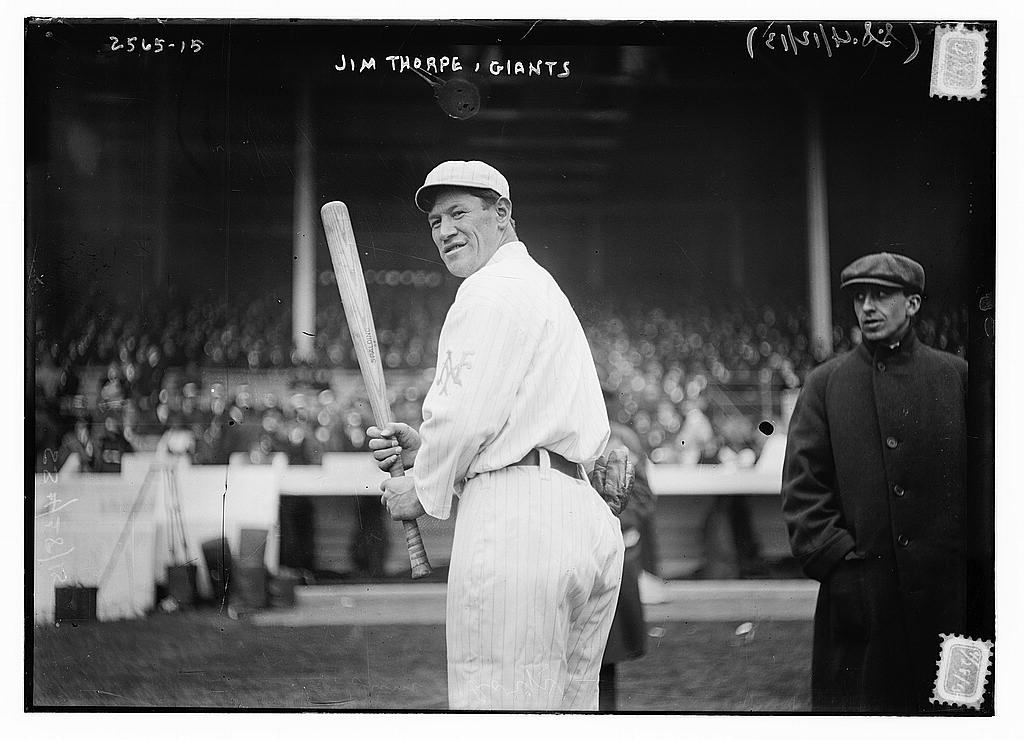
Jim Thorpe as a member of the New York Giants baseball team in 1913. (Photo credit: The Associated Press)

Carolina in 1909.

Undeterred, Thorpe returned home and signed to play baseball with the New York Giants, coached by John McGraw, for six seasons. During the off season, he played professional football, winning championships with the Canton, Ohio Bulldogs in 1916, 1917 and 1919.

In the 1920s, Thorpe was involved in the formation of the group that evolved into the National Football League. Thorpe retired from football in 1929 while a member of the Chicago Cardinals.

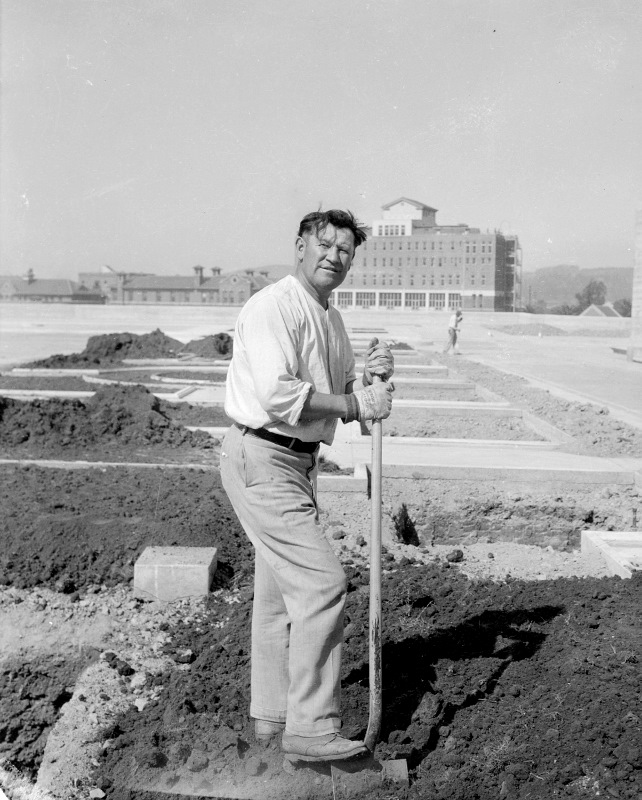
Jim Thorpe, former Olympic decathlon champion and football great, works as a laborer at the site of the new Los Angeles County Hospital in this March, 1931 photo. (Photo credit: The Associated Press)

Thorpe’s life after athletics was a crazy quilt of different jobs. The Depression forced him to scramble. By 1930, he had arrived in the South Bay, living in Hawthorne and working with the paint crew at Standard Oil. As he told the Los Angeles Times, “Can’t keep the wife and kids in food on ancient glory.”

He appeared in bit parts in several films, including 1935’s, “Fighting Youth,” with Andy Devine, where he played an alumnus who returns to college to help the school’s football team become competitive. He worked as a day laborer. He gave lectures on his past athletic glories. He lent his name to the ghost-written book “Jim Thorpe’s History of the Olympics,” released during the 1932 Los Angeles Games.

His name pops up occasionally in news accounts from the era after his athletic career had ended. In 1934, he was arrested on misdemeanor disturbing the peace charges in Hawthorne, blaming liquor for the domestic disturbance with his wife. His sentence was suspended.

He remained active in Native American affairs, playing a lead role in a 1935 celebration and parade in Hawthorne that attracted members from more than 100 tribes.

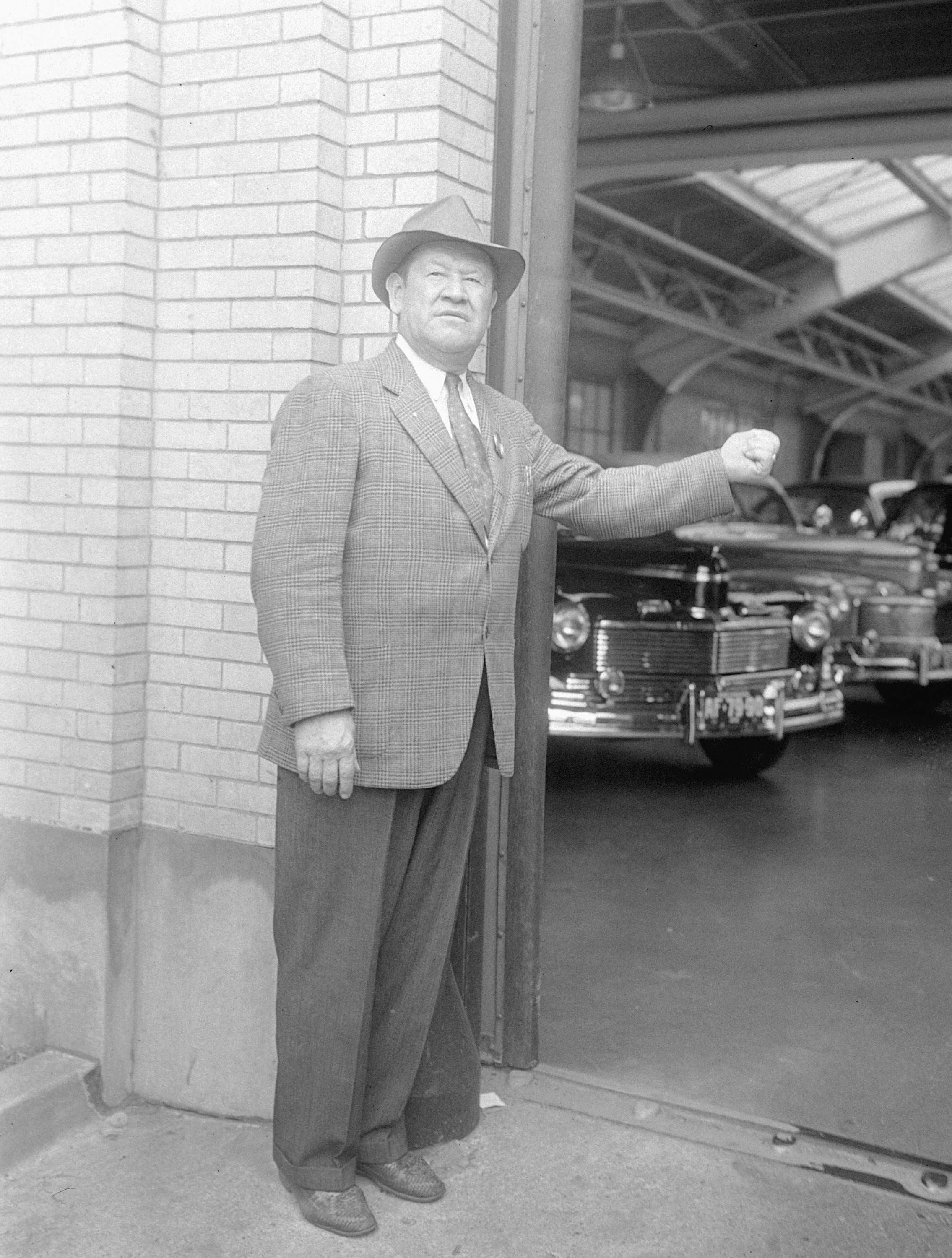
Jim Thorpe, one-time Carlisle football player, who was known as one of the greatest halfbacks in the country, and who is now working as a plant production policeman at the River Rouge plant of the Ford Motor Company, is shown on the job outside the factory building on May 22, 1942. (AP Photo)

On Oct. 15, 1939, he appeared as the main speaker at a pep rally for the Narbonne High School Gauchos football team, comparing the style of football being played then to that played when he was involved with the game during a talk to the students.

Thorpe worked in a Ford Motor Company plant in Detroit during the 1940s, and served a stint in the Merchant Marine during the last part of World War II. After the war, he moved to Chicago for a time, where he became a member of the recreation staff of the Chicago Park District.

He returned to Hawthorne, where he lived from 1946-49. In 1974, the city named a park on Prairie Avenue just north of Rosecrans for him. Jim Thorpe Park is located at 14100 Prairie Avenue in Hawthorne.

Iron Eyes Cody donated a football autographed by Thorpe to the city of Hawthorne on March 30, 1974, shortly after he attended the park’s dedication. Unfortunately, the football was stolen on Wednesday, Dec. 23, 1998, and never recovered. (Santa Ana also named a school after him, Jim Thorpe Fundamental Elementary School.)

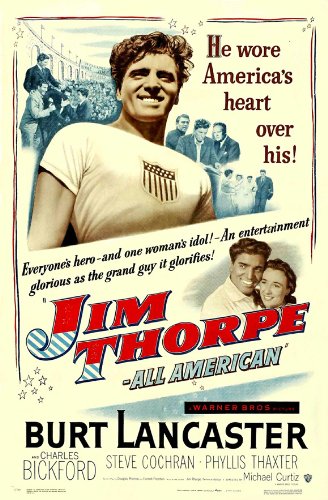
Jim Thorpe's film biography was released in 1951.
Jim Thorpe’s film biography was released in 1951.

In 1950, Thorpe made headlines when the Associated Press named him the best male athelete of the first 50 years of the 20th Century, far outpolling second-place Babe Ruth for the honor.

In 1951, it was disclosed that Thorpe, ill and broke, was being treated as a charity case in a Philadelphia hospital. Several baseball team owners got together to raise money for him, and he got some revenue from the 1951 biographical film, “Jim Thorpe, All-American,” starring Burt Lancaster, enough to have successful surgery for lip cancer.

Thorpe and his wife Patricia were able to return to Southern California. For a time, they operated a restaurant, Neal’s Sandwich Shop, at the Wilmington Recreation Center, a four-lane bowling alley at 221 E. Anaheim Street in Wilmington.

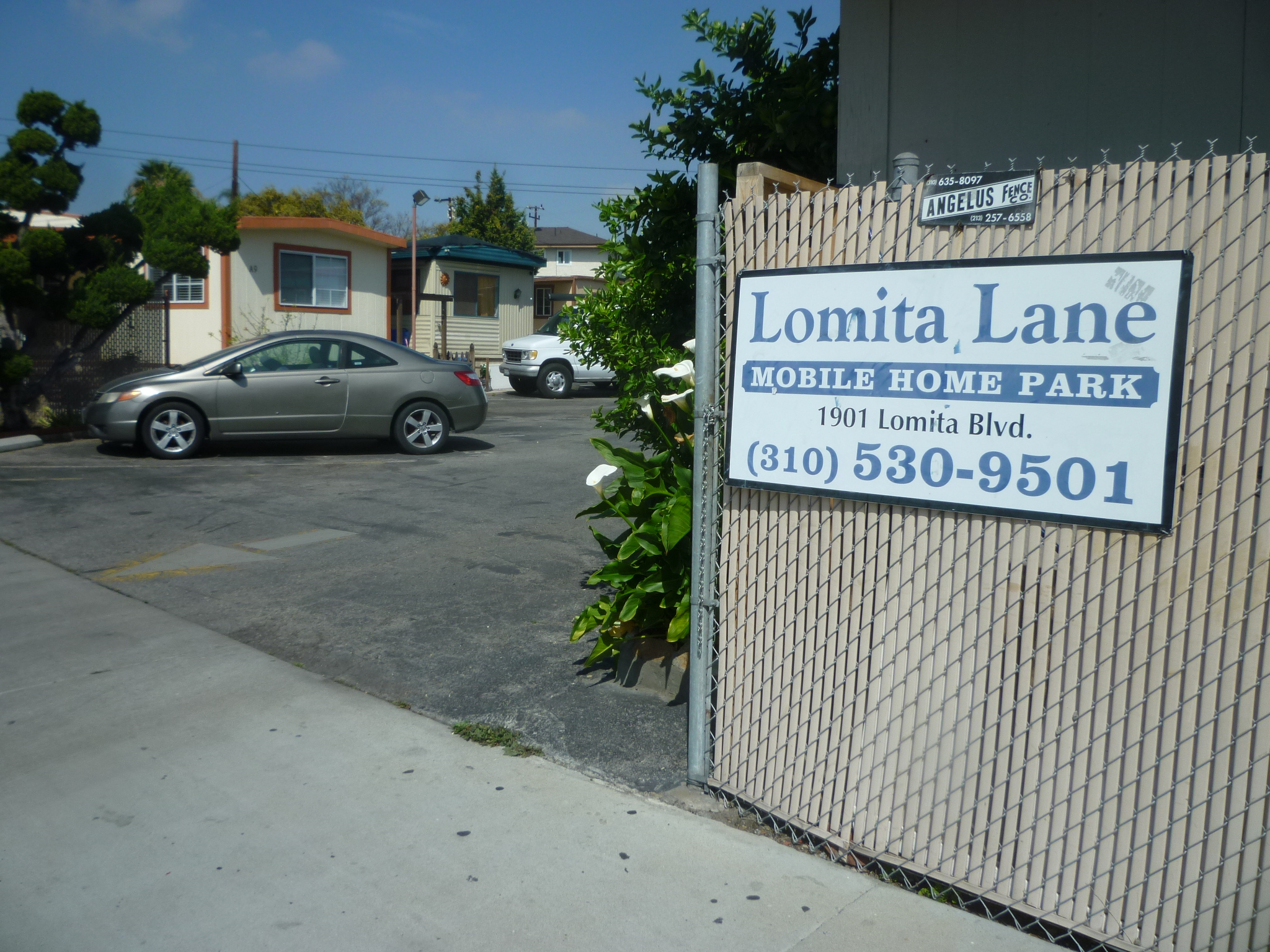
Jim Thorpe died at his home in this Lomita trailer park. March 2014 Daily Breeze photo.

Thorpe was eating lunch with his wife on Saturday, March 28, 1953 at their mobile home in a small trailer

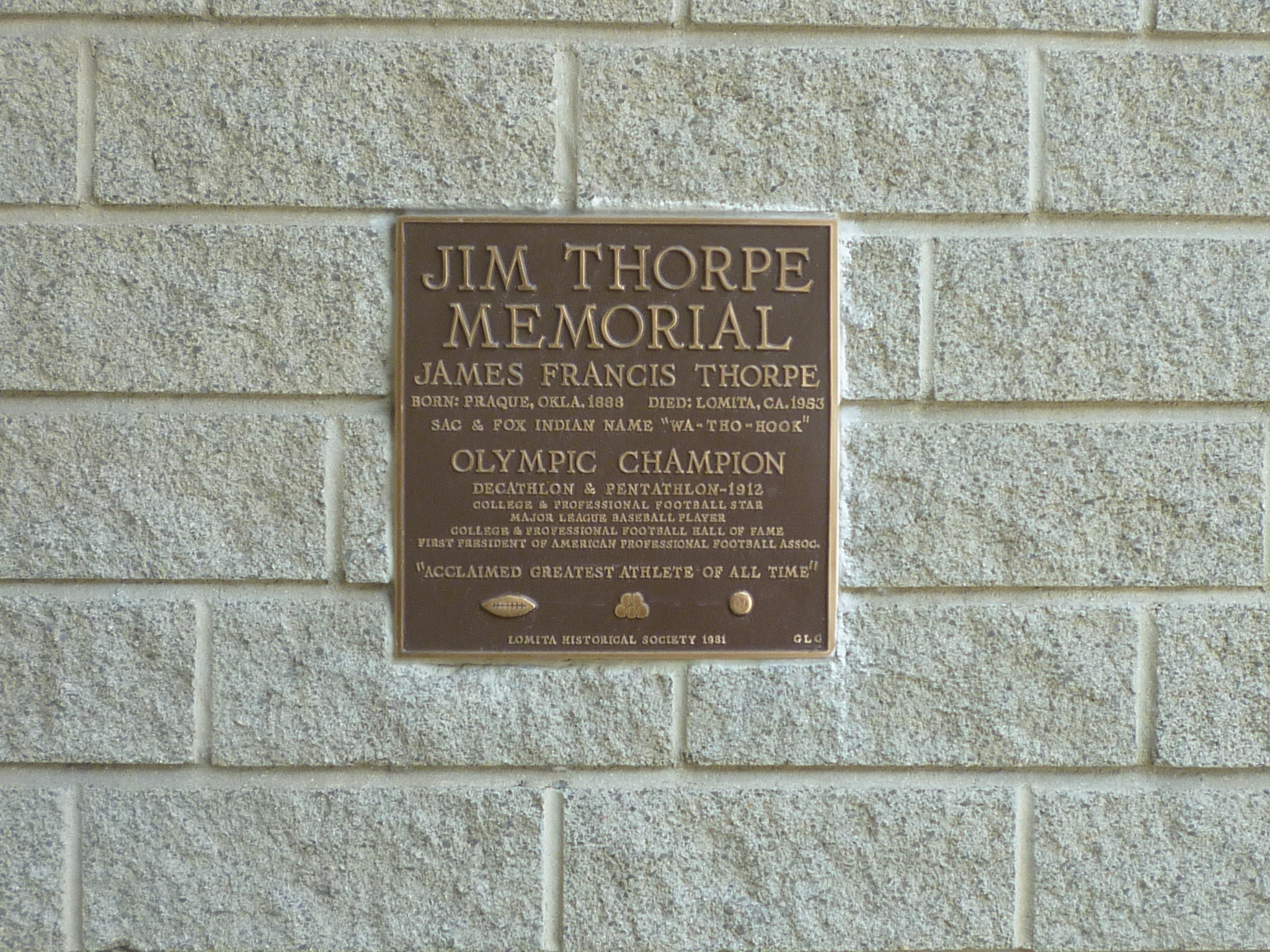
The City of Lomita honors Jim Thorpe's memory with this plaque at Lomita City Hall. March 2014 Daily Breeze photo.
The City of Lomita honors Jim Thorpe’s memory with this plaque at Lomita City Hall. March 2014 Daily Breeze photo.

park at the corner of Lomita Boulevard and Walnut Avenue in Lomita when he suffered a fatal heart attack. He suffered from alcoholism and poor health in the last years of his life, and had survived two earlier heart attacks in the 1940s.

According to the New York Times account of his death, Thorpe revived after a neighbor, Colby Bradshaw, administered CPR for nearly an hour. The athletic legend reportedly

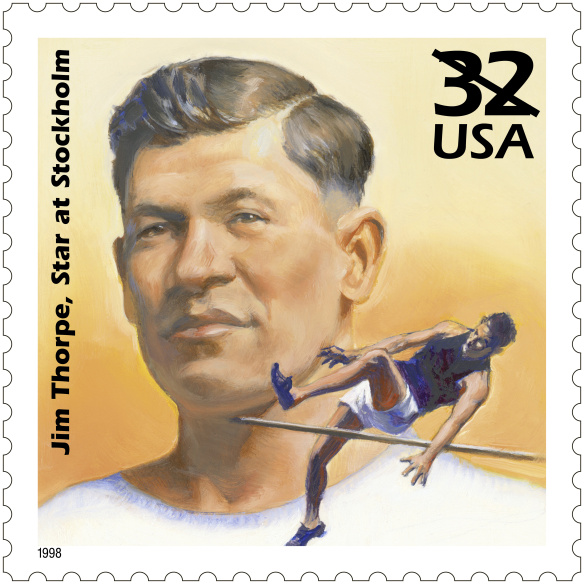
The U.S. Postal Service issued this stamp honoring Jim Thorpe in 1998. An earlier stamp commemorating him was issued in 1984.

recognized and spoke to people around him briefly, then suffered a relapse and died.

What happened next surprised nearly everyone. After an April 6, 1953, memorial service in Los Angeles attended by more than 400 friends, former teammates and family, Thorpe’s body was shipped by train to Shawnee, Okla., for a formal funeral service.

On April 13, a traditional Indian burial service was being held for Thorpe at the Sac and Fox Reservation in Oklahoma when Thorpe’s wife Patricia arrived with a hearse and some state troopers in tow, seized Thorpe’s body, which was on display during the ceremonies, and drove away.

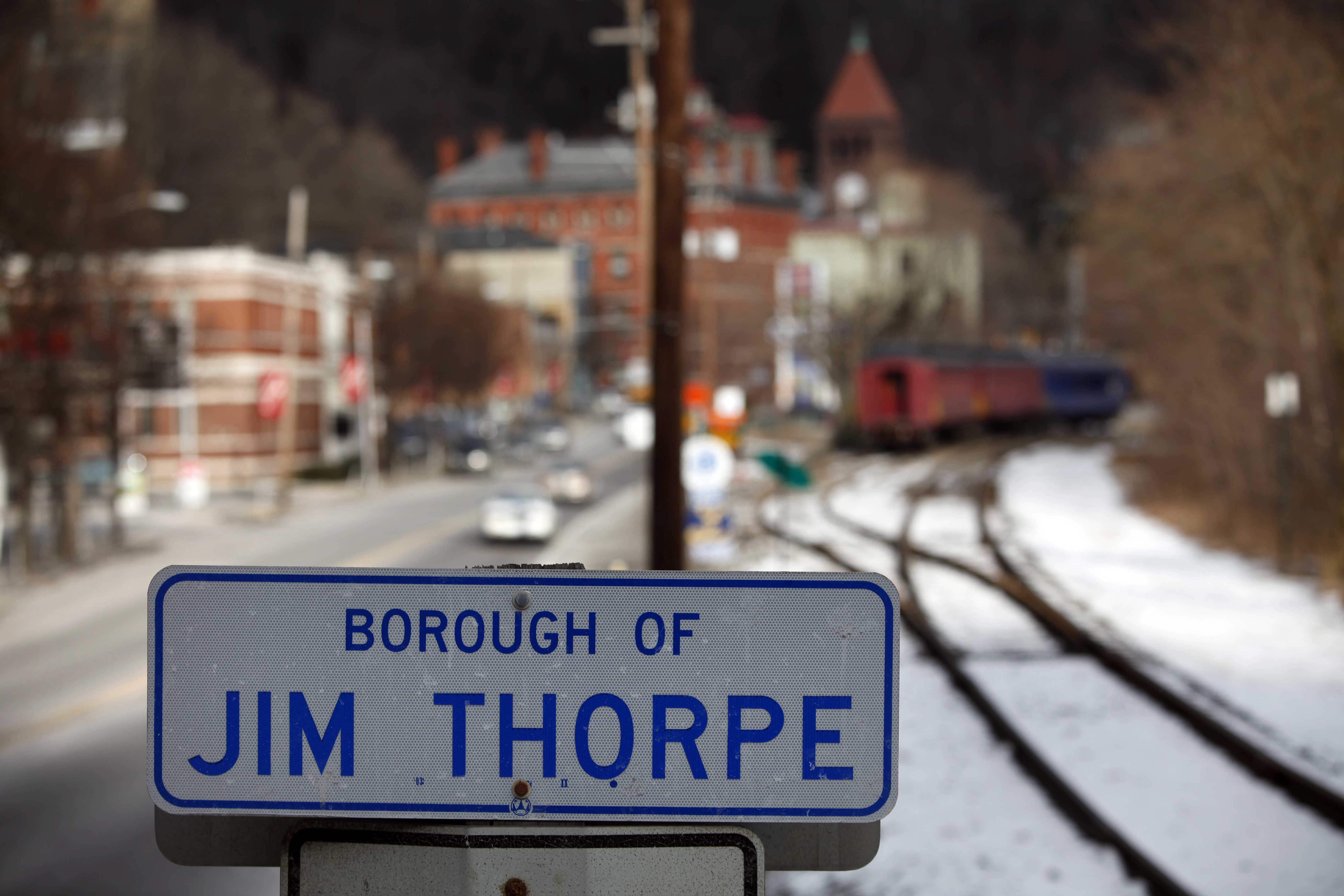
In this Jan. 12, 2010 file photo, a sign in the town of Jim Thorpe, Pa., is shown. (AP Photo/Matt Rourke, File)

After attempts to have the city of Tulsa build a memorial for him failed, Mrs. Thorpe eventually made a deal with the towns of Mauch Chunk and East Mauch Chunk, Pennsylvania. The two communities were merging and looking for something to give their new city an identity and draw visitors.

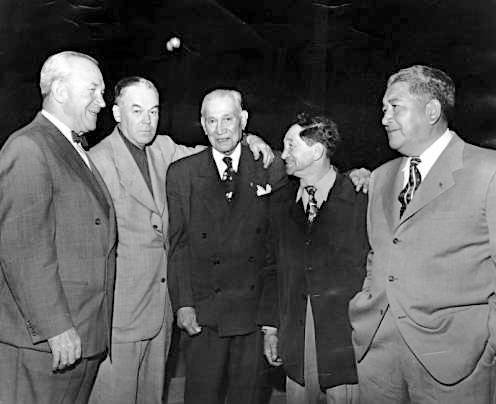
One of the groups who paid tribute to Jim Thorpe at a rosary service at Malloy & Malloy Mortuary in Los Angeles included, from left to right, Jack Powell; Dunc Farrell; Chief Meyers; Young Abe Attell; and Harry Jones. Thorpe passed away in Lomita on March 28, 1953. April 7, 1953 photo. (Credit: Los Angeles Public Library Photo Collection)

Mrs. Thorpe agreed to let them bury her husband’s body there and build a proper memorial for him if they would rename their new city “Jim Thorpe, Pa.” They agreed.

So, even though he never set foot in the town named for him, the great athlete’s body remains buried in Jim Thorpe, Pa., to this day. For decades, Thorpe’s blood relatives have fought to get his body returned to the family’s native burial ground in Oklahoma, but as of this writing, he remains buried in Pennsylvania.

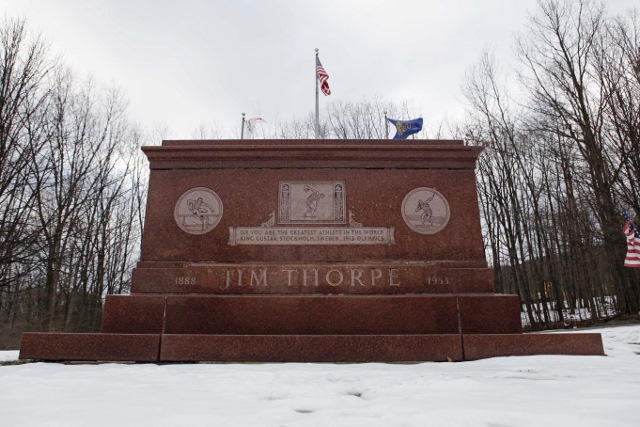
Jim Thorpe's gravesite memorial in Jim Thorpe, Pa. (Photo credit: The Associated Press)
Jim Thorpe’s gravesite memorial in Jim Thorpe, Pa. (Photo credit: The Associated Press)

Jim Thorpe did receive posthumous vindication from the International Olympic Committee regarding his Olympic gold medals from the 1912 Summer Games. 69 years after taking them away, the IOC announced on Oct. 13, 1982, that it was restoring the two track and field golds that it had taken away from him almost seven decades earlier.


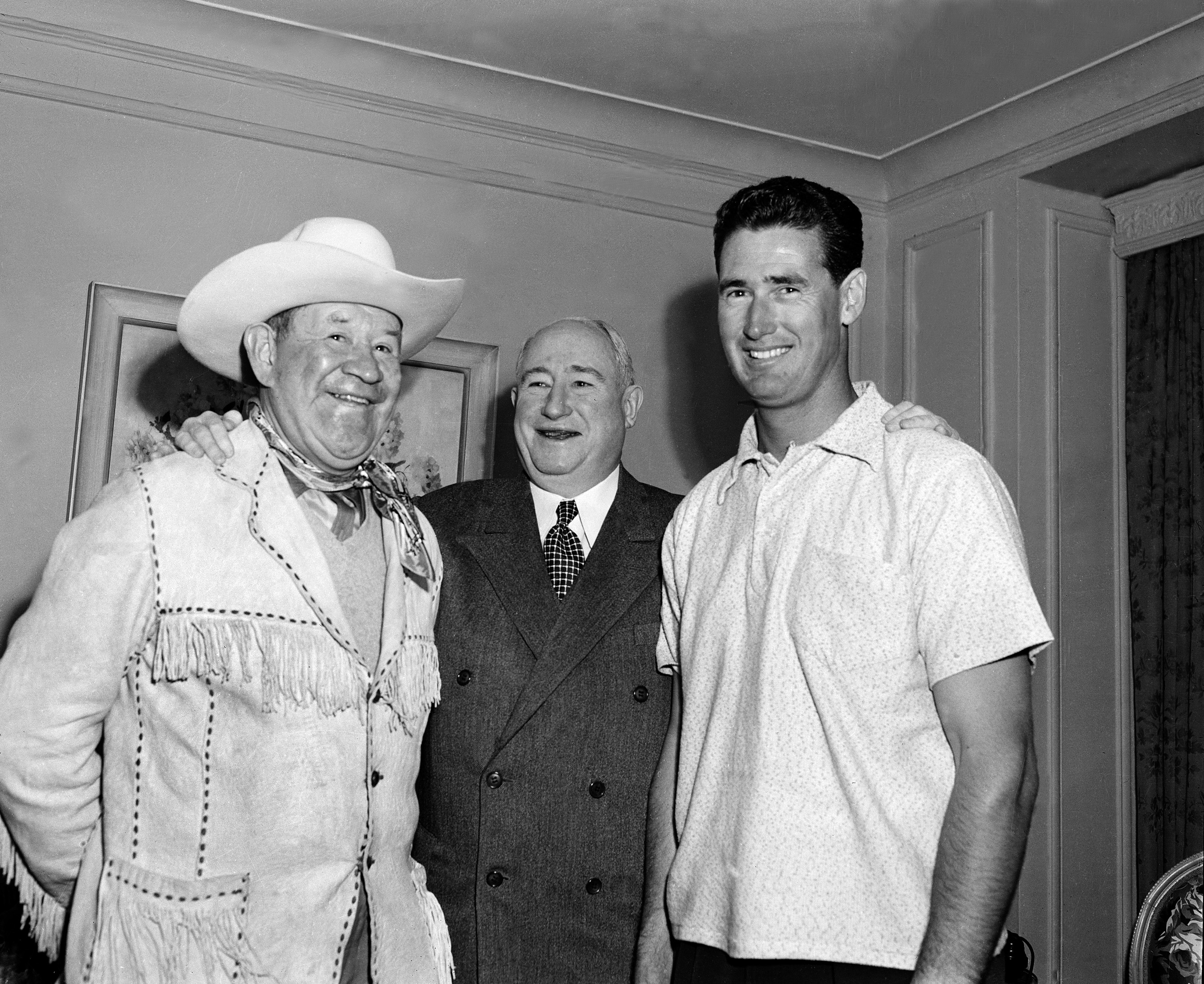
Football star and Olympic legend Jim Thorpe, left, poses with baseball player Ted Williams of the Boston Red Sox, right, and Williams' manager, Fred Corcoran, Feb. 1, 1952. (AP Photo)
Football star and Olympic legend Jim Thorpe, left, poses with baseball player Ted Williams of the Boston Red Sox, right, and Williams’ manager, Fred Corcoran, Feb. 1, 1952. (AP Photo)

Sources:

Daily Breeze files.

“Jim Thorpe,” by Donald Greyfield, Find A Grave website, http://www.findagrave.com/cgi-bin/fg.cgi?page=gr&GRid=1031

Los Angeles Times files, especially “Jim Thorpe, Pa., fights to keep its namesake,” by David Zucchino, Oct. 18, 2013.

New York Times files.

Torrance Herald files.


The City of Hahn fails to materialize

The late Los Angeles County Supervisor Kenneth Hahn. 1974 Daily Breeze file photo.

Los Angeles County Supervisor Kenneth Hahn’s place in history seems secure, even though a 1960 attempt to form a new city bearing his name ended in failure.

Hahn is a crucial figure in the history of Los Angeles County government. After a five-year stint on the Los Angeles City Council starting in 1947, he served for 40 consecutive years as a supervisor, from 1952-1992. His brother, Gordon, served on the council as well as in the California Assembly.

Hahn died in 1997, but his legacy continued with the election of his son James as Los Angeles Mayor. He served from 2001 -2005 after serving earlier as Controller and City Attorney.

James’ sister, Janice, was elected to the U.S. Congress in 2011 after serving 10 years as Los Angeles City Councilwoman for the 15th District.

But the attempt to immortalize him by naming a new city after him never did come to fruition.

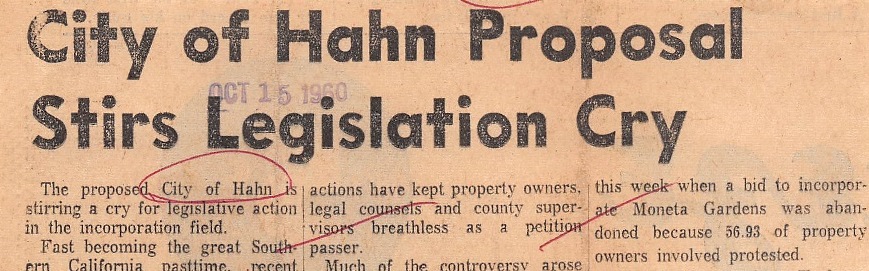
A potential resident of the new city, Ralph Fanberg, sponsored the movement, filing the papers to form the City of Hahn on Tuesday, Oct. 4, 1960.

The proposed city would have been entirely within Hahn’s supervisorial district. Its population would have been about 50,000, and would have included then-unincorporated county territory bordering on Vermont and Prairie avenues to the east and west, and from

Daily Breeze clipping, Oct. 15, 1960.

the Los Angeles city limits to the Lawndale city limits on the north and south.

Fanberg lived in the Moneta Gardens area between Hawthorne and Gardena. Moneta Gardens made up the largest chunk of the nascent City of Hahn. Fanberg’s attempt to incorporate the area as an independent city earlier in 1960 had failed.

Fanberg began his push for the incorporation of Hahn in October 1960 not just to honor Hahn, but also to avoid an annexation move by the City of Hawthorne. Hawthorne had filed to annex much of Moneta Gardens at the same time, reportedly almost to the minute, as Fanberg filed his proposal for a new city.

The legal battle was on.

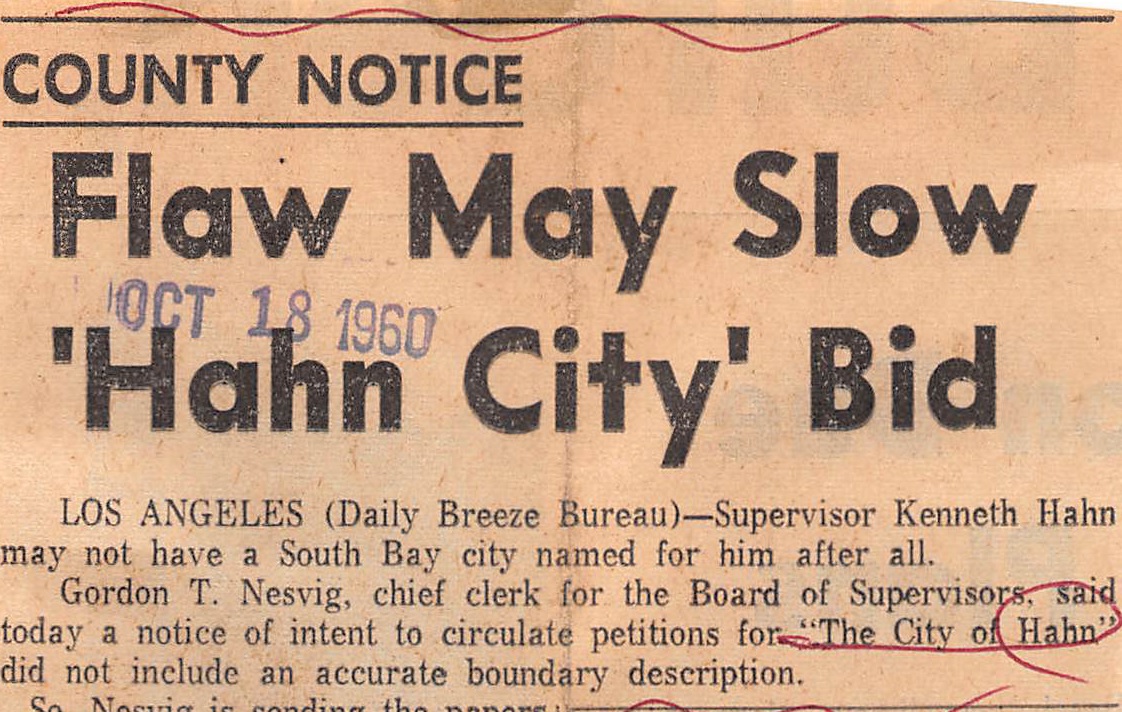
Daily Breeze clipping, Oct. 18, 1960.

Trial began before Inglewood Superior Court Judge Eugene Fay on Monday, Nov. 21, 1960. The county and Fanberg wrangled over his proposal, which the supervisors had denied on the ground that he had failed to include a detailed description of the new city’s boundaries.

Legal proceedings dragged on into early 1961. On Feb. 20, 1961, Hawthorne was stopped from further annexation attempts in the area by a restraining order filed by Fanberg’s attorney, Graham Ritchie.

The City of Hahn dream began to unravel when Lawndale began to pursue annexations that overlapped with the City of Hahn proposal. The reason? City of Hahn attorney Ritchie also was the Lawndale City Attorney at the time, and had to remove himself from the City of Hahn proposal due to a conflict of interest.

Fanberg abandoned the City of Hahn proposal, but remained adamant about keeping Hawthorne from annexing Moneta Gardens. Another incorporation petition drive for Moneta Gardens alone was held in February 1962, but failed to gain enough signatures.

In late May 1962, Fanberg started another petition drive to have Moneta Gardens annexed by Lawndale instead of Hawthorne, but this attempt also fell short.

Finally, Moneta Gardens residents voted 239-204 for annexation to Hawthorne in a special election held on Dec. 4, 1962.

A smaller parcel, Moneta No. 3, voted down annexation to Hawthorne in an Oct. 22, 1968 special election, and remains an island of county land surrounded by the cities of Hawthorne and Gardena to this day.

The annexed Moneta Gardens area of Hawthorne became a densely populated mishmash of industrial buildings, apartment houses, condo developments and older houses, despite various attempts to redevelop the area over the years.

Groups such as Moneta Gardens Improvement, Inc. continue to work to better conditions in the area.


Sources:

Daily Breeze files.

Los Angeles Times files.


Hermosa Beach’s Insomniac coffeehouse was a Beat Generation haven

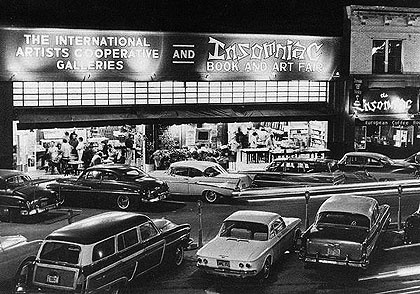
The Insomniac Cafe, right, and Book and Art Fair, left, are thriving in this undated photo taken by founder Bob Hare.
The Insomniac coffeehouse, right, and Book and Art Fair, left, are thriving in this undated photo taken by founder Bob Hare.

When Bob Hare saw a vacant Hudson Shoe Store for rent one day in 1958 at 53 Pier Avenue in Hermosa Beach, right across from Howard Rumsey’s Lighthouse jazz club, he knew what he had to do.

He borrowed $2,000 to put towards refurbishing the shoe store, and began paying its $150 monthly rent so that he could turn it into the Insomniac coffeehouse, one of the few

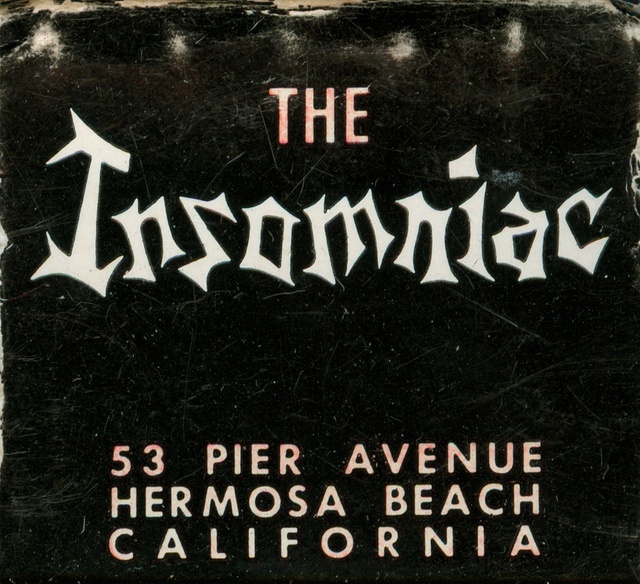
A matchbook from the Insomniac Cafe shows Lynn Jay "Tweakie" Kroeger's distinctive lettering design.
A matchbook from the Insomniac shows Lynn Jay “Tweakie” Kroeger’s distinctive lettering design.

coffeehouses in the Los Angeles area. Hare chose the name because the club stayed open until 3 a.m. Opening night was Nov. 28, 1958, and Hare made $100,000 from the club during the first year it was open.

Hare was born in Iowa, and came to Southern California as a young boy. He graduated from California State University, Long Beach, with a degree in English literature.

He later joined the Navy, and flew dozens of seaplane missions during the Korean War. He met his wife, Karen, at a Swedenborgian church service.

The Insomniac was an immediate hit, fitting right in with the Beat Generation era and attracting droves of famous artists, performers, poets, musicians and customers.

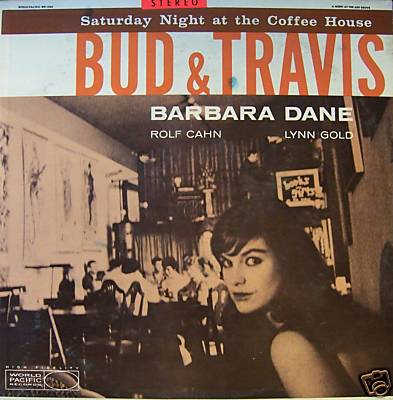
This 1958 album with Bud & Travis and Barbara Dane recorded live at the Ash Grove was issued originally with this photo, actually taken inside the Insomniac Cafe in Hermosa Beach.
This 1958 album with Bud & Travis and Barbara Dane recorded live at the Ash Grove folk club in Pasadena was issued originally with this cover photo, actually taken inside the Insomniac Cafe in Hermosa Beach.

Linda Ronstadt reportedly was a waitress and a scuffling singer there. The Chambers Brothers, Mel Carter, Bud & Travis, gospel group Bessie Griffin and the Gospel Pearls and the Virgin Island Steel Drum Band all appeared there. Blues duo extraordinaire Sonny Terry and Brownie McGhee played an extended engagement there in 1962.

Other performers included poet Allen Ginsburg, who read “Howl” there, and beat-era comedians Lenny Bruce and Lord Buckley. Ramblin’ Jack Elliott, Dave Van Ronk and a young Van Dyke Parks also played at the club.

As the club’s popularity grew, it expanded into the adjacent storefront at 57 Pier Avenue so Hare could open the Book and Art Fair annex, which sold mainstream books, small-press poetry volumes, paintings,

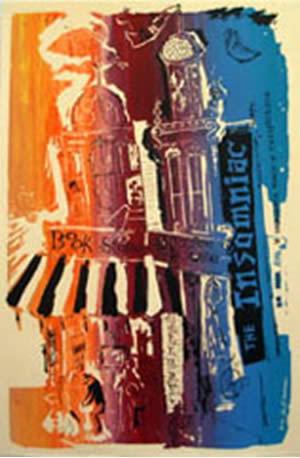
Artist Earl Newman's Toulouse-Lautrec-influenced poster shows the exterior of the Insomniac.
Artist Earl Newman’s Toulouse-Lautrec-influenced poster shows the exterior of the Insomniac.

non-mainstream records, art supplies, incense, flowers and similar types of unconventional merchandise.

Hare employed well-known artists to produce posters for the Insomniac, including Earl Newman, who designed posters for the Monterey Jazz Festival for many years, often in the

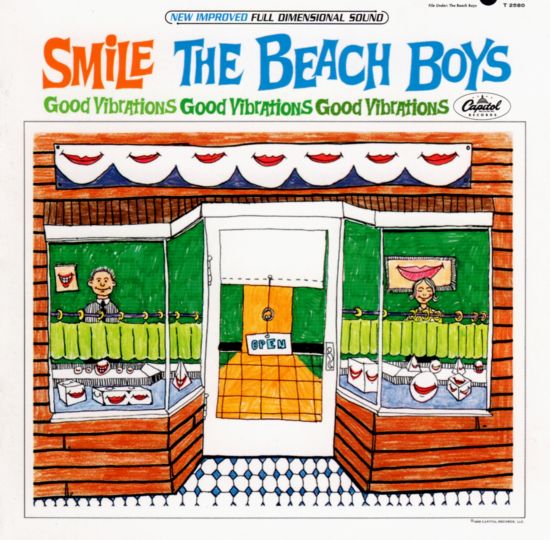
Artist Frank J. Holmes later designed the graphics for the Beach Boys' long-unreleased "Smile" album after working and selling art at the Insomniac.
Artist Frank J. Holmes later designed the graphics for the Beach Boys’ long-unreleased “Smile” album after working and selling art at the Insomniac.

style of French post-Impressionist artist Henri de Toulouse-Lautrec, and Frank Holmes, who worked there for four years and later would design art for the Beach Boys’ “Smile” album.

During the mid-1960s, the club began to have run-ins with authorities. The problems grew serious when police began to conduct regular drug raids there, culminating in a major raid on Nov. 29, 1965. Hare and co-owner Stanley Ray Bond were arrested on a variety of drug-related charges, along with two other patrons in the club.

When Bond applied to the city for a public entertainment permit a few days later on Dec. 7, 1965, it was denied, and the Insomniac essentially was out of business.

The city, which had long sought to acquire the property in order to tear the buildings down and build a walkway from parking lots to the Pier Avenue shopping area, won a decision in Los Angeles Superior Court on Jan. 13, 1966 to condemn the property.

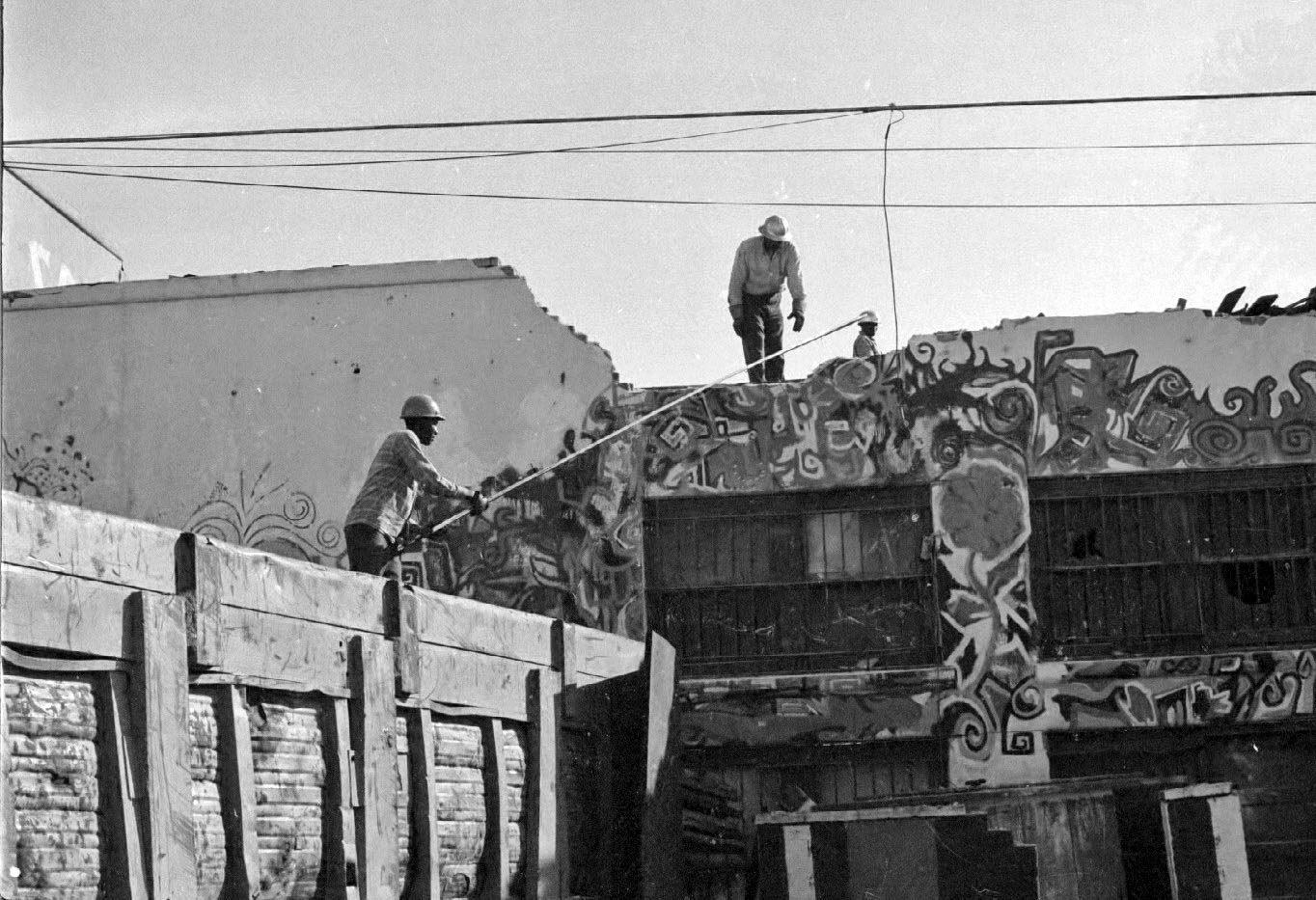
Workmen see to the demolition of the Insomniac buildings on Pier Avenue in Hermosa Beach in this Feb. 9, 1966, Daily Breeze file photo.

That freed the city to purchase the property for demolition. The city’s agreement with Stan Lewis, owner of the property, to raze the structures became official on Feb. 2, 1966, and demolition began a few days later.

Bob Hare went on to become a Swedenborgian church minister and a counselor at the Pacific Lodge Boys’ Home in Woodland Hills, where he worked boys with emotional and behavioral problems for 25 years until his retirement in 1994.

In 2003, Hare collaborated with producer/writer Will Brady on a 23-track CD, “The Insomniac,” that featured Hare reading poetry over Brady’s musical backing.

Bob Hare, Insomniac founder, reading poetry at a Hermosa Beach Historical Society event in 2008. (Video still from Hermosa Beach Historical Society video.)

In 2009, Hare was celebrated by the Hermosa Beach Historical Society in two special “Insomniac Night” programs that paid tribute to him and the cultural influence of his club. The second night, held in April, featured Lynn Joy “Tweakie” Kroeger, a Disney animator who designed the Insomniac’s distinctive logo and menu in her early days as an artist.

Hare died of natural causes on Dec. 19, 2011 at his home in Glendora, Calif. He was 80.


Sources:

Daily Breeze files.

The Quarterterly Newsletter of the Hermosa Beach Historical Society, Volume 20, Number 3, December 2007, and Volume 21, Number 3, December 2008, Hermosa Beach Historical Society.

“Insomniac sleeps: Bob Hare, founder of a beat generation icon, exits the scene,” by Robb Fulcher, Easy Reader, Jan. 5, 2012.

Los Angeles Times files.


Wild 1948 joyride ends in tragedy for two South Bay policemen

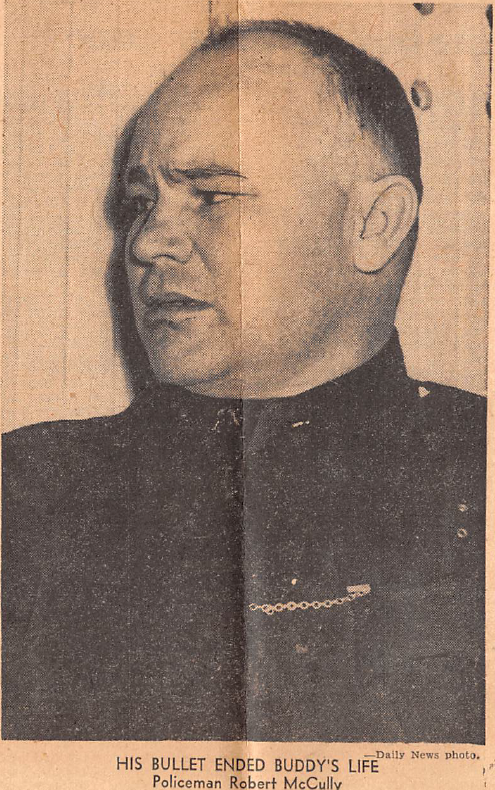
Hermosa Beach police officer Robert McCaulley. (Photo from Los Angeles Daily News, June 12, 1948.)

The pre-dawn events of June 11, 1948 that centered on the Hi-Spot Drive-In restaurant in Hermosa Beach ended up taking one policeman’s life and destroying another’s.

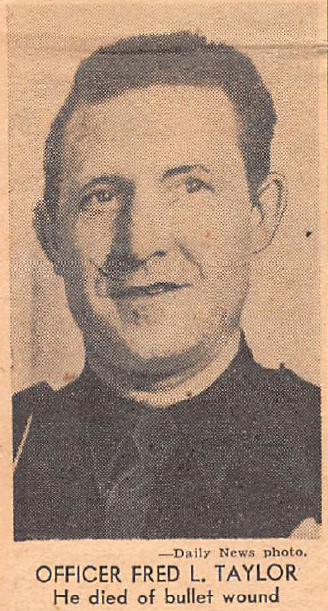
Hermosa Beach Radio Patrolman Robert McCaulley, 32, and Redondo Beach acting Sgt. Fred L. Taylor, 37, were good friends, having worked together on the Hermosa Beach police force before Taylor transferred to Redondo Beach. Both men were married. Taylor had four children, and McCaulley three.

McCaulley told investigators that he regularly swung by the Hi-Spot, located on Sepulveda Boulevard at Gould Lane, at closing time to give rides home to two car hops who worked there “to take the girls home and keep them out of trouble.”

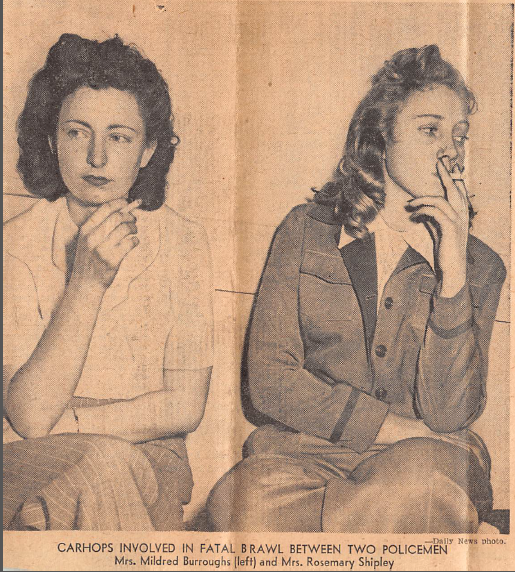
Mrs. Mildred Burroughs, left, and Mrs. Rosemary Shipley.  (Photo from Los Angeles Daily News, June 12, 1948.)
Mrs. Mildred Burroughs, left, and Mrs. Rosemary Shipley. (Photo from Los Angeles Daily News, June 12, 1948.)

The waitresses, Mrs. Mildred Burroughs, 27, of Manhattan Beach, and Mrs. Rosemary Shipley, 22, of Lawndale, had been working at the cafe when a robbery took place near it seven months earlier, causing McCaulley’s concern.

On this night, McCaulley picked up the two women, who joined Hermosa Beach Officer William Hart and his wife in the car. McCaulley then drove the Harts home, but returned with the two waitresses to Pier Avenue and Sepulveda Boulevard, where the women demanded that he take them home.

Redondo Beach Police Acting Sgt. Fred L. Taylor.  (Photo from Los Angeles Daily News, June 12, 1948.)
Redondo Beach Police Acting Sgt. Fred L. Taylor. (Photo from Los Angeles Daily News, June 12, 1948.)

McCaulley refused, so they had him radio for a Redondo Beach police car. McCaulley called Fred Taylor, who drove over in his patrol car and then got into McCaulley’s car.

What followed next was a wild late-night ride during which the quartet took swigs of whiskey while McCaulley drove erratically. At one point, after being relieved of the wheel by the terrified Mrs. Shipley, he stuck his gun out the side window and fired into some brush.

Mrs. Burroughs in the back seat asked for the gun so she could fire out the window, and so did Mrs. Shipley in the front seat.

Mrs. Shipley and McCaulley then quarreled, presumably about his unwelcome advances toward her. Mrs. Burroughs insisted they drive back to the Hi-Spot, which they did. When they stopped and McCaulley reached into the back seat for Mrs. Burroughs, Taylor tried to stop him and McCaulley shot him during the ensuing scuffle.

McCaulley was arraigned and charged with murder. Citing Taylor’s two gunshot wounds, the coroner ruled that McCaulley should be held to answer for the crime, and a preliminary hearing began on June 18, 1948.

After the hearing concluded later that afternoon, Judge Vernon Hunt reduced the charge against McCaulley from murder to manslaughter, determining that the shooting had not been premeditated. Trial was set for September, and it was a doozy.

On Sept. 14, 1948, the waitresses Mrs. Burroughs and Mrs. Shipley testified for the prosecution. Burroughs again described the early-morning events, testifying that her friend Shipley finally had to take the wheel from McCaulley due to his wild driving during their “ride of terror.”

Mrs. Shipley then testified about the shooting itself, saying Taylor was attempting to calm the out-of-control McCaulley. They were struggling when McCaulley pulled out his service revolver and fired. “They were scuffling. He just pulled out a gun and shot,” Shipley told the court. Taylor never pulled out a gun, she said.

“My God, I’ve been shot. Call the station, Bob shot me,” Taylor reportedly cried.

After his incoherent call to police headquarters, McCaulley was arrested and brought to the Hermosa station by Redondo Beach officers.

Taylor died in the hospital at 7:25 a.m. that morning, following unsuccessful emergency surgery.

During the next day’s testimony, defense attorneys brought up the prescription painkillers that McCaulley had been taking for a painful shoulder injury. Three doctors testified that they had treated McCaulley in the past, and each had prescribed a codeine-based medication for him.

A fourth doctor, expert witness S.G. Sonnyland, then claimed that McCaulley was under the influence of a “dangerous dose” of painkillers which may have caused his “uncontrollable rage” and the subsequent blackout which McCaulley claimed occurred on the night of the shooting, causing him to lose all memory of the night’s events.

On the final day of the three-day trial, McCaulley wept during the defense’ closing arguments, which claimed that he was under the influence of the drugs at the time of the crime.

The next day, Judge William R. McKay issued his verdict, finding McCaulley guilt of manslaughter in the fatal shooting.

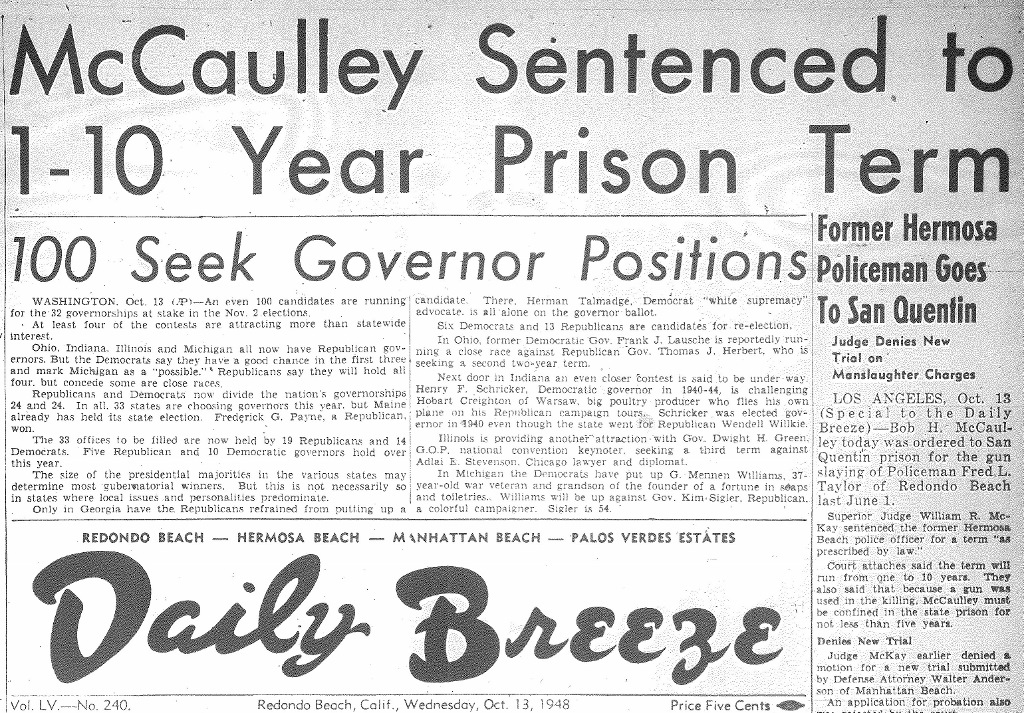
On Oct. 13, 1948, McKay sentenced McCaulley to 1-10 years in prison. Because a gun was used in the slaying, McCaulley was required to serve a minimum of five years in San Quentin.

Daily Breeze front page, Wednesday, Oct. 13, 1948.

Sources:

Daily Breeze files.

Los Angeles Daily News files.

Los Angeles Times files.
 

Beatlemania hits the South Bay

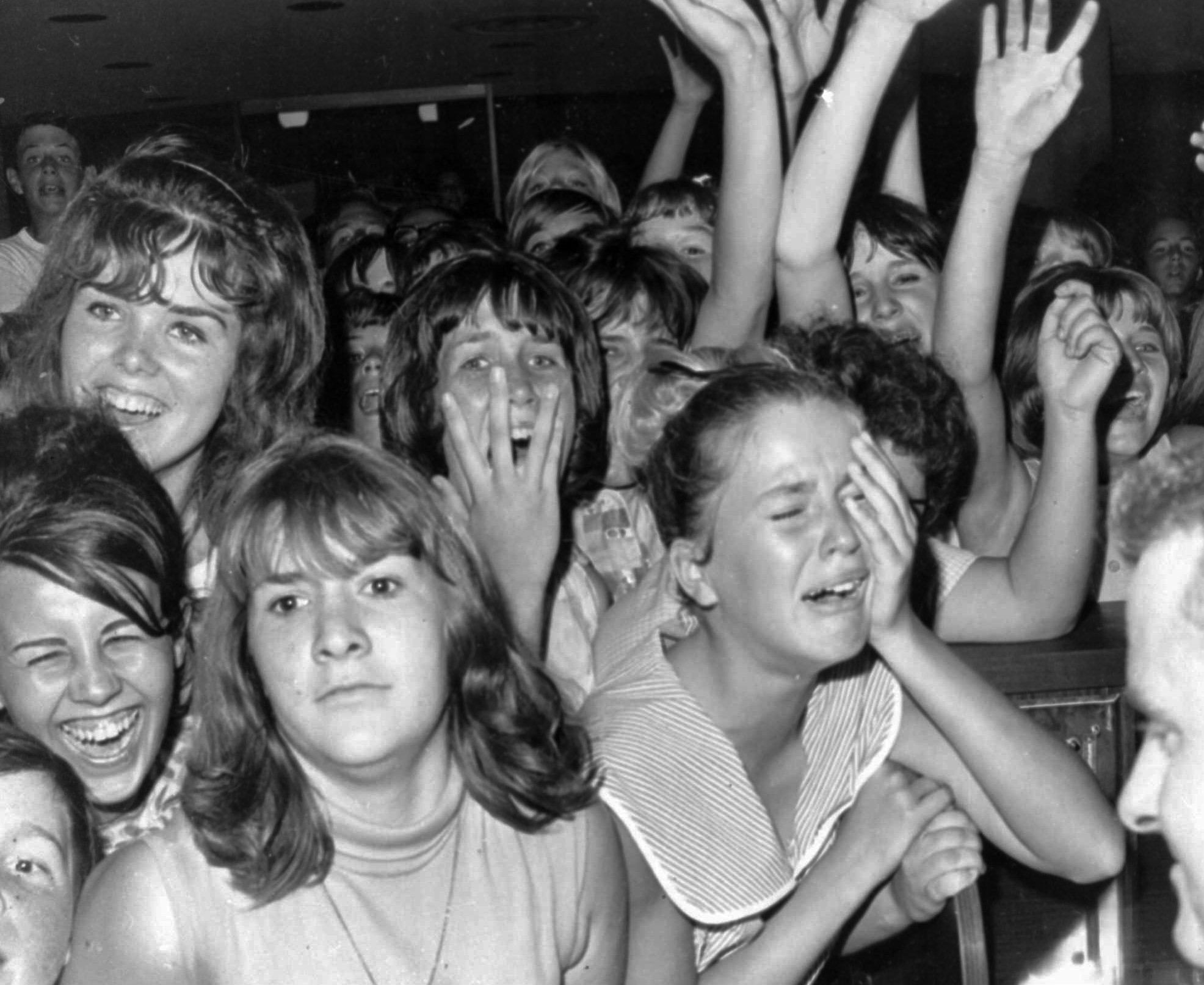
Just the sight of The Beatles from a distance caused this reaction among a group of Girls at the Los Angeles International airport in this Aug.18, 1964 file photo. Airport security kept the British singers away from several thousand youngsters during a brief stopover in Los Angeles en route to San Francisco. (AP Photo/stf)
Just the sight of The Beatles from a distance caused this reaction among a group of girls at the Los Angeles International airport in this Aug.18, 1964 file photo. Airport security kept the British singers away from several thousand youngsters during a brief stopover in Los Angeles en route to San Francisco. (AP Photo/stf)

The Beatles’ first appearance on the “Ed Sullivan Show” on Sunday, Feb. 9, 1964 sent shock waves throughout the American pop culture landscape.

South Bay youths were not immune to the charms of the Liverpudlian quartet, proceeding to go pretty much as batty for them as everyone else in the months that followed.

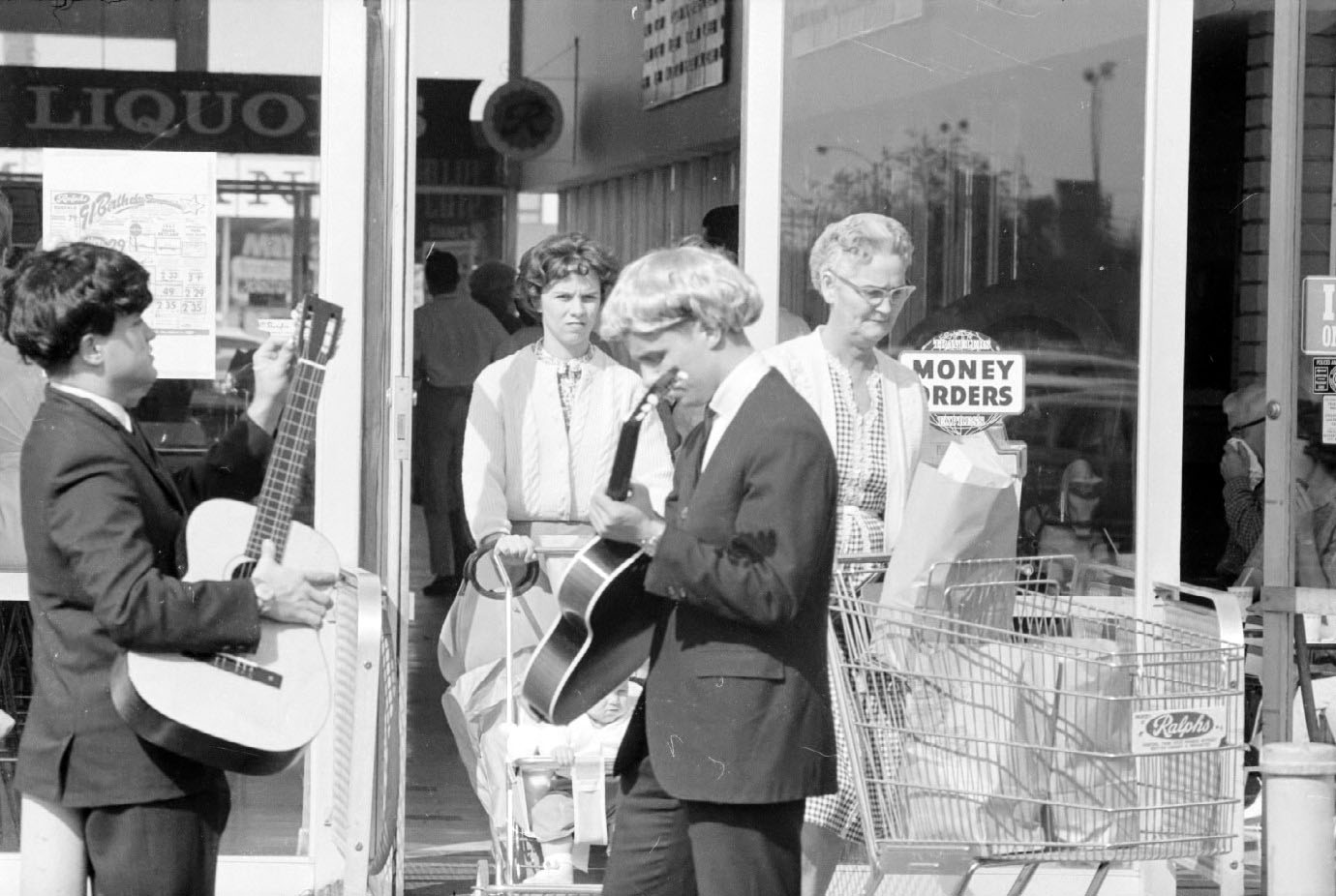
Impressed by “I Want To Hold Your Hand” and the fevered reaction to the Beatles’ Sullivan show appearance, two intrepid Daily Breeze reporters decided to grab a couple of guitars, don Beatle wigs – already a popular novelty item – and head for South Bay Center, the outdoor precursor of the South Bay Galleria, to get reactions.

Jay Berman and Chuck Cole found the stunt drew stares but few responses from bemused shoppers, who mostly left them alone. Finally, they began asking people for their thoughts.

“It wasn’t any of my business,” Patricia Hanna of Torrance told them. “It isn’t good manners to point and stare at persons, even if they are nuts.”

Daily Breeze reporters Jay Berman, left, and Chuck Cole, center, perform their Beatles act outside the Ralphs market at South Bay Center to the bemusement of shoppers.  Daily Breeze photo by Bob Jones, Feb. 14, 1964.
Daily Breeze reporters Jay Berman, left, and Chuck Cole, center, perform their Beatles act outside the Ralphs market at South Bay Center to the bemusement of shoppers. Daily Breeze photo by Bob Jones, Feb. 14, 1964.

Ultimately, Berman and Cole got a funny story and photo out of the experience.

We spoke to Jay in February 2014, and here’s how he remembers those early days:

“Mitch Chortkoff was a Breeze sportswriter in the early ’60s. He and I heard “I Want to Hold Your Hand” while we were coming back to the Breeze office from lunch in my 1962 Ford Falcon. We were stunned at how different they sounded from anything else that was being played at the time.

“There was a Wallichs Music City record store on Hawthorne Boulevard in Torrance. I think I bought “Meet the Beatles” as soon as I got off work. In vinyl, of course, because that’s all there was. The Breeze office was next to the Redondo Beach pier in those days. I can’t believe how long it’s been.”

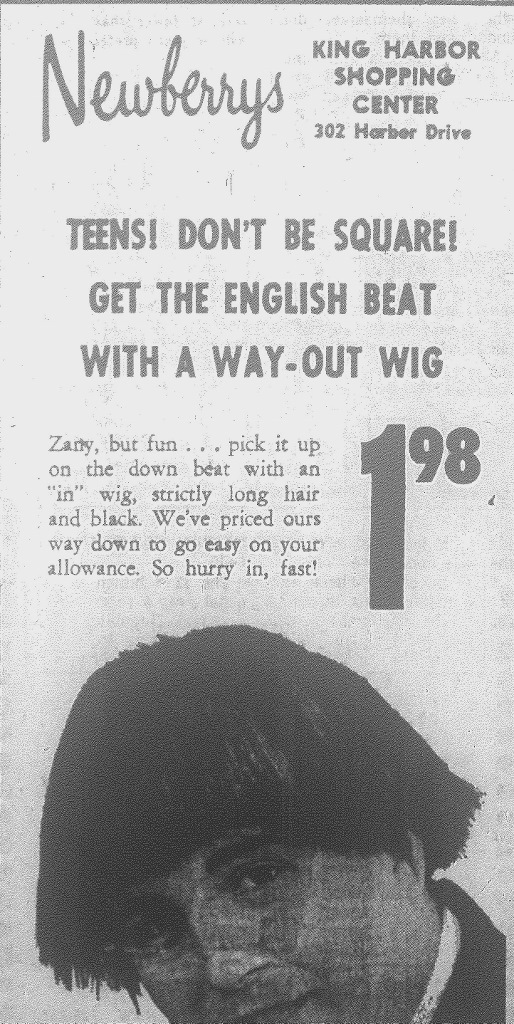
Newberry's ad for Beatles wigs, Daily Breeze, Feb. 21, 1964, Page 9.
Newberry’s ad for Beatles wigs, Daily Breeze, Feb. 21, 1964, Page 9.
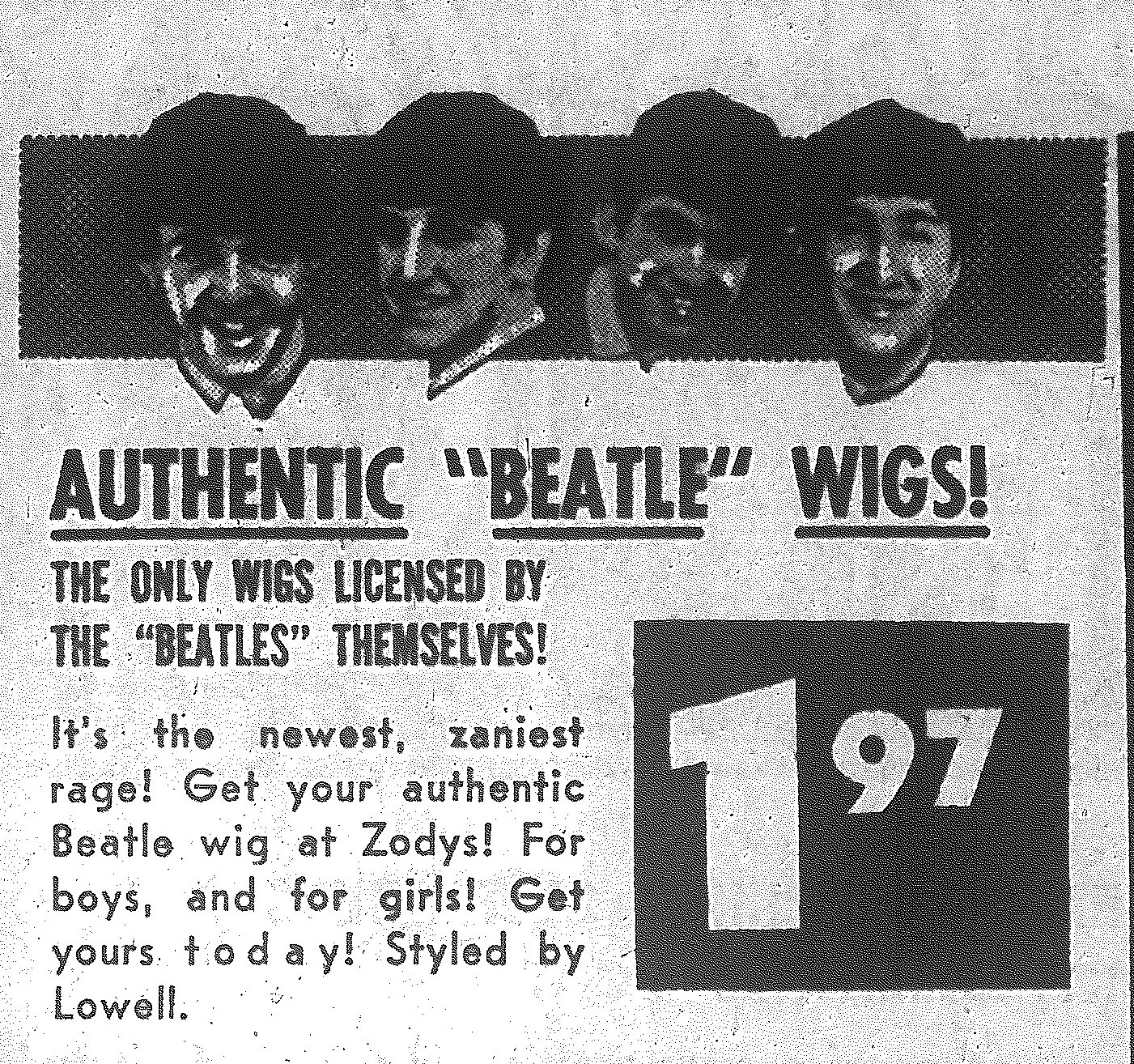
Zody's department store ad for Beatle wigs, Daily Breeze, Feb. 16, 1964, Page 4.
Zody’s department store ad for Beatle wigs, Daily Breeze, Feb. 16, 1964, Page 4.

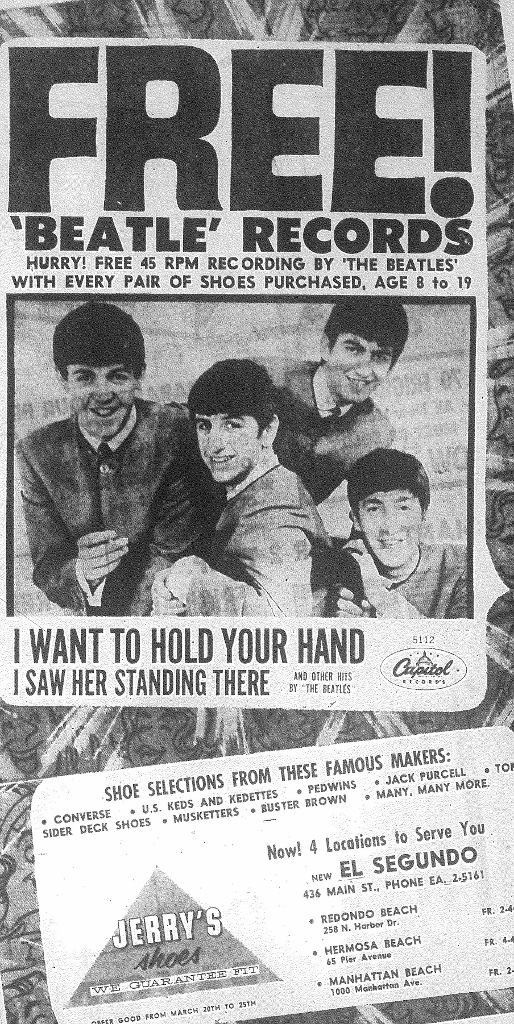
Almost immediately, retail stores were quick to pounce on the  craze, selling everything from Beatles records to wigs to sweatshirts and pens. Jerry’s Shoes, below right,  offered free copies of the “I Want to Hold Your Hand” 45 to anyone between 8 and 19 who bought a new pair of shoes.

Jerry's Shoes ad in the Daily Breeze, March 19,1964, Page 17.
Jerry’s Shoes ad in the Daily Breeze, March 19,1964, Page 17.

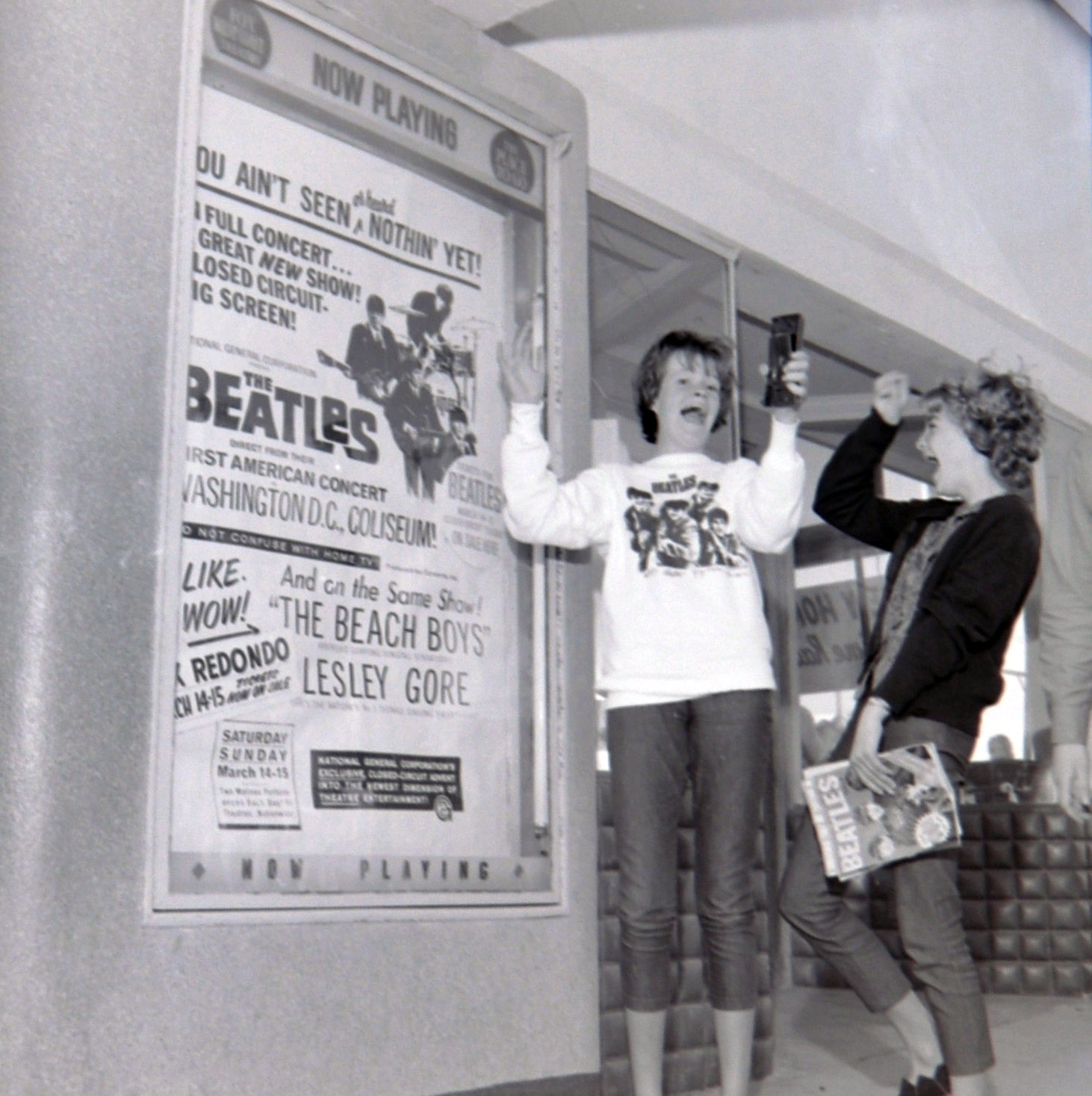
By mid-March 1964, anticipation already had begun building for the moptops’ American arrival. The Fox Theatre in Redondo Beach was among those who booked a closed-circuit re-broadcast of the Beatles’ first American concert on Feb. 11, 1964 from Washington, D.C.

Theaters showed the concert on March 14 and March 15, 1964. Daily Breeze reporter Ron Erickson went to the Fox Redondo for the March 14 screening, reporting that South Bay fans at the show went into a tizzy, greeting the broadcast with non-stop screams as if it were a live show.

Torrance residents Linda West, 13, clad in Beatles sweatshirt, and  Karen Larsen, 13, clutching Beatles magazine, show their enthusiasm after seeing the Beatles' Washington, D.C. concert film on a closed circuit showing at the Fox Redondo Theatre on March 14, 1964. Daily Breeze file photo.
Torrance residents Linda West, 13, clad in a Beatles sweatshirt, and Karen Larsen, 13, clutching a  Beatles fan magazine, show their enthusiasm after seeing the Beatles’ Washington, D.C. concert film on a closed circuit showing at the Fox Redondo Theatre on March 14, 1964. Daily Breeze file photo.

Mirroring what would become a growing problem for the band live, Erickson noted that he could barely hear the band over the wild screams of the audience. “I thought the theater was going to loose its moorings and slip into the harbor basin,” he wrote.

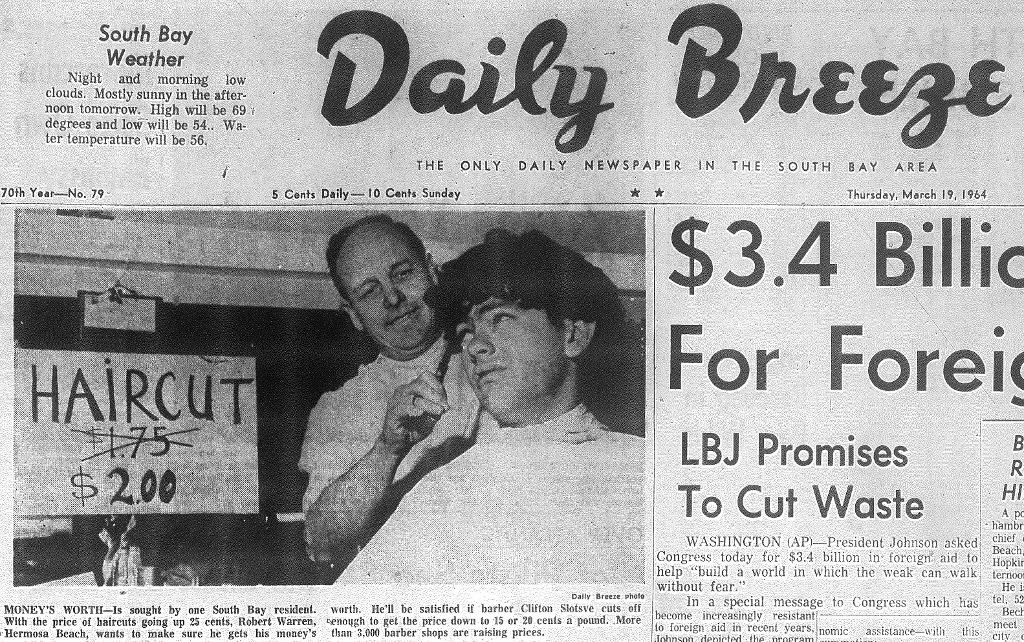
Front-page photo, Daily Breeze, March 19, 1964.
Front-page photo, Daily Breeze, March 19, 1964. Click to enlarge.

Of course, the Beatle haircuts quickly became the source of debate between generations. A March 19, 1964 Breeze photo shows Hermosa Beach barber Clifton Slotsve cutting customer Robert Warren’s hair after Slotsve had raised his haircut price to $2.00.

The Beatles’ first Los Angeles-area concert was scheduled for the Hollywood Bowl on Aug. 22,1964.

Following his earlier story dressed as a faux Beatle in February, Jay Berman also covered the Fab Four’s first LAX press conference in advance of the show on Aug. 18, 1964, and remembers this moment:

“Just before it was about to start, Ringo saw my camera and said “Is that an old Nikon S1?” I told him it was, and he asked to look at it. I handed him, he checked it out, said he had one just like it and handed it back to me. I still have it and I wonder if he still has his.”


According to the Associated Press story in the Breeze on the Monday after the concert, 19,000 screaming fans seemed to have a great time at the show.

The Beatles phenomenon would continue to mushroom, including return concerts at the Hollywood Bowl in 1965. The band finally had to retire from live performing following a series of stadium shows in 1966 when the hysteria at their concerts grew too great to overcome.

Their final show was at Candlestick Park in San Francisco on Aug. 29, 1966, following a show at Dodger Stadium the night before. Other than their brief appearance on a London rooftop on Jan. 30, 1969 as seen in the “Let it Be” film, they would never play another concert.

Sources:

Daily Breeze files.

Special thanks to Jay Berman for sharing his recollections.


Former Torrance man becomes first person imprisoned for airplane hijacking

The first attempted airplane hijacking is a matter of debate, but most sources cite an incident in Peru on Feb. 21, 1931. Pilot Byron Rickards had landed his Ford Tri-Motor in Arequipa when he was accosted by armed revolutionaries demanding that he use his plane to drop anti-government propaganda leaflets.

Rickards refused, and a standoff lasting 10 days began. He eventually was allowed to go free.

But there’s no debate that the first person in the U.S. ever to be sentenced to prison for hijacking a commercial airliner was a former South Bay resident, Leon Bearden.

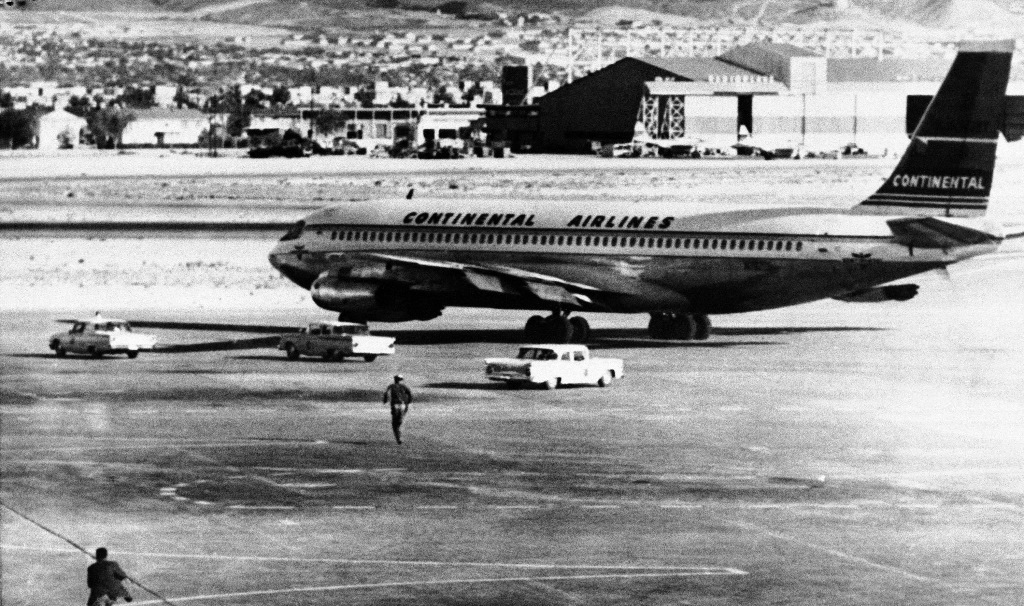
Police cars race round in airliner as it attempted to take off in the control of two gunmen at El Paso, Texas on August 3, 1961, police officers opened fire on the undercarriage, bursting the types and halting the plane. After holding crew and passengers hostage for several hours, the hijackers surrendered. They said they wanted to take the plane to Havana. (AP Photo)

By the late 1960s, airplane hijackings had reached epidemic proportions, but only four were recorded in 1961, with Bearden’s caper having the highest profile.

Bearden had moved to Coolidge, Arizona with his wife and four children at the time of the 1961 crime. Prior to that, though, he lived on 190th Street in Torrance. That’s where he was arrested on June 28, 1957 for masterminding the holdup of the Sunset Stage Bus Line offices in Lennox in May 1957.

Bearden was working part-time as a roofer in Torrance, and used the company truck in the robbery. He recruited two youths, gave them guns, and had them force the night watchman at the bus company to open the safe.

The robbery netted Bearden $800, but the identification and tracking by police of the  truck used in the robbery netted him a jail term at the California Institute for Men in Chino.

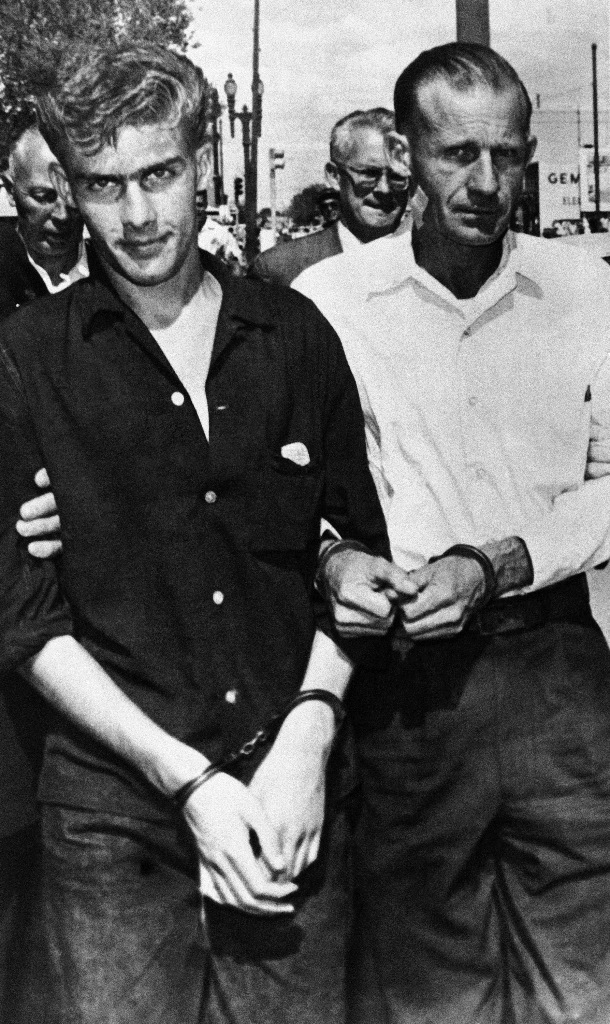
Leon Bearden, right, and his 17-year-old son Cody are handcuffed as they are taken from the federal building in El Paso, Texas on August 3, 1961, to the county jail after they had been charged with hijacking an airliner. They held the crew and passengers hostage for several hours before they surrendered the plane at El Paso. The pair said they wanted to take the plane to Cuba. (AP Photo)
Leon Bearden, right, and his 16-year-old son Cody are handcuffed as they are taken from the federal building in El Paso, Texas on August 3, 1961, to the county jail after they had been charged with hijacking an airliner. They held the crew and passengers hostage for several hours before they surrendered the plane at El Paso. The pair said they wanted to take the plane to Cuba. (AP Photo)

When he decided to hijack a Continental Airlines Boeing 707 jetliner in El Paso on Aug. 3, 1961, Bearden, then 38, recruited his 16-year-old son Cody to help him. Bearden said he was fed up with life in the U.S. and wanted to start fresh in Cuba, and planned to give the hijacked jet to Fidel Castro in return for political asylum in his country.

Using a female flight attendant on Continental Flight 54 as a hostage, the father and son duo forced their way into the cockpit of the $5 million jetliner while it was over New Mexico en route from Phoenix to El Paso and demanded that pilot Byron Rickards fly them to Havana, Cuba.

Yes, that Byron Rickards, the same man who was piloting the plan in Peru in 1931 in what most call the first airplane hijacking in aviation history. Rickards was working for Continental and living in Palos Verdes Estates at the time of the 1961 hijacking.

Rickards convinced the Beardens that he didn’t have enough fuel to reach Havana, and would need to stop in El Paso for refueling. They landed in El Paso at 2 a.m., and airport and airline authorities immediately began stalling the Beardens in an attempt to keep the plane on the ground.

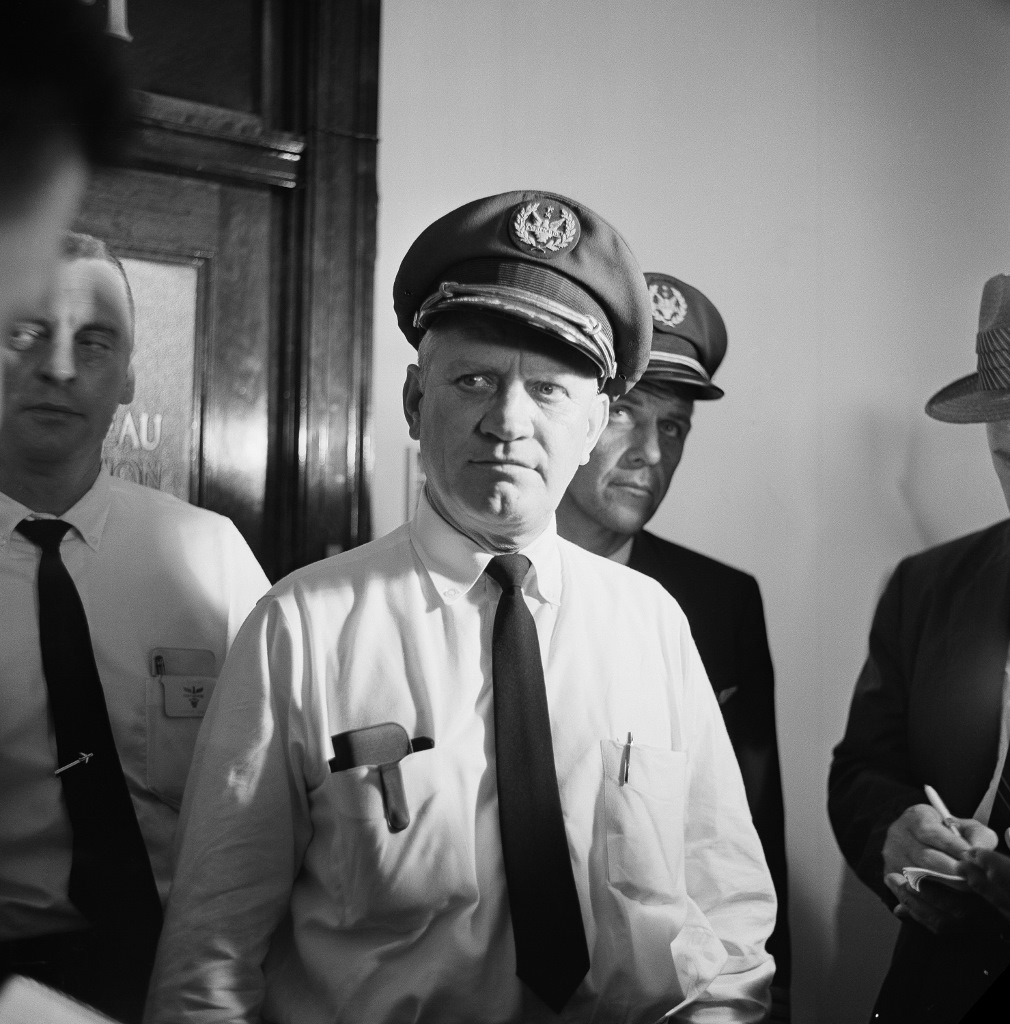
Captain Byron D. Rickards, 52, of the hijacked Continental Airlines jetliner, talks with newsmen outside the El Paso office of the FBI on August 3, 1961. He gave FBI agents a detailed account of the plane seizure. (AP Photo/Ferd Kaufman)

President John F. Kennedy, recently stung by the disastrous Bay of Pigs invasion of Cuba, was not anxious to let the plane get to Cuba and cause further embarrassment to the U.S. Government. He kept in close phone contact with the FBI agents and federal authorities on the ground in El Paso.

Leon Bearden grew increasingly upset, and demanded that the plane take off near dawn. Finally, it began to taxi, but only got a few feet down the runway before police and FBI agents shot out its tires and landing gear with machine guns, preventing its takeoff.

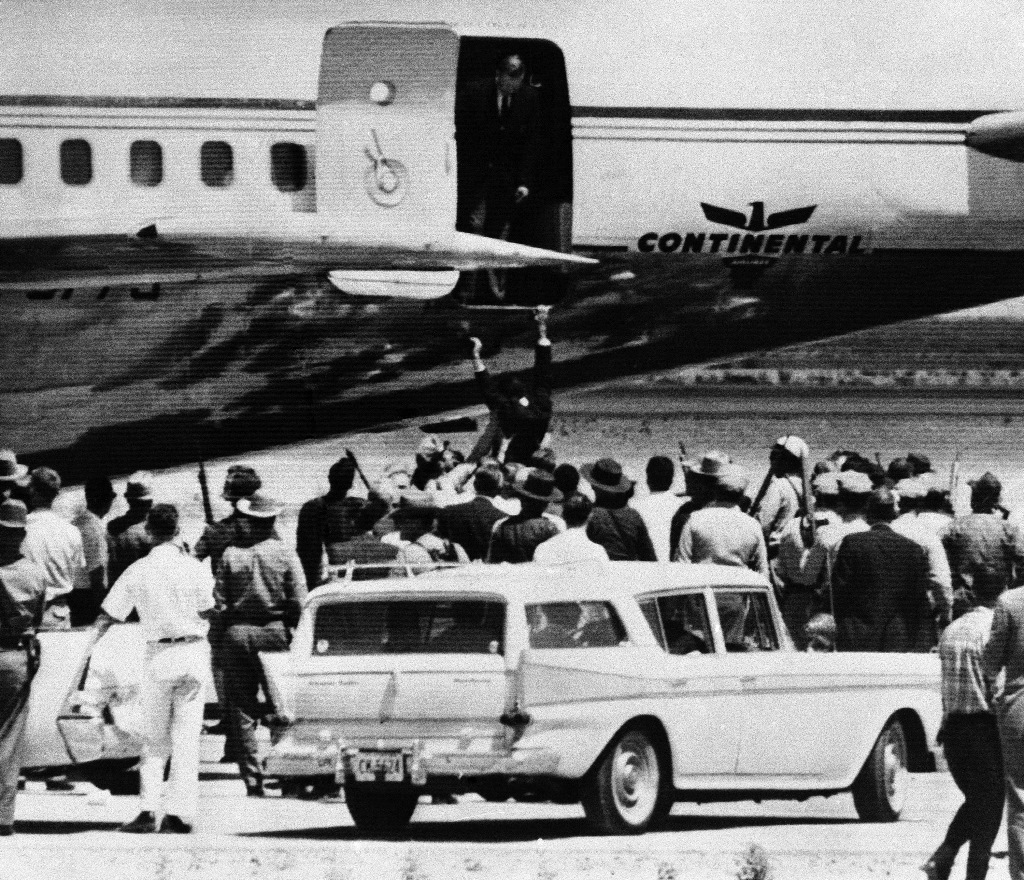
An unidentified passenger jumps into the arms of waiting police officers from a hijacked aircraft held by gunmen at El Paso, Texas on August 3, 1961. The gunmen, a father and son, held the crew and several passengers hostage for several hours before they were taken into custody. (AP Photo)

Bearden had released all the passengers but four volunteers in El Paso, and had allowed FBI agents to enter the plane to negotiate. One of the passengers who volunteered to stay aboard, Border Patrol officer and former boxer Leonard Gilman, managed to catch Bearden while his guard was down, and punched him so hard in the face that it broke Gilman’s hand. The stunned Bearden fell to the deck and was captured, while the chief FBI negotiator, Frances Crosby, was able to subdue a surprised Cody Bearden at the same time.

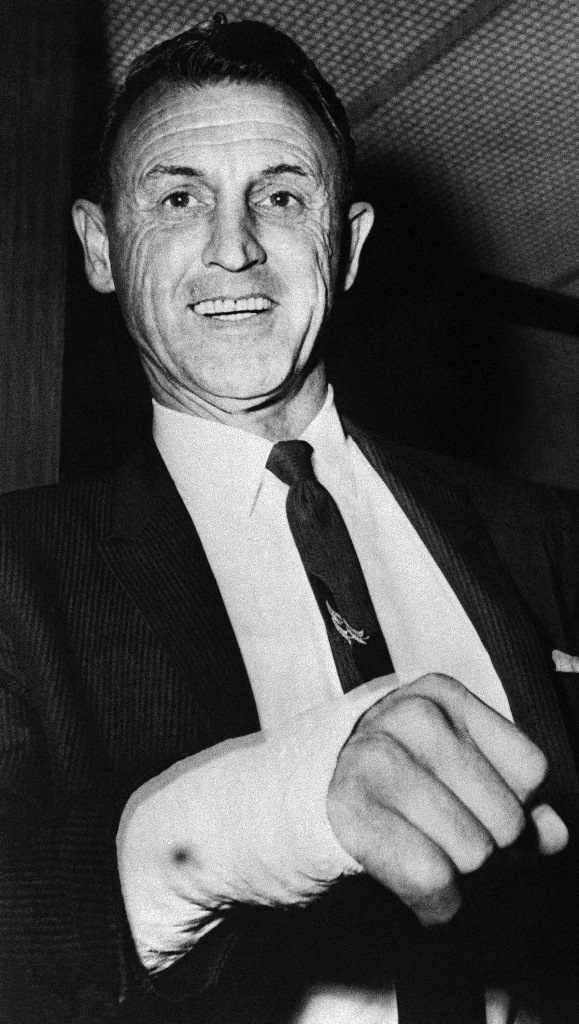
Leonard W. Gilman, associate deputy regional commissioner of the United States Border patrol in El Paso, Texas, displays the cast covered hand which he injured when he slugged a gunman on board an airliner on Thursday, August 3, 1961. The gunman, Leon Bearden, and his son, Cody, 17, had commandeered the plane in the air between phoenix and El Paso. Then they attempted to take it to Havana. (AP Photo)

Other than Bearden’s face and Gilman’s broken hand, no one was seriously injured in the nearly nine-hour standoff on the ground in El Paso.

A jury took just 22 minutes to convict Bearden of the hijacking on Oct. 18, 1961. His son Cody had pleaded guilty in a plea deal as the trial began that would allow him to be released from custody when he was 21.

Leon Bearden was sentenced to life in prison plus 25 additional years on Oct. 31, 1961. He was sent to the federal penitentiary on Alcatraz Island to serve out his term.

Immediately following the Bearden hijacking, the U.S. Senate drafted legislation making airplane hijacking punishable by death or not less than 20 years in prison. President Kennedy signed the bill on Sept. 5, 1961.

The law would become even more important when airplane hijackings became much more frequent in the late 1960s and 1970s.

Cody Bearden kept a low profile following his 21st birthday. His father Leon settled in the town of Show Low, Arizona, following his release from prison. He died there at 86 on Oct. 15, 2009.

Captain Byron Rickards died on March 9, 1983.


Sources:

Daily Breeze files.

Find A Grave website, Leon Bearden entry, http://www.findagrave.com/cgi-bin/fg.cgi?page=gr&GSln=bearden&GSfn=leon&GSbyrel=all&GSdyrel=all&GSob=n&GRid=68247723&df=all&

“Jet Airliner Hijackers Captured in EP,” El Paso Times website, http://elpasotimes.typepad.com/morgue/2008/05/suncitycynic-th.html

Los Angeles Times files.
“Skyjacker of the Day: A father and a son who were ‘just fed up’ with being Americans,” http://www.slate.com/articles/life/history/features/2013/skyjacker_of_the_day/leon_and_cody_bearden_hijacked_a_plane_because_they_were_just_fed_up_with.html.

The Hermosa Beach girl who fell in love with Errol Flynn

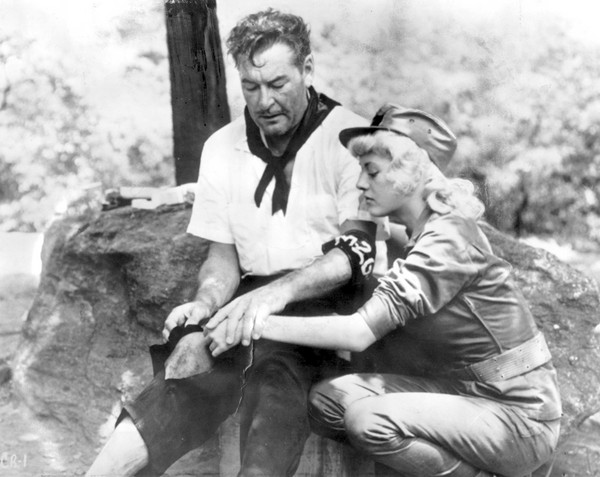
Errol Flynn and Beverly Aadland during the filming of "Cuban Rebel Girls," Flynn's last film. Photo by The Associated Press.
Errol Flynn and Beverly Aadland during the filming of “Cuban Rebel Girls,” Flynn’s last film. Photo by The Associated Press.

When Beverly Aadland was only two years old in 1944, her mother, Florence, was priming her for a career in show business by enrolling her in voice lessons. She already had been an Ivory Soap baby at six months old.

The Aadlands lived in Hermosa Beach, first on the corner of Manhattan Avenue and Sixteenth Street, and later on Monterey Boulevard. Florence was a retired show girl-turned-manicurist, and Beverly’s father Herbert was a bartender.

Beverly’s schooling in the performing arts continued during her childhood. At 3, she was doing (very early) television commercials and by six, she was taking drama lessons.

She was much in demand at Hermosa Beach events. In a 1959 Daily Breeze story, she said, “I was queen of the aquaplane races when I was 4 and again when I was 5. I think I cut the ribbon when they opened the Hermosa Beach Aquarium (in 1947)…and I sang ‘God Bless America’ at the Hermosa Biltmore. I was sort of a sponsor for the city. The mayor (Paul H. Drake) was crazy about me.”

Florence Aadland had been a dancer in the chorus line in vaudeville, and her daughter reportedly spent a brief time in a Las Vegas chorus line at 14. Her ability to pass for older than she really was would get her into hot water soon enough.

In 1957, Aadland was 15 and working as a dancer on the Warner Bros. Studios lot in the film “Marjorie Morningstar” in a scene with Gene Kelly when Errol Flynn sent a messenger over from a nearby set where was working, asking her to read for a part in a play.

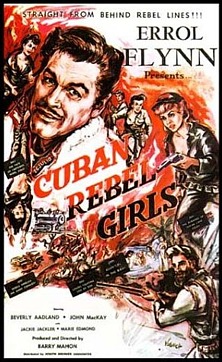
Movie poster for "Cuban Rebel Girls," Errol Flynn's last film.
Movie poster for “Cuban Rebel Girls,” Errol Flynn’s last film. Beverly Aadland gets billing at bottom left.

He thought she was 18, and thus began a relationship that would scandalize Hollywood and generate worldwide headlines.

The debonair Flynn had crammed a lot of living into his wildy successful acting career. He was only 48 when they met, but Aadland ended up being the last woman of the many in his life.

He gave her a starring role in his final film, “Cuban Rebel Girls,” in which Flynn plays a correspondent in Havana trying to help Fidel Castro to overthrow the Batista regime. (Castro succeeded in toppling Batista’s regime in 1959.)

Commenters and critics have described the film as among the worst movies ever made by a major star, due to its amateurish nature, low-quality production values and, with the exception of Flynn, almost completely nonprofessional cast. Aadland’s performance failed to garner her much critical praise.

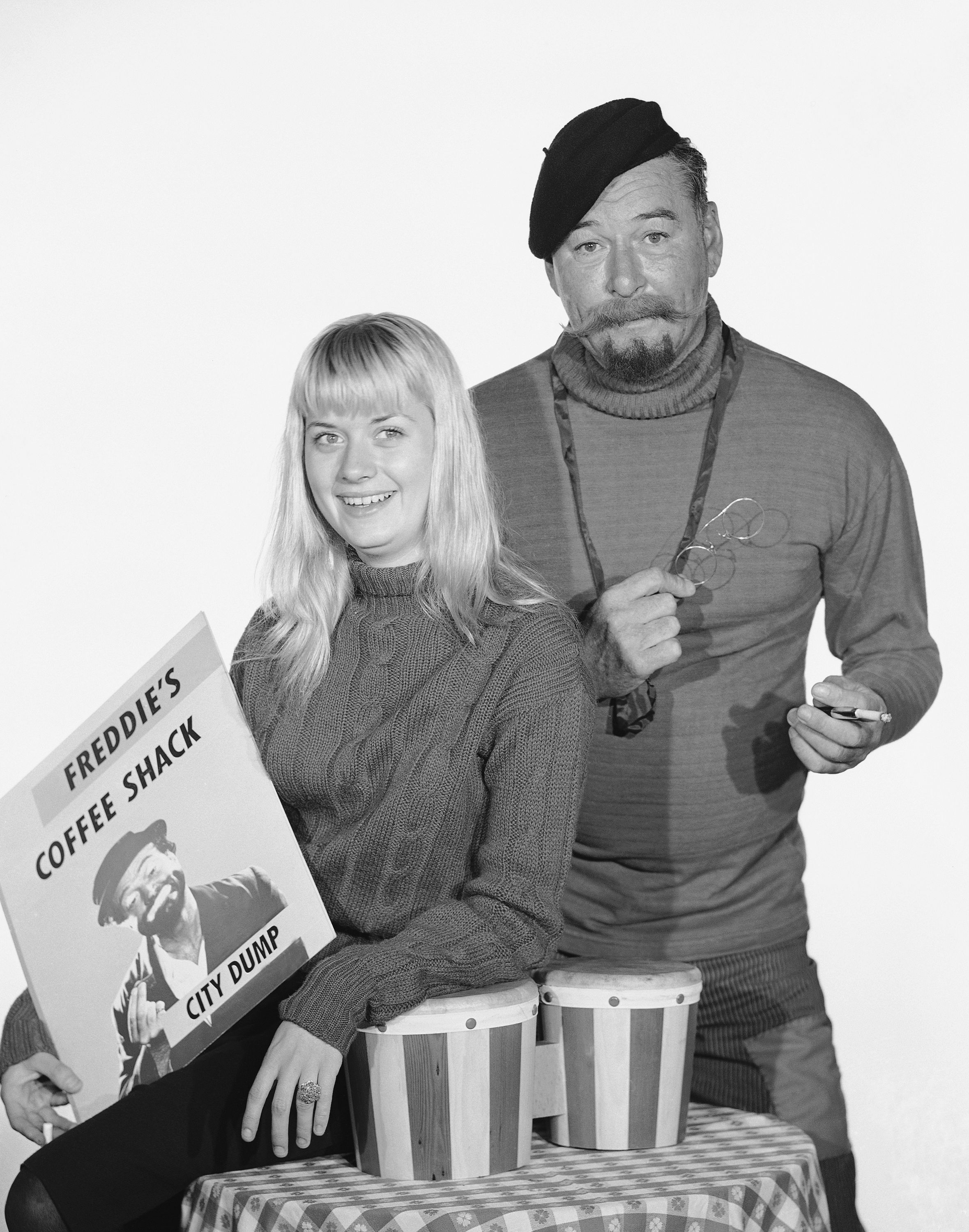
Beverly Aadland and Errol Flynn pose in costume for a skit they performed on the "The Red Skelton Show" that aired on Sept. 29, 1959, two weeks before Flynn's death. Photo by The Associated Press.
Beverly Aadland and Errol Flynn pose in costume for a skit they performed on the “The Red Skelton Show” that aired on Sept. 29, 1959, two weeks before Flynn’s death. Photo by The Associated Press.

But Aadland and Flynn had fallen in love, and she later told one of her husbands that the actor was the love of her life and she would have stayed with him had he not died suddenly.

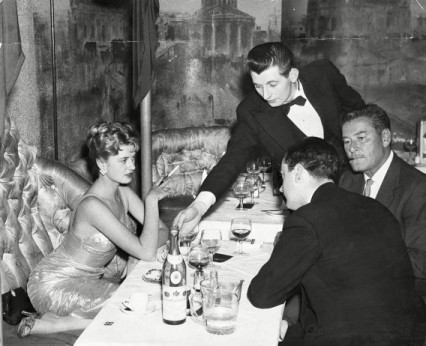
16-year-old Beverly Aadland, left, at the Lido Club in London, England on May 5, 1959, with actor Errol Flynn, far right.

Flynn died from heart failure in Vancouver, Canada on Oct. 14, 1959, several months after the couple had returned from filming in Cuba. Aadland was in the other room when it happened, but her attempts to revive him failed.

It was only the first shock of what would be a tempestuous time for Aadland.

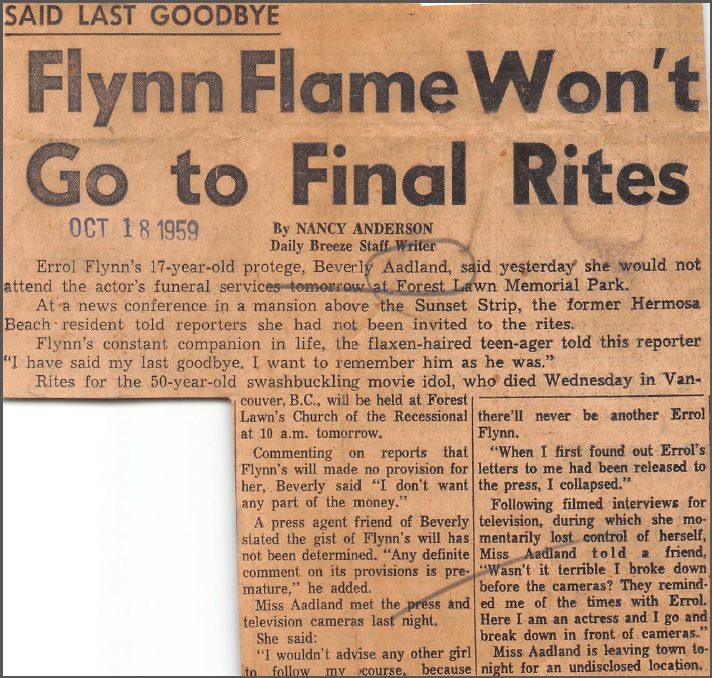
Upon Flynn’s death, the world learned that Aadland really was only 17 years old, and that Flynn had first romanced her when she was 15. Every Hollywood gossip magazine jumped on the story of Flynn’s underage paramour.

Daily Breeze, Oct. 18, 1959.
Daily Breeze, Oct. 18, 1959. (Click to enlarge.)

She held a press conference announcing that she would not attend Flynn’s funeral because “I want to remember him as he was.”

An inquest was held into charging Beverly’s mother for contributing to the delinquency of a minor for allowing the relationship with Flynn to continue, but it was halted when Beverly refused to testify against her mother.

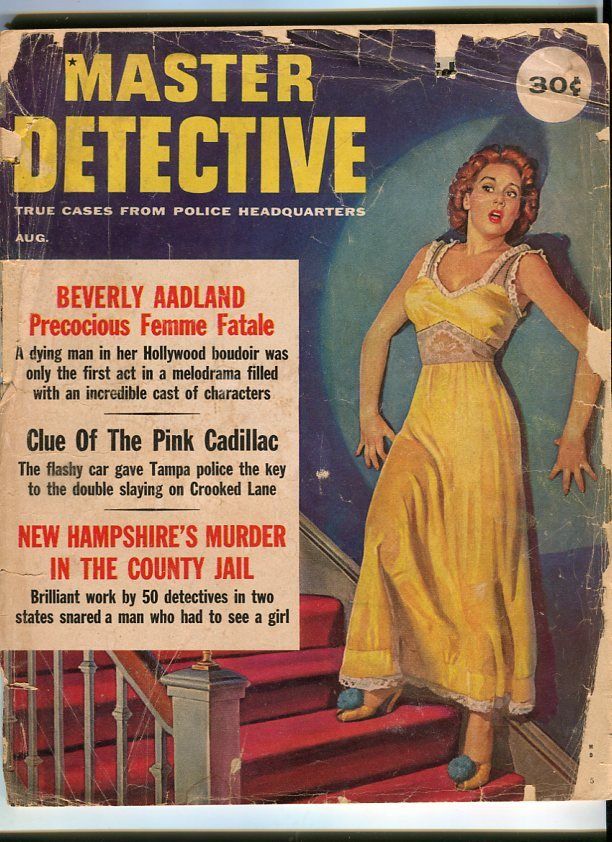
The sensational headlines continued in 1960. On April 10, one of Aadland’s suitors, aspiring actor William Stanciu, 20, was shot in the head with his own gun after pushing

Beverly Aadland gets top billing on the cover of Master Detective magazine following the shooting death of William Stanciu in 1960.

his way into the apartment Aadland shared with her mother. The circumstances of the shooting remain unclear more than 50 years later; Aadland may or may not have pulled the trigger. Her story changed several times. Ultimately, she claimed there was a struggle for the gun, which then went off while in her hand. Stanciu died the next day from the wound.

After this incident, authorities ruled that Beverly was not receiving proper guardianship from her mother, and made her a ward of the juvenile court system. She spent more than a year under the guardianship of Mrs. Frances Eilers, even after she turned 18.

The guardianship ended five months after Beverly married draftsman Jose DeLeon in June 1961. Her mother eventually was convicted on four counts of contributing to the delinquency of a minor in July 1961.

Florence Aadland was placed on three years probation, and spent 80 days in jail in 1963 for failure to pay a fine related to the case. Her daughter Beverly had just left her room after a visit when her mother died on May 9, 1955 at the age of 55, after being admitted to the hospital for cirrhosis of the liver and intestinal bleeding.

In the years that followed, Beverly would divorce DeLeon and pursue various show business careers, including singing. She was performing in the San Fernando Valley club the Black Bull when the Associated Press wrote a “Where are they now?” article on her in 1967.

Aadland was working as a cocktail waitress when she met auto parts executive Ronald Fisher in 1970. They were married for 40 years, living mostly in the Lancaster area until her death from diabetes and heart failure at Lancaster Community Hospital on Jan. 5, 2010.

Sources:

Daily Breeze files.

“The Death Of Errol Flynn And His Under-Age Girlfriend Beverly Aadland,” Anorak website, http://www.anorak.co.uk/381418/celebrities/the-death-of-errol-flynn-and-his-under-age-girlfriend-beverly-aadland.html/.

“Errol Flynn’s Pretty Baby,” by Beverly Aadland, People magazine, Oct. 17, 1988.

Footnotes on the Sand, by Patricia A. Gazin, published by Myron Gazin, 1991.

Los Angeles Times files.
 

Is this your new site? Log in to activate admin features and dismiss this message
Log In