
When sea captains J.C. Ainsworth and R.R. Thompson began developing Redondo Beach in the mid-1880s, they saw the potential in transforming the sleepy seaside town into a major tourist attraction, especially once railroads could be built connecting it to Los Angeles.
The Santa Fe railroad came first in 1888, followed two years later by Ainsworth and Thompson’s Redondo Railway (later renamed the Los Angeles & Redondo Railway).
To accommodate the influx of visitors the railroads brought, the pair’s Redondo Beach Investment Co. built the magnificent Hotel Redondo, which opened on May 1, 1890. The Redondo Railway line connected directly to a depot behind the hotel.
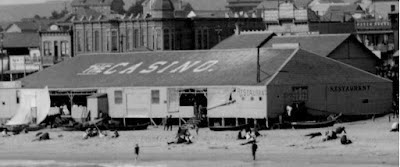
Tourists started flocking to Redondo, which was incorporated in 1892. That same year, the beginnings of a downtown entertainment area took shape with the opening of the Redondo Beach Casino, operated by Michael Mayer, along with the city’s first pavilion building.
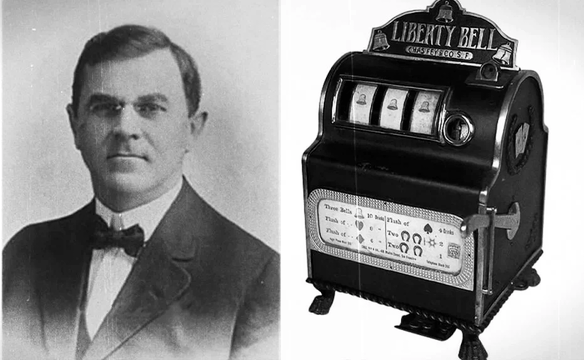
Situated directly on the shoreline, the Casino, a large, architecturally nondescript building housed a popular cafe in addition to offering gaming opportunities, including some of the earliest coin-operated slot machines. Californian Charles Fey had invented the first such device, the “Liberty Bell,” in 1895.
An ordinance banning such gambling devices passed in June 1900. But the city often turned a blind eye toward such “amusements” until finally driving gambling operations out during the late 1930s.
When Henry Huntington brought his Pacific Electric trolley system to Redondo, he saw the advantages the city offered. He bought out Ainsworth and Thompson’s holdings in 1905, and established the Red Cars on the Los Angeles & Redondo Railway line the same year.
Huntington also set about revamping the beachside area around the city’s main railroad depot at Pacific Ave. and Emerald St. The district would become known as El Paseo.
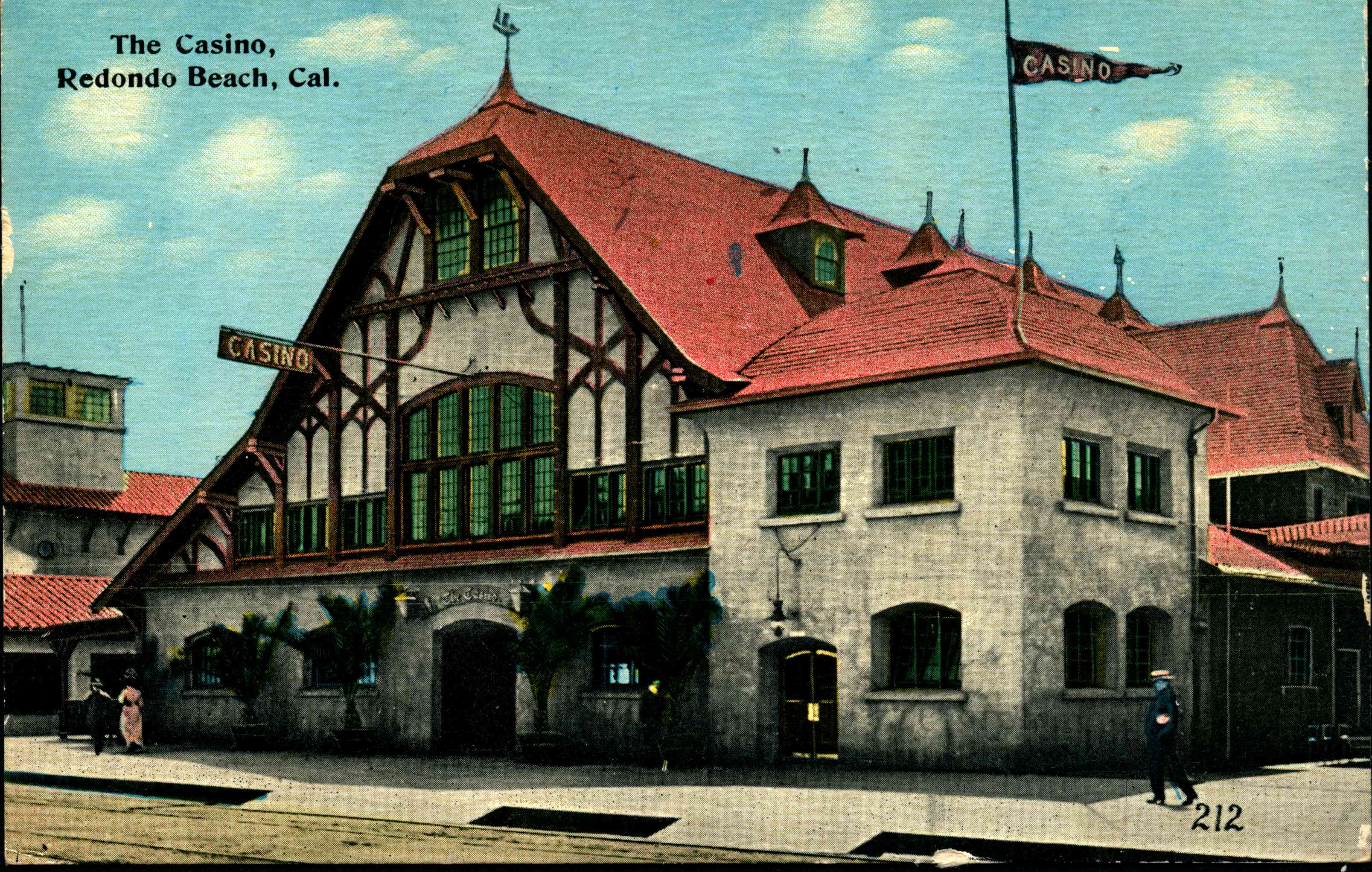
Three major structures were envisioned to replace the original pavilion and casino buildings. The buildings were adjoining but not connected. Huntington built the mammoth new Pavilion with its huge upstairs Mandarin Ballroom as well as the combination salt/freshwater indoor Plunge, while Michael Mayer financed the new Casino building in between the two on land owned by Huntington.
The Pavilion and Casino were built first. Construction began in January 1907, with a grand opening ceremony for both scheduled for Saturday, June 29, 1907.
But those plans changed early on Friday morning, the 28th. Around 7 a.m., carpenter Joseph Oouthoudt and two of his fellow Casino construction workers went over to the building to take a look at its interior. They encountered a locked door, behind which were large clouds of smoke.
Oouthoudt broke one of the building’s large plate glass windows, ran in, found a hose and began battling large flames at the rear of the structure. But the hose’s water pressure didn’t hold out and soon the entire building was ablaze.
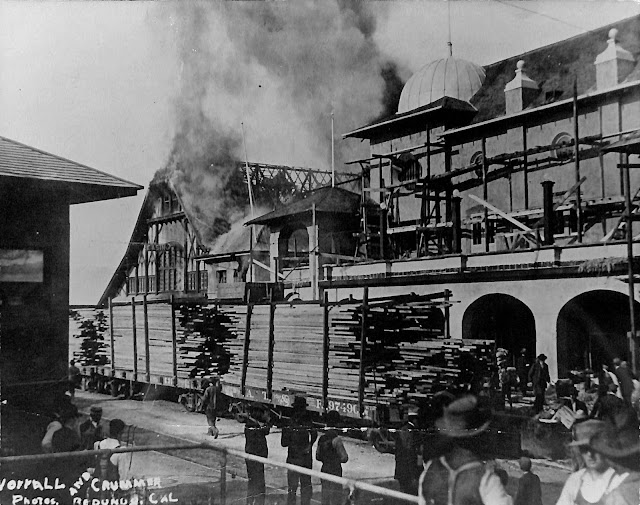
A quick-thinking worker at the new Pavilion building next door may have saved it from destruction by spraying water on the side of the building facing the Casino to keep flames from spreading to it.
At the time, Redondo had no fire department, but citizens mobilized quickly, forming an old-fashioned bucket brigade to staunch the blaze. The call also went out to the Los Angeles Fire Dept. to send help. The railroad lines were cleared for a firefighting crew and equipment. By the time they arrived by rail 35 minutes later, the flames had been extinguished.
When Mayer saw the blaze consuming his new Casino, he collapsed due to the shock and his longtime heart condition. A short in the electrical wiring was blamed for sparking the blaze.
Mayer survived, but the German Heidelberg-styled building was a total loss, though the larger conflagration that many had first feared was avoided. The Pavilion was cleaned up and able to hold its grand opening on the following Monday, July 1, 1907.
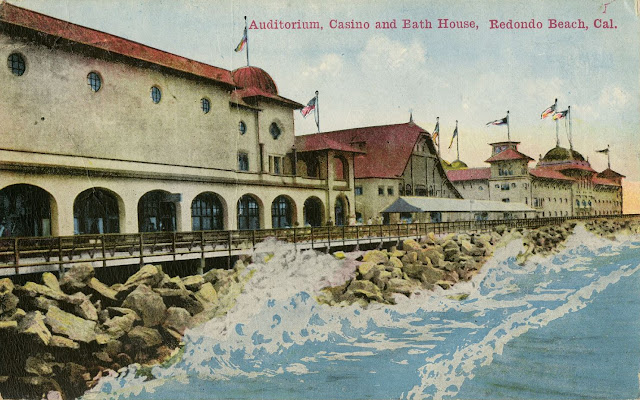
The rebuilding of the Casino began in late August 1907. The exact date of its reopening is unclear, but it probably occurred in early 1908. The Plunge opened in 1909, and three of El Paseo’s biggest attractions were complete. (The Lightning Racer seaside roller coaster was added nearby in 1913.)
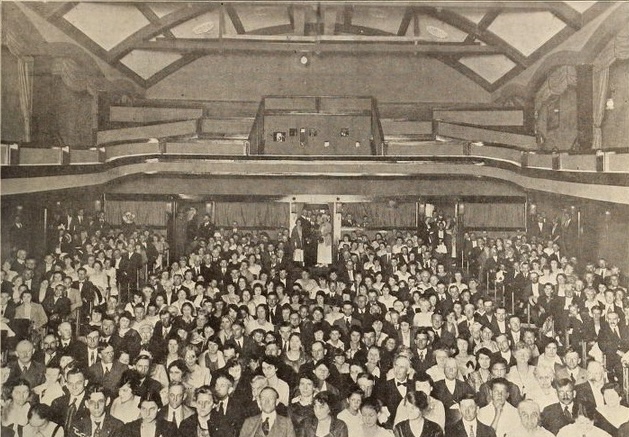
The new, larger Casino was rebuilt exactly as it had been designed originally. It had an open-beamed ceiling and a popular restaurant which Mayer continued to manage until the building was bought and converted into a showplace movie theater in 1920. (Mayer died of heart disease at his Redondo Beach home in 1925.)
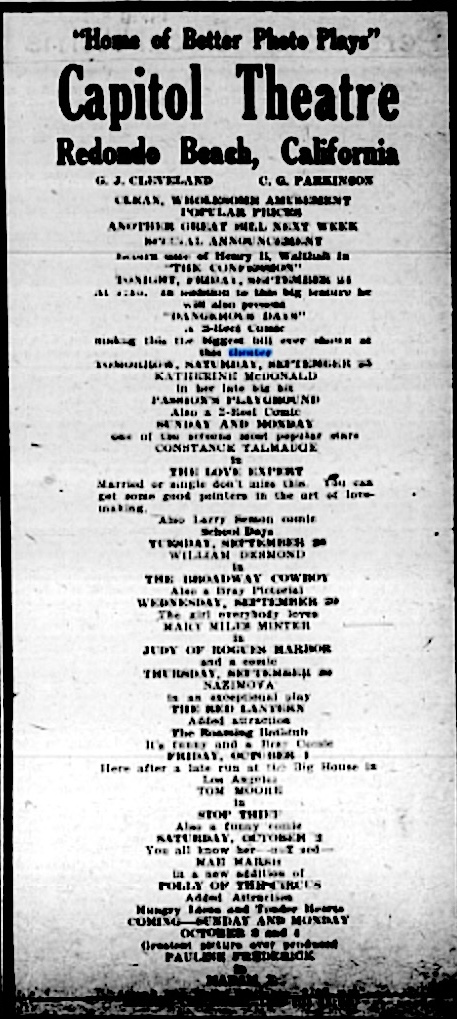
The new theater, Fancher’s Capitol Theatre (later shortened to the Capitol Theatre), opened on Aug. 1, 1920. As was the case with many theaters of the era, hosted vaudeville acts, musical revues and fashion shows in addition to first-run Hollywood films.
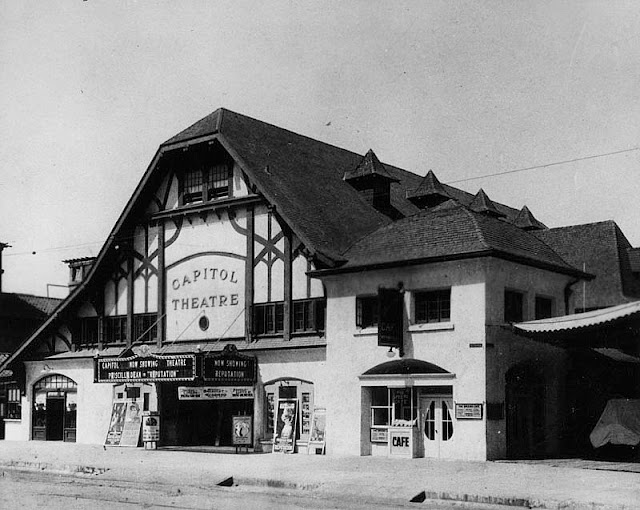
Its status as Redondo’s premier theater was eclipsed when the Fox Redondo opened on Feb. 22, 1929, on nearby Diamond St. It became the city’s first-run theater, and the Capitol fell on hard times, especially after the Depression hit.
The theater soldiered on for a few more years. It was still showing films as of 1935, but after that there are no mentions of it in local newspapers. A Feb. 19, 1944 Los Angeles Times article states that, as of that date, the building hadn’t been used in several years, and its demolition had begun that day.
The neighboring Plunge had been torn down and turned into a parking lot for the Pavilion in 1941. The Pavilion was the final of the three buildings to be torn down in December 1960 to make way for the King Harbor redevelopment that changed the face of the Redondo shoreline.
The land where the three main buildings stood currently lies underwater.
Sources:
Cinema Treasures website.
Daily Breeze archives.
Los Angeles Herald archives
Los Angeles Theatres website.
Los Angeles Times archives.
Old Redondo: A Pictorial History of Redondo Beach, California, by Dennis Shanahan, Legends Press, 1982.
Redondo Reflex archives.


I always love reading your stories.I did want to bring to your attenti
LikeLike
The caption of the photo of the 1907 fire reads: “The second Redondo Beach Casino on fire on the morning of June 28, 1987, the day before it was scheduled to open.” The date, of course, should read June 28, 1907.
LikeLike
PS: I always find your historical articles interesting and with numerous things I never knew growing up in the area. Keep it up!
Thanks,
Paul
LikeLike
Hi Paul,
Wow, what a bonehead mistake! Fixing it now, many thanks for the heads up.
Sam
LikeLiked by 1 person