
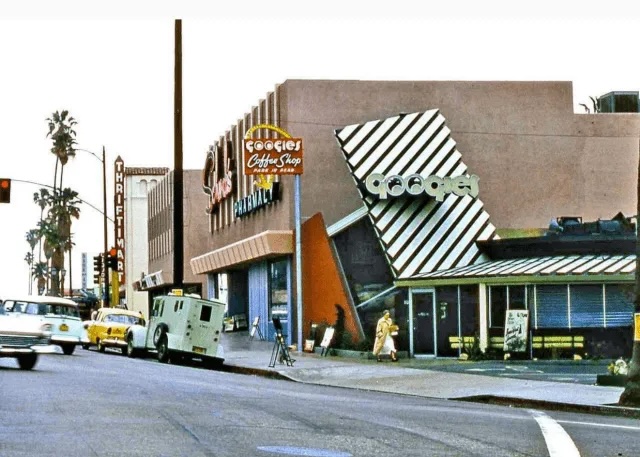
The Googie style of mid-century modern architecture got its name from Googie’s Coffee Shop, a Hollywood diner built in 1949. Architect John Lautner designed the building at the corner of Sunset and Crescent Heights boulevards, right next to Schwab’s drugstore.
Lautner’s creation sported wildly angular roofs, giant glass walls, dayglo-bright neon signage and modernist interiors. All of these characteristics would come to be considered as typical elements of the fanciful Atomic Age-based Googie style, which also is known by the less colorful name of Coffee Shop Moderne. Sadly, the original Googie’s was demolished in 1988.
Architects Louis Armet and Eldon Davis picked up on Lautner’s ideas not long after forming their Santa Monica firm, Armet & Davis, in 1947. (When Victor Newlove became partner in 1972, the firm adopted its current name, Armet Davis Newlove.)
s
The partners soon found a niche in designing diners and restaurants. Some were relatively conventional in design, such as Bob’s Big Boy and Denny’s. Others, such as Ships, Holly’s, The Wich Stand and some Norm’s locations, were full-on Googie in character. But all of them had some elements of the inventiveness and kitsch that became Armet & Davis hallmarks.
I wrote in 2019 about The Wich Stand at 4508 W. Slauson Ave., which is located about a mile and a half northwest of Pann’s. The restaurant, a favorite 1960s cruising haunt once frequented by Beach Boy Brian Wilson, closed in 1988. The building was saved, however, and has been transformed into the architecturally toned-down Simply Wholesome restaurant and health foods store.
Holly’s in Hawthorne became renowned after it closed when Quentin Tarantino used it as a film location for the opening scene in “Pulp Fiction” (1984). The film’s popularity inspired a brief reopening of the restaurant, but it closed shortly afterward. The building was razed and is now an Auto Zone store.
Developers also came for the landmark Ships restaurants in Westwood, Culver City and Los Angeles, the various Coffee Dan’s locations and many other restaurants designed by architects such as Lautner and Armet & Davis that are no more. Fortunately, Chips in Hawthorne continues to operate.
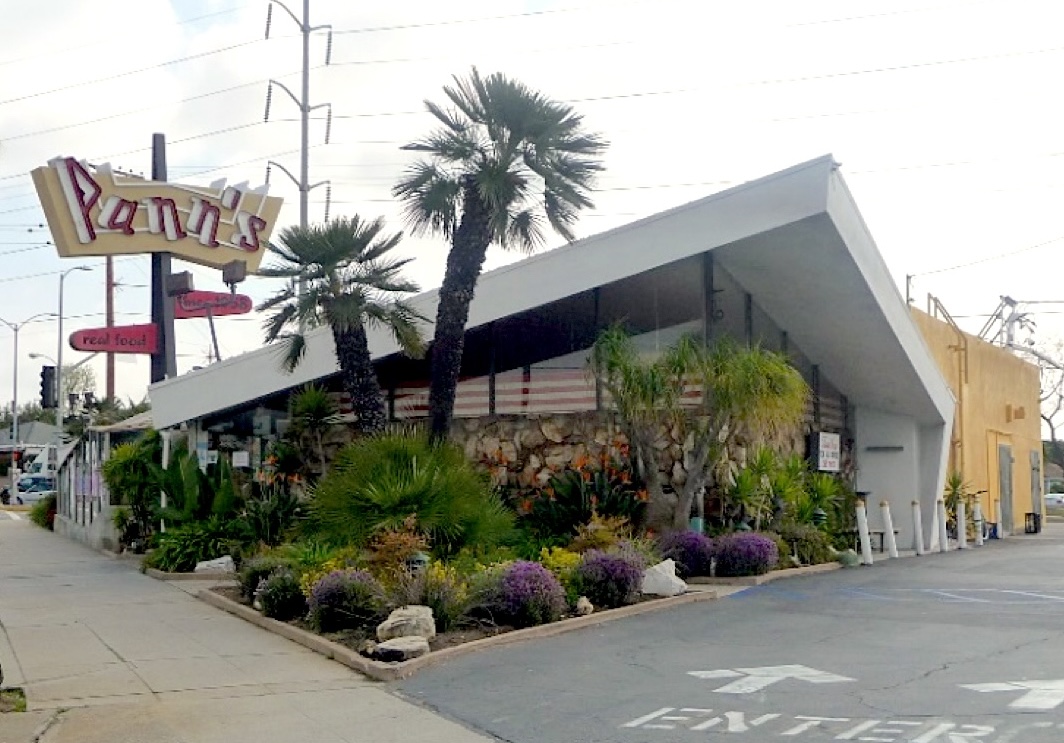
And Pann’s survives. The distinctive building is situated on a small triangular island of land at the intersection of La Tijera and La Cienega boulevards. Technically, it’s part of the City of Los Angeles, though various sources describe its location as being in Westchester, Ladera Heights and Inglewood, all of which are nearby.
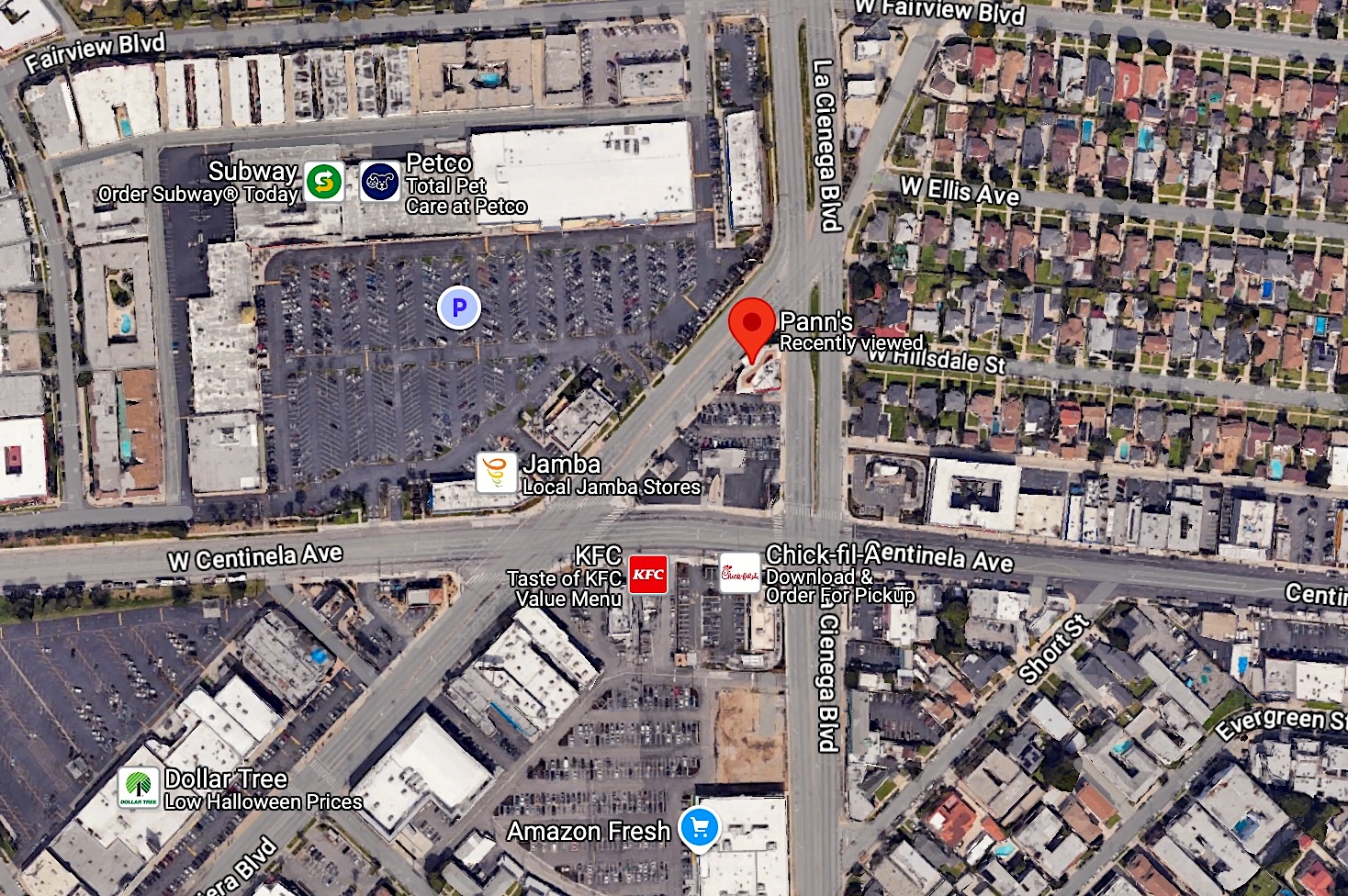
In fact, Pann’s is close enough to Inglewood that the city launched an attempt in 1978 to annex a 62-acre portion of L.A. City land on its northern border that included it, but the bid failed.
Armet & Davis had already designed several Googie-inspired restaurants when they took on the Pann’s project in 1957. The land was owned by McCulloch Motors, which leased it to the restaurant’s husband-and-wife owners, George and Rena Panagopoulos. They later shortened the last name to Poulos. (The couple also owned Holly’s.)
Poulos, a Greek immigrant, learned how to cook while serving as a chef in the U.S. Air Force during World War II, and worked in several Los Angeles-area restaurants before starting his own.
Construction of the 4,000-square-foot building at 6710 La Tijera Blvd. began in July 1957. The estimated cost of the project was put at $150,000. Pann’s opened its large glass doors to the public in 1958.
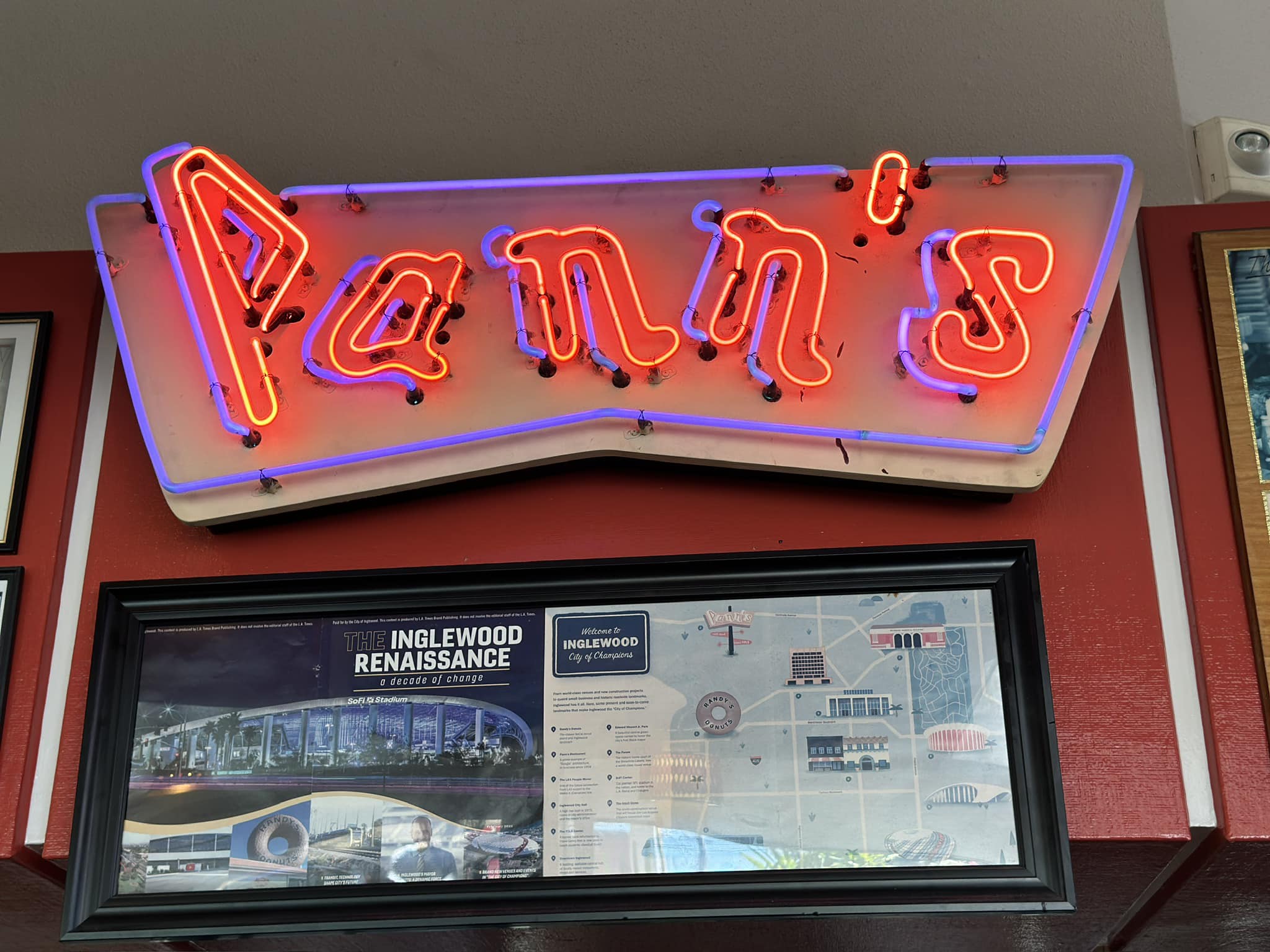
Armet & Davis employee Helen Liu Fong is credited with the restaurant’s design, working together with Eldon Davis. Its exterior features a large neon sign with “Pann’s” in distinctive lettering, a sharply cantilevered roof section, and palm trees and tropical vegetation inside and out.
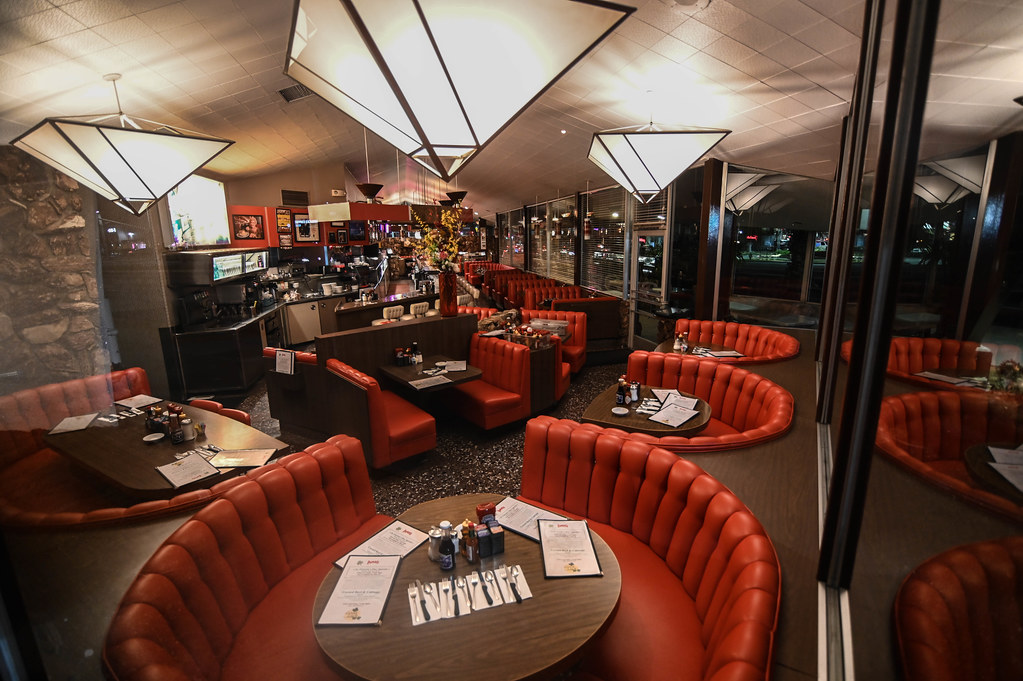
Its interior has bright red leather booths in addition to a long lunch counter. The walls are mostly glass, along with flagstone. Planters filled with lush foliage are plentiful, giving the restaurant a tropical feel.
The charm of its retro design has been kept intact through the years. Jim Poulos, son of the original owners, completely restored the restaurant to its original form in 1993, and won a Conservancy Preservation Award from the Los Angeles Conservancy for his efforts.
Its menu certainly has been updated over the years, but it still features staples of diner fare such as hamburgers and chicken dishes. Pann’s stopped serving dinners in 2016, and now serves breakfast and lunch until 3 p.m. daily.
Its ambitious and audacious look continues to recall the anything-is-possible optimism of an earlier era.
Author Alan Hess wrote in his definitive guide Googie: Fifties Coffee Shop Architecture (Chronicle Books, 1985) that Googie-style restaurants such as Pann’s “told us about ourselves by showing us in full scale and three dimensions what we once thought our future would look like.”
Sources:
Daily Breeze archives.
Googie: Fifties Coffee Shop Architecture, by Alan Hess, Chronicle Books, 1985.
“Googie Coffee Shops,” by Austin, Mid-Century Mondays website, July 1, 2024.
Los Angeles Times archives.
“Pann’s Coffee Shop,” Los Angeles Conservancy website.
Comments:
From Cynthia Dunbar:
Your article made it sound like Chips on Hawthorne Boulevard is no longer around, but it’s definitely still in operation and has a lot of the same original design charm. I just ate there on Saturday morning and would love to see continued business for them.
Also, a commercial was filmed there within the last couple years or so:
Cynthia,
Thanks for the correction. I’ve fixed the blog accordingly.
Sam

