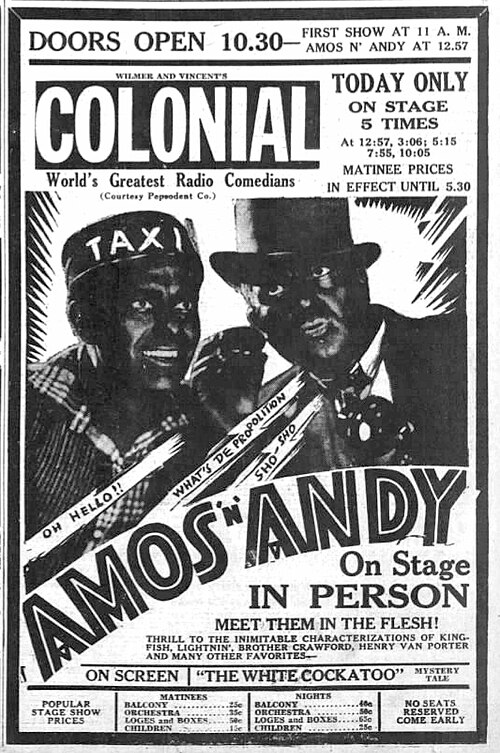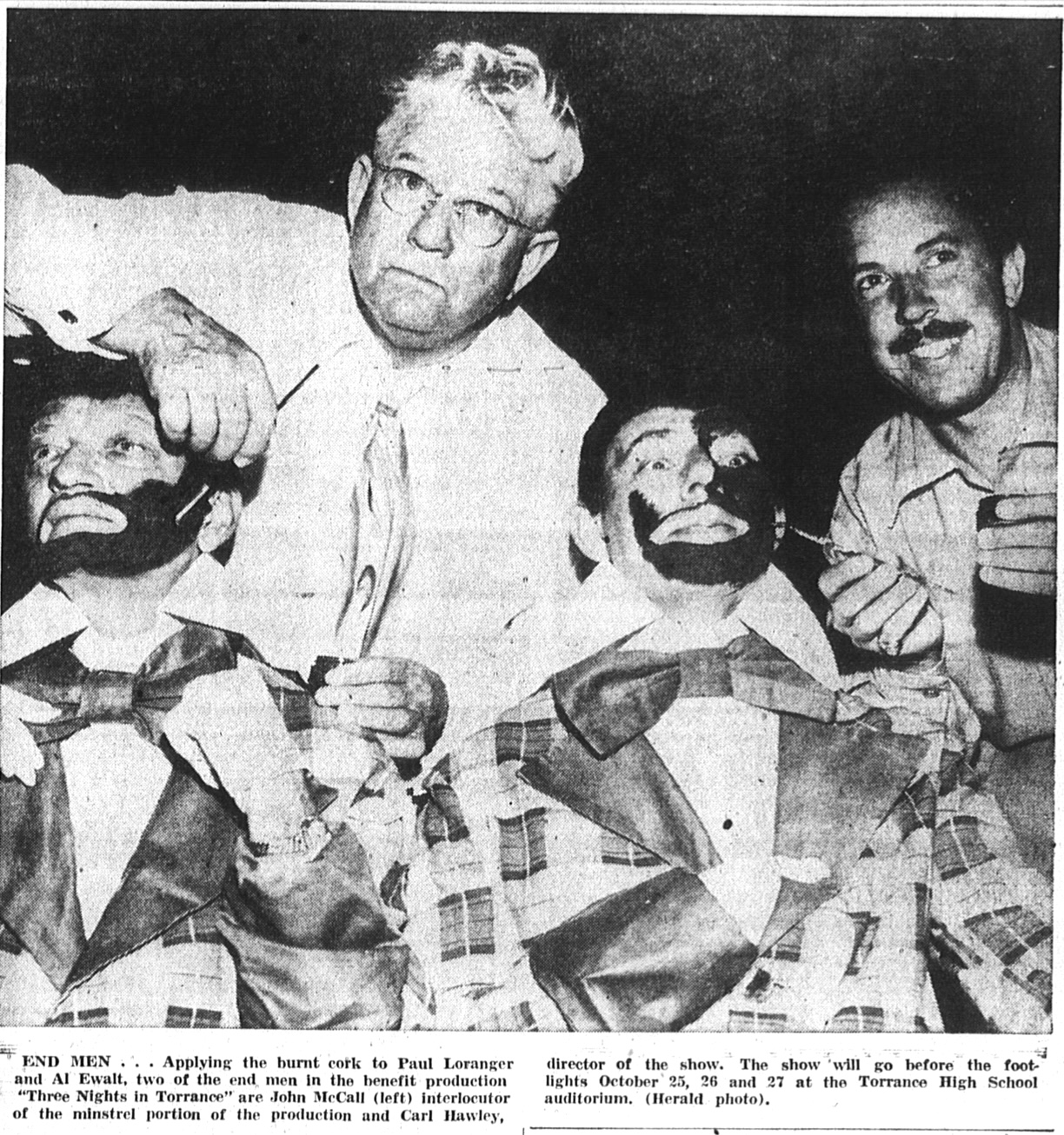
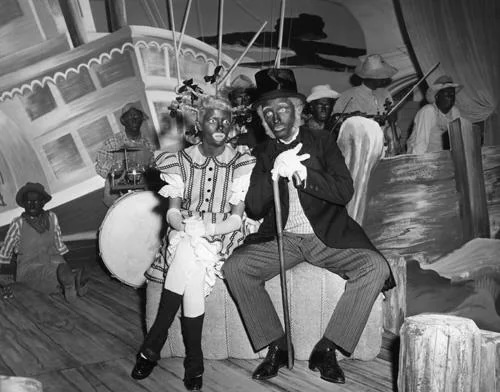
The sight of middle-class South Bay suburbanites donning blackface makeup in order to play roles in minstrel shows at the local high school auditorium benefit show seems wildly inappropriate by modern standards.
But it wasn’t considered unusual until the early 1950s, when a groundswell of disapproval arose from civil rights groups calling attention to the racial caricatures present in minstrel shows.
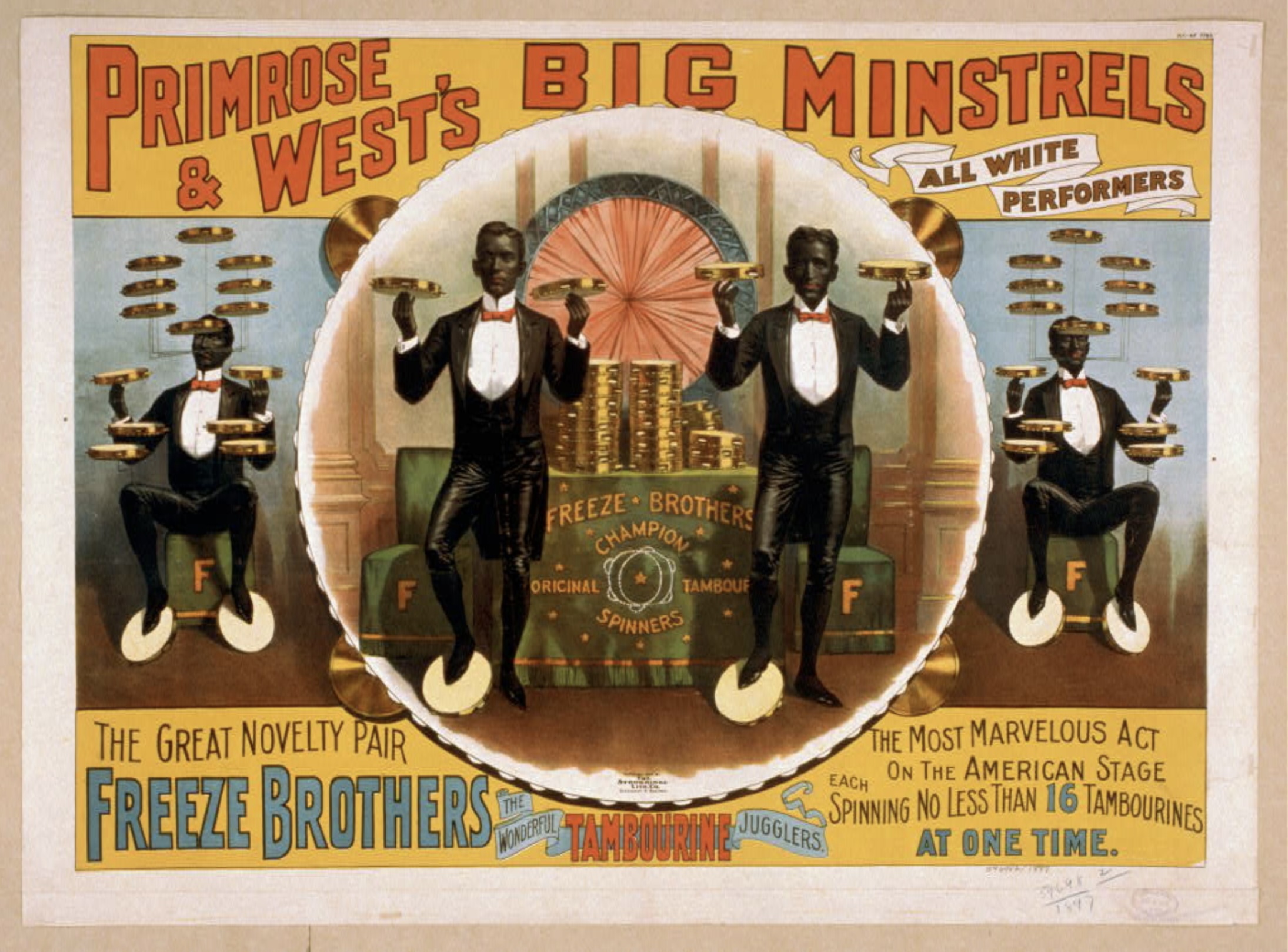
First, some background. Minstrel shows originated in the northeast states in the early 1800s. They usually featured mostly white actors comically portraying black stereotyped characters in jokes, songs and skits staged in the revue format.
Uniquely American, the shows became the most popular theatrical art form in the country during the 1840s. Troupes of professional minstrel performers criss-crossed the country in shows that presaged the vaudeville era of the early 1900s, whose popularity eventually outstripped minstrelsy.
The “Amos ‘n Andy” characters were created in the mid-1920s by two white actors, Freeman Gosden and Charles Correll, who were very familiar with the minstrel show tradition. The show became one of the radio era’s most popular programs, airing between 1928 and 1960 in various forms.
The minstrel show format also became a popular one for local theater productions, and was often used by service clubs and other community organizations staging fundraisers and benefit shows. Librettos and songbooks from popular minstrel shows were readily available from theater publishers at the time.
A front-page Feb. 8, 1924 Torrance Herald story noted that members of the Torrance Business Men’s association had voted unanimously to stage their own minstrel show to benefit the local Boy Scouts organization.
It was planned to be one of the first public productions to be staged in the then-new Torrance High School auditorium, which would later have to be replaced after being severely damaged in the 1933 Long Beach earthquake.
The Torrance Women’s Club announced its own minstrel show production, “comprised entirely of home talent” according to the Herald, at its clubhouse in April 1926.
The practice of staging amateur minstrel shows continued to be commonplace in the years after the end of World War II. After all, many movie stars, most notably Al Jolson in the late 1920s, had performed in blackface.
In addition to Jolson, there was Fred Astaire in “Swing Time” (1936), Judy Garland and Mickey Rooney in “Babes on Broadway” (1941), and, famously, Bing Crosby’s blackface minstrel segment in “Holiday Inn” (1942). The latter is often excised from television screenings of the film, though the TCM channel still includes it, with an explanation.
By the late 1940s, the amateur community minstrel shows still drew good-sized crowds, and many groups staged them annually.
In 1951, the Junior and Senior Women’s Clubs in Torrance came up with their own minstrel show, “The Three Nights of Torrance,” which they planned to stage at the Torrance High School auditorium on Oct. 25. It included a blackface minstrel segment.
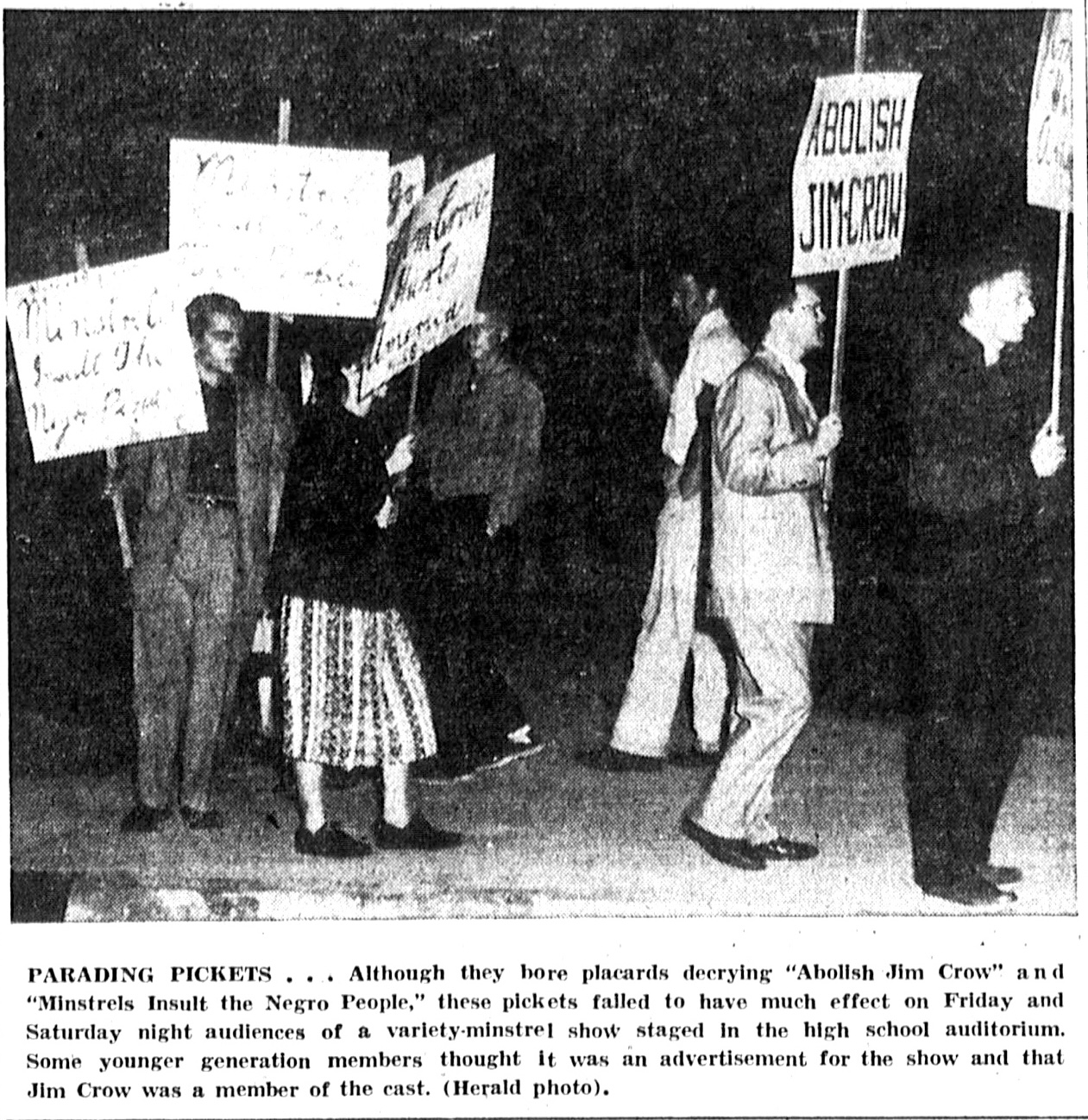
A few days before the scheduled performance, Mrs. Emma Roberts, president of the senior Woman’s Club, reported to the Herald that she’d received a phone call demanding that the performance be canceled because “it made buffoonery of a minority group,” according to the newspaper.
A handbill decrying the show also had been distributed in downtown Torrance, signed by Cora Johnson, president of the Southeast Interracial Council. It stated, in part, that minstrel shows “are carry-overs from a part of our national history and national shame which all thinking Americans are now trying to rectify.”
The show went on as planned, but so did a small picket line of 15 protesters carrying signs decrying it beforehand. The Herald and the Torrance Press complained that the whole protest was the work of pro-Communist groups, echoing the then-prevalent anti-Red sentiments being hammered home by groups such as the House Un-American Activities Committee (HUAC) in the U.S. Congress.
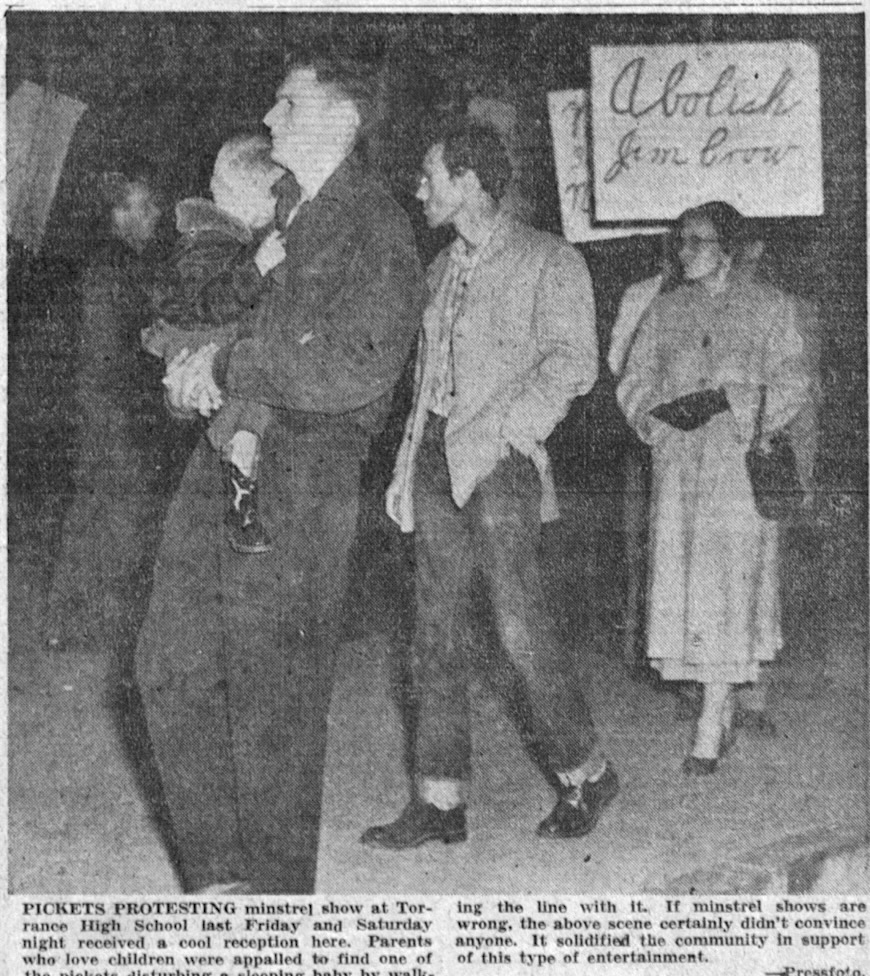
The YWCA, the Los Angeles County Joint Commission on Human Relations and the National Association for the Advancement of Colored People (NAACP) sided with the protesters, also denouncing the minstrel shows.
As for Senior Women’s Club president Roberts, she told the Torrance Press: “I think the picketing was disgraceful, particularly when there are no Negroes living in Torrance.”
1951 also was the year that the “Amos ‘n Andy” show began airing on national television. It only lasted until 1953, when its sponsors withdrew due to pressure over its perceived racist content and it was canceled.
It wasn’t the end for such shows, but societal pressures and the growing civil rights movement made them far less common. Professional minstrel show companies had pretty much died out, with only a few independent tent shows still operating by the late 1950s
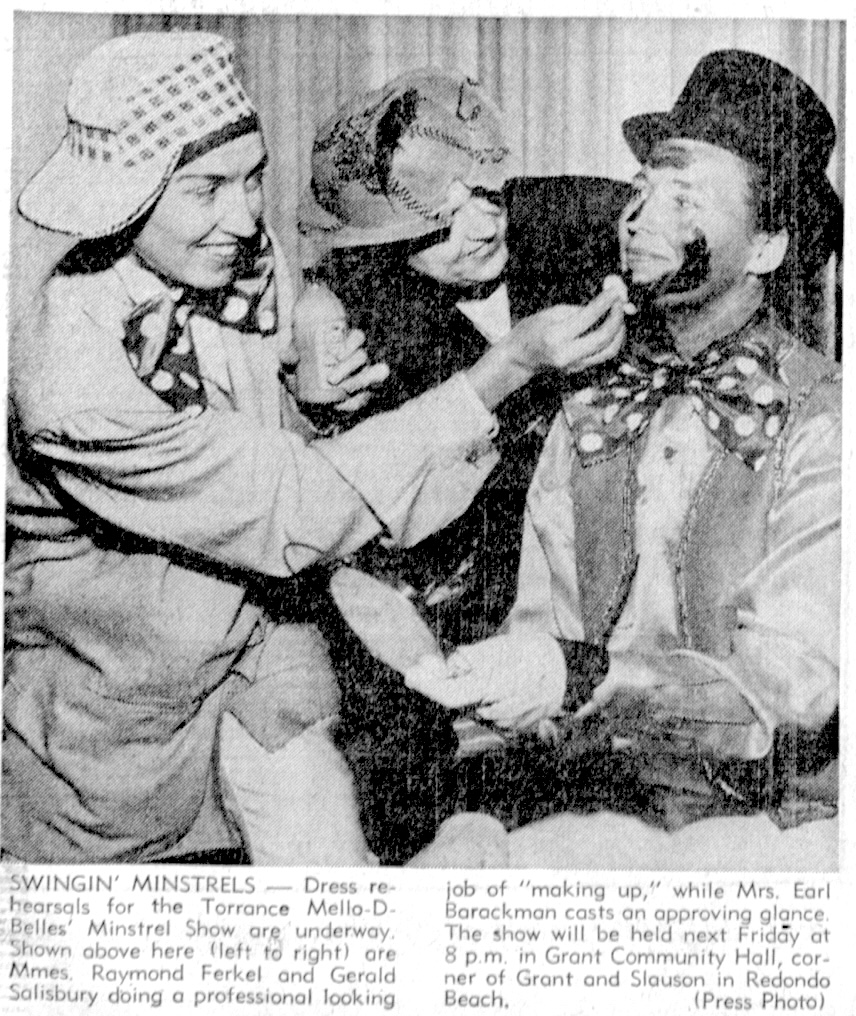
During my research, the latest article I came across regarding a local minstrel show production was promoting an April 1962 Redondo Beach charity show sponsored by a Torrance signing troupe, the Mello-D-Belles:
Sources:
The Blackface Minstrel Show in Mass Media: 20th Century Performances on Radio, Records, Film and Television, by Tim Brooks, McFarland & Co., 2020.
San Pedro News Pilot archives.
Torrance Press-Herald archives.
Wikipedia.
Wilmington Press Journal archives.