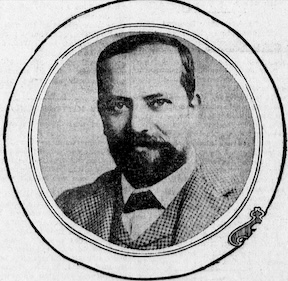
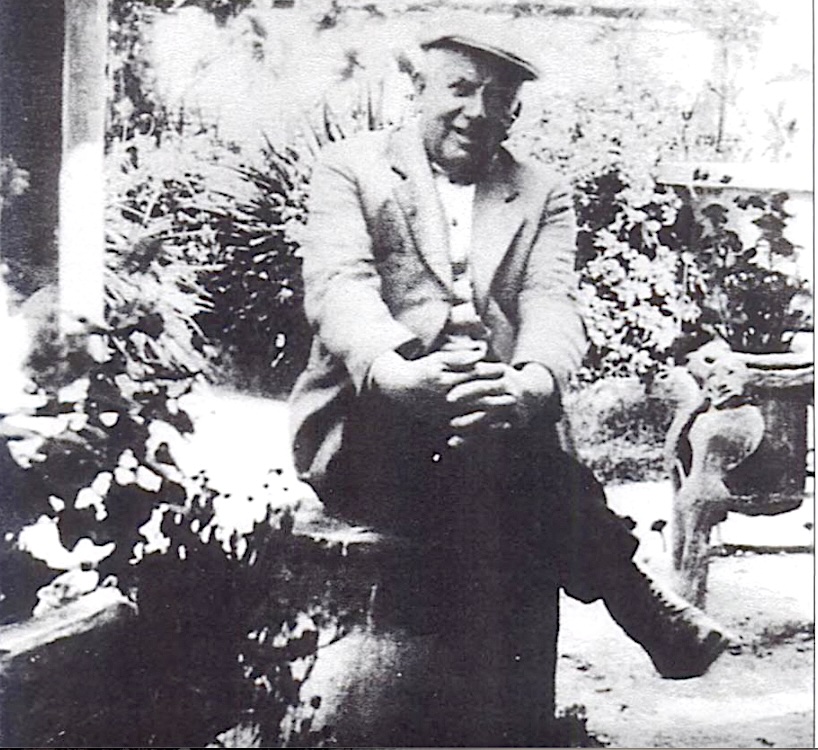
Felix Achilles Peano’s rich, fascinating life in the arts began in Parma, Italy, on June 9, 1863. As a young man, he studied sculpture under the tutelage of the then well-known Italian artist Odoardo Tabacchi in Turin.
Peano (pronounced pee-ah-no) emigrated to New York in the 1890s after earning renown for his art works in Paris. While in New York, he designed the Lipton Cup sports trophy for Tiffany & Co. and Scottish tea magnate Sir Thomas Lipton.
IIn 1900, he accepted a post as an art professor at the University of California, Berkeley, teaching sculpture. While living there, he met writer Jack London while both were attending a public lecture. They became friends, and London ended up writing his most famous novel, The Call of The Wild, at Peano’s house in Oakland.
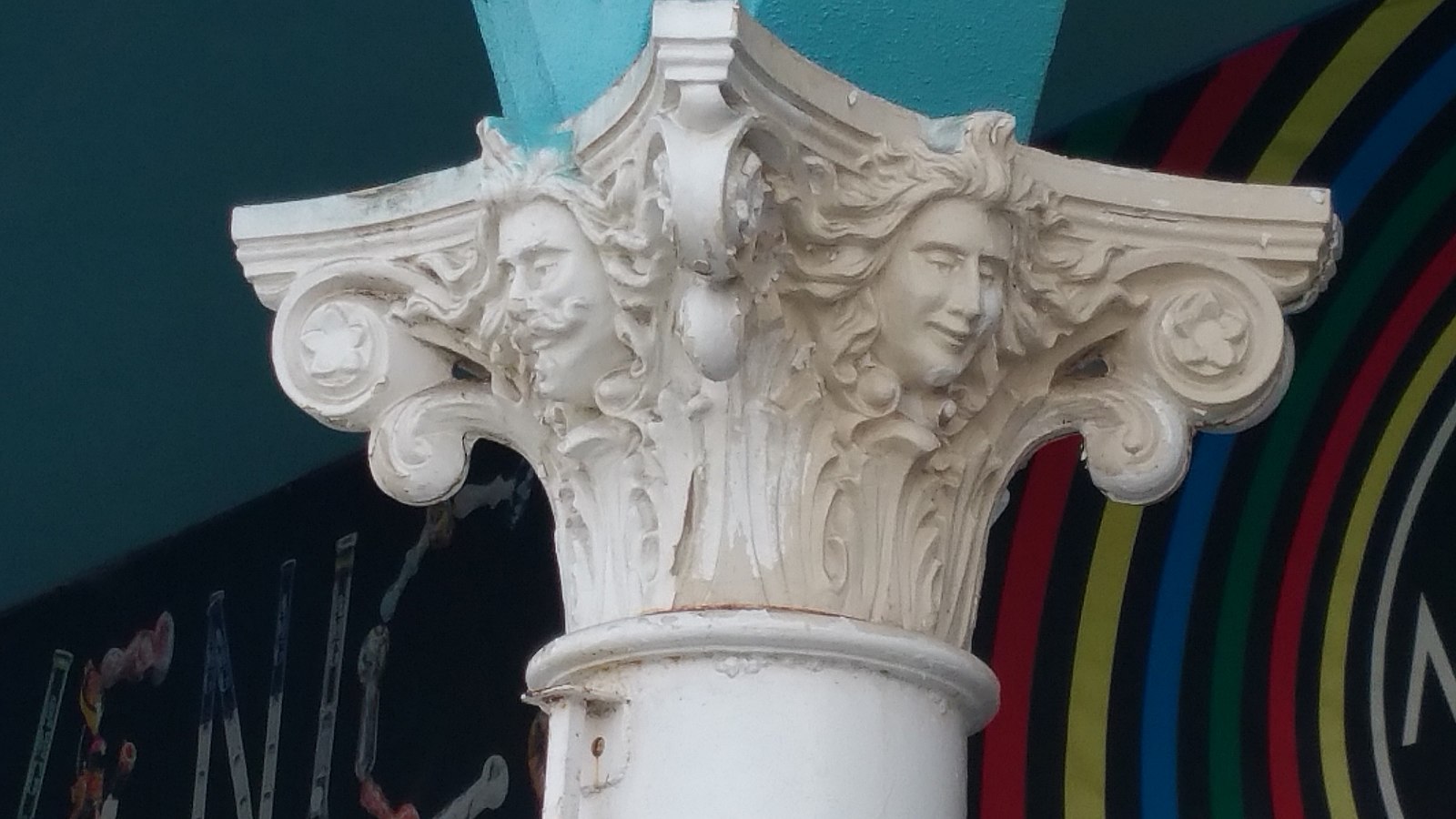
Southern California real estate developer Abbot Kinney contacted Peano in 1905, offering him a job as architect/designer for his new development along the coast south of Santa Monica.
Kinney called his seaside project “Venice In America,” and enlisted Peano’s help to design it. He originally was slated to craft as many as one hundred of the development’s villas, but ultimately Peano was responsible for one villa. He did design a dozen of the bridges that crossed the development’s canals.
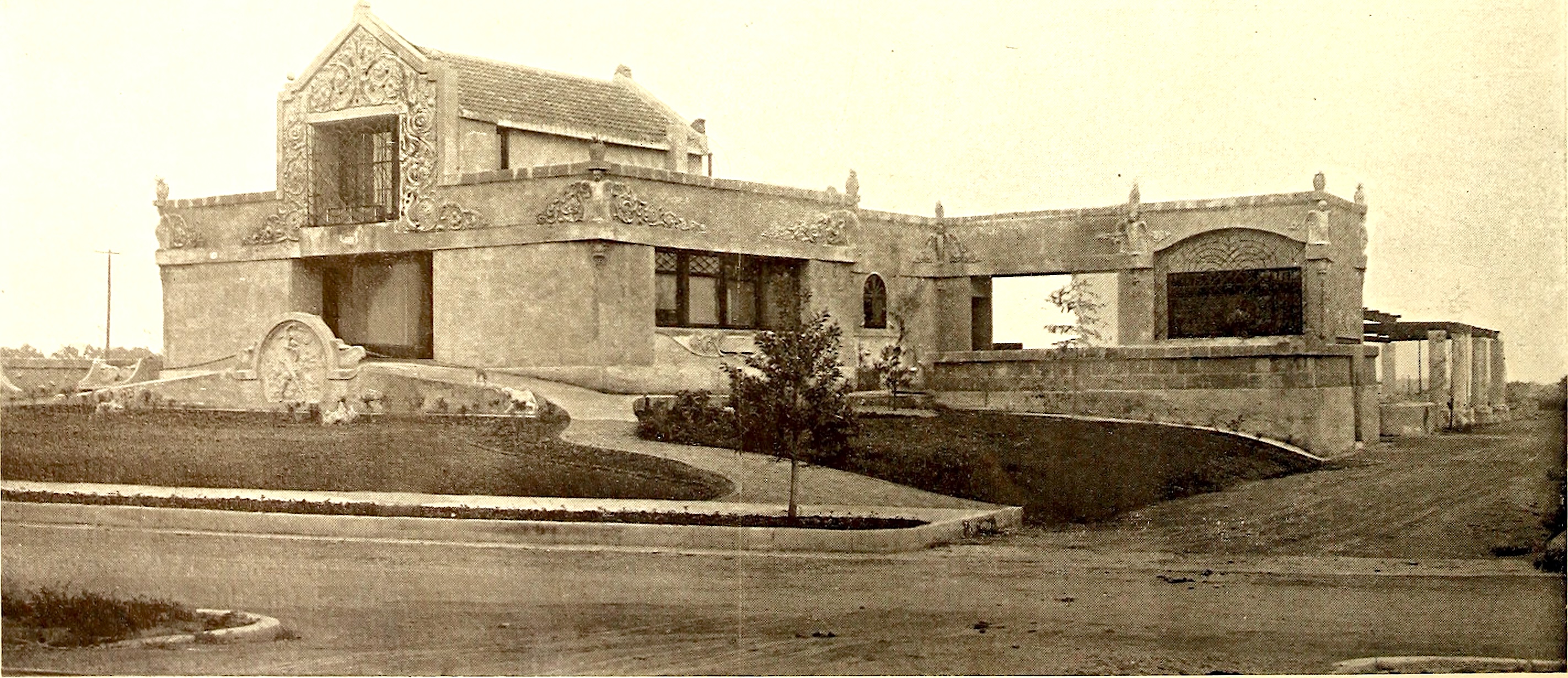
Peano also built a distinctive home for himself at 128 San Vicente Blvd. in Santa Monica. Known as the “Pompeiian House,” it became something of a local landmark at the time.
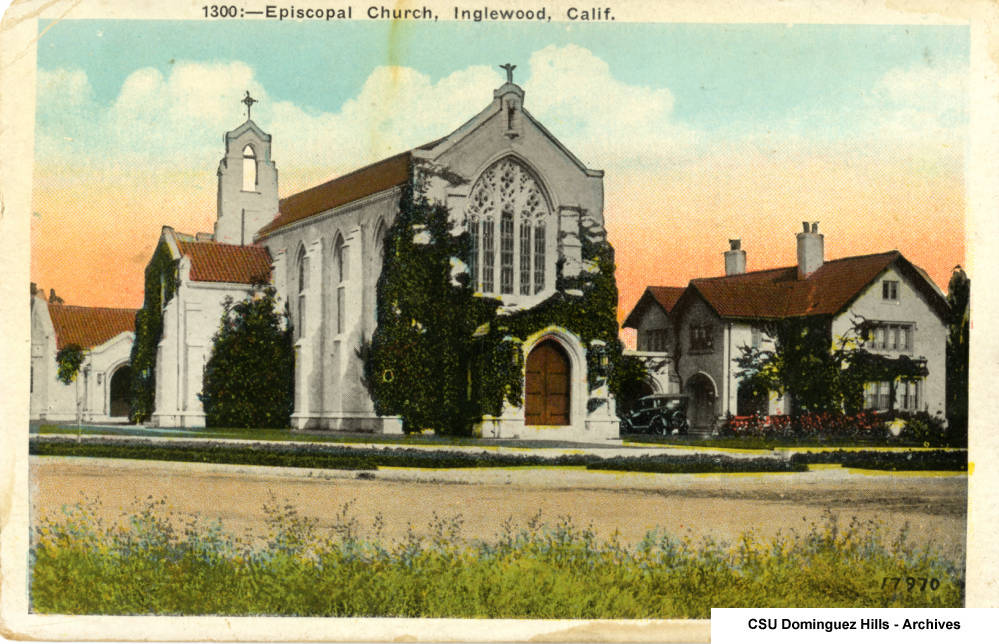
In 1914, he shifted his attention to the South Bay. That year, he received a request from the daughter of Inglewood founder Daniel Freeman, Grace Freeman Howland, commissioning him to create doors for the entrance of the under-construction Holy Faith Episcopal Church at 260 N. Locust St. in Inglewood for a fee of $85,000.
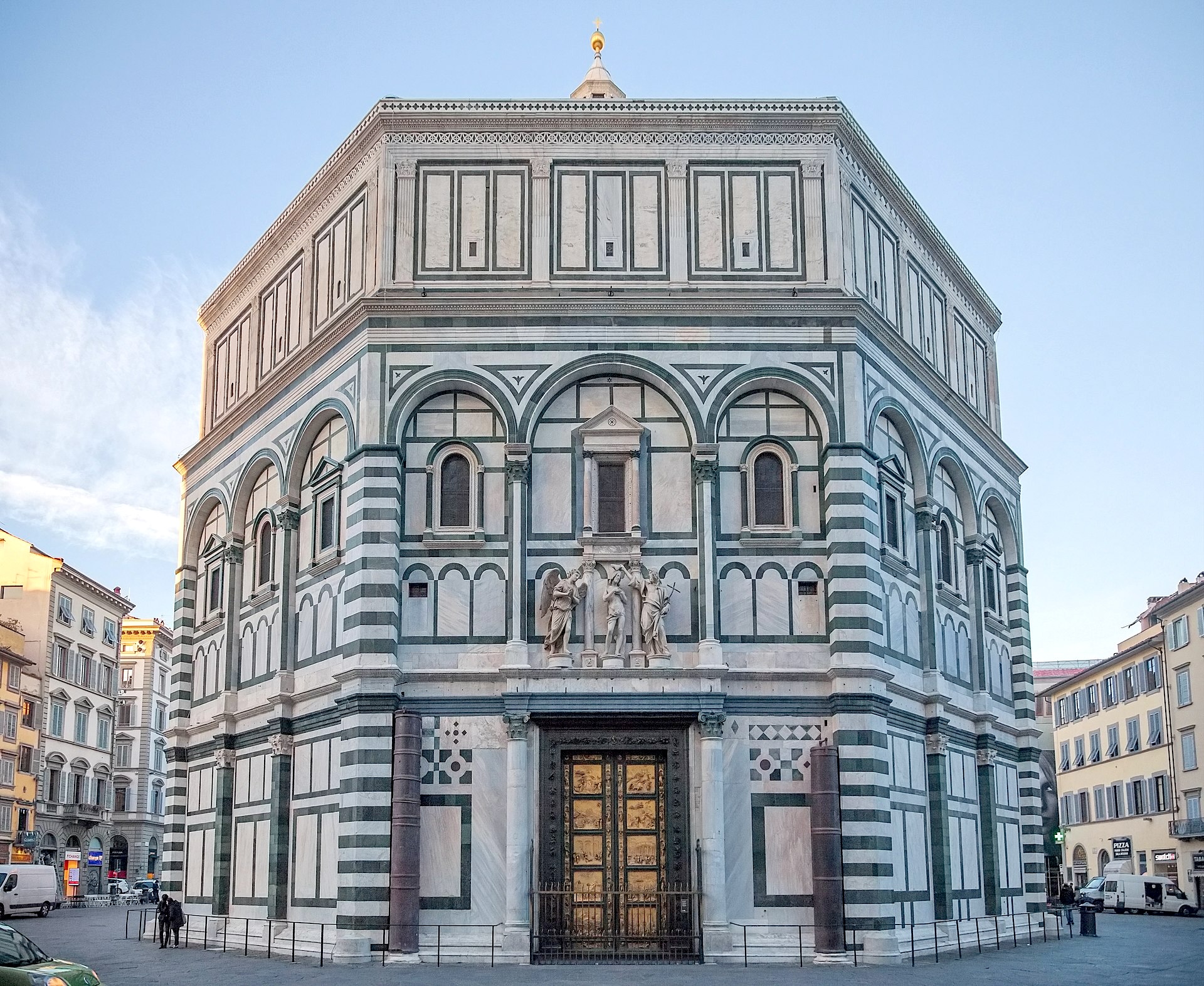
Creating and executing the massive iron doors, 10½ feet tall and 7 feet wide, would become his life’s work. Inspired by the famed baptistery doors finished in 1453 by Italian Renaissance sculptor Lorenzo Ghiberti entitled the “Gate of Paradise,” Peano would spend the next 34 years of his life working on the project he called the “Door of Life.”
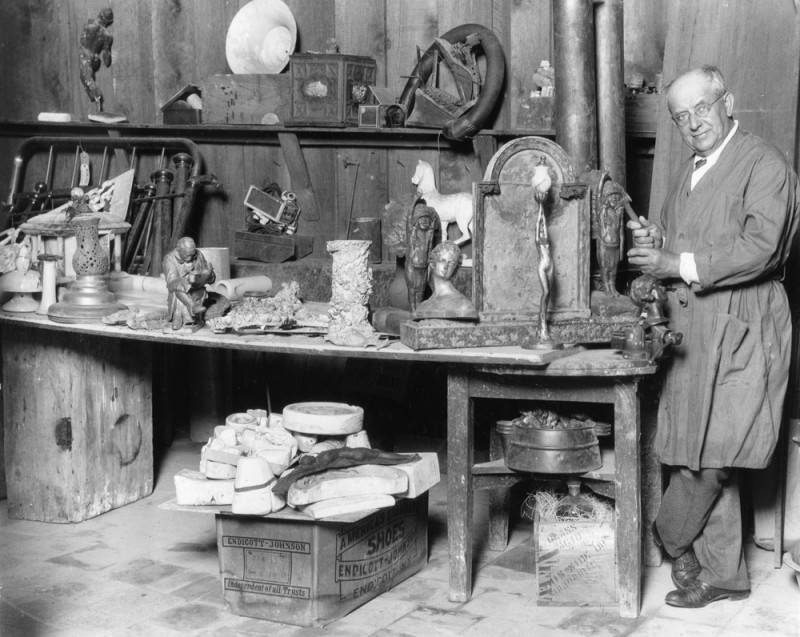
He moved from Santa Monica to Hawthorne after establishing a studio and foundry at 484 N. Hawthorne Blvd. in Inglewood where he could work on the “Door of Life” and other projects.
His eccentricity manifested itself in the new dwelling he built for himself in 1929 at 260 Freeman Ave. in Hawthorne. The lavish home became known locally as the “House of Surprises” for its ornate statues, carved marble columns and unusual features such as the underground tunnels connecting the main swimming pool to other smaller ones.
Passersby often stopped to gawk at the unusual edifice and its furnishings, some attempting to climb the fences and explore further. Police kept a close eye on Peano’s house for that reason. (Unfortunately, no overall photos of the house seem to have survived.)
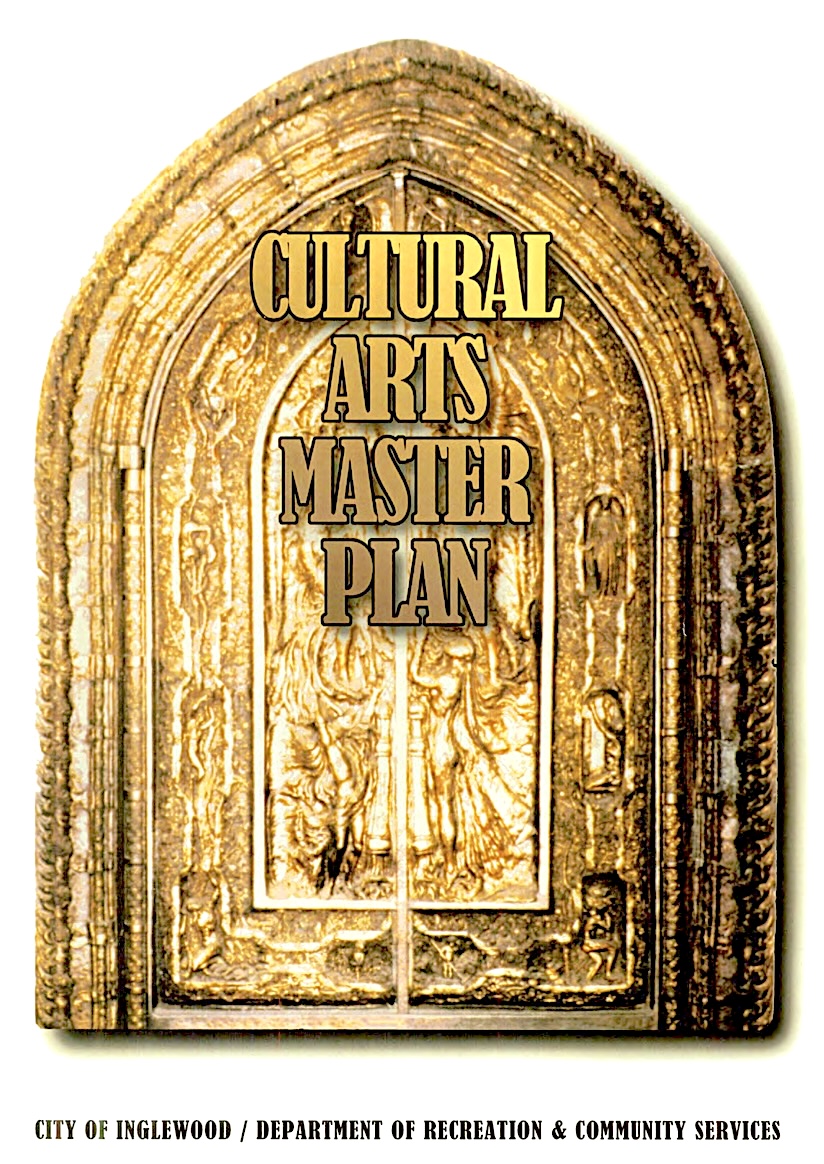
The massive bronze doors that that Peano had made his life’s work were made of bronze and weighed two tons. Like Ghiberti’s earlier work, they were adorned with individual sculpted panels depicting biblical scenes. Following the style of the Italian masters, Peano’s depictions, such as of Eve in the Garden of Eden, contained unclothed human figures.
When the members of the church building council saw Peano’s work, they were outraged. He covered one such figure with long, cascading tresses, but that did little to mollify the committee. When they further demanded that he put some clothes on Eve, he flatly refused.
As a result, the doors were rejected. They never adorned Holy Faith Episcopal’s entrance. In fact, Peano never actually finished the doors. Discouraged and in poor health, he died from a self-inflicted gunshot wound in his Hawthorne home on Nov. 25, 1948.
He believed in eugenics, the controversial process of improving the human race through genetic engineering, and left his Hawthorne home and $10,000 in his will to the Eugenics Society for research “toward the creation of supermen.”
Before he died, Peano had done much of his work at the Slauson Ave. foundry owned by his friend, Robert Haley. Haley enlisted Peano’s friend Jacob Pfeiffer, a bronze finishing expert, to help him complete the project after Peano’s death.
The two of them worked on the “Door of Life” at Haley’s foundry, the Advance Aluminum & Brass Co. for several years before finishing the artwork in 1954, 40 years after work on it began. But the doors were so immense that no church could be found that would install them.
They languished in Haley’s foundry for years. They did go on public display, but only on rare occasions.
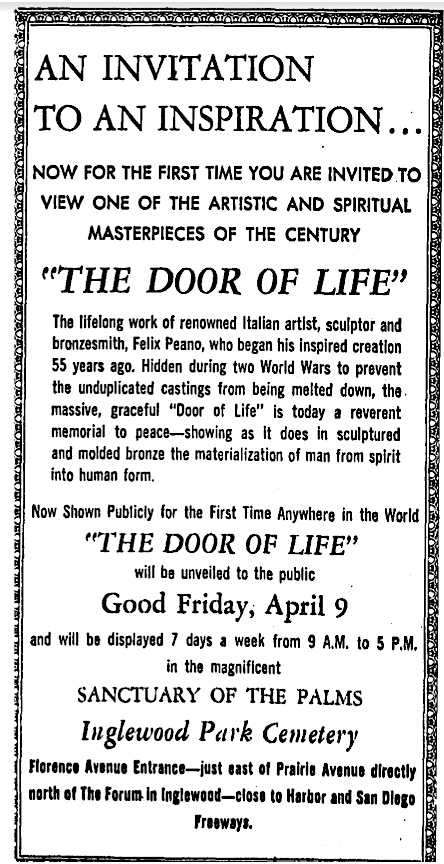
The doors were shown at the Los Angeles Home Show at the Pan-Pacific Auditorium in L.A. in June 1955, at the Sanctuary of the Palms at Inglewood Park Cemetery in April-May 1971 and at the Inglewood Bank of America branch on Manchester later in the 1970s.
The last publicly reported appearance of Peano’s artwork was at the Hawthorne Diamond Jubilee celebration in 1982, and, when last sighted in 1996, the doors were gathering dust at a foundry in East Los Angeles.
Sources:
Cultural Arts Master Plan for the City of Inglewood, City of Inglewood Department of Recreation & Community Services, June 1996.
Find A Grave website.
Los Angeles Herald archives.
Los Angeles Times archives.
“Noirish Los Angeles,” SkyscraperPage website.
Wikipedia.