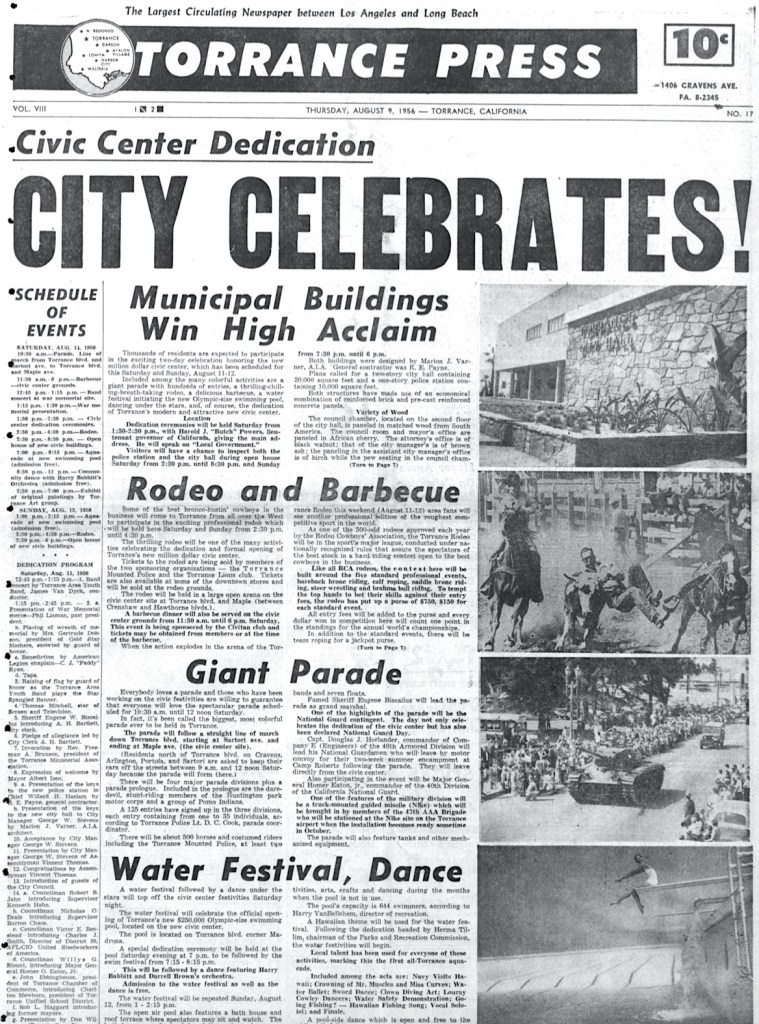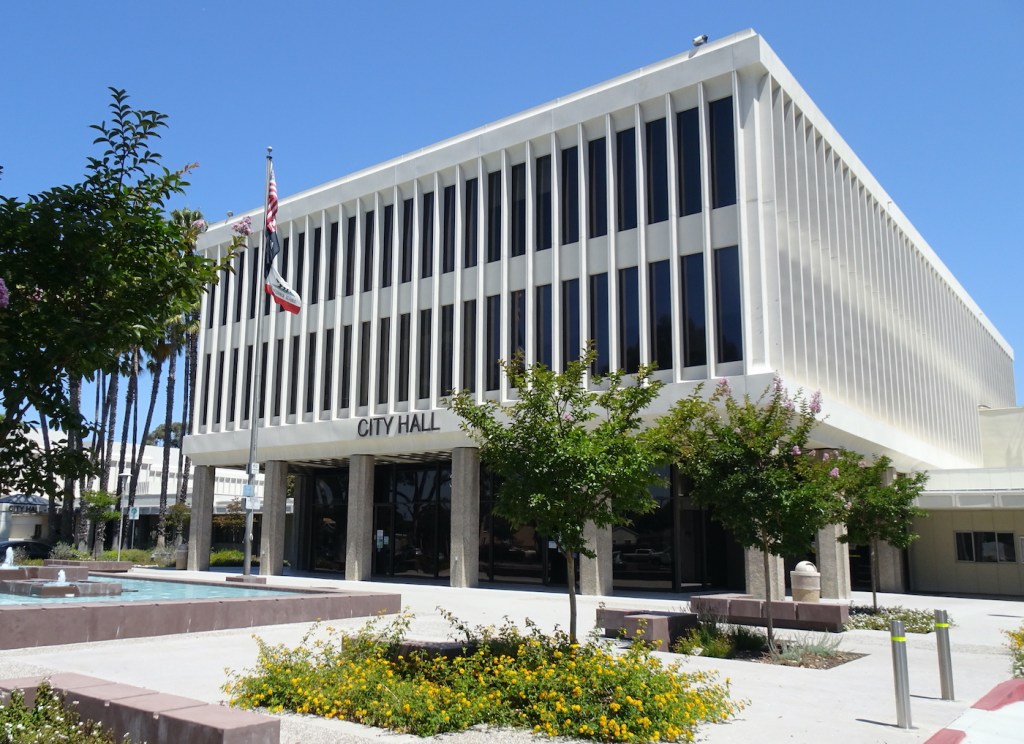
Why did the city of Torrance feel the need to open a huge new civic center complex only twenty years after moving into their then-new building on Cravens Ave. downtown? One big part of the answer: population.
In 1947, the city had 13,160 residents. In 1957, that number had grown to 94,302. During one 1954-56 stretch, Torrance’s population grew at a rate of 1,000 new residents per month.
These numbers weren’t lost on those in city government, whose offices were becoming increasingly inadequate to handle the surge in population. The police department headquarters, which at the time was housed in city hall, felt the space pinch more acutely than most.
Also, Torrance’s city fathers took great pride in their booming city, and didn’t like not having civic buildings to show off to prospective businesses they wanted to entice into moving their operations to town.
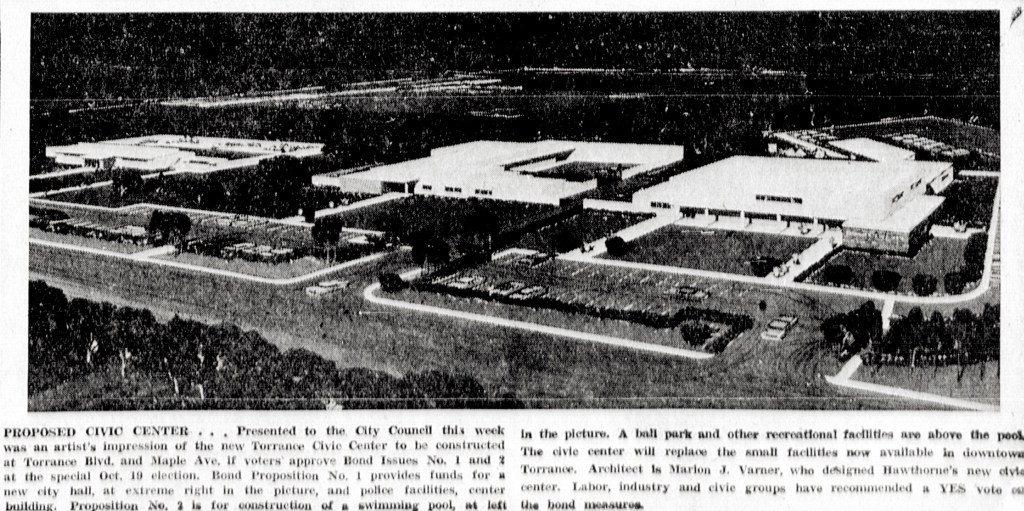
The drive to build a new civic center began in late March 1953, when the city council voted to have city manager George Stevens pursue the purchase of 30 acres of land along Torrance Blvd. between Maple and Madrona avenues for just such a purpose.
Downtown Torrance merchants reacted swiftly to the move. More than 100 of them signed petitions against it immediately, sensing the loss in business they would suffer as a result of the proposed move.
But most of the city’s movers and shakers stood behind the effort, and it was put on the ballot for public vote in the April 1954 municipal election. The bond propositions for the new center, and a separate one for a new public swimming pool to be built there, received more yes than no votes, but failed to garner a large enough majority to pass.
Civic center backers, taken aback by the defeat, redoubled their efforts to get the measures passed, adding them to the October 1954 ballot for a second attempt. This time, an all-out effort involving newspaper advertising, public rallies and other events promoting the bond measures met with success.
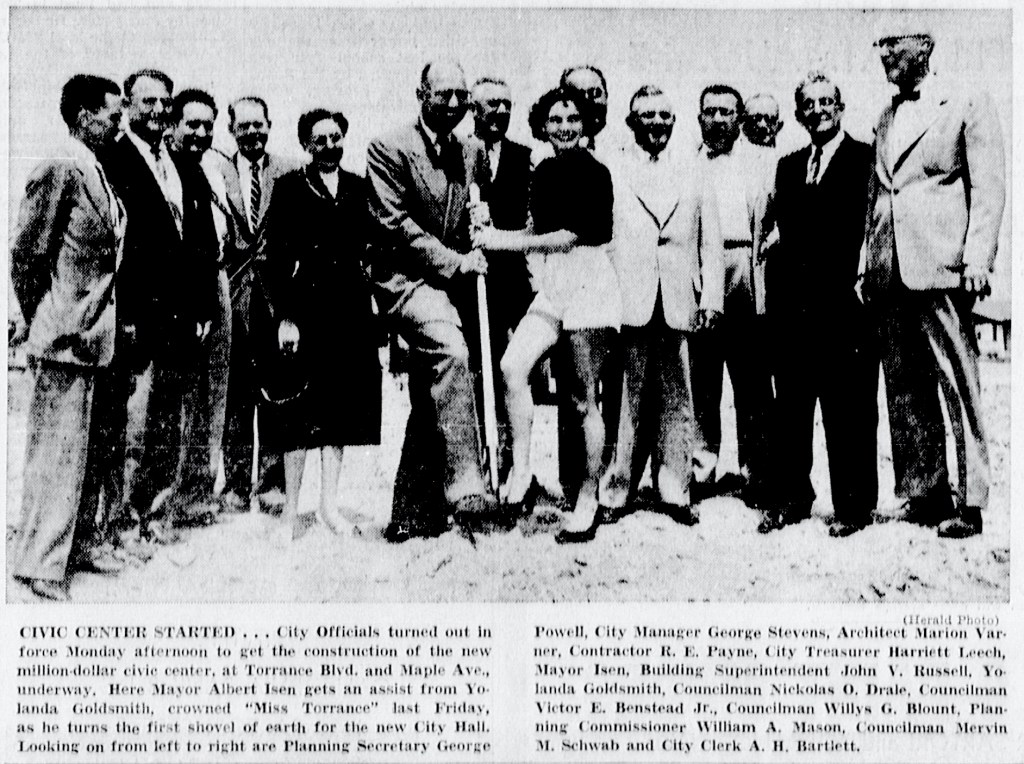
The passage of the bond measures meant full steam ahead for the civic center. The council hired Pasadena architect Marion J. Varner to design the huge facility. He came up with an ambitious, detailed plan, not all of which would be built during the initial phase of construction.
One segment which would not come to fruition immediately was the building of a new county courthouse proposed for the Maple Ave. side of the property. Political bickering would delay that addition until 1968.
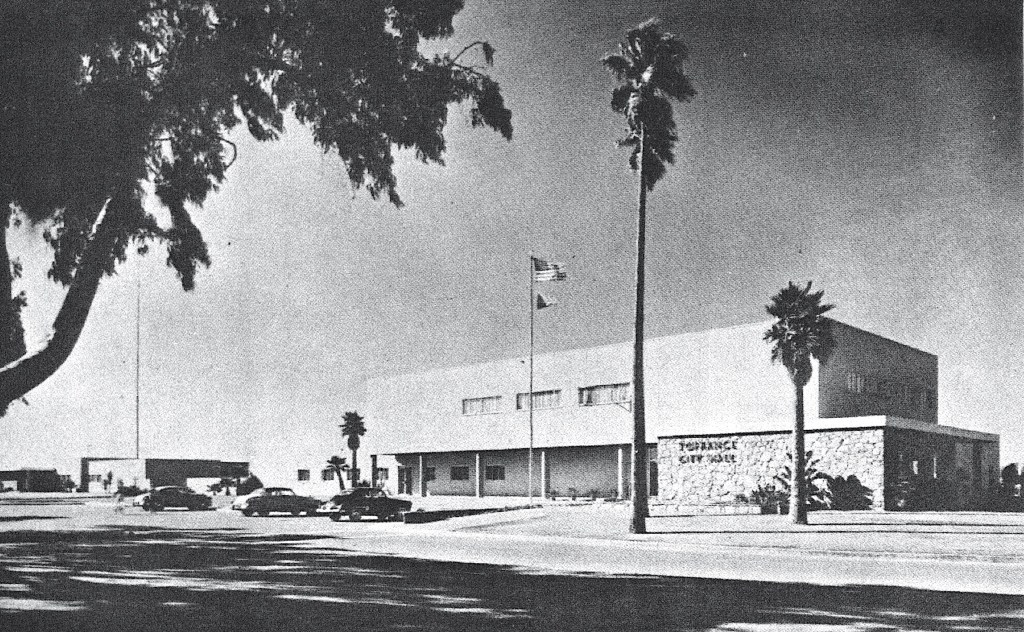
Other elements not added immediately included a new main library building (1971), an elaborate arts center (1991) and recreational facilities (soccer fields opened there in 2014). Even without all its pieces, the center as completed in 1956 cost an estimated $1.25 million.
Ground was broken for the new center on Aug. 1, 1955, with the new facilities slated to open in 1956. The next few months were spent planning additional details, this time for an onslaught of activities to celebrate the city government’s new home.
The wide-ranging dedication ceremonies couldn’t be contained to a single day, so they were scheduled for two days, Saturday and Sunday, Aug. 11-12, 1956.
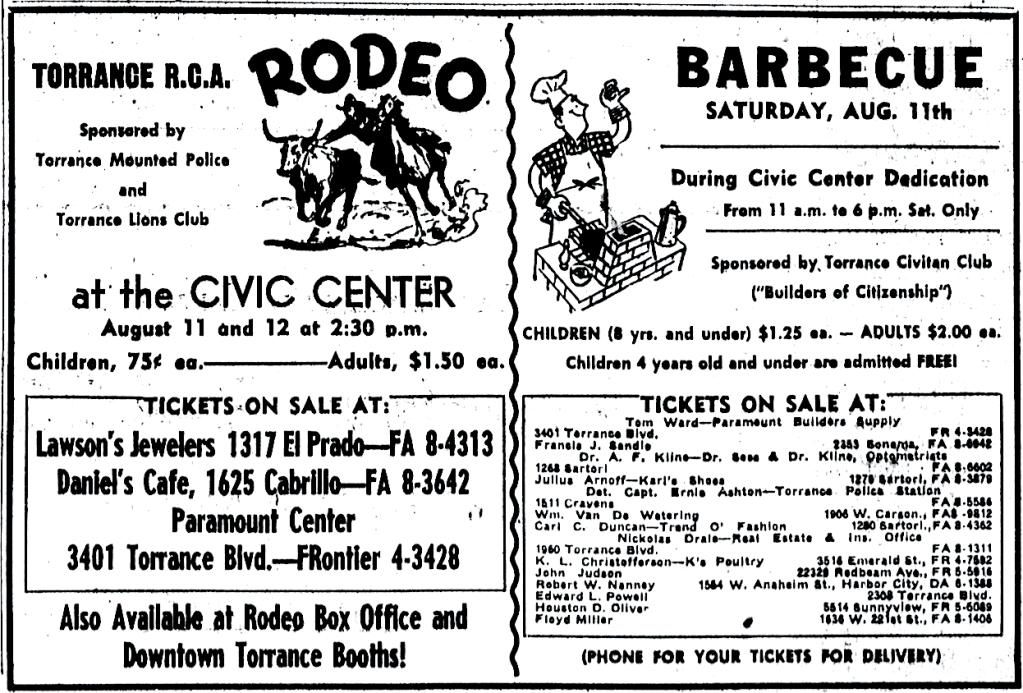
Here’s what was planned: a massive Saturday parade down Torrance Blvd. with 125 entries followed by the dedication ceremonies, rodeos on both afternoons, an evening watercade followed by a dance at the new swimming pool, a Saturday night barbecue and ongoing open houses and tours of the new police and city hall buildings.
The weekend was a smashing success. The Torrance Herald estimated that 65,000 people enjoyed the festivities. 3,000 of them signed the official guest book at city hall, and the parade drew the largest crowd.
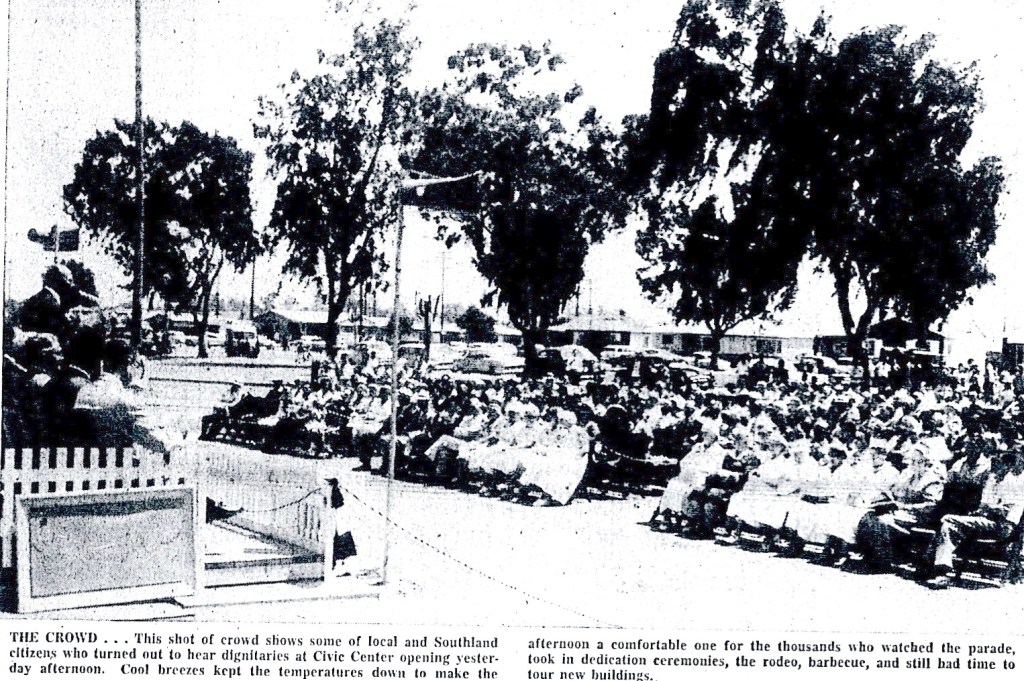
Dignitaries included California Lt. Gov. Harold Powers, who gave the keynote address, Los Angeles County Sheriff Eugene Biscailuz, Assemblyman Vincent Thomas, county supervisors Burton Chace and Kenneth Hahn, and of course, Torrance Mayor Albert Isen, the members of the city council and Miss Torrance of 1956, Gaye Wilson.
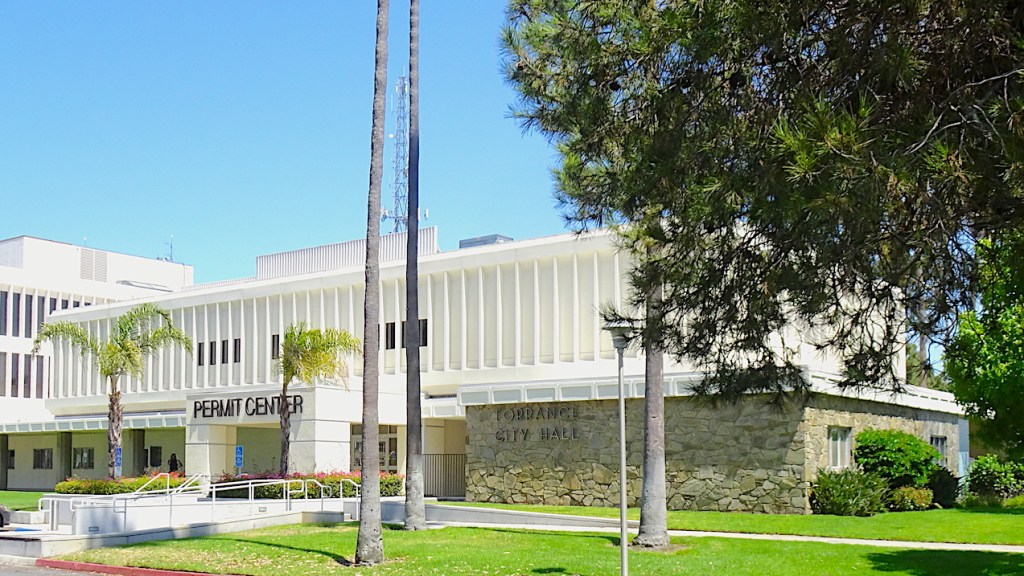
The city has spent the decades since revamping and updating its civic center, starting with a master plan adopted in November 1960. A three-story addition to City Hall was built in the 1980s, as was the new police headquarters building, which formerly had been located near City Hall.
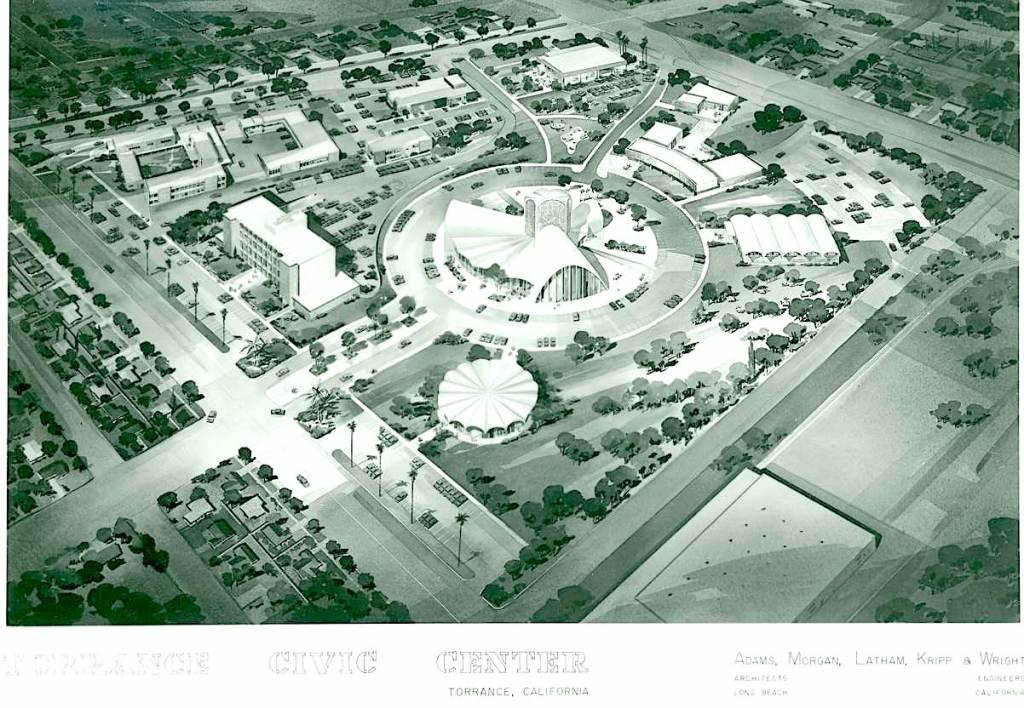
Plans for underground parking were formulated, fought over, and never built. Parking garages would have been built beneath a proposed recreation area with parkland, a lake and tennis courts, but neither came to pass. A renewed effort to cover the municipal plunge never became reality, and a second courthouse building has long been on the drawing boards but has yet to be undertaken.
A centralized permit center building next to the city hall did come to fruition in 2011 after the project had passed through the hands of four different mayors. The $1.9 million center allows those in need of more than 50 types of city permits to apply and receive them all in one place instead of having to locate each individual issuing department.
For a complex first built almost seven decades ago, the Torrance Civic Center continues to adapt to the changing needs of its employees and city’s residents remarkably well. It’s certainly lasted much longer than its downtown Torrance predecessor did.
Sources:
Daily Breeze archives.
Historic Torrance: A Pictorial History of Torrance, California, by Dennis F. Shanahan and Charles Elliott, Jr., Legends Press, 1984.
“History of the Civic Center,” City of Torrance website.
History of Torrance: A Teacher’s Resource Guide, Torrance Unified School District, 1964.
Los Angeles Times archives.
Torrance Press-Herald archives.
Note: Special thanks to Michael George, reference librarian, Torrance Public Library.