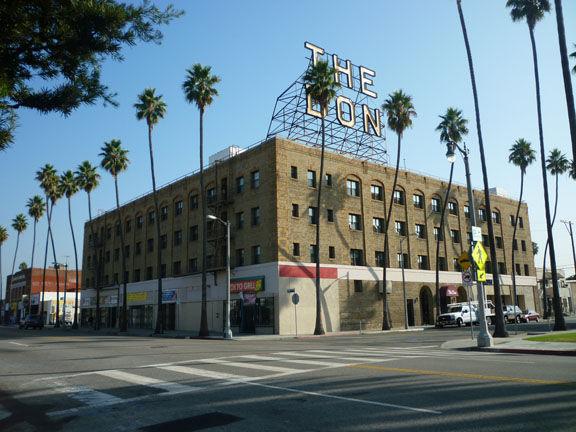
The Don Hotel


55475-donhotel-thumb-400x231-55474.jpgThis undated postcard shows the Don Hotel in Wilmington in the late 1940s.


When the Don Hotel held its gala opening in Wilmington on July 2, 1929, it was described as the largest and most modern hotel in the harbor district.

Its name came from Los Angeles investor Don Hundredmark, the hotel’s owner. The Wilmington construction firm A.M. McLellan began building the hotel on Dec. 26, 1928.

The four-story brick structure was located just up the street from the Wilmington harbor at the corner of Avalon Boulevard and I Street (its addresss is 105 E. I Street). It had 135 rooms, each with private bath, as well as a spacious lobby, a large basement ballroom, a cafe and several stores.

Hundredmark intended for the hotel to cater to tourists going to and from Catalina Island on ships such as the S.S. Avalon and the S.S. Catalina, the Great White Steamship, that had begun ferrying passengers to Catalina from its Catalina Terminal at Banning’s Landing in Wilmington.

During the hotel’s heyday in the 1930s, publishing magnate William Randolph Hearst had his own suite reserved, and crooner Bing Crosby was a frequent guest. In addition to Catalinia tourists, the Don also drew guests whose yachts were docked at the Wilmington harbor at the foot of Avalon Boulevard.

Avalon Boulevard had been renamed in December 1926 after the S.S. Avalon after existing for 75 years as Canal Street. Canal Street was literally a canal in Wilmington’s early years, before being filled in with dirt and becoming a regular road. (Apparently no pictures of Canal Street as a canal have survived.)

The Don Hotel’s central location made it an important part of community life, with many meetings and social events scheduled there over the decades.

The hotel began to fall on hard times over the years, and its owners failed to keep up its elegance.

By the 1980s, its clientele had changed from the prestigious to the homeless, who were allowed to stay there under an L.A. County welfare voucher program.

Its owner, Cesar Lopez, had trouble coming up with funds to make the structure earthquake-safe. In July 1988, he put the hotel on the market for $5.5 million, with potential buyers looking to tear down the hotel and develop the land. New owners were accused of being slumlords in December 1995, though they denied the charges.


55477-donfrontdoor-thumb-300x400-55476.jpgThe entrance to the Don Senior Apartments on I Street in Wilmington. September 2011 Daily Breeze photo.


Another option for the hotel other than selling it and tearing it down turned out to be its salvation. In June 1997, the City of Los Angeles approved a plan to convert it into a senior housing facility.

Following a $2.7 million renovation, the city began accepting tenants for the Don Senior Apartments in November 1999.

The venerable Don Hotel sign atop the building’s roof was taken down, and a restored sign with the same lettering that reads just “The Don” was erected in its place in February 2000.
As of this writing, the once-splendid hotel continues to function in its second incarnation as a senior housing complex.


55479-usethisdon-thumb-400x300-55478.jpgThe Don Senior Apartments, formerly the Don Hotel, in Wilmington. September 2011 Daily Breeze photo
.


Sources:

Daily Breeze files.

Los Angeles Times files, especially “Don Decays: End May be Near for Storied Wilmington Hotel, Now a ‘Rattrap,” by Sheryl Stolberg, July 29, 1988, and “Wilmington’s New Hotel Opens in May,” April 7, 1929, Page E9.

“Images of America: Wilmington,” Simie Seaman and Hank and Jane Ousterhoudt of the Wilmington Historical Society, Susan Ogle of the Drum Barracks Civil War Museum and Michael Sanborn of the Banning Residence Museum, Arcadia Publishing, 2008.


Extending Western Avenue

Western Avenue stretches from the southern tip of Griffith Park in the Los Feliz area of Los Angeles all the way down to Paseo del Mar at Royal Palms County Beach in San Pedro.

55356-westernsign-thumb-200x108-55355.jpgThe 28-mile thoroughfare is one of the longest streets in Los Angeles County. (Some say Sepulveda Boulevard is the longest at 42.8 miles from the north Valley to the Long Beach border; the two roads intersect at Torrance’s eastern border with Harbor City.)

A surveyor named Henry Washington first plotted the street in 1853, and it got its name because it was then considered to be on the far western border of the Los Angeles pueblo.

In its early days, plans were made to extend Western north, so that it could meet up with the Western Avenue in the city of Glendale, but that never came to pass.

Instead, the roadway eventually would connect downtown L.A. with myriad neighborhoods and communities stretching southward from Los Angeles to San Pedro.

Plans to complete the southern section of Western, from Torrance to San Pedro, had been discussed in the 1920s. Serious attention began to be devoted to the project in the mid-1930s. The County Board of Supervisors ordered a survey of possible routes and rights-of-way issues in April 1937.

At that point in time, the San Pedro section that connected Western between 1st and 25th streets ran along residential streets such as Dodson Avenue. City and county officials realized that cutting a 100-foot wide swath through this corridor would result in major upheaval to the residents, and sought instead to develop the street along unoccupied land west of the affected streets.


55358-westernin50s-thumb-400x275-55357.jpgWestern Avenue near 1st Street in San Pedro is a two-lane road in this undated 1950s file photo. Photo: San Pedro Bay Historical Society.


At roughly the same time, the section of Western between Torrance Boulevard and Anaheim Avenue began to undergo major widening and other improvements.

Both of these projects would take years to come to fruition. World War II intervened, placing them on hold for several years.

By July 1947, 75 percent of the rights-of-way needed to finish the Torrance-to-Lomita development of Western had been secured.

By December 1949, the Western Avenue project had progressed to the point where its builders, the Warren Southwest Construction Co., had completed two 12-foot concrete lanes running from Torrance through to the San Pedro section.

The four-mile section between Torrance Boulevard and Pacific Coast Highway in Lomita ended up being the final link to the completion of Western from Hollywood to San Pedro. It was opened in April 1950.

The section through San Pedro finally was completed as a direct thoroughfare all the way to the coast late in 1958, when work on the final segment between 9th and 19th streets was finished.

It would take many more years of improvements until the roadway began to resemble the major thoroughfare we know today.

Thanks to the persistence of Democratic Assemblyman Vincent Thomas, the California Highway Commission designated the section of Western from the San Diego (405) Freeway south  to 25th Street in San Pedro as California State Highway 213 on Sept. 21, 1967. The segment north of the freeway remains a regular city street. A very long one.


55361-westernsigns-thumb-300x332-55360.jpgNear The Skating Edge ice rink in Harbor City. September 2011 Daily Breeze photo. 


Sources:

Daily Breeze files.

Five-part front page series on Western Avenue by Patt Morrison, Los Angeles Times, July 7, 1985 – Aug. 4, 1985.

San Pedro: A Pictorial History, By Henry P. Silka, San Pedro Bay Historical Society, 1993.

Torrance Herald files, especially “Western Extension Gains Impetus,” April 15, 1937, Page 1, and “Western Avenue Extension Takes Shape With New Concrete Lanes,” Dec. 8, 1949, Page 12.

Isidore B. Dockweiler

55204-dockweilerlc-thumb-187x544-55203.jpgIsidore B. Dockweiler, left (photo: Library of Congress), was born into a prominent Catholic family at a home near First and Broadway in downtown Los Angeles on Dec. 28, 1867. He excelled in academics, becoming the first person to earn a bachelor’s degree from St. Vincent’s College, an early precursor of Loyola Marymount University.

Dockweiler worked as a bookkeeper and then a surveyor before being admitted to the state bar as a lawyer in 1889. He married his wife Gertrude in 1891 in San Francisco.

He remained a devout Catholic his whole life. In 1924, he was named one of the Knights of St. Gregory by Pope Pius XI. He and Gertrude had eleven children together, several of whom became attorneys and judges.

Dockweiler also had an aptitude for politics. He ran for  Lieutenant Governor in 1902, was a delegate to two national Democratic conventions and a member of the Democratic National Committee from 1916 to 1932. He served on the Board of U.S. Indian Commissioners under President Woodrow Wilson.

He also played a key role in the development of the Los Angeles Public Library, serving as its president from 1901-1911.

Later in life, Dockweiler became active in improving Los Angeles’ public park system. He served as chairman of the Los Angeles County Parks Committee, which was formed in early 1940 “to obtain funds for parks and recreations purposes, preserve beaches for public uses and aid in regional planning for development of this area.”

The group’s first action after forming was to propose the formation of a huge 1,800-acre park in Palos Verdes. The proposed recreational area would have stretched from the present-day Royal Palms County Beach/white Point Park northwest across the inside edge of the Palos Verdes Peninsula Hills to the southern edge of Torrance.

Dockweiler and his committee enivisoned developing the park in a way that would remind visitors of Hyde Park in London or Golden Gate Park in San Francisco. Unfortunately, the County Board of Supervisors nixed the plan, deciding that the Committee’s strategy to finance the acquisition of the land was “not legally feasible,” and the proposed park never came to fruition.

Dockweiler died at St. Vincent’s Hospital while being prepped for minor kidney surgery on Feb. 6, 1947. He was 79.

Hundreds of friends and admirers attended Dockweiler’s funeral on Feb. 10, including Los Angeles Mayor Fletcher Bowron, County Sheriff Eugene Biscailuz and actor Leo Carrillo. (Carrillo co-starred as Pancho in the television series “The Cisco Kid,” and had a beach park near Malibu named in his honor for his years of service on the state beaches and parks commission.) Archbishop John J. Cantwell presided over the service, with Bishop (and future Cardinal) Timothy Manning paying tribute to Dockweiler during his sermon.

On Jan. 27, 1955, the State Park Commission changed the name of the Venice-Hyperion Beach State Park to the Isidore B. Dockweiler Beach State Park in his honor.
A plaque honoring Dockweiler was placed at the beach in June 1955, following its presentation at a St. Vincent’s College reunion dinner on June 6, 1955, headlined by Jimmy Durante.


55206-dockweilerentrance-thumb-300x400-55205.jpgDockweiler State Beach was renamed in 1955. Daily Breeze photo, September 2011.


Dockweiler State Beach has become known over the years for several distinctive features. Located underneath the flight path of Los Angeles International Airport, it’s also one of the few L.A.-area beaches with fire pits. Recreational vehicles have used a special parking lot for years as a long-term camping spot.


55210-dockweilerrvs-thumb-400x242-55207.jpgThe long-term RV parking lot at Dockweiler State Beach can be seen at left center of this September 2011 Daily Breeze file photo.


Hang gliders also have taken off from the bluffs overlooking the beach for decades. Following a 13-year period during which hang-gliding was banned for liability reasons, the Dockweiler State Beach Hang Gliding Park was opened in 1999.

In June 2005, a State Senate committee turned down a plan to open a dog park on a portion of Dockweiler. In January 2008, construction began on the Dockweiler Youth Center, which opened in October 2009. The center is used both for training youths in aquatic sports and safety, and as a community recreational facility.

Sources:

Daily Breeze files.

“Dockweiler Family History,” Loyola Marymount University Special Collections Dept., http://library.lmu.edu/Collections/specialcollections/CSLA_Research_Collection/CSLA_Research_Collection__Dockweiler_Family_Collection/Dockweiler_Family_History.htm.

Los Angeles Times archive stories, especiallly “Isidore B. Dockweiler, Dean of Lawyers, Dies,” Feb. 7, 1947, Page 1, “Park Project Move Looms,” Apr. 22, 1940, Pge A2, “County Park Deal Blocked,” May 9, 1940, Page A2.


Palos Verdes Surfing Club


55057-docballsurfs-thumb-400x261-55056.jpgPalos Verdes Surfing Club founder John “Doc” Ball catches a wave at Bluff Cove in this undated file photo from the 1940s.


55061-hoppy-thumb-150x381-55060.jpgFenton Scholes and Richard Meine, both 93 years old, are the only two members remaining of a group that used to meet for lunch every Tuesday at Hennessey’s Tavern in Redondo Beach.

The group, which numbered five as recently as August of 2010, once included Adolph “Adie” Bayer, LeRoy Grannis, Lewis Earl “Hoppy” Swartz (shown at right in a 1988 Daily Breeze file photo), E. Calvin “Tulie” Clark,  Cliff Tucker and others whose membership in the Palos Verdes Surfing Club dated as far back as the 1930s.

One of the first and most enduring mainland surfing clubs in the U.S., the Palos Verdes Surfing Club began in the mid-1930s, in either 1934 or 1935 depending on the account, by Hermosa Beach dentist John Heath “Doc” Ball and Adolph “Adie” Bayer. It held its regular meetings in a back room at Ball’s dentist office on Vermont Avenue in Los Angeles.

The Palos Verdes Surf Club had its own distinctive green club jackets. Smoking was forbidden during meetings, and the group had its own creed, in which members swore to “at all times strive to conduct myself as a club member and a gentleman.” In addition to its own activities, the PVSC organized and conducted surfing contests and popular paddleboard race events between themselves and other clubs that had begun to spring up along the Southern California coast in Santa Monica, Venice, San Onofre and Del Mar.

The club’s members were part of a a fairly small group of surfers in that era, 25 years before surfing started to become a national phenomenon. Its members say there were so few surfers back then that if a car went by on the highway with a surfboard sticking out, chances were better than good that both parties knew each other.

The surfing culture was new, and there was much more of a fraternal feeling than there is now. As Scholes tells it, “When we surfed, everyone who went for the wave got it. There wasn’t any ‘This is my wave’ stuff. Everybody rode together, four or five guys on a wave. If some guy was next to you, you pulled his board in (onto the wave). You didn’t pull him out.”

The Palos Verdes Surfing Club used Bluff Cove in Palos Verdes Estates as its home surfing base. In the 1930s, an access road led about three-quarters of the way down to the beach. This made life easier for the surfers, who usually were carting 9-to-12 foot surfboards that could weigh over 100 pounds.

The road was closed off from the beach during World War II for security reasons, and never reopened. Fortunately, the boards had grown somewhat lighter by then, weighing more in the 40-pound range.


55067-grannis-thumb-300x462-55065-thumb-300x462-55066.jpgPalos Verdes Surfing Club member LeRoy Grannis surfing with his waterproof Nikonos camera in Hermosa Beach in 1969. Copyright 2006,  San Diego Union-Tribune/Zuma Press.


Ball, a Hermosa Beach dentist, was a pioneering surfing photographer. When the surf was up, he would grab his Graflex camera strap between his teeth, paddle out, stand up and snap away. He also used a 16mm movie camera, with which he once recorded footage of members of the PVSC taking Oscar the Surfing Snake, the club’s one-time mascot gopher snake, for a ride during which he was filmed “hanging 10” on a surfboard.

His 1946 photo collection, California Surfriders, 1946, was a landmark work, and has been reprinted twice since its initial publication. (The most recent reprint came out in 1995 under the title Early California Surfriders.)

Ball also is credited with encouraging legendary surfing photographer LeRoy Grannis to pursue seriously his practice of shooting surfing photos as a way to relieve stress from his day job with Pacific Bell.

55059-docballskateboard-thumb-150x239-55058.jpgGrannis, who died at 93 on Feb. 3, 2011, went on to become the sport’s premier photographer during its golden age in the 1960s.

As for Doc Ball, he later moved to Eureka, where he continued to ride waves – and skateboards in the July 1987 Daily Breeze file photo at left – well into his 80s. Ball died on Dec. 5, 2001.


55064-tulieclarkcrop-thumb-200x399-55062-thumb-150x299-55063.jpgHistorical groups such as the Surfing Heritage Foundation have kept this era alive through a series of oral histories with those who were there in the 1930s. Check out this clip from an oral history session with PVSC members Fenton Scholes and Tulie Clark. Clark, shown at right in a July 2006 Daily Breeze file photo, died on April 30, 2010.

The Surfing Heritage Foundation website also hosts “Legendary Surfers,” a  treasure trove of surfing history essays by Malcolm Gault-Williams that is a must-read  for anyone with an interest in the subject.


Sources:

Daily Breeze files.

“Surf club founded in 1930s has home in Redondo,” by Annie Lubinsky, The Beach Reporter,
http://www.tbrnews.com/articles/2010/08/09/redondo_beach_news/news13.txt

“Legendary Surfers: A Definitive History of Surfing’s Culture and Heroes,” by Malcom Gault-Williams, http://www.legendarysurfers.com/.


Harbor Hills Housing Project


54946-hhoffice-thumb-400x299-54945.jpgEntrance to the office at the Harbor Hills Housing Project in Lomita. August 2011 Daily Breeze photo.


The Harbor Hills Housing Project in Lomita began with a $60,000 grant from the federal government under the direction of President Franklin Delano Roosevelt. The grant money was used to prepare plans for the $1,000,000 low-income facility. Funding for the Carmelitos Housing Project in North Long Beach was authorized at the same time.

The two projects were among Roosevelt’s first federally mandated housing projects following the passage of the Housing Act of 1937, which called for federal subsidies for local public agencies in order to create low-income housing for struggling families during the Depression. (The Housing Act of 1934 had created the foundation for the move to federally subsidized housing with its creation of the Federal Housing Administration (FHA)).

The Harbor Hills funds were received in early March 1939, with architectural plans for the project mostly completed by the firm Associated Architects in late May. Initial construction at the site near the intersection of Western Avenue and Palos Verdes Drive North had begun before then on March 17, 1939, and by late October 1940, 80 percent of the structures were completed.

As originally built, Harbor Hills consisted of 52 buildings, with 4 to 10 housing units in each, for a total of 300 dwellings. The units contained from one to three bedrooms, some with two stories. Rents ranged from $17 to $20 a month depending on number of bedrooms, and were limited to those in financial need. Utilities were subsidized, and the units came with heaters, ranges, refrigerators and water heaters.

Tenants began moving into Harbor Hills in January 1941, and 112 families were living there by September 1941.


54950-harborhills2-thumb-400x262-54949.jpgHousing units at the Harbor Hills Housing Project. August 2011 Daily Breeze photo.


Former Lomita city councilman Jerry Moore writes about living in Harbor Hills in its early days in the local history book “Lomita: A Century Remembered”:
“If there was a negative stigma to living in a housing project back then, my brother Mike and I never felt it at Harbor Hills. We have nothing but good memories from the experience, and I am sure most others from our generation feel the same.”

Moore also remembers that major league baseball’s first $100,000 “bonus baby” signing, Paul “Lefty” Pettit, lived in Harbor Hills. A Feb. 9, 1950 Los Angeles Times article notes that the Pettit family had to move out of their house in the project because the left-handed pitcher’s contract offer from the Pittsburgh Pirates exceeded the $3,000 annual upper income limit required to live there.

Like most public housing projects, Harbor Hills has had its share of problems with gangs, drugs and crime over the years, despite being more favorably located than many public housing projects. The bulldozing of Normont Terrace in Harbor City in 1995, and the razing of Dana Strand in San Pedro in 2003 leaves Harbor Hills and Rancho San Pedro as the only remaining public housing projects in the South Bay and Harbor Area.


54948-harborcenter-thumb-400x265-54947.jpgVisitors take a look at the newly completed community center at the Harbor Hills Housing Project in this October 2004 Daily Breeze file photo.


The Harbor Hills complex has undergone periodic remodelings of its aging buildings, and a new community center with an indoor gym opened there in October 2004. A renovation of kitchen facilities in 201 of the complex’s units was approved in July 2011.


Sources:

Daily Breeze files.

“Housing Project Eviction Notice Served on Pettits,” Los Angeles Times, Feb. 9, 1950, Page C2.

Lomita… A Century Remembered, by Jim Cole, City of Lomita, 2007.

Torrance Herald files.

The Redondo Barn

54769-pavilionearly-thumb-400x301-54768.jpgCrowds mill around the Redondo Beach Pavilion in this undated file photo from the early 1900s. The saltwater Plunge, built in 1909, can be seen at rear left.

When Henry Huntington began to develop a recreation sone along El Paseo Avenue next to the ocean in Redondo Beach designed to attract riders on his Pacific Electric Red Cars to the seaside burg, one of the first structures he had built was the Redondo Beach Pavilion.
The Pavilion opened in 1907, two years before the ornate saltwater Plunge was completed next door.

54773-arcade-thumb-400x257-54772.jpgThe bottom floor of the Pavilion, shown above in a 1908 postcard, contained shops, a theater and a restaurant, but it’s the second floor of the three-story building that is the subject of today’s post.

The Mandarin Ballroom could seat 4,000 people, and had a beechwood dance floor that could accommodate 500 couples. From the beginning, it was a popular attraction, drawing large crowds to dance to the live orchestras that appeared there regularly. By 1936, the Mandarin was well enough established to attract the likes of Benny Goodman and his orchestra, featuring singer Helen Ward.

54778-spikejones-thumb-144x253-54776-thumb-100x175-54777.jpgWhen the saltwater Plunge was demolished in 1941, it was converted into a parking lot used by patrons of the Mandarin’s increasingly popular dance concerts. The 1940s were the venue’s heyday, featuring regular appearances from traditional swing bands, Latino bandleader Tony Alvarez, zany antics from Spike Jones and his City Slickers (left), and several performers from the newly minted Western swing genre. Bob Wills and his Texas Playboys played a regular Wednesday night gig at the Mandarin in the mid-1940s, as did rising star Spade Cooley and his orchestra.

In April 1946, cowboy actor, country disc jockey and bandleader Texas Jim Lewis got the approval of the Redondo Beach City Council to run the newly renovated Mandarin Ballroom under a new name: Texas Jim’s Redondo Barn.


54784-Texas_Jim_Lewis1937-thumb-245x320-54783.jpgTexas Jim Lewis, center, and his Lone Star Cowboys in a 1937 publicity photo.

54780-spadelong-thumb-200x503-54779.jpgThe Redondo Barn’s heyday coincided with Western swing’s peak popularity, and reports of weekend crowds of 10,000 people to see acts at the venue were not uncommon. It became part of a regular circuit of Western music venues that included the Venice Pier Ballroom, the Riverside Rancho in the Los Feliz area, the Santa Monica Ballroom and the Town Hall Ballroom in Compon.

Texas Jim Lewis and his Lone Star Cowboys were the house band, playing regular weekend stands there as early as June 1946. A July 1946 Torrance Herald story mentions an upcoming appearance by Bobby Blake, Little Beaver from the Red Ryder cowboy serial, at the Redondo Barn. He would grow up to be actor Robert Blake.

Sporting events also were held there, including boxing matches and regular pro wrestling matches every Thursday night.

Texas Jim Davis left the Redondo Barn in 1950, moved to Seattle, and became the hugely successful host of the children’s television show “Sheriff Tex’s Safety Junction.” (Two years later, Los Angeles got its own children’s lawman when “Sheriff John’s Lunch Brigade” began a long local run on KTTV Channel 11.)

Spade Cooley made regular appearances at the Redondo Barn through the early 1950s, and also went on to success as the host of a Western swing music show on local television, “The Hoffman Hayride.” His story would end in tragedy when he was convicted of first-degree murder for the killing of his second wife, Ella Mae Evans, in 1961. He died in 1969.

The Redondo Barn’s popularity began to wane later in the 1950s, and eventually ceased operation. Redevelopment and the construction of King Harbor led to the building’s demolition in December 1960.

Streets such as El Paseo and Pacific Avenue were no more, and water for the new harbor filled in the land where the Pavilion and its ballroom once stood.


54782-harbornow-thumb-400x287-54781.jpgWater for the new harbor being built in Redondo Beach flows into where the Pavilion/Redondo Barn once stood in this April 11, 1961 file photo.


Sources:

Daily Breeze files.

Images of America: Redondo Beach Pier, By Jennifer Krintz, Arcadia Publishing Co., 2011.

Torrance Herald files.


Lawndale gas explosion


54676-gasbreeze1-thumb-400x529-54674-thumb-400x529-54675.gifWhen Joseph H. Johnson, owner of a small general store in Lawndale at 4104 W. Compton Boulevard (renamed Marine Avenue in 1988) , had a crew out on Dec. 29, 1952 to install a sewer line into his building, he warned the workers to be careful about the underground gas line beneath where they were excavating.

Unfortunately, at 11:45 a.m., the crew’s ditching machine struck the gas pipeline, and the resulting explosion and fire ended up injuring 12 people, 2 of whom later died from burns suffered in the blast and ensuing flames.

Witnesses said the explosion, which blew out windows for a mile around, felt like an earthquake. Nearby Osage Street resident George Whitney said it knocked his young daughter out of her bed and felt like “the biggest earthquake you can imagine.”

The Los Angeles Times described the scene as a “Bikini-like inferno,” referring to the then-recent nuclear weapons tests held at Bikini Atoll in the South Pacific.

The four-inch-diameter pipeline carried  gasoline from Ventura to the Shell Oil Co. refinery in Carson. The gasoline-fed blaze continued unabated for an hour before company officials could cut off the flow.

Firemen didn’t dare try to extinguish the blaze at its source while the gasoline still was flowing, as to do so would have further spread flames onto the nearby street and buildings, risking further damage and loss of life. Once the valve was closed, the flames diminished, but the fire wasn’t extinguished completely until 4 p.m.

Charles Edinger, the 53-year-old head of Edinger Cesspool and Drilling Co. suffered second and third degree burns over 50 percent of his body. He was sent to Washington Hospital in Culver City in critical condition.

His co-worker Thomas Annastas of Redondo Beach also was burned severely, but his injuries weren’t as life-threatening as Edinger’s. Ultimately, both would survive the blast, but two members of the Arredondo family did not.

Margarito and Natividad Arredondo operated a small grocery next to the Johnson store, and lived with their 10 children at the rear of the store.

The Dec. 29 blast blew through their store and living quarters, seriously injuring the Arredondos and seven of their children. At the time of the blast, Mrs. Arredondo and her 2-year-old daughter Margaret were listed in critical condition at Harbor General Hospital (now County Harbor-UCLA Medical Center).

Burned over more than half of her body, Mrs. Arredondo evenutally died. Margaret survived, but another daughter, 14-year-old Rachel, also died later from injuries suffered during the conflagration.

Authorities estimated the damage from the explosion and fire at $25,000, not including damage to the pipeline itself and the cost of the lost gasoline.

17 defendants filed lawsuits against Shell Oil, contractors Honeycutt & Lindsay Co. and plumbing contractor John H. Phillips, the man who hired Edinger’s firm. After lengthy court proceedings and a 2-month trial, damages totaling $395,815 were awarded in July 1956.

Edinger was awarded $133,933, Annastas, $48,189, and the Arredondo family was awarded $71,023. The remainder of the settlements went to less seriously injured victims of the explosion and fire.


Sources:

Daily Breeze files.

“17 Awarded $395,815 in Lawndale Blast Case,” Los Angeles Times, July 20, 1956, Page B1.

“12 Injured in Explosion of Gasoline,” Los Angeles Times, Dec. 30, 1952, Page 1.


Note:

Thanks to Lawndale historian Jim Osborne for pointing out another gas pipeline accident in Lawndale that occurred in 1932:

“Twenty years earlier a similar incident happened in Lawndale. In December 1932, a ruptured pipeline belonging to the Standard Oil Company spilled gasoline in Lawndale’s gutters and formed about a quarter-acre lake. People began saving the gas into whatever they could find – tanks, tubs, buckets etc.in order to salvage the free gas. One person actually claimed to save about 200 gallons. Luckily, there was no fire or explosions from the incident. The company eventually repaired the line and recovered about ten barrels from the spill.”


North American Aviation

54397-NorthAmericanAviation-thumb-150x143-54396.gifIncorporated on Dec. 6, 1928, North American Aviation’s formation followed the founding of the Boeing Company in 1916 and Douglas Aircraft in 1921. For its first few years, North American operated as a holding company, owning parts of many other aviation firms, including Douglas and General Aviation Manufacturing Corp. in Dundalk, Maryland.

In 1934, federal antitrust legislation required that the company give up its holdings in other aircraft companies. At that point, under engineer Dutch Kindelberger and designers Lee Atwater and J.S. Smithson, North American became an aviation manufacturer, moving into General Aviation’s plant at Dundalk.

Its stay there would be temporary. After the company won its first airplane contract for 42 NA-16 trainers in 1935, Kindelberger began moving North American’s manufacturing operations west.

He built temporary quarters in El Segundo near the southeast corner of Mines Field, more than a decade before it became Los Angeles International Airport. The company rented 20 acres there for $600 a month. A permanent factory was finished on the site and occupied in January 1936, with 250 employees.

North American’s location has been confused over the years by the company’s use of an Inglewood mailing address. Also, it eventually would build facilities on property both in El Segundo and in the city of Los Angeles.

The NA-16 trainer, the first U.S. military plane to have an official model number, which would evolve into the BT-9 and then the AT-6 Texan, became an important aircraft in the training of American and British pilots. The company focused on such smaller planes at first, choosing not to compete with larger operations which could produce bigger, multi-engine planes.

These trainers became essential with the outbreak of World War II and the resultant need to train thousands of men quickly to become pilots. By the time of the Pearl Harbor attack, North American’s employment had risen to 23,000 people, and it was producing more than 300 aircraft per month.


 54402-naab25assemblycolordark-thumb-400x310-54398.jpgView of the B-25 final assembly line at North American Aviation’s El Segundo plant in 1942. Photo: Alfred T. Palmer. Photo credit: Library of Congress.

In 1939, North American had begun developing a twin-engine bomber that eventually evolved into the B-25 Mitchell bomber. Named after the late air warfare pioneer Gen. Billy Mitchell, the planes went into production in 1939.


54401-naabetterb25-thumb-288x212-54400.jpgNew B-25 bombers lined up for final inspection and tests at the flying field of North American Aviation. July 1942 photo. Photo credit: Library of Congress.

The B-25 became famous when Col. Jimmy Doolittle used them in his famous raid on Tokyo on April 18, 1942. Immortalized in the book and film “Thirty Seconds Over Tokyo,” The Doolittle raid was the first U.S. air attack on the Japanese mainland and was an important morale booster early in the war effort.


54404-naap51s-thumb-288x205-54403.jpgP-51 Mustang fighter planes being prepared for test flight at the field of North American Aviation in October 1942. Photo by: Alfred T. Palmer. Photo credit: Library of Congress.

Perhaps the company’s most outstanding wartime achievement was the development of the P-51 Mustang fighter. The plane grew out of Great Britain’s desire to purchase more P-40 Flying Tiger fighters from the U.S.


54406-naap51inflight-thumb-288x208-54405.jpgNorth American’s P-51 Mustang fighter plane in flight in October 1942. Photo by: Mark Sherwood. Photo credit: Library of Congress.

Lee Atwood convinced the British that North American could provide it with an even better fighter. A prototype of the proposed new design was rushed into production and first flew on Oct. 26, 1940. Britain had the planes in service by April 1941. Its first engine had performance problems, but once Rolls Royce engines began to be used in the P-51s, their superior performance made them one of the most important Allied weapons of the war. By war’s end, more than 5,000 P-51s were in service for the U.S.


54413-naaworkersbw-thumb-400x308-54407.jpgEmployees enter the North American Aviation manufacturing plant in El Segundo in this undated photo, circa 1942. Photo credit: Library of Congress.

A bitter strike hit the plant in June 1941. Because of the threat to national security, President Franklin D. Roosevelt considered the strike an emergency, and ordered federal troops sent in to safeguard the plant. A few months later, Roosevelt wrote in a Collier’s magazine article that the strike had been “inspired and directed by Communist forces, interested not  in the advancement of labor but in the defeat and overthrow of the United States.” The strike was settled peacefully with the signing of a new contract on July 1, 1941.

The ramped-up war effort led to the opening of additional North American plants in Kansas City, Mo. and Dallas, Texas in addition to the El Segundo plant. The Hollywood Park horse racing season was canceled in 1943 when North American leased out the racetrack to get more space for production.


54410-naarosie-thumb-288x223-54409.jpgA North American Aviation employee works on an airplane engine in this undated photo. Photo credit: Library of Congress.

The company turned out more than 40,000 airplanes during the war, including 9,498 B-25 Mitchell bombers, 15,586 P-51 Mustangs, and 15,498 trainers of various types. North American built 14 percent of all aircraft produced by U.S. manufacturers for the war effort.

The firm’s orders dropped off rapidly after the war ended, causing it to close its plants in Kansas City and Dallas. North American engineers already had been working with the new jet engine technology, and now that effort moved forward quickly with the company producing a variety of postwar jet fighter designs.

The company hit the jackpot with the F-86 Sabre Jet, the Air Force’s first swept-wing fighter jet. Its first test flight was in 1947, and it went into production in 1948. It would become the premier fighter plane of the Korean War, which began in 1950. North American expanded again, ramping up production in El Segundo and building plants in Downey and Columbus, Ohio to keep up with demand.


54412-faaf86s-thumb-400x202-54411.jpgF-86 Sabres with their 51st Fighter Interceptor Wing “Checkertails” are readied for combat during the Korean War at Suwon Air Base, South Korea. Credit: USAF photo.

The company produced a variety of jet airplanes during the 1950s, including the F-100 series of fighters. It also presaged the space program with its development of the X-15 rocket research plane, whose test flights began in June 1959 and ran through 1968.

Starting in 1951, North American’s Downey plant also began developing and producing rocket engines for Atlas, Thor and Jupiter missiles during the 1950s, as well as the early Redstone boosters that would later be used for the first Mercury space flights. It formed a separate company, Rocketdyne, in Canoga Park, to produce rocket engines. North American’s Rocketdyne unit later would produce rocket engines that would power the Gemini and Apollo space programs, including the second stage rocket of the massive Saturn V that launched the Apollo 11 moon landing.

In September 1967, North American merged with the Rockwell Standard Corp. to become North American Rockwell Corp. In July 1972, it won the $2.6 billion contract to develop the space shuttle at the Downey plant. In February 1973, the company officially was renamed Rockwell International Corporation.


54415-naab1bomber-thumb-400x265-54414.jpgLightning strikes behind a B-1B Lancer during an evening thunderstorm, Sept. 9, 2010, at Ellsworth Air Force Base, S.D. Photo credit: USAF, Senior Airman Corey Hook.

After work on the B-1 Bomber program, another huge defense contract won by Rockwell, slowed in the late 1980s, the company began reducing its operations at its El Segundo facilities. Many of its employees were laid off in the aerospace industry downturn of the early 1990s. In October 1993, Rockwell announced it would shut down almost all its operations in the South Bay, transferring most employees to its Seal Beach and Downey plants.

In December 1996, Rockwell International Corporation’s aerospace and defense divisions, including Rockwell’s space systems unit, guidance systems firm Autonetics and Rocketdyne, merged with the Boeing Company and were renamed singly as Boeing North American Inc. The unit later was integrated into Boeing’s Defense division. Rocketdyne was sold to United Technologies in 2005.

The buildings on the North American site in El Segundo were demolished after Rockwell left the South Bay so that the land could be sold. The Campus El Segundo development currently is under construction there.


Sources:

Boeing corporate history, http://www.boeing.com/history/narrative/n022naa.html.

California Wings: A History of Aviation in the Golden State, by William A. Schoneberger with Paul Sonneburg, Windsor Publications, 1984.

Daily Breeze files.

El Segundo: Seventy-Five Years: A Pictorial History of El Segundo, California, by Eileen Curry Hunter, H2 Limited, 1991.

“North American Plane Plant Strike Alien Sabotage Plot, Says President,” Los Angeles Times, Oct. 10, 1941, pg. 16.

Prints and Photographs Online Catalog, The Library of Congress, http://www.loc.gov/pictures/.

Note: Post modified to include clarifying information on North American’s physical location in El Segundo and Los Angeles.

Carib Star bombing


54231-caribstarnew-thumb-400x214-54230.jpgThe Carib Star before the explosion. Avalon can be seen in the distance. Photo: Jeannine L. Pedersen and the Catalina Island Museum.


Introduced in 1974, the 147-foot, $2.5 million passenger ship the Carib Star was part of the same passenger fleet as the S.S. Catalina. Owned by M.G.R.S., the same investor group that owned the Great White Steamship, it was roughly half the length of that 305-foot vessel, with a carrying capacity of 598 passengers.
The Carib Star was docked at Berth 95, just south of the Vincent Thomas Bridge, on April 10, 1975, when an explosion ripped through the engine room at 10:38 p.m. No one was aboard at the time.


54233-caribnightsink-thumb-400x292-54232.jpgThe Carib Star sinks after a bomb exploded in its engine room. Daily Breeze file photo.


The blast caused the ship to take on water and eventually sink. No fire was reported. L.A. city firemen attempted to use pumps to keep the Carib Star afloat, but it sank into the harbor about two hours after the blast.
Shortly after the ship sank, the Long Beach Independent Press-Telegram got an anonymous phone call claiming credit for the blast. “You can tell those people not to sell the steamer to the Arabs. This is just a warning,” the caller said. The call was a reference to rumors that circulated in the fall of 1974 that the S.S. Catalina was about to be sold to a group of Kuwaiti investors. The deal never came to pass.
On April 17, 19-year-old self-described explosives expert Phillip John Goodman of the Jewish Defense League (JDL) was arrested for the Carib Star bombing and 5 other bombing incidents in the L.A. area. JDL chief Irv Rubin denied the charges against Goodman vehemently. They were dropped in early May 1975 due to insufficient evidence.
Two months later, the S.S. Catalina herself fell victim to saboteurs. On Thursday, June 12, sand was dumped into the ship’s main bearings, and the ship’s main electric cable was smashed by a hammer. A bomb threat also had been made against the ship on Wednesday, June 11. A man identifying himself as Tony Zar of the “Army of Cambodia” warned that a bomb would explode on the S.S. Catalina at 11:45 p.m. that evening. No bombing occurred, and the ship was back in service by June 14. It would make its last Catalina journey later that summer, on Sept. 14, 1975.


54235-caribdaysink-thumb-300x416-54234.jpgThe Carib Star the morning after the bombing, with the Vincent Thomas Bridge above left. Daily Breeze file photo.


Though the Carib Star had sunk into the harbor’s sandy bottom, it was not a total loss. The Coast Guard lifted it from the harbor to investigate, and the Carib Star later was towed to the Al Larson Boat Works on Terminal Island for examination and repairs.
The blast had ripped a large hole in the ship’s hull in the engine room. All the engines had to be removed in order to make the repairs, which took about six months to complete. The ship eventually ended up in San Francisco.
No culprit ever was apprehended in the Carib Star bombing.


Sources:

“Bomb Is Suspected in Blast That Sank Ship,” By Jack Jones, Los Angeles Times, April 12, 1975, Page B1.

Daily Breeze files.

Images of America: Catalina By Sea: A Transportation History, By Jeannine L. Pedersen and the Catalina Island Museum, Arcadia Publishing, 2006.

“JDL Member, 19, Charged in Bombings,” By John Kendall, Los Angeles Times, April 18, 1975, Page 30.

“S.S. CATALINA | ‘THE GREAT WHITE STEAMER,” By Shawn J. Dake, SteamShip Historical Society of America, Southern California Chapter website, http://www.shawnandcolleen.com/sshsasocal/docs/catalina2.html.

Daniel Freeman Mansion

54058-danielhimself-thumb-288x356-54056-thumb-200x247-54057.jpgDaniel Freeman, left, was born on a farm in Ontario, Canada in 1837. After a brief career as a teacher, he decided to go to law school, passing the bar in 1864.

He married Catherine Grace Christie and would go on to have three children with her. His wife’s tuberculosis required that the family moved to warmer weather, so they left Canada in 1873, settling first in Charleston and then Atlanta.

Freeman’s readings suggested that the climate in California ultimately would be best for Catherine’s health, so the family moved to Julian in San Diego for a time. Despite his attempts, Catherine died in 1874.

Through a series of transactions from 1881-1885, Freeman ended up owning two Southern California ranchos, the Rancho Sausal Redondo and the Rancho Aguaje de la Centinela.
Freeman first tried being a gentleman farmer, then raised barley, a cash crop, for a time. Ultimately, though, Freeman’s greatest success would come in real estate. He became a central figure in the development of Inglewood through his Centinela-Inglewood Land Company.

Freeman’s company caught the end of the great Los Angeles land boom of the 1880s, and he became a very wealthy man through subdivision and sale of his real estate holdings and through other ventures such as his Continuous Brick Kiln Co., which manufactured bricks for construction.

The Freeman family had been living in their ranch house, now known as the historic landmark the Centinela Adobe, when Daniel decided to build a mansion matching his growing status in the community.

The mansion was to be located on the property that would later become Daniel Freeman Hospital, on the west side of present-day Prairie Avenue between Manchester and Florence avenues. Freeman began planning the mansion in 1887, with construction and finishing of the grand structure taking place from July through September of 1888.

54053-freemanmansionlc-thumb-400x307-54050.jpgThe Daniel Freeman Mansion in Inglewood in 1970, shortly before it was demolished. Photo: Library of Congress.


Freeman used bricks from his brick company, as well as redwood he purchased when a boat carrying the lumber ran aground in Redondo Beach. He wanted the house to be a landmark, but he favored a sturdy wood and brick design over the more ostentatious Victorian houses more commonly built by the well-to-do during that period. The wood was carved with ornate designs, and there was a stained-glass window containing the family crest above one of the mansion’s nine fireplaces.

Once the mansion was built, the Freemans began living there in style, entertaining high-class guests at balls complete with live orchestras. Freeman had become a prominent figure in Southern California; he was twice president of the Los Angeles Chamber of Commerce, and was the first president of the exclusive men’s group the California Club.

After his daughter Grace married Charles Howland in 1888, the couple continued to live in the Centinela Adobe. Her father sold his last interests in his ranchos in 1912, and lived peacefully in the mansion until his death in 1918.

54055-freemancolumnlc-thumb-300x376-54054.jpgLooking out on vegetation from the porch at the Daniel Freeman Mansion in Inglewood in 1970. Photo: Library of Congress.

The Howlands divorced in the early 1920s, and Grace moved into the mansion. She lived a somewhat reclusive life there until her death in 1956 at the age of 86.

Before she died, Grace spent a great deal of time planning for the future of the estate. She traveled the country in search of an organization that could best carry out her plan for a hospital on the site, and settled on the Sisters of St. Joseph of Carondelet, deeding them nine acres of family property in 1942 expressly  for the construction of a hospital.

Daniel Freeman Hospital, operated by the Carondelet order, opened on the site in 1954. The Sisters inherited the entire property following Grace’s death. Two nearby streets, Grace Avenue and Howland Drive, were named in her honor.

No one lived at the mansion following Grace’s death, but it was used by the hospital for a time to hold classes. Vandals kept stealing medical equipment from the abandoned house, though, and classes were discontinued. Despite security measures, homeless people would occasionally break in and live there, which led to fears that the historic mansion would be destroyed by fire. The stained glass window was stolen during this period, and never recovered.

By 1970, the disposition of the mansion had become a real issue, as the hospital wanted to use the land on which it stood. The Sisters offered to deed the structure to the city, providing that it be moved from hospital land. Because of the size of the mansion, though, this idea was deemed impractical.

So, in an unpopular decision in 1972, the Daniel Freeman Mansion was demolished to make room for expansion at Daniel Freeman Hospital.

Some parts of the home and its furnishings were saved and given to the Historical Society of Centinela Valley. The hand-carved door ended up being installed at Inglewood City Hall in June 1977.

Tenet Healthcare sold Daniel Freeman Hospital and nearby Centinela Hospital Medical Center to Prime Healthcare Services in 2007. Daniel Freeman Hospital closed first its emergency room and later the entire in-patient hospital shortly afterwards. Today, a variety of medical clinics and offices operate on the old Daniel Freeman property at 333 N. Prairie Avenue, but the hospital itself remains closed.

54049-danielclosed-thumb-400x299-54048.jpgDaniel Freeman Hospital in Inglewood has been closed for several years. Daily Breeze photo, July 2011.

Sources:

Daily Breeze files.

“Family History, Freeman Family Papers, CSLA-21,” website, http://library.lmu.edu/specialcollections/CSLA_Research_Collection/Daniel_Freeman_Family_Papers/Family_History__Freeman_Family_Papers__CSLA-21.htm.

“Freeman Mansion reflects history and generosity,” by Ray Ripton, Los Angeles Times, Oct. 1, 1967, Page CS1.

“Future Uncertain for Mansion With a Past,” by Ray Ripton, Los Angeles Times, Oct. 11, 1970, Page CS1.

The History of Inglewood, by Gladys Waddingham, Historical Society of Centinela Valley, 1994.

Prints and Photographs Online Catalog, The Library of Congress, http://www.loc.gov/pictures/.


Is this your new site? Log in to activate admin features and dismiss this message
Log In