Developing the Ponte Vista site

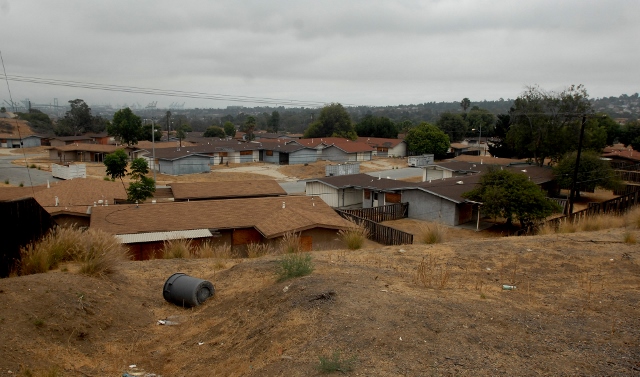
Boarded-up houses at the Ponte Vista (former Navy housing) site in San Pedro. Photo by Brittany Murray / Staff Photgrapher, Aug. 24, 2012.

Hundreds of cars drive by it on busy Western Avenue every day. To some, it seems as if the former military housing site at 26900 S. Western, the place with all those boarded-up houses, has been there forever.

In fact, the Ponte Vista site, as it is now known, only became a military housing site when the United States Navy decided in the early 1960s to use military land formerly associated with the Defense Fuel Supply Point for that purpose. (Built in 1943, the Defense Fuel Supply Point stored and distributed fuels of various types for military use. It was closed in 1997.)

The San Pedro Naval Housing Complex was completed in 1964. Its 245 single-story residential units were used as housing for employees of the Long Beach Naval Shipyard and their families for the next 33 years.

Continue reading “Developing the Ponte Vista site”

F-51 crashes in Torrance in 1964, narrowly missing houses


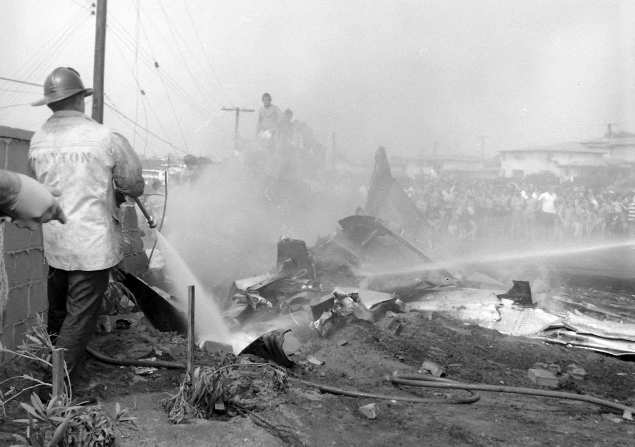
Firefighters douse the smoking wreckage of the F-51 airplane that crashed in Torrance on Aug. 23, 1964. Daily Breeze photo.

Mrs. Robert Seitz of 456 Palos Verdes Boulevard was working in her backyard on a pleasant summer Sunday afternoon when she heard an airplane engine sputtering above her.

“I looked up and saw it coming straight down in a nosedive. I thought it would hit the building.”

Mrs. Seitz lived on the second floor of an apartment building directly across the street from where an F-51 plane crashed to the ground at 2:45 p.m. on Aug. 23, 1964, killing both people aboard.

Continue reading “F-51 crashes in Torrance in 1964, narrowly missing houses”

Sinking or swimming in the Amphicar

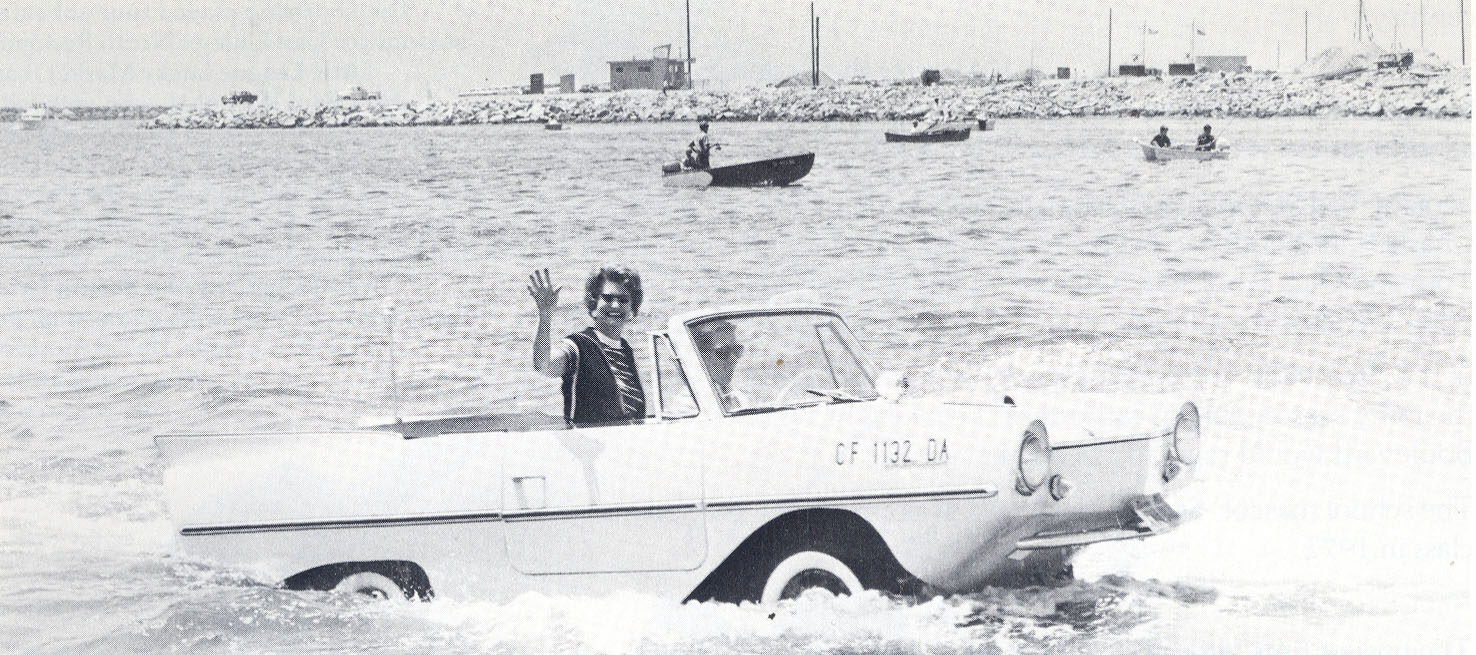
It makes sense that the Amphicar, the first mass-produced amphibious automobile, would have made its presence felt in the South Bay.

Test drives/voyages seemed to center around Redondo Beach, where several such jaunts began – and sometimes quickly ended – from the early 1960s on.

German engineer Hanns Trippel designed the Amphicar for the Quandt Group in Germany, which produced about 4500 of the unusual vehicles between 1962 and 1967.

Most of the Amphicars were exported to the U.S. market. The undated photo of the Amphicar successfully navigating the Redondo Beach harbor waters shown above  appeared in “Old Redondo: A Pictorial History of Redondo Beach, California,” by Dennis Shanahan (Legends Press, 1982).
Continue reading “Sinking or swimming in the Amphicar”

Shanghai Red Cafe in San Pedro

The Shanghai Red Cafe, also known more familiarly as Shanghai Red’s, was one of San Pedro’s most well-known, and, at times, infamous, nightlife spots.

Just to differentiate, it should not be confused with the restaurant chain of the 1980s, or the strip club that operated briefly as Shanghai Red’s, then as the Shanghai Lady, in the city strip near Torrance in the early 1980s.

This Shanghai Red was a waterfront fixture at 5th and Beacon streets in San Pedro for decades. It all began when San Franciso-born Charles Eisenberg opened his establishment in the 1920s in the toughest part of the rough-and-tumble waterfront section of San Pedro.

Eisenberg was born in the 1890s in San Francisco’s Barbary Coast. He learned about the bar trade during a boyhood stint as an errand boy in a waterfront tavern, before he decided to join the U.S. Navy and see the world. The world for him included Shanghai, and he was so taken with the city that he bought a share of ownership in a drinking establishment located in the city’s famed Bund waterfront area. His renown among sailors spread, and he became known as Shanghai Red.

61664-shanghairedbootshim-thumb-400x485-61661-thumb-400x485-61662.jpgCharles Eisenberg, aka Shanghai Red, removes a customer from his waterfront cafe as a man in a hat looks on in this undated photo. (Credit: Port of Los Angeles.)

In the late 1920s, probably around 1927, he came back to the U.S. and chose San Pedro as the place to open his night spot, the Shanghai Red Cafe. His reputation among seamen followed him there, and the burly Eisenberg became famous for proclaiming, “I can lick any man in the joint!”

61667-shanghaipostcard-thumb-200x316-61666.jpgLegends began to grow around his prodigious strength. He often boasted that his hands were bigger than any man’s, and supposedly he was never bested on that score. No doubt it took both large hands and great strength to operate his business in the toughest part of town for three decades.

Eisenberg was slowed by several heart attacks in the 1950s, but he was able to bounce back from each one. But on Tuesday, Aug. 11, 1957, he suffered a serious heart attack following the funeral of his longtime friend and employee, Joseph “Cap” Hill. He was taken to Community Hospital in San Pedro, where he died later that night.

At Eisenberg’s funeral, Rabbi Jacob Halevi described him as “a man with a great heart known to sailors all over the world.” Afterwards, he was buried at Green Hills Memorial Park in Rancho Palos Verdes.

The Shanghai Red Cafe was never the same after that. The building was among those torn down in the Beacon Street redevelopment project in the early 1970s.

61671-shanghaiclosed-thumb-400x296-61670.jpgSignage is all that remains of the closed Shanghai Red Cafe at 5th and Beacon in San Pedro in this 1969 Daily Breeze file photo.

Sources:

Daily Breeze files.

Los Angeles Times files, especially “Shanghai Red of Waterfront Dies,” by Jack Smith, June 13, 1957, Page B1.

Port of Los Angeles: An Illustrated History From 1850 to 1945, by Ernest Marquez and Veronique de Turenne, Los Angeles Board of Harbor Commissioners, 2007.


Carl Boenish and BASE jumping

Carl Boenish of Hawthorne wasn’t the first man to dive with parachute off the cliff of El Capitan at Yosemite – it had been done as early as 1966 – but he was so taken with the 1978 experience that he set about finding other tall fixed objects from which to leap.


61239-boenishfromap-thumb-400x274-61237-thumb-400x274-61238.jpgAmerican couple Jean and Carl Boenish of Hawthorne, California, photographed on June 9, 1984 in Aandalsnes, Norway, prior to their televised parachute jump from the Troll Spire. Carl Boenish was killed on Saturday, July 7, 1984, when he jumped from another of the peaks in the famous Trollveggen (Troll Wall), while his wife Jean jumped and landed successfully, just two days after her husband was killed. (Photo by The Associated Press)


His activities would lead to the formation of a national association promoting the activity, the U.S. BASE Association. BASE stands for building, antenna, span and earth, all of which are used as launching pads for the high-altitude sport.

Following his graduation from USC, Boenish became an engineer at Hughes Aircraft in the late 1960s. But he left that field when his love for skydiving led him to a contract with Metro-Goldwyn Mayer Studios in Culver City to do free-fall cinematography for the 1969 film “The Gypsy Moths” starring Burt Lancaster and Deborah Kerr.

His experience on the film gave him the expertise to form his own company, Photo-Chuting Enterprises of Hawthorne, in 1970. Operating out of his own home, he filmed and produced skydiving shorts and segments .

By the late 1970s, the practice of jumping from fixed objects began to become more publicized, thanks to daredevil jumps from such locations as Royal Gorge in Colorado, the newly built CN Tower in Toronto, and, most famously, the World Trade Center in lower Manhattan.

Boenish was convinced such jumps could be done more safely and regularly using available technology such as a square parachute that was better for gliding and improved launching techniques. He organized and filmed such a jump in August 18, 1978, after climbing El Capitan with three skydiving experts. The event is considered the birth of the modern era of BASE jumping.

One of the men with Boenish on the jump was Southern California photographer David Blattel, who said of Boenish in a 1984 interview in the Daily Breeze, “I don’t consider him a daredevil. He’s always done it (BASE jumping) in the safest possible manner and has always been meticulous about what he’s doing.”


61241-royalgorge-thumb-400x263-61240.jpgThe Royal Gorge Bridge near Canon City, Colo., is shown on June 7, 2002 in this file photo from The Associated Press
.


In August 1979, John Noak, Dave Blattel, Robin Heid and Carl Boenish jumped from the Royal Gorge Bridge near Canon City, Colorado. At the time, it was the highest suspension bridge in the world, with a clearance of 956 feet over the Arkansas River below. Boenish filmed this event as well.

Boenish also married his wife Jean in 1979. Her first parachute jump from a plane occurred shortly before the couple were wed, but she quickly became an enthusiast, teaming up with her husband as a practitioner and advocate of the sport. The Boenishes started BASE magazine, which covered not only the exploits of base jumpers, but also the equipment and safety techniques the sport required.

For a few brief months in 1980, one could obtain a permit to BASE jump in Yosemite from the Forest Service, but the government banned the practice permanently in the fall of that year.


61245-Trollveggen_2002_June-thumb-254x251-61242-thumb-254x251-61243-thumb-254x251-61244.jpg

Trollveggen (Troll Wall) in Norway in June 2002. (Photo by Ximonic, courtesy of Wikimedia Commons.)


On July 5, 1984, Boenish jumped successfully from Trollveggen Mountain in western Norway, also known as the “Troll Wall.” This feat would be entered in Guinness World Records as the highest base jump in the world at the time, as Trollveggen’s elevation tops 6000 feet. The category is still active in Guinness, though Boenish’s record has been surpassed.


Two days later, on July 7, 1984, Boenish, then 43, was found dead by two local mountain climbers at the upper part of a small glacier about halfway down Trollveggen Mountain after an unsuccessful second jump from a different take-off point. It’s still unclear exactly what caused the accident, with tangled lines or a chute that failed to fully open, or some combination of the two, offered as possible explanations.

On July 9, 1984, two days after Boenish’s death, his wife Jean successfully made the jump off the same Trollveggen peak from which her husband had made his attempt. It would be the last time she would ever jump from the site.

Boenish’s name lives on as the man who gave the sport its name, published the first magazine about it and, most importantly, outlined how it could be made safer through the use of proper equipment and technical expertise.

Jean Boenish, 52, still lives in the South Bay.

SOURCES:

“About BASE,” excerpt from the book About BASE Jumping, http://www.blincmagazine.com/forum/wiki/About_BASE.

Daily Breeze files.

“Hawthorne daredevil parachutist killed in Norway,” by Dirk Broersma, The Daily Breeze, Tuesday, July 10, 1984, Page A1.

“Know your BASE history,” by Nick Di Giovanni, http://www.apexbase.com/educationPost.php?education_id=2.

VIDEO

The following video from the Norwegian Broadcasting Corporation (NRK) was filmed shortly after Jean Boenish made her Trollveggen jump on July 9, 1984. It’s in Norwegian, but Boenish’s portion of the interview is in English:


John Laurence Miller


61062-wetzeltop1-thumb-400x232-61060.gifTop of Daily Breeze front page from Nov. 13, 1957. Click image to enlarge.


John Laurence Miller’s troubled life began in 1942, when he was born to Harold and Lela Miller of Long Beach. His first arrest, for burglary, came when he was 13 years old. Two years later, Miller was sent to the Fred C. Nelles School for Boys in Whittier for burglarizing a house and stealing a car in San Bernardino.

While at the reform school, he received a 10-hour weekend pass. His parents came and picked him up on Nov. 10, 1957, but he managed to slip away from them, running off and finding his way to the Rolling Hills home of a family friend, Stafford Thurmond, who lived on Dunwood Road. Miller later said he knew the Thurmonds kept guns and money and intended to burglarize their house. The Thurmonds weren’t at home, but he found the 22-month-old nieghbor girl, Laura Helen Wetzel, playing in the front yard.

He took her into the house, where he beat and assaulted her before smothering her to death. He fled the scene after being confronted while he was still in the house. He threatened a neighbor who had come to investigate, then bolted when the neighbor got Mrs. Wetzel away from the scene and went to call the sheriffs.

Following a frantic search for the missing baby, young Laura Wetzel’s body was found under some blankets in the bedroom by one of the Wetzels’ neighbors.

60957-millertimesclip-thumb-140x331-60956.jpgAfter fleeing the Rolling Hills house, Miller (shown at left in a clipping from the Los Angeles Times) stole a bike and rode it to Redondo Beach, where he stole a car and headed north. After a four-day, 1500-mile odyssey through California, Oregon and Nevada, Miller was captured in a Reno, Nev., service station. He had been identified from news reports by a hitchhiker he picked up, who had called police after being dropped off.

Air Force Capt. Charles Wetzel, Laura’s father, said after the capture, “We don’t want revenge. We just want to see him put behind bars for the rest of his life so he can never do it again. He’s a sick soul – a sick soul.” Those words would turn out to be prophetic, sadly.

The trial jury found Miller guilty of first-degree murder and, though still a juvenile at 15, he was sentenced to life imprisonment for his crime. After serving 17 years of the sentence, Miller, then 32, was paroled in August 1975.

Just two months later, on Oct. 21, 1975, he went to the Long Beach home of his parents and shot them both to death. He was linked to the crime only after being arrested during a Downey bank robbery a week later during which he held the bank manager hostage.

On March 25, 1976, he was sentenced to death in the gas chamber after earlier telling his parole officer that he wanted the death penalty because he lacked the courage to take his own life. The death sentence was never implemented, and Miller, now 70, remains incarcerated at Pleasant Valley State Prison near Coalinga, Calif, according to California State Department of Corrections records.

(Note: Though his middle name often has been spelled “Lawrence,” Dept. of Corrections records use the “Laurence” spelling.)


Sources:

California Department of Corrections & Rehabilitation Inmate Locator, http://inmatelocator.cdcr.ca.gov/.

Daily Breeze files.

“John Lawrence Miller”, Murderpedia website, http://www.murderpedia.org/male.M/m/miller-john-lawrence.htm.

Los Angeles Times files.


Marlon Brando comes to Southwood

Developer Don Wilson was one of the biggest players in the Southern California’s post-World War II housing boom. By 1962, Wilson had built more than 50,000 suburban homes and developed more than 50 complete communities.

59121-donwilsonclip-thumb-200x321-59120.jpgWilson was particularly active in the South Bay, having built more than 5,000 homes by that time in the city of Torrance alone. His developments would include parts of Southwood in West Torrance and Marble Estates, a huge housing tract southwest of Sepuveda and Crenshaw boulevards, in addition to many other such projects in the area.

In 1962, he opened model homes at his new Southwood Riviera Royale development near Anza Avenue and Calle Mayor in Torrance. It would lead to several months of controversy and tumult.

In March 1963, the California attorney general’s office filed suit against Wilson for alleged violations of the Unruh Civil Rights Act of 1959 with regard to another project of his, the Dominguez Hills housing tract in Carson. The suit alleged that potential black buyers were denied purchase applications for the new houses being built there on six different occasions in September 1962.

In the wake of the suit, anti-discrimination demonstrators began to appear at the Southwood Riviera Royale offices at 23448 Evalyn Avenue, sponsored by the civil rights group the Congress of Racial Equality (CORE). They claimed that Wilson was refusing to sell Southwood tract homes to blacks.

Wilson countered by saying that he was building expensive homes, and that many would-be buyers failed to qualify financially to purchase them.

On June 16, 1963, Wilson himself made a citizen’s arrest of 16 demonstrators at the tract near 243rd Street and Evalyn, claiming that the protesters were staging a sit-in on the floor and blocking access to his tract office. The arrested demonstrators told police, “We’ll be coming from here on out. Next time we’ll have 200.”

CORE persisted in its efforts, staging daily protests that included more sit-ins, sing-ins and other activities. Neighbors were not pleased about the noise, growing intensity and crowds of onlookers generated by the demonstrations. More than 100 of them packed a June 25, 1963 Torrance City Council meeting to complain, but the demonstrators persisted.


59132-torranceherald-thumb-400x281-59130.jpgTorrance Herald front page for June 27, 1963. Credit: Historical Newspaper Archives, Torrance Public Library. (Click to enlarge image.)


Torrance Mayor Albert Isen drew national attention at the June 25 council meeting when he responded to allegations that he had said that there weren’t enough blacks in Torrance to appoint to an interracial committee to improve community relations.

“I said that if Torrance has any Negroes it has so few that I don’t know whom I could appoint. I don’t know how I could appoint an interracial committee,” Isen was quoted as saying in the June 26, 1963 Daily Breeze.

It was announced on Friday, July 12, 1963, that black attorney Odis Jackson had put down a deposit to buy one of Wilson’s homes. This information resulted in a two-week truce, during which CORE pulled back its protests and the neighborhood quieted down temporarily.

But it would all come boiling back to a head on Saturday, July 27, 1963. That previous Wednesday, July 24, Wilson announced that Jackson’s down payment check of $500 had bounced, and that Wilson was unable financially to complete the purchase of the house. CORE countered by charging that Wilson never had intended to sell to Jackson in the first place.

Enter Marlon Brando. Rumors spread before Saturday’s renewed demonstrations that Brando would appear, and he and actor Pernell Roberts kept their word. At 2 p.m., Brando joined over 100 pickets carrying signs and shouting protests in front of the Southwood Riviera Royale sales office on Evalyn Avenue.


  59128-marlonwithsign-thumb-343x353-59127.jpgActor Marlon Brando, far right, marches at the head of a protest at the Southwood Riviera Royale housing tract in Torrance on July 27, 1963. Associated Press photo.


He didn’t carry a sign, but did march at the head of the protest. In addition to the march, a sit-in was held near the office. In all, 47 protesters were arrested, including two Episcopal ministers, the Rev. Morris Samuel and the Rev. Herbert Yates. Though he wasn’t arrested, 1960s activist Rev. Malcolm Boyd also participated in the march.

Brando caused quite a stir. The news media descended on him with questions as he marched, but he responded only in general terms when asked why he was participating, saying “Anyone who believes in civil rights should demonstrate.”


59129-brando-thumb-400x268-59123.jpgMarlon Brando confers with march leaders during the July 27, 1963 Torrance protest. Associated Press photo.


He was cheered by some, and jeered by others. Members of the American Nazi Party who were present counter-demonstrated with signs such as “Brando is a stooge for Communist mixture” and others that were more racially offensive.

Charges against the 47 arrested protesters later were dropped. Though the July 27 march and protest was the emotional flash point of the Southwood incident, the demonstrations continued.

Superior Court Judge Alfred Gitelson’s restraining orders issued on Aug. 13 and again on Nov. 4 greatly limited the scope of the demonstrator’s activities, and the protests died down. CORE announced later that during its 13 months of picketing, 3,500 persons had participated, and 249 were arrested. (All charges against those arrested at various times during the 13 months later were dropped.)

On Dec. 5, the California Fair Employment Practices Commission filed suit against Wilson, charging racial discrimination against potential buyer Lloyd Ransom, a black chemist at Hughes Aircraft. The suit was dropped on June 10, 1964 when it was found that the home had already been sold before Ransom’s offer.

Later that month, Ransom and his family were able to buy and take occupancy of a house in the Southwood Rivera Royale tract. A white intermediary purchased the house and signed it over to the Ransoms on June 17, 1964.

Wilson died on Aug. 10, 2001, at age 91. At the time of his death, real estate experts estimated that Wilson’s firm had built about one-third of all the houses in Torrance.

Don Wilson Builders overcame the bad publicity from the 1963 protests and continues to operate its real estate development and management business in the South Bay.


Sources:

Associated Press.

Daily Breeze files.

Los Angeles Times files.

Torrance Herald files.

Bob Hope’s Vietnam tours


58642-hope4-thumb-400x253-58641.jpgNews media members surround Bob Hope and Racquel Welch, right, as his troupe prepares to depart on a Vietnam tour on Dec. 15, 1967. Los Angeles Mayor Sam Yorty is dressed as Santa Claus at left of Hope
.

Comedian and American icon Bob Hope first performed for American troops when he did a show at March Field in Riverside, Calif. in 1941. He continued the practice under the auspices of the newly formed United Service Organizations (USO) banner, throughout World War II, then in Berlin during the airlift era, Korea, and other spots during the peacetime era that followed.

But it was the Vietnam War that brought Hope’s USO work for the troops into the public eye in a major way. Between 1964 and 1972, Hope traveled to the war zone every Christmas, bringing entertainment to troops in Vietnam and surrounding areas in Southeast Asia.

Hope’s USO caravans would leave from Los Angeles International Airport every year in mid-December for roughly two weeks. The resulting shows were filmed for the first time, and presented in the following January in commercial-free form as 90-minute specials on NBC, sponsored by Chrysler.


58638-hope5-thumb-400x266-58637.jpgBob Hope poses on Dec. 15, 1967, with female stars who are about to leave with him for shows in Southeast Asia. L to R: Hope (with his trademark golf club), actress Racquel Welch, actress/singer Elaine Dunn, Miss World Madeleine Bel and singer Barbara McNair.


The shows always included high-profile starlets and actresses of the day. Joey Heatherton, Ann-Margret, Raquel Welch and Jill St. John were among those making the tour, which also would feature a reigning beauty queen, usually that year’s Miss Universe. Les Brown and His Band of Renown provided the music, with Hope’s quips (tailored to fit whatever base or geographical location he happened to land) and bits by Jerry Colonna and other comics providing the humor.


58640-hope-thumb-300x308-58639.jpgBob Hope (with eyes closed) reunites with his family upon returning from his Vietnam USO tour on Dec. 30, 1965. L to R: Sons Tony and Kelly, daughter Nora, Hope, his wife Dolores, and daughter Linda.


Daily Breeze photographers were on hand at LAX three times to capture Hope and his troupe on film. Jack Wyman caught Hope’s return from Vietnam on Dec. 30, 1965 and his departure to Vietnam two years later, on Dec. 15, 1967. Bob Carrington took photos of Hope and company’s departure on Dec. 14, 1968.


58644-hope3-thumb-400x259-58643.jpgBob Hope poses with Los Angeles Rams “Fearsome Foursome” member Rosey Grier above, as his group of entertainers prepares to leave for Vietnam on Dec. 14, 1968. Hope waves goodbye to media and well-wishers as he boards the plane, below, for the 1968 USO tour.


58646-hope2-thumb-300x446-58645.jpgIn the later years of the war, Hope’s visits caused some controversy because of his hawkish stance in the face of growing opposition at home to the war, but his visits no doubt boosted morale to servicemen fighting a difficult war in a strange and hostile land.

Hope had many connections to the South Bay. Alice Hope, his favorite aunt, lived in El Segundo, as did his Uncle Fred and cousins Chad and Francis. “Aunt Alice” even convinced Hope to perform at a Junior Women’s Club fundraiser in 1941 at the El Segundo High School auditorium. He also would record radio shows from El Segundo High on occasion.

Hope’s lifelong devotion to entertaining servicemen through the USO led to his receiving many honors from the group. A small USO facility named for World War II hero Jimmy Doolittle had opened at LAX in 1984. In October 2001, it was announced that it would be expanded and renamed the Bob Hope Hollywood USO, and it continues to provide comfort for servicemen at the airport.

Hope died on July 27, 2003 at the age of 100.


Sources:

“Bob Hope’s Vietnam Christmas Tours,” by Judith Johnson, Dec. 23, 2009, http://www.historynet.com/bob-hopes-vietnam-christmas-tours.htm

Daily Breeze files.

Los Angeles Times files.

“South Bay salutes legendary comedian,” by Josh Grossberg, Daily Breeze, Tuesday, July 29, 2003.


Redondo’s Fox Theater


58291-foxatnight-thumb-400x311-58290.jpgThe Fox Theater in Redondo Beach, ca. 1956. Daily Breeze file photo.


When the Fox Theater in Redondo Beach opened on Friday, Feb. 22, 1929, it was the premier movie showplace in the South Bay. Only San Pedro’s Warner Grand, opened in 1931, could rival its splendor. Built at an estimated cost of $300,000 at 103 W. Diamond Street, it had all concrete construction, a state-of-the-art sound and projection system and a large pipe organ.

The architect was John Paxton Perrine, who designed six other movie theaters in the Southern California area. The Fox Theater was built on the site of an earlier theater, the Art Theater, a Paramount theater which had been built in 1912 and torn down in 1928. Fox’s movie theater arm West Coast Theatres acquired the Art Theater in 1920.

58303-HelenTwelvetreesB01-thumb-125x162-58302.jpgThe Fox Theater’s opening night was headlined by a showing of the new Fox film “The Ghost Talks,” starring actress Helen Twelvetrees, shown at left in a publicity photo. The comic farce was only the second talkie ever produced by Fox. It was well reviewed by the New York Times, but unfortunately is now considered lost, with no prints known to have survived.

Twelvetrees was in attendance at the Fox Theater screening of “The Ghost Talks,” which also included a second feature, a Fox Movietone newsreel, and five live vaudeville acts to round out the evening. In fact, the Fox was built to accommodate not only the screening of films, but also the staging of vaudeville shows.


58289-foxredondokingbest-thumb-400x269-58288.jpgThe Fox Theater in Redondo Beach stands in isolation as the King Harbor redevelopment project goes on all around it in this March 31, 1961 Daily Breeze file photo. Walt Disney’s original “101 Dalmatians” is advertised on the marquee.


The sturdily built theater remained a moviegoing landmark for 44 years. When redevelopment came to the Redondo Beach harbor area with the construction of King Harbor in the early 1960s, the Fox Theater was one of the few structures to survive. Though built right on the ocean, it was strong enough to withstand the 1933 Long Beach Earthquake as well as the occasional violent storms that rocked the area.


58287-bobbyfuller-thumb-400x405-58286.jpgFox Theater manager Hugo L. Holbach and Redondo Beach Mayor William Czuleger, center, pose inside the theater with rock ‘n’ roller Bobby Fuller, leader of the Bobby Fuller Four, before the band’s August 1965 concert at the Fox Theater in Redondo Beach. Fuller and Czuleger hold a copy of the band’s then-hit 45, “Let Her Dance.” Daily Breeze file photo.


In addition to showing films, it would occasionally host other events. One such instance came in 1965, when the Fox Theater presented a live rock ‘n’ roll concert featuring the Bobby Fuller Four. The El Paso group had relocated to Los Angeles, where it became popular in the city’s clubs. Its Redondo appearance came on the heels of its first big local hit, “Let Her Dance.” The group would later record an even bigger hit, “I Fought the Law.” Fuller’s career ended suddenly with his mysterious death on July 18, 1966. He was found dead in his car but how and why it happened still remains a mystery. He was 23. (Watch for Fuller expert Miriam Linna’s definitive biography of the rocker, “I Fought the Law, The Life and Strange Death of Bobby Fuller 1942-1966,” co-written with Fuller’s brother Randy and due out in Summer 2012.)

Redevelopment eventually did claim the Fox. One of its economic problems was lack of parking. Though it was built to accommodate both films and vaudeville acts, it was not built to accommodate automobile parking, and it became economically unfeasible to add it after the fact. The theater was purchased by the Redondo Redevelopment Agency for $201,000 in 1972, which planned to tear it down for new development.


58293-foxcloses-thumb-400x271-58292.jpgThe Fox Theater screened its last film, “Woodstock,” on Dec. 5, 1972. Daily Breeze file photo.


A group of students from El Camino College staged a mini-protest before the Redondo Beach City Council the night before the Fox Theater showed its final feature on Dec. 5, 1972, but to no avail.

The theater wanted to get “The Last Picture Show” as its final feature, but it was unavailable, so they settled for a showing of “Woodstock.” Operating the curtain that night was J.E. (Jim) McGinnis, the same man who operated the projection booth on the theater’s opening night in 1929 when it showed “The Ghost Talks.”


58301-foxdemoliton-thumb-400x307-58300.jpgThe wrecking ball brings down the wall at the Fox Theater in Redondo Beach in this March 1973 file photo.


Demolition of the Fox Redondo began on Feb. 26, 1973. A hotel had been planned for the site when demolition was completed later that spring, but it never was built, and the site currently is a parking lot.

Sources:

Daily Breeze files.

“The Fox Theater: This Gem of Our History was Part of Our Lives,” By Kathy McLeod, Redondo Beach Historical Society website, http://www.redondobeachhistorical.org/fox.html.

Los Angeles Movie Palaces website, http://sites.google.com/site/losangelesmoviepalaces/redondo.

Torrance Herald files.


Torrance High School auditorium

57780-torrancehigholdaud-thumb-400x298-57779.jpg

The original Torrance High School auditorium opened in 1924. Undated Daily Breeze file photo from Torrance Historical Society.


The new auditorium at Torrance High
School was a great source of pride for the community when it opened
in 1924. The relatively ornate structure was designed by Los Angeles
architectural firm Farrell & Miller, and was one of the first structures
in the city used as a public meeting place. (It predated the city’s
Civic Auditorium, which was not finished until 1937. )

57781-torrancehighad.jpg

To celebrate the occasion, a three-act
comedy called “The Charm School” was presented at the dedication
ceremonies for the auditorium, which were held on May 2 and May 3 of
1924.

A major addition to the high school
came in 1929. The $90,000 project included a new science building and
a cafeteria. In an unusual bit of planning, the full-size cafeteria
was built underneath the auditorium. Excavations were made to enlarge
the area, which previously housed dressing rooms.

When the 6.4 Long Beach earthquake
hit on March 10, 1933, the relatively new Torrance High auditorium was
one of the South Bay buildings that suffered collateral damage. In fact,
the structural damage was so severe that the auditorium could no longer
be used.

Plans to build a replacement began
to be floated soon after the earthquake damage was assessed in 1933,
but it would be several years before the new building became a reality.
After lying dormant for 3 years, the old auditorium was demolished in
1936.

Because of the auditorium’s closure
and subsequent razing, Torrance High students were forced to hold events
such as plays, proms and other dances and graduation ceremonies in the
Civic Auditorium.

Though the new auditorium’s Moderne
architecture resembled many of the public structures built during the
1930s under the auspices of New Deal agencies such as the Works Progress
Administration and the Public Works Administration, it actually was
built without the use of federal government funds.

At the time, Torrance’s schools were
part of the Los Angeles school district, whose $20 million bond issue
that would have replaced the auditorium was defeated in 1934. (Torrance
would break away and form its own school district in 1947.)

The district’s building projects
may have been slowed by the defeat, but it was determined to go ahead
with the project using its own funds. Construction of the $80,000 structure
began early in 1938. Its architect was Wesley Eager, who previously
had designed the boys gymnasium at Torrance High, which still is in
use today.

The completed building was dedicated
on Dec. 23, 1938. A crowd of more than 700 enjoyed an early English
Yuletide festival presented by Mrs. Marjorie Eischen Cooke, the first
performance in the new facility. Student a capella and choral groups
also performed, as did the student orchestra led by Mrs. Florence Haffner.

In 1948, “Home Life in Old Taos,”
the Federal Art Project mural by A. Katherine Skeele that had been in
storage since the 1941 earthquake caused its removal from the school
library was pulled out of storage and reinstalled in the auditorium.
The depiction of Pueblo Indian life underwent a major cleaning and
restoration in 2002, and hangs in the auditorium to this day.

57783-torranceaudnew-thumb-400x299-57782.jpg

The Torrance High School Auditorium is listed on the National Register of Historic Places. December 2011 Daily Breeze photo.


On Oct. 13,1983, the auditorium became
the fourth building at Torrance High to be named to the National Register
of Historic Places. The others include the old Torrance School building
(now known as the Annex), the Home Economics building, and the school’s main diagonal building
on Carson Street.

In the early 1990s, the Torrance
Unified School District used the money it was paid by producers to film
exteriors for the TV series “Beverly Hills 90210” to pay for
a remodeling of the auditorium, which had grown somewhat shabby over
the decades.

57786-torrancehighbas-thumb-400x243-57785.jpg

The original bas relief sculptures can still be seen atop the Torrance High School auditorium. December 2011 Daily Breeze photo.

Sources:

Daily Breeze files.

Torrance Herald files.


Is this your new site? Log in to activate admin features and dismiss this message
Log In