
Torrance annexations

The original tract of land for Torrance consisted of about one square mile when the city was founded in 1912 by Jared Sidney Torrance.

Torrance wasn’t incorporated until May 21, 1921. At the time of incorporation, the city’s area had increased to 3.82 square miles in the area now known as Old Torrance.
The 1920s brought about rapid expansion for the city. Five major chunks of land and one minor one were added to Torrance between 1926 and 1931.

52043-map4sam-thumb-400x530-52042.jpgHere are the annexations during that period (see map above, from Torrance Herald’s June 1936 “Torrance on Review” special section, click to enlarge):
1. Northwest Torrance, Feb. 9, 1926. 4.14 square miles including much of the western part of the city.
2. Meadow Park, Jsn. 18, 1927. The largest tract annexed by the city at 5.91 square miles, it included South Torrance from Lomita to Torrance Beach.
3. Walteria, March 12, 1928. 0.39 square miles.
4. Helbush, Sept. 10, 1929. A very small 6-acre tract on the eastern edge of the Meadow Park tract.
5. McDonald, June 2. 1930. 3.68 square miles. North Torrance.
6. South Torrance, May 26, 1931. 0.94 square miles that include Southeast Torrance as it wraps around the northern Lomita border.

After the 1931 South Torrance tract was annexed, Torrance’s total area had mushroomed to 18.88 square miles, almost five times the size of the city as it was incorporated in 1921.

Annexations since 1931, including the Victor tract in West Torrance added in 1956 after a tussle with Redondo Beach, have increased Torrance’s area to 21 square miles.

Of course, not all of Torrance’s annexation attempts have been successful. But many of them have been colorful.

Attempts to annex the Alondra Park and El Camino College area just north of the city date back at least to 1951, when a serious bid was launched. It died out by Feb. 1953, but not permanently. Another unsuccessful bid sprang up in 1959, and continued through the early 1960s without success. Councilman Dan Walker then  revived the idea of annexing the college, park and golf course in Feb. 1992, and, as mayor, Walker tried again in Aug. 2002, but the annexation never became reality.

The 1800-acre area near Crenshaw Blvd. south of the city that was once the Great Lakes Carbon diatomaceous earth mining operation and now contains the South Coast Botanic Garden has been a topic of annexation talks since the 1950s as well, but remains county land. The size of the parcel under consideration had dropped to 370 acres by the time Torrance withdrew its interest in March 1979.

Other quixotic Torrance annexation attempts include a very friendly overture by the city council toward Rolling Hills on Jan. 12, 1954 that received a chilly reception. This attempt eventually blossomed into an unsuccessful three-year effort to annex a 10-square mile area of the Palos Verdes Peninsula.

A new effort was launched in Dec. 1956. This time the target was the as-yet-unincorporated city of Lomita, with Rolling Hills again thrown into the bargain by the ever-persistent Torrance. Accusations of “land-grab” flew, and Lomita fought the move for years before finally incorporating as an independent city on June 30, 1964.

Things just got silly in Jan. 1957, when some Torrance council members suggested that annexing Redondo Beach wouldn’t be such a bad idea. Redondo Beach officials could barely suppress their laughter. Then-councilman William Czuleger, who was considering a run for mayor, told reporters, “Just say I’m taking out papers for Isen’s job,” when asked if his Redondo Beach mayoral candidacy was official. Albert Isen was then the mayor of Torrance. The two cities jousted for a few months over the relative ridiculousness of the proposal, but nothing serious ever came of it.

Though occasional annexation attempts have been floated since, the golden era of Torrance’s expansion fever had cooled by the mid-1960s — before the city had even gotten around to trying to snap up Carson, Hawthorne, Gardena or Lawndale.

Sources:

Daily Breeze files.

“Torrance Marches with Time!”, Torrance Herald “Torrance on Review” section, June 1936.
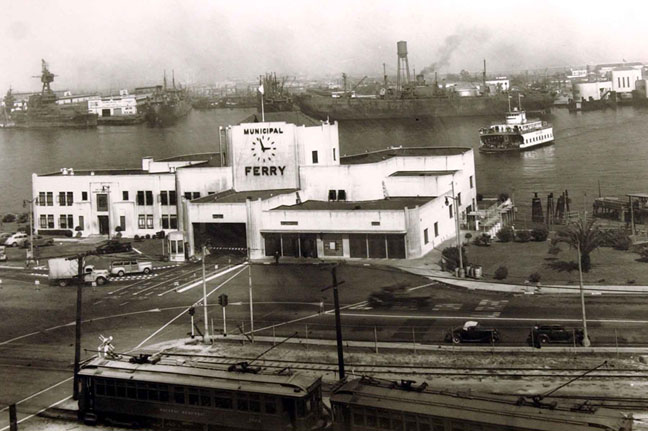
Municipal Ferry Building


51938-hsitory-ferry-thumb-400x266-51937.jpgA ferry approaches the Municipal Ferry Building terminal in this undated file photo. The Berth 234 Terminal Island building can be seen across the channel at far right. Photo: San Pedro Bay Historical Society.


Privately operated ferry boats had been crossing the main channel of the Los Angeles Harbor since its inception. Until 1941, however, there was no permanent terminal.

As the U.S. geared up for World War II, thousands of workers needed to cross over to Terminal Island to work in the military bases and shipyards, joining those who already were working in the tuna canneries on the island.

Two terminals were authorized to be built under the New Deal’s Works Progress Administration program, one at Berth 84 at the base of 6th Street past Harbor Blvd., and the other at Berth 234 across the main channel on Terminal Island.


51940-terminalbeingbuilt1941-thumb-288x298-51939.jpgThe WPA-built ferry terminal at Berth 84 is shown under construction in this June 31, 1941 photo. Photo: Port of Los Angeles: An Illustrated History from 1850-to 1945.


The buildings were designed by Los Angeles Harbor Department architect Derwood Lydell Irvin in the sleek Streamline Moderne style.

Hundreds of thousands of passengers would pass through the elegant building during the years of its operation, from 1941 until the opening of the Vincent Thomas Bridge in 1963.
The Berth 84 building housed some harbor department employees and members of the Army Corps of Engineers.

With the opening of the Vincent Thomas Bridge, the ferry’s operations became unnecessary. The bridge officially opened to traffic on Friday, November 15, 1963 at 12:01 a.m. The final run of the Terminal Island ferryboat the “Islander” was at 9:30 p.m. on Thursday, November 14, 1963.

The building at Berth 234 on Terminal Island was torn down in 1972 in order to expand cargo operations, but preservationists mounted a successful drive to save the Berth 84 main ferry building. On Sept. 17, 1975, it became #146 on the list of Los Angeles Historic-Cultural Monuments.

The Los Angeles Maritime Museum, which had been looking for a permanent home, became the ferry building’s new tenant. A $1.8 million federal grant was given for the project in January 1977, and interior demolition and remodeling of the building began later that year.

The external design was preserved, but the interior was completely revamped to accommodate museum exhibits instead of the various offices that had been located there.


51942-museumselect-thumb-400x300-51941.jpgThe Los Angeles Maritime Museum. April 2011 Daily Breeze photo.


After some bureaucratic struggles, the Los Angeles Maritime Musuem opened in its new home in December 1979. It has operated at the location ever since, occupying the structure longer than the original ferry operation did. In 1996, the building was listed in the National Register of Historic Places.


Sources:

Daily Breeze files.

 “Derwood Irvin: The Man Behind the Ferry Terminals,” Channel Crossings: Newsletter of The Los Angeles Maritime Museum, Vol. 2, No. 1, Summer 2005. www.lamaritimemuseum.org/Vol_2_No1_Summer_2005.pdf

“It’s a museum that just grew,” by Bruce Keppel, Los Angeles Times, Dec. 11, 1979, Page C1.


Who was Sam Levy?


51782-saminstoreundated-thumb-288x226-51781.jpgTorrance retailer Sam Levy inside his downtown department store in an undated file photo.


Sam Levy was active in city affairs for decades, built many downtown Torrance buildings including the fire station and played a central role in the establishment of two hospitals in the city. Torrance named an elementary school and a park after him following his death.

Levy was born in Boston on May 19, 1895, and came to California when he was 13 years old. His association with Torrance begins with a small dry cleaning and pressing business he bought for $300 in 1919 on the ground floor of the El Prado apartment building downtown.

A salesman came by one day selling socks. Levy bought some to resell and quickly sold out of them. He decided to go into the retail clothing business, building his own store at 1311 Sartori Avenue in 1923.


51784-samlevy38ad-thumb-288x291-51783.jpgThis Sept. 15, 1938 ad for the Sam Levy Department Store appeared in the Torrance Herald.


The Sam Levy Department Store grew quickly, as Levy catered to the local mill and factory workers in Torrance at the time. Its motto: “Everything to wear.”

Levy sold brand-name goods – Levi’s, Florsheim shoes, Stetson cowboy hats, Hart, Schaffner and Marx clothing – and by 1936, he had doubled the size of his original store.

According to his daughter, Ella Schwartz, Levy helped the needy and the down on their luck constantly over the years, though he publicly sought little credit for it.

He believed that the city of Torrance had a bright future, and began to participate in its activities, though he never ran for elected office. He headed fundraising drives for YMCA and the local United Jewish Welfare Fund. He also was named both head of the Little Company of Mary Hospital campaign and the chairman of the drive to pass Proposition B, the $15 million bond issue to improve facilities at Harbor General Hospital (now County Harbor-UCLA Medical Center). And that was just in 1956 and 1957!

For his efforts, the Torrance Chamber of Commerce chose him as its “Distinguished Citizen of 1956.” Levy couldn’t attend the 1957 dinner because of a recent heart attack he’d suffered, but more than 400 people did attend to honor him.


51786-samlevyheadline-thumb-288x172-51785.jpgSam Levy died on Oct. 30, 1965, after suffering his fourth heart attack in a decade. His funeral was held at Hillside Memorial Park in Culver City two days later. Torrance businessman, and, later, school board member Bert Lynn said, “Wherever they hold Sam’s funeral, it’ll never hold all the people who’ll attend.”

On Dec. 6, 1965, the Torrance school board voted to name its new elementary school at 229th and Madison streets after Sam Levy. The school opened in Fall 1967. It closed due to low enrollment in 1980 and became an adult school and curriculum center. Since September 2007, students from J.H. Hull Middle School have been relocated at Sam Levy while the new Hull Middle School is being built.

In addition to the school, the 2 1/2-acre park at Carson Street and Plaza Del Amo used by the YWCA and the Boy Scouts was renamed Sam Levy Memorial Park on Sept. 28, 1966.

Levy’s daughter Ella Schwartz took over the operation of Sam Levy Department Store after his death. In 1989, she changed the store into a women’s boutique and renamed it Ella’s. It operated until Schwartz retired in 1998. Schwartz died on May 8, 1999 at the age of 80.


51788-levystorenow-thumb-288x139-51787.jpgThe building at 1311 Sartori Avenue in downtown Torrance in an April 2011 Daily Breeze photo.


The original building that housed Sam Levy Department Store (and Ella’s) still stands on Sartori in downtown Torrance. It currently houses Debra Bowen’s campaign headquarters for her 36th Congressional District run.


51791-levyellasign-thumb-300x225-51789-thumb-200x150-51790.jpgThis plaque is mounted on the outer front wall of 1311 Sartori Avenue.


Sources:

Daily Breeze files.

The History of Torrance Schools, 1890-2000, by Thomas Rische, TUSD History Project, 2002.

Torrance Herald files.


May 5, 2011:

Here’s a note I received from Alan Schwartz, one of Sam Levy’s grandsons:


It’s always fun when I read about my Grandfather — Not only are a couple of buildings he built still standing, but both his baby-boomer grandsons are still in business here in Torrance– In my case, I run the successor business to his (in the same building in Downtown Torrance), which to my knowledge is the oldest continuing business in Torrance (about 93 years) — See www.amschwartz.net — My cousin, Richard Greene, is a successful property developer in the Torrance/Lomita area — And we are still active in the community — Just thought you might like to know…


Thanks, Alan!


Northrop’s Flying Wing

51604-yb49mainmuginflight-thumb-400x317-51599.jpgThe Northrop YB-49 Flying Wing bomber during a test flight. Photo credit: U.S. Air Force.

Shortly after Jack Northrop formed the Northrop Corporation in Hawthorne in 1939, he began the push to make his long-held vision of a flying wing aircraft a reality.

In September 1941, his company submitted design plans for the XB-35 Flying Wing Bomber to the Army Air Force. The military wanted a plane that was capable of flying nonstop from U.S. airfields to enemy targets in Europe in case the Germans had been able to overrun England early in the war.

By January 1943, the company had built a new manufacturing plant to build the planes at Northrop Field, which later would become Hawthorne Municipal Airport. Construction began immediately on 2 XB-35 Flying Wing prototypes and 13 bombers.


51607-flyingwingjack-thumb-288x184-51606.jpgJack Northrop was on hand for an XB-35 test flight at Muroc (later Edwards AFB) on July 3, 1946. Photo credit: Northrop: An Aeronautical History.

The XB-35 was driven by four propeller engines. It had a wing span of 172 feet, a 7,500-mile range and a maximum speed of 391 mph. By putting everything – the crew, engines and equipment – inside the wing itself, drag was reduced and lift maximized.

The war ended before the XB-35’s maiden flight from Hawthorne, which occurred without incident on June 25, 1946. Its crew consisted of veteran pilot Max Stanley, co-pilot Charles Bretcher and flight engineer Orva Douglas.


51614-yb35songround-thumb-288x209-51613.jpgXB-35s lined up on the ground at Northrop Field in Hawthorne in late 1948. Photo credit: Northrop: An Aeronautical History.

Competition was keen among aerospace firms in the post-World War II environment. Northrop was vying with Convair to build new long-range bombers for the Air Force, its Flying Wing going up against Convair’s B-36 bomber, a conventional propeller-driven aircraft.

The B-36 would be the last piston-engine aircraft comissioned by the Air Force, as the transition began to jet engines. Earlier, on June 1, 1945, The Air Force had approved Northrop’s plan to install jet engines in two of the XB-35s to replace the propeller-driven piston engines.


51609-wingfactoryshot-thumb-288x189-51608.jpgAssembly crews work on converting two XB-35s to YB-49 models at Northrop’s manufacturing plant in Hawthorne. Photo credit: Northrop: An Aeronautical History.


These jet-powered Flying Wings were re-christened as the YB-49 model. Its first test flight out of Hawthorne took place on Oct. 21, 1947. Using the same crew as the June 1946 XB-35 test flight, the plane took off after a 3,500-foot run and reached its destination, Muroc Air Force Base in just 32 minutes. Its new listed maximum cruising speed was 493 mph.

Muroc Air Force Base became Edwards Air Force Base on Dec. 8, 1949. The base was renamed to honor U.S. Air Force test pilot Glen Edwards, who was killed along with four other crew members during a test flight of a YB-49 Flying Wing near then-Muroc AFB on June 5, 1948.

The high point of the Flying Wing program came with its cross-country flight earlier in 1949. On Feb. 9, a YB-49 took off from Muroc in the California desert and reached its destination, Andrews AFB near Washington, D.C, four hours and 25 minutes later. It averaged 511.2 mph for the flight.

In addition to its military applications, Northrop even envisioned using the Flying Wing for commercial flights. Mockups showing the plane’s interior outfitted with seating for 80 passengers and window views from the front and rear of the wings were produced in 1948. A short promotional film was produced extolling the virtues of the idea:


The Air Force abruptly decided to drop the Flying Wing Bomber project Oct. 28, 1949 in favor of its competition, the B-36 bomber.

The decision was a blow to Jack Northrop. He retired from Northrop in 1952 at the age of 57. He didn’t speak publicly about the demise of the Flying Wing program until October 1979, when he told newsman Clete Roberts that he felt the decision by then-Secretary of the Air Force Stuart Symington was politically motivated.

According to Northrop, when he refused Symington’s demand that he merge his company with Convair, builder of the B-36, Symington shut down the Flying Wing program, despite the revolutionary design and often extraordinary performance of the XB-35s and, later, the YB-49s. Northrop died on Feb. 18, 1981 at 85, convinced until the end that his design had been stymied by short-sighted political machinations.

When Jack Northrop’s dream had ended with the last YB-49 Flying Wing aircraft being scrapped in late 1953 after gathering dust at Northrop’s Ontario air field for two years, the Institute of Aeronautical Science noted, “Perhaps we will have to wait 20 years before we find out the true significance of our mistake.”

51612-b2flyover-thumb-150x201-51610-thumb-150x201-51611.jpgActually, it took more than twice that long until Northrop’s B-2 Stealth Bomber, which incorporated many design elements from the Flying Wing including its 172-foot wingspan, officially became operational on Jan. 1, 1997.

After years of cost overruns and development difficulties, the B-2 would go on to become the first flying wing aircraft to be used successfully in combat in Kosovo in 1999.  Because of its striking design and frequent use in flyovers at major sporting events (such as at Opening Day at Dodger Stadium on March 31, 2011, left), the B-2 eventually would grow into a respected symbol of America’s air superiority. (Photo: The Associated Press.)

Northrop continues to employ variations of its Flying Wing design. A modified version of it is being used in the company’s X-47B unmanned combat aircraft, which performed well during its first test flight on Feb. 4, 2011.


51619-wingspecs-thumb-300x363-51615.jpgSpecifications for the YB-49 Flying Wing. (Click on image to enlarge.) Credit: Northrop: An Aeronautical History.


Special thanks to James Hart, Manager, External Affairs at Northrop Grumman Corporation.


SOURCES:

California Wings: A History of Aviation in the Golden State, by William A. Schoneberger with Paul Sonneburg, Windsor Publications, 1984.

Daily Breeze files.

“Last of Flying Wings Junked,” by Marvin Miles, The Los Angeles Times, Jan. 31, 1954, Page 24.

Northrop: An Aeronautical History, by Fred Anderson, Northrop Corporation, 1976.

“Northrop Claims AF Scuttled ‘Flying Wing'”, by Ken Gepfert, The Los Angeles Times, Dec. 8, 1980, Page 1.

Torrance Press-Herald


51319-heraldfrontpages-thumb-288x207-51318.jpgVarious editions of the Torrance Herald. Daily Breeze file photo.


The first edition of the Torrance Herald appeared on Jan. 1, 1914. (The Daily Breeze began 20 years earlier in 1894, but covered a wider area of the South Bay, including its then-home Redondo Beach.) Its editor was B.M. Knutson, who operated at first out of a room above the Brighton Hotel on Cravens Avenue in downtown Torrance. He later moved the operation to the Erwin Hotel building on El Prado.

On March 14, 1922, Knutson sold the paper to C.P. Roberts, publisher of the Lomita News Letter. Roberts moved his facilities from Lomita to Torrance, publishing the paper from a small room at 1877 Carson Street, near the Torrance Laundry.

Roberts only owned the paper for a year, selling it in June 1923 to Grover C. Whyte and W. Harold Kingsley. They moved the paper to a new building at 1419 Marcelina Avenue. On July 14, 1925, the owners incorporated under the name of Lomita-Torrance Publishing Company. The paper moved again, this time to 1836 El Prado, where it would stay put until 1948. On July 1, 1929, Kingsley sold his share of the firm to Whyte.


51326-heraldlogo-thumb-288x41-51324-thumb-288x41-51325.jpgWhyte continuted to publish the bi-weekly paper until his death in 1953, relocating its offices to 1619 Gramercy Avenue in 1948. His widow, Mrs. Pluma Whyte, sold the paper to new publisher King Williams of Chicago on June 1, 1954. Williams kept Reid Bundy as its managing editor, and continued to publish the Herald on Thursdays and Sundays. (Bundy would later become news editor of the Daily Breeze.)

In 1964, the Torrance Herald underwent two more changes. In Jan. 1964, Williams and his then co-publisher Glen Pfeil sold the paper to Rodgers and McDonald Publications of Los Angeles. Rodgers and McDonald had been publishing the western edition of the New York Times as well as weeklies in the Los Angeles area. Pfeil continued as publisher of the paper, which was described as a “throw-away” in the Daily Breeze article detailing the sale.

In June 1964, Rodgers and McDonald merged the Herald with another bi-weekly it owned, the Torrance Press, to form the Torrance Press-Herald. Operations remained at the Gramercy Avenue plant, with the renamed paper coming out on Wednesdays and Saturdays.

Just a few years later, the Torrance Press-Herald’s days as an independent entity ended when the Daily Breeze bought the property on Jan. 10, 1970 and turned it into an advertiser publication.

The historic Torrance Herald building at 1619 Gramercy is now the home of Rudell Design.

In 1971, the Daily Breeze donated all of the Torrance Herald, Torrance Press and Torrance Press-Herald files to the Torrance Civic Center Library. For years, the paper was available only on unindexed microfilm. In April 2011, the Library introduced a searchable retrospective database that allows full retrieval of Herald, Press and Press-Herald information. Search the Torrance Herald, Press and Press-Herald here.

51321-heraldclip71-thumb-288x277-51320.jpg 

Sources:


Daily Breeze files.

“Torrance Herald Keeps Up With Growth of City,” Torrance Herald, June 15, 1936 “Torrance on Review” special section.

Federal Theatre Project


51178-helpyourselfposter-thumb-400x276-51177.jpgThe Federal Theatre Project’s production of “Help Yourself” was staged in Redondo Beach and El Segundo in March 1937. Photo credit: Library of Congress.


Times were tough during the 1930s, even for those in show business.

In 1935, Franklin Delano Roosevelt’s New Deal program the Works Progress Administration began several arts initiatives as a part of its mission to generate jobs for the unemployed.

The ambitious Federal Theatre Project that began in October 1935 was one of them.  Roosevelt named Vassar college professor Hallie Flanagan as its director, and her vow to provide uncensored theater to the public on a wide scale later would prove problematic.

At its peak, the project employed about 10,000 people, and millions of customers saw its low-priced productions. New York had the most theatrical activity as one might expect, but the Los Angeles area ran a close second.

Offerings included Shakespeare, Shaw, a black version of Gilbert & Sullivan’s “The Mikado” and a controversial left-wing work “The Cradle Will Rock” produced by John Houseman and Orson Welles. (The 1999 Tim Robbins film “Cradle Will Rock” was a fictionalized re-telling of Welles’ involvement in the play.)

In Los Angeles, Federal Theatre Project productions brought up the house lights at a half-dozen formerly semi-dark venues, including the Mason, the Mayan, the Musart, the Greek Theater, the Beaux Arts and the Hollywood Playhouse.

A national organization was set up, but in reality the regional theater operations operated autonomously. The idea was not just to subsidize theater in the larger urban areas, but to bring it to local venues at the grassroots level.

That’s how Paul Vulpius’ three-act comedy satirizing the banking industry, “Help Yourself,” came to appear in the South Bay under the auspices of the Federal Theatre Project.

The play was staged at the Redondo Union High School auditorium on March 4, 1937, and at the El Segundo High School auditorium the next night, March 5. The Redondo Union High Parent-Teachers Association sponsored the March 4 show, while the El Segundo Womens Club sponsored the March 5 production.

Seats were priced at 55 cents and 35 cents.


51181-ftphelpyourselfad1-thumb-254x184-51179-thumb-254x184-51180.jpgAd promoting the Redondo Union High School production of “Help Yourself.” Daily Breeze, March 4, 1937, Page 2.


The actors in “Help Yourself,”  including leads Christopher Wyatt, Paul Reyner and Carroll Borland, were part of a traveling company of Federal Theatre Project players who brought the productions to areas where live theater was a relative rarity. Those on the project’s payroll earned from $55 to $94 a month, depending on their skill level.

The program was responsible for hundreds of stage productions of plays both classic and new, and it remains the only large-scale U.S. government program to fund theater.

But conservatives in Congress weren’t happy with the federal government paying for plays that sometimes espoused left-wing views. Testimony before Congress in August 1938 accused the program of having been infiltrated by Communists who were using it to promote their agenda.

After bitter debate, Congress ended the Federal Theatre Project, canceling its funding on June 30, 1939.


Sources:

The Concise Oxford Companion to American Theatre, by Gerald Bordman, Oxford University Press, 1987.

“Federal Theatre Project Collection: About the WPA Federal Theatre Project,” http://international.loc.gov/ammem/fedtp/ftwpa.html.

“Federal Theater(sic) Project’s Success Still Undetermined,” by John Scott, Los Angeles Times, April 12, 1936, Page B1.

“Get Tickets for ‘Help Yourself’ Thursday Night,” Daily Breeze, March 1, 1937, Page 3.

Honoring Louis Zamperini

51017-laurabook-thumb-150x231-51016.jpgLaura Hillebrand’s “Unbroken” has topped the best-seller lists, and has made a national figure out of Torrance’s favorite son, Olympic track star and World War II hero Louis Zamperini.

Two major sites in Torrance already had been named for Zamperini long before Hillebrand’s book arrived. In an elaborate ceremony held on Dec. 7, 1946, the city named the airstrip at Torrance Municipal Airport Zamperini Field. Unfortunately, no permanent signs were erected, federal aviation authorities never acknowledged the name change and the gesture was eventually forgotten.

According to Zamperini, a Torrance High history teacher named James Armstrong changed that situation beginning in 1973. Armstrong had read about the 1946 ceremony, and wondered why Zamperini’s honor hadn’t been more publicized. The teacher assigned three female students in his class, Anne Carfachia, Jan Karr and Joanne Wohlers, the task of researching the issue and presenting knowledge of the ceremony and Zamperini’s exploits to the city council.

The trio presented its case to the city council in October 1973, and on Jan.29, 1974, the Torrance City Council made the name change official and awarded Zamperini a plaque to commemorate the occasion (again).


51019-airportsignlou-thumb-400x267-51018.jpgLouis Zamperini stands by the newly dedicated sign at the corner of Zamperini Way and Pacific Coast Highway on March 23, 2010. Daily Breeze file photo.


Zamperini was also on hand 26 years later when permanent signs were unveiled on March 23, 2010 denoting the landing strip as Zamperini Field. (Armstrong, for whom the city’s Armstrong Theatre is named,  went on to become mayor of Torrance from 1978-1986. He died in Jan. 2002.)

The other major facility named for Zamperini is Torrance High’s Zamperini Stadium, located on Lincoln Avenue, a few blocks south of the school. Torrance High, which opened in Sept. 1917, originally played its home football games on its Carson Street campus. Facilities were spruced up after Torrance took over operation of Torrance High from Los Angeles in 1948, a year after Torrance successfully broke away from the L.A. district to form its own school district on July 1, 1947.

51021-heraldstands49-thumb-160x129-51020.jpgA Jan. 27, 1949 Torrance Herald photo showing progress on the installation of new bleachers on the field, left, noted that new lights had been installed already. The project was completed in time for the Tartars’ home opener on Sept. 23, 1949, the first Torrance High football game to be played under the lights. Torrance defeated Rosemeade, 25-2.

In Aug. 1962, the Torrance school district put out a call for bids to build a new football stadium on the former U.S. naval annex land it had acquired. The new Torrance football stadium was completed in time for the first game of the 1963 football season. On Friday, Sept. 20, 1963, the Torrance High Tartars met the Redondo Union Sea Hawks in the first game played at the new stadium. The game, described in newspaper accounts as sloppy, ended in a 6-6 tie.

Other facilities would be built on the naval land, including Torrance Elementary School, the Southern California Regional Occupational Center (now known as SoCalROC) and the continuation school Shery High, as well as the city’s Wilson Park.

The move to re-name the Torrance High football stadium for Zamperini began in 1987 with a group of Torrance High students who successfully petitioned the school and the district for the name change.

The dedication of the plaque making it official was made at halftime of Torrance High’s game against Redondo Union High School on Sept. 18, 1987. A touched Zamperini was invited down to the field at halftime for the ceremony. (Redondo won the game, 16-6.)


51023-zamperinistadium-thumb-288x246-51022.jpgThe scoreboard at Zamperini Stadium. March 2011 Daily Breeze photo.


In 2009, all the Torrance high schools, including Zamperini Stadium, installed new synthetic athletic fields using money from bond Measures Y and Z, passed in Nov. 2008. The new fields were ready in time for the Sept. 17, 2009 home opener for Torrance High vs. West High, which they lost, 17-6.


51025-newzampfield-thumb-350x230-51024.jpgCrews put finishing touches on the new Zamperini Stadium. Aug. 2009 Daily Breeze file photo.


Torrance High holds two track events at Zamperini Stadium honoring Louis Zamperini: The annual Zamperini Youth Track Meet which began in 2001, and the Zamperini Distance Carnival Invitational, a pre-season event for high school distance runners that began in 2007.


Sources:

Daily Breeze files.

The History of Torrance Schools, 1890-2000, By Thomas Rische, TUSD History Project, 2002.

“Louis S. Zamperini: An Olympian’s Oral History,” Interview by George A. Hodak, Hollywood, Calif., June 1988. Published by the Amateur Athletic Foundation of Los Angeles.
www.la84foundation.org/6oic/OralHistory/OHZamperini.pdf.

“Progress Report,” Torrance Herald, Jan. 27, 1949, Page 2.

“Tartars Tie Redondo In Sloppy Grid Fray,” Torrance Herald, Sept. 22, 1963, Page 6.


The Free Harbor Jubilee


50834-jubileeposterlc-thumb-400x538-50833.jpgPoster announces the Free Harbor Jubilee. Credit: Library of Congress.


The Free Harbor Jubilee officially began on April 26, 1899, when President McKinley pushed a button in Washington, D.C. that signaled a barge 3,000 miles away in San Pedro to dump a load of large boulders into the sea, marking the beginning of the construction of the new port’s breakwater.

The ceremony was the culmination of an 7-year battle that pitted two Southern California business titans against each other. At stake: the location of the official deep-water harbor for Los Angeles.

On one side was Southern Pacific Railroad head Collis P. Huntington, who wanted a monopoly on the port and its operations. He put his money and energy behind Santa Monica as its location, where he had purchased land and begun developing a harbor. He went so far as to name his site Port Los Angeles in 1892.

On the other side was Harrison Gray Otis, owner and publisher of the Los Angeles Times, who proposed a free port open to all. He was joined in the fight against Huntington’s proprietary plan by newspaper magnate William Randoph Hearst as well as community and business leaders in the Los Angeles Chamber of Commerce.

For years the battle between the two sites raged. Huntington’s power and influence seemed to be winning the day when U.S. Senator Stephen M. White stepped in with a proposal in 1896 that called for an independent board of engineers to choose the site.

The amended River and Harbor Bill, which also took away Huntington’s power to control the port regardless of which site was chosen, became law in June 1896. On March 1, 1897, San Pedro was selected as the location of the new L.A. port.

Huntington didn’t suffer defeat quietly; it took a presidential order from McKinley to end the port squabble for good. Once that happened, Free Harbor supporters began planning a massive celebration to take place both in downtown Los Angeles and in San Pedro on April 26 and April 27, 1899.

Planning for the Free Harbor Jubilee festivities took months. Downtown Los Angeles held a massive parade attended by an estimated 100,000 people. Most banks and businesses closed for the festivities. The day also included speeches by many of the Free Harbor advocates.

On the first day in San Pedro, a massive barbecue was held for 20,000 visitors, followed by a water carnival and fireworks later that night. The second day featured a historical pageant, a floral parade and a parade of illuminated boats.


50840-jubileebbq-thumb-288x224-50839.jpgOrganizers estimated that 20,000 visitors came to enjoy the Free Harbor Jubilee barbecue in San Pedro. Photo credit: Port of Los Angeles: An Illustrated History from 1850 to 1945.


Dignitaries in attendance included Senator White, California Governor Henry T. Gage, Los Angeles Mayor Frederick Eaton, San Francisco Mayor James Phelan and a host of other prominent judges, businessmen and politicians. Published accounts indicate that the Jubilee, one of the larger public celebrations held the Los Angeles area up to that time, was a rousing success.

The construction of the breakwater that began with those first few boulders took many years. Its first and most crucial section was completed in 1912. Together with a major dredging project begun in 1904 that brought its water depth to 30 feet, the new harbor could accommodate almost any size cargo ship of the day. (The final breakwater segment would not be completed until 1949.)


50836-jubileemaptoharbor-thumb-400x580-50835.jpgThis 1916 Map shows the thin strip of land down to San Pedro that was annexed to the city of Los Angeles. Homer Hamlin, City Engineer ; compiled under the direction of J.R. Prince, chief draftsman. From Library of Congress map collection.


Los Angeles also had to push through an annexation plan that would make San Pedro and Wilmington part of the city. This was accomplished through assembling enough parcels to create a narrow, continuous 16-mile corridor of land between L.A. and the Harbor Area, a feat which became reality when the annexation became official on Aug. 28, 1909.


Sources:

“100 reasons to celebrate: Speakers, waterworks show, mariachi band will mark anniversary of SP breakwater,” by Caroline Brady, The Daily Breeze, April 24, 1999, Page B1.

Los Angeles Times, various stories, March and April 1899. Also, “From Mud Flat to World Port In a Human Lifetime: The Evolution of a Billion Dollar Harbor,” by Waldo Drake, Los Angeles Times, Jan. 2, 1930, Page C11.

Port of Los Angeles: An Illustrated History From 1850 to 1945, by Ernest Marquez and Veronica De Turenne, Angel City Press, 2007.


Simon Ramo and TRW

50697-ramowestchester(2)-thumb-400x321-50696.gifSimon Ramo, left, poses with partner Dean Wooldridge in front of the
Ramo-Wooldridge Corp.’s first headquarters, a former barbershop in
Westchester, in the early 1950s. Daily Breeze file photo.

Simon Ramo had an amazing career as a scientist, engineer and creative thinker. His achievements have made him far more than just the “R” in the diversified aerospace firm TRW Inc.

Born May 7, 1913 in Salt Lake City, Utah, Ramo graduated from Caltech with a double doctorate in physics and electrical engineering – at the age of 23.

Following graduation, Ramo became the director of research at General Electric. His work in electronics resulted his writing two textbooks which quickly became standards in the field: “Fields and Waves in Modern Radio,” and “Introduction to Microwaves.”

“Fields and Waves” has been revised and updated over the years, but remains a classic work. It is still in print under the title “Fields and Waves in Communication Electronics.”

Ramo left GE in 1946 to become electronics research director at Hughes Aircraft, where he partnered with his old classmate Dean Wooldridge, who also had received his doctorate degree from Caltech in 1936.

After the U.S. Army Air Corps became the U.S. Air Force in 1947, Howard Hughes created an Aerospace Group at Hughes Aircraft to work with the Air Force. Ramo headed up the research end, while Wooldridge took care of the business end of the new group. But Ramo and Wooldridge slowly began to  grew disenchanted with working for the notoriously eccentric Hughes.

In September 1953, they jointly resigned from Hughes to form their own company, the Ramo-Wooldridge Corporation. They set up shop in a 1,000-square-foot rented storefront in Westchester that formerly had been a barbershop.

During the 1950s, Ramo-Woolridge Corp. became the primary defense contractor for the newly established intercontinental ballistic missile program. It would eventually develop the Atlas, Titan, Thor and Minuteman missile weapons systems, as well a variety of missile detection and interception systems.

50699-ramotimecover-thumb-300x395-50698.jpgSimon Ramo, right, and partner and former classmate Dean Wooldridge share the cover of Time magazine’s April 29, 1957 issue.

By 1957, Ramo-Woolridge had grown from its humble barbershop beginnings
to a company with annual sales of $44 million. Its facilities had been
expanded greatly, with plants and testing operations added at nearly a
dozen locations throughout the U.S.

In 1958, Ramo-Wooldridge
merged with Thompson Products of Cleveland, Ohio, which had been
providing the company with venture capital since its inception. The
firm’s new name, Thompson Ramo Wooldridge Inc., was a mouthful; it
officially became TRW Inc. in 1965.

Dean Wooldridge retired from
the company in January 1962 in order to become a professor at Caltech.
(He died on Sept. 20, 2006 at 93.) Ramo became president of the computer
arm of the company, Bunker-Ramo Corp. and, later, vice chairman of TRW.

As
the company expanded, it diversified into areas besides defense
systems, computer technology and space engineering. TRW formed its
Credit Data group in 1970. Personal credit reports were known as “TRW
reports” for years, until the division spun off into its own company in
1996, Experian.

TRW itself ceased to exist when Northop Grumman
acquired the company on July 1, 2002 for $7.8 billion. Simon Ramo is
credited for playing a key role in making that transaction a reality.

Ramo’s
list of accomplishments and honors is lengthy. In addition to the
textbooks he authored, he also wrote books about business, technology,
and even a 1970 book on tennis.

He helped design TRW’s Redondo
Beach facility more as a college campus than the usual sterile corporate
setting, with the idea of creating an environment where innovation
could flourish. (In March 2007, Northrop Grumman held a ceremony to
rename a private street at the facility as Simon Ramo Drive.)

He created TRW’s Space Technology Labs company, which became the first private firm to build a spacecraft, Pioneer 1.

Though
he has been semi-retired for decades from the company he co-founded,
Ramo continued to speak about technological and social issues over the
years. He has received the Presidential Medal of Freedom and awards from
the Institute of Electrical and Electronics Engineers (IEEE), the
American Philosophical Society and the American Academy of Arts and
Sciences.

As recently as March 2011, Ramo still was receiving
honors, in this case, the Dr. Robert H. Goddard Memorial Trophy, the
National Space Club’s pre-eminent award for achievements in rocketry and
astronautics.

Simon Ramo died at the age of 103 on Monday, June 27, 2016.

50701-TB15-RamoAward-thumb-260x483-50700.jpgTRW co-founder Simon Ramo with the General James E. Hill
Lifetime Space Achievement Award on behalf of the Space Foundation that
he received on Sept. 14, 2007. Daily Breeze file photo.

Sources:

Daily Breeze files, especially:

“Multimillion Dollar Facility Evolves From Small Operation,” Oct. 2, 1958.

“Ramo honored for visionary work,” By Muhammed El-Hasan, March 21, 2007, Page C1.

Improved Order of Red Men


50450-redmenfar-thumb-288x196-50449.jpg
The Improved Order of Red Men, Sequoia Tribe No. 140 lodge in San Pedro. March 2011 Breeze photo.


The Improved Order of Red Men’s roots can be traced back to the 1760s, when it was one of several secret groups such as the Sons of Liberty that formed in the years before the American Revolution. (It was members of the Sons of Liberty that dressed up like Native Americans and dumped tea in the harbor at the Boston Tea Party.)

After a meeting at Fort Mifflin near Philadelphia in 1813, several of the still-functioning patriotic groups came together as the Society of Red Men. The name was changed at an 1834 meeting in Baltimore to the Improved Order of Red Men, the name still used today.


50452-redmenscroll2-thumb-300x389-50451.jpg
This 1889 certificate, or “Redmens Diploma Legendary & Historical Chart” for the Society of Red Men, was given to new members of the fraternal group. (Click to enlarge image.)  Source: Library of Congress.


A Grand Council in 1847 in Baltimore united the group nationally, and it continued to grow well into the 20th century. Branches were active in the Los Angeles area in the 1890s, including one in San Pedro. In 1915, Sequoia Tribe No. 140 moved into a former public library building at 543 Shepard Street in San Pedro after converting it into a 3,190-square-foot lodge.

The Red Men drew many of its rituals and terms from the Iroquois Tribe as a sign of respect, not ridicule. Members refer to its American Craftsman-style building overlooking the Pacific Ocean between Gaffey and Pacific streets as a “wigwam.” Meetings, called pow-wows, are opened by banging a tomahawk on the podium instead of a gavel. Groups are called tribes, the leaders are named after great chiefs such as Sachem, Saamore and Incohonee and secret passwords and signs are used during meetings.

Though one does not have to be a Native American to join, members in the past had to wear Native American regalia at the time of their adoption into the tribe.

In June of 1915, over 5,000 people attended an Improved Order of Red Men pow-wow at Point Fermin following a parade through the San Pedro business district. The drill team from Sequoia Tribe No. 140 won first prize in the parade. Other events in the two-day festivities included a sacred concert, speeches by various Great Chiefs of the Red Men, a barbecue, and three three-round boxing matches.

The Improved Order of Red Men claimed to have 500,000 members across the country in the 1930s, but, as with many fraternal organizations, membership has dipped in recent years. The entry in the latest version of the reference source Associations Unlimited states the current nationwide membership of the Waco, TX-headquartered Great Council of U.S. Improved Order of Red men at 15,251.

Ebbing membership rolls led to a crisis for the Sequoia Tribe’s San Pedro lodge in November 2002.The local chapter had become inactive in the early 1990s, and the unoccupied building nearly was sold for $350,000 to a bidder who wanted to turn it into a private residence.

Local preservationists led by Liz Schindler and Julian Jimenez alerted the state Red Men organization, which blocked the sale. But in order to save the building, it became necessary to re-activate the group’s charter, which meant that Schindler, Jimenez and the rest of the 50 new members had to re-learn the Red Men ways and re-establish its female auxiliary group, the Degree of Pocohontas.

According to Daily Breeze reporter Donna Littlejohn’s account, the new members drew the line at donning Native American garb and headdresses. “We do have some rituals. But I can’t tell you about them,” Schindler told Littlejohn at the time.

The community effort to save the Red Men building was successful. On April 29, 2003, the city of Los Angeles designated the hall as Los Angeles Historical-Cultural Monument #751, which makes altering or tearing down the original structure much more difficult to do.

The current re-constituted group continues to be active in the community, holding fund-raisers and other events at the venerable lodge to support Alzheimer’s research, one of the Improved Order of Red Men’s chief charitable causes.
50455-redmenclose-thumb-288x487-50453-thumb-288x487-50454.jpg

Daily Breeze photo, March 2011. 


Sources:

“1915 lodge wins historic status,” by Donna Littlejohn, The Daily Breeze, April 30, 2003, Page A3.

“Great Council of U.S. Improved Order of Red Men” entry, Associations Unlimited database, Gale Research Co., 2011.

The Improved Order of Red Men website, http://redmen.org/redmen.info/.

“Thousands of Redmen in Point Firmin(sic) Powwow,” The Los Angeles Times, June 14, 1915, Part II, Page 7.


Is this your new site? Log in to activate admin features and dismiss this message
Log In