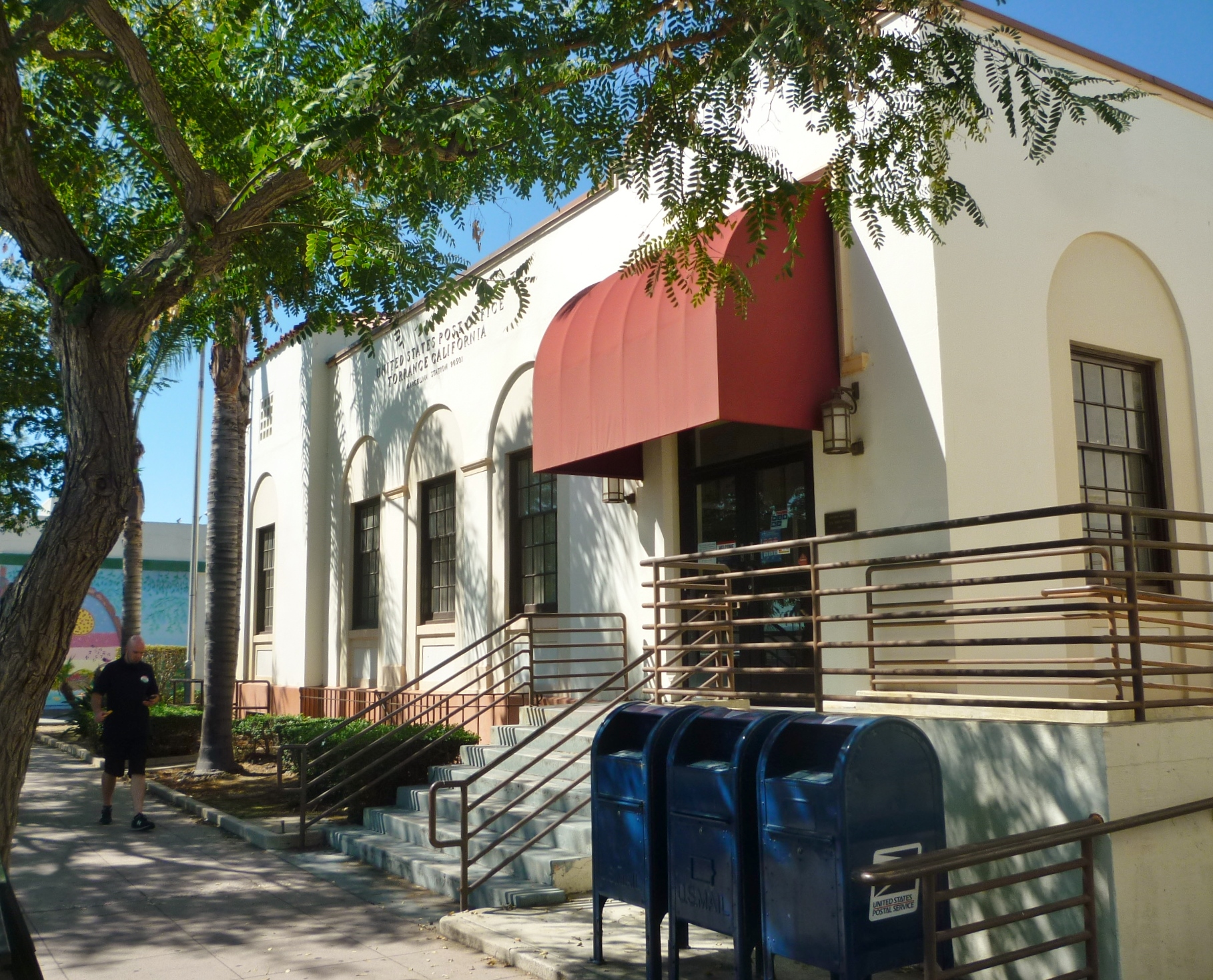
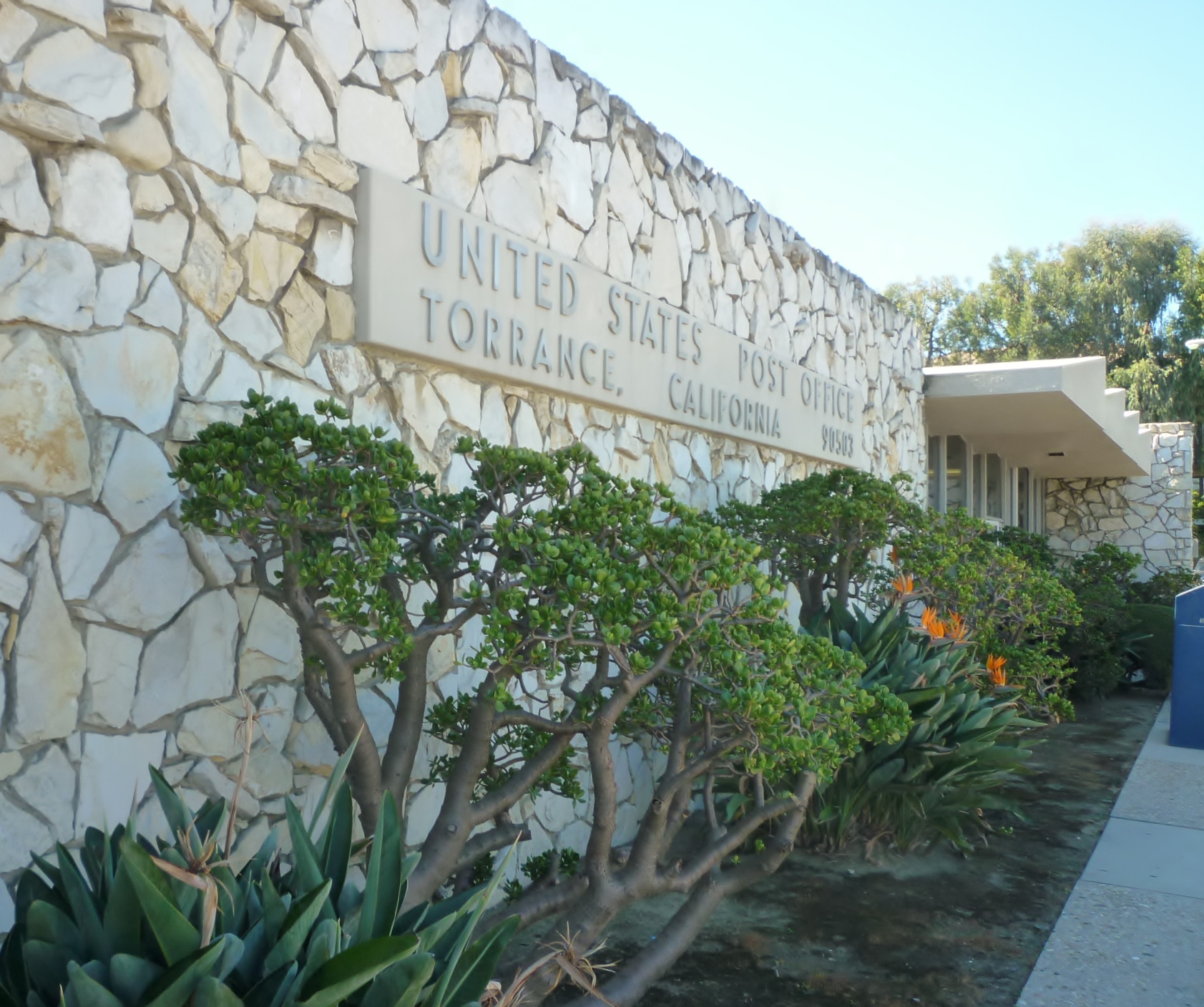
The Marcelina Avenue branch of the U.S. Post Office in Old Torrance. (October 2015 Daily Breeze photo)
The Torrance post office was authorized to operate on Sept. 18, 1912, a few weeks before the city’s official founding date of Oct. 24, 1912. 68 cents worth of postage stamps were sold on its first day of business.
Stewart F. Mager was the city’s first unofficial postmaster, but he only served for a few months as part of his duties as a Campbell employee.
Herman Burmaster took over the job on July 27, 1913, as the city’s first full-time, officially sanctioned postmaster. Burmaster held the office until Alfred Gourdier was appointed to the job on Nov. 19, 1919.
Gourdier would stay in the job for 15 years. One of his first priorities was to establish home mail delivery in the city.
In 1923, he went to Washington, D.C., to plead the city’s case for the authorization of home mail delivery with federal postal officials. His efforts were successful, with home delivery to Torrance residents beginning on Jan. 1, 1924. (In the weeks before delivery began, residents were advised to set out boxes for the purpose of receiving mail deliveries.)
In July 1925, he added free parcel post home delivery to the city’s postal services.
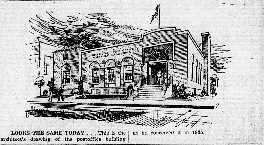
Artist’s rendering of the Marcelina Avenue post office building in Torrance from the Torrance Herald, June 26, 1941 (retrospective article). (Photo: Historical Newspaper Archives, Torrance Public Library)
“With the inauguration of parcel post delivery here, Mr. Gourdier expects that before long a special vehicle will be authorized for that service,” the Torrance Herald reported at the time.
In July 1931, Gourdier warned local residents to be careful when they put their hands in their home mailboxes after his letter carriers reported seeing many black widows in mailboxes on their routes. Three people in California actually had died from black widow bites earlier that year, according to the postmaster.
A much more momentous event in Torrance’s postal history also happened in 1931. The federal government officially authorized the construction of a permanent federal post office building in the city in February 1931.
26 sites were proposed, and the Marcelina site was chosen early in 1934.
Gourdier also retired early in 1934. (He died in 1939.)
Former Torrance councilman C. Earl Conner was tapped to be the city’s new postmaster. We met him here in the blog a few weeks ago as the owner of Earl’s Cafe at 1625 Cabrillo Avenue in downtown Torrance, the first of a series of restaurants on the present-day site of the Crest Sports Bar & Grill.
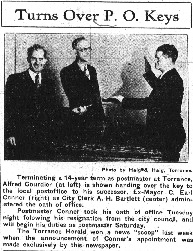
Postmaster Alfred Gourdier, left, hands the keys over to Earl Conner, right, as City Clerk A.H. Bartlett presides. Torrance Herald, Feb. 8, 1934, Page 1. (Photo: Historical Newspaper Archives, Torrance Public Library)
Conner’s commission became official on Feb. 10, 1934.
The new post office building at 1433 Marcelina Avenue in Torrance was a Works Project Administration project, like many of the city’s early public buildings, including its first city hall and public library (now the home of the Torrance Historical Society).
General contractor Harold Hansen of Hollywood,Calif., headed the construction of the project, and he used local products to do it. Steel came from the city’s Columbia Steel plant, and the Torrance Electric Shop a few doors down at 1419 Marcelina provided electrical fixtures and wiring for the building, and lumber came from the local Consolidated Lumber Company.
It had two stories and a full-size basement, and was described as the first post office to have an automatic steam heat system installed.
The cornerstone was laid on May 31, 1935, and included a steel box with a newspaper from the day and other documents marking the occasion.
The new post office opened on Oct. 12, 1935, and it remains the only one of the downtown civic buildings constructed during the era to still be in use for its original intended purpose.
The Torrance post office grew rapidly along with the city, gaining a first class rating based on its size and revenue on July 1, 1941.
One of Conner’s ongoing projects as postmaster after the end of World War II was to try to resolve the crazy quilt of postal service in the city. The Gardena post office served many residents in the city’s north end, with Redondo handling postal service on the city’s west side and Lomita covering the south end. Conner worked to end the confusion, with the goal of having all the city’s residents served by the Torrance post office.
He had made great strides in the project at the time of his sudden death on Feb. 3, 1949, from a heart attack suffered at home.
Clara Conner, Earl’s wife, received her official commission as postmaster succeeding him on June 22, 1950. She had been acting postmaster since his death in 1949.
She would continue his work of consolidation, and also preside over the city’s expansion of postal services. The old Walteria post office was replaced by a new building at 4110 W. Pacific Coast Highway on Oct. 1, 1954.
A North Torrance branch opened in December 1954. A large distribution center opened at 3611 Torrance Boulevard in November 1956.
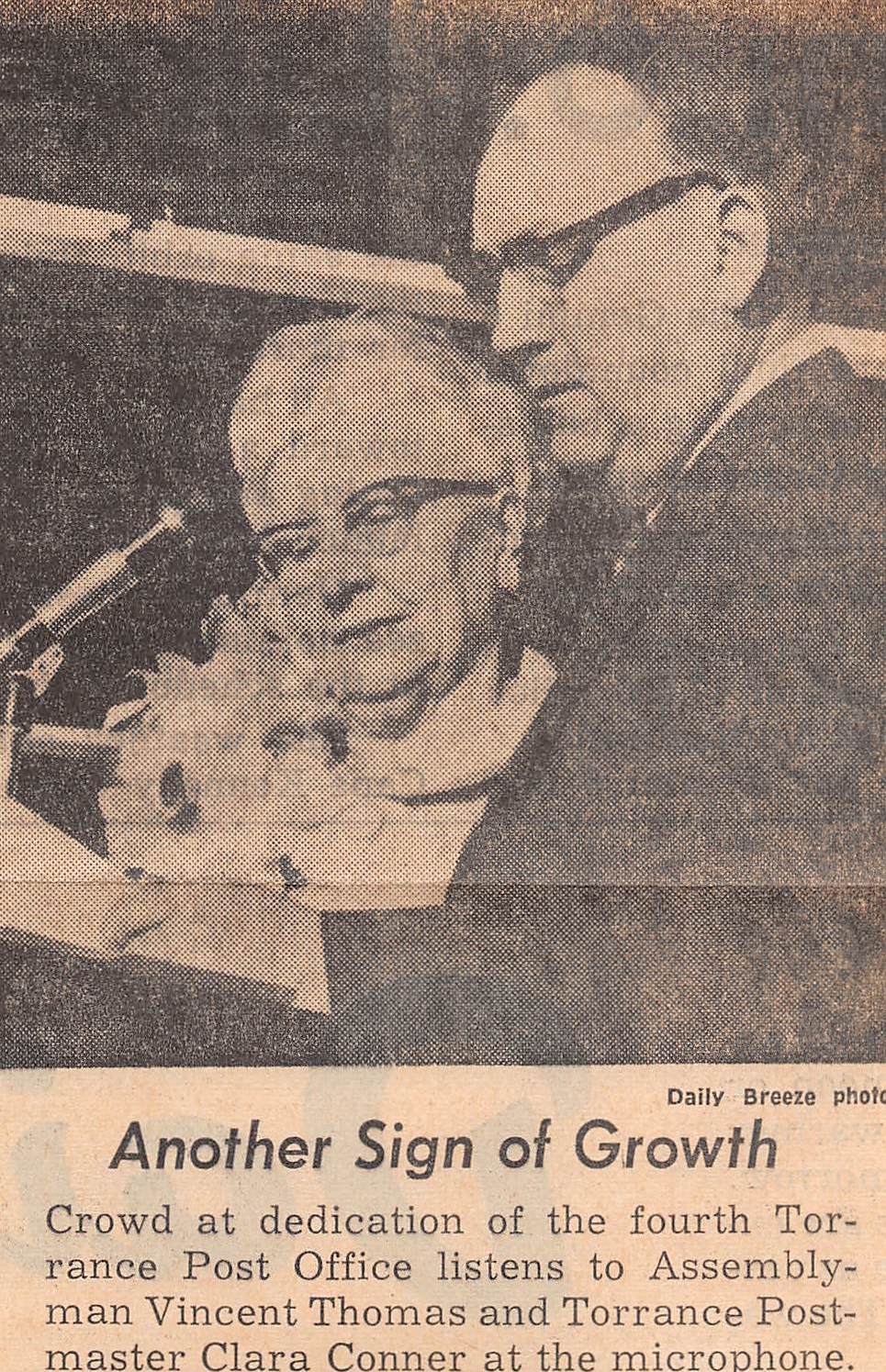
Clara Conner, left, with Vincent Thomas at the dedication of the Monterey Avenue post office. Daily Breeze, Dec. 12, 1965.
In May 1960, the Torrance City Council called for a resolution declaring the need for a new, larger central post office facility, calling the existing set-up “completely inadequate.”
In 1962, the new post office was authorized. On Dec. 11, 1965, the building at 2510 Monterey Street was dedicated in a public ceremony. It was built on a 3.5-acre site at a cost of $750,000.
Shortly after it opened, Clara Conner retired as postmaster. She handed over the keys to her assistant, Carl Backlund, on Dec. 30, 1965, after 15 years on the job. Taken together with her husband’s service, Mr. and Mrs. Conners guided the Torrance post office for 31 years. Clara Conner died on April 8, 1986, and is buried next to her husband, Earl, at Roosevelt Memorial Cemetery in Gardena.
The Marcelina Avenue post office continues in operation today as a branch office that locals often refer to as that cute little post office in Old Torrance. Now we know that the modest little building served a major role in the city’s development.
The Torrance post office on Monterey Avenue. (October 2015 Daily Breeze photo)
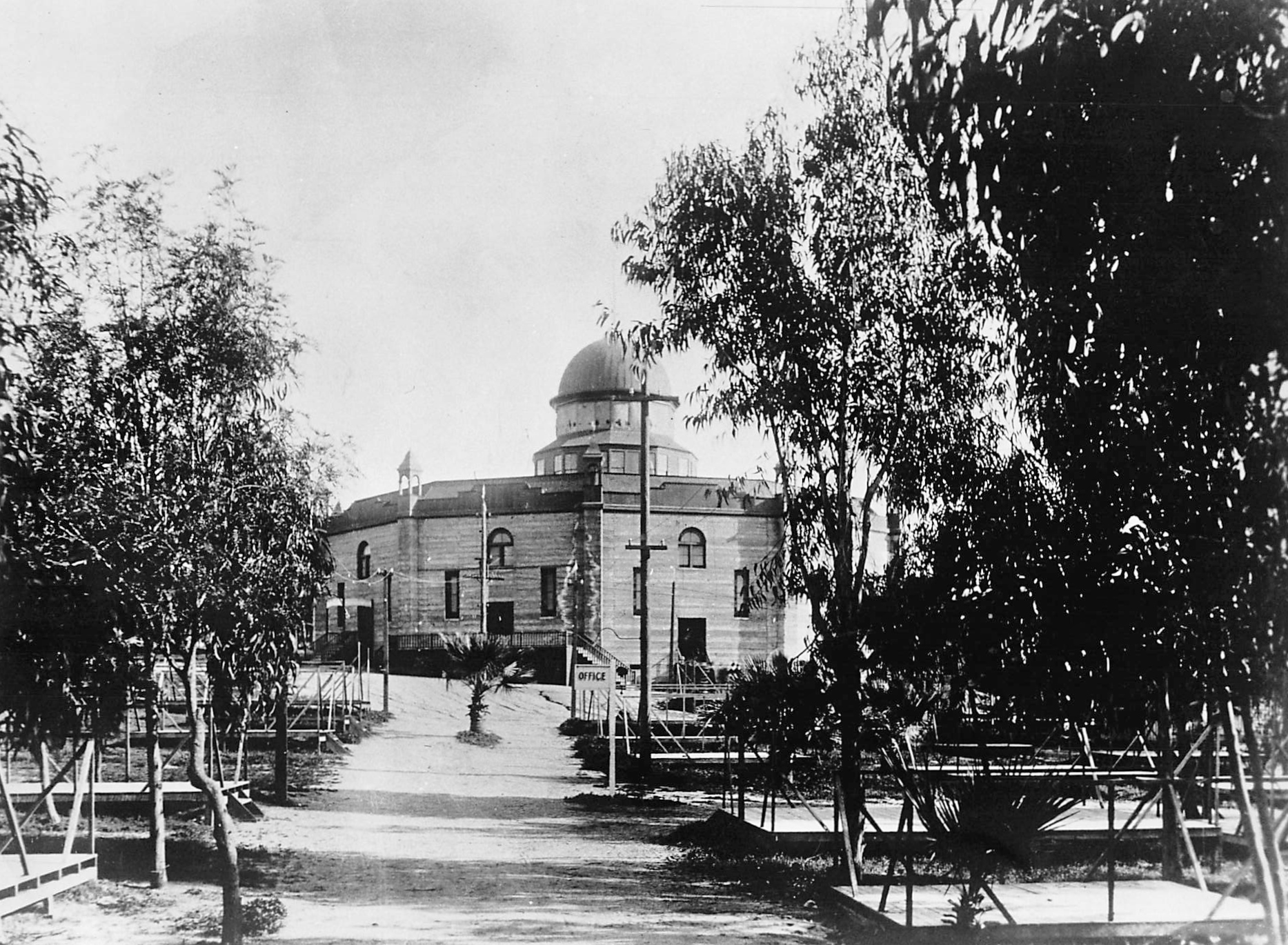
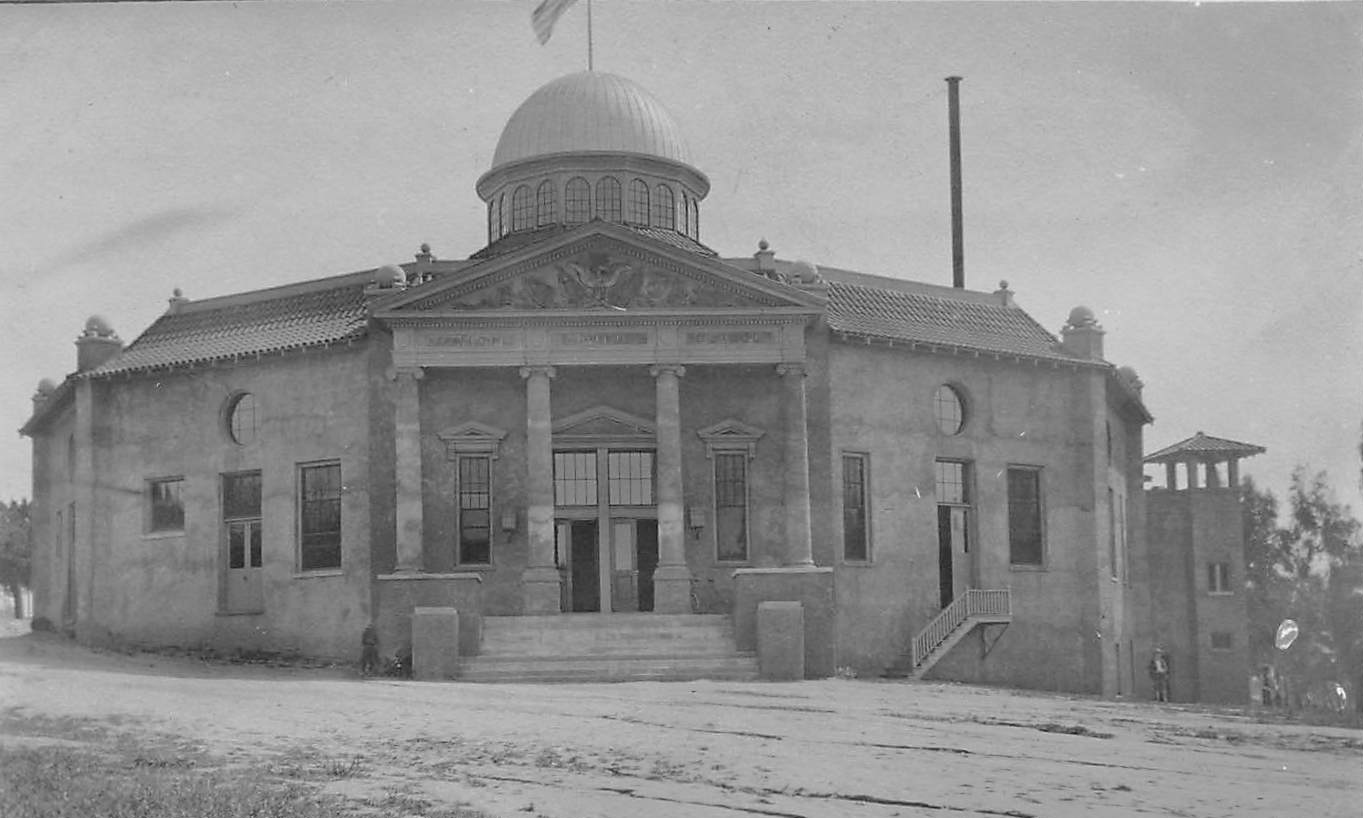
The Redondo Beach Chautauqua Assembly auditorium building. Undated Daily Breeze file photo, circa 1890-92.
An estimated 1,500 people came to the dedication ceremonies for the auditorium at the Chautauqua Assembly in Redondo Beach on Feb. 22, 1890.
Many of them streamed into the nascent city, which would not be incorporated until two years later, on the Santa Fe railroad line or the newly built Redondo Railway .
When they arrived, they saw the first of five buildings planned for the 15-acre site donated by the Dominguez family at Diamond and Elena streets. It was a polygonal building with 11 sides, made out of concrete and topped by a distinctive dome with gleaming glass panels.
Inside was auditorium set up in a natural amphitheater set up against a small slope. It had the capacity to seat 4,000 people, with a stage large enough to accommodate 300, and additional smaller rooms for classes and lectures.
Its leaders hoped the Redondo Beach location, recently moved from its former home in Long Beach following a brief feud between two local factions, would become the West Coast center of the burgeoning Chautauqua movement.
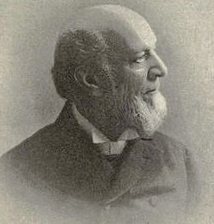
John Heyl Vincent. (Undated photo)
The Chautauqua education movement began in 1874 on the shores of Chautauqua Lake in upstate New York.
Its founders, including Methodist minister John Heyl Vincent, had begun it as a training program for Sunday school teachers, but it soon blossomed into a wide-ranging mix of educational and entertainment offerings, featuring speakers over the years that included Ulysses S. Grant, Walt Whitman, Will Rogers and William Jennings Bryan. Thanks to his fiery oratorical flourishes, Bryan became one of the circuit’s most popular attractions.
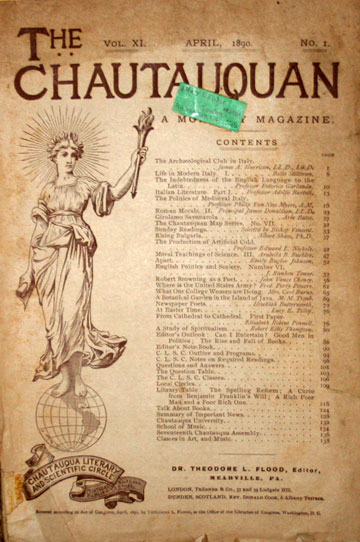
April 1890 issue of The Chautauquan magazine.
Chautauqua’s success fed off the growing American populist movement of the late 19th Century, which attempted to bring popularized, accessible forms of education to a broader range of people, not just the upper classes of society.
Typical Chautauqua conferences featured not only lectures, but also music, plays and instruction in religious and philosophical topics. Its magazine, The Chautauquan, became one of the most widely read popular journals of the day.
Vincent and Rev. S.J. Fleming, the Redondo Assembly’s leader, both had streets named after them nearby. Vincent Street remains today; Fleming Street was a casualty of the later expansion of Redondo Beach Union High School.
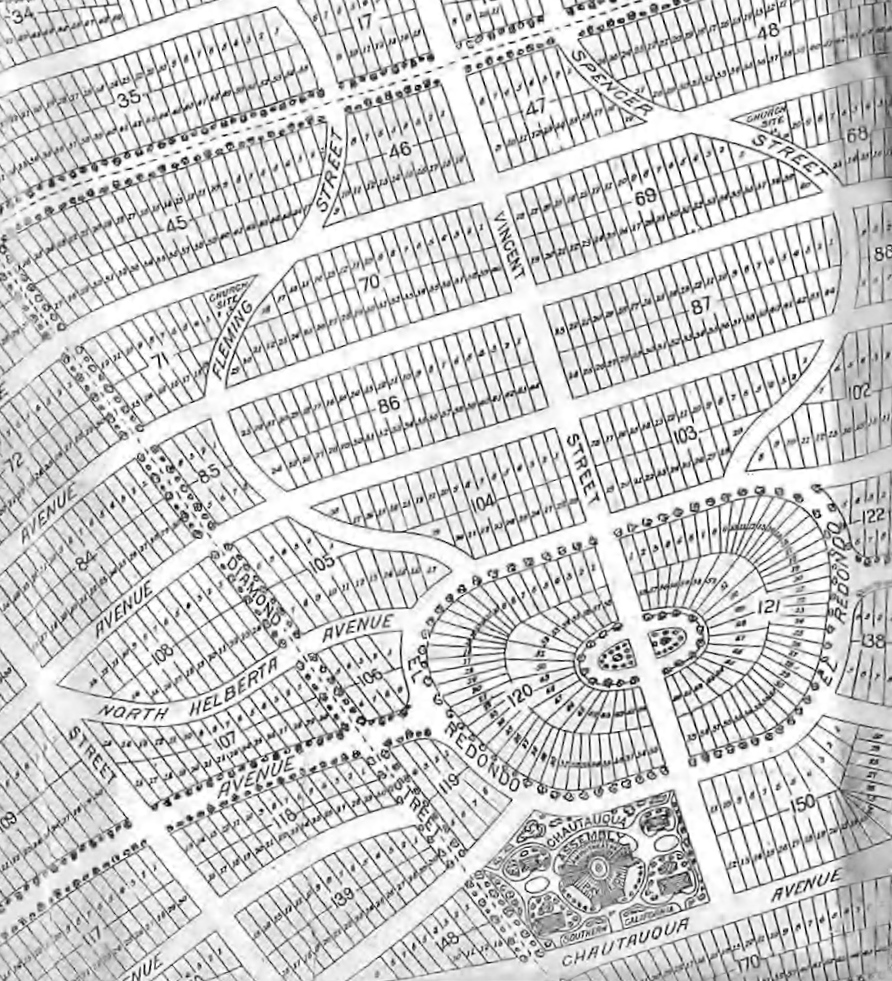
In fact, the early layout of Redondo Beach was influenced by the Chautauqua movement. The 1887 plat map created by city engineer William Hall incorporated the Lamp of Learning, the symbol of Chautaqua into its design, with the oval Vincent Park, now a designated City Landmark, at its base, and curved portions of Spencer and Fleming streets forming the top section of the lamp.
The Redondo Beach Chautauqua Assembly got off to a big start on its first session on July 30, 1890.
Portion of 1887 Redondo Beach map by city planner William H. Hall shows the Chautauqua Assembly, bottom, the oval base of the lamp, lower right, and the upper curved portion of the lamp design formed by Spencer and Fleming streets. (Daily Breeze files)
James Clement Ambrose gave the first lecture, “My Father,” which addressed the issue of women’s rights. “The ballot for women is coming. Prejudice is a high fence, but progress is a high jumper,” he concluded, 30 years before woman’s suffrage became the law of the land.
Other topics covered in the Assembly’s first couple of days included the reunification of Germany, a lecture on the Book of Hebrews, “Russia and the Romanoffs,” “The Four Napoleons” and readings from the book “Ben-Hur.”
The programs proved increasingly popular, with large crowds in attendance.
The Chautauqua center only lasted two years in Redondo, however. In 1892, the Redondo Beach and Long Beach factions patched up their differences, and established a single center in Long Beach.
The abandoned Chautauqua auditorium began to be used as a granary and storage repository by local farmers.
On Aug. 7, 1905, the city’s residents passed a $25,000 bond measure aimed at establishing the first high school. Part of the money was used to purchase a 5-acre site where the Chautauqua auditorium building still stood, and the remainder was spent attempting to rehabilitate the now rat-infested structure for use as a school.
The Redondo Beach Union High School building in 1907, after being repurposed from the Chautauqua Assembly auditorium. (Daily Breeze file photo)
Redondo Union High School had held its first classes in the city’s Masonic Lodge in 1905. In 1906, the former Chautauqua auditorium welcomed the school’s students. Now fully remodeled (and with rats removed), the site featured physical and chemical laboratories, a lecture room, a principal’s office and five recitation rooms along with bathrooms and a spacious assembly hall. Students used the building for almost a decade.
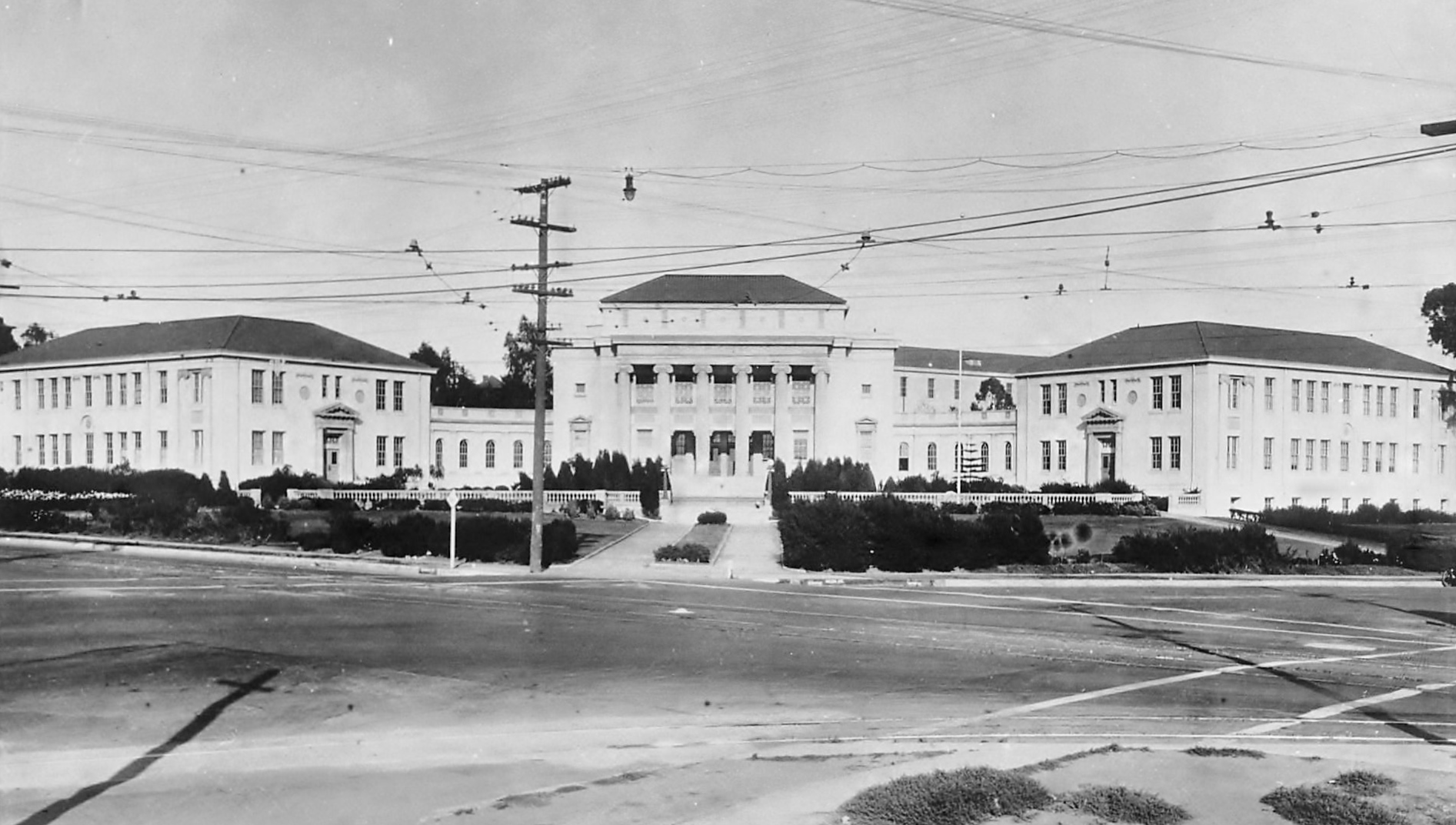
In 1915, the auditorium was torn down to make way for a new auditorium that lasted until the early 1970s, when it was determined not to be earthquake safe. The current auditorium was completed in 1972.
Redondo Union High School permanent buildings built at the former Chautauqua Assembly auditorium site. The school’s replacement auditorium is at center with columns. It was replaced by the school’s current auditorium in 1972. (Daily Breeze file photo, ca. 1925)
The Chautauqua movement reached its peak nationally in the 1920s, when its popularity began to wane with the advent of mass media diversions such as radio and film.
The original New York Chautauqua Assembly still operates today on the shores of Lake Chautauqua under the name Chautauqua Institution.
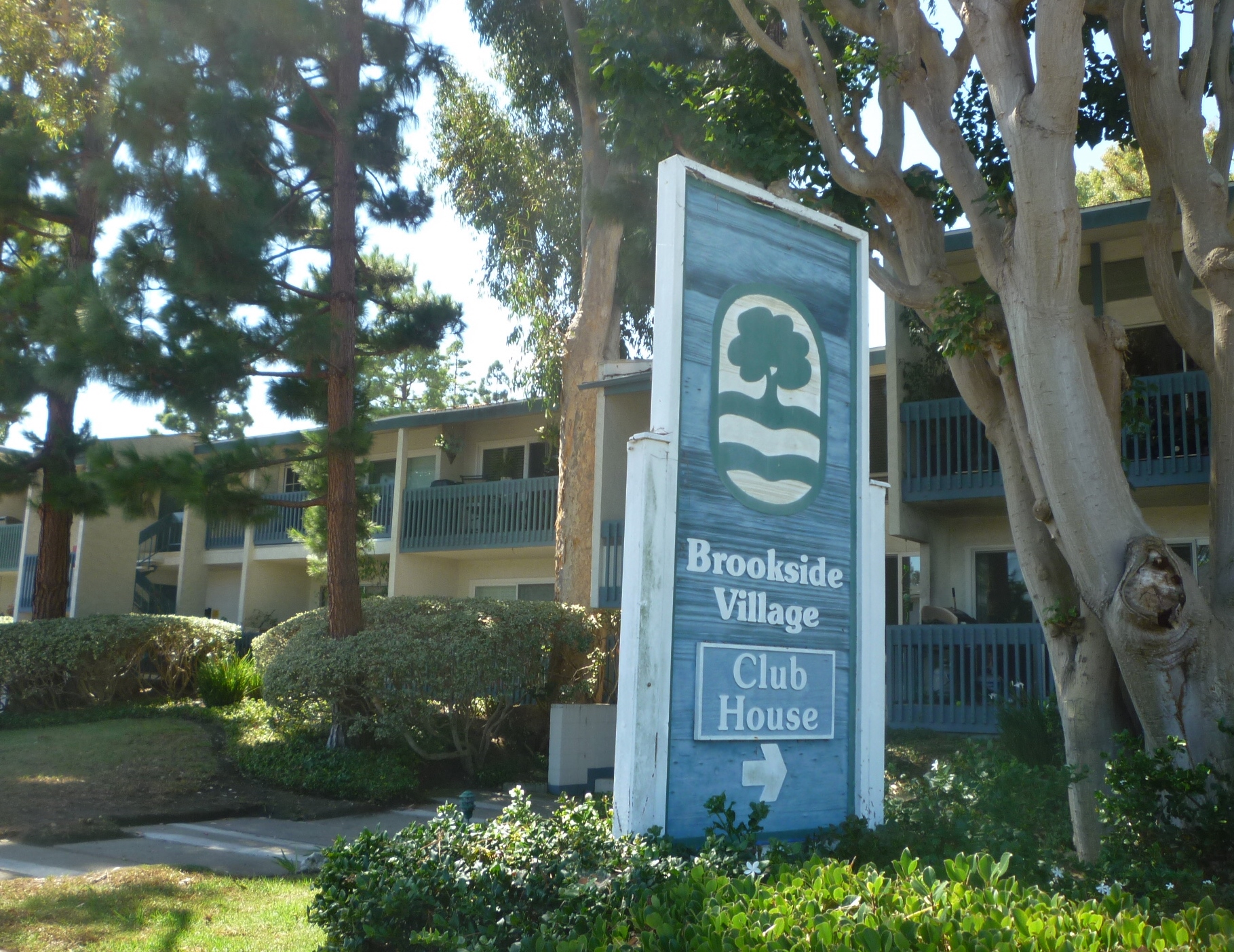
Brookside Village in Redondo Beach. (September 2015 Daily Breeze photo)
Walter Mitchell was earning his living as a house painter in Redondo Beach before running for and winning a city council seat in 1977.
By November 1978, he had become embroiled in controversies that ultimately would cost him his office and land him in prison.
After being elected, Mitchell announced plans to build a fun center in the Edison right-of-way beneath the giant towers just south of Herondo Street near King Harbor and near the city’s border with Hermosa Beach.
The plan for the 5 1/2-acre entertainment center called for an outdoor roller rink, a water slide, two miniature golf courses batting cages, a pinball arcade and a snack bar.
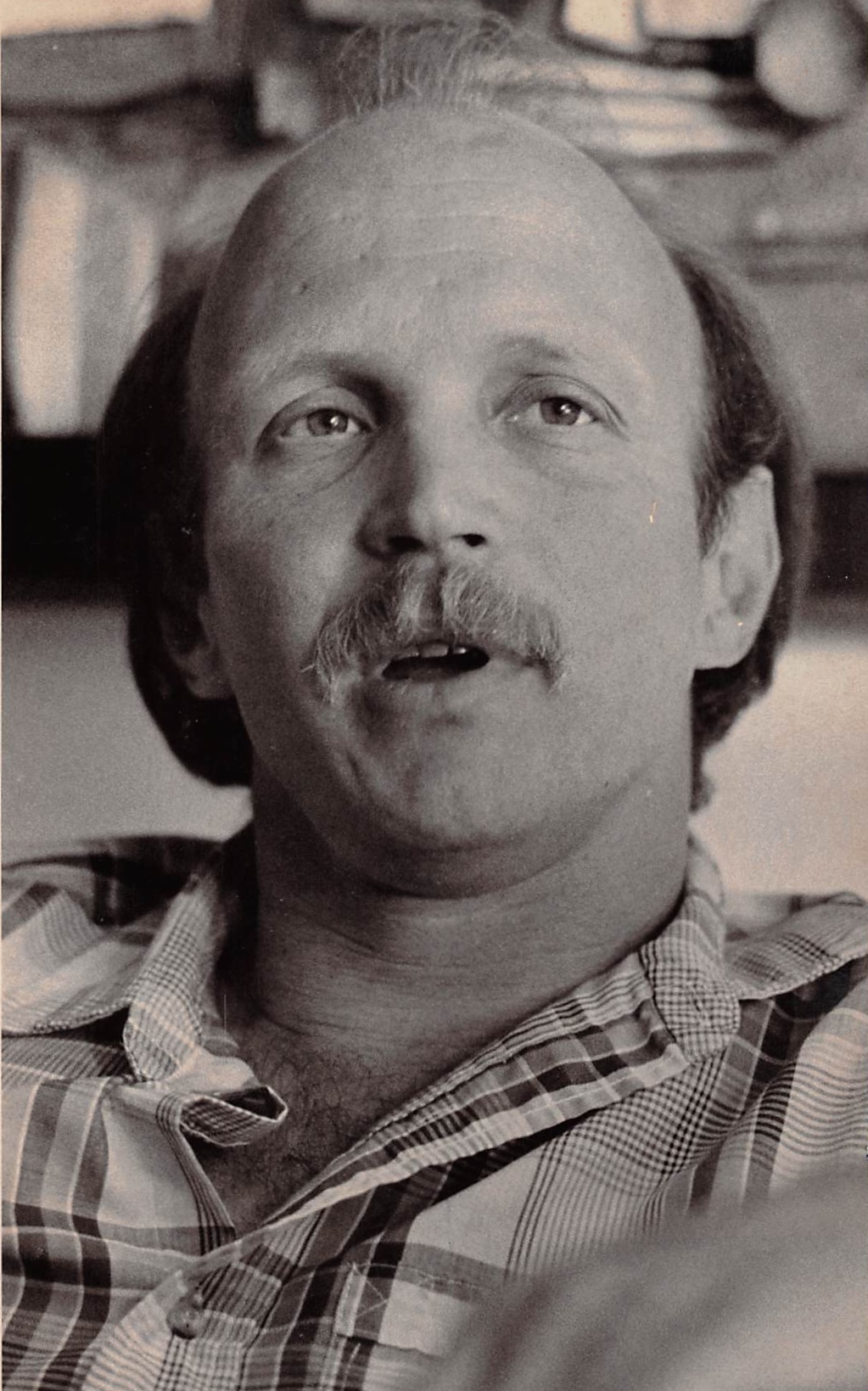
Former Redondo Beach City Councilman Walter Mitchell. Daily Breeze file photo.
One of the candidates he defeated for his Redondo Beach City Council seat, Archie Snow, expressed reservations about Mitchell’s plan. Snow, a community activist who ran a local watchdog group called Concerned Citizens Of Redondo Beach, pointed out that Mitchell’s deal with Edison would disqualify him from voting on any issues involving the utitlity, as it would conflict with Mitchell’s business ties with the utility.
The city’s planning commission approved the project in October 1979, but eventually, the city of Hermosa Beach also expressed concerns, and the fun center never became reality.
Mitchell’s ties with a firm called Condor Investments would prove to be even more damaging. Mitchell’s relationship with Condor begin in 1977, when he befriended company members who were attempting to pass a plan to convert of the Sand Castle apartment complex in Redondo Beach to owner-occupied housing.
Mitchell became friends with Condor’s president, Orange County developer Robert A. Ferrante, and ended up voting in favor of the conversion, which the City Council passed 3-2 in 1978.
Mitchell’s painting business benefited from the relationship. He did painting work for Ferrante at two Condor properties in Houston, Texas, and at the firm’s Continental Village complex in Granada Hills.
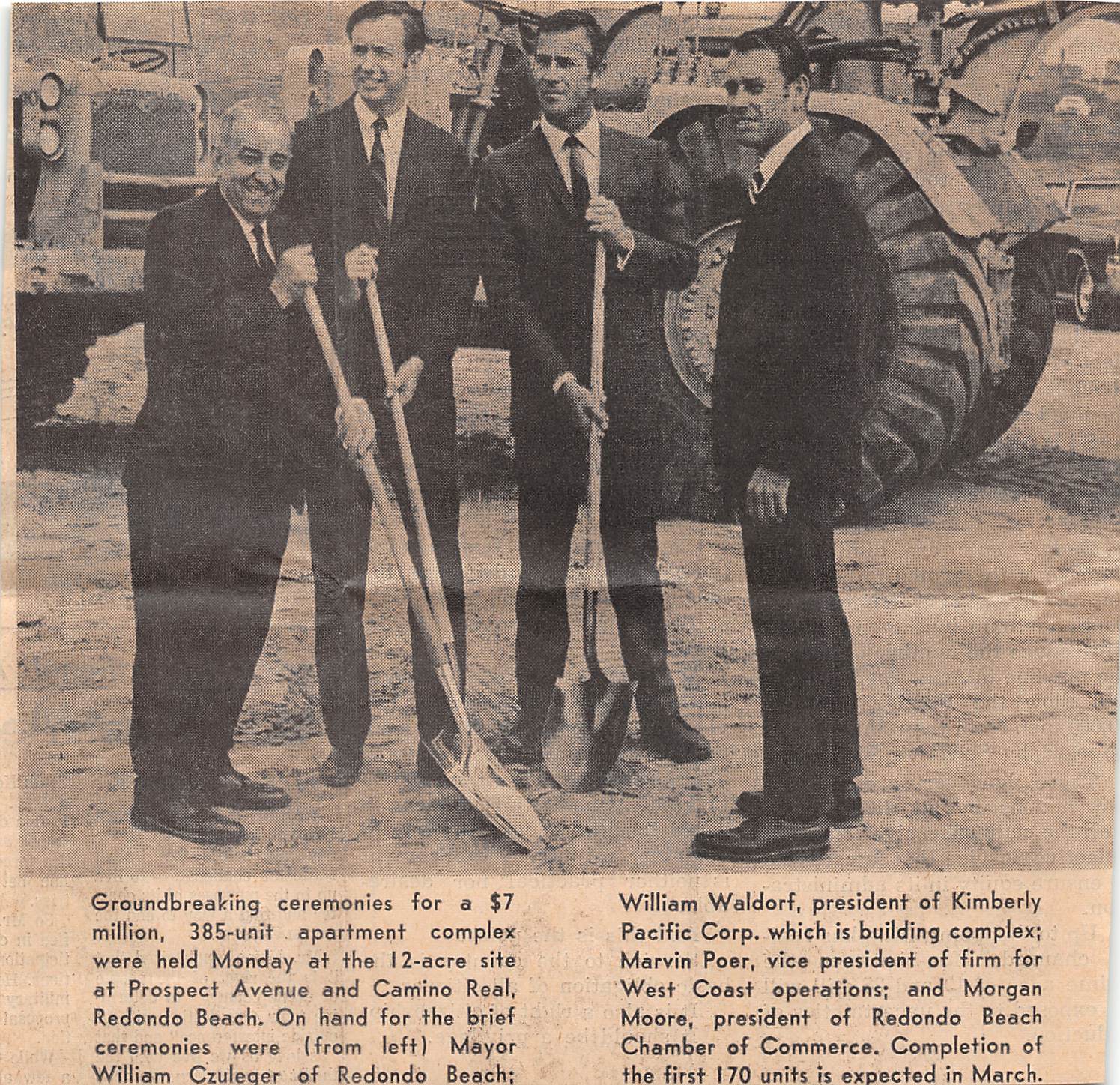
Ferrante then turned his attention to Brookside Village. Ground had been broken for the apartment complex on a 12-acre site on Camino Real and Prospect Avenue, just north of Alta Vista Park in 1969, with the first units completed in 1970. Eventually, 385 units were built, making it the largest apartment complex in Redondo Beach at the time.
Photo from the Daily Breeze edition of Sept. 24, 1969, shows the groundbreaking ceremony for the Brookside Village apartment complex.
Ferrante led a group that had purchased Brookside in the late 1970s, and Mitchell began working to persuade city officials to approve Ferrante’s plan to convert the huge complex into condominiums.
Officially, Mitchell denied having any kind of business interest in the Brookside deal, and Ferrante denied being the brains behind the conversion.
Mitchell recused himself from voting on the project, saying he wanted “to assure that there will be no further charges of impropriety by the council or any of its members.” That statement came on day after a Nov. 18, 1979, Daily Breeze article that detailed Mitchell’s business dealings at length.
The Brookside conversion measure passed on another 3-2 vote in December 1979, with Mayor David Hayward cast the deciding vote.
In the months following the approval, Brookside residents reported seeing Mitchell at the complex inspecting ongoing painting work there after the conversion passed and construction work on it had begun. Ferrante also had been spotted at Brookside several times.
By then, Snow had begun a recall drive against Mitchell, claiming that he was using his office for his own financial benefit and that his business dealings caused conflicts of interest that made him unable to represent Redondo residents properly.
After the required 962 signatures calling for a recall had been verified, the election was set for Aug. 26, 1980. The vote in favor of recalling Mitchell was 493 for, 279 against. It was the first successful recall election in Redondo Beach in 50 years.
Shortly afterward, Snow also attempted to have Mayor David Hayward recalled, but that attempt failed.
Mitchell moved to Canyon Lake in Riverside County after being recalled, but his legal troubles weren’t over. He was working as a prison guard at the California Institute for Men in Chino when he was indicted by the federal government in May 1983 on 14 charges of political corruption and tax fraud.
In addition to accusing him of using his political influence to sway the Brookside Village conversion vote in order to receive painting contracts from Ferrante, a federal jury also accused him of laundering payoff money from the developer.
Mitchell was fired by the prison after the indictment came down, before the case came to trial in July 1983. On July 13, 1983, Mitchell was convicted on six counts of mail fraud and one count of tax evasion.
He served 10 months in a minimum-security federal camp in La Tuna, Texas, near El Paso, and another five months at a halfway house in Rubidoux.
In February 1989, Mitchell won an appeal to have the mail fraud counts overturned, but the tax evasion count stood.
As for Ferrante, he was walking with another man to a car near the Brookside Village complex at 11:25 p.m. on April 12, 1982, when a masked man jumped out of the bushes and fired “four or five rounds” at him. Bullets struck Ferrante in the left leg, left arm and chest, but he survived the attack. The man with him was not injured.
The crime was never solved. Ferrante said at the time he had no idea who shot him or why. (Years later, he testified that he thought two former business partners with ties to the Israeli Mafia were behind the hit attempt.)
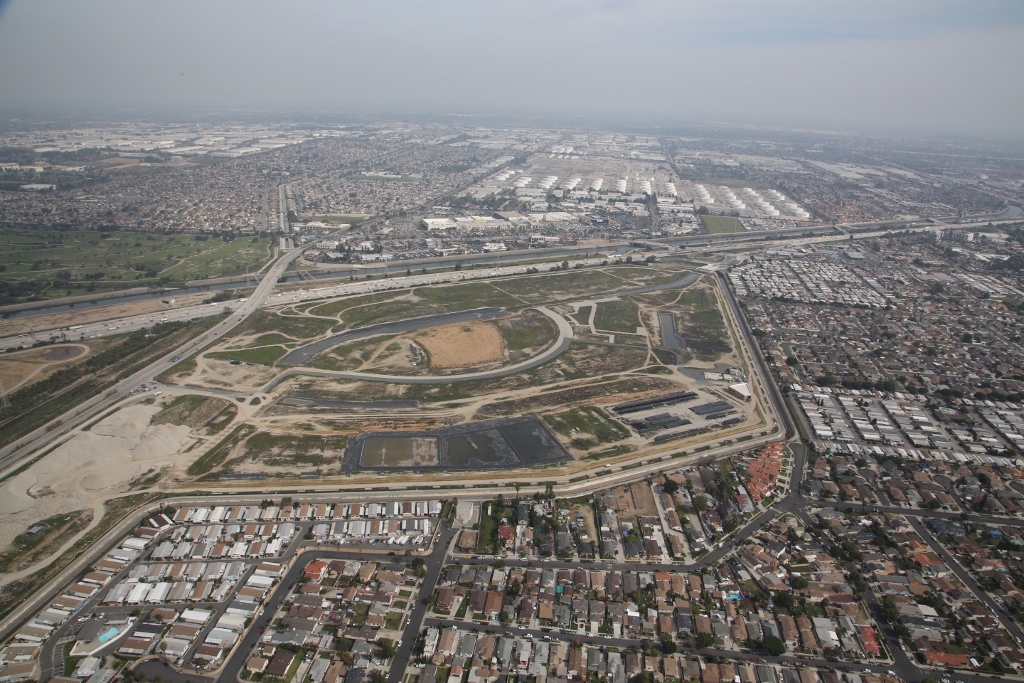
Proposed site in Carson to build an NFL stadium. Feb. 21, 2015. (Chuck Bennett / Staff Photographer)
Ferrante popped up again in the South Bay a couple of years later. He struck a partnership with the glass workers union pension fund to develop a giant outlet mall on the site of a former landfill in Carson that we wrote about a couple of weeks ago, since it’s currently the proposed site for a new NFL stadium.
Ferrante ran Consolidated Savings & Loan in Irvine until it failed in 1986, partially due to the $28 million in delinquent loans on the Carson property.
Another factor was his involvement with the takeover of Pyrotronics, the firm owned by fireworks magnate and known influence peddler W. Patrick Moriarty, until his own financial problems caused him to give it up in 1984. After taking it over, Ferrante allegedly approved loans from Consolidated to Pyrotronics, even though he owned both.
Moriarty would later have his own legal troubles in the South Bay. He would go to prison in 1986 on political corruption charges that included influence peddling, mail fraud and kickbacks in several Southern California cities, including Carson.
After an investigation, federal authorities indicted Ferrante in February 1991 for allegedly helping to loot Consolidated Savings Bank of Irvine of $30 million. He was acquitted of the charges in 1992 trial, but, in 1993, federal banking authorities banned him from ever running a federally insured savings and loan again.
Now 66, Ferrante lives in Orange County, where he works for philanthropic causes. Mitchell, 68, lives in Riverside County. Archie Snow died in Redondo Beach at 79 on March 30, 1998.
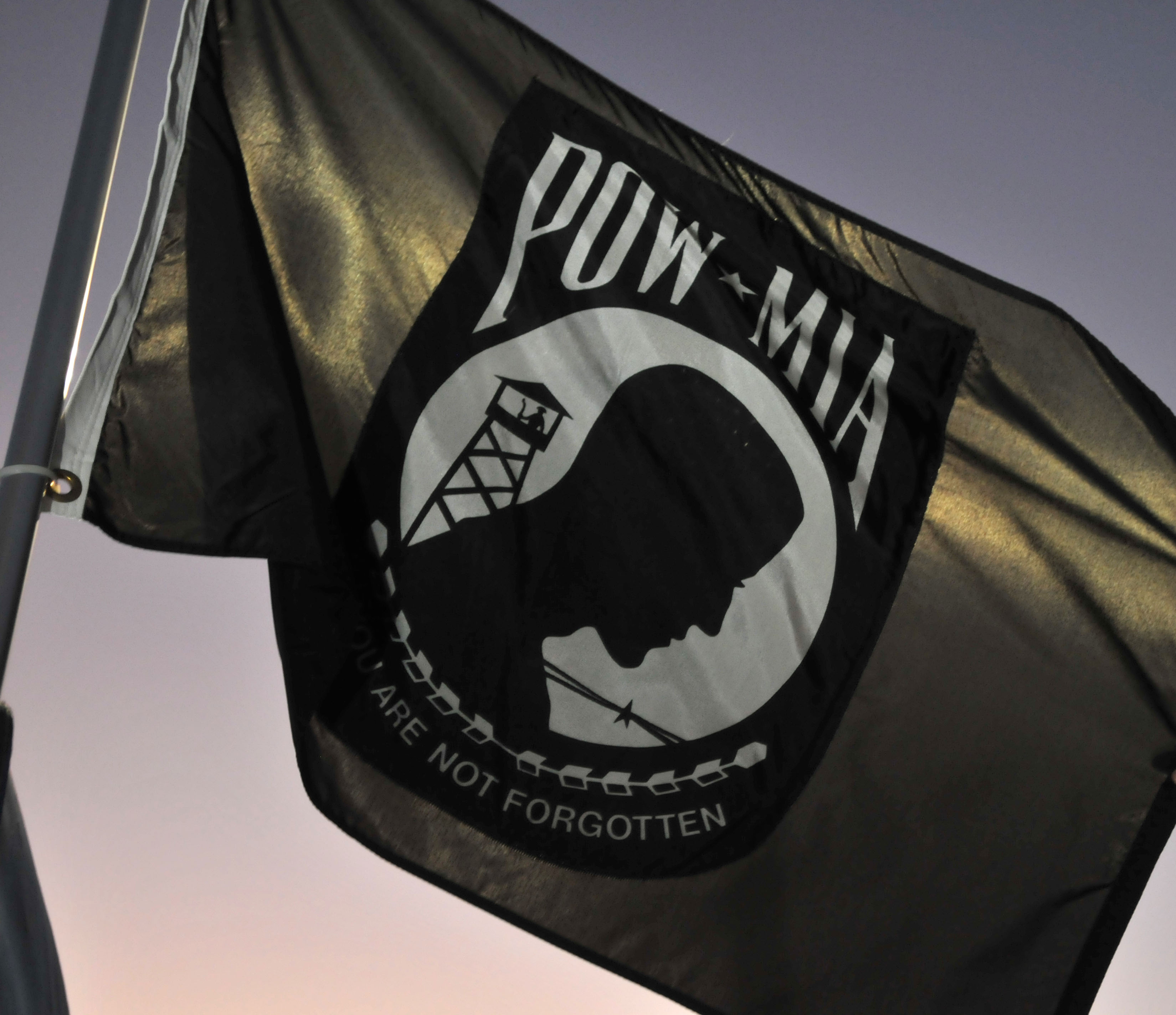
The POW/MIA flag flies during a torch relay event in honor of National POW/MIA Appreciation Day at the Los Angeles Air Force Base El Segundo on Sept. 18, 2008. (Daily Breeze file photo)
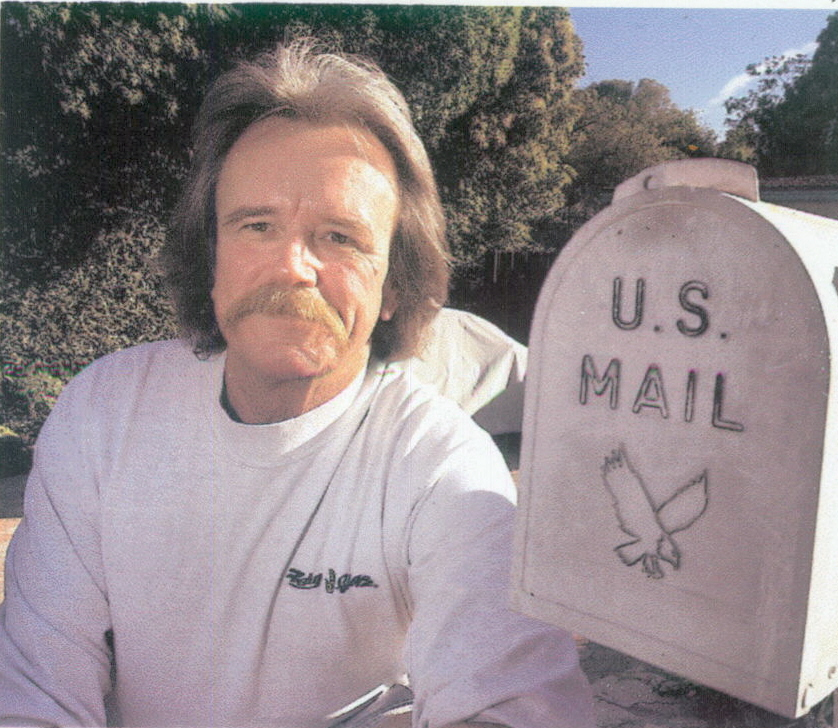
U.S. Army veteran Ron Updike was working at the Palos Verdes Peninsula branch of the U.S. Postal Service in 1990, the year that its new building in Rolling Hills Estates opened.
In honor of National POW/MIA Recognition Day, which had been designated by the U.S.
Ron Updike
Congress in 1979, Updike raised the POW/MIA flag at 6:00 a.m. at the post office for the first time on that year’s Recognition Day, which fell on Sept. 21, 1990.
It marked the first time the flag had been flown at a post office in the U.S. It would fly there 24 hours a day for the next six years.
The distinctive black and white flag was created by graphic artist Newt Heisley in 1972 for the National League of Families of American Prisoners and Missing in Southeast Asia.
It depicts a silhouette of a man set against barbed wire and a guard tower, with the words “You Are Not Forgotten” placed underneath.
On Aug. 10, 1990, Congress recognized Heisley’s flag as a national symbol for the POW/MIA issue. Though associated with the Vietnam War, it has come to stand for POW/MIAs for all American wars.
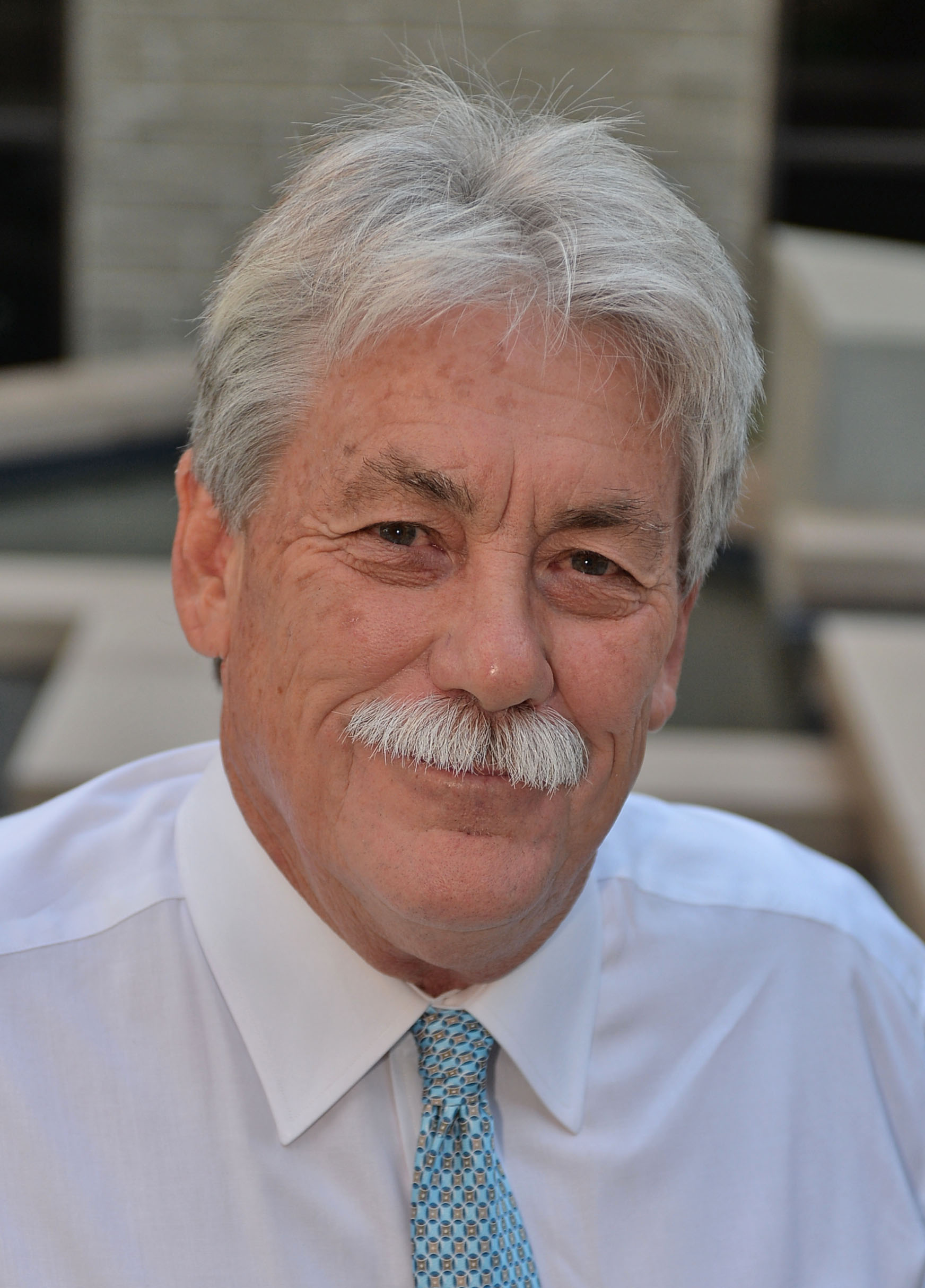
Dave Albert
The story might have ended there if Lomita City Councilman Dave Albert hadn’t been inspired by Updike’s idea, and asked in late 1996 if the POW/MIA flag would be allowed to fly at the Lomita Post Office.
Albert, who had been the driving force behind the veterans memorial installed at the Lomita P.O., had discovered that two of the 74 men honored by the post office memorial were listed as missing in action.
He wanted to honor them by flying the flag, which in 1995 had begun flying at City Hall, Veterans Park, the Lomita V.F.W. post and the Lomita Railroad Museum.
Lomita post office officials had no objection to the request, but postal officials at the regional headquarters in Long Beach quickly shot down Albert’s idea.
“We can’t be hoisting everyone’s flag on the flagpole, so we draw the line at the U.S. flag,” Los Angeles Postal Service spokesman George Marsh said at the time.
When Albert pointed out in a Daily Breeze story that the Palos Verdes Peninsula post office had been flying the POW/MIA flag since 1990, postal officials ordered on Dec. 31, 1996, that the Peninsula post office immediately stop flying the POW/MIA flag.
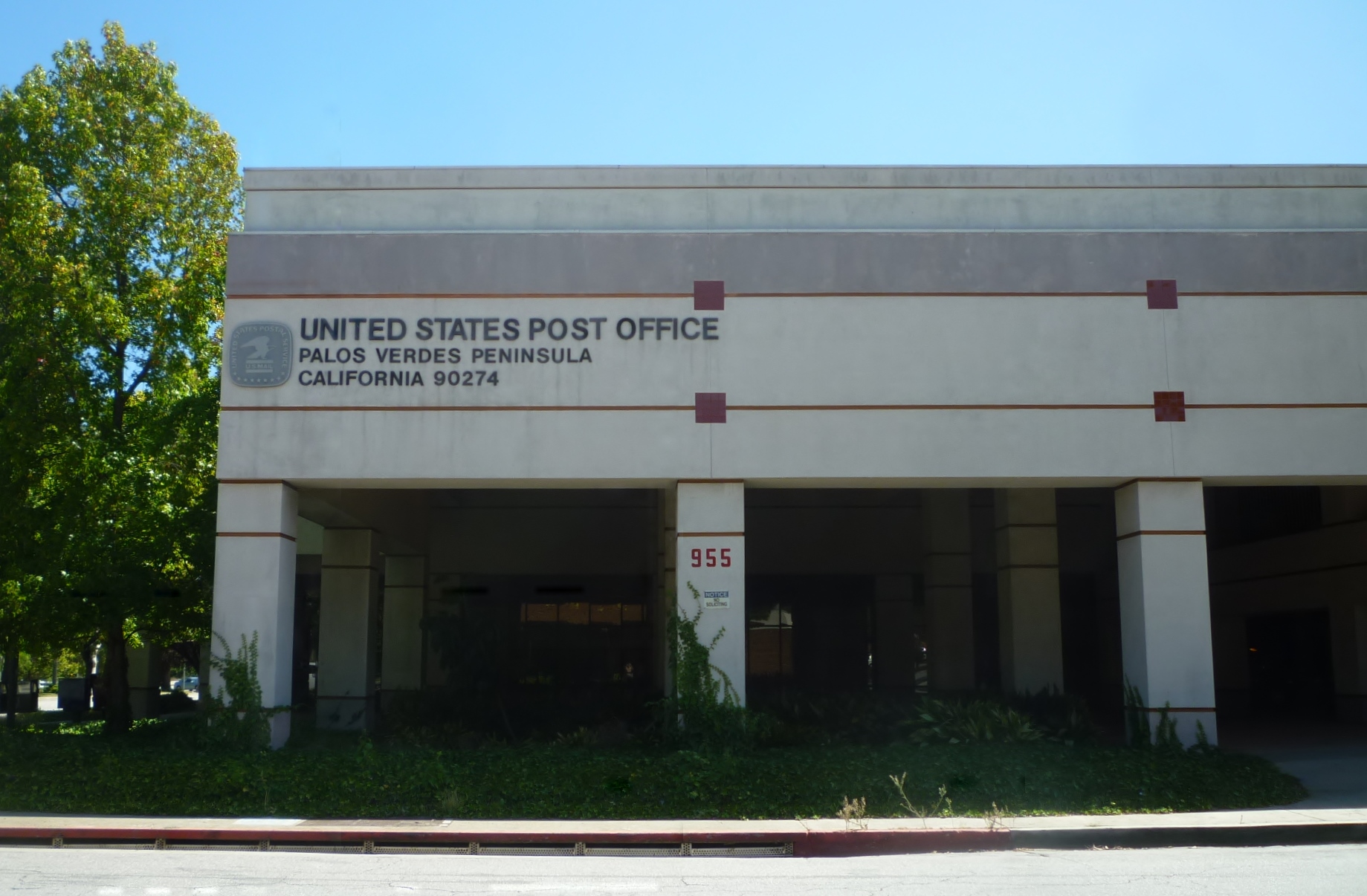
Palos Verdes Peninsula post office. (September 2015 Daily Breeze photo)
The order to take down the flag and the denial of Albert’s request upset postal workers and veterans groups. There’s a crossover between the two: statistics at the time showed that more than one-third of all postal workers were veterans.
Albert wrote letters to the U.S. Postmaster General in Washington, D.C., who upheld the ruling against the flag, and to then-President Clinton, who did not respond.
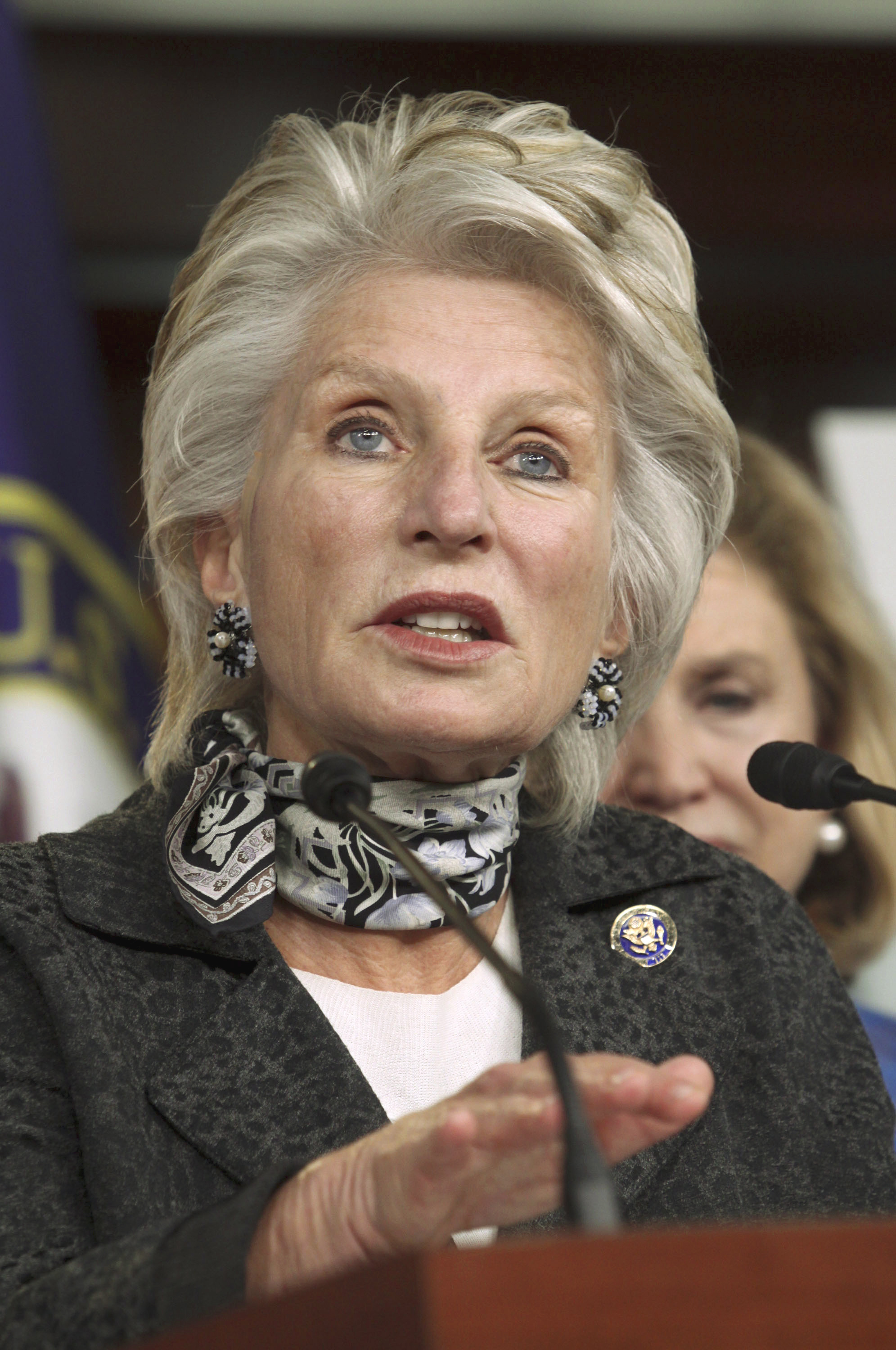
Rep. Jane Harman, D-Calif. speaks on Capitol Hill in Washington in this March 20, 2010 file photo. (AP Photo/Lauren Victoria Burke, File)
The South Bay cities of Rolling Hills Estates. Torrance, Redondo Beach, Hermosa Beach and Lawndale all passed resolutions in favor of flying the flag at their local post offices.
Veterans groups took up the cause, and brought it to the attention of local elected officials.
Congresswoman Jane Harman then made the cause a national issue. First, she went to Postmaster General Marvin Runyon in Washington, D.C., with the idea, but he flatly refused to consider it.
So she introduced a bill in the House of Representatives on March 20, 1997, calling for the POW/MIA flag to be flown at federal buildings, including post offices, on six specific holidays.
Harman got her bill inserted as Section 1082 of the 1998 Defense Authorization Act, which passed both houses of Congress and became law in November 1997.
Under the law, the POW/MIA flag will be flown at government offices on the following special days:
Armed Forces Day (Third Saturday in May)
Memorial Day (Final Monday in May)
Flag Day, June 14
Independence Day, July 4
National POW/MIA Recognition Day (Third Friday in September)
Veterans Day, Nov. 11
On Veterans Day, Nov. 11, 2008, Harman wrote the following in The Daily Breeze:
“I remain enormously proud of my authorship of the law to require federal facilities to fly the POW/MIA flag on holidays like today. Those prepared to die for our country, those who never returned and those buried in military cemeteries in the South Bay, Arlington and around the world must be properly honored and remembered. Our future security requires that our young women and men be prepared to emulate their courage and sacrifice – with the support of their families and a grateful nation.”
Ron Updike retired from the Postal Service in November 2001, but he continues to work tirelessly to remind us to honor the memory of POW/MIAs on National POW/MIA Recognition Day, which falls this year on Friday, Sept. 18, 2015.
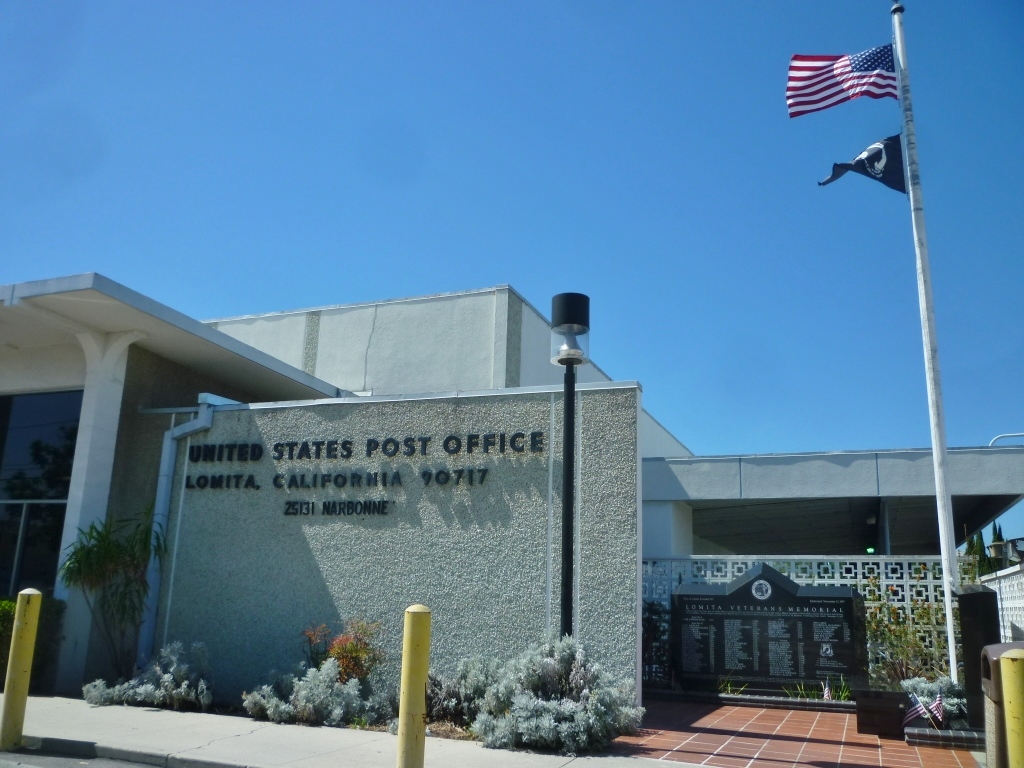
The POW/MIA flag flies at the U.S. Post Office in Lomita, upper right, on Sept. 18, 2015, National POW/MIA Recognition Day. The Lomita Veterans Memorial is visible at lower right. (Daily Breeze photo)
Monday, Sept. 21, 2015, marks the 25th anniversary of the first time the POW/MIA flag flew at a U.S. post office building.
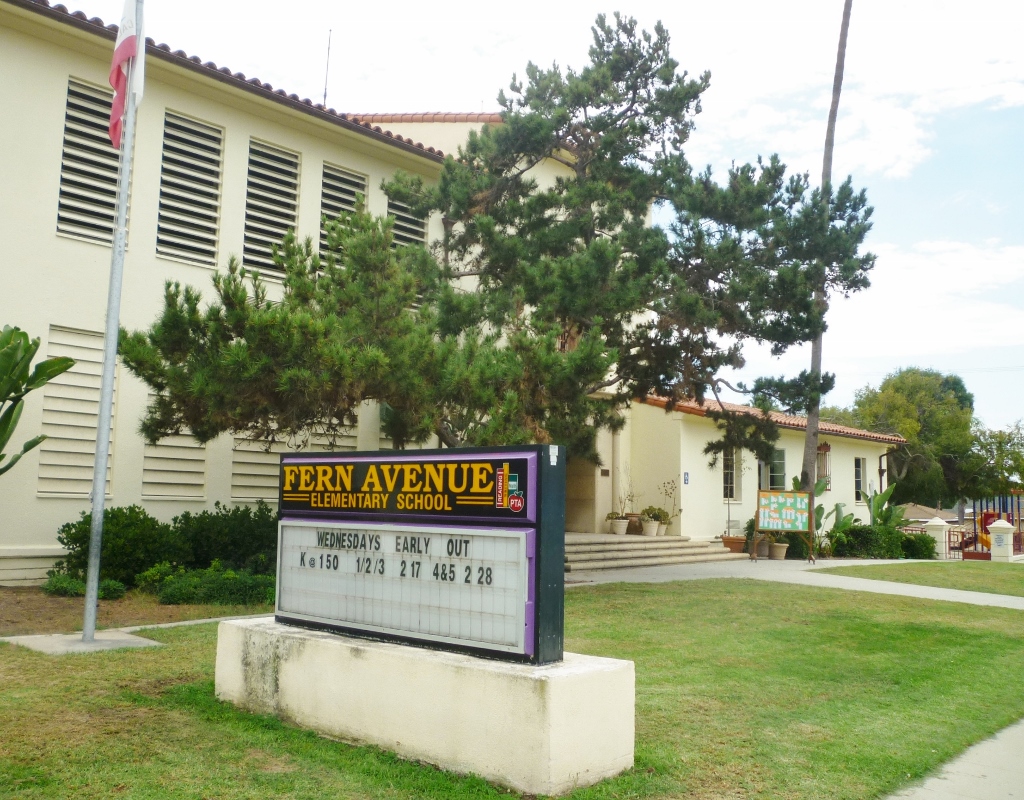
Fern Elementary School in Torrance began in 1926 as a group of bungalows assembled as a remote addition to Torrance Elementary School.
The school originally was known as Redondo Boulevard School, named after the nearby street that would later become Torrance Boulevard.
The school’s name changed to Fern Avenue School in 1928, after the street on which it actually was located.
On March 27, 1931, Torrance voters voted in favor a $12.7 million bond issue for the Los Angeles School District, as did the rest of the city. Torrance still was part of the Los Angeles district; it would not establish its own independent school district until 1947.
The city was assured that part of the bond money would go toward the construction of a permanent $80,000 structure to house Fern Elementary. The bungalows had proven to be substandard and inadequate as the population of the school grew from its original 119 students. Architectural plans were announced and artist’s renditions of the new building made public.
So Torrance officials and residents were outraged when the L.A. district announced in September 1931 that the school would not be built until the district was convinced that Torrance would not form its own school district and take over the school.
An incensed Torrance Chamber of Commerce immediately petitioned the L.A. district board to change its mind, pointing out that Torrance voters always had supported school bond measures and that the city gave a disproportionate amount to the big city district when compared what it received in return in the way of teachers and facilities.
In the meantime, the vociferous protests from the city wore down the L.A. school board, which reversed itself in 1932, when construction of the school began.
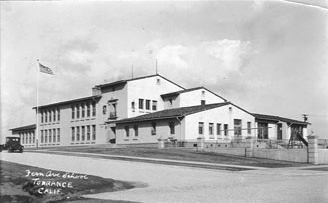
Fern Avenue School , shortly after its completion in 1932. (Photo: Torrance Historical Society)
Even details of the construction process became rancorous.
The Los Angeles board voted in July 1932 to build a cesspool at the Fern Avenue school site, rather than spend an extra $400 to $700 to connect the school to the main sewer line as it had promised to do. Fortunately, Torrance residents were paying attention and nixed the cesspool idea.
After the lengthy struggle, the $84,000 Fern Avenue School building at 1314 Fern Avenue opened its doors to students on Jan. 2, 1933. Guy Holliday was its first principal, retaining the job he had been performing since 1929.
Weeks after the school opened, the city of Torrance announced plans to pave Sonoma and Eldorado streets. The two dirt streets leading to Fern became impassable during rainy weather. The city of L.A. already had paid for an extension of Fern Avenue to the recently renamed Torrance Boulevard.
Two months after the school opened, it was shaken but not seriously damaged by the Long Beach earthquake, which rolled through the area at 5:54 p.m. on March 10, 1933.
Fern Avenue School’s Parent Teacher Associated was formed by 20 charter members on April 29, 1933, with Mrs. C.D. Lowen as its first president.
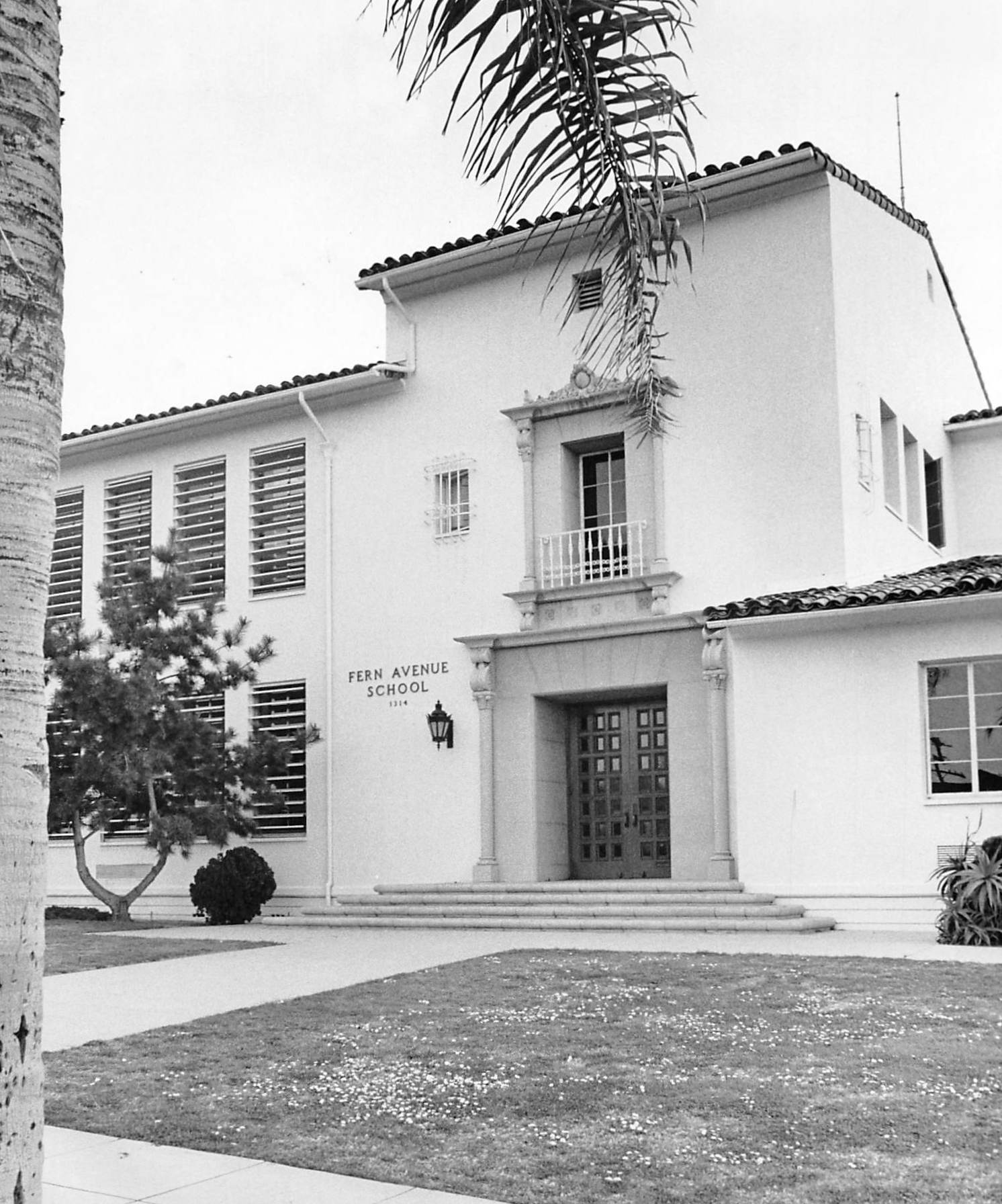
Fern Avenue School in 1974. (Daily Breeze file photo)
By 1940, the school had grown to 285 students. It officially became part of the new Torrance Unified School District on July 1, 1947, when its keys were handed over to Torrance’s first superintendent, J.H. Hull.
In 1949, the Torrance district began looking at options to provide more facilities for Fern Avenue Elementary. The district owned a lot on the southwest corner of Fern and Eldorado, a low-lying area with drainage problem.
The district decided to solve the drainage problem and build a school there. Greenwood School opened in 1951. It was operated jointly with Fern Avenue School from 1953 until its closure in 1984.
Ownership of the land passed to the Torrance Parks and Recreation Department, which opened Greenwood Park on the site in 1995. The Greenwood School buildings are now occupied by a privately owned day care center.
By this time, the Fern Avenue School main building had survived two earthquakes, the one in March 1933 mentioned above, and another quake that damaged many buildings in Torrance on Nov. 14, 1941.
After the 1933 quake, the Field Act was enacted in California, setting quake safety standards for public buildings.
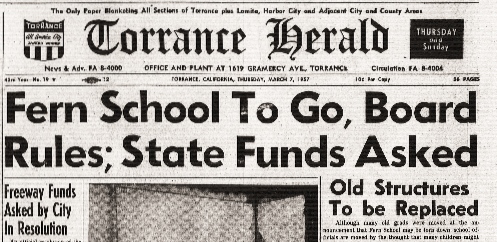
Front page headline from the Torrance Herald, March 7, 1957. (Credit: Historical Newspaper Archive, Torrance Public Library)
On March 6, 1957, realizing that many of its older school buildings didn’t meet those standards, the Torrance board of education announced plans to abandon and demolish the Fern building, in addition to the Perry School administration building and 24 additional structures at five other Torrance schools.
The district hired a Long Beach architectural firm, Killingsworth, Brady and Smith, to design a new building.
After some deliberation, the state of California in March 1958 saved Fern from the wrecking ball, rejecting the idea of replacing the elegant old school building. The state determined that rehabilitation of Fern to meet earthquake standards would be more cost effective than razing it and starting over.
The project, which took several months, was completed in 1959 at a cost of $240,000.
In recent years, overcrowding at the school, now known as simply as Fern Elementary School, led to the district leasing back some of the land that was now Greenwood Park in 1996 for a place to put portable classrooms. For more than a decade, students had to be escorted across the street to and from the temporary structures.
After several attempts at getting enough money to unify the school on its main site, the passage of Measures Y and Z in 2008 finally provided enough funding for the job.
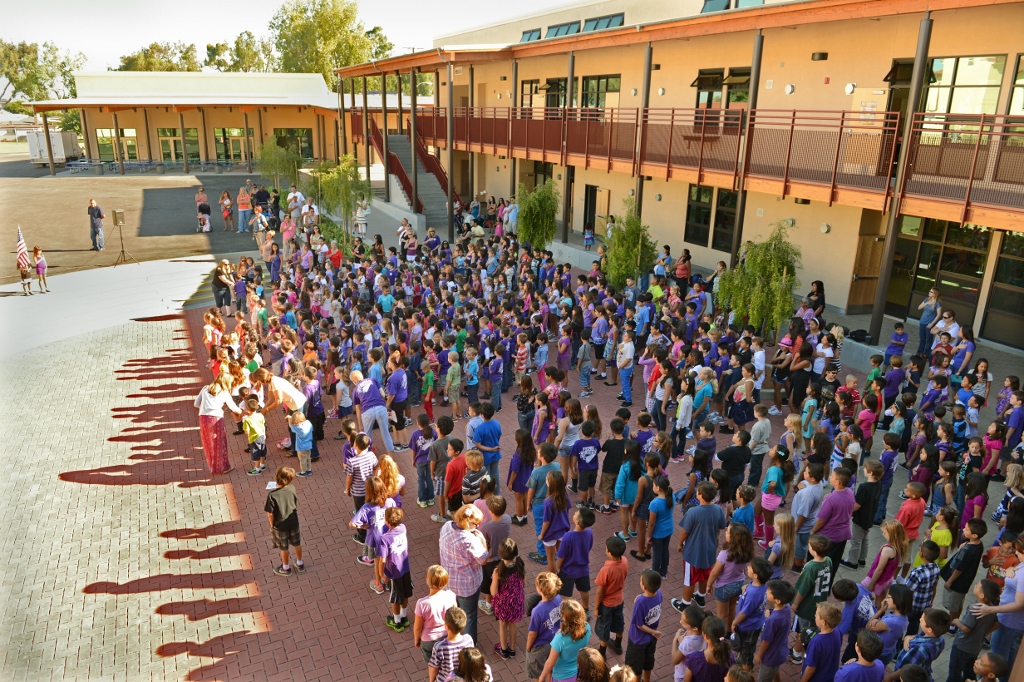
The $13.5 million renovation uniting the split campus opened to students with the first day of classes in September 2012.
A morning assembly at Fern Elementary School in Torrance brought together grades K-5 in the shade of their new wing of classrooms. Upper grades at the school were held across the street for years during the long construction phase. 2012 file photo. (Daily Breeze file photo by Brad Graverson / Staff Photographer)
The new campus includes 14 new classrooms, a multipurpose room and a new cafeteria.
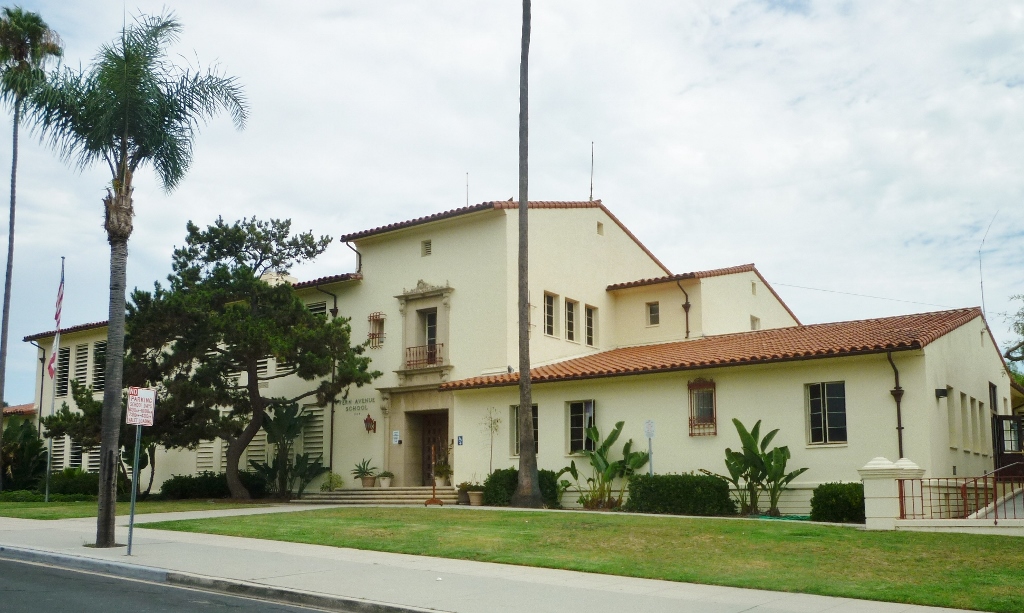
The school’s 83-year-ol main building has been upgraded and renovated, but remains intact, a survivor of both natural and man-made attempts to destroy it.
Sources:
Daily Breeze files.
The History of Torrance Schools, 1890-2000, by Thomas Rische, Ph.D, TUSD History Project, 2002.
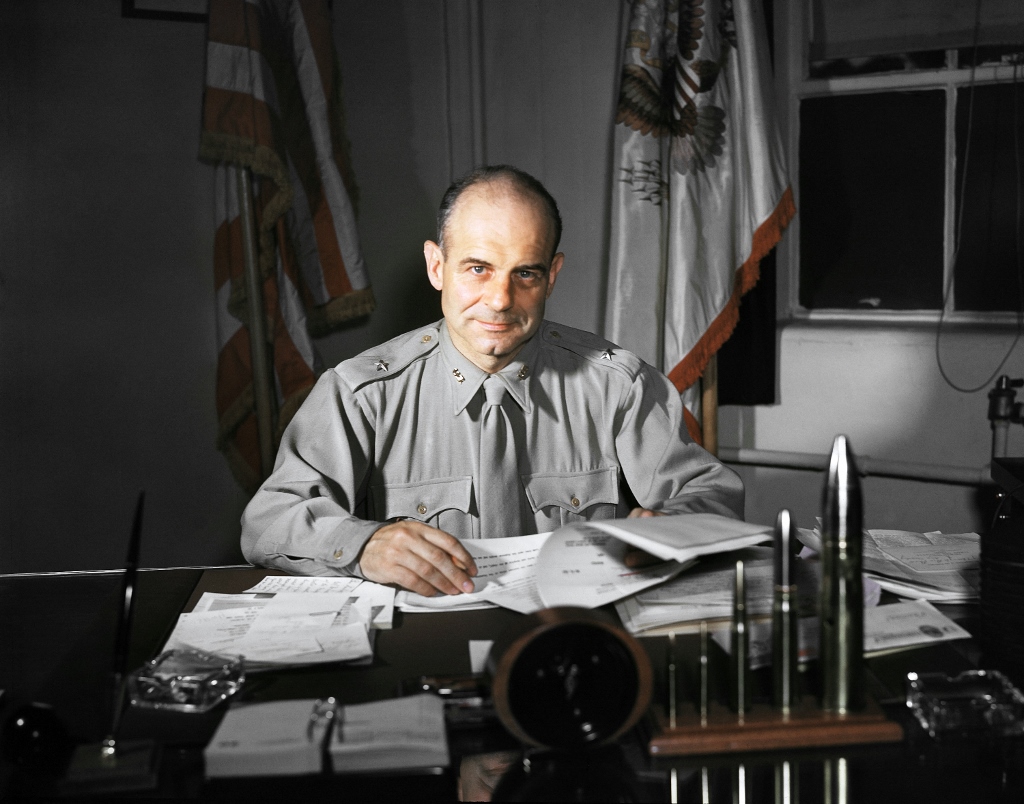
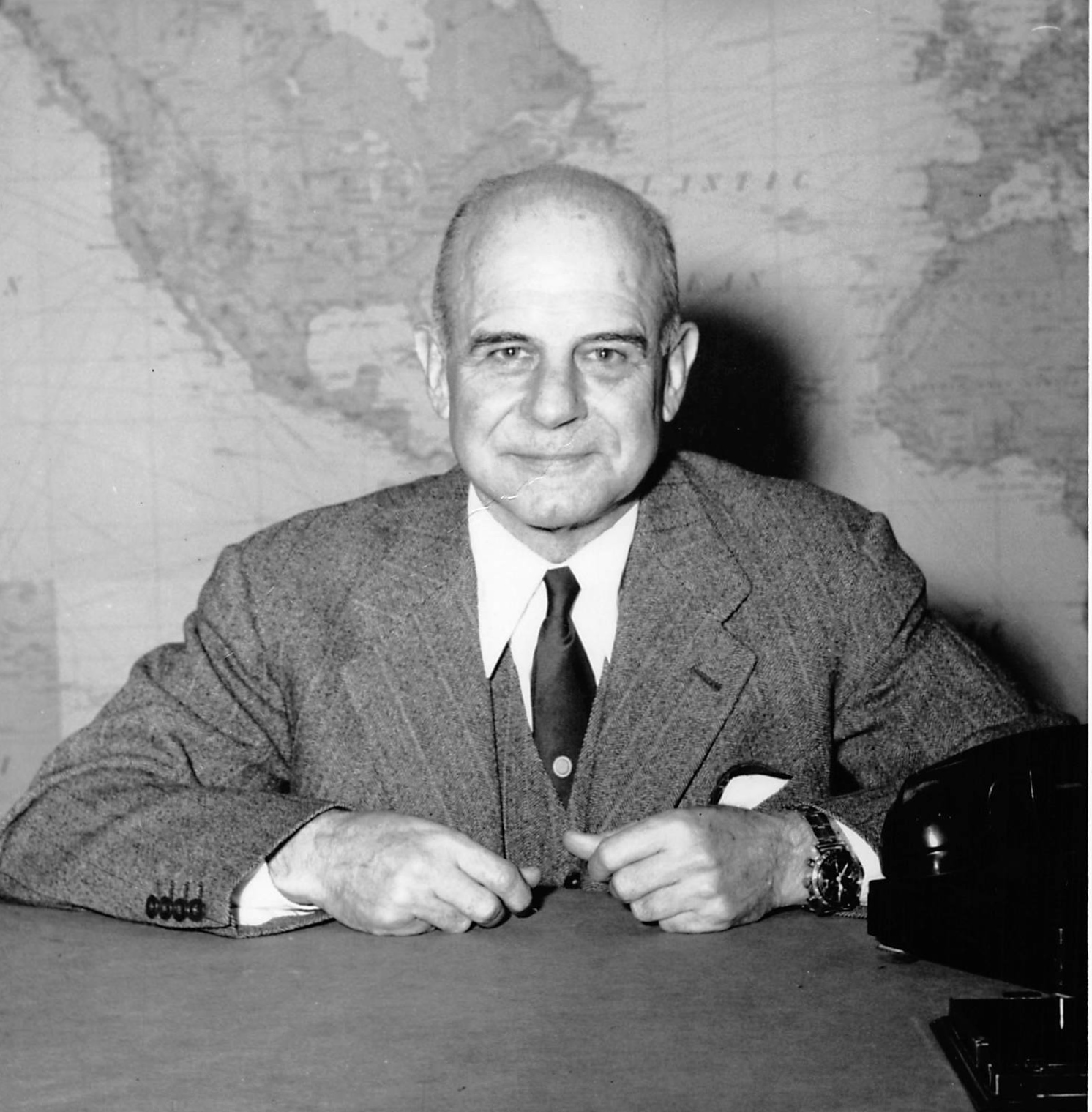
Lt. General James “Jimmy” Doolittle in 1942. (Associated Press)
Gen. James “Jimmy” Doolittle’s exploits as a test pilot, war hero and postwar military expert make him one of the greatest aviation figures of the 20th Century.
He was born on Dec. 14, 1896, in Alameda, Calif., and spent much of his childhood in Nome, Alaska. Doolittle, who was 5-foot-6, became a champion amateur bantamweight boxer upon moving to California.
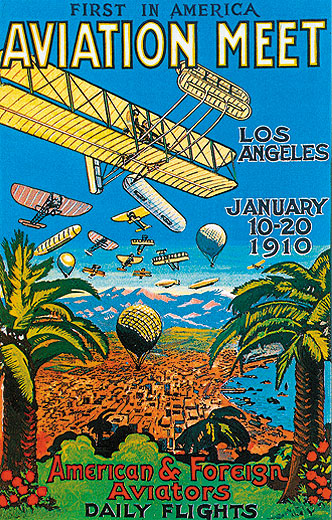
Poster for the 1910 Los Angeles International Air Meet.
His love of aviation may have stemmed from the marvels he saw upon attending the landmark 1910 Los Angeles International Air Meet at Dominguez Field in present-day Carson. The epochal 11-day event was held at an airfield that no longer exists located near the present-day site of California State University, Dominguez Hills.
Events such as the first-ever powered airplane flight in the West by aviation pioneer Glen Curtiss at the meet made quite an impression on Doolittle.
After graduating from Manual Arts High School in Los Angeles in 1914, Doolittle would go on to attend Los Angeles City College and transfer to the University of California, Berkeley, to study mining engineering. He took a leave of absence from college in 1917 to enlist in the U.S. Army’s Signal Corps pilot training program.
He remained stateside as a flight instructor during World War I. After the war, he became a member of the Signal Corps reserves, while continuing his education. He earned a B.A. from UC Berkeley, 1922 and a master’s degree and PhD from the Massachusetts Institute of Technology in 1924 and 1925.
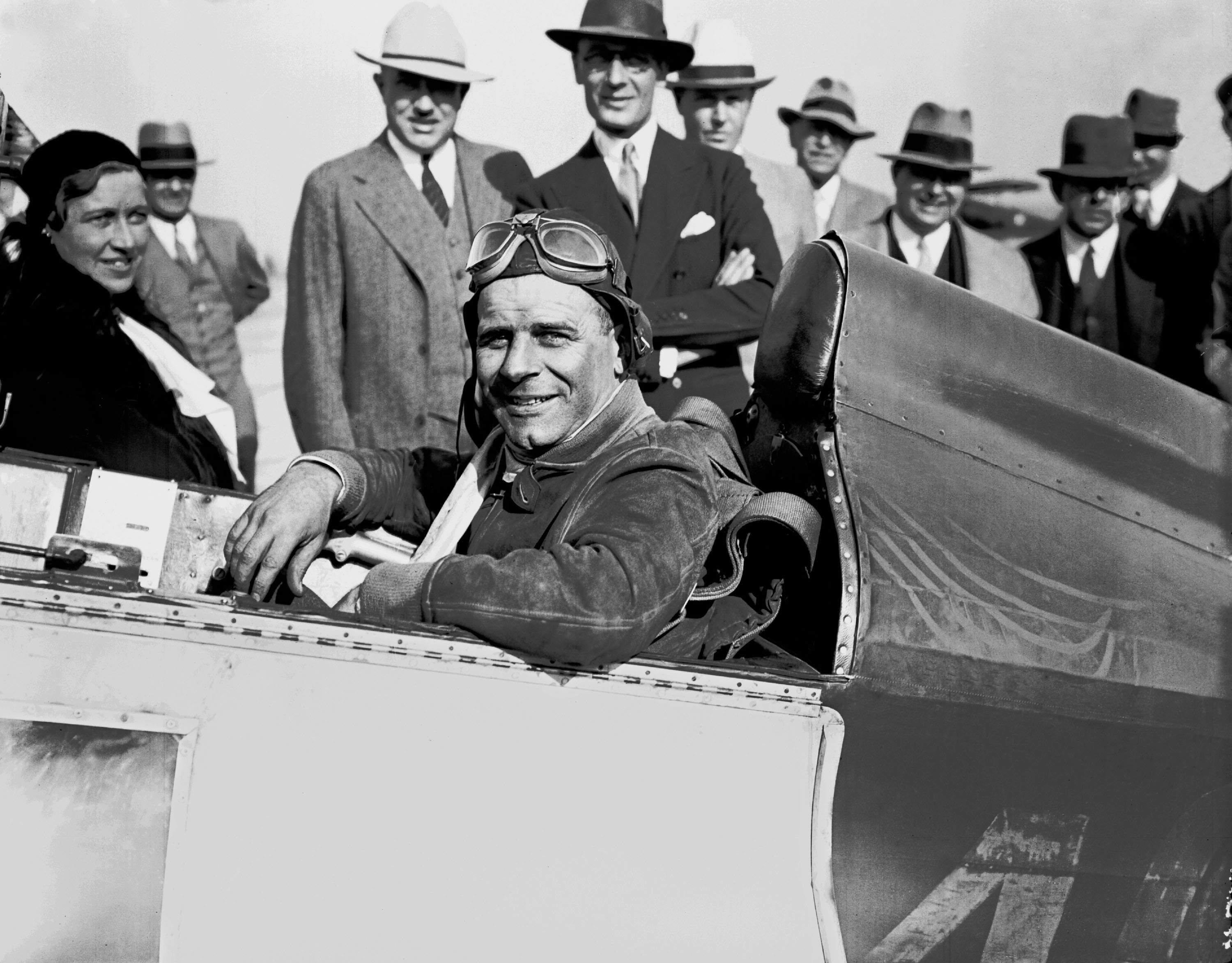
Maj. James (Jimmy) Doolittle smiles from the cockpit after landing in St. Louis, M0., on Oct. 26, 1931 after a record breaking flight of 6 hours 33 minutes. Doolittle averaged about 230 miles per hour for the 1,500-mile trip. (Associated Press)
Doolittle’s air racing career lasted until he retired from competition in 1932, after having won many championships. His feats were celebrated in the national press, as air races were highly visible public events at the time.
His work as a test pilot was even more impressive. His early achievements included making the first transcontinental U.S. Flight in under 24 hours in September1922, performing the first outside barrel loop on May 25, 1927. This particular maneuver was so dangerous at the time that the Army barred its pilots from attempting it in the future because of its risk.
Perfecting the art of “blind” flying using just aeronautical instruments topped Doolittle’s list of military aviation achievements. He became the first pilot to conduct such a flight on Sept. 24, 1929, at Mitchel Field In New York.
Doolittle resigned from the Army Signal Corps in 1930 in order to take a job with Shell Oil that would help him to better support his wife, Joe, and their two sons, James Jr. And John.
He would remain with Shell, and continue as a test pilot, until he returned to duty with the U.S. Army Air Corps in July 1940.
The outbreak of World War II led to the moment that would forever define Doolittle’s military career. From the beginning, the bombing raid conducted under his leadership on Tokyo on April 18, 1942, the first U.S. attack on Japanese soil during WWII, had been conceived as more of a psychological boost for the country and its fighting men than a full-scale destructive assault.
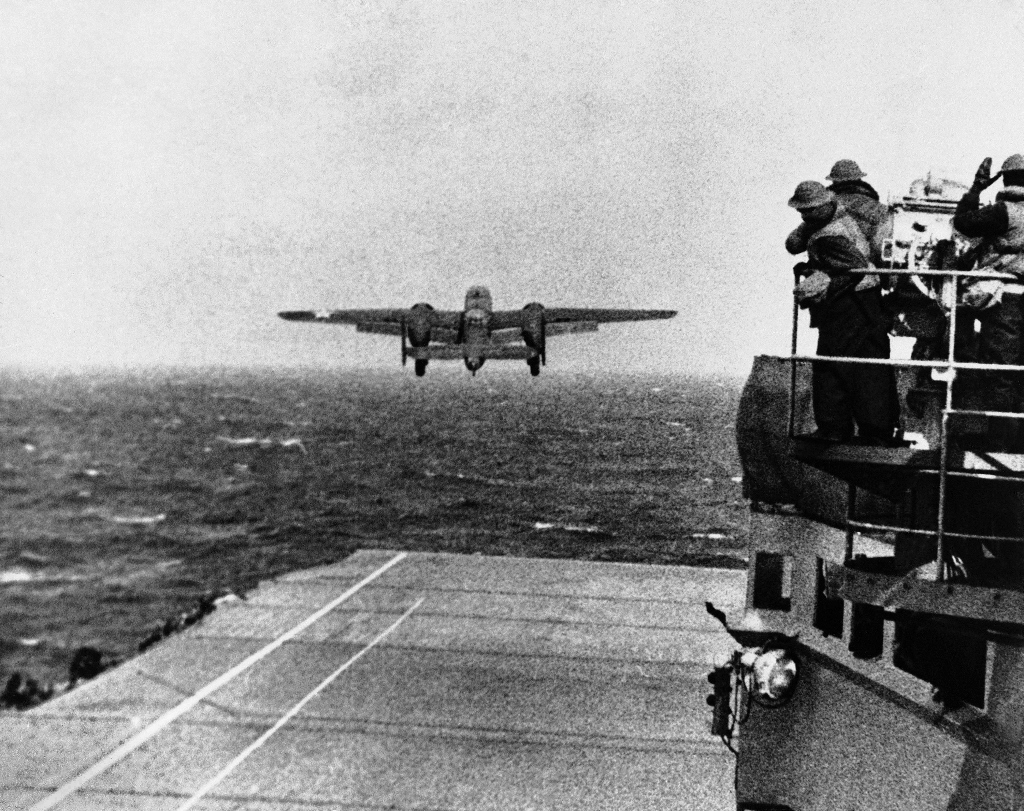
One of the 16 B-25 bombers takes off from the deck of the USS Hornet on April 18, 1942, on the mission to bomb the Japanese mainland. (Associated Press)
Doolittle selected 79 men – “Doolittle’s Raiders” – to conduct the mission using 16 B-25 bombers to be launched from the deck of the USS Hornet. They would fly several hundred miles to Japan, where they would bomb their targets on the mainland, then land in China, where sympathetic Chinese forces would escort them to safety.
It was an ingenious plan that utilized the capabilities of both the aircraft carrier and the airplanes to their fullest, given the technology available at the time. And it was a success, though seven men were killed either in crashes or by Japanese forces after being captured.
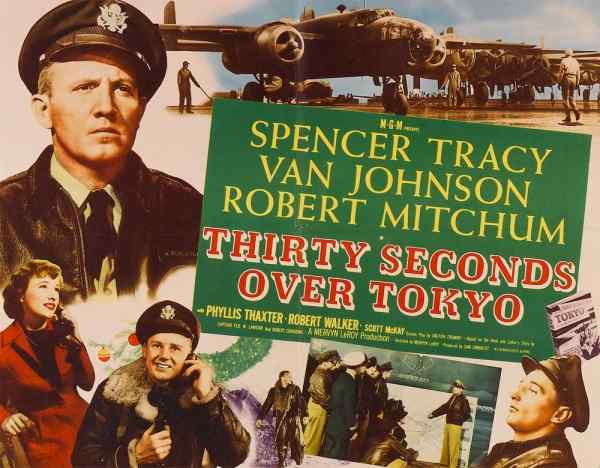
Spencer Tracy portrayed Jimmy Doolittle in the 1944 film about the raid, “30 Seconds Over Tokyo,” based on the book of the same name by Col. Ted Lawson, one of the pilots participating in the raid. Doolittle liked Tracy’s performance, though he claimed he was not as harsh and imperious in real life as Tracy had portrayed him.
He feared that he would be criticized and demoted following the raid, since all 16 B-25s were lost and seven men were killed. Instead, he was widely lauded as an American hero, and was awarded the Congressional Medal of Honor by President Franklin D. Roosevelt on May 19, 1942.
Doolittle went on to many other exploits during the war, including commanding the Eighth Air Force after rising to the rank of Lieutenant General.
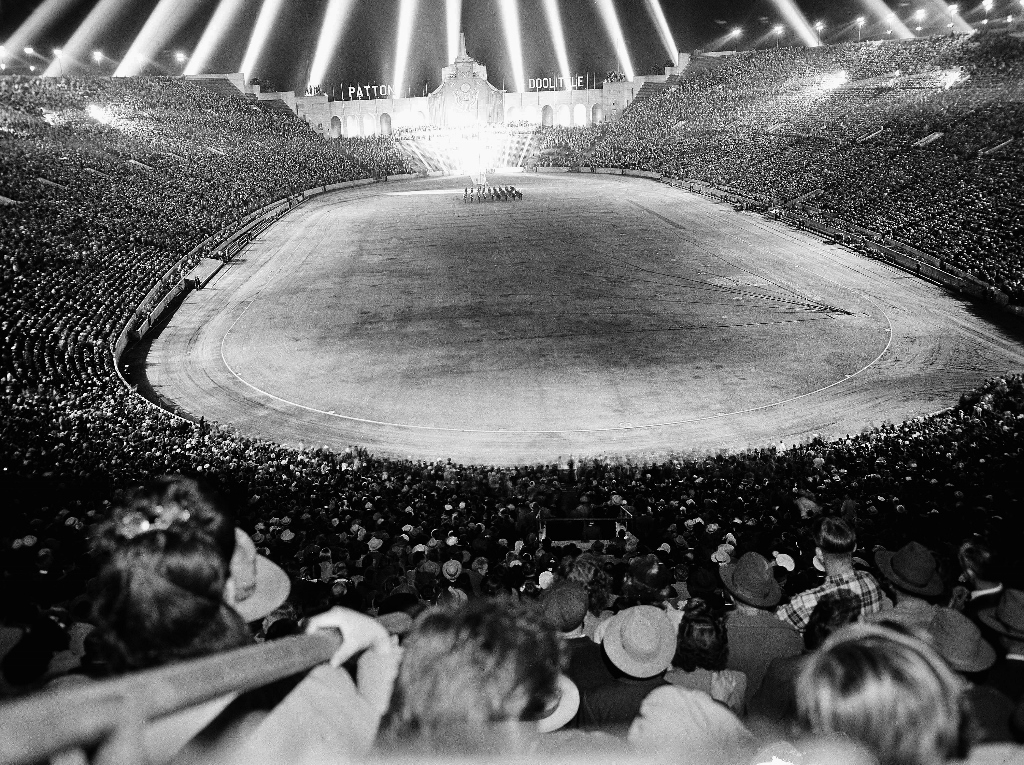
A month after V-E Day, Doolittle and Army Gen. George Patton received heroes’ welcomes during a celebration held at the Los Angeles Coliseum on June 9, 1945. As many as one million people were estimated to have jammed the parade route from LAX (then known as Los Angeles Municipal Airport) to City Hall downtown and then to the Coliseum to see them.
Grateful Americans, more than 100,000 of them, pack Los Angeles Memorial Coliseum to the rim, June 9, 1945, to pay homage to Gen. George S. Patton Jr. and Lt. Gen. James H. Doolittle. The Coliseum pageant climaxed a day of welcome to the conquering generals and 47 accompanying soldiers and fliers. (AP Photo/Dick Strobel)
He returned to civilian life after the war, resuming his job with Shell Oil. He continued to work as a consultant for the government on such projects as recommending racial integration in the armed forces (1951), analyzing and proposing improvements to urban airport safety (1952) and undertaking a comprehensive classified study of the CIA (1954).
Tragically, his son, James Jr., a pilot and major in the Air Force, committed suicide in 1958 after suffering from depression.
The Doolittles had been living in Pebble Beach in the Bay Area, but when the booming aerospace industry in Southern California came calling, they moved to Santa Monica in 1959, where they would live for the next decade. (My wife, a Santa Monica native, recalls seeing and meeting him in the neighborhood when she was younger.)
It was during this period that Doolittle established his business ties with the South Bay. He
Jimmy Doolittle at Space Techologies Laboratory in Redondo Beach. Undated Daily Breeze file photo ca. 1959.
had formed a relationship with Ramo-Woolridge Corp., the company that would become TRW, when he went to work for them in 1954.
On Jan. 1, 1959, he became chairman of the board of directors of Space Technology Laboratories in Redondo Beach, a subsidiary of Ramo-Woolridge devoted to space technology, space exploration and ballistic missile development.
He stayed in that position until announcing his retirement from the post in January 1962. (The day after he announced his retirement, he told the annual Centinela Valley Boy Scout Breakfast that homeowners should begin building fallout shelters as soon as humanly possible.)
In December 1963, Doolittle was elected as a member of the board of trustees of the Aerospace Corporation in El Segundo, a post he would hold for the next 6 years.
An unapologetic political conservative, Doolittle broke his vow not to get involved in politics only once, to campaign for military supporter Barry Goldwater’s unsuccessful run for president against Lyndon Johnson in 1964.
He continued to be active in the South Bay, participating in various El Segundo Chamber of Commerce functions during the 1960s.
Doolittle was honored upon leaving the Aerospace Corp. board with a special award from the U.S. Air Force in a ceremony held in the research facility’s courtyard on Sept. 14, 1969. In 1981, the James H. Doolittle Facility, a $15 million development, opened in his honor on the Aerospace Corporation campus.
Other buildings have been named for him as well. In August 1945, the Los Angeles City Council voted down an attempt to rename Los Angeles Municipal Airport as Doolittle Field after the general himself recommended against the idea. Doolittle Hall at the U.S. Air Force Academy in Colorado Springs is named after him, as is the command center building at Davis-Monthan Air Force Base in Tucson, Ariz.
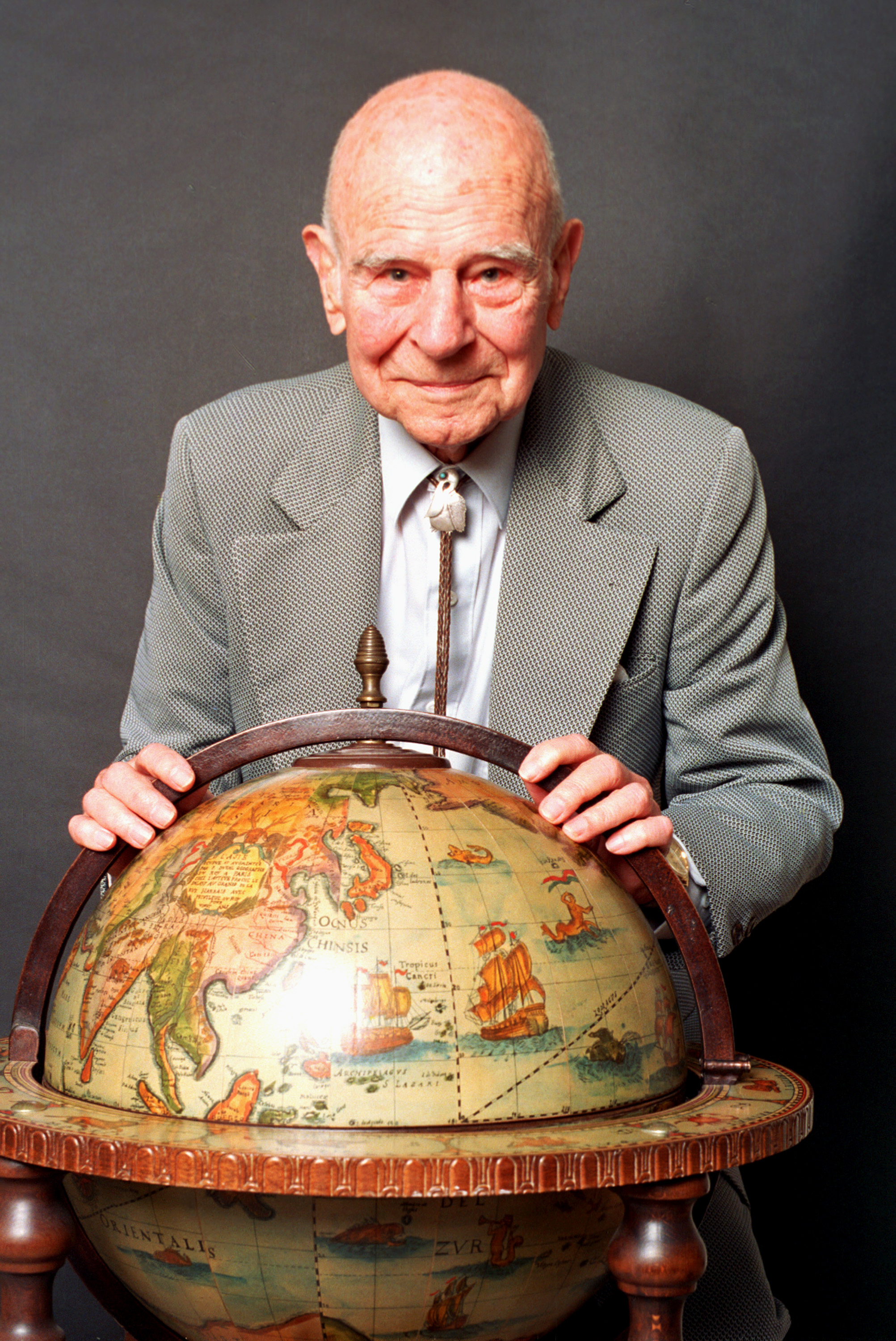
Gen. James H. “Jimmy” Doolittle poses behind a globe at his home in Carmel Valley, Ca., in Dec. 1986. (AP Photo/Eric Risberg)
Doolittle kept busy after leaving the aerospace world with board of directors duties for several of the Mutual of Omaha insurance companies. In 1978, he and his wife decided to leave Santa Monica and move to a retirement community in Carmel Valley, Calif.
President Reagan and Barry Goldwater pinned another star on Doolittle at a White House ceremony in 1985, making him a four-star general. In 1986, a major celebration of his 90th birthday was made into a television special, with accolades from Bob Hope, Jimmy Stewart, and many other stars.
In 1990, he moved into the house in Pebble Beach that he had given to his son, John, a retired Air Force colonel. The elder Doolittle died peacefully there on Sept. 27, 1993 at the age of 96. He is buried next to his wife, who died in 1988, at Arlington National Cemetery in Arlington, Virginia.
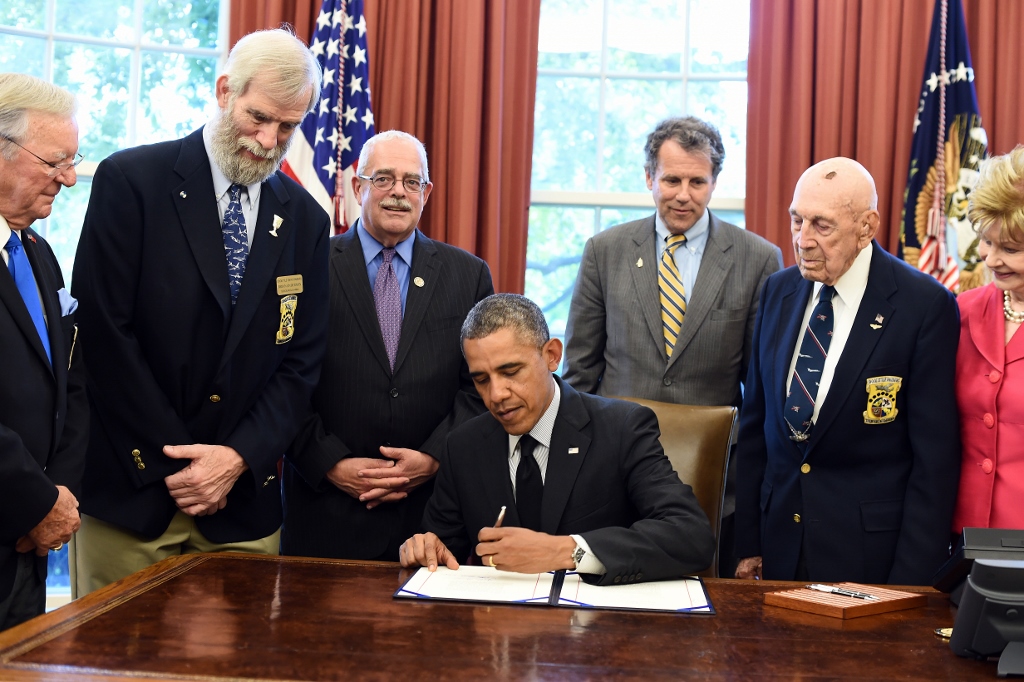
US President Barack Obama signs a gold medal act in the Oval Office at the White House in Washington, DC, on May 23, 2014. The act awards the Congressional Gold Medal to the World War II members of the Doolittle Tokyo Raiders in recognition of their military service. (Getty Images)
In a tradition that began in 1945, the surviving members of Doolittle’s Raiders agreed to meet for a reunion ceremony every year on April 18, the day of the raid.
The final such public event was held at Fort Walton Beach, Fla., in 2013, with only three surviving Raiders in attendance. A long-saved bottle of Hennessey cognac from 1896 was opened, and a “final toast” was offered to members both living and dead.
As of this writing, only two surviving members remain, 99-year-old retired Lt. Col. Richard “Dick” Cole, and 93-year-old Staff Sgt. David Thatcher, 93. Though the public reunions ended in 2013, the two continued the tradition by meeting privately on April 18, 2015, the 73rd anniversary of the raid.
Sources:
Daily Breeze files.
Los Angeles Times files.
I Could Never Be So Lucky Again: An Autobiography, by General James H. “Jimmy” Doolittle with Carroll V. Glines, Bantam Books, 1991.
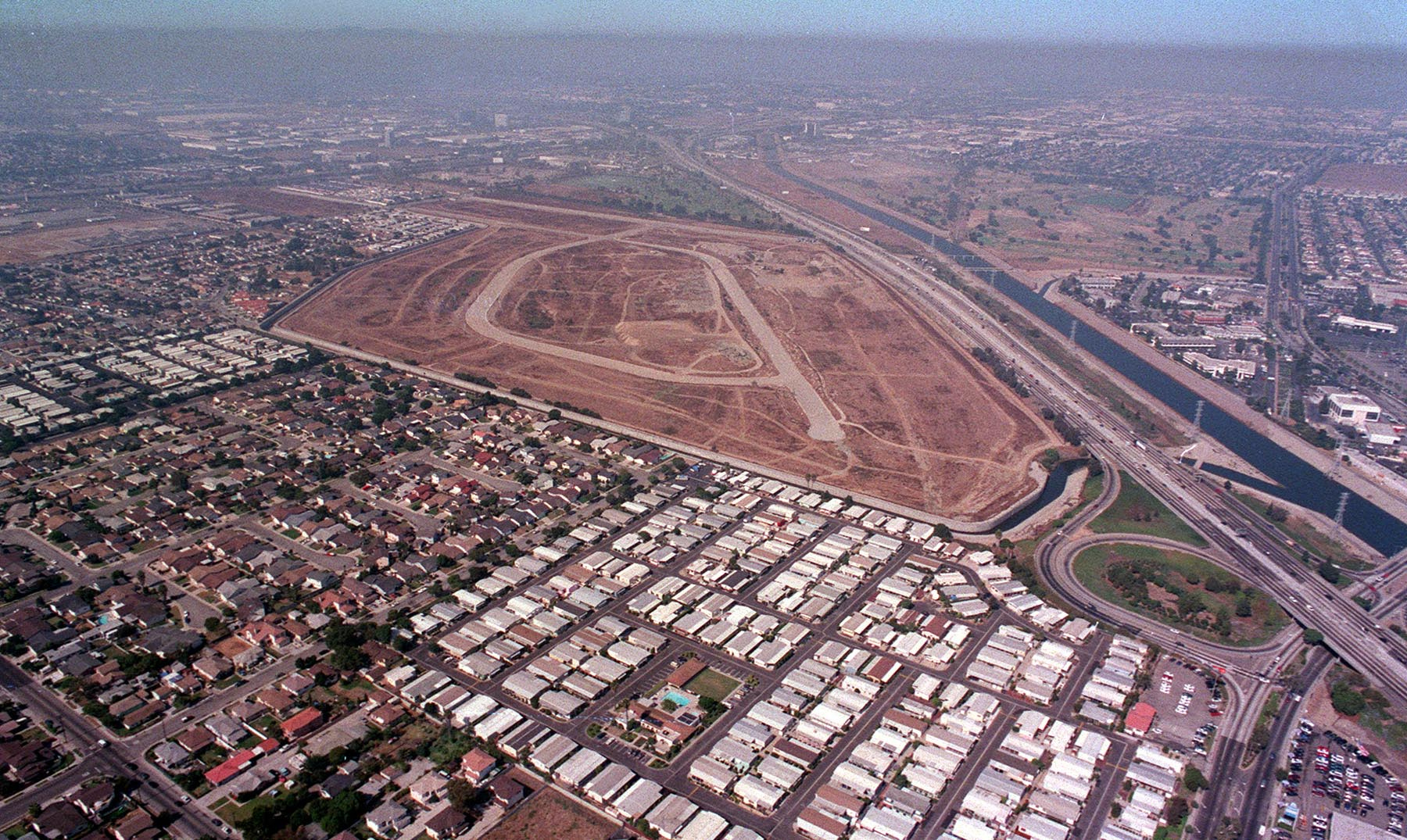
Proposed site in Carson to build an NFL stadium. Feb. 21, 2015. Main Street at left; 405 Freeway, diagonally through center. South Bay Pavilion mall is across the 405, center. (Chuck Bennett / Staff Photographer)
Major media attention recently has focused on a roughly 180-acre piece of land in Carson as a potential site for a new NFL stadium.
The plot of land bounded by Del Amo Boulevard, Main Street – its address is 20400 S. Main – and the 405 Freeway has had only one development on it before: a privately owned waste dump. And that only was open for six years. So this whole post is pretty much all about a vacant lot.
Before that, it was swampland prone to flooding during the rainy season, which made it impossible for it to be used for any kind of residential or commercial building projects.
In 1949, the Los Angeles County Board of Supervisors banned the burning of trash in the county, giving rise to the need for public landfills where trash could be deposited.
The need for landfills made the Carson site a natural choice for landfill operator Ben Kazarian, whose Cal Compact Inc. company was able to buy the large site cheaply, since it had little value to be used for any other purpose.
The Cal Compact facility opened for business in 1959 and closed in 1965.
The eventual completion of the Dominguez Channel and related drainage improvements by the early 1970s greatly reduced the area’s flooding problems. The land had become usable again, but there was one big problem: the presence of toxic waste in the former Cal Compact dump.
During its six years of operation, the Cal Compact site had accepted not just household wastes, but also industrial waste from refineries. This included oil drilling muds, waste paint, oil sludge and various solvents.
The regulations concerning disposal of these types of industrial wastes were much looser during the years of Cal Compact’s operation than they are today, making chemical dumping much easier. The presence of these potentially harmful pollutants that were deposited during those six years would continue to plague prospective developers of the site for decades.
There was little activity on the land during the 1970s as developers looked elsewhere to build on less-tainted sites, including the Carson Mall (now South Bay Pavilion), which opened directly across the 405 Freeway from the site in 1973.
W. Patrick Moriarty. 1985 file photo. (The Associated Press)
By 1980, ownership of the property had fallen into the hands of Orange County fireworks magnate W. Patrick Moriarty. Using the corporate name Casa Del Amo Estates, he planned first to build a mobile home park on the site, then decided on a business park development to be called the Carson Business and Industrial Center.
Before building could begin, though, the state of California had to inspect all former dump sites to be sure they were safe for development under the terms of a hazardous waste law the state had put into effect in 1981.
The Carson City Council supported Moriarty’s plans, but the state was slow to conduct the inspections. Its study wasn’t completed until 1984, and it revealed that the site had an estimated 250,000 cubic yards of hazardous materials.
While the project was stalled, Moriarty got himself into trouble for influence-peddling and payoffs in Carson, among other violations.
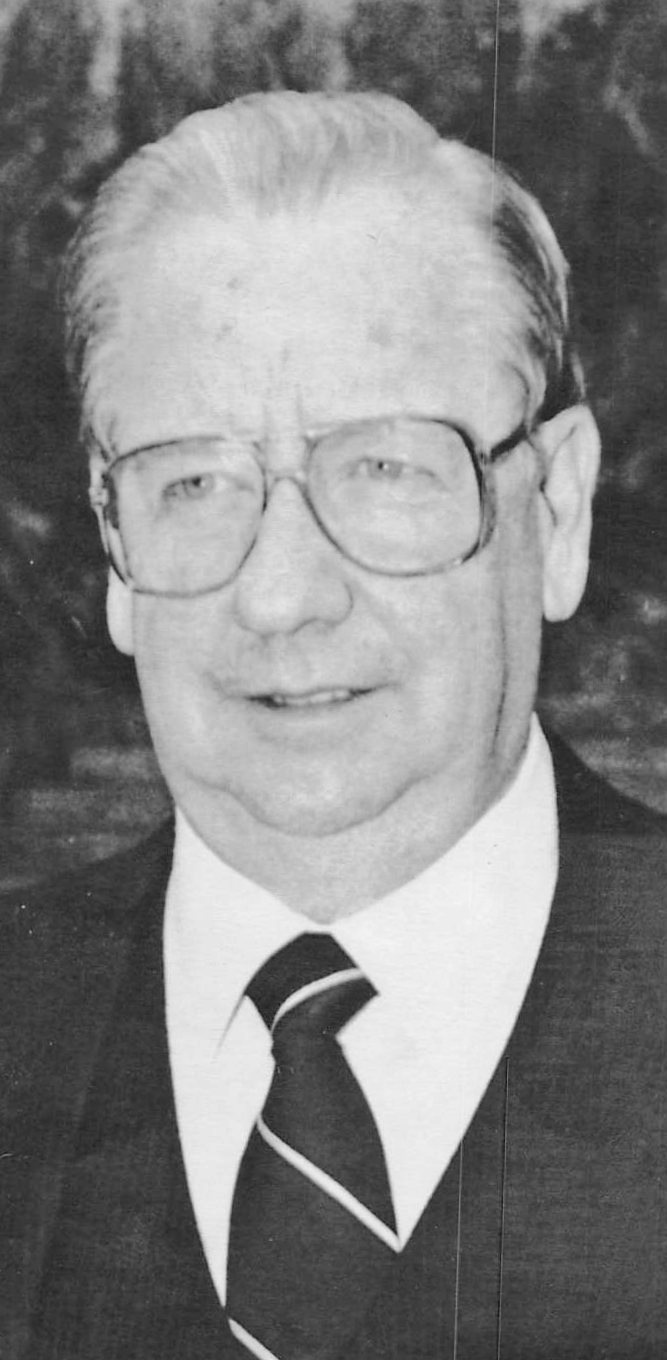
Moriarty was sentenced to 7 years in prison in 1985 on a variety of political corruption charges.
Ferrante reportedly sold the land to another developer, Ranbir S. Sahni, in 1985, and from there, its ownership becomes increasingly convoluted.
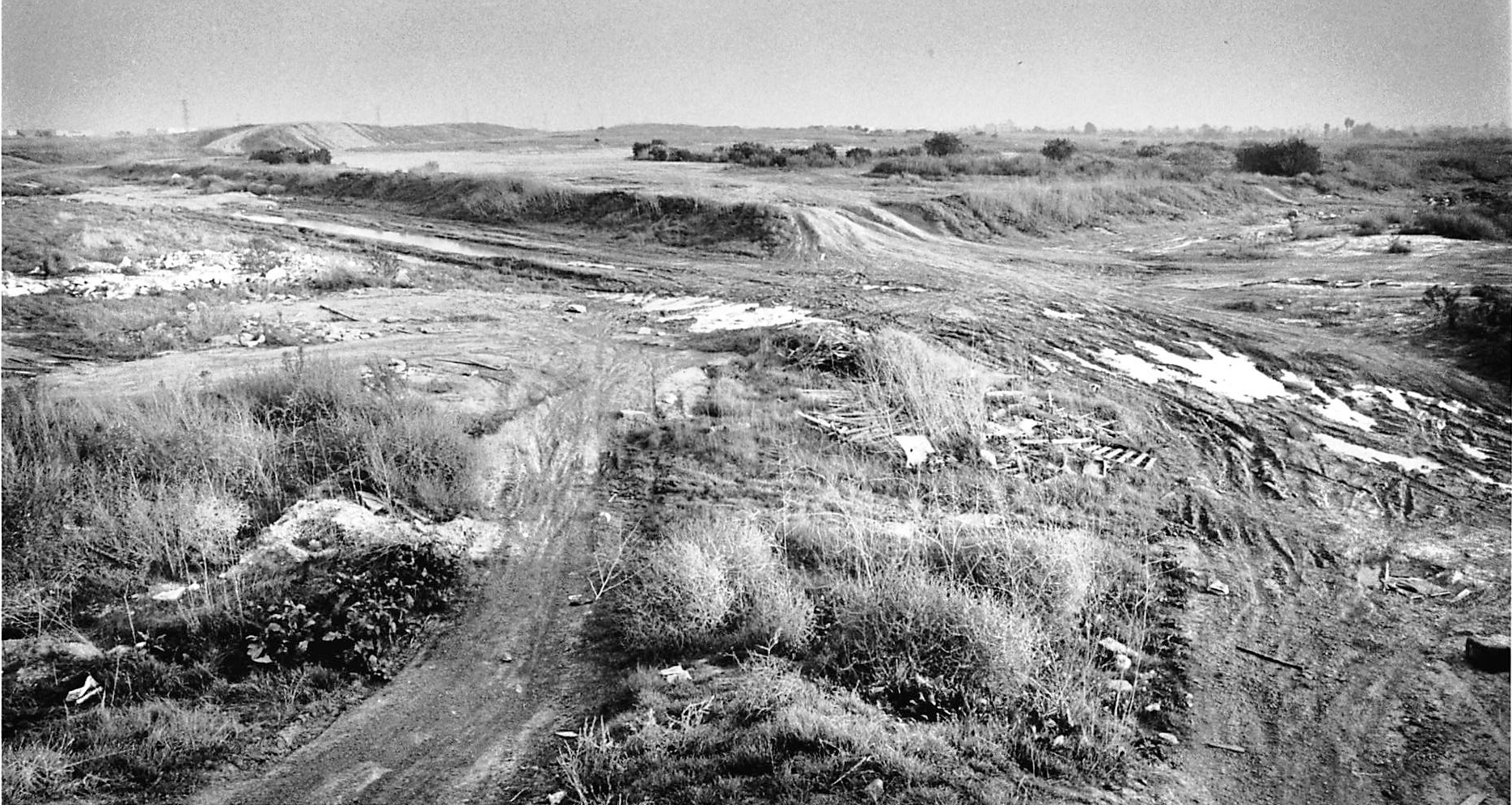
“Jack Rabbit Field,” the former Cal Compact waste dump site in Carson, during its days as a dirtbike and rabbit-hunting haven. Dec. 9, 1983, Daily Breeze file photo. (Brad Graverson / Staff Photographer)
During all this, little was happening on the fenced-off site itself, which had become a popular, but illegal, haven for dirt bikers and racers. They called it “Jack Rabbit Field.” Three Carson mobile home parks nearby complained about the activities, which included the occasional stray bullet from rabbit hunters, and police regularly issued tickets to the trespassers.
In 1987, Los Angeles Raiders owner Al Davis, unhappy with his lease deal with the Los Angeles Coliseum, held informal talks with Carson about possibly building a new stadium on the site, though some suspected he was using the threat to move to Carson merely as leverage against his downtown landlord.
The Los Angeles Rams also had talked to Carson about the site in 1978, but the talks died out and the team decided to move to Anaheim Stadium in 1980.
The Raiders plan was dead by 1988. The city began working in earnest again on plans to rehabilitate the site, voting to allow construction work on roads and other improvements in hopes of attracting developers.
The site’s then-owner, World Industrial Center LLC, got little help from the nine oil companies who had dumped their waste, legally at the time, at the Cal Compact site during the years it was open. All of them balked at participating in the cleanup when contacted by the state toxics agency.
Dirt was trucked in for the road improvements, and interest in the site grew, including feelers from a partnership headed by Ferrante, who by 1989 had acquired World Industrial. But still no concrete plans had come to the table.
That changed in 1991, when a new plan to build a giant retail outlet mall surfaced. The proposed L.A. MetroMall at Carson would have almost 200 shops, including an Oshman’s sporting goods center complete with athletic facilities for testing its wares, as well as other outlets including Macys, Saks Fifth Avenue, Burlington Coat Factory and Marshall’s.
The project’s developer was LA MetroMall LLC, a wholly owned subsidiary of the Glaziers Union pension fund.
The plan still faced obstacles due to the ground contamination. Underground methane gas from the former dump would need to be extracted, and the developer planned to a clay cap over the landfill site, and cover the entire site with an additional 20 feet of fill dirt.
Ground was officially broken for the project in October 1995, though fine points of the development still were being worked on. In December, LA MetroMall agreed with the state to pay $26 million in cleanup costs.
Red tape, delays and a spate of complicated lawsuits kept the project in limbo. In 1997, the Ohio-based company Glimcher Realty Trust entered the picture, negotiating to take over the now-troubled LA MetroMall project.
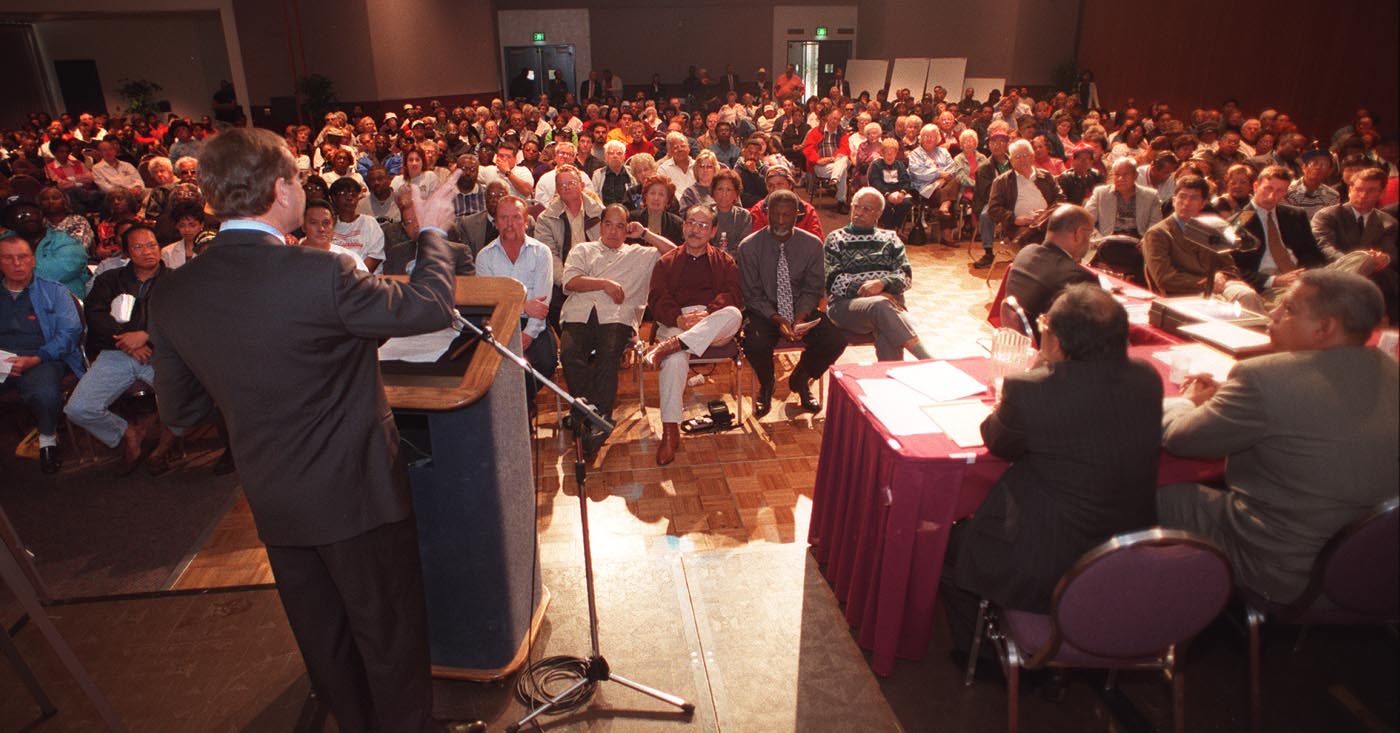
Michael Ovitz, left foreground, talks about football stadium proposal to several thousand attendees of Town Hall meeting at Carson Community Center on Feb. 6, 1999. (Daily Breeze staff file photo)
In December 1997, another name surfaced in connection with LA MetroMall: former Disney power broker Michael Ovitz. After leaving Disney in January 1997, he entered into talks with Glimcher about developing an entertainment component at the proposed mall.
In March 1998, the nature of that entertainment became clear: Ovitz was leading a group planning to build, wait for it, a new NFL stadium on the MetroMall site. It would seat 75,000 fans, and be completed in time for the 2002 season.
Excitement ran high for the project, since both the Rams and the Raiders had left Los Angeles after their 1994 seasons concluded, leaving the metropolis without an NFL franchise. The City of Carson signed on, approving the project in October 1998.
The site of the proposed stadium and mall in Carson. Oct. 23, 1998. (Daily Breeze staff file photo)
Ovitz’s overall plan was called Hacienda Los Angeles, and would include an entertainment complex as well as the stadium, hosting concerts as well as sporting events.
The initial buzz began to slow in 1999 when it became apparent that the NFL was not as enthusiastic about the Carson site as Ovitz initially had been. It died when Ovitz jumped to the team planning to revamp the L.A. Coliseum as an NFL stadium.
Hoping to put the best face on the defeat of his Carson stadium proposal, media mogul Michael Ovitz talks to reporters on April 20, 1999. (Daily Breeze staff file photo)
The plan was completely moribund by 2000, when the city began talking outlet mall again with Glimcher Realty Trust. The new plan called for a retail mall, restaurants, a food court and a 20-screen cineplex. Carson approved it in November, but Glimcher didn’t follow through.
In 2002, GMS Realty of Carlsbad took its shot, entering into the plans to develop a shopping center on the site.
Ovitz then re-entered the picture in 2003, entering into negotiations with GMS to again develop an NFL stadium there. At the time, the NFL was considering the Rose Bowl and the Coliseum as possible sites, in addition to Carson.
In 2004, the heat from that latest NFL bid had died down somewhat when yet another Orange County developer entered the picture to attempt to push through a commercial development. Jerry Hopkins, owner of Hopkins Real Estate Group in Irvine, formulated a plan he called Carson Marketplace, a mixed-use development with a 200-room hotel, movie theaters and restaurants.
Hopes for an NFL stadium continued to bubble quietly, but they burst in May 2005, when the city officially removed its plan from consideration after it became apparent that the NFL wasn’t biting.
On June 7, 2005, Carson agreed to the Hopkins development plan for Carson Marketplace, despite the loss of the stadium component. Building for the massive development was scheduled to begin in 2008.
But first, the still-empty-after-all-these-years land had to be cleaned up. Carson agreed to Hopkins’ cleanup plans in February 2006, and approved the development plan in its entirety one month later.
The developers, which by now also included LNR Property Corp. in addition to Hopkins, changed the name of the plan to the Avalon at South Bay in Carson, but had to change it again after a threatened lawsuit to the Boulevards at South Bay.
The 2008 deadline was pushed back to 2010 as cleanup efforts at the site were moving much more slowly than had been anticipated.
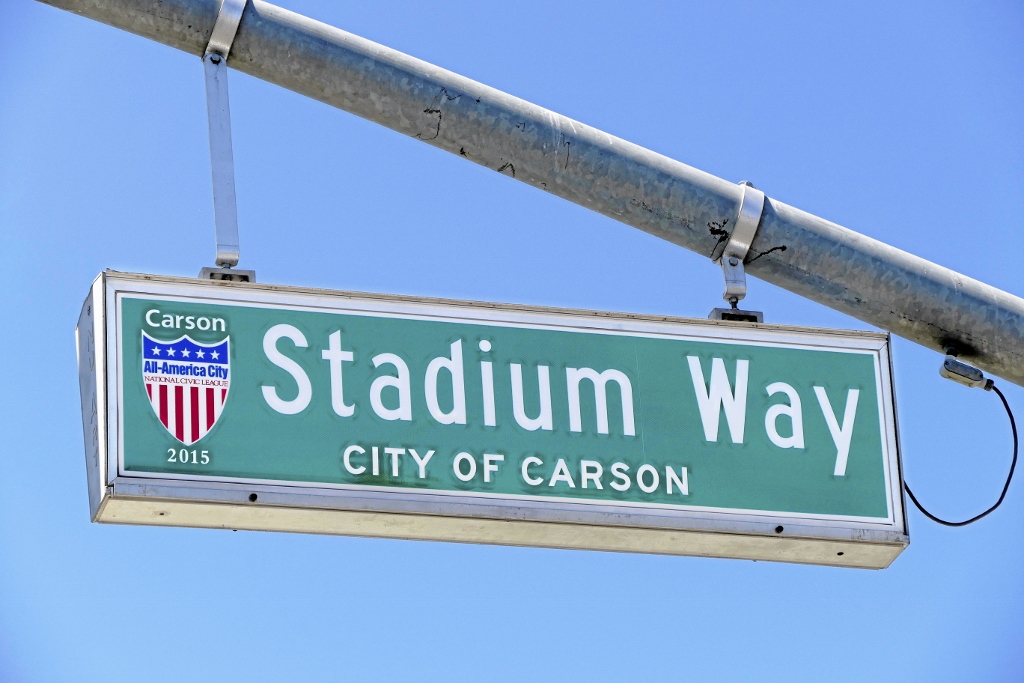
The City of Carson renamed a street “Stadium Way” at the site of the proposed NFL stadium. Aug. 28, 2015. (Brad Graverson / Staff Photographer)
In 2011, Mayor Jim Dear caused a stir when he pushed through a vote allowing one of the streets in the planned development to be called “Jim Dear Boulevard.” Signs went up in 2013, but were removed in July 2015 after the current Carson City Council rescinded Dear’s action. On Aug. 28, 2015, Carson officials officially renamed the street Stadium Way, even though it has not been completed yet.
Robert Rand of the Beverly Hills firm Rand Resources LLC continued to keep low-key hopes alive for an NFL stadium on the site , issuing a plan to the NFL that Carson agreed to endorse in September 2012.
But not much was expected from the plan at the time, since the AEG plan for Farmers Field adjacent to the Staples Center in downtown Los Angeles seemed to have the inside track with the NFL. Another plan put forth by developer Ed Roski for a stadium in the City of Industry also was on the table.
Enthusiasm for those plans gradually waned, and in February 2015, the NFL excitement returned to the South Bay with news that a group had formed to bring either the Oakland Raiders or the San Diego Chargers, or both, to a new stadium complex to be built on the Carson site.
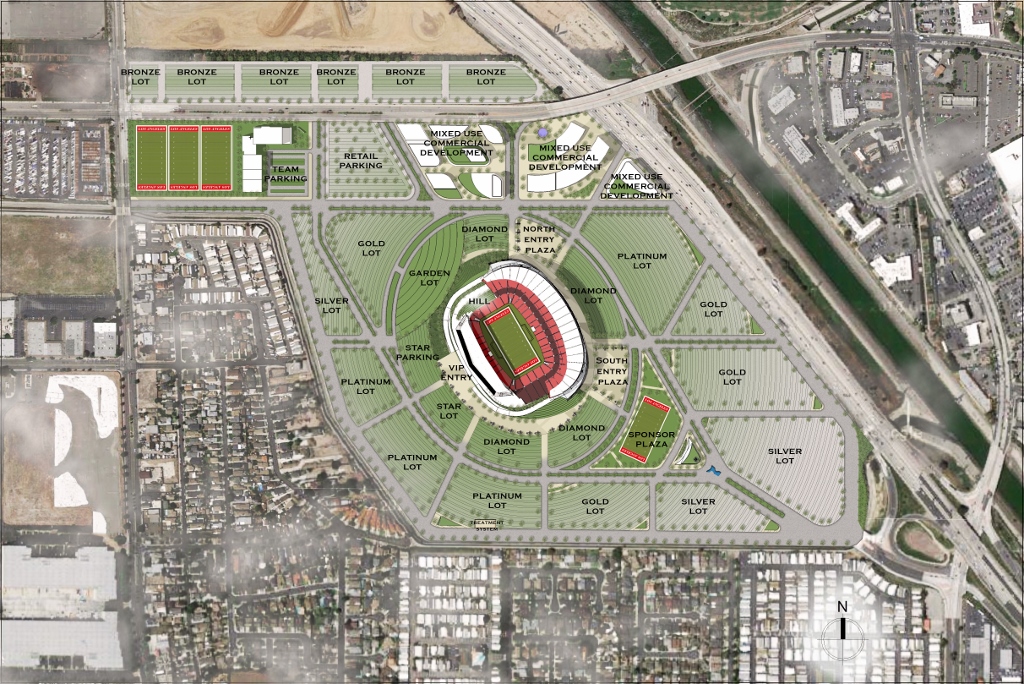
Proposed layout of the new Carson NFL stadium released in February 2015.
A similar plan is in motion to bring the St. Louis Rams back to Los Angeles on the former site of the Hollywood Park racetrack, now owned by Rams owner Stan Kroenke.
Any franchise moves must receive a “yes” vote from 24 of the NFL’s 32 owners. Votes on the Carson and Inglewood plans are not expected to come from the NFL until early in 2016. In the meantime, I’m still writing about an empty piece of dirt.
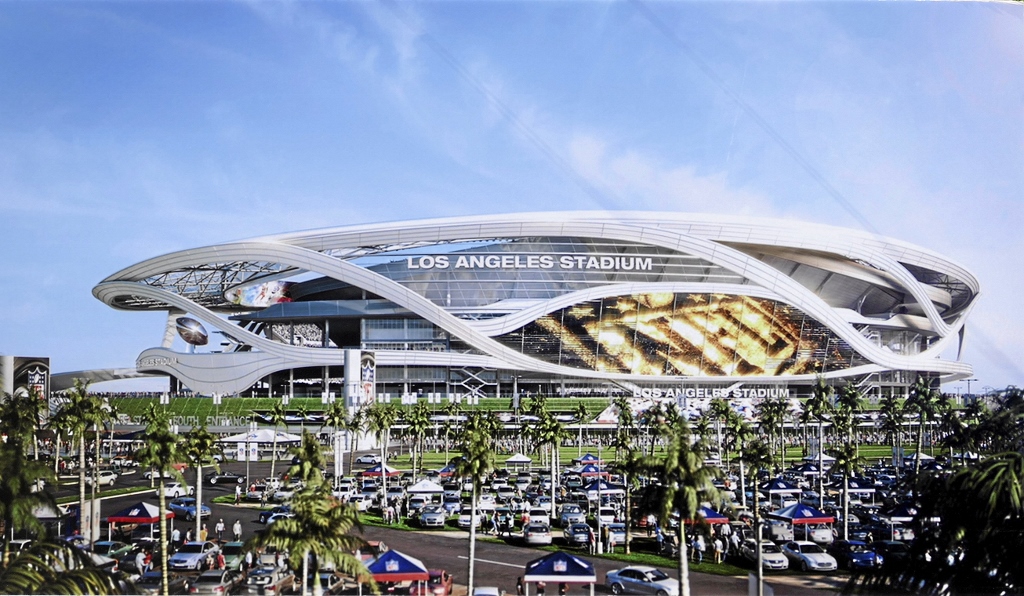
Artist’s rendition of the proposed Carson NFL football stadium. August 2015.
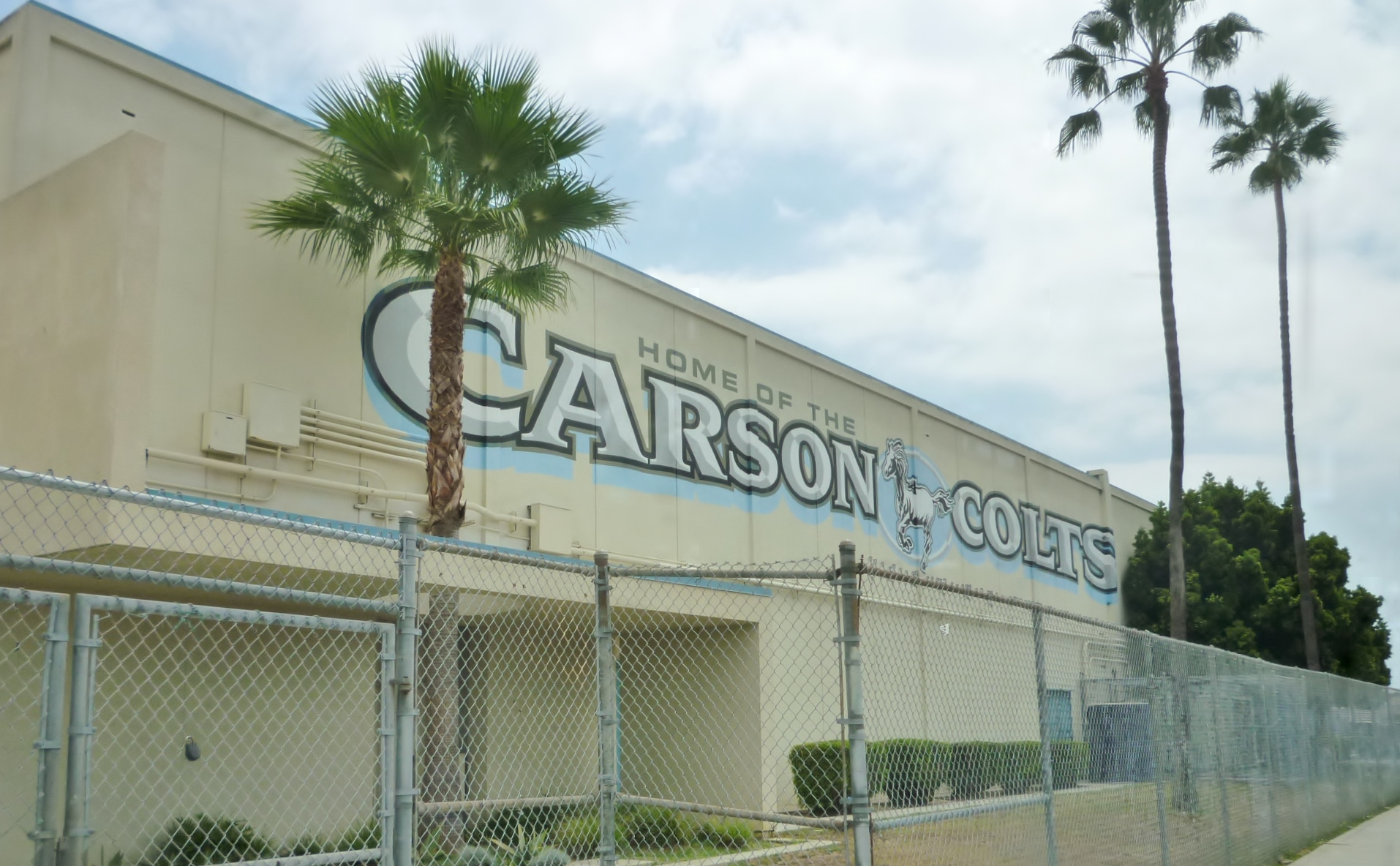
Carson High School. (August 2015 Daily Breeze photo)
By the end of the 1950s, overcrowding had become an increasingly hard-to-ignore problem in the booming South Bay.
Population had increased, and school facilities in areas such as Redondo Beach, Torrance and Carson were being taxed to their limits.
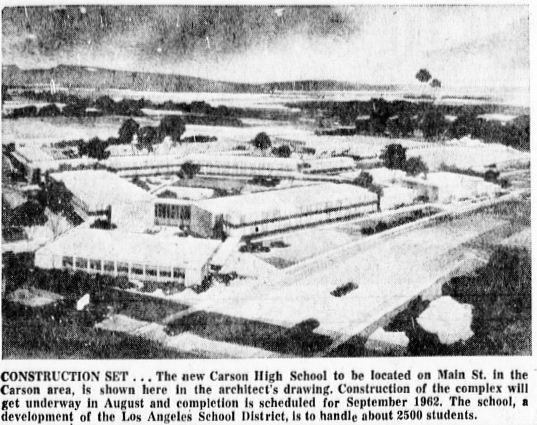
Artist’s rendition of Carson High School, from the Torrance Herald, July 23, 1961, Page7. (Credit: Torrance Public Library, Historical Newspaper Archives database)
In Carson, the Los Angeles Unified School District had seen the need for a new senior high school. The community was in the midst of a long incorporation battle, which would not resolve itself until its cityhood became official in 1968. Then, as now, Carson did not have its own school district, and its schools fell under the auspices of LAUSD.
In January 1960, LAUSD commissioned the services of the architectural firm Austin, Field & Fry to design the new school. The Los Angeles firm specialized in school projects. One of its principals, John F. Austin, had designed the original iconic Los Angeles High School building in 1916, and the firm had also designed several community colleges in Southern California, including Chaffey College, Mt. SAC and Compton College.
The district was able to move fairly quickly on the project when area voters approved a school bond issue in the November 1960 election.
Carson High School was planned to accommodate 2,500 students, with the capacity to add 500 more students if needed. The school’s original cost was estimated at $4.5 million, though it would end up costing closer to $5 million.
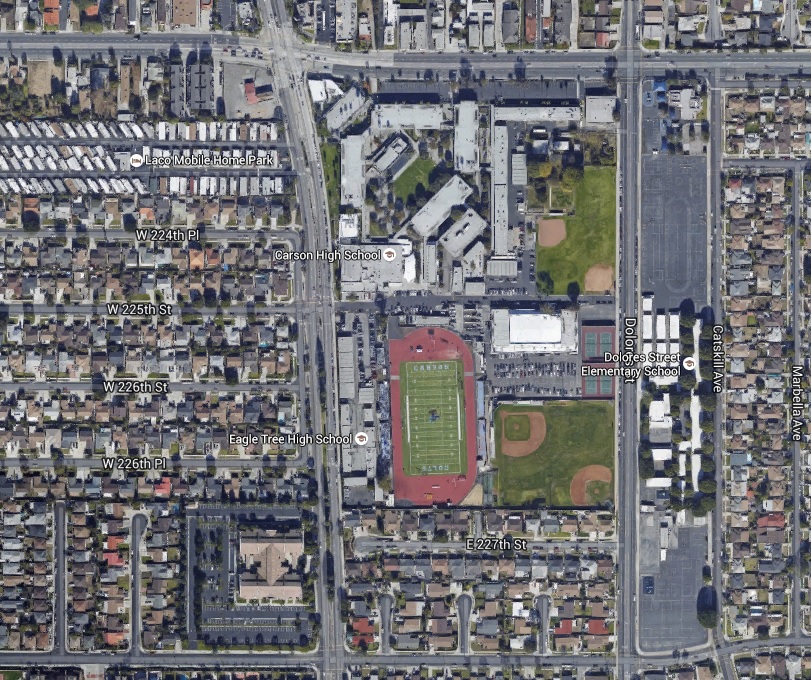
It would be built on a 27-acre site at 22328 South Main Street, bounded by 223rd Street to the north, 227th Street to the south and Dolores Street to the east.
Carson High from the air. Main Street at left center, 223rd Street at top, 228th Street at bottom. (Credit: Google Maps)
Construction began in August 1961, with an eye toward opening the school for the start of classes in September 1962. Students from nearby overcrowded Narbonne, Gardena and especially Banning high schools who lived in the Carson area would be moved to the new school.
Construction ran slightly behind schedule, and the opening date for the school had to be moved to 1963. In late 1962, the school’s first administrators were named: Bernard J. Donahue was named principal, with Clarice F. Brown and Donald Pelton named girls and boys vice principals. More than 60 faculty members were hired to handle teaching duties.
Carson High School’s opening was set for Monday, Feb. 4, 1963, with 1,200 students in attendance. (The school would expand its capacity further beginning with the full 1963-64 school year.) Opening day had the expected air of confusion as the students flooded the main office to get registered properly and wandered the new campus in search of the right classrooms.
The school’s official dedication was held on April 24, 1963.
The school grew quickly. By the second semester of the 1963-64 year, its enrollment had grown to 1,962 students.
From the beginning, sports played a role in establishing Carson High’s identity. The school hired Gene Vollnogle to be its football coach in 1963. After going 2-6 and 3-5 in his first two seasons, Vollnogle would go on to win 310 games and 10 L.A. City Section championships as Carson’s coach during a storied career. Vollnogle retired from the Carson head job in 1990. Fittingly, his Colts team went 12-1 in his final season.
Carson’s football rivalry with Banning reached epic proportions in the 1970s and 1980s, with Vollnogle’s duels with Banning Coach Chris Ferragamo drawing thousands to the games.
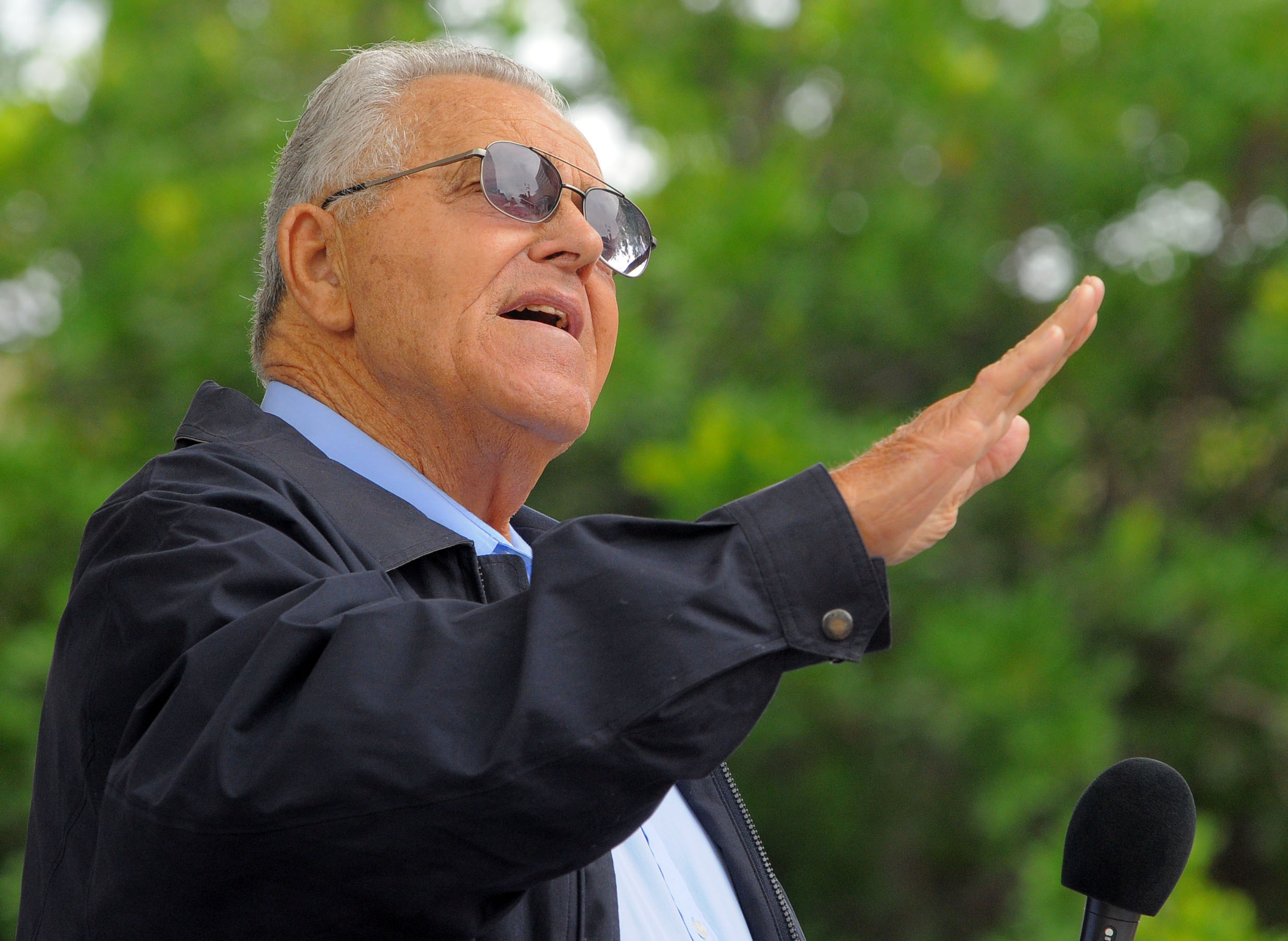
Former Carson football coach Gene Vollnogle gives his acceptance speech during San Pedro Sportswalk induction ceremony in 2009. Vollnogle passed away on Sept. 6th, 2012. (Scott Varley / Staff Photographer)
“If I had to choose one person who meant the most to me in my career, he would be at the top of the list,” said New York Jets three-time All-Pro wide receiver, Wesley Walker, who played on Vollnogle’s legendary undefeated 1971 team.
Vollnogle died on Sept. 6, 2012.
Carson’s girls tennis teams went 12 years, from 1998 to 2010, without losing a match. They were 129-0 during the streak.
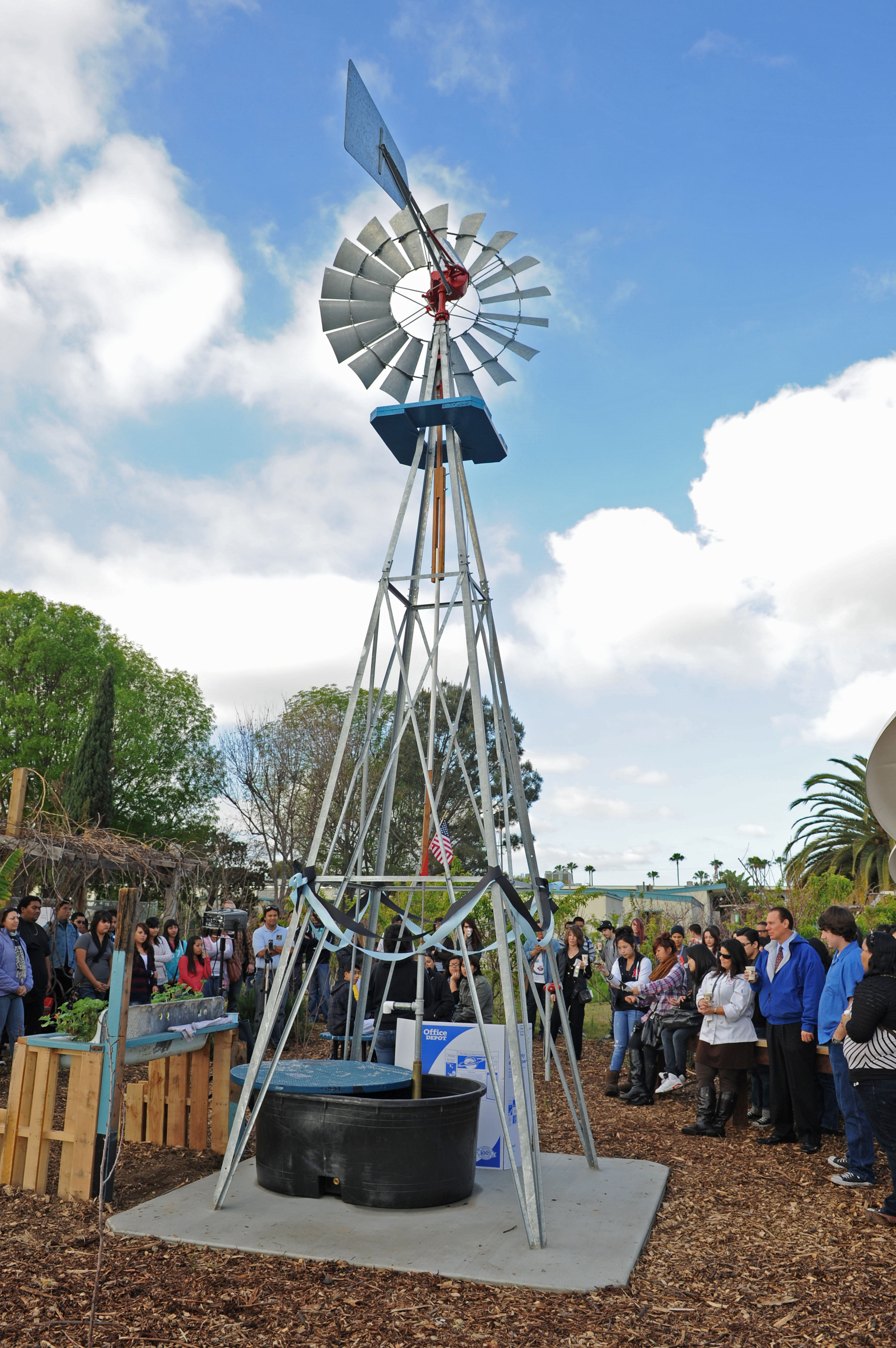
Carson High School unveiled its windmill in 2012, a research project by students in the Energy and Environmental Learning Program. The small farm area at the school, has fruit trees, garden beds and chickens as well. (Brad Graverson / Staff Photographer)
The school “Blue Thunder” marching band, drill team and flag squad have won dozens of awards over the years.
A $5.5 million improvement project begun in 2009 brought a new administration building annex, electronic marquee and dozens of other modifications and improvements to the campus.
Carson has had its share of troubles over the years. Its test scores dropped low enough in 2010 that the school found itself added to the state of California’s list of “persistently lowest-achieving” schools.
New principal Windy Warren was brought in to make changes starting with the 2011-12 school year, and instituted a variety of measures to help revitalize the school, including the establishment of three separate schools – the Academy of Medical Arts and Academies of Education and Empowerment – at the Main Street campus.
She also worked to improve relations between different ethnic groups after a brawl involving 40 students that broke out in March 2012 drew attention to racial unrest at the school.
School test scores have risen since the reforms were implemented, and the Academy of Medical Arts has become an especially strong academic performer.
Carson High celebrated its 50th anniversary in October 2013.
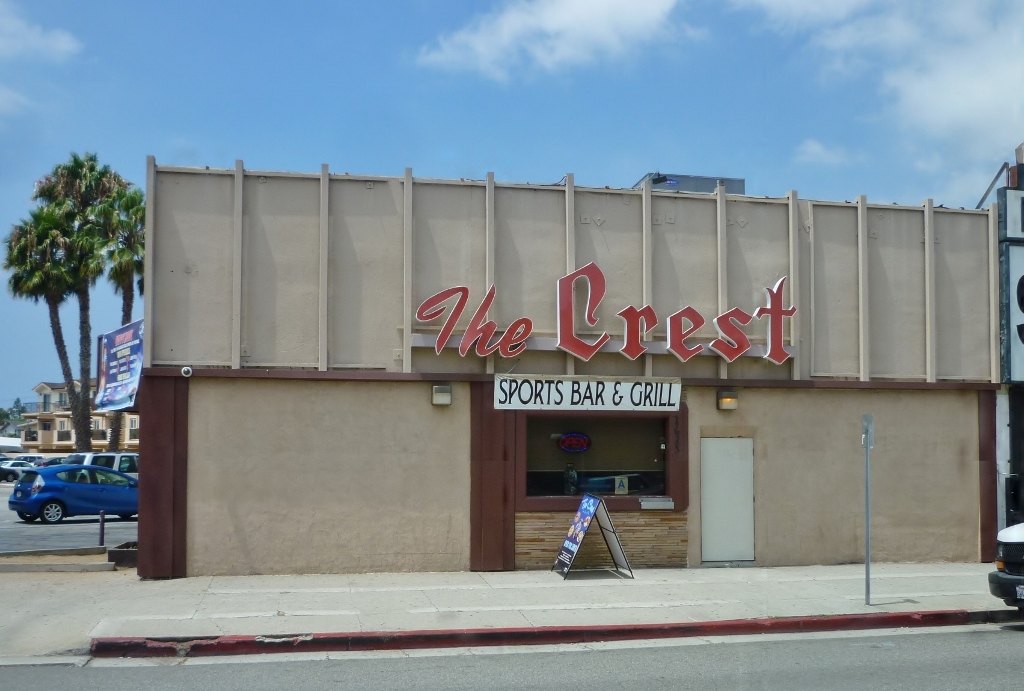
The Crest Sports Bar & Grill at 1625 Cabrillo Avenue in Old Torrance. (August 2015 Daily Breeze photo)
The Crest in Old Torrance has been a part of the local landscape for so long that its presence is easy to take for granted. Turns out the Crest is only the latest of several colorful establishments occupying that same location for the past 87 years.
The Crest’s origins date back to 1928, when the building at 1625 Cabrillo Avenue that currently houses it was constructed by former Torrance hardware store owner R.G. Baird.
The new building attracted the attention of two business owners: Ed Tansey and Earl Conner.
Conner, who would become the city’s mayor and then later be appointed Torrance’s postmaster in 1932, had opened Earl’s Cafe downtown a year earlier in May 1927, but he and Tansey liked the looks of the new site, and both decided to move their businesses there.
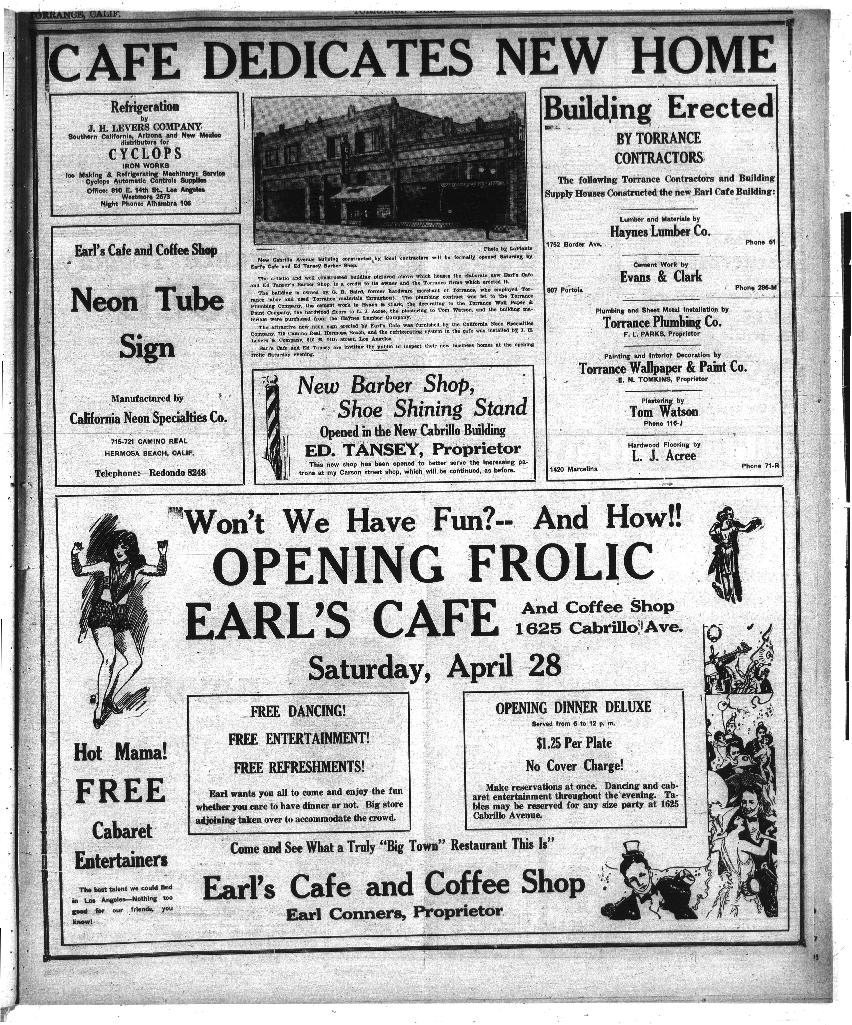
On April 28, 1928, Earl’s Cafe and Ed Tansey’s Barber Shop opened for business next to each other at the new location. An ad in the Torrance Herald trumpeted Owen’s Cafe as a “big town” restaurant, complete with dancing and cabaret entertainment.
Torrance Herald ad from April 26, 1928, announces the grand opening of Earl’s Cafe at 1625 Cabrillo, including a “Hot Mama!” at lower left. Click to enlarge. (Credit: Torrance Historical Archives database, Torrance Public Library)
The depression had a sobering effect on such frivolity, with Earl and his wife Clara spending much time feeding the many who couldn’t afford the restaurant’s 15- to 25-cent meals for free.
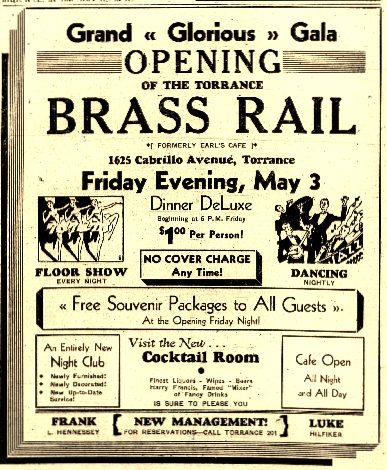
Conners sold his cafe in 1935 to Frank L. Hennessey and Luke Hilfiker, who reopened it on May 3, 1935, as an all-out nightclub-style joint called the Brass Rail.
Torrance Herald ad from May 2, 1935, promotes the grand opening of the Brass Rail at 1625 Cabrillo on May 3. Click to enlarge. (Credit: Torrance Historical Archives database, Torrance Public Library)
The Brass Rail only lasted a few months until the duo sold it later in 1935 to Lew Daniels, under whose tenure the restaurant would blossom. (Conner died on Feb. 3, 1949, after a distinguished career as postmaster.)
Daniels reopened the cafe under his own name, Daniels Cafe,and it became hugely successful as the downtown gathering place for local businessmen and politicians.
The building shook but didn’t fall during the strong earthquake that rocked Torrance in 1941. Well, the front facade of the building actually did fall down, but Daniels Cafe diners merely picked their way through the rubble to grab a seat at the counter of the restaurant, which remained open 24 hours a day.
In the 1940s, Daniels hired a chef, Charley Gotts, who had a way with comfort food, especially steaks. “Charley’s Chuck Wagon Steak” would become his specialty.
Chief cook Gotts took over ownership of Daniels Cafe when Lew Daniels retired from the business in 1944.
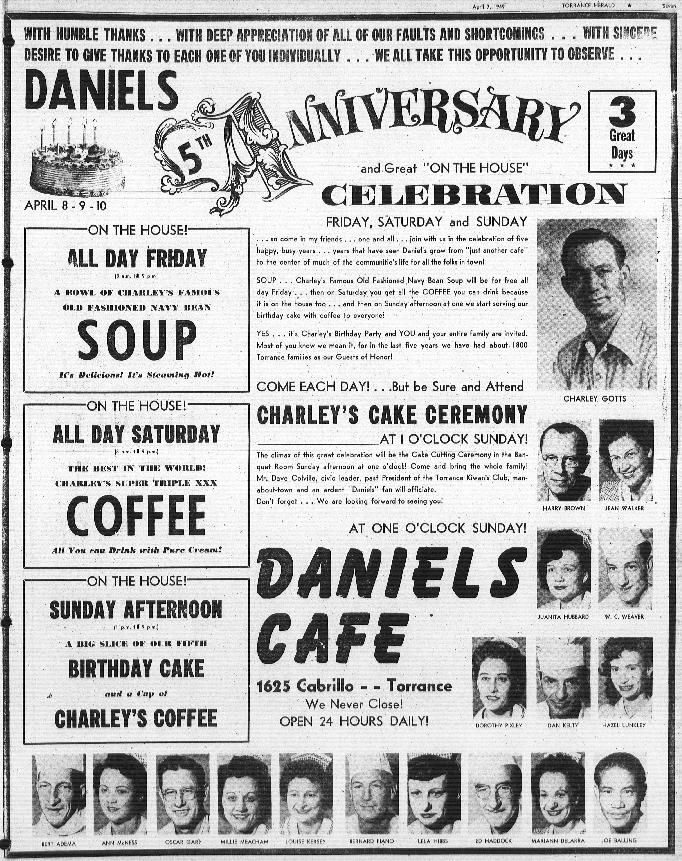
Torrance Herald ad of April 13, 1949, trumpets the fifth anniversary of Charley Gotts’ purchase of Daniels Cafe, showing the cafe’s owner and employees. Click to enlarge. (Credit: Torrance Historical Archives database, Torrance Public Library)
Not wanting to mess with karma and the cafe’s name identification, he continued to operate the restaurant under the Daniels Cafe moniker for several years.
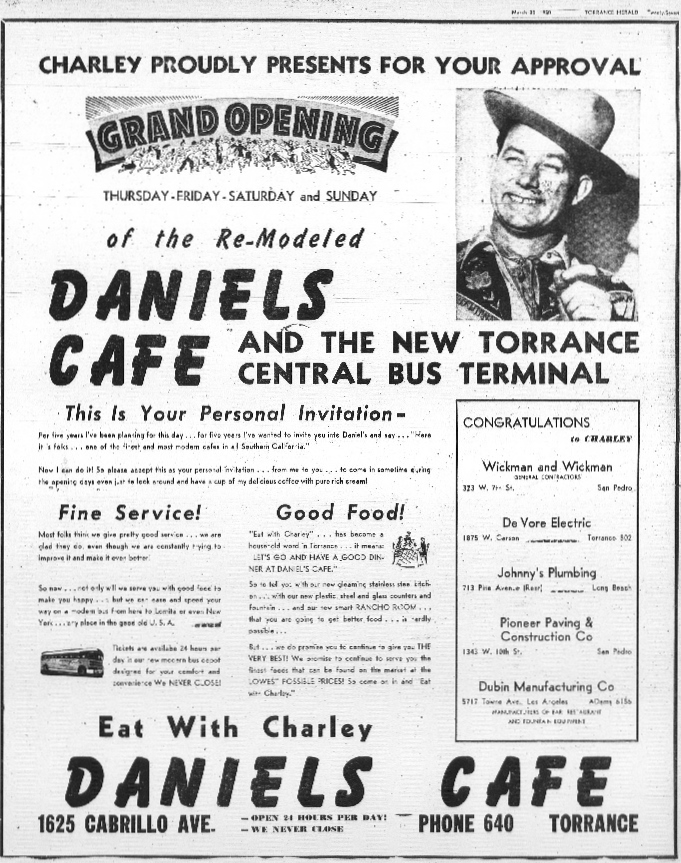
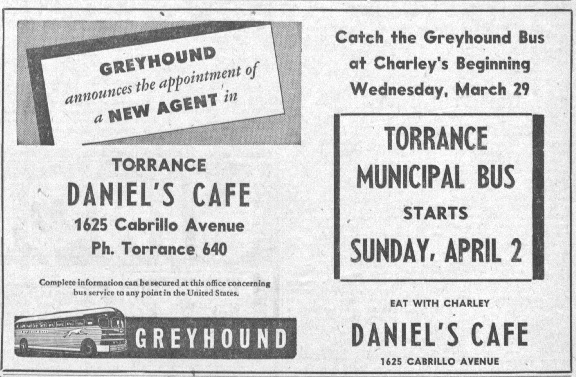
In 1950, Gotts embarked upon a major construction project at Daniels Cafe. This involved adding on a small passenger terminal for the nearby Greyhound bus station in downtown Torrance. It was connected to Daniels Cafe, so that Greyhound customers could relax in the terminal, or, if feeling the need, possibly step into the adjoining restaurant to enjoy a meal before catching their bus.
Torrance Herald ad of March 30, 1950, promoting the news Greyhound bus terminal. Click to enlarge. (Credit: Torrance Historical Archives database, Torrance Public Library)
Gotts ran creative ads in the Torrance Herald during the 1950s, including listings of the names of prominent recent diners in the restaurant. At one point, he even had his own column in the paper, “Charley’s Corner,” filled with local news tidbits as well as the doings at his restaurant.
Peninsula Press ad from March 30, 1950. Torrance Herald ad of April 13, 1949, trumpets the fifth anniversary of Charley Gotts’ purchase of Daniels Cafe, showing the cafe’s owner and employees. Click to enlarge. (Credit: Torrance Historical Archives database, Torrance Public Library)
Since everyone had come know it as Charley’s place anyway, Gotts finally rechristened Daniels Cafe as Charley’s in 1959.The name may have changed, but Charley’s menu, service and ambience continued squarely in the Daniels Cafe tradition.
The restaurant underwent another major remodel in 1962, with Gotts revamping and adding a fire pit to the cocktail lounge area and expanding the restaurant to accommodate 200 guests.
Gotts had become a local business leader, heading both the Chamber of Commerce and the Downtown Torrance Merchants Association over the years.
The cafe had been known for hosting music since its earliest days. In April 1963, Dodger Stadium organist Helen Dell performed there regularly, as did fellow organist Buddy Nolan.
Gotts sold Charley’s in the mid-1960s, when it became the Crest Cocktail Lounge. (Gotts retired and moved to Lake Arrowhead, where he died in November 1978.)
The bus station terminal was long gone at this point, but the Crest continued to thrive.
An early morning fire gutted the interior of the the Crest on May 1, 1968, causing $20,000 in damage, but the restaurant rebuilt and reopened shortly afterward.
It also continued to host live music. Negative attention came to the club in 1989 whe three men were stabbed during a confrontation with members of a skinhead group from Orange County during a punk rock show at the Crest in 1989.
All parties involved seemed to agree that agitation from the skinhead group led to the fracas. The Crest continued to book musical acts, and does so to this day.
These days, The Crest’s official name is The Crest Sports Bar & Grill, and it has held regular early weekend morning viewing parties for sporting events such as overseas soccer matches over the years.
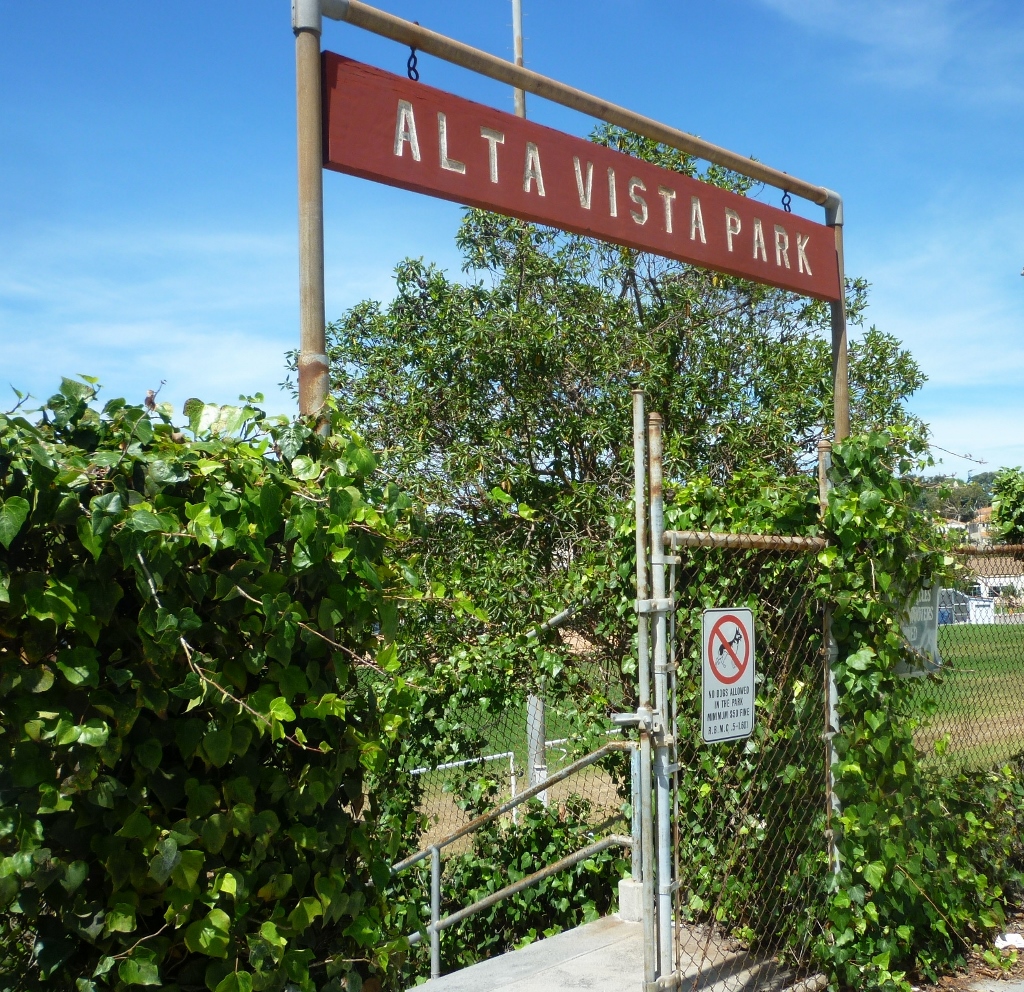
Stairs lead down from the Camino Real street level entrance into Alta Vista Park in Redondo Beach. (August 2015 Daily Breeze photo)
On March 20,1962, the Redondo Beach City Council committed itself to the development of a large park in the southern section of the city. In May, it went ahead with the purchase of a good-sized chunk of it, a 7.9-acre piece of land from the Huntington Land Company, for $156,000.
The land was part of a large piece of undeveloped land on the southwest corner of Prospect Avenue and El Camino Real on the site of a former sump used for storm runoff water drainage. It seemed like an ideal location for a new park, something the city needed to meet the recreational needs of its booming population.
After making the large purchase, the city continued with its plan to piece together a large public park on the sunken area, combining a series of smaller land purchases throughout 1964 qnd 1965 with a lease deal for 8 acres of land owned by the Redondo Beach City School District.
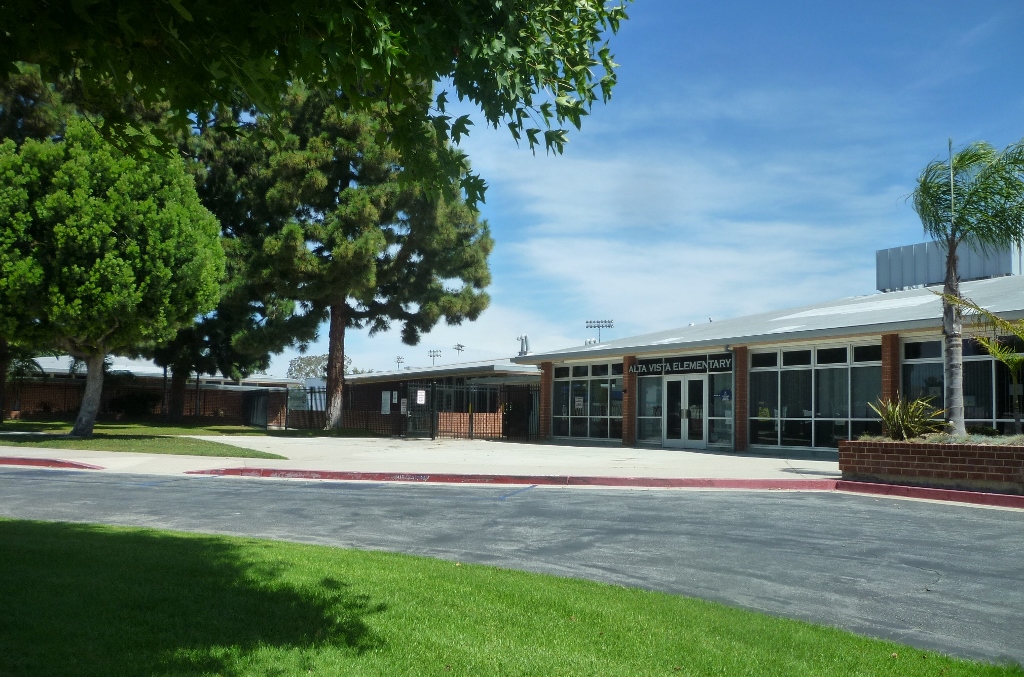
The district had built and opened Alta Vista Elementary School on part of its property there, dedicating the school at 815 Knob Hill Avenue on Nov. 9, 1965. The city got the okay to use the rest of the land for its new park, with the understanding that it wouldn’t build any major structures on that part of the park in case the district should need the land back in the future.
Alta Vista Elementary School opened in 1965. (August 2015 Daily Breeze photo)
Before construction on the park could begin, the city had to sort out several issues. The first step was to erect a fence around the property and to start filling in the site with landfill material so that it could be properly graded.
The final two lots had to be acquired to complete the park, which the city took care of in January 1967.
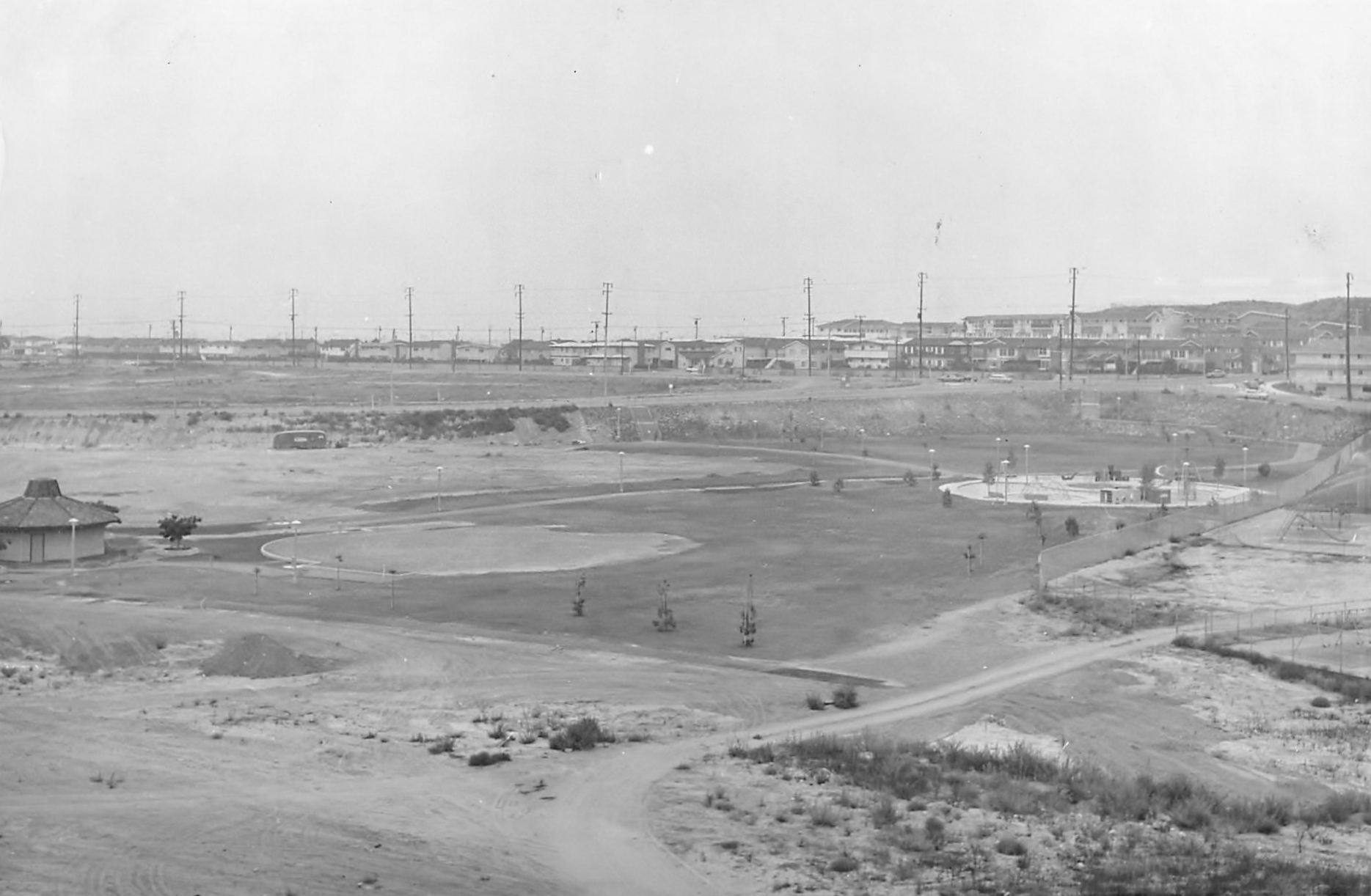
Undated photo ca. 1968 shows Alta Vista Park in Redondo Beach under construction. View looking southeast shows the still-standing octagonal rest rooms/snack bar building, which was renamed the Pat Dowling Memorial Snack Bar on Feb. 4, 1992, after the dedicated volunteer who ran the snack bar for 13 years until his death at 75. (Breeze file photo)
Also, the presence of two Rico Oil Co. oil wells in the center of the property had to be dealt with. First, the council determined that it opposed oil drilling in the park. Though some members of the council advocated buying the wells outright, the council finally settled in April 1968 on disguising the wells with landscaping around the site and raising the wells 23 feet to match the grade level of the nascent park.
Having cleared these and other hurdles, the city agreed to an overall plan for the park that would cost about $1 million, according to an August 1967 estimate. Its first phase would cost far less, but adopting the full plan allowed the city to receive federal matching funds for the project.
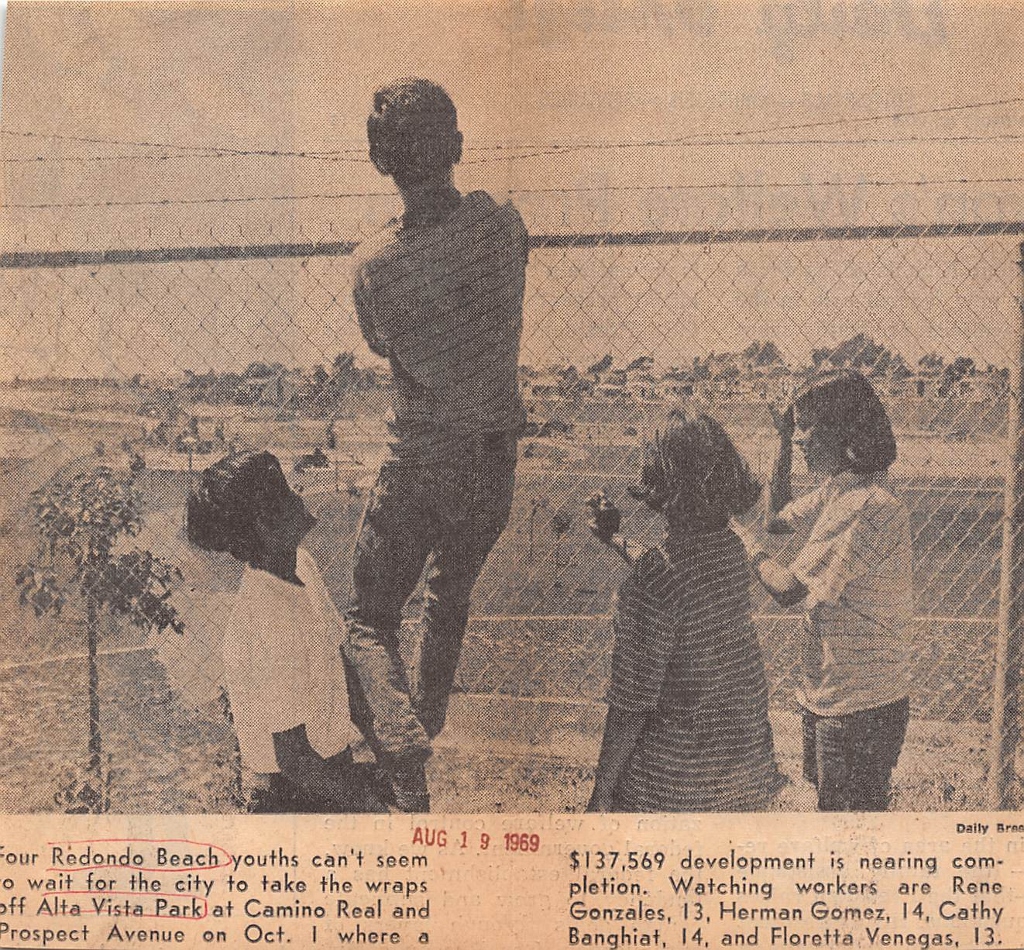
From the Daily Breeze, Aug. 19, 1969. Click to enlarge.
The original plans for Phase I of Alta Vista Park included a rest room / snack bar building, 2 baseball diamonds, a community center, picnic area and playground area.
The council had to scale that back, authorizing only enough money in October 1968 for grading and landscaping, a restroom facility, children’s play area and lighting. The Moulder Brothers contracting firm was awarded the job a month later in November after submitting its $137,659 bid, and construction began in earnest.
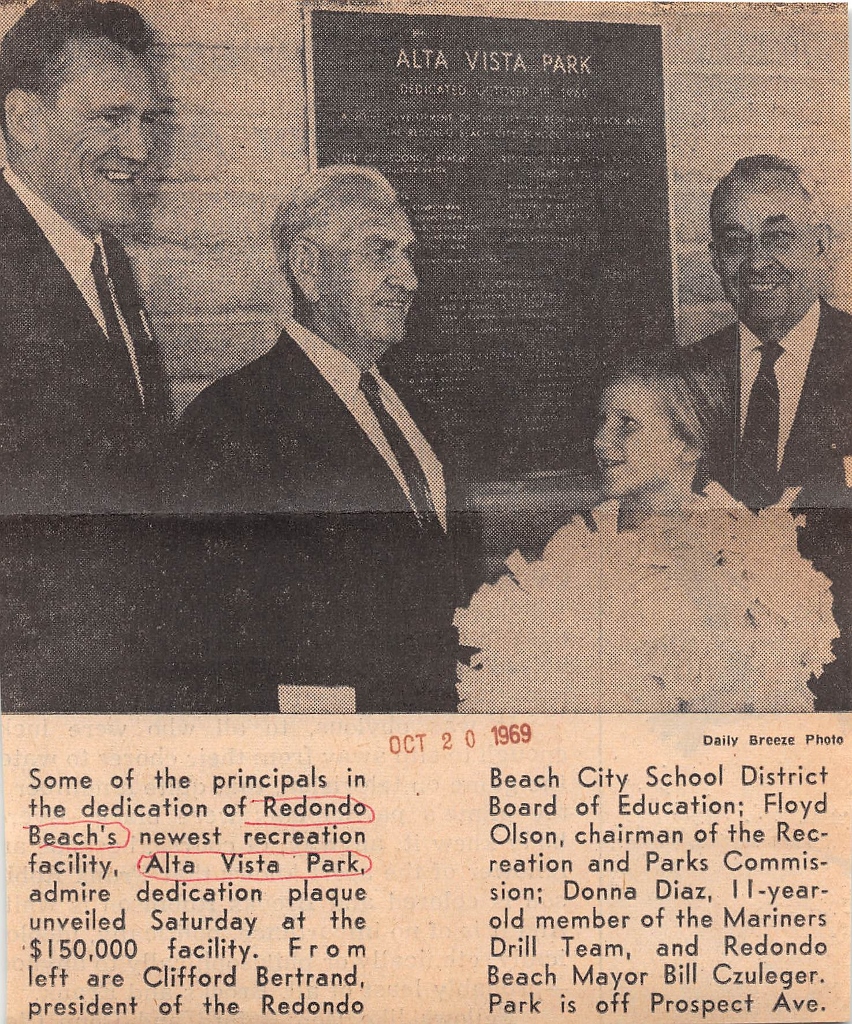
Dedication of the new park took place on Saturday, Oct. 18, 1969, with Redondo Beach Mayor Bill Czuleger, Redondo Beach City School District Board of Education Clifford Bertrand, and the usual host of other dignitaries and local authorities on hand.
When it opened, Alta Vista Park definitely still was a work in progress. The baseball fields that now form a large chunk of the park had yet to be built, much less the amenities added in later years.
From the Daily Breeze, Oct. 20, 1969.
The city council paved the way for the ball fields in March 1970, when it approved contracts for two backstops and six sections of bleachers to be installed at the park. Excited volunteers from the Redondo Beach Sunset Little League and the Redondo Beach Pony League went to work preparing the fields for opening day of their 1970 seasons.
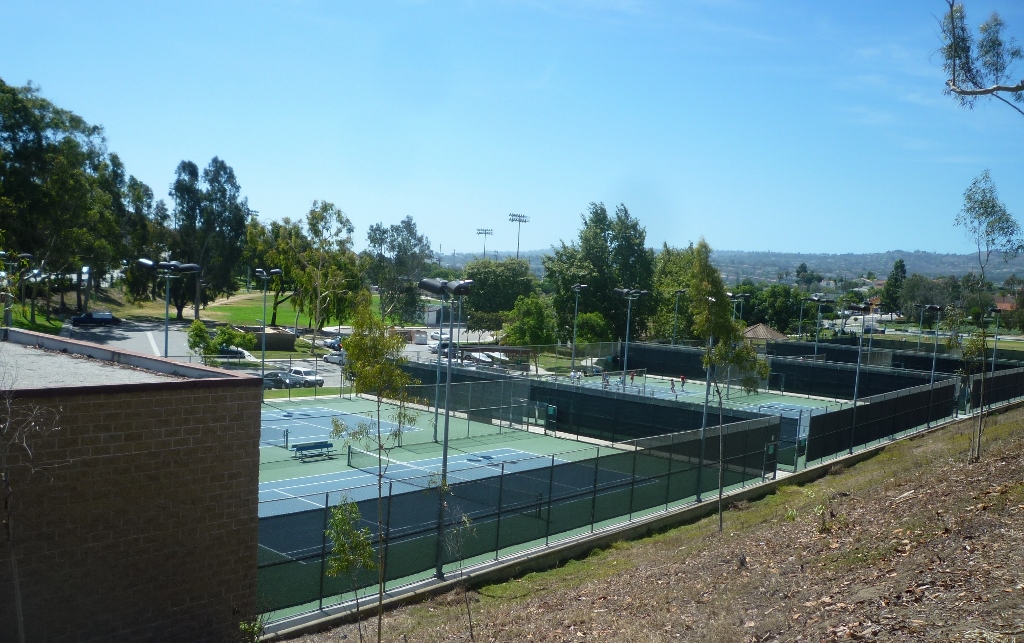
Tennis courts would become the next major addition to Alta Vista. The eight courts in the northwest corner of the park were approved on July 1, 1974, and would become the first tennis courts owned and operated by the city.
After a slight delay, that is. The city engineering department never ordered a soils analysis of the area. Because of the imperfect nature of the landfill done years earlier, the analysis, when finally completed. revealed that the land wouldn’t be stable enough to support the concrete slabs of tennis courts without either building the courts on pilings, or recompacting the soil in the area. Otherwise, the courts could crack and break up.
The city opted for recompacting the soil. After that was done, actual construction began in spring 1975, and the courts opened in early September.
The tennis courts at Alta Vista Park opened in 1975. (August 2015 Daily Breeze photo)
Since the 1970s marked the height of the boom in the popularity of tennis, the city soon had to institute a reservation system to handle the demand, and hourly fees to cover maintenance costs.
The community center building planned for the park had a much longer and more tangled path to completion.
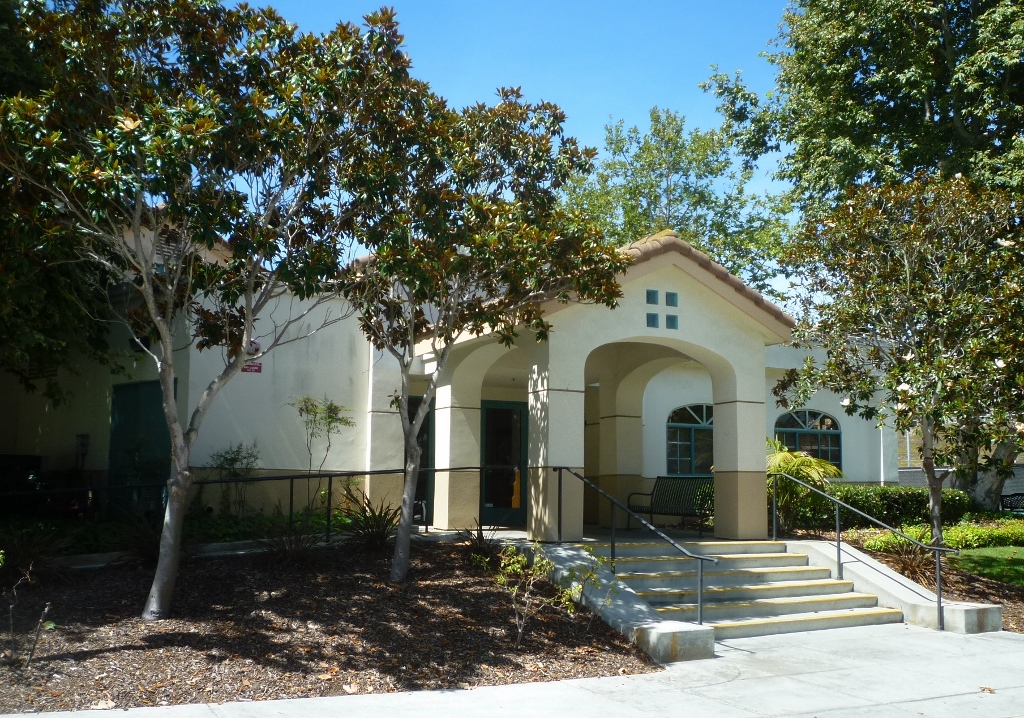
The community center building at Alta Vista Park was completed in 1997. (August 2015 Daily Breeze photo)
The city always had intended to build such a center, but it never quite happened in the 1970s. When the neighboring Brookside Village apartments, whose story deserves a future blog post of its own, petitioned the city to convert to condominiums in 1979, the city made it a condition that each condo buyer kick in $2,000 as a part of the purchase price for the new units. That money then would be put toward the community center building.
When no center had appeared by 1990, the Brookside Village Homeowners Association sued, demanding that the city return the money if they weren’t going to build the center. After dragging its feet, the city finally began construction of the center in 1996. The center finally was completed in 1997.
The deteriorating bleachers at the park’s youth baseball fields were replaced before the 2007 season through a city-approved partnership with a local construction firm that donated its services. Community volunteers also pitched in to put the finishing touches on the job.
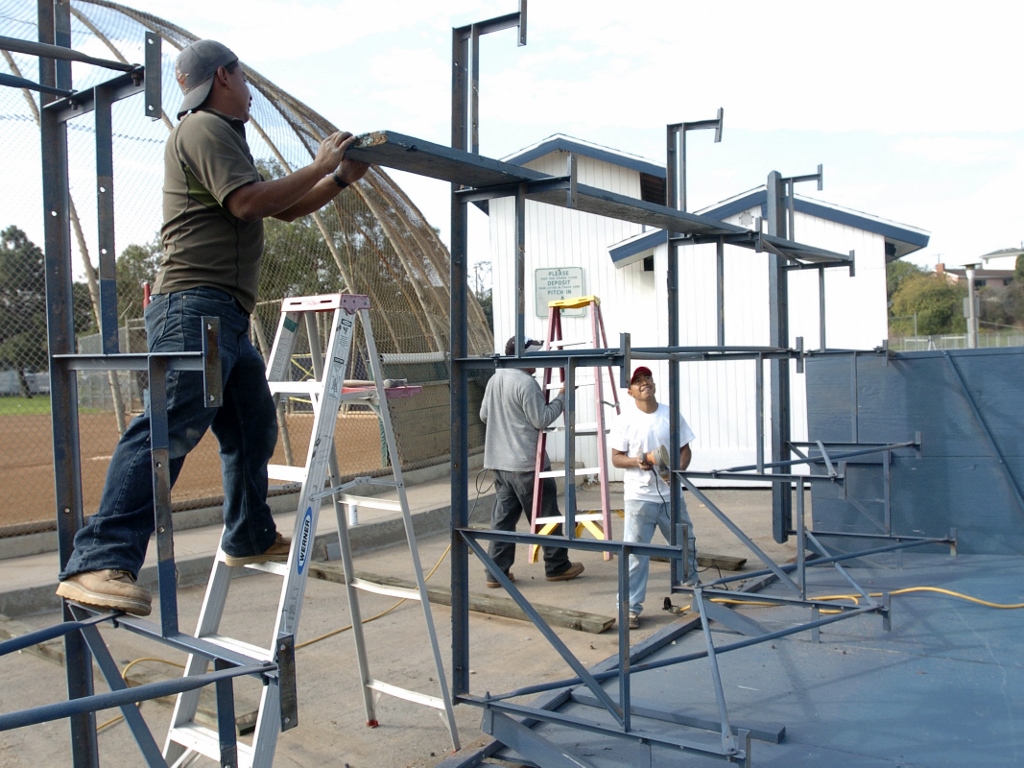
Building contractor Gary Lane and some of his associates along with other volunteers replace aging bleachers at Alta Vista Park in Redondo Beach. Old splintered wood is removed. 2007 file photo. (Robert Casillas / Staff Photographer)
In 2011, the city installed a water reclamation system at the park that recycles storm runoff and stores it for use in irrigating the park.
There’s a lot to irrigate. At 19.42 acres, Alta Vista is Redondo Beach’s second largest park. Only Dominguez Park, with its large dog park area, is bigger, covering 23.75 acres.