The day the Redondo Beach pier went up in flames

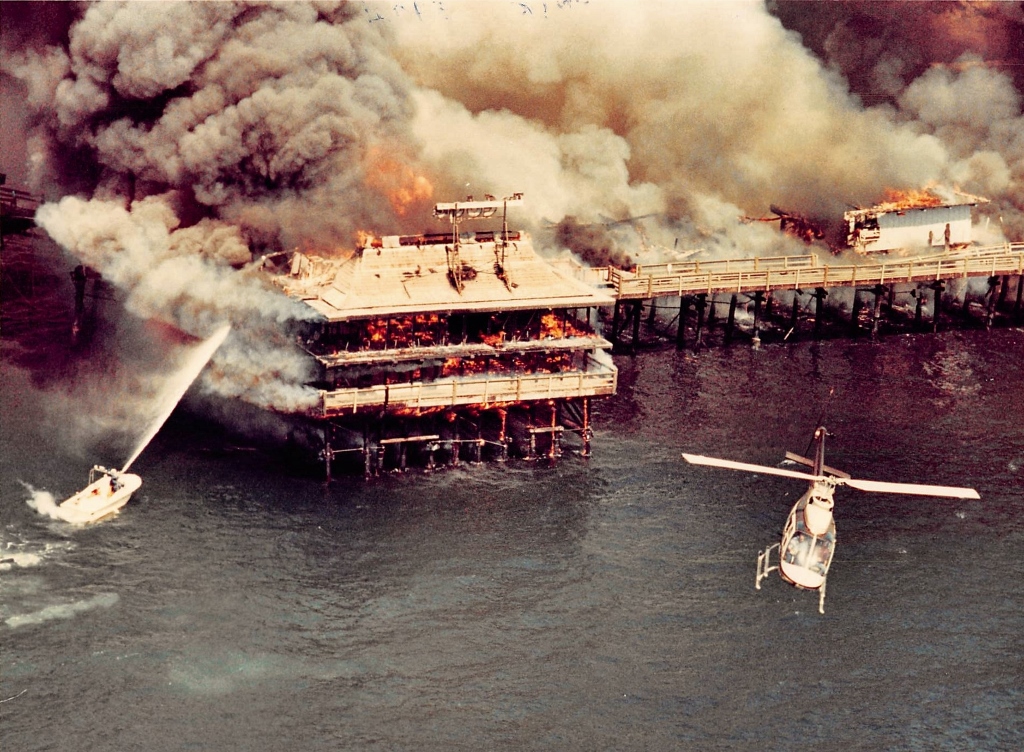
The Redondo Beach pier fully involved in flames on May 27, 1988.
The Edge restaurant, center, at the Redondo Beach pier is fully involved in flames on May 27, 1988. A fireboat battles the blaze at far left. ( Daily Breeze file photo)

Friday, May 27, 1988 was a clear, cool day in Redondo Beach, with temperatures near 70 degrees.

It was getaway day for the Memorial Day holiday weekend, and hundreds of diners, tourists, fishermen and others were visiting the Redondo Beach pier.

At 1:40 pm, the Redondo Beach Fire Department received its first call:
“Station 1. Structural response. Breakers restaurant, 400 Fisherman’s Wharf. This is called in from Tony’s. They state there is  lot of smoke coming from under the building.”

Diners at Tony’s restaurant had seen wisps of smoke rising from beneath the Breakers Seafood Restaurant and notified the fire department.

The smoke came from a fire that had broken out underneath the Breakers from an unknown cause. The heat of the ensuing conflagration was so great that most clues as to its origin were destroyed, leaving the exact cause of the fire undetermined to this day.

Investigators later would theorize that electrical equipment and wiring knocked loose from high waves that had pounded the pier twice earlier in 1988 probably short-circuited beneath the restaurant and ignited the wooden pilings.

The pilings had been coated with creosote to make them water-resistant, but the substance also made the pilings burn easily and rapidly. While burning, they gave off a toxic smoke.
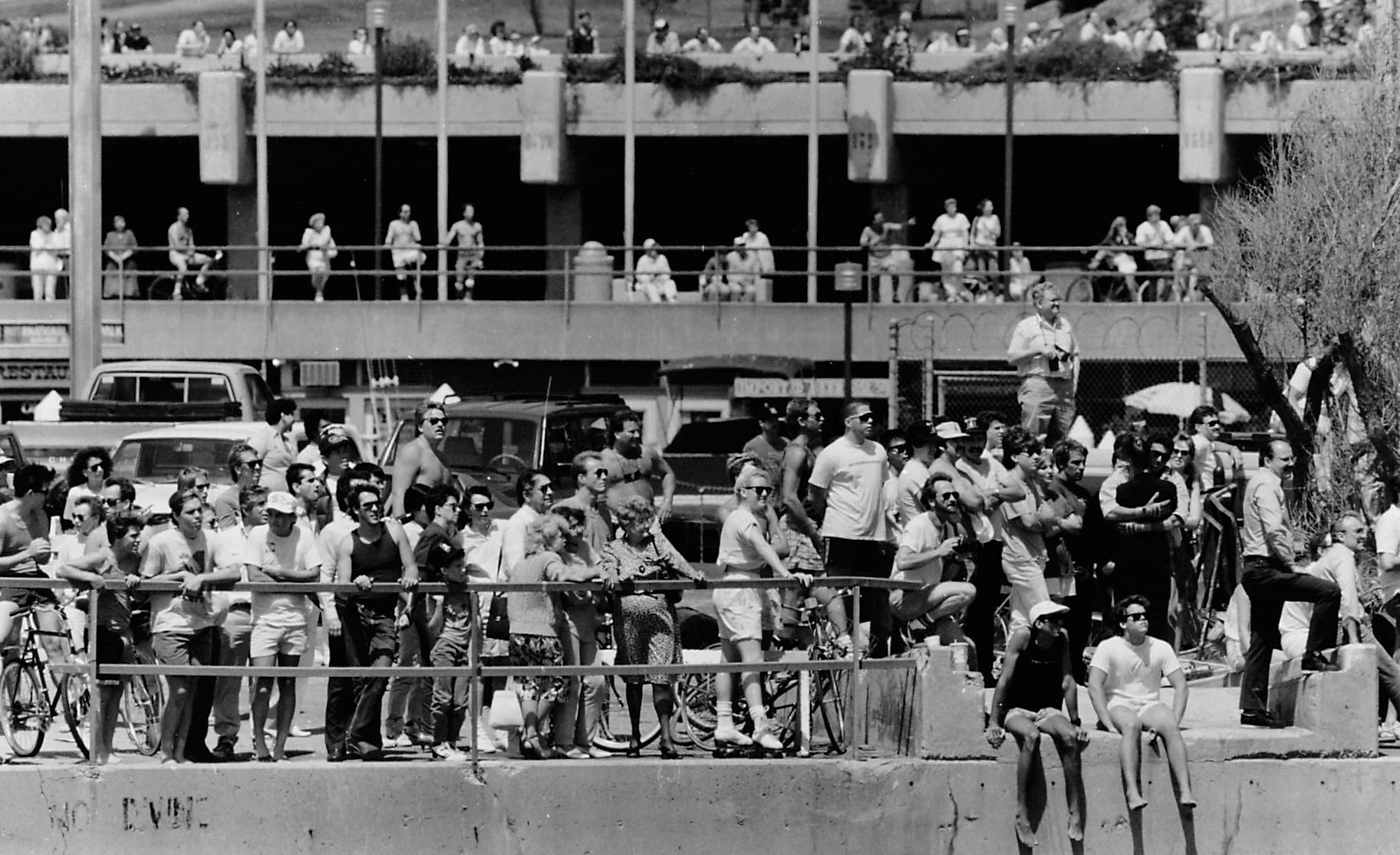
Spectators crowd the waterfront area to watch the Redondo Beach pier fire. May 27, 1988. (Daily Breeze file photo)

As the blaze continued to rage, a police officer clearing crowds of spectators near the flames hollered, “The smoke over your head is toxic! Please leave the area now! It is getting in your lungs right now!”

He may have been exaggerating slightly – the toxic smoke is harmful mostly in much higher concentrations – but it worked. The spectators quickly retreated.

Seven minutes after the first call reach firefighters, the underside of the pier was reported completely involved with flames.

14 minutes after the first report, firefighters were forced to give up trying to save the Breakers. “The Breakers Seafood is gone,” came the voice on the fire radio.

By now, all hell had broken loose on the blazing pier.

A Channel 2 news helicopter looking for the best photo opportunities of the inferno, flew in  close to the pier from the ocean side. Too close, say fire authorities, who claim wind generated by its rotors actually fanned the flames firefighters were desperately trying to control.

Merchants desperately gathered merchandise, computers, cash registers and other valuables into carts and trash barrels, saving as much as they could before being evacuated by emergency personnel.

Smoke from the flames caused a Sig Alert on the 405 Freeway, miles away from the blaze. Thousands of spectators descended on the area to get a better view of the spectacular flames, causing even more headaches for those trying to battle the blaze.
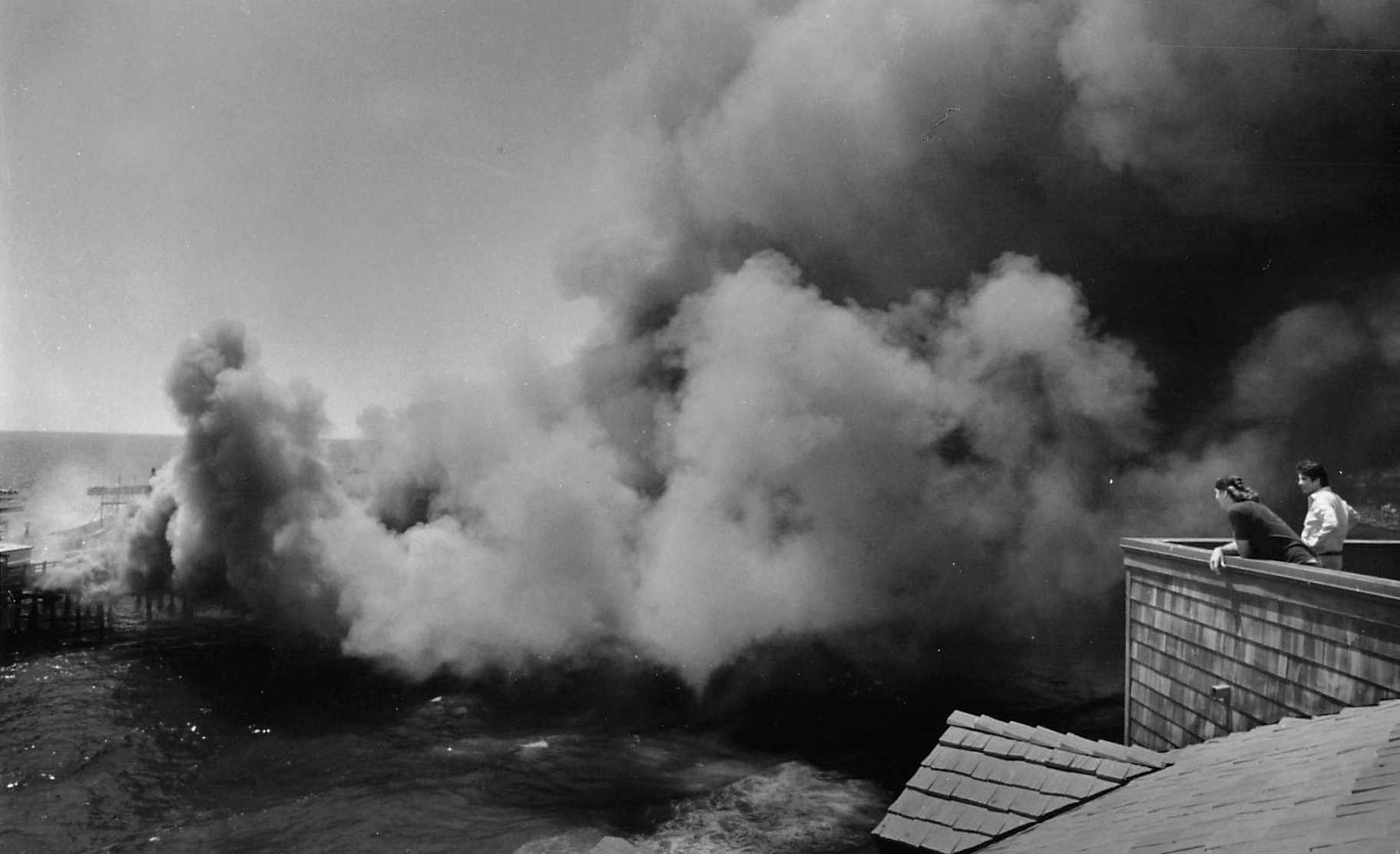
Bystanders watch the pier fire from their balcony. May 27, 1988. (Daily Breeze file photo)
Nearby residents watch the pier fire from their balcony. May 27, 1988. (Daily Breeze file photo)

Traffic jammed nearby streets, and police closed Torrance Boulevard from Anza Avenue to its terminus in front of the pier. A command post operated from the turnaround area in front of the pier parking structure.

Because it started underneath the pier, the fire was more difficult to battle, and attempts to save The Edge restaurant failed. Cattlemens was saved, but it wouldn’t survive, either, as you’ll read below. It was closed at the time due to damage from high surf earlier that winter.

Fire crews were able to make a stand to halt the blaze’s advance by boring holes in the pier’s concrete surface to create areas from which water could be poured on the blaze. These areas acted as firebreaks, keeping the flames from spreading to the rest of the pier. Despite their valiant efforts, a 500-foot section of the Horseshoe Pier was destroyed, in addition to 200 pilings beneath it.

By 3:20 p.m., the fire had been slowed and brought under control, though firefighters would spend several more hours working on the blaze.

In all, more than 140 firefighters battled the flames. The entire Redondo Beach Fire Department, along with crews from L.A. County, Torrance, El Segundo, Hawthorne, Hermosa Beach, Manhattan Beach and Gardena, pitched in to fight the blaze.Fire boats from Redondo Beach and Los Angeles and a Coast Guard cutter fire boat attacked the flames from the sea. Area lifeguards even joined in the battle.

15 businesses were destroyed. These included the two large restaurants, Breakers Seafood and the Edge, 12 smaller shops and restaurants and the pier’s property management office.
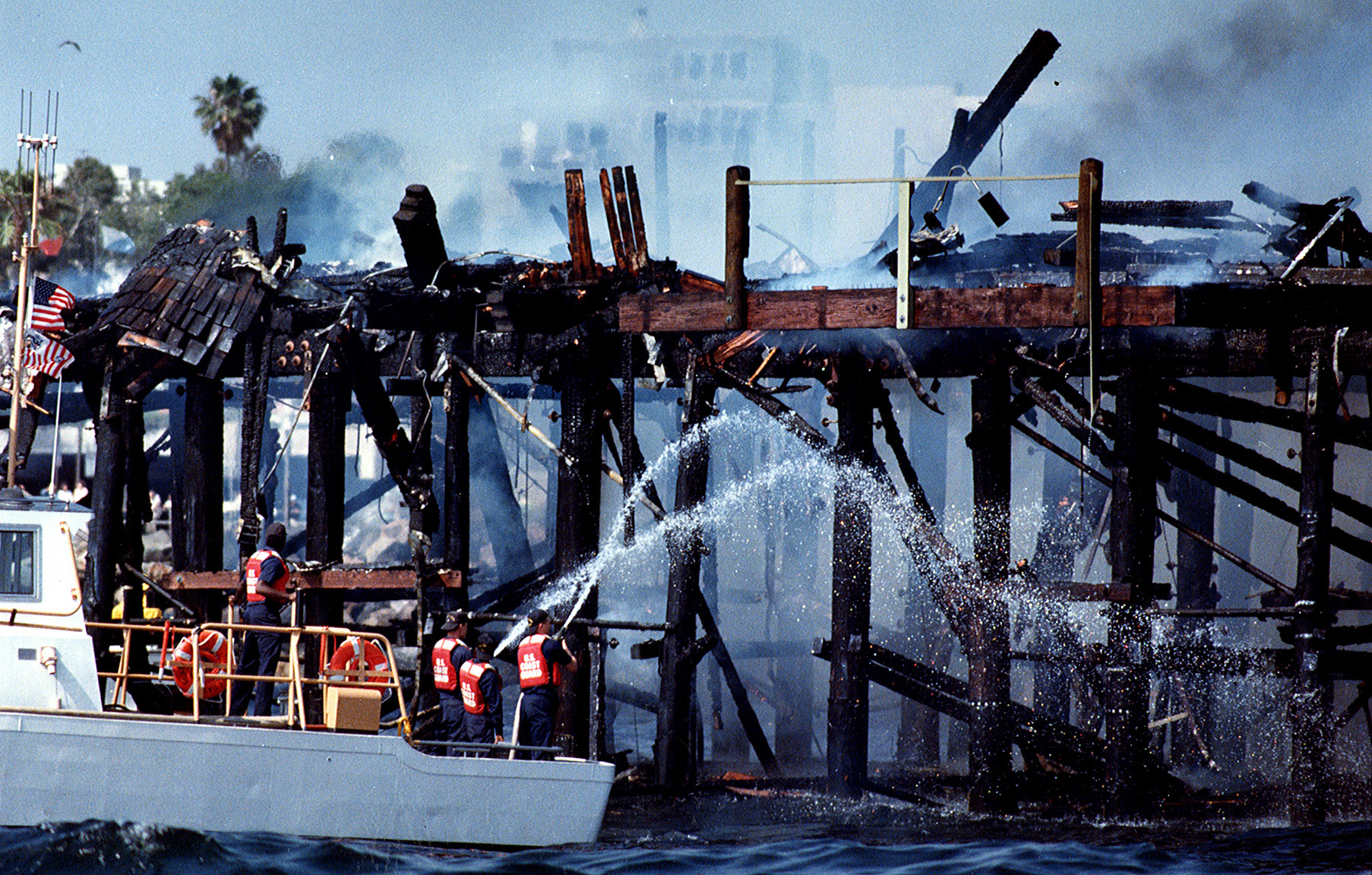
Firefighters hose down smoldering remains of northern section of Redondo Beach pier that was devastated by the May 27, 1988 fire. (Daily Breeze file photo)

Damages were assessed at $6.8 million, $2.5 million to the pier structure, and $4.3 million to pier businesses.

Miraculously, no one was seriously hurt in the blaze.

More wind-whipped waves hit Cattlemens restaurant two days later on Sunday, May 29, causing parts of it to fall into the sea. A giant crane stationed near the pier after the fire scooped up the restaurant wreckage and placed it on the shore for disposal. It never reopened.

The high surf may have sounded the final death knell for Cattlemens, but it also helped extinguish the last smoldering areas of the pier fire, according to fire personnel.
2016_03_04_19_51_380001
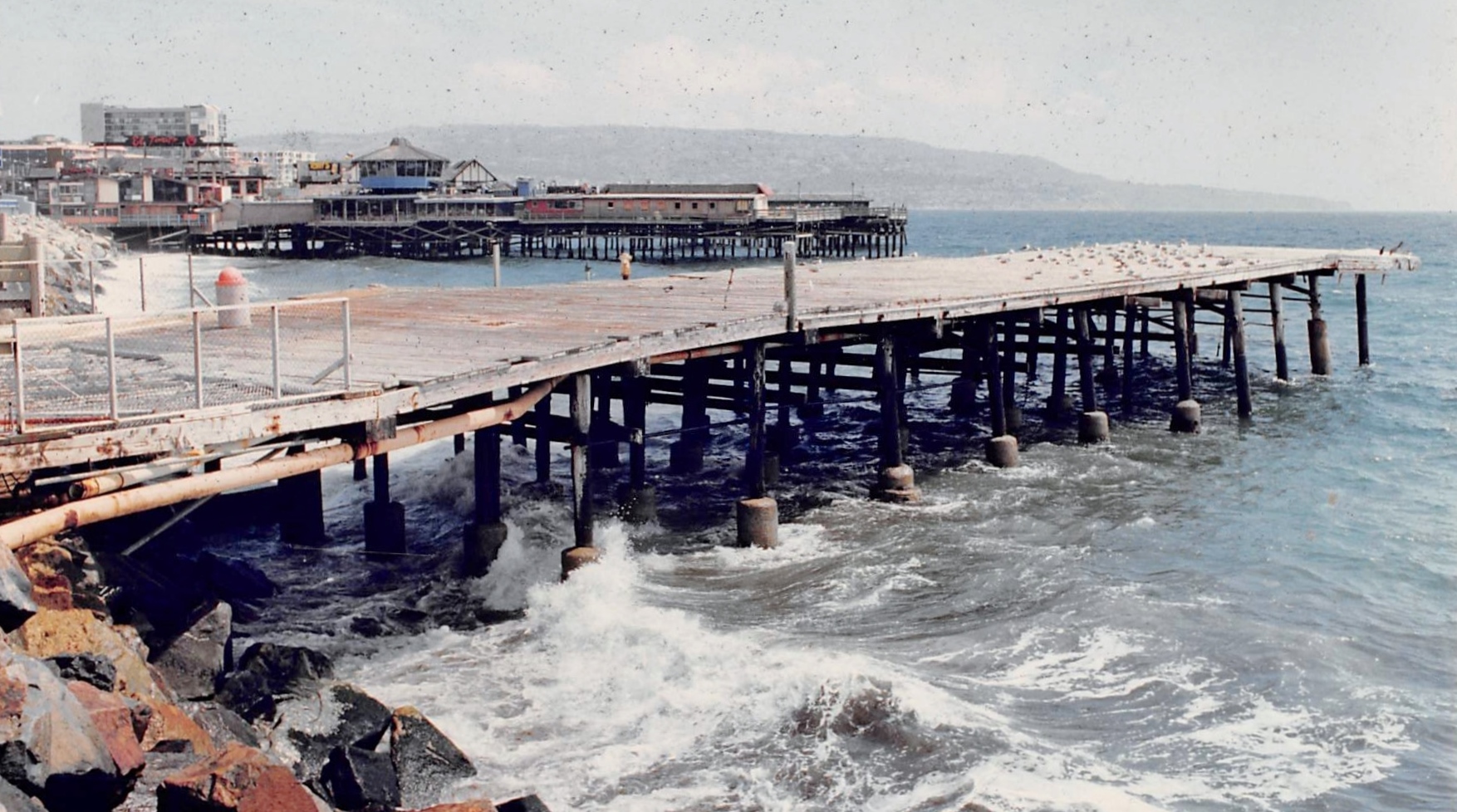
Not much remains of the Horseshoe Pier two years after the fire in this Daily Breeze file photo from May 31, 1990. (Brad Graverson / Staff Photographer)

The undamaged other half of the pier reopened in the days following the blaze. Shops were crowded with sightseers buying souvenirs, but it was only a temporary phenomenon.

Business at the pier soon dropped by as much as 30 percent as the city fathers debated the future of the structure.

The debate would last for several years.

Judge Abraham Gorenfeld ruled on Jan. 24, 1990, that the city was obligated to rebuild the pier. A ballot measure mandating the rebuilding passed in June 1990. Plans were drawn up and discussed, and the city council approved a final plan on Sept. 3.1991.

The new pier’s piling would be built 5 feet higher than before in order to better resist periodic bouts with high surf. A carousel and museum that were part of the plan never came to fruition as the dickering continued.
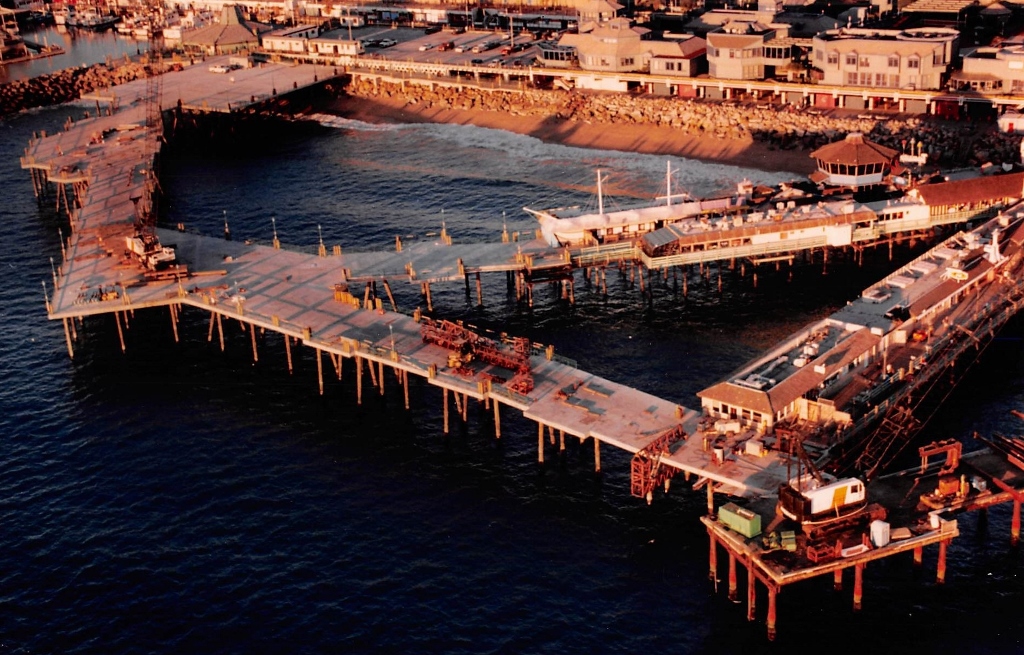
The rebuilt Redondo Beach pier on Feb. 1, 1995, shortly before the damaged area reopened. (Daily Breeze file photo by Brad Graverson / Staff Photographer)

Construction on the new pilings began in 1993.

The rebuilding project ultimately would cost the city roughly $11 million. The pier finally reopened on Feb. 11, 1995, after 16 months of construction.

In January 1997, the city approved the construction of the $3 million upscale Kincaid’s restaurant at the pier.

Despite the newly rebuilt pier structure and the addition of Kincaid’s and other businesses, retail outlets located there have continued to struggle. The flow of tourists has slowed, and the pier has been unable to recapture the audience it once had.
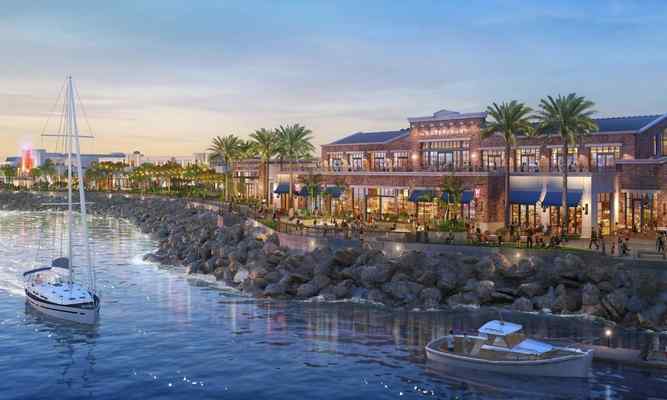
Artist's rendition of a portion of the proposed CenterCal Redondo Beach waterfront plan. (Credit: CenterCal)
Artist’s rendition of a portion of the proposed CenterCal Redondo Beach waterfront plan. (Credit: CenterCal)

Business owners are hopeful that the $300 million CenterCal waterfront redevelopment proposal, which would revamp 36 acres stretching from Seaside Lagoon to the pier, will change their fortunes and bring people back to enjoy the pier once more.

CenterCal’s proposal currently is in its final EIR phase, though it still faces opponents who fear the development will overcommercialize the waterfront area.

Whatever the area’s future may bring, all who were there will never forget May 27, 1988.
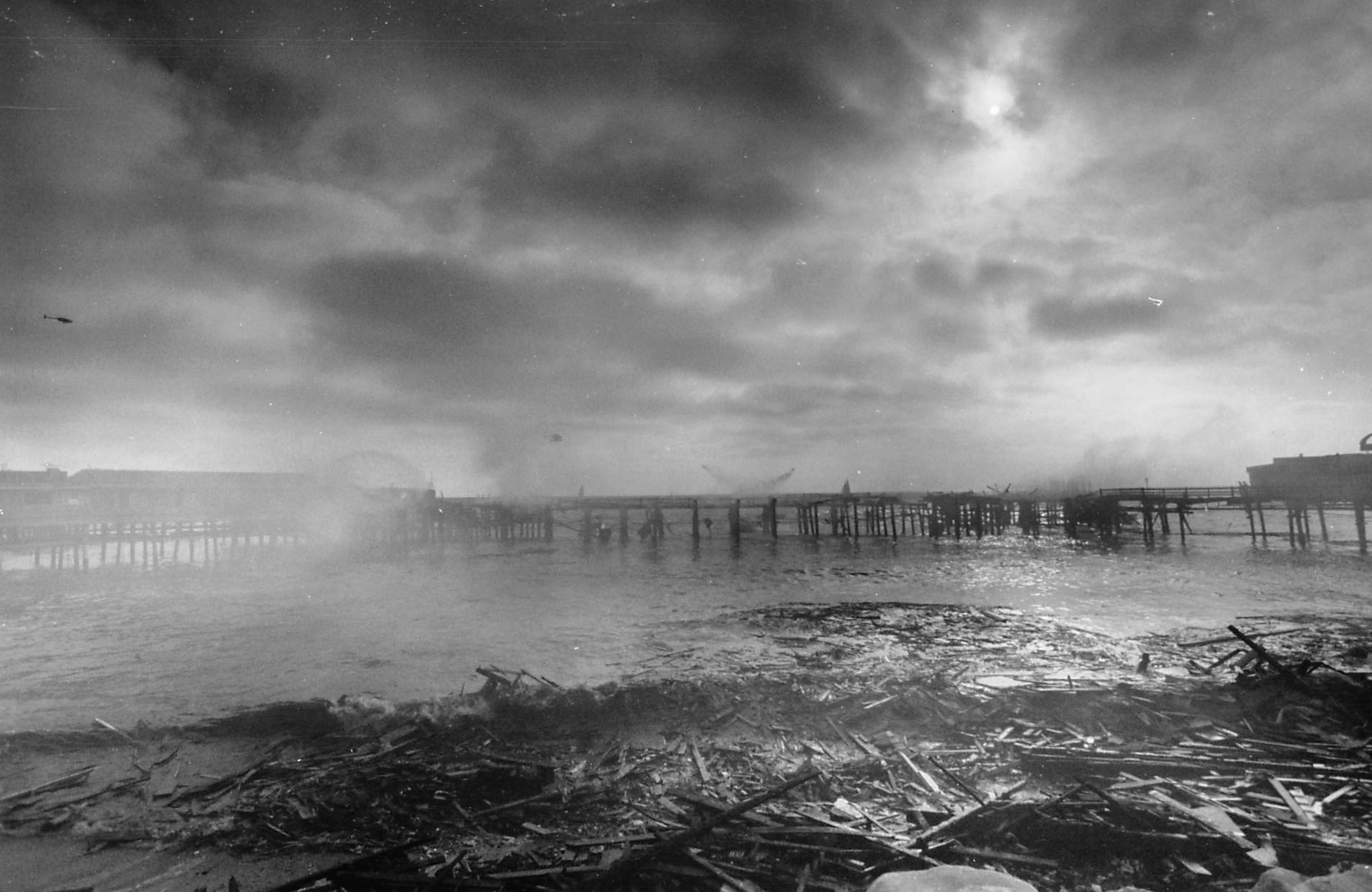
Smoking remains of the damaged pier. May 27, 1988. (Daily Breeze file photo)

Sources: 

Daily Breeze files.

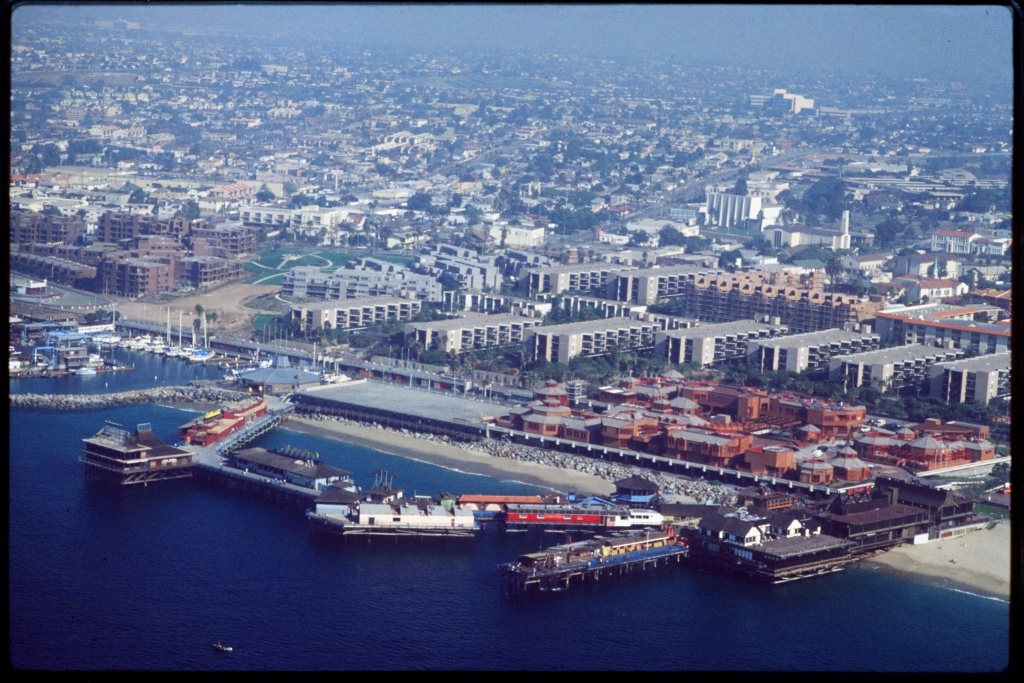
The Redondo Beach pier in an undated photo taken before the fire. (Daily Breeze file photo)
The Redondo Beach pier in an undated photo taken before the fire. The Edge restaurant is at far left, over the water. (Daily Breeze file photo)

Horseshoe Pier businesses claimed by the fire May 27, 1988:

Breaker’s Seafood

Bamboo HutCandy Man

The Edge restaurant

Ginza Snack Shop

Solvang Danish Pastries

Port of Spain restaurant

Fiorentino’s

Imports Oriental

Pier Imports

Pacific Gem & Pearl

Pier Sunglasses

Redondo Sportswear

Slightly Different Gift Shop

Sunshine Kite Co.
Note: Several of the businesses later reopened. Slightly Different Gift Shop and Sunshine Kite Co. are still in business today.
Actor and Palos Verdes Estates resident Buddy Ebsen’s rich career

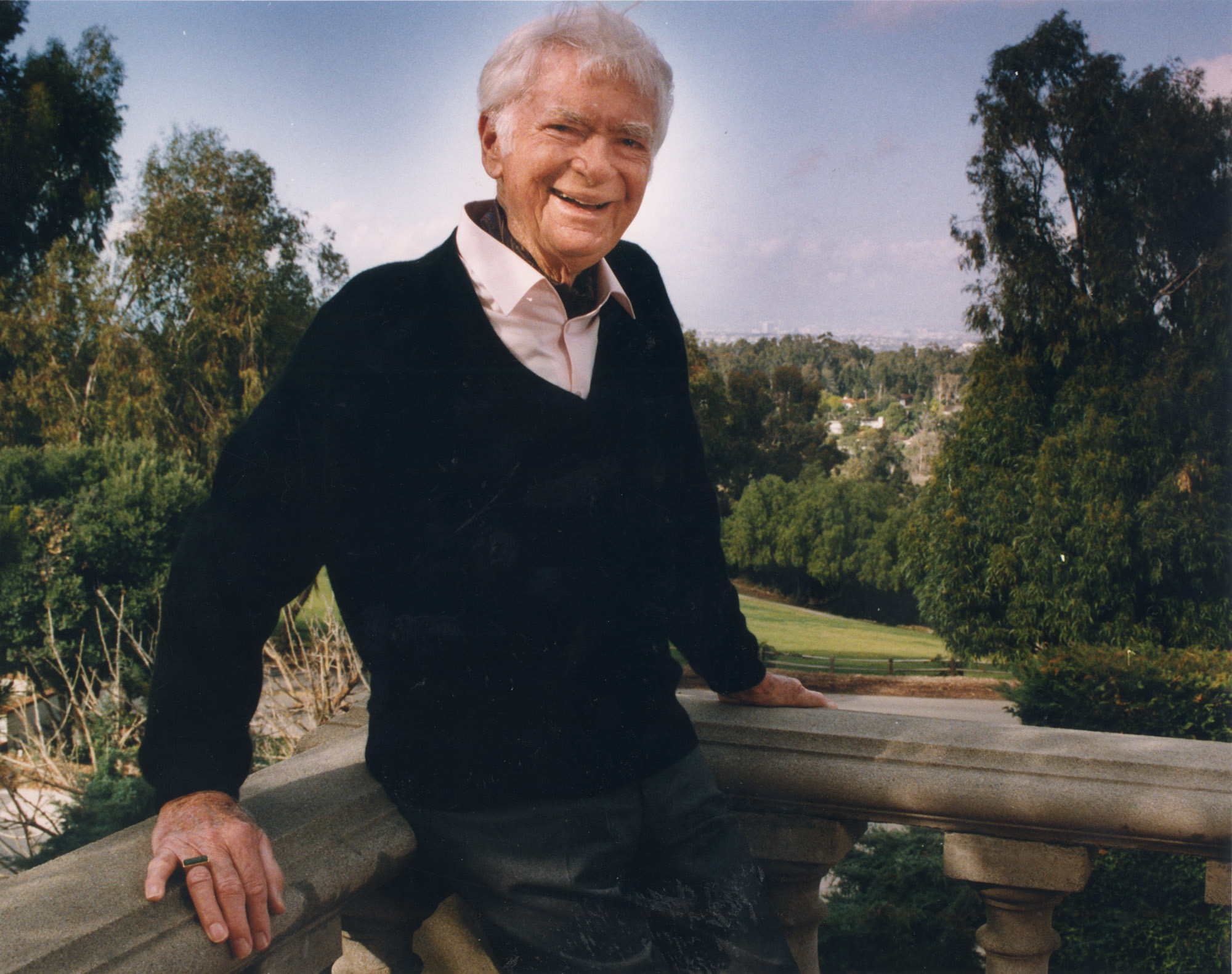
Buddy Ebsen at home in Palos Verdes Estates. Ebsen, star of The Beverly Hillbillies and Barnaby-Jones recently wrote his autobiography, "The Other Side of Oz." Feb. 17. 1994. (Daily Breeze photo by Robert Casillas )
Buddy Ebsen at home in Palos Verdes Estates. Ebsen, star of “The Beverly Hillbillies” and “Barnaby Jones,” recently had written his autobiography, “The Other Side of Oz.” Feb. 17. 1994. (Daily Breeze photo by Robert Casillas )

Christian Ludolf Ebsen, Jr. – better known as Buddy – was born on April 2, 1908, in Belleville, Illinois.

His dad, Christian Sr., was a Danish choreographer who once owned a dance studio in Illinois, and ran another one when the family moved to Orlando, Florida in 1920.

That’s where Buddy and his sister, Vilma, learned to dance.

After graduating from high school in 1926, Buddy spent a year at the University of Florida in Gainesville, and another year at Rollins College in Florida. He had to leave college for financial reasons when the family was hit hard by the Florida land boom collapse of 1928.

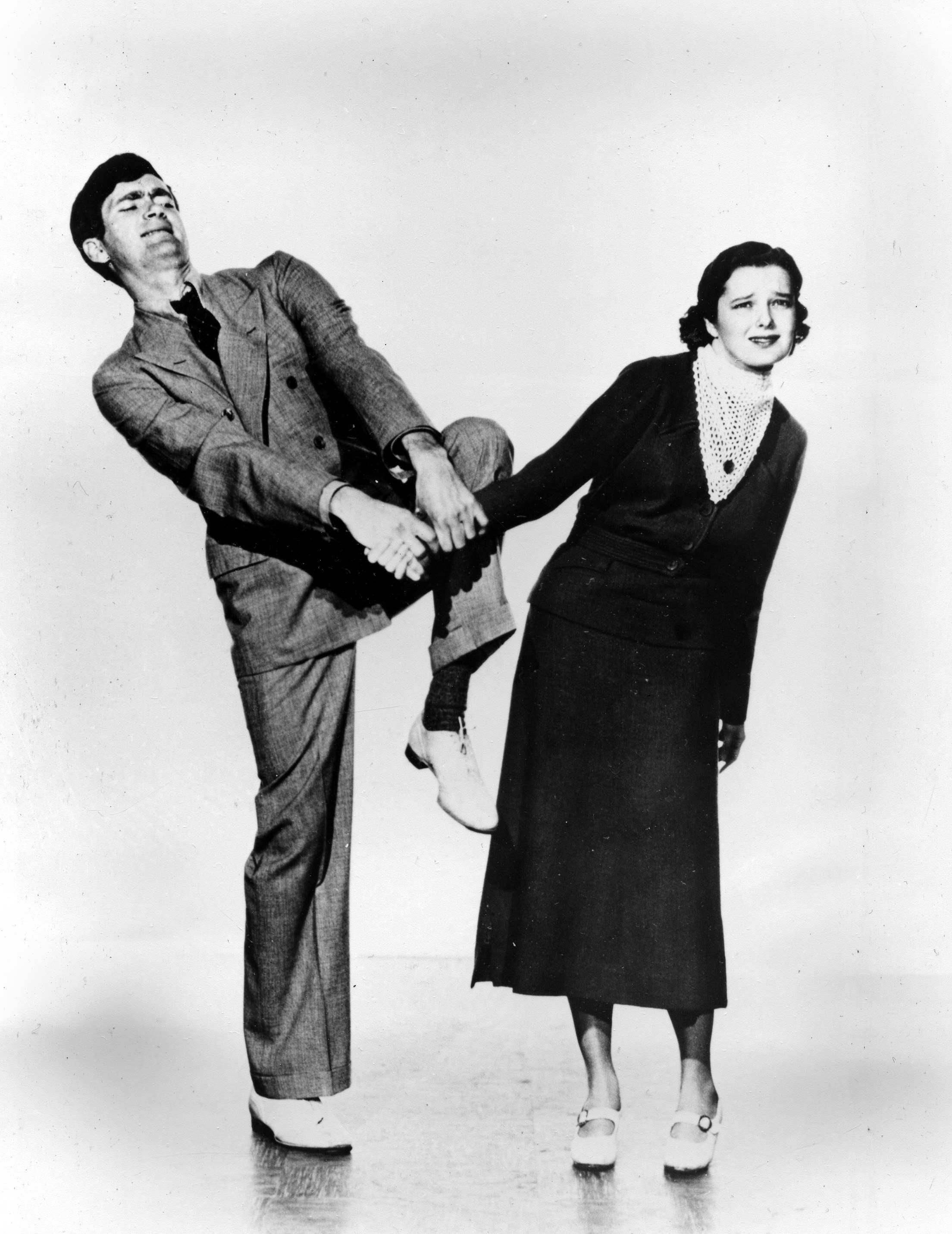
Buddy and Vilma Ebsen in a scene from "Broadway Melody of 1936." (Associated Press photo)
Buddy and Vilma Ebsen in a scene from “Broadway Melody of 1936.” (Associated Press photo)

Buddy and Vilma decided at that point to ply their hoofing skills in New York City. Dubbing themselves “The Baby Astaires,” the duo became a popular dance act on the vaudeville circuit.

Hollywood came calling, and the duo signed with MGM. Their first film, “Broadway Melody of 1936,” was a musical revue filmed in 1935. It would be Vilma’s last film; she gave up the movie business and went to New York City with her husband, musical conductor Robert Dolan. She eventually moved to California to raise her family. She died in Thousand Oaks in 2007.

Now solo, Buddy continued to use his dancing skills in a variety of movie roles, including the 1936 film, “Captain January,” where he danced with Shirley Temple.

He was all set to star as The Tin Man in “The Wizard of Oz” in 1939. He recorded his songs, and rehearsed his dance numbers, but when filming began in costume, he became ill, suffering from shortness of breath.

Doctors determined that he was suffering a reaction to the aluminum dust used in the Tin Man’s makeup. He had to leave the film to recover, and the unsympathetic studio quickly put Jack Haley in his place. (A new makeup formulation also was used, and Haley didn’t get ill as Ebsen had.) For years afterward, Ebsen complained of trouble with breathing that he associated with his “Oz” experience.

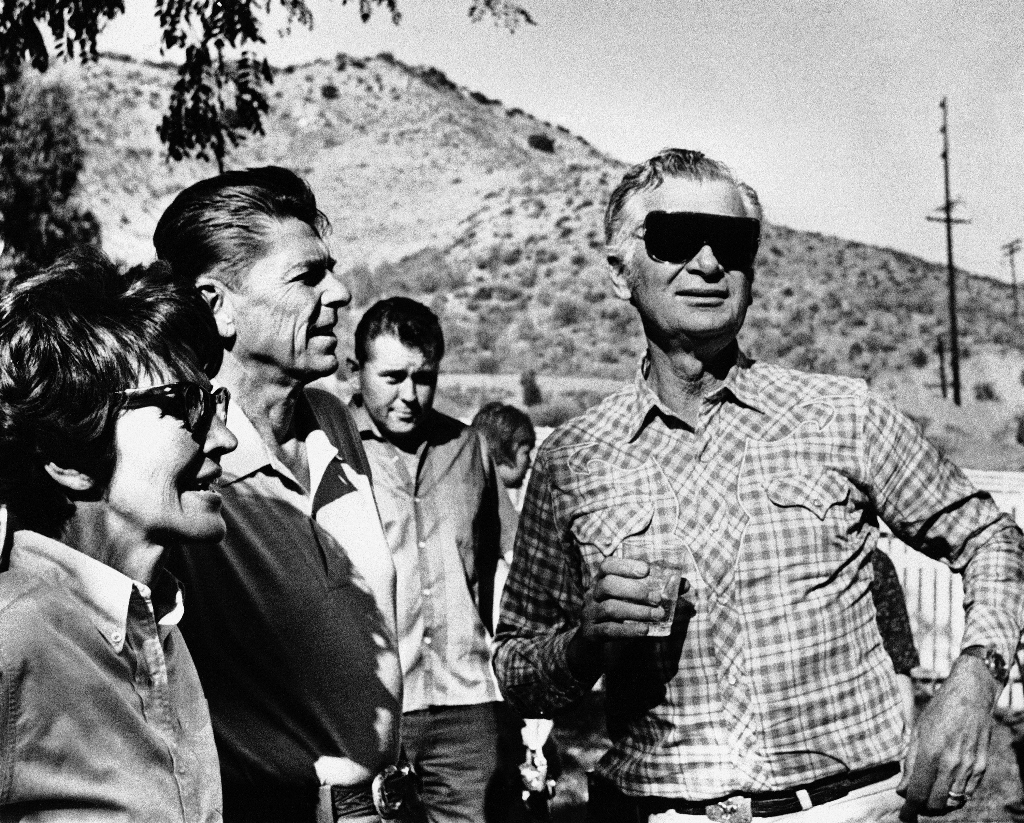
Ronald Reagan and his wife Nancy talk with actor Buddy Ebsen (right) at the Reagan's 305-acre ranch in the Malibu Hills near Los Angeles on Oct. 16, 1966, just before the start of a state-wide political telecast in California during Reagan's campaign for governor of the state. (AP Photo/Harold Filan)
Ronald Reagan and his wife Nancy talk with actor Buddy Ebsen (right) at the Reagan’s 305-acre ranch in the Malibu Hills near Los Angeles on Oct. 16, 1966, just before the start of a state-wide political telecast in California during Reagan’s campaign for governor of the state. (AP Photo/Harold Filan)

He served as a lieutenant in the U.S. Coast Guard during World War II, which allowed him to use his considerable skills as a sailor and seaman. He met and married his second wife, Nancy Wolcott, while both were in the Coast Guard. He had divorced his first wife, Ruth Cambridge, a few years earlier.

After the war, he returned to acting, and found a wealth of roles in the nascent television industry, often playing villains in Westerns. His most prominent role during this period was as Georgie Russel, friend to Davy Crockett on the wildly popular Walt Disney “Davy Crockett” miniseries that spawned a coonskin cap craze after it aired in 1954-55.

In 1961, Ebsen played Doc Golightly, father to Audrey Hepburn’s Holly Golightly character, in the film “Breakfast at Tiffany’s.”

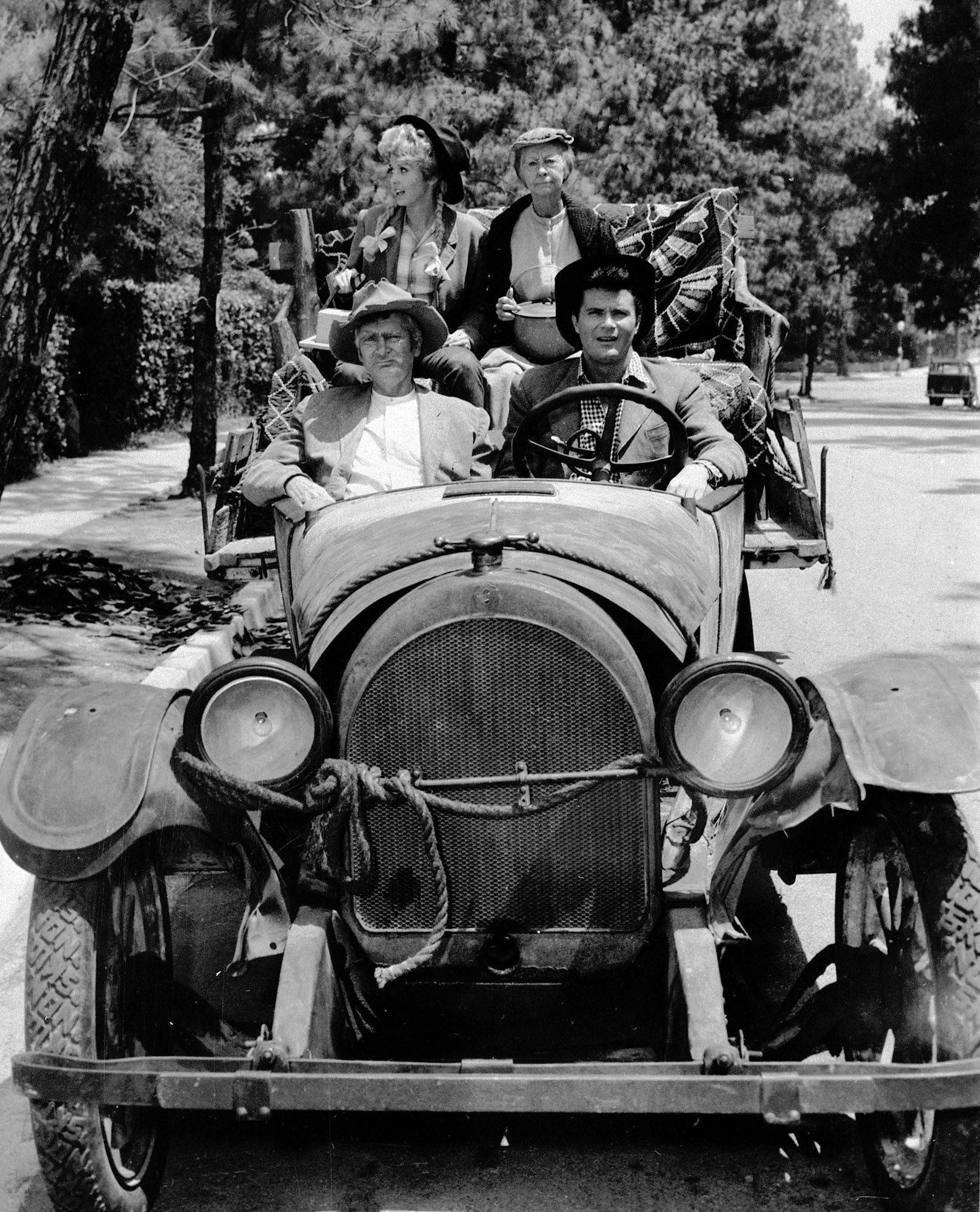
The cast of TV's "The Beverly Hillbillies," are seen riding in their car in this May 19, 1967 photo. Seen are Buddy Ebsen, front left, Max Baer, front right, Donna Douglas, rear left, and Irene Ryan. (AP Photo)
The cast of TV’s “The Beverly Hillbillies,” are seen riding in their car in this May 19, 1967 photo. Seen are Buddy Ebsen, front left, Max Baer, front right, Donna Douglas, rear left, and Irene Ryan. (AP Photo)

After playing dozens of TV roles during this era, Ebsen hit it big, really big, in 1962. Producer Paul Henning cast him in the lead role of Jed Clampett, patriarch of a family of hillbillies who strike it rich when they discover oil on their property and decide to move to Californ-y.

“The Beverly Hillbillies,” though derided by critics, had a nine-year run on CBS as one of the most popular sitcoms of its era. Ebsen became the show’s iconic figurehead, and the series spawned other rural-themed sitcoms from Henning such as “Petticoat Junction” and “Green Acres.”

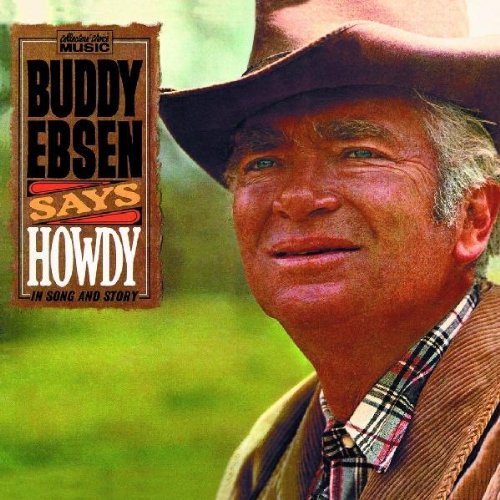
Buddy Ebsen's 1965 Reprise album.
Buddy Ebsen’s 1965 Reprise album.

So great was Ebsen’s popularity that, in 1965, Reprise Records released an album of songs recorded by him, “Buddy Ebsen Says Howdy In Song and Story.” The album features such tracks as “Howdy,” “You Are My Sunshine,” a couple of Hank Williams covers sung pleasantly by Ebsen in his modest but charming voice and two recitations, “Everything’s Okay” and “Men With Broken Hearts.”

Ebsen scored another success after “The Beverly Hillbillies” left the air when he took the title role in the CBS detective drama, “Barnaby Jones.” It lasted almost as long as “Hillbillies,” running from 1973-1980. Ebsen was 72 years old when it was cancelled.

After that, he slowed his acting pace somewhat. His last regular TV series role was as the title character’s uncle on “Matt Houston,” starring Lee Horsley. He appeared during the show’s third season, from 1984 to 1985.

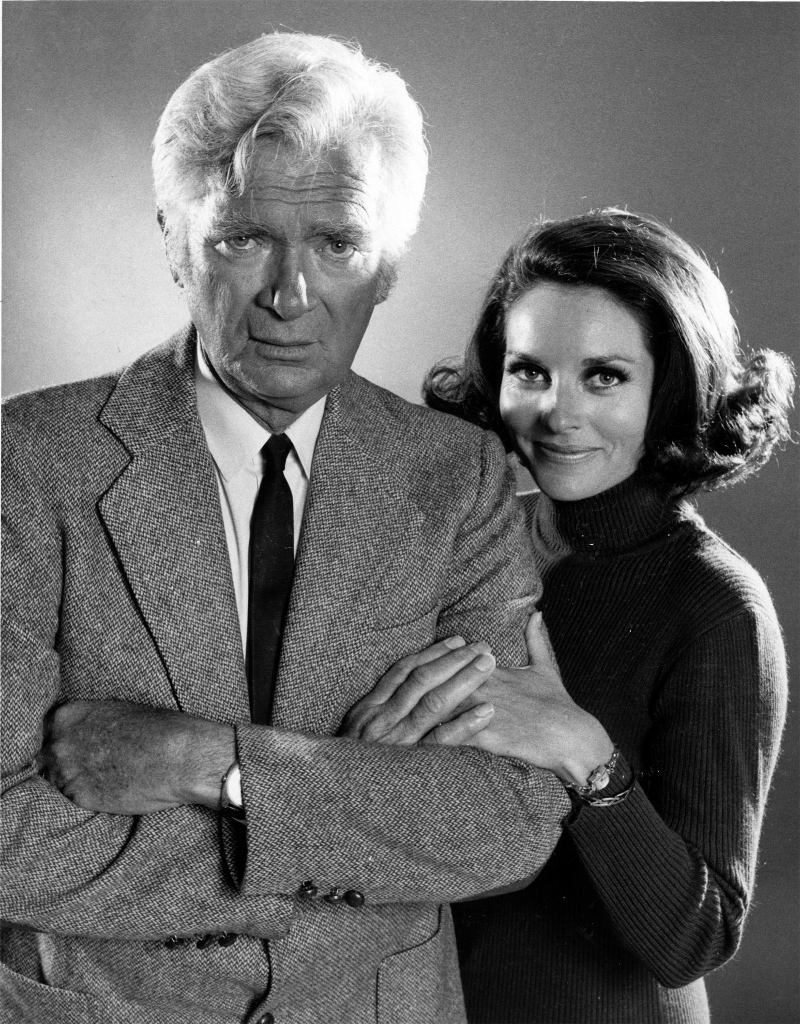
Buddy Ebsen and Lee Meriweather from Barnaby Jones TV series. (AP photo)

1985 was a big year for Ebsen. He married his third wife, Dorothy Knott, and they moved to the South Bay, buying a four-bedroom house on Via Horquilla in Palos Verdes Estates for $950,000. He’d wanted to move to the area as far back as the 1930s, but his managers always had advised him against it, considering it to be too far away from Hollywood.

His acting may have been put on the back burner – he did make a memorable cameo as a character named “Barnaby Jones” in the 1993 movie remake of “The Beverly Hillibillies” – but he still kept very busy in semi-retirement.

In 1987, Ebsen auctioned off his world-class coin collection. He continued working on his oil painting, including a series of folk art works, “Uncle Jed Country,” based on his “Beverly Hillbillies” character.

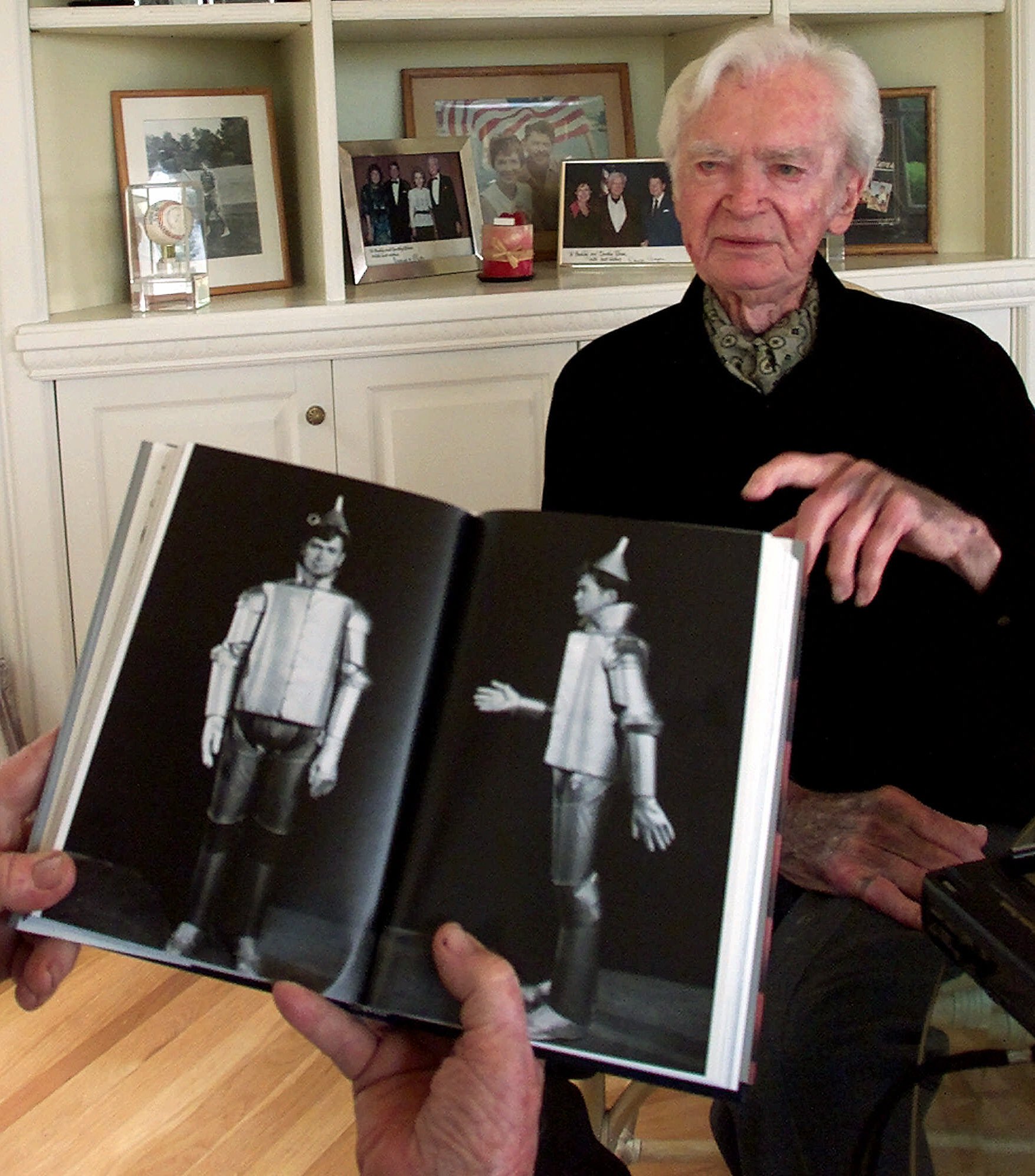
Actor Buddy Ebsen, 93, points to a book that shows him wearing the costume of the "Wizard of Oz" character the Tin Man, during an interview at his home in Palos Verdes Estates, Calif., May 24, 2001. (AP Photo/Damian Dovarganes)
Actor Buddy Ebsen, 93, points to a book that shows him wearing the costume of the “Wizard of Oz” character the Tin Man, during an interview at his home in Palos Verdes Estates, Calif., May 24, 2001. (AP Photo/Damian Dovarganes)

He had been a writer as well, authoring a play about Civil War Gen. George McClellan, “Champagne General,” in 1973, and a successful novel, “Kelly’s Quest,” in 2000.

Sailing had been one of Ebsen’s longtime passions. In 1988, the Windjammer’s Yacht Club of Marina del Rey instituted the Buddy Ebsen Trophy, given to the first sailboat to reach Palos Verdes from Marina del Rey during the club’s annual yacht race. Ebsen and a five-member crew won the Trans-Pac yacht race from San Pedro to Honolulu in 1968 with his boat, “Polynesian Concept.”

Ebsen, who docked his boats in the Wilmington marina, was named grand marshal of the annual “Christmas Afloat” LA Harbor boat parade in 1994. He later donated four of his “Polynesian Concept” sailboats to to the US Naval Academy’s Sailing Squadron in Annapolis, Maryland.

He was active in community affairs on the Peninsula, joining an effort in 1999 to reduce airport noise in the area when he was in his 90s.

Late in June 2003, Ebsen was admitted to Torrance Memorial Medical Center for an undisclosed illness, later revealed to be pneumonia. He died on Sunday morning, July 6, 2003 at 95.

Per his wishes, his body was cremated, and his ashes scattered at sea.

On Aug. 30, 2003, a celebration called the “Life Celebration for Ebsen” was held at the Academy of Televison Arts & Sciences’ Goldenson Theatre. Dick Van Dyke emceed the event which also featured past Ebsen co-stars Fess Parker (“Davy Crockett”), Max Baer Jr. (Jethro on “The Beverly Hillbillies”) and Lee Meriwether (“Barnaby Jones”).

His wife, Dorothy, auctioned off some of Ebsen’s memorabilia in 2007, including his top hat and white shoes from his early dancing days, and the felt hat he wore as Jed Clampett.

She sold the Via Horquilla house in December 2008, but not before compiling a virtual online tour of it called the Buddy Ebsen Museum.

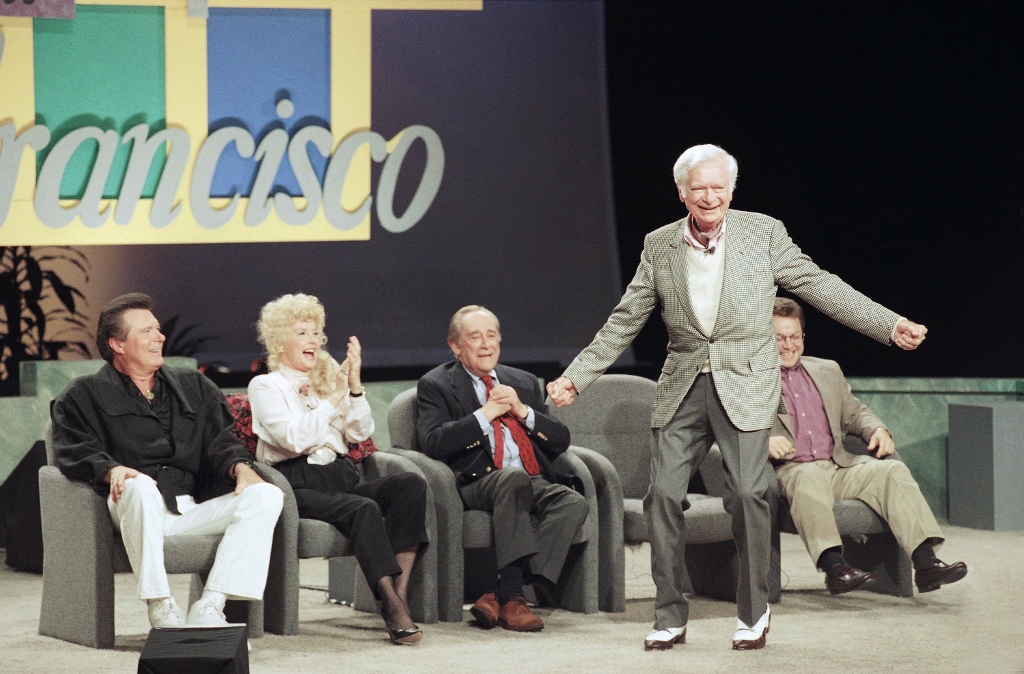
Buddy Ebsen shows off his famous shuffling dance during an appearance during the taping of the "Jerry Springer Show" in San Francisco on Wednesday, May 12, 1993. (AP Photo)
Buddy Ebsen shows off his famous shuffling dance moves during an appearance during the taping of the “Jerry Springer Show” in San Francisco on Wednesday, May 12, 1993. (AP Photo)

Sources:

Daily Breeze files.

Internet Movie Database, www.imdb.com.

Wikipedia.

Del Conte’s in Torrance kept its customers happy for three decades

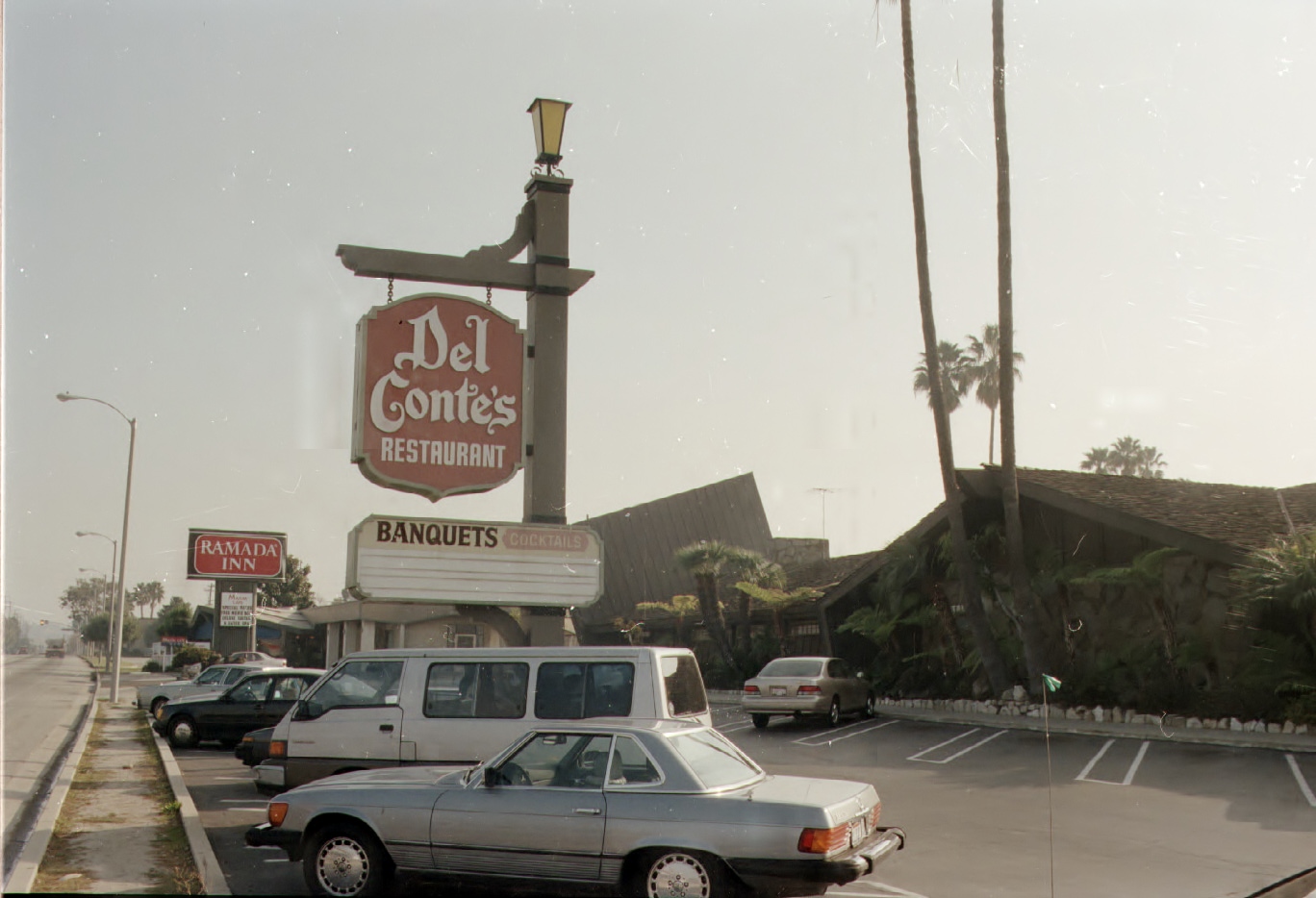
Del Conte's restaurant at 2900 Pacific Coast Highway in Torrance. 1999 Daily Breeze file photo.
Del Conte’s restaurant at 2900 Pacific Coast Highway in Torrance. January 1999 Daily Breeze file photo.

Del Conte’s Restaurant became a revered institution in Torrance during its 30 years of doing business on Pacific Coast Highway.

But it wasn’t the first restaurant to occupy the site. A horse breeder named Jack Rogers  first recognized the potential of the site at 2900 PCH, just south of the Torrance Municipal Airport.

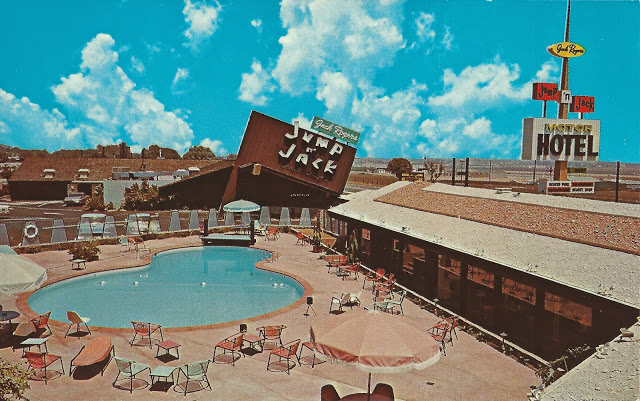
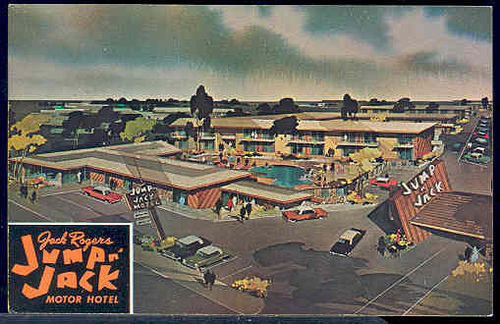
In 1957, he built the Jump ‘N Jack restaurant there, and it became an immediate success, hosting all kinds of community group meetings as well as providing a comfortable place to relax with drinks and dinner.

Undated postcard shows the Jump 'N Jack motel, foreground, and restaurant, at rear with angled sign.
Undated postcard shows the Jump ‘N Jack motel and swimming pool, foreground, and restaurant, at rear with angled sign.

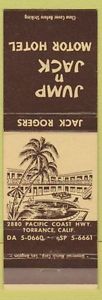
In 1960, Rogers embarked on an ambitious expansion plan. He hired the architectural firm Armet & Davis to design a two-building, 88-room motel on the land adjacent to the Jump ‘N Jack.

$_35The motel project, not surprisingly named the Jump ‘N Jack Motor Hotel, cost more than $1 million, and included a coffee shop with seating for 50 guests, a Polynesian-style swimming pool and poolside lounge, separate barber and beauty shops and beauty shop and a TV lounge.

Ground was broken for the project on July 14, 1960,  and the expansion transformed the Jump ‘N Jack into a full-service motel-restaurant complex.

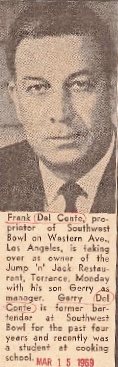
Rogers operated his Jump ‘N Jack restaurant and motel throughout the 1960s, but got out of the business in 1969, selling the complex to Frank Del Conte.

Born on Feb. 24, 1911, Del Conte was an Italian immigrant.

Frank Del Conte. March 15, 1969 Daily Breeze clipping.
Frank Del Conte.

He became involved in the bowling world, running the Vermont Bowl in Los Angeles from 1947 to 1957, before taking over at Southwest Bowl at 11633 S. Western (at Imperial Highway). His son, Gerry, became a bartender there in 1965.

On May 17, 1969, Del Conte bought the Jump ‘N Jack from Rogers. Gerry became its new manager, and they kept the Jump ‘N Jack name for a year, changing it to Del Conte’s in 1970.

Another one of Del Conte’s sons, David, wrote a book about his father that was published after Frank’s death in Orange County on July 18, 2002, at the age of 91.

Frank and Lena operated the Saddleback Lanes bowling alley in Mission Viejo for several years after buying it in 1981. In 1997, the Bowling Writers Association of America presented Frank Del Conte with a lifetime achievement award for his dedication to excellence in the

Reissue of "Song of a Gypsy."
Reissue of “Song of a Gypsy.”

bowling industry.

As for David Del Conte, he followed a less traditional path in his early years before eventually joining in the family business.

Recording under the name of Damon, he released several singles and a full-length album, “Song of a Gypsy,” in the late 1960s. They are considered unsung classics in the psychedelic folk genre, and an original  copy of the “Gypsy” album today is valued by one collector’s source at $3,500.

After acquiring the business, the Del Contes sold off the motel, which became the Airport Inn and eventually, the Ramada Inn, the company that currently runs it.

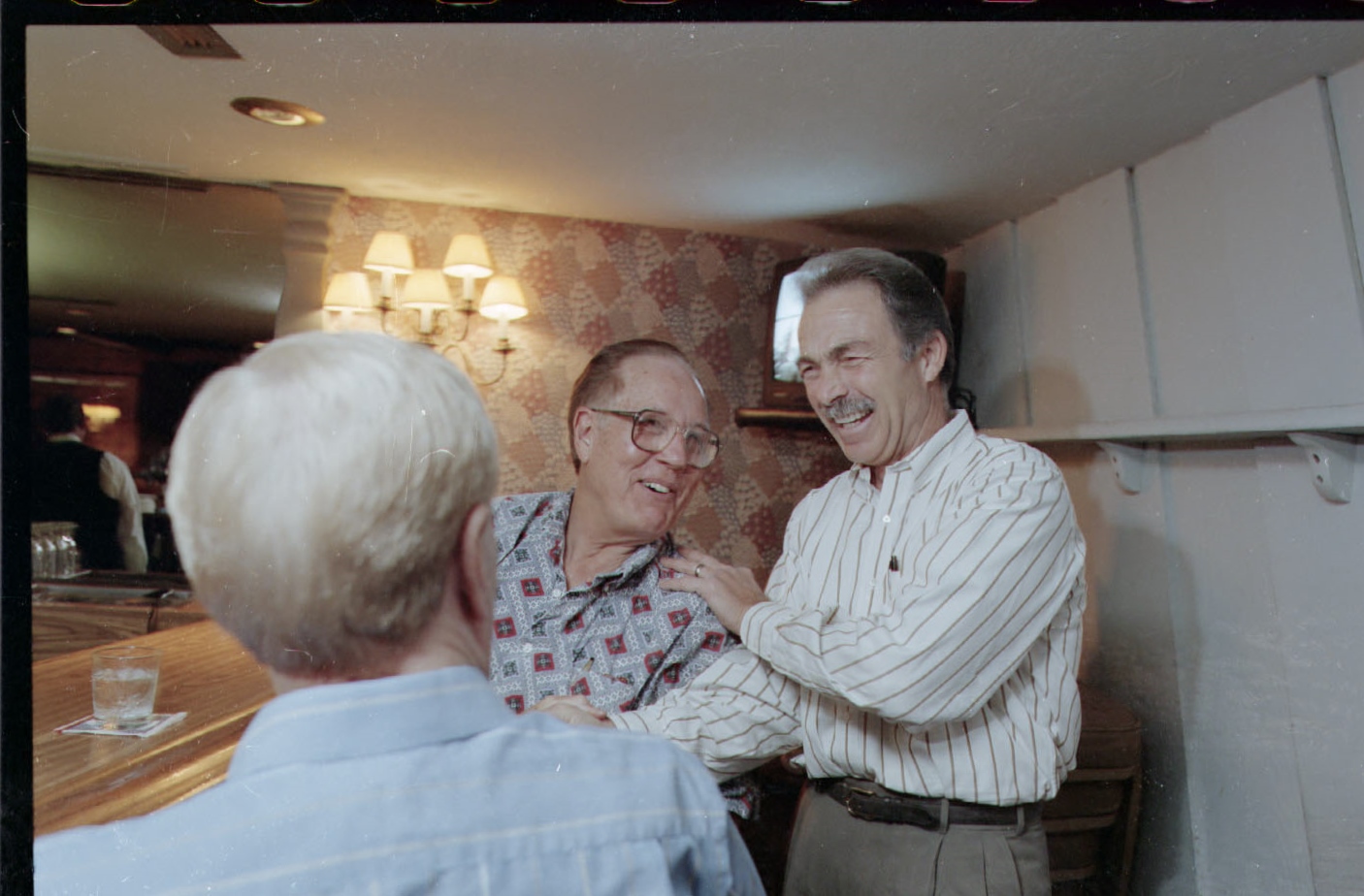
Gerry Del Conte, right, laughs with longtime customer Dave Beech on the restaurant's last day, Feb. 3, 1999. (Brad Graverson / Staff Photographer)
Gerry Del Conte, right, laughs with longtime customer Dave Beech on the restaurant’s last day, Feb. 3, 1999. (Brad Graverson / Staff Photographer)

Gerry Del Conte and his wife Sandy concentrated on managing the restaurant, hiring devoted employees who often ended up staying for decades.

Its traditional American menu items consisted of steaks, chicken, shrimp, pot roast and the like. Its  wine list reportedly had three choices: white, rose and red. Despite, or maybe because of these familiar, non-trendy offerings, the Del Contes built a devoted local following in Torrance.

The pair’s original plan was to run the restaurant for 25 years. After stretching that to 30, the couple decided to close it in 1999, after hosing thousands of service club meetings, wedding receptions, bar mitzvahs and retirement dinners.

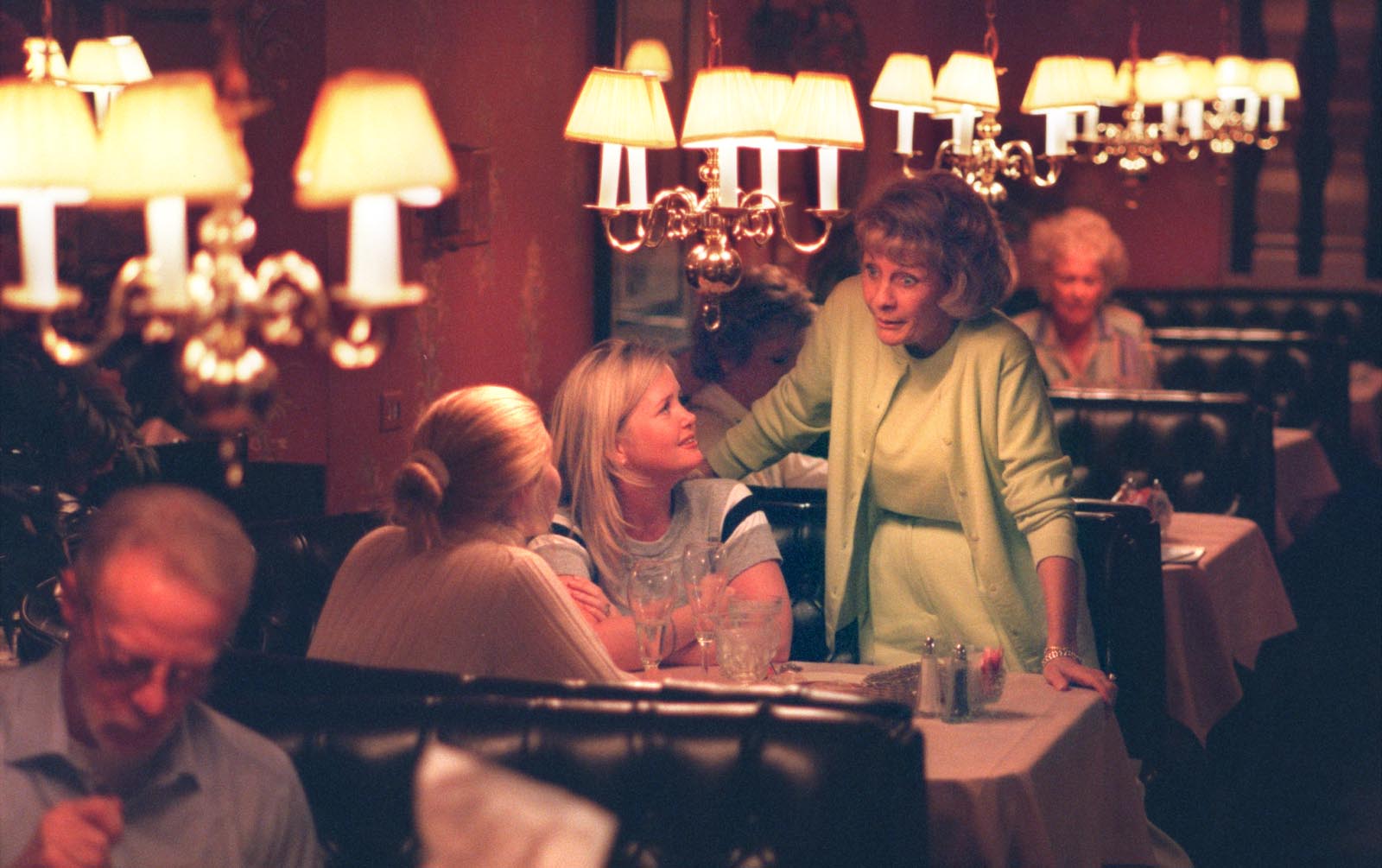
Sandy Del Conte (standing) reminisces with former hostess Heather Hill , center, during lunch at Del Conte's Restaurant on its closing day, Feb. 3, 1999. (Brad Graverson / Staff Photographer)
Sandy Del Conte (standing) reminisces with former hostess Heather Hill , center, during lunch at Del Conte’s Restaurant on its closing day, Feb. 3, 1999. (Brad Graverson / Staff Photographer)

“It’s been such a good, faithful clientele for so many years,” Sandy Del Conte told the Daily Breeze on Feb. 3, 1999, the day the Del Conte’s closed its doors for the final time. “I never realized we’d be around so long as to become an institution.”

$_1Customers such as Jack Kahlo of Palos Verdes Estates mourned the closure. Kahlo recalled being at the restaurant’s opening in 1969, telling Daily Breeze reporter Sandy Cohen, “We’ve always said that if you want to meet your old friends, come to Del Conte’s and they’re here. It’s sad to see it go. It’s a landmark.”

He went on to recall the time when two Del Conte’s waitresses came to visit his wife when she was in intensive care in the hospital.

The Del Contes never bought the land on which the restaurant was built. The Vasek Polak Trust owned the land, and there had been talk for years about building a luxury car dealership there, possibly a BMW lot.

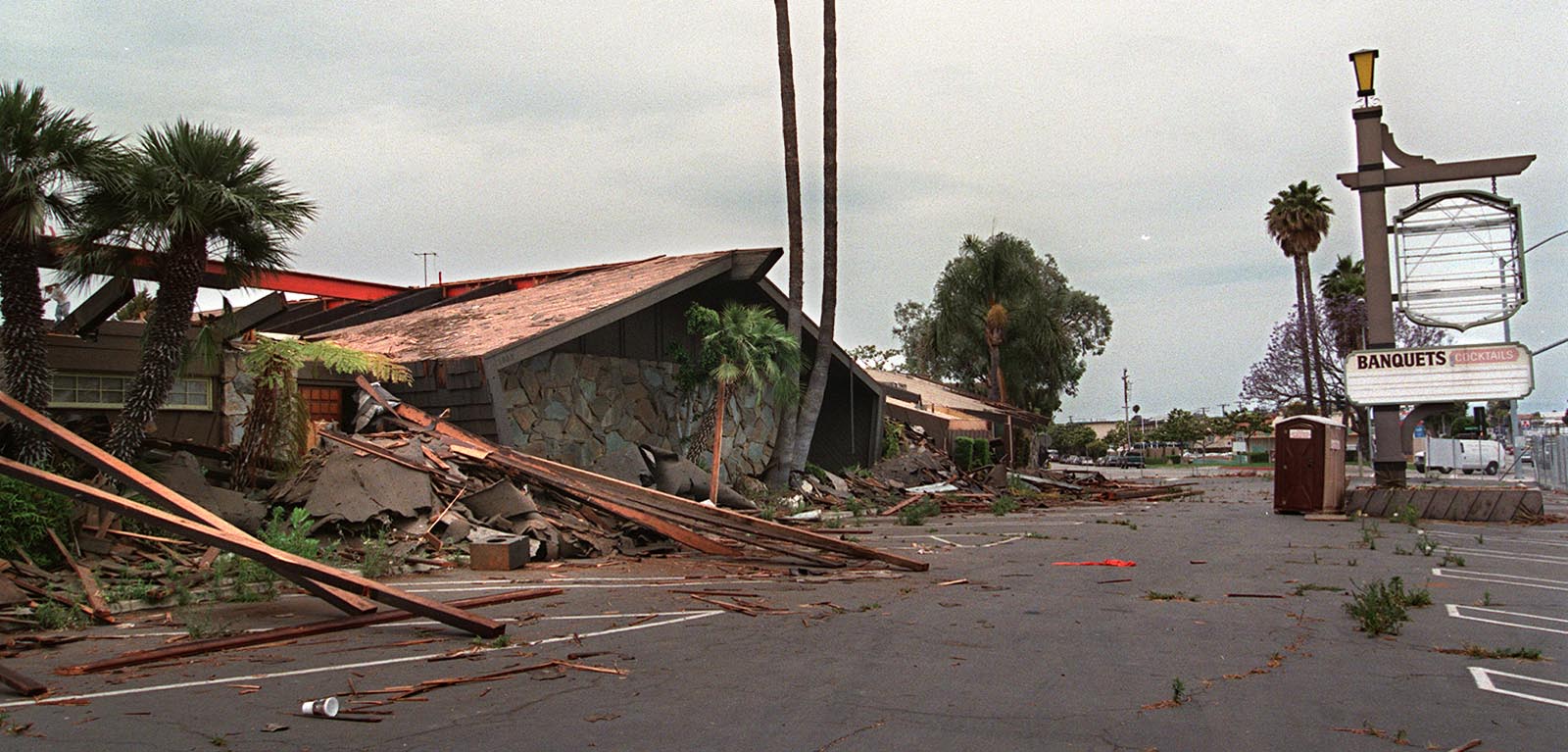
Del Conte's Restaurant in Torrance falls to the wrecking ball on June 1, 1999. (Daily Breeze staff file photo)
Del Conte’s Restaurant in Torrance falls to the wrecking ball on June 1, 1999. (Daily Breeze staff file photo)

On June 1, 1999, workers began demolition of the Del Conte’s restaurant building. Grading began in 2001 to prepare for the construction of the 15,000-square-foot Pacifc Porsche dealership that opened on the site on Feb. 25, 2002, after moving there from Hermosa Beach.

Pacific Porsche and its striking gleaming building continues to occupy the corner site at Denny Road and Pacific Coast Highway.

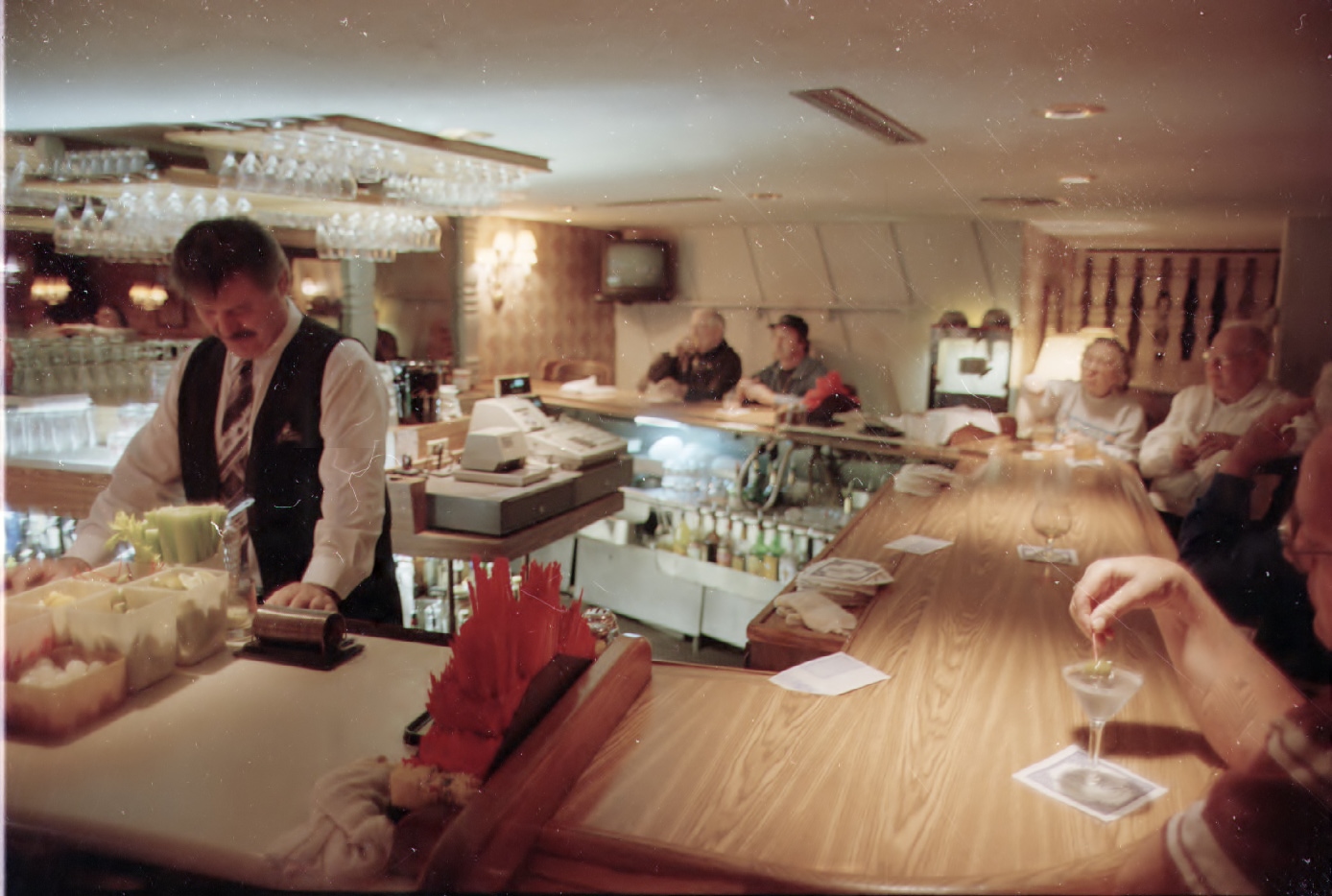
But old-timers still remember when Del Conte’s was there, remember its horseshoe-shaped bar, its dark, comfortable booths and its overall 1970s retro feel. That, and the friendly, family atmosphere created by its owners and employees.

As Jim Ruesch said at the 1999 closing, “It’s better than ‘Cheers.'”

Customers at the horseshoe-shaped bar at Del Conte's on Feb. 3, 1999. (Brad Graverson / Staff Photographer)
Customers at the horseshoe-shaped bar at Del Conte’s on Feb. 3, 1999. (Brad Graverson / Staff Photographer)

Sources:

Daily Breeze files

Los Angeles Times files.

Torrance Herald files.


Undated postcard shows a different view of the Jump 'N Jack complex.
Undated postcard shows a different view of the Jump ‘N Jack complex.

DirecTV transforms the television broadcasting industry

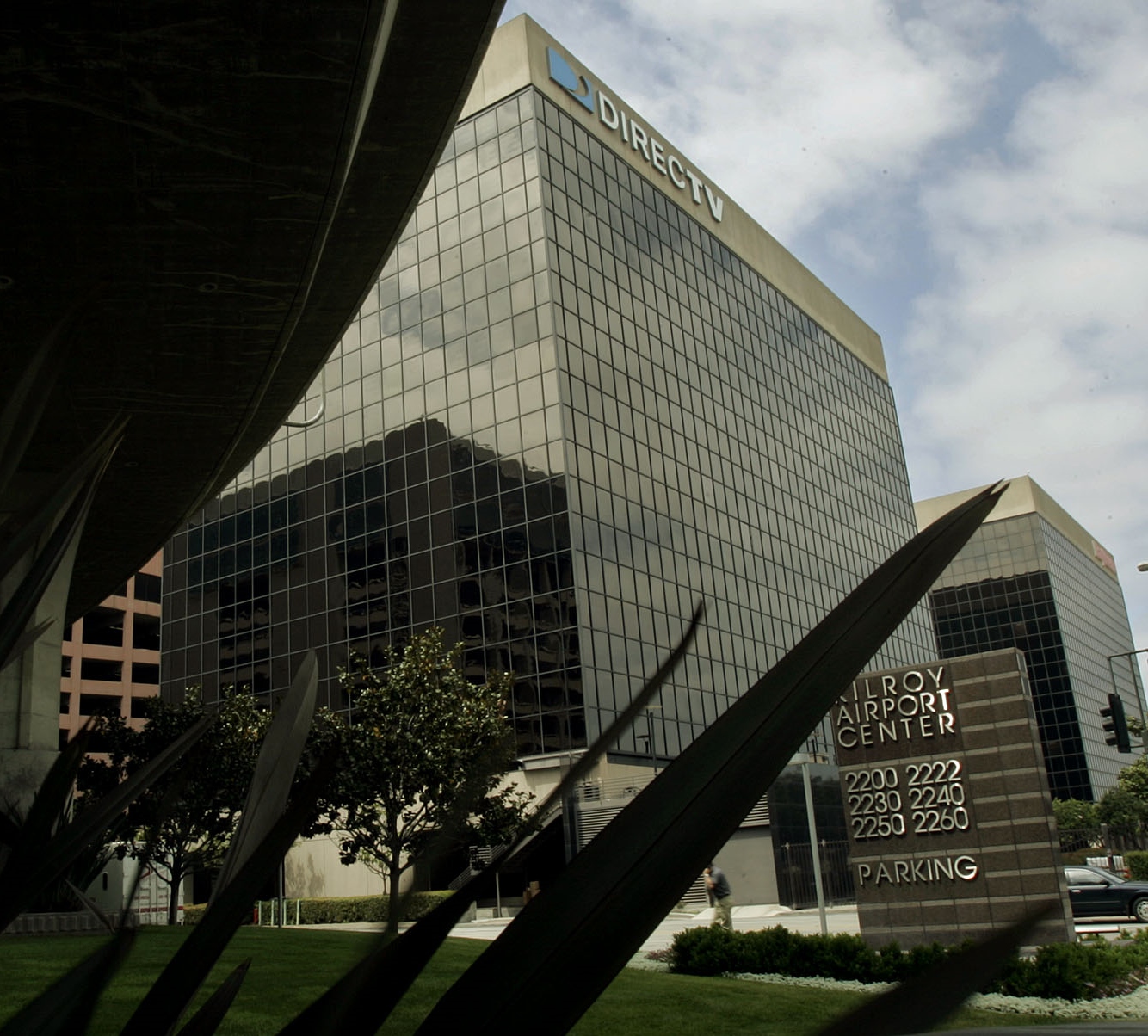
Clear blue skies provide the setting for DirecTV's headquarters Thursday, May 4, 2006, in El Segundo. Since the 2015 merger with AT&T, the DirecTV logo has been replaced by the blue AT&T globe logo. (AP Photo/Ric Francis)
Clear blue skies provide the setting for DirecTV’s headquarters on Thursday, May 4, 2006, in El Segundo. Since the 2015 merger with AT&T, the DirecTV logo atop the building has been replaced by the blue AT&T globe logo. (AP Photo/Ric Francis)

The roots of satellite television stretch back into the early 1980s, when cable and set-top boxes were dominating the market.

The earliest form of consumer satellite TV, called television receive-only, or TVRO, became viable when the Federal Communications Commission ruled on Oct. 18, 1979, that consumers could operate the large satellite dishes without a license.

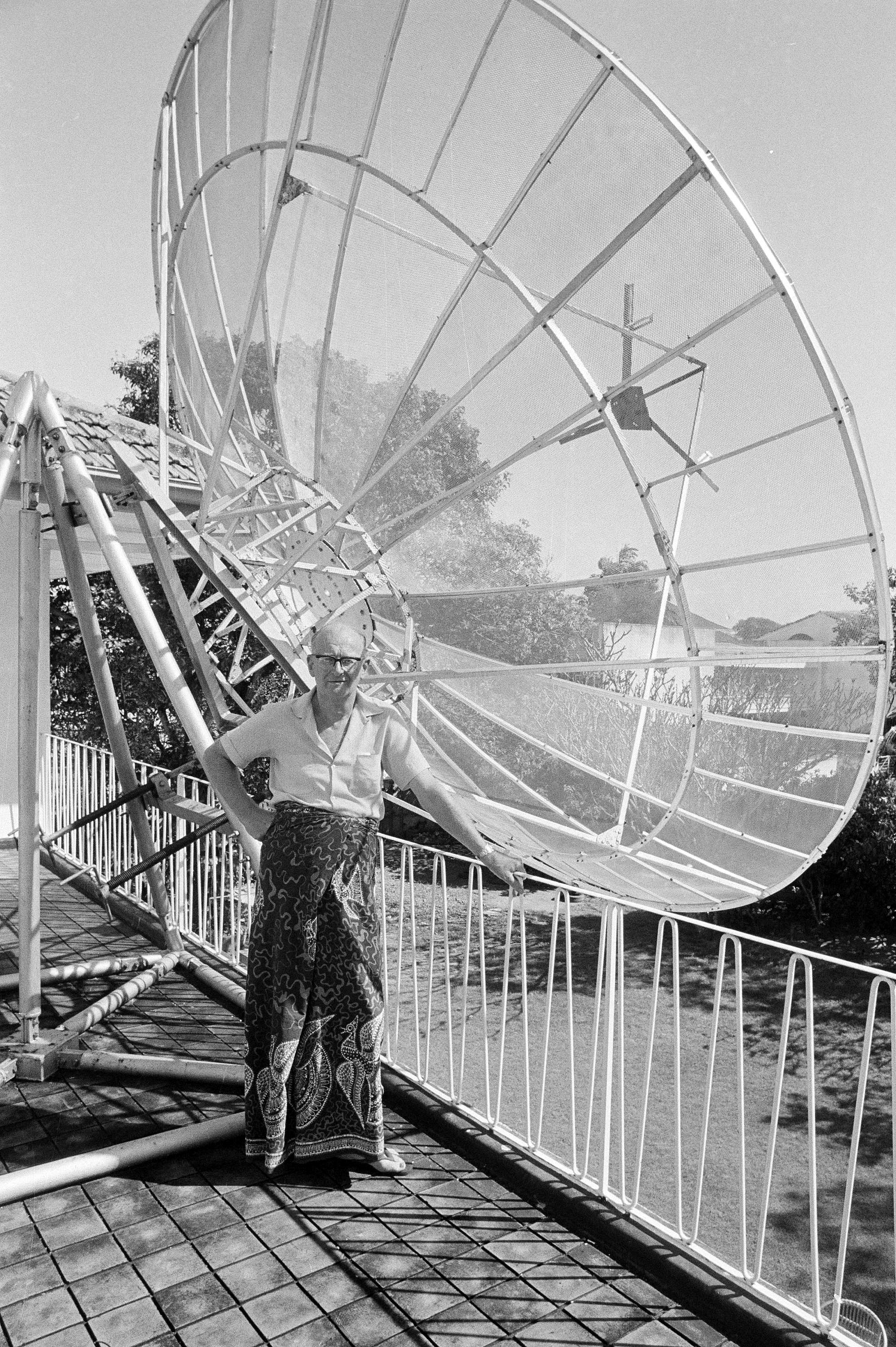
At home in the future, science fiction writer Arthur C. Clarke pauses near his personal satellite antenna at his residence in Colombo, Sri Lanka, Jan. 28, 1977. He uses the device to received programs beamed from India in an experiment to broadcast educational programs through space. The antenna and television, the only one in Sri Lanka, were gifts of the Indian government. (AP Photo/Denis Gray)
At home in the future, science fiction writer Arthur C. Clarke pauses near his personal satellite antenna at his residence in Colombo, Sri Lanka, Jan. 28, 1977. He uses the device to receive programs beamed from India in an experiment to broadcast educational programs through space. The antenna and television, the only one in Sri Lanka, were gifts of the Indian government. (AP Photo/Denis Gray)

The dishes, jokingly called BUDs (“big ugly dishes”), usually were set up on poles in backyards. They received analog TV satellite transmissions on the C-band, the same raw feeds that broadcasting companies used. The TVRO dishes could be adjusted to sweep the skies in order to pick up programming, which was free and unencumbered by scrambled signals at first.

Bert Jett proudly stands in the yard of his home near Blue Creek, where he and his two brothers have installed a $7,800 satellite receiving dish so they can get better TV reception in Elkview, W.Va., July 14,1981. The Jetts said they now can get nearly 60 stations around the globe and have their choice of four separate movie channels, as well as several Christian networks and most of the big city TV stations in this country. (AP Photo)
Bert Jett proudly stands in the yard of his home near Blue Creek, where he and his two brothers have installed a $7,800 satellite receiving dish so they can get better TV reception in Elkview, W.Va., July 14,1981. File photo. (AP Photo)

The systems grew in popularity in the early 1980s, especially in rural areas where reception and cable access was problematic. The quality of the picture often wasn’t the best, but wheeling in broadcast signals from all over the world became an adventure in itself.

In the mid-1980s, broadcasters such as HBO began to encrypt their signals, though BUD users were allowed access if they paid a fee.

As the technology improved, broadcasters began using the higher-frequency and more powerful Ku satellite band instead of the C-band for transmission. This, and the growing use of encryption, made the BUDs less attractive to consumers, and opened the door for the next phase: Direct broadcast satellite (DBS). DBS beamed programming directly to homes, using smaller, roof-mounted dishes.

Sky Television launched in Britain in 1989 using this technology, and PrimeStar, formed by a consortium of cable companies, came online in the U.S. in 1991.

Enter Hughes, which had become a major player in satellite technology. The aerospace  company had been acquired by General Motors in 1985, who merged it with GM’s Delco Electronics to form Hughes Electronics Corp.

Hughes had begun looking at a consumer satellite service in the 1980s, but felt that the picture quality and other issues made the idea impractical.

The rise of digital compression technology in the late 1980s, which not only produced a much sharper image but also took up much less satellite bandwidth, changed the company’s mind. Hughes began actively developing its own DBS system.

An abortive attempt to start such a system, Sky Cable, was announced in 1990 in conjunction with Cablevision Systems Corp., NBC and Rupert Murdoch’s News Corp, but it fell apart long before the announced 1993 launch date.

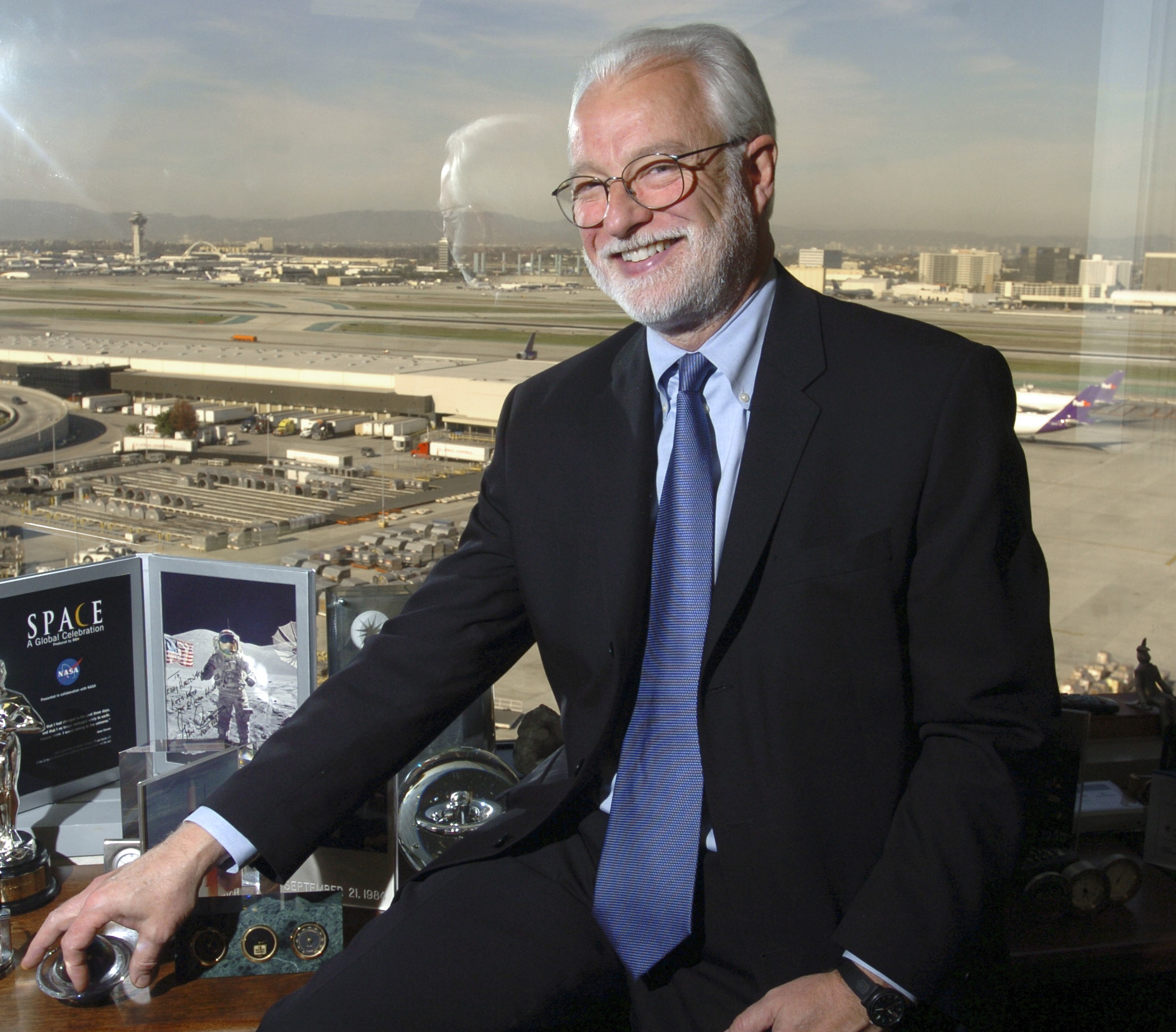
In 1990, the company chose Eddy Hartenstein to lead the new start-up, to be headquartered in an office building on Imperial Highway in El Segundo. Hartenstein was a vice president at Hughes Communications, the company’s commercial satellite division, and a believer in the DBS concept.

Eddy W. Hartenstein, DirecTV's Vice Chairman, announces his retirement at the end of 2004 after having navigated the satellite TV provider to its current indurstry dominance. (December 2004 Daily Breeze file photo.)
Eddy W. Hartenstein, DirecTV’s Vice Chairman, announced his retirement at the end of 2004 after having navigated the satellite TV provider to industry dominance. (December 2004 Daily Breeze file photo.)

He called the new venture “DirecTV,” and he would remain its chief executive until 2004. After leaving DirecTV, Hartenstein became first the publisher and CEO of the Los Angeles Times in 2008, then the president and CEO of the paper’s owner, the Tribune Company in 2011. His currently holds the title of Chairman of the Board of Tribune Publishing.

In June 1991, the company signed an agreement with United States Satellite Broadcasting to build and operate the new system. It would spend the next couple of years ironing out technical matters and securing the right to distribute programming from a variety of cable programmers, sports leagues and movie studios for the new service.

In December 1993, DirecTV successfully launched the DBS-1 on a French Ariane rocket, its first satellite designed to beam programming directly into homes equipped with the company’s 18-inch dishes.

With much fanfare, the company officially launched the service on May 1, 1994, and began selling the first dishes to consumers in June 1994. The initial dishes, made by Thomson Electronics under the RCA brand, cost $700 In addition, viewers paid monthly subscription charges starting at $35 giving them access to its 175 channels. Sports programming was one of its main calling cards, including the NFL package thast showed every game on Sundays.

DirecTV had cost the company $750 million, but the gamble paid off. By July 1995, it had 650,000 subscribers. Though still a drop in the bucket compared to the 62 million Americans with cable, it was signing up new customers at the rate of 4,000 per day.

DirecTV_logo__130614042300The venture still wasn’t in the black, but its subscriber base was growing. In 1996, telecom giant AT&T invested in a 2.5% stake in DirecTV, with an option to own as much as 27.5% of the company. The move was expected to bring more customers in through the phone company’s marketing channels. The plan never really panned out as hoped, and DirecTV bought back AT&T’s investment a year later.

DirecTV received a boost to its programming when President Bill Clinton signed a bill in November 1999 allowing satellite broadcasters to offer their subscribers their local broadcast stations along with the rest of its channels, something they previously had been barred from doing. The new law allowing local stations put the company on an even stronger footing to compete with cable systems.

DirecTV’s subscriber base had grown to 7.8 million by that time, boosted by the company’s 1999 acquisition of PrimeStar, whose customers were then switched over to the DirecTV service.

In April 2003, Rupert Murdoch popped up again on DirecTV’s screen when his News Corp. paid $6.6 billion for a 34 percent ownership stake in DirecTV. In 2005, DirecTV announced it had enrolled its 15 millionth subscriber, and in 2007, the company began offering high-definition television channels for the first time.

In 2008, Liberty Media acquired News Corp.’s interest in DirecTV.

This combo made from file photos shows the AT&T logo on the side of a corporate office in Springfield, Ill., left, and a DirecTV satellite dish atop a home in Los Angeles. (AP Photo)
The AT&T / DirecTV merger became official in July 2015. (AP Photo)

But  those deals merely were a prelude to  the largest deal of them all, the acquisition of DirecTV, which now had 20 million subscribers, by AT&T for $49 billion. The deal became official on July 24, 2015. AT&T also owns its homegrown U-Verse broadcasting system, and its 26 million video subscribers make it the largest pay-TV provider in the U.S., at least until Comcast or Charter can complete a merger with Time Warner Cable, a move that so far has been blocked by government regulators.

New revolutions in streaming and online programming continue to shake the broadcasting industry, but there’s no doubt that DirecTV played a major role in completely transforming how consumers watch television over the last 25 years with its introduction and rise to prominence.

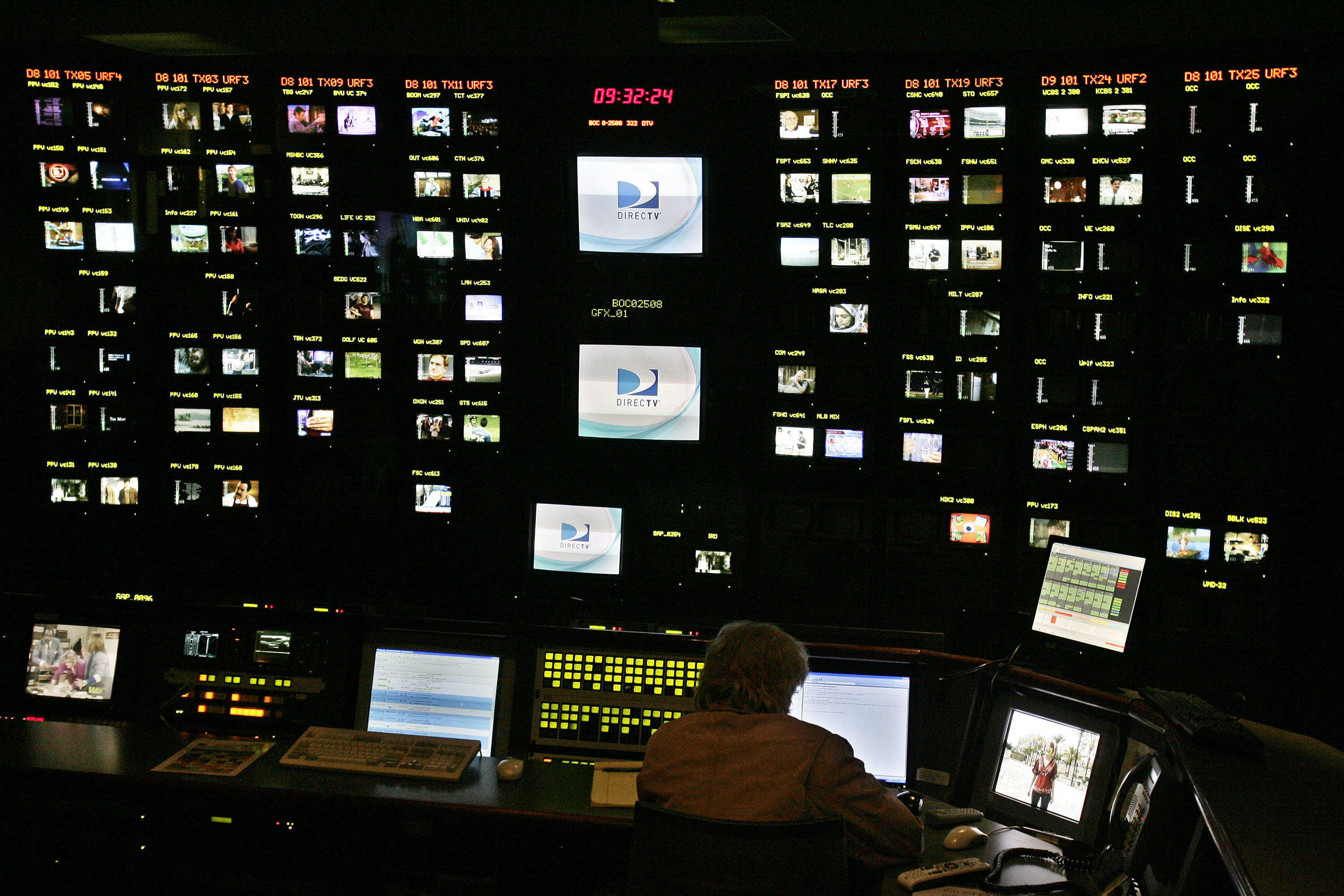
A broadcast operator monitors signals transmitted to DirecTV customers from the satellite television company's broadcast center on Wednesday, May 7, 2008, in Marina Del Rey. (AP Photo/Ric Francis)
A broadcast operator monitors signals transmitted to DirecTV customers from the satellite television company’s broadcast center in Marina Del Rey in May 2008. File photo. (AP Photo/Ric Francis)

Sources:

Daily Breeze files.

“DirecTV Inc.,” Encyclopedia.com website.

“FCC approves AT&T-DirecTV Merger,” by Ted Johnson, Variety, variety.com website.

Los Angeles Times files.

Wikipedia.org.


Dolley Drug Co., one of the first businesses in Torrance

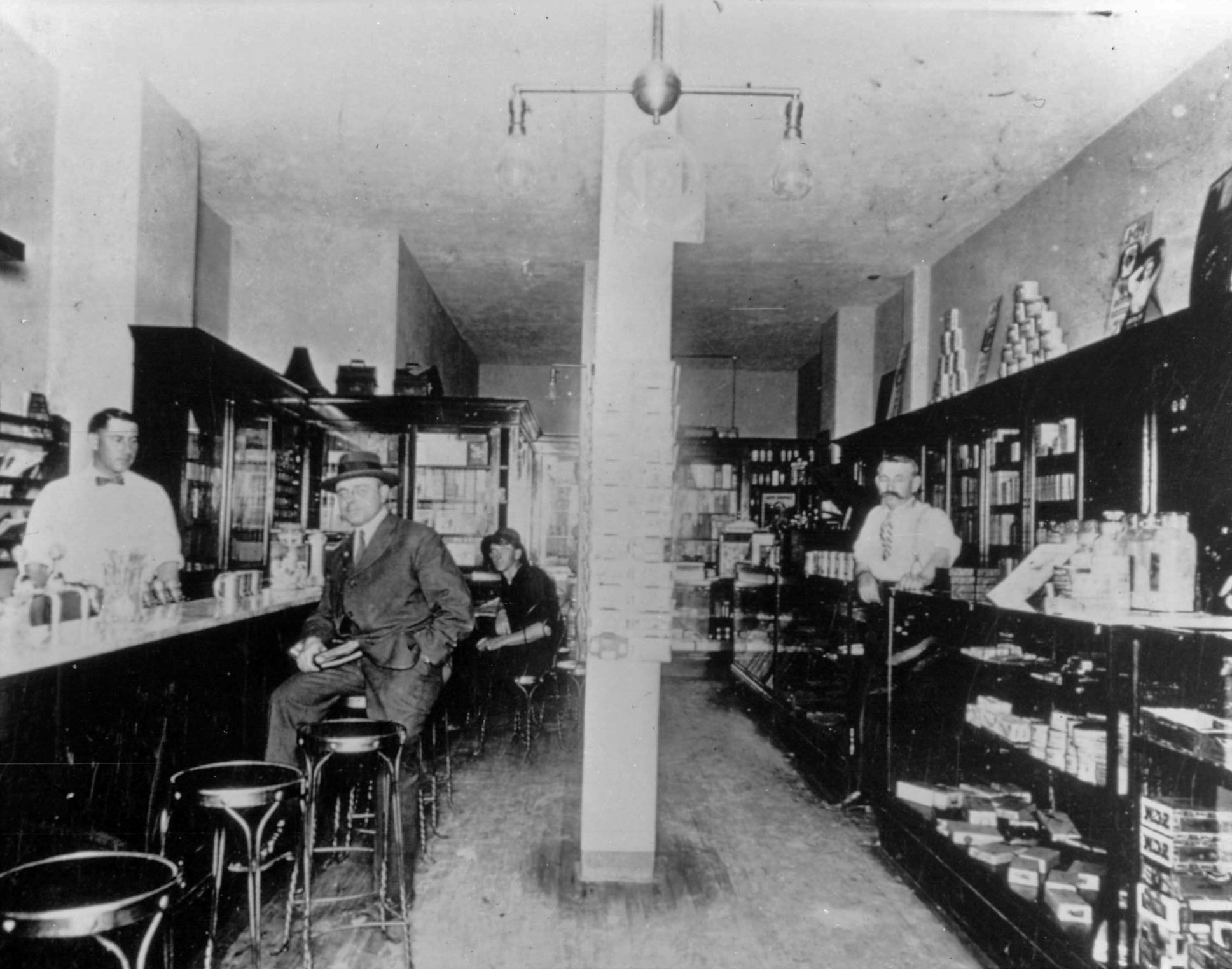
Harry H. Dolley, left, behind soda fountain, and his father, W.C. Dolley, with mustache at right, inside the Dolley Drug Co. in a circa 1922 undated photo. (Credit: Torrance Historical Society)
Harry H. Dolley, left, behind soda fountain, and his father, W.C. Dolley, with mustache at right, inside the Dolley Drug Co. in an undated photo circa 1922. (Credit: Torrance Historical Society)
Harry H. Dolley vividly recalled the day he opened Torrance’s first drug store when asked about it by the Torrance Herald in 1936.

“It was bathtubs that brought me to Torrance,” he said.

Dolley was born on Nov. 6, 1988, in Hagerstown, Indiana, and had lived in the South Bay since graduating from USC with a pharmacy degree in 1909.

His father, W.C. Dolley, had seen a vacant lot filled with tubs while passing by the still-developing Torrance townsite in 1912, the year of the city’s founding. He told his son, Harry, who had a struggling drug store in Azusa, that he should look into land there for the new drug store he wanted to open.

So the younger Dolley went to the Thomas Campbell real estate agency, then handling property in the new city, which didn’t officially incorporate until 1921.

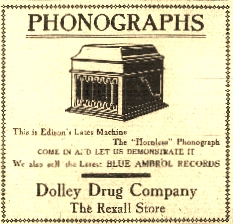
Dolley Drug ad from The Torrance News, Oct. 25, 1913. (Credit: Torrance Newspaper Archives database, Torrance Public Library)

“I asked the rental of the only store then suitable for our needs, and was almost floored when the price was quoted as $100 a month. Why, I was only paying $25 in Azusa, and Azusa was already on the map!”

But something about seeing those stacked-up bathtubs made Dolley think that Torrance eventually would be filled with people who would need to take care of their health, and he decided to take the plunge.

A little later, Hurum Reeve, one of the carpenters working on building the store building that Dolley had just leased expressed interest in opening a hardware store of his own in part of the same space. The two of them worked out a deal to share the building in the fall of 1912.

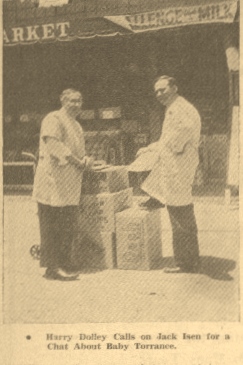
Harry H. Dolley, left, with Jack Isen in 1936. (Photo: Torrance Newspaper Archives database, Torrance Public Library)

Reeve’s store, the Torrance Hardware Company, became just the second business to open in Torrance. Jack Isen’s Torrance Food Market on Cabrillo Avenue was the first. The Dolley Drug Co. became the third, opening its doors to the public on Feb. 13, 1913.
Dolley took in $13 on his first day of business.

Dolley Drug Co. soon became a fixture at the corner of El Prado and Sartori avenues in Torrance. From its earliest days, it was affiliated with the national Rexall drugstore chain.

In addition to his duties as head pharmacist at the drug store, Dolley also became the first city treasurer for the city of Torrance upon the city’s incorporation in 1921, a post he would hold for the next 15 years.

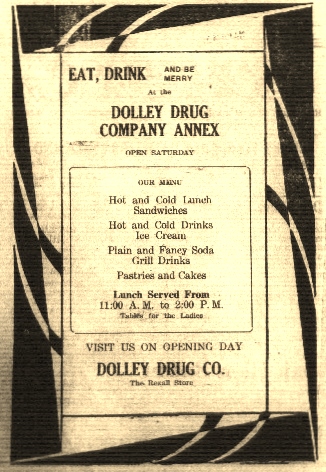
In 1923, Dolley introduced the Dolley Drug Company Annex, carved out of the former Sam Levy building next door. The Annex opened on Dec. 1, 1923, and featured a lunch counter and soda fountain.

Dolley Drug Co. ad in the Torrance Herald celebrates opening of its annex, which contained a lunch counter, on Dec. 1, 1923. "Tables for the ladies." (Credit: Torrance Newspaper Archives database, Torrance Public Library)
Dolley Drug Co. ad in the Torrance Herald celebrates opening of its annex, which contained a lunch counter and soda fountain, on Dec. 1, 1923. “Tables for the ladies.” (Credit: Torrance Newspaper Archives database, Torrance Public Library)

Over the years, Dolley expanded the store from merely prescription drugs and sundries to include a complete line of Kodak cameras and film supplies as well as tobacco products.

Dolley Drug also became the local source for theater tickets, first for the Orpheum vaudeville house in Los Angeles, then, with the establishment of the Mitchell Theater Tickets branch office, for a variety of events and productions throughout Southern California.

Along the way, Dolley met and married Karmee Olson on July 24, 1924, at her home in Spokane, Washington. The couple returned to Torrance and settled into a house on Post Avenue.

Dolley’s friend Hurum Reeve sold his hardware store to Leon Larson of the Wilmington Hardware Company in May 1926, leaving Dolley and Isen’s stores as the two oldest in the city.

In addition to his city treasurer duties, Dolley was much in demand for community affairs as well, heading up the Torrance Chamber of Commerce from 1928-29.

After more than a quarter century as a downtown Torrance fixture, Harry Dolley decided to close up his drug store in 1938.

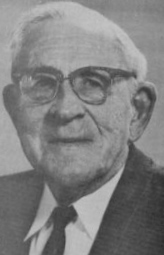
Harry H. Dolley, undated photo. (Photo: Torrance Newspaper Archives database, Torrance Public Library)

Dolley Drug Co. was replaced by the Service Electric Co., which opened in mid-December of 1938. It, in turn, was replaced by the United Cut Rate Drug store on Sept. 29, 1939, less than a year later. United became Discount Cut-Rate Drugs in 1940.

Harry Dolley resurfaced for awhile as the pharmacist at Vic’s Cut-Rate Drugs at 1911 Carson Street, a brand new operation opened by Victor Potik of Los Angeles that opened on Sept. 21, 1939.

The Dolleys eventually left the area, moving to Culver City in the 1940s.

At the time of his death in an Inglewood hospital on Feb. 17, 1965, at the age of 76, he and his wife had returned to the South Bay and were living in Gardena.

Dolley is buried next to his father, W.C. Dolley, in Roosevelt Memorial Park Cemetery in Gardena.

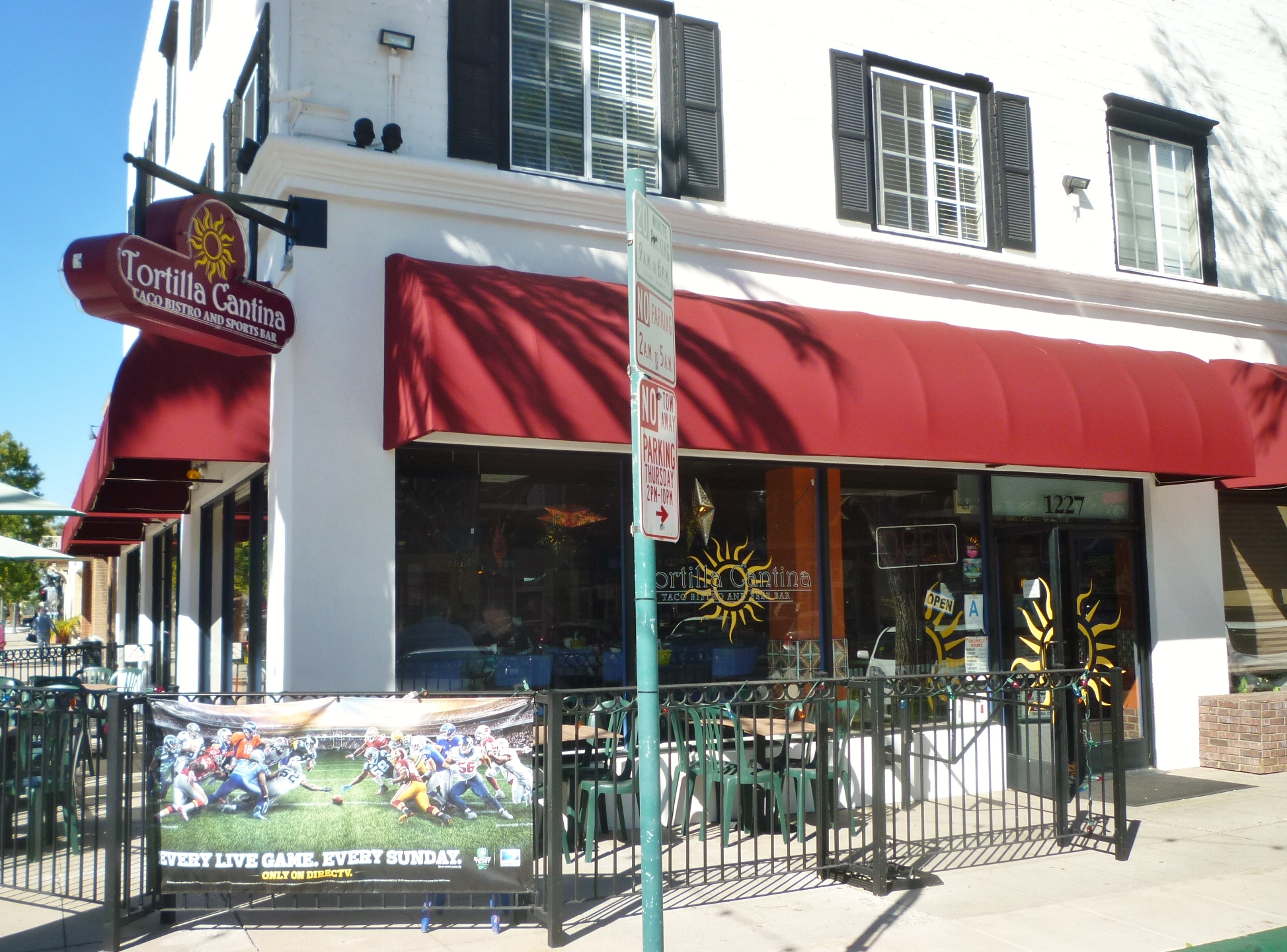
As for 1225 El Prado Avenue, the former site of Dolley Drug, it now houses the Tortilla Cantina restaurant.

The Tortilla Cantina restaurant currently occupies the building at El Prado and Sartori avenues where Dolley Drug was founded in 1913. (February 2016 Daily Breeze photo)

Sources:

Daily Breeze files.

Torrance Herald files.

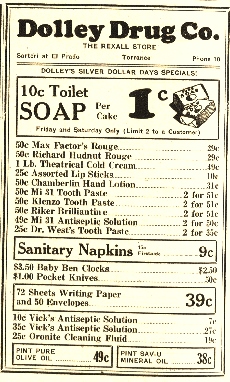
Typical ad for Dolley Drug Co., Torrance Herald, June 8, 1933, Page 2. (Credit: Torrance Newspaper Archives database, Torrance Public Library)
Typical ad for Dolley Drug Co., Torrance Herald, June 8, 1933, Page 2. “Phone 10” is one of the earliest telephone numbers in the city. (Credit: Torrance Newspaper Archives database, Torrance Public Library)

Nash-Kelvinator brings the auto industry to El Segundo following World War II


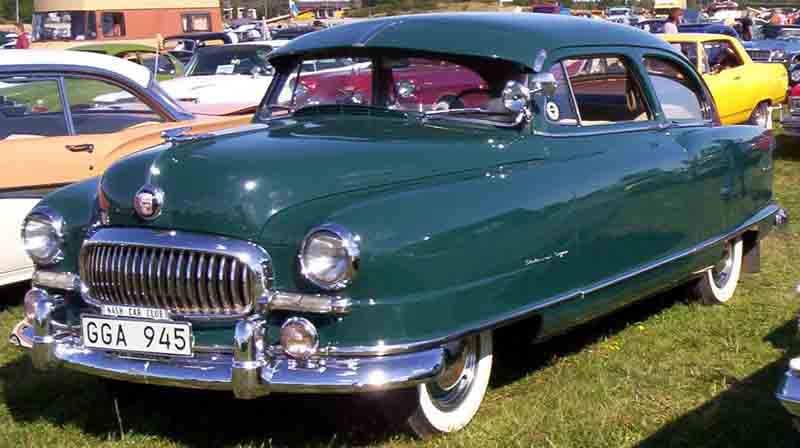
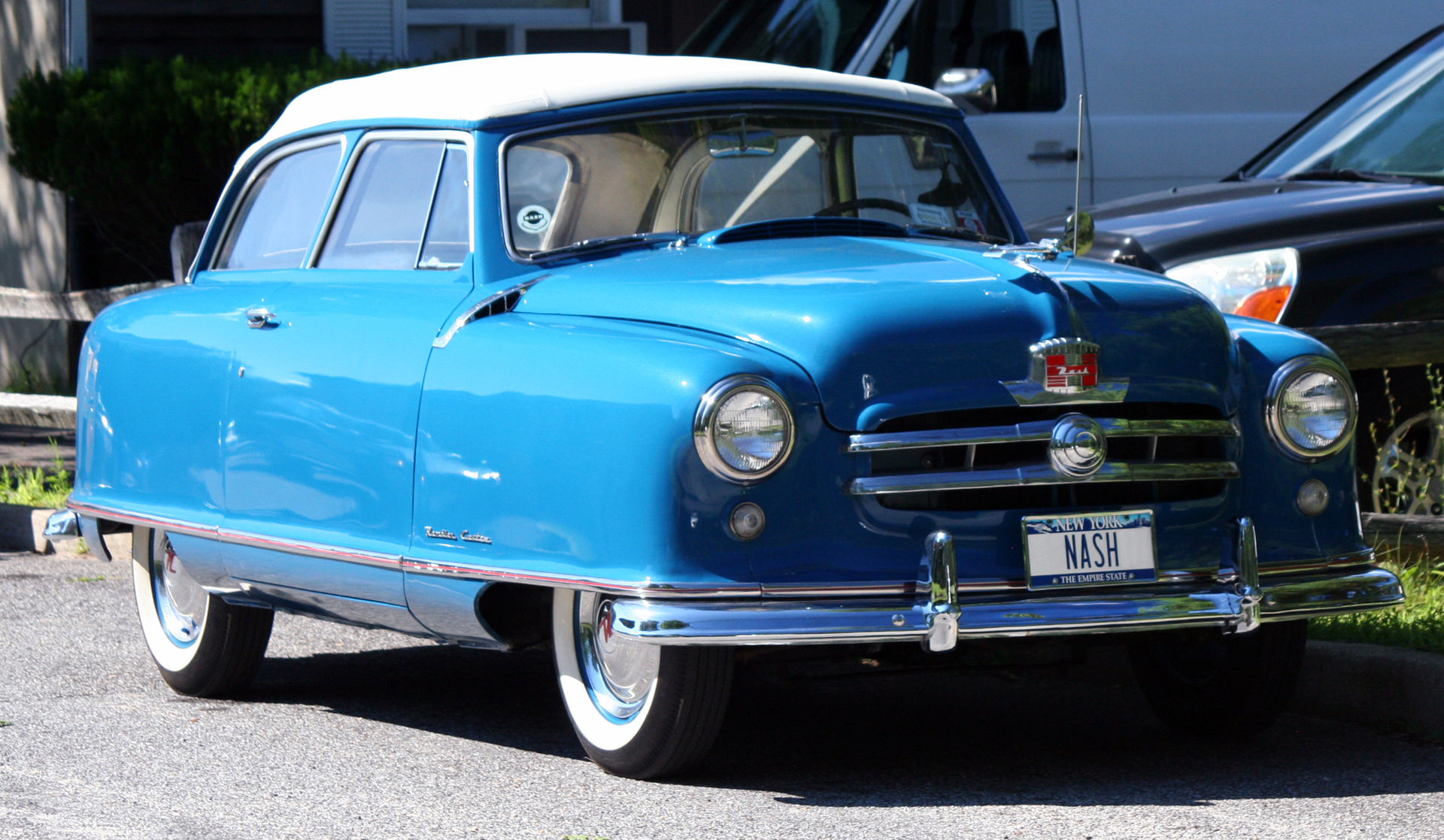
The 1951 Nash Statesman, one of the company's Airflyte models. (Photo: Wikimedia Commons)
The 1951 Nash Statesman, one of the company’s Airflyte models. (Photo: Wikimedia Commons)

Charles Williams Nash , the man who founded the company that brought the automobile industry to El Segundo – if only briefly – was born in Illinois in 1864.

After driving his first car in 1897, Nash became hooked on the new technology. In 1908, he co-founded the Buick Motor Co. together with David D. Buick and William C. Durant.

He would rise through the industry to become the head of General Motors in 1910, replacing Durant in that post. But Durant regained power in 1916, and fired Nash.

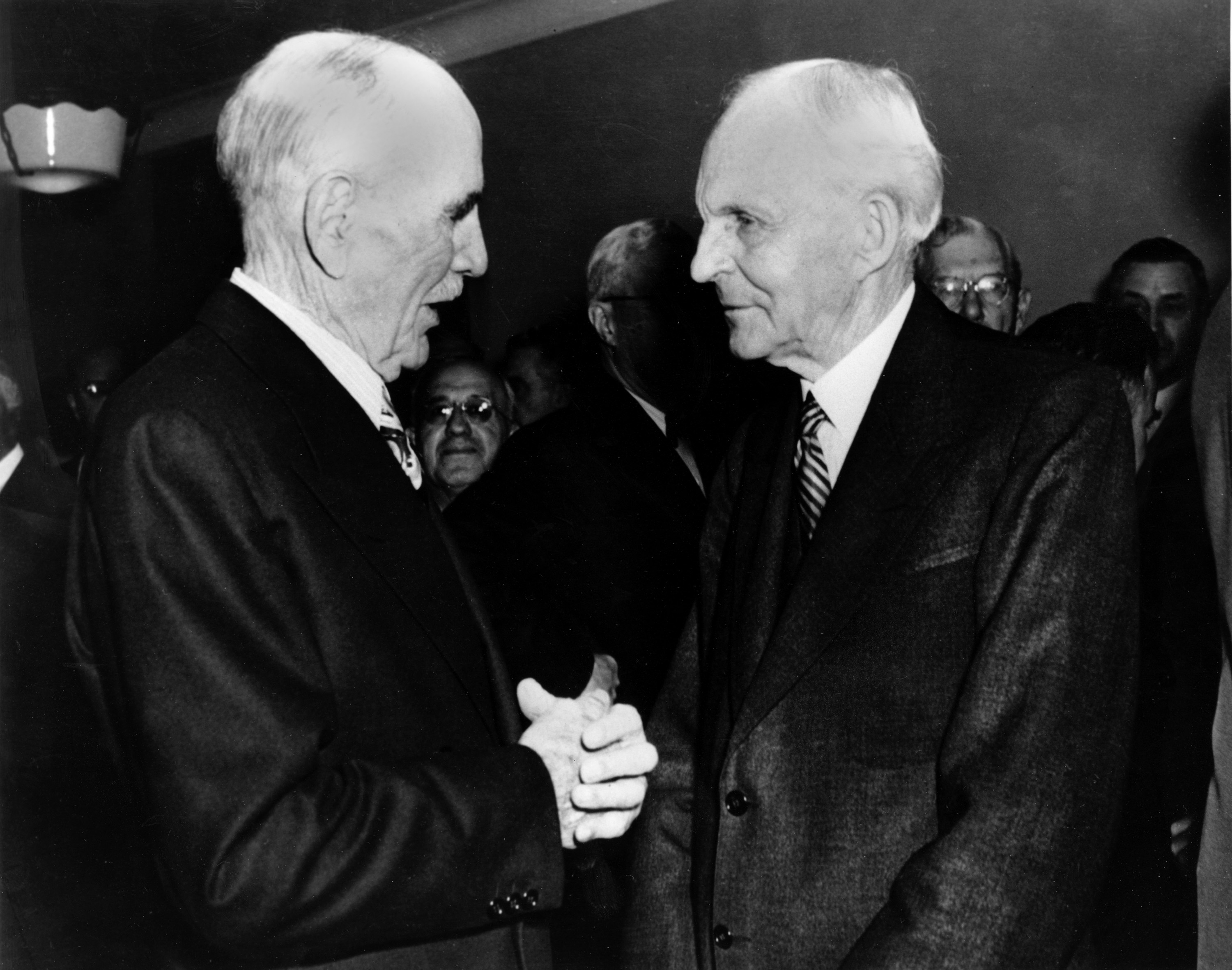
Automobile manufacturer Henry Ford, right, chats with Charles W. Nash, chairman of the board of directors of Nash-Kelvinator Corp., in Detroit, Mich., on May 28, 1946. Ford, 82, has been inducted into the Automobile Hall of Fame during the industry's golden jubilee celebration. (AP Photo)
Automobile manufacturer Henry Ford, right, chats with Charles W. Nash, chairman of the board of directors of Nash-Kelvinator Corp., in Detroit, Mich., on May 28, 1946. (AP Photo)

Fed up with internecine corporate politics, Nash decided to start his own company in Kenosha, Wisconsin. He bought the Jeffery Motor Company in 1916 and renamed it Nash Motors. (Jeffery had built the first Rambler automobile in 1902.)

The company was successful, mostly because of Nash’s knack for building less expensive and more functional autos. He retired from the firm in 1936, turning over its presidency to George W. Mason, the president of the Kelvinator appliance company.

kelvinator_logo_29502Nash became Nash-Kelvinator in 1937. Mason made adding Kelvinator to Nash’s company part of the deal before accepting the job as president.

World War II brought an end to the commercial automobile business, as factories halted auto production and retooled to outfit the nation’s war effort

When America’s manufacturers turned back to the consumer market after the war ended, they faced a public ready to buy new cars.

Nash-Kelvinator looked west from Kenosha to establish an assembly plant to meet the demand for cars and refrigerators in rapidly growing postwar Southern California and the rest of the Pacific states.

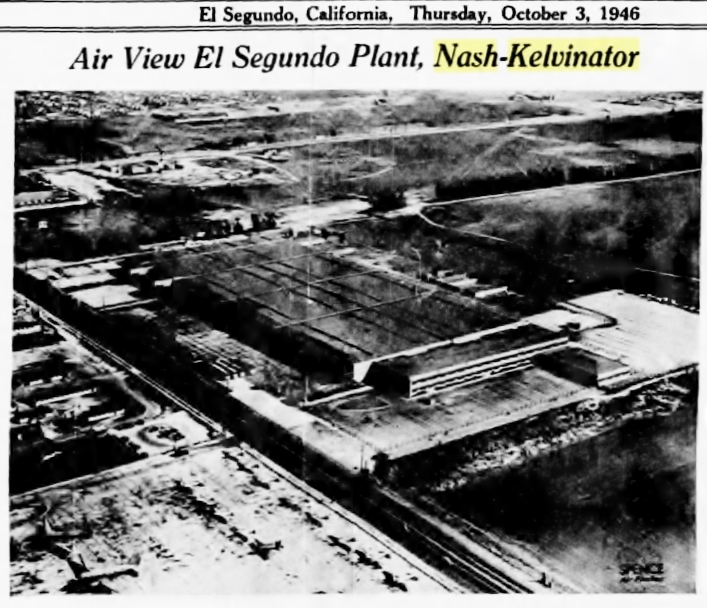
El Segundo Herald, Oct. 3, 1946, Page 1. (Credit: El Segundo Herald archive database, El Segundo Public Library)
El Segundo Herald, Oct. 3, 1946, Page 1. Imperial Highway runs diagonally in foreground. (Credit: El Segundo Herald archive database, El Segundo Public Library)

On March 29, 1946, the company announced that it had selected a home for its West Coast plant in El Segundo, in a warehouse built in 1944 that had been used during the final years of war production by North American Aviation (which became North American Rockwell in 1967).

The 30-acre site on East Imperial Boulevard near Sepulveda, which Nash-Kelvinator bought from the government’s War Assets Corp. for $1.5 million, had plenty of room, 475,000 square feet of floor space, and its buildings were easily adaptable to auto assembly. (Since the Nash-Kelvinator plant didn’t fabricate its own parts onsite, it was considered an assembly plant rather than an auto manufacturing plant.)

In addition to Nash autos, the company also planned to produce Kelvinator refrigerators there.

Mason announced that the plant would employ 2400 workers, and the company planned to gear up for production as soon as possible.

Nash-Kelvinator took possession of the factory on Oct. 1, 1946.

nashlogoTurning out new cars would take a little while to become a reality, however, due to equipment and auto parts shortages following the war.

By the time of Charles W. Nash’s death at 84 on June 6, 1948, the company was still gearing up to build its autos. (By the way, when Nash died, he left an estate valued at $43 million, at the time believed to be the second largest ever probated in LA County, behind Henry Huntington’s $49 million.)

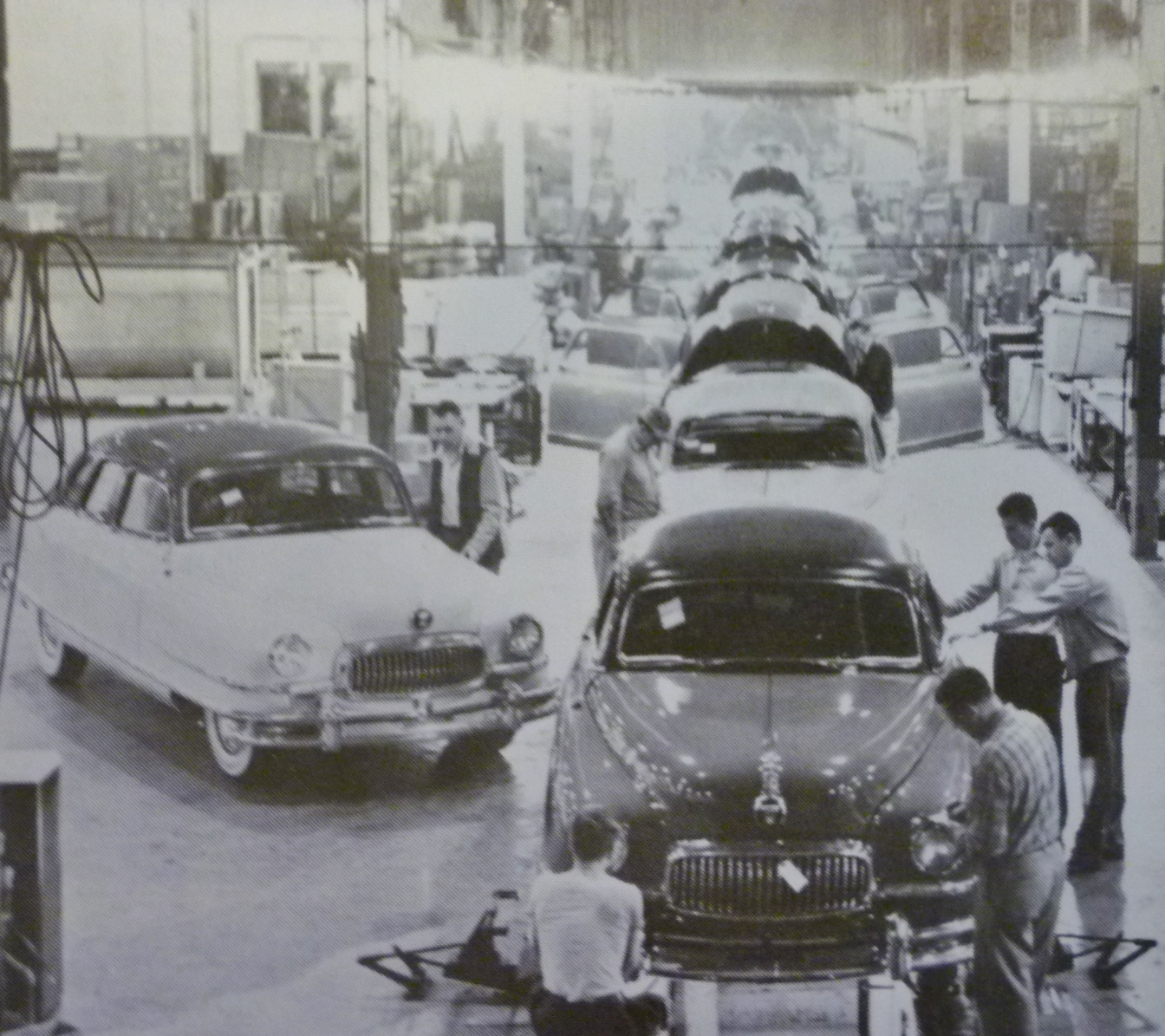
The assembly line at the Nash-Kelivnator plant in El Segundo ca. 1950. (Credit: "El Segundo: Seventy-Five Years," by Eileen Curry Hunter)
The assembly line at the Nash-Kelivnator plant in El Segundo ca. 1950. (Credit: “El Segundo: Seventy-Five Years,” by Eileen Curry Hunter)

Finally, by November 1948, Nash-Kelvinator was able to begin assembling cars, turning out the new 1949 Nash Airflyte model in numbers still limited by material shortages.

The Airflyte, which came in the Ambassador and Brougham models, had among its features the “Super Lounge” option – the ability fold down all its seats to create a bed, as illustrated in the following video:

Over the next five years, Nash-Kelvinator’s El Segundo plant turned out plenty of automobiles, producing about eight percent of the company’s output. In 1950. the company reintroduced Rambler via its Nash Rambler model, which would be produced through 1955.

Production of the revived Nash Rambler began in 1950. (Credit: Wikimedia Commons)

By 1953, however, sales were waning. Faced with declining revenues, Nash announced plans in 1954 to merge with another troubled smaller manufacturer, the Hudson Motor Car Co., to form American Motors.

George Mason put the $355 million merger together. It became effective on May 1, 1954. It was part of his plan to unite smaller automakers, including Studebaker and Packard, into one larger company that could compete with the Big Three Detroit manufacturers.

Unfortunately, Mason died at 63 on Oct. 8 of that year, so only Hudson was added to the fold. His successor, George Romney, father of Mitt Romney, ran American Motors from 1954 until 1962 before becoming governor of Michigan and campaigning unsuccessfully for president in 1964 and 1968. Romney had no interest in carrying out Mason’s consolidation plans.

On Aug. 1, 1954, the troubled Nash-Kelvinator plant shut down for several months. It reopened briefly on Feb. 14, 1955, only to be closed permanently on Sept. 22, 1955. American Motors announced at the time that it had decided to consolidate all of its auto operations in Kenosha.

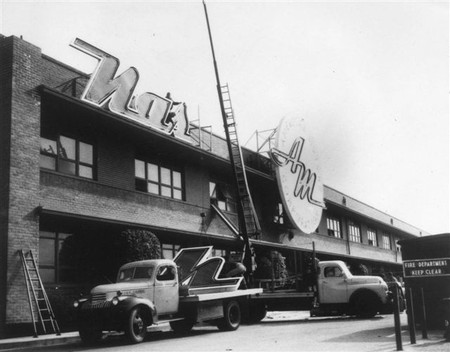
Workers remove signage from the Nash assembly plant after its closure in 1955. (Credit: allpar.com website)
Workers remove signage from the Nash assembly plant after adding the new “American Motors” sign, right. Undated photo, ca. 1954. (Credit: allpar.com website)

Thus ended the postwar auto plant experiment in the South Bay.

latestIn 1957, American Motors decided to drop the Nash and Hudson names from its model lines, replacing them with Rambler, and Charles W. Nash and J.L. Hudson became footnotes to auto history.

Hughes Aircraft bought the plant from American Motors. In 1961, it opened the Hughes Space and Communications Company there.

When Boeing acquired Hughes in 2000, it renamed the facilty the Boeing Satellite Development Center, and it became the largest satellite manufacturing plant in the world, with 1 million square feet of floor space.

The Boeing satellite facility in El Segundo was forced to lay off hundreds of workers in late 2015 due to a downturn in the cyclical nature of the satellite market, but remains one of the city’s largest employers.

The Kelvinator brand of appliances still exists as a division of the A.B. Electrolux company in Sweden.

Sources:

“Boeing Satellite Business Celebrates 50 Years in El Segundo,” Boeing website.

“Car Show Classic: 1953 Nash Statesman – AMC’s DNA,” Curbside Classic website.

“Charles Williams Nash,” Wikipedia.org article.

Daily Breeze files.

El Segundo Herald archival database, El Segundo Public Library website.

El Segundo: Seventy-Five Years: A Pictorial History of El Segundo, California, by Eileen Curry Hunter, H2 Limited Publishers, 1991.

Los Angeles Times files.

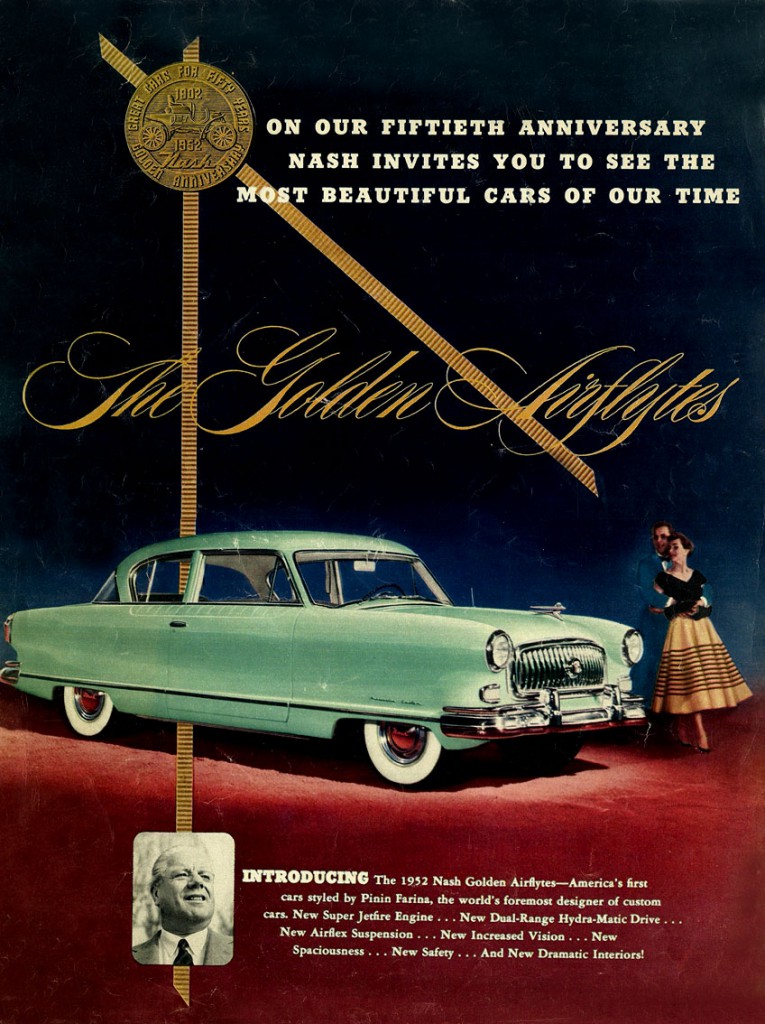
Ad for the 1952 Nash Airflyte models. (Credit: oldcarbrochures.org website)
Ad for the 1952 Nash Golden Airflyte. (Credit: oldcarbrochures.org website)

Pier Avenue School in Hermosa Beach becomes the city’s community center

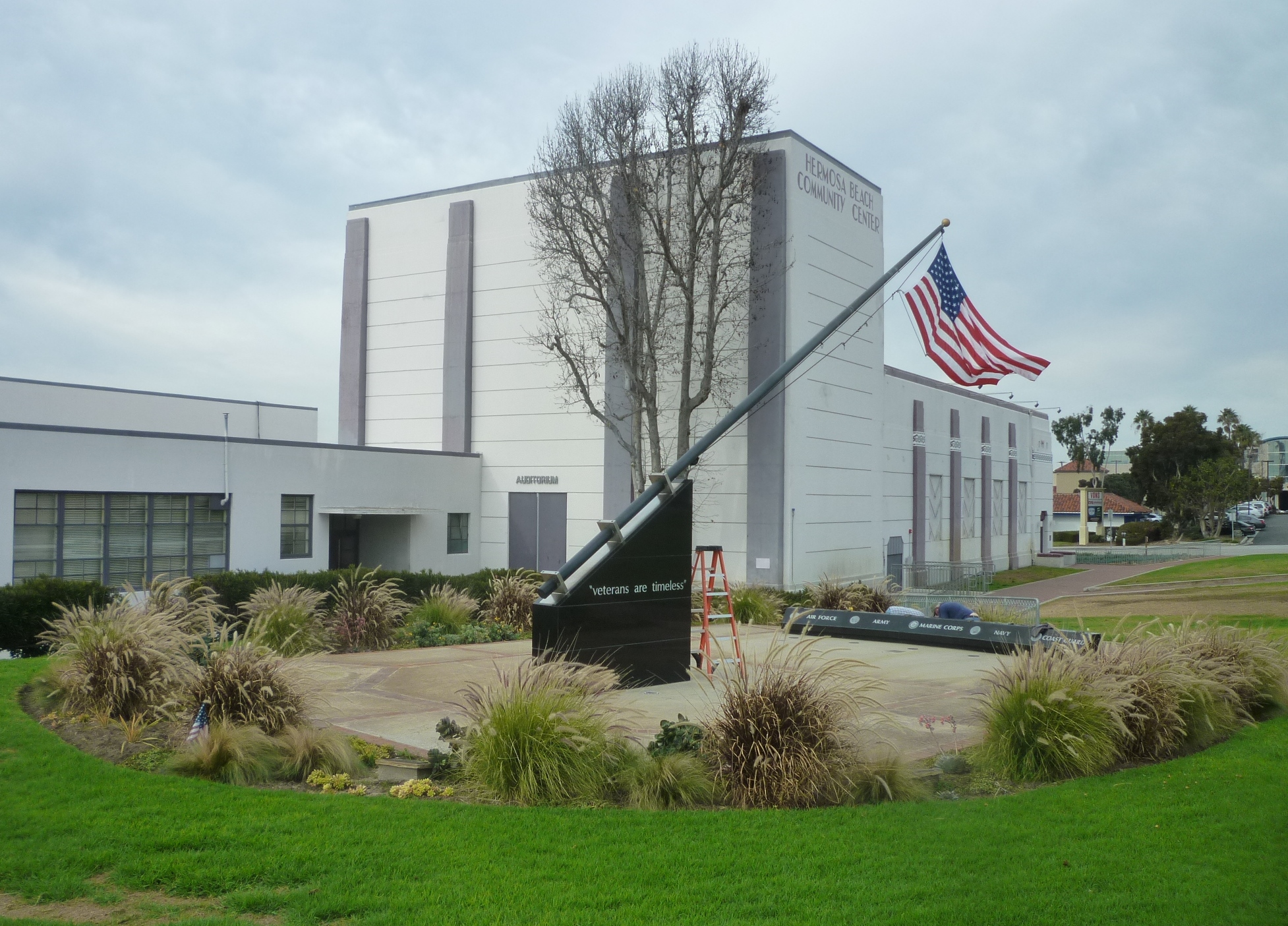
The Hermosa Beach Community Center, with the Veterans Memorial in the foreground. (Jan.s 2016 Daily Breeze photo)

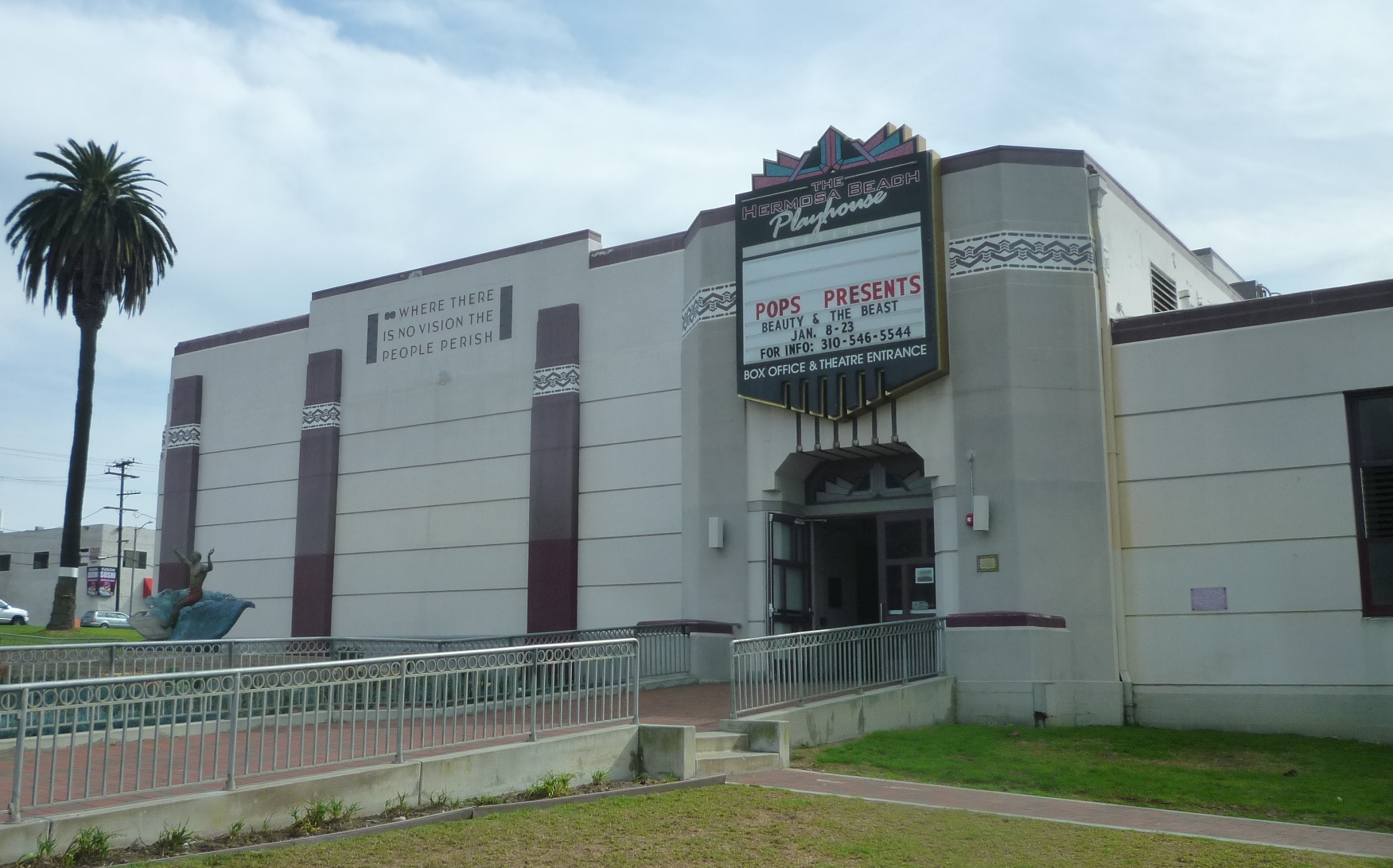
The Hermosa Beach Community Center, one of the beach city’s most recognizable public structures, plays a central role in the city’s life.

The landmark building at 710 Pier Avenue, near Pacific Coast Highway, began its existence as one of the city’s first public schools. “Where there is no vision the people perish,” the motto on the school’s Pier Avenue facade since the 1930s, still remains etched on its outside wall.

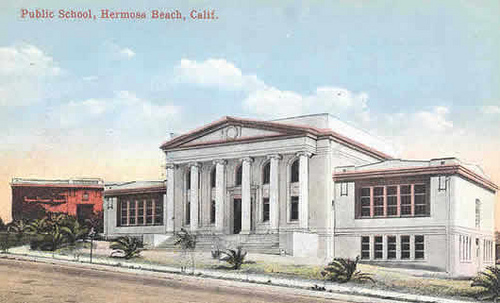
Undated postcard shows the original Pier Avenue School, built in 1911.

In her 1933 history of Hermosa Beach’s early years, the city’s librarian Fern Rhein dates the construction of the original Pier Avenue School to 1911. She notes that it was not the first school built in the city, which was incorporated in 1907. The Ocean View School on Monterey Boulevard, where the present-day St. Cross Episcopal Church was built in 1952, was the city’s first.

Pier Avenue School faced a crisis in 1933. The magnitude-6.2 Long Beach earthquake on March 10, 1933, severely damaged the school. Parts of the walls of its original auditorium collapsed, and the school had to be closed.

The auditorium’s architect, Samuel Lunden, stepped in to work on rebuilding the school. Plans were submitted and work begun in 1934 on the new school, using heavily reinforced concrete to withstand future quakes.

The New Deal agency the Works Progress Administration (WPA) was enlisted to complete the work. The building cost $6,757 to build, almost all of which came from government funds. 

Los Angeles County schools superintendent A.R. Clifton gave the keynote address at the new auditorium’s official dedication on May 26, 1936.

The rest of the school also had been completely rebuilt, at an estimated total cost of $45,000.

In September 1953, Pier Avenue School underwent another transformation. Its elementary school children were transferred to the newly completed Hermosa View School, and Pier Avenue became a junior high school for 7th and 8th grade students only. The elementary grade classrooms were converted into art and music classrooms, and a teachers’ workshop for district-wide use.

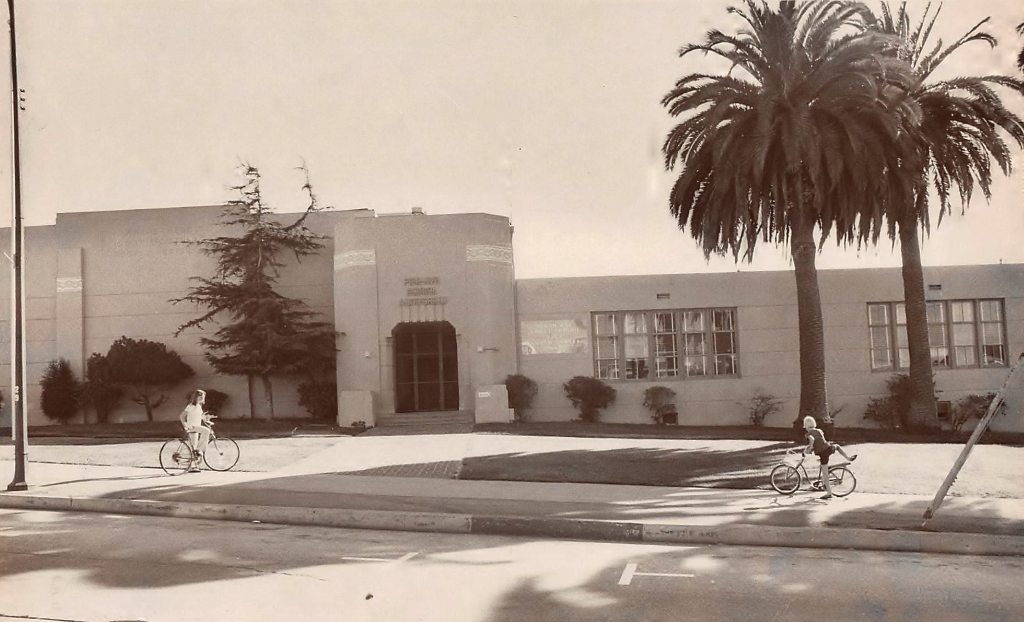
Declining enrollment led to the closure of Pier Avenue School following the 1974-75 school year.

The closed Pier Avenue School in Hermosa Beach in Nov. 1977. (Daily Breeze file photo)

Over the years, the school’s facilities, especially its auditorium, had been used for much more than just academic activities.

During World War II, it was designated as a Red Cross Disaster Center and used as a center to register for Army service.

It has been a polling place, and a center for live theater as well as movie screenings. Political meetings have been held there, and, in 1961, the finals of the city’s yo-yo contest attracted youths from throughout the South Bay.

But perhaps its most famous use came shortly after the school closed in 1975.

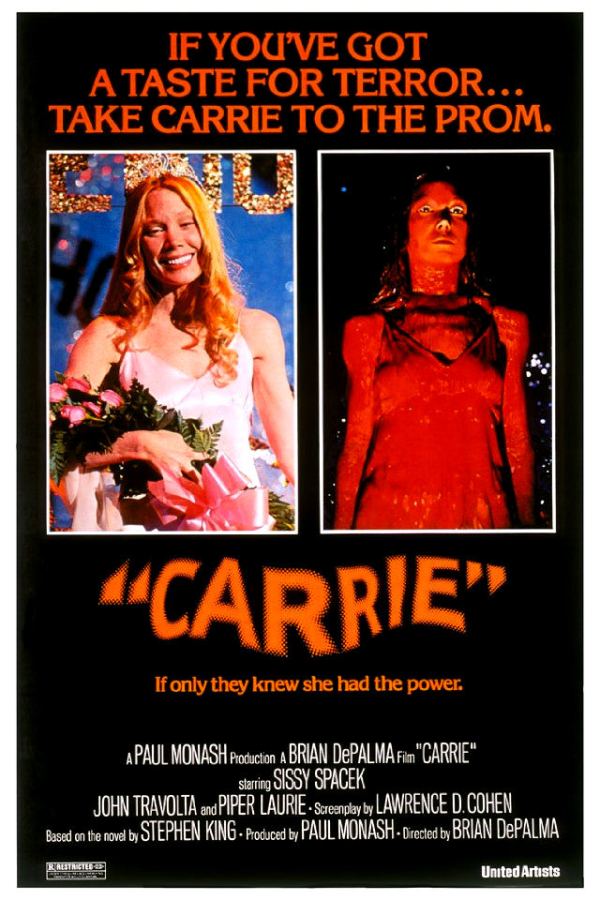
Parts of the 1976 film, "Carrie," were shot after Pier Avenue School closed.
Parts of the 1976 film, “Carrie,” were shot at the closed Pier Avenue School.

Actress Sissy Spacek describes the scenario in an interview conducted by Mike Childs and Alan Jones for Cinefantastique magazine for its Summer 1977 issue: 

“Brian (“Carrie” director Brian DePalma) had intended to use a new modern school….California State University…but a big, modern glass school would have been too intimidating for Carrie. She would have crawled along the corridors to get to class! Eventually we found an old, abandoned school, Pier Avenue School, in Hermosa Beach, about forty miles from L.A.

“Jack (Fisk, Spacek’s husband) rebuilt the gymnasium in the sound stage, as it had to burn. The special effects were very interesting. I had to stand on that stage while everything was on fire! I got all the hair on my body practically singed off! I got so involved in it! ‘Fire?! What do you mean? It can’t hurt me!I’m Carrie, I’ll flex!’ While I was on the platform, my cue was: ‘Leave the stage only when you can’t stand the heat anymore. But walk slowly!’

“Carrie,” based on the Stephen King novel, was released in 1976 and was both a box office and critical hit, garnering Academy Award acting nominations for Spacek and Piper Laurie, who plays her mom in the film.

The school buildings and auditorium would not remain empty, however. The City of Hermosa Beach already had begun negotiations to purchase the property from the Hermosa Beach School District, and the dickering over the proposal becoming quite heated in 1977.

The terms of the sale eventually were settled, and the district authorized the sale to the city for $650,000 on Jan. 18, 1978, and the deal became final on Feb. 28, 1978.

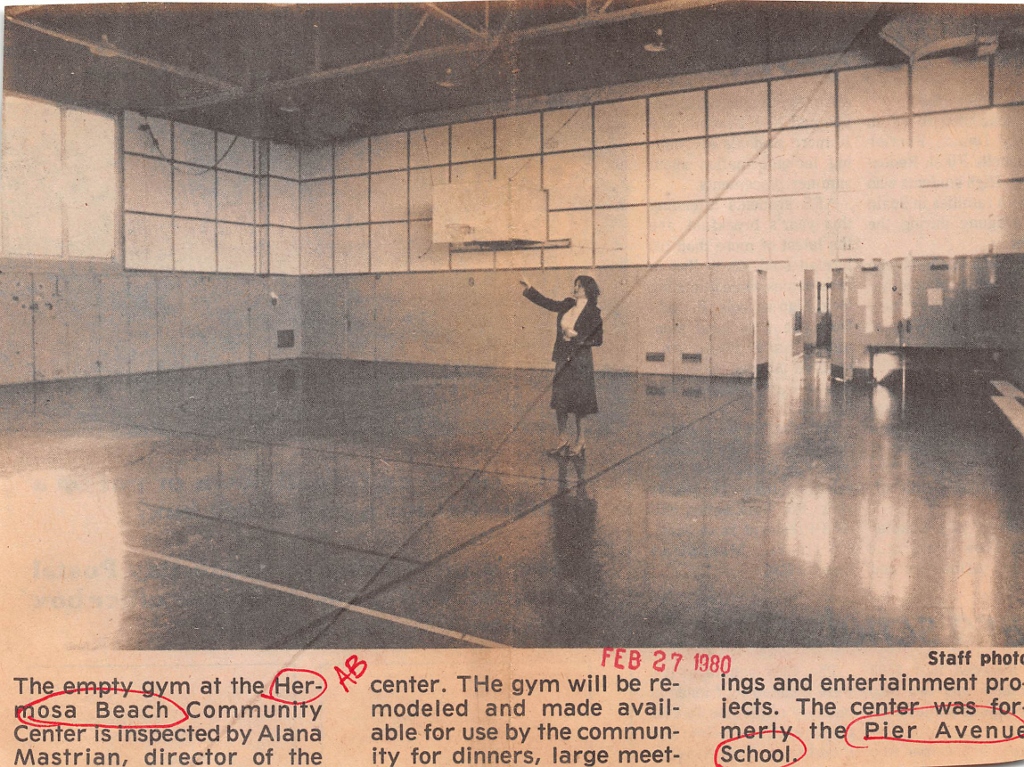
Daily Breeze clipping, Feb. 27, 1980 edition.

After years of debate over how best to use the center, and much prompting from the Friends of the Arts group based in the beach cities, the city decided to make the center a place for the performing arts as well as a central location for community services.

The 500-seat theater at the new Hermosa Beach Community Center had its gala opening Feb. 11, 1984, with Mel Torme in concert with the Alvino Rey Orchestra and the King Sisters.That same year, the newly opened facility won a Restoration Award from the historical preservation watchdogs at the Los Angeles Conservancy.

The Hermosa Beach Playhouse at the Community Center. (Jan. 2016 Daily Breeze photo)

It has hosted dozens of concerts and stage productions over the years since.

In addition to its other community activities, the center also is the home of the Hermosa Beach Historical Society,which opened there in 1992. Its expanded and remodeled museum opened in 2007.

The center was remodeled from 1999-2001, receiving a new paint job highlighting its art deco features, as well as a new lit theater marquee that was added in 1999.

In July 2002, the Hermosa Beach City Council designated the Hermosa Beach Community Center as a locally significant historical landmark.

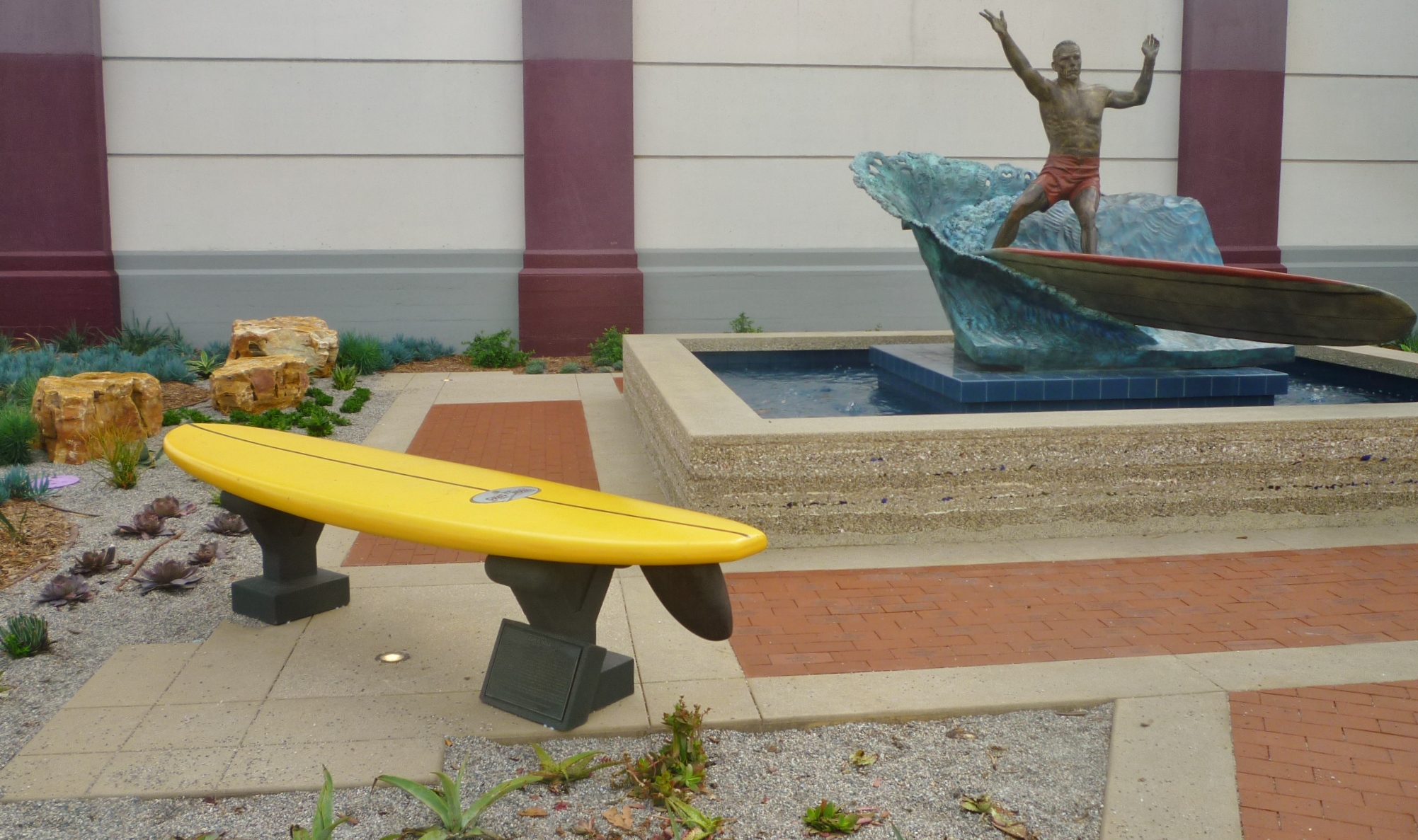
On Nov. 14, 2015, a statue depicting South Bay surfing legend Dewey Weber was unveiled outside the community center, which is also home to the city’s veterans memorial.

The memorial to surfing legend Dewey Weber was installed in 2015. (Jan. 2016 Daily Breeze photo)
The memorial to surfing legend Dewey Weber in front of the Hermosa Beach Community Center was unveiled in Nov. 2015. (Jan. 2016 Daily Breeze photo)

Sources:

Daily Breeze files.

“Hermosa Beach Community Center,” The Living New Deal website.

“Hermosa Beach: The Early History, 1900-1930,” by Fern Rhein, 1933.

Los Angeles Times files.

“Monstervision host segments for Carrie by Stephen King,” angelfire.com website.

Special thanks to reader Ron Johnson, who pointed out that my initial transcription of the school’s motto for this post, which read, “Where there is vision, the people perish,” was missing the word “no,” which changes the meaning considerably! It’s now corrected.

After a brush with extinction, Torrance Park’s Kendall Field thrives

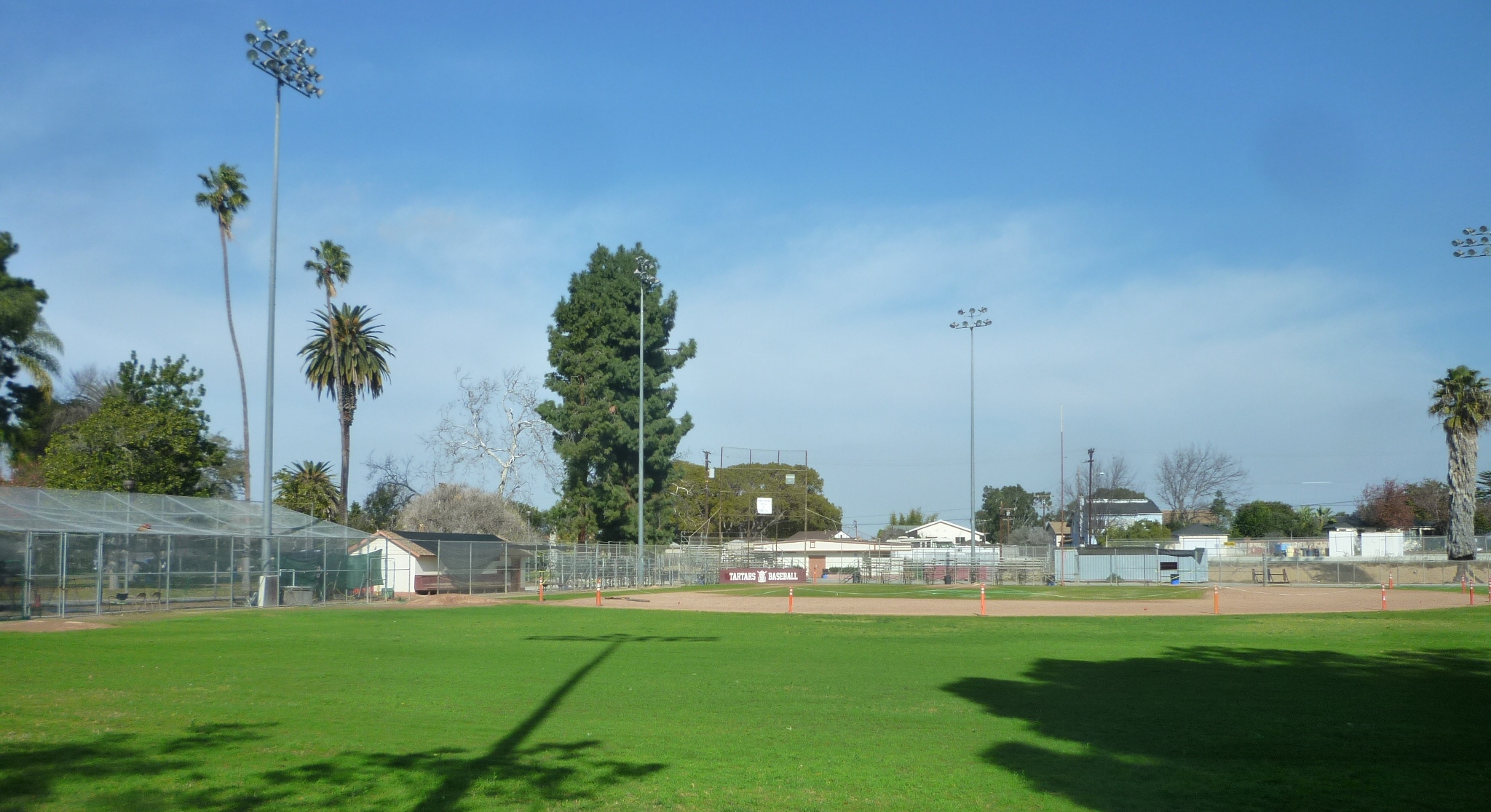
Kendall Field at Torrance Park. (Jan. 2016 Daily Breeze photo)

Semipro baseball once thrived in Torrance, back in the days when large manufacturing plants such as Union Tool and Columbia Steel employed thousands of workers, and baseball became a prime form of recreation and entertainment for the factory hands.

The city even had its own semipro team, the Torrance Bluebirds, an all-star group featuring the area’s best players that won a state title in 1933 under manager Spud Murphy.

The city’s only full-size baseball field was at Torrance Municipal Park, also known as Torrance City Park. Work began on the park in 1932, and its dedication was held on Aug. 26, 1934. Torrance Park, as it is now known, was the city’s first public park.

There were plenty of players and teams using Torrance Park’s baseball field in the 1930s, despite its lack of amenities such as bleachers and lights for night games.
The sport’s popularity led to the city eventually agreeing to upgrade the facility.

In 1938, with help from the New Deal-era Works Progress Administration, a complete baseball field was built at Torrance Park, including wooden bleachers, a backstop, new wooden outfield fences and all the trimmings. It was called the Torrance Municipal Baseball Park, and, after night lighting was added in the spring of 1939, the city began to enjoy a golden age of semipro baseball.

The field became the site for state tournaments and playoffs that drew large crowds. The Torrance Tournament, started in 1939 by Dale Riley, became a much-anticipated annual event.

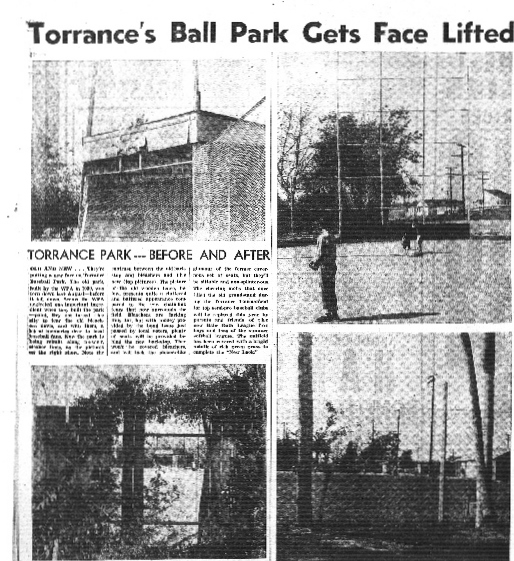
Before photos on left, after photos on right. Torrance Herald, April 15, 1954, Page 6. (Credit: Torrance Newspaper Archives database, Torrance Public Library)

By the early 1950s, however, the WPA-built ball field had become shabby and worn-down. The wooden fences had more holes than fencing, and the dilapidated wooden backstop was considered a danger to users.

The city considered a variety of options, including tearing down the baseball field and replacing it with a picnic area and recreation building. A new field would be built on the site of the city dump on Plaza del Amo near Western Avenue. (That site would later become the home of the Central Torrance Little League fields, which were rebuilt in 1997 into a state-of-the-art youth baseball facility.)

This plan was rejected when it was decided that the landfill site on the city’s eastern border wasn’t a central enough location.

The city also considered building a new baseball field at the proposed “Central Park” that would be part of Torrance’s planned civic center at Torrance Boulevard and Madrona Avenue. The civic center got built, but the park never did.

In August 1953, Torrance City Councilman Nick Drale got a resolution passed supporting bringing major league baseball to the West Coast, five years before the Dodgers and the Giants became the first MLB franchises out West. In a bit of wishful thinking, Drale’s resolution also suggested that Torrance Park’s increasingly deteriorating baseball park be used for spring training.

Sadly, at about the same time in August 1953, the park’s backstop had to be torn down because of dry rot and corrosion, leaving the city essentially without a baseball diamond. The Torrance High Tartars baseball team also was left without a home field, and had to play most of its 1954 season on the road, including “home” games at Paramount High School’s field, the only one in the area available to them.

Fortunately, the ball park found a champion in Parks and Recreation Director Harry Van Bellehem. He convinced the city to revive the facility, and his department began working to rebuild it in 1954. A new backstop was installed in the spring of 1954, along with new bleachers and chain link fencing to replace the old wooden fence.

The games resumed, much to the relief of the city’s baseball fans, and the Torrance Bluebirds semipro team even was revived during the mid-1950s.

With improvements over the years including a 30-foot-high fence, more modern lighting and the addition of grass to the infield, Torrance Park’s baseball field has been made to last.

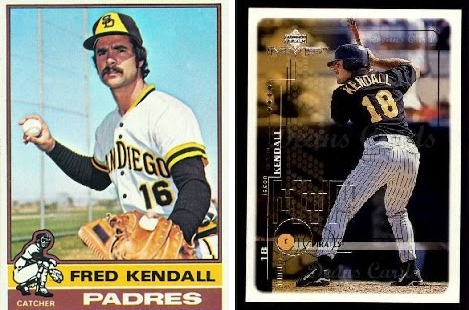
Baseball cards of father Fred Kendall, left, and his son, Jason, right.

Jason Kendall was among the Torrance High Tartar baseball players who excelled on the field, where the nearby high school still plays its games.

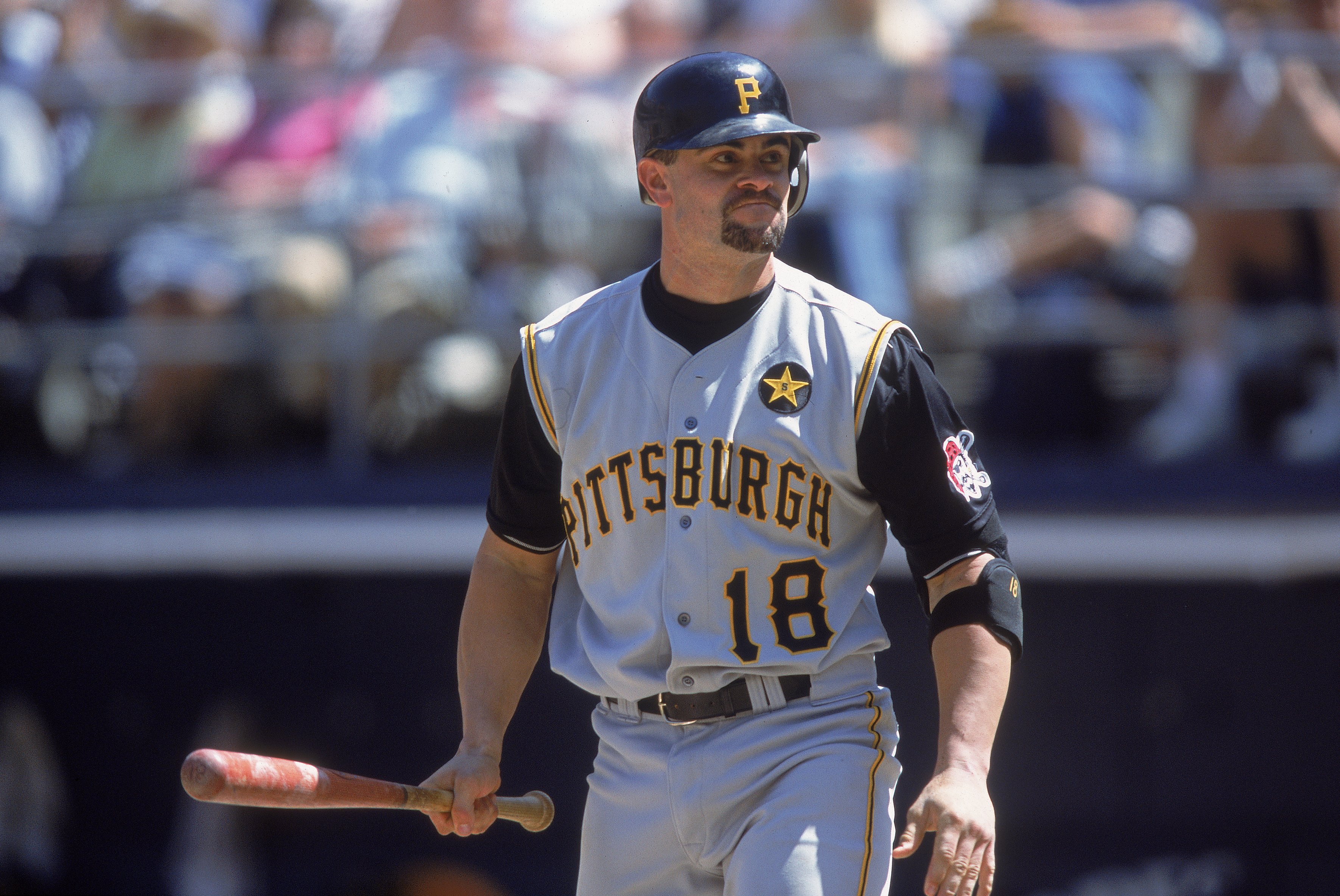
In 1992, Kendall, then a senior, was named the Daily Breeze prep baseball Player of the Year for his exploits. He went on to a stellar pro career, becoming an all-star catcher with the Pittsburgh Pirates, and played for several other teams as well.

His father, Fred Kendall, also played for the Tartars, graduating in 1967. He went on to play catcher for 12 years with the San Diego Padres, Cleveland Indians and Boston Red Sox.

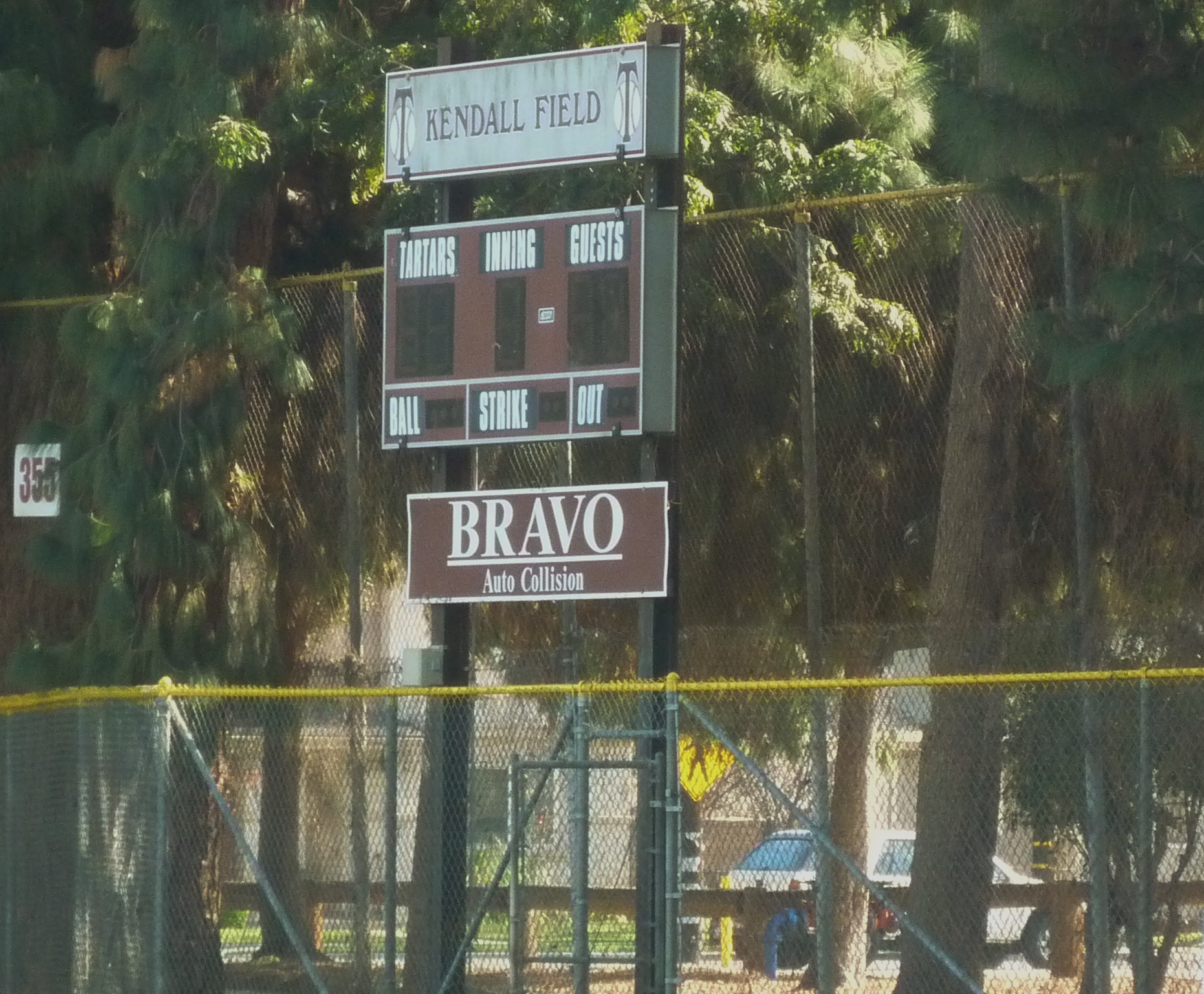
In 1997, Torrance High teacher and coach Harold Warfle, who coached both Kendalls, suggested that the city rename the Torrance baseball park as Kendall Field, in honor of the father-and-son duo who he called “the best that ever came down the pike.”

On Sept. 28, 1999, the Torrance City Council voted in favor of the renaming, and Kendall Field was  dedicated at a ceremony held with both men present on Jan. 20, 2001.

Kendall Field at Torrance Park. (Jan. 2016 Daily Breeze photo)
Centerfield scoreboard at Kendall Field in Torrance Park. (Jan. 2016 Daily Breeze photo)

Sources:

Daily Breeze files.

Los Angeles Times files.

Torrance Herald files.

 Jason Kendall of the Pittsburgh Pirates walks to the plate during the game against the San Diego Padres at Qualcomm Stadium in San Diego, California. April 29, 2001. File photo. (Getty Images/Todd Warshaw /Allsport)
Jason Kendall of the Pittsburgh Pirates walks to the plate during the game against the San Diego Padres at Qualcomm Stadium in San Diego, California. April 29, 2001. File photo. (Getty Images/Todd Warshaw /Allsport)

Gardena High School commemorates the last of the Mohicans

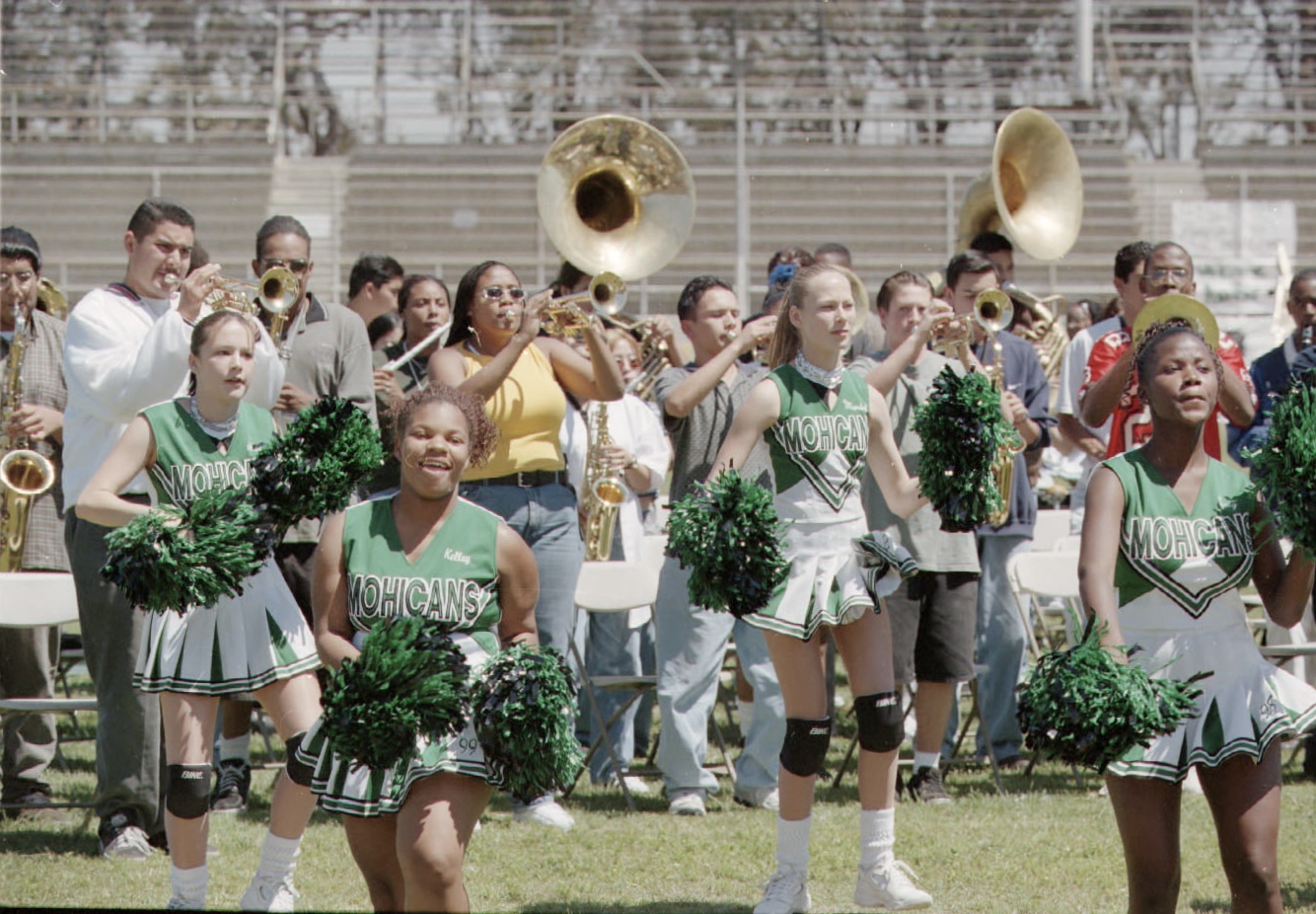
Cheer squad members wear their "Gardena Mohicans" uniforms for the last time at the April 17, 1998 rally. (Daily Breeze staff file photo)
Gardena High cheer squad members wear their “Gardena Mohicans” uniforms for the last time at the school’s “Last of the Mohican Ceremony” on April 17, 1998. (Daily Breeze staff file photo)

Sports team nicknames have become increasingly controversial in recent years.

American Indian groups have expressed disapproval of  the Cleveland Indians’ Chief Wahoo logo as well as the “tomahawk chop” chants used by Atlanta Braves and Florida State Seminoles fans.

The Stanford University Indians became The Cardinal way back in 1972.

But it’s the Washington Redskins who currently face the most heated criticism.

Team owner Daniel Snyder continues to come under fire for his adamant refusal to change his team’s name. The term “redskin” has long been considered offensive by American Indians, who first protested the Washington club’s use of the name in 1968. 

In Feburary 1992, The Oregonian newspaper in Portland began refusing to use the name in its sports stories, a policy that continues to this day.

In July 2015, a federal judge upheld the U.S. Patent Office’s decision to cancel the team’s trademark registrations due to the disparaging nature of the term.

In October 2015, California became the first state to pass a law banning the use of “Redskins” as a high school team mascot. Beginning in 2017, the four high schools in Tulare, Madera, Calaveras and Merced counties currently using the name will have to come up with something different for their teams.

But it’s not just the Redskins name that has caused controversy. Team names such as “Braves” and “Warriors” aslso have come under fire.

BHS_braveIn 1997, the Los Angeles Unified School District’s American Indian Education Commission, after years of study, recommended that the district eliminate Indian symbols being used at three of its high schools: The Birmingham High Braves in Van Nuys, the University High Warriors in West Los Angeles and the Gardena High Mohicans.

On Sept, 8, 1997, the commission’s recommendation became official at an emotional LAUSD Board of Education meeting with 6-1 vote in favor of eliminating the names.

Birmingham High students and alumni weren’t happy about the ruling. According to Los Angeles Daily News reporter Terri Hardy, a scuffle even broke out in the gallery among two members on opposing sides of the issue.

Birmingham High alumni partial to the “Braves” name took their case to federal court in an attempt to keep the tradition, but lost. Birmingham became the Patriots in 1998.

gardenalogoGardena High already was in the process of phasing out its “Mohicans” name at the time, so the issue caused less controversy there. Still, some viewed the Mohicans name with nostalgia; it had been part of the school’s culture since its founding in 1908.

90 years later, on April 17, 1998, Gardena High held an hour-long assembly for the whole campus that it called “The Last of the Mohican Ceremony,” echoing the title of James Fennimore Cooper’s 1826 historical novel about the tribe, “The Last of the Mohicans: A Narrative of 1757.”

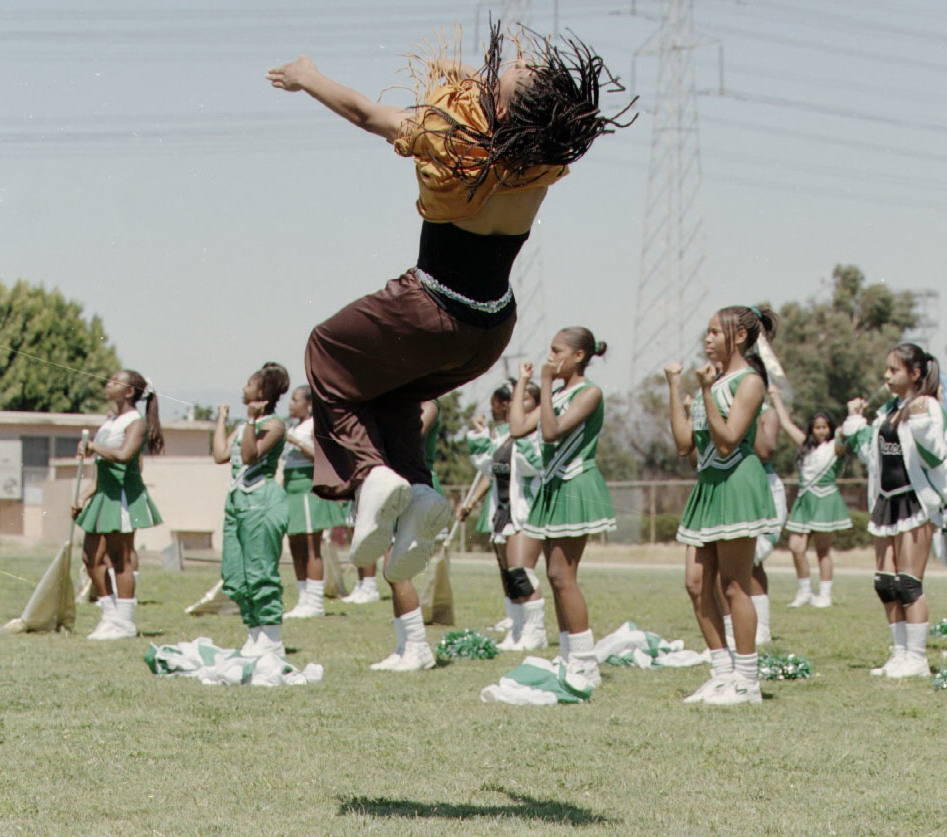
As the band played on, cheerleaders appeared in their Mohicans uniforms for the final time. Zack Fisher, the school’s official Mohican mascot, added green, white and black face paint markings and dressed up in a tan bodysuit with fringes, to perform cheer routines and do back flips across the field.

17-year-old Zack Fisher performs a flip while clad in his Mohican mascot outfit at the April 17, 1998 rally. (Daily Breeze staff file photo)

Junior class president Stacy Hom told the assembly, “I’m proud that our school is open-minded and respectful enough of our fellow American cultures to be willing to change our school’s long years of tradition.”

Head football coach Marshall Jones told the Daily Breeze, “I definitely have an emotional, nostalgic tie to the name. I’ve been a Mohican since 1976, when I was a sophomore. It will be hard to give up.”

Students chose the Panthers as the school’s new mascot, choosing it instead of Gators, Aggies, Bears or Bulldogs.

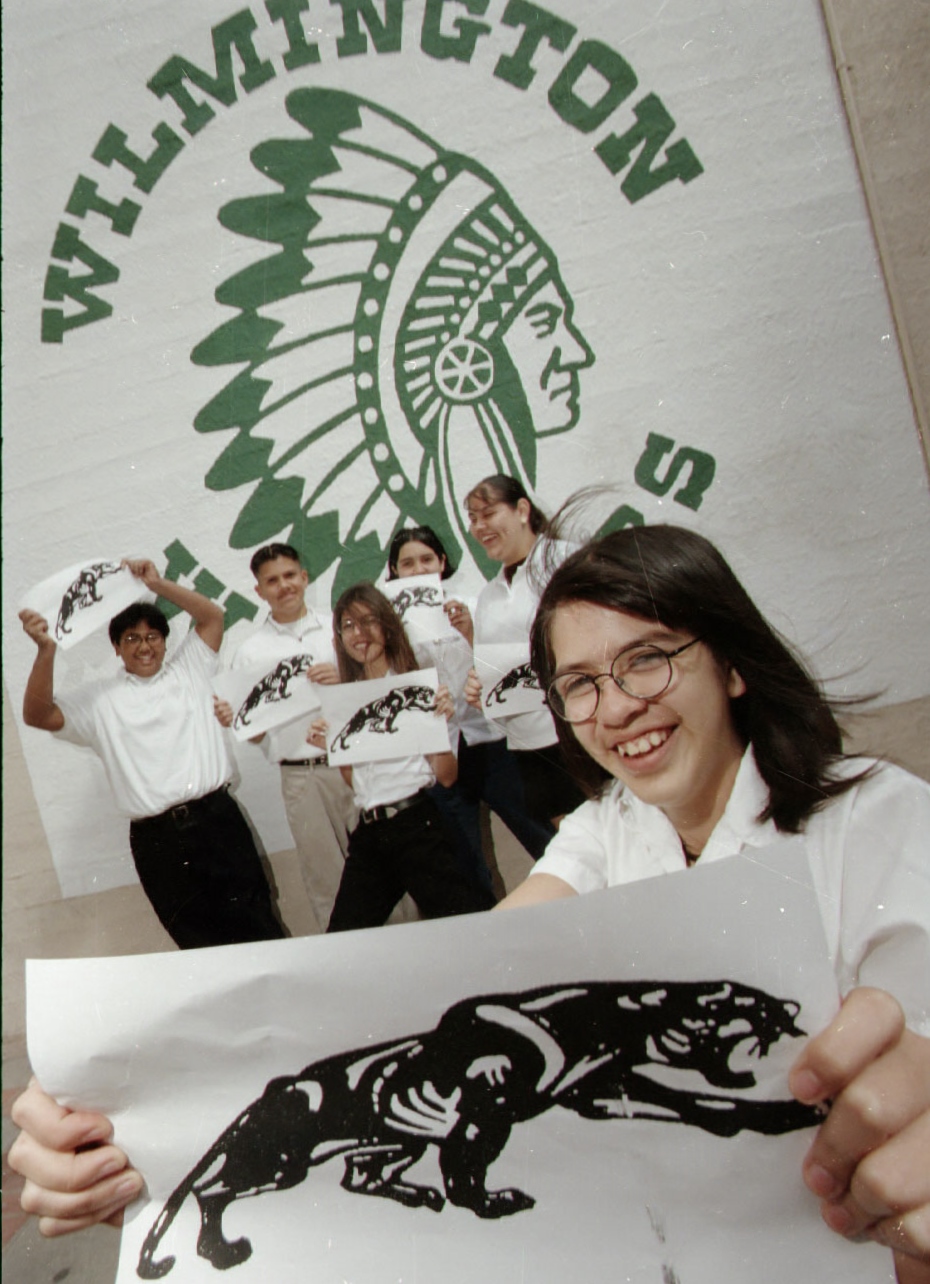
Students hold images of Wilmington Middle School's new "Jaguars" logo, with the old "Warriors" logo in the background. April 6, 1998. (Daily Breeze staff file photo)
Students hold images of Wilmington Middle School’s new “Jaguars” logo, with the old “Warriors” logo in the background. April 6, 1998. (Daily Breeze staff file photo)

The name change at Gardena involved changing football, cheerleader, drill team and banner squad uniforms, painting over old logos, redoing the gym floor and removing other traces of the old mascot. LAUSD gave Gardena High $125,000 to make the changes.

The school kept its green and white colors, and enlisted former Mohican mascot Fisher to portray the new panther mascot at pep rallies and sporting events.

At the same time, Wilmington Middle School’s Warriors also were required to become something less ethnically offensive. After 50 years, the Warriors became the Jaguars in 1999. It was the only middle school affected by the LAUSD ruling.

In 2002, former LAUSD board president Jackie Goldberg, then serving as a member of the California Assembly in Sacramento, proposed a law that would ban all public schools in the state from using certain American Indian mascots.

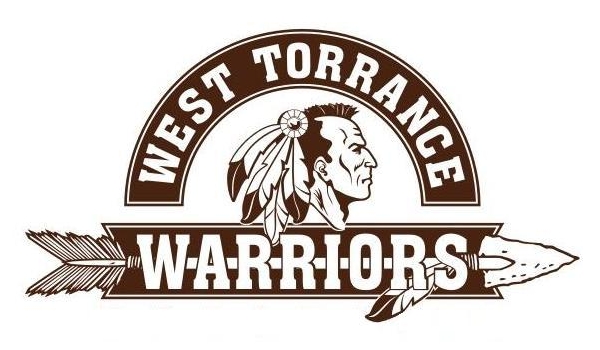
Several non-LAUSD schools in the area still have such mascots, including the West High and El Camino College Warriors in Torrance, the Centennial (Compton) and Arcadia High Apaches, the Hart High Indians in the San Fernando Valley and many other schools.
West High discontinued using its dancing Warrior mascot at games years ago, and El Camino College’s Warriors also downplay potentially offensive depictions of American Indians in its uniforms and symbols.

West_torrance_logo(Side note: El Camino College changed the name of its school newspaper from the Warwhoop to the Union in 1998.)

On May 28, 2002, Goldberg’s bill fell 12 votes short of passage after meeting opposition from both Republicans and Democrats, some of whom felt that local school boards, not the Assembly, should decide such matters.

A refined version of the bill also was defeated 37-31 in the California Assembly in June 2003. According to the Los Angeles Times, Assemblyman Tim Leslie sang the Arcadia High Apaches’ school song  to protest the bill. (Arcadia had won support in using the name after speaking with Apache leaders in Arizona.)

In addition to West High’s Warriors, Torrance’s other three public high schools have names based on aggressive tribes, though they are not American Indians. The South High Spartans (from the militant Greek city-state), North High Saxons (Germanic tribes that migrated to England in the 5th Century) and Torrance High Tartars (central Asian/Turkic tribes) all feature warlike imagery in their logos, though the giant sword wielded by the Torrance High Tartar mascot on the school’s gym has been removed in the latest version painted there.

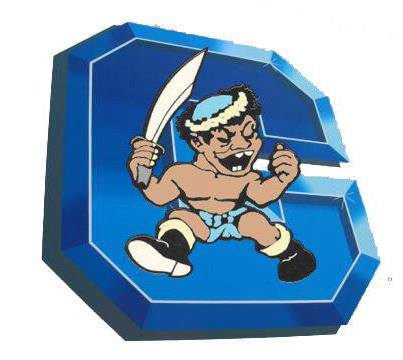
The Compton High Tar-Babes logo.

The Tartars name also is at the heart of Compton High’s “Tar-Babes” mascot, often cited as racist in nature, though it has nothing to do with the Tar-Baby character from the Joel Chandler Harris collections of Uncle Remus stories.

According to the school’s website, Compton High’s mascot was the Lions until 1925, when it was changed to the Tartars. The community college and the high school shared facilities at the time, so the high school team became known as the “Baby” Tartars.

Over the years, the baby Tartars had a variety of nicknames – Little Tartars, Tartar babies and Tar-Babes, with the latter name becoming the most popular and the one currently being used.

Sources:

“Our History,” Compton High School website.

Daily Breeze files.

Los Angeles Daily News files.

Los Angeles Times files.


Special thanks to reference librarian Mike George, Katy Geissert Civic Center Library, Torrance.

When was the last time real snow fell in the South Bay / Harbor Area?

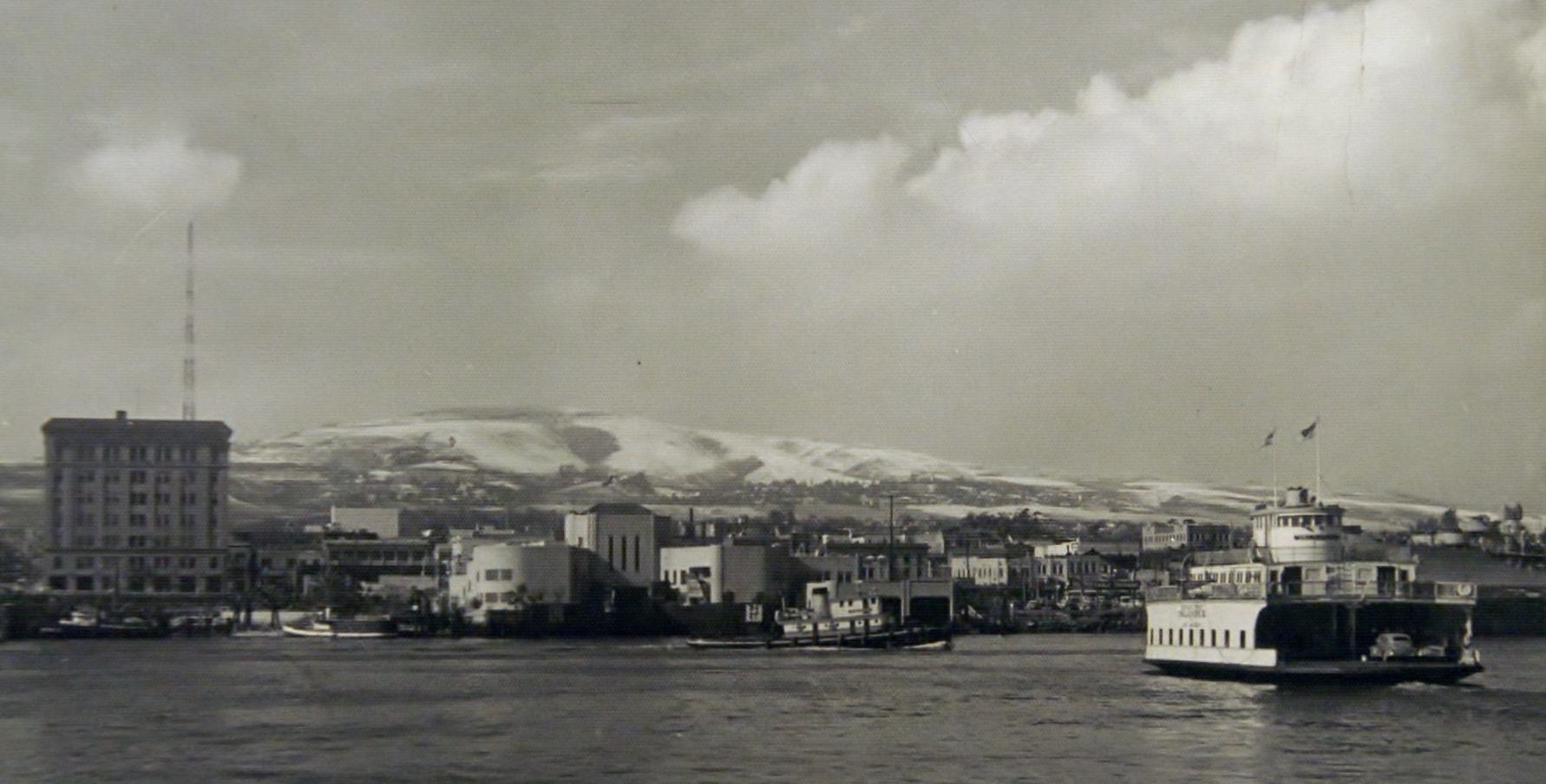
Snow can be seen on the Palos Verdes Hills following the Jan. 11, 1949, snowfall. (Photo courtesy of San Pedro Bay Historical Society)
Snow can be seen on the hills of the Palos Verdes Peninsula following the Jan. 11, 1949, snowfall. (Photo courtesy of San Pedro Bay Historical Society)

When was the last time it snowed, really snowed and stayed on the ground, in the South Bay and Harbor Area?

Unlike some Southern California areas near foothills that do receive snow from time to time when the level drops to the lower elevations, the South Bay and Harbor Area rarely gets a dusting of the white stuff.

We do get our share of freakish storms, a couple of which I’ve blogged about in the past.
Redondo Beach was pounded by major storms in 1952 and 1953 that inflicted much damage on its coastal area.

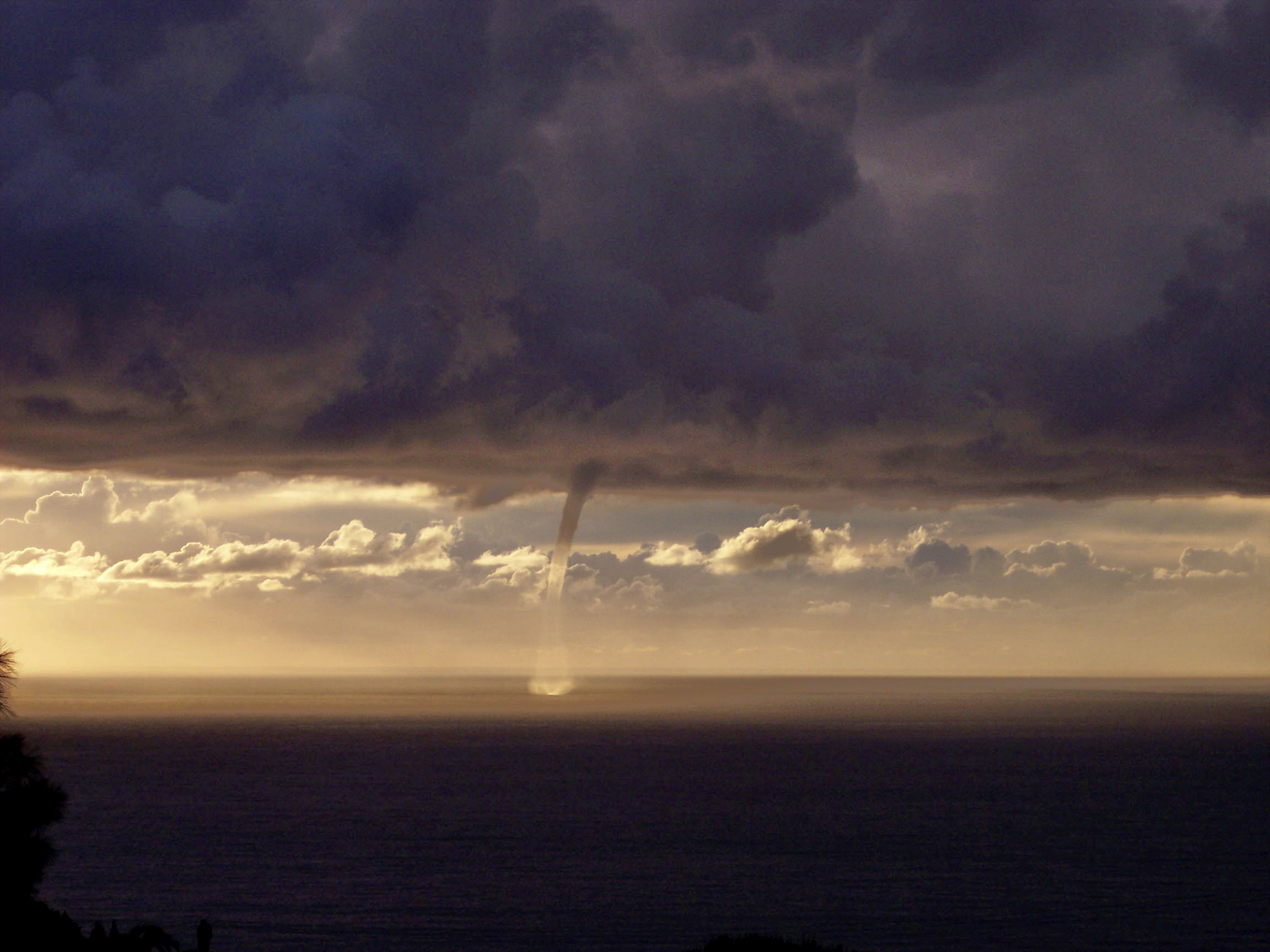
A waterspout forms off of the Golden Cove area of Palos Verdes Estates on Jan. 3, 2005. (Photo by Bill Watson)

Water spouts occasionally pop up off the Southern California coast during more violent storms. More extreme storms also can produce hailstones, which, while not common, do fall from our skies from time to time.

And tornadoes, though rare, have touched down on land in the South Bay over the years, most notably in Hawthorne in 1930, 1966 and 1983.

But snowfall is much rarer.

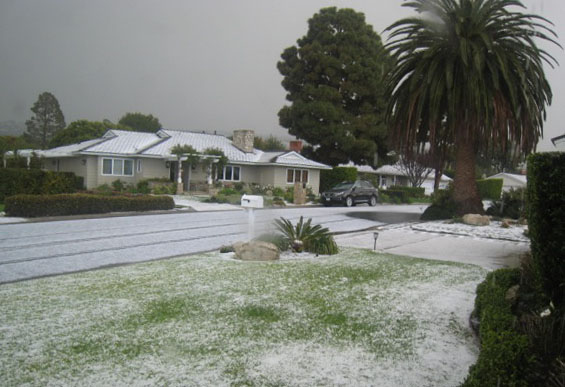
A coating of graupel, soft hail, carpeted this Lunada Bay neighborhood on March 2, 2015. (Photo By Rose Ramsay)
A coating of graupel, or soft hail, carpeted this Lunada Bay neighborhood on March 2, 2015. (Photo By Rose Ramsay)

As recently as March 2, 2015, a blanket of white covered parts of the Southern California coastline, including parts of the Palos Verdes Peninsula and an even thicker layer at Huntington Beach in Orange County.

Technically, it wasn’t snow, however, but graupel. Graupel, also known as soft hail or snow pellets, forms when raindrops are collected and freeze on a falling snowflake, forming small, soft balls of ice that fall to the ground. This snow/hail hybrid is softer in consistency than hail, and about as close to the real thing as one can get without having an actual snowfall.

The graupel that fell last March covered the ground with about an inch of the stuff, enough for students at Lunada Bay Elementary to make “hail balls” and for surfers at Huntington Beach to ride their boards down icy sand dunes and make a “hail man” near the beach.

It may not have been actual snow, but it was soft enough and plentiful enough to look like the real thing.

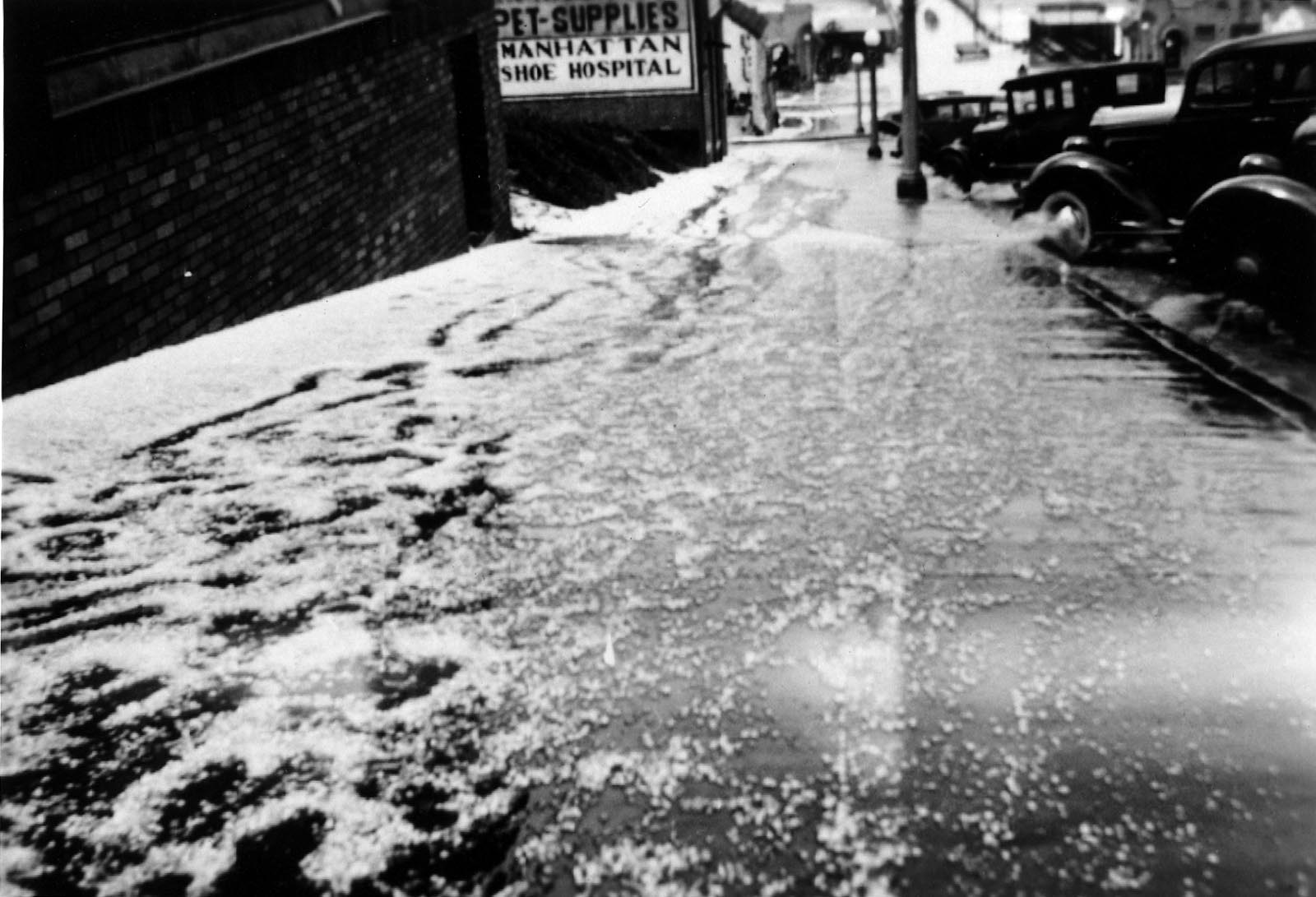
Downtown Manhattan Beach hailstorm of 1937. 100 block of Center Street (now Manhattan Beach Blvd.) looking west towards the pier. (File photo)
Downtown Manhattan Beach following a 1937 hailstorm. 100 block of Center Street (now Manhattan Beach Blvd.) looking west towards the pier. (File photo)

The real thing has fallen in Southern California in the past.

According to the Los Angeles Times, hail turned to snow briefly in the Pasadena area on Jan. 15, 1928, but failed to stick on the ground.

A more wide-ranging storm dropped snow in parts of Corona, Pomona and Ontario on Jan. 13, 1932, with traces also falling near Pasadena, Monrovia and Burbank.

The overnight snowfall that fell in northern San Bernardino that same day stayed on the ground until noon the next day.

Traces of snow also were reported in the Los Angeles Basin on Jan. 1 and Feb. 21, 1942.

When it comes to South Bay and Harbor Area, though, the precipitation that fell on Jan. 11, 1949, was the most authentic snowstorm the area has ever seen.

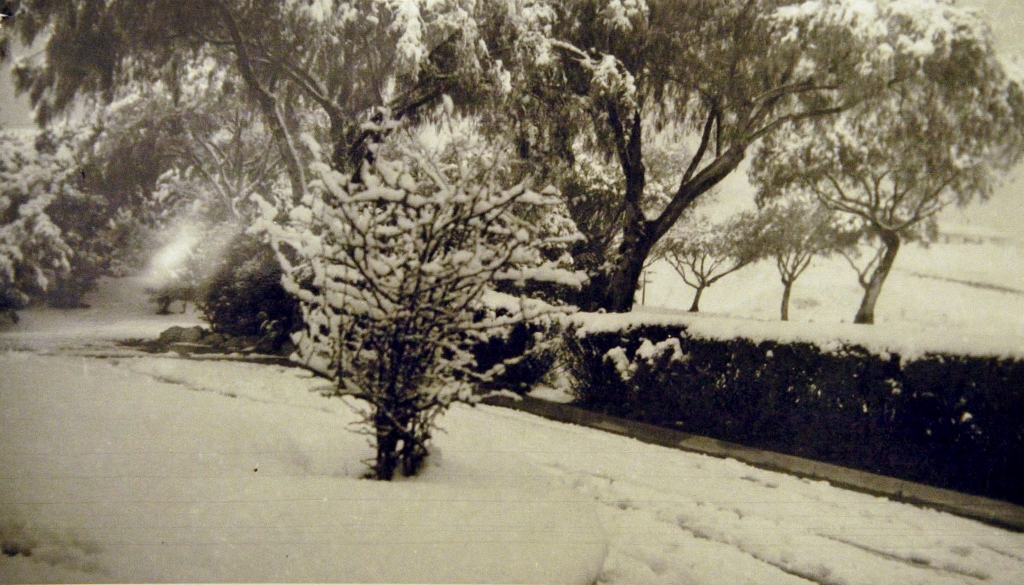
In early Jan. 1949 it snowed in San Pedro as seen in this photo taken in the Palos Verdes Hills. (Photo courtesy of San Pedro Bay Historical Society)
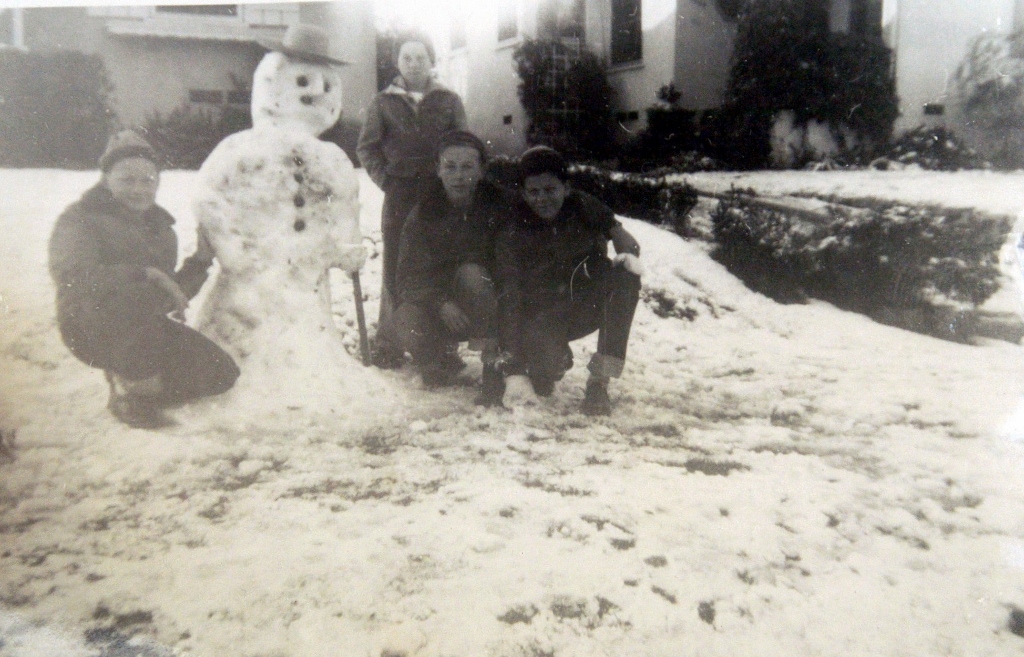
On Jan. 11, 1949, it snowed locally, as seen in this photo taken on the Palos Verdes Peninsula. (Photo courtesy of San Pedro Bay Historical Society)

Four to six inches of snow blanketed San Pedro and the Palos Verdes Peninsula, and stayed on the ground, much to the delight of local residents.

“We all ran out and tried to make snowmen,” Al Bitonio, who lived on 15th Street between Palos Verdes and Center streets, told reporter Donna Littlejohn, then writing for More San Pedro, in 2005.

San Pedro residents make a snowman following the Jan. 11, 1949 storm. (Photo courtesy of San Pedro Bay Historical Society)

“I don’t think any of us had ever seen snow before,” wrote Sam Domancich in 2004, also for More San Pedro. “White flakes began to swirl around us like tiny feathers being blown by the wind. We couldn’t figure out what they were.”

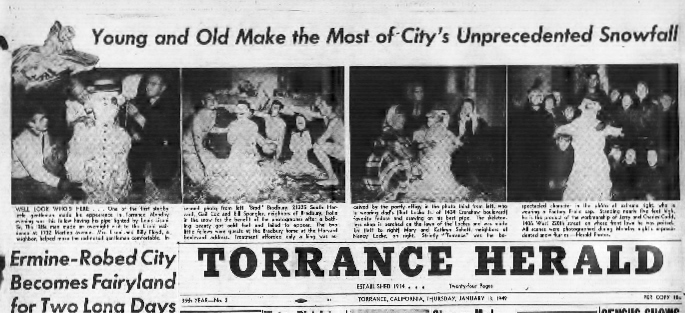
Snow also fell in Torrance, 1.25 inches of it, leading to an outbreak of snowman-building as documented in the Torrance Herald:

Torrance Herald front page, Jan. 13, 1949. (Credit: Torrance Historical Archive database, Torrance Public Library)

Impromptu ski slopes developed in the Palos Verdes Hills. Students played hooky in large numbers from the Torrance schools, and Sam Levy reported a 50 percent increase in the sales of long underwear at his Levy Department Store in downtown Torrance.

Fortunately, several photos taken of the freak event survive in the archives of the San Pedro Bay Historical Society.

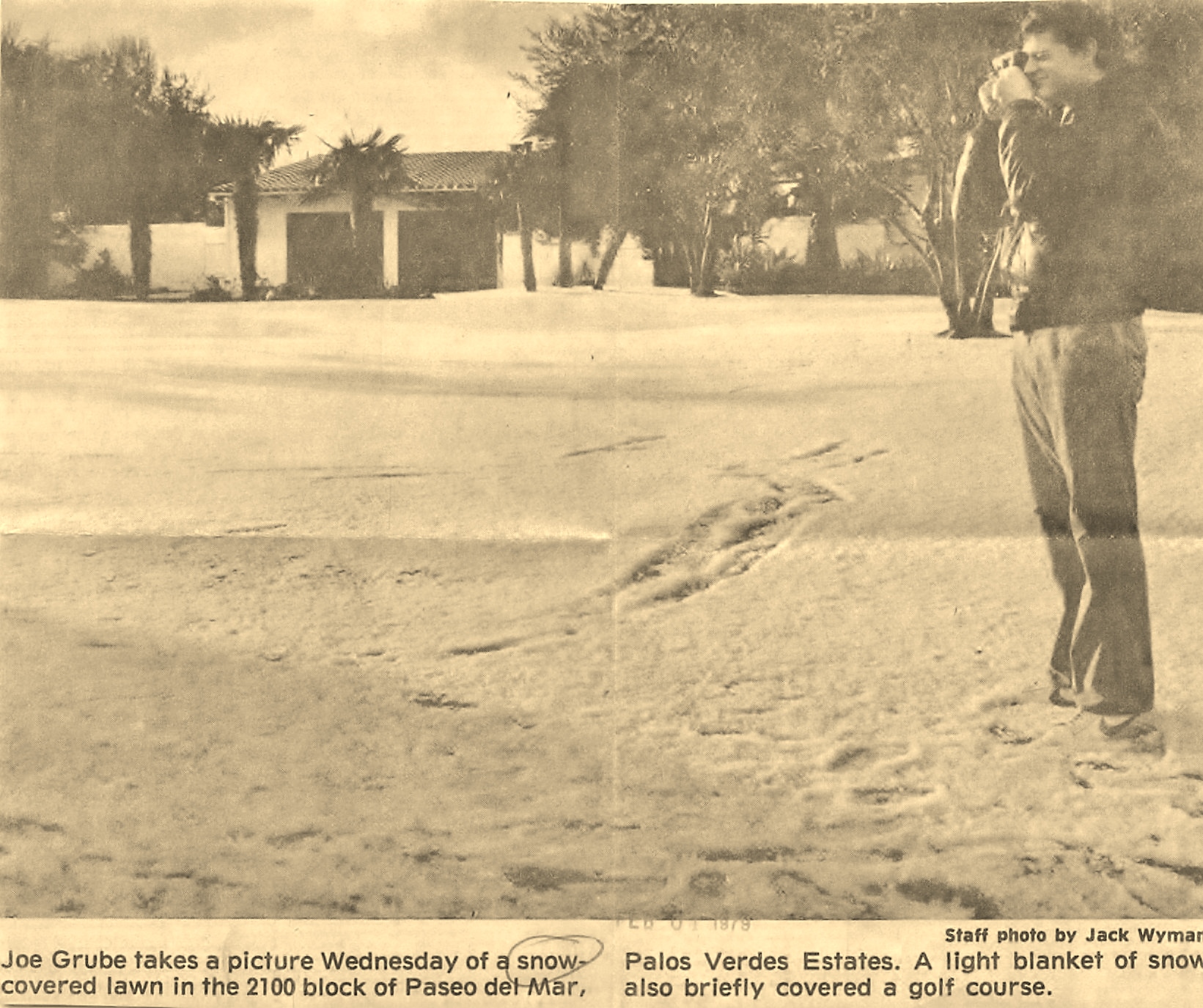
2015_12_31_13_55_180001In more recent years, enough graupel fell on Dec. 6, 1978, Jan. 31, 1979, Feb. 25, 1987, December 1990, Jan. 12, 2001, and Jan. 7, 2005, to simulate a winter wonderland, however briefly. But actual snow has yet to make a reappearance.

If the predicted El Nino weather conditions fall just the right way in the next couple of months, maybe we’ll see real snow again. Or something – like graupel – resembling it.

Sources:

Daily Breeze files.

Los Angeles Times files.

More San Pedro files.

Torrance Herald files.