Nativity Catholic Church: Torrance’s first Catholic church

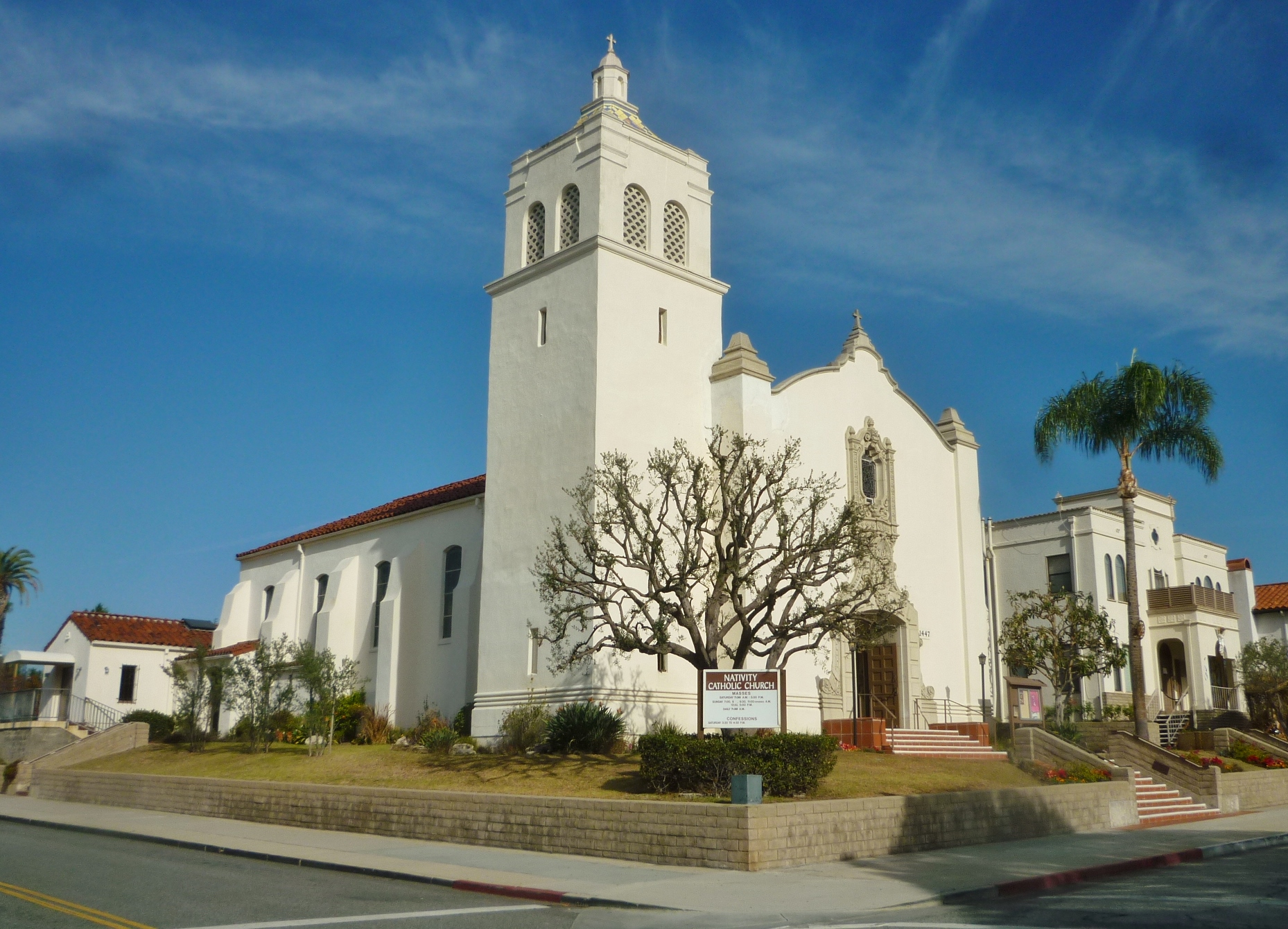
Nativity Catholic Church in Torrance. (December 2015 Daily Breeze photo)

The first Catholic church in Torrance began as an idea in the minds of the area’s Catholic residents who had moved to the area after the city was founded in 1912.

They began holding informal religious gatherings in various spots including the city’s library near the corner of Carson Street and Cabrillo Avenue, a movie theater on El Prado and the private home of local resident George Probert.

In 1918, the Catholic community in Torrance came under the jurisdiction of St. James Catholic Church in Redondo Beach.

First, Msgr. Nicholas Conneally, and then, in 1918, Father James Deenihan were assigned to the Torrance congregants. Father Deeniham, then the pastor of St. James, led the effort to get a church built in Torrance.

He got Mrs. Jared Sidney Torrance, wife of the city’s founder, to donate land at 1420 Cota Avenue, not far from downtown Torrance. Through the efforts of Catholic residents in the area, a wood frame structure was built on the site in the summer of 1921, the same year that the city of Torrance officially was incorporated.
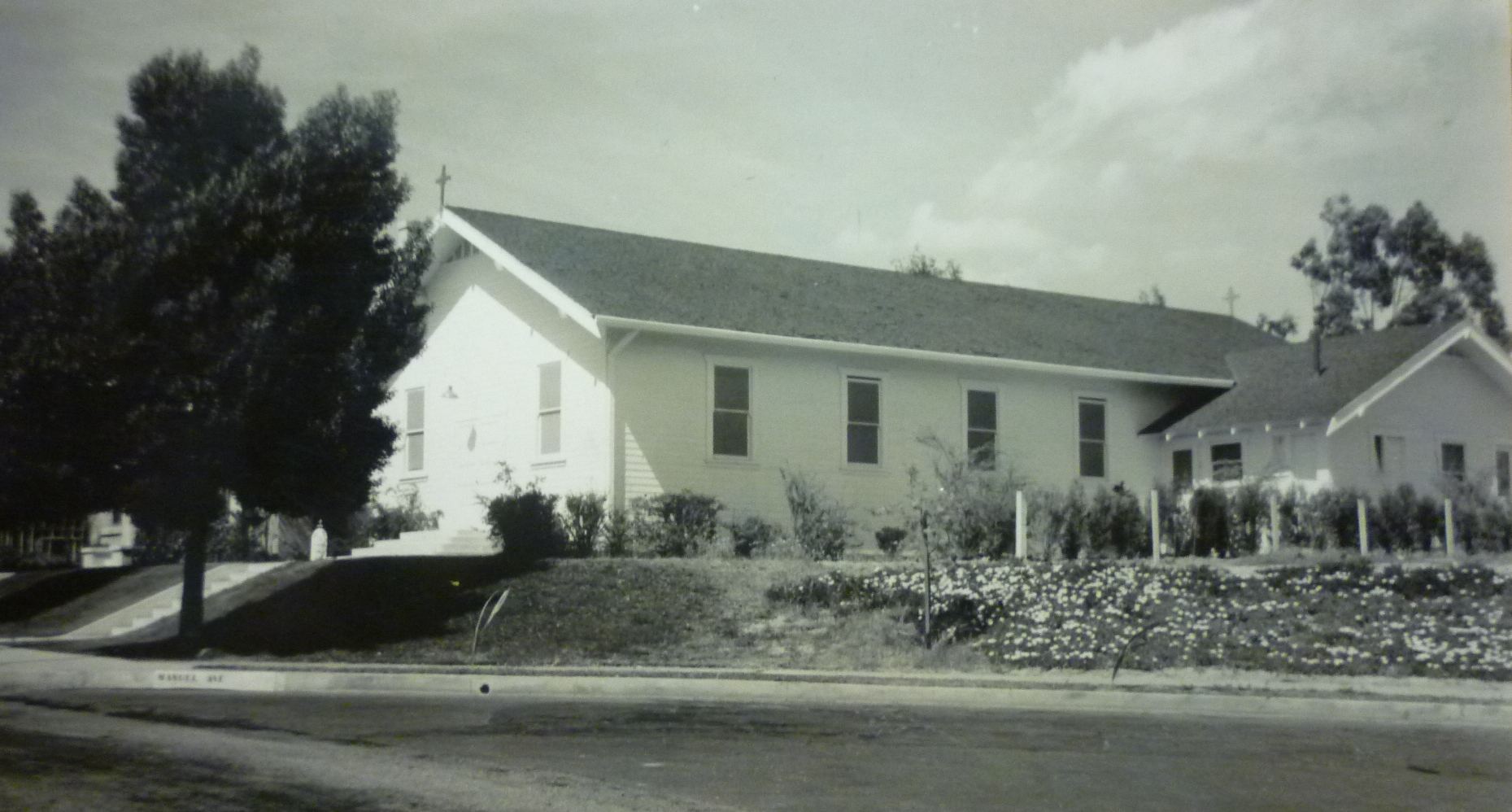
Undated photo of the Church of the Nativity's original building, circa 1930s. (Daily Breeze file photo)
Undated photo of the Church of the Nativity’s original building, circa 1930s. (Daily Breeze file photo)

It would serve as the city’s first Catholic church for the next 18 years.

In 1923, leadership of the nascent church passed from St. James in Redondo to St. Anthony’s in Gardena, whose clergy were in charge for the next year.

Finally, in December 1924, a separate parish officially was established for Torrance, and the Church of the Nativity came under the leadership of Father Edward Riordan.
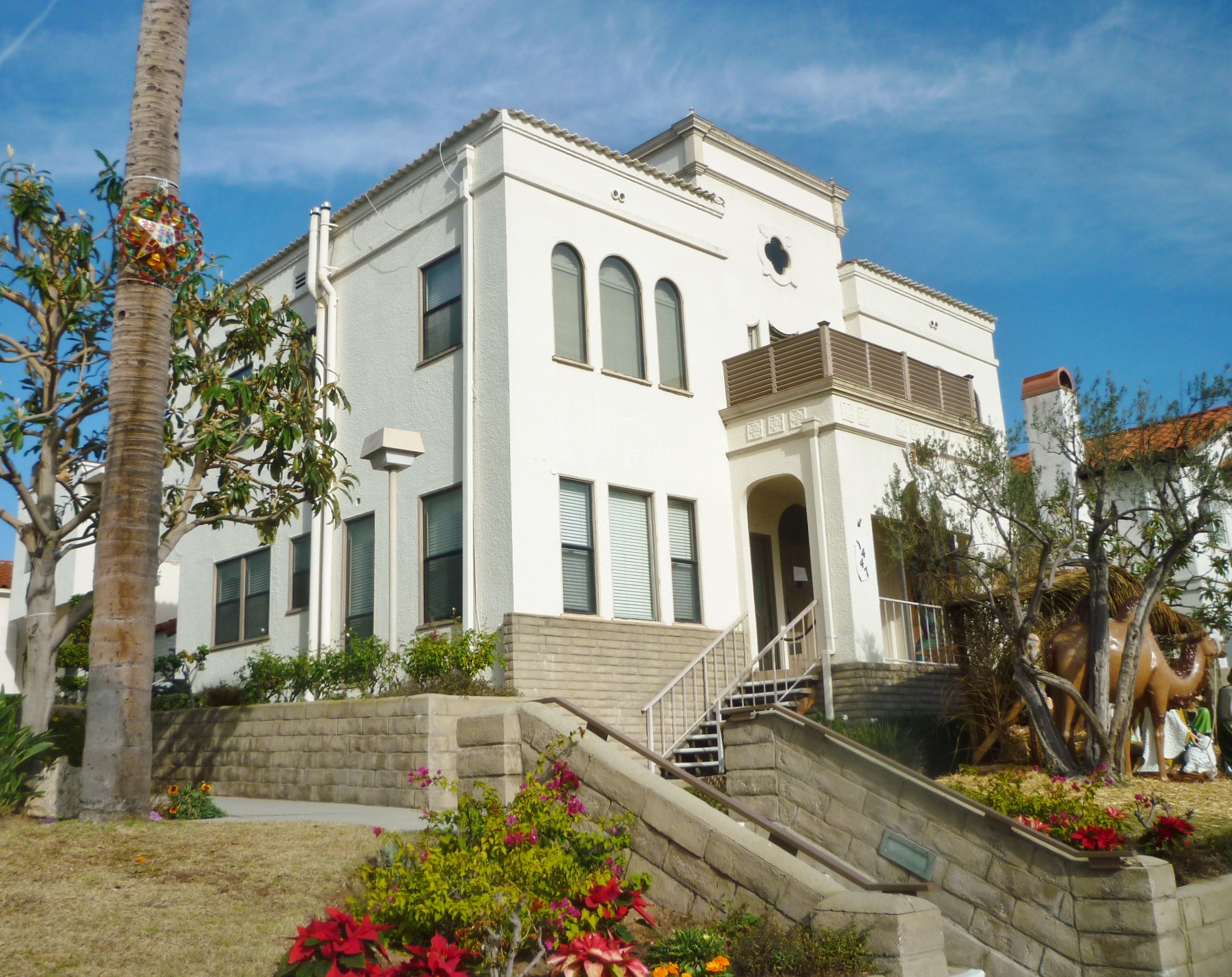
The rectory at Nativity Catholic Church was built in 1928. (December 2015 Daily Breeze photo)

Father Riordan was able to get a rectory built next to the church in 1926, an imposing stuccoed structure with a tile roof. It still stands today.

The parish flourished under a variety of pastors after Father Riordan left in 1928.

The arrival of Father Joseph Fitzgerald, originally from Limerick, Ireland, in 1937 marked a turning point in the church’s history. Father Fitzgerald, together with the help of the Los Angeles Archbishop John J. Cantwell, led the drive to finance the construction of a new church building, using every fundraising strategy at his disposal to do so.

After financing was secured, ground for the new building at the corner of Engracia and Manuel avenues was broken on Sept. 11, 1938. Its official address was then, and remains now, 1447 Engracia Avenue.

Los Angeles architects John and Anthony Kauzor designed the building, and contractors from the firm of Harman Pacific carried out its construction.
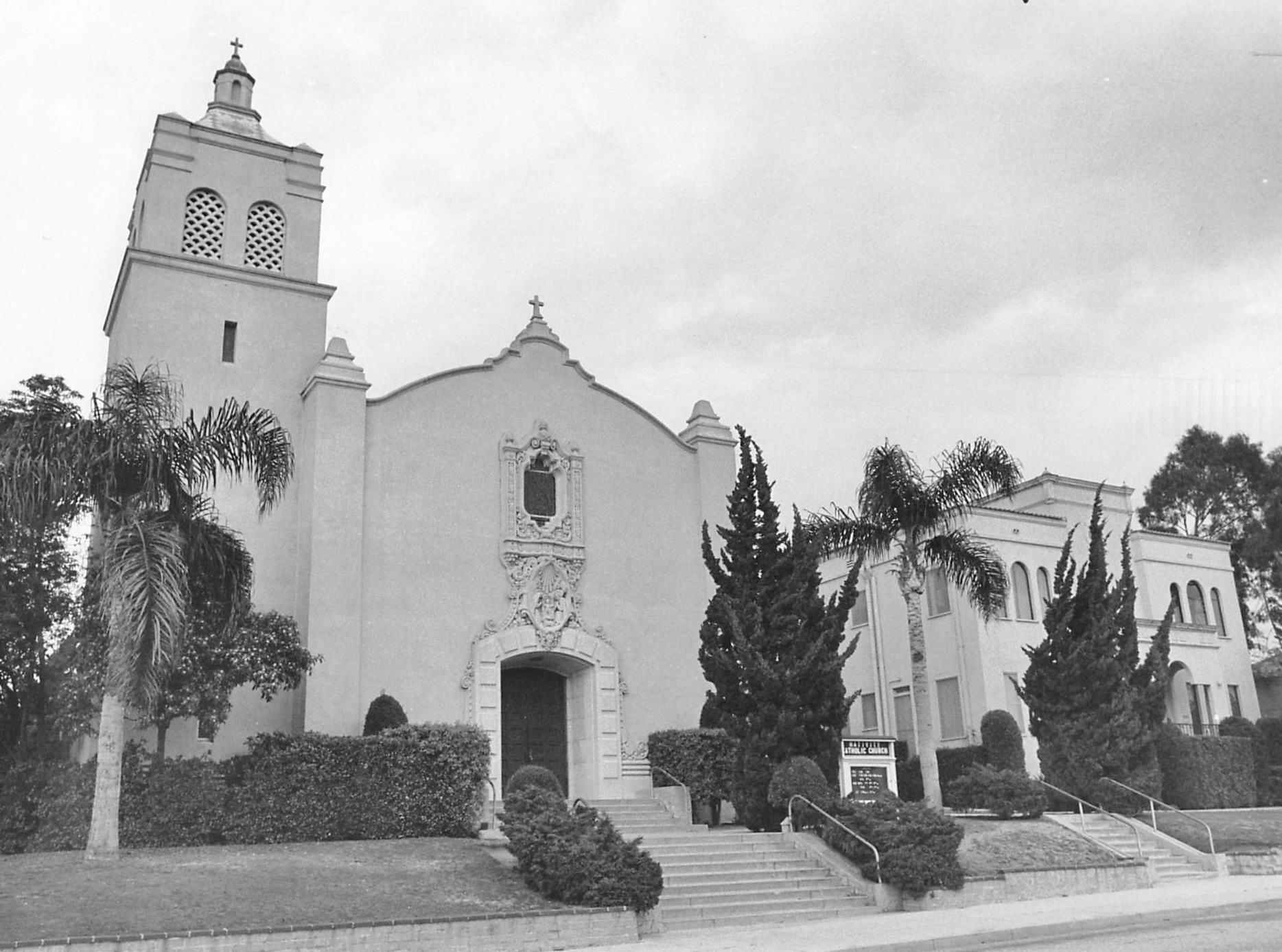
Nativity Catholic Church. 1973 Daily Breeze file photo.
Nativity Catholic Church and rectory, right. 1973 Daily Breeze file photo.

The Spanish colonial structure had a 43 x 110 foot nave, with room for 410 worshippers, and an imposing 60-foot bell tower. It was built at a cost of $25,000, and it quickly became the center of Catholic religious life in Torrance.

The first mass in the new church was celebrated by Father Fitzgerald at 9:00 a.m. on the morning of Sunday, March 5, 1939, after he led a procession to the new church from the old church building after the final mass was performed there at 7:30 that morning.

The formal dedication of the Torrance Catholic Church of the Nativity was held on June 18, 1939, with Archbishop Cantwell presiding. The church was packed to its full capacity for the occasion.
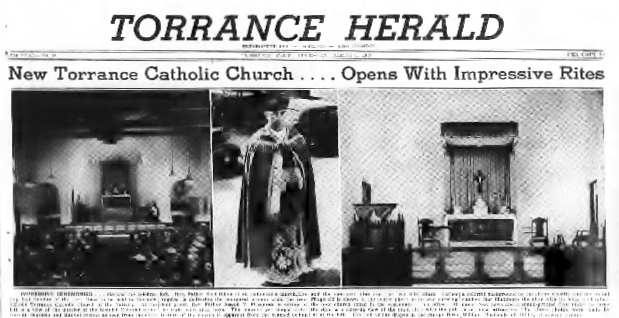
Front page of the Torrance Herald, Thursday, March 9, 1939. (Credit: Torrance Historical Archives database, Torrance Public Library)

Hundreds turned out to mourn the death of Father Fitzgerald, who took ill early in 1940, then developed pneumonia and died on Oct. 7, 1940.

He was succeeded by Father Joseph Bauer, who spruced up the grounds of the church and revamped its interior, installing stained glass windows and new floors.

In November 1944, Archbishop Cantwell appointed Father Pat McGuinness as the parish’s new pastor, and charged him with building a school for the church.

This took some doing, as there was no land nearby large enough to accommodate one. In 1946, a suitable lot was found on Carson Street between Acacia and Madrid avenues, and ground was broken for the new school on Oct. 12, 1947.
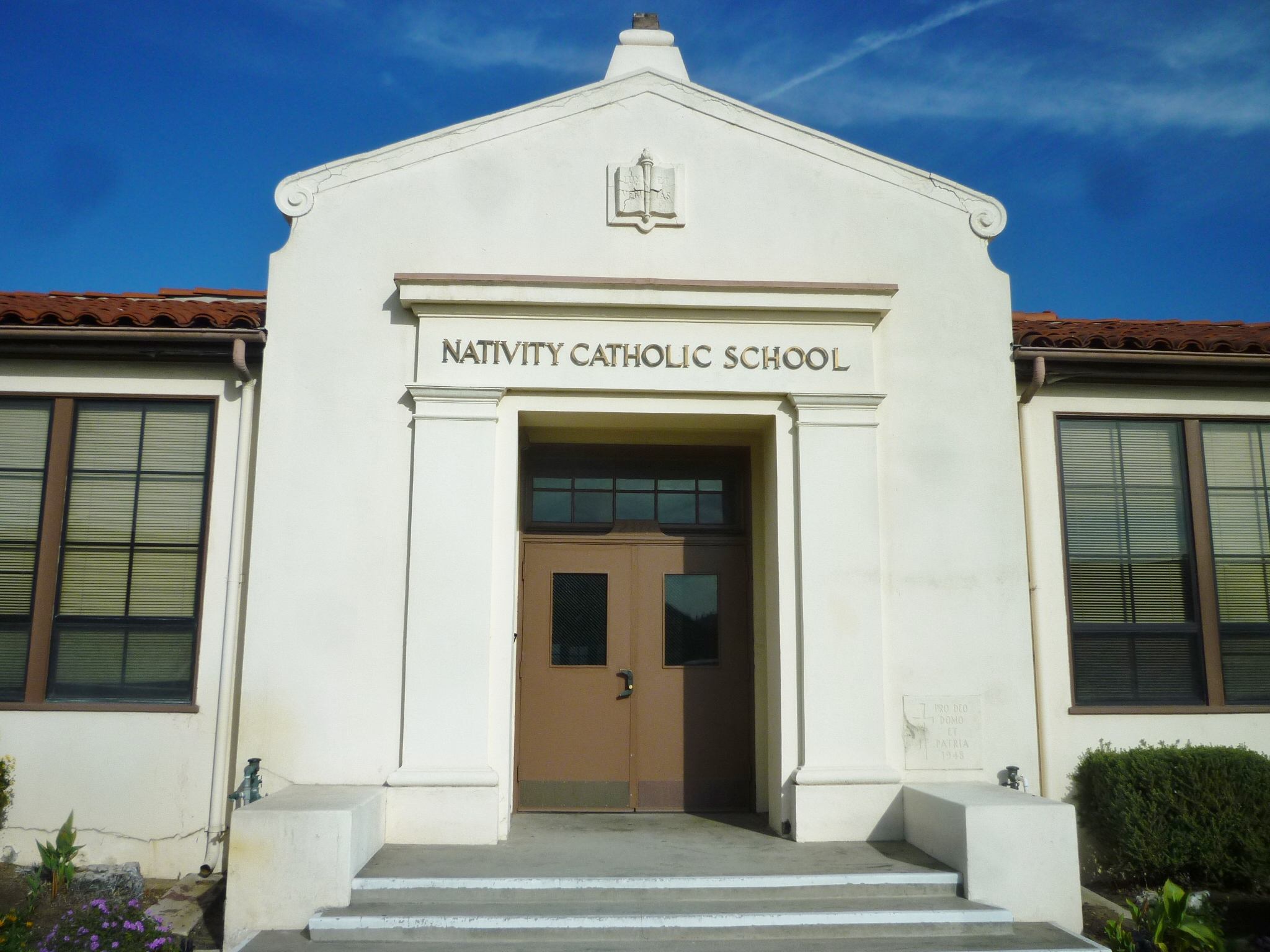
Nativity Catholic School welcomed its first students in September 1948. (December 2015 Daily Breeze photo)

The school opened to students in September 1948.

At the same time, a new convent was being built across the street from the church. It cost $54,000, and was dedicated by the new Archbishop, James Francis McIntyre, on Nov. 28, 1948.

The church was enlarged in 1953. The original First Christian Church building was acquired in the early 1960s, and converted to its present use as the Nativity Annex.

On Sept. 28, 1974, Cardinal Timothy Manning, then archbishop of Los Angeles, presided over a Mass of Thanksgiving in the church, along with Pastor Patrick J. McHugh and several former pastors. McHugh would serve the parish as pastor for 25 years, retiring in 1997.

In 1999, the church celebrated its 75th anniversary.

The Rev. Hung Tran is the church’s current pastor.

Sources:

“About Us,” Nativity Catholic Church website.

Daily Breeze files.

“Nativity Catholic Church, Torrance California,” unpublished history, by William R. Kanatsky, April 1964.

Torrance Herald files.
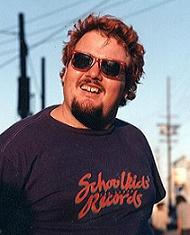
30 years later, D. Boon of the Minutemen remains a San Pedro legend

D. Boon, undated photo. (Courtesy Wikipedia)
D. Boon, undated photo. (Courtesy Wikipedia/Wikimedia Commons)

Dennes Dale Boon died 30 years ago this month, on Dec. 22, 1985, to be exact.

14 years before that, when he was 13 years old, he dropped out of a tree in Peck Park in San Pedro park in front of startled fellow teen Mike Watt, saying “You’re not Eskimo.”

Watt replied, “No, I’m not Eskimo.” “Eskimo” apparently was a friend that Boon thought might be in the park, Watt found out later.

Boon then proceeded to regale Watt with note-for-note comedy routines from George Carlin albums, which Watt, unfamiliar with them, originally thought Boon was making up on the spot.

They became fast friends. They attended Dodson Junior High, and then San Pedro High School together, graduating from SPHS in 1976.

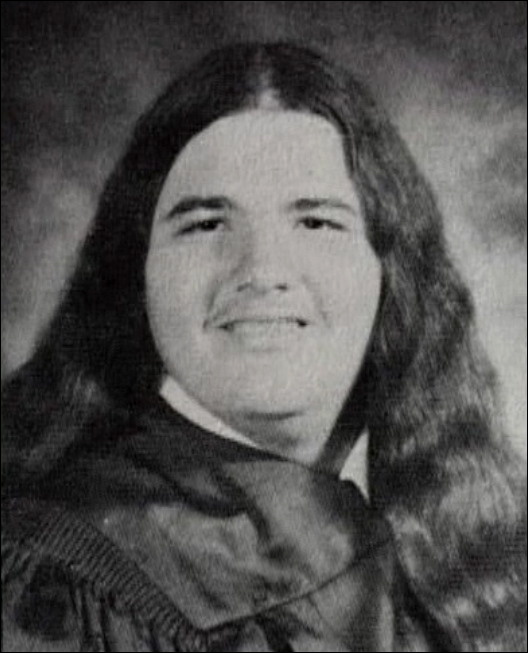
D. Boon's senior high school yearbook photo. San Pedro High School, 1976.
D. Boon’s senior high school yearbook photo. San Pedro High School, 1976.

George Hurley also graduated that year, and though he would become the inventive drummer for the Minutemen, the influential band that Watt and Boon would form in 1980, he didn’t know them in high school.

But we’re getting ahead of the story. Before forming the Minutemen, Boon and Watt spent their formative years playing together for fun. They were fond of jamming on songs by Creedence Clearwater Revival, Blue Oyster Cult, Black Sabbath and Alice Cooper.

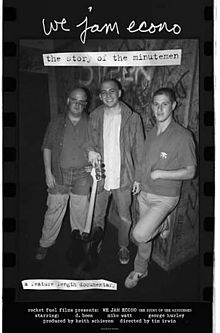
In the definitive documentary on the band, 2005’s “We Jam Econo: The Story of the Minutemen,” Watt, a military brat who moved to San Pedro from Maryland when he was 10, describes how the two would get together in Boon’s mom’s house, in a  former Navy housing tract that had been converted into a housing project.

Mrs. Boon learned to live with the constant guitar playing emanating from D. Boon’s room. It comforted her; she preferred knowing where the boys were to having them roam the streets. She died when Boon was 18.

With the arrival of the first wave of punk-rock in the mid-1970s, Watt and Boon realized that the music’s do-it-yourself ethic applied to them as well. The quest to form a band begun, and, in 1979, The Reactionaries were born.

The "We Jam Econo" DVD.
The “We Jam Econo” DVD.

Boon and Watt hooked up with drummer Hurley, and they recruited Martin Tamburovich to be their lead singer.

While attending a Clash concert at the Santa Monica Civic in February 1979, they came across Greg Ginn of Black Flag, who was handing out flyers for an upcoming Black Flag show in San Pedro.

After Boon and Watt described the Reactionaries to him, Ginn invited the band to be on the bill at a Black Flag show in San Pedro, which ended up being held at a teen center at 240 N. Mesa Street, having been moved at the last minute from the nearby Star Theatre.

The Feb. 17, 1979 bill for San Pedro’s first punk-rock show included the Alley Cats, the Plugz, and South Bay bands the Descendents and the unbilled The Last, who played two songs. It was Black Flag’s second gig ever, and the Reactionaries’ first, and it ended in chaos when unruly punk fans began trashing the recently remodeled teen center.

The Reactionaries lasted only a few months before Boon decided they didn’t need a separate lead singer. In January 1980, they reformed as the Minutemen, a three-piece consisting of Boon, Watt and original drummer Frank Tonche, who played the band’s first two live gigs before being replaced by Hurley to form the band’s classic lineup.

The band’s name referenced the New England Revolutionary War fighters, though many assumed it referred to the length of the band’s songs, few of which broke the one-minute barrier in length.

By now, Boon had become a talented guitarist with a distinctive staccato picking style that meshed with Watt’s increasingly fluid bass playing and Hurley’s innovative, jazz-influenced drumming. They were a part of the punk scene, but the band’s music, with its elements of funk, hard rock, jazz and punk, was unlike anyone else’s on the scene.

Bands and club owners expecting a typical hardcore punk band often were baffled by the band’s distinctive sound.

The band assimilated its varied influences – the 1970s rock bands mentioned above, Captain Beefheart, Wire, improvisational jazz, Parliament/Funkadelic – into a series of arresting bursts of sound and fury.

The band performed its first gig as the Minutemen at the Seahawk Center at Los Angeles Harbor College on May 30, 1980. Also on the bill: The Plugz, The Gears and Red Cross (who would be forced by the charity organization to change their name to Redd Kross).

As the Minutemen began to find themselves musically, Boon transformed himself into a natural frontman. He sang on most of the band’s songs while playing lead guitar and bouncing around the stage with a manic glee.

Daily Breeze music writer Michael Lev captured it best in this 1985 appreciation of Boon:

“On stage, D. Boon as performer and singer was pained. He didn’t bother to keep his huge body under control. Instead, it grabbed him, flinging him around the stage so it appeared he was holding onto the neck of his guitar for dear life.”

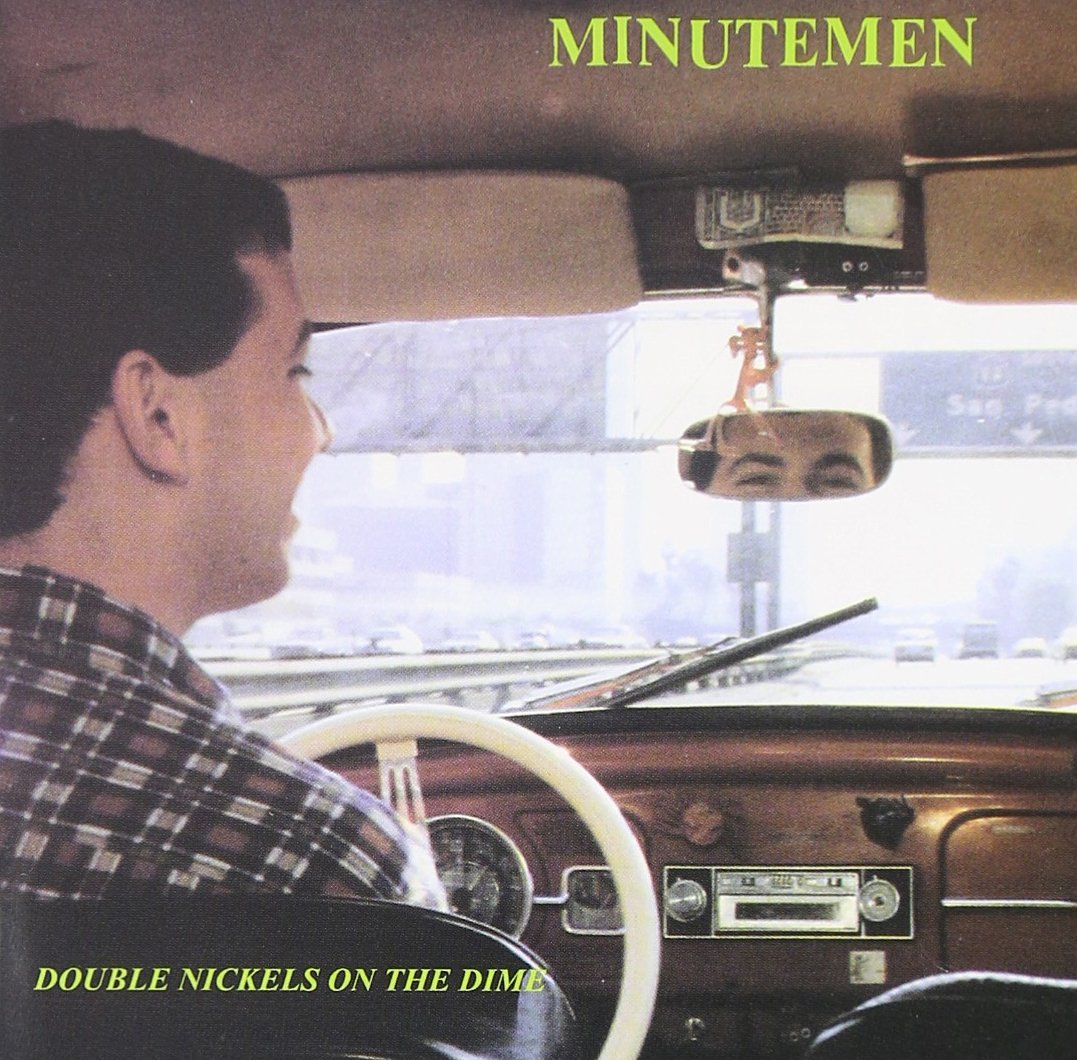
Mike Watt at the wheel on the cover of the Minutemen's 1984 classic album.
Mike Watt at the wheel on the cover of the Minutemen’s 1984 classic album.

The band’s first record, the 7-track, 7-minute “Paranoid Time” came own on Black Flag’s SST label in 1980. It would release four albums on the label, the most successful of which was its double-album opus, “Double Nickels on the Dime,” in 1984, considered to be its masterpiece.

D. Boon also was a visual artist, designing the album covers for five of the band’s records.

By this time, the band had received critical acclaim for its unique sound and vision throughout the rock music world. R.E.M., then in the process of becoming one of the most popular bands in rock music, insisted that the band tour with them for a month’s worth of dates on its 1985 tour.

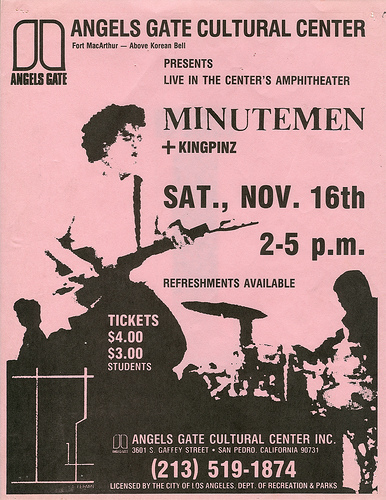
Flyer from the Angels Gate Cultural Center show, Nov. 16, 1985.

On Dec. 13, 1985, the Minutemen played what would be its final show at the Park Center in Charlotte, North Carolina. R.E.M. called the band onstage for its final encore, a cover version of “See No Evil” by Television.

On Dec. 22, 1985, D. Boon was headed for a New Mexico vacation following the tour in Boon’s 1979 Dodge van being driven by his girlfriend, Linda Kite, whom he’d planned to marry in 1986. Kite’s sister, Jeanine Garfias, also was in the van.

Boon wasn’t feeling well and was lying down on a blanket in the rear of the van when an axle broke 50 miles east of Quartzsite, Ariz. The van rolled over, and Boon was killed instantly. Kite and Garfias suffered serious injuries.

He was buried in Green Hills on Jan. 4, 1986.

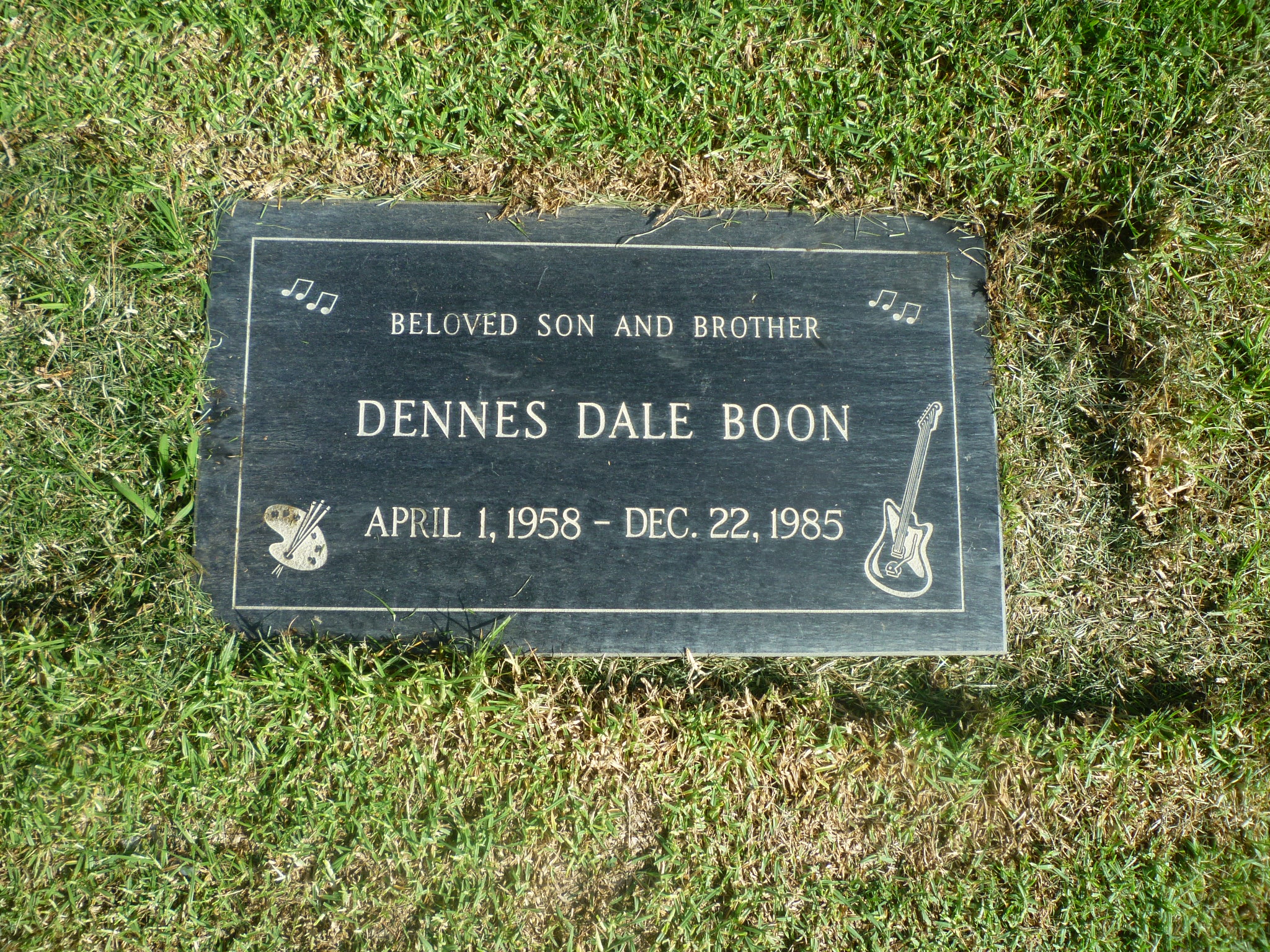
D. Boon's gravestone at Green Hills Memorial Cemetery. (October 2015 Daily Breeze photo)
D. Boon’s gravestone at Green Hills Memorial Cemetery. (October 2015 Daily Breeze photo)

Boon’s bandmates were devastated. They later would regroup and form fIREHOSE, and Mike Watt has gone on to a successful solo career, but there was no replacing D. Boon.

Sources:

Daily Breeze files.

Our Band Could Be Your Life: Scenes From the American Indie Underground, by Michael Azerrad, Back Bay Books, 2001.

A Wailing of a Town: An Oral History of Early San Pedro Punk and More, by Craig Ibarra, END FWY Press, 2015. (Essential.)

“We Jam Econo: The Story of the Minutemen,” a documentary directed by Tim Irwin, 2005.

Some of the South Bay venues played by the Minutemen:

Harbor College, Harbor City (the Minutemen’s first gig, May 30, 1980)
Capones, San Pedro (1980)
Croatian Hall, San Pedro
Dancing Waters, San Pedro
The Barn at Alpine Village, Torrance
Wilson Park, Torrance (May 22, 1982)
Fishermen’s Fiesta, Ports O’ Call (Oct. 2, 1982)
Longshoremen Memorial Hall, Wilmington (June 24, 1983)
Angels Gate Cultural Center (Nov. 16, 1985)

(Source: A Wailing of a Town: An Oral History of Early San Pedro Punk and More, by Craig Ibarra, END FWY Press, 2015.)

(Live at the Angels Gate Cultural Center, Nov. 16,1985)

Logan Cotton: An active community participant for more than six decades

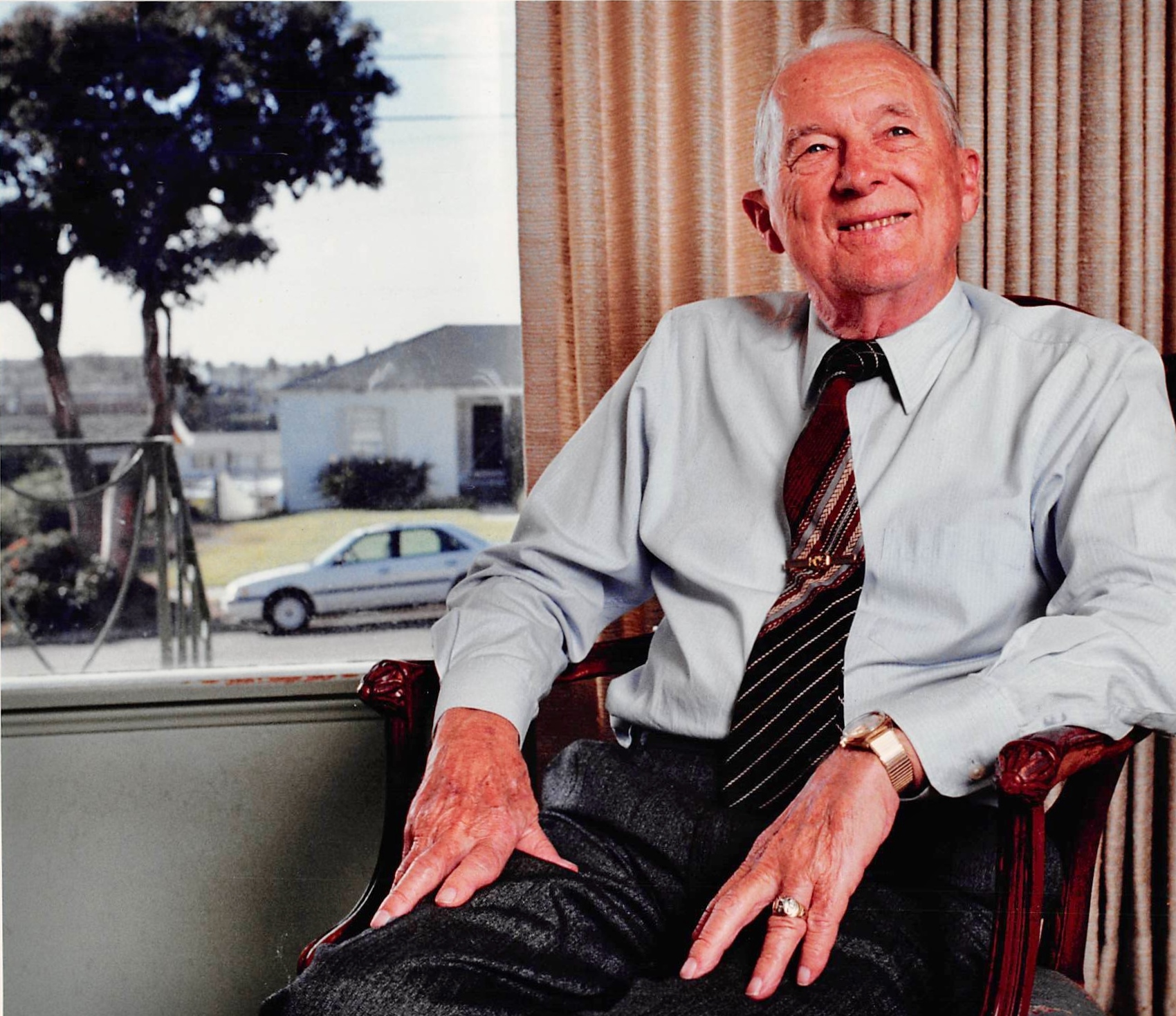
Logan Cotton at 90 in Redondo Beach. Oct. 30, 1990. (Daily Breeze photo by Robert Casillas / Staff Photographer)

We met Logan Cotton briefly in last week’s blog post on South Bay Hospital. At the time, he was heading up a committee to push for passage of a 1956 bond issue to help fund the hospital’s development. (It passed.)

Well, it turns out that was just the tip of the iceberg.

Logan Cotton turns out to have played a prominent role in community leadership in the beach cities for more than a half a century.

Cotton was born on Nov. 2, 1900, in the Amish farming area near New Wilmington, Pennsylvania. He married his wife, Della, on Oct. 2, 1917.

The couple decided to move to California in 1925 after Della returned from a trip there and raved about the state. They settled in a house on 15th Street in Hermosa Beach, and Cotton continued the college education he had begun in Ohio at USC.

He got his accounting degree from USC, and started Logan R. Cotton Accounting and Auditing in 1928.

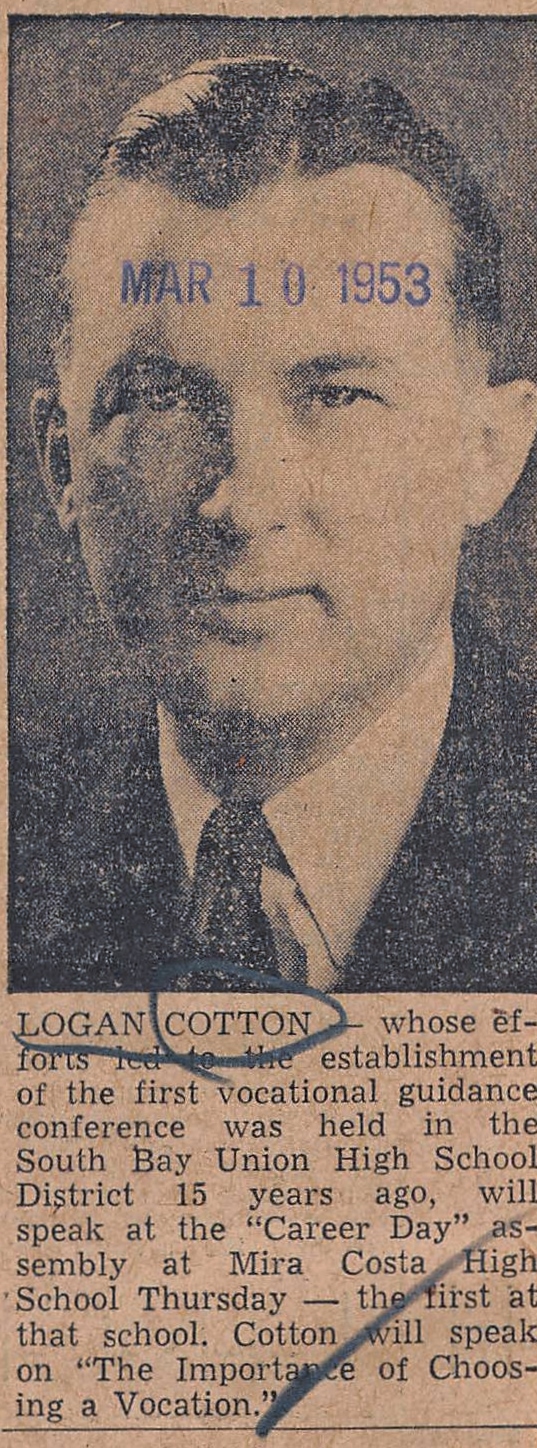
Logan Cotton to speak at Mira Costa High's first-ever career day. Daily Breeze, March 10, 1953.
Logan Cotton to speak at Mira Costa High’s first-ever career day. Daily Breeze, March 10, 1953.

The firm grew rapidly, and he found himself handling accounting and auditing duties for Hermosa Beach, Redondo Beach, and a variety of other cities, school systems and water districts.

Cotton’s lifetime of civic involvement began with his appointment in 1928 to a Hermosa Beach civic commission.

The 1929 stock market crash had a lifelong effect on Cotton.

The wave of hunger and poverty that arose from the arrival of the Depression made him dedicate his life to public service, he told the Daily Breeze in 1990.

In 1930, he ran for and won a seat on the Hermosa Beach City Council. He became mayor of the city in 1931, serving in that capacity through 1932.

“The bathing suit ordinance was the big crusade of ’32. It was very strict — men had to wear tops and women’s suits could be no shorter than four inches above the knee. I was required to spend a lot of time measuring bathing suit lengths,” Cotton reminisced in 1973.

On a more serious note, Cotton and the city engineer of Hermosa used to drive to downtown Los Angeles at 4 a.m. to pick up pay vouchers from the Works Progress Administration office. They would return to Hermosa and distribute them to the jobless, giving them a day’s work and pay.

Cotton only served one four-year term on the Hermosa Beach council, but his lifelong involvement with politics had begun. A staunch conservative Republican, he participated in various local Republican committees and organizations, including the California Republican Central Committee.

He was a strong supporter of former President Richard M. Nixon during Nixon’s successful 1950 run for the U.S. Senate, and, in 1952, became the local chairman heading up the re-election of U.S. Senator William F. Knowland, a noted conservative of the era.

In 1953, a move was launched to have him appointed to the LA County Board of Supervisors following the death of Raymond Darby. Several Hermosa businessmen and civic leaders petitioned Gov. Earl Warren to make the appointment, but it did not come to pass.

Cotton was one of the all-time joiners. He believed in involvement on all levels. The first service club he joined was the Kiwanis in 1928, and he was an active Kiwanian for the rest of his life. He served as the group’s District Governor, and chairman of its International Committee of Public and Business Affairs, among other posts.

What other groups was he involved in?  Pull up a chair: President of the South Bay Shrine Club, Exalted Ruler of the Redondo Beach Elks Club, president of the South Bay Hospital Cancer Foundation, board chairman of the tourism-boosting group the All Year Club of Southern California, board member of the California State University, Dominguez Hills advisory board, chief patron of the Los Angeles County Lifeguard Association, lifelong member of the Masonic Temple, president of the Salvation Army Advisory Board, head of the Redondo Beach Round Table, even chair of the International Surf Festival for several years during the 1970s.

Oh, and member of the organizing committee for the 1932 Summer Olympics held in Los Angeles.

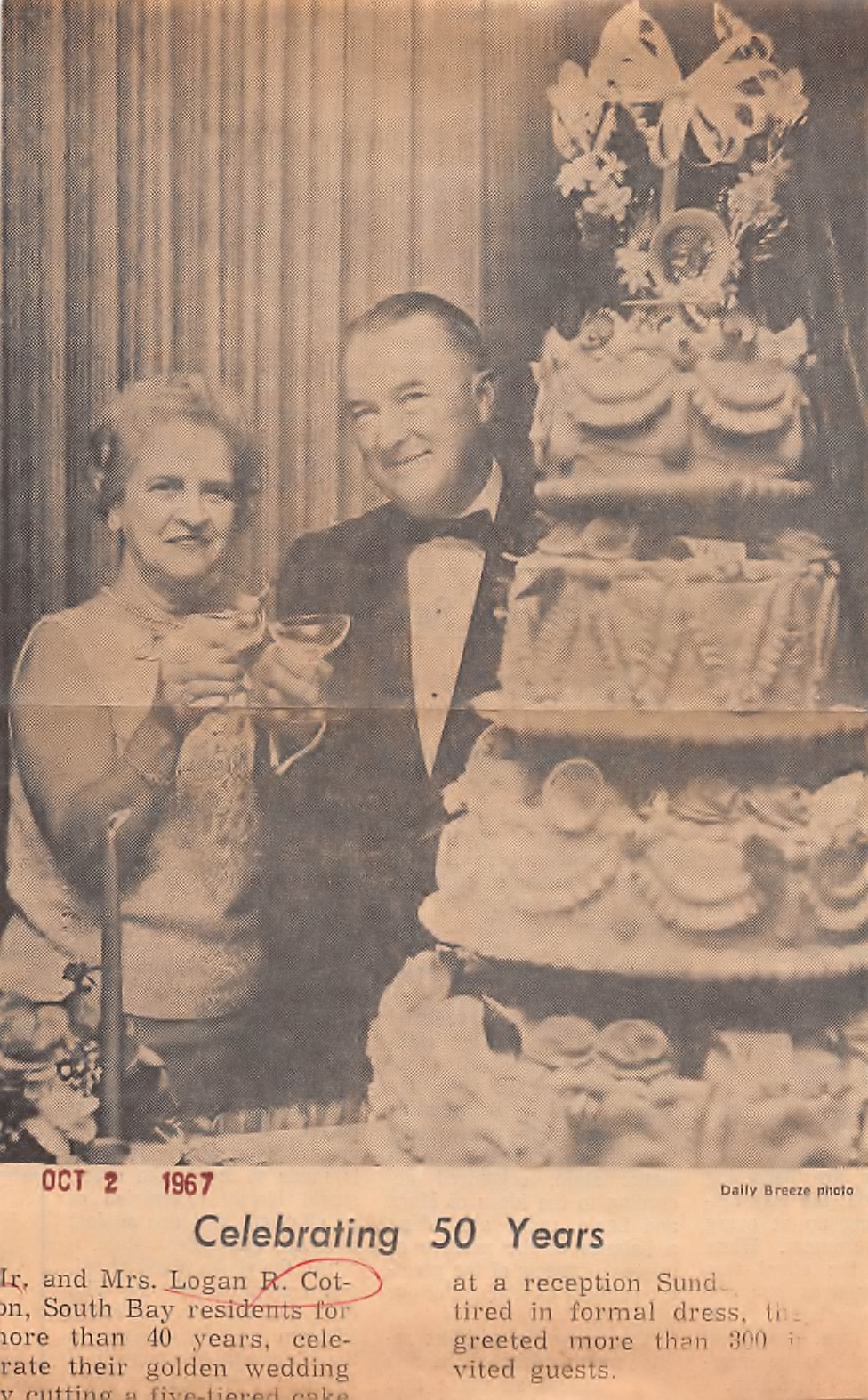
Logan and Della Cotton at the party celebrating their 50th wedding anniversary, which was attended by more than 300 invitees. (Daily Breeze, Oct. 2, 1967.)

In 1964, he was one of 48 Americans selected to tour Radio Free Europe installations in Portugal and near the Berlin Wall in West Germany, where he met with Berlin’s Mayor Willy Brandt, who would later become the country’s chancellor in 1969.

In 1967, 300 invited guests came to a celebration of his 50th wedding anniversary at the Manhattan Room of the Pen and Quill Hotel in Manhattan Beach. By this time, the Cottons were living on Gertruda Avenue in Redondo Beach, where Cotton was proud to say he took a morning pool swim every day  well into his 90s.

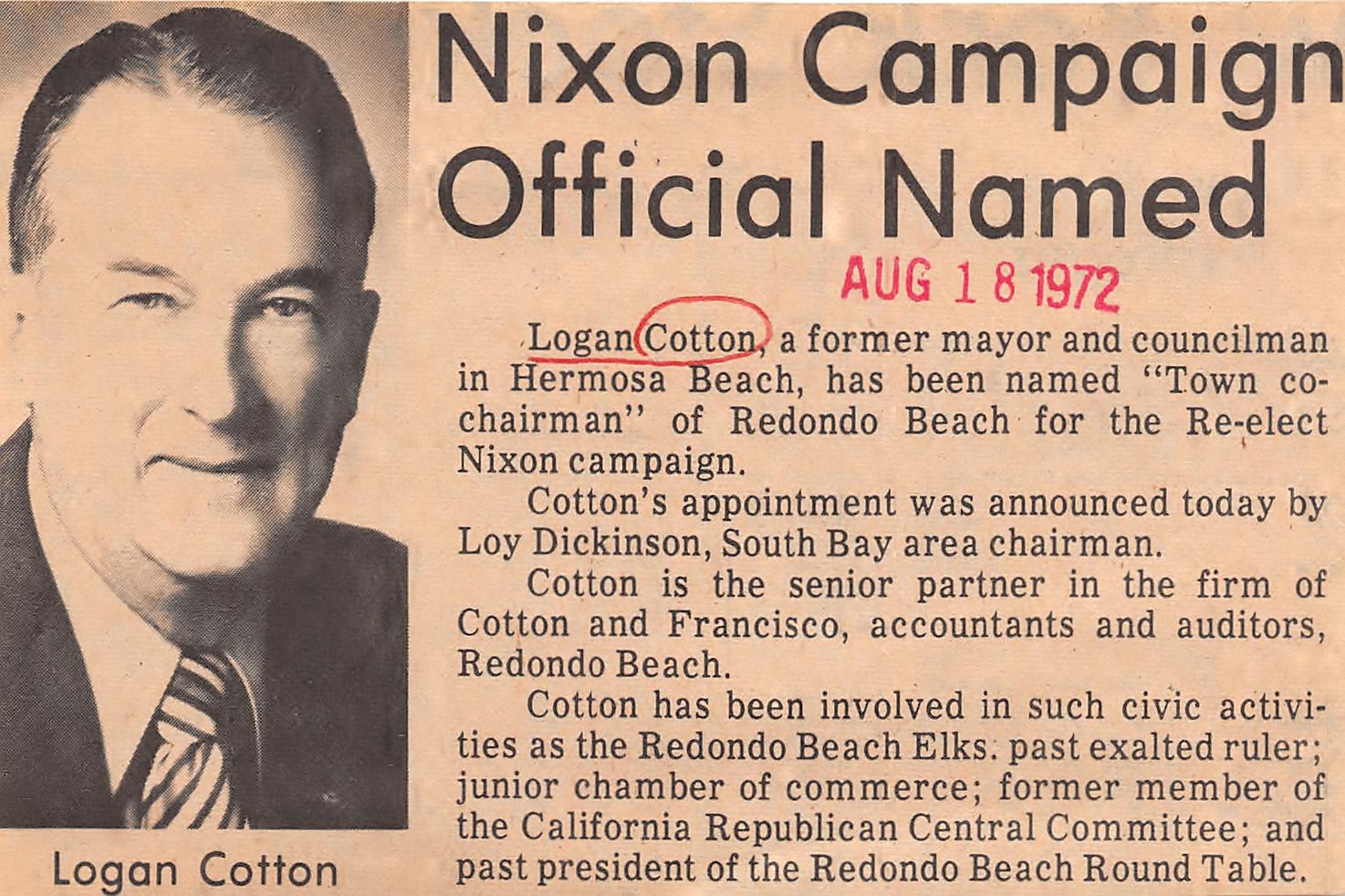
Logan Cotton named in Richard Nixon's 1972 presidential re-election camapign. Daily Breeze, Aug. 18, 1972
Logan Cotton named in Richard Nixon’s 1972 presidential re-election camapign. Daily Breeze, Aug. 18, 1972

In 1972, he was named town co-chairman for the campaign to re-elect President Richard Nixon, but he was deeply disillusioned by the Watergate scandal that followed.

He told Daily Breeze reporter Dirk Broersma in 1981, “He (Nixon) was a brilliant individual, but I don’t know what happened to him … I think he surrounded himself with disloyal people, with these younger, eager folks that had no particular respect for government.”

Cotton also was involved with President Ronald Reagan’s 1980 presidential campaign, serving as his regional finance director.

In 1975, Cotton was honored for his decades of service by being named Redondo Beach Citizen of the Year. In 1985, the South Bay Cancer and Health Care Foundation gave him an additional Citizen of the Year Award.

After 70 years of marriage, his wife, Della, died in May 1988.

Cotton retired from his accounting practice in 1980, but he remained active in community affairs and fraternal organizations up until the time of his death on Thursday, July 2, 1992, at the age of 91.

Tributes to Cotton’s more than six decades of community participation and leadership poured in from civic leaders throughout the South Bay,.

Perhaps Cotton himself said it best to the Daily Breeze in 1981: “As long as I live, I’m going to contribute. As long as I have any energy about me, I’m going to give what I can.”

He was a man who kept his word.

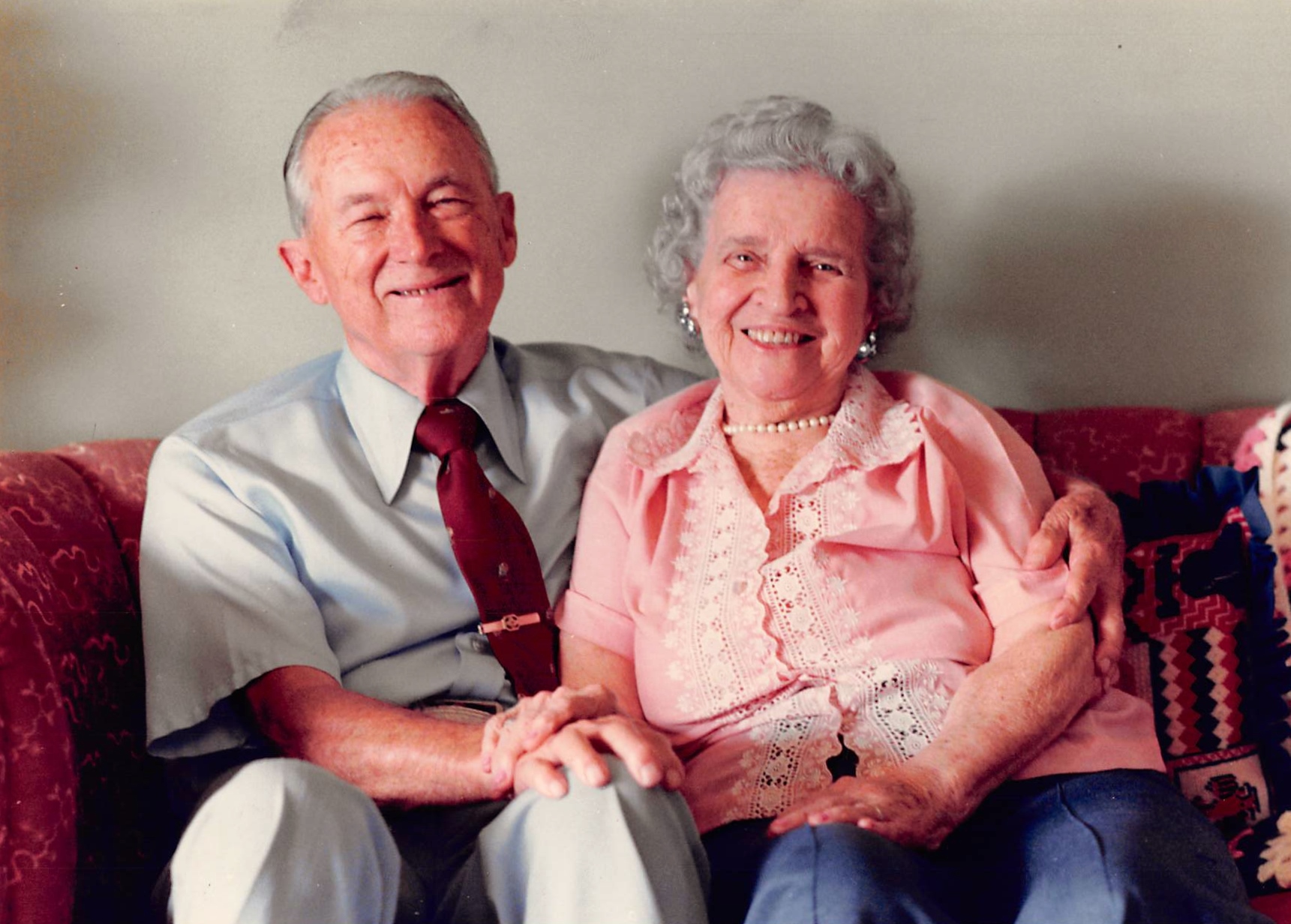
Logan Cotton and his wife, Della, on the celebration of their 70th wedding anniversary. Oct. 5, 1987. (Daily Breeze staff file photo)
Logan Cotton and his wife, Della, on the occasion of their 70th wedding anniversary. Oct. 5, 1987. (Daily Breeze staff file photo)

Source:

Daily Breeze files.

Beach cities don’t take no for an answer in bid to create South Bay Hospital

South Bay Hospital in Redondo Beach. Feb. 1, 1985. (Daily Breeze file photo)

Imagine the dismay among those pushing for new hospital in the beach cities area of the South Bay when state officials denied their request in 1947 after two years of struggle because, “The South Bay is a beach resort and doesn’t need a hospital.” The state instead recommended beefing up existing hospitals in the area.


In that same year, 1947, a survey by Minnesota hospital consultants James A. Hamilton and Associates already had concluded that the beach cities would need a 238-bed hospital to meet demand by 1950, only three years in the future. Hospital backers were asking only for a 100-bed facility.


Frustrated by having to travel to use the only two other large hospitals nearby at the time, Torrance Memorial and Hawthorne Memorial, beach cities residents and health authorities began pulling together in 1951 to mount another effort.


Dr. Frederic Ewens of Manhattan Beach pointed out that a law passed in 1951, the Defense Housing and Community and Facilities Service Act, stipulated that federal funds should be used to shore up areas, such as the South Bay and the beach cities, where defense workers have increased the population to the point where improvements in sewers, police and fire departments and hospitals had become necessary.


2015_12_02_16_27_290001
So discussion continued on how to go about making the hospital a reality. The first step, the creation of of a hospital district, began in late 1953 with the appointment of a joint 21-member committee drawing members from Manhattan, Hermosa and Redondo.


The Los Angeles County Board of Supervisors held the power to sanction the new hospital district, so the hospital’s boosters spent the next year gathering over 5,000 signatures in support of the hospital and submitting them to the Board, which scheduled an election for Jan. 11, 1955, that would authorize the creation of the district.


The vote wasn’t close: 5,148 for the district, 824 against.


On Feb. 7, 1955, it became official when the five new directors of the South Bay Hospital District – Herman R. Brandt, Auten F. Bush, Foster Day, Clyde Marsh and Mark Wood – were sworn into office. Its first official meeting was held in the Manhattan Beach City Council chambers on Monday, Feb. 28, 1955, four years after the drive for the new hospital began.


It might seem like we’ve come a long way to get this far, but the hospital itself would not become a reality for several more years.


The immediate future was filled with haggling with the state over just how many people were in the South Bay Hospital District and whether it qualified for government funding. Then, a bond issue would need to be placed on the ballot to complete financing for the project.


Government funding eventually came through for the $3.5-million project, with the state and the feds chipping in about half of the amount. A $1.5 million bond issue was placed on the ballot for Sept. 18, 1956, to cover the remainder.


Longtime civic leader Logan Cotton, the late civic leader who deserves a future blog post for all of his South Bay activities over the years, became chairman of the Citizens Hospital Group pushing for passage of the bond measure. It passed, but the vote was much closer this time: 6,601 to 3,242, a mere 117 votes over the two-thirds majority needed for passage.


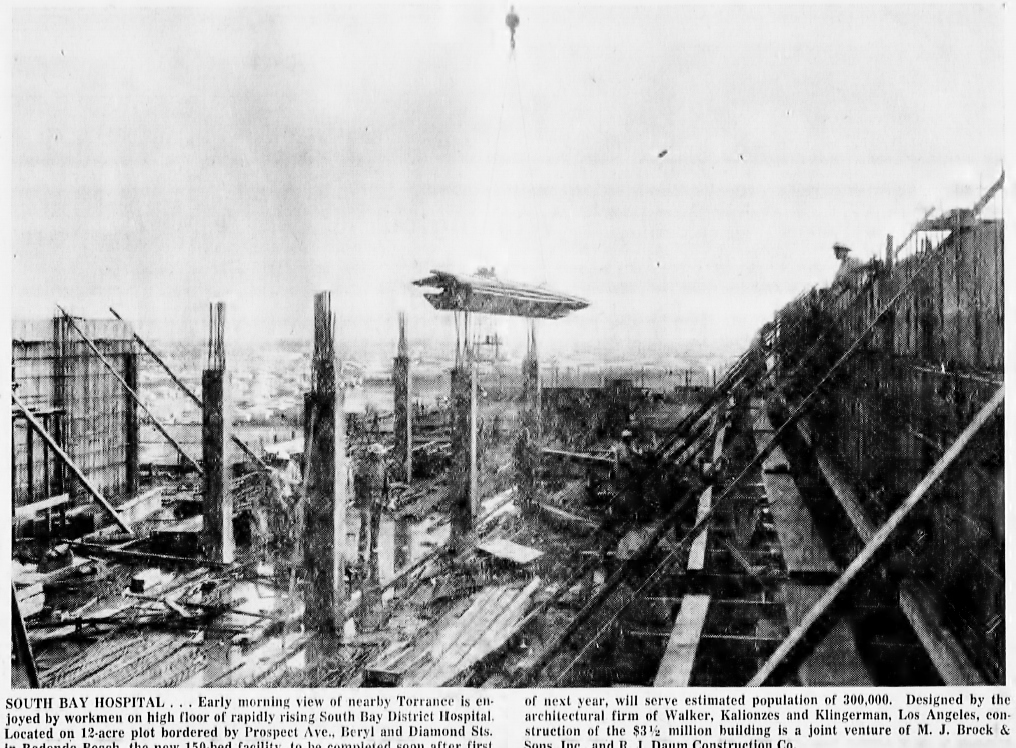
South Bay Hospital under construction, from the Torrance Herald, Aug. 2, 1959, Page 3. (Courtesy Torrance Public Library Historical Archives website)

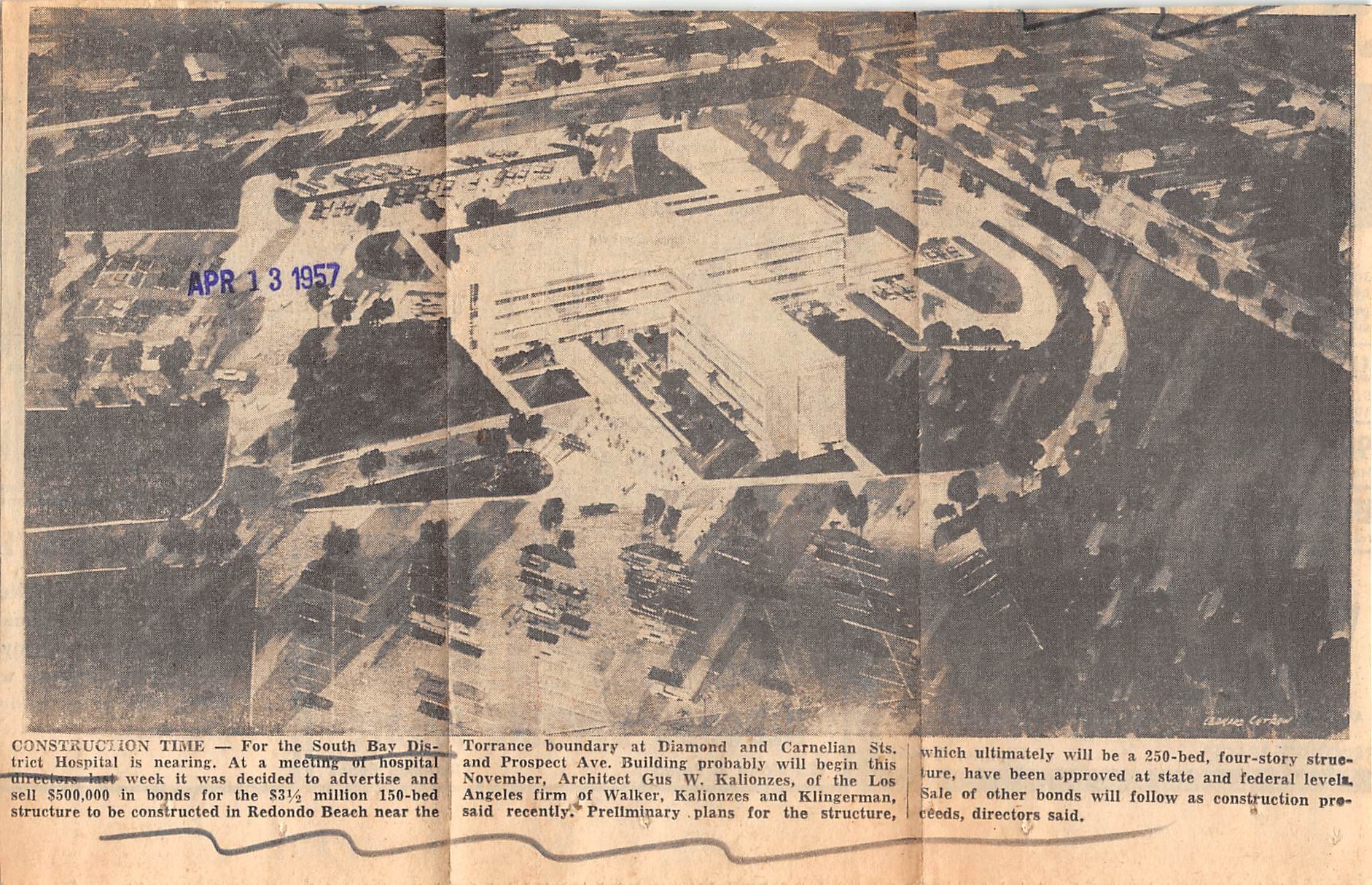
With funding in place, the 146-bed hospital project finally began to gather steam. A site was chosen: 12 acres of undeveloped land (believe it or not) bounded by Prospect Avenue, Diamond Street, and the Torrance city limit to the east. Preliminary sketches were drawn up as well.


The hospital’s backers weren’t concerned by a concurrent plan to build a new Catholic hospital, Little Company of Mary, in Torrance. Both facilities were needed to support the booming population of the area, the directors maintained, and went full speed ahead with their own plans.


Construction began on the South Bay Hospital project in late March of 1957, though the official groundbreaking wasn’t held until June 20. General contractors were M.J. Brock & Sons and R.J. Daum Construction, both Los Angeles firms.


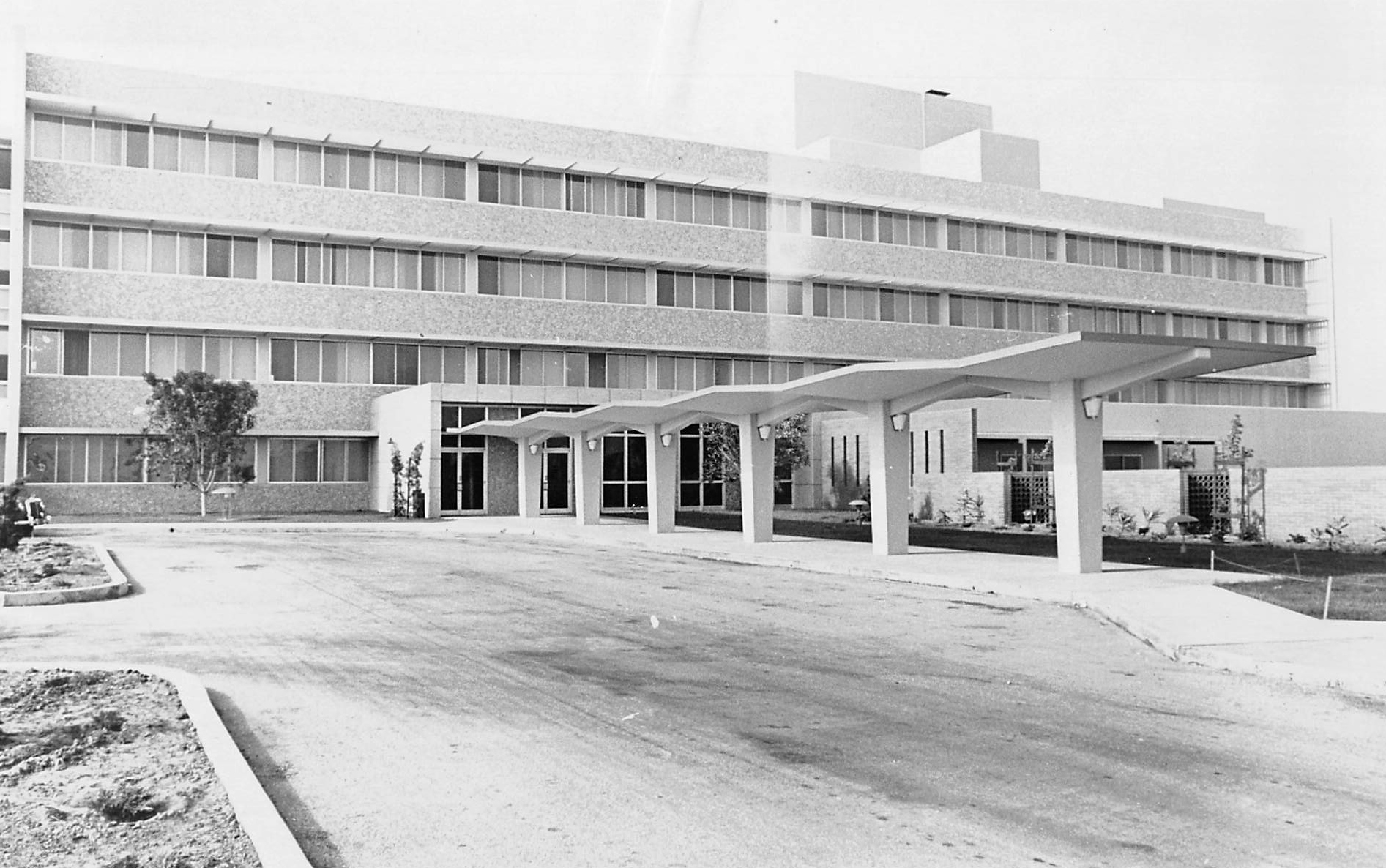
Landscaping is unfinished and signage lacking in this undated photo of South Bay Hospital circa 1960. (Daily Breeze file photo)

Russell B. Williams was hired from UCLA to be the hospital’s first director in November 1959. The hospital reached the 95% completion rate in April 1960.


The four-story hospital was built with a careful eye toward expanding by an additional 100 beds in a future project, a design strategy that brought the Los Angeles architectural firm of Walker, Kalionzes and Klingerman praise from the professional trade publication Architectural Record.


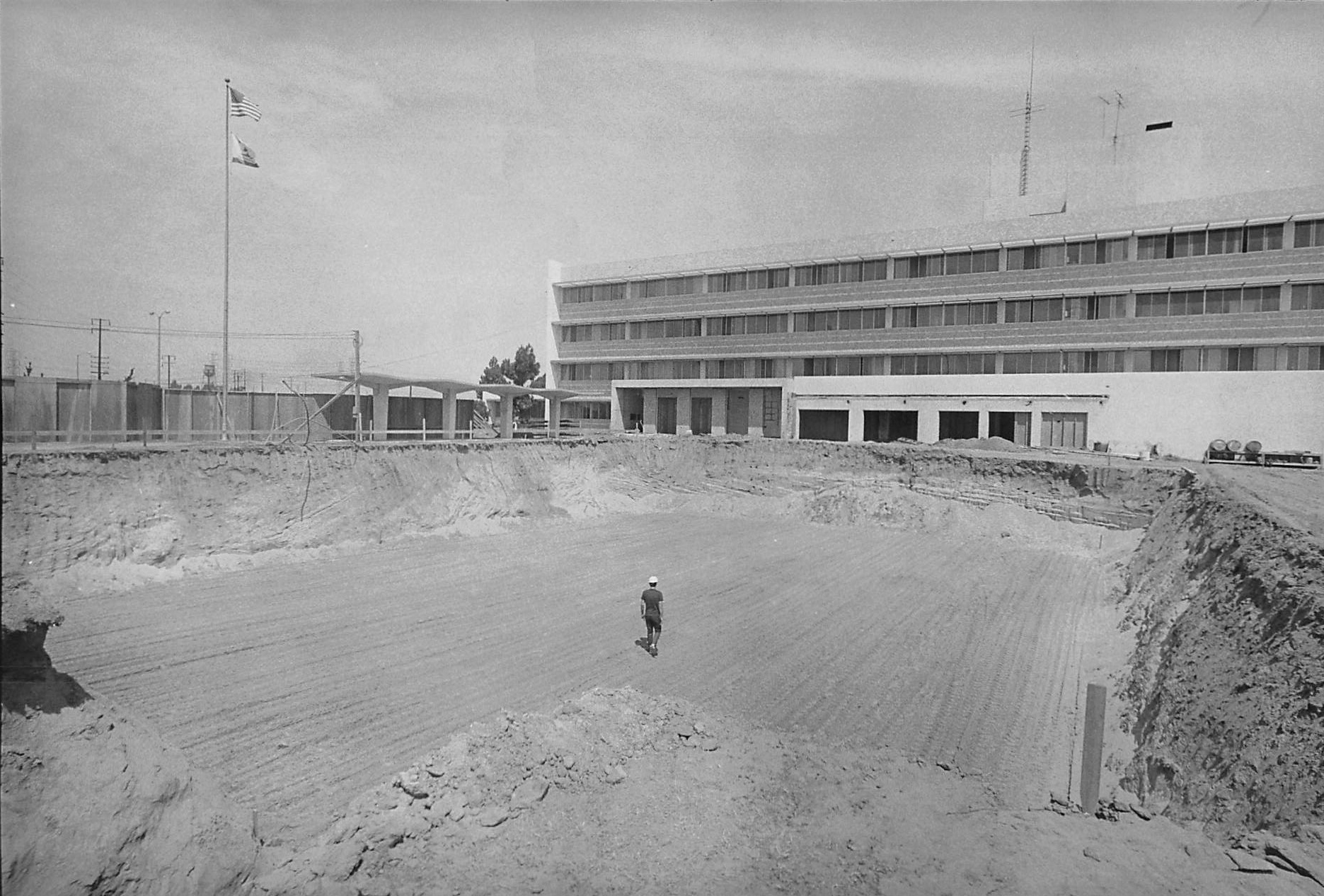
A workman walks through the construction site for the new South Bay Hospital wing in 1968. The wing was planned for in the original construction. (Daily Breeze file photo)

Daily Breeze publisher Robert Curry took the role of master of ceremonies at the dedication of the completed hospital on Sunday, July 31, 1960.


More than 1200 South Bay residents toured the new facility after the dedication ceremonies were concluded, and the hospital officially opened for business on Wednesday, Aug. 3, 1960.


During its soft opening the day before, Mrs. Dale Bryson gave birth to Kevin Scott Bryson, who became the first baby born in a hospital in the city of Redondo Beach. By the hospital’s fourth anniversary in August 1964, 5,000 births had occurred there.


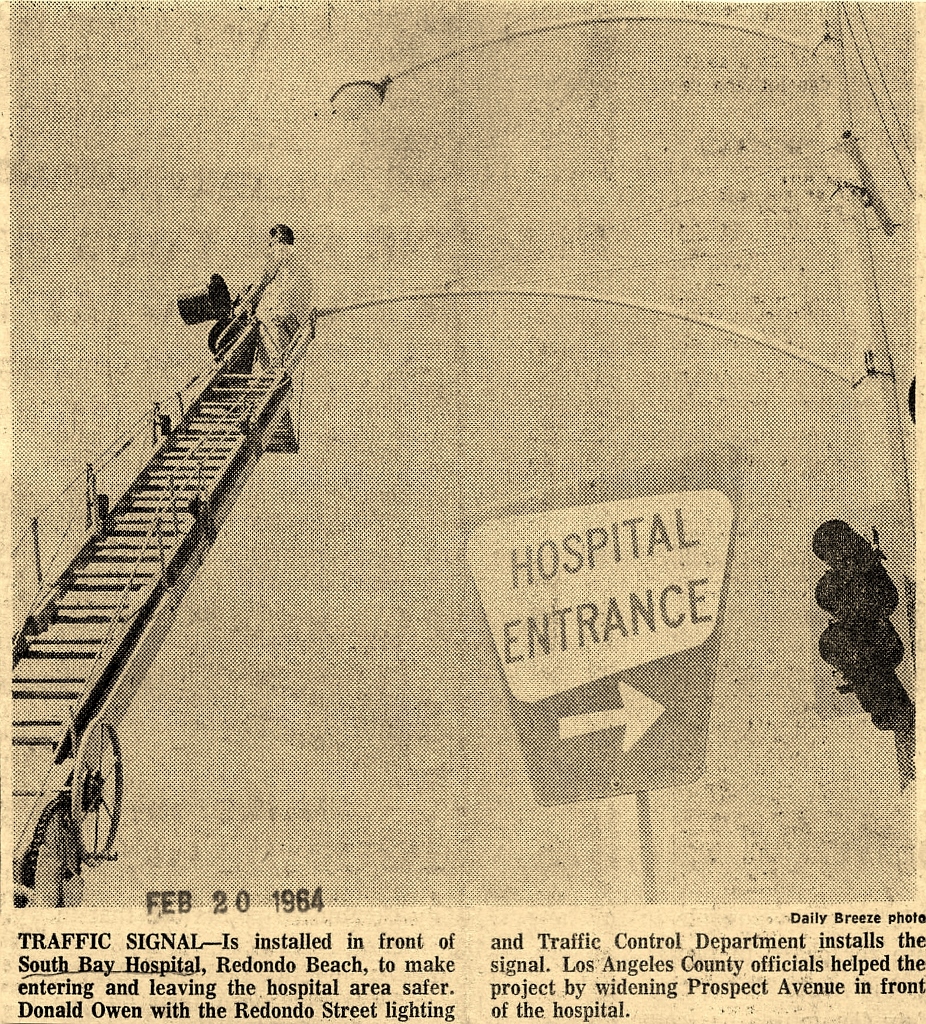
A new traffic signal is installed on Prospect Avenue for the hospital in this photo from the Daily Breeze, Feb. 20, 1964 edition.

In November 1960, Los Angeles County officials designated South Bay Hospital as the South Bay area’s official emergency medical facility.


The hospital boomed during the 1960s, and construction began on the planned new wing of the facility, now trimmed to 70 beds, in August 1968. It opened in 1970.


Facing increasing competition from private hospitals such as Torrance Memorial Medical Center and Little Company of Mary, the publicly owned South Bay Hospital began to lose patients and falter financially in the late 1970s.


Layoffs became increasingly common. By 1984, the 203-bed hospital was forced to give up its publicly owned status. The South Bay Hospital District signed a lease deal with American Medical International in 1984, with AMI taking over operation of the facility.


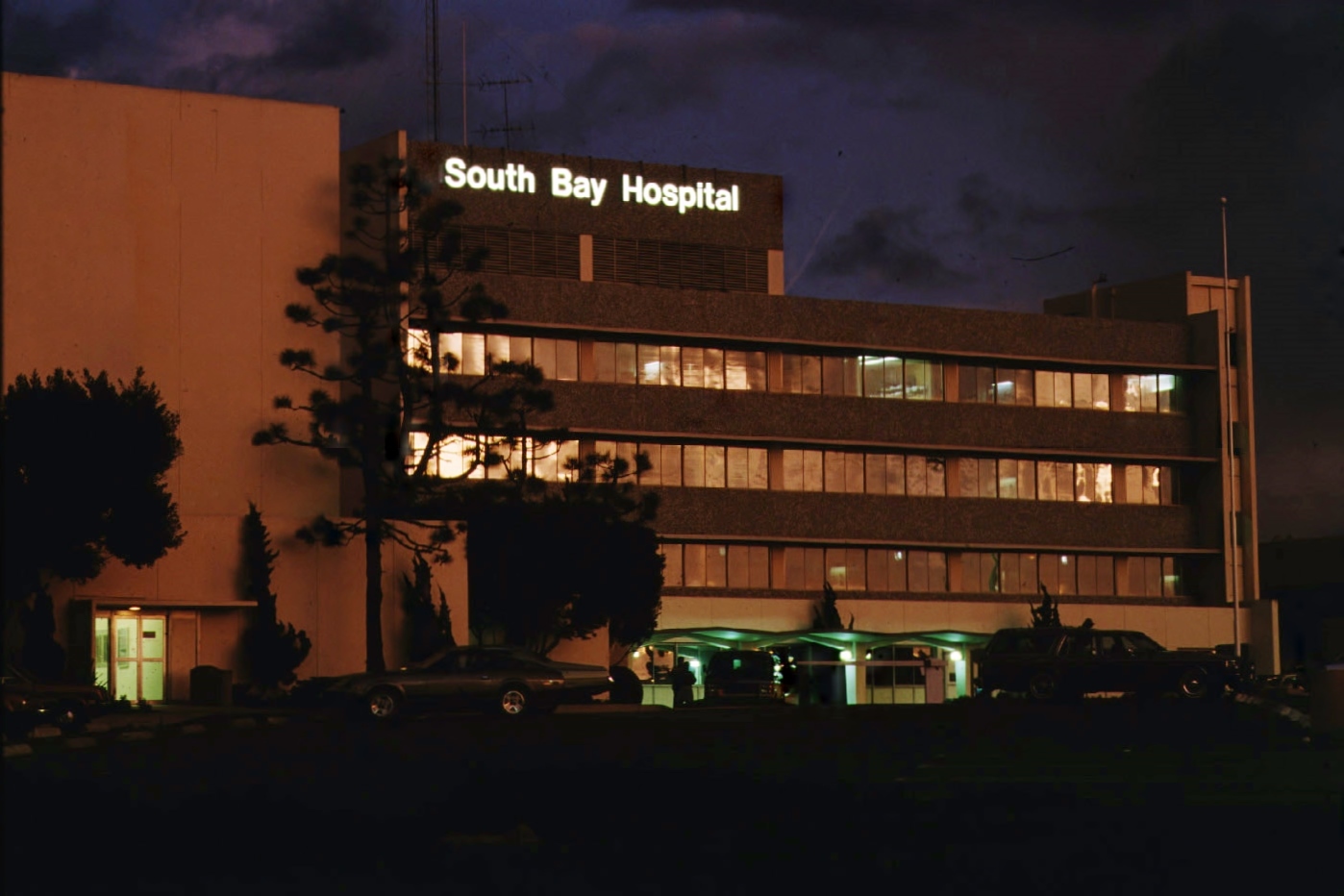
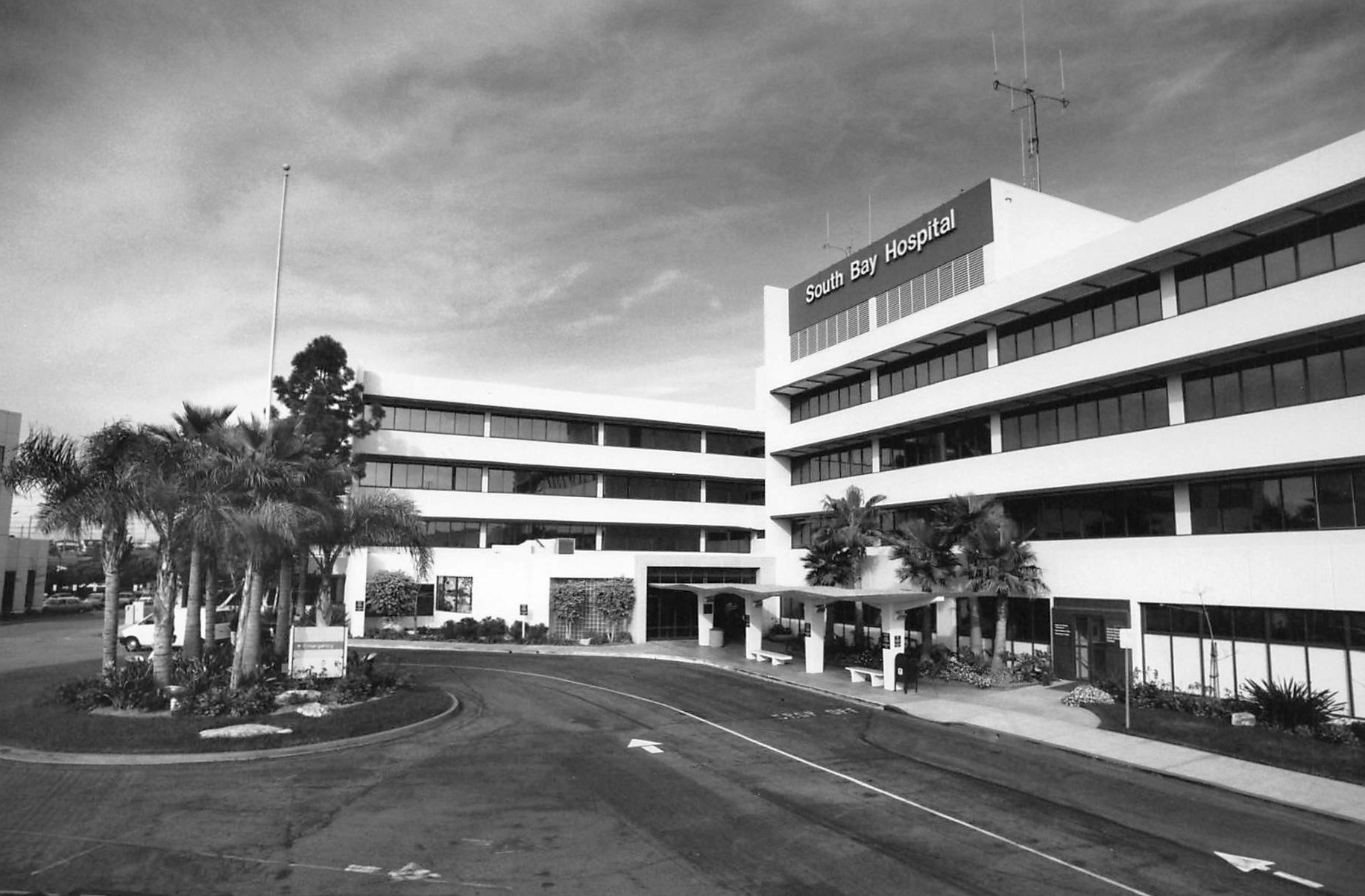
South Bay Hospital in 1992. (Daily Breeze file photo)

Two name changes followed: In 1994, the South Bay Hospital District changed its name to the Beach Cities Health District, and, in February 1995, South Bay Hospital became South Bay Medical Center.


Its financial problems continued despite the name change, however, with AMI’s attempts to sublease the hospital to Daniel Freeman Medical Center in Inglewood ended without a deal in November 1994.


Tenet Healthcare Corp. assumed control over the hospital when it acquired AMI in 1995. By then, the hospital’s future was becoming increasingly bleak, with fewer doctors signing on as residents. In 1997, Tenet announced that it would give-up its lease with the Beach Cities Health District in May 1998, essentially abandoning the hospital.


After 38 years of operation, South Bay Medical Center closed its doors for good on Sunday, May 31, 1998. 


Various plans had been floated following Tenet’s withdrawal, including razing the hospital and building assisted living residential housing there, or leasing its facilities to a variety of interested health care providers.


Beach Cities Health District chose to make a lease deal with Little Company of Mary Health Services, who remodeled the existing facility and turned it into Beach Cities Ambulatory Care Center, a walk-in clinic offering urgent care and emergency care, but no treatment involving overnight hospital stays.


The remodeling took about six months, and Beach Cities Ambulatory Care Center opened at the newly renamed Beach Cities Health Center in September 1998. Names and configurations of the various buildings changed over the years. Providence Little Company of Mary (Providence was added to the name in 2009) now operates the Providence Little Company of Mary Medical Institute at the site, a walk-in urgent care facility.


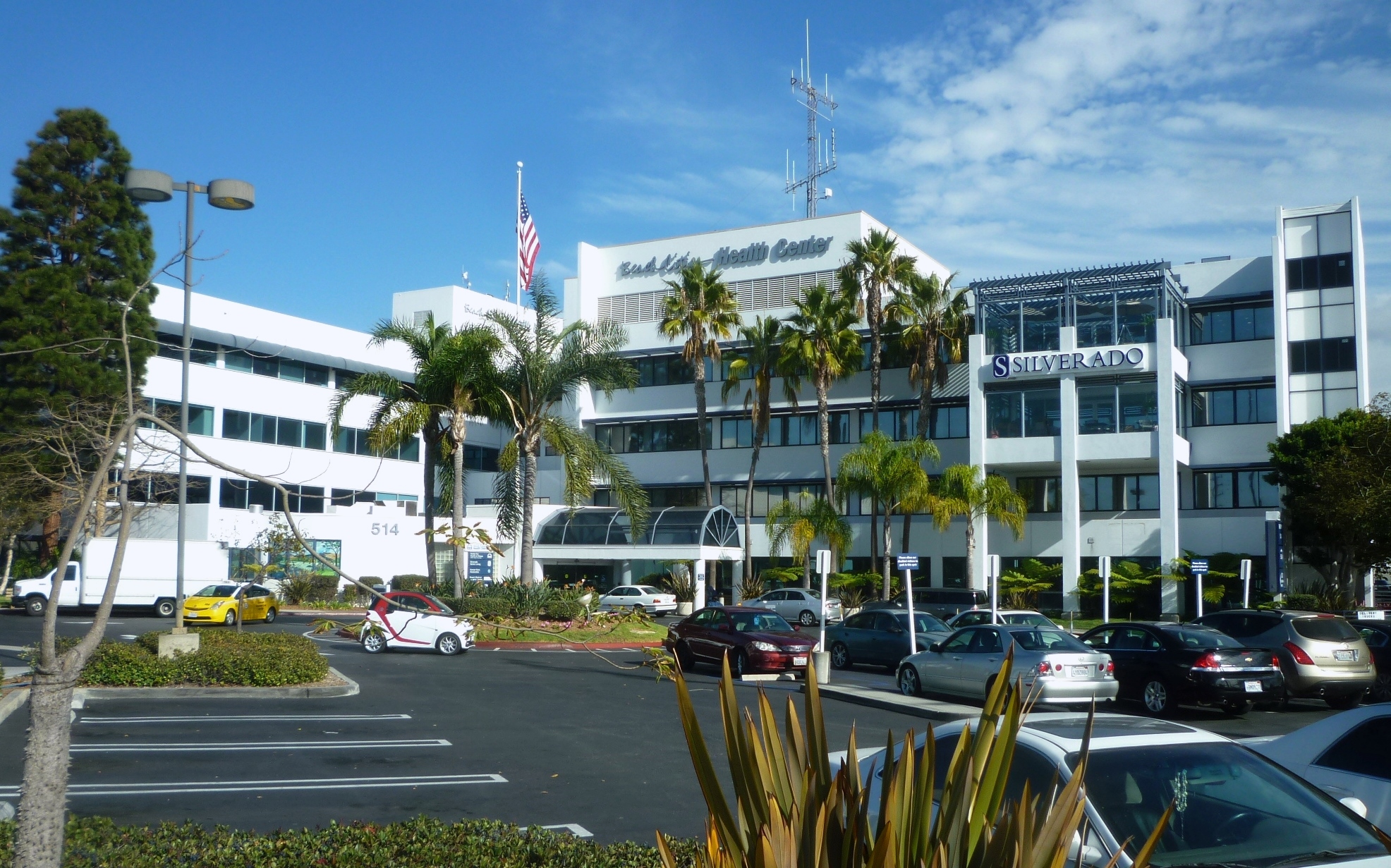
Beach Cities Health Center in Redondo Beach. (December 2015 Daily Breeze photo)

The Beach Cities Health District continues to operate the Beach Cities Health Center at the former hospital site, leasing its space to a variety of outpatient health care providers.

Sources: 

Daily Breeze files.

Los Angeles Times files.

Torrance Herald files.
Frank Robinson turns a rejected idea into the world’s largest maker of civilian helicopters

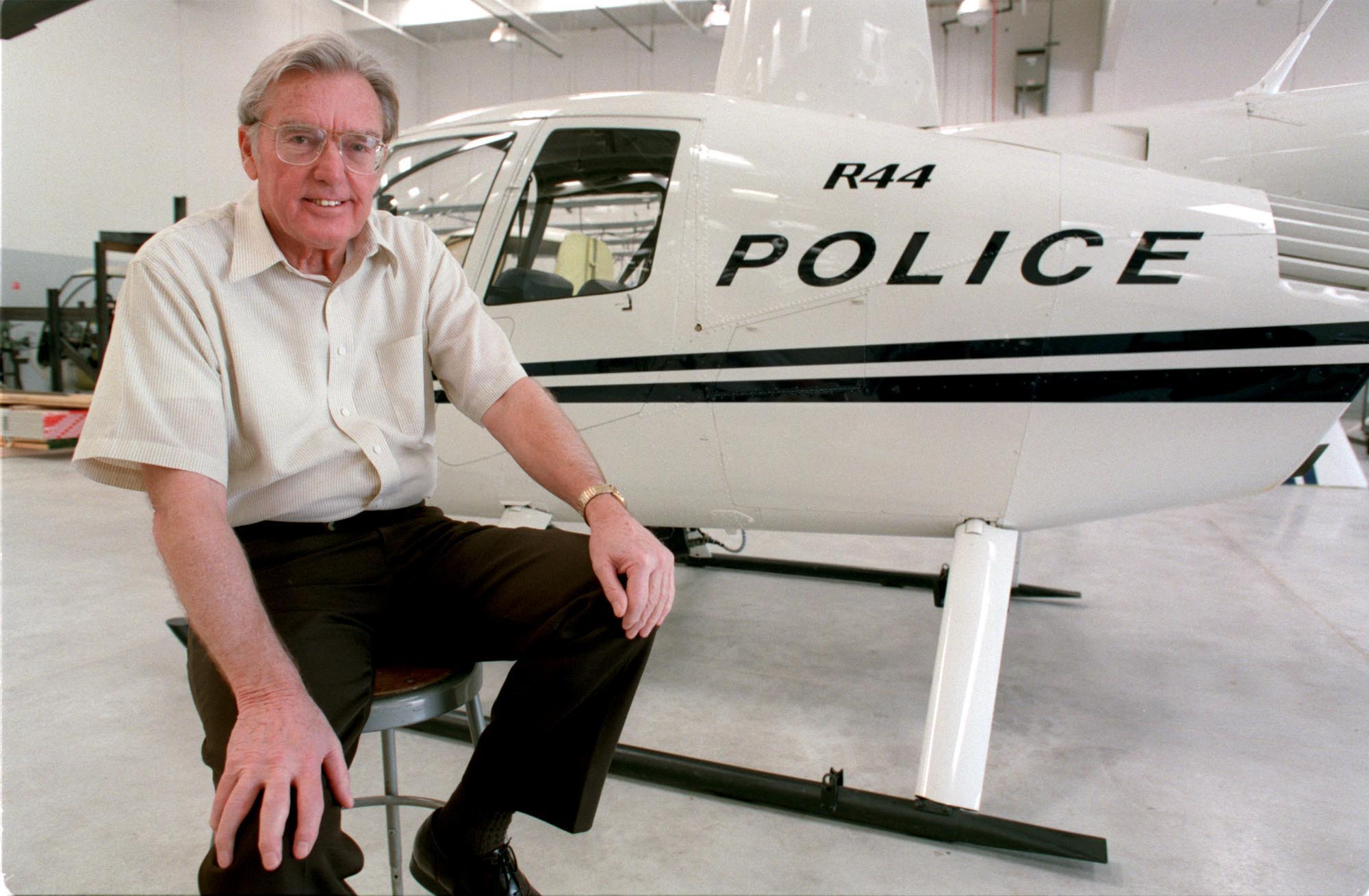
Frank Robinson of Robinson Helicopter Company, Torrance. Behind him is the R44 helicopter, police version. (1998 Daily Breeze file photo)

Frank Robinson tried to tell his employers in the aerospace industry repeatedly in the late 1960s and early 1970s that a viable market existed for non-military helicopters.

They weren’t interested, so, together with financial partner C.K. LeFiell, he founded Robinson Helicopter, now the world’s leading manufacturer of civil helicopters and one of the largest employers in Torrance, in his Rancho Palos Verdes home in June 1973.

Franklin Davis Robinson was born in Carbonado, Washington, on Jan. 14, 1930, and grew up during the Depression era as the youngest of four children.

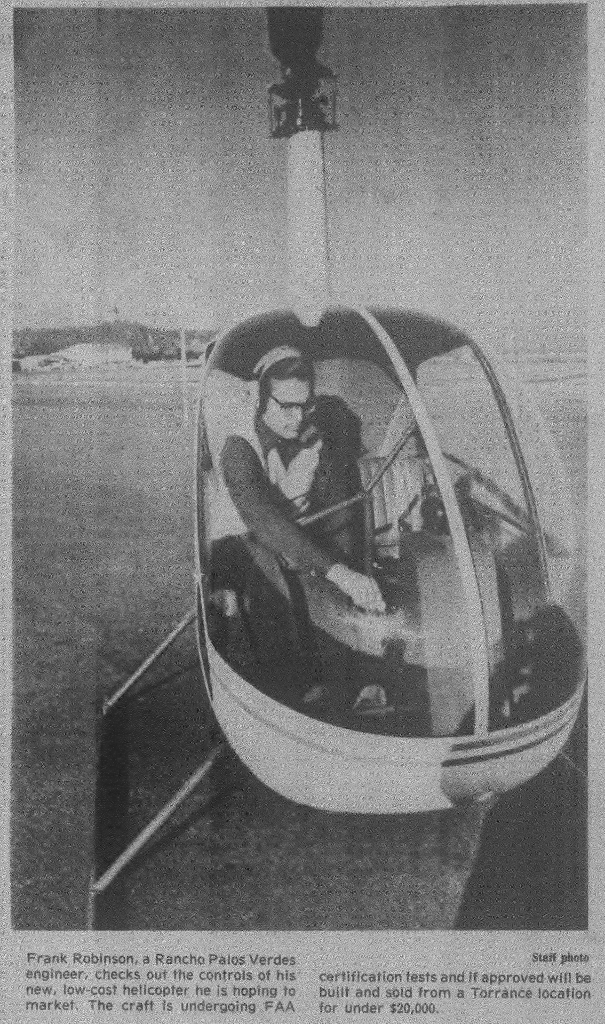
Daily Breeze, Oct. 19, 1975 edition.
Daily Breeze, Oct. 19, 1975 edition. (Click to enlarge.)

At the age of nine, he saw a photo of helicopter pioneer Igor Sikorsky with one of his creations in the Seattle Post-Intelligencer, and he was hooked.

He graduated from the University of Washington with a mechanical engineering degree (BSME) in 1957, and did graduate work at the University of Wichita, focusing on helicopter design.

He worked for several aircraft manufacturers after graduation: Cessna, Umbaugh, McCulloch Motor Co., Kaman Aircraft, Bell Helicopter, and, in 1969, Hughes.

It was while at Hughes that he decided to go out on his own. He was convinced that he could build a civilian helicopter that would sell for under $20,000 – the cheapest helicopter at the time sold for $60,000 – and that could compete in the market with general aviation aircraft such as the Cessna 172 or the Piper Cherokee.

He spent the first two years of the company’s existence working on the prototype for what would become Robinson’s first product, the two-seat R22 helicopter. Its manufacture took place inside a small hangar at Torrance Municipal Airport.

In August 1975, Robinson took the R22 out for its maiden flight at Torrance. He later told the Daily Breeze, “The first test flights were so flawless, they were eerie.”

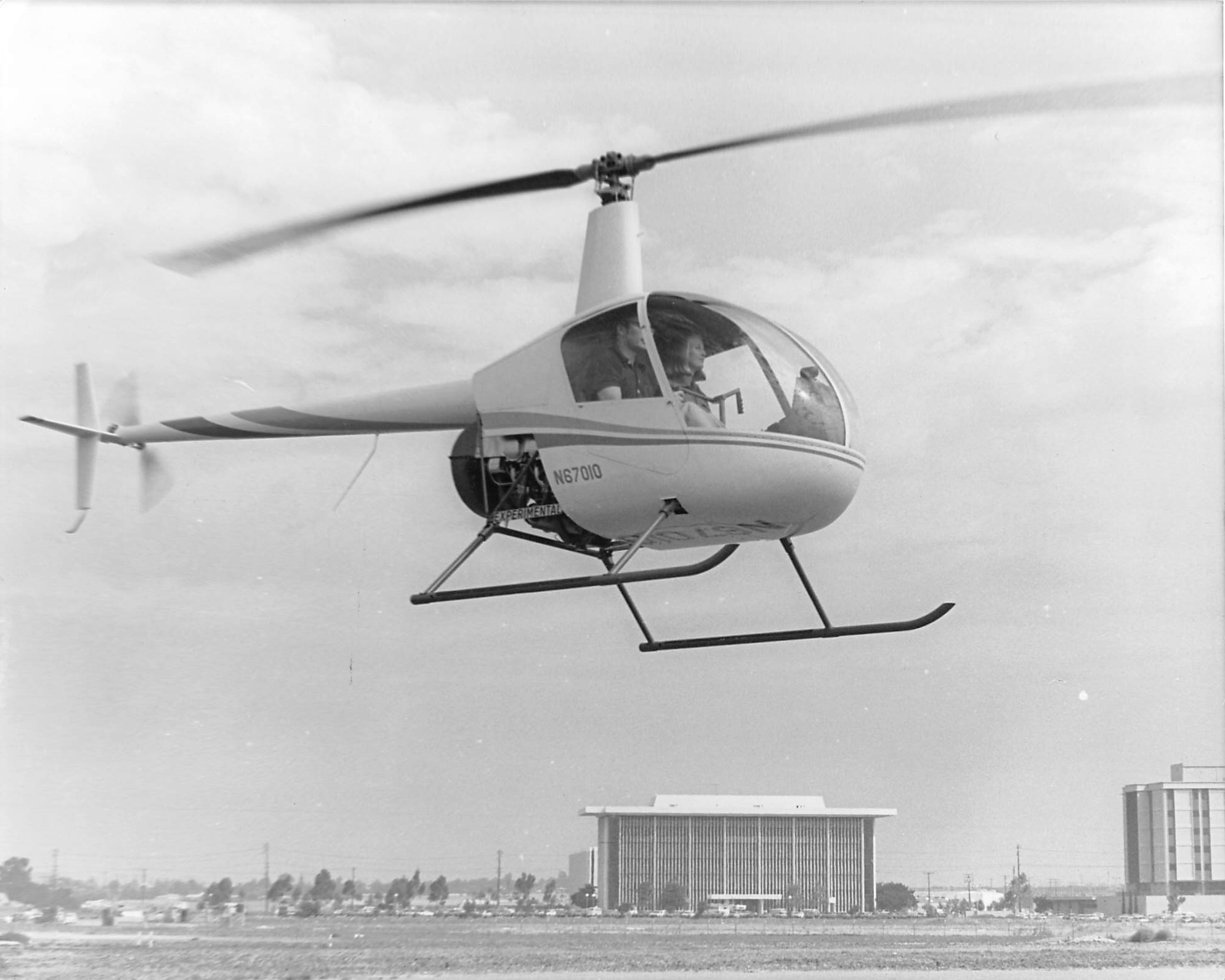
Frank Robinson pilots his first R22 helicopter in Torrance on Oct. 17, 1975. (Daily Breeze file photo)

While still awating FAA certification for the aircraft, he and LeFiell decided to begin production on the first 50 helicopters. LeFiell had retired from his Santa Fe Springs metal fabricating company to Hawaii, but would return to the mainland every few months with new precision parts he had made for the R22 in his basement.

In January 1978, Robinson Helicopters announced that it had leased a large manufacturing plant at the Torrance Municipal Airport for its factory and corporate offices. One of the stipulations of the lease was that the firm’s helicopters had to pass the City of Torrance’s strict new airport noise regulations, which they did.

When the FAA certification became official in March 1979 after more than three years of testing, Robinson Helicopter was able to sell its first R22, six years after the company was founded. It would become the world’s top-selling civil helicopter, even though Robinson couldn’t quite meet his $20,000 price tag: the first batch of R22s sold for $39,850 each.

33 R22s sold by Robinson were grounded temporarily while the FAA investigated a May 3, 1980, crash in Rancho Palos Verdes that killed two people. The ban was lifted when it was determined that the helicopter itself was not at fault.

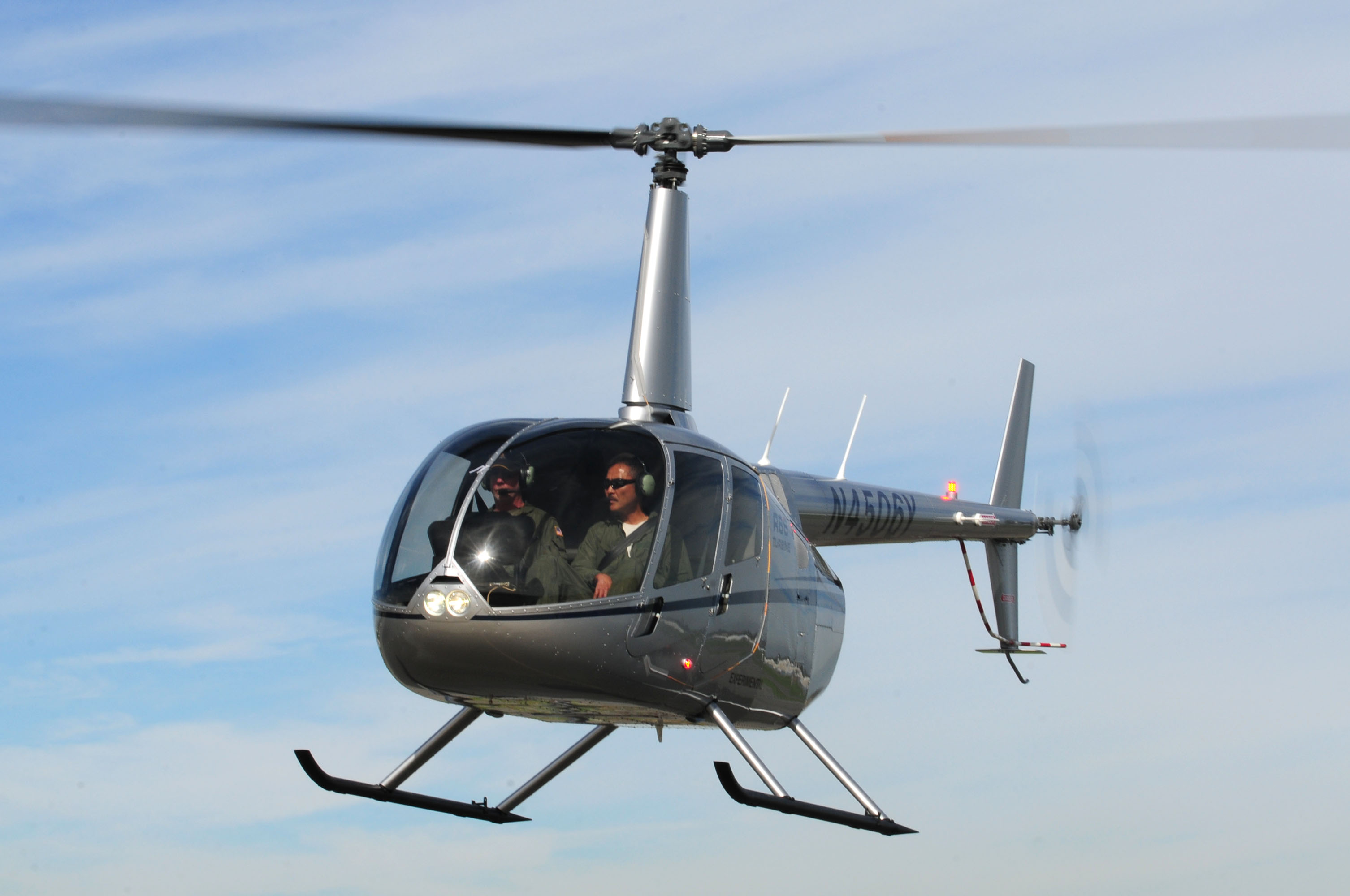
Robinson Helicopter Company in Torrance received certification from the FAA in 2010 for the turbine-powered R66. Test pilots take on of the first production R66 helicopters for a test flight. The helicopters are completely manufactured in Torrance and the company is the single largest private employer in the city. Oct. 29, 2010. (Daily Breeze photo by Steve McCrank / Staff Photographer)

Robinson’s second model, the R44, a four-seat copter, was developed during the 1980s. Its first flight was in March 1990, and deliveries to customers began in 1993. The R44 was larger than the R22, and specialized models were built for police, news organizations and other uses.

It eventually would outsell the R22.

Robinson himself got into hot water with his Rancho Palos Verdes neighbors for landing his own personal R22 helicopter in the backyard of his hilltop house on Longhill Drive. After residents complained to authorities, Robinson agreed to only land there in case of emergency.

Noise complaints weren’t limited to his home, however. Helicopter training at Torrance Municipal Airport had been a sticking point with neighboring homeowners as far back as 1970. In August 1982, the Torrance City Council placed a 90-day moratorium on helicopter training in and around the airport following a spate of residential complaints.

Robinson’s manufacturing business continued to fly high, however. By 1988, the company had become the largest producer of civilian helicopters in the world, surpassing Sikorsky, Boeing, McDonnell Douglas and Robinson’s former employer, Bell Helicopters.

In 1992, Robinson alarmed city officials by talking about plans to move his entire operation to 131 acres of land he had acquired in Santa Maria.

He had wanted to expand his production facilities in Torrance. City officials met with him and agreed to his plans to acquire more acreage for his plant, and he signed a 40-year lease with the city in April 1992.

As Robinson sold more and more helicopters, the amount of crashes involving them began to concern federal aviation officials.

An FAA investigation concluded in1996 that the R22 and R44 models had no design flaws that led to crashes. Instead, the agency blamed inadequate training among civilian helicopter owners, and recommended stricter rules and more training for helicopter pilots.

In 2001, Robinson began developing its third helicopter, the R66, his largest one yet. A 2005 deal signed with Rolls Royce to produce the RR300 turbine engine for the five-seat copter brought the new design closer to reality.

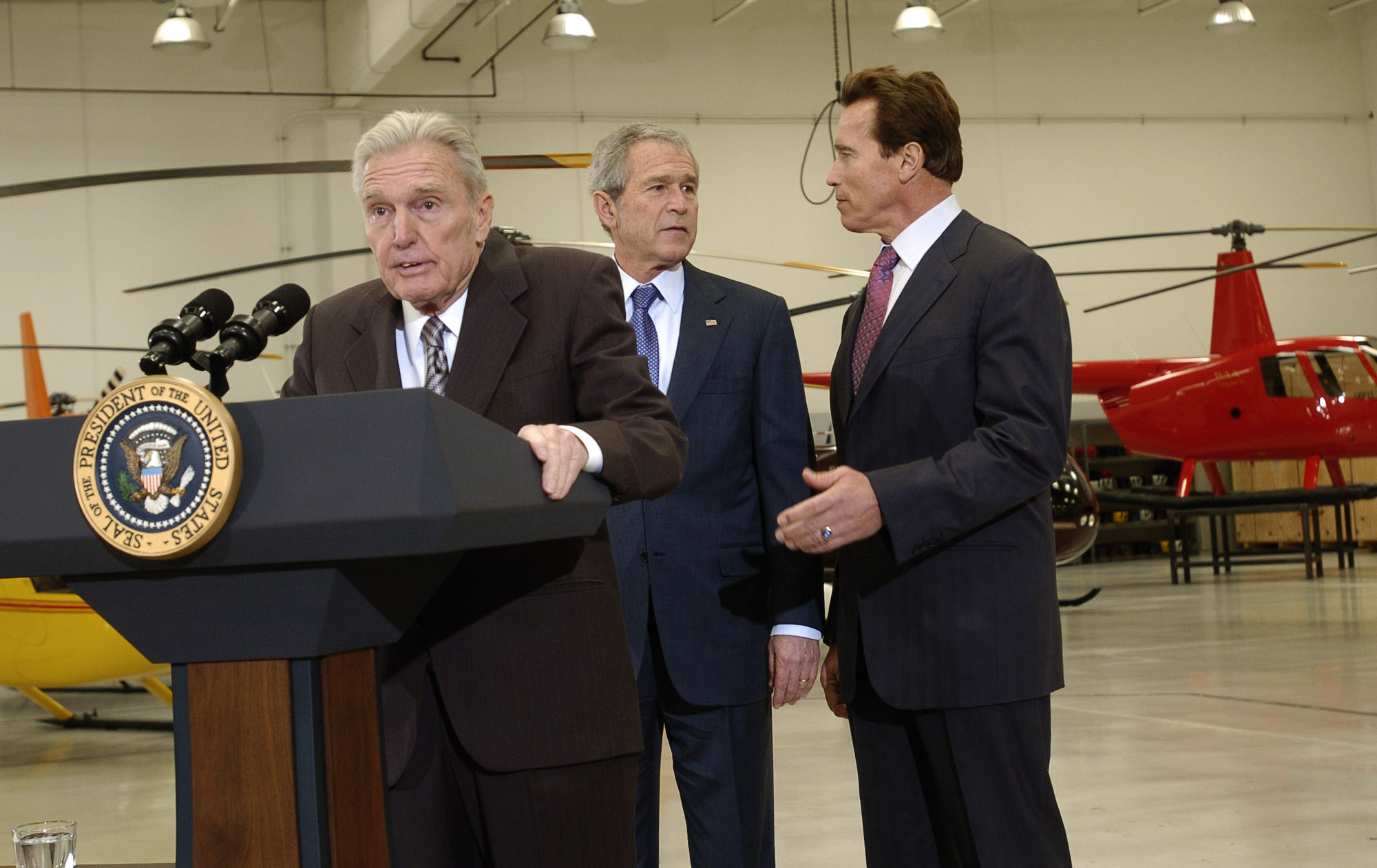
Frank Robinson, president of Robinson Helicopter Company, introduces President George W. Bush and Gov. Arnold Schwarzenegger while touring Robinson Helicopter Company in Torrance Cailfornia. Jan. 30, 2008. (Daily Breeze photo by Brad Graverson / Staff Photographer)
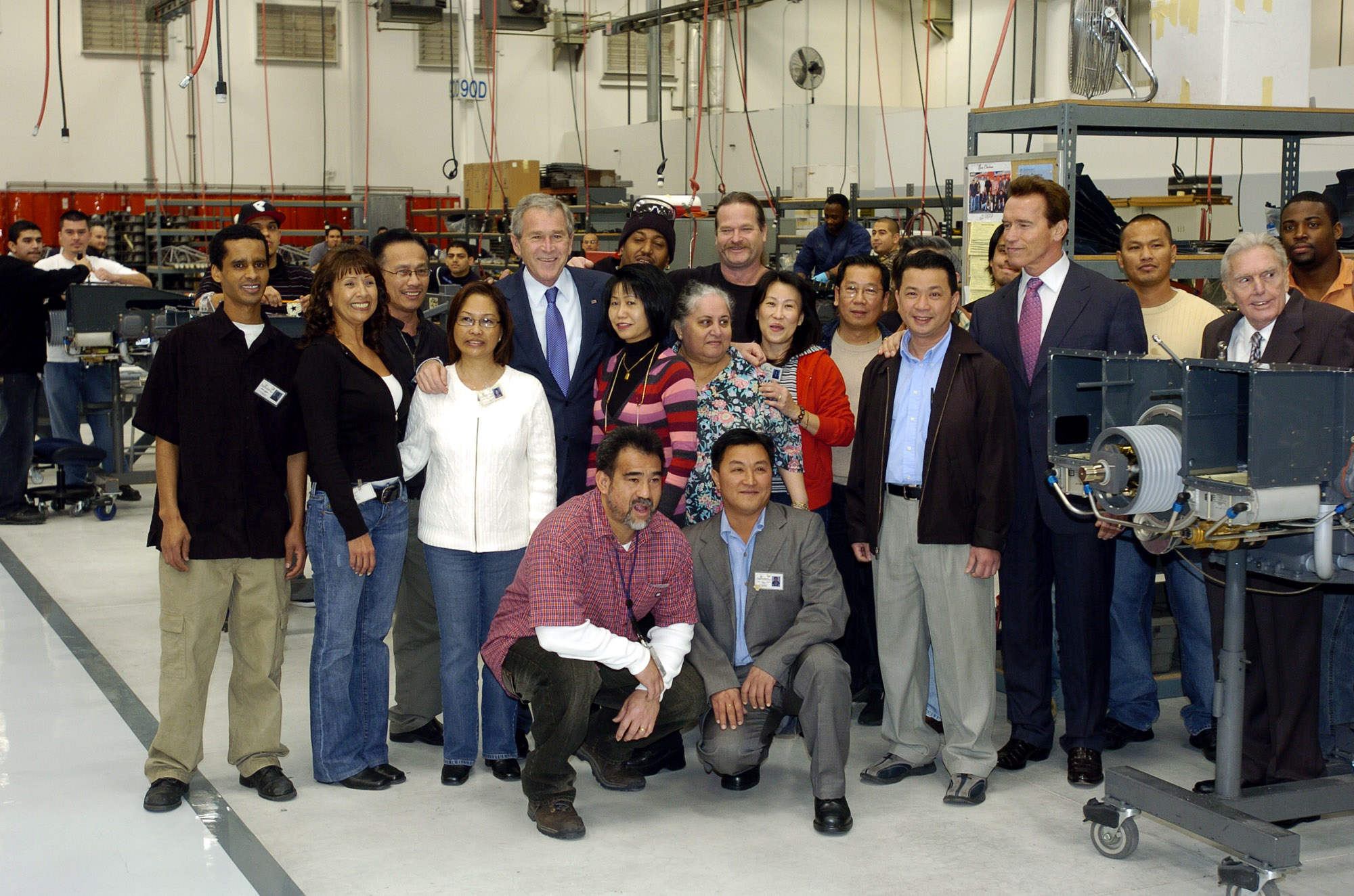
President George W. Bush poses with employees inTorrance, California while touring Robinson Helicopter Company. Gov. Schwarzenegger and Frank Robinson can be seen at right. Jan. 30, 2008. (Daily Breeze photo by Brad Graverson / Staff Photographer)
President George W. Bush poses with employees in Torrance, California while touring Robinson Helicopter Company. Gov. Schwarzenegger and Frank Robinson can be seen at right. Jan. 30, 2008. (Daily Breeze photo by Brad Graverson / Staff Photographer)

2010 was a watershed year for Robinson Helicopter. Frank Robinson debuted the R66 at a helicopter trade show in Houston, Texas, in February. He announced his retirement as president of the firm in August, and his son, Kurt, became the firm’s new president.

In October 2010, the FAA certified the R66 and the company completed an expansion of its Torrance plant, which now contained 617,000 square feet of working space.

The first R66 was delivered in November 2010.

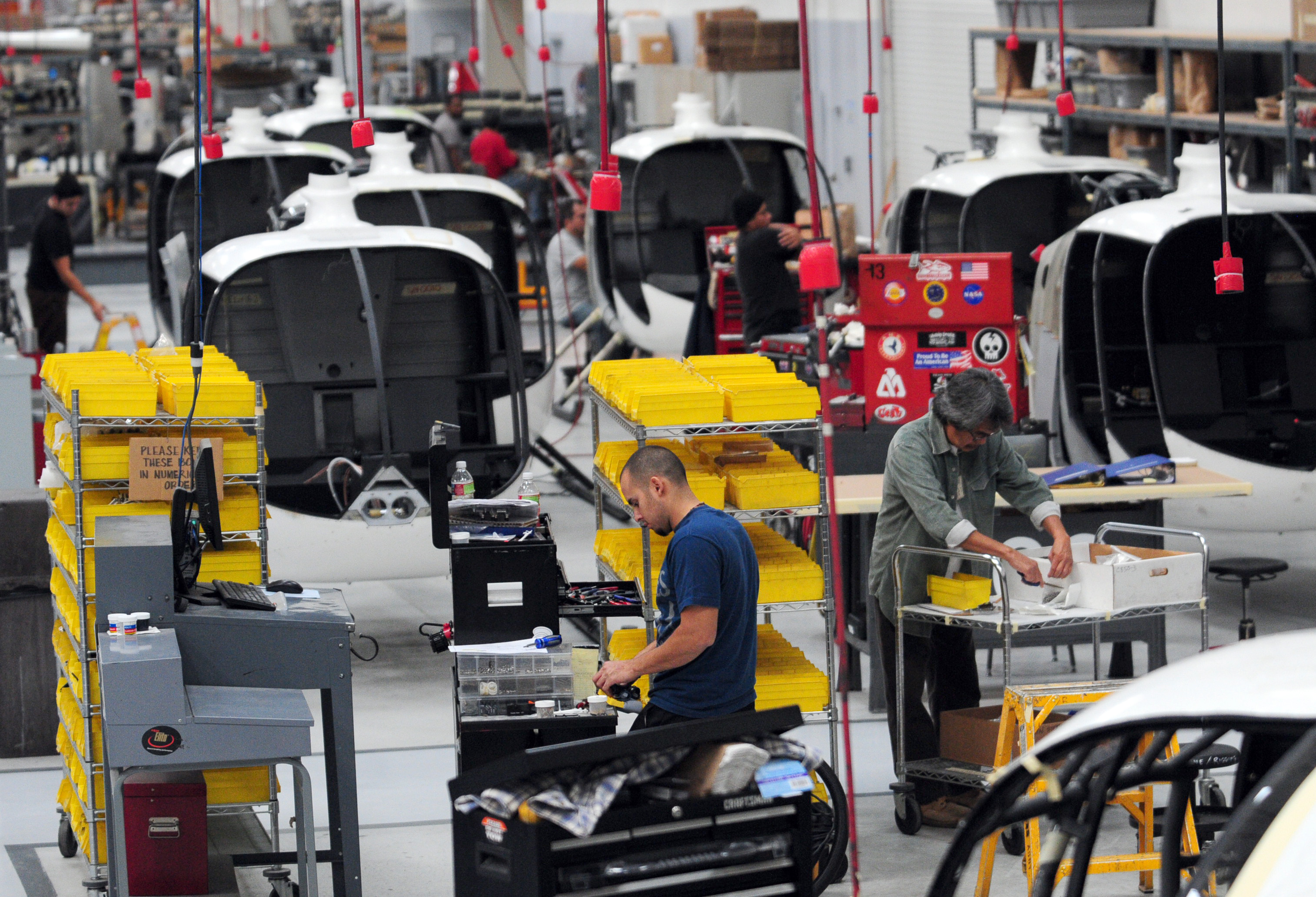
Workers assemble the first batch of the new Robinson R66 helicopters at their Torrance facility. Oct. 29, 2010. (Daily Breeze photo by Steve McCrank / Staff Photographer)

The firm now employs about 1,300 workers, making it one of the largest private employers in Torrance. The company to date has produced more than 11,000 helicopters.

Kurt Robinson remains its president. Frank Robinson moved to Rolling Hills in 1993, and will turn 86 in January.

Sources:

Daily Breeze files.
Los Angeles Times files.
Robinson Helicopters website, which contains detailed information and timelines on the company and its founder, Frank Robinson.

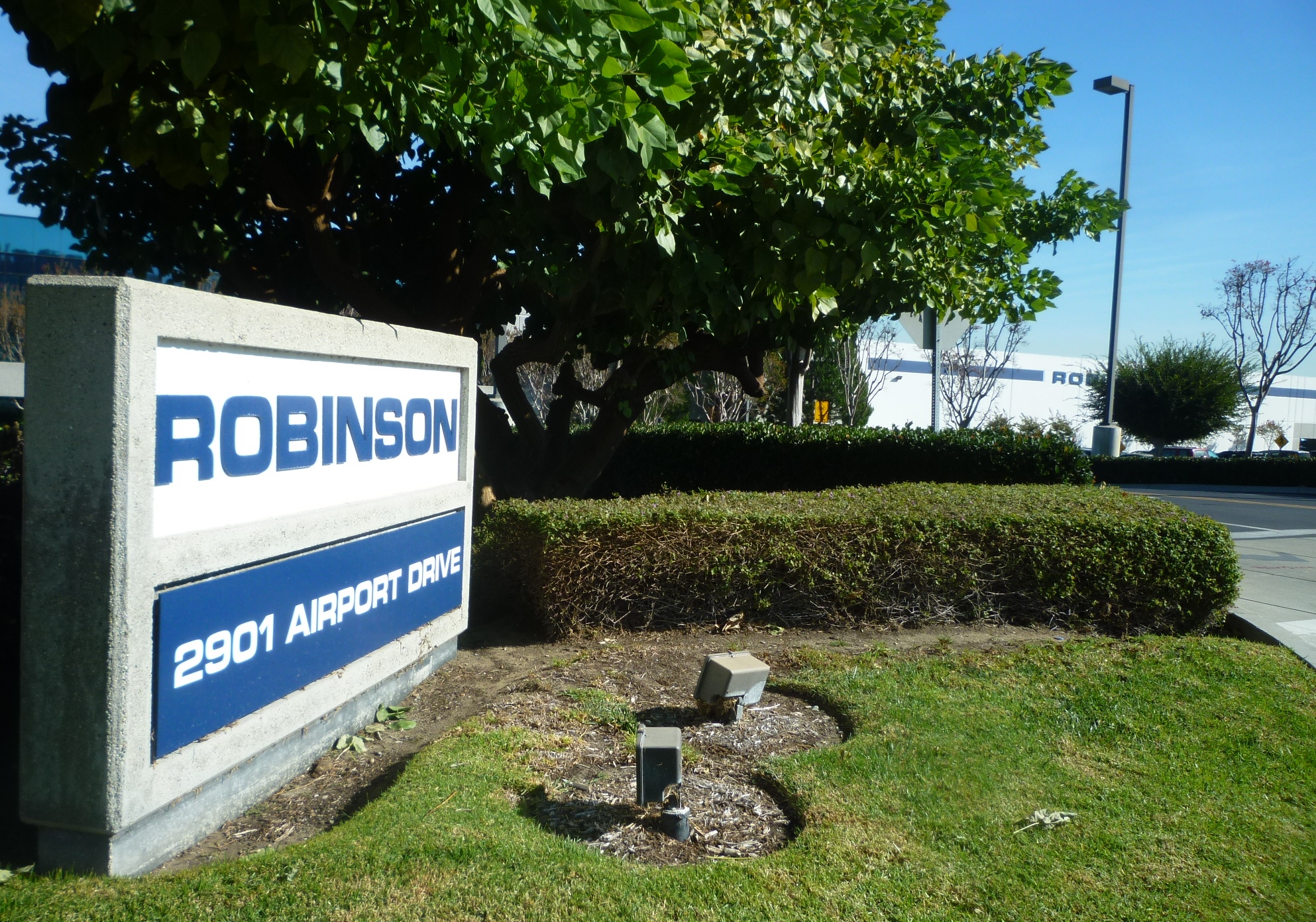
Robinson Helicopter plant at the Torrance Municipal Airport. (November 2010 Daily Breeze photo)
Robinson Helicopter plant at the Torrance Municipal Airport. (November 2015 Daily Breeze photo)

Note: This blog post has been corrected from an earlier version.

South Bay Center changes the retail landscape

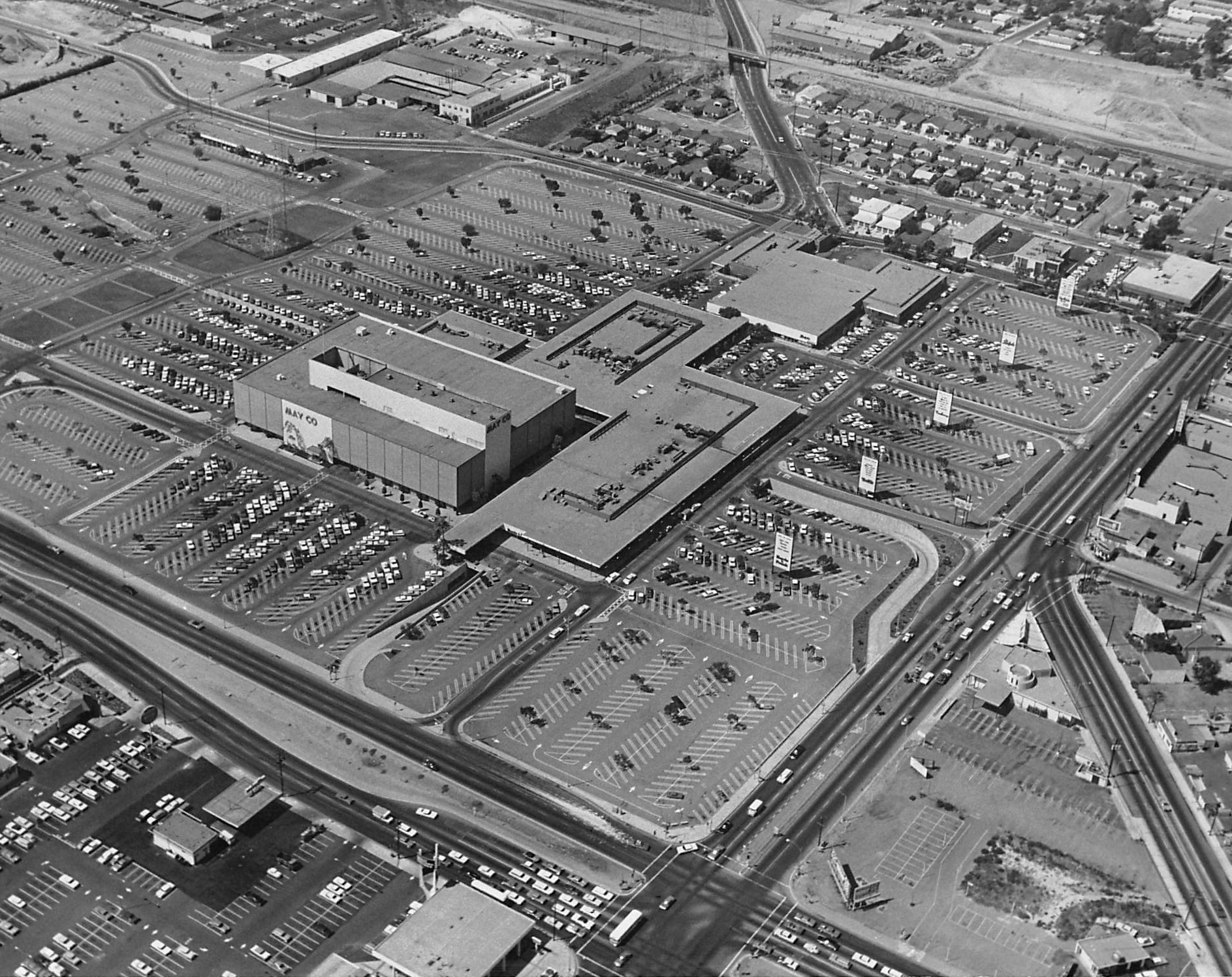
Aerial photo of South Bay Center looking southwest, Dec. 6, 1987. Hawthorne Boulevard is at bottom, Artesia Boulevard at right. (Daily Breeze file photo)
Aerial photo of South Bay Center looking southwest on Dec. 6, 1967. Hawthorne Boulevard is at bottom, Artesia Boulevard at right. (Daily Breeze file photo)

News concerning the development of a major shopping center on a 50-acre site at 174th Street and Hawthorne Boulevard in Redondo Beach began to become public in February 1955.

The May Co. department store chain signed on to be its anchor store that December, with executive vice president Tom May noting that the South Bay was one of the largest populated area in the nation not then served by a major planned shopping complex. (Though it would be the centerpiece of the development, the 351,000-square-foot May Co. store, its seventh, took longer to build, and would open later than the rest of the stores in the center.)

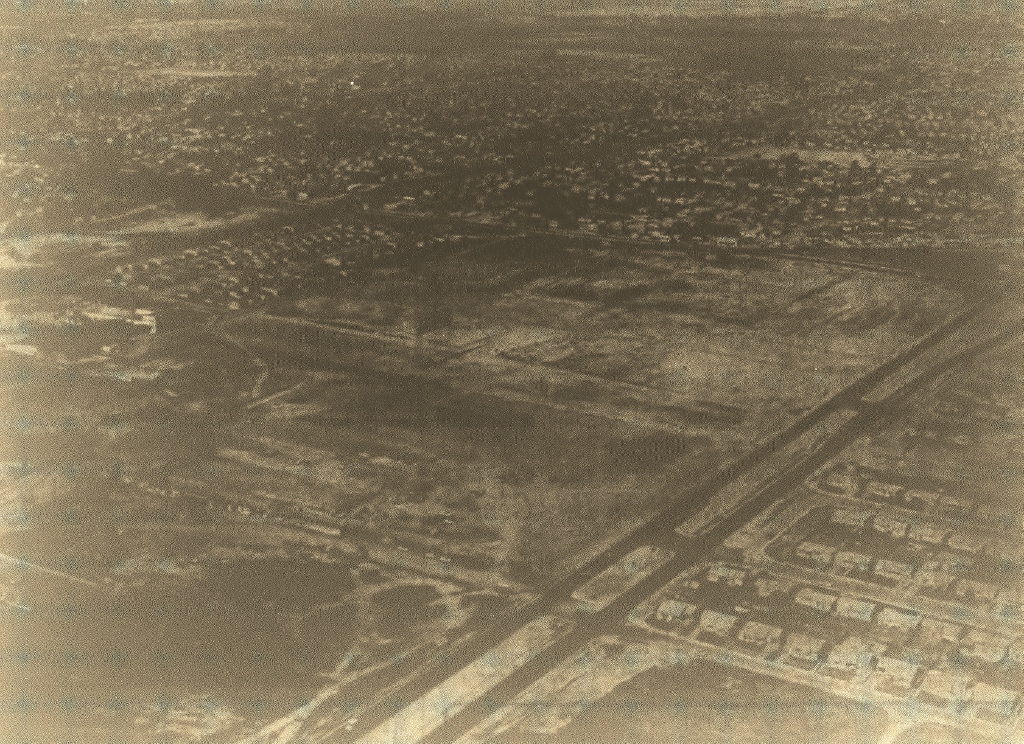
Photo taken from Daily Breeze microfilm of Aug. 21, 1957, special section shows the South Bay Center site before construction, looking northwest with Hawthorne Boulevard running diagonally along bottom right.
Photo taken from Daily Breeze microfilm of Aug. 21, 1957, special section, shows the South Bay Center site before construction, looking northwest with Hawthorne Boulevard running diagonally along bottom right.

The huge L-shaped shopping center was designed by architects A. Quincy Jones, Frederick Emmons and Victor Gruen & Associates, and developed by Sidney F. Brody, president of Brody Investment Co. in Beverly Hills.

The center was designed with a quarter-mile-long tunnel under the stores, so that all delivery areas for its stores would be shielded from the public. Its core consisted of a major shopping area, with outlying buildings containing service and recreation businesses. The center’s layout also allowed customers parking in the 5,000-plus spaces in its parking lots to be close to the stores.

The first component to be built was the free-standing South Bay Bowling Center, a modern alley with 54 lanes and automatic pin setting technology. Groundbreaking for the bowling alley took place in February 1956, and it opened for business later that year, along with its Steak Knife Restaurant inside.

Groundbreaking for South Bay Shopping Center, which would become known colloquially as just “South Bay Center,” took place on Sept. 10, 1956.

A little less than a year later, all of the stores except May Co. were ready to open.

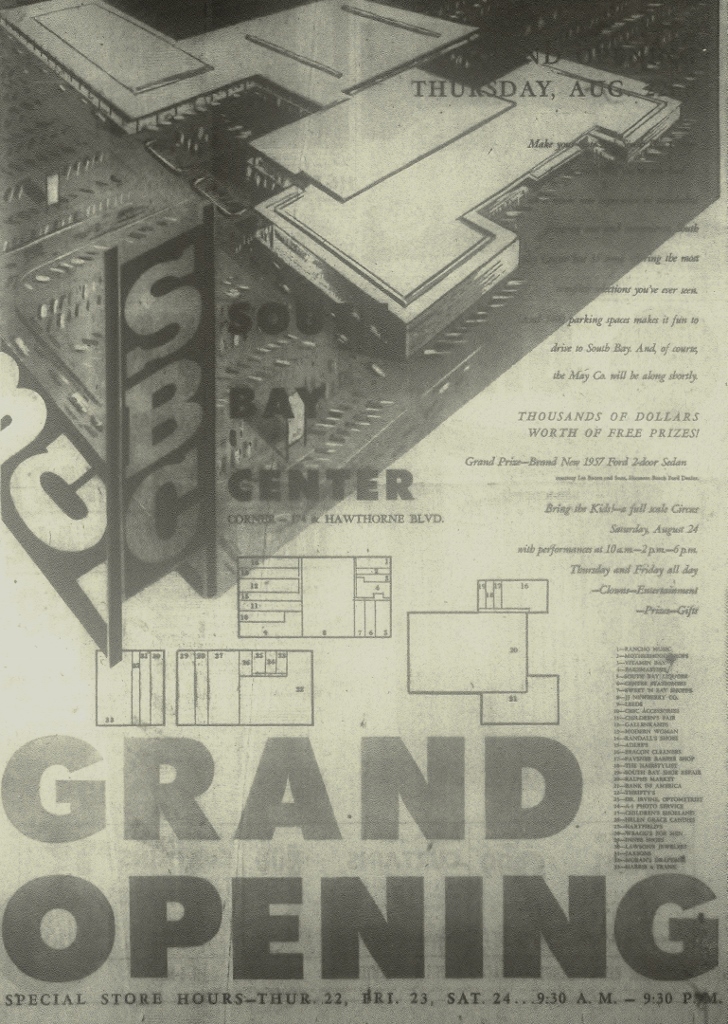
Cover of the Aug. 21, 1957, 24-page special section in the Daily Breeze trumpeting the arrival of South Bay Center.
Cover of the 24-page special section in the Daily Breeze on Aug. 21, 1957,  trumpeting the arrival of South Bay Center.

The grand opening of South Bay Center, with its 37 tenants, took place on Aug. 22, 1957. The Daily Breeze had published a 24-page advertising supplement about the much-anticipated opening in its Aug. 21 edition.

In addition to Brody and the usual city dignitaries, celebrities were in attendance to launch the $15 million project. The only one mentioned by name in articles published at the time was Laurette Luez, an actress starring in the “Jungle Jim” and “Dr. Fu Manchu” television programs, who cut the ribbon to open the new Harris & Frank men’s clothing store.

In addition, the grand opening featured a full-scale circus and the giveaway of a brand-new 1957 Ford Custom two-door sedan by Les Bacon & Sons Hermosa Beach Ford.

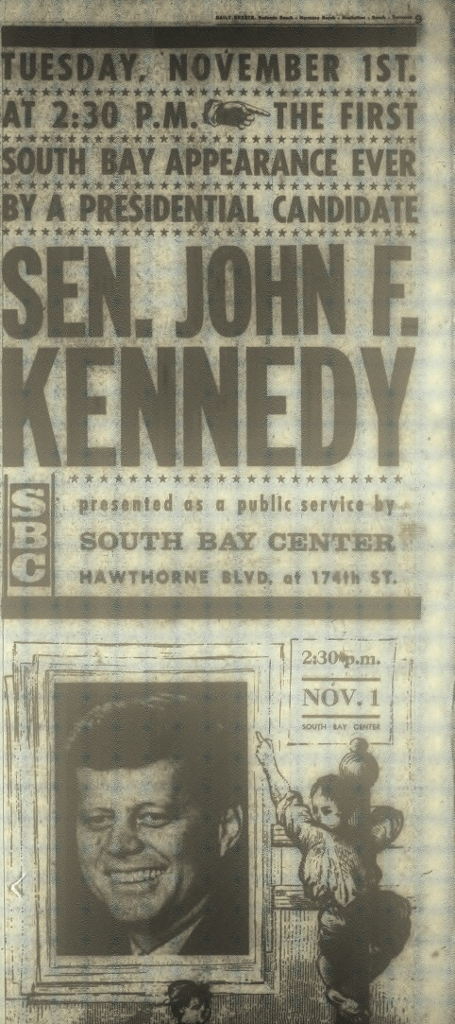
Daily Breeze ad from Oct. 28, 1960, advertising JFK's upcoming Nov. 1 campaign stop at South Bay Center in Redondo Beach.
Daily Breeze ad from Oct. 28, 1960, advertising JFK’s upcoming Nov. 1 campaign stop at South Bay Center in Redondo Beach.

South Bay Center became complete with the grand opening of the May Co. store, which took place on Feb. 9, 1959. Albert C. Martin and Associates designed the four-story emporium, and the firm of Lindgren & Swinerton handled its construction. It had three full floors, and a mezzanine and a basement. The basement included a fountain and the Bay Shore Tea Room.

South Bay Center quickly became a focal point for area shoppers and community events.

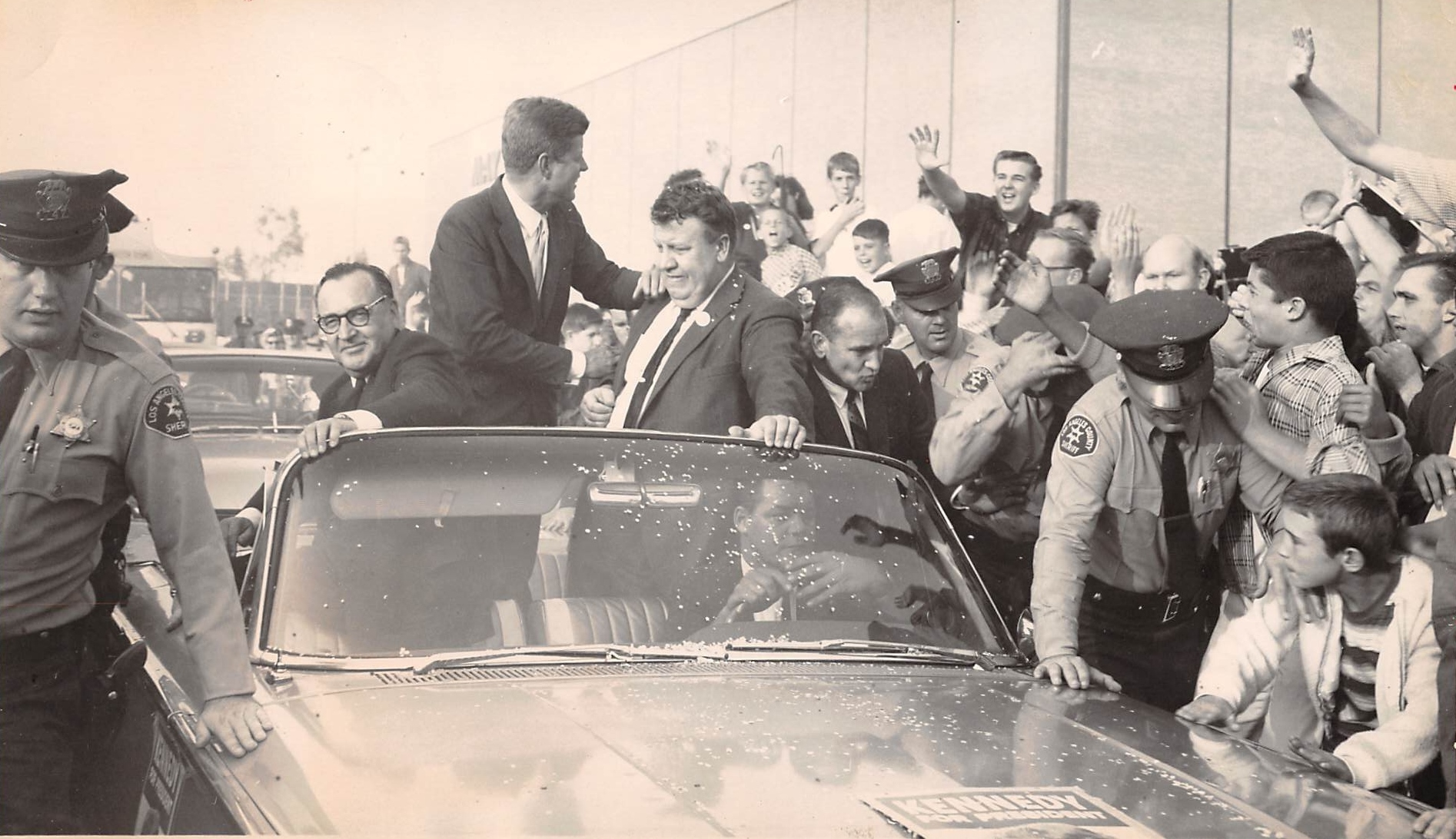
One such event took place on Nov. 1, 1960, when presidential candidate Sen. John F. Kennedy made a campaign stop at South Bay Center, exactly one week before voters went to the polls and chose him as president over Richard Nixon.

In a sign of the times, the May Co. at South Bay Center became the first South Bay building to be designated as a public fallout shelter in January 1963.

By 1965, an estimated 10 million people shopped annually at South Bay Center, whose retailers already had provided over $1.7 million in tax revenue to Redondo Beach.

Democratic presidential candidate John F. Kennedy makes a campaign stop at South Bay Center on Nov. 1, 1960, days before being elected president. (Daily Breeze file photo)
Democratic presidential candidate John F. Kennedy makes a campaign stop at South Bay Center on Nov. 1, 1960, a week before being elected president. (Daily Breeze file photo)

By the early 1970s, a raft of competitors had arisen along the Hawthorne Boulevard retail corridor. There was Old Towne Mall in Torrance, and, further down Hawthorne, the twin Del Amo Fashion Center and Del Amo Shopping Center. Further up The Hill, Peninsula Center in Rolling Hills Estates also competed for shopping dollars.

With the joining of Del Amo Fashion Center and Del Amo Shopping Center into a megamall in 1979, South Bay Center faced its most formidable competition. The outdoor center suddenly seemed outdated when compared to the newer indoor malls, something its management set about to rectify in the early 1980s.

In 1983, South Bay Center manager Bill Recknor announced plans to tear down all of South Bay Center except for The May Co. store, and build a new enclosed shopping mall that would include two additional anchor stores: Mervyn’s and Nordstrom.

The Torrance Co., then-owners of Del Amo Fashion Center, immediately sued to block the expansion, citing traffic and environmental impacts should the new mall be allowed. Superior Court Judge John Cole promptly threw out the suit, and demolition of the old South Bay Center buildings surrounding the May Co. began in earnest just after Christmas 1983.

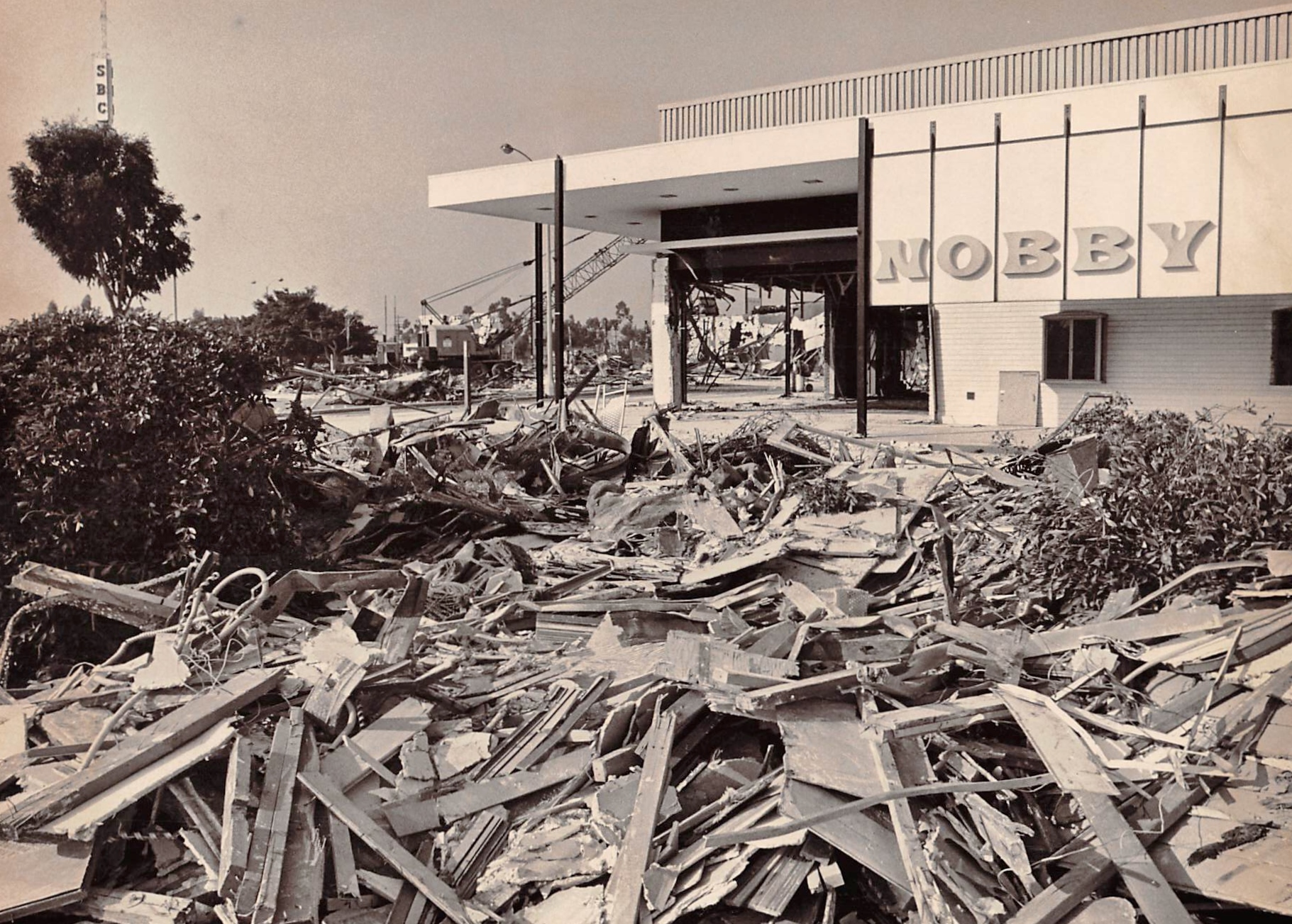
Demolition of South Bay Center in preparation for construction of the South Bay Galleria is underway in this Daily Breeze file photo from Jan. 11, 1984.
Demolition of South Bay Center in preparation for construction of the South Bay Galleria is well underway in this Daily Breeze file photo from Jan. 11, 1984.

The new mall, known as the Galleria at South Bay, opened its 150 shops to the public on Monday, Aug. 26, 1985. (It changed its name to South Bay Galleria in 2003.)

The bowling alley that had been the first business to open at South Bay Center became one of its last remnants to disappear when it was razed for parking and landscaping in 2005. The center, then known as AMF South Bay Lanes, had closed in the spring of 2004 when it lost its lease.

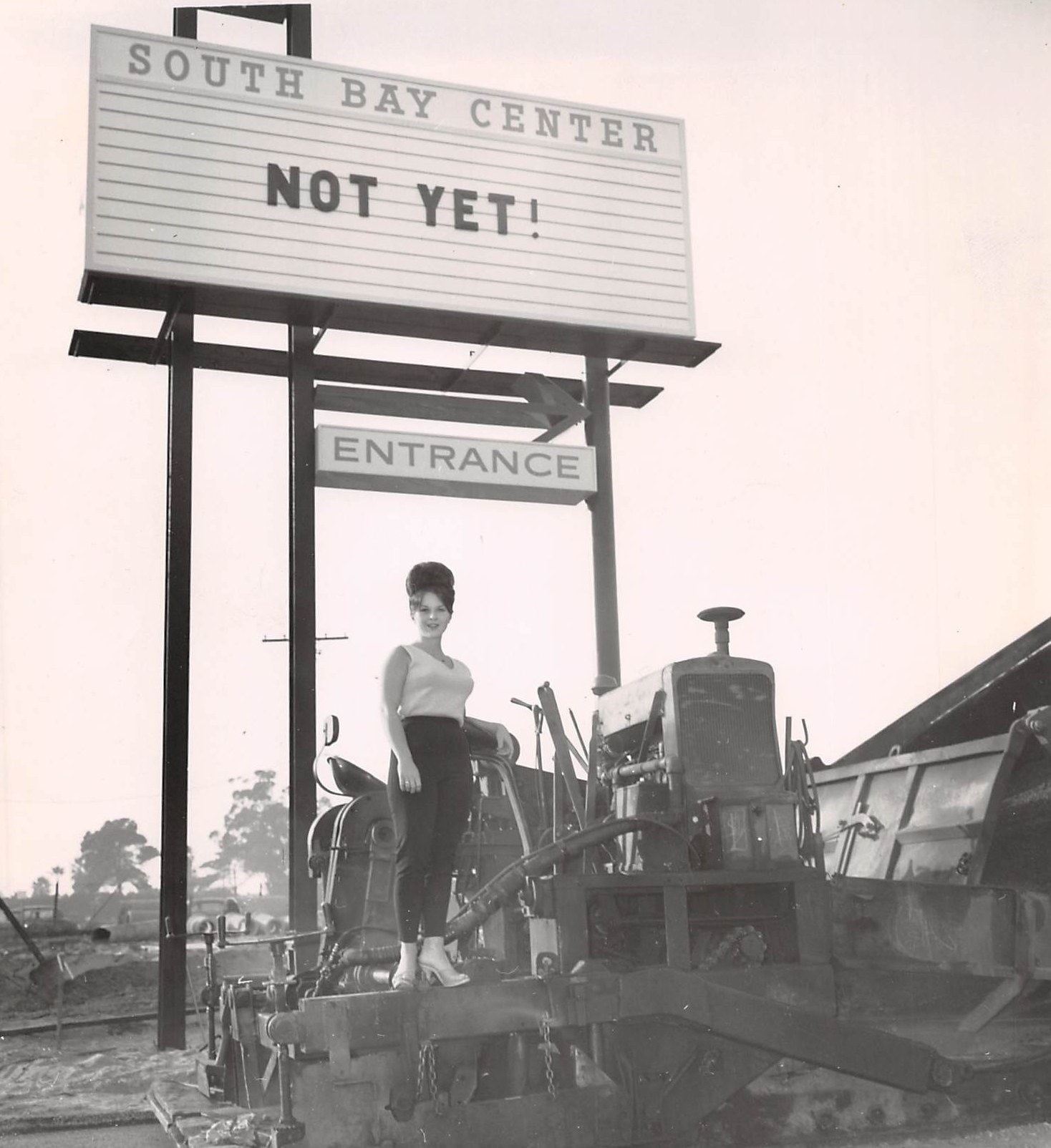
Sue Larson poses atop a paving machine being used to prepare an extension of Kingsdale Avenue west of South Bay Center to allow for entrance to the center from its western end. Dec. 11, 1962 Daily Breeze file photo.
Sue Larson poses atop a paving machine being used during construction of an extension of Kingsdale Avenue west of South Bay Center to allow for entrance to the center from its western end. Daily Breeze file photo, Dec. 11, 1962.

Sources:

Daily Breeze files.
Los Angeles Times files.
Original South Bay Center tenants:

Adlee’s
Aitken’s Chic Accessories
A-1 Photo Service
Armand’s Sewing Center
Bakemasters
Bank of America
Beacon Cleaners and Dyers
Center Stationers
Children’s Fair
Children’s Shoeland
Gallenkamps
The Hair Stylists
Harris & Frank
Hartfield’s
Helen Grace Candies
Innes Shoes
Dr. Irving, Optometrist
Jaxson’s
Lawson’s Jewelers
Leeds Shoes
Moran Drapery Stores
Modern Woman Store
Motherhood Shops
J.J. Newberry Co.
Norm Manning
Pavsner’s Barber Shop
Ralphs Market
Randall’s Shoes
Rancho Music Box
South Bay Bakery
South Bay Bowling Center
South Bay Liquors
South Bay Shoe Repair
Sweet ‘n Eat Shoppe
Thrifty Drug
Vitamin Bay
Wragg’s For Men

Martin Bogdanovich launches an empire in Fish Harbor

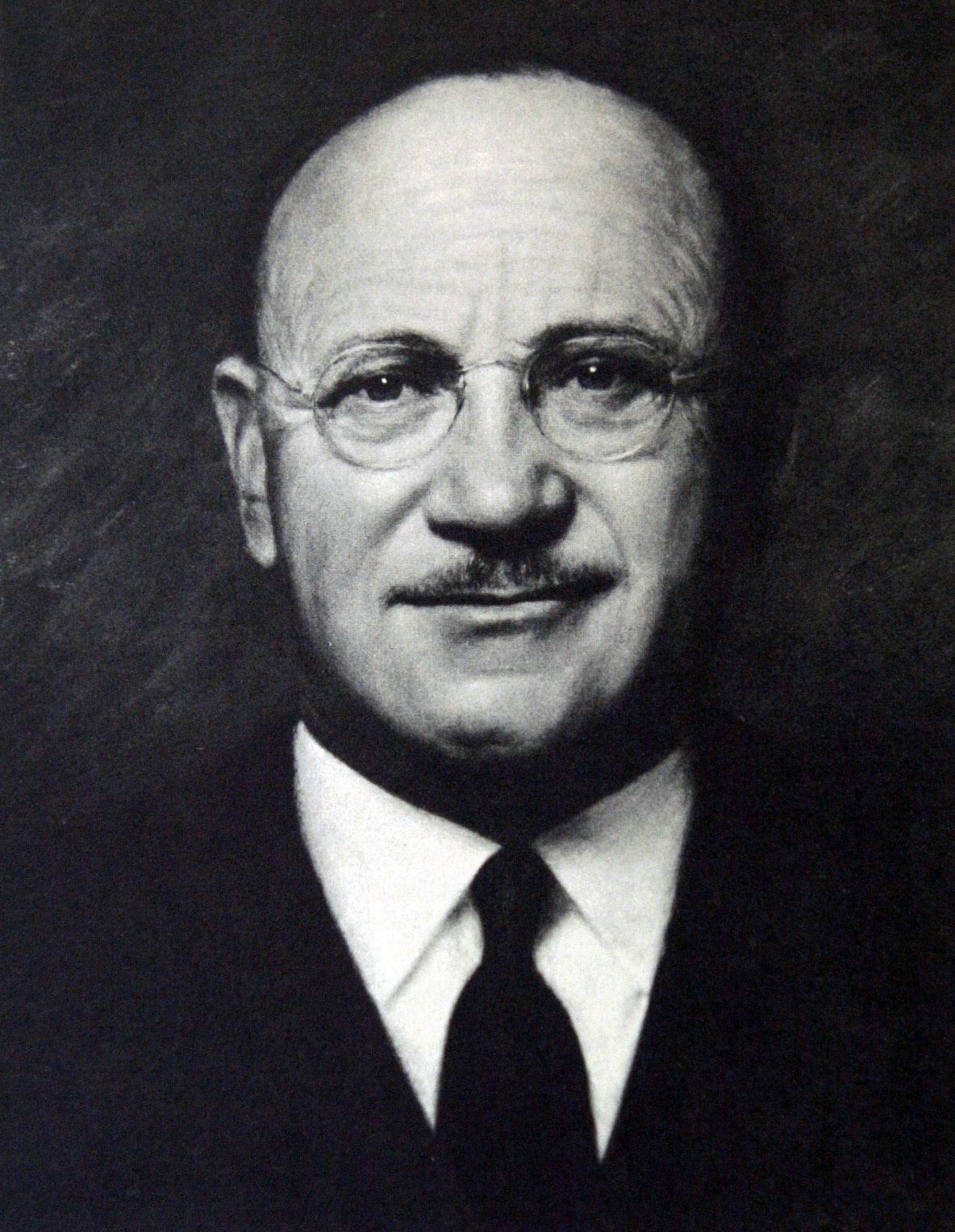
Martin J. Bogdanovich, founder of Star-Kist Tuna. (Photo courtesy the San Pedro Bay Historical Society)

Martin J. Bogdanovich was born on the island of Vis in the Adriatic Sea just off the Dalmatian coast of Croatia on Nov. 5, 1882.

He emigrated to the U.S. in 1908, the same year that he married his wife, Antoinette, with whom he would raise a son and six daughters.

He began his career in the sardine fishing business in 1910 on Terminal Island, where a group of fishermen had begun operations in an area that would come to be known as Fish Harbor.

In 1917, Bogdanovich and four associates – Joseph P. Mardesich, Nick Vilicich and James and Ivo Mirkovich – began a new venture in Fish Harbor: the French Sardine Company.

The company quickly became successful, and Bogdanovich became a leader in the state’s fish canning industry. Its success continued when French Sardine wisely turned to tuna canning when the coastal sardine supply began to ebb in the 1940s.

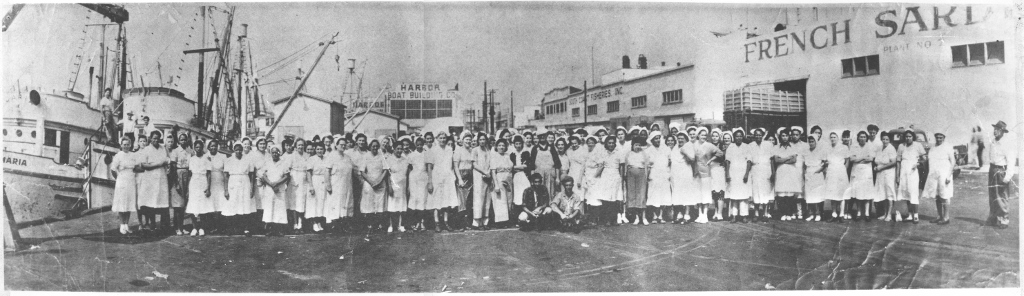
Cannery workers pose in front of the French Sardine Cannery at Fish Harbor, Terminal Island circa 1939. French Sardine later became Star-Kist. Los Angeles Maritim
Cannery workers pose in front of the French Sardine Cannery at Fish Harbor, Terminal Island circa 1939. French Sardine later became Star-Kist. (Photo courtesy Los Angeles Maritime Museum)

Bogdanovich was proud of his ethnic heritage, and joined with 25 countrymen to form the Yugoslav Club on May 26, 1926. 

The club’s members pooled its funds and came up with $100,000 to build a meeting hall. Bogdanovich was the club’s president when “Slav Hall,” as it was known, opened its doors in 1935.

The Yugoslav Club would go on to become the Yugoslav-American Club in 1949, and was renamed in 1992 with its current name, the Dalmatian-American Club of San Pedro.

But just before the opening of the club’s annual meeting at its hall at 1639 Palos Verdes Street on June 18, 1944, Bogdanovich, who was still its president, was stricken with a heart attack and died at 61.

During his lifetime, he had built the French Sardine Company into one of the world’s largest tuna canneries. In 1942, the company began selling its products under the Star-Kist name.
After Martin Bogdanovich’s death, his son, Joseph, took over the family business, which was booming and outgrowing its original facilities.
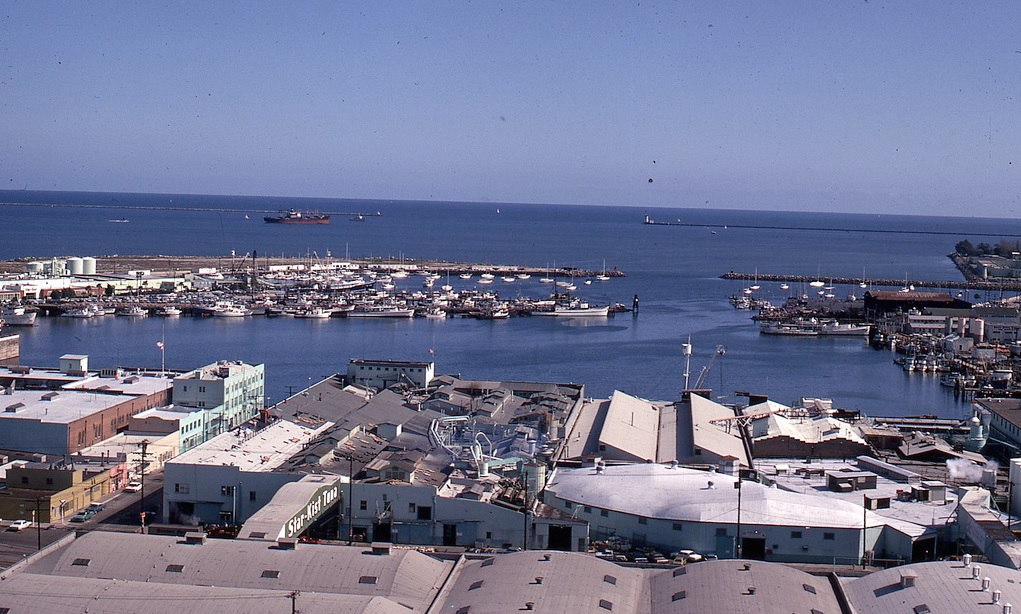
The Star-Kist Tuna cannery, foreground, in 1969. . (Photo courtesy Los Angeles Fire Department Historical Society)
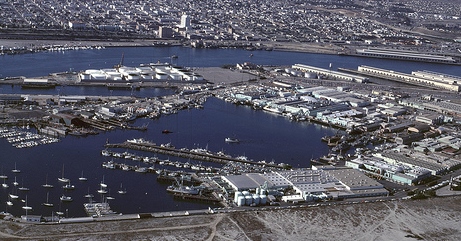
The Star-Kist Tuna cannery, foreground, in 1969. (Photo courtesy Los Angeles Fire Department Historical Society)

On Nov. 12, 1952, the company opened a giant new Star-Kist tuna cannery plant on Terminal Island. The $2 million facility at 1000 Ways Street had 200,000 square feet of floor space. It was a built on a man-made addition of land to Terminal Island.

In 1953, the French Sardine Company officially became Star-Kist Foods, and, by the mid-1950s, it had become largest tuna canning firm in the world. That same year, the company began producing tuna-based cat food under the 9Lives brand name at its Plant No. 1.

The company was sold to the H.J. Heinz Company in 1963, with Joseph Bogdanovich continuing as its chief executive.

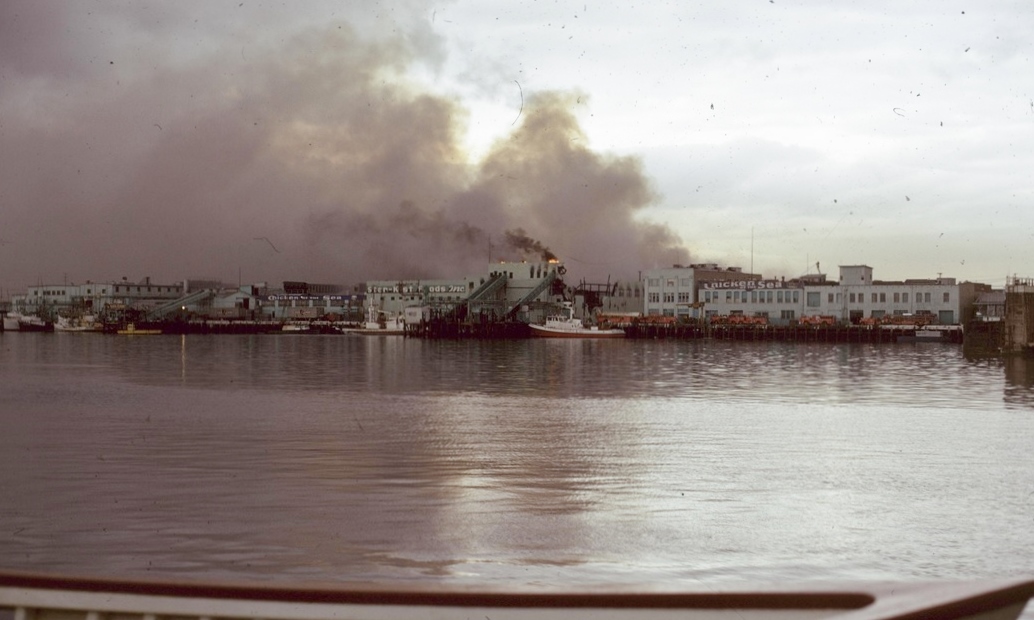
Fire at Star-Kist Tuna Plant No. 1 in the early morning hours of Jan. 3, 1974. (Photo courtesy Los Angeles Fire Department Historical Society)

A major fire destroyed Plant No. 1 on Jan. 3. 1974, causing a $1 million loss. The plant was rebuilt at a cost of $2 million and reopened in 1976.

By the 1980s, a variety of problems had begun to beset the tuna canning industry, most notably competition from cheaper producers in Asia.

The Fish Harbor operations suffered from rising labor costs, charges from the EPA that it was discharging polluted water into the harbor, and, in 1983, a series of layoffs at the Star-Kist plant.

On Oct. 19, 1984, Star-Kist Foods shut down its Terminal Island cannery for good, laying off its final 1,200 workers. Most of its operations had been moved to Puerto Rico and American Samoa, but it still was the end of an era in Fish Harbor.

Fish Harbor, center, in December 1968. (Photo courtesy Los Angeles Fire Department Historical Society)

In 2002, Del Monte acquired Starkist Foods (whose name had been dehyphenated). In 2006, the Korean firm Dongwon Industries purchased the company from Del Monte, and remains its current owner.

A StarKist brand product is seen on a grocery store shelf, Monday, June 30, 2008. (AP Photo/Lisa Poole)

Joseph Bogdanovich died in London on March 28, 2005, at 92. He had been a South Bay resident since the early 1990s, when he moved to England to avoid estate and investment income taxes. He had retired from StarKist in 1998.

In October 1987, the City of Los Angeles changed the name of the San Pedro Recreation Center at the county-run Friendship Park in San Pedro to the Martin J. Bogdanovich Recreation Center. (A park on 25th Street named for Bogdanovich had been closed in order to be developed into military housing.)

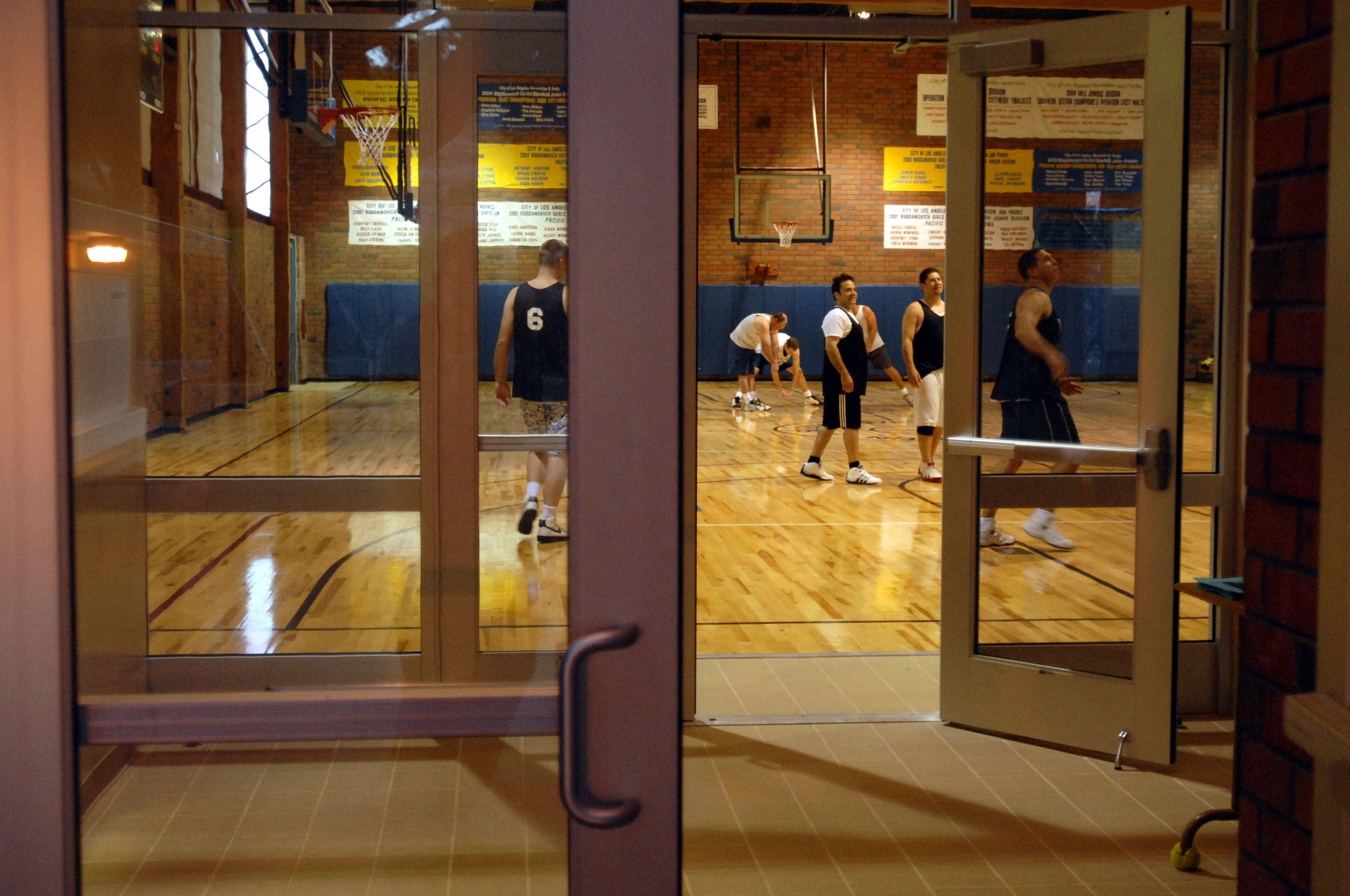
The gym at Bogdanovich Recreation Center after its remodeling in 2006. (Steve McCrank / Staff Photographer)

The hilltop facility has, in addition to its spectacular views of the Port of Los Angeles, a gym, soccer and baseball fields, an auditorium and a children’s play area.

Martin Bogdanovich’s last two children died in 2008. Katherine Loker died on June 26 at 92, and Nina Trutanich died on August 19 at 90.

Sources:

Daily Breeze files.

“Starkist Company,” Grocery.com website.

Los Angeles Times files.

Related reading:

“Between Catch & Can: The Cannery Women of the Los Angeles Harbor, 1930-1960,” San Pedro History Project, Taran Schindler, San Pedro, 2008.


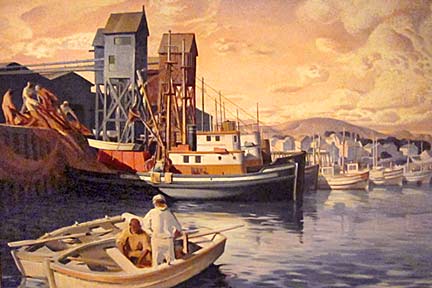
"Fish Harbor, Terminal Island," oil painting by Millard Sheets, 1935.
“Fish Harbor, Terminal Island,” oil painting by Millard Sheets, 1935.

Torrance residents: Don’t mess with our rocket ship!

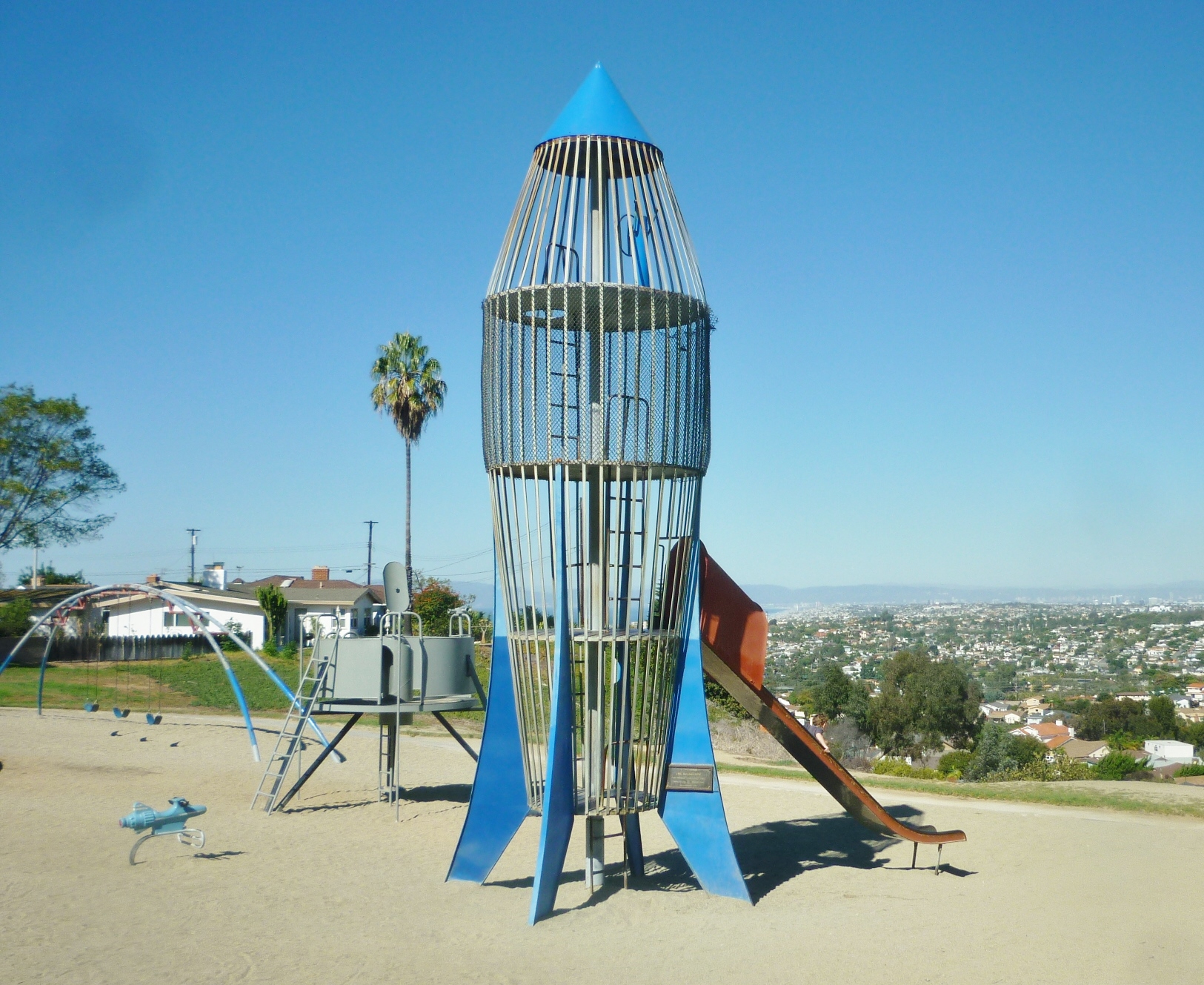
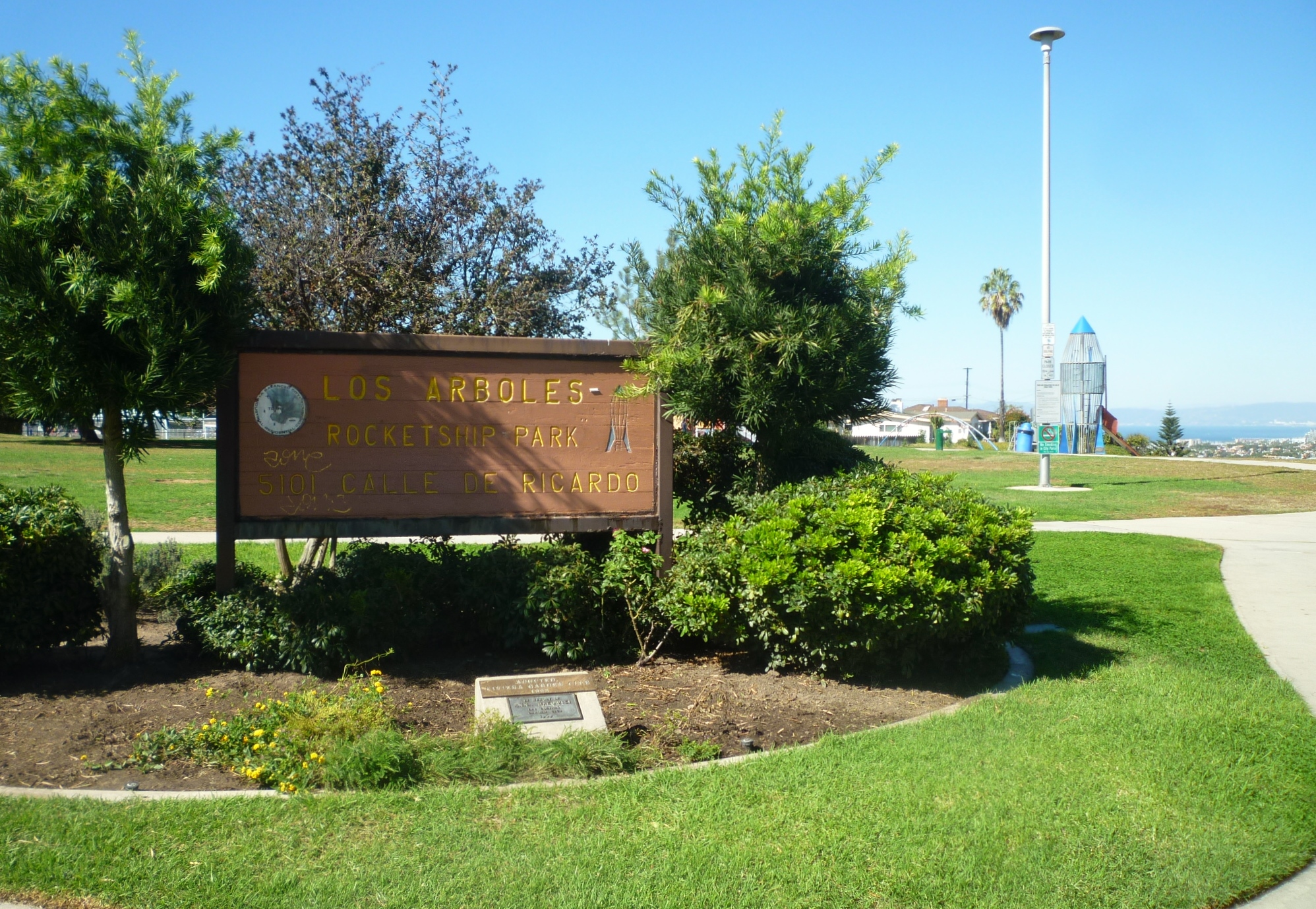
The rocket ship slide in Torrance's Los Arboles "Rocketship" Park was installed in 1960. (October 2015 Daily Breeze photo)
The rocket ship slide in Torrance’s Los Arboles “Rocketship” Park was first installed in 1960. (October 2015 Daily Breeze photo)

Los Arboles Park first came onto the City of Torrance drawing boards late in 1954, when Recreation Director Harry Van Bellehem told the city planners about a five-acre hilltop site next to Riviera School that looked like a promising site for a park.

At the time, the city had been feeling the effects of the post-World War II baby-boom population explosion, and realized its park facilities needed expansion.

Architect William Woollett was hired to work up a master plan for upgrading the city’s parks – Seaside, El Retiro, Walteria, McMaster and Central (now Torrance Park), and for adding new ones.

Money would come from a $150,000 bond issue passed by Torrance voters on April 13, 1954.

The plan for the hilltop park at 5101 Calle de Ricardo in the Hollywood Riviera section of the city was approved, along with plans for two other new parks, one in the Southwood development just below Torrance Boulevard, and the other at the terminus of Inglewood Avenue just below 190th Street. In 1956, the city held a contest to name all three facilities, and the names Paradise Park, La Romeria Park and Los Arboles Park were chosen.

Work on developing Los Arboles began in earnest in 1958. A master plan was approved, grading was completed, and lawns and sprinkler systems were installed.

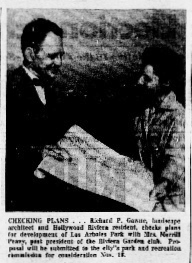
From the Torrance Herald, Nov. 8, 1959, Page 2. (Credit: Torrance Public Library, Historical Newspaper Achives)
Richard Gawne, left, and Merrill Peavy check Los Arboles Park plans. Torrance Herald, Nov. 8, 1959, Page 2. (Credit: Torrance Public Library, Historical Newspaper Achives)

On Nov. 18, 1959, architect and Hollywood Riviera resident Richard P. Gawne went before the Recreation Commission with members of the Las Colinas and Riviera garden clubs to propose that the two groups take over landscaping and gardening duties at Los Arboles. The city approved the idea.

The Riviera Garden Club, which had been founded two years earlier in 1957, began donating the services of its members to maintain and improve the park, a community volunteer effort that continues to this day.

With the landscaping help, by 1960, Los Arboles was beginning to look like the park that had been envisioned six years earlier.

Late in 1960, the city began the installation of playground equipment. It was the first bloom of the U.S. space program, which had been launched in response to Russia’s successful 1957 Sputnik satellite mission, so why not go with a spaceport theme?

In addition to two miniature jet planes, a submarine, a space slide and a model of Saturn, the playground had as its centerpiece a rocket ship slide. (A lunar lander and an orbiter would be added later.) The rocket ship slide would give the park its informal name, and would, years later, be added to its formal name.

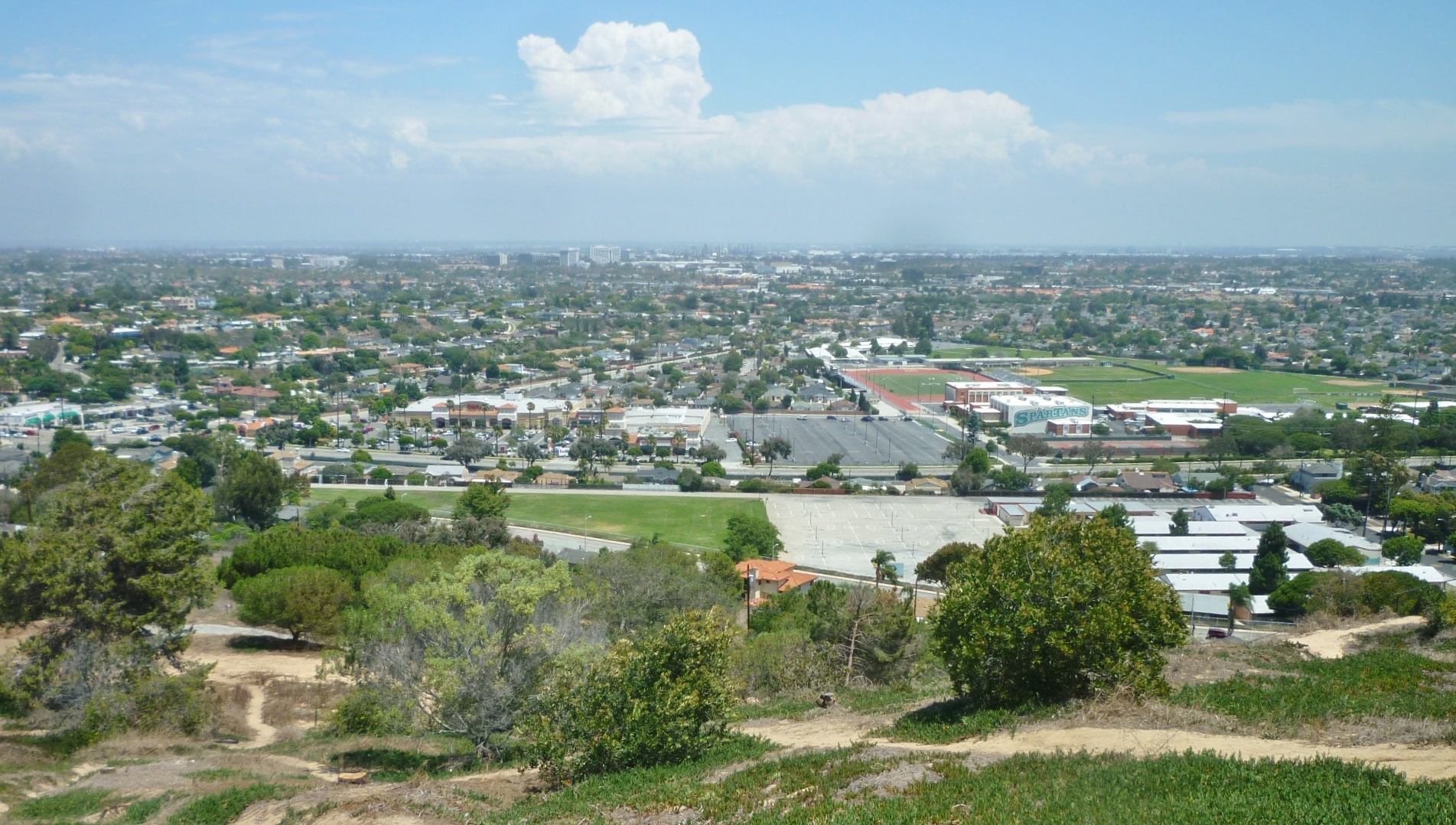
The space-age equipment was hit from the first, and generations of park visitors clambered up the 28-foot high rocket ship for a spectacular view of the South Bay and beyond, with Santa Monica Bay on the left and the greater expanse of the L.A. Basin at center and right. It was an enhanced version of the view already available from the park’s hilltop edge.

Torrance, viewed from Los Arboles "Rocketship" Park. (July 2015 Daily Breeze photo)
Torrance and points north, viewed from the hilltop at Los Arboles “Rocketship” Park. South High can be seen at middle right. (July 2015 Daily Breeze photo)

Years later, nostalgic grown men and women would continue to make the pilgrimage to “Rocketship Park” – Los Arboles – to try and squeeze themselves up to the top of the steel rocket structure one more time.

All of which factored in to the tremendous outcry that would greet the city’s actions that began at 6 a.m. on Friday, Feb. 28, 1992.

“We were up here at 6 a.m. to get it down before too many people noticed,” city worker Kenny Sanchez told a Daily Breeze reporter at the time as he and his crew went about the work of dismantling and carting away the beloved metal rocket ship.

Torrance parks and recreation director Gene Barnett ordered the action after city officials had expressed safety concerns and the fear of lawsuits that might result from accidents at the structure. No actual accidents were cited, but there were fears one might happen if children climbed up the outside of the rocket ship. “We’d rather err on the safe side,” Barnett said at the time.

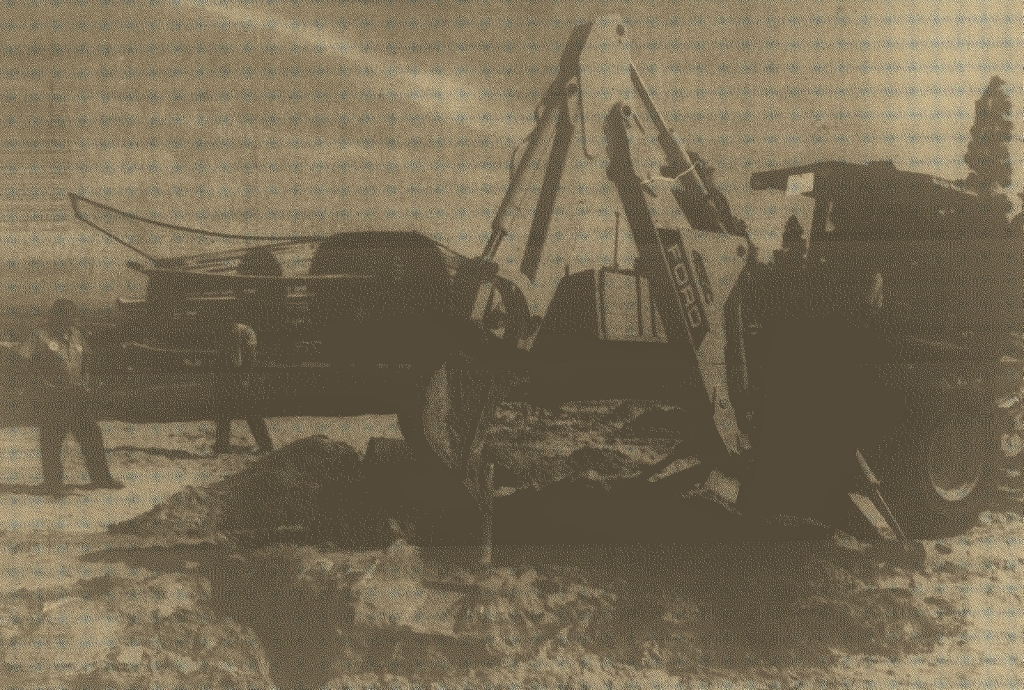
The rocket ship slide lies on its side at left rear as a backhoe digs up its foundtion in this file photo from March 1, 1992 taken from microfilm. (Robert Casillas / Staff Photographer)
The rocket ship slide lies on its side at left rear as a backhoe digs up its foundation in this file photo from March 1, 1992 taken from Daily Breeze microfilm. (Robert Casillas / Staff Photographer)

It was a sensible and prudent decision, but it failed to account for the emotional attachment many residents felt toward the playground icon.

Reaction from the community was swift, with more than a dozen residents filing formal complaints in the first week following the removal. The city held a hearing on March 19 at Riviera Elementary attended by about 100 people, most of who supported the return of the spaceship.

Barnett apologized to them for taking the rocket ship slide away without warning, and promised that it would be returned.

After being repaired and refurbished, the rocket ship touched down again in Los Arboles Park on August 5, 1992, when workmen reinstalled it a few feet closer to the park’s edge. The lunar module and a swing set also made their return.

“It’s a wonderful thing to see you can influence government,” Henry Low, a retired TRW engineer, told a Daily Breeze reporter at the time. “The voice of some individual people can mean a lot.”

Los Arboles Park in Torrance. (October 2015 Daily Breeze photo)
Los Arboles “Rocketship” Park in Torrance. (October 2015 Daily Breeze photo)

As originally planned, the city also installed $28,600 of modern equipment at the park at the same time. The park’s name had been changed to “Los Arboles ‘Rocketship’ Park” in preparation for the rocket’s return.

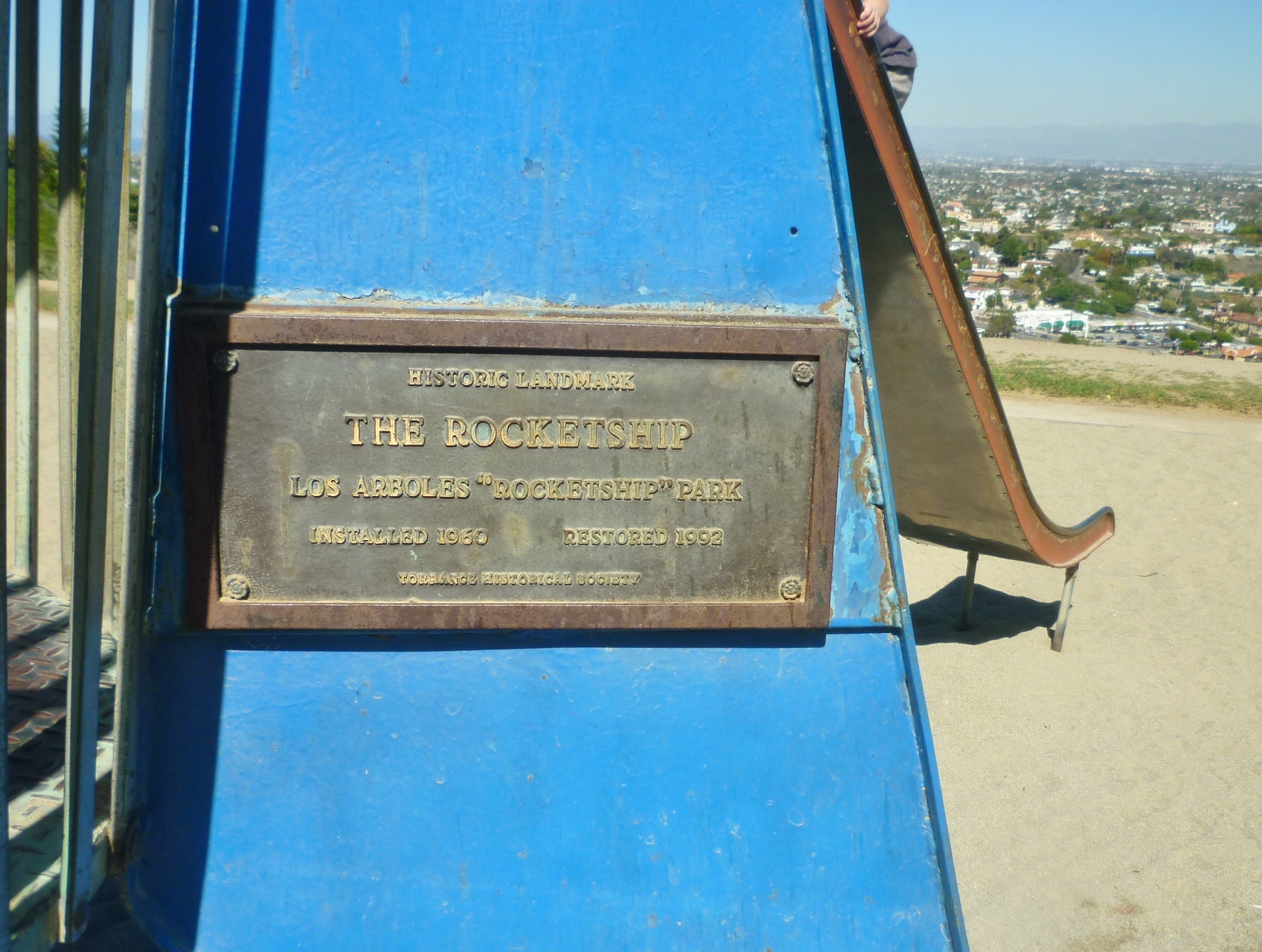
On September 12, the Torrance Historical Society placed one of its historical landmark plaques on one of the rocket’s fins at the official dedication of the refurbished ship, insuring

Plaque added by the Torrance Historical Society on one of the ship's fins in 1992. (October 2015 Daily Breeze photo)
Plaque added by the Torrance Historical Society on one of the ship’s fins in 1992. (October 2015 Daily Breeze photo)

that it would remain part of Los Arboles “Rocketship” Park.

Not many of the distinctive metal ships remain. An example at Heights Park in Richardson, Texas stood for decades but was removed and put into storage in 2008, also for liability fears. 

Another example remains standing in a park in Wichita, Kansas, but its slide has been removed and its entrances blocked off.

A functional playground rocket ship can still be found at Soule Park in Ojai, Calif.

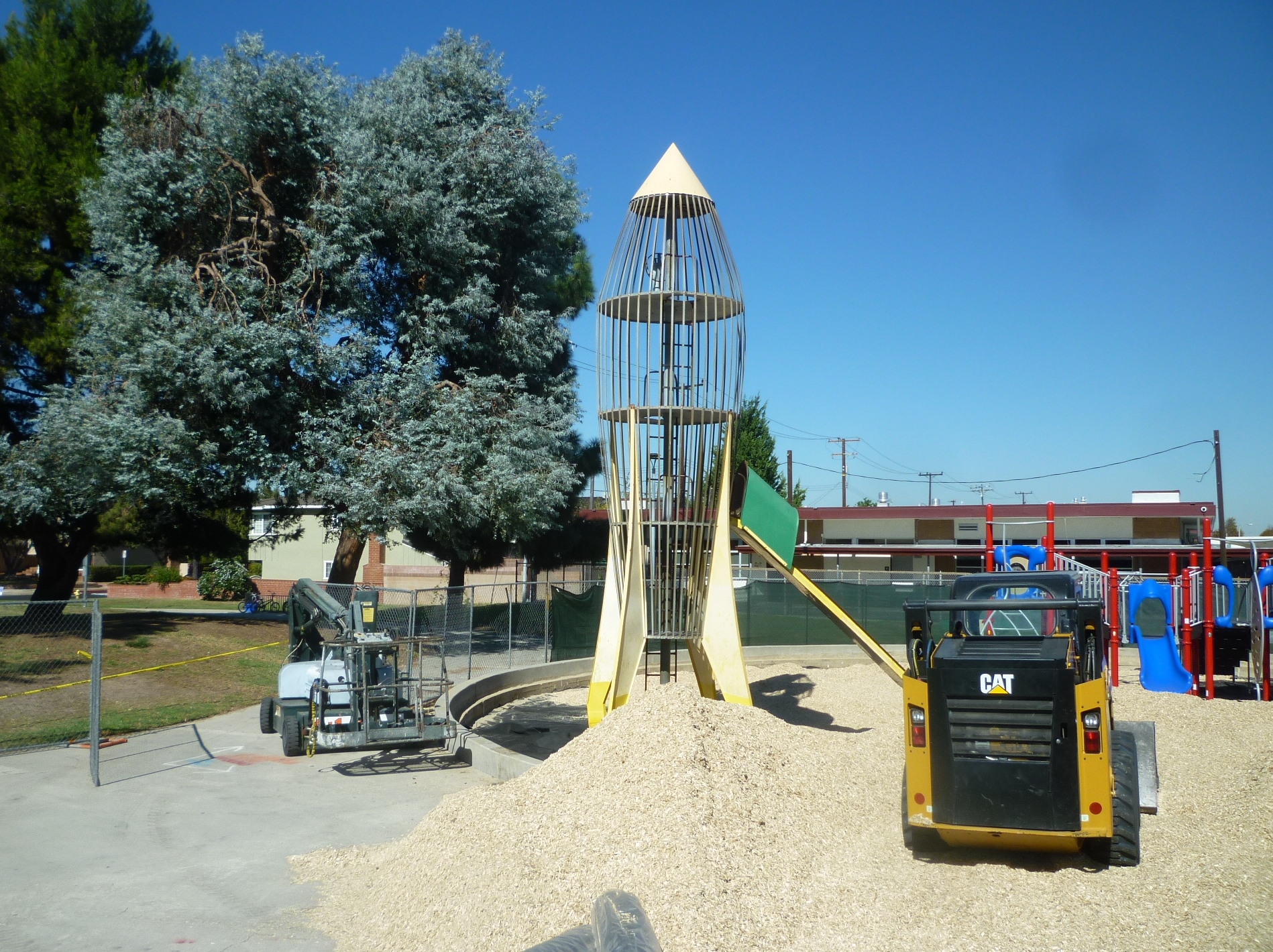
Both of Torrance’s space-age structures, the one at Los Arboles “Rocketship” Park and a similar vintage spaceship at Hickory Park, continue to stand as links to a different era, as well as fun places to play.

The playground housing the rocket ship slide at Hickory Park in Torrance is currently undergoing renovation. (October 2015 Daily Breeze photo)

Sources:

Daily Breeze files.

Los Angeles Times files.

Further reading:

Rocket Science, Lauren Orchowski, Blurb Books, 2010.

“Space-Age Playgrounds,” Life magazine, March 15, 1963, Page 97.

Why the Del Amo name seems to be everywhere you look in the South Bay

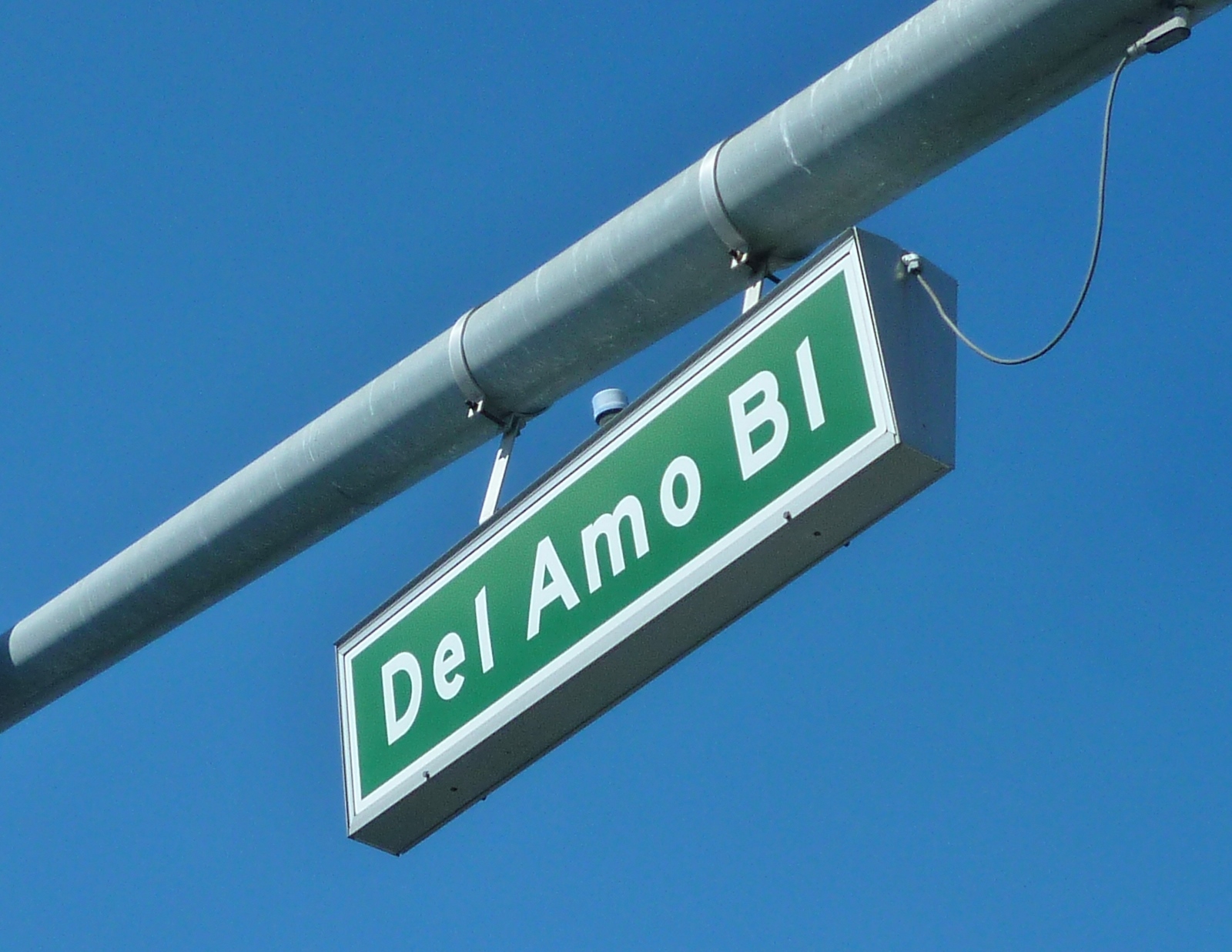
Del Amo Boulevard is a major South Bay thoroughfare. Sign at Hawthorne and Del Amo boulevards intersection. (October 2015 Daily Breeze photo)

The presence of the Del Amo name on everything from one of the South Bay’s major thoroughfares to its gigantic mall to dozens of smaller businesses can be traced to one man: Dr. Gregorio Del Amo.

Del Amo was born into a prominent Spanish family in Santona in the province of Santander on Aug. 18, 1858. He became a physician in 1879 after studying at the University of Madrid.

He practiced medicine in Uruguay and Mexico before coming to the U.S. in 1887, where he practiced for the next 18 years.

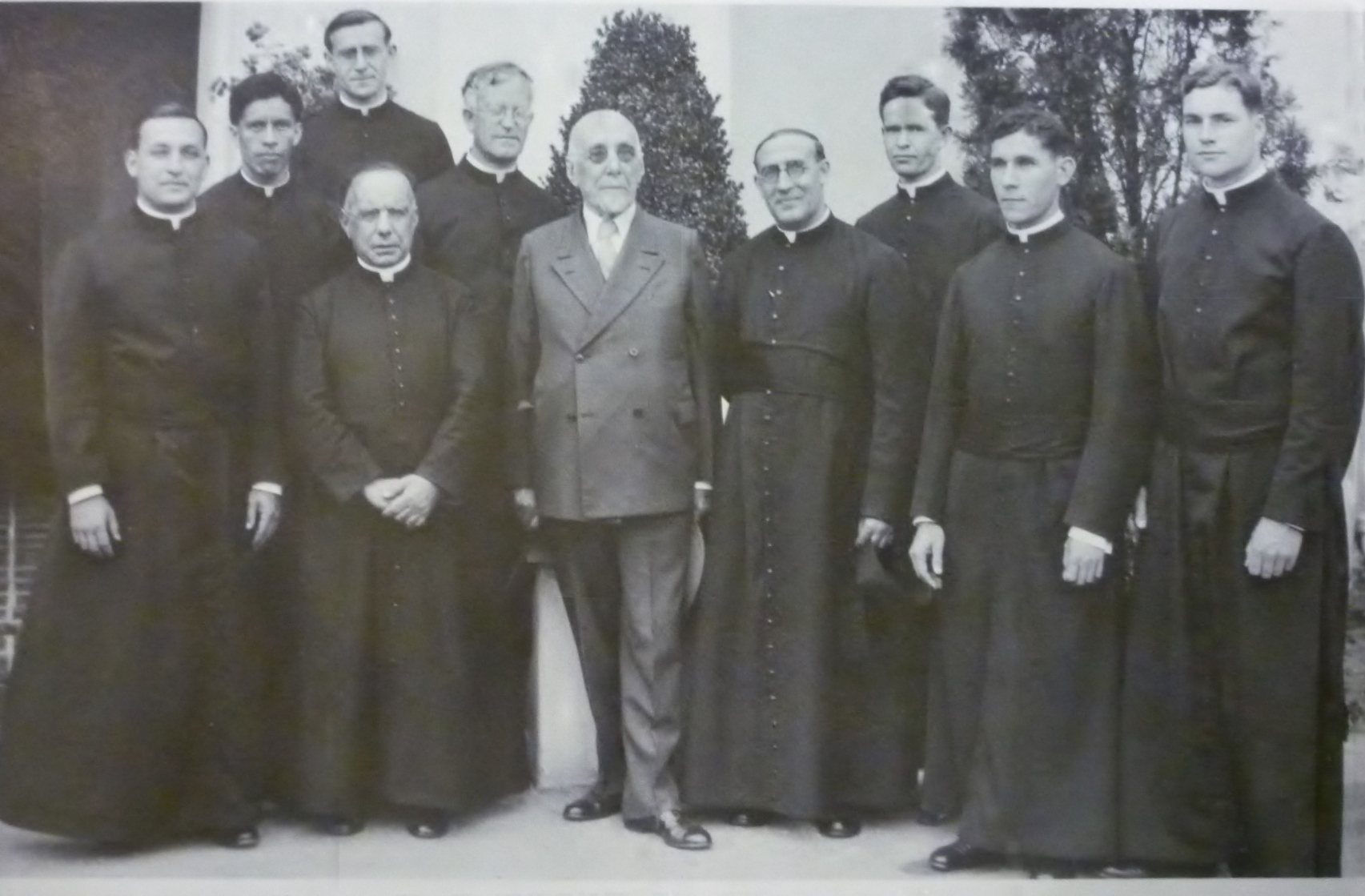
Dr. Gregorio Del Amo is flanked by Claretian priests at the 1927 opening of the Dominguez Memorial Seminary in 1927. (Photo: Del Amo Estate Company)

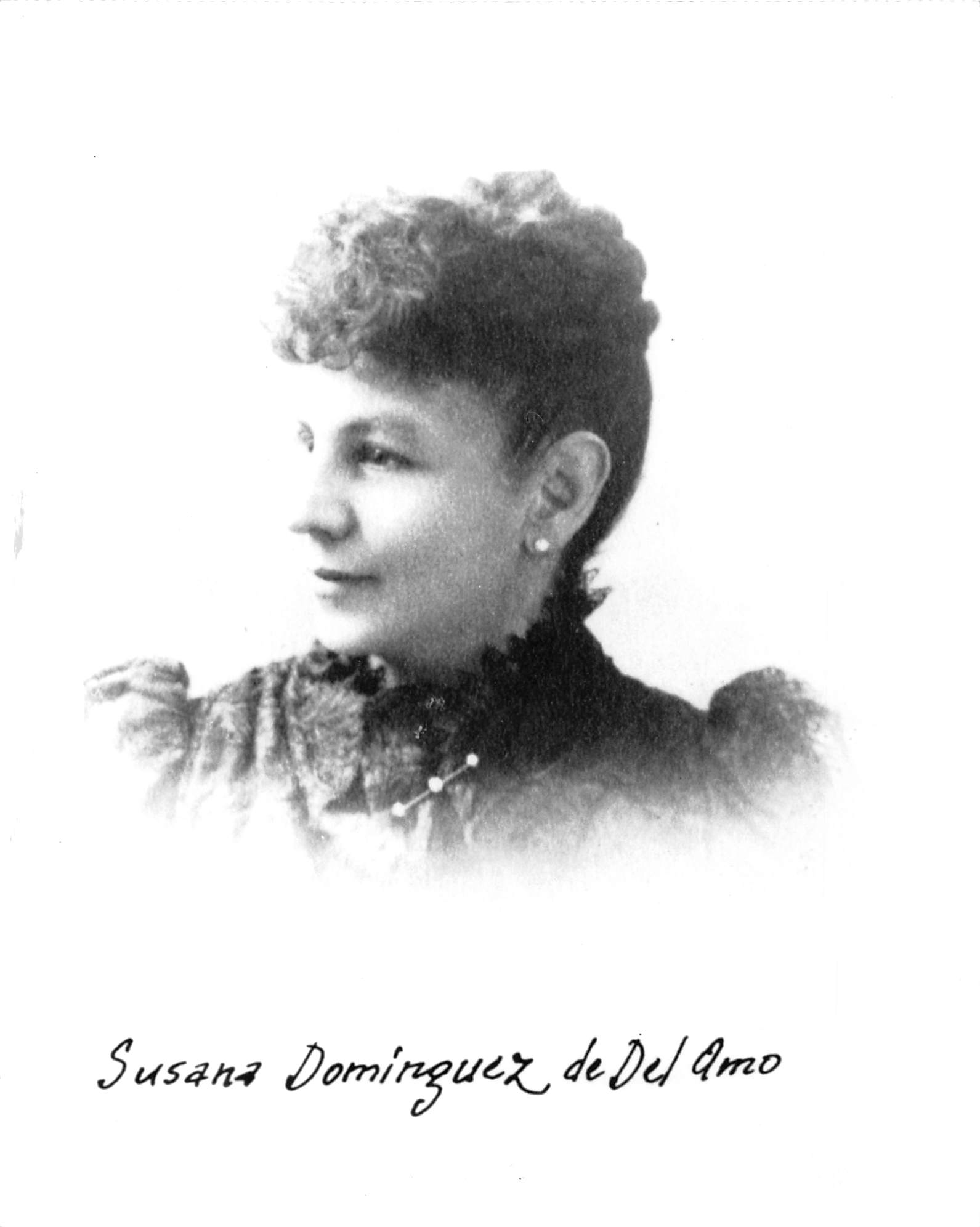
Through his practice, he met Maria Susana Delfina Dominguez, whom he married on Feb. 15, 1890, in St. Vibiana’s Cathedral in downtown Los Angeles.

Dominguez, who went by the name Susana, was 14 years older than Dr. Del Amo. She was the fifth of six surviving daughters of Don Manuel Dominguez, the owner of the approximately 75,000-acre Rancho San Pedro Spanish land grant that he had inherited through the family from its original owner, Juan Jose Dominguez. Juan Jose Dominguez was granted the land by King Carlos III of Spain in 1784.

The Rancho San Pedro’s borders included a good chunk of the present-day South Bay area. This map shows the area in yellow, between Rancho Los Palos Verdes (pink) and Rancho Los Cerritos (green).

Susana was born in the family home, the Dominguez Rancho Adobe, on June 5, 1844. Don Manuel had built the house for his family on Dominguez Hill near present-day Carson in 1826.Before marrying Del Amo, she signed an agreement deeding her husband half interest in her share of the Rancho San Pedro property.

The couple adopted two sons, Carlos, born in 1903, and Jaime, born in 1908. Carlos died in 1931. Jaime would later inherit the family’s holdings.

The couple lived for a time in a house in Redondo Beach until the distinguished doctor became Consul for Spain in San Francisco in 1906, the year of the famous earthquake. He served in that position until 1912.

After leaving that post, Gregorio took his wife Susana with him to Europe, where they stayed until 1920, when they returned and bought a house at 1119 Westchester Place in Los Angeles, in the Mid City area west of downtown.

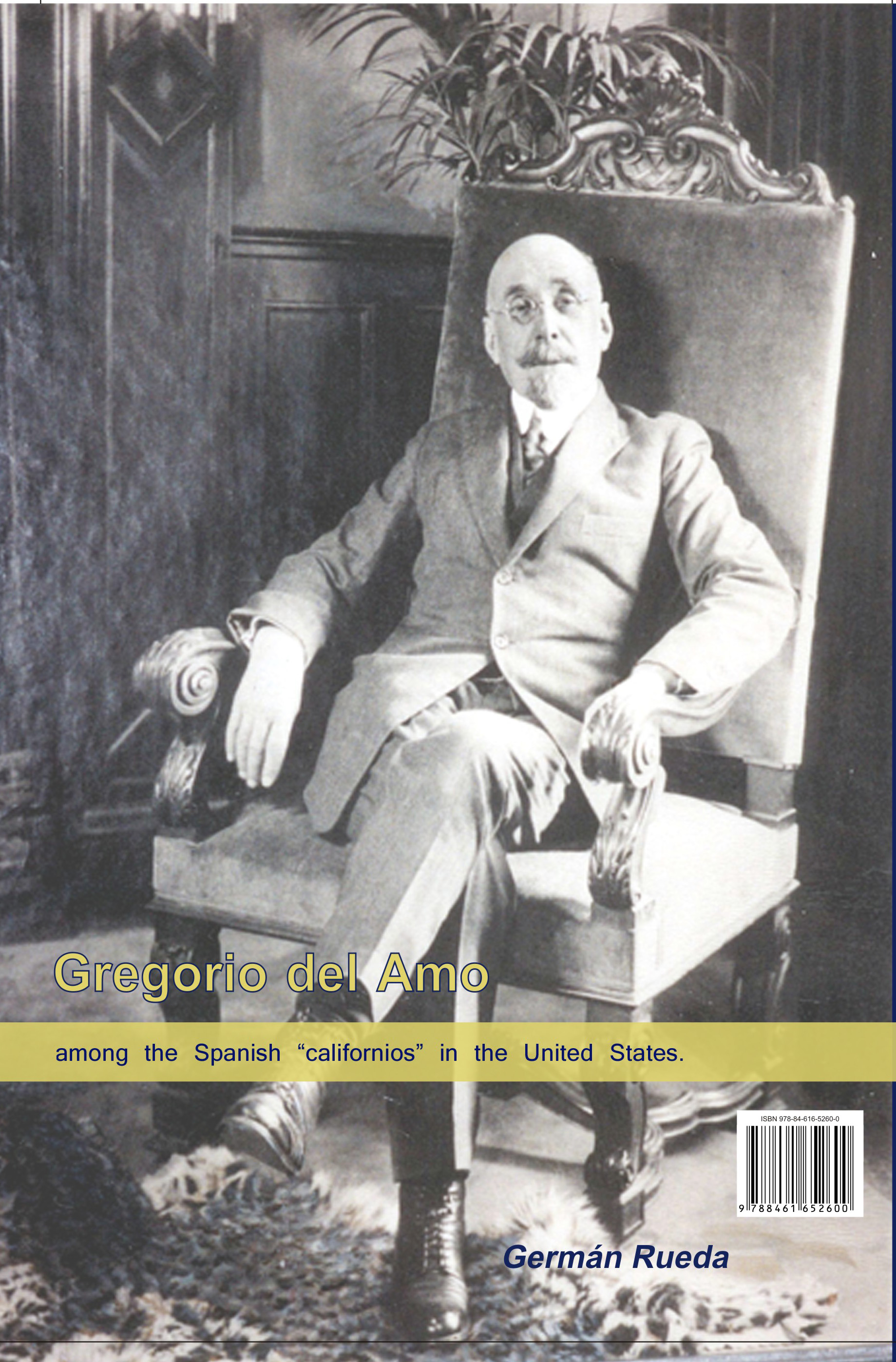
German Rueda's biography of Gregorio Del Amo was published in Spain in 2009.
German Rueda Hernanz’s biography of Gregorio Del Amo was published in Spain in 2009.

There, Gregorio took great pains to have the house landscaped, as horticulture was one of his great passions. By now, his business interests and land management duties both at the Rancho and in Spain took up much of his time; he no longer practiced medicine after 1920.

The early 1920s were a busy time for the Del Amos. In February 1921, Gregorio established the San Pedro Ranch Nursery near the Adobe. It would become Del Amo Nurseries in 1933, for years one of the largest such operations in the South Bay.

The first oil well in the South Bay was built on Del Amo land, not far from downtown Torrance, and it came in on June 7, 1922. It marked the beginning of the South Bay oil boom of the 1920s and 1930s and beyond. The original Torrance well produced until its closure in 1953.

The city of Torrance annexed the Del Amo land on which the oil well stood on Feb. 23, 1926, the first of several major annexations that would build the city out from its downtown core.

(Undated Daily Breeze file photo)

As for Susana, she and her only surviving sister, Maria, became active in philanthropic activities involving the Catholic Church. They donated the Adobe and 13 additional acres to the Claretian Missionary Fathers order in 1924, and built the Dominguez Memorial Seminary on the grounds in 1927.

Gregorio and Susana saw a need to consolidate their various holdings into one entity, and on Oct. 22, 1926, they formed the Del Amo Estate Company to manage their properties.

Gregorio spent many of his later years overseas, becoming involved in a project to build the Casa Del Amo residence hall for foreign exchange students at the University of Madrid. Unfortunately, it was destroyed during the Spanish Civil War of the 1930s.

But from it came another long-lasting project, the Del Amo Foundation. Gregorio established it in 1929 to finance higher education and improve relations between Spain and the U.S. It carried on its work for half a century before dissolving and giving its assets to the University of Madrid, USC and UCLA.

Susana Dominguez Del Amo died on Jan. 21, 1931, at the age of 83 at the house on Westchester Place. Her body was laid to rest in a special plot in the basement of the chapel near the Dominguez Rancho Adobe.

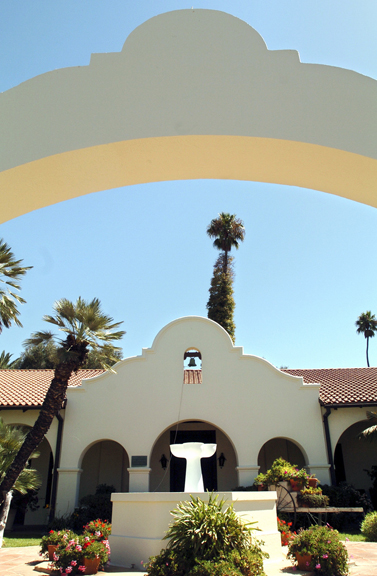
The Dominguez Rancho Adobe after a 2004 renovation. (Daily Breeze file photo)

After suffering a major stroke, Dr. Gregorio Del Amo also died at home, on Sept. 10, 1941. He was the same age as Susana, 83, at the time of his death.

The Rev. Patrick McPolin, a seminary student at the Dominguez Memorial Seminary at the time, got to know Del Amo, and was given the responsibility of burying him in the chapel basement next to his wife, Susana, following his death.

He told the Daily Breeze in 1983 that Del Amo “had the bearing of a European prince. He carried a cane and was every inch a great gentleman.”

McPolin would go on to become rector of the seminary and was in great part responsible for the refurbishing of the Adobe and establishing it as a treasured  historical landmark.

Control of the Del Amo Estate Company and its holdings passed to Jaime Del Amo, who managed the properties skillfully until the early 1960s, when it became increasingly difficult to produce income from the vast properties due to high taxes.

Jaime Del Amo decided to sell off much of the family property beginning in 1962. On Sept. 23, 1964, the Del Amo Estate Company was dissolved. Most of the land went to 10 South Bay businessmen and developers.

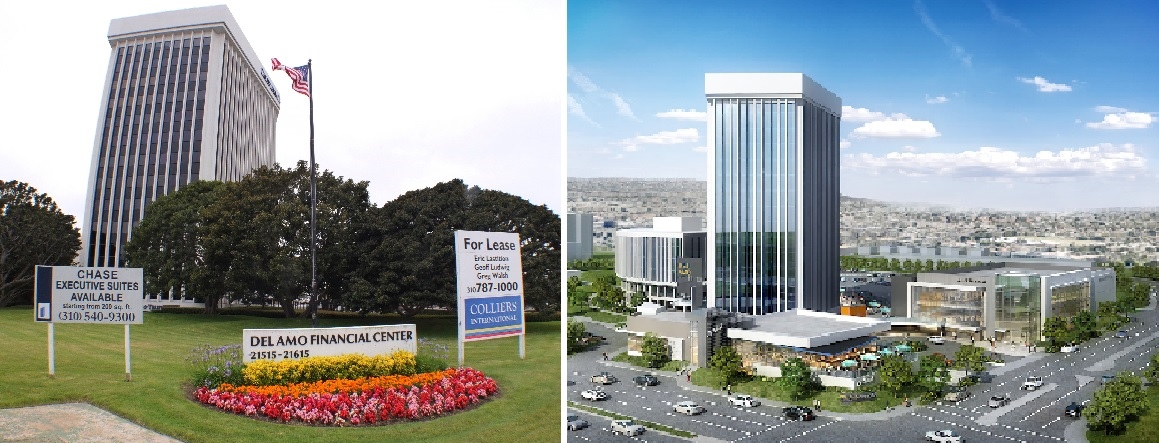
The Del Amo Financial Center at Carson Street and Hawthorne Blvd. in 2013, left, is slated to become a new development called DelAmoCrossing by its new owners. (Daily Breeze photo, left, and artist's rendering)
The Del Amo Financial Center at Carson Street and Hawthorne Blvd. in 2013, left, is slated to become a development called DelAmoCrossing (artist’s rendering, right) by its new owners. (Daily Breeze file photo, left, and artist’s rendering)

These parcels included the land on which the present-day Del Amo Fashion Center shopping mall grew and thrived, and the land across Hawthorne Boulevard where the Del Amo Financial Center was built in 1967.

(October 2015 Daily Breeze photo)

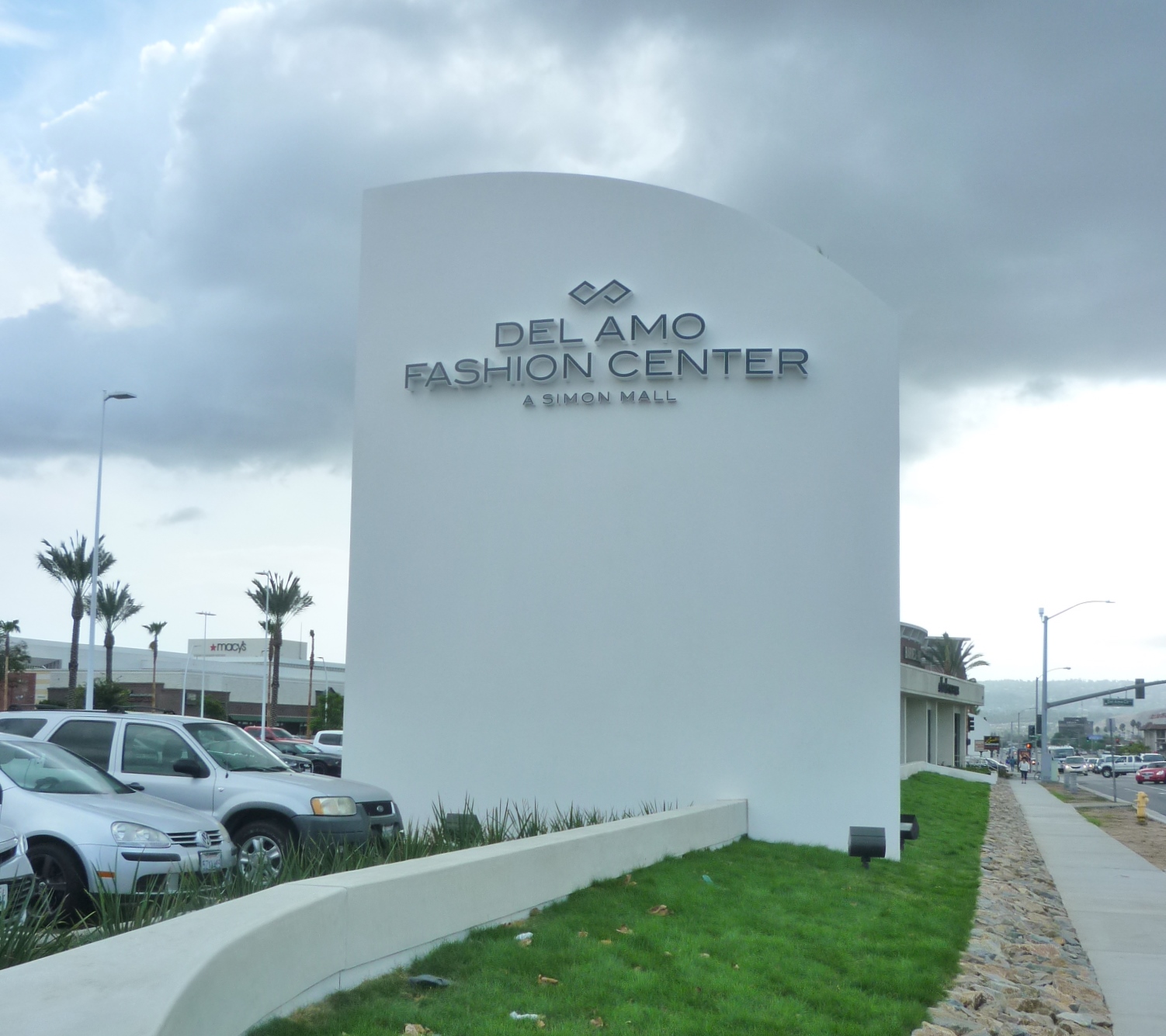
Del Amo Boulevard and Plaza Del Amo were named for the family, and dozens of businesses have adopted the name over the years. Del Amo Elementary School in Carson opened in 1949.

In January 1990, a giant melaleuca tree was transplanted from Four Seasons nursery to a site near the chapel where the Del Amos are buried at the Adobe. Gregorio had planted the tree in the 1930s at Del Amo Nurseries, and it had been moved to Four Seasons after Del Amo Nurseries closed in 1975.

Father McPolin had been eyeing the tree for years, and, in a final tribute to Gregorio Del Amo, managed to have it moved from the Four Seasons lot, which was closing down at the time, in order to give it its fitting final resting place.

Sources:

Daily Breeze files.

Los Angeles Times files.

The Rancho San Pedro: The Story of a Famous Rancho in Los Angeles County and of its Owners The Dominguez Family, by Robert Cameron Gillingham, Dominguez Properties, 1961.

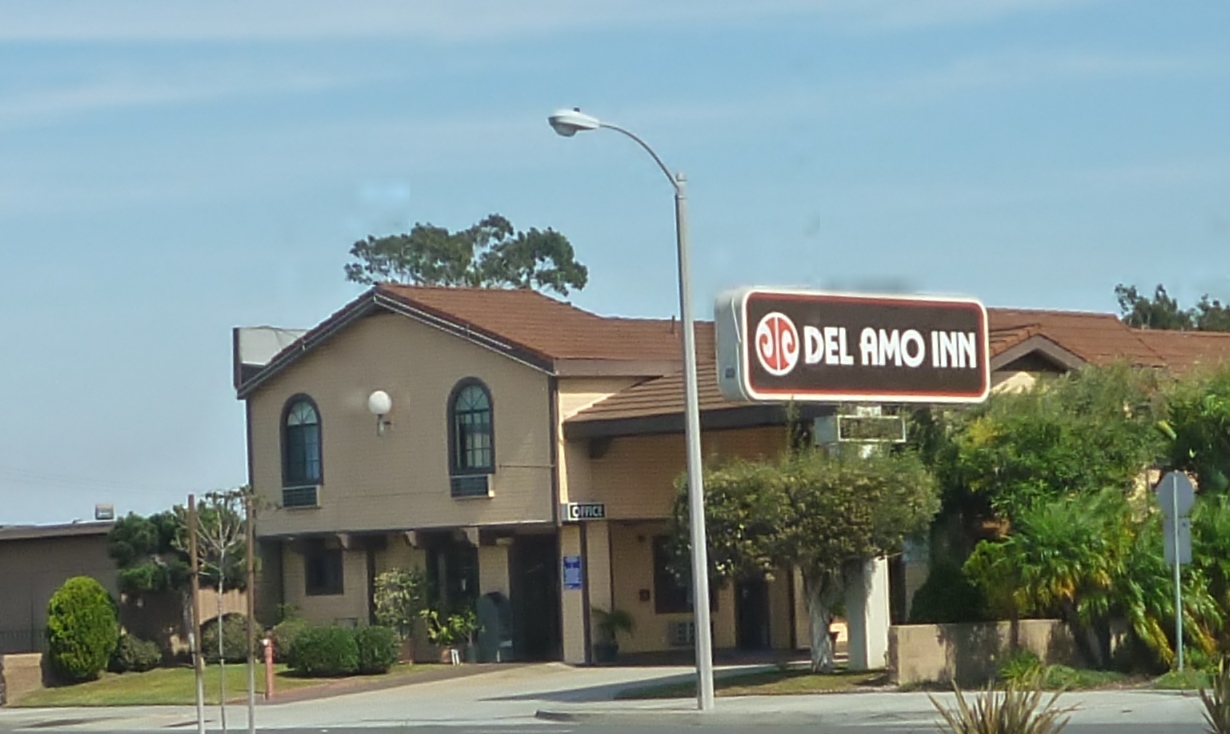
The Del Amo Inn on Hawthorne Boulevard in Torrance, one of the many businesses bearing the name. (October 2015 Daily Breeze photo)
The Del Amo Inn on Hawthorne Boulevard in Torrance, one of the many South Bay businesses bearing the name. (October 2015 Daily Breeze photo)

Malaga Cove School, the Peninsula’s first permanent school building

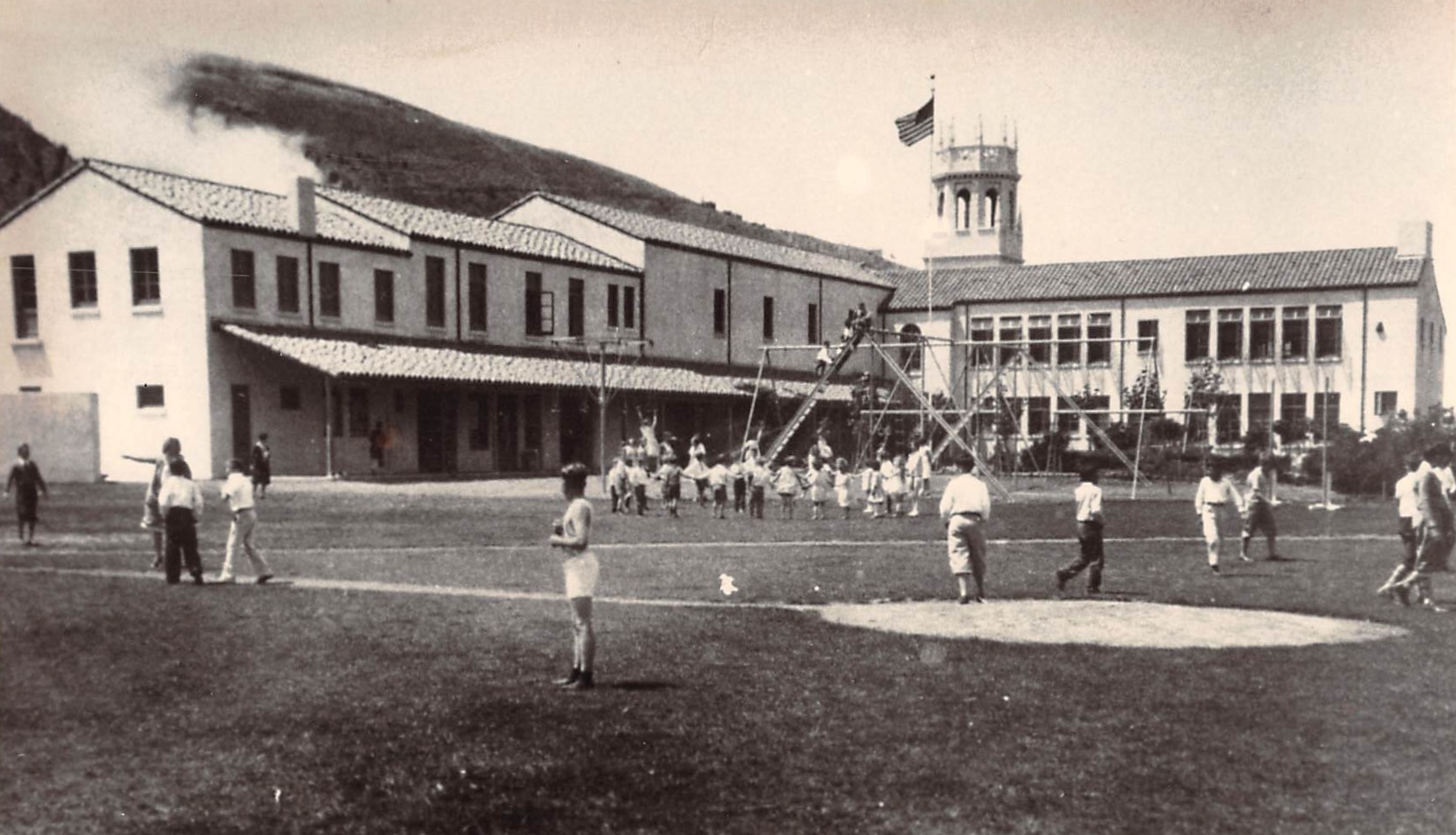
Malaga Cove School in 1926, the year it opened to students. (Daily Breeze file photo)

Malaga Cove School, one of the South Bay’s most iconic historic buildings, came into existence largely due to the efforts of Romayne Martin.

Martin was one of the three original trustees of the Palos Verdes Peninsula School District – L.F. Horner and Col. J.C. Low were the others – when it was formed in 1925. 

Martin immediately pushed for an $85,000 bond issue for a permanent school for the area. It passed unanimously in 1925.

Its first 24 students began classes at a room in the then-new Gardner building in Malaga Cove on Sept. 8, 1925, while they awaited construction of the new school.

A seven and one-half acre site on Via Almar was selected, and the architectural firm of Allison & Allison was hired to design the school.

The original building, with its distinctive spires atop its bell tower resembling a crown, was made of reinforced concrete with a stucco finish. It had four classrooms and an auditorium that seated 294 people. The auditorium was made to accommodate so many because the school was conceived from the first as a community gathering place as well as an educational facility.

Edith Perry became the school’s first principal. When Malaga Cove School opened on April 5, 1926, it had 35 students and two additional teachers, Mildred Hilliard and Edna Sprung. Sprung would later become principal as well.

It was the first Palos Verdes Peninsula school to have its own permanent building.

Its outdoor facilities were only partially built when it opened. When finished, they would include three tennis courts, two handball courts, two basketball courts and a baseball field. The school had no fences.

Students play on the Malaga Cove School playground in this undated photo thought to be from 1926. (Daily Breeze file photo)

The building’s beauty was recognized from the first. It won an Honor Award from the American Institute of Architects for having the most notable school architecture in Southern California for the years 1925-26.

The school grew rapidly from the first along with the Peninsula’s population, and new facilities were needed almost immediately. A $25,000 addition to the school was announced in 1926 to house the “manual training and domestic science departments.” It was completed in October 1927. 

In April 1927, students at the school discovered an eight-foot ivory tusk protruding from a sea cliff near the school. It had been exposed by recent rains. Paleontologists determined it to be from one of the largest mammoth fossils discovered up to that time, estimating that its owner probably weighed in the neighborhood of three tons when it had roamed the area in prehistoric times.

Additional school buildings were added to Malaga Cove following the passage of another bond measure in 1929, this one calling for $80,000 in additional construction.

In its later years, the school would undergo several transformations. It was converted into Malaga Cove Intermediate School in the early 1960s. That was its name when it was closed in June 1991 due to declining enrollments at Peninsula schools.

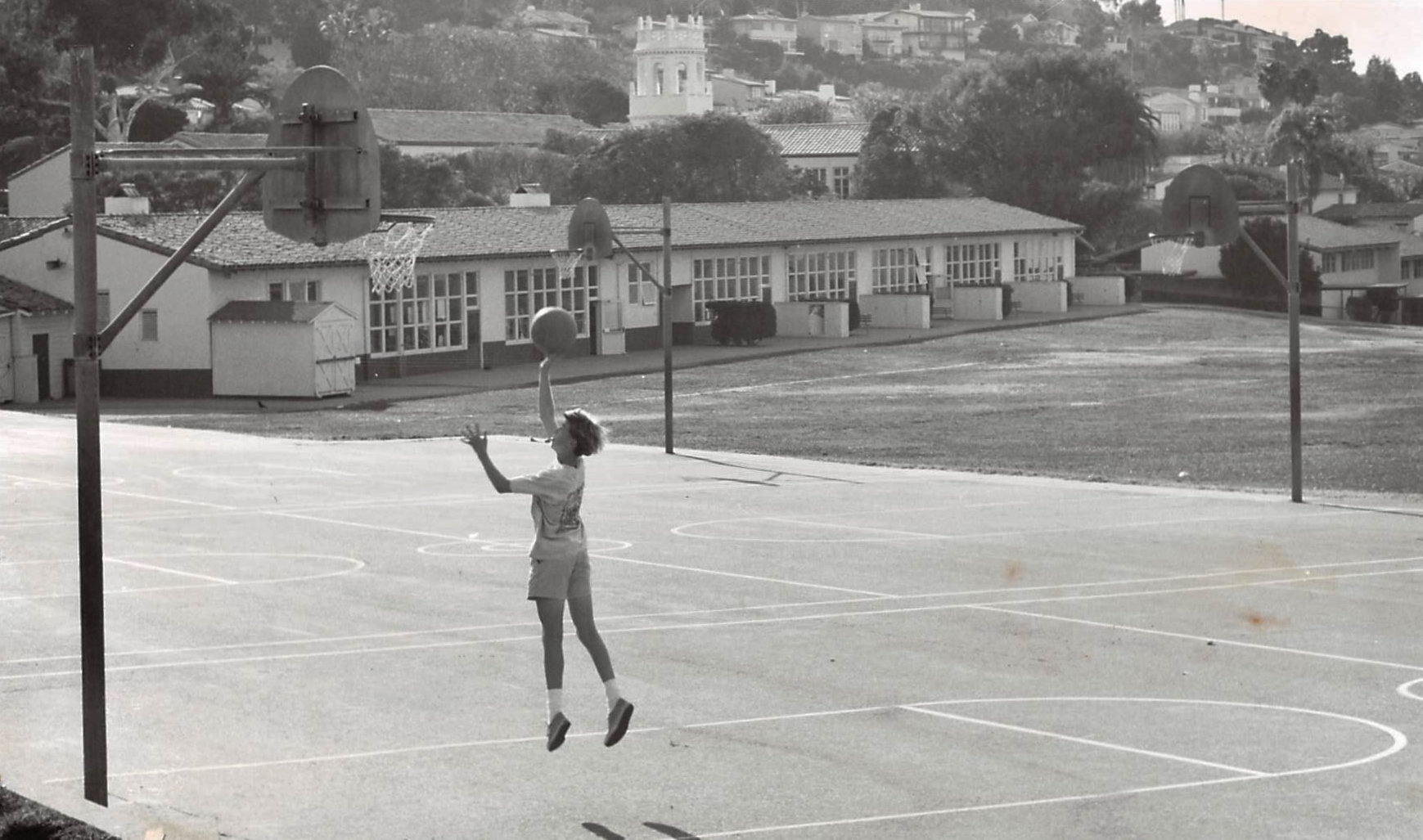
Seventh-grader Tom Gaul plays basketball after school at Malaga Cove Intermediate School in 1991. The school would close in June of that year. (Daily Breeze staff file photo)
Seventh-grader Tom Gaul plays basketball after school at Malaga Cove Intermediate School in 1991. The school would close in June of that year. Its distinctive bell tower can be seen at top center. (Daily Breeze staff file photo)

The building continued to be used for other purposes, however.

Rolling Hills Preparatory School sublet the building for its classes in 1992, and operated there for 14 years. Rolling Hills Prep, founded in 1981, moved to its new permanent campus in San Pedro in 2008.

A Los Angeles County special education program also was housed at the former school.

Another four rooms in the school building were occupied by a small natural history museum operated by the Rancho de los Palos Verdes Historical Society.

The group had been using the building rent-free, but they were forced to move by the Palos Verdes Peninsula Unified School District when it decided to reclaim the building for its headquarters in 2006.

The group became dormant shortly after being evicted, and its historical displays and artifacts were put into 10 crates for storage in 2006. They include the mammoth tusk and the original diorama commissioned by Frank Vanderlip in 1924 showing his vision for developing the Palos Verdes Peninsula.

Work on the school district headquarters project began in 2008, and the newly remodeled and repurposed landmark building opened for business on Jan. 26, 2010.

In September 2014, Rancho de los Palos Verdes Historical Society head Ken Dyda, who originally founded the group in 1975, announced plans to revive it with help from members Vicki Mack and Ann Hugh and curator Joe Cocke. The search continues for a new home for its museum.

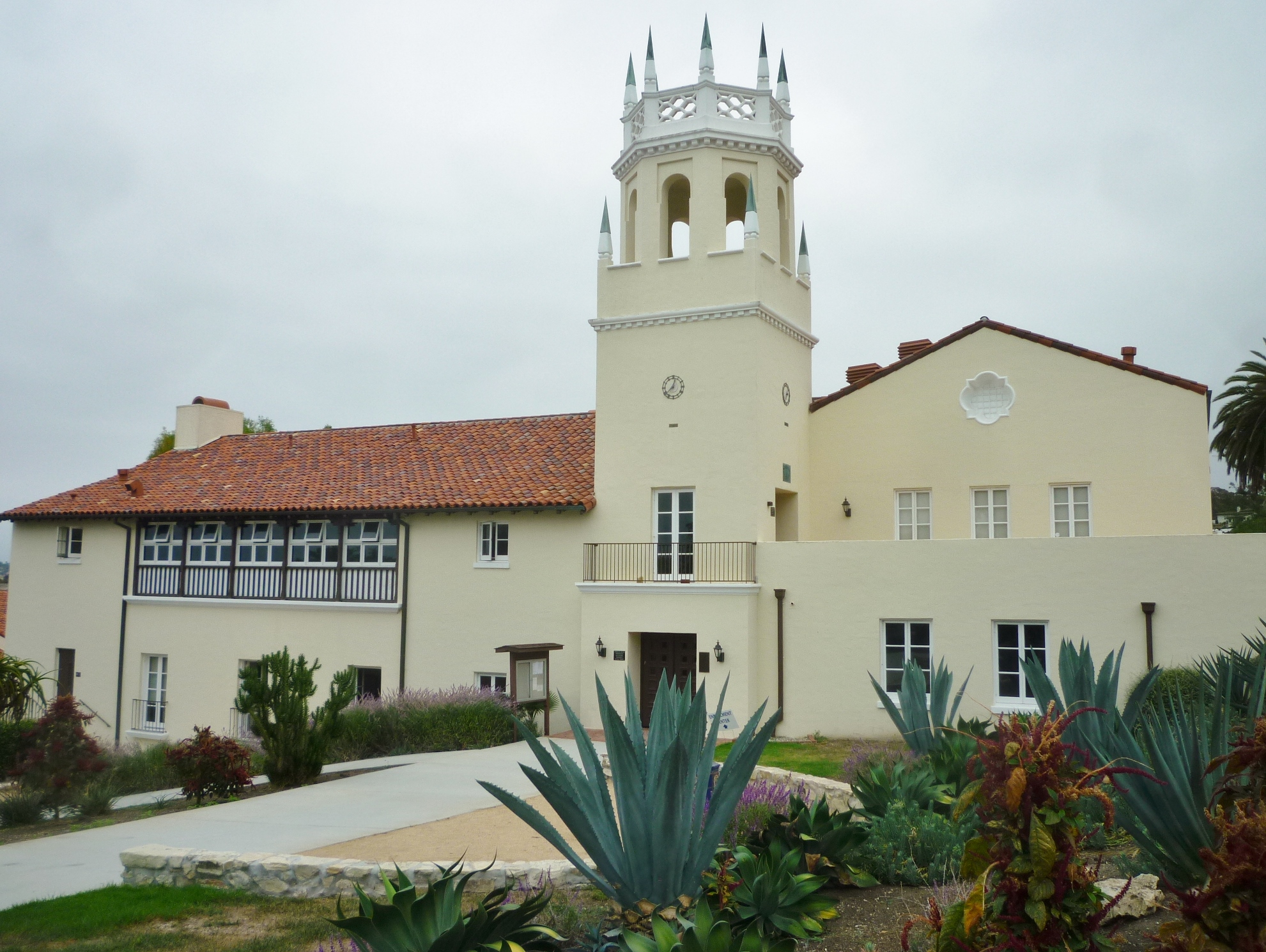
The former Malaga Cove School site is now the home of the Palos Verdes Peninsula Unified School District's offices. (October 2015 Daily Breeze photo)
The former Malaga Cove School site is now the home of the headquarters office of the Palos Verdes Peninsula Unified School District. (October 2015 Daily Breeze photo)

Sources:

Daily Breeze files.

Los Angeles Times files.

The Palos Verdes Story, by Delane Morgan, The Palos Verdes Review, 1982.