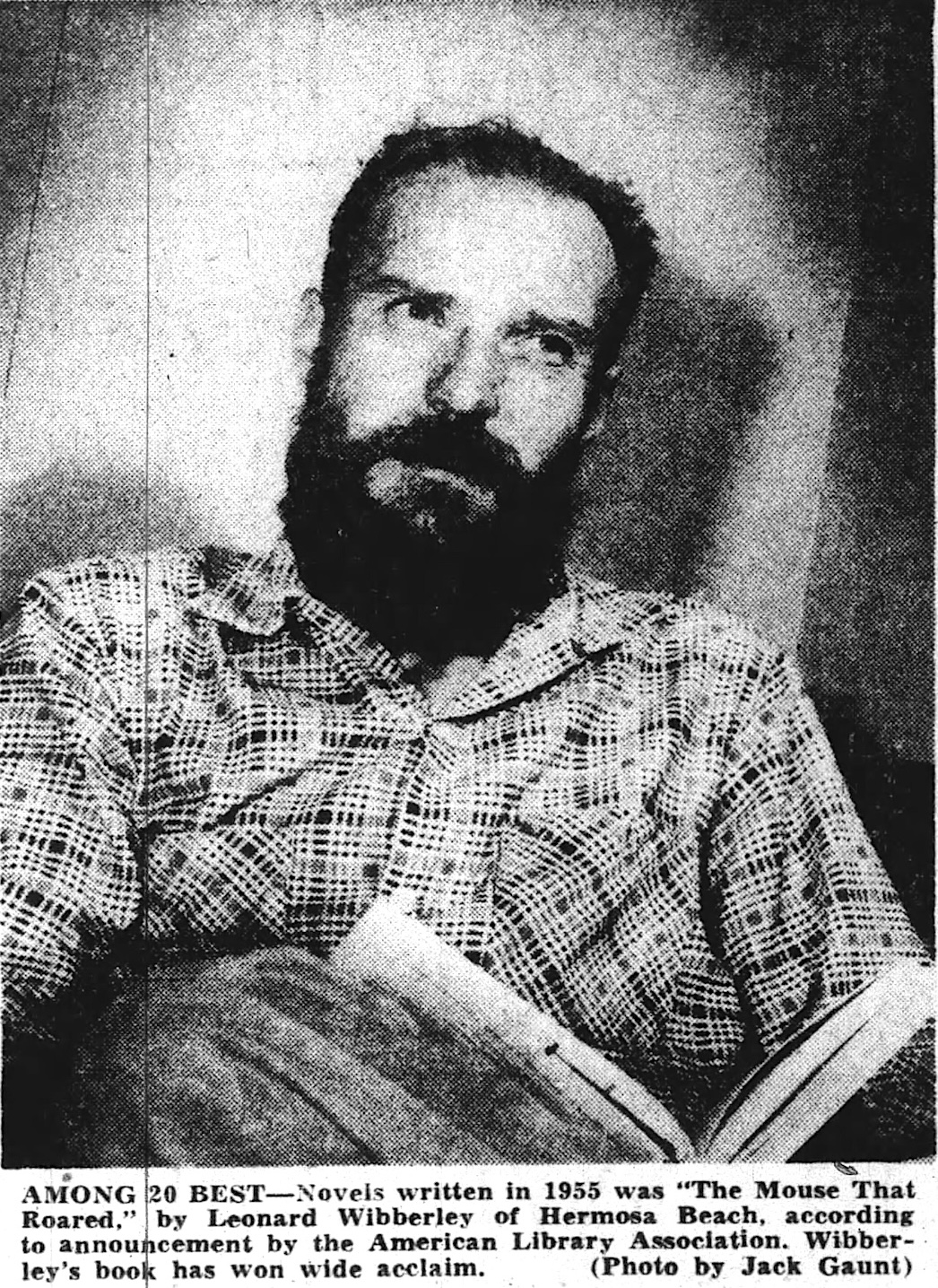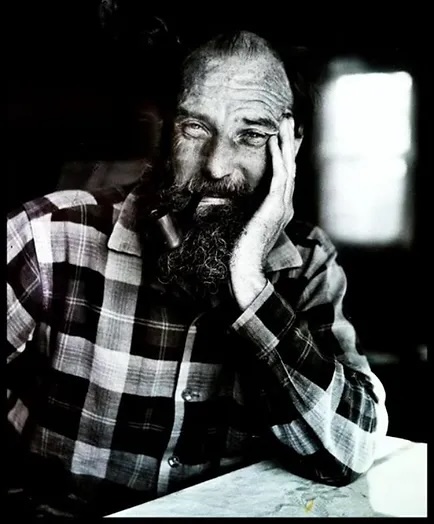
By the time his most famous novel, The Mouse That Roared, was published in 1955, Irish-born Leonard Wibberley already had lived and worked in a variety of jobs at a variety of locations all over the world.
Born on April 9, 1915 in Dublin, he was the youngest of six children. After his early years in Ireland, the family moved to England. His father, Thomas, was a professor of agricultural science at various universities in Ireland and England.
In addition to his regular school studies, Leonard’s father made sure he was schooled in classical violin, which the young Wibberley would continue to play throughout his life.
When he was 15, his father died suddenly at age fifty, leaving his mother to support the six children. Leonard was forced to leave school. After a succession of odd jobs, he turned to journalism, securing his first newspaper job as a copy boy with the Sunday Dispatch in London in 1931.
It would be the start of his twenty-plus years in journalism. He worked for several London newspapers as a reporter and a copy editor during the early 1930s.
In 1936 he moved to Trinidad, where he continued to work in journalism as well as putting in a stint as an oilfield worker. He also met and married his first wife, Olga Maynard, there in 1938. They had one child together.
Wibberley and family moved to New York City in 1943. He initially worked at a shipyard before returning to journalism again, taking jobs as an editor with the Associated Press and as New York City bureau chief for the London Evening News.
In 1947, Wibberley moved to California, where he would live for the rest of his life. He had divorced his first wife Olga a year earlier. In 1948, he met and married Katherine Hazel Holton, who went by Hazel, and with whom he had six children.
He worked for newspapers in Turlock and San Rafael before securing work as a copy editor and reporter for the Los Angeles Times in 1950. He was working at the Times when his first novel, the historical adventure tale The King’s Beard, was published in 1952.
After several more of his books were published, Wibberley decided to pursue his career as an author on a full-time basis. He had settled the family in Hermosa Beach, buying a house on 31st Street, and in 1954, he quit his job at the Times. He would live in Hermosa for the rest of his life.
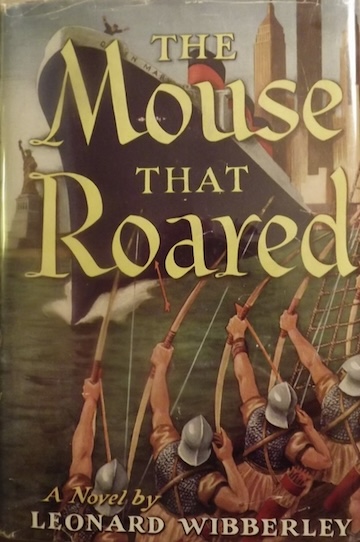
That life would change immeasurably with the publication of his eighth book, The Mouse That Roared, in 1955 by Little, Brown and Co. The book’s contents originally appeared in six installments in the Saturday Evening Post during December and January 1955.
The whimsical political satire told the story of the fictional European country of the Grand Duchy of Fenwick, the world’s tiniest country, which was located in the Alps somewhere between France and Switzerland.
Beset by a financial crisis, its leaders decide to declare war on the United States, which they hope their tiny army, armed only with bows and arrows, will lose so that the Duchy would become the recipients of financial aid from the U.S. as a result. (Both Japan and Germany had received aid from the U.S. following World War II.)

In 1959, Peter Sellers starred in the film adaptation of Mouse. He played three different roles in the farcical comedy and his performance was widely praised by critics.
The novel became a best seller, inspiring Wibberley to write three sequels to it, none of which matched the original’s popularity, though one of them, The Mouse on the Moon, also was made into a film in 1963.
The book cemented Wibberley’s reputation as an author. He would go on to write more than 100 books covering a wide range of subjects and genres, from juvenile fiction to detective stories, nature studies and even a four-volume examination of the life of Thomas Jefferson.
He also wrote newspaper columns for the San Francisco Chronicle, and in his later years, for the Daily Breeze. His Breeze columns ran from November 1978 right up until his death in November 1983.
He carried on with a busy writing career while helping to raise a family of seven in Hermosa Beach and fully participating in community activities. The family was active in Our Lady of Guadalupe church in Hermosa, where Hazel taught in the church’s school for a time.
Wibberley became a regular speaker at Southwest Manuscripters Club meetings, a community group founded in 1949 focused on recognizing and developing aspiring writers that met monthly at the Clark Building in Hermosa Beach.
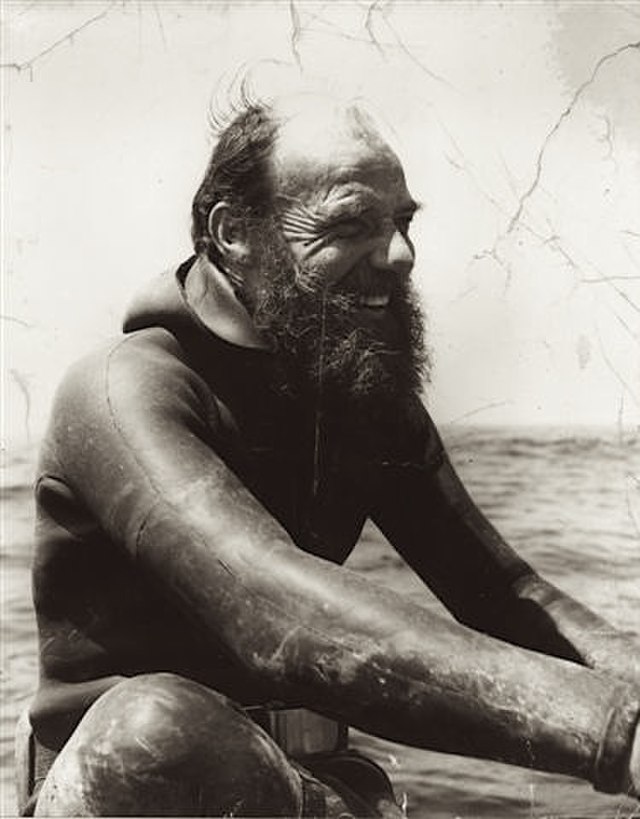
He also had wide-ranging interests that went beyond writing. He never stopped trying to improve as an amateur classical musician, playing violin with a variety of local community orchestras over the years. He also appeared in various local theater productions. In addition, he was an accomplished sailor who took regular trips in his 40-foot sailboat, the Bahia.
On Nov. 22, 1983, he was stricken with a heart attack while on his way to an art lesson in Santa Monica. He died at 2 p.m. that day at Santa Monica Hospital. His death was mourned by many of his faithful readers in the pages of the Breeze. His funeral took place at Our Lady of Guadalupe church.
A memorial portrait of him was hung at the Hermosa Beach Public Library, where he often could be found doing research for his books.
Sources:
“Bibliography,” Leonard Wibberley website.
Daily Breeze archives.
Footnotes on the Sand: An Incomplete Compendium, an Arbitrary Selection of Events, Rumor, Speculation, Some Fact and Some Fiction About Hermosa Beach, by Patricia A. Gazin, self-published, 1991.
Los Angeles Times archives.
New York Times archives.
Wikipedia.