
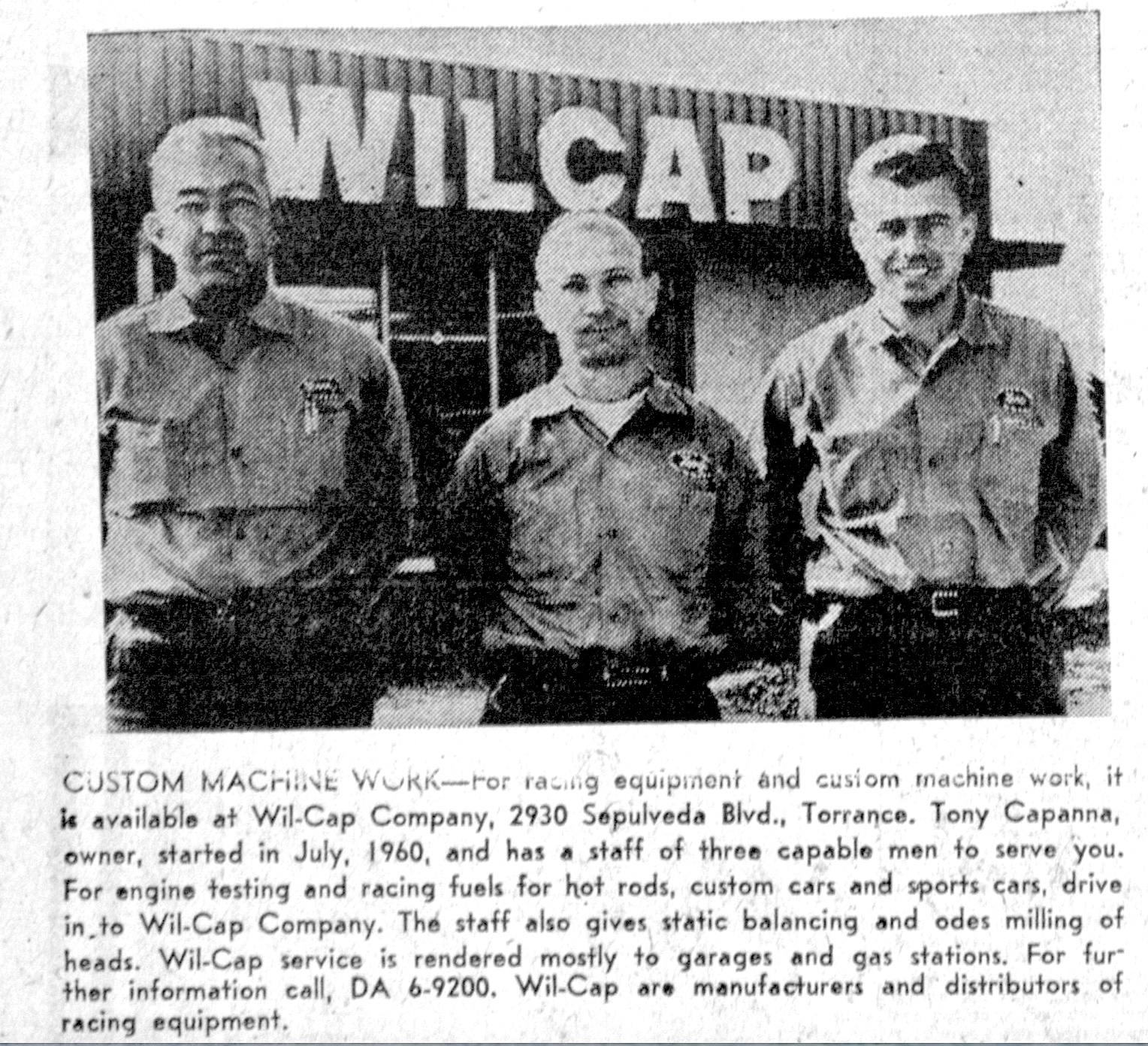
The story of Hot Rod City in Torrance starts with one man: Anthony “Tony” Capanna.
Capanna, sometimes misspelled “Capana,” was born to Italian immigrant parents in Utica, New York, on June 14, 1921. They had arrived in the U.S. one year earlier, and moved to Los Angeles three years later, in 1924.
Tony Capanna attended Jacob Riis High School in Boyle Heights, graduating in 1939. While a student there, he became friends with Lowell and Kenny Lewis. One day, the car enthusiast brothers took Tony out to Muroc, near Edwards Air Force Base in the Mojave Desert, where high performance car drivers were chasing the land speed record on the area’s dry lake beds.
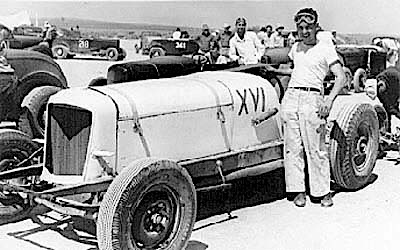
Capanna immediately became hooked on building and driving the souped-up machines that would become known as “hot rods” during the 1940s. He joined the Albata car club in 1939. Its members comprised a who’s who of racers tooling in search of faster and faster speeds across the dry lakes.
Automotive engineer Jim Harrell also joined the Albata Club in 1939. Capanna had spent many hours during the 1930s hanging around Harrell Engines, his Los Angeles shop, where he learned about building high-performance cars, knowledge he would use when starting his own business.
Looking to broaden his skill set as a car mechanic after graduation, Capanna took a welding class at Banning High School in Wilmington. Combined with his experience as a mechanic, he quickly landed a job with a shipbuilding firm in the defense industry, which was ramping up due to the growing war in Europe.
After the Pearl Harbor attack, he attempted to enlist, but his civilian status as an expert welder was deemed more important to the war effort. (He would later join the U.S. Navy Reserve in 1966 as a Chief Petty Officer.)
He worked for the next two years as a welder at the Pearl Harbor Naval Station in Hawaii. He arrived there a few months after the Japanese attack, but saw the devastation it caused firsthand.
He married his wife Ora in 1945 after returning from Hawaii to a job at the Long Beach Naval Shipyard. After she had their first child in 1946, Capanna quit competitive race car driving for good, not wanting to risk losing his life and leaving his children fatherless.
He worked for the Powell motor scooter company on Gaffey St. in San Pedro for a while, before using the money he’d saved from his welding jobs to purchase enough equipment to open his own small machine shop next door.
He moved his business into a larger facility at 10215 S. San Pedro St. in South Los Angeles. He formed a partnership with auto equipment expert Red Wilson there, and the company became known as Wilcap, based on the beginnings of their last names.
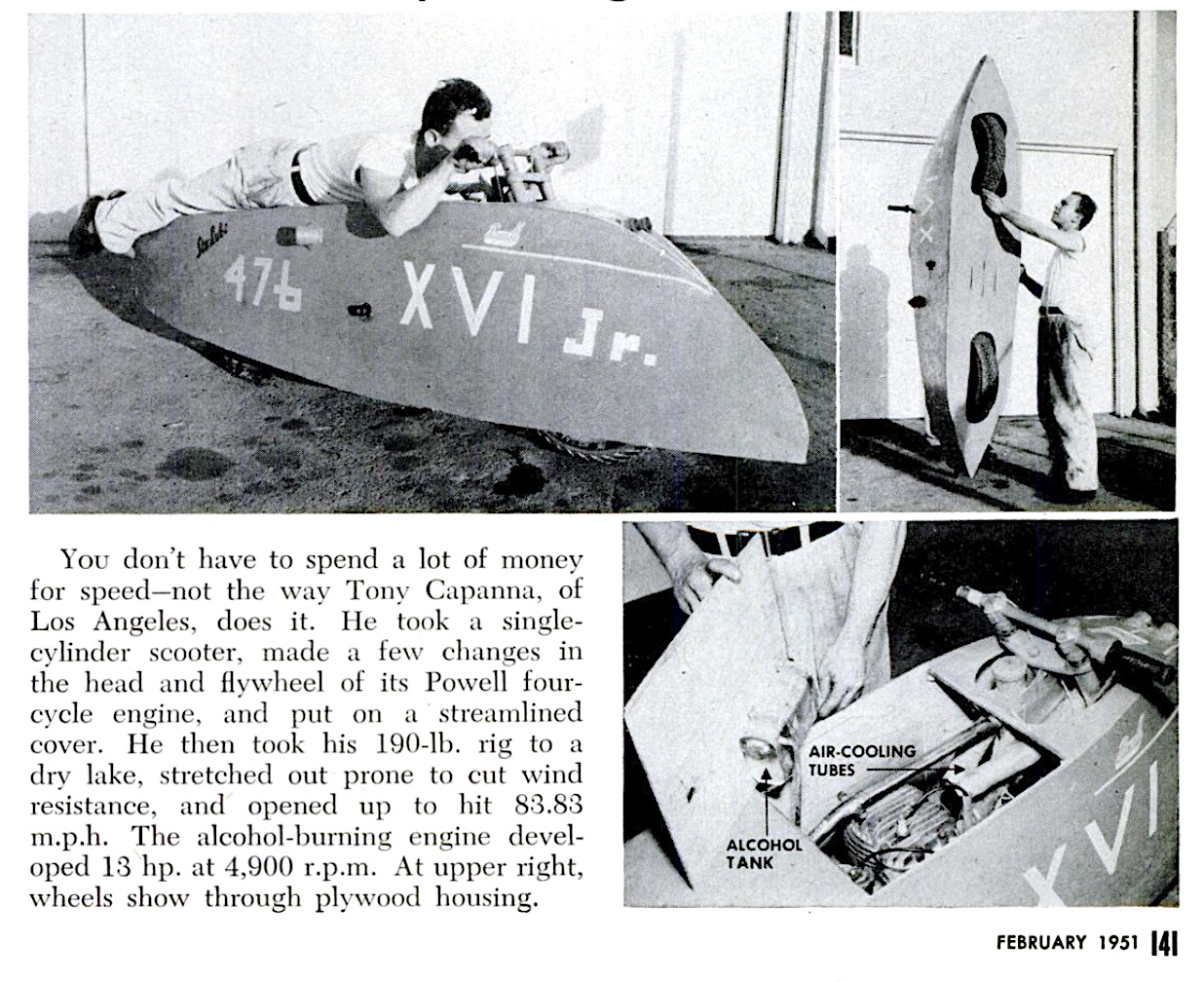
He continued to experiment at the garage with high-performance race cars, often using nitro-based fuels. Twice he attempted to qualify race cars for the Indy 500 during the 1950s, without success. He found the whole process too costly, and never tried again.
The hot rod craze of the 1950s meant steady business for Wilcap. The ambitious Capanna pooled his resources and bought some land on the south side of Sepulveda Blvd. just east of Maple Ave. in Torrance.
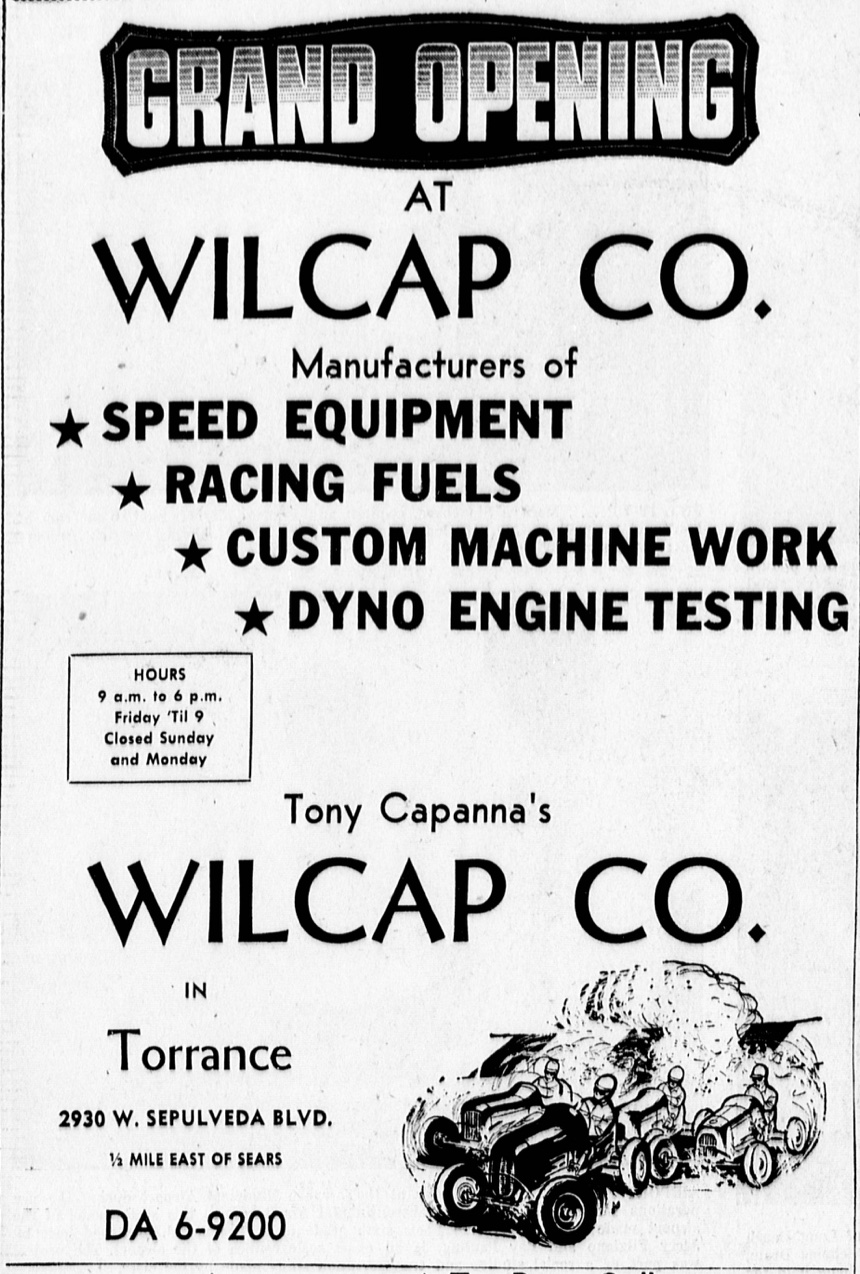
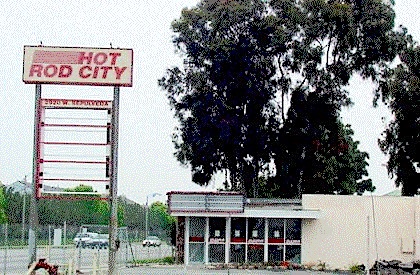
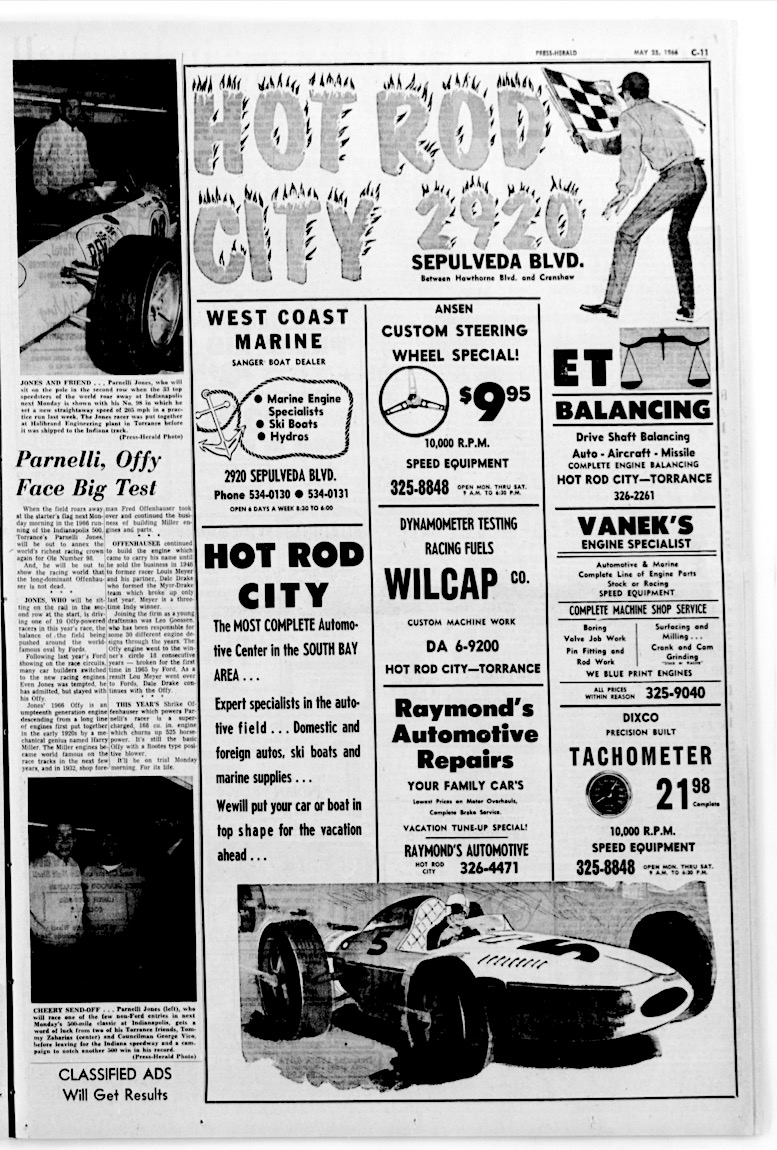
Wilcap opened its relocated operations to the location at 2930 W. Sepulveda on July 10, 1960. Capanna wanted to create a whole shopping center there dedicated to catering to the needs of high-performance car enthusiasts. He called it “Hot Rod City,” and soon Wilcap had been joined by a number of auto specialty shops such as 10,000 RPM Speed Equipment, Chet Herbert Cams and Vanek’s Engine Specialist.
Longtime Torrance resident Jeff Santiago remembers Hot Rod City fondly as a place where he and his teenage friends loved to hang out and learn about cars. He recalls that the various auto shops would give them free promo stickers and decals for STP, Pennzoil and other automotive products, prized booty for the young car racing fans.
Hot Rod City became a fixture at the site for the next 25 years. Capanna, who had been living with his family at their home on Via Colusa in Palos Verdes Estates, decided to pull up stakes in 1985. He moved his family and the Wilcap business to Arroyo Grande on the Central Coast near Pismo Beach.
He and his sons operated Wilcap successfully there for many years. He died in nearby Oceano, California, on Sept. 20, 2001. He was 80.
One of the honors he was most proud of was his induction as the first member of the Dry Lakes Racing Hall of Fame in 1992. The organization includes dry lakes specialists from Craig Breedlove to dozens of others who pursued the land speed record over the decades.
As for Hot Rod City, it closed down during the 1990s after Capanna had left. In 2001, it was announced that the site would become part of an enlarged parking area for the newly revamped Torrance YMCA just to the east of it. To paraphrase Joni Mitchell’s “Big Yellow Taxi,” they paved auto racing paradise and put up a parking lot.
One of the former Hot Rod City businesses still operates in Torrance. Hot Rod Performance, founded in 1987 at the Sepulveda center, moved to its current location at 1932 Del Amo Blvd. after Hot Rod City closed, and continues to operate there. Another, 10,000 RPM Racing Clutches and Billet Flywheels, founded by Ron Hammer in 1964, is now based in Lancaster.
After Capanna’s death, the family sold the Wilcap company to new owners, who continue to conduct business under the Wilcap name in Waunakee, Wisconsin.
Note: Thanks to Jeff Santiago for suggesting this story.
Sources:
Daily Breeze archives.
Find A Grave website.
“History,” Wilcap Co. website.
Palos Verdes Peninsula News archives.
Torrance Press-Herald archives.
Musical Note: The “G.T.O.” group Ronny & the Daytonas wasn’t referring to Hot Rod City in Torrance specifically with this tune, but they could’ve been.

