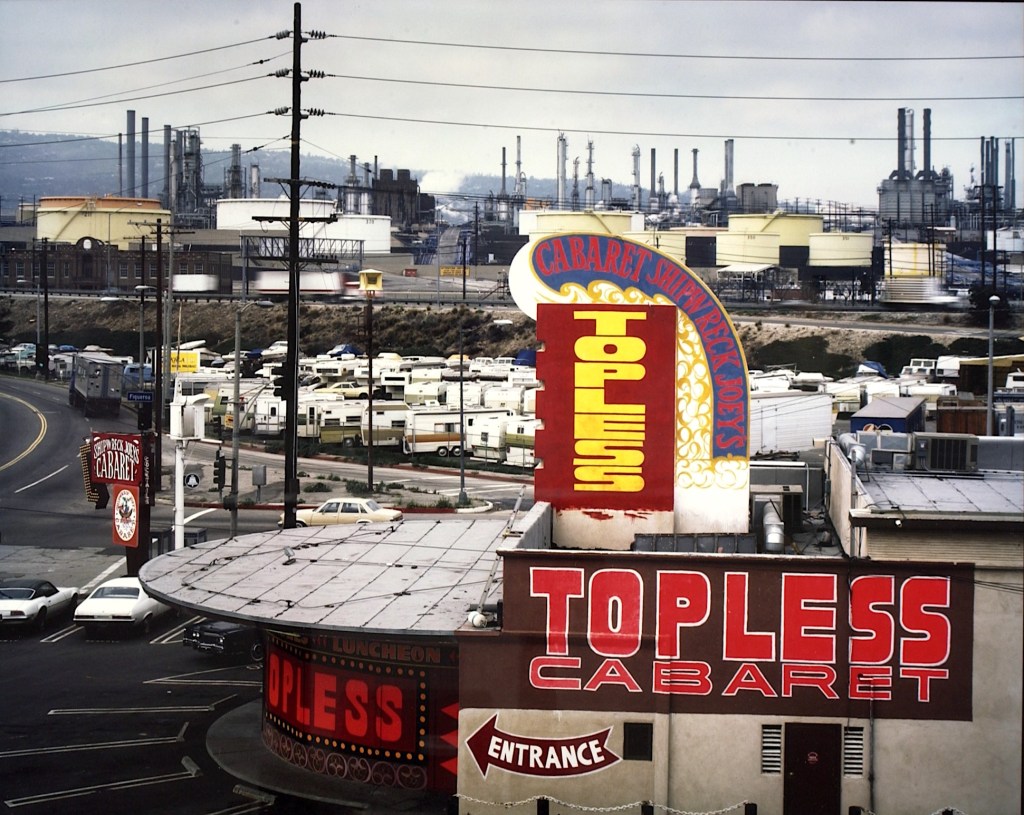
“To have it so visible and to have it be that hideous color…It’s at the entrance to the community and it just looks terrible.”
That’s how Los Angeles City Councilwoman Joan Milke Flores described the nudie bar Shipwreck Joey’s to the Los Angeles Times in 1988.
The nightclub’s “Topless” sign stood out, a garish beacon at Figueroa and B streets in Wilmington. Easily visible from the 110 Freeway, especially at night, Shipwreck Joey’s once-stylish building was fully covered by painted “Topless” signs by the late 1980s.
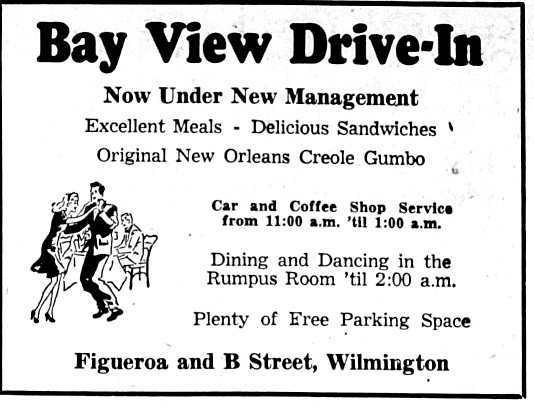
It wasn’t always that way. In 1941, John Frankovich, owner of the Waldorf Inn on Sixth St. in San Pedro decided that the site at 1331 W. B St. would make a great location for a 24-hour drive-in cafe, catering to truck drivers and other workers at the Port of Los Angeles just to the south of it.
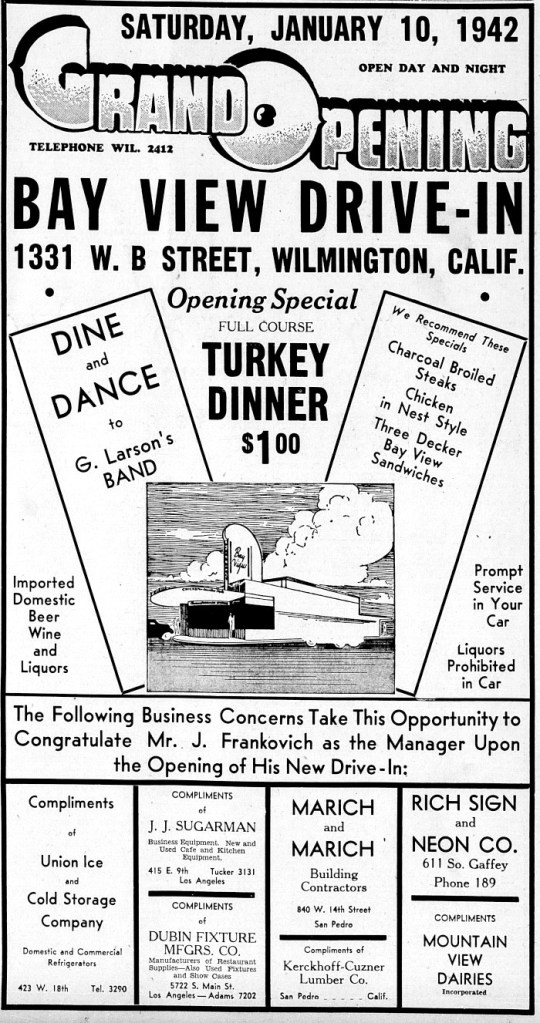
On Jan. 10, 1942, the Bay View Drive-In opened, staffed by three chefs and 20 carhops and other wait staff members. The new restaurant offered both car and sit-down table service. It prospered during World War II, serving the large numbers of industrial workers at the port supporting the war effort.
As early as 1942, the Bay View had introduced live entertainment and floor shows to its menu, billing itself in some San Pedro News Pilot advertisements as the “Bay View Drive-In Nite Club.” Another ad from December 1946 announcing a change in ownership may have signaled a drop-off in its business following the end of the war.
The Bay View’s history during the 1950s is less documented, making the precise determination of its transformation into Shipwreck Joey’s hard to pinpoint. The name change probably happened during the early 1960s.
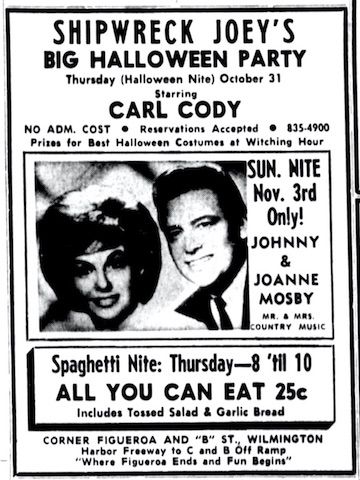
By the latter half of the 1960s, Shipwreck Joey’s had become a full-on nightclub, though its offerings during this era – live country and western performers – were much more respectable than the entertainment offered in its later incarnation.
Local country performers became a staple at the club, including Johnny & Jonie Mosby in 1968. The duo had several country music hits during the late 1960s and early 1970s. Bakersfield standout Wynn Stewart’s appearance at the came in the late 1970s, shortly before the club became a topless establishment.
Not surprisingly, it was Shipwreck Joey’s transformation into a topless cabaret that led to controversy, bringing new meaning to its ad slogan, “Where Figueroa ends and fun begins.” As we noted above, the club was hard to miss for those passing by. Its high visibility brought in customers, but also heightened its notoriety.
Complaints about the club increased during the 1980s, with many locals joining with Supervisor Flores in calling for its closure.
Residents and civic officials may have disliked Shipwreck Joey’s, but it became popular with Hollywood locations scouts during this period.
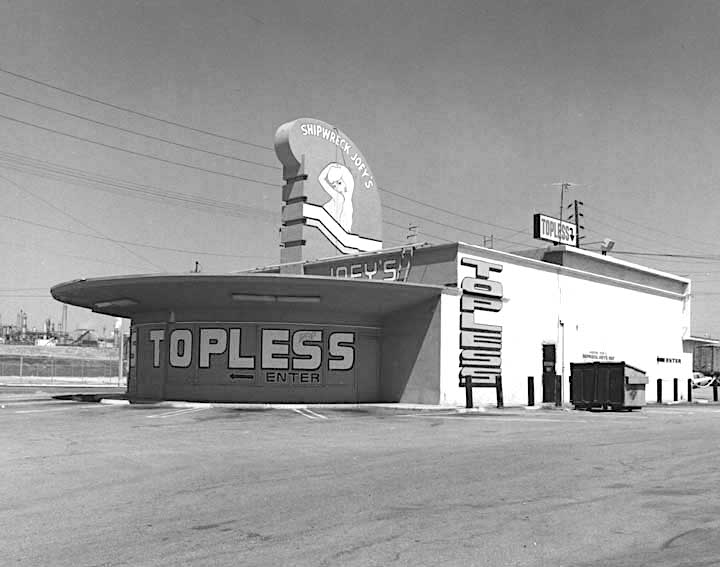
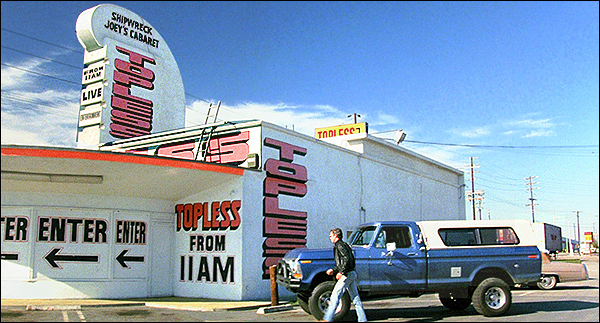
The club was repainted with pink lettering for the 1985 William Friedkin drama “To Live and Die in L.A.,” and both its exterior and interior were used in the production. Its name was retained. Episodes of the 1987-88 CBS television series “Houston Knights” also were filmed there.
The beginning of the end came in September 1988, when the owners of the property, brothers Maurice and William Rosenfeld and their sister, Sally Harris, of Beverly Hills, put the parcel on the market, asking $1.5 million. The Port of Los Angeles expressed interest in the land, which it wanted as part of its planned buffer zone between the Port and Wilmington residents, but balked at the price tag, offering just $975,000.
The club soldiered on for the next few months as the land’s owners sought a buyer who would do something more constructive with the land. It finally closed for good in July 1990, when the owners approved plans by Rocco Grieco of San Pedro to build a truck stop there.
Grieco, who purchased the land for $1.2 million, built the Harbor Truck Stop using the Shipwreck Joey’s building (with all signage removed). It included a weigh scale, bays for washing trucks and a small cafe and market. It opened in 1990 and operated at the location on B St., which was renamed Harry Bridges Blvd. in 1994, for several years.
In 1998, the Port purchased the land from Grieco, who then moved his Harbor Truck Stop operation to a larger location at 2130 W. Pacific Coast Hwy. on the eastern edge of Long Beach.
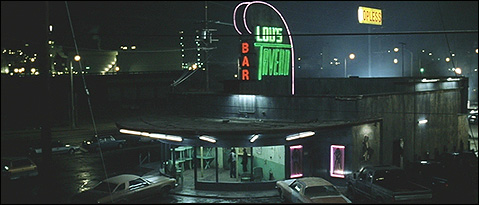
A year later, the empty building was used in another well-known film, becoming “Lou’s Tavern” for “Fight Club” in 1999, starring Brad Pitt and Edward Norton. The building finally was razed in 2000.
The empty land became part of the Port’s buffer zone plan to shield Wilmington residents from noise and encroaching development.
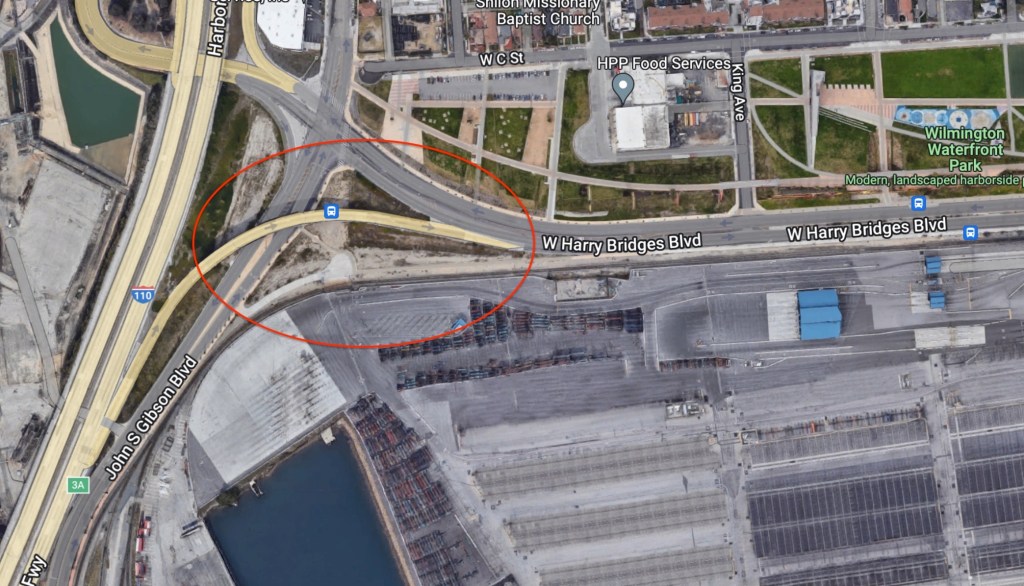
A 20-foot-high wall originally was part of the plan, but residents protested, opting for the building of Wilmington Waterfront Park instead. The old Shipwreck Joey’s lot directly south of the park remains undeveloped, save for an exit ramp from the northbound 110 Freeway that leads onto Harry Bridges Blvd.
Sources:
Daily Breeze archives.
Harbor Truck Stop website.
Los Angeles Times archives.
San Pedro News Pilot archives.
“To Live and Die in L.A.,” Seeing Stars: Where the Movies Were Shot (on location) website.
Torrance Press-Herald archives.
“Watt’s picture of the week – Friday, February 6, 2015,” by Mike Watt, The Los Angeles Beat blog, Feb. 6, 2015..
“Wilmington: Missions Down ‘B’ Street,” by Doña Junta, Swapmeet Chronicles blog, Nov. 2, 2010.