
Frank Bennett was busy raising melons and lima beans on his El Segundo farm in 1911 when representatives from the Standard Oil Co. contacted him about buying his land.
The company needed to build a Southern California refinery to ease the load on its Richmond facility in the Bay Area. Bennett’s 840 acres fit the bill, giving the company an ideal location with room not only for a refinery, but also for a large tank farm for storage.
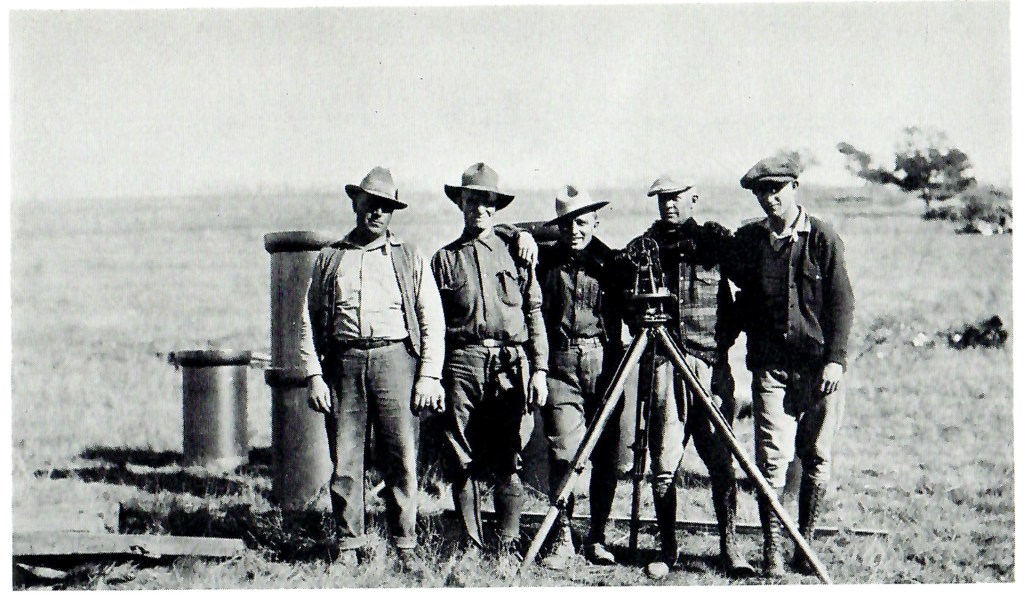
The oversized tanks would hold large amounts of fuel for steam engines and steam-powered ships. As more efficient and powerful methods of powering ships surpassed steam, the tanks suddenly became less useful. Eventually the tank farm became obsolete.
But that didn’t keep it from adorning 37 acres of the northeast Manhattan Beach landscape for the next half a century as the neighboring cities grew up and filled in around it.
Finally, in the early 1970s, Standard Oil, through its Chevron Land and Development Co. subsidiary, began exploring the possibilities of developing not just the tank farm site, but the entire 187 acres it owned in Manhattan Beach. It began studying proposals for the project in 1973.
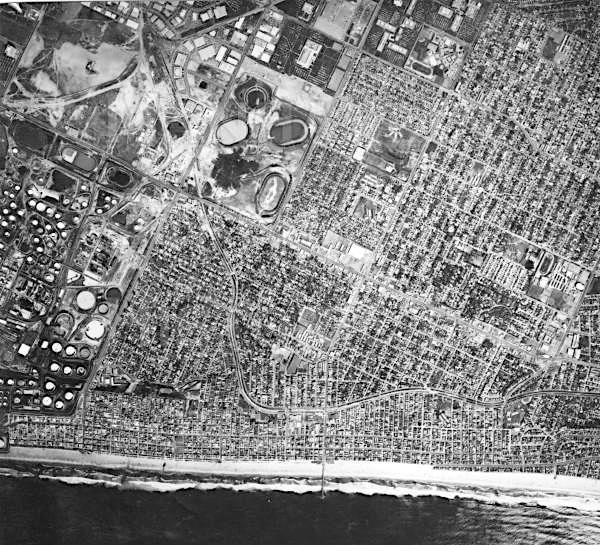
As laid out in plans made with two developers, Alexander Haagen Development and Broadmoor Homes, the project, named Manhattan Village, would be split into four separate developments: 83 acres for residential housing, 39 acres for recreation space, 28 acres for a business park and the aforementioned 37 acres for a shopping and retail area.
That land, on the east side of Sepulveda Blvd. south of Rosecrans Ave., would become the Manhattan Village mall, developed by Haagen. Ground was broken in 1979, and its first phase, an outdoor section including a Ralphs supermarket, Sav-On Drug and several smaller businesses, opened in 1980.
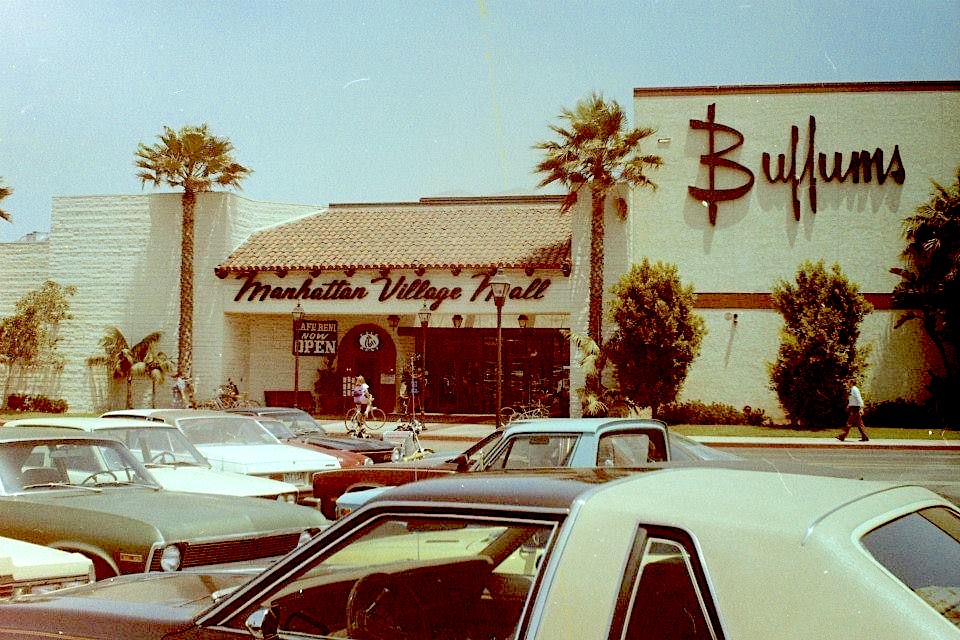
Construction on the enclosed mall, which would be on a much smaller scale than others in the South Bay, began that September. Its two anchors were both department stores: Buffums opened in 1981 and Bullocks a year later in 1982. (Buffums would go out of business in 1990, and Bullocks was consolidated into Macy’s in 1996.)
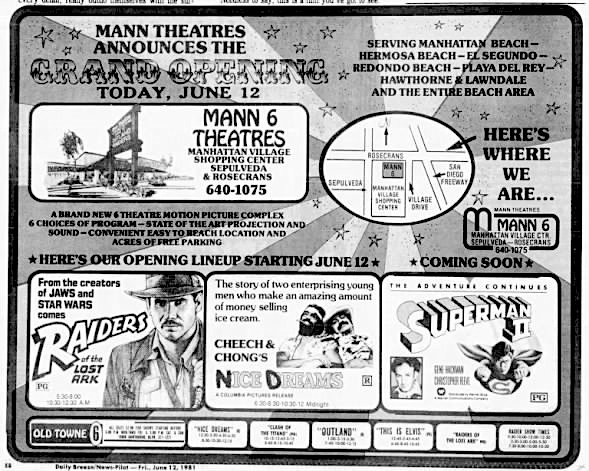
In addition, the Mann Theatres chain announced that it would open a six-theater cineplex on the property. Its first two theaters began operation on June 12, 1981, showing “Raiders of the Lost Ark” and “Cheech & Chong’s Nice Dreams.” Pacific Theatres bought out Mann in 1996, and the Manhattan Village theaters operated as Pacific’s Manhattan Village 6 unti the complex closed on May 28, 2012.
The new mall may have been smaller than most, but its carefully selected department stores and specialty retailers were targeting a very specific set of consumers: the upscale residents of the beach cities, especially in its home town of Manhattan. The developers even trucked in 2,000 grown trees at a cost of nearly $1 million to give the mall’s exterior a fully formed look from the beginning.
The mall changed ownership several times after Haagen first sold it for $70 million to the Pacific Telesis pension fund in 1990. It underwent its first remodel in 1992.
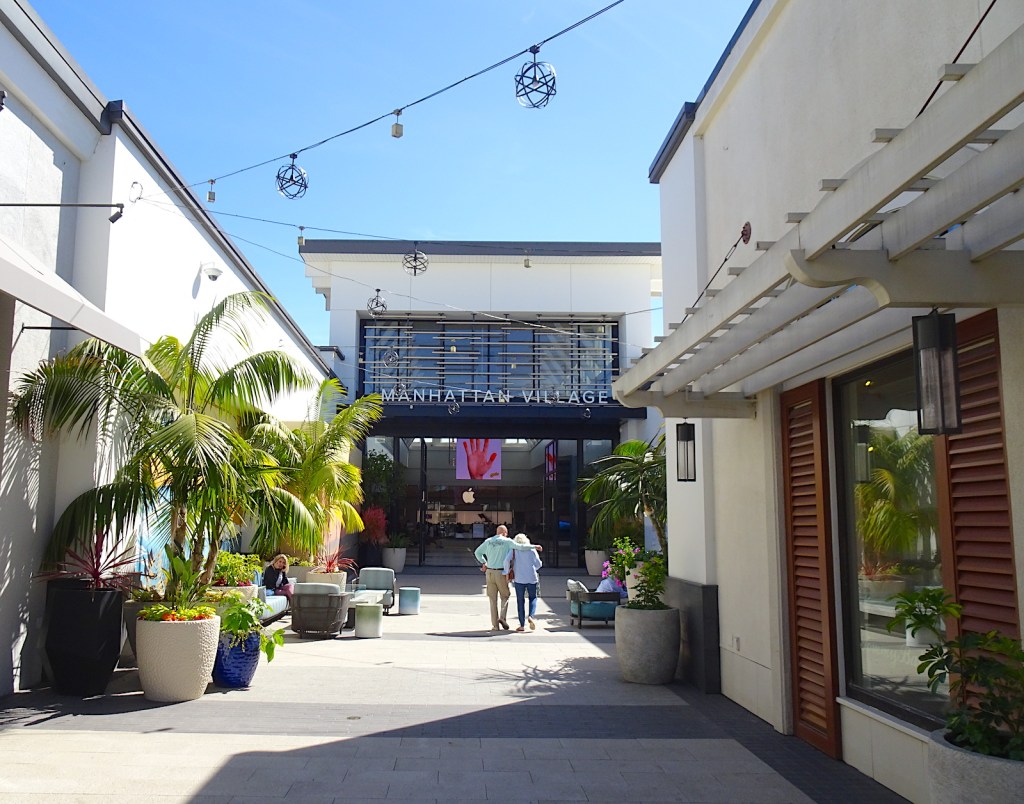
One of its most anticipated and influential tenants arrived when the Apple Store opened for business at the mall on July 30, 2005. It was the first and remains the only Apple Store operating in the South Bay/Harbor Area.
A year after it opened in 2006, its current owner, the Deutsche Bank-owned real estate trust firm RREEF America L.L.C., began talking with the city of Manhattan Beach about a long-range development plan for the mall and surrounding area. RREEF had purchased the mall in 2004.
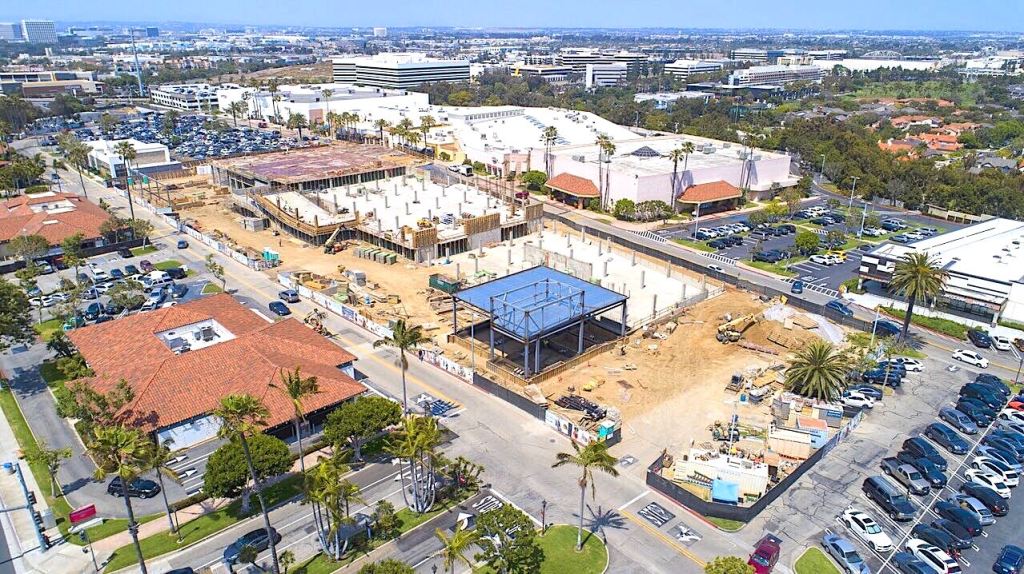
Long-range being the operative word, as its owners and Manhattan city fathers would continue to dicker over the proposal for the next six years. In 2012, a revised plan was made public. It would include new parking garages, an expanded outdoor shopping area known as the Village Shops, and construction of a new building that would allow Macy’s to consolidate its two outlets at the mall into one store.
It would be two years before the Manhattan Beach City Council would give final approval to the $110 million plan in December 2014. The group Sensible Citizens of Manhattan Beach sued the developers in an attempt to stop the expansion. A settlement was reached with them in 2017, and work began in earnest on the revamp.
Under the plans, the Apple Store has become the focal point of Manhattan Village. The mall’s new central court has a fountain and a concierge counter, both situated in front of the Apple location.
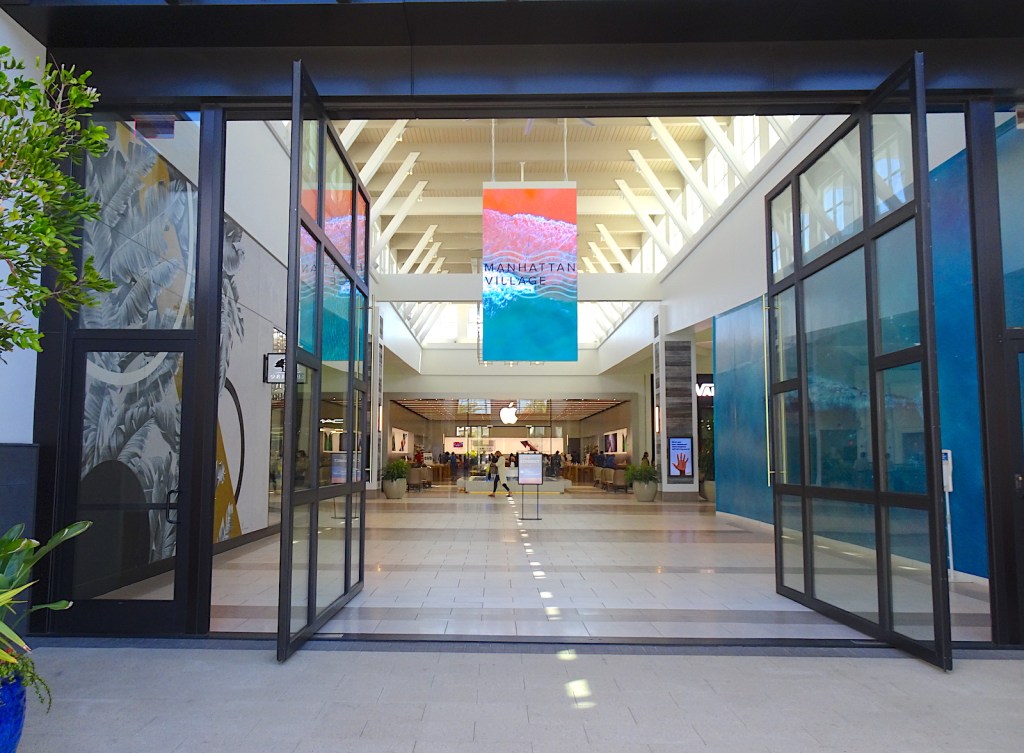
Don Ziss, senior general manager of the mall’s operating company, Jones Lang LaSalle, told the Daily Breeze’s Kirsten Farmer in 2019 that the Apple store serves as a regional draw to the otherwise locally focused shopping center.
Cost for the project increased to an estimated $250 million as various other improvements, such as the conversion of a Wells Fargo Bank branch into two restaurants, were added to the mix.
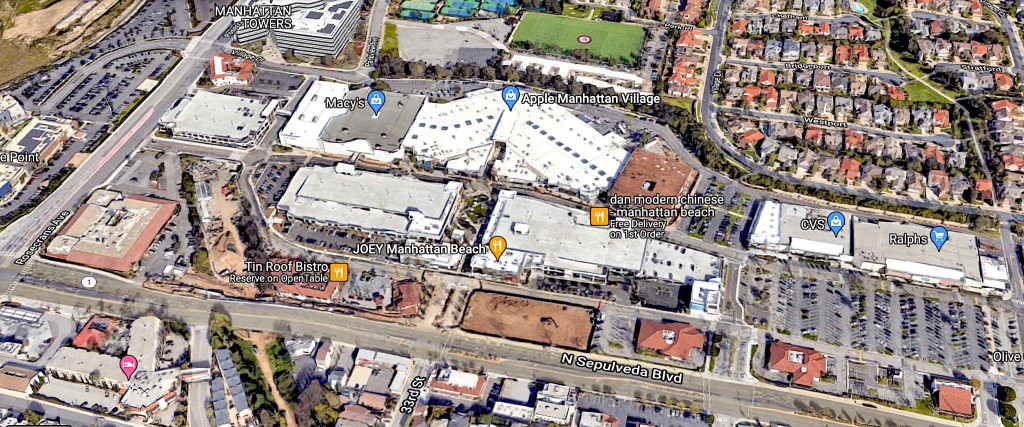
As of this writing, the interior redesign of the mall has been completed, the new parking garages, including electric car charging stations, have opened and much of the outdoor Village Shops development has been finished. The entire project is scheduled for full completion by the end of 2022.
Plans for the former Fry’s Electronics site on the site’s northwest corner at Rosecrans and Sepulveda boulevards are ongoing. The entire Fry’s chain closed in February 2021.
Sources:
Beach Reporter archives.
Daily Breeze archives.
El Segundo: Seventy-Five Years: A Pictorial History of El Segundo, California, by Eileen Curry Hunter, H2 Limited Publishers, 1991.
Los Angeles Times archives.
“Pacific’s Manhattan Village 6,” Cinema Treasures website.

