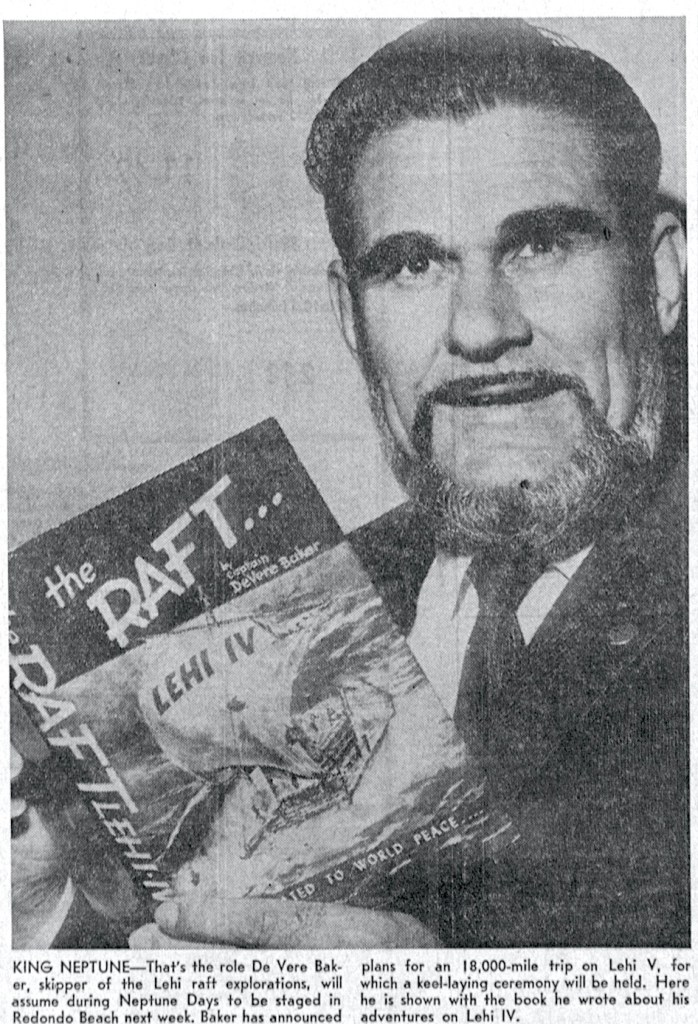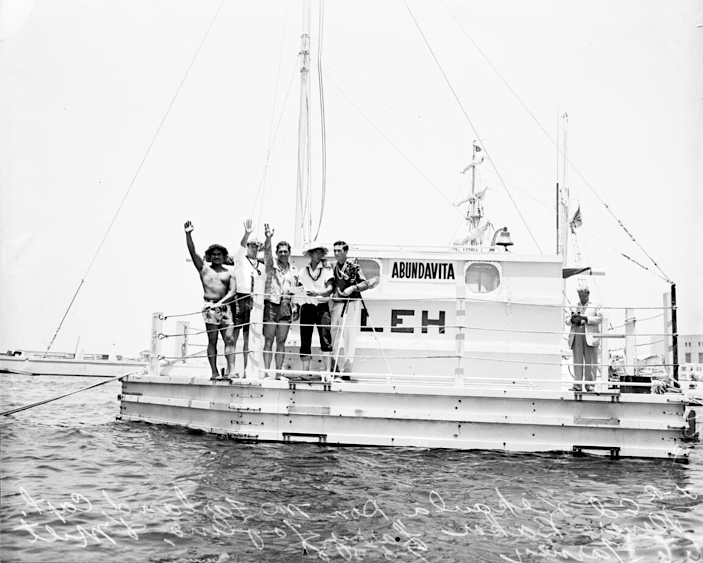
DeVere Baker was already 30 when the idea for his life’s work came to him. He decided to consolidate all his assets and put the money toward proving a basic tenet of his Mormon faith: that ancient peoples had migrated to North America from the Middle East.
Born in Tremonton, Utah, on Dec. 14, 1915, Baker later moved to Petaluma, Ca., where he had prospered during World War II as the owner of two shipyards in Sausalito that built and maintained military landing vessels.
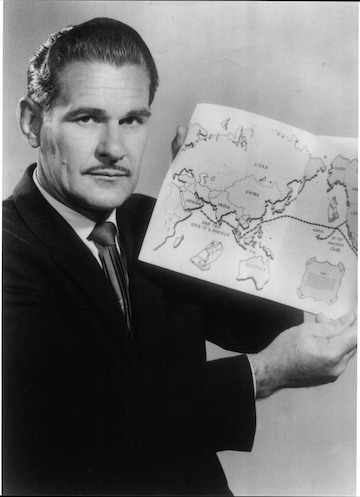
He used this money to begin financing a series of expeditions using custom-built rafts, all of them named Lehi followed by the trip number, I, II, III, etc. The voyages were meant to prove that the Lehites, a lost tribe of Israel led by the prophet Lehi in 600 BC, had migrated across the Atlantic to the New World to start a new civilization, as described in the Book of Mormon.
“It was almost a joke, almost a whim,” Baker’s wife, Nola, told the Daily Breeze at the time of Baker’s death in 1990. “He’d done almost everything else. He wanted to see what it felt like. He loved it because he got to meet so many people and got to spread his theories on religion.”
Baker would conduct five raft trips between 1952 and 1979, some of them successful, others less so, most from his home base at King Harbor in Redondo Beach. He lived in Redondo at a home on the Esplanade for much of this time, later moving to San Pedro.

He ultimately would write seven books on his experiences, become celebrated in the media and even appear as a guest on “You Bet Your Life” with Groucho Marx on an episode that aired on Feb. 11, 1960.
But that all came later. First came his disastrous initial voyage on the Lehi I. Baker built his first raft for $25,000, and launched it from San Francisco Bay in July 1954. Six days later, the Hawaii-bound craft had managed only to drift 62 miles offshore and 200 miles south of San Francisco before its five-member crew had to be rescued by a banana boat, the Metapan.
Baker pulled it together for the next voyage, the Lehi II, less than a year later. The rebuilt raft, still aiming at Hawaii 2400 miles away in an attempt to prove that Mormon settlers traveled to Polynesia after relocating in America, launched from Jack London Square in Oakland on April 29, 1955.
This voyage also came to an early end three days later, when a severe storm hit and the crew had to be rescued by the Coast Guard. An empty Lehi II drifted due southward, ending up in a Mexican lagoon.
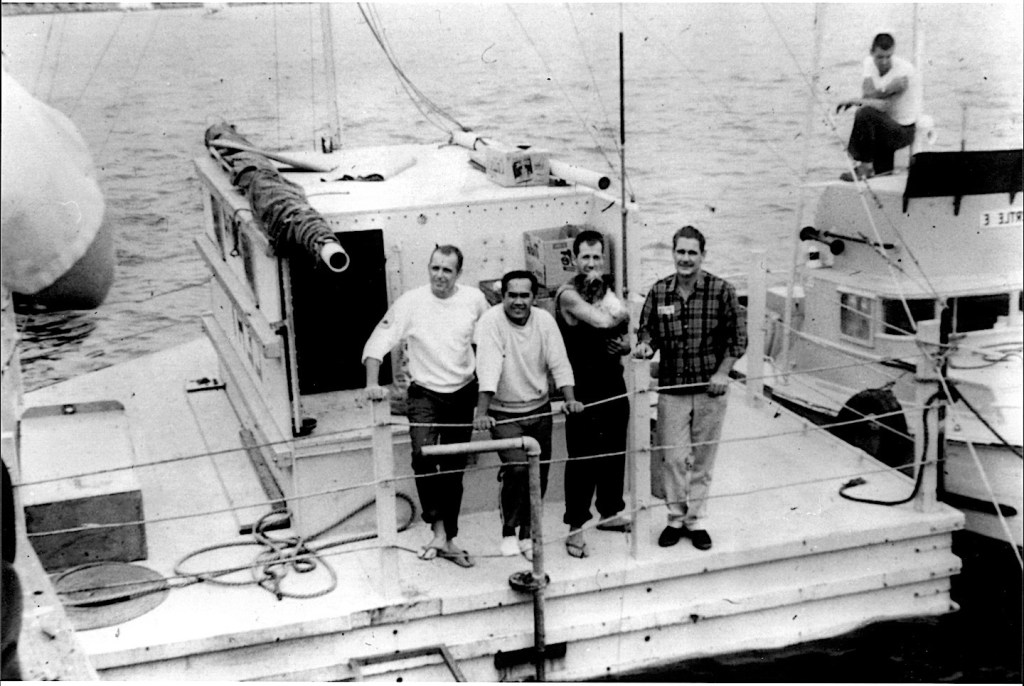
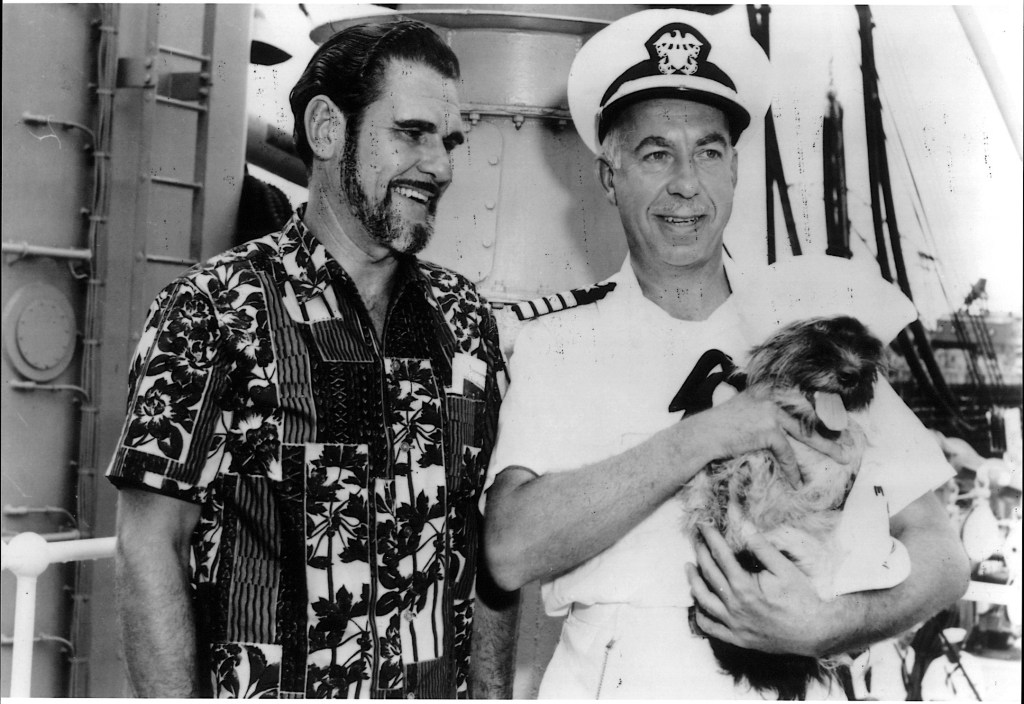
These initial ventures were dispiriting, but Baker managed to get together enough financing for a Lehi III trip in March 1957. This time, he set his sights lower. The makeshift raft would travel from Bodega Bay south to Santa Monica with just one additional crew member and Baker’s dog, Tangaroa, on board, for what was termed a test voyage for a longer trip.
The trip was separated into shorter segments, and was completed successfully on May 4, 1957. Its completion marked an upward turn in Baker’s fortunes, and he quickly began raising funds for Lehi IV. It would become the high-water mark of his rafting exploits.
Lehi IV’s journey to Hawaii began on July 5, 1958, when the retooled 18-by-24-foot raft and its crew of four (plus Tangaroa) set out from King Harbor in Redondo Beach. The city had agreed to provide partial financing for the undertaking. Baker and his crew would encounter storms, high winds and sharks during the course of their 2,000+ mile voyage, but ended up landing safely on the shores of Maui on Sept. 5, 69 days later.
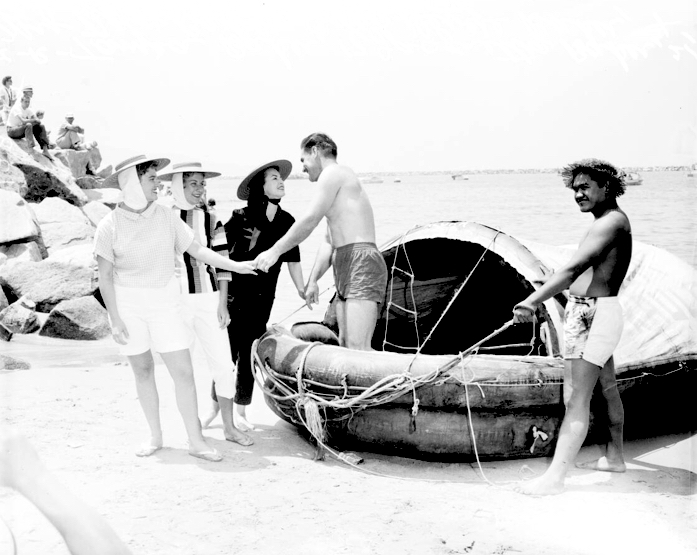
The successful trip brought Baker international fame and publicity, landing him on the front pages of newspapers worldwide. In addition to “You Bet Your Life,” he became the subject of an episode of the BBC documentary series, “Danger Is My Business.” He felt vindicated by having shown that the Mormon theories about ancient ocean crossings were indeed a possibility.
He pointed that out at his frequent personal appearances locally as well as nationally, hoping to gain financing for additional sea adventures by sharing details and showing films of his voyages. Lehi V would be a longer trip, a months-long odyssey starting in Israel and ending in Guatemala.
After stopping and restarting several times, Baker never fully pulled this last trip off, mostly due to struggles with his health. He suffered three heart attacks and one stroke during the 1960s, even as his vision for the journey expanded to an ambitious six-year time frame.
After sponsoring him for at least $15,000 over the years, the city of Redondo Beach, and especially then-mayor William Czuleger, grew wary of giving Baker more money for exploits that seemed to never come to fruition. After lengthy debate, the council agreed to give him his last grant, $3,000 in financing, in November 1969. But the trip and the planned Lehi VI never became a reality.
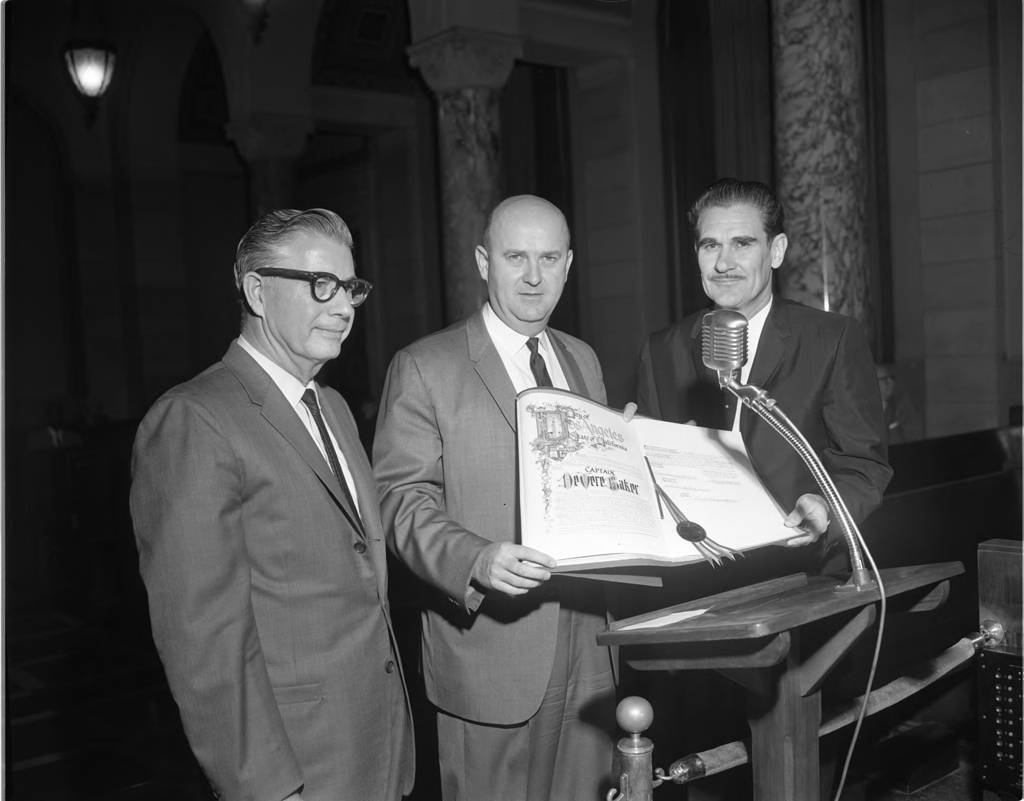
Baker’s next public exploit was a brief, quixotic Democratic presidential run in 1980. He dropped out after a poor showing in the New Hampshire primary.
According to reporter Chris Richard of the Daily Breeze, “Toward the end of his life, Baker championed establishing a series of orbiting ‘peace stations’ manned by scientists from around the world and armed with lasers to destroy nuclear missiles before they could detonate.”
He died on Dec. 5, 1990, in Provo, Utah, after a lengthy illness.
Note: Thanks to Douglas Thompson of the Redondo Beach Public Library for suggesting the topic and for providing additional research.
Sources:
Daily Breeze archives.
“DeVere Baker and a Raft Called Lehi,” by Bill Soberanes, Petaluma Post, February 2003, Page 22.
“DeVere Baker and his Ocean Rafts,” by Warren Aston, Meridian Magazine, Jan. 31, 2011.
Internet Movie Database.
Los Angeles Times archives.
Redondo Reflex archives.
Torrance Press-Herald archives.
Wikipedia.
Additional reading: Only one of Baker’s Lehi books remains in print, The Raft Lehi IV: 69 Days Adrift on the Pacific Ocean.