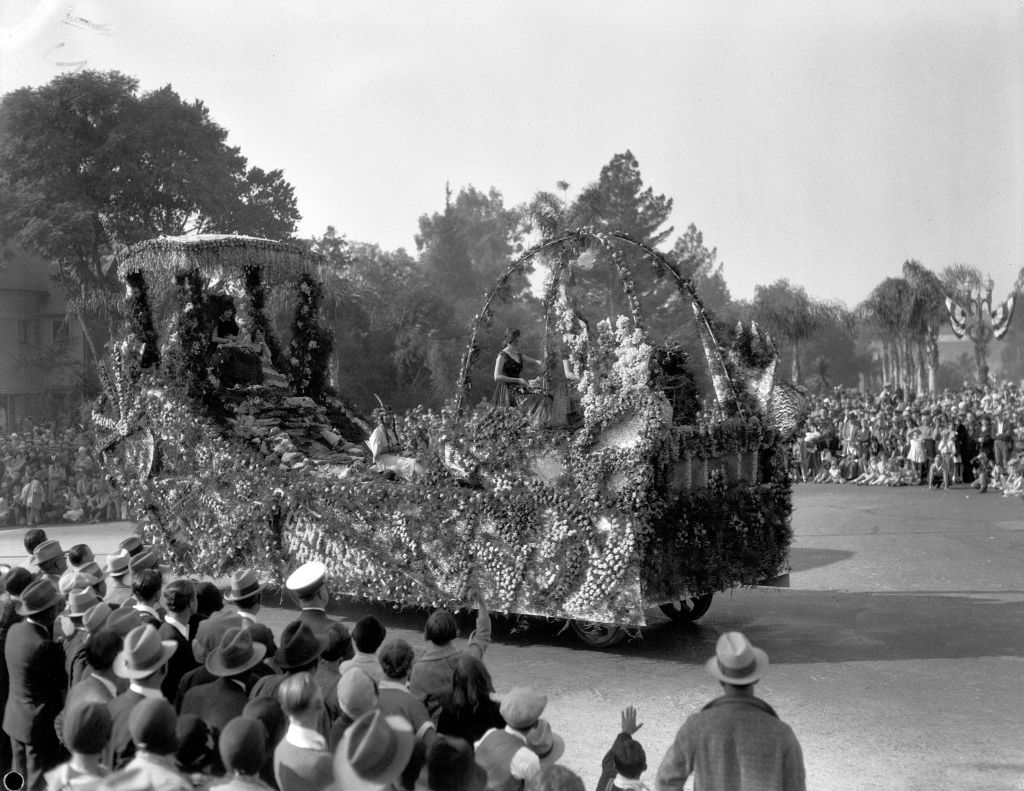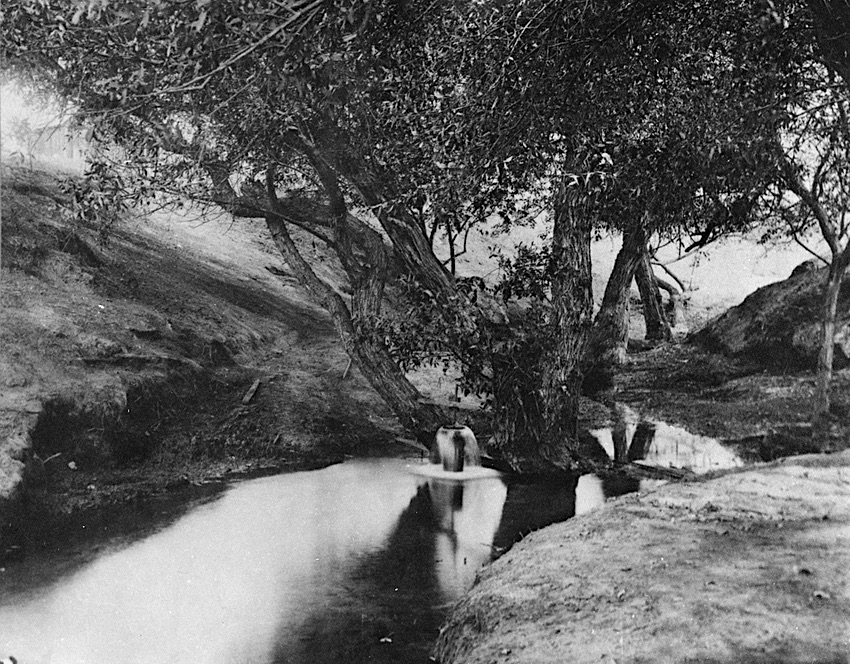
The initial settlement of Inglewood was based on one substance: water. It came from the Centinela Springs, as the artesian springs later would become known. Artesian springs occur naturally when water rises through the surface of the land without the aid of a pump.
Members of the indigenous Gabrielina/Tongva tribe lived in the area before the arrival of Mexican settlers known as pobladores (translation: settlers) in the 1700s. Artifacts from the tribe were found on the land near the springs during the excavation to build the outdoor amphitheater at Centinela Park in the 1930s. (The park was renamed Ed Vincent Park in 1997, after the former Inglewood mayor.)
The pobladores came next, officially establishing a new village on the site on Sept. 12, 1781. The name Centinela comes from the Spanish word for “sentinel.” Some say the “sentinels” were the hills in the area, while others claim the name came from the men who watched over their herds, and the springs themselves, from those hills.
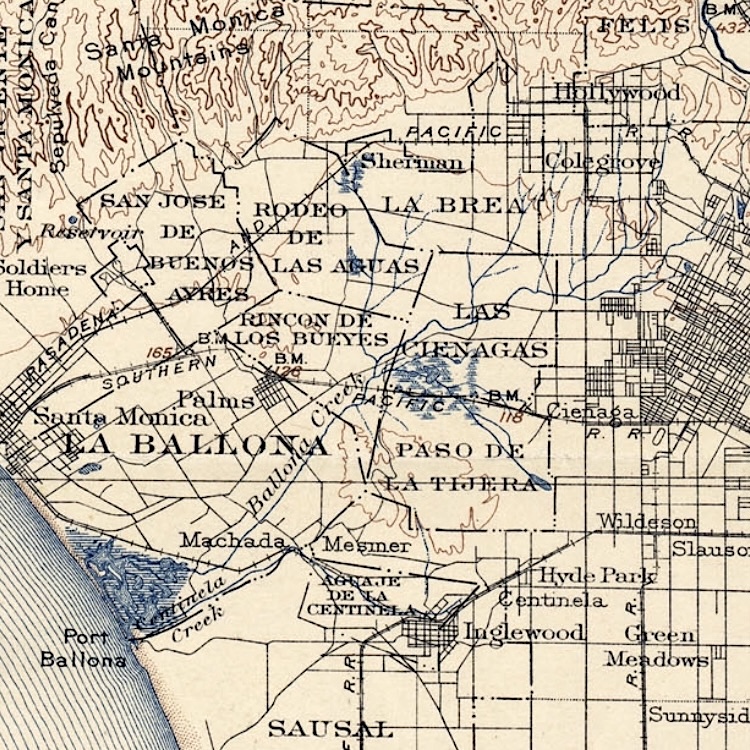
(Credit: United States Geological Survey)
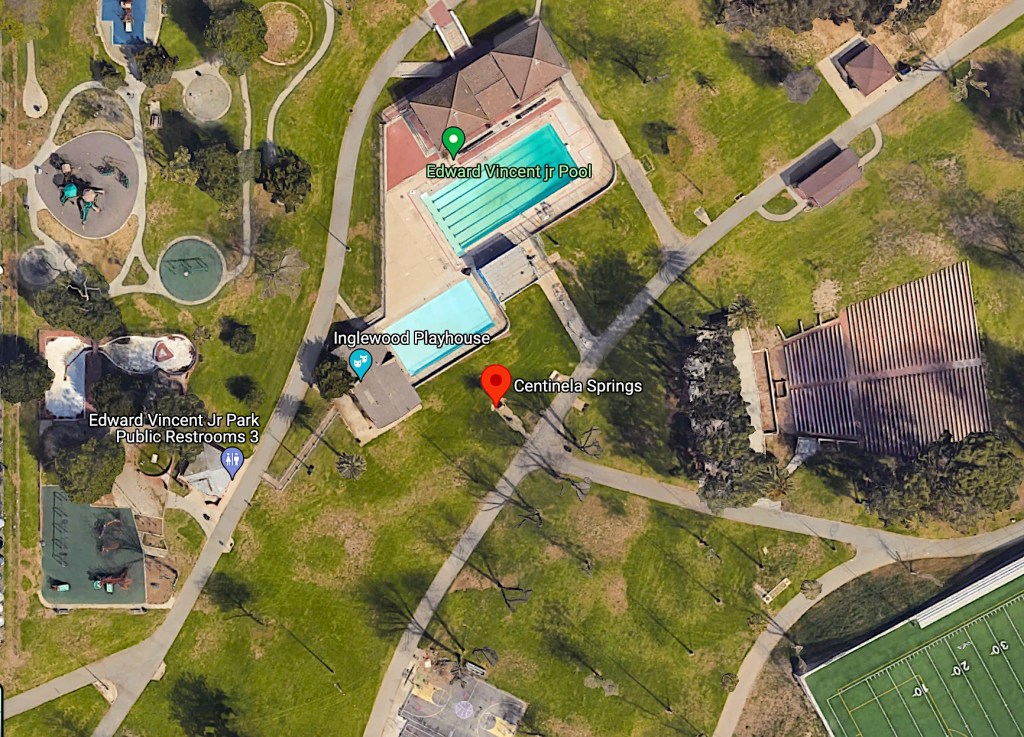
The late Inglewood historian Gladys Waddingham suggested that the springs originally covered a good-sized area of 55-acre Ed Vincent Park, with the largest spring located where the park’s swimming pool now sits. The waters collected into Centinela Creek, which ran west through present-day Westchester and Playa del Rey before emptying into the old Ballona Lagoon, where Marina del Rey now stands.
In the 1830s, Ygnacio Machado decided to build a farm near Centinela Creek, about two miles west of Centinela Springs. He applied for and received a land grant for the 2200-acre Rancho Aguaje de la Centinela (“Sentinel of the Waters”). This chunk of land containing the springs was carved out of Ygnacio Avila’s much-larger Sausal Redondo grant.
The farmhouse Machado built in 1834 became known as the Centinela Adobe. It still stands as one of the oldest structures in the South Bay, though the Dominguez Adobe in Rancho Dominguez does predate it by eight years.
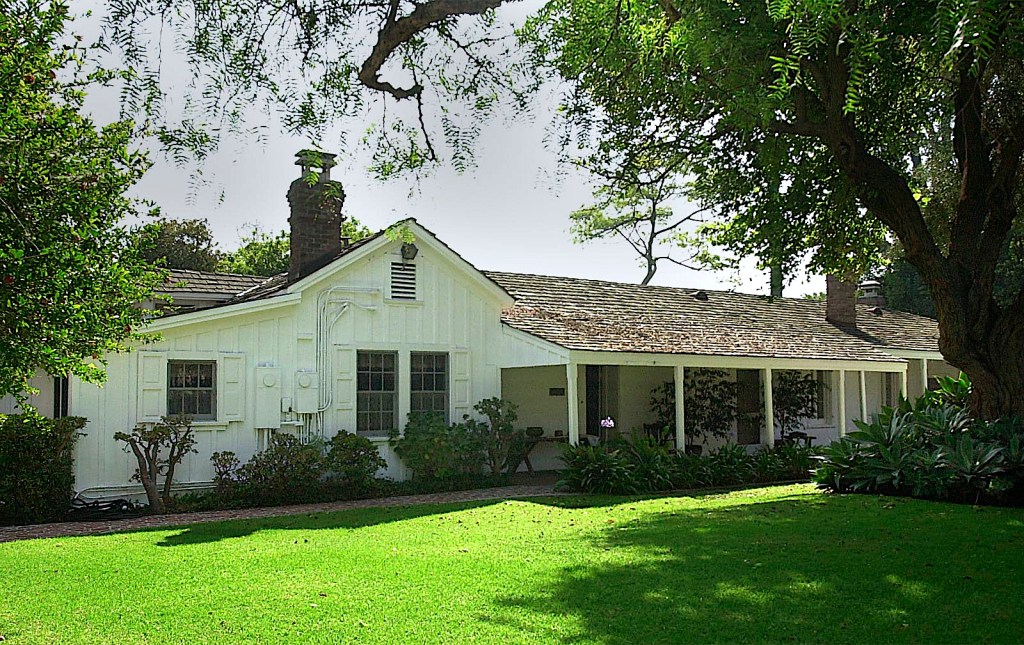
The Centinela Valley Historical Society and its museum currently occupy the Centinela Adobe at 7634 Midfield Ave. Its prior residents included Inglewood founder Daniel Freeman, who lived there before building his own mansion in Inglewood in 1888.
Centinela Springs became even more crucial with the formation of Inglewood, which Freeman founded in 1888. One of his first actions was to have wells dug to draw water from the springs to the new town.
The move made the town self-reliant. Inglewood had no need to pay for water from outside sources such as the Los Angeles Metropolitan Water District; the springs provided most of the town’s water, and would do so for decades.
Inglewood was incorporated as a city in 1908. At the time, the springs were still privately owned. At one point, its owners apparently attempted to sell bottled water from them, going so far as to propose building a viewing area where visitors could see the water’s source up close. The plans never came to fruition.
As the town grew, its residents came to recognize the importance of Centinela Springs, both practically and historically.
In October 1931, the city celebrated the springs with a new historical production held at the Centinela Park amphitheater. “The Romance of Centinela Springs” was the brainchild of A.E. Chamberlain of the Inglewood Chamber of Commerce, who co-wrote the musical pageant with J.L. Rosenberg.
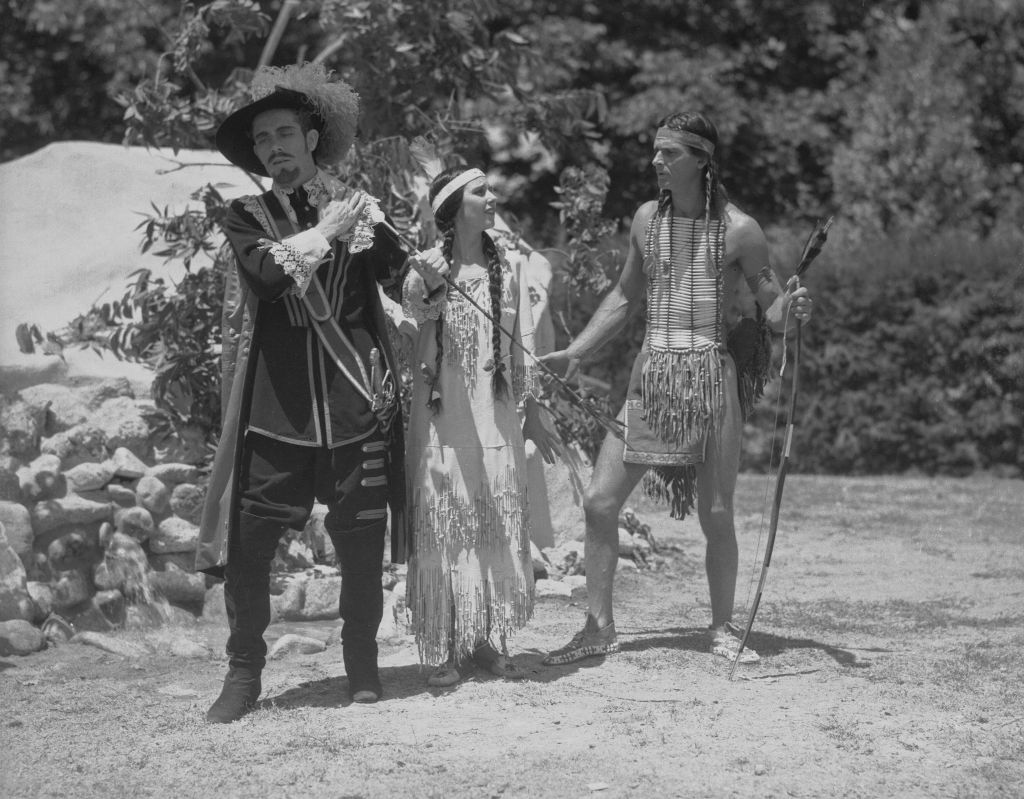
The production, a light operetta along the lines of the “Ramona” historical pageant first staged in Hemet in 1923 and still held annually, would become the centerpiece of the Centinela Days civic fiesta and was performed annually throughout the decade.
Paradoxically, as Centinela Springs became more celebrated, the town’s increased population began drawing more and more heavily upon the water source. By the 1930s, the springs no longer were robust enough to bubble to the surface. There still was plenty of water, but, by 1936, it was estimated to be at a level roughly 150 feet below ground.
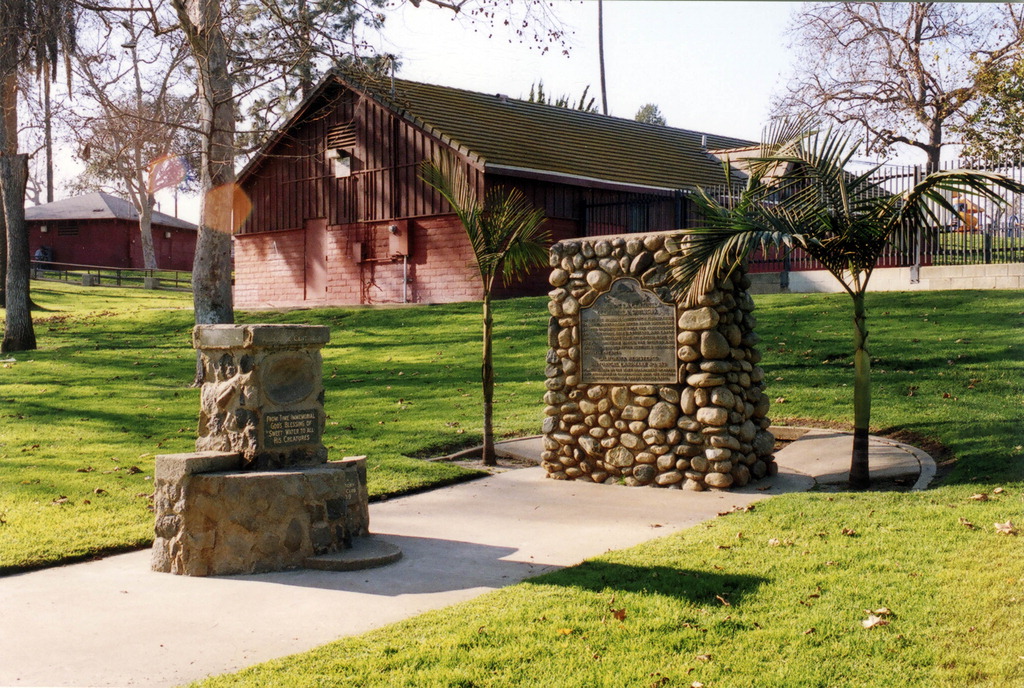
A movement arose to recognize the historic significance of the Centinela Springs site, and a marker was installed at a ceremony in Centinela Park on March 2, 1939. The monument was located a couple hundred feet from the swimming pool built ten years earlier that was thought to be on the site of the original spring.
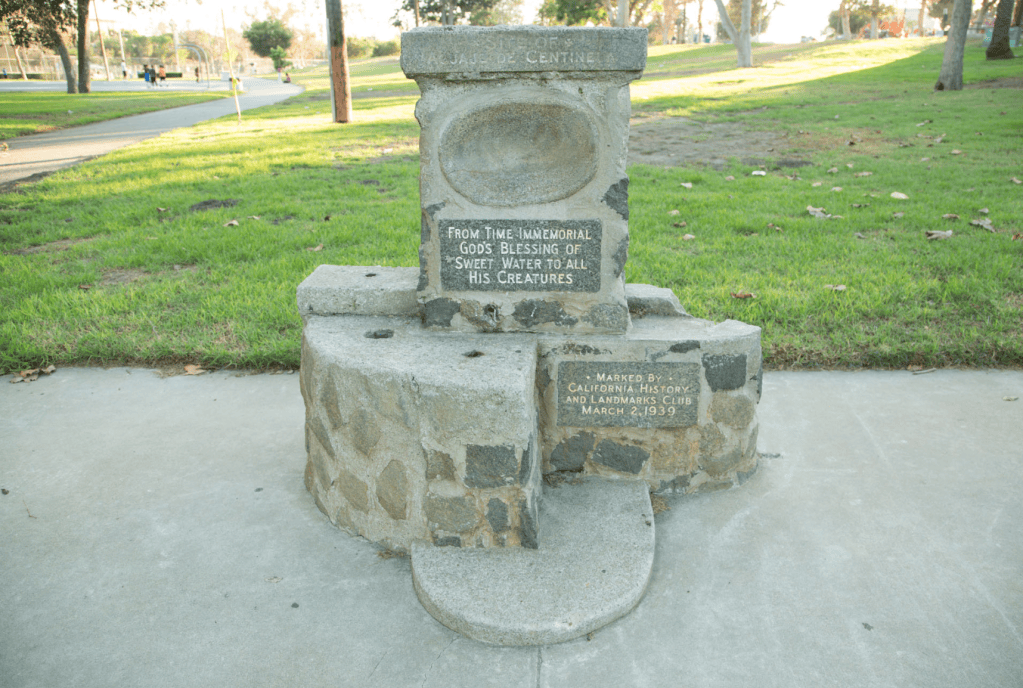
It was designed by Archibald Garner, the same artist who created the “Centinela Springs” wood carving depiction at the Inglewood Post Office building on Hillcrest Ave. in 1937. The new stone monument’s somewhat cryptic inscription reads, “From time immemorial, God’s blessing of sweet water to all his creatures. Marked by California History and Landmarks Club, March 2, 1939.”
Thirty years later, local historians and the city petitioned the state Department of Parks and Recreation office in Sacramento to grant Centinela Springs official landmark status. The state agreed to do so, designating the site as California Historic Landmark #363 on Oct. 9, 1970.
In October 1976, a more descriptive plaque detailing its historic significance was installed in the park, right next to Garner’s.
Inglewood had ceased being able to rely on Centinela Springs for its water independence two decades earlier. In 1949, the city joined the Metropolitan Water District of Southern California and the West Basin Water Association at the same time, effectively going out of the groundwater extraction business.
Sources:
“Aguaje de la Centinela: Centinela Springs,” Inglewood, CA Public Art website.
Daily Breeze archives.
The History of Inglewood, by Gladys Waddingham, published by the Historical Society of Centinela Valley, 1994.
The History of Inglewood: Narrative and Biographical, by Roy Rosenberg, Arthur H. Cawston, 1938.
Los Angeles Times archives.
“Re-Indigenizing Spaces: How Mapping Racial Violence Shows the Interconnections Between Settler Colonialism and Gentrification” (Senior Thesis), by Jocelyn Lopez, University of California, Berkeley, Spring 2020.
“Water Works,” City of Inglewood website.
Wikipedia.