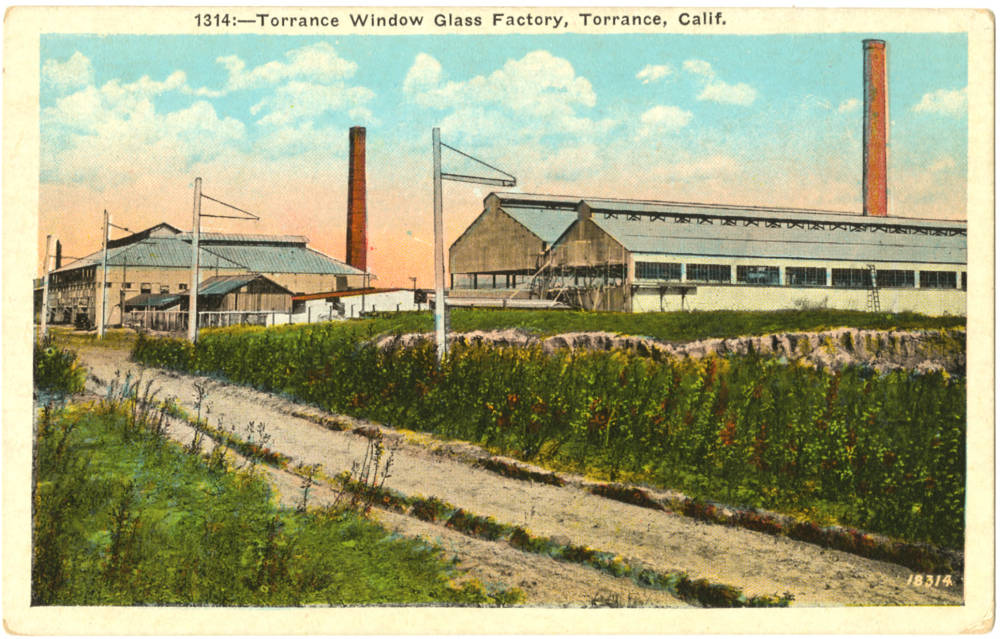
Jared Sidney Torrance founded the city that bears his name in 1912 with the express purpose of creating an industry-friendly community where workers could live close to their place of employment.
The Union Tool Co. became the first large firm to take him up on his idea, with construction on its massive plant beginning in 1912. Others such as the Llewellyn Iron Works quickly followed suit.
Word of the nascent would-be business utopia apparently didn’t take long to reach Toledo, Ohio. In 1914, the owners of a glass company there decided to move to sunny California. They boasted upon arrival that “we make the finest glass in the United States,” according to Historic Torrance: A Pictorial History of Torrance, California (Legends Press, 1984).
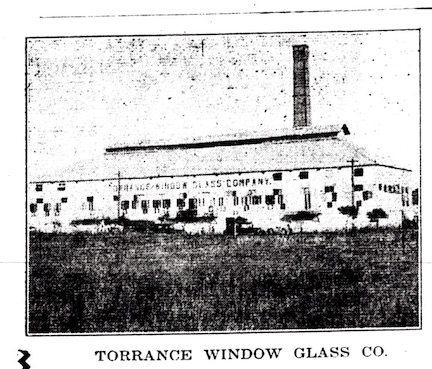
New trainees from the local area joined about 50 experienced glassblowers who had migrated from Ohio to Torrance when the Torrance Window Glass Co. began full operations in 1916. Charles L. Bisbee was the operation’s first manager.
The new plant went up on eight acres of land near the corner of Border Ave. and 222nd St., just west of Cabrillo Ave. and downtown Torrance, employing 250 men. When it opened, it was the only flat window glass manufacturing entity west of Kansas.
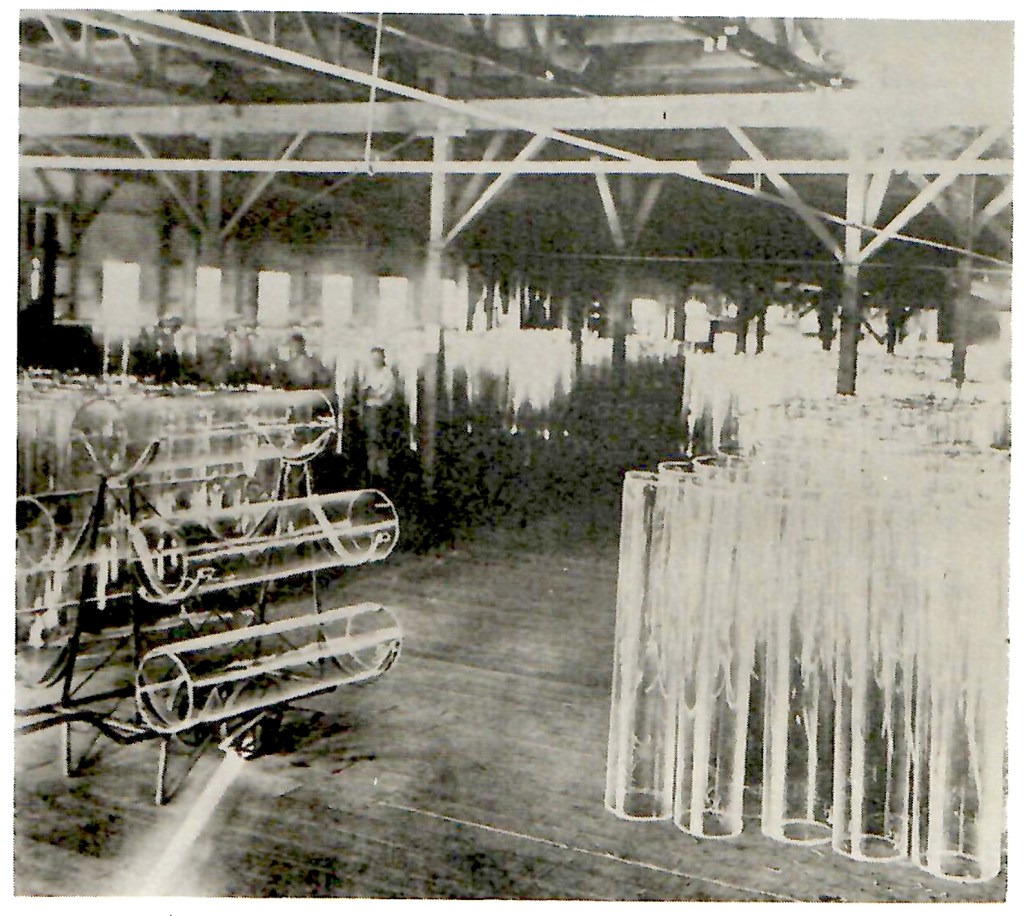
At that time, even simple flat glass had to be painstakingly hand-blown by skilled craftsmen. The much-in-demand glassblowers worked only seven-hour days instead of the usual eight due to the arduous nature of their jobs, which had to be done quickly and deftly near the intense heat from blast furnaces. (This Torrance Herald article, “Half Million Feet of Glass Each Month,” gives a detailed description of the process.)
The furnaces were fired up only for part of the year, generally during the cooler months from fall through spring, leaving its workers idle during the factory’s summer down time. Repairs and construction work were done on the plant while it was closed.
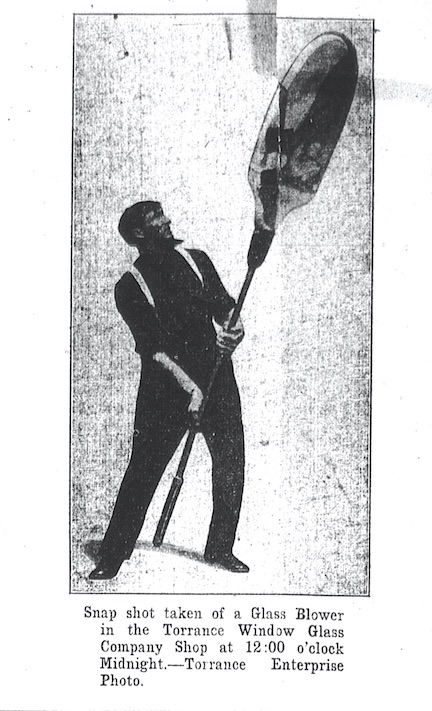
The Torrance Window Glass plant became a popular destination for industrial tours. Members of the Masons, a delegation of Culver City civic officials, or similar groups of visitors all would be fascinated to see the intricate step-by-step process by which the factory’s hand-blown glass products were produced.
Plant engineer E.B. Taylor developed a new process for frosting windows in 1917. Finished panes ran under a machine that sprayed sharp sand on them from a high-pressure nozzle, giving them the frosted look. The sand was then collected and reused.
Shortly afterward, the president of the Cleveland-based National Window Glass Workers Association union praised the plant, telling the Los Angeles Times that the plant was “turning out a quality of glass here that is not equalled by the Eastern plants.”
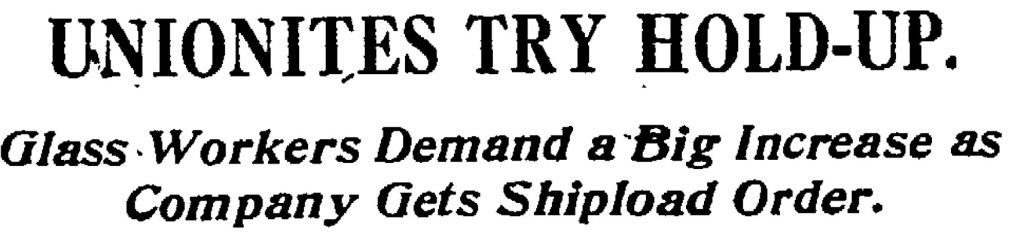
A year later in 1918, that same union would strike the Torrance Window Glass Co., asking for a 35 percent raise in wages. The decidedly anti-labor L.A. Times, whose headquarters had been bombed by a union member in 1910, responded with this headline:
On July 27, 1919, the Torrance Window Glass Co. was gutted by a mysterious fire. No one was hurt or killed, as it occurred during the plant’s idle period. No blame was assigned for the blaze, and its owners had the factory rebuilt and put back into operation within 90 days.
Business was booming. Beginning in 1920, tons of limestone, a key ingredient in glassmaking along with silica and sand, would be shipped in to the factory from a quarry operated by the McFadden Co. in Swarthout Canyon, located in the Cajon Pass north of San Bernardino
Labor problems at the plant continued as productivity increased, with the operation reaching its peak success levels in the early 1920s. But it would be advances in glassmaking technology, and not labor issues, that would become the plant’s ultimate undoing later in the decade.
The implementation of mechanical glass production techniques pioneered by Belgian Emile Fourcault and American inventor Irving Colburn began to reduce the need for glassblowing by hand as they reached American factories during the mid-1920s.
The Torrance Window Glass Co. was acquired by the Western Sheet Glass Co. in June 1923. Western held the rights to the Fourcoult glass process for the West Coast, and the company opened a new factory near the Torrance Window Glass operation.
Many of the skilled glassblowers lost their jobs with the installation of the new automated machinery in 1924, and the original Torrance Window Glass Co. plant eventually closed in 1927.
Several businesses attempted unsuccessfully to reuse the facilities, but the building eventually was abandoned. In 1938, it was sold to the Western Iron and Metal Co. of Los Angeles, a salvage company who ultimately dismantled it for scrap in 1939.
The area near the plant’s original location east of Old Torrance currently houses a cluster of industrial buildings and warehouses.

Sources:
Historic Torrance: A Pictorial History of Torrance, California, by Dennis F. Shanahan and Charles Elliott, Jr., Legends Press, 1984.
History of Torrance: A Teacher’s Resource Guide, Torrance Unified School District, 1964.
Los Angeles Times archives.
“Making of Window Glass,” National Glass Budget: Weekly Review of the American Glass Industry, Vol. 35, Page 13, Dec. 13, 1919.
San Pedro News Pilot archives.
Torrance Press-Herald archives.