Charles Bukowski

“What I’ve tried to do, if you’ll pardon me, is bring in the factory-workers aspect of life…the screaming wife when he comes home from work. The basic realities of the everyman existence…something seldom mentioned in the poetry of the centuries.”
-Charles Bukowski, interviewed by Sean Penn, Interview magazine, Sept. 1987
 
46365-bukowskibook-thumb-172x138-46364.jpgHenry Charles Bukowski was born in Andernach, Germany on Aug. 16, 1920. In 1923, the family came to the United States, eventually moving west to settle in Los Angeles in 1930.

He graduated from Los Angeles High School in 1938, and attended Los Angeles City College with the idea of becoming a journalist or a writer. He began writing poetry and fiction in earnest during this period, selling his first short story, “Aftermath of a Lengthy Rejection Slip,” to Story magazine, where it was published in the March/April 1943 issue.

He eventually grew disillusioned with his lack of success as a writer, and began to drift into the vagabond existence that would form the source material for many of his later works.

His extensive writings on the down-and-out side of life arose out of his own experiences. During the period from the late 1940s through the mid-1950s, he worked in an auto parts factory, a picture frame factory, a tool warehouse, a lighting company and a department store called Milliron’s, which later became The Broadway.

46367-postoffice-thumb-172x258-46366.jpgIn 1952, he started work as  a substitute postal carrier. He would work off and on for the post office through the 1960s. His experiences there inspired his first novel, Post Office (1969), a realistic look at life in a grinding, humdrum job that became one of his most popular and enduring works.

In 1967, he began writing his “Notes of a Dirty Old Man” column for the underground newspaper Open City, and then for the Los Angeles Free Press after Open City folded.
The increasingly prolific Bukowski was writing copious amounts of poetry in addition to his novels. By the early 1970s his talents began to be recognized more fully, and he was able to make a living solely from his writing.

He populated his writings with loners and drunks carousing in seedy bars, and hardscrabble characters eking out a living on the city’s less-glamorous streets.

In 1978, he moved from East Hollywood to a quiet neighborhood in San Pedro, where he became an increasingly well-known resident until his death on March 9, 1994. He came to love San Pedro’s blue-collar, unassuming atmosphere, even as his celebrity and stature continued to grow.

46369-barflyposter-thumb-150x205-46368.jpgBukowski wrote the screenplay for the 1987 film with Mickey Rourke, “Barfly,” whose main character Henry Chinaski was a loosely rendered self-portrait. (The Chinaski character also was the protagonist in Post Office.) The film was a critical success.

In 1990, Bukowski gave the last of his many public readings at the Sweetwater club in Redondo Beach. During his prolific career, he wrote dozens of volumes of poetry, six novels, many short stories and several nonfiction works.

His gravesite at Green Hills Memorial Park in San Pedro, inscribed with the motto “Don’t Try” (as in, don’t just try, but do) and a pair of  boxing gloves is a much-visited local landmark. 

In 2003, the high-profile documentary “Bukowski: Born Into This” was released, and in 2005, Matt Dillon starred in a well-received screen adaptation of Bukowski’s novel Factotum.

In 2006, Bukowski’s widow Linda donated his literary archive to the Huntington Library in San Marino.

The Huntington will open the exhibit “Charles Bukowski: Poet on the Edge”  in its West Hall on Saturday, Oct. 9, 2010. Scheduled to run until Feb. 14, 2011, the exhibit is described as “the most comprehensive exhibition on the author ever undertaken.” There is an admission fee to the Library, except for the first Thursday of each month. For more information: (626) 405-2100 or www.huntington.org.


46372-bukowskipoems-thumb-329x500-46370-thumb-150x227-46371.jpg 

Sources:
 
“Charles Bukowski: American Author,” http://bukowski.net/.
 
“Tough Guys Write Poetry,” Sean Penn interviews Charles Bukowski, Interview, Sept. 1987.
 
“Timeline of Bukowski’s Life,” http://bukowski.net/timeline/.

Photo of Charles Bukowski from the book cover of Tales of Ordinary Madness, City Lights Publishers, 2001.


Terminal Island’s lost village


46083-japaneseoverall-thumb-400x254-46082.jpgThe Japanese fishing village on Terminal Island is shown in this undated photo from the 1930s. Photo courtesty San Pedro Bay Historical Society.


Imagine being told you have 48 hours to move from your house to a distant location, where you will be forced to stay for four years. Then, when you are allowed to return home, all traces of the community you lived in will have been wiped off the face of the earth by bulldozers.

It happened to the residents of the once-thriving Japanese fishing village on Terminal Island, which was located on streets with names such as Cannery and Tuna and Pilchard at Fish Harbor near where the tuna canneries once stood.

Known to its residents as “furusato” – roughly translated, “home sweet home” – the tightly knit village had a Shinto shrine, Fisherman’s Hall where Japanese arts such as judo and kendo were taught, Japanese grocery stores, candy stores and billiard parlors.

Children attended East San Pedro Grammar School, which opened in 1918. After pioneering educator Mildred Walizer died in 1933, the school was renamed Walizer Elementary.


46085-japanesefishermen-thumb-350x273-46084.jpgJapanese fishermen are shown on Terminal Island in this undated, pre-World War II photo. Photo courtesy the Terminal Islanders.


The settlement area had a population of about 3,000. Its residents operated as many as 250 fishing boats, or worked in the many tuna canneries that were located on Terminal Island. (The last cannery in operation there closed down in 2001.)

46087-japarticle-thumb-125x390-46086.jpgThat all changed with the attack on Pearl Harbor on December 7, 1941. First, the FBI immediately began arresting a number of Japanese-American men on Terminal Island shortly after Pearl Harbor and moved them to undisclosed locations for security reasons.

Then, on Feb. 19, 1942, President Franklin Delano Roosevelt signed Executive Order 9066. It required that all people of Japanese descent on the West Coast be sent to relocation camps.
Families were given 48 hours to leave Terminal Island. Many ended up at Manzanar in the foothills of the Sierra Nevada just north of Lone Pine, while others were taken as far away as Kansas, Arkansas and Wyoming. The thriving fishing community became an instant ghost town (see Daily Breeze story at left, from February 27, 1942, Page 1).

When the internees returned home four years later, everything was gone. There was no trace of Furusato. The Navy had bulldozed the entire settlement, all of the homes, Walizer Elementary, the Shinto shrine and Buddhist temple, everything. Their fishing boats were gone along with all their possessions.

The canneries were still there, so some of the displaced were able to return to jobs working for the canneries. The rest scattered across Southern California.

Over the decades, the former community’s members battled to keep its memory alive. A memorial was dedicated on the village’s site in July 2002, and remains the only trace of the settlement in the area.


46092-memorialstatue-thumb-400x567-46090-thumb-275x389-46091.jpgThis statue showing Japanese fishermen is part of the Terminal Island memorial dedicated in 2002. Sept. 2010 photo.


Filmmaker David Metzler told the village’s story in his documentary, “Furusato: The Lost Village of Terminal Island,” a 45-minute film that included interviews with many former residents of the fishing community. It premiered at the Warner Grand Theatre to a sold-out house on June 18, 2005.


46096-memorialpoem-thumb-300x425-46095.jpgFrom the Terminal Island memorial. Sept. 2010 photo.


Sources:


 “California’s Japantowns: Terminal Island,” http://www.californiajapantowns.org/terminalisland.html.

Daily Breeze files.

“Furusato: The Lost Village of Terminal Island,” http://www.terminalisland.org/furusato.htm.

Personal Justice Denied: Report of the Commission on Wartime Relacation and Internment of Civilians, United States Government Printing Office, Washington, D.C., 1982.

Red Lacquer Bridge: The Story of a Forgotten Community and the Bridge Between Two Worlds, by Maggie Shelton, AuthorHouse, 2007.

Hollywood Riviera Beach Club

45835-Hollywood-thumb-400x254-45834.jpgAerial view of the Hollywood Riviera Beach Club taken on July 27, 1930. (Photo courtesy Historic Torrance: A Pictorial History of Torrance, California.)

Surfers still refer to the section of Torrance beach below where the Hollywood Riviera Beach Club once stood as “Burnout Beach.”

The name refers not to the state of mind of its denizens, but to the spectacular fire that consumed the seaside resort on the night of Sept. 25, 1958.

Ground had been broken for the private club decades earlier, on March 4, 1930. Clifford Reid, the developer who envisioned the Hollywood Riviera section of Torrance as a potential playground for the Hollywood elite when he began selling lots there for about $3500 each in 1928, saw the club as a central attraction whose glamorous image would lure homebuyers in to buy lots.

It opened on June 27, 1931. Residents of the Hollywood Riviera development automatically became members of the club, though dues were required to use the pool and to attend special events held there.


45838-hollywood30s-thumb-250x152-45836-thumb-300x182-45837.jpgVisitors enjoy the Hollywood Riviera Beach Club’s ambience in this undated photo from the 1930s. (Photo courtesy Historic Torrance: A Pictorial History of Torrance, California.)

Reid’s plan to attract movie stars foundered on two shoals: the advent of the Depression, and the development’s anti-Semitic policies, which prohibited Hollywood elites such as Louis B. Mayer and Sam Goldwyn from owning property there.

But the development’s spectacular location still attracted visits from the rich and famous, though only the late actress Rosemary DeCamp actually became a long-term resident there.

Reid’s nephew, Marshall Stewart, recalls using the club’s 75-foot swimming pool while his father, Roy Stewart, was managing it from 1930-1942. Not long after Pearl Harbor, the military installed anti-aircraft guns in the hills by Torrance beach, and by Stewart’s account, the pounding of the ensuing target practice structurally damaged the club, which closed in 1942.

It reopened after the war after Reid sold it, and its new owners made it a public club open to all. It had a successful run during the 1950s, though its image became decidedly less elegant and took on more of the atmosphere of a roadhouse than a swanky club.

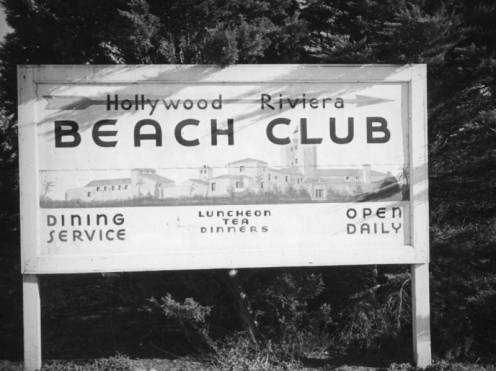
Sign for the Hollywood Riviera Beach Club in Torrance, circa 1937. (Credit: Los
Angeles Public Library Photo Collection)

Since the club straddled the city limit between Torrance and Redondo Beach, the story has been told that imbibers would have to cross from one side of the tavern to the other to stay in compliance with each city’s liquor laws.

Neighbors began to complain about “undesirables” congregating there, and tales were told of all-night jam sessions and other such disruptive goings-on. Also, the club suffered some flood damage from storms both in 1955 and 1957.

The owner at the time of the fire, Norton Wisdom, had taken over the club in 1957 and signed a new lease which extended until June 30, 1965.

According to Daily Breeze accounts, the fire broke out in the cocktail lounge at about 3:30 a.m. early on Thursday, Sept. 25, 1958. At least 45 firemen, 21 from Redondo and 24 from Torrance, battled the blaze and brought under control an hour later, though it continued to burn until dawn.


45840-hrivday11-thumb-300x395-45839.jpgDaily Breeze front page for Thursday, Sept. 25, 1958.

Wisdom is said to have arrived during the height of the blaze, when he ran into the courtyard and asked, “What the hell has happened?” Later, firemen had to restrain him from going back into the burning structure to try and retrieve some of his belongings.


45842-hrivday21-thumb-288x253-45841.jpgDaily Breeze front page photo from Saturday, Sept. 27, 1958 showing the burned-out club.

The club was a total loss. No one was injured in the blaze, but several employees who lived at the club were left homeless. Estimates of its value ranged from $150,000 to $700,000, but it was never rebuilt. Shortly after the fire, its ruins were bulldozed into the sea.

For years afterward, plans were made to re-develop the site. Even before the fire, Torrance and Redondo were trying to formulate plans to buy the club and convert it into a teen recreation center, but they had been unable to sort out the site’s tangled ownership situation.

As early as 1964, the Sovereign Development Co. had proposed a plan to build a 16-story apartment complex on the site. That proposal was defeated in Aug. 1964, but similar attempts and proposals would be made throughout the rest of the 1960s, all of them opposed by Hollywood Riviera residents.

Developers eventually brought the case before the Los Angeles Superior Court in 1972, where Judge Richard Schauer ruled that the property had been “dedicated by implication” to the public, and the property’s then-owner, Oscar Berk, could not build upon the property that he had purchased for $600,000.

That ruling eventually led to the development of Miramar Park on the site. The small, beautiful park was dedicated by the City of Torrance on January 11, 1984. Since then, the one-time posh night spot, shown below in a Sept. 2010 photo, has been a public space that all can enjoy.


45844-miramarview-thumb-400x183-45843.jpg 


Sources:

“Life on the Riviera, Hollywood that is – Tackling the starstruck myths, legends and history of South Bay’s famous parcel of land,” By Tom Barnidge, The Daily Breeze, April 2, 2004, Page B1.

“Stars didn’t buy, but GIs did,” By Dennis Johnson, The Daily Breeze, May 5, 2002, Pag A4.

City of Redondo Beach Historic Context Statement, by Marguerite Duncan-Abrams and Barbara Milkovich, Ph.D, Redondo Beach Planning Department, 1995.

History of the Early Hollywood Riviera, by Marshall E. Stewart, (self-published, no date).

Historic Torrance: A Pictorial History of Torrance, California, By Dennis F. Shanahan and Charles F. Elliott, Legends Press, 1984.

Daily Breeze files.


45847-rivierastairs-thumb-300x400-45845-thumb-300x400-45846.jpgOne of the two sets of stairs up the hill from Torrance beach that once led to the Hollywood Riviera Beach Club. (Stairs are visible in foreground of vintage aerial photo above; they were remodeled in 2003.) Sept. 2010 photo.


Augustus W. Timms

45560-timmses-thumb-200x284-45559.jpgAfter serving in the U.S. Army during the Mexican War (1846-48), German immigrant Augustus W. Timms, shown at left with his wife Louise, settled on Catalina Island, where he had a goat farm. He also established a boat landing there which became known as Timms Landing.

The area was known by that name for decades until the city was renamed Avalon by developer George Shatto in 1887.

Timms also was a savvy land speculator and developer.

He quickly snapped up waterfront property in San Pedro when Spanish land grant holder Diego Sepulveda made it available in 1852. Known as Sepulveda’s Landing, it was little more than mud flats at the time.

The former sea captain – he met his wife Louise on board a schooner he was piloting from San Francisco to San Pedro in 1857 –  began to develop the landing, which also would become known both as Timms Point and Timms Landing.

He added a mansion, a hotel and bathhouse, a warehouse, a store, a corral, and a couple of houses to the landing area. The story goes that the Ocean Hotel was built upon the hull of his boat at Timms Point after he gave up being a sea captain. The general store also was built in the 1850s, and was a fixture on the scene until it was razed in 1904.


45562-timms1894landing-thumb-400x287-45561.jpgTimms Point, circa 1894. Photos from book of early San Pedro photographs by Merrick Reynolds, circa 1894. Photo courtesy of San Pedro Bay Historical Society.   

In addition to its use as a shipping and receiving hub, Timms Point became a popular beach destination where visitors would come to go clamming.

When the San Pedro & Los Angeles Railway was extended from Los Angeles down to Timms Point in the early 1880s, the pace of development in the area quickened considerably.

In the year of his death, 1888, Timms donated property for a cemetery to be built in San Pedro. When he died on July 21, 1888, his graveside memorial was placed prominently in the center of what is known now as Harbor View Memorial Cemetery, where it remains to this day. (It originally was called San Pedro Cemetery.)

45565-timmsgrave-thumb-300x347-45564.jpgAugustus W. Timms’ grave stands at the center of Harbor View Park Cemetery in San Pedro in this Sept. 2010 photo. Detail below.

45567-timmsgraveclose-thumb-200x266-45566.jpgAfter Timms’ death, the Southern Pacific Railroad acquired the landing from his widow, Louise, in 1902. The ship channel that now stands there is still identified as the Southern Pacific Slip or SP Slip on maps.
Over the years, the area was reconfigured so many times that all traces of Timms Point have vanished. Indeed, the original location itself would be mostly underwater in the current configuration.

Records are hazy as to when exactly the buildings at Timms Point were demolished, but a Sept. 9, 1913 Los Angeles Times article would seem to indicate that the Harbor Commission was poised to raze the structures at that time.

The marker designating Timms Point as California State Landmark #171, below, was placed on Sampson Way just south of Ports O’Call Village near the Southern Pacific Slip in 1993, not far from the street known as Timms Way.

45569-timmsmarker-thumb-400x424-45568.jpg

Sources:

“Big Orange Landmarks: Exploring the Landmarks of Los Angeles, One Monument at a Time” (website), http://bigorangelandmarks.blogspot.com/2008/08/no-171-site-of-timms-landing.html.

Port of Los Angeles: An Illustrated History from 1850 to 1945, by Ernest Marquez and Veronique De Turenne, Angel City Press, 2007.

San Pedro: A Pictorial History, Henry P. Silka, San Pedro Bay Historical Society, 1993.

“Was Owner of Timms’s Point,” (obituary of Mrs. Louise T. Seick, wife of Augustus W. Timms), Los Angeles Times, Nov. 20, 1905.

Vetter Windmill

German immigrant Herman Vetter played a key role in the early days of the city of Hermosa Beach. He was among the city’s first group of elected trustees in 1906, and served as Hermosa’s first city clerk. He also helped push for the city’s incorporation in 1907, and helped to found its first school, Ocean View School.

But his most visible legacy turned out to be a 48-foot-tall windmill.


45287-vetterorig-thumb-374x206-45286.jpgThe Vetter Windmill at its original site on Herman Vetter’s Hermosa Beach flower farm. (Photo Courtesy the Hermosa Beach Historical Society.)


Vetter erected the windmill in 1903 in order to provide irrigation for the plants on his flower farm, located on Ardmore Avenue between 16th and 21st streets. He raised carnations, tulips and other flowers there, and his daughter would sell them around town from a wagon. In 1916, he opened the city’s first flower shop on Pier Avenue.

After Vetter’s death, the flower farm stood vacant until the late 1960s, when real estate developers began looking at the property for housing.

A group of citizens formed to attempt to preserve the old windmill, forming the Save the Windmill Committee and raising $2,000 to help save the structure.

In 1969, a group of Seabees were enlisted to help move the structure to Greenwood Park, near the intersection of Pacific Coast Highway and Aviation Boulevard, where the reconstructed windmill stood for three decades.


45289-vetter1970-thumb-301x407-45288.jpgCivic officials donned period costumes for the dedication of the Vetter Windmill site at Greenwood Park in June 1970. (Daily Breeze photo.)


In the late 1990s, its deterioration and weathering had become noticeable. Vanes had broken off, and the working parts were caked with mud, grease and rust.

Another citizens group was formed to help restore the decaying windmill, this time led by local activist Roger Bacon. Bacon contributed $2,500 of his own money, and convinced several local businesses to do the same. He raised about $40,000 for the project.

Among those he enlisted to help was local windmill expert Steve Storm, an engineer from El Segundo who went far and wide to obtain mechanical parts for the structure.

Finally, in 2000, the fully restored windmill was celebrated in a ceremony in Greenwood Park, where it still functions today, more than 100 years after it was first built.


45291-vetter2000-thumb-300x457-45290.jpgMembers of the Mira Costa High marching band perform during the dedication ceremony of the newly restored Vetter Windmill in April 2000 at Greenwood Park in Hermosa Beach. (Daily Breeze file photo.)


Club Gunga Din


45088-clubgungabuilt-thumb-380x207-45087.jpgThe completed Club Gunga Din in Hawthorne, which was built in 1945. Reprinted with permission from Hawthorne, by Walt Dixon, Jerry Roberts. Available from the publisher online at
www.arcadiapublishing.com or by calling 888-313-2665.


When club Gunga Din was completed in Hawthorne in 1945, it was billed as the first “teen canteen” in Southern California.

Located near the city’s civic center, the informal recreation facility was built at a cost of $45,000 in May 1945 by a group of Hawthorne elementary and high school students, with the help of adults from the city’s service clubs. The Hawthorne Woman’s Club donated furniture for the club.


45090-clubgungausc-thumb-400x316-45089.jpgChildren and teens work on the construction of Club Gunga Din in Hawthorne in this May 19, 1945 photograph. Courtesy USC Libraries Special Collections, LA Examiner Digital Archive.

Upon its completion, Club Gunga Din quickly became a social center not only for teens, with dances, concerts and other activities, but also for the city’s clubs, with senior citizens, garden clubs and veterans organizations all holding meetings there over the years.


45092-gungarally-thumb-378x268-45091.jpgEnthusiastic teens at a pep rally at the Club Gunga Din in this undated file photo, probably from the 1950s. Reprinted with permission from Hawthorne, by Walt Dixon, Jerry Roberts. Available from the publisher online at
www.arcadiapublishing.com or by calling 888-313-2665.


When the new million-dollar Hawthorne Memorial Recreation Center opened at Hawthorne Memorial Park in 1964, all the clubs that had once used Club Gunga Din moved their meetings to the newer facility, rendering the Gunga Din obsolete.

Part of the Club actually had been torn down in 1961 to make room for the new Hawthorne library building. In Nov. 1964, the Hawthorne City Council ordered the demolition of Club Gunga Din to make way for more parking at the civic center.

Senior citizens groups held a special meeting to reminisce about their days at Club Gunga Din before the demolition later that year, which cost the city $1,500.


Sources:

“‘So Long’: Gunga Din,” Daily Breeze (South Bay Scene, Page 3), Nov. 8, 1964.

Images of America: Hawthorne, by Walt Dixon and Jerry Roberts, Arcadia Publishing, 2005. Available from the publisher online at www.arcadiapublishing.com or by calling 888-313-2665.


For reminiscences about Club Gunga Din and a wide variety of other Hawthorne landmarks and topics past and present, visit John Baker’s excellent “Cougartown” site: http://cougartown.com/.


Terminal Island’s ‘Big House’


44860-terminalaerial-thumb-400x277-44856-thumb-400x277-44857.jpgThe Terminal Island Federal Correctional Institution can be seen at the upper right of this undated aerial photo, north of the Coast Guard station. (Photo courtesy Freebase.com)


The first prisoners, 610 men and 40 women, filed into the new 21-acre federal prison near the southern end of Terminal Island on June 1, 1938.

The Terminal Island Federal Correctional Institution consisted of three cell blocks built around a central quadrangle, and cost $2 million to build.

In 1942, the U.S. Navy took control of the prison for use as a receiving station, and then as a barracks for court-martialed prisoners.

After the Navy deactivated the facility in 1950, the state of California took it over for use as a medical and psychiatric institution.

The state ceded control to the U.S. Bureau of Prisons in 1955, which converted the facility back into a low-to-medium security federal prison.

The prison has housed the famous and the infamous over the years.

Al Capone spent the last few months of his 10-year sentence for income tax evasion at Terminal Island in the late 1930s.


44861-capone-thumb-300x217-44858-thumb-300x217-44859.jpgAl Capone in a leisurely moment in an undated 1930s file photo. (Getty Images.)


44863-cohen-thumb-100x130-44862.jpgLos Angeles gangster Mickey Cohen, left, ended spending some time at the prison in 1967 as part of his own tax evasion sentence, his second. He was moved from Alcatraz at his request so he could be nearer his ailing mother at the time.

44866-manson-thumb-100x150-44864-thumb-100x150-44865.jpgCharles Manson, right, did two stints in Terminal Island before his 1971 conviction in the infamous Tate-LaBianca murder case. In the mid-1950s, he was sent there after his conviction for stealing cars, but was paroled in 1958. He returned in 1966 and part of 1967 while serving out a sentence for attempting to cash a forged U.S. Treasury check.

In 1974, LSD guru Timothy Leary and Watergate co-conspirator G. Gordon Liddy were incarcerated there at the same time.

Sara Jane Moore came to Terminal Island in 1976 after her failed assassination attempt on President Gerald Ford. Hustler publisher Larry Flynt spent time there after shouting obscenities at a judge during one of his trials in the early 1980s; he was transferred after allegedly punching prison staff members.

Other guests included Wall Street fraud artist Barry Minkow of ZZZZ Best fame, automaker John DeLorean (briefly, following his drug trial), and jazz singer Flora Purim, who served 18 months for durg charges before the prison returned to its current all-male make-up.

The prison was coed, with women prisoners housed in a separate area, until overcrowding forced authorities to transfer the women to the federal prison in Pleasanton in 1977. It has been male-only ever since then.

During the 1970s, Terminal Island became known for escape attempts. In December 1979, the San Pedro News Pilot reported 12 escapes during a single 2 1/2-month period.

Fortification including more barbed wire and increased armed guards were added to dispel the facility’s “Club Fed” image in the early 1980s.


44870-guard-thumb-352x393-44869.jpgAn armed guard near the newly installed barbed wire at the Terminal Island federal prison in May 1983. Daily Breeze file photo.


The prison was rocked by a corruption scandal in the early 1980s that resulted in the indictment of six Terminal Island federal employees between 1982 and 1984. The charges involved bribes, cover-ups, marijuana sales to inmates and other types of corruption.

Up until that time, the scandal was the most serious in the history of the federal prison system, because of the high-ranking officials involved. These included Charles DeSordi, the prison’s former chief investigator of crimes committed, the highest-ranking federal prison official ever to be indicted.

As of Thursday, August 19, 2010, the inmate population stood at 1,099. More than half of its inmates are in prison on drug-related charges, and more than 60 percent of its inmates have no documented history of violence.


44868-terminalislandgate-thumb-400x320-44867.jpg


Sources:

Daily Breeze files.

“Here’s Southland’s new United States prison at Harbor | Federal jail to open today,”

The Los Angeles Times, May 26, 1938, Page A1.

Photos of Mickey Cohen and Charles Manson from Getty Images.

Hawthorne’s Chris Montez

44559-earlychris-thumb-95x126-44558.jpgBorn Ezekiel Christopher Montanez on January 17, 1943, Chris Montez grew up in Hawthorne. He graduated from Hawthorne High School in 1962, which made him a contemporary of the Beach Boys. He recalls hanging out playing music at the Wilsons’ house in Hawthorne, and being in a science class with Brian Wilson.

But his real idol growing up was Ritchie Valens, the dynamic Latino rocker of “La Bamba” fame who died with Buddy Holly and the Big Bopper in a plane crash near Clear Lake, Iowa in 1959. Valens was 17.

A chance meeting with Valens at a concert in Hawthorne a few months before the tragic crash inspired Montez to try his hand at recording, which eventually led to him being signed by Monogram Records.

 
Monogram released his first record, “All You Had to Do (Was Tell Me)” in 1962. Later that year came the Tex-Mex rocker “Let’s Dance,” and it was an instant smash, rising to #4 on the national Billboard charts. “We’ll do the twist, the stomp, the mashed potato too/Any old dance that you wanna do.”

44547-letsdancelp-thumb-95x96-44546.jpgThanks to its success, Montez joined an early Dick Clark tour, then hooked up with Sam Cooke’s tour, which played before predominantly black audiences and included the Drifters, Jerry Butler and a young Smokey Robinson.

44554-The-Beatles-Rialto-York-March-370306-thumb-150x239-44552-thumb-150x239-44553.jpg“Let’s Dance” also took off as a hit in England, and Montez and Tommy Roe were asked to co-headline a 21-date British tour in March 1963. On the bottom of the bill: The Beatles, who were just taking off in their home country.

When the tour hit Liverpool on March 24, 1963, Montez was told it was the Beatles’ home town, so he agreed to let them headline the show. What began as a nice gesture ended up with them headlining the remainder of the tour due to their popularity.


44549-Chris_Montez_Beatles_Tommy_Roe-thumb-400x296-44548.jpgChris Montez, left front, poses with Tommy Roe, right front, and the Beatles during his March 1963 tour of England.


After he returned to the States, Montez had a couple more minor hits, but became disillusioned with his record company, a common theme among artists at the time. The hits stopped coming, and soon Montez was broke.

He decided to enroll at El Camino College near Torrance to study music, and went from there to the Southern California Conservatory of Music in Sun Valley. One day While he was a student, a friend of his asked him to come along while he delivered a music demo to A&M Records in Hollywood.

While he was there, he ran into Herb Alpert, the “A” of A&M, who asked him if he was interested in recording. Montez originally declined, then decided to give it a try with material in the rocking style of “Let’s Dance.” Alpert wasn’t crazy about what he heard, and convinced Montez to record a softer ballad he had, “Call Me.”

44551-moreiseeyoufrnt-thumb-100x100-44550.jpgThus began the second phase of Montez’s career as a soft-rock crooner, and a very good one. “Call Me” was a Top 40 hit, as were “The More I See You,” “There Will  Never Be Another You” and “Time After Time.”
After four albums for the label, his career at A&M began to wane.

He recorded foreign language songs for CBS International that were popular in Europe during the 1970s. In recent years, he’s toured on many revival shows with his old buddies Tommy Roe, Brian Hyland, Bobby Vee and others.

In 2008, Brett Hudson’s Frozen Pictures announced it would follow up its successful Neil Innes documentary “The Seventh Python” with a documentary on Montez, “The Chris Montez Story.”

 
Shortly after a preview of the film was shown at the Pacific Palisades Film Festival in May 2010, Montez performed an impromptu version of “Call Me.” The film is now scheduled for release in 2011.

Click here to sample “Let’s Dance” and Montez’s other hits.

44557-chrismontez_(2)-thumb-279x400-44556.jpg 

SOURCES:


“The Chris Montez Interview,” http://www.classicbands.com/ChrisMontezInterview.html

“Chris Montez: Rock & Pop Hit Maker of the 60s,” interview by Mark Guerrero, http://www.markguerrero.net/15.php.

 Chris Montez’s official website: http://www.chrismontez.com/pages/home_frames.html

“The Chris Montez Story” documentary: http://www.frozenpictures.com/Frozen/The_Chris_Montez_Story.html.

“The Montez-Roe Tour, March 1963,” WogBlog, http://wogew.blogspot.com/2009/01/montezroe-tour-march-1963.html

California Shipbuilding Corp.

During its four-year existence, the California Shipbuilding Corporation employed as many as 40,000 workers at one time at its Terminal Island location.

Calship, as the company was known, built a total of 467 Liberty and Victory ships during its years of operation during World War II. The ships were used chiefly to haul military cargo and personnel overseas.


44294-calshipsoverall-thumb-400x290-44293.jpgGeneral view of the assembly yards at California Shipbuilding Corporation, Terminal Island. (U.S. Farm Security Administration/Office of War Information photograph, courtesy Library of Congress.) 


Calship was one of nine emergency shipyards authorized by the U.S. government during the buildup to the war. The facility initially was a joint venture between Todd Shipyards and industrialist Henry Kaiser, though Kaiser bought out Todd in 1942.

The shipyard began production in May 1941 with eight “ways,” the timber frameworks on which ships are constructed and then used to launch the completed ships into the water. The number of ways was increased to 14 as wartime production geared up.


44306-shipsvictory-thumb-320x450-44295-thumb-250x351-44296.jpgPoster printed by the U.S. Government Printing Office in 1942, courtesy of the American Merchant Marine at War website,
www.usmm.org.


The plant was located north of New Dock Street, where Berths 212 and 213 of the Port of Los Angeles now stand. A ferry transported workers from the mainland across the East Basin Channel to the Calship location.

The first ship produced at Calship, the USS John C. Fremont, rolled into the water on Sept. 27, 1941. It took only four months to build.

By June 1942, ship production was meeting the quota of 12 ships produced per month; by 1943, Calship routinely was producing more ships than that per month.

Among the noteworthy ships produced there were two Victory ships that currently operate as museums. One, the Lane Victory, currently resides at Berth 94, just down the channel from where it was built and launched 65 years ago. The Lane Victory has been restored with loving care by dedicated volunteers, and remains a seaworthy vessel.


44301-lanevictory-thumb-400x176-44300.jpgThe Lane Victory at its current home, Berth 94, near the Vincent Thomas Bridge. Daily Breeze file photo by Sean Hiller
.

The other, the American Victory, has been established as a museum ship in Tampa, Florida. After four years of restoration, it opened in 2003. Like the Lane Victory, it is fully operational and seaworthy.

On Sept. 29, 1942, Calship launched the USS Booker T. Washington, a Liberty ship that was the first major U.S. Navy vessel to be named for an African-American. Renowned opera singer Marian Anderson was chosen to christen the ship.


44303-marianchristens-thumb-400x303-44302.jpgCelebrated contralto Marian Anderson christens the USS Booker T. Washington, the first major U.S. Navy ship named for an African-American, at the California Shipbuilding Corporation on September 29, 1942. (U.S. Farm Security Administration/Office of War Information photograph, courtesy Library of Congress.)


The ship’s commander, Captain Hugh Mulzac, was the first African-American to command a ship in the United States Merchant Marine. Together with his integrated crew, he made 22 transatlantic voyages over the next four years. The ship hauled coal after the war, and was scrapped in 1969.


44305-bookerlaunch-thumb-400x299-44304.jpgThe USS Booker T. Washington enters the water after being christened and launched at the California Shipbuilding Corporation on September 29, 1942. (U.S. Farm Security Administration/Office of War Information photograph, courtesy Library of Congress.)


A full list of the ships built at the California Shipbuilding Corporation is available here.


Calship, an integral part of the war effort, was closed and its assets liquidated in Sept. 1945, exactly four years after it launched its first ship. Today, Berths 212 and 213 are part of the Yusen Container Terminal Complex.


SOURCES:

The American Victory website, http://www.americanvictory.org/.

“California Shipbuilding Corporation [Calship] Collection,” California State University, Northridge website, http://library.csun.edu/Collections/SCA/UAC/CALSHIP

“California Shipbuilding Corporation, Los Angeles, CA,” http://shipbuildinghistory.com/history/shipyards/4emergency/wwtwo/kcalifornia.htm. (Note: This site lists all the ships built at California Shipbuilding Corportion during World War II.)

“A landmark liberty ship: The USS Booker T. Washington,” http://www.marad.dot.gov/education_landing_page/k_12/k_12_salute/k12_liberty_ship/liberty_ship_detail_page.htm.

The Lane Victory website, http://www.lanevictory.org/.

Library of Congress Prints & Photographs Division Online Catalog, www.loc.gov/pictures.


Red Cars and reefs

When Daily Breeze reporter and surfing enthusiast Doug Morino told me about “Trolleycars,” a surfing spot off the Hermosa Beach Pier he’d heard about, I was a little skeptical.

According to an item he’d seen in Surfing magazine, old Pacific Electric Red Cars had been dumped into the ocean years ago just off the Hermosa Beach pier to make an artificial reef.
I told him I’d look into it. Turns out he was right.

According to Daily Breeze files, old Red Cars were indeed used to construct articial reefs off both the Hermosa Beach and Redondo Beach piers in the mid-1960s.


44015-redcarsclip-thumb-300x246-44014.jpgMarine biologists inspect old Red Cars for possible use in offshore artificial reefs in this photo taken from a March 19, 1967 Daily Breeze clipping.


The first such pier was built in 1960, about a half mile west of Hermosa Beach. It included an old Red Car, 14 auto bodies, 44 concrete shelters and 333 tons of quarry rock.

In the summer of 1966, another reef using a similar combination of materials, including old Red Cars, was constructed around the Hermosa Beach pier.

The cities teamed with the state Department of Fish and Game to create the reefs, part of a system of 20 such artificial reefs, including one near Redondo Beach, from San Diego to Santa Barbara that began in 1958.

Most Red Car lines had long since ceased operation in the South Bay, resulting in a surplus of unused coaches. (The last Red Car line to Long Beach ceased operating in 1961.)


44022-redcarclipdiver-thumb-343x536-44016-thumb-250x390-44017.jpgMarine biologist Charles H. Turner examines marine life inside one of the sunken Red Cars in this photo from a March 19, 1967 Daily Breeze clipping.


As time passed, scientists noted that, though the marine life did well around the Red Cars and automobile bodies, the metal bodies deteriorated in three to five years once submerged. The concrete blocks and rocks were longer lasting, and more popular with sea life.

More artificial reefs would follow. What was described as the first man-made surfing reef in the world was built using nylon bags full of sand at Hermosa Beach in September 1971. It did not survive the first large swell.

Most of the artificial reefs built in the 1970s were aimed at improving sportfishing by increasing the amount of sea life around them.

A large surplus navy barge was sunk a mile southwest of Redondo Beach in Feburary 1974, and old auto tires were used to build a reef at Cabrillo Beach in 1972.

One of the larger artificial reef projects involved the sinking of the U.S. Navy Liberty ship Palawan off Redondo Beach in Sept. 1977. Explosives were used to sink the 420-foot decommissioned ship in an area with relatively little marine life in the hopes of improving sportfishing in the area.


44019-usspalawan-thumb-322x243-44018.jpgThe decommissioned USS Palawan was submerged offshore from Redondo Beach in Sept. 1977.


The most serious attempt to construct an artificial reef to improve surfing conditions began in Sept. 2000 just off Dockweiler State Beach, north of Grand Avenue. Pratte’s Reef was a cooperative venture between the Surfrider Foundation, the California Coastal Commission and Chevron.

Chevron had damaged the wave conditions when it built underwater sea walls to protect pipes to its El Segundo refinery from waves, and, after being sued by the Surfrider Foundation, the company agreed to help build Pratte’s Reef as an attempt to restore the wave conditions its actions had removed.


44021-buildprattes-thumb-400x262-44020.jpgWorkers lower one of 120 10-14 ton sand bags, creating a 300 foot “V” shaped artificial reef near Dockweiler State Beach. Daily Breeze photo.


Despite the high hopes of all concerned, Pratte’s Reef never lived up to expectations, and work to remove it began in Sept. 2008.


Sources:

Daily Breeze files.


Is this your new site? Log in to activate admin features and dismiss this message
Log In